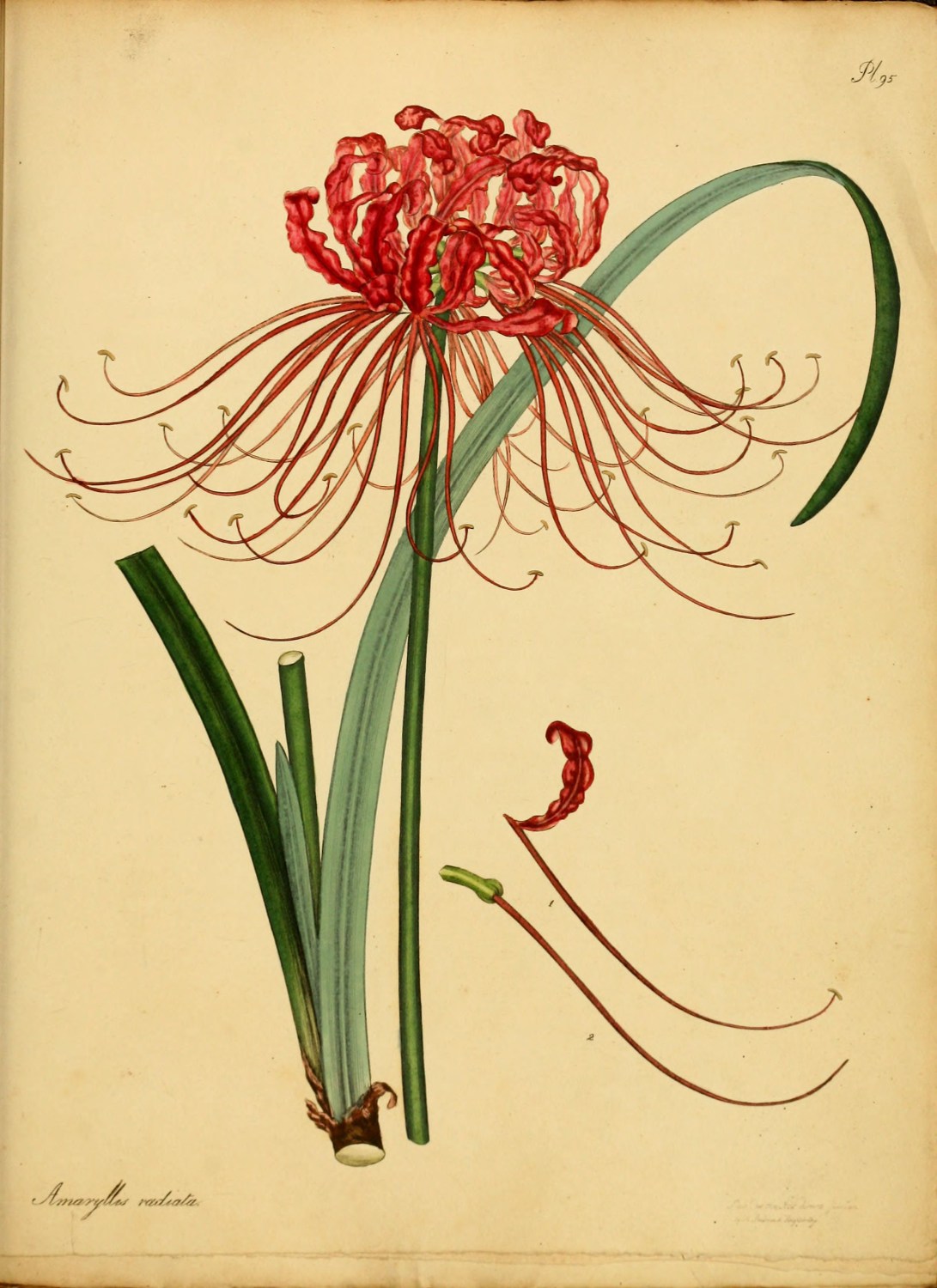
Volume 2 — PLATE XCV. AMARYLLIS RADIATA. Rayed Lily Daffodil.
Reading edition
CLASS VI. ORDER I.
HEXANDRIA MONOGYNIA. Six Chives. One Pointal.
GENERIC CHARACTER.
Calyx. Spatha oblonga, obtusa, compressa, emarginata, marcescens.
Corolla. Petala sex lanceolata.
Nectarium squamis sex, extra basin filamentorum, brevissimis.
Stamina. Filamenta sex subulata. Antheræ oblongæ, incumbentes, assurgentes.
Pistillum. Germen inserum. Stylus filiformis, longitudine ferme et situ staminum. Stigma trifidum, tenue.
Pericarpium. Capsula subovata, trilocularis, trivalvis.
Semina plura.
Empalement. Sheath oblong, blunt, compressed, notched at the end, and withering.
Blossom. Six lance-shaped petals.
Honey-cup, six scales from the base of the threads, very short.
Chives. Six awl-shaped threads. Tips oblong, fixed sideways to the threads, and turned up at the end.
Pointal. Seed bud beneath. Shaft thread-shaped, almost the length and situation of the chives. Summit three-cleft, slender.
Seed-vessel. Capsule nearly egg-shaped, three cells, three valves.
Seeds many.
SPECIFIC CHARACTER.
Amaryllis spatha multiflora; corollis revolutis, undulatis, lanceolatis; genitalibus deflexis, divergentibus, corolla triplo longioribus.
Lily Daffodil, with many flowers in the sheath; blossoms turned backward, waved and lance-shaped; the parts of fructification are bent downward, spread from the centre, and thrice the length of the blossom.
REFERENCE TO THE PLATE.
1. A Petal, with the Chive attached. 2. The Pointal and Seed-bud, the Petals cut off.
This species of Lily, certainly not a novelty to many as a plant, is nevertheless in its blossom, to most, quite so; for, though few collections are without it, yet we are pretty well assured, in no one has it flowered, at least for many years within the vicinity of London; except, in that of the Right Hon. the Marchioness of Rockingham, at Hillingdon near Uxbridge; for whose kind communication, (though personally unknown to her Ladyship,) of a most beautiful specimen, of which our figure conveys but a faint idea of the brilliancy; we can only thus, express our sincerest thanks. Mr. Greig, who had the goodness to bring the flower himself; informs us, the mode of his treating it is, to plant the bulbs in light sandy peat, and confine them to small pots, nearly half filled with broken tiles, and keep them on a shelf of the hothouse. It is a native of China, was introduced by the late Dr. Fothergill; and generally flowers, according to Mr. Greig, in the month of February, or March; and is increased abundantly from the root, by offsets.
PLATE 95