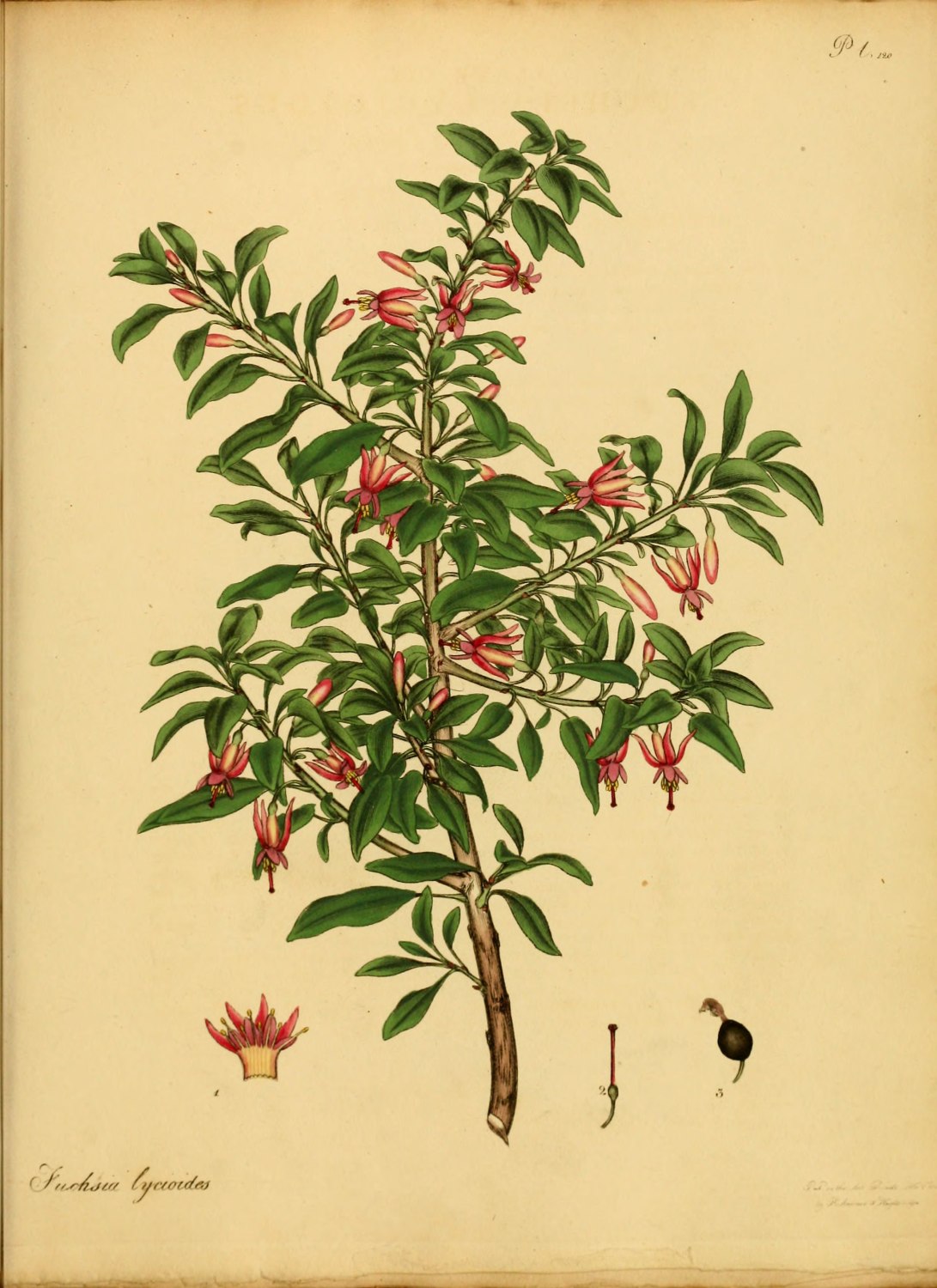
Volume 2 — PLATE CXX. FUCHSIA LYCIOIDES. Box Thorn-like Fuchsia.
Reading edition
CLASS VIII. ORDER I.
OCTANDRIA MONOGYNIA. Eight Chives. One Pointal.
GENERIC CHARACTER.
Calyx. Perianthium monophyllum. Infundibuliforme, coloratura, superum marcescens; limbus quadripartitus.
Corolla. Petala quatuor, sessilia, ore calycis inserta.
Stamina. Filamenta octo, inæqualia, filiformia, erecta, tubo calycis inserta. Antheræ ovatæ.
Pistillum. Germen inserum, ovatum. Stylus filiformis, erectus, longitudine staminum. Stigma tuberculatum.
Pericarpium. Bacca carnosa, ovata, quadri-locularis.
Semina plura, parva, receptaculo columnari affixa.
Empalement. Cup one leaf, funnel-shaped, coloured, above and withering; border four divisions.
Blossom. Four petals, sitting close on the mouth of the cup, into which they are inserted.
Chives. Eight threads, unequal, thread-shaped, upright, fixed into the tube of the cup. Tips egg-shaped.
Pointal. Seed-bud beneath, egg-shaped. Shaft thread-shaped, upright, the length of the chives. Summit composed of small knobs.
Seed-vessel. A fleshy berry, egg-shaped, and four valves.
Seeds many, small, affixed to a pillar-shaped receptacle.
SPECIFIC CHARACTER.
Fuchsia foliis ovatis undulatis, subternis; pedunculis unifloris, axillaribus; laciniis calycis reflexis.
Fuchsia with egg-shaped leaves, waved, and growing mostly by threes; foot-stalks with one flower growing from the insertion of the leaf, the segments of the cup reflexed.
REFERENCE TO THE PLATE.
1. A Flower cut open, to expose the insertion of petals and chives into the cup. 2. The Pointal, complete. 3. A ripe berry, natural size.
No plant perhaps ever excited such universal admiration, as the Scarlet Fuchsia; wherefore, the addition of a second species to our collections, of so fine a Genus, must be considered as a very agreeable acquisition. The Box Thorn-like Fuchsia, is a native of the North-west coast of America; and was first brought to England, in the year 1796: it is certainly, much more tender than the Scarlet Fuchsia, as the plant constantly perishes, as low as to the earth, if not preserved in the hothouse; but whether it is herbaceous the root surviving, we have not sufficient experience to determine. The increase is certain and easy, if cuttings are made, from the young shoots, early in March, and plunged in a hotbed, or in the bark of the hothouse, six or eight in a pot; from which they may be removed, about June, into large pots for flowering, which will be from August till November. Loam, with a small portion of rotten dung, is the soil it most approves.
The specific title we have adopted, is from the very great resemblance the plant bears to Lycium afrum, or the Box-Thorn; although we have some doubts, whether this species may not be the F. triphylla of Father Plumier. But as the F. coccinea, as well as this plant, has frequently the leaves growing by threes; we thought that, as it as yet had no specific title with us, the character of the plant would be best distinguished, by the name we have chosen.
PLATE 120