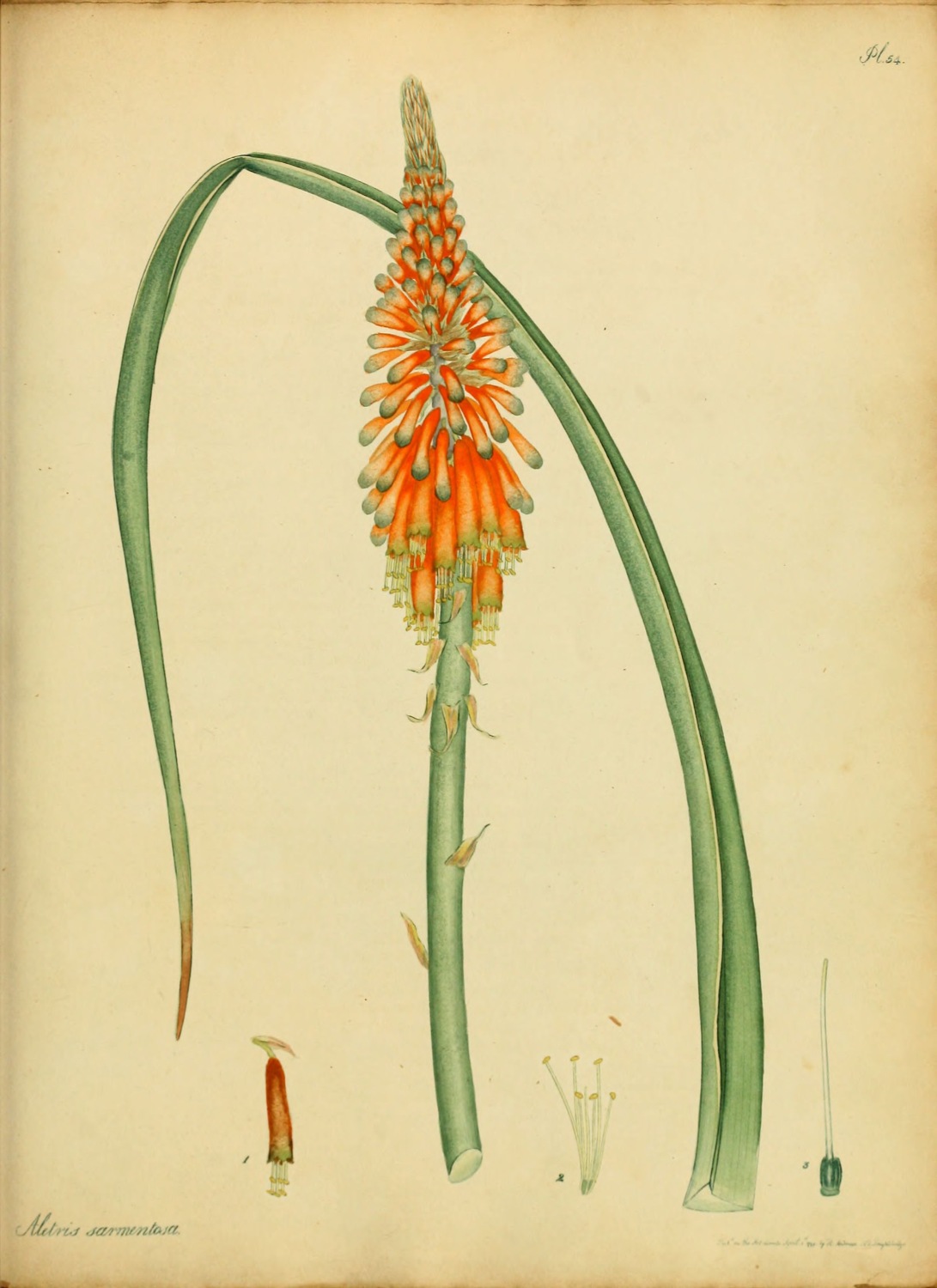
Volume 1 — PLATE LIV. ALETRIS SARMENTOSA. Creeping-rooted Bastard Aloe.
Reading edition
CLASS VI. ORDER I.
HEXANDRIA MONOGYNIA. Six Chives. One Pointal.
GENERIC CHARACTER.
Calyx, nullus.
Corolla, monopetala, oblonga; limbi laciniis lanceolatis, acuminatis, erectis; persistens.
Stamina. Filamenta sex, subulata, longitudine corollæ, inserta basi laciniarum corollæ. Antheræ oblongæ, erectæ.
Pistillum. Germen ovatum. Stylus subulatus, longitudine staminium. Stigma trifidum.
Pericarpium. Capsula ovata, triquetra, acuminata, trilocularis.
Semina plurima.
Empalement, none.
Blossom, one leaf, oblong; the segments of the border are lance-shaped, tapering, and upright; remaining.
Chives. Threads six, awl-shaped, the length of the blossom, and inserted into the divisions of it, at the base. Tips oblong, upright.
Pointal. Seed-bud egg-shaped. Shaft awl-shaped, the length of the chives. Summit three-cleft.
Seed-vessel. Capsule egg-shaped, three-sided, tapered, and of three cells.
Seeds many.
SPECIFIC CHARACTER.
Aletris, acaulis; foliis ensiformibus, laxis; floribus spicatis, suave rubentibus; radicibus sarmentosis.
Bastard Aloe, without a stem; having sword-shaped, weak leaves; flowers grow in spikes of a soft red colour; roots producing suckers from the joints.
REFERENCE TO THE PLATE.
1. A Flower. 2. The Chives, and Pointal. 3. The Pointal.
This species of Aletris was introduced to us, from the Cape of Good Hope, about the year 1789; it is a hardy plant, requiring the same management as Aletris Capensis, that is, to be kept in a dry part of the greenhouse; although the plant should be frequently watered when in bloom, as should mostly all plants, notwithstanding (as in the present instance is the case) their flowering in the winter months. This caution we have thought necessary, as it is a general rule with gardeners during that season, to put as little moisture as possible to their plants, whether in flower or not, to avoid damps. The little difficulty in propagating this handsome species of Aletris, will render it soon common; the roots grow nearly horizontally, and from their joints numberless young plants are produced; which character we were desirous of expressing in the figure, as from thence we have taken our trivial name; but from the size of the work, it was found impracticable. The drawing was made in December 1798, from a plant then in flower, at the Hammersmith nursery: we are nevertheless informed, that from being planted in a light, rich soil, it may be made to grow to the height of three feet; with a spike of flowers, one fourth the length of the flower-stem.
PLATE 54