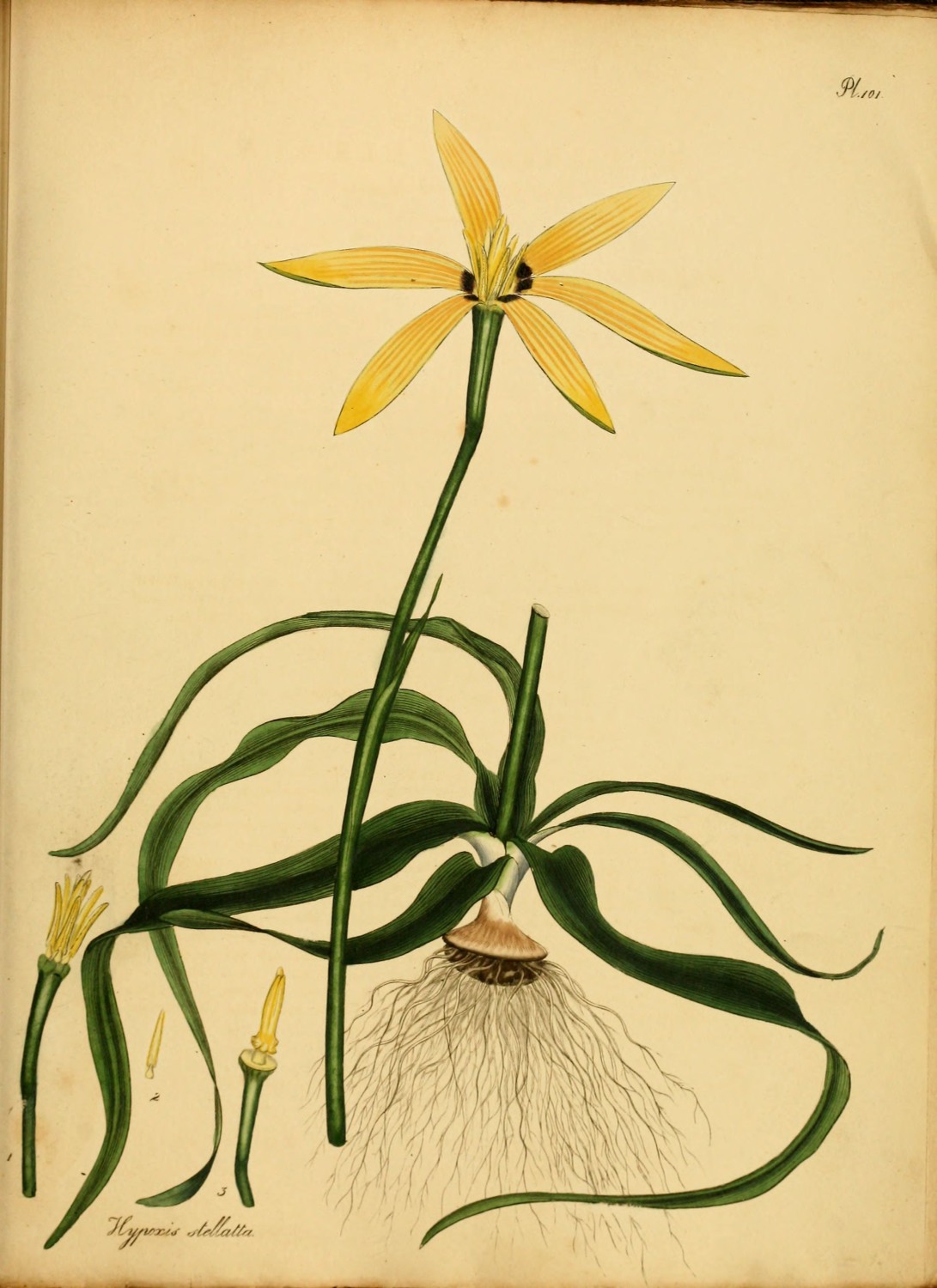
Volume 2 — PLATE CI. HYPOXIS STELLATA. Star-flowered Hypoxis.
Reading edition
CLASS VI. ORDER I.
HEXANDRIA MONOGYNIA. Six Chives. One Pointal.
GENERIC CHARACTER.
Calyx. Gluma bivalvis.
Corolla monopetala, supera; limbus sexpartitus, laciniis ovato oblongis, patentibus; persistens.
Stamina. Filamenta sex, brevissima, capillaria. Antheræ oblongæ, petalis breviores.
Pistillum. Germen inferum, turbinatum. Stylus filiformis, longitudine staminum. Stigma obtusiusculum.
Pericarpium. Capsula oblongiuscula, basi angustior, coronata corolla persistente, trilocularis, trivalvis.
Semina plurima, subrotunda.
Empalement. Husk of two valves.
Blossom one petal, superior; border of six divisions, segments oblong-egg-shaped, and spreading; permanent.
Chives. Six very short hair-like threads. Tips oblong, shorter than the petals.
Pointal. Seed-bud beneath, turban-shape. Shaft thread-shaped, the length of the chives. Summit bluntish.
Seed-vessel. Capsule rather oblong, smaller at the base, crowned by the permanent blossom, three cells, three valves.
Seeds many, roundish.
SPECIFIC CHARACTER.
Hypoxis scapo unifloro; foliis sub-linearibus, laxis, striatis; petalis basi maculatis.
Hypoxis with but one blossom on the flower-stem; leaves nearly linear, flexible, and scored; the petals spotted at the base.
REFERENCE TO THE PLATE.
1. The Chives and Pointal, cleared from the Blossom. 2. A Chive. 3. The Pointal.
Though we have little doubt in referring this plant to the title under which we have figured it, and by which it has been long known to most botanists, at least by name; yet have we great ones, whether it ought in any wise to be considered as such. Thunberg, perhaps the only botanist, who has seen it in flower, thought so, and placed it to a genus he had named Fabricia. Certainly no one character of the genus Hypoxis, can be traced in the flower. The husk is of one valve, the petals not even close at the base, the threads flat, the summits three, and halbert-shaped, the shaft pillar-shape and short, &c. But, as upon our old plea, we do not choose to change generic names when long established, this plant, for us, must still remain an Hypoxis; tho’ it could not now be placed, at any rate, to Fabricia, as that title is given to a family of plants, natives of New Holland. The star-flowered Hypoxis is a native of the Cape of Good Hope, is rather a tender bulb, and does not often flower. It was according to the Kew Catalogue first introduced to the Royal Gardens by Mr. F. Masson, in the year 1788; but as the time of flowering is not mentioned, we suppose it did not flower there. The root should, like other Cape bulbs, be removed from the pot after flowering, and replanted in October. It propagates itself pretty freely by offsets, if planted in light sandy peat, mixed with a little loam. The drawing was made in June, this present year, at the Hammersmith nursery.
PLATE 101