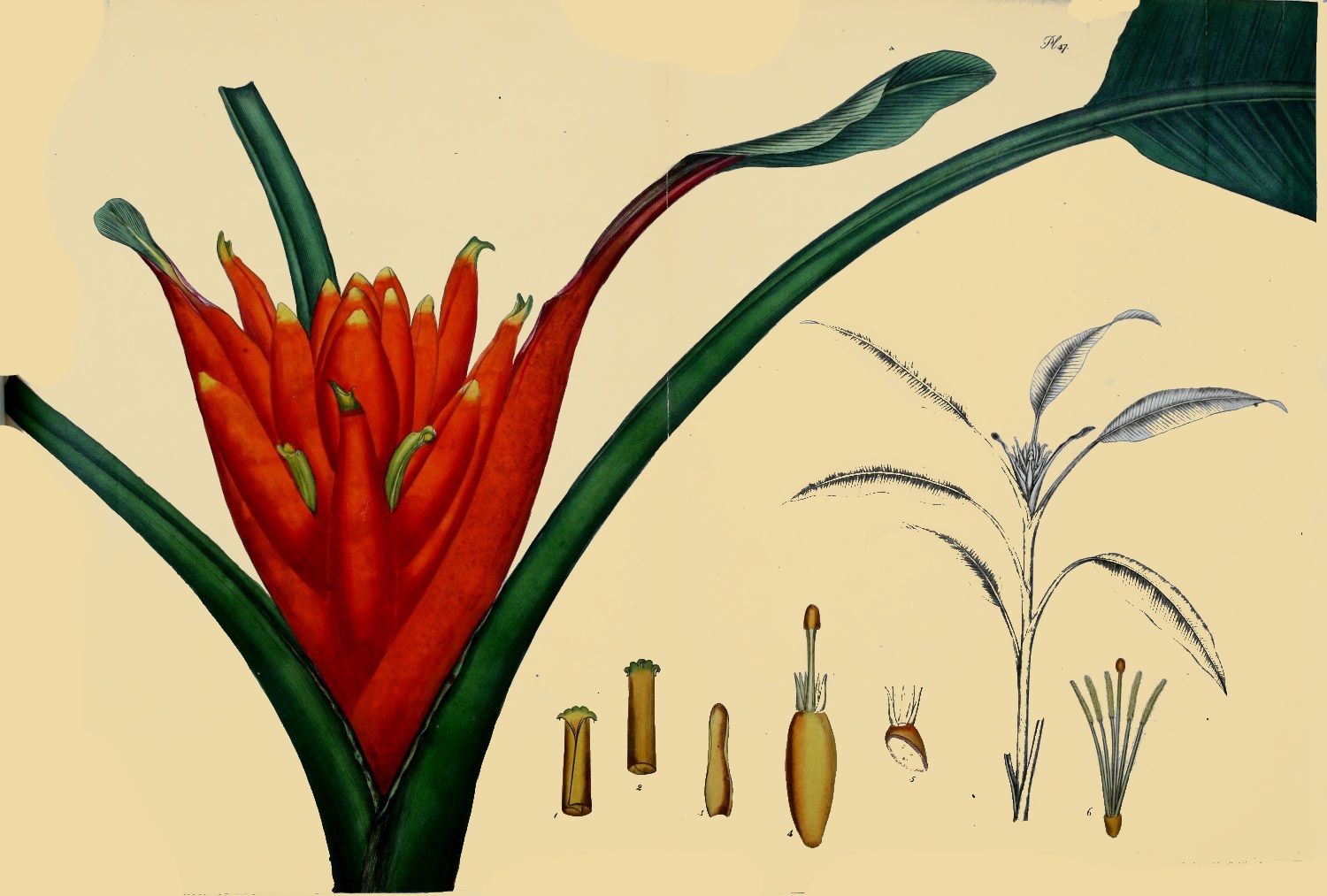
Volume 1 — PLATE XLVII. MUSA COCCINEA. Scarlet-flowered Plantain-tree.
Reading edition
CLASS XXIII. ORDER I.
POLYGAMIA MONOECIA. Various dispositions. Upon one Plant.
GENERIC CHARACTER.
Hermaphroditi feminei flores.
Calyx. Spatha partialis ovato-oblonga, plano-concava, magna.
Corolla inæqualis, ringens; petalo constituente labium superins, nectario vero labium inferius.
Petalum erectum, ligulatum, quinquedentatum, basi antice connivens.
Nectarium monophyllum, naviculare, petalo, brevius, intra sinum petali insertum.
Stamina. Filamenta sex, subulata erecta, petalo dimidio breviora. Antheræ abortivæ.
Pistillum. Germen infra receptaculum floris, maximum, longissimum. Stylus erectus, longitudine petali. Stigma capitatum, subrotundum.
Pericarpium. Bacca carnosa, corio tecta, longissima, pulpa trifariam, absque dissepimentis.
Semina plurima, globosa.
Hermaphroditi masculi flores.
Calyx ut in feminæo.
Corolla ut in feminæo.
Stamina. Filamenta ut in feminæo, at longiora, tenuiora. Antheræ lineares, sulcatæ, erectæ, magnæ.
Pistillum. Germen ut in feminæo, ut minus. Stylus, et stigma ut in fæmineo, at minora.
Pericarpium abortit.
Hermaphrodite flowers, where the female parts are perfect.
Empalement. Partial sheath oblong, egg-shaped, smoothly-concave, and large.
Blossom unequal and gaping; the petal forming the upper lip, the honey-cup the under.
Petal upright, ligulate, five-toothed, and meeting at the base in front.
Honey-cup one leaf, ship-shaped, shorter than the petal, and inclosed within it.
Chives. Threads six, awl-shaped, upright, shorter by half than the petal. Tips abortive.
Pointal. Seed-bud below the receptacle of the flower, large and very long. Shaft upright the length of the petal. Summit headed, nearly round.
Seed-vessel. A fleshy berry, covered with a tough skin, very long, the pulp laying three ways, without partitions.
Seeds many, round.
Hermaphrodite flowers, where the male parts are perfect.
Empalement as in the female flower.
Blossom as in the female flower.
Chives. Threads as in the female flower, but longer, and thinner. Tips linear, channelled, upright, and large.
Pointal. Seed-bud the same as in the female, but smaller. Shaft and summit like the female, but smaller.
Seed-vessel is abortive.
SPECIFIC CHARACTER.
Musa spadice erecto; floribus capitatis; spathis confertis, coccineis, maximis, apicibus luteis.
Plantain-tree with an upright fruit-stalk; flowers growing in heads; sheaths crowded together, scarlet, very large, points yellow.
REFERENCE TO THE PLATE.
1. The upper lip of the blossom, shewn in front, as cut off close to the seed-bud. 2. The same, shewing the hinder parts, with the three small claws on the border. 3. The honey-cup, which forms the lower lip of the blossom. 4. The seed-bud, chives, style, and summit, of a female hermaphrodite flower. 5. A seed-bud cut obliquely, to expose the situation character of the seeds. 6. The chives, seed-bud, shaft, and summit, of a male hermaphrodite flower.
The honour of having introduced this supremely beautiful plant, pertains to, Thomas Evans Esq. of Stepney; a gentleman to whose zeal for the introduction of new plants our stoves are of late much beholden; he having received it, amongst many others, about the year 1792 from China, where, as well as in Cochin-China, Sumatra, Java, &c. it is very commonly found. Our figure was taken, in part, from a plant which flowered at James Vere’s, Esq. Kensington Gore, last December, and partly, from one in blossom about the same time, at the Hon. Lady Archer’s, Ham Common. The Musa Coccinea grows to the height of about three, or four feet before it blows, and without question, has no rival but Strelitzea Regina in the hothouse, where its brilliancy, tends in some degree, to dispel the gloom of winter, for at least three months. It increases itself by suckers, which are thrown up in abundance from a vigorous plant; may be taken off at any time, and will arrive at a flowering size in twelve months; if planted in rich earth, and kept growing in pine heat, or on a strong hotbed.
PLATE 47