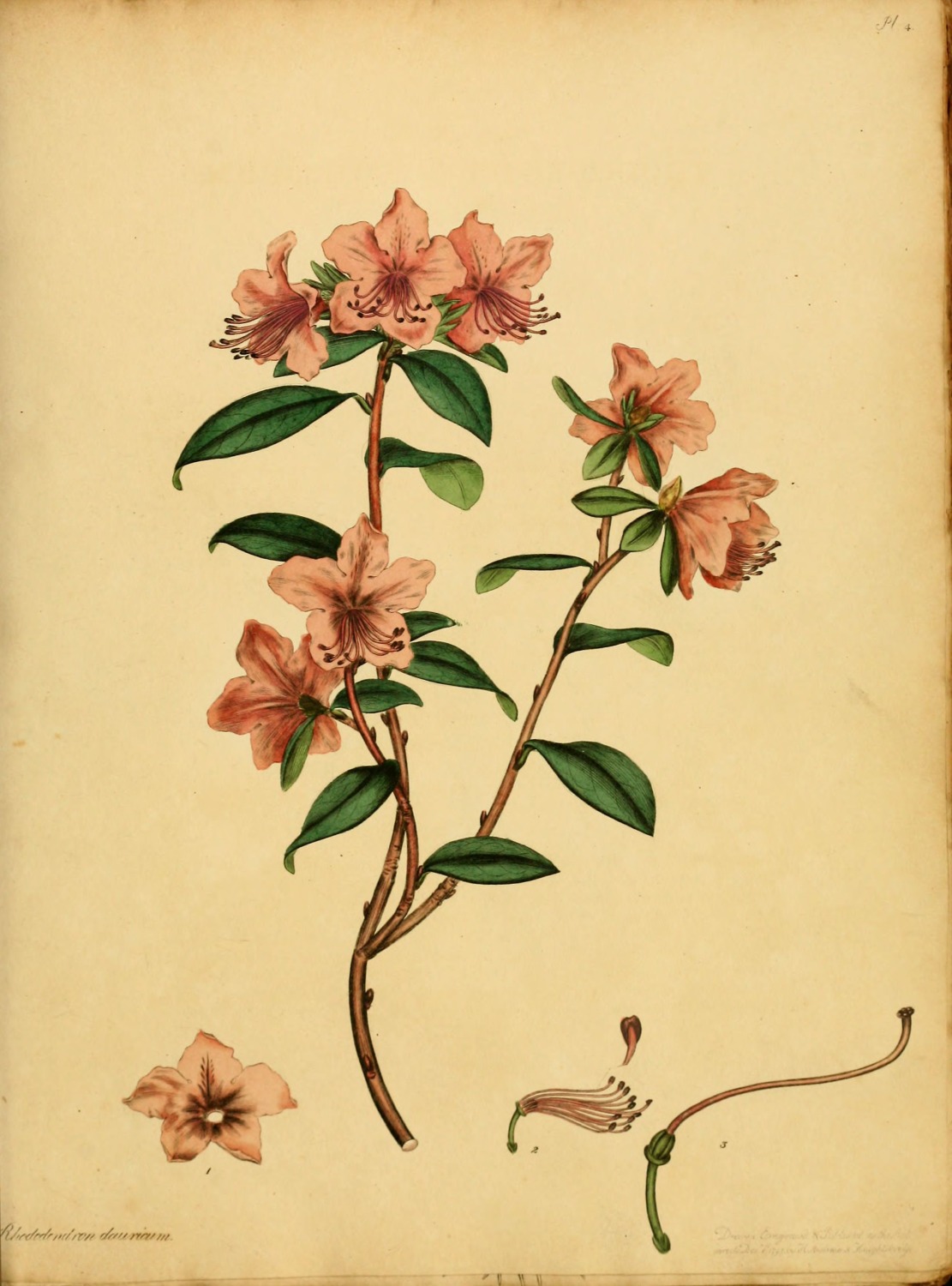
Volume 1 — PLATE IV. RHODODENDRON DAURICUM.
Reading edition
Dauric Rhododendron.
CLASS X. ORDER I.
DECANDRIA MONOGYNIA. Ten Chives. One Pointal.
GENERIC CHARACTER.
Calyx quinquepartitus, persistens.
Corolla. Monopetala, rotato-infundibuliformis: limbo patente; laciniis rotundatis.
Stamina. Filamenta decem, filiformia, longitudine corollæ, declinata. Antheræ ovales.
Pistillum. Germen pentagonum, retusum. Stylus filiformis, longitudine corollæ. Stigma obtusum.
Pericarpium. Capsula ovata, quinquelocularis.
Semina numerosa, minima, lineares.
Empalement of five divisions, and remaining.
Blossom. One leaf, of a roundish funnel-shape: the limb spreading; and its segments rounded.
Chives. Ten hair-like threads, the length of the blossom, bent downward. Tips oval.
Pointal. Seed-bud five-sided, and dented. Shaft thread-shaped, the length of the blossom. Summit blunt-ended.
Seed-vessel. Capsule oval, five-celled.
Seeds many, small, and linear.
SPECIFIC CHARACTER.
Rhododendron, foliis glabris utrinque nudis, petiolis longissimis; corollæ violaceæ, foliis ampliores, rotatæ.
Rhododendron, with smooth leaves, naked on both sides, and long foot-stalks; the blossoms light purple, larger than the leaves, and wheel-shaped.
REFERENCE TO THE PLATE.
1. The Blossom, (natural size). 2. The Chives, and Pointal, (natural size); one tip detached, (magnified). 3. The Seed-vessel, and Pointal, (magnified).
Although this shrub has been described, and is well known to botanists, it has not, till within these very few years, been seen in Great Britain. It is a perfectly hardy plant, being a native of the coast of the Black and Caspian seas, and parts adjacent; from whence it has been conveyed to Petersburg by Dr. P. Pallas, and figured by him in his Flora Russica. Mr. Bush was the person who brought it to England, on his return from Russia. The flowers begin to appear in the month of March, continuing through April and May. As yet (from its scarcity) the best method of cultivating it can scarcely be known; but it seems to like a sheltered situation, and light soil, like most of the genus; and has been increased by layers. The drawing was made from a plant, at the nursery of Messrs. Lee and Kennedy, Hammersmith.
PLATE 4