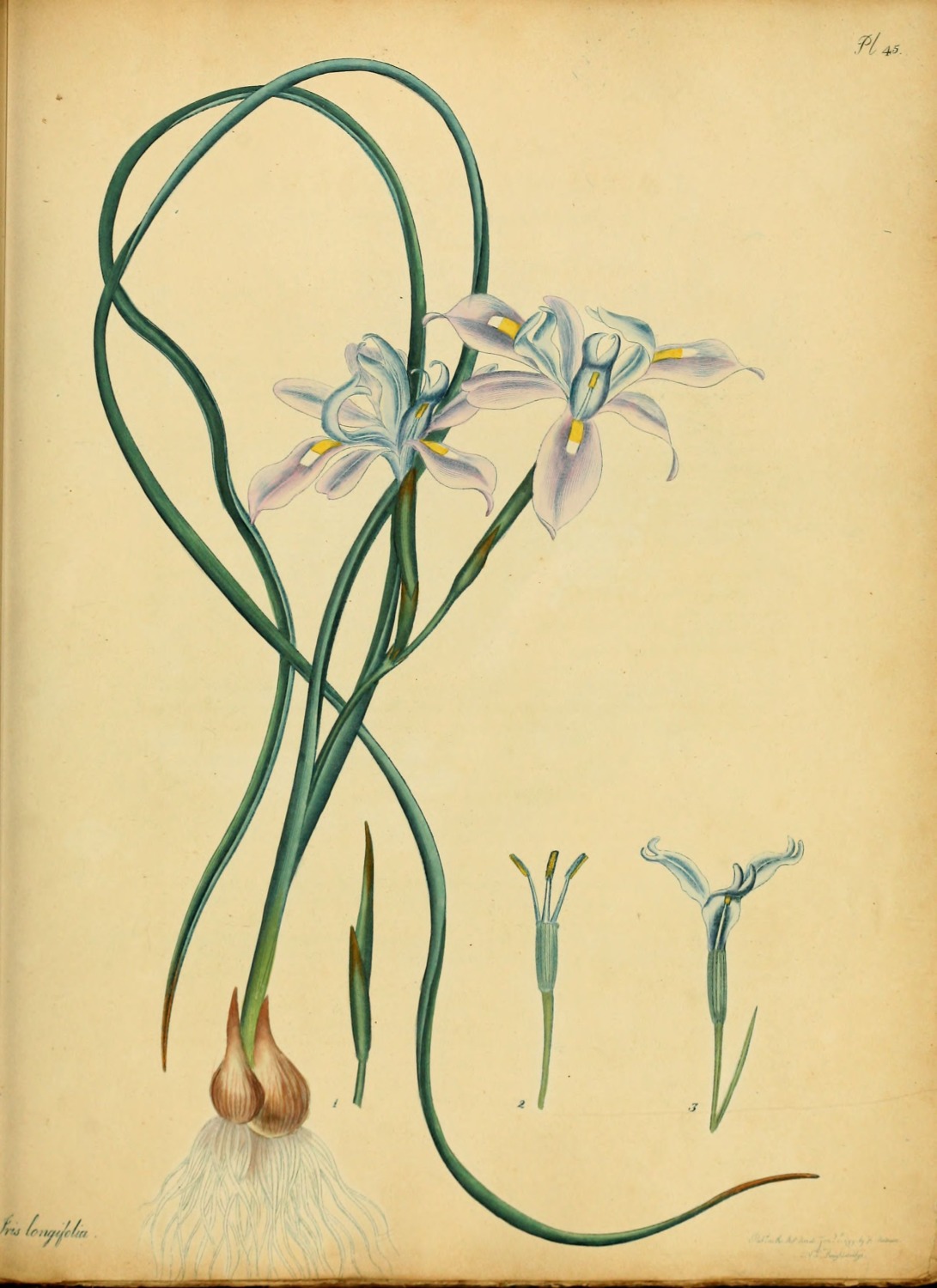
Volume 1 — PLATE XLV. IRIS LONGIFOLIA. Long-leaved Iris.
Reading edition
CLASS III. ORDER I.
TRIANDRIA MONOGYNIA. Three Chives. One Pointal.
GENERIC CHARACTER.
Calyx. Spathæ bivalves, flores distinguentes, persistentes.
Corolla sexpartita; petala oblonga, obtusa, tria exteriora reflexa, tria interiora erecta, acutiora; omnia unguibus conata.
Stamina. Filamenta tria, subulata, petalis reflexis incumbentia. Antheræ oblongæ, rectæ, depressæ.
Pistillum. Germen inferum, oblongum. Stylus simplex, brevissimus. Stigma maximum, tripartitum, laciniis petala mentientibus, latis, reflexis, stamina et petala alterna deprimentibus, apicibus bifidis.
Pericarpium. Capsula oblonga, angulata, trilocularis, trivalvis.
Semina plurima, ovata, glabra.
Empalement. Sheaths of two valves, separating the flowers, permanent.
Blossom with six divisions; petals oblong, blunt, the three outer ones reflexed, the three inner ones upright, and sharper; all connected by the claws.
Chives. Threads three, awl-shaped, laying on the reflexed petals. Tips oblong, straight, depressed.
Pointal. Seed-bud beneath, oblong. Shaft simple, very short. Summit very large, divided into three segments, resembling petals, broad, bent back, and alternately pressing down the chives and petals, cleft at the ends.
Seed-vessel. Capsule oblong, angular, of three cells, and three valves.
Seeds many, egg-shaped, and smooth.
SPECIFIC CHARACTER.
Iris foliis linearibus, canaliculatis, longissimis, glaucis; scapus teres, multiflorus; radix bulbosus.
Iris with linear, channelled leaves, very long, and bluish; flower-stem cylindrical, with many flowers; the root bulbous.
REFERENCE TO THE PLATE.
1. The two Sheaths of the Empalement. 2. The Chives as attached to the Seed-bud. 3. The Pointal complete.
This Iris is a native of the Cape of Good Hope, and was introduced to us from the collection of Messrs. Voorhelm and Schnevoght, of Haarlem in Holland, about the year 1792. The leaves of this delicate Iris grow sometimes to the length of three feet, giving it a very singular appearance: it should be treated like the Cape Ixias, and protected from the weather, whilst in bloom, as the flower is injured by the lightest wind, and the duration of each blossom is but a few hours; there is, however, a good succession, which rise diurnally from the same sheath, seldom more than one at a time. This figure was taken in the month of June 1797 at the Hammersmith nursery. It has a singular mode of propagating itself; the old root dying, two young ones are formed above it, from whence the flower-stem arises: seldom ripe seeds are produced.
PLATE 45