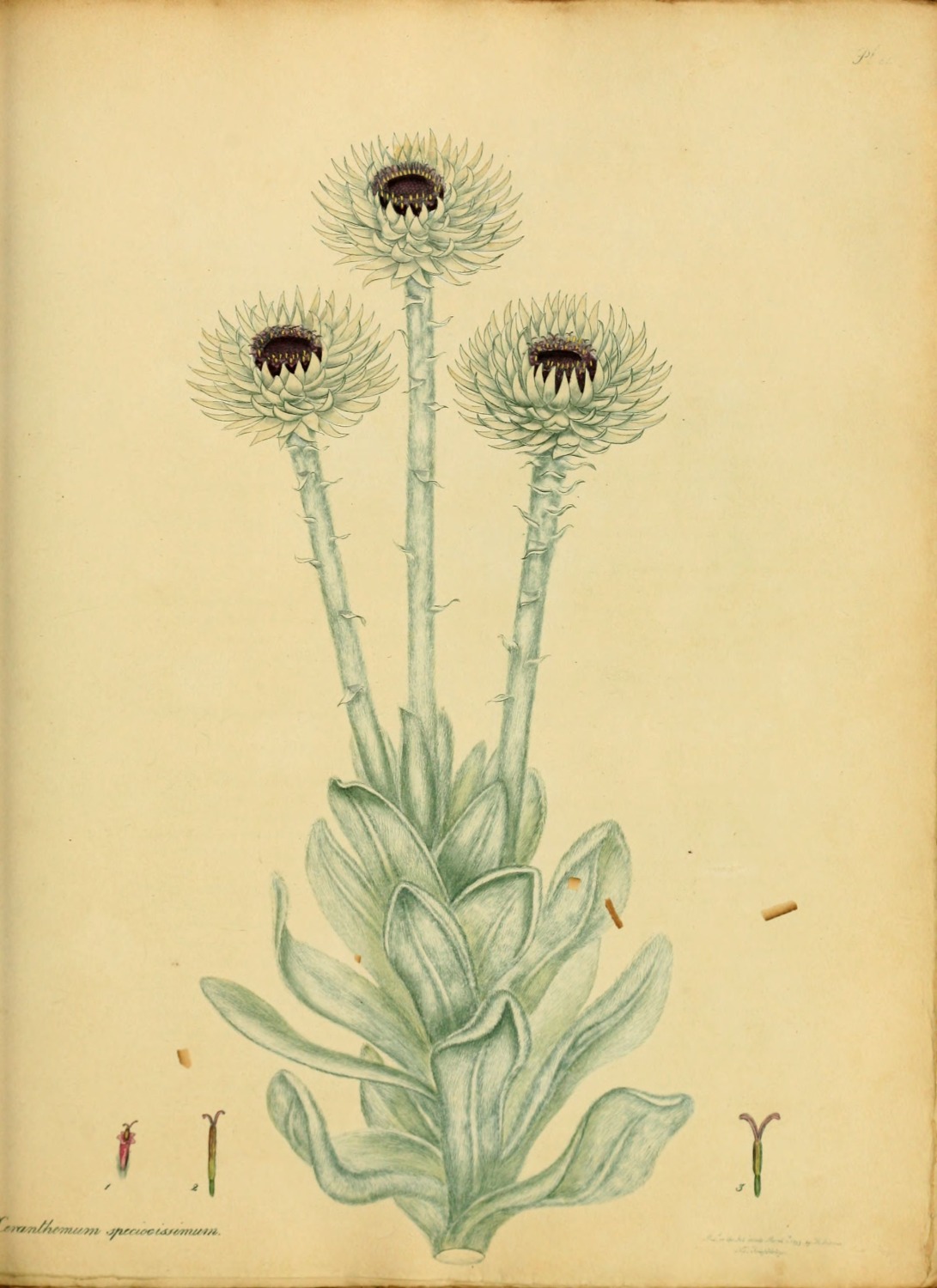
Volume 1 — PLATE LI. XERANTHEMUM SPECIOCISSIMUM. Largest-flowering Everlasting Flower.
Reading edition
CLASS XIX. ORDER II.
SYNGENESIA POLYGAMIA SUPERFLUA. Tips united. Superfluous Pointals.
GENERIC CHARACTER.
Calyx. Communis imbricatus; squamis lanceolatis, quarum intimæ disco longiores, membranaceæ, nitidæ, radium constituentes.
Corolla. Composita inæqualis; corollulæ hermaphroditæ plurimæ, tubulosæ in disco. Femineæ pauciores, tubulatæ, in ambitu.
Propria hermaphroditis infundibuliformis, calyce longe brevior; limbo quinquefido, patulo.
Femineis tubulosa, longitudine hermaphroditi, quinquefida, minus æqualis.
Stamina. Hermaphroditis filamenta quinque, brevissima. Antheræ cylindracea, tubulosa, longitudine fere corollulæ.
Pistillum. Hermaphroditis germen breve. Stylus filiformis, staminibus longior. Stigma bifidum.
Femineis germen ut in hermaphroditis. Stylus filiformis, longitudine hermaphroditorum. Stigmata duo, oblonga reflexa.
Pericarpium nullum. Calyx vix mutatus.
Semina oblonga, coronata.
Receptaculum nudum, planiusculum, punctatum.
Empalement. Common tiled; scales spear-shaped, the inner ones longer than the disk, skinny, shining, and forming the ray of the flower.
Blossom. Compound, unequal; florets with chives and pointals numerous and tubular in the disk. Female florets fewer, and tubular in the circumference.
Individuals with chives and pointals funnel-shaped, much shorter than the empalement; border with five clefts, spreading.
Individuals with only pointals, tubular the length of the hermaphrodites, five cleft, and rather smaller.
Chives. The threads in the hermaphrodites are five, and very small. Tips forming a cylinder, tubular almost the length of the florets.
Pointal. Seed-bud of the hermaphrodites short. Shaft thread-shaped, longer than the chives. Summit cloven.
Seed-bud of the female florets the same as the hermaphrodites. Shaft thread-shaped the length of the hermaphrodites. Summits two, oblong and bent back.
Seed-vessel none. Empalement scarcely changing.
Seeds oblong, and crowned with a feather.
Receptacle naked, flatish, and dotted.
SPECIFIC CHARACTER.
Xeranthemum fruticosum, erectum; foliis amplexicaulibus, lanceolatis, trinerviis; ramis unifloris, subundis.
Everlasting flower with an upright shrubby stem; leaves embracing the stem, lance-shaped, and three-nerved; branches with one flower, and nearly naked.
REFERENCE TO THE PLATE.
1. An Hermaphrodite floret, (natural size). 2. The Chives, Pointal, and Seed-bud, (magnified). 3. The Pointal, and Seed-bud from a female floret, (magnified).
This handsome species of Xeranthemum was introduced, according to the Kew catalogue, by Mr. F. Masson from the Cape of Good Hope, in the year 1787; it is, nevertheless, a very scarce plant, being subject to decay from our winter damps; therefore requires a dry stove for its protection. The blossoms (or rather the flower-cups, for they are the persistent parts) are easily preserved for many years, in all their brilliancy, by cutting them, when they first expand; but our atmosphere seems uncongenial to the ripening of their seeds, and is with great difficulty increased by cuttings. The soil it most approves is sandy peat, with a small portion of loam. Our figure was taken in September last year, at the Hammersmith nursery.
PLATE 51