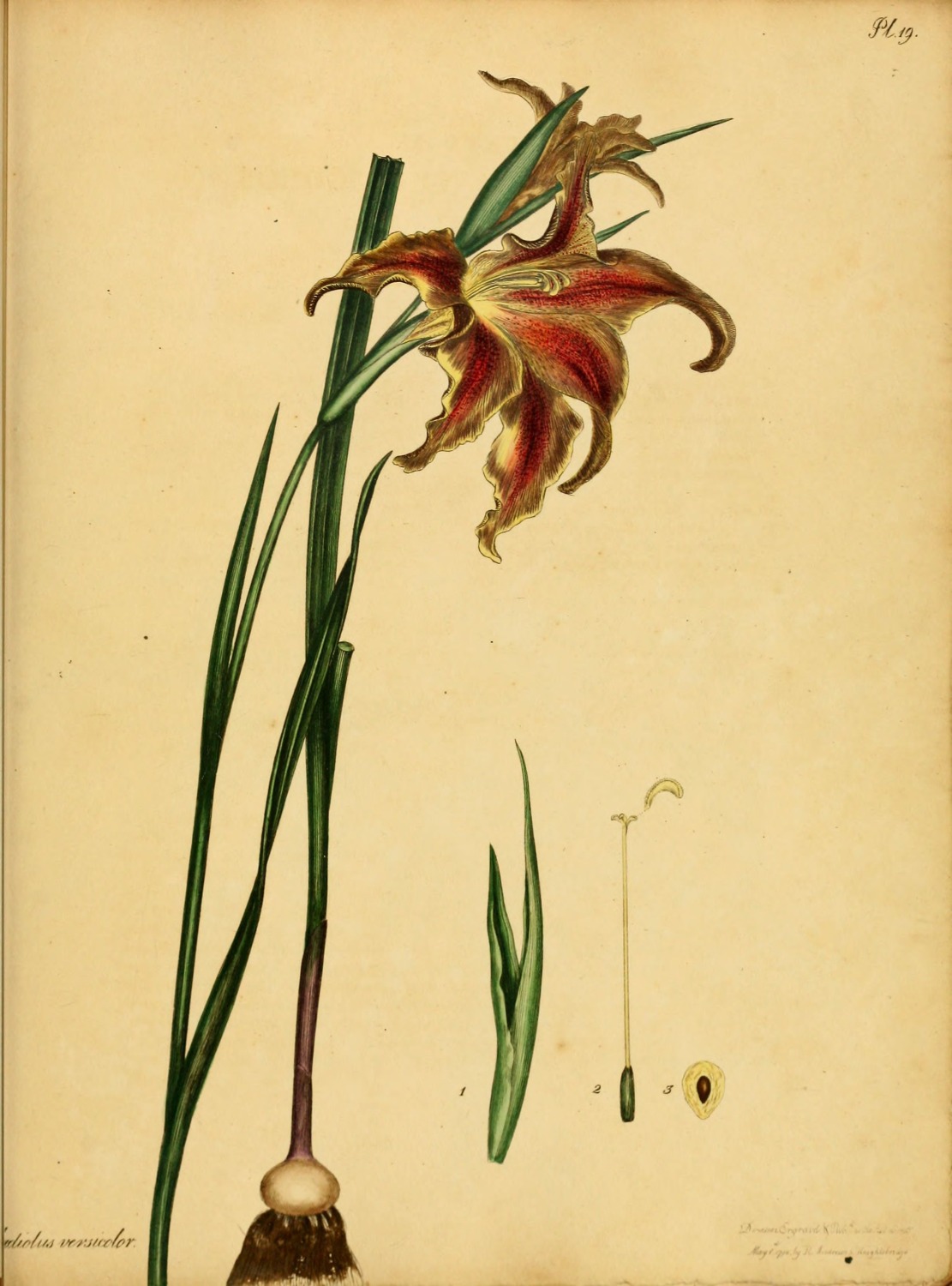
Volume 1 — PLATE XIX. GLADIOLUS VERSICOLOR. Changeable Gladiolus.
Reading edition
CLASS III. ORDER I.
TRIANDRIA MONOGYNIA. Three Chives. One Pointal.
GENERIC CHARACTER.
Calyx. Spathæ bivalves.
Corolla, sexpartita, ringens. Petala oblonga, omnia unguibus in tubum connata.
Stamina. Filamenta tria, subulata, divisuris alternis petalorum inserta. Antheræ oblongæ.
Pistillum. Germen inferum. Stylus simplex, longitudine staminum. Stigma trifidum concavum.
Pericarpium. Capsula oblonga, obtusa, trilocularis, trivalvis.
Semina plura, subrotunda.
Empalement. Sheath two valves.
Blossom, of six divisions, and gaping. Petals oblong, having their claws formed into a tube.
Chives. Three awl-shaped threads, fixed into the alternate divisions of the petals. Tips oblong.
Pointal. Seed-bud beneath. Shaft simple, the length of the chives. Summit cut into three, and concave.
Seed-vessel. Capsule oblong, blunt-ended, three cells, three valves.
Seeds many, nearly round.
SPECIFIC CHARACTER.
Gladiolus, foliis lineari-cruciatis; floribus maximis, versicoloribus.
Gladiolus, with linear cross-shaped leaves; flowers very large, and changeable.
REFERENCE TO THE PLATE.
1. The two Sheaths of the Empalement. 2. The Pointal, and Seed-bud; one of the divisions of the Summit magnified. 3. A ripe Seed, natural size, in its tunic.
That colour bears the character given it by Sir Isaac Newton, our present subject (as did the prism) adds another proof. The Gladiolus versicolor might, like the camelion, equally be a subject of contention, to those who have seen its blossom at different periods of the same day; for, strange to tell! it is brown in the morning, and continues to change from that colour till it becomes light blue by night. During the night it regains its pristine colour; and this change is effected diurnally, whilst the flower is in its vigour; but upon the decay, the change is less powerful, gradually fixing in a dark brown; which, however, does not take place in less than nine or ten days. This is the only flower, we have ever noticed, to regain the colour that has once forsook it. A drawing was began about ten o’clock in the morning, but before it was finished the plant was so totally altered in colour that there was an absolute necessity for taking a second day to complete it. The bulbs of this plant were sent from the Cape of Good Hope by J. Pringle, Esq. of Madeira, in 1794, amongst many others, to Messrs. Lee and Kennedy, of Hammersmith, where the drawing was made. It flowers about the month of June; is increased by the root or seed; and thrives best in peat earth.
PLATE 19