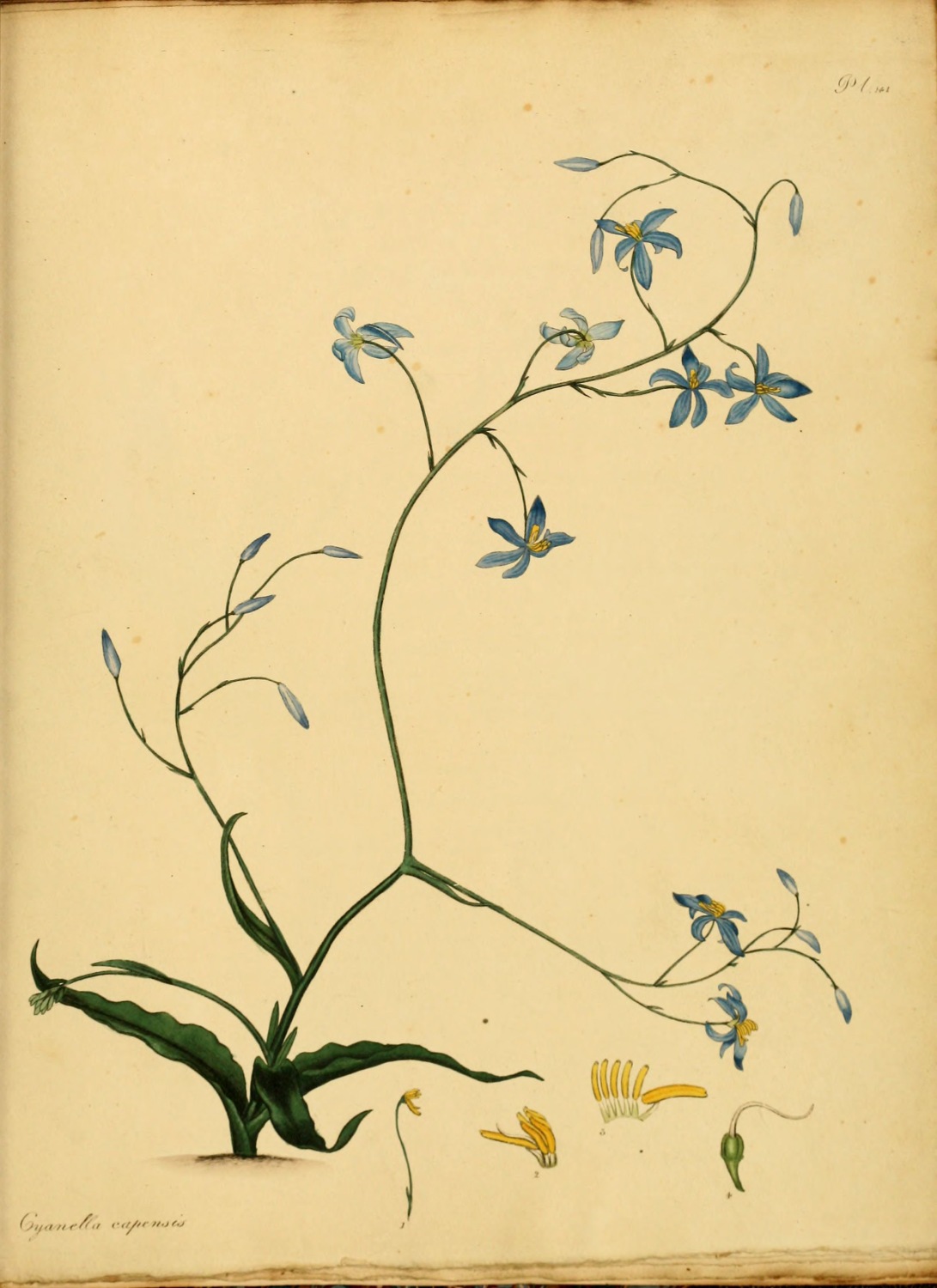
Volume 2 — PLATE CXLI. CYANELLA CAPENSIS. Cape Cyanella.
Reading edition
CLASS VI. ORDER I.
HEXANDRIA MONOGYNIA. Six Chives. One Pointal.
GENERIC CHARACTER.
Calyx nullus.
Corolla. Petala sex, unguibus cohærentia, oblonga, concava, patula; tribus interioribus propendentibus.
Stamina. Filamenta sex, basi contigua, brevissima, patentiuscula; infimo declinato. Antherarum quinque oblongæ, curvatæ, erectæ, apice dehiscentes, dentibus quatuor obtusis; altera vero declinata, maxima, apice bifida.
Pistillum. Germen trigonum, obtusum. Stylus filiformis, declinatus, longitudine infimi staminis. Stigma acutiusculum.
Pericarpium. Capsula subrotunda trisulcata, trilocularis, trivalvis.
Semina plura, oblonga.
Empalement, none.
Blossom. Six petals, adhering by the claws, oblong, concave, spreading; the three interior ones hanging forwards.
Chives. Threads six, contiguous at the base, very short, spreading a little; the lower one bent down. Five of the tips are oblong, curved, upright, splitting at the end, with four obtuse teeth; but the other is bent down, very large, and two-cleft at the end.
Pointal. Seed-bud three-sided, obtuse. Shaft thread-shaped, bent downward, and the length of the lower chive. Summit rather sharp-pointed.
Seed-vessel. Capsule roundish, three-furrowed, three cells, three valves.
Seeds many, oblong.
SPECIFIC CHARACTER.
Cyanella caule folioso, paniculato; racemis divaricatis; foliis lanceolatis, undulatis; floribus cæruleis.
Cyanella with a leafy stem growing into a panicle; branches straddling; leaves lance-shaped, and waved; flowers blue.
REFERENCE TO THE PLATE.
1. The Chives and Pointal, natural size, the petals of the blossom cut away. 2. The Chives and Pointal, magnified. 3. The same thrown open, to shew their connection at the base. 4. The Pointal and Seed-bud, magnified.
The Cape Cyanella has been long known in many herbariums, and to most botanists by name, but we much question whether a living plant has, till now, been seen in our gardens. The description, in his dictionary, of a plant cultivated by Miller in 1768, where he says, “the leaves are long, narrow, with a groove on the upper side, the peduncle arising immediately from the root, supporting one flower, of a fine blue colour;” surely can have no connection with our plant, but in the colour of its blossom. From every appearance of the plant, even in an abortive specimen, more than one flower must be produced, if any. It is enumerated, in the Kew Catalogue, as one of the species of Cyanella; but, we suppose, only from an accepted idea, that the plant described by Miller was the C. capensis; and, as having been cultivated in Britain, might be therefore introduced with propriety into the book, though it had never graced the garden; otherwise, if this plant, which is incontestibly the true C. capensis of Linnæus, had ever been seen in the Royal Gardens, no affinity would have been traced to that of Miller.
A few small inaccuracies occur in the generic character of this Genus, which we have rectified; one is, that the inner, and not the outer petals, are those which hang forward; the others may be observed by those, who may consider them worthy notice. This species is a bulbous-rooted plant, flowering freely in the green-house; although the roots had been received, late in the season, from the collector for the Hibbertian Collection now at the Cape; which, perhaps, is the reason the flowers are produced at this time of the year (February). Mr. Allen informs us, that, it has had no other treatment, than what is given to Cape bulbs in general. From the swelled appearance of the seed-vessels we have little doubt of ripe seeds being produced.
PLATE 141