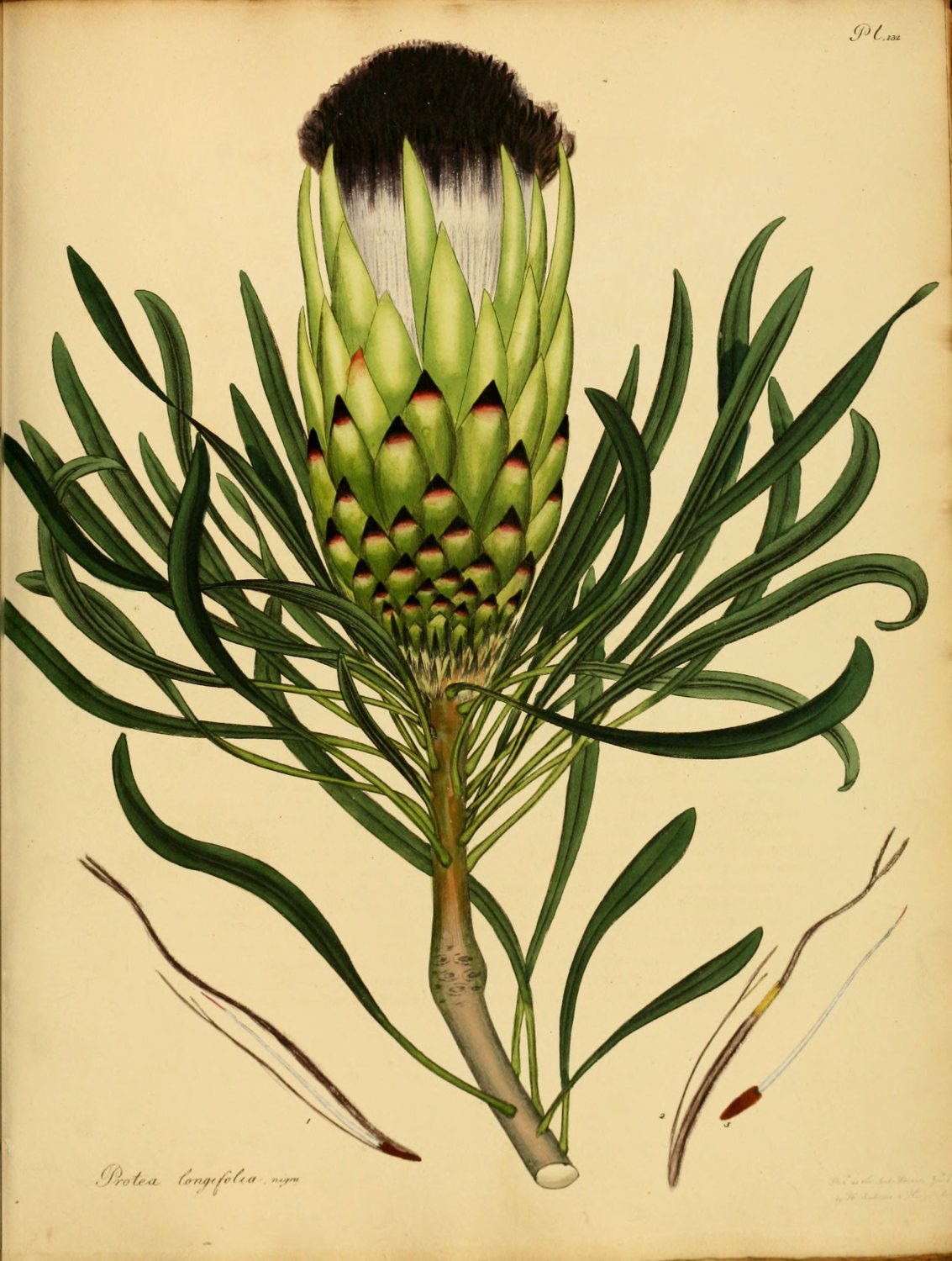
Volume 2 — PLATE CXXXII. PROTEA LONGIFOLIA. Nigra. Long-leaved Protea. Black flower.
Reading edition
CLASS IV. ORDER I.
TETRANDRIA MONOGYNIA. Four Chives. One Pointal.
ESSENTIAL GENERIC CHARACTER.
Corolla 4-fida seu 4-petala. Antheræ lineares, insertæ petalis infra apicem. Calyx proprius nullus. Semina solitaria.
Blossom 4-cleft or 4 petals. Tips linear, inserted into the petals below the point. Cup proper, none. Seeds solitary.
See Protea formosa, Pl. XVII. Vol. I.
SPECIFIC CHARACTER.
Protea foliis sublinearibus, angustis, obliquis, rigidis, longissimis; squamis interioribus, calycis lanceolatis, erectis; florum plumis atro-purpureis.
Protea with leaves nearly linear, narrow, oblique, harsh and very long; the inner scales of the cup are lance-shaped and upright; the plume of flowers of a black-purple.
REFERENCE TO THE PLATE.
1. A Blossom complete, with the seed-bud attached. 2. The Petals of the flower opened, to shew the situation of the Tips. 3. The Seed-bud, Shaft and Summit.
This species of Protea, from the Cape of Good Hope, of which we have drawings of three varieties, is as yet, very scarce in this kingdom. The variety here figured, as well as the others of this species, have been hitherto considered as varieties of P. speciosa; with which, however, they have less connexion, than with P. mellifera; but from both they stand quite distinct. Wherefore, we have given them the specific title of longifolia, from the extreme length of their leaves, which are considerably longer, than could be expressed in the figure. We believe this is the first year it has flowered in England, or in any other collection, than the nursery, Hammersmith; where our drawing was made in November. It is most difficult, or indeed almost impracticable, to increase it, as it puts out no side shoots, and certainly damps off, if laid down, where it touches the earth.
From Boerhaave’s having arranged this species of Protea, (See his Index to the Leyden Garden, Part 2. from P. 185 to 189,) with his Lepidocarpodendrons, after fig. 187, which is our P. mellifera; Willdenow has been led into an error; since he has given this plant, the 188 Fig. of Boerhaave, as a synonim to P. speciosa, which ought not to be so taken, unless we understand, that he meant all his Lepidocarpodendrons as only varieties of each other; the principal distinguishing feature, in P. speciosa, being the incurved and fringed character, of the inner scales of the empalement.
PLATE 132