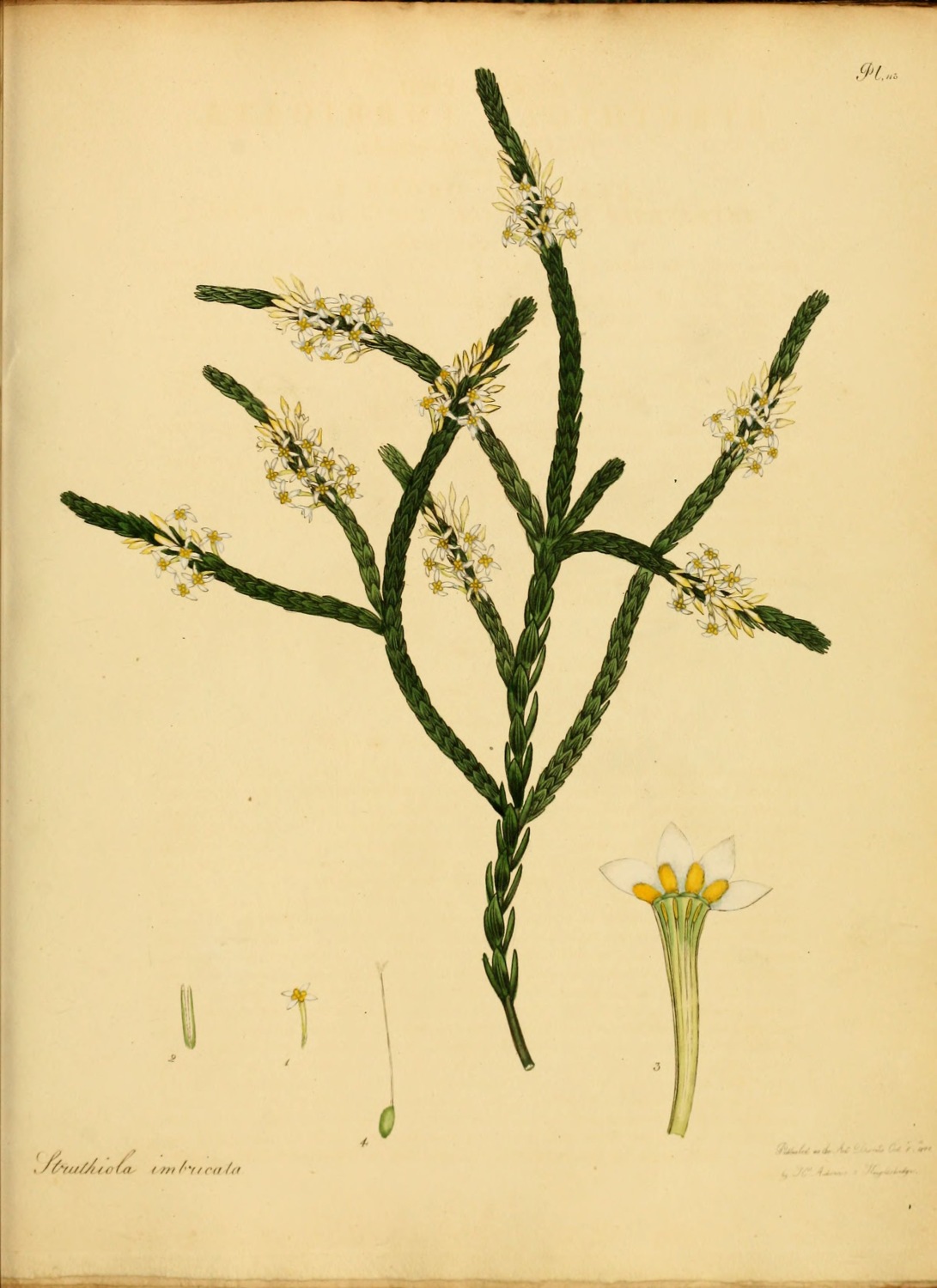
Volume 2 — PLATE CXIII. STRUTHIOLA IMBRICATA. Tiled-leaved Struthiola.
Reading edition
CLASS IV. ORDER I.
TETRANDRIA MONOGYNIA. Four Chives. One Pointal.
GENERIC CHARACTER.
Calyx, nullus; nisi bracteas sub germine pro calyce assumas.
Corolla monopetala, marcescens; tubus filiformis, elongatus; limbus quadripartitus, planus, tubo brevior; laciniis ovatis.
Nectarium, glandulæ quatuor, seu octo, ovatæ, fauci circumpositæ, penicillo proprio cinctæ.
Stamina. Filamenta quatuor, brevissima, intra tubum ocultata. Antheræ lineares.
Pistillum. Germen ovatum. Stylus filiformis, longitudine tubi. Stigma capitatum, hispidum.
Pericarpium coriaceum, ovatum, uniloculare.
Semen unicum, acutiusculum.
Empalement, none; unless you take the floral leaves at the base of the seed-bud for the cup.
Blossom one petal, withering; tube thread-shaped, lengthened; border of four divisions, flat, shorter than the tube; segments egg-shaped.
Honeycup, four or eight oval glands, placed round the mouth of the blossom, each being surrounded by its brush of hairs.
Chives. Four threads, very short, hid within the tube. Tips linear.
Pointal. Seed-bud egg-shaped. Shaft thread-shaped, the length of the tube. Summit, a hairy knob.
Seed-vessel leathery, egg-shaped, of one cell.
Seed One, a Little Pointed.
SPECIFIC CHARACTER.
Struthiola foliis ovato-acuminatis, concavis, imbricatis, glabris, margine ciliatis; glandulæ quatuor supra faucem.
Struthiola with oval leaves, tapering to a point, concave, tiled, smooth, and hairy at the edges; four glands upon the mouth of the blossom.
REFERENCE TO THE PLATE.
1. A Flower with its floral leaves, or cup. 2. The floral Leaves or Cup, magnified. 3. A Flower cut open, magnified. 4. The Seed-bud, Chives, and Pointal, magnified.
The Genus Struthiola, from the few species yet known, has been but slightly considered. Linnæus, at the end of his Generic Character, affines it to Passerina; it is true, the habits of S. virgata, and S. erecta, which are undoubtedly only varieties of the same stock, and the only two he had seen, might lead to such a comment; but, from the seven species of which we have drawings, all taken from living plants, and which will be brought forward in due course, we consider them, as perfectly distinct, in more essential characters than merely the number of chives. The acute and diligent Willdenow, in his new edition of Sp. Plant. enumerates five species from Thunberg, &c.; but from his notes of observation, prefixed to each, he had not seen either living or dried specimens of any, but the two above named. The characters in which we observe this genus to differ from Gnidia and Passerina, are, first, a cup of two leaves, constant in every species we have examined, for they cannot be considered as floral leaves, being attached to the base of the blossom, and joined together at the bottom; secondly, the honeycup forming a complete cincture to the mouth of the flower, and upon which are seated, four, or eight, upright glands. This species of Struthiola was first raised in England, at the nursery, Hammersmith, from the Cape of Good Hope, in the year 1794. It is a tender green-house plant, and very subject to be destroyed by wet; therefore, should be protected from too much rain in summer, and kept in an airy part of the house in winter. It is propagated by cuttings made in the month of May, or June, and should be planted in light, sandy peat, mixt with about one sixth part of loam. The flowers of this, as well as all the species we have seen, are extremely fragrant in the evening, beginning to smell with the setting sun, and continuing their flavour till morning. An agreeable peculiarity attendant on most plants of this natural order, and on every species of this genus, in particular, is, that they flower twice in the year, about the month of March, and again in September; in which month, last year, our drawing was made, from the Hibbertian collection, Clapham Common.
PLATE 113