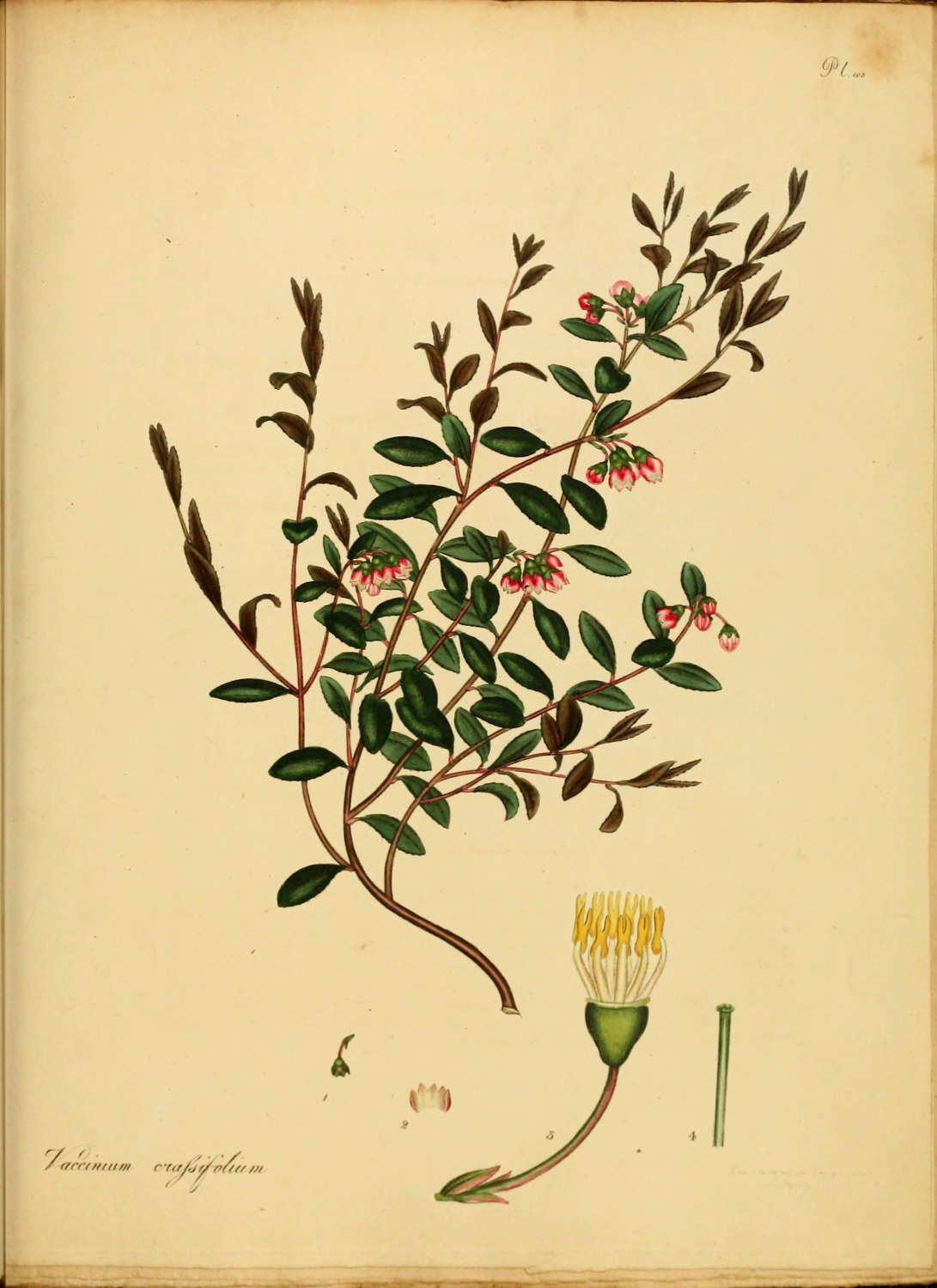
Volume 2 — PLATE CV. VACCINIUM CRASSIFOLIUM. Thick-leaved Whortle-berry.
Reading edition
CLASS VIII. ORDER I.
OCTANDRIA MONOGYNIA. Eight Chives. One Pointal.
ESSENTIAL GENERIC CHARACTER.
Calyx superus. Corolla monopetala. Filamenta receptaculo inserta. Bacca quadri-locularis, polysperma.
Cup superior. Blossom of one petal. Threads fixed to the receptacle. A berry with four cells, and many seeds.
Sec Vol. I. Pl. XXX. Vaccinium Arctostaphyllus.
SPECIFIC CHARACTER.
Vaccinium foliis ovatis, serratis, rigidis crassiusculis; floribus sub-umbellatis, terminalibus; calycibus adpressis; corollis campanulatis; stamina decem.
Whortle-berry with oval leaves sawed at the edges, stiff, and thickish; flowers grow nearly in umbels, at the end of the branches; cups pressed to the blossom; blossoms bell-shaped; ten chives.
REFERENCE TO THE PLATE.
1. Cup and Seed-bud, natural size. 2. A Blossom cut open. 3. The Chives and Seed-bud, the leaflets of the cup cut off, magnified. 4. The Pointal, magnified.
This species of Whortle-berry was introduced from Carolina, about the year 1794, by Mr. J. Fraser, nurseryman. It is another of those with ten chives, five cells in the berry, and five segments in the borders of the cup and blossom. It is an evergreen, and will live through a mild winter, on a warm border; but cannot resist the cold of a severe one, though a small degree of protection is sufficient for its preservation. As a greenhouse plant, it is very decorative, flowering about June; in which month this year our drawing was made, at the Hammersmith nursery, from a plant in that collection. The pabulum best calculated to preserve it in a flourishing state, is a mixture composed of sandy peat two parts, and light loam one part. To propagate it, the younger branches should be laid down about the end of May, and they will be rooted by the ensuing spring.
PLATE 105