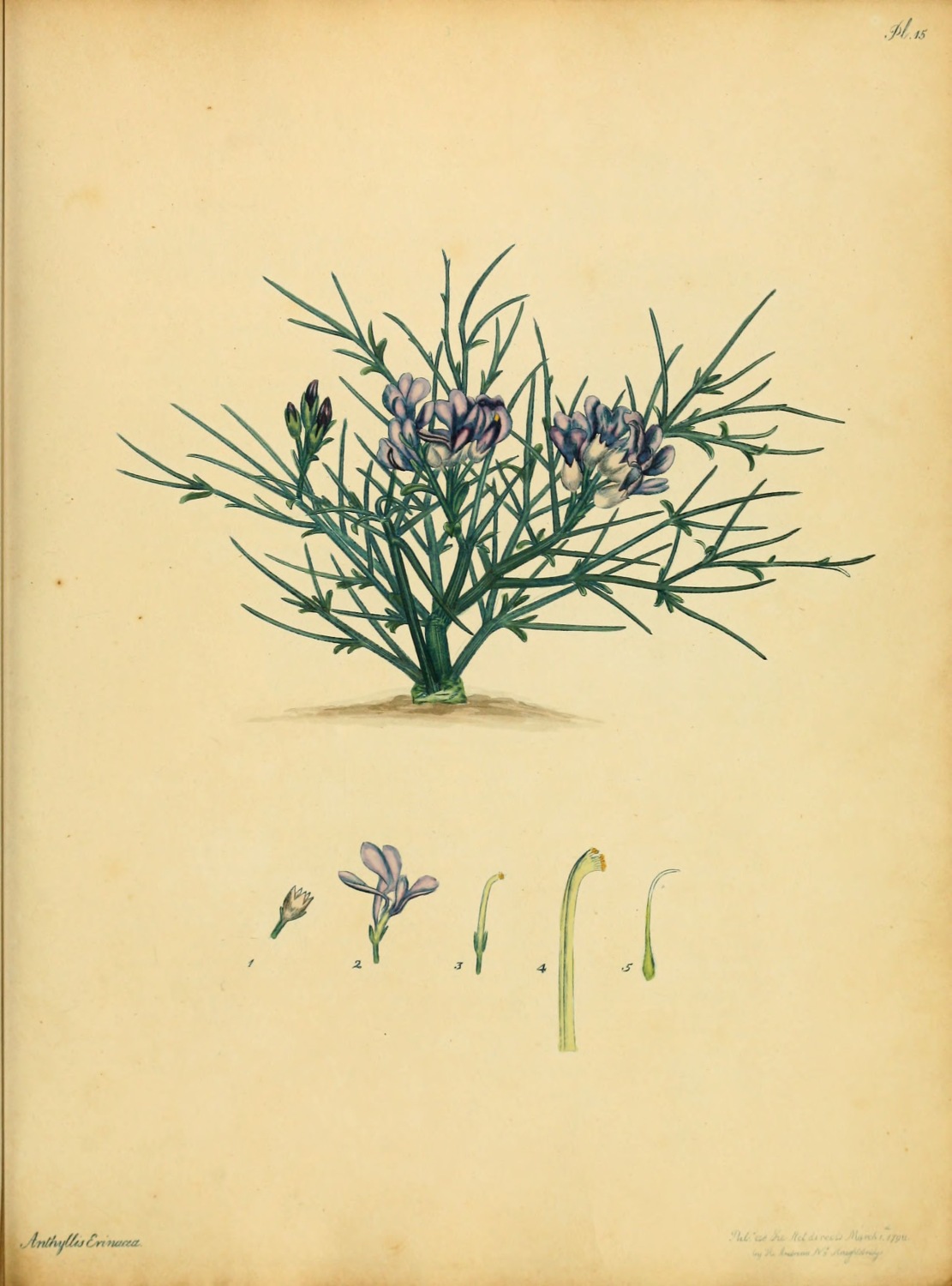
Volume 1 — PLATE XV. ANTHYLLIS ERINACEA. Blue Broom of Spain.
Reading edition
CLASS XVII. ORDER III.
DIADELPHIA DECANDRIA. Chives in two sets. Ten Chives.
GENERIC CHARACTER.
Calyx. Perianthium monophyllum, ovato-oblongum, parum inflatum, villosum; ore quinquedentato, inæquali; persistens.
Corolla papilionacea:
Vexillium longius, lateribus reflexis, ungue longitudine calycis.
Alæ duæ, oblongæ, vexillo breviores.
Carina compressa, longitudine alarum, alis similis.
Stamina. Filamenta decem, connata, assurgentia. Antheræ simplices.
Pistillum. Germen oblongum. Stylus simplex, adscendens. Stigma obtusum.
Pericarpium. Legumen subrotundum, tectum intra calycem, minimum, bivalve.
Semen unum, alterumve.
Empalement. Cup of one leaf, oblong egg-shaped, a little swelled, and hairy; mouth cut into five unequal teeth; permanent.
Blossom, butterfly-shaped.
Standard longer, sides bent back, the claws as long as the cut.
Wings two, oblong, shorter than the standard.
Keel compressed, as long as the wings, and like them.
Chives. Ten threads, connected, rising upwards. Tips simple.
Pointal. Seed-bud oblong. Shaft simple, ascending. Summit blunt.
Seed-vessel. Pod roundish, covered by the cup, very small, of two valves.
Seeds. One or two.
SPECIFIC CHARACTER.
Anthyllis fruticosa, spinosa; foliis simplicibus; floribus ex cæruleo purpurascentibus.
Broom, shrubby, and covered with prickles; leaves simple; blossoms of a purplish blue.
REFERENCE TO THE PLATE.
1. The Cup. 2. A Blossom, the cup taken off to shew the exact situation and shape of its various parts. 3. The Chives, as they inclose the pointal (natural size.) 4. The Threads magnified, and cut open, to shew their tubular shape. 5. The Pointal, magnified.
Owing to the difficulty in propagating and preserving some plants, although frequently introduced to us, and well known; yet are they more scarce to be found, in our best collections, than plants of seemingly more difficult acquisition. This species of Anthyllis has been mentioned under various synonyms by most botanical authors from Clusius downwards. Mr. T. Johnson, in his edition of Gerard of 1633, has given a description of this plant from Clusius, and a cut; both of which are excellent (considering the then infant state of the art of engraving), under the title of Genista spinosa humilis; Dwarf Furze. It is termed Erinacea by Clusius (says he), from the Spanish name of the hedge-hog, Erizo, of which country it is a native, in the kingdom of Valencia: from which we might infer, that, like other plants of that country, it would live through our winters; which is not the case. It must be kept as a greenhouse plant, and watered but sparingly. The soil it prefers is a light loam; is propagated by cuttings, and flowers in April, or May.
PLATE 15