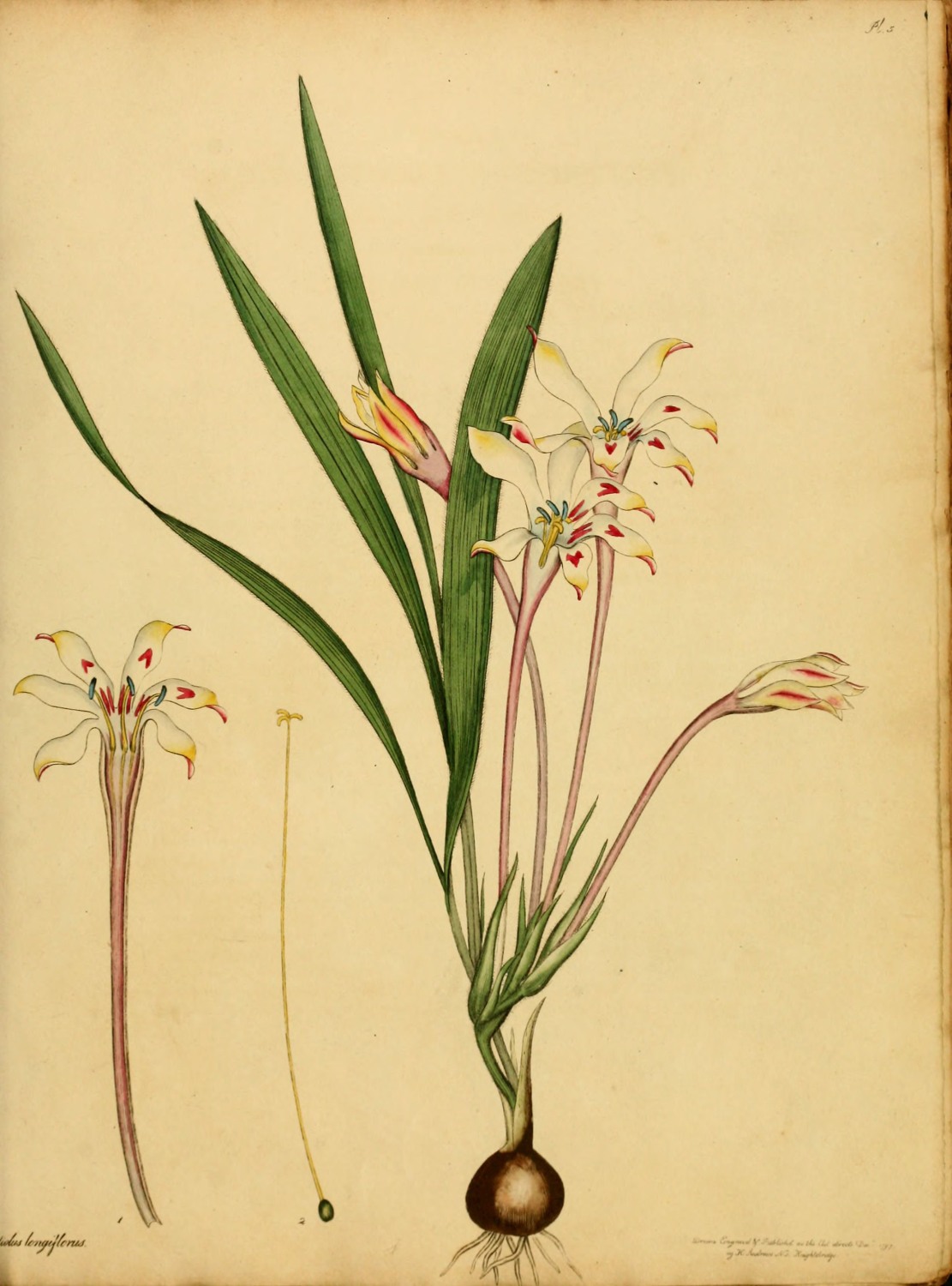
Volume 1 — PLATE V. GLADIOLUS LONGIFLORUS. Long-flowered Gladiolus.
Reading edition
CLASS III. ORDER I.
TRIANDRIA MONOGYNIA. Three Chives. One Pointal.
GENERIC CHARACTER.
Calyx. Spathæ bivalves.
Corolla, sexpartita, ringens. Petala oblonga, omnia unguibus in tubum conata.
Stamina. Filamenta tria, subulata, divisuris alternis petalorum inserta. Antheræ oblongæ.
Pistillum. Germen inferum. Stylus simplex, longitudine staminium. Stigma trifidum, concavum.
Pericarpium. Capsula oblonga, obtusa, trilocularis, trivalvis.
Semina plura, subrotunda.
Empalement. Sheath two valves.
Blossom, cut into six segments, and gaping. Petals oblong, having all their claws connected into a tube.
Chives. Three threads, awl-shaped, fixed into each alternate division of the petals. Tips oblong.
Pointal. Seed-bud beneath. Shaft simple, the length of the chives. Summit divided in three, and concave.
Seed-vessel. Capsule oblong, obtuse, three cells, three valves.
Seeds many, nearly round.
SPECIFIC CHARACTER.
Gladiolus, foliis ensiformibus, plicatis, villosis; corollis tubiformus, longissimis; petalis undulatis, reflexis.
Gladiolus, with sword-shaped, plated, hairy leaves; blossoms trumpet-shaped, and very long; petals waved, and bent back.
REFERENCE TO THE PLATE.
1. A Blossom cut open, to shew the situation, and insertion of the Threads; the Threads, and Tips, remaining attached.
2. The Seed-bud, Shaft, and its Summit.
This species of Gladiolus, (as are most of the genus) is a native of the Cape of Good Hope, about Table Mountain; where the roots of Ixia, Antholyza, Gladiolus, &c. form a chief part of the food of the inhabiting monkies. It came to England amongst many other roots and seeds of beautiful and rare plants, collected by J. Pringle, Esq. of the island of Madeira, when on an excursion at the Cape; and sent by him to Messrs. Lee and Kennedy, of Hammersmith. Like most bulbs, it has its period of rest; during which, it should be kept without moisture, but whilst growing, requires abundance; flowering about June, or July, and producing good seeds. It should be treated as a greenhouse plant, and planted in light sandy earth. Like the Crocus, the old root perishing, a number of fresh ones are produced, which may, (if thought necessary) be kept out of the ground two or three months.
PLATE 5