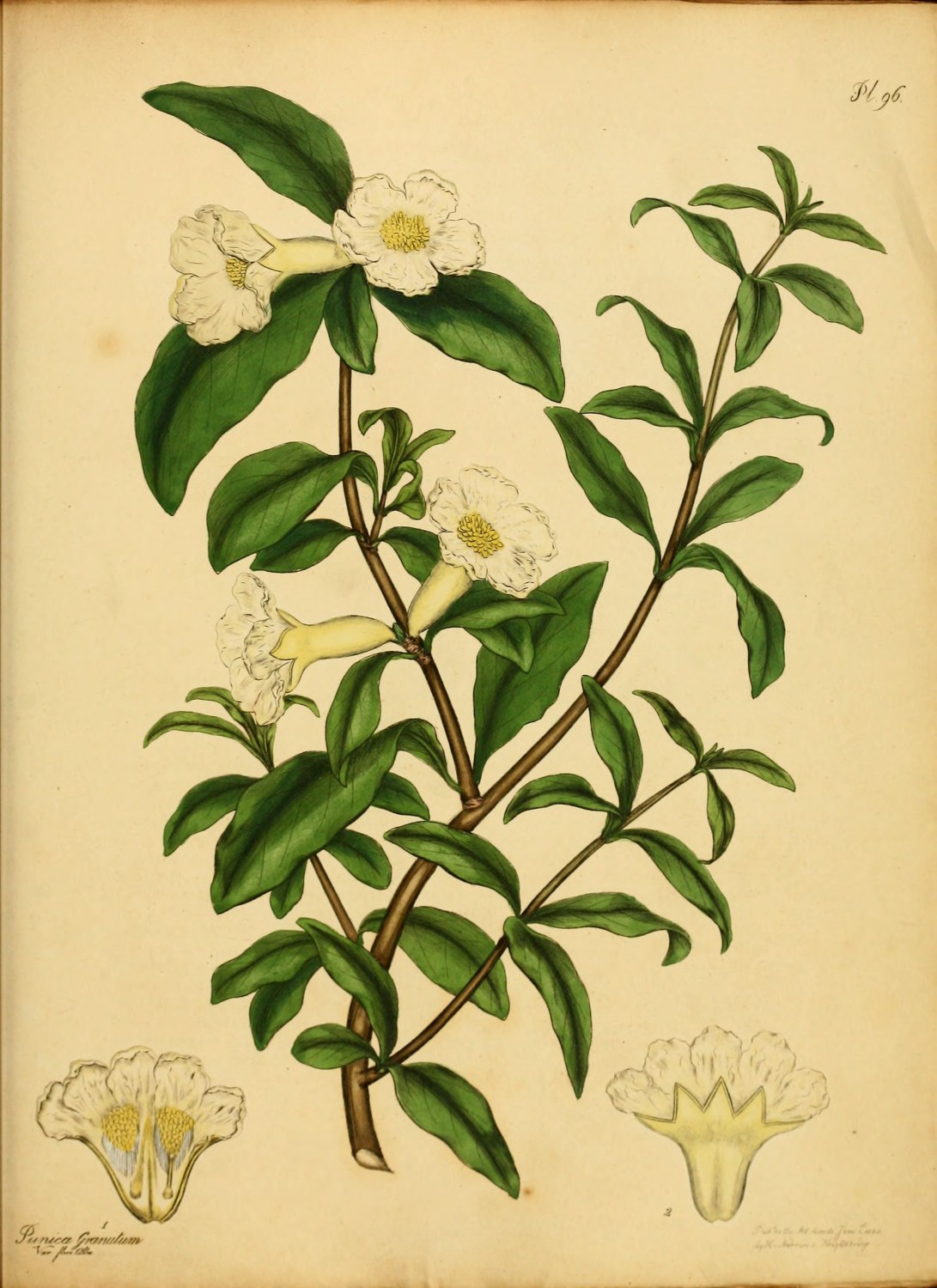
Volume 2 — PLATE XCVI. PUNICA GRANATUM. Var. flore albo. White Pomegranate.
Reading edition
CLASS XII. ORDER I.
ICOSANDRIA MONOGYNIA. Twenty Chives. One Pointal.
GENERIC CHARACTER.
Calyx. Perianthium monophyllum, campanulatum, quinquefidum, acutum, coloratum, persistens.
Corolla. Petala quinque, subrotunda, erecto-patentia, calyci inserta.
Stamina. Filamenta numerosa, capillaria, calyce breviora, calyci inserta. Antheræ oblongiusculæ.
Pistillum. Germen inferum. Stylus simplex, longitudine staminum. Stigma capitatum.
Pericarpium. Pomum subglobosum, magnum, coronatum calyce, novemloculare, dissipimentis membranaceis.
Semina plurima, angulata, succulenta. Receptaculum carnosum, singulum loculamentum pericarpii bifariam dividens.
Empalement. Cup one leaf, bell-shaped, five-cleft, pointed, coloured, and remaining.
Blossom. Five petals, roundish, upright and spreading, attached to the cup.
Chives. Threads numerous, hair-like, shorter than the cup, and fixed to it. Tips nearly oblong.
Pointal. Seed-bud beneath. Shaft simple, the length of the chives. Summit a knob.
Seed vessel. A large and nearly round apple, crowned by the cup, five-celled, the partitions skinny.
Seeds numerous, angulated, and juicy. Receptacle fleshy, and dividing each cell of the seed-vessel into two.
SPECIFIC CHARACTER.
Punica foliis lanceolatis, caule arboreo.
Pomegranate with lance-shaped leaves, and tree-like stem.
DIFFERENCE IN VAR.
Punica Gra: Foliis majoribus, pallidioribus; floribus sub-albidis.
Pomegranate with larger and paler leaves; flowers nearly white.
REFERENCE TO THE PLATE.
1. A Flower cut open, to shew the insertion of the Petals and Chives, into the cup; with the situation of the Pointal. 2. The same shewn from the reverse side.
This handsome variety of the common Pomegranate, (for it cannot be considered as a species,) will, it is to be hoped, prove an agreeable addition to our gardens; though not as a fruit tree, yet as an ornamental plant, of the middling hardy class. Indeed we have little doubt of this, if we may judge by analogy, from its deciduous character, or from its natural affinities; as the other sorts of this species, viz. single red, double red, yellow flowered, and another new variety with large red blossoms and larger leaves, all endure our winters, with little, or no protection, in the southern, or western counties of the island; and are all natives of the same clime: from whence, no doubt, they, like the Orange-tree, &c. &c. have been originally transported; though at present considered as indigenous, to all the different countries on the coasts of the Mediterranean sea, where the single red is cultivated for its fruit; the agreeable acidity of which, is considered as a great luxury, in allaying the thirst occasioned by the intense heat, of those parching regions. In the month of April last year 1799, a fine branch, in full flower, was obligingly communicated by Lady Hume, from her select collection at Wormley Bury, Herts; from which our figure was taken, and where it was then flowering for the first time in England. Her Ladyship had received the plant, amongst a number of others, from China, in the year 1796. The fruit did not ripen, which we attribute to its being kept in the hothouse, to which situation, all plants coming from the East, are necessarily consigned on their first importation. The mode of increasing it is certain and easy, by cuttings, or layers; and it grows most luxuriant in light earth, composed of rotten leaves or rotten dung, and light sandy loam.
PLATE 96