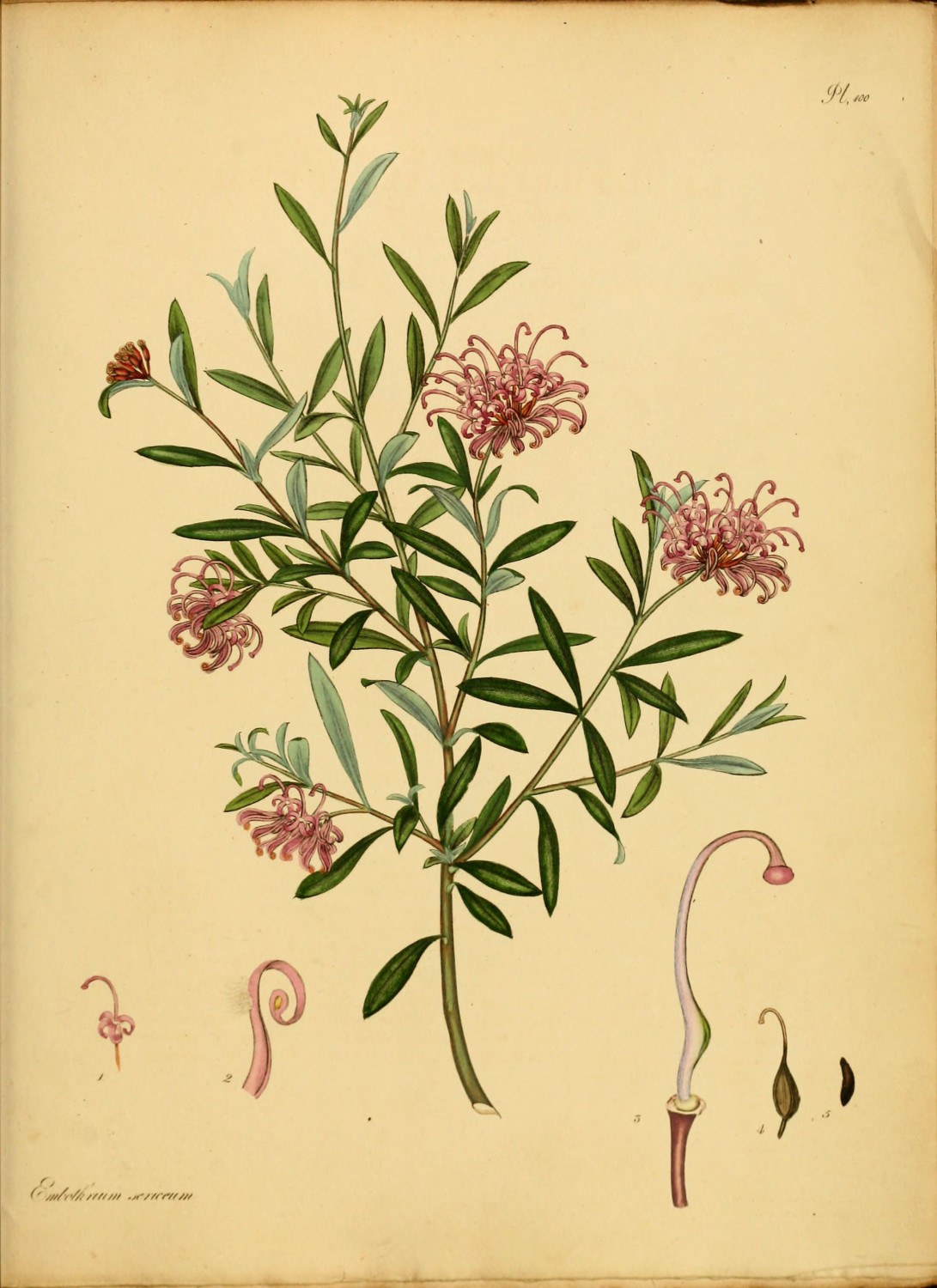
Volume 2 — PLATE C. EMBOTHRIUM SERICEUM. Silky Embothrium.
Reading edition
CLASS IV. ORDER I.
TETRANDRIA MONOGYNIA. Four Chives. One Pointal.
GENERIC CHARACTER.
Calyx nullus.
Corolla. Petala quatuor, linearia, obliqua, apice latiore, subrotundo, concavo, staminifero; post fœcundationem revoluta.
Stamina. Filamenta quatuor, brevissima, in singulo petala singula, vel nulla. Antheræ oblongæ, intra cavitatem petali sitæ, majusculæ.
Pistillum. Germen lineare, adscendens, inflexum. Stylus nullus. Stigma subrotundum, antice planum, postice concavum, magnum.
Pericarpium. Folliculus teres, unilocularis.
Semina quatuor seu quinque, ovata, compressa, margine altero membrana alata.
Empalement none.
Blossom. Four petals, linear, oblique; broad ended, roundish, concave, and supporting the chive; after the bursting of the tips they are rolled back.
Chives. Four threads, very short, one in each petal, or none. Tips oblong, placed in the hollow end of the petal, larger.
Pointal. Seed-bud linear, ascending, and bent. Shaft none. Summit nearly round, the forepart flat, the hinder concave, large.
Seed-vessel. A cylindrical pod of one cell.
Seeds four or five, egg-shaped, flattened, having a skinny wing at one edge.
SPECIFIC CHARACTER.
Embothrium foliis sub-ternatis, integerrimis, acutis, margine revolutis, subtus sericeis; spica recurva; fructu tuberculato, glabro.
Embothrium with leaves growing mostly three together, entire, pointed, rolled back at the edge, and silky beneath; spike bent downward; fruit tuberculated, not downy.
REFERENCE TO THE PLATE.
1. A Blossom complete. 2. A Petal of the Blossom, magnified. 3. The Seed-bud and Summit, magnified. 4. A ripe Seed-vessel. 5. A Seed.
Whem the figure of this plant, or a variety of it, was published by Dr. Smith, in the third No. of his New Holland Botany, it had not then flowered in England; and from the leaves only, of the dried specimens, it was scarce possible to trace, amongst such a variety of new faces, this species of Embothrium. It nevertheless was in many collections, and in some, all the varieties, although it had not then flowered in any. About the end of the year 1791 the seeds of this plant, with many others, were received by Messrs. Lee and Kennedy, of Hammersmith, transmitted to them from New South Wales, by Col. Paterson. As a hardy greenhouse plant, it will always be coveted, as it is seldom without flowers through the whole year. Our plant appears to differ sufficiently, from the three varieties given by the Doctor, to form a fourth; as the leaves on this are by no means constantly three together, but are often scattered. We have notwithstanding nearly copied his specific character. It should be planted in light sandy peat, and may be increased by cuttings, or by seeds, which occasionally ripen, whilst the plant is still in flower.
PLATE 100