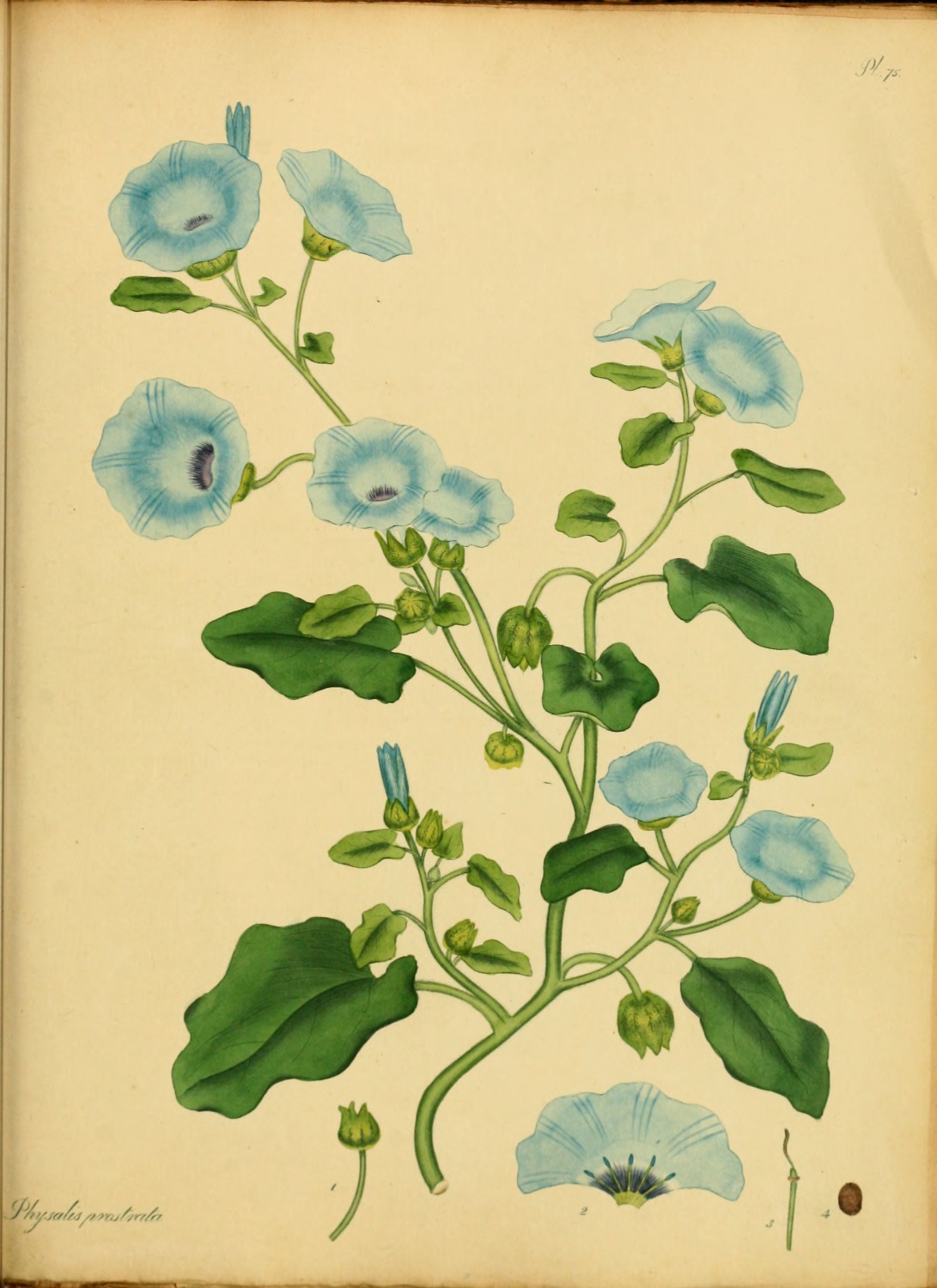
Volume 2 — PLATE LXXV. PHYSALIS PROSTRATA. Trailing Winter-cherry.
Reading edition
CLASS V. ORDER I.
PENTANDRIA MONOGYNIA. Five Chives. One Pointal.
GENERIC CHARACTER.
Calyx. Perianthium monophyllum, ventricosum, semi quinquefidum, pentagonum; laciniis acuminatis; persistens.
Corolla. Monopetala, rotata. Tubus brevissimus. Limbus semiquinquefidus, magnus, plicatus.
Stamina. Filamenta quinque, subulata, minima, conniventia. Antheræ erectæ, conniventes.
Pistillum. Germen subrotundum. Stylus filiformis, staminibus fere longior. Stigma obtusum.
Pericarpium. Bacca sub-globosa, bilocularis, intra calycem maximum, inflatum, clausum, pentagonum.
Semina plurima, reniformia, compressa.
Empalement. Cup one leaf, bellied, half five-cleft, and five-sided; the segments are tapered; permanent.
Blossom, one petal, wheel-shaped. Tube very short. Border half five-cleft, large, and plaited.
Chives. Five threads, awl-shaped, very small, and approaching. Tips upright, and approaching.
Pointal. Seed-bud roundish. Shaft thread-shaped, hardly longer than the chives. Summit blunt.
Seed-vessel. A roundish berry, two-celled, within a large, swelled, close-mouthed, five-sided cup.
Seeds many, kidney-shaped, and flat.
SPECIFIC CHARACTER.
Physalis, ramosissima, prostrata, hispida; foliis subcarnosis; corollis cæruleis.
Winter Cherry, very branching, trailing, and hairy; leaves nearly fleshy; blossoms blue.
REFERENCE TO THE PLATE.
1. The Empalement. 2. A Flower cut open, with the Chives attached. 3. The Pointal (natural size). 4. A ripe Seed-vessel.
This beautiful species of Physalis, as a tender annual, should be sown early in March, on a strong hotbed; and kept, when potted, in the greenhouse, being impatient of cold or wet, and perishes if exposed to either. It is a native of Peru, South America, and has been figured by Professor Jacquin in his Ic. Rar. I. t. 38; likewise by Mons. l’Heritier in his Stirp. Nov. p. 43. t. 22; and was first transmitted to England in the year 1782, by Mons. Thoin, from France. Although it has been cultivated here some years, it is but little known, owing to its great delicacy when young, being very liable to damp off in the hotbed.
PLATE 75