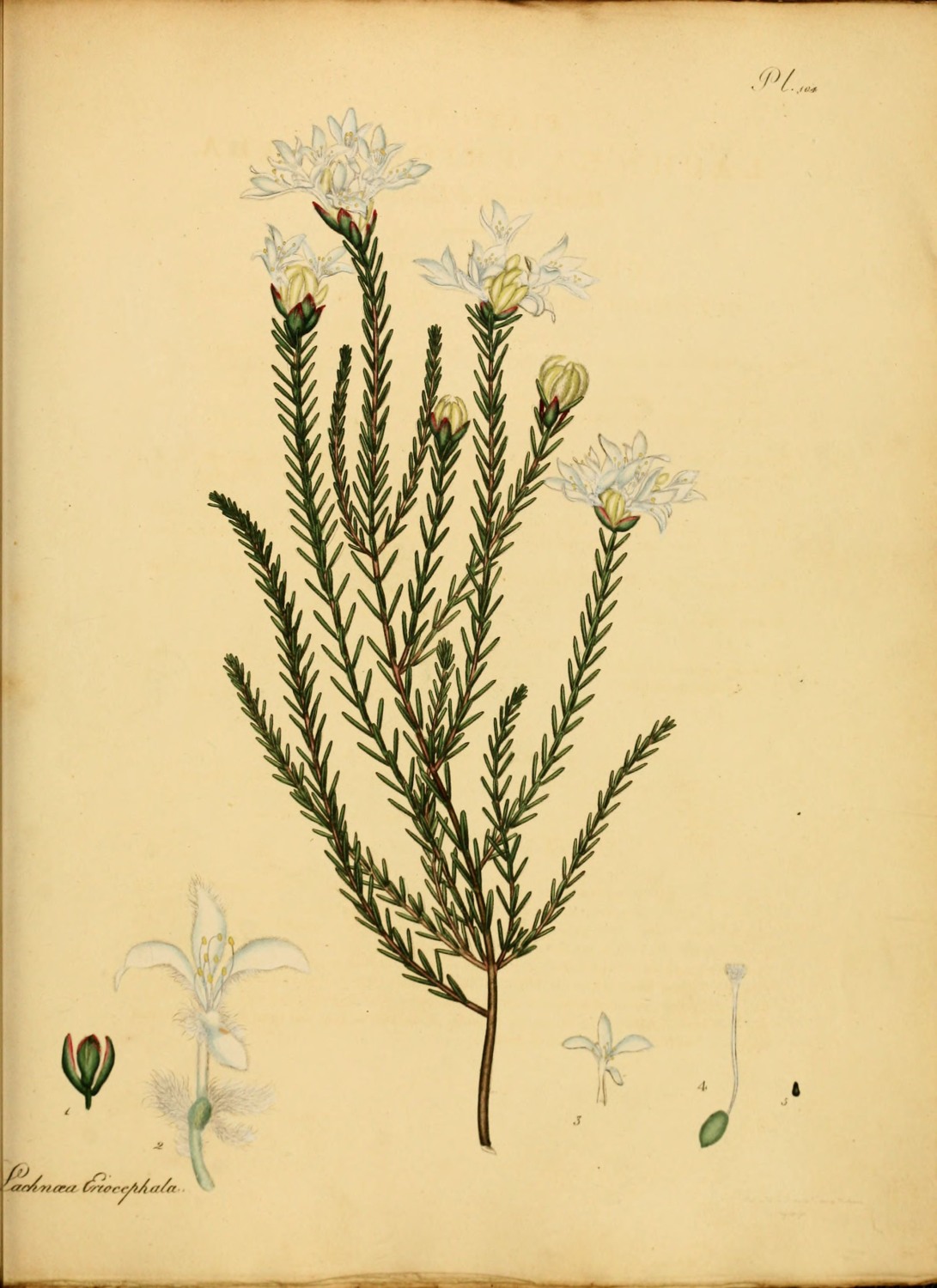
Volume 2 — PLATE CIV. LACHNÆA ERIOCEPHALA. Woolly-headed Lachnæa.
Reading edition
CLASS VIII. ORDER I.
OCTANDRIA MONOGYNIA. Eight Chives. One Pointal.
GENERIC CHARACTER.
Calyx. Perianthium monophyllum, persistens; tubo longo, tenui; limbo quadripartito, inæquali; lacinia summa retrofracta, minima; laciniis reliquis tribus erectis; intermedia majore.
Corolla nulla.
Stamina. Filamenta octo capillaria, erecta, longitudine ferme floris. Antheræ simplices.
Pistillum. Germen ovatum. Stylus filiformis, germinis lateri insertus. Stigma capitatum, hispidum.
Pericarpium nullum. Fructus in fundo calycis.
Semen unicum, ovatum.
Empalement. Cup one leaf, remaining; tube long, slender; border of four divisions, unequal; the upper segment appearing broke back, and small; the three other segments are upright; the middle one the largest.
Blossom none.
Chives. Eight hair-like threads, upright, almost the length of the flower. Tips simple.
Pointal. Seed-bud egg-shaped. Shaft thread-shaped, fixed into the side of the seed-bud. Summit a hairy knob.
Seed-vessel none. The fruit is in the bottom of the cup.
Seed one, egg-shaped.
SPECIFIC CHARACTER.
Lachnæa capitulis solitariis, lanatis; foliis quadrifariam imbricatis.
Lachnæa with little bunches of flowers growing solitary and woolly; leaves are tiled on the stem, forming four regular angles.
REFERENCE TO THE PLATE.
1. The terminating Leaves of the branches, which inclose the small heads of flowers. 2. A Flower, magnified. 3. A Flower cut open, natural size, to shew the insertion of the Chives. 4. The Seed-bud and Pointal, magnified.
The figure of this curious new plant was taken from a specimen most obligingly communicated by the Hon. Wm. Hen. Irby, from his valuable and extensive collection at the Parsonage, Farnham Royal, near Windsor, Bucks. The genus Lachnæa has hitherto, with us, remained in obscurity; as the L. Conglomerata has not as yet flowered, and the L. Eriocephala was not in our collections till within these five years; about which time it was introduced by Mess. Lee and Kennedy, Hammersmith, from the Cape of Good Hope. It differs but little in habit from Passerina Grandiflora, and until it flowered this year, was considered as a variety of that plant. May be propagated with ease by cuttings, and continues to flower from March till August. A mixture of peat and loam is the soil it most approves; but it is very susceptible of damps.
PLATE 104