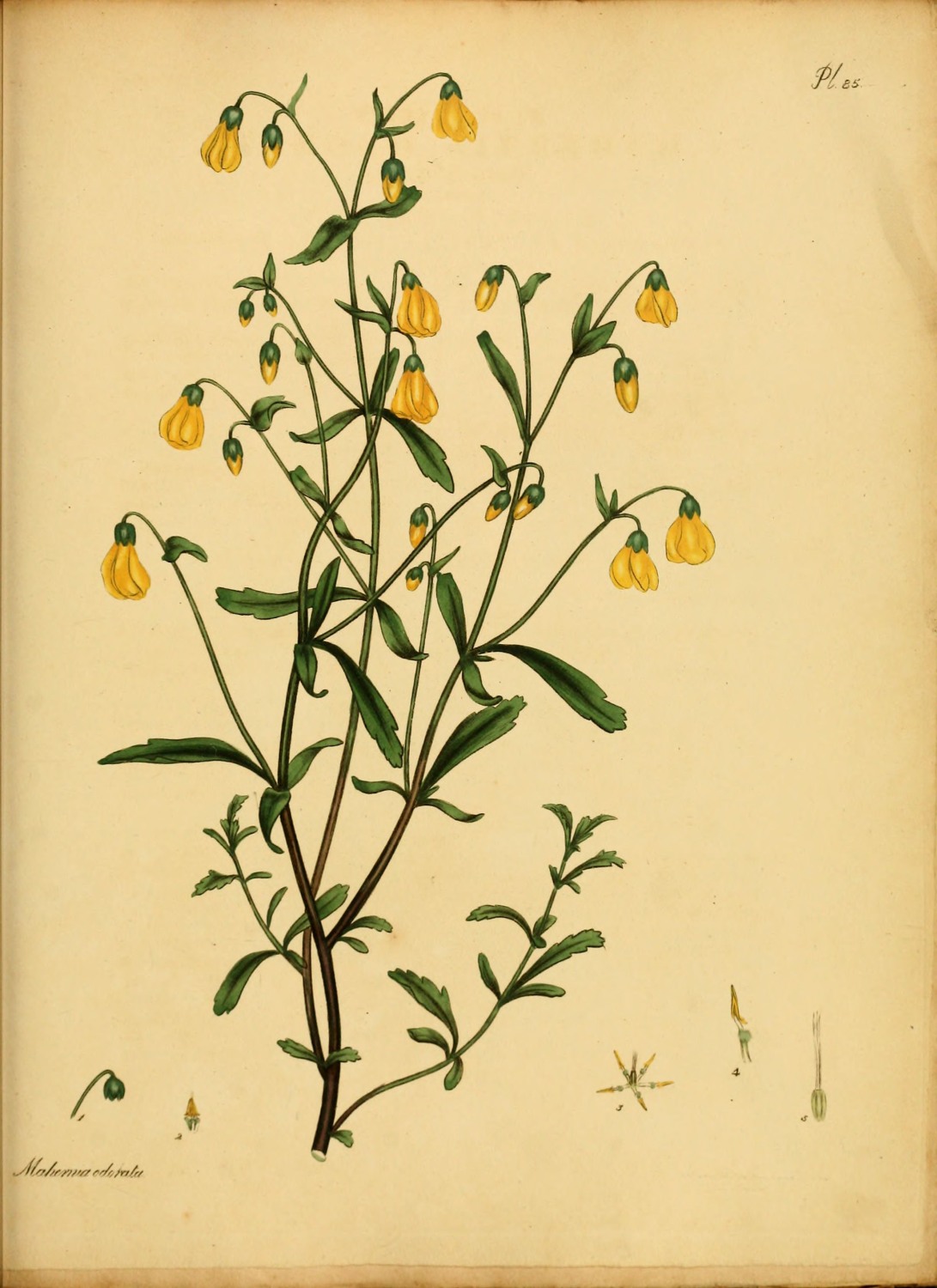
Volume 2 — PLATE LXXXV. MAHERNIA ODORATA. Sweet Mahernia.
Reading edition
CLASS V. ORDER V.
PENTANDRIA PENTAGYNIA. Five Chives. Five Pointals.
GENERIC CHARACTER.
Calyx. Perianthium monopetalum, quinquefidum, campanulatum; dentibus subulatis, longioribus; persistens.
Corolla. Petala quinque, cordata, oblonga, patentia, calyce duplo longiora.
Nectaria quinque, obcordata, pedicellata, germen cingentia, calyce breviora.
Stamina. Filamenta quinque, capillaria, nectario infidentia, calyce breviora. Antheræ oblongæ, acuminatæ, erectæ.
Pistillum. Germen subpedicellatum, obovatum, quinquangulum. Styli quinque, setacei, erecti, longitudine petalorum. Stigmata simplicia.
Pericarpium. Capsula ovata, quinquelocularis, quinquevalvis.
Semina nonnulla, reniformia.
Empalement. Cup one leaf, five-cleft, bell-shaped; the teeth awl-shaped, and longer; remaining.
Blossom. Five petals, heart-shaped, oblong, spreading, twice the length of the cup.
Honey-cups five, inversely heart-shaped, having little foot-stalks, embracing the seed-bud, shorter than the cup.
Chives. Five threads, hair like, sitting on the honey-cups, shorter than the cup. Tips oblong, tapered to a point, and upright.
Pointal. Seed-bud supported on a very short foot-stalk, inversely egg-shaped, five-angled. Shafts five, like bristles, upright, the length of the petals. Summits simple.
Seed-vessel. Capsule egg-shaped, five cells, five valves.
Seeds a few, kidney-shaped.
SPECIFIC CHARACTER.
Mahernia foliis lanceolatis, glabris, apice dentatis; pedunculis bifloris; corollis luteis, odoratissimis.
Mahernia with lance-shaped leaves, smooth and toothed at the end; foot-stalks bearing two flowers; the blossoms yellow and very sweet.
REFERENCE TO THE PLATE.
1. The cup, (natural size). 2. The Chives, Honey-cups, and Pointals, as they stand in the flower. 3. The same, with the Chives thrown back, as far as the slight junction of the honey-cups will permit, without tearing. 4. A Chive with its honey-cup, (magnified). 5. The Seed-bud and Pointals, (magnified).
Many species of this Genus have, hitherto, been arranged as Hermannias, to which they are undoubtedly very nigh affined; in nothing essentially varying, but in the character of the chives, being, in this, placed on honey cups, which are wanting in the other; the same natural appearance however of the junction of the supporters of the tips, being common to both. From this small change of the identity of character, so necessary in our artificial system, they are thrown to a wide distance in classification; the one standing in the fifth, the other in the sixteenth class! The Mahernia odorata is from the Cape of Good Hope, and was sent in seeds to England about the year 1792. It is but a short-lived greenhouse plant, and must be raised every two years, at least, from cuttings; which should be made about the beginning of March, and placed on a gentle hot bed, they will by this means become good sized plants by midsummer. The flavour of the blossoms is exactly that of the Jonquil, it continues to flower through the whole year, but is as yet to be found in few collections, although from its different attractions we have no doubt of seeing it soon in most. Rich earth, of old cow dung, and loam, seems to be the soil it most affects. Our drawing was made at the nursery Hammersmith, in July 1799.
PLATE 85