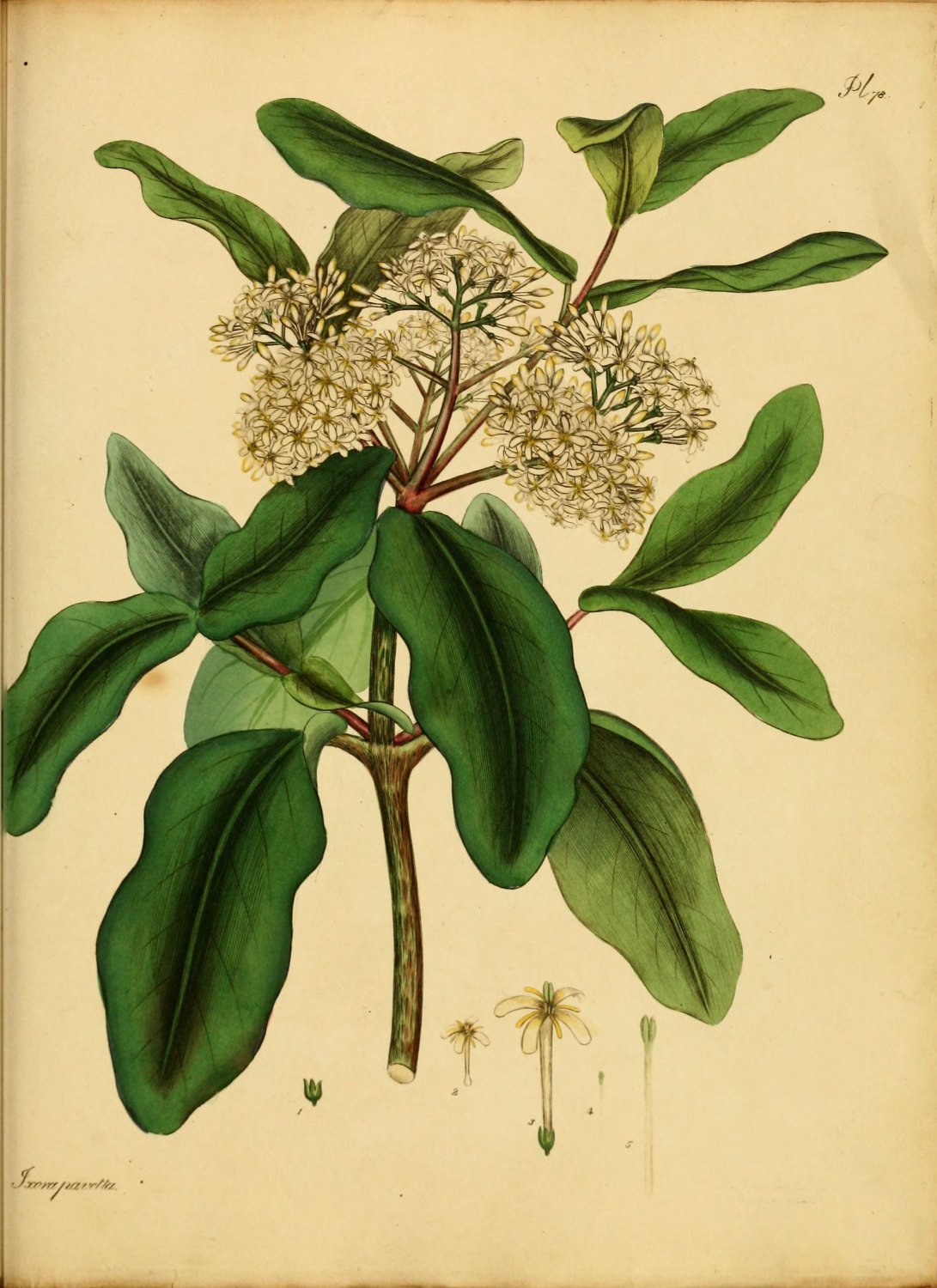
Volume 2 — PLATE LXXVIII. IXORA PAVETTA. Sweet Ixora.
Reading edition
CLASS IV. ORDER I.
TETRANDRIA MONOGYNIA. Four Chives. One Pointal.
GENERIC CHARACTER.
Calyx. Perianthium quadripartitum, minimum, erectum, persistens.
Corolla monopetala, infundibuliformis. Tubus cylindraceus, longissimus, tenuis. Limbus quadripartitus, planus; laciniis ovatis.
Stamina. Filamenta quatuor, brevissima, in divisuris corollæ. Antheræ oblongæ.
Pistillum. Germen subrotundum, intra basin calycis. Stylus filiformis, longitudine tubi. Stigma bifidum.
Pericarpium. Bacca subrotunda, bilocularis.
Semina duo, hinc convexa, inde angulata.
Empalement. Cup with four divisions, very small, upright, and remaining.
Blossom of one petal, funnel-shaped. Tube cylindrical, very long, and small. Border of four divisions and flat; the segments egg-shaped.
Chives. Four threads, very short, placed in the divisions of the blossom. Tips oblong.
Pointal. Seed-bud roundish, in the bottom of the cup. Shaft thread-shaped, the length of the tube. Summit two-cleft.
Seed-vessel. A roundish berry, with two cells.
Seeds, two, hollow on the inside, and angled without.
SPECIFIC CHARACTER.
Ixora foliis obtusis, undulatis, petiolatis, floribus fasciculatis, odoratis, sordide luteis.
Ixora with blunt, waved, leaves, having foot-stalks; flowers grow in bunches, are sweet scented, and of a dirty yellow.
REFERENCE TO THE PLATE.
1. The Empalement, (magnified). 2. A Blossom with the seed-bud attached, (natural size). 3. The same with the Empalement, (magnified). 4. The Pointal, (natural size). 5. The same, magnified.
To the Lady Dowager de Clifford are we indebted, for the introduction of this new species of Ixora, a native of the East Indies; her Ladyship having received it from thence, in the year 1796. It is a tender hot-house plant, growing to the height of a foot, or more, and very bushy; the bunches of flowers are very large, covering nearly the whole upper part of the plant, and are exceedingly fragrant. The blossoms begin to expand about the beginning of August, and continue to blow in succession, till the end of October. The only plant we have yet heard of, in England, is in her Ladyship’s collection at Paddington; where it has flowered for the first time this year, and where our drawing was made. It is propagated like the other species of Ixora, by cuttings, and should be kept in rich earth.
PLATE 78