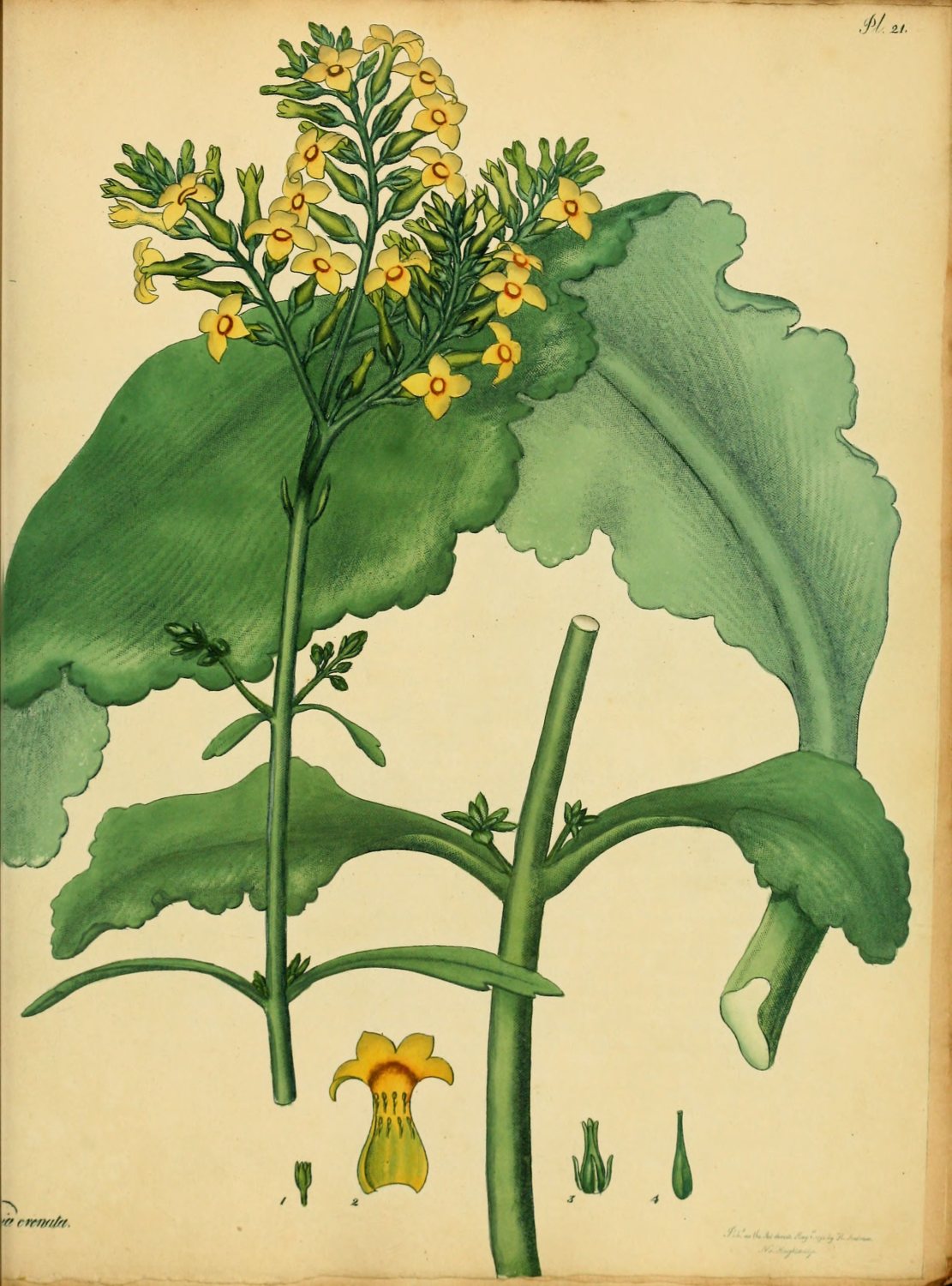
Volume 1 — PLATE XXI. VEREIA CRENATA. Scolloped-leaf Vereia.
Reading edition
CLASS VIII. ORDER IV.
OCTANDRIA TETRAGYNIA. Eight Chives. Four Pointals.
GENERIC CHARACTER.
Calyx. Perianthium tetraphyllum, foliolis lanceolatis, concavis, erectis, acutis, persistentibus.
Corolla monopetala, ventricosa; limbus patens, revolutus quadripartitus; laciniis ovatis, acuminatis.
Nectaria quatuor; singulum squamula debilia, minima, singulo germini ad basin extrorsum inserta.
Stamina. Filamenta octo, brevia, quorum quatuor medio, quatuor vero ad basin corollæ adnatæ. Antheræ subrotundæ simplices.
Pistillum. Germina quatuor, oblonga, definentia in stylos subulatos. Stigmata obtusa.
Pericarpium. Capsulæ quatuor, ovatæ acuminatæ, rectæ, trigonæ, longitudinaliter sutura introrsum dehiscentes.
Semina plurima minima.
Empalement. Cup four leaved, which are lance-shaped, concave, upright, sharp-pointed, and permanent.
Blossom of one leaf, big bellied; border spreading, rolled back, and divided into four egg-shaped, pointed segments.
Honey-cups four, each consisting of a small slight scale, fixed on the outside the base of each seed-bud.
Chives. Eight short threads, four of which are fixed to the middle, and four to the base of the blossom. Tips nearly round, and simple.
Pointal. Four seed-buds, oblong, ending in awl-shaped shafts. Summits blunt.
Seed-vessel. Four capsules, egg-shaped, tapering, upright and three sided, opening inwards along the seam.
Seeds many, very small.
SPECIFIC CHARACTER.
Vereia, foliis oppositis, crenatis, patentibus; racemis longissimis laxis; floribus luteis.
Vereia, with opposite, scolloped, spreading leaves; very long loose spikes, and yellow flowers.
REFERENCE TO THE PLATE.
1. The Empalement, (natural size.)
2. A Blossom cut open to shew the situation of the Chives.
3. The Seed-vessel, Shafts, and Summits, with the scales of the Honey-cups, as they stand in the blossom, (magnified.)
4. One Capsule of the Seed-vessel detached.
This genus of Plants must class with Linnæus’s natural order of Succulents, nearly approaching Crassula in habit; but as the Sexual System is the basis of our theory, we cannot admit it under that or any other yet described genus; we have therefore named it after James Vere, Esq. long and well known for his extended and liberal patronage to the professors and cultivators of the science; in whose beautiful and select collection at Kensington Gore, the present species, has for the first time, flowered in this kingdom. Mr. Anderson the gardener informs us, that this plant is a native of Sierra Leone; from whence it was sent to England, by Professor Eld. Elfzelius, in the year 1793; that he has treated it as a tender hot-house plant, keeping it constantly in the tan bed, by which means he has made it flower; but from every appearance of the plant, we should be led to think the common treatment of hot-house Succulents would answer for this. It is easily propagated by cuttings; grows to the height of three or four feet, having when in flower the appearance of a middle sized shrub; blows in the winter months, and thrives best in rich mould.
PLATE 21