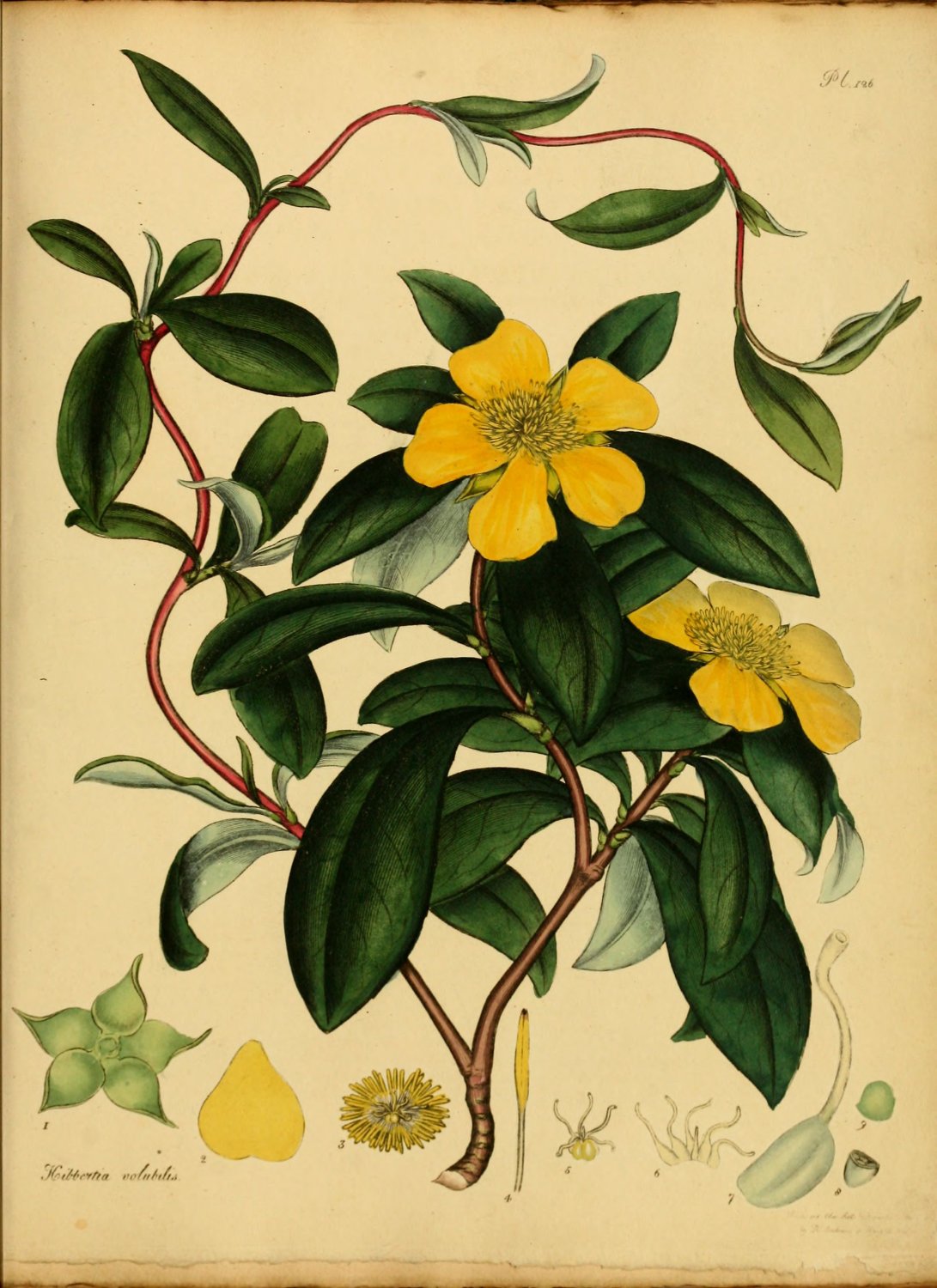
Volume 2 — PLATE CXXVI. HIBBERTIA VOLUBILIS. Twining Hibbertia.
Reading edition
CLASS XIII. ORDER V.
POLYANDRIA PENTAGYNIA. Many Chives. Five Pointals.
GENERIC CHARACTER.
Calyx. Perianthium pentaphyllum; foliolis coriaceis, sub-ovatis, concavis, acutis, persistentibus.
Corolla. Petala quinque, obcordata, calyce longiora.
Stamina. Filamenta numerosa, filiformia, receptaculo fructificationis inserta. Antheræ lineares, erectæ, emarginatæ.
Pistilla. Germina quinque, ovato-oblonga, desinentia in stylos flexuosos, longitudine fere staminum. Stigmata simplicia, apice concava. Corpusculum subulatum, membranaceum in medio germinum, eorumque longitudine.
Pericarpium. Capsulæ quinque ovatæ, trigonæ, uniloculares, distinctæ.
Semina plurima, subrotunda.
Empalement. Cup five leaves; leaflets tough, nearly egg-shaped, concave, sharp, and remaining.
Blossom. Five petals, inversely heart-shaped, longer than the cup.
Chives. Threads numerous, thread-shaped, fixed into the receptacle of the fructification. Tips linear, upright, notched at the ends.
Pointals. Five seed-buds, between oblong and egg-shaped, terminating in zig-zagged shafts, nearly the length of the chives. Summits, simple, and hollowed at the top. A small awl-shaped, skinny substance in the middle of the seed-buds, and of their length.
Seed-vessel. Five capsules, egg-shaped, three-sided, one celled, and distinct.
Seeds many, roundish.
SPECIFIC CHARACTER.
Hibbertia foliis obtuse-serratis, obovato-lanceolatis, floribus solitariis, sessilibus, fœtidissimus.
Hibbertia with obtusely sawed leaves, between lance and inversely egg-shaped; flowers grow solitary, sitting close on the stem; very fœtid.
REFERENCE TO THE PLATE.
1. The Empalement. 2. A leaf of the blossom. 3. The Chives and Pointals. 4. One Chive, magnified. 5. Pointals apart, as they stand in the center of Chives. 6. The Pointals spread open, with the skinny substance which stands in their center. 7. One of the Pointals, magnified. 8. A Seed-bud, cut transversely. 9. A half ripe seed, magnified.
The Hibbertia volubilis, (as are the three species of which we have seen specimens,) is from New Holland, near Port Jackson; was raised from seeds in many different collections near London in the year 1792. It is a hardy green-house plant, and makes a very handsome climber, for trellis, or pillars in a conservatory. Its growth is very rapid, and its flowers which are very brilliant and specious, continue in succession from May till September. The increase is certain and easy from cuttings, made in the month of May, and placed on a gentle hotbed, or plunged in the bark-bed of the hothouse. It delights in a light sandy peat soil. Our drawing was made from a plant, in the collection of the Hon. Lady Dowager De Clifford, Paddington.
As hitherto this tribe of Plants has not been given to the public by any truly established name; (the different species having been erroneously titled Dillenias, which have many pointals,) and as we find it to differ, from any yet described Genus, we have named it after G. Hibbert, Esq. of Clapham Common, Surry; whose knowledge and fervor in botanical pursuits, as well as liberality in his endeavours to enrich our collections, from every quarter of the globe, but especially from the Cape of Good Hope, has not been exceeded by any; and we are well assured, no name deserves a place, on botanical record, more than that of Hibbert.
PLATE 126