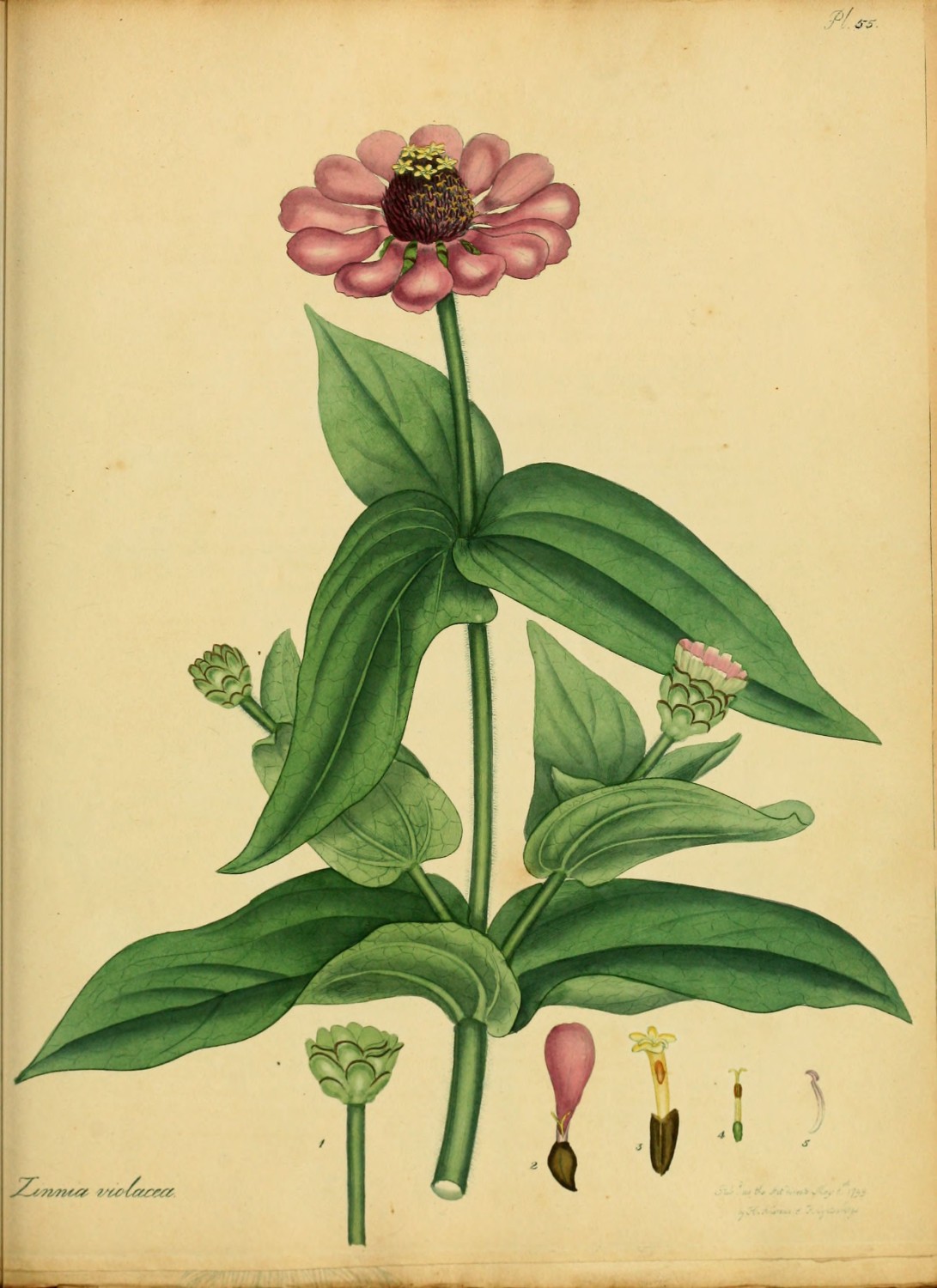
Volume 1 — PLATE LV. ZINNIA VIOLACEA. Purple Zinnia.
Reading edition
CLASS XIX. ORDER II.
SYNGENESIA POLYGAMIA SUPERFLUA. Tips united. Superfluous Pointals.
GENERIC CHARACTER.
Calyx. Communis ovato-cylindricus, lævis, imbricatus; squamis plurimis, obtusis, erectis, persistentibus.
Corolla. Composita radiata; corollulæ hermaphroditæ plures in disco elevato. Femineæ plurimæ in radio.
Propria hermaphroditi infundibuliformis, quinquefida intus villosa.
Feminea ligulata, subrotunda, retusa, persistens.
Stamina. Hermaphroditis; filamenta quinque, brevissima. Anthera cylindracea, tubulosa.
Pistillum. Hermaphroditis; germen oblongum, triquetrum. Stylus filiformis, semibifidus. Stigmata duo, obtusa.
Femineis; germen oblongum, triquetrum. Stylus capillaris, semibifidus. Stigmata duo, recurvata.
Pericarpium. Calyx immutatus.
Semina. Hermaphroditis solitaria, oblonga, tetragono-ancipitia. Pappus muconibus duobus.
Femineis solitaria, mutica, coronata petalo persistente.
Receptaculum paleaceum; paleis lingulatis, canaliculatis, longitudine calycis, deciduis.
Empalement. Common cylindrically egg-shaped, smooth, and tiled; scales many, blunt, upright, and remaining.
Blossom. Compound radiate; florets with chives and pointals, are numerous in the center, which is elevated; florets with only pointals, many in the circumference.
Individuals with chives and pointals funnel-shaped, five-cleft, and hairy within.
Individuals with pointals only, ligulate, roundish, dented at the end, and remaining.
Chives. Hermaphrodites; five short threads. Tips forming a hollow cylinder.
Pointal. Hermaphrodites; seed-bud oblong, three-sided. Shaft thread-shaped, split nearly half way down. Summits two, blunt.
Females; seed-bud oblong, three-sided. Shaft hair-like, split half way down. Summits two, bent backward.
Seed-vessel. Cup not changing.
Seeds. Hermaphrodites; solitary, oblong, three-sided, but sharp at two edges. Feather of two sharp points.
Females, solitary, without points, being crowned with the persistent petal.
Receptacle chaffy; chaff tongue-shaped, channelled, the length of the cup, and falling off.
SPECIFIC CHARACTER.
Zinnia foliis oppositis, amplexicaulibus, lato-lanceolatis, scabris; floribus pedunculatis, purpureis, solitariis.
Zinnia with opposite leaves, embracing the stem, broadly lance-shaped, and rough; flowers have foot-stalks, are purple, and grow solitary.
REFERENCE TO THE PLATE.
1. The Empalement. 2. A Floret of the ray with the seed attached, (natural size). 3. A Floret of the disk with the seed attached, (magnified). 4. The Chives and Pointal of an hermaphrodite floret. 5. The chaffy substance dividing the florets.
This elegant new species of Zinnia, is described and figured by J. A. Cavanilles, in his first volume of Spanish plants; where he says, it is a native of Mexico, South America, and was transmitted from thence to the royal gardens, where it perfected its seeds. In the year 1796, the Marchioness of Bute received it amongst many other curious seeds, from Madrid, through the medium of Professor Ortega. Being rather a tender annual, it should be sown in March, on a gentle hotbed; and transplanted into the open borders the beginning of May. The plant grows to the height of three feet or more, and makes in the months of August and September, a very considerable addition to the splendor of the flower garden. The seeds ripen freely, though the flower should be plucked before it appears decayed.
PLATE 55