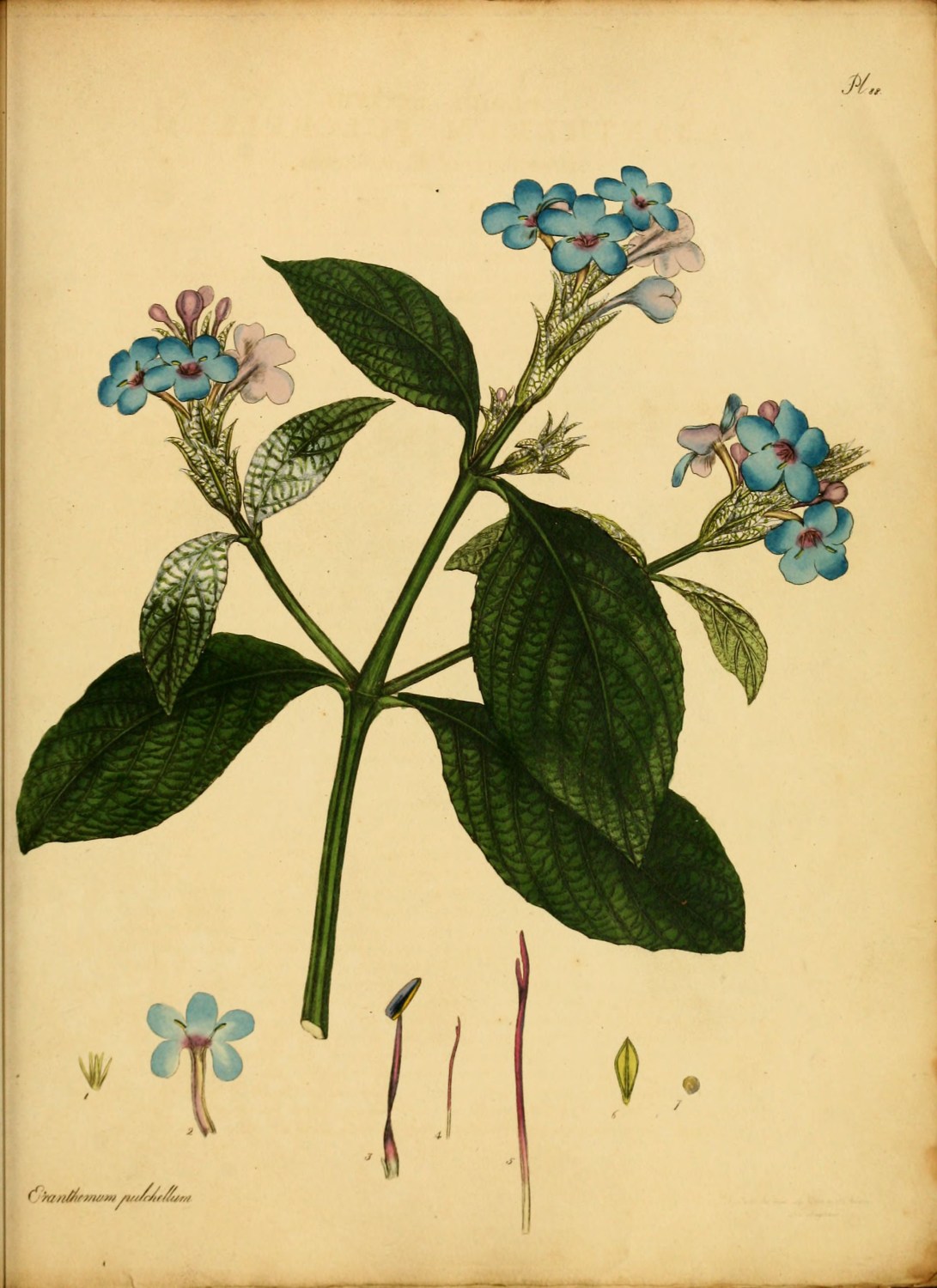
Volume 2 — PLATE LXXXVIII. ERANTHEMUM PULCHELLUM. Blue-flowered Eranthemum.
Reading edition
CLASS II. ORDER I.
DIANDRIA MONOGYNIA. Two Chives. One Pointal.
GENERIC CHARACTER.
Calyx. Perianthium quinquefidum, tubulosum, erectum, membranaceum, persistens.
Corolla monopetala, infundibuliformis; tubus filiformis, longissimus. Limbus quinquepartitus, planus; laciniis obovatis, æqualibus.
Stamina. Filamenta duo, ad basin spiralia, in fauce corollæ. Antheræ subovatæ, compressæ, extra tubum.
Pistillum. Germen ovatum, compressum. Stylus filiformis, longitudine staminum. Stigmata duo, inæqualia, erecta.
Pericarpium. Capsula spathulata, compressa, bivalvis, bilocularis, dissipimento valvulis contrario.
Semina solitaria, lentiformia.
Empalement. Cup five cleft, tubular, upright, skinny, and remaining.
Blossom one petal, funnel-shaped; tube thread-shaped, and very long. Border divided into five, and flat; the segments are inversely egg-shaped, and equal.
Chives. Two threads, spiral at the base, at the mouth of the blossom. Tips nearly egg-shaped, flattened, and without the tube.
Pointal. Seed-bud egg-shaped and flattened. Shaft thread-shaped, the length of the chives. Summits two unequal, and upright.
Seed-vessel. Capsule spatula shape, flattened, two valves, two cells, the partition contrary to the valves.
Seeds solitary, lentil shape.
SPECIFIC CHARACTER.
Eranthemum foliis lanceolato-ovatis, nervosis; floribus spicatis; bracteis lanceolatis, imbricatis.
Eranthemum with lance-shaped, oval, and strongly nerved leaves; the flowers grow in spikes; the floral leaves are lance-shaped, and tiled.
REFERENCE TO THE PLATE.
1. The Empalement, with its four small leaflets. 2. The Blossom cut open, to shew the part of insertion of the Chives. 3. One of the Chives, (magnified.) 4. The Pointal, (natural size.) 5. The same, (magnified.) 6. The Seed-bud. 7. A Seed.
Eranthemum, although standing in our ancientest tables, as a name to different plants; must have been, hitherto, considered as a dead letter in all our modern ones, as attached to the tribe of plants it now titles: but perhaps, to none of the former more aptly could it have been applied; (especially this species, as the Greek word Ήράνθεμον, a compound of Ής the spring, and ἀνθέω to blossom, fairly indicates;) since the E. pulchellum first begins to flower in January, and continues to blossom till May. Linnæus in treating this Genus, acknowledges to have seen but one imperfect specimen; and from this circumstance, left the description of the seed-vessel, and seed, to be determined by future Botanists; as yet, that has not been accomplished, even by the indefatigable and accurate Schreber; indeed, had the character of the pointal been likewise omitted, it would have been as well; since, in place of one, the two unequal summits, (which might escape observation in a dried specimen, from their disproportion in length, and upright situation;) point out a stronger Generical distinction from Justicia, to which it much affines, than either, the regular shape of the limb of the blossom, or the situation of the chives. Our species is a native of the coast of Coromandel, in the East Indies, and was first received in seeds from Dr. Roxburg, at the Royal gardens Kew, in the year 1796. It is a most desirable plant, for although it has hitherto been kept in the hot-house, we have no doubt from its flowering and thriving there, with so little care, in any situation; but that it will soon be considered as a proper inhabitant of the greenhouse. It is with the greatest ease, and certainty, increased by cuttings. Our drawing was made this month, from a plant in flower at the Hammersmith nursery.
PLATE 88