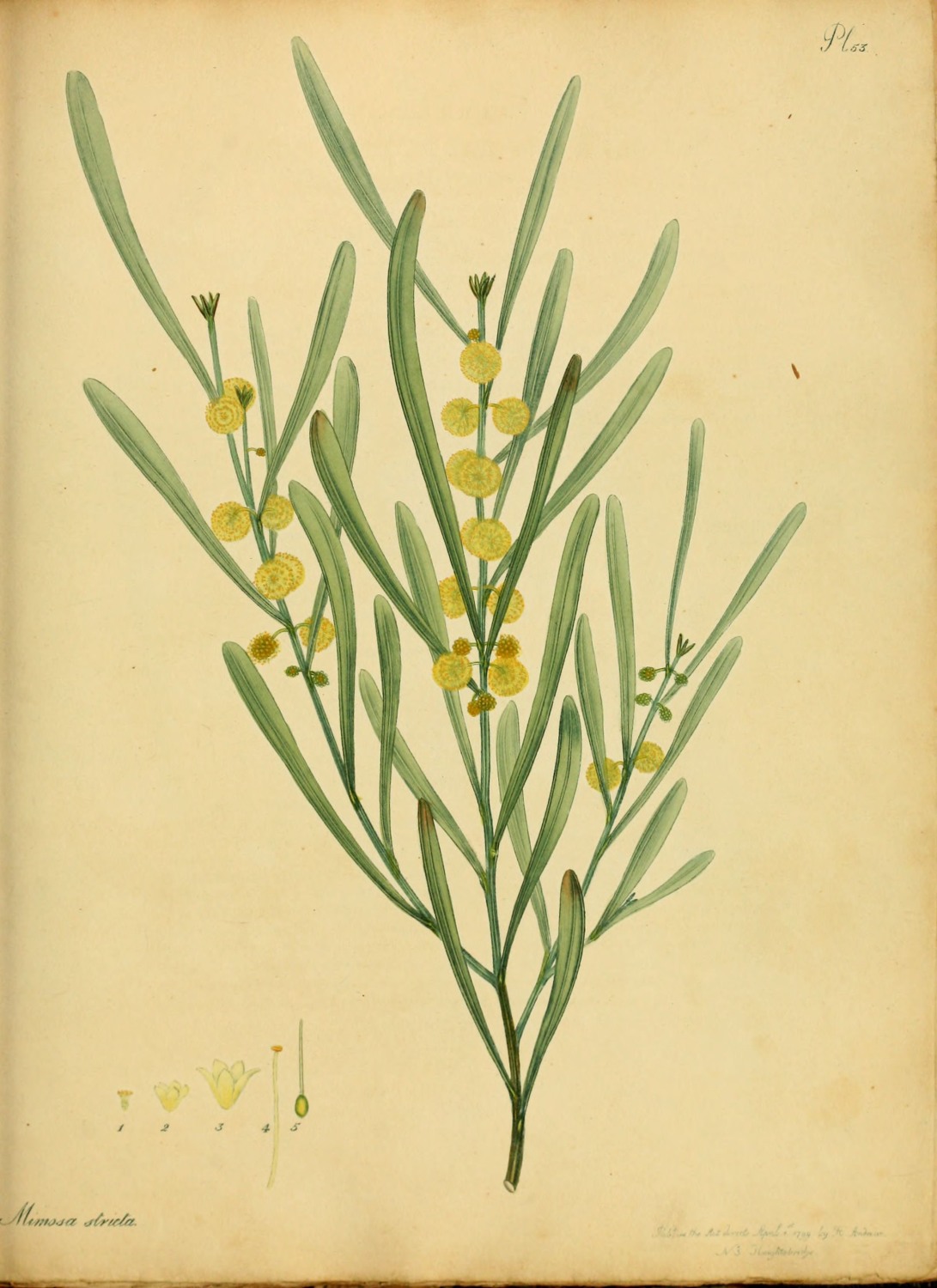
Volume 1 — PLATE LIII. MIMOSA STRICTA. Harsh-leaved upright Mimosa.
Reading edition
CLASS XXIII. ORDER I.
POLYGAMIA MONOECIA. Various dispositions. Upon one Plant.
GENERIC CHARACTER.
Perianthium monophyllum, quinquedentatum, minimum.
Corolla. Petalum unicum, infundibuliforme, semiquinquesidum, parvum.
Stamina. Filamenta capillaria, longissima. Antheræ incumbentes.
Pistillum. Germen oblongum. Stylus filiformis, flaminibus brevior. Stigma truncatum.
Pericarpium. Legumen longum, dissepimentis transversis, pluribus.
Semina plurima; figura varia.
Empalement. One leaf, five-toothed, and very small.
Blossom. One petal, funnel-shaped, cut half way down into five divisions, and small.
Chives. Threads like fine hairs, and very long. Tips laying on the threads.
Pointal. Seed-bud oblong. Shaft thread-shaped, shorter than the chives. Summit appearing cut off.
Seed-vessel. A long pod, the partitions run across the pod, and are numerous.
Seeds many; of different shapes.
SPECIFIC CHARACTER.
Mimosa foliis simplicibus, utrinque venosis, linearibus, obtusis; ramis strictissimis; capituli geminati, oppositi, ex alis foliorum.
Mimosa with simple leaves, veiny on both sides, linear, and blunt ended; branches growing close and upright; flower heads grow by pairs, opposite, and at the insertion of the leaf into the stem.
REFERENCE TO THE PLATE.
1. A Floret, (natural size). 2. The Empalement, (magnified). 3. The Blossom, (magnified). 4. One Thread and its Tip, (magnified). 5. The Pointal, (magnified).
This species of New Holland Mimosa, has as yet, escaped even the indefatigable, and accurate Dr. Smith; it is from Port Jackson, whence the seeds were transmitted by Colonel Paterson in the year 1793. Being easily raised, it is found in most collections; the seeds preserving their vegetative quality many years, and striking readily by cuttings. It has the peculiar character attached to the Mimosas of that country, viz. winged seed-leaves, which are lost after the first year’s growth. This species has no smell, and grows to the height of three or four feet before it flowers; perfectly straight and compact, from which circumstance we have taken its trivial name.
PLATE 53