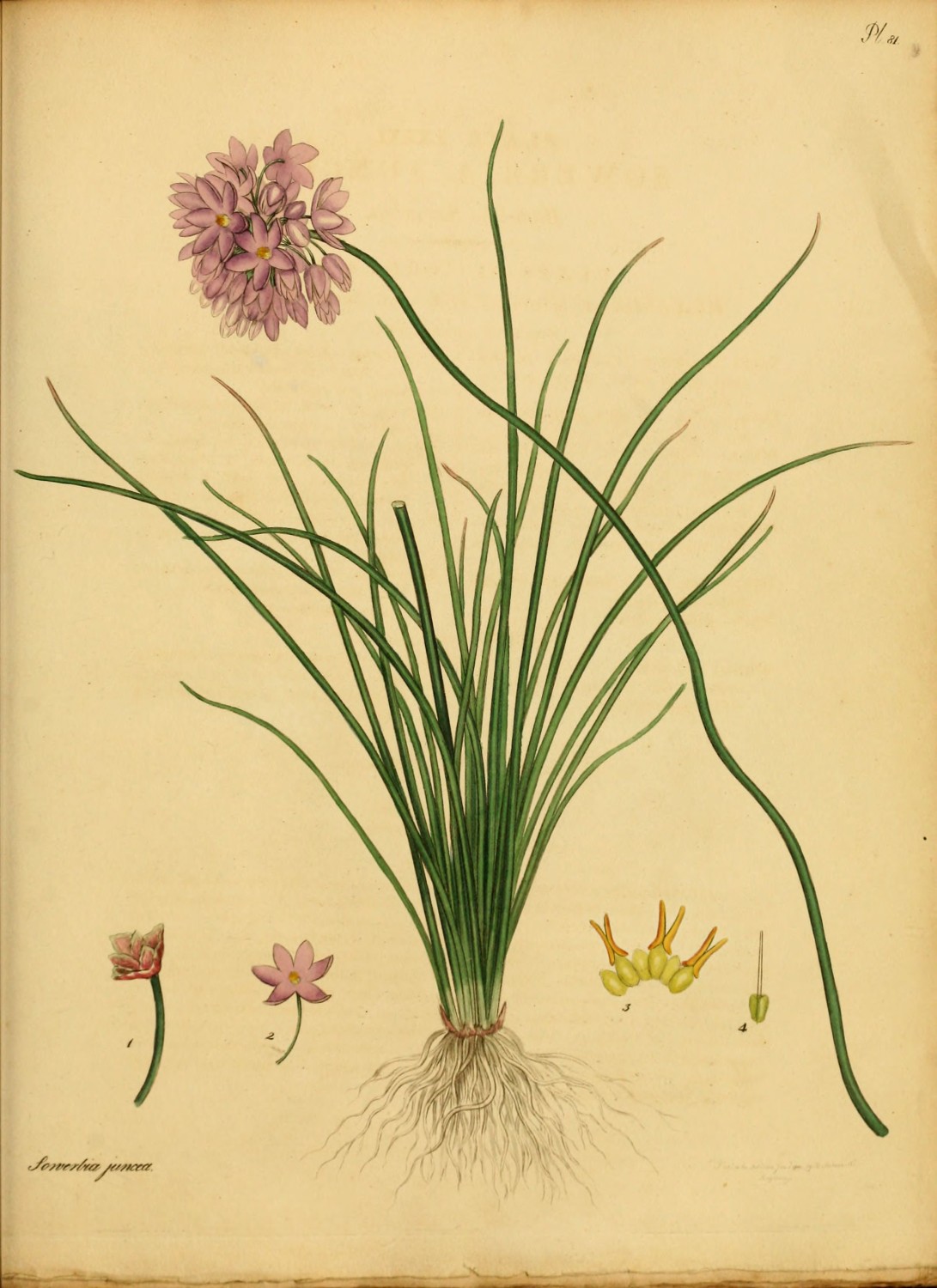
Volume 2 — PLATE LXXXI. SOWERBIA JUNCEA. Rush-like Sowerbia.
Reading edition
CLASS VI. ORDER I.
HEXANDRIA MONOGYNIA. Six Chives. One Pointal.
GENERIC CHARACTER.
Calyx. Involucrum hexaphyllum, multiflorum; foliolis erectis, scariosis, persistentibus.
Corolla. Petala sex, infera, persistentia; laciniis ovatis, concavis.
Stamina. Filamenta sex, sub-globosa, carnosa, germen cingens; ex quibus tria biantherifera, sterilibus tribus interstinctis. Antheræ geminæ, lineares, erectæ.
Pistillum. Germen superum. Stylus filiformis, longitudine staminum. Stigma simplex.
Pericarpium. Capsula obtusetrigona, oblonga, trilocularis, trivalvis.
Semina plura, angulata.
Empalement. Fence six-leaved, containing many flowers; the small leaves are upright, skinny, and permanent.
Blossom. Six petals, beneath and remaining; segments egg-shape, and concave.
Chives. Six threads almost round, fleshy, surrounding the seed bud; of which three bear two chives, each parted by three sterile ones. Tips double, linear, and upright.
Pointal. Seed-bud above. Shaft thread-shaped, the length of the chives. Summit simple.
Seed-vessel. Capsule bluntly three-sided, oblong, three-celled, three-valved.
Seeds many, angular.
SPECIFIC CHARACTER.
Sowerbia, foliis teretibus, mucronatis; scapo nudo, flexuoso; umbella globosa; floribus petiolis longissimis.
Sowerbia, with cylindrical leaves pointed at the ends; flower-stem naked and crooked; the umbel globular; flowers with very long foot-stalks.
REFERENCE TO THE PLATE.
1. The Fence. 2. A Blossom complete. 3. The Chives expanded. 4. The Pointal.
The very great resemblance this plant bears in habit, to some species of the garlick and rush, led us, at first sight, to consider it of one of those Genera: but as Dr. Smith has in the fourth Volume of the Linn. Trans. p. 220, constituted it a new genus, from the construction of the chives, we make no scruple to follow such good authority. It is named after Mr. James Sowerby, so well known for his numerous botanical engravings, as attached to different works; but especially, for his excellent coloured plates of English plants. Messrs. Lee and Kennedy of Hammersmith, were the first, who raised this plant from seeds, received in 1792 from Botany Bay. Our drawing was taken in May 1798, the first time it flowered there; it is the full size of the plant, the flower-stem cut off, it being twice the length of the leaves. There is no smell to any part of the plant; but nevertheless, it is very desirable in the greenhouse, from the character of the flowers, which retain their colour with little change, till the seeds are perfected. To increase it, the roots may be parted early in spring, and should be planted in peat earth.
PLATE 81