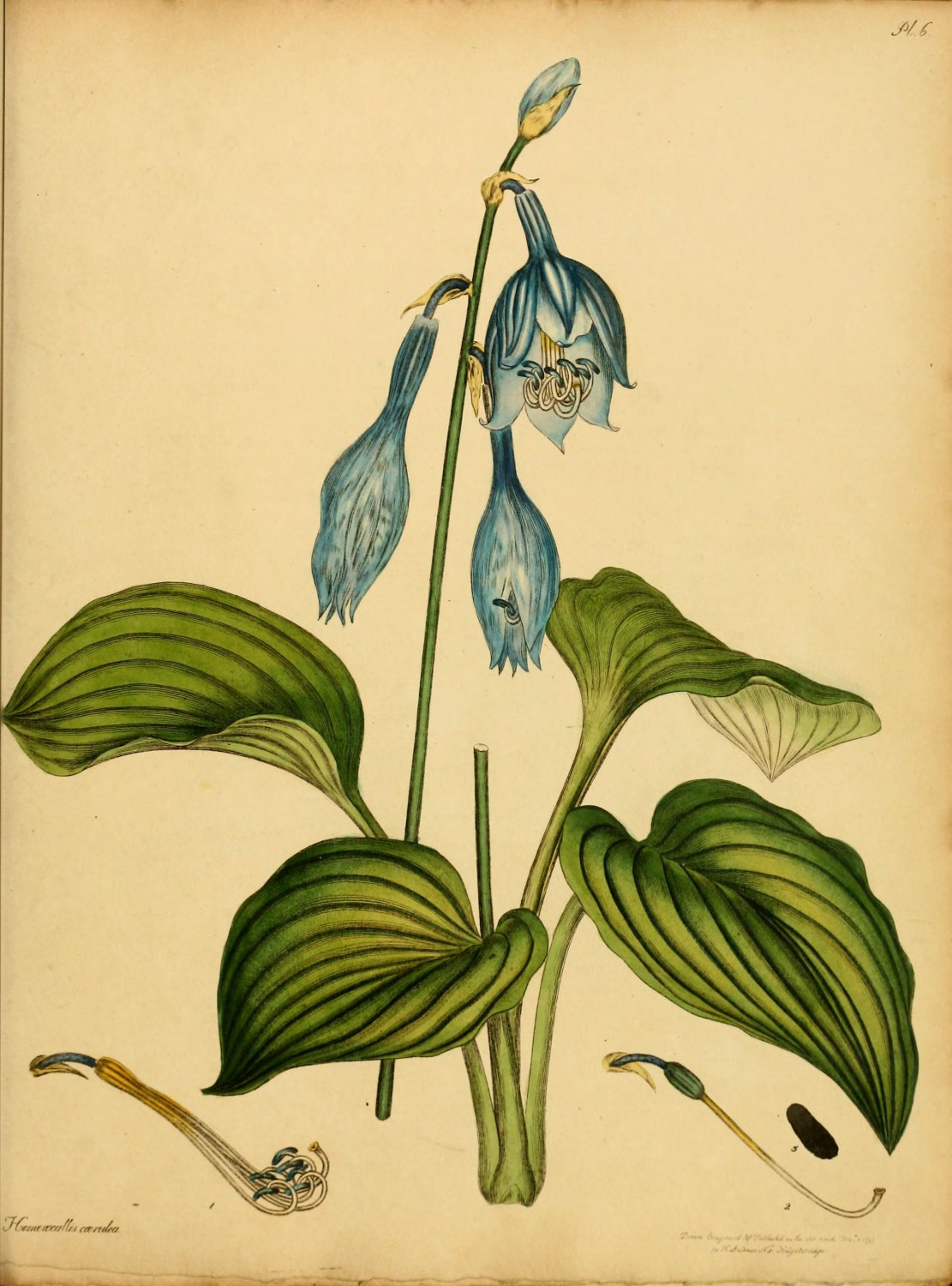
Volume 1 — PLATE VI. HEMEROCALLIS CÆRULEA. Blue Day Lily.
Reading edition
CLASS VI. ORDER I.
HEXANDRIA MONOGYNIA. Six Chives. One Pointal.
GENERIC CHARACTER.
Calyx. Nullus.
Corolla, sexpartita, infundibuli-campanulata.
Stamina. Filamenta sex, subulata, longitudine corollæ, declinata; superiora breviora. Antheræ oblongæ, incumbentes, assurgentes.
Pistillum. Germen sulcatum, superum. Stylus filiformis, longitudine et situ staminium. Stigma obtuse-trigonum, assurgens.
Pericarpium. Capsula trigona, trilocularis, trivalvis.
Semina plurima, subrotunda.
Empalement. None.
Blossom, has six segments, of a funnel bell-shape.
Chives. Six awl-shaped threads, the length of the blossom, bent downwards; the upper ones the shortest. Tips oblong, fixed by their sides, and turned up at the ends.
Pointal. Seed-bud furrowed, and above. Shaft thread-shaped, of the length and position of the chives. Summit bluntly three-cornered, turned up at the point.
Seed-vessel. Capsule three-sided, three cells, three valves.
Seeds many, nearly round.
SPECIFIC CHARACTER.
Hemerocallis, foliis cordatis, petiolatis; corollis cæruleis.
Day Lily, with leaves that are heart-shaped, and have foot-stalks; the blossoms blue.
REFERENCE TO THE PLATE.
1. The Chives, and Pointal, as placed in the Blossom. 2. The Seed-bud, Shaft, and Summit. 3. A Seed of the shape and size when ripe.
The variety of character exhibited in this new species of Hemerocallis, so different from its congeners, in foliage, flower, and seed; would almost induce us to think like Gærtner, a generic division necessary; if we were not withheld, by that strong rule of Linnæus, (from which, it will be a leading feature of this work, not to swerve) not to increase the number of genera, but where absolutely necessary. This species, as well as a white variety, which has been figured by Kæmpfer; and continued since him by Welldenow, in his new Species Plantarum, under its present denomination; is a native of China, and introduced to our gardens from thence by G. Hibbert. Esq. of Clapham, from whose most extensive and beautiful collection this specimen was taken. It is as yet cultivated as a hothouse plant, where it flowers in the spring months, perfecting its seeds: perhaps when better known, it may be found, like many Chinese plants, to bear our climate. It is propagated as well by parting its roots, as from the seeds.
PLATE 6