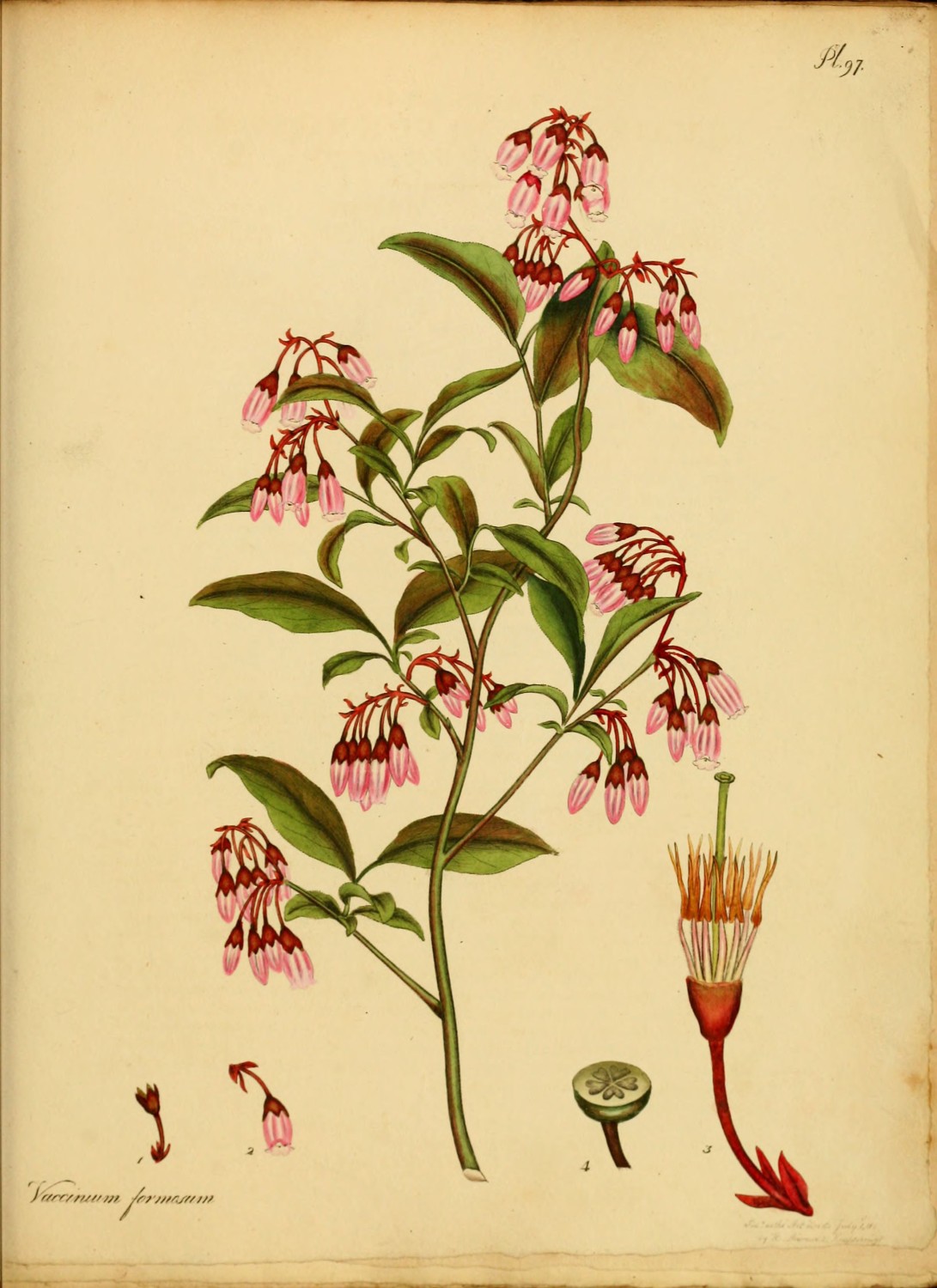
Volume 2 — PLATE XCVII. VACCINIUM FORMOSUM. Red-twigged Whortle-berry.
Reading edition
CLASS VIII. ORDER I.
OCTANDRIA MONOGYNIA. Eight Chives. One Pointal.
ESSENTIAL GENERIC CHARACTER.
Calyx superus. Corolla monopetala. Filamenta receptaculo inserta. Bacca quadrilocularis, polysperma.
Cup superior. Blossom of one petal. Threads fixed to the receptacle. A berry with four cells, and many seeds.
See Vol. I. Pl. XXX. Vaccinium Arctostaphyllus.
SPECIFIC CHARACTER.
Vaccinium racemis pedicellisque bracteatis; foliis integerrimis, oblongis, acutis, glabris; calycibus adpressis; corollis sub-cylindraceis, costatis; stigma sub-exserta; stamina decem.
Whortle-berry with floral leaves on the branch part of the bunch, as well as on the partial foot-stalks; leaves quite intire, oblong, pointed, and smooth; cups pressed to the blossom; blossoms nearly cylindrical, and ribbed; summit just without the blossom; ten chives.
REFERENCE TO THE PLATE.
1. The Blossom and Cup. 2. The Chives and Pointal, magnified. 3. The Seed-bud a little advanced, with the Cup upon it. 4. A nearly ripe Berry, cut transversely, magnified.
From the number of different new and old known species, of this genus, which we have been enabled to examine this spring; and of which drawings have been made, (a figure from one of them being intended to be given in each successive No. till they are finished;) we are more fully confirmed, in what was asserted in a former part of the work, that V. Arctostaphyllus, with the greater part of those plants, now known as Vacciniums, should be placed in Decandria. It is true, a certain latitude has been given by Linnæus, in an observation on the genus, by allowing, that a fourth in addition to the usual number is frequently found, in the different parts of the flower. But when so essential a part of the fructification is, with a very few exceptions, constant through a numerous genus, we cannot but think, in a system, founded chiefly on that basis, that in such case, the mere character of the fruit should give way to first principles; and that those with ten chives should be placed to Andromeda. Or, if the distinction of a dry, from a moist capsule, should be thought of sufficient weight, on which to form a new genus, those species, with ten chives, and berries, might be so arranged. Indeed, the difference in the general habit, of those with ten, from those with eight chives, would well warrant such an alteration. But such a change we have declined making, upon the grounds we have, and are determined to pursue; not to alter any established name, if even a little erroneous; but only to point out the error, or the apparent necessary alteration.
This species of Whortle-berry was first introduced, (according to the Kew Catalogue,) in 1770, by Mr. William Young, from N. America; and is consequently hardy enough to bear the severity of our common winters. It should be planted in sandy peat earth, on a dry, sheltered border. It is propagated by layers, which should be put down in spring, and taken off the succeeding summer. The leaves of this species are deciduous, when planted in the open ground; but, if kept in the greenhouse, where it will be found very ornamental, it becomes an evergreen. Our figure was made at the nursery, Hammersmith, in May this year.
PLATE 97