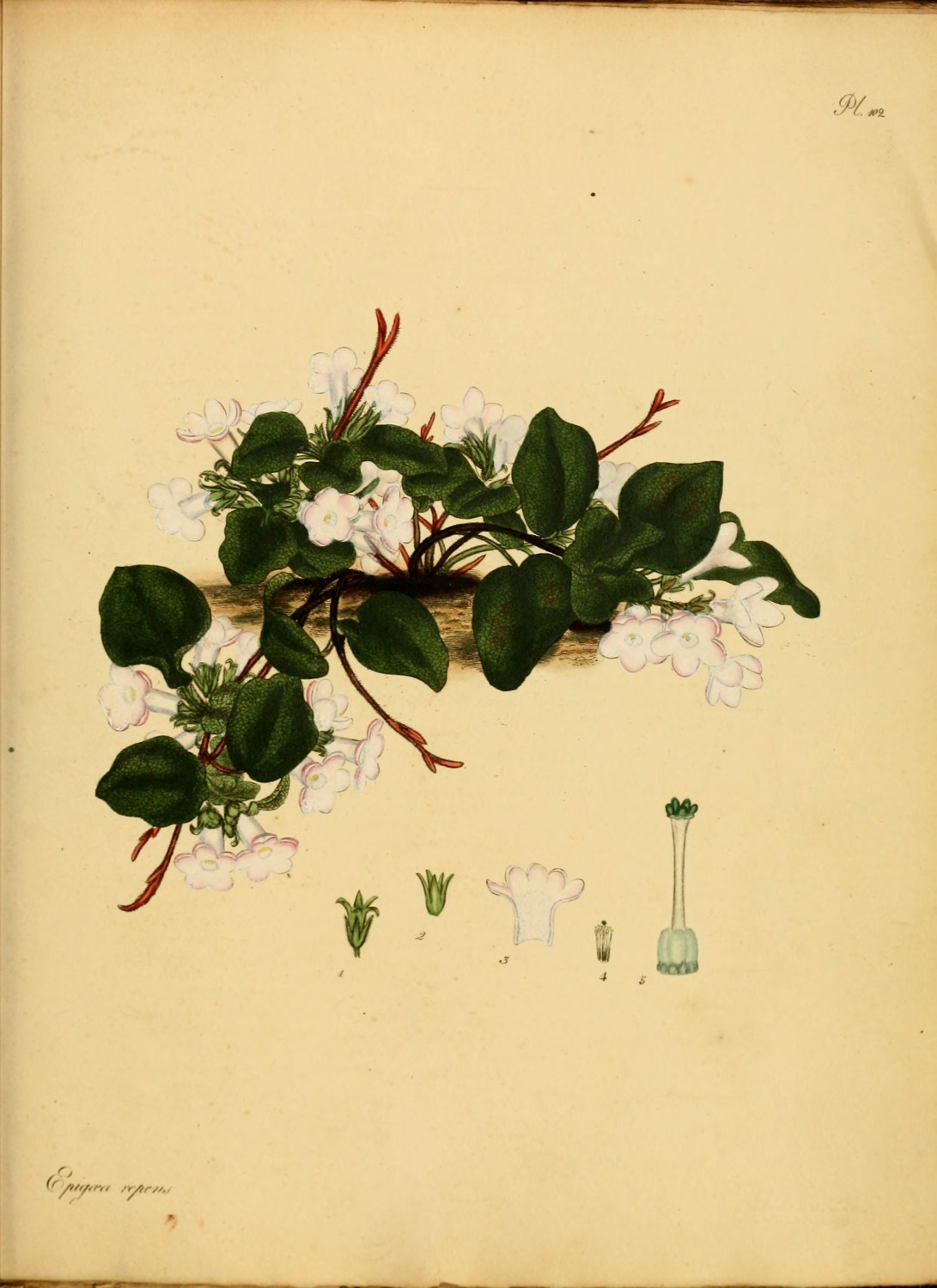
Volume 2 — PLATE CII. EPIGÆA REPENS. Creeping Epigæa.
Reading edition
CLASS X. ORDER I.
DECANDRIA MONOGYNIA. Ten Chives. One Pointal.
GENERIC CHARACTER.
Calyx. Perianthium duplex, approximatum, persistens.
P. exterius triphyllum; foliolis ovato-lanceolatis, acuminatis; exteriore majore.
P. interius quinquepartitum, erectum, exteriore paulo longius; foliolis lanceolatis, acuminatis.
Corolla monopetala, hypocrateriformis; tubus cylindricus, intus hirsutus; limbus patens, quinquepartitus, lobis ovato-oblongis.
Stamina. Filamenta decem, filiformia, longitudine tubi. Antheræ oblongæ, acutæ.
Pistillum. Germen globosum, villosum. Stylus filiformis, longitudine staminum. Stigma obtusum, subquinquefidum.
Pericarpium. Capsula sub-globosa, depressa, pentagona, quinquelocularis, quinquevalvis.
Semina plurima, subrotunda.
Receptaculum magnum quinquepartitum.
Empalement. Cup double, close together, and remaining.
Outer cup three-leaved; leaflets between lance and egg-shape, pointed; the outer one the largest.
Inner cup of five divisions, upright, a little longer than the outer; leaflets lance-shaped and pointed.
Blossom one petal, salver-shaped; tube cylindrical, hairy within; the border spreading with five divisions, the segments of an oblong egg-shape.
Chives. Ten thread-shaped threads the length of the tube. Tips oblong, and tapered.
Pointal. Seed-bud globular and hairy. Shaft thread-shaped, the length of the chives. Summit blunt, and slightly five-cleft.
Seed-vessel. Capsule nearly globular, flattened, five-sided, five cells, and five valves.
Seeds many, roundish.
Receptacle large, of five divisions.
SPECIFIC CHARACTER.
Epigæa caulibus procumbentibus; foliis cordato-ovatis, integerrimis, reticulatis; corollis hypocrateriformibus.
Epigæa with stems that lay on the earth; leaves between heart and egg-shape, quite entire, and netted; blossoms salver-shaped.
REFERENCE TO THE PLATE.
1. The two Cups of the Empalement. 2. The inner Cup, disengaged from the outer. 3. A Blossom cut open, to shew its hairy interior. 4. The Chives and Pointal, as they stand in the Blossom. 5. The Pointal, (magnified).
The Creeping Epigæa is the only species of the genus yet in Britain; it was first introduced by P. Collinson, Esq. in 1736, from N. America; where it is found in most parts, from Virginia, as far north as Canada. The flowers of this plant are extremely fragrant, and are produced from March till May. Hitherto, very few situations have been found congenial to its cultivation, or growth; indeed, so subject is it to perish from the moisture, or changeableness of atmosphere in our winter months, to which it is not subject in its native clime, being during that season covered with a deep snow; that unless an occasional supply had not been procured from America, the plant must, long ere this, have been lost to us. The soil which appears best adapted for its preservation, is a light sandy loam: if planted in the open air, it should have a sheltered situation, on a dry border; but the most likely mode to preserve it, is by keeping it as a greenhouse plant. It is with difficulty increased by cuttings, but may be divided at the root, with success, in March. Our figure was made at the nursery of Mess. Lee and Kennedy, Hammersmith, this year, in the month of April.
PLATE 102