THE BOOK OF NATIONS Geographical, Historical, Descriptive
Reading edition
EXTINCT NATIONS OF THE PAST
CHIEF HISTORICAL PEOPLES: Egyptians—Babylonians—Assyrians—Hebrews—Phœnicians—Medes and Persians—Hindus—Greeks—Romans
PROGRESS OF HISTORICAL GEOGRAPHY AND DISCOVERY, B.C. 3800 TO THE PRESENT, WITH 16 MAPS
THE WORLD’S GREATEST EXPLORERS, B.C. 1400 TO 1917 A.D.
COMPARATIVE OUTLINE HISTORY OF ANCIENT NATIONS, B.C. 5000 TO 843 A.D.
DESCRIPTIVE GEOGRAPHY, HISTORY AND GOVERNMENT:
The Spell of Egypt: Ancient and Modern
The Babylonian-Assyrian Empires
The Hebrews and the Holy Land
The Phœnicians: First Nation of Colonizers
The Medo-Persian Empire
The Greeks: Glory of the Ancient World
Rome: Mistress of the World
The Saracen Empire: Its Fanaticism, Art and Learning
The Germanic Empire of Charlemagne
LIVING NATIONS OF TO-DAY
COMPARATIVE OUTLINE HISTORY OF MODERN NATIONS
TRANSITION PERIOD FROM THE ANCIENT TO THE MODERN
GEOGRAPHICAL AND HISTORICAL DEVELOPMENT OF THE GREAT POWERS: Great Britain—France—Germany—Italy—Austria-Hungary—Russia—United States—Japan
THE LESSER MODERN NATIONS: In Europe, Spain and Portugal—Scandinavia (Norway, Sweden, Denmark)—The Netherlands—Switzerland—The Balkan States (Bulgaria, Roumania, Turkey, Greece, Servia); In Asia, China, Persia, Turkey; In America, Brazil—Argentina—Chile—Mexico—Canada
DICTIONARY OF HISTORY AND GOVERNMENT, including Great Wars, Great Battles, Dynasties, Rulers, Historic and Literary Shrines, Allusions, etc.
HISTORICAL CHARTS AND TABLES, MAPS AND PLANS
HISTORICAL GEOGRAPHY OF THE WORLD Showing its Territorial Growth Due to Successive Discoveries
The Known World about 3800 B. C.
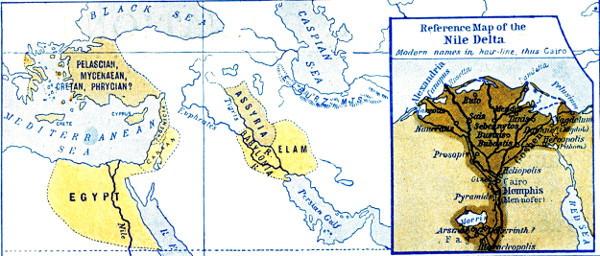
Large map (339 kB)
Mycenean Greece and the Orient about 1450 B. C.
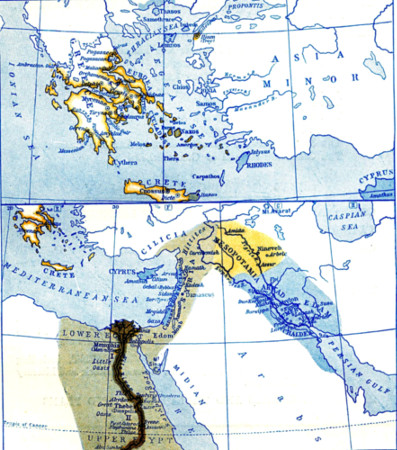
Large maps (488 kB)
THE BOOK OF NATIONS
We shall perhaps gain the best idea of the gradual expansion of the world to-day if we go back to the earliest times of which we have any definite historical records, and from that as a starting point, picture to ourselves the world at important epochs as it was divided among the more civilized nations. In spite of revolutions and the rise and fall of nations, the course of history has been continuous. The periods of history are not separated by gaps or breaks, but really merge gradually one into another. Bearing this in mind, the general history of the world may be viewed in two great divisions—ancient and modern. Ancient history begins with the dawn of civilization, and traces the progress of mankind among those nations which have now ceased to exist—or at least have ceased to contribute anything to the world’s progress. Modern history, on the other hand, deals with the origin and growth of those nations which still exist and are working out the problems and ideals peculiar to their own national life.
THE ANCIENT EXTINCT NATIONS
In the Oriental world we see the beginnings of civilized life—the first successful efforts of man to subdue the earth and to utilize the resources of nature; the beginnings of science and of a well-defined written language; the first evidences of architectural skill in the construction of great buildings; and the first marked tendency in the direction of great empires and of centralized governments. The chief nations may be summarized as follows:
Egyptians.—One of the earliest civilized nations—the great representative of the Hamitic race—developed apart—were not a conquering or aggressive people—wonderful builders in the massive style—made great progress in mechanical arts, and some advances in science—government a monarchy restricted in authority by law, custom, and powerful priesthood—religion a nature-worship—popular worship the adoration of animals—an artistic, industrious and peculiar nation—always wonderful and interesting to foreigners—-did not greatly influence others.
Babylonians.—As ancient a race in civilization as the Egyptians—partially of Tartar race, mainly Semitic—made great progress at an early date in science—reached a high pitch of power and civilization—known to us, in great measure, from ruins with inscriptions in cuneiform writing—invented permanent system of weights and measures—great in astronomy—the Chaldæan priests developed into a caste of learned men, continuing (in the later Babylonian and Persian empires) long after extinction of their own nation as an independent power.
Assyrians.—A Semitic people—warlike and conquering race—great in architecture and sculpture—very wealthy and luxurious—empire extended over Asia Minor (east of river Halys), Syria, Phœnicia, Palestine, most of Egypt, Media, and countries on Tigris and Euphrates to Persian Gulf—artistic workers in glass, metals, gems—rule despotic over loosely connected nations.
Babylonians (Later kingdom).—A Semitic people—as a political power ruled for only eighty-seven years, 625-538 B.C., from end of Assyrian power to conquest by Persians under Cyrus—were a commercial and luxurious race—city of Babylon emporium for trade between eastern Asia and western Asia, Egypt and Europe—great in manufactures of woven stuffs and gem-engraving.
Hebrews.—A pure Semitic race—little influence on political history of antiquity—distinguished by their worship of one God, and for the Scriptures transmitted to future ages—a great monarchy under David and Solomon, then declined—a non-artistic, unscientific nation in ancient history.
Phœnicians.—A pure Semitic people—greatest commercial and colonizing race of early times—distinguished as transmitters of civilization from East to West—never formed one great independent state—several independent cities, sometimes in alliance, sometimes hostile—Tyre and Sidon famous for dyes, glass-making, embroideries, brass-work, weaving of cloth in linen and cotton, ship-building, mining—developers of alphabet still used by modern nations—religion a sensual worship—a crafty, money-making people—Carthage was the greatest of all the Phœnician colonies.
Medes and Persians.—Pure Aryans in race—warlike people, great in cavalry and as archers—Median monarchy ended 558 B.C., then Persian monarchy arose—Persians a lively, brave, poetical people, simple in life at first, after their great conquests degenerated into luxury—more like Europeans in civilization than any other Asiatics—were the great ruling power in Asia from time of Cyrus to conquest by Alexander the Great (558-331 B.C.)—first Asiatics that tried to conquer in Europe—signally failed—empire extended over all western Asia, and over Egypt—religion recognized two principles, a good and a bad spirit—had taste in architecture—no literature of importance.
Hindus.—Until recent times almost isolated from the western world—unwarlike, dreamy specimens of Aryan stock—early advance in civilization—a rich and remarkable religious and poetical literature in Sanscrit, one of the oldest of the Indo-European tongues—first known in real history on invasion by Alexander the Great, 327 B.C.—progress greatly checked by rigid system of castes—government of native princes thoroughly despotic—no free aspirations or political instincts in the people—popular religion grossly superstitious—Brahminism (a philosophic deism), creed of the educated, along with Mohammedanism, introduced by conquest in thirteenth century A.D.—skilled at an early period in mathematics, manufactures, architecture—a tasteful, intelligent, but unpractical, non-historical people.
THE ASSYRIAN EMPIRE AND THE REGION ABOUT THE EASTERN MEDITERRANEAN, 750-625 B. C.
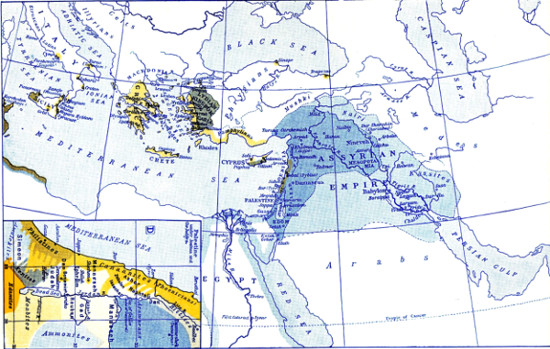
Large map (482 kB)
Greeks.—In the Greek world we see a finer type of humanity: a versatile intellect, expressed in exalted works of philosophy and literature; a refined æsthetic taste embodied in the most beautiful specimens of architecture and sculpture; and a strong love of freedom, shown in the development of democratic institutions.
Romans.—In the Roman world we see a more practical genius and a more vigorous manhood; a great capacity for military and political organization; a broad sense of civil justice, expressed in an enduring system of law; a wide cosmopolitan spirit, capable of appropriating the ideas of other peoples—in short, a civilization which expressed the highest unity and broadest culture of the ancient world.
HISTORICAL GEOGRAPHY AND DISCOVERY
No intelligent knowledge of the historical nations is possible without a corresponding knowledge of their geography. The first and most important question that geography answers for us is where. Historical Geography answers both where and when? Where is Rome located? Where and when did the Babylonian Empire exist?
History not only answers the questions when and who but, in addition, gives us a consecutive account of the doings of civilized mankind in their progress toward the most valued and elevating of social and political blessings. It deals rather with the life of nations than with races of men; and its special function is to sketch the career and describe the conditions of those great nations whose ideas and institutions, or whose achievements in politics, war, literature, art and science, were remarkable in their own epoch, or, by influencing other nations, helped to make the civilized world what it is now.
WHERE THE FIRST CIVILIZATIONS BEGAN
The first scenes in the drama of human history are laid in two remarkable river valleys—the one formed by the Euphrates and the Tigris in western Asia, and the other formed by the river Nile in northeastern Africa. The Euphrates and the Tigris poured their waters into the Persian Gulf, the Nile flowed north into the Mediterranean Sea. Both these valleys were possessed of a rich, alluvial soil, that favored the early development of industrial life among their dwellers. Along the lower courses of the Asiatic rivers were the Babylonians, and later, by conquest, the Chaldeans. In the upper reaches were the Assyrians. On the banks of the Nile were the Egyptians. Such, according to our present knowledge, is the first historic zone in which the real history of the civilized world began.
In the basins of the Tigris and the Euphrates were several distinct territories: Armenia, or the mountainous region between Asia Minor and the Caspian Sea; Assyria proper, between the Tigris and the Zagros Mountains; Babylonia, the great plain between the lower courses of the Tigris and of the Euphrates, and extending westward to the Syrian Desert; Chaldæa (in the narrower sense, as a province of the Babylonian Empire), west of the Euphrates, at the head of the Persian Gulf; Mesopotamia, between the middle courses of the Tigris and the Euphrates; Elam or Susiana, east of the Tigris, and at the head of the Persian Gulf.
THE REGION WEST OF THE EUPHRATES
West of the Euphrates we have the peninsula of Asia Minor which later contained the important Lydian nation, and many Greek colonies connected with later history; Syria, on the eastern shore of the Mediterranean Sea, divided into three distinct parts,—Syria proper; Phœnicia, or the strip of coast between Mount Lebanon and the sea; and Palestine, south of Phœnicia; the peninsula of Arabia, extending southeastward, and having little to do with ancient history.
THE HISTORIC PLATEAU OF IRAN
East of the Zagros Mountains lay Media and Persia proper,—Media, northeastward, towards the Caspian Sea; and Persia, on the tableland of Iran stretching southward to the Persian Gulf. The latter absorbed the great monarchies of Babylonia and Assyria in the sixth century B. C., and extended almost from the Indus to the Mediterranean, Ægean, Euxine, and Caspian Seas, when it had reached the summit of its power.
THE FAR DISTANT ORIENT
Farthest to the east was ancient China, drained by two great rivers, the Hoang and the Yangtze. Its remote situation and the barriers on the west formed by the spurs of the Himalayas, combined to make this land the most isolated of the civilized lands of the Old World.
To the west of China lies India, also drained by two great rivers, the Indus and the Ganges, which rise among the slopes of the Himalayas and flow in different directions to the sea. These two countries—China and India—stood nearly alone in ancient times, separated from the peoples of western Asia by the wide, dry plateau of Iran, and hence these countries did not exercise a great influence upon the ancient world, or come into historical view until much later.
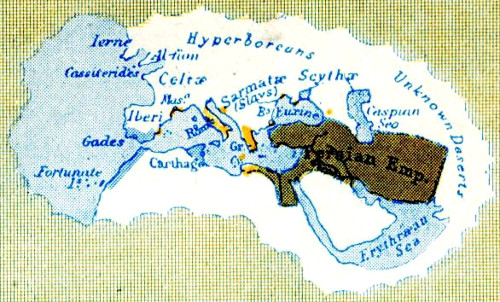
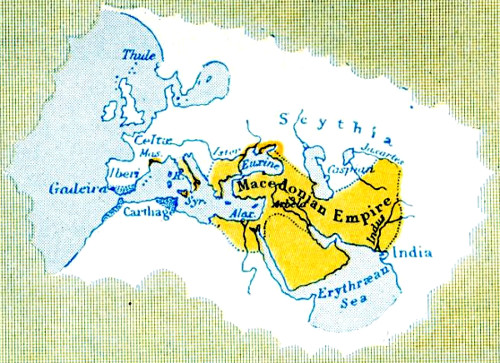
THE KNOWN WORLD—ABOUT B.C. 450.
ABOUT B.C. 325
ABOUT A.D. 300
EGYPT WAS A GIFT TO MANKIND FROM THE NILE
The Nile is one of the longest rivers of the world; rising in the distant lakes of central Africa, it pursues a course of about four thousand miles on its way to the sea. But the part of the valley occupied by the Egyptian people extended only about six hundred miles from the mouth of the river—to the rapids called the “first cataract,” on the borders of Ethiopia. The valley is inclosed on either side by low ranges of mountains, which furnish stone suitable for building; and it should be noticed that this abundant supply of stone gave to the Egyptians a great advantage over the Babylonians, who were obliged to use the less durable materials, clay and brick, for building.
The valley of the Nile is only about seven or eight miles in width—except at the delta, where it spreads out into an open plain. Not only has this valley been cut by the Nile, but its fertility was anciently due to the annual overflow of the river, for the climate is dry and rain rarely falls. This river was also the great highway of Egypt, affording a ready means of communication from one part of the country to another. The fertile soil of Egypt was especially suitable for the raising of vegetables and grain. Rice, oats, barley, and wheat grew there in great abundance, so that the country became the granary of the ancient world.
THE DIVISIONS OF UPPER AND LOWER EGYPT
Egypt may be divided into two principal parts. (1) The lower, or northern, part includes the extended plain about the delta, where the soil is most fertile, and where the earliest civilization was developed. It was here that the first empire was established, with its center at Memphis. (2) The upper, or southern, part includes the remainder of the valley as far as the “first cataract.” This formed a second area of civilization, with its center at Thebes. In either direction from these two centers the banks of the Nile became dotted with a multitude of towns and villages, each one of which was a seat of industry and art.
THE MOST HISTORIC SEA IN THE WORLD
But the most important center of ancient civilization was the Mediterranean Sea. This body of water formed the world’s greatest highway, and was possessed successively by the Phœnicians, the Greeks, and the Romans, who made it an important factor in the development of a wider world commerce and a higher world culture.
Known World about B. C. 450.—About this period the decadence of the great Persian Empire had already begun. Greece was becoming a strong power, and had flourishing colonies all round the Mediterranean and Black Seas, at Syracuse in Sicily, on the southern shores of Italy, at Massilia (the present Marseilles), on the coast of Spain, at Cyrene in North Africa, at Cypress, at Byzantium (Constantinople), and at many points between these.
Carthage had already risen from its condition of a colony to that of a great independent state, which held practically all the north African coast. The Carthaginians had come in contact with the Greeks in Sicily, and in their first trial of strength the Carthaginian army under Hamilcar had been defeated. Rome had been founded for perhaps three hundred years. Already the Romans had taken the lead in Latium, and the Republic was in constant warfare with its neighbors on all sides—the southern Etruscans, the Volscians, and the Æqui.
Thus the great events of this period were clustered round the Mediterranean shores. As yet the unknown peoples of the west and north beyond these were vaguely called the Hyperboreans by the Greeks, “the dwellers behind the north wind;” and eastward, beyond Persia and the Indies, Herodotus could only mark “unknown deserts” on his map.
World About B. C. 325.—This little map represents the short-lived Macedonian empire of Alexander, at the date of his return to Persia, when his power was at its height. To his victorious career the world owed a vast increase of geographical knowledge; all eastern Asia had been unveiled, and the road to India, with its boundless wealth, was disclosed to Europeans.
Westward also, about Alexander’s time, the geography of the Greeks was greatly extended by Pytheas, a bold navigator of the Greek colony of Massilia (Marseilles), who, from Gadiera (Cadiz), coasted Iberia and the country of the Celts (France), and reached Britain. He followed the southern and eastern shores of the islands, and, after six days’ sail from the Orcades (Orkney Islands), discovered Thule, a land of fogs in the north, which has been variously identified as the Shetland Islands, the Norwegian coast, or even Iceland.
In Italy the Romans were continuing their struggles with the neighboring nations. The whole of southern Etruria had yielded to their supremacy, and was kept in check by Roman garrisons; while towards the south, at this time, a terrible conflict was in progress with the heroic Samnite highlanders. Of Sicily the Carthaginians held the western, the Greek colonists the eastern half, a brief lull having taken place in the fierce wars which had been waging between these powers for the possession of the island, during which the prosperity of the great fortified city and seaport of Syracuse was rapidly reviving.
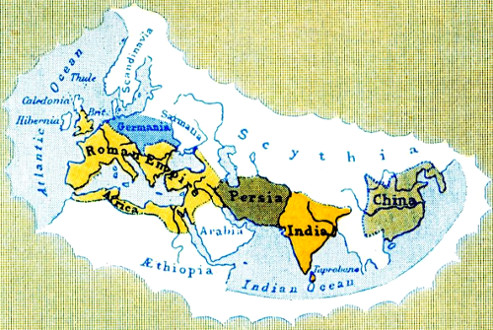
World About A. D. 300.—Almost six hundred years has elapsed, and the Great Roman Empire is already in its decline. A special map of the Roman Empire at its height will be found later on. This little map represents the empire in the time of Constantine.
Under Constantine the Great two great changes took place—the introduction of Christianity as the religion of the State, and the transference of the seat of government from Rome to Byzantium (A. D. 330), which was re-named after the emperor, Constantinople.
Persia at this time, under the Sassanian dynasty, attained a height of prosperity and power such as it had never before reached, and against it even the veteran Roman legions could gain no lasting laurels.
ABOUT A.D. 500
ABOUT A.D. 800
ABOUT A.D. 1000
In China authentic history begins with the Chow dynasty (1122-255 B. C.) when Confucius and Mincius flourished (600 B. C). In the next (Tsin) dynasty Shih Hwang Ti (221-209 B. C.) reduced the independent petty states, and built the Great Wall as a protection against the barbarous Hiong-non (Huns) or Tartars of the north. Shortly after the beginning of the Christian era the Chinese seem to have begun intercourse with the Parthians and to have known the Roman Empire as Ta-tsin; and about the time of Constantine’s establishment of his new capital the Chinese emperor’s court was fixed at Nanking, the southern capital.
The increase of geographical knowledge during the period in which Rome was spreading out its power in all directions could not fail to be very considerable. Already in the latter part of the first century B. C., a general survey of the Roman Empire had been begun by the collection and arrangement of the itineraries of the roads to places in the empire. One of these traces the main roads of all the region stretching from Britain to the mouth of the Ganges in India.
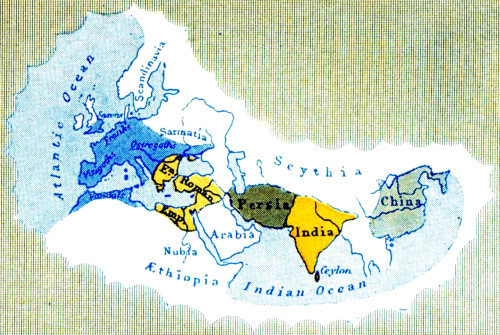
World About A. D. 500.—For more than two centuries prior to this map, the whole of northern Europe, had begun to pour forth wave after wave of barbarian hordes, against the Roman Empire. By the invasions of the tribes of Goths, Franks, Vandals, etc., the western emperors lost their power outside of Italy, and the empire itself ceases to exist in 476, when it is nominally joined to the Eastern Empire. The Vandals had established their rule along north Africa; the Visigoths ruled in Spain; the Ostrogothic monarchy of Theodoric the Great extended over Italy, France, and all the countries round the Alps as far as the middle Danube; and the Franks, under Clovis, had possession of the whole of Gaul between the Loire and Somme.
Persia, still under the energetic Sassanian dynasty, not only maintained its integrity as an empire, but had begun to repel the Roman or Byzantine power in Asia, and had added part of Armenia. Westward, however, the arms of the Byzantine Empire were triumphant, the reign of the Emperor Justinian having been rendered famous by the expedition of his great general Belisarius to Africa, where, after a campaign of two years, he completely overthrew the Vandals and led their king captive to Constantinople. In a second war, Belisarius wrested all southern Italy from the Ostrogoths, pursuing them northward to Rome and Ravenna, and thus began the re-conquest of the peninsula, which was completed by his successor, the imperial general Narses, after which the Ostrogoths disappear as a distinct nation.
At this time, under Khosru, the greatest of the great monarchs of the Sassanian dynasty, the Persian Empire stretched from the Red Sea to the Indus, and from Arabia far into central Asia.
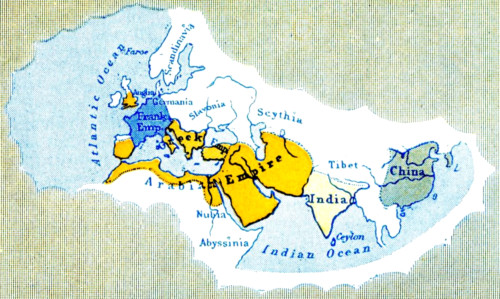
World About A. D. 800.—The end of this century finds three great empires in Europe and eastern Asia: the Mohammedan or Saracenic Empire, the Eastern or Byzantine Empire, and the Frankish Empire of Charlemagne. The Mohammedan Empire had spread itself out to central Asia and to Spain, and had already passed the zenith of its greatness. The dynasty of the Ommiades of Damascus had given place to that of the Abassides in the east, though a branch from it had set up an independent Califate at Cordova, in Spain. The Abbaside Haroun-al-Rashid, whose praises are sung by eastern poets, had his capital at Bagdad, on the Tigris, a city which had been founded by his predecessor in 762.
Charlemagne had consolidated and extended the Frankish Empire, received the ambassadors sent from the court of Bagdad to salute him, and had been crowned by the Pope at Rome. Irene, the mother of the Byzantine emperor, Constantine VI., had conceived the bold plan of uniting the east and west of Europe in one great empire, by marrying the Frankish emperor, a scheme which was frustrated by her overthrow and her banishment to the Isle Lesbos in the Ægean Sea (802).
Britain, so far as occupied by the Angles and Saxons, was divided into seven (or eight) little kingdoms, known as the Saxon Heptarchy.
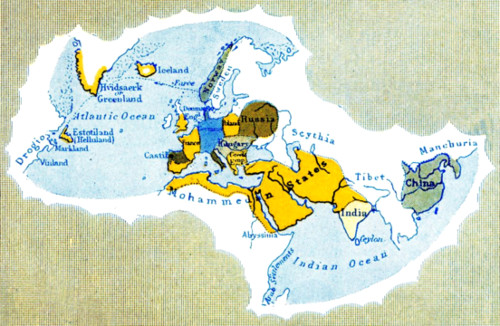
World About A. D. 1000.—Germany, or the Eastern Franks, becomes at this time the greatest power in Europe, uniting to itself Upper Italy and Lotharingia.
France, or the Western Franks, early in this century is invaded by the Norsemen or Normans,—bold seafaring adventurers from Denmark and other northern lands, from whom the name Normandy is derived. The kingdom of France, however, began in 987.
The Saracen Empire was divided at the beginning of this century into no less than seven independent califates, of which the most distinguished was that of the Fatimites. The Saracenic civilization in Spain is now at its height. By the end of the century the power of the Saracens in the East is of but little account politically.
The Magyars, or Hungarians, before the end of the century have established a strong kingdom in the southeast of Europe; and to the north the Slavonic states of Poland and Bohemia are planted.
Denmark, Norway, and Sweden are powerful kingdoms by the close of this century and England, now one kingdom, is engaged in struggles with the Danes.
The hardy Scandinavian seamen had pushed back the clouds of ignorance over the vast region of the north Atlantic, and had reached the shores of the American continent nearly five centuries before Columbus. About the year 994 an expedition under Leif, son of Erik the Red, set sail for this new country. The regions discovered were named Helluland (Slateland), supposed to be Labrador; Markland, or Woodland, probably Southern Labrador; and Vinland, a country named from the wild vine growing there, which some identify with Newfoundland, while others transfer it to the New England coast, opposite the island of Martha’s Vineyard.
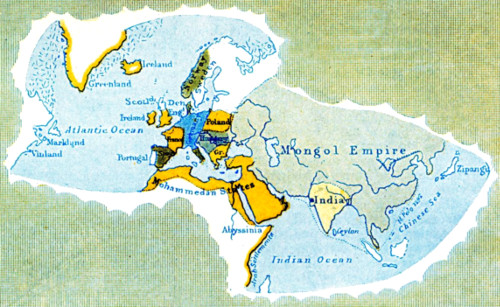
World About A. D. 1300.—Before the middle of the thirteenth century the vast Mongol Empire, under Ghengis Khan, had stretched out from China to Poland and Hungary, over all Asia except India and Asia Minor—an empire which far surpassed in extent any that had yet been known on the surface of the globe.
ABOUT A.D. 1300
ABOUT A.D. 1500
The great Mongol expansion forced the removal of the Ottoman Turks, who retreated from the steppes east of the Caspian to the mountains of Armenia. Othman or Osman, a chief of the tribe, on the destruction of the Seljuk power, obtained possession of Bithynia, attacked the Asiatic portion of the sinking Byzantine empire with success and founded there (1299) the subsequently great empire of the Ottoman or Osmanli Turks, as they are named from him.
In the course of his conquest Genghiz Khan had carried off multitudes of western Asiatics as slaves. Twelve thousand of these, mostly Turks and Circassians, were bought by the Sultan of Egypt (a successor of Saladin), who formed them into a body of troops. From being servants these well-armed slaves rose to be masters in Egypt, and placed one of their own number in the sultanate (1254), thus founding the Mameluke (or slave) dynasty in Egypt, which lasted for nearly three centuries, bringing the country again into great prosperity and power.
Thus, about the year 1300 the once great Mohammedan Empire had been restricted to its original seat, and to the western region of north Africa, all else having fallen into the hands of the Turks. The Calif of Bagdad had taken refuge under the protection of the Mamelukes of Egypt, retaining his spiritual power only; the Ommiade califate in Spain had long fallen.
The English, under Edward I., had incorporated Wales after ten years’ contest; Scotland was fighting for independence, led by Wallace and Bruce; and long wars engaged England and France, leading finally to a great increase in French territory and power. Denmark, Sweden and Norway were separate states. In central Europe, Poland and Hungary had been brought to the verge of ruin by the Mongol invasions, which had swept away for the time the divided principalities of Russia. In the south, the old Greek Empire was fast sinking through the assaults on it by the Turks.
The German Empire in this century both loses and gains territory, without material change.
Italy is still divided into independent commonwealths, which more and more fall under the power of princely families or tyrants.
In the Spanish Peninsula there are few geographical changes in this century, but Spain is steadily consolidating into a great power.
The Venetian, Marco Polo, the greatest of medieval travelers, passed seventeen years in exploring the kingdoms of Asia, and opened up to accurate knowledge not only the vast region of the central Asiatic continent, but also the disclosure of the existence of Japan, which he called Zipangu. While Venice opened up new paths to commerce towards the east, Genoa looked westward, sought to open up a new road to India by sailing through the Strait of Gibraltar and round the southern extremity of Africa. It was Genoese who first, in modern times, ventured upon the Atlantic; discovered the Canaries, Madeira, and the Azores; and who first felt their way along the west coast of Africa.
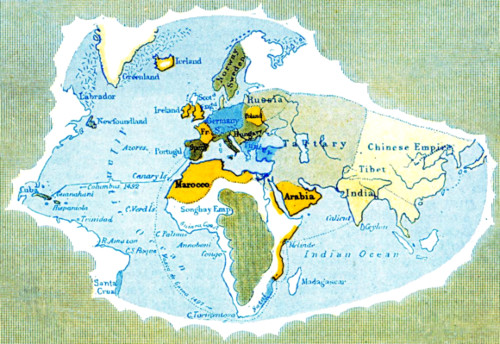
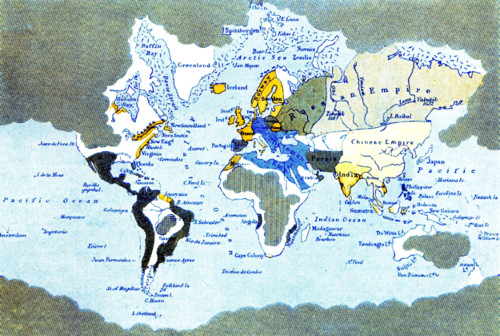
World About A. D. 1500.—Previous to this century the nations with which we have been concerned has been restricted to Europe, a little of western Asia, and a small part of northern Africa. An immense enlargement of these bounds now suddenly occurs in consequence of the application of the compass to navigation. From this time dates the period of greatest maritime enterprise and discoveries.
The Portuguese took the lead in bold projects of adventure by sea. The Cape of Good Hope was discovered and doubled by Bartholomew Diaz in 1487, and in 1498 the feat of reaching India by water was accomplished by Vasco da Gama, who, rounding the Cape of Good Hope, reached Calicut in Malabar.
The general excitement about maritime discovery among the Portuguese suggested to Columbus the bold plan of reaching India, not by way of Africa, but by steering to the west across the Atlantic. The result of his voyage was the final discovery of the American continents. India he did not reach, but discovered instead, the island of Guanahani or San Salvador, in 1492, the main continent being discovered a few years later (June 24, 1497) by John Caboto, or Cabot, a Venetian sailor.
In the far east China had recovered its independence under the Ming dynasty, and its supremacy was acknowledged over Mongolia and eastern Turkestan, though the states of Tonquin and Cochin China, in the southern peninsula beyond India, had assumed a political independence. Western Asia had been reconquered by Timur, or Tamerlane, of western Turkestan. The Ottoman Turks had extended their European territory to its widest limit over the ruins of the Greek Empire; and Russia had become a united kingdom under Ivan the Great, and threw off the Tartar yoke.
In western Europe, the Swiss mountaineers had secured their independence. France was recovering from the calamities inflicted on it by the English, who had all but lost their hold on the land. In the south the reaction of Christendom against Mohammedanism had begun. The Christian kingdoms of Spain and Portugal had driven back the Moors across the Straits into Africa, and had consolidated their strength over the whole Peninsula. The Moors in turn settled along the north African coast. Morocco at this time had been formed into a monarchy, and enjoyed great prosperity.
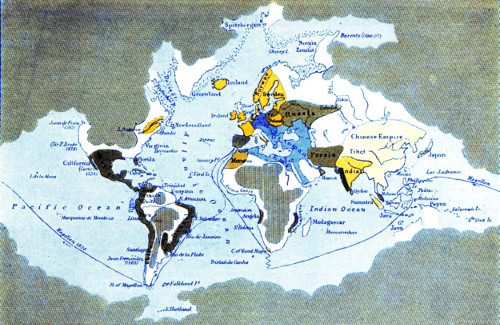
World About A. D. 1600.—Spain is the chief power at this time. Besides vast continental dominions in the New World, its European possessions comprised the whole of the Spanish Peninsula, the Netherlands and other lands of the House of Austria, the Sicilies, Sardinia, and Milan. But, by the revolt of the United Provinces of the Netherlands, Spain loses a considerable portion of her territory before the end of the century.
ABOUT A.D. 1600
ABOUT A.D. 1700
Large map top (466 kB) bottom (515 kB)
The German Empire continues, but more as a dignity than as an independent power. The emperors are uniformly chosen from the princes of the House of Austria, which now by its hereditary possession becomes one of the chief powers of Europe. In the person of the Emperor Charles V., who united the crown of Spain with the sovereignty of Austria, the imperial power reached its greatest extent.
France is engaged in wars civil and religious and foreign, but without much change of territory, except in America, where some colonies were established. England makes some attempts at colonization in America during this century, but the real settlements begin in the next.
Italy, during this period, is a battle-field of contention among the rival princes of Europe. The peninsula was made up of principalities and commonwealths, some of which were independent, but the most of which, during the greater part of this century, were under the dominant influence of Austria and of Spain. The northern provinces of the Netherlands throw off the yoke of Spain, and are united in a federal commonwealth. The union of Denmark, Norway, and Sweden ceases in the early part of this century, by the independence of Sweden, which now plays an important part in European history. Poland is an important state in this century, with extensive possessions.
The Turkish or Ottoman Empire is largely extended in this century by the annexation of Syria, Egypt, a great part of the northern coast of Africa, and the conquest of a large part of Hungary.
In Asia the Chinese Empire remained unshaken; Persia had again become an independent empire; the Mohammedan Moguls had begun to reign in northern India; the once great Tartar empire had been reduced to the states east of the Caspian. In the north, Russia was spreading eastward over Asia, and had come in contact with the Ottoman Empire, now expanding to its greatest extent in the South, and with Sweden in the northwest. The great Reformation had passed over Europe, separating its Catholic states of the south from the Protestants of the north, and giving rise to fierce wars and many political changes. Maritime discovery and adventure and commerce were being eagerly extended by the nations of western Europe. Four times the world had been circumnavigated—by the Portuguese Magellan, by the English Drake and Cavendish, and lastly by the Dutchman Van Noort. Spain had extended her conquests to Mexico, Peru, and Chile, which were now ruled by Spanish viceroys. The Portuguese had established themselves firmly on the African shores; their possessions and settlements in the East Indies included the Malabar coast of India, Ceylon and Malacca; and their traffic reached to all the islands of the Asiatic archipelago, to China and Japan.
The English and Dutch, after vainly seeking an independent highway to the northeast or northwest through the ice-fields of the Arctic region, had become formidable rivals of the Spaniards and Portuguese in their own lines, both in the West Indies and round the Cape of Good Hope to the eastward.
World About A. D. 1700.—In Europe, France under Louis XIV., now becomes the leading power, and makes great accessions of territory. England also becomes one of the important nations, and, besides being engaged in civil and foreign wars, was planting colonies in America and in India. Austria had increased her power in Italy and Hungary. The Spanish monarchy is broken up, and Spain sinks to an inferior position. Prussia has risen into prominence under the great elector, Frederick William. The United Provinces held a high place and had been engaged in a long struggle with France. Italy had fallen to a low condition. Savoy was slowly gaining in power, and Venice was engaged in wars with the Turks. Sweden was at the height of its power and possessions. Russia is rapidly rising, and Poland is declining. The Turks press forward into Austria, from which they are driven out, and make some important conquests in other parts; but their power is on the decline.
In Asia, this was the period at which the Mohammedan Empire in India was raised to its highest point of splendor and greatness by Shah Jehan, the “King of the World,” and by his son, the famous Aurungzeb, the crafty and ambitious “reviver of religion.” It was during these reigns that the English began to gain a hold on India.
Outside of Europe it cannot fail to be observed how completely the spread of knowledge on the outer borders of the known world was controlled by events which took place in western Europe. Chief of these was the gradual crippling and decay of the maritime supremacy of Spain and Portugal, and the rise of that of the Dutch and British into strength. Maritime enterprise had passed to Holland, England, and France.
In America the British dominion was extended by the formation of the Hudson Bay Company. In 1690 this fur company had built several forts and factories on the coasts, whence from time to time their operations extended inland.
The French also, after La Salle first descended (1682) the great river, Mississippi, “the father of waters,” invaded Spanish claims by settling in Louisiana, about the mouth of the great river, in 1699.
World About A. D. 1800.—In Europe France holds about the same position till near the close of the century, when the Revolution breaks out, and the republic makes large accessions of territory in the Austrian Netherlands, Savoy, Piedmont, and the islands of the Mediterranean. Through the very enormity of the excesses of the revolutionary period, the form of government soon gave way to a new constitution, known as the Directory, under which Napoleon Bonaparte came to the front as the central figure in the affairs of Europe. During these last years of the century the French Republic was engaged in constant wars with the various coalitions formed against it by the other powers. In the year 1799 the Directory came to an end, and the supreme control was vested in the hands of Napoleon, who was made First Consul.
ABOUT A.D. 1800
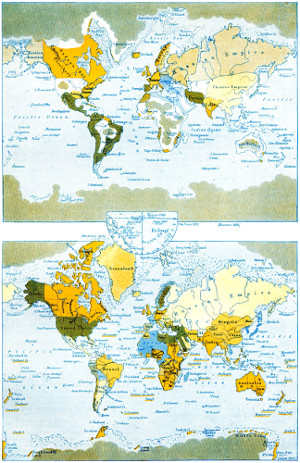
ABOUT 1915
Large map (558 kB)
Great Britain is engaged in foreign wars, and has lost a large part of her American colonies, which win their independence in 1783. The British dominion in India is greatly extended during this period. The scattered settlements of British merchants and of the East India Company, now became firmly established by the military achievements of Clive. The French and native troops were overthrown, and one after another the provinces of India were brought under English control. Spain rises very considerably in importance. The United Provinces become in the last years of the seventeenth century a dependency of France. The Turkish dominion, though with occasional successes, is on the decline. Prussia becomes an important European state under Frederick the Great. Austria is engaged in frequent wars, with somewhat diminishing power. The German Empire, though still in existence, is more a dignity than a power, its functions being wielded chiefly by the great kingdoms of Austria and Prussia. Russia, under Peter the Great, rises to a front rank among the states of Europe and makes large gains of territory.
In the latter part of the seventeenth century Poland disappears from the map of Europe, the territory being divided between Russia, Prussia, and Austria; and in 1795 Poland, as a kingdom, ceased to exist.
In America, the United States of America come into being as an independent nation in 1783.
France, at the beginning of the nineteenth century under Napoleon I., was the chief power in Europe. The battle of Waterloo finally overthrew the empire of Napoleon, and brought to an end the succession of wars which had lasted with little interruption for twenty-three years. By the terms of peace agreed upon by the Allies, the conquests of France were given up, and the boundaries of the European states re-established.
From the starting-point of this re-arrangement of the map of Europe we may now follow rapidly the subsequent changes of territory in each of the leading states of Europe which have given them the limits they occupy at the present day.
England rises to the front rank of European states, by her part in the Napoleonic wars. In the nineteenth century she made some small acquisitions of territory in Europe, and greatly extended her colonial empire.
The marked feature of the political movements in Europe in the last quarter of the nineteenth century was the tendency to consolidate the petty and weak states, into which a great part of the Continent had been broken up, into strong central governments. This tendency is shown specially in the confederation of the smaller German states under the leadership of Prussia, and the formation of the present German Empire which has become the first military power in Europe. The old German Empire came to an end in 1806. In Italy the same tendency has shown itself in the establishment of the new kingdom of Italy, with Rome for its capital.
Austria was entirely separated from Germany, and united into one state with Hungary. Russia has become one of the greatest European powers. Denmark lost considerable territory, taken from her by Prussia. The new kingdom of Belgium has been formed. Spain loses Mexico and the republics of Central America. Greece secured its independence, and became a kingdom. The power of Turkey is still declining.
In America, the United States were greatly increased by the addition of new States and Territories. The attempt at secession of the southern States in 1861 proved abortive; and the restored Union, freed from the disturbing element of slavery, advanced in wealth, power, and the arts of peace, at a rate of progress never equalled in past history.
Mexico, which had belonged to Spain, revolted and became an independent republic.
In Asia, Japan renounced its former isolation, opened her ports to foreign trade, and changes of almost startling rapidity were adopted in the country. The whole political constitution of the empire was remodeled; and Japan took rank with the great powers of the world.
The continent of South America was apportioned among the various present-day countries; Africa has been colonized and divided among the European powers; and the commonwealths of Canada, Australia and New Zealand have taken a foremost place among the colonies of Great Britain.
World About A. D. 1915.—In the realm of geographical discovery the supreme events were the attainment of the North Pole by Admiral Peary, and that of the South Pole by Captain Roald Amundsen.
The geographical changes resulting from the great European War are noted in connection with the nations and colonies directly affected.
THE WORLD’S GREATEST EXPLORERS
Explanation of Abbreviations.—Arab., Arabian; Brit., British; Carthag., Carthaginian; Dan., Danish; Dut., Dutch; Egypt., Egyptian; Eng., English; Fr., French; Gen., Genoese; Ger., German; Ital., Italian; Norw., Norwegian; Port., Portuguese; Rus., Russian; Scot., Scotch; Span., Spanish: Swed., Swedish; U. S., United States; Ven., Venetian.
B.C.1400-1250.—Egyptians make invasions of Habesh, Arabia, Phœnicia, Syria.
B.C.1350(?).—Greeks undertake Argonautic expedition to Colchis.
B.C.1000.—Phœnicians voyage to Ophir, Gades, Britain.
B.C.750.—Greeks extend colonies in the Mediterranean and Pontus Euxinus.
B.C.700.—Samians discover Spain (Tartessus) for the Greeks.
B.C.600.—Phœnicians circumnavigate Africa by order of Necho.
B.C.—Himilco (Carthag.) visits Atlantic coast of Europe, Sargasso Sea. Said to have visited Britain.
B.C.500.—Anaximander (of Miletus) makes the first maps.
B.C.500.—Hecatæus (of Miletus) writes the first geography.
B.C.470.—Hanno (Carthag.) coasts west Africa as far as Cape Palmas.
B.C.330.—Pytheas of Massilia sails to Thule, North Sea, Scandinavia.
B.C.330.—Nearchus (Macedon.) sails from the Indus to Red Sea.
B.C.329-325.—Alexander the Great makes expedition to Iran, Turan and India.
B.C.290.—Egyptians navigate the east coast of Africa.
B.C.218.—Hannibal crosses the Alps.
B.C.120 (about).—Eudoxus of Cyzicus attempts circumnavigation of Africa.
B.C.61-58.—Romans, under Julius Cæsar in Gaul, Germany, and Britain.
B.C.30 (since).—Romans extend their geographical knowledge and commerce as far as central Asia.
B.C.20—Strabo (Greek) describes Roman Empire and first mentions Thule and Ireland.
B.C.15.—Tiberius discovers the Lake of Constance; Drusus, the Brenner Pass.
A.D.84.—Roman general, Agricola, circumnavigates Britain.
150.—Claudius Ptolemy (Egypt.) constructs his geography and atlas.
518-21.—Hoei-sing (Chinese) visits Pamirs and Punjab.
671-95.—I-tsing (Chinese) visits Java, Sumatra and India.
861.—Norsemen discover the Faroe Islands. North Cape of Europe rounded.
865.—Naddod (Norse) discovers Iceland. Visited by Irish monks about 795.
876.—Gunnbjörn (Norse) reaches Greenland coast. Rediscovered by Erik the Red (983).
985.—Erik the Red (Norse) colonizes Greenland.
1000(?).—Lief Erikson (son of Erik the Red) discovers Newfoundland (Helluland), Nova Scotia (Markland), and coast of New England (Vinland)[?].
1154.—Edrisi (Sicily), geographer to King of Sicily, produces his geography.
1200 (about)—Arabian trading merchants discover Siberia.
1253.—Ruysbroek reaches Karakorum, the ancient seat of the Mongol Empire.
1271-95.—Marco Polo (Venet.) travels in central Asia, China, India, Persia.
1290.—Genoese reach the Canaries, Azores, etc.
1325-52.—Ibn Batuta (Arab.) travels through the whole Mohammedan world, northern Africa, eastern Africa, southern Russia, Arabia, India and China.
1327.—Sir John Mandeville (Eng.) travels in India.
1415-60.—Prince Henry (Port.) gives an impetus to Portuguese voyages of discovery.
1419-20.—J. Gonzales and Martin Vaz (Port.) discover Porto Santo and Madeira.
1442.—Nuno Tristao (Port.) reaches Cape Verde, etc.
1460(?).—Cintra and Costa (Port.) sail to coast of Guinea.
1474.—Toscanelli (Ital.) sends Columbus his map showing the western route to Cathay (China).
1485.—Diego Cam (Port.) reaches the mouth of the Congo river.
1487.—Bartholomew Diaz (Port.) rounds Cape of Good Hope.
1492-98.—Columbus (Gen.) discovers America, West Indies, Trinidad, Cuba, etc.
1497-98.—John Cabot (Anglo-Ven.) sails along eastern coast of America from Labrador as far as Florida.
1498.—Vasco da Gama (Port.) finds route to India by Cape of Good Hope.
1499.—Amerigo Vespucci (Ital.) discovers Venezuela, and that America was not “part of Asia.”
1499.—Pinzon (Span.) discovers mouth of Amazon river and Cape St. Roque.
1500.—G. Cortereal (Port.) reaches entrance of Hudson Strait, called by him Strait of Anian.
1500.—Alvarez Cabral (Port.) coasts Brazil (named by him Ilha da Vera Cruz, being southern part of Bahia State).
1502.—Columbus(Gen.) reaches central America on his fourth voyage.
1512.—Ponce de Leon (Span.) reaches Florida.
1513.—Portuguese reach the Moluccas.
1513.—Balboa (Span.) crosses Isthmus of Panama and discovers Pacific Ocean.
1516.—Solis (Span.) reaches La Plata.
1517.—Sebastian Cabot (Eng.) discovers Hudson Strait.
1519-21.—Cortez (Span.).—conquers Mexico.
1519-21.—Magellan (Span.) first to circumnavigate the globe. Passes through the Strait of Magellan, crosses the Pacific, and discovers the Philippines.
1534.—Pizarro (Span.) completes the conquest of Peru.
1535.—Diego d’Almagro (Span.) conquers Chili.
1535-42.—Jacques Cartier (Fr.) finds Gulf of St. Lawrence. Ascends river to Hochelaga (Montreal).
1539.—Francesco de Ulloa (Span.) explores Gulf of California.
1540 (about).—French continent of Australia seen by French sailors.
1541.—Pizarro and Orellana (Span.) discover Amazon river.
1542.—Antonio de Mota first reaches Japan.
1542.—Ruy Lopez de Villalobos (Span.) discovers Pelew Islands, and takes possession of Philippine Islands for Spain.
1542.—Pinto (Port.)—visits Japan,
1553.—Sir H. Willoughby (Eng.) reaches Nova Zembla.
1576.—Frobisher (Eng.) coasts Labrador and Baffin Land.
1577-80.—Sir F. Drake (Eng.) made second circumnavigation of the globe, and first saw Cape Horn. Explored western coast of North America nearly as far as Vancouver Archipelago.
1587.—J. Davis (Eng.) finds Davis Strait.
1596.—Barentz and Heemskerk (Dut.) discover Spitzbergen, Bear Islands, etc.
1598.—Mendaña (Span.) discovers Marquesas Islands.
1606.—Quiros (Span.) reaches Tahiti (Sagittaria), and other South Sea Islands.
1606.—Torres (Span.) discovers Torres Strait. Dutch reach Australia.
1608.—Champlain (Fr.) discovers Lake Ontario.
1610.—H. Hudson (Eng.) reaches Hudson Bay and makes discoveries in North America.
1614-17.—Spillbergen (Dut.) circumnavigated the globe.
1616.—W. Baffin (Eng.) enters Baffin Bay.
1616.—La Maire and Schouten (Dut.) round Cape Horn.
1616.—Dirk Hartog (Dut.) sails up west coast of Australia.
1618.—G. Thompson (Eng.) sails up Gambia.
1642.—Abel Tasman (Dut.) discovers Van Diemen’s Land (Tasmania) and New Zealand.
1643.—Vries (Dut.) explores eastern coast of Japan, Saghalien, and Kurile Island.
1645.—Deshnev (Cossack) rounds east cape of Asia from the Kolyma to the Anadyr.
1660.—French discover the lake region of the St. Lawrence.
1673.—Marquette and Joliet (Fr.) explore the Mississippi from the north.
1725-43.—Russians explore the coasts of Siberia.
1728 and 1741.—Bering (Dan.) and Tishirikov (Rus.) explore Bering Strait and the northwestern coast of America.
1768-79.—Capt. Cook (Eng.) voyages round the world. Surveys the Society Islands, Sandwich Islands, eastern coast of Australia, Cook Strait in New Zealand, Antarctic Ocean, northwestern coast of America, etc.
1770.—James Bruce (Scot.) discovers sources of the Blue Nile.
1770.—Liakhov (Rus.) discovers New Siberian Islands.
1785-88.—La Perouse (Fr.) explores north of Japan, Saghalien, etc.
1789.—A. Mackenzie (Scot.) explore the Mackenzie river.
1792.—Vancouver (Eng.) visits Vancouver Island, discovered by Perez, 1774. Exploration of the northwestern coast of America.
1795-1806.—Mungo Park (Scot.) journeys to and explores the Niger districts.
1799-1804.—Alex, von Humboldt (Ger.) makes explorations in South America and writes “Cosmos.”
1801-1804.—Flinders (Eng.) explores southern coasts of Australia.
1803-6.—Krusenstern (Rus.) surveys in Sea of Japan and Sea of Okhotsk, Saghalien, etc.
1804-6.—Lewis and Clark make extensive explorations in northwestern United States from the Mississippi to the Columbia river.
1805-9.—Salt (Eng.) makes visit to Abyssinia.
1807-8.—Klaproth (Ger.) makes exploration of the Caucasus.
1819.—Long (U.S.) makes exploration of Rocky Mountains.
1819.—Wm. Smith (Eng.) explores South Orkney Islands and South Shetlands. Visited by Weddell in 1822.
1823.—Wrangel (Rus.) discovers Wrangel Land.
1823.—Denham and Clapperton (Eng.) discover Lake Chad.
1825-26.—A. G. Laing (Scot.) reached Timbuktu from Tripoli, Africa.
1827-8.—René Caillie (Fr.) made journey from Kakandy to Timbuktu and Morocco, Africa.
1830-32.—Biscoe (Eng.) discovers Enderby Land and Graham Land.
1831.—Sir J. C. Ross (Eng.) finds magnetic North Pole.
1832.—Laird and Oldfield (Scot.) explore the Niger and Benué rivers.
1835.—Sir F. Schomburgk (Ger.) makes explorations in Guiana, South America.
1837.—Wood (Eng.) discovers sources of the Oxus.
1840.—Trümmer discovers remains of ancient Nineveh.
1841.—Sir James C. Ross (Eng.) discovers Victoria Land, with volcanoes Erebus and Terror.
1841-73.—D. Livingstone (Scot.) spends thirty years’ travel in central South Africa.
1845.—Sir John Franklin (Eng.) sails on his last voyage never to return.
1848.—Rebmann and Krapf (Ger.) discover Mt. Kilima-njaro. Sighted Mt. Kenia.
1849-55.—Richardson and Barth (Eng.-Ger.) explore western Sudan and Sahara.
1850.—Sir R. M’Clure (Irish) discovers Northwest Passage.
1852-4, 1861.—Sir C. R. Markham (Eng.) makes explorations in Peru.
1856-59.—Du Chaillu (Fr.) explores basin of Ogowé river, west Africa.
1858.—Sir R. Burton (Scot.) discovers Lake Tanganyika.
1858.—Speke and Grant (Brit.) discover Victoria Nyanza.
1860.—Sir S. Baker (Eng.) explores Upper Nile. Discovers Albert Nyanza, 1864.
1867-72.—Richthofen (Ger.) makes extensive explorations in China.
1869.—G. Nachtigal (Ger.) makes explorations in Lake Chad region and central Sudan, Africa.
1870-1886.—Prejevalsky (Rus.) journeys in Mongolia, Tibet, etc.
1872.—Payer and Weyprecht (Austrian) explore Franz Josef Land.
1872-76.—“Challenger” Expedition (Brit.) explores the depths of the oceans.
1874-75.—Lieut. Cameron (Eng.) crosses equatorial Africa.
1876-90.—H. M. Stanley (Eng.) explores Congo Basin; Mt. Ruwenzori; Forests on the Aruwimi, etc. Africa.
1878-79.—Nordenskjold (Swed.) finds northeast passage.
1878-89.—Thomson (Scot.) journeys through Masai Land, British South Africa, Sokoto, Morocco, etc.
1878-85.—Major Serpa Pinto (Port.) twice crosses Africa.
1878-92.—Emin Pasha (Ger.) travels and surveys in Equatorial Africa.
1879.—Moustier and Zweifel (Swiss) find sources of the Niger.
1881-85.—Greely (U. S.) discovers Grinnell Land and northwestern coast of Greenland.
1885.—Wiesmann (Ger.) journeys across Africa from west coast, Congo Basin.
1886.—Peary (U. S.) explores North Greenland.
1887.—Capt. Younghusband (Eng.) travels from Pekin to Kashmir.
1893-96.—Nansen (Norw.) reached his “Farthest North” in lat. 86° 13′ 6′′ N.
1897.—Jackson (Scot.) makes surveys and explorations in Franz Josef Land.
1893-97.—Sven Hedin (Swed.) makes explorations in north central Asia.
1895-96.—Pr. Henri d’Orléans travels in Tonkin and China.
1897.—Andrée (Swed.) attempts to cross over the North Pole in a balloon, with fatal results.
1898-99.—De Gerlache (Belgian) attempts to reach the South Pole with the “Belgica,” first ship to winter within Antarctic circle.
1899.—Major Gibbons makes explorations in Congo and Zambezi headwaters.
1900.—Borchgrevink (Brit. Ex.) reached lat. 78° 50′ S. via Victoria Land.
1900.—Duke of Abruzzi (Ital.) reached lat. 86° 33′ N. via Franz Josef Land.
1900-02.—Sven Hedin (Swed.) made important journey in central Asia.
1908.—F. A. Cook (U. S.) claims to have reached the North Pole, April 21.
1909.—R. E. Peary (U. S.) reached the North Pole, April 6.
1911.—Roald Amundsen (Norw.) reached the South Pole, December 14.
1912.—Capt. Scott (Eng.) reached the South Pole, but perished before returning.
COMPARATIVE HISTORY OF NATIONS Showing their Origin, Chief Events, Changes or Extinction, from the Earliest Period to the Present
I. [1]FROM EARLIEST HISTORIC RECORDS TO THE TIME OF ABRAHAM, X-2250 B. C.
The earliest history of mankind, so far as we now know, begins with the peoples known as Semites. Northern Arabia is generally accepted as their primitive home. Issuing thence, they conquered or settled Babylonia and Egypt, and through amalgamations with the native races (of which we know very little), became the earliest historic Babylonians, Assyrians, and Egyptians. Historians sometimes assume that the native races were Mongolians, traces of which still persist in China, Thibet, Finland, The Caucasus, and perhaps, among the American Indians.
B. C. Greeks (Cretans and Mycenæan) Egypt (Heb. Misraim) Border Peoples (Between Egypt and Babylonia) Babylonia (Heb. Shinar) Border Peoples (East of Babylonia)
I. Prehistoric Period I. Sumerian Period
5000 5000. Extensive excavations in Crete reveal a prehistoric civilization before the Bronze Age. 5000. Egyptian records name the Gods as the earliest rulers and Kings, who were decendents of gods, succeeded them. Actual history begins by revealing, in the Nile valley, a number of districts or nomes held together chiefly by a religious bond. A variety of tribes and peoples dwelt on the ill-defined borders of Egypt and Babylonia. We come to know their names later through their attacks upon the various states. These tribes and other migratory peoples from the older Semitic centers became the founders of the Syrian states and Asia Minor. 5000. Government in Babylonia had reached the form known as the city state. The southern group of cities (known collectively as Sumer) comprised Eridu, Lagash (Shirpurlo), Ur, Larsa, Uruk (Erech) and Isin: the northern group (known as Accad or Akkad) comprised Agade (Accad), Sippar, Nippur, Kutha, and later Babylon. Out of these tribes developed the Elamites, Medes, Persians, and Hindus.
4241. Earliest fixed date marking the introduction of the calendar.
4000 4000. Pre-dynastic kingdoms flourish in Upper and Lower Egypt. 4000. Lugalzaggisi of Uruk, first great conqueror made expeditions to the Mediterranean and north of Mesopotamia.
II. Semitic or Chaldean Period
3800-3600. Pre-dynastic kings Ka-ap and Ro are placed within these dates according to recent interpretations of tombs and vases. 3800. Sargon I. begins to rule. He and his son Naram-Sin, kings of Agade, extend their conquests to Armenia, Elam, Arabia and the Mediterranean. These reigns were an early “Golden Age” of Babylonia.
II. The Old Kingdom (Includes Dynasties 1 to 10) 3750. Naram-Sin built temple of Sun-god at Sippur. Fusion of Sumerians and Semites follows his reign.
3400. Accession of Menes and beginning of dynasties. Under Menes the kindgoms were unified.
I. Prehistoric Period Tombs erected at Abydos by successive kings; wars with Libyans and others; mining in Sinai.
3000 3000-2500. Rising civilization on coasts and islands of the Aegean Sea and in Crete. 2900-2750. Fourth dynasty is most important. Kings memorialized by Pyramids at Gizeh and Abu Roash. Capital probably at Memphis. 3000. The Kings of Ur. Under this dynasty Ur became the seat of government. Temples were built in both North and South. 3000. Assyria (Asshur) founded by a colony from Babylonia. Niniveh also in existence.
2700. The Phœnicians settle on the Sidonion coast and build Aradus (Arvad); later Tyre and Byblos. 2800. Gudea, priest-king, or governor of Lagash (Shirpurla or Tello) became the chief ruler. Built a palace, temples and statues of bronze.
2590-2570. Primitive sea-voyages made to Palestine. Government centralized at Memphis. Landed nobles in evidence. 2600-2400. Dynasties of Isin and Larsa, respectively. This was a period of strife among the various centers.
2500 2500. The cities of Mycenæ and Tiryns already founded. 2500. Semitic (Amoritic) migrations into Syria and Palestine, about Jerusalem. 2445-2160. Kings resided at Heracleopolis; numerous struggles with Thebes to which seat of government was finally removed. 2400. First Babylonian dynasty. The South lost its political power and the city of Babylon became for the first time the seat of government. 2400. Chedorlaomer, king of Elam, invades South Babylonia.
II. FROM THE AGE OF ABRAHAM TO THE RISE OF ASSYRIA, 2250-1100, B.C.
Great Events of Period. Abraham becomes first great leader of the Hebrews. Egyptian revolt from the Shepherd Kings. New Egyptian empire. Rise of Assyria—originally settled by emigrants from Babylonia. Wars with Babylonia. Sidon, a Phœnician city, at its zenith. Phœnician colonies established round the Mediterranean. Advanced civilization in Crete. Exodus of the Hebrews from Egypt under Moses. Hittites rise to great power, contending equally with Egypt and Assyria.
B. C. Greeks Egypt Hebrews and Phœnicia Babylonia-Assyria Border Peoples
I. Patriarchal Age (2250-1200) III. Early Babylonian Empire (2250-1750)
2500 2250. Rise and triumph of Thebes. 2250. Period of Abraham, patriarch of the Hebrews, who left Ur, wandered north to Horan and finally entered Canaan (Palestine). 2250. HAMMURABI (Amraphel?), great ruler and lawgiver, united the whole of Babylonia. His code of laws one of the most important of Oriental discoveries. Under him Babylon reached high degree of culture.
III. Middle Kingdom (Includes Dynasties 11 to 17) 2100. Second Babylonian dynasty: lasted about 300 years.
2000 2000-1000. Achæans and Greeks settle in Greece proper, and Ionians in Asia Minor. 2000-1788. This period reached its highest development in the Twelfth dynasty, which was Theban. Obelisks, public works, regulation of Nile, Lake Mœris, and the Labyrinth belong to this period. 2000. Semitic emigrants enter Phœnicia.
1800-1600. “Golden Age” of Cretan civilization. Great palace at Knossos completed. 1788-1580. The Hyksos, or Shepherd Kings, conquer Egypt and rule about 100 years. The invaders introduce the horse into Egypt. Period of comparative obscurity. 1800. Hiksos (Hittites?) consolidate Syrian power at Kadesh and over-run Egypt. IV. Kassite Period (1750-1150) 1800-1500. Assyria ruled by patesis or governors.
1750. Third, or Kassite, dynasty of foreign kings in power for nearly 600 years. 1750. The Kassites, a mountain people north of Elam, subdue Babylonia. An Elamite dynasty with its capital at Susa, gave rise to the Persian nation (1750-836).
IV. The Egyptian Empire (Includes Dynasties 18-20)
1580. After the expulsion of the Hyksos, Egypt was organized as a military state. Syria was conquered and made tribute by 1500. 1550. Phœnicia made tributary to Egypt.
1500 1479-1447. Thutmose III. rules at Thebes and the Empire increased rapidly in power and extent. Egyptian fleet was developed, temple at Karnak erected. 1500-1220. Palestine under Egyptian domination.
1414-1383. Amenhotep III., Great king, called the “Magnificent.” Built temple at Luxor and elsewhere. Tel-el-Amarna Letters with Syria and Babylon.
1400 1400. Probable Mycenæan invasion destroyed Cretan civilization. 1400. Burnaburiash, greatest of Kassite kings, established political relations with Egypt. Settled boundary with Assyria. See Tel-el-Amarna Letters.
1400-1300. Bloom of the Agean and Mycenæan civilization. 1383-1365. Amenhotep IV. Very important reign. Official religion changed from polytheism to monotheism; chief seat of worship removed from Thebes to Tel-el-Amarna. Syria lost. 1350. Joseph in Egypt. Hebrews settle in Goshen. V. Period of Decline (1300-745) 1350. Great expansion of Assyria; capital removed from Asshur to Kalkhi (Ninevah).
1326-1300. Seti I. Restorer of ancient monuments; great temple at Abydos; began great hall at Karnak; tomb in Valley of Kings.
1300 1300-1234. RAMESES II., the Great. Subdues Syria at Kadesh; built temples at Abu and Simbel; built Pithom and Raamses. Supposed Pharaoh of the Israelite oppression. 1300. Period of Sidon’s greatest power. 1300. Kassites absorbed into the Semitic population of Babylonia. 1275. Continuous struggle between Assyria and Babylonia.
1234-1214. Merneptah drove out foreign invaders. Supposed Pharaoh of the Exodus. 1250. Oppression of the Israelites. 1250-1210. Decline of Babylonian power and rise of Assyria. 1250. King of Assyria conquers Babylon and rules seven years.
1200 1200. Dorian invasion ended the grand prehistoric age of Greece. 1202-1171. Rameses III., greatest king in twentieth dynasty. Built temples at Karnak and Medinet Habu. Great naval battle at Pelusium. 1220. Exodus of the Israelites under MOSES.
1193-1184. TROJAN WAR. V. Decay of the Empire (1150-525) II. Period of the Judges (1160-1020) 1100. Babylon subjected by TIGLATH PILESER I. of Assyria. Great expansion of Assyrian empire.
B. C. Greeks Egypt Hebrews and Phœnicia Babylonia-Assyria Border Peoples
I. Patriarchal Age (2250-1200) III. Early Babylonian Empire (2250-1750)
2500 2250. Rise and triumph of Thebes. 2250. Period of Abraham, patriarch of the Hebrews, who left Ur, wandered north to Horan and finally entered Canaan (Palestine). 2250. HAMMURABI (Amraphel?), great ruler and lawgiver, united the whole of Babylonia. His code of laws one of the most important of Oriental discoveries. Under him Babylon reached high degree of culture.
III. Middle Kingdom (Includes Dynasties 11 to 17) 2100. Second Babylonian dynasty: lasted about 300 years.
2000 2000-1000. Achæans and Greeks settle in Greece proper, and Ionians in Asia Minor. 2000-1788. This period reached its highest development in the Twelfth dynasty, which was Theban. Obelisks, public works, regulation of Nile, Lake Mœris, and the Labyrinth belong to this period. 2000. Semitic emigrants enter Phœnicia.
1800-1600. “Golden Age” of Cretan civilization. Great palace at Knossos completed. 1788-1580. The Hyksos, or Shepherd Kings, conquer Egypt and rule about 100 years. The invaders introduce the horse into Egypt. Period of comparative obscurity. 1800. Hiksos (Hittites?) consolidate Syrian power at Kadesh and over-run Egypt. IV. Kassite Period (1750-1150) 1800-1500. Assyria ruled by patesis or governors.
1750. Third, or Kassite, dynasty of foreign kings in power for nearly 600 years. 1750. The Kassites, a mountain people north of Elam, subdue Babylonia. An Elamite dynasty with its capital at Susa, gave rise to the Persian nation (1750-836).
IV. The Egyptian Empire (Includes Dynasties 18-20)
1580. After the expulsion of the Hyksos, Egypt was organized as a military state. Syria was conquered and made tribute by 1500. 1550. Phœnicia made tributary to Egypt. 1500-1220. Palestine under Egyptian domination.
1500 1479-1447. Thutmose III. rules at Thebes and the Empire increased rapidly in power and extent. Egyptian fleet was developed, temple at Karnak erected. 1500-1220. Palestine under Egyptian domination.
1414-1383. Amenhotep III., Great king, called the “Magnificent.” Built temple at Luxor and elsewhere. Tel-el-Amarna Letters with Syria and Babylon.
1400 1400. Probable Mycenæan invasion destroyed Cretan civilization. 1400. Burnaburiash, greatest of Kassite kings, established political relations with Egypt. Settled boundary with Assyria. See Tel-el-Amarna Letters.
1400-1300. Bloom of the Agean and Mycenæan civilization. 1383-1365. Amenhotep IV. Very important reign. Official religion changed from polytheism to monotheism; chief seat of worship removed from Thebes to Tel-el-Amarna. Syria lost. 1350. Joseph in Egypt. Hebrews settle in Goshen. 1350. Great expansion of Assyria; capital removed from Asshur to Kalkhi (Ninevah).
1326-1300. Seti I. Restorer of ancient monuments; great temple at Abydos; began great hall at Karnak; tomb in Valley of Kings. V. Period of Decline (1300-745)
1300 1300-1234. RAMESES II., the Great. Subdues Syria at Kadesh; built temples at Abu and Simbel; built Pithom and Raamses. Supposed Pharaoh of the Israelite oppression. 1300. Period of Sidon’s greatest power. 1300. Kassites absorbed into the Semitic population of Babylonia. 1275. Continuous struggle between Assyria and Babylonia.
1234-1214. Merneptah drove out foreign invaders. Supposed Pharaoh of the Exodus. 1250. Oppression of the Israelites. 1250-1210. Decline of Babylonian power and rise of Assyria. 1250. King of Assyria conquers Babylon and rules seven years.
1200 1200. Dorian invasion ended the grand prehistoric age of Greece. 1202-1171. Rameses III., greatest king in twentieth dynasty. Built temples at Karnak and Medinet Habu. Great naval battle at Pelusium. 1220. Exodus of the Israelites under MOSES.
1193-1184. TROJAN WAR. V. Decay of the Empire (1150-525) II. Period of the Judges (1160-1020) 1100. Babylon subjected by TIGLATH PILESER I. of Assyria. Great expansion of Assyrian empire.
III. FROM THE DEVELOPMENT OF THE ASSYRIAN EMPIRE TO THE TIME OF XERXES THE GREAT, 1100-485 B. C.
Great Events of Period. 1100-1000: Heroic age of Greece; Hebrews reach their highest point of national power. Beginning of the Medo-Persian nations. Celts disperse over western Europe and into British Isles. 1000-900: Homeric age. Celts already in Britain, with bronze in use. Phœnician trade extended from Senegal to India. 900-800: Decline of Phœnician cities. 800-700: Ethiopian supremacy in Egypt. Assyrian conquests continue; Tiglath-Pileser III.; Sargon; Babylonia rises to height of its power. 700-600: Zenith and fall of Nineveh, and Assyrian empire. Media rises to power. Perhaps last migrations from the Aryan center—Teutonic and Slav races. 600-500: Zenith and fall of Babylon. Long reign of Nebuchadnezzar; he ravages Egypt. The seventy years’ captivity of Judah. Rise of Persia. Founding of the Roman republic. Establishment of democracy in Athens.
B. C. Rome Greeks Egypt Phœnicia-Lydia Phrygia Hebrews Babylonia-Assyria Persians China, Japan, India B. C.
II. Formation of Greek States (1100-500) VI. The Assyrian Empire.
1100 1100. The Etruscans already in central Italy. 1100-950. Great migrations in Greece of Dorians and Thessalians. Ionic colonies founded in Asia Minor. 1091. At beginning of the twenty-first dynasty two lines of kings: one at Thebes and another at Tanis. Power of Tanis established and great wall built. 1100. Tyre attains first rank among Phœnician seacoast towns. 1100-930. History of Babylon of little importance until 600 B. C. Assyria the great power of Western Asia till the rise of the New Babylonian Empire after the destruction of Nineveh in 607 B. C. 1100. Formation of a powerful empire in Bactria. Deeds of kings celebrated in the Shahnameh of Firdusi. China: 1123-255. Chow dynasty. Feudal system developed. 1100
1068. Codrus, last king of Athens. Beginning of rule of archons. 1040. Samuel, last of the “Judges.”
III. Period of Monarchy
1020. Saul, king. Jerusalem, the capital of all Israel.
1000 1000. Period of HOMER. Poems of Homer reflect the Mycenæan and Aegean period of the Greeks. A very complex and obscure period. 1000. David, king. 1000. Period of ZOROASTER and Zoroastrianism, was chief of the Magi, a priestly tribe of Media. 1000
987-952. Pasebkhanu II. King Solomon married one of his daughters. 970. King Hiram sent material for Solomon’s Temple. 977-937. SOLOMON, king. Began building the temple about 973. Married a daughter of King Pasebkhanu II. of Egypt.
952. Sheshanq (Shishak of the Bible), married to sister of the wife of King Solomon. Great conquests in Syria. Capture of Jerusalem. 930-640. Brilliant epoch of Assyria. A period of conquest, expansion, architecture, sculpture and literary activity.
IV. Divided Monarchy (937)
900 Judah and Israel 886-858. Ashur-Nasir-Pal. One of the greatest Assyrian kings. Extended the empire. Moved the government to Calah (Nimrod) from Ashur. Built a great palace there. 900
820. Legislation of Lycurgus founded the stability of Sparta. 846. Carthage founded by Elissa (Dido). 858-823. Shalmaneser II. Ceaseless wars made him master of Western Asia. First contact with Israelites. Jehu, King of Israel, among those who sent tribute. Built palace at Calah (Nimrod). Protectorate over Babylon. I. Ancient Persian Period (836-640)
810-781. Ramari-nirrari IV. captured Damascus. Married Babylonian princess Semiramis.
800 800. Phrygia an independent monarchy. India: 800. Bramanic period of Vedic literature. 800
I. Mythical Period of the Kings (753-510) 776. First Olympiad, or first year the Olympian victor was recorded. 780. Rise of independent kingdom in Nubia. China: 780-700. Constant struggles between central power and feudal states.
753-716. Romulus.
753. Rome founded.
750. Sabines incorporated with Romans. 750-550. Colonizing period of the Greeks. 745-727. Tiglath-Pileser II. (Identical with the king Pul of the Bible) made Babylonia subject to Assyria.
743-724. FIRST MESSENIAN WAR between Messenia and Sparta. 728. Midas of Phrygia foments rebellion against rule of Sargon in Northern Syria. 735-715. Ahaz became tributary to Assyria. Isaiah denounced the alliance. 728. END OF OLD BABYLONIAN EMPIRE. 740. Western Iran (Media and Persia) subject to Assyria.
VI. Nubian Period (722-654) 727. Tyre captured by Assyria. Phœnician decline begins. 727-722. Shalmaneser IV. suppressed the revolt of the Phœnician cities and the kingdom of Israel.
715-673. Numa Pompilius. Traditional founder of religious institutions. 722. Egypt lost Palestine to Assyria. 715-686. Hezekiah. Began religious and social reforms. 722-705. Sargon II. conquered Samaria and destroyed the Kingdom of Israel. He received tribute from Arabia, Egypt, and Cyprus; suppressed revolts in Armenia, Media and Babylonia, and united the latter with Assyria.
707. Shabako, the Nubian, gains all Egypt, incites revolt in Syria and Palestine against Sargon. Later is defeated by Sennacherib. 705. Sennacherib. Invaded Judah. Palace at Nineveh and library. Assyrian art most flourishing from Ninth to end of Seventh Century.
700 700-200. Etruscan influence very strong. 700. Cimmerian invasion shortly destroys Phrygian Kingdom. 700-600. Scythians sweep over Media, Persia and Assyria. 700
689. Gyges, first important King of Lydia. 681. Esarhaddon. Wars with Phœnicia, Cilicia, Edom, Medes, and Arabs. Conquest of Lower Egypt.
673-641. Tullus Hostilius. Alba Longa destroyed. 670-660. Assyrian supremacy. Nubians expelled by Ashur-bani-pal but hold Thebes until 654. 668. Ashur-Bani-Pal (Sardanapalus). Expelled Nubians from Egypt and established his supremacy for a time. Best period of art. Creation tablets and Deluge tablets. Gyges, King of Lydia, killed during a revolt. II. Period of the Median Empire.
655-633. Phraortes united Media.
641-616. Ancus Marcius. Capture of Ostia. War with Latins. 645-628. SECOND MESSENIAN WAR. Sparta victorious. 653-610. PSAMETIK I. re-united Egypt. In alliance with Gyges, King of Lydia, made Egypt independent of Assyria. Built a magnificent palace at Sais, the new capital. Revival of art, religion and literature. 636. Last Assyrian governor of Phœnicia. 640. Medes revolt from Assyria and establish the Median Empire (640-558). Japan: 660-585. Jimmu Tenno, first Mikado. Largely legendary.
625. Corinth at its zenith. Periander, tyrant. 626. Assyrian power declining at death of Ashur-bani-pal. NABOPOLASSOR, Assyrian governor of Babylon, makes the latter independent, and wars against Assyria. 633-593. Cyaxeres, with Nabopolassor of Babylonia, capture Nineveh and destroy the Assyrian Empire.
621. Laws of Draco at Athens.
616-578. Tarquinius Priscus. Treaty with Latins. Temple of Jupiter on the capitol. Important advance in power and civilization. 610-595. Neku II. Invades Syria, but is vanquished at Carchemish by Nebuchadnezzar II. of Babylonia. 610. Alyattes, King of Lydia, battles with Cyaxares of Media. Erected magnificent buildings at Sardis. 610. Fall of Nineveh. END OF ASSYRIAN EMPIRE, divided among Medes and Babylonians.
608-597. Jehoiakim. Jeremiah. 608. New Babylonian Empire.
604-551. NEBUCHADNEZZAR II. makes Babylonia the leading nation of the East. Conquered Jerusalem (586) and subdued Tyre (585). Splendid architectural era at Babylon.
600 600-590. FIRST SACRED WAR. 600
594. Solon, archon of Athens. Laws and reforms. 586-573. Tyre besieged by Nebuchadnezzar. Phœnicia a Persian province (538). 586. Capture of Jerusalem by Nebuchadnezzar, temple destroyed and Jews made captive. 593-558. Astyoges, last King of Medes. Cyrus revolted, deposed the king, became king of Persia and master of the East.
578-534. Servius Tulius. Rome consolidated. Rise of patricians and plebians. 560-527. Pisistratus, tyrant of Athens. Ionia and Greek cities of Asia conquered by Cyrus of Persia. 570-526. Aahmes II. Encouraged Greek settlement. Magnificent buildings at Naucratis and Sais. 568. Crœsus, son of Alyattes, subdued all the Grecian cities of the coast. II. Period of the Persian Empire (558-330)
546. Sardis captured and Lydia absorbed into Persian Empire. 555. Nabonidus, father of the Biblical Belshazzar, great builder and restorer of temples. 558-529. CYRUS, emperor. Conquered Crœsus, King of Lydia. China: 551. CONFUCIUS born. Greatest figure in Chinese history.
538. Phœnicia became a Persian province. 538-332. Palestine under Persian dominion. 539-538. War of Cyrus against the Babylonians. Babylon captured. The Babylonian Empire incorporated with the Persian.
534-510. Tarquinius Superbus. End of the Kings. Rome a Republic with two Consuls. The Rise of Athens. 530. CARTHAGE becomes independent. 529-522. Cambyses conquered Egypt by his victory at Pelusium.
525. Psametik III. defeated by Cambyses at Pelusium. Egypt a Persian province.
520. Capture of Thebes (Luxor) and transplantation of 6000 Egyptians to Susiana. 520-516. Temple rebuilt at Jerusalem. 521-485. DARIUS son of Hystaspes was made king.
Phœnicia: through its influence the whole country is allowed to carry on its trade as usual, under the authority and protection of the king of Persia. Darius has special interest because he was first to extend Persian authority into Europe, and thus paved the way for the subsequent invasion of Greece. This great Chinese philosopher, introduces a new religion, opposed to that of Fohi, and boldly inveighs against the vice and immorality of the times.
II. The Republic to the Beginning of the Punic Wars (510-264) The Persian kings exact a large tribute. The fisheries of Lake Mœris, etc. 518. Revolt of Babylon, and destruction of that city after a twenty months? siege. Indian campaign, in which the countries north of the Indus become subject to Persia. Indus the boundary of the empire.
Struggle between patricians and plebians and development of Roman consolidation. 510. Athenian democracy fully established. 513. (?). Unsuccessful expedition of Darius against the Scythians with a land force of 700,000 men. Macedonia and Thrace tributary.
508. First commercial treaty with Carthage. 508. Carthage makes its first commercial treaty with Rome.
500 III. Persian Wars (500-449) 500. Carthage trades with the Greeks. 500-494. The Ionian colonies rebel, and are assisted by the Athenians, which gives rise to the Perso-Grecian wars and the national hatred between the two countries. 500
See under Persia.
498. First Dictator. Carthage effects an alliance with the Persians against Sicily. According to Philo, the history of Judith and Holofernes falls under the reign of Artaxerxes. Under the same king lived Esther and Haman. 499. Sardis burnt by the Ionians. Grecian wars follow.
First struggle, on account of the oppression of the debtors. 494. The Greeks and their allies defeated in naval engagement at the island of Lade.
493. Tribunes of the people. 493-490. War of Darius against the European Greeks. Revolt among the Egpyptians.
492. First expedition, under Mardonius, unsuccessful.
491. Comitia Tributa, in which the people have the preponderance. 490. Marathon. The Athenians under Miltiades defeated the Persians under Datis. Free government and Greek civilization saved. 490. Second expedition, defeated at Marathon by Miltiades.
Second struggle, respecting the division of lands. Athens mistress of the sea.
486. First Agrarian law. 489. Miltiades attacks Poros and fails. His condemnation and death follow. 486. Revolts, but is again subdued by Xerxes. 486. Egypt revolts and is not reduced to subjection until 484.
Continual wars against the neighboring states. 485. Gelo, master of Syracuse. The tribute increased. 485. Death of Darius. He was succeeded by his son XERXES.
B. C. Rome Greeks Egypt Phœnicia-Lydia Phrygia
II. Formation of Greek States (1100-500)
1100 1100. The Etruscans already in central Italy. 1100-950. Great migrations in Greece of Dorians and Thessalians. Ionic colonies founded in Asia Minor. 1091. At beginning of the twenty-first dynasty two lines of kings: one at Thebes and another at Tanis. Power of Tanis established and great wall built. 1100. Tyre attains first rank among Phœnician seacoast towns.
1068. Codrus, last king of Athens. Beginning of rule of archons.
1000 1000. Period of HOMER. Poems of Homer reflect the Mycenæan and Aegean period of the Greeks. A very complex and obscure period.
987-952. Pasebkhanu II. King Solomon married one of his daughters. 970. King Hiram sent material for Solomon’s Temple.
952. Sheshanq (Shishak of the Bible), married to sister of the wife of King Solomon. Great conquests in Syria. Capture of Jerusalem.
900
820. Legislation of Lycurgus founded the stability of Sparta. 846. Carthage founded by Elissa (Dido).
800 800. Phrygia an independent monarchy.
I. Mythical Period of the Kings (753-510) 776. First Olympiad, or first year the Olympian victor was recorded. 780. Rise of independent kingdom in Nubia.
753-716. Romulus.
753. Rome founded.
750. Sabines incorporated with Romans. 750-550. Colonizing period of the Greeks.
743-724. FIRST MESSENIAN WAR between Messenia and Sparta. 728. Midas of Phrygia foments rebellion against rule of Sargon in Northern Syria.
VI. Nubian Period (722-654) 727. Tyre captured by Assyria. Phœnician decline begins.
715-673. Numa Pompilius. Traditional founder of religious institutions. 722. Egypt lost Palestine to Assyria.
707. Shabako, the Nubian, gains all Egypt, incites revolt in Syria and Palestine against Sargon. Later is defeated by Sennacherib.
700 700-200. Etruscan influence very strong. 700. Cimmerian invasion shortly destroys Phrygian Kingdom.
689. Gyges, first important King of Lydia.
673-641. Tullus Hostilius. Alba Longa destroyed. 670-660. Assyrian supremacy. Nubians expelled by Ashur-bani-pal but hold Thebes until 654.
641-616. Ancus Marcius. Capture of Ostia. War with Latins. 645-628. SECOND MESSENIAN WAR. Sparta victorious. 653-610. PSAMETIK I. re-united Egypt. In alliance with Gyges, King of Lydia, made Egypt independent of Assyria. Built a magnificent palace at Sais, the new capital. Revival of art, religion and literature. 636. Last Assyrian governor of Phœnicia.
625. Corinth at its zenith. Periander, tyrant.
621. Laws of Draco at Athens.
616-578. Tarquinius Priscus. Treaty with Latins. Temple of Jupiter on the capitol. Important advance in power and civilization. 610-595. Neku II. Invades Syria, but is vanquished at Carchemish by Nebuchadnezzar II. of Babylonia. 610. Alyattes, King of Lydia, battles with Cyaxares of Media. Erected magnificent buildings at Sardis.
600 600-590. FIRST SACRED WAR.
594. Solon, archon of Athens. Laws and reforms. 586-573. Tyre besieged by Nebuchadnezzar. Phœnicia a Persian province (538).
578-534. Servius Tulius. Rome consolidated. Rise of patricians and plebians. 560-527. Pisistratus, tyrant of Athens. Ionia and Greek cities of Asia conquered by Cyrus of Persia. 570-526. Aahmes II. Encouraged Greek settlement. Magnificent buildings at Naucratis and Sais. 568. Crœsus, son of Alyattes, subdued all the Grecian cities of the coast.
546. Sardis captured and Lydia absorbed into Persian Empire.
538. Phœnicia became a Persian province.
534-510. Tarquinius Superbus. End of the Kings. Rome a Republic with two Consuls. The Rise of Athens. 530. CARTHAGE becomes independent.
525. Psametik III. defeated by Cambyses at Pelusium. Egypt a Persian province.
520. Capture of Thebes (Luxor) and transplantation of 6000 Egyptians to Susiana.
Phœnicia: through its influence the whole country is allowed to carry on its trade as usual, under the authority and protection of the king of Persia.
II. The Republic to the Beginning of the Punic Wars (510-264) The Persian kings exact a large tribute. The fisheries of Lake Mœris, etc.
Struggle between patricians and plebians and development of Roman consolidation. 510. Athenian democracy fully established.
508. First commercial treaty with Carthage. 508. Carthage makes its first commercial treaty with Rome.
500 III. Persian Wars (500-449) 500. Carthage trades with the Greeks.
See under Persia.
498. First Dictator. Carthage effects an alliance with the Persians against Sicily.
First struggle, on account of the oppression of the debtors.
493. Tribunes of the people.
491. Comitia Tributa, in which the people have the preponderance. 490. Marathon. The Athenians under Miltiades defeated the Persians under Datis. Free government and Greek civilization saved.
Second struggle, respecting the division of lands. Athens mistress of the sea.
486. First Agrarian law. 489. Miltiades attacks Poros and fails. His condemnation and death follow. 486. Revolts, but is again subdued by Xerxes.
Continual wars against the neighboring states. 485. Gelo, master of Syracuse. The tribute increased.
B. C. Hebrews Babylonia-Assyria Persians China, Japan, India
VI. The Assyrian Empire.
1100 1100-930. History of Babylon of little importance until 600 B. C. Assyria the great power of Western Asia till the rise of the New Babylonian Empire after the destruction of Nineveh in 607 B. C. 1100. Formation of a powerful empire in Bactria. Deeds of kings celebrated in the Shahnameh of Firdusi. China: 1123-255. Chow dynasty. Feudal system developed.
1040. Samuel, last of the “Judges.”
III. Period of Monarchy
1020. Saul, king. Jerusalem, the capital of all Israel.
1000 1000. David, king. 1000. Period of ZOROASTER and Zoroastrianism, was chief of the Magi, a priestly tribe of Media.
977-937. SOLOMON, king. Began building the temple about 973. Married a daughter of King Pasebkhanu II. of Egypt.
930-640. Brilliant epoch of Assyria. A period of conquest, expansion, architecture, sculpture and literary activity.
IV. Divided Monarchy (937)
900 Judah and Israel 886-858. Ashur-Nasir-Pal. One of the greatest Assyrian kings. Extended the empire. Moved the government to Calah (Nimrod) from Ashur. Built a great palace there.
858-823. Shalmaneser II. Ceaseless wars made him master of Western Asia. First contact with Israelites. Jehu, King of Israel, among those who sent tribute. Built palace at Calah (Nimrod). Protectorate over Babylon.
810-781. Ramari-nirrari IV. captured Damascus. Married Babylonian princess Semiramis. I. Ancient Persian Period (836-640)
800 India: 800. Bramanic period of Vedic literature.
China: 780-700. Constant struggles between central power and feudal states.
745-727. Tiglath-Pileser II. (Identical with the king Pul of the Bible) made Babylonia subject to Assyria.
735-715. Ahaz became tributary to Assyria. Isaiah denounced the alliance. 728. END OF OLD BABYLONIAN EMPIRE. 740. Western Iran (Media and Persia) subject to Assyria.
727-722. Shalmaneser IV. suppressed the revolt of the Phœnician cities and the kingdom of Israel.
715-686. Hezekiah. Began religious and social reforms. 722-705. Sargon II. conquered Samaria and destroyed the Kingdom of Israel. He received tribute from Arabia, Egypt, and Cyprus; suppressed revolts in Armenia, Media and Babylonia, and united the latter with Assyria.
705. Sennacherib. Invaded Judah. Palace at Nineveh and library. Assyrian art most flourishing from Ninth to end of Seventh Century.
700 700-600. Scythians sweep over Media, Persia and Assyria.
681. Esarhaddon. Wars with Phœnicia, Cilicia, Edom, Medes, and Arabs. Conquest of Lower Egypt.
668. Ashur-Bani-Pal (Sardanapalus). Expelled Nubians from Egypt and established his supremacy for a time. Best period of art. Creation tablets and Deluge tablets. Gyges, King of Lydia, killed during a revolt. II. Period of the Median Empire.
655-633. Phraortes united Media.
640. Medes revolt from Assyria and establish the Median Empire (640-558). Japan: 660-585. Jimmu Tenno, first Mikado. Largely legendary.
626. Assyrian power declining at death of Ashur-bani-pal. NABOPOLASSOR, Assyrian governor of Babylon, makes the latter independent, and wars against Assyria. 633-593. Cyaxeres, with Nabopolassor of Babylonia, capture Nineveh and destroy the Assyrian Empire.
610. Fall of Nineveh. END OF ASSYRIAN EMPIRE, divided among Medes and Babylonians.
608-597. Jehoiakim. Jeremiah. 608. New Babylonian Empire.
604-551. NEBUCHADNEZZAR II. makes Babylonia the leading nation of the East. Conquered Jerusalem (586) and subdued Tyre (585). Splendid architectural era at Babylon.
600
586. Capture of Jerusalem by Nebuchadnezzar, temple destroyed and Jews made captive. 593-558. Astyoges, last King of Medes. Cyrus revolted, deposed the king, became king of Persia and master of the East.
II. Period of the Persian Empire (558-330)
555. Nabonidus, father of the Biblical Belshazzar, great builder and restorer of temples. 558-529. CYRUS, emperor. Conquered Crœsus, King of Lydia. China: 551. CONFUCIUS born. Greatest figure in Chinese history.
538-332. Palestine under Persian dominion. 539-538. War of Cyrus against the Babylonians. Babylon captured. The Babylonian Empire incorporated with the Persian.
529-522. Cambyses conquered Egypt by his victory at Pelusium.
520-516. Temple rebuilt at Jerusalem. 521-485. DARIUS son of Hystaspes was made king.
Darius has special interest because he was first to extend Persian authority into Europe, and thus paved the way for the subsequent invasion of Greece. This great Chinese philosopher, introduces a new religion, opposed to that of Fohi, and boldly inveighs against the vice and immorality of the times.
518. Revolt of Babylon, and destruction of that city after a twenty months? siege. Indian campaign, in which the countries north of the Indus become subject to Persia. Indus the boundary of the empire.
513. (?). Unsuccessful expedition of Darius against the Scythians with a land force of 700,000 men. Macedonia and Thrace tributary.
500 500-494. The Ionian colonies rebel, and are assisted by the Athenians, which gives rise to the Perso-Grecian wars and the national hatred between the two countries.
According to Philo, the history of Judith and Holofernes falls under the reign of Artaxerxes. 499. Sardis burnt by the Ionians. Grecian wars follow.
Under the same king lived Esther and Haman. 494. The Greeks and their allies defeated in naval engagement at the island of Lade.
493-490. War of Darius against the European Greeks. Revolt among the Egpyptians.
492. First expedition, under Mardonius, unsuccessful.
490. Second expedition, defeated at Marathon by Miltiades.
486. Egypt revolts and is not reduced to subjection until 484.
485. Death of Darius. He was succeeded by his son XERXES.
IV. FROM THE ACCESSION OF XERXES THE GREAT TO THE PERIOD OF THE PUNIC WARS, 485-264, B. C.
Great Events of the Period. 500-400: Zenith of Persia; and glorious century of Greece. Struggles of Patricians and Plebeians at Rome. 400-300: Decline and fall of Persia before Alexander the Great; Greek language and Greek civilization extended all through the Levant. Roman wars with the Samnites. Internal quarrels of the Romans diminish. 300-200: Semi-Greek Kingdoms built on the ruins of the Persian Empire; in Egypt the Ptolemies; in Syria, the Antiochi. Many Jews at Alexandria.
B. C. Carthage Rome The Greeks Egypt Hebrews Persia China-Japan-India B. C.
Carthage became independent of Phœnicia in 530. ÆSCHYLUS (525-456). 485. Xerxes quelled a revolt. 485-465. XERXES I.
481-475. Wars with Veii. 481-480. Third expedition of the Persians against Greece, under Xerxes.
480. Carthaginians invaded Sicily; defeated at Himera by Gela. 480. Battle of the Greeks under Leonidas, at Thermopylæ. Naval battle of Salamis saved Athens. 480. Xerxes invaded Greece, Thermopylæ, Salamis. Elaborate great palace at Persepolis. Hypostyle Hall, fine bull-capitals, good bas-reliefs with invocations to Ahura Mazda. Propylæa, winged human-headed bulls. Hanging draperies. Xerxes and his eldest son murdered.
479. Fourth expedition of the Persians against Greece. Greek victories at Platæa and Mycale. Persian army destroyed. 479. Persians expelled from Greece. 478. China: Death of Confucius. China distracted by internal wars.
475 SOPHOCLES (495-406). 475
471. First Publilian Laws. 465. Battle of the Eurymedon. 465-424. Artaxerxes I. succeeded to the throne.
464-456. THIRD MESSENIAN WAR. 458(?). Ezra. 462-455. Second revolt of the Egyptians.
457-445. War of the Spartans and Bœotians against Athens.
451-449. The Decemvirate. 455(?). Herodotus in Egypt.
450 450. The Twelve Tables. 449. Battle of Salamis in Cyprus. 450. India: Brick and stone buildings in existence. 450
448. Valerian and Horatian Laws. HERODOTUS (484-408).
EURIPIDES (480-406).
445. Canuleian Laws. 445. End of Persian war. Thirty years’ peace between Athens and Sparta.
IV. Age of Pericles and Greek Luxury
PERICLES (499-429).
444. Consular Tribunes. 444-429. Athens under the administration of Pericles, reached the zenith of its greatness. 444. Nehemiah, governor of Jerusalem. Rebuilds the city walls.
PHIDIAS (fl. 448-440).
431-404. PELOPONNESIAN WAR—between Athens and Sparta.
425 SOCRATES (469-399). 424. Xerxes II. murdered by his brother Sogdianus same year. 425
421. Alcibiades in power at Athens. 423. Darius II.
THUCYDIDES (471-402).
410. HANNIBAL and Hamilcar invade Sicily. 415-413. Expedition of the Athenians against Syracuse. Greek defeat. Decline of Athenian power. 415. Death of Nehemiah. High priests rule under Persian authority. 412. Sparta recognized Persian rule in Asia minor.
405. Treaty between Carthage and Syracuse. Landed aristocracy created at Carthage. 405. Lysander of Sparta destroyed Athenian fleet. 405. Egypt declared its independence.
The Spartan Supremacy (405-371).
404. Surrender of Athens and end of Peloponnesian War. Sparta supreme in Greece. 404. Egypt independent of Persia for short period. 404. Artaxerxes II. Revolt of his younger brother Cyrus, aided by Greeks.
401. Cyrus defeated at Cunaxa and slain. “Retreat of the Ten Thousand.”
400 399-394. War between the Spartans and Persians. Fall of Spartan power in Asia. 398. Artaxerxes II. War with Greece. Egypt and Cyprus assisted Greece. 400
390. GAUL’S INVASION OF ITALY. Rome burned. PLATO (429-347). 394. Persian fleet defeated the Spartans at Cnidus.
379-362. War between Thebes and Sparta. Thebes freed.
377-367. Licinian Laws.
375 366. First Plebeian Consul. 361. Treaty with Sparta vs. Persians. 370. Persian satrap suppressed civil war. 370-363. Renewed revolts in Asia Minor. Egypt joined the rebels and invaded Syria. 372. China: Mencius born. 375
359. Rise of the Macedonian power. Philip of Macedon. 359-342. Persian invasions of Egypt. Nectanebo II. last native king.
DEMOSTHENES (382-347). 358. Artaxerxes III. seized the throne. Persians defeated in Egypt.
357-355. The Social War.
360. Carthaginians form settlements in Spain. 355-346. Second Sacred War against the Phocians, who seized Delphi.
350 348. Treaty of commerce with Carthage. ARISTOTLE (384-322). 350. Temple destroyed by Persians. Many Jews deported. 350
343. Greek cities of Sicily freed from Carthage. 343-341. FIRST SAMNITE WAR.
340-338. Great Latin War. V. The Macedonian Period (338-146) 340. Conquest of Egypt.
339-338. THIRD SACRED WAR. Macedonians against Athens and Greece.
338. Macedonia supreme under Philip II. 337. Mithridates I. of Pontus became independent of Persia.
336. Philip assassinated.
336-323. ALEXANDER THE GREAT, King of Macedonia. Great extension of power. 335. Darius III. ascended the throne.
334-328. WARS OF ALEXANDER IN ASIA. 334-323. Alexander the Great overthrows Persians, and is master of Egypt. Greek domination. Alexandria founded. 334-332. Alexander the Great defeated Darius at Granicus and Issus.
334. Battle at Granicus.
333. Founded Alexandria in Egypt. Occupied Babylon, subdued Persia and Darius III. Invaded India in 327. 333. Palestine under Alexander the Great. Remained under Greek domination to 198 B. C. 331. Battle of Arbela. The Persians defeated by the Macedonians and Greeks under Alexander the Great. END OF THE PERSIAN EMPIRE.
Euclid (Alexandria). (fl. 325). 326. India: Alexander’s invasion.
Carthage Rome The Immense Greek Empire of Alexander The Great China-Japan-India
326-304. SECOND SAMNITE WAR.
325 325-315. India: Maurya Dynasty, most brilliant of old Hindu dynasties. 325
Carthage rises in wealth and political importance. 323. Death of Alexander at Babylon. His empire split up among his generals after his death. Perdiccas became regent in Asia for Alexander’s half brother and his posthumous son. Antipater and Craterus shared the regency of the west. The other generals received lieutenancies: Ptolemæus, Egypt; Antigonus, Pamphylia, Phrygia and Lycia; Eumenes, Alexander’s secretary, Paphlygonia and Cappadocia; and Cassander, Caria; Leonnatus, Phrygia on the Hellespont.
323-301. Wars of Alexander’s Successors for his Asiatic Dominions. The first partition of the empire was made 322, but twenty-two years elapsed before peace was concluded between the contending claimants.
KINGDOMS AND STATES which arose upon the DIVISION OF THE MACEDONIAN EMPIRE AT THE DEATH OF ALEXANDER THE GREAT.
Macedonia Greece Thrace Egypt Palestine Phrygia, Lycia, Pamphylia Syria

323. Perdiccas appointed regent; slain 321. 323-322. Lamian War; Phocian at head of affairs. Death of Demosthenes. 323. Lysimachus is appointed governor of Thrace. 323. Ptolemy I. Soter, the son of Lagus. 323. Annexed with Phœnicia to Syria.
321. The Samnites defeat the Romans at the Caudine Forks and send them under the yoke. 319. Polysperchon succeeds Antipater, and proclaims liberty to the Grecian cities. 321. Antipater, regent of the empire. 320. Ptolemy makes himself master of Cyprus and Syria. 320. Phrygia, Lycia, Pamphylia fell to the share of Antigonus, who defeats Eumenes and makes himself master of all Asia Minor. 321. The Kingdom of the Seleucidæ founded by Seleucus Nicator, who received Babylon as his province.
317. Carthage and Syracuse at war. 317. Phocion put to death by the Athenians. Demetrius Phalereus governs Athens.
315. Cassander rebuilds Thebes. 312. Capture of Jerusalem by Ptolemy. Colony of Jews in Alexandria. 315. Formation of a league against Antigonus by Ptolemy, Cassander, Seleucus, and Lysimachus. 312. Syria ruled by Seleucus Nicator; he takes Babylon. Era of the Seleucidæ. 312-306. India: Seleucus attempts to recover provinces of Alexander.
310. Agathocles invades Carthaginian territory in Africa. 309. Fabius Maximus defeats the Etrurians at the Vadimonian Lake. 311-301. Subject to Antigonus.
306. Peace with Syracuse. 307. The Carthaginians defeat Agathocles and besiege Syracuse. 303. Demetrius Poliorcetes, general of the Grecian states, opposes Cassander. 307. Lysimachus seizes the throne. 305. Ptolemy assumes the regal title of Egypt. Alexandria begins a great period.
302. Cassander, king of Macedonia. 302. Invades Asia. 301. Again under Egypt. 301. Battle of Ipsus. Antigonus killed. 301. After the battle of Ipsus, Seleucus gains the provinces of Syria, Cappadocia, Mesopotamia, and Armenia.
301. AFTER THE BATTLE OF IPSUS ALEXANDER’S EMPIRE WAS AGAIN DIVIDED INTO FOUR CHIEF PARTS.
Macedonia Greek States Egypt Palestine Seleucid Kingdom
300 298-290. THIRD SAMNITE WAR. These wars pave the way to the subjugation of Italy, and the future greatness of Rome. 296. Death of Cassander. Quarrels of his two sons, Antipater and Alexander. The empire of the Ptolemies extended over Egypt, Libya, Cyrene, Arabia Pettræa, Judæa, Phœnicia, Damascus, and Cyprus. Golden age of the Ptolemies. 300. Canon of Old Testament, under Simon the Just. 299. Seleucus built or improved a great number of cities including Antioch, Seleucia, Apamea, and Laodicea. 300. India: Brahmanic system of caste instituted. 300
286. Law of Hortensius, by which the decrees of the Plebs are made absolute in the state. The end of the long struggle between Patricians and Plebeians. 287. Demetrius expelled by Pyrrhus. Lysimachus drives Pyrrhus out of Macedonia. 287. Athens revolts from Demetrius. 287. Seleucus defeats Demetrius Poliorcetes and keeps him prisoner.
282-272. ROMAN WAR WITH TARENTUM. Tarentum seeks the aid of Pyrrhus, king of Epirus. 283. Death of Demetrius. 281. Lysimachus defeated and slain by Seleucus. 281. The Achæan League created. Lysimachus defeated and slain by Seleucus in the battle of Korupedion. 283-247. Ptolemy II. Philadelphus, the most magnificent of the Egyptian kings, is associated by his father in the kingdom. Canal of Arsinoë. Obelisk. 284. The Septuagint translation of the Old Testament, begun at Alexandria, by order of Ptolemy Philadelphus.
278. Pyrrhus lands in Sicily, and makes himself master of all the Carthaginian towns. 280. Sosthenes ascends the throne and liberates his country; but falls, 278. 280. Antiochus I. succeeds Seleucus. 278-250. Nicomedes I.
277. Antigonus Gonatas, King of Macedonia, descendant of one of Alexander’s generals, master of all Greece except Sparta. 277. Gauls (Galatia) invaded Asia Minor.
275 274. Pyrrhus invades Macedonia, defeats Antigonas, and is proclaimed king. 273. Ambassadors sent to Rome. 275
272. Pyrrhus besieges Sparta and Argos—is slain, and Antigonus is restored. 272. Roman embassy sent to Egypt. 270. India: Asoka descendant of Chandragupta, reigns in Magadha; he is a friend of Buddhism.
266. Roman subjugation of Italy is completed. 266. The Chremonidean War. Athens and Sparta allied in revolt against Macedonia.
264-241. FIRST PUNIC WAR. Contest over Sicily.
B. C. Carthage Rome China-Japan-India
Carthage became independent of Phœnicia in 530.
481-475. Wars with Veii.
480. Carthaginians invaded Sicily; defeated at Himera by Gela.
478. China: Death of Confucius. China distracted by internal wars.
475
471. First Publilian Laws.
451-449. The Decemvirate.
450 450. The Twelve Tables. 450. India: Brick and stone buildings in existence.
448. Valerian and Horatian Laws.
445. Canuleian Laws.
444. Consular Tribunes.
425
410. HANNIBAL and Hamilcar invade Sicily.
405. Treaty between Carthage and Syracuse. Landed aristocracy created at Carthage.
400
390. GAUL’S INVASION OF ITALY. Rome burned.
377-367. Licinian Laws.
375 366. First Plebeian Consul. 372. China: Mencius born.
360. Carthaginians form settlements in Spain.
350 348. Treaty of commerce with Carthage.
343. Greek cities of Sicily freed from Carthage. 343-341. FIRST SAMNITE WAR.
340-338. Great Latin War.
326. India: Alexander’s invasion.
326-304. SECOND SAMNITE WAR.
325 325-315. India: Maurya Dynasty, most brilliant of old Hindu dynasties.
Carthage rises in wealth and political importance.
317. Carthage and Syracuse at war.
312-306. India: Seleucus attempts to recover provinces of Alexander.
310. Agathocles invades Carthaginian territory in Africa. 309. Fabius Maximus defeats the Etrurians at the Vadimonian Lake.
306. Peace with Syracuse. 307. The Carthaginians defeat Agathocles and besiege Syracuse.
300 298-290. THIRD SAMNITE WAR. These wars pave the way to the subjugation of Italy, and the future greatness of Rome. 300. India: Brahmanic system of caste instituted.
286. Law of Hortensius, by which the decrees of the Plebs are made absolute in the state. The end of the long struggle between Patricians and Plebeians.
282-272. ROMAN WAR WITH TARENTUM. Tarentum seeks the aid of Pyrrhus, king of Epirus.
278. Pyrrhus lands in Sicily, and makes himself master of all the Carthaginian towns.
275
270. India: Asoka descendant of Chandragupta, reigns in Magadha; he is a friend of Buddhism.
266. Roman subjugation of Italy is completed.
264-241. FIRST PUNIC WAR. Contest over Sicily.
B. C. The Greeks Egypt Hebrews Persia
ÆSCHYLUS (525-456). 485. Xerxes quelled a revolt. 485-465. XERXES I.
481-480. Third expedition of the Persians against Greece, under Xerxes.
480. Battle of the Greeks under Leonidas, at Thermopylæ. Naval battle of Salamis saved Athens. 480. Xerxes invaded Greece, Thermopylæ, Salamis. Elaborate great palace at Persepolis. Hypostyle Hall, fine bull-capitals, good bas-reliefs with invocations to Ahura Mazda. Propylæa, winged human-headed bulls. Hanging draperies. Xerxes and his eldest son murdered.