BOOK OF THE SCIENCES AND INVENTION (continued 2)
Reading edition
Texas 28 ... ... ... ... 60 55 ... ...
Vermont ... ... ... ... 60 60 ... ... ...
Virginia 40 22 ... ... 60 56 56 12 ...
Washington 28 ... 45 ... ... 60 ... ... ...
West Virginia 33 ... ... ... ... 60 ... ... ...
Wisconsin 33 ... ... ... 60 60 54 ... 45
State or Territory Ruta- bagas Rye Meal Rye Shorts* Sorghum Seed Tomatoes Timothy Seed Turnips Wheat
United States ... ... 56 ... ... ... ... ... 60
Alabama ... ... 56 ... ... ... ... 55 60
Arizona ... ... 56 ... ... ... ... ... 60
Arkansas ... ... 56 ... 50 ... 60 57 60
California ... ... 54 ... ... ... ... ... 60
Colorado ... ... 56 ... ... ... 45 ... 60
Connecticut 60 50 56 20 ... ... ... 50 60
Delaware ... ... ... ... ... ... ... ... 60
Florida ... ... 56 ... 56 ... ... 54 60
Georgia ... ... 56 ... ... ... 45 55 60
Hawaii ... ... 56 ... ... ... ... ... 60
Idaho ... ... 56 ... ... ... ... ... 60
Illinois ... ... 56 ... ... ... 45 55 60
Indiana ... ... 56 ... ... ... 45 55 60
Iowa 50 ... 56 ... 50 50 45 55 60
Kansas ... ... 56 ... 50 56 45 55 60
Kentucky ... ... 56 ... ... ... 45 60 60
Louisiana ... ... 32 ... ... ... ... ... 60
Maine 60 50 50 ... ... ... ... 50 60
Maryland ... ... 56 ... 50 60 45 50 60
Massachusetts ... 50 56 20 ... 56 45 55 60
Michigan ... ... 56 ... ... ... 45 58 60
Minnesota 52 ... 56 ... 57 ... 45 ... 60
Mississippi ... ... 56 ... 42 ... 45 55 60
Missouri 50 ... 56 ... 42 45 45 42 60
Montana ... ... 56 ... ... ... 45 50 60
Nebraska ... ... 56 ... 50 ... 45 55 60
Nevada ... ... 56 ... 50 56 45 56 60
New Hampshire ... 50 56 20 ... 56 45 55 60
New Jersey ... ... 56 ... ... ... 45 ... 60
New York ... 50 56 20 ... ... 45 ... 60
North Carolina ... ... 56 ... 50 ... 45 50 60
North Dakota ... ... 56 ... ... ... 45 60 60
Ohio ... ... 56 ... ... 56 45 60 60
Oklahoma 50 ... 56 ... 50 45 45 60 60
Oregon ... ... 56 ... ... ... ... ... 60
Pennsylvania ... ... 56 ... ... ... ... ... 60
Rhode Island ... 50 56 20 ... 56 45 50 60
South Carolina ... ... ... ... ... ... ... ... ...
South Dakota ... ... 56 ... ... ... 42 60 60
Tennessee ... ... 56 ... 50 56 45 50 60
Texas ... ... 56 ... ... 55 45 55 60
Vermont ... ... 56 ... ... ... 45 60 60
Virginia ... ... 56 ... ... ... 45 55 60
Washington ... ... 56 ... ... ... ... ... 60
West Virginia ... ... 56 ... ... ... 45 ... 60
Wisconsin 56 50 56 20 ... ... 45 42 60
* Not defined.
a Small white beans, 60 pounds.
b Green apples.
c Sugar beets and mango-wurzels.
d Shelled beans, 60 pounds; velvet beans, 78 pounds.
e White beans.
f Wheat bran.
g Corn in ear, 70 pounds until December 1st next after growth; 68 pounds thereafter.
h English blue-grass seed, 22 pounds; native blue-grass seed, 14 pounds.
i Rice corn.
j Corn in ear from November 1st to May 1st following, 70 pounds; 68 pounds from May 1st to November 1st.
k Soy beans, 58 pounds.
l Cracked corn, 50 pounds.
m Green unshelled beans, 30 pounds.
n Cannel coal, 70 pounds.
o Standard weight in borough of Greensburg, 75 pounds.
p Dried beans; green unshelled beans, 30 pounds.
q Red and white.
r Unwashed plastering hair, 8 pounds; washed plastering hair, 4 pounds.
Table II. LEGAL WEIGHTS PER BUSHEL FIXED IN BUT ONE OR TWO STATES
Article Weight States
Pounds
Blackberries 30 Iowa. Tennessee, 48 pounds; dried 28 pounds.
Blueberries 42 Minnesota.
Canary seed 60 Tennessee.
Cantaloupe melon 50 Tennessee.
Cement 80 Tennessee.
Cherries 40 Iowa. Tennessee, with stems 56 pounds; without stems, 64 pounds.
Chestnuts 50 Tennessee. Virginia, 57 pounds.
Cotton seed, staple 42 South Carolina.
Cucumbers 48 Iowa, Tennessee, Missouri. Wisconsin, 50 pounds.
Currants 40 Iowa and Minnesota.
Grapes 40 Iowa. Tennessee, with stems, 48 pounds; without stems, 60 pounds.
Hickory nuts 50 Tennessee.
Hominy 60 Ohio. Tennessee, 62 pounds.
Horse-radish 50 Tennessee.
Kaffir corn 56 Kansas.
Kale 30 Tennessee.
Land plaster 100 Tennessee.
Mustard 30 Tennessee.
Plums 40 Florida. Tennessee, 64 pounds.
Plums, dried 28 Michigan.
Popcorn 70 Iowa, Indiana, Tennessee. Ohio, in the ear, 42 pounds; Iowa, shelled, 56 pounds.
Prunes, dried 28 Idaho; green, 45 pounds.
Quinces 48 Florida, Iowa and Tennessee.
Rape seed 50 Wisconsin.
Raspberries 32 Iowa, Kansas, Tennessee, 48 pounds.
Rhubarb 50 Tennessee.
Salads 30 Tennessee.
Sand 130 Iowa.
Spinach 30 Tennessee.
Strawberries 32 Iowa. Tennessee, 48 pounds.
Sugar-cane seed 57 New Jersey.
Velvet-grass seed 7 Tennessee.
Walnuts 50 Tennessee, Iowa.
Apothecaries’ Weight
Apothecaries’ Weight is used by apothecaries and physicians weighing medicines for prescriptions.
TABLE
20 grains (gr.) = 1 scruple (sc., or ℈)
2 scruples = 1 dram (dr., or ʒ)
8 drams = 1 ounce (oz., or ℥)
12 ounces = 1 pound (lb., or ℔)
Pound Ounces Drams Scruples Grains
1 = 12 = 96 = 288 = 5760
1. In writing prescriptions, physicians express the number in Roman characters, using j instead of i final. They also write the symbol first; thus: ℥v, ʒvj, ℈ij.
Medical Signs and Abbreviations
℞ (Lat. Recipe), take; āā, of each; ℔, pound; ℥, ounce; ʒ, drachm; ℈, scruple; ♏, minim, or drop; O or o, pint; f℥, fluid ounce; fʒ, fluid drachm; as, ℥ss, half an ounce; ℥i, one ounce; ℥iss, one ounce and a half; ℥ij, two ounces; gr. grain; Q. S., as much as sufficient; Ft. Mist., let a mixture be made; Ft. Haust., let a draught be made; Ad., add to; Ad lib., at pleasure; Aq., water; M., mix; Mac., macerate; Pulv., powder; Pil., pill; Solv., dissolve; St., let it stand; Sum., to be taken; D., dose; Dil., dilute; Filt., filter; Lot., a wash; Garg., a gargle; Hor. Decub., at bed time; Inject., injection; Gtt., drops; ss, one-half; Ess., essence.
Comparison of Weights
TABLE
1 pound avoirdupois = 7000 grains
1 ounce avoirdupois = 4371⁄2 grains
1 pound Troy, or apothecary = 5760 grains
1 ounce Troy, or apothecary = 480 grains
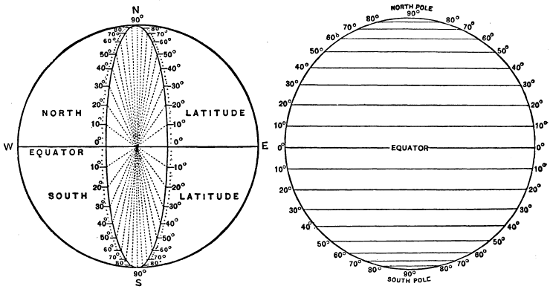
CIRCULAR MEASURES
Circular or Angular Measures are used in surveying, navigation, astronomy, geography, reckoning latitude and longitude, and computing differences in time.
A Circle is a plane figure bounded by a curved line, every point of which is equally distant from a point within, called the center.
The Circumference is the bounding line of a circle.
The Radius of a circle is a straight line drawn from the circumference to the center.
The Diameter is a straight line drawn through the center, with the ends terminating in the circumference.
An Arc of a circle is any portion of the circumference.
An Angle is the difference in direction between two straight lines which meet.
If two diameters divide a circle into four equal parts, these diameters make right angles with each other.
An angle less than a right angle is an acute angle.
The circumference of a circle may be divided into 360 equal parts, called degrees. If the circle is large, the degree is large, and if the circle is small, the degree is small, but the degree is always 1⁄360 part of the circumference, whatever the size of the circle.
An angle at the center of a circle is measured by the arc which bounds it.
If the angle is a right angle, it is measured by 1⁄4 of 360 degrees, or 90 degrees; hence, any angle of 90 degrees is a right angle.
An acute angle is always less than 90 degrees.
An obtuse angle is always more than 90 degrees.
Table of Circular Measure
60 seconds (′′) = 1 minute (′)
60 minutes = 1 degree (°)
360 degrees = 1 circumference (cir.)
Circum- ference Degrees Minutes Seconds
1 = 360 = 21,600 = 1,296,000
A quadrant is 1⁄4 of a circumference, or 90°; a sextant is 1⁄6 of a circumference, or 60°.
The length of a degree of longitude on the earth’s surface at the Equator is 69.16 miles.
In astronomical calculation 30° are called a sign, and there are therefore 12 signs in a circle.
LONGITUDE AND TIME
The earth’s circumference (which has the form of a circle) at the equator is (3.1416 × 7926), 24900 miles; which divided by 360, gives 69.17 miles for 1 degree of longitude at the equator. Leaving the equator, degrees of longitude gradually diminish, since all meridians converge at the poles. Thus, 1 degree of longitude, at 10 degrees of latitude, is 68.1 miles; at 20 degrees 65 miles; at 30 degrees 59.9 miles; at 40 degrees 53 miles; at 50 degrees 44.5 miles; at 60 degrees 34.6 miles; at 70 degrees 23.7 miles; at 80 degrees 12 miles; at 90 degrees 0.
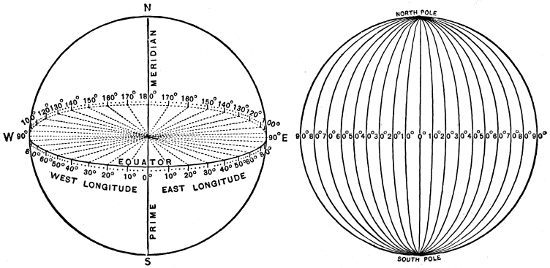
Imaginary lines running north and south, through these degrees, from pole to pole, are called meridians. Those east and west, parallels.
One meridian which runs through Greenwich, near London, England, is called the prime meridian, and all the other meridians are reckoned as east or west of it.
Longitude is distance east or west of the prime meridian. When we say that the longitude of Paris is 2° 20′ East, we mean that the meridian running through Paris is 2° 20′ east of the prime meridian that runs through Greenwich, England. The longitude of Washington, D. C., is 77° 7′ West. That means that the meridian which passes through Washington is 77° 7′ west of the prime meridian.
The longitude of a place tells in degrees, minutes, and seconds, the distance it is east or west of the prime meridian.
Rule.—To find the difference of time between two places, when the difference of longitude is known, or vice versa, multiply the given longitude, expressed in degrees, by 4. This gives the equivalent time in minutes. Dividing the given time, expressed in minutes, by 4, gives the equivalent longitude in degrees.
Example: The difference of longitude between Boston and San Francisco is nearly 511⁄4°, what is the difference of time?
511⁄4 × 4 = 205. 205 minutes equal 3 hours and 25 minutes. Ans. 3 hours and 25 minutes.
The difference of time between London and New York is about 4 hours and 551⁄2 minutes, what is the difference of longitude?
4 hours and 551⁄2 minutes equals 2951⁄2 minutes. 2951⁄2 ÷ 4 = 737⁄8. Ans. 737⁄8°.
Measures of Time
The unit of time measurement is the same among all nations. Practically it is 1-86400 of the mean solar day, but really it is a perfectly arbitrary unit, as the length of the mean solar day is not constant for any two periods of time. There is no constant natural unit of time.
Time measures are used in telling the time of day, in problems in longitude and time, in figuring interest on notes and bills, and in numerous other ways.
TABLE OF THE DIVISIONS OF TIME
60 seconds (sec.) = 1 minute (min.)
60 minutes = 1 hour (hr.)
24 hours = 1 day (da.)
7 days = 1 week (wk.)
30 days = 1 commercial month (mo.)
52 weeks = 1 year (yr.)
12 months = 1 year
360 days = 1 commercial year
365 days = 1 common year
366 days = 1 leap year
100 years = 1 century
Century Years Months Days Hours Minutes
1 = 100 = 1,200 = 36,500 = 876,000 = 52,560,000
Centennial years exactly divisible by 400, and other years exactly divisible by 4, are Leap Years.
Why We Have Leap Year
The average time it takes the earth to revolve once around the sun (one year) is 365 days, 5 hours, 48 minutes, 47.8 seconds, or about 3651⁄4 days.
The change in the length of the mean sidereal day, i.e., of the time of the earth’s rotation upon its axis, amounts to 0.01252 seconds in 2400 mean solar years.
Instead of reckoning this part of a day each year, it is disregarded, and an addition is made when this amounts to one day, which is very nearly every fourth year. This addition of one day is made to the month of February. Since the part of a day that is disregarded when 365 days are considered as a year, is a little less than one quarter of a day, the addition of one day every fourth year is a little too much, and, to correct this excess, addition is made to only every fourth centennial year.
STANDARD TIME
By this is meant time which differs from Greenwich mean time by whole hours.
The earth revolves on its axis from west to east, nearly 17.3 miles in 1 minute at the equator; at the latitude of New Orleans, nearly 15 miles in 1 minute; at Memphis, 14 miles; at Chicago, 13 miles; at London, 10.8 miles; at St. Petersburg, 8.6 miles. That is, a watch would gain one minute going west, or lose one minute going east that distance, in the latitudes of the respective cities.
The globe is divided into zones of 15 degrees or one hour breadth, the Greenwich meridian being in the center of the zero zone. Thus Belgium and Holland (since 1892) keep Greenwich time; Denmark, Sweden, Switzerland (1894), Austrian railroads, Germany, and Italy (1893) keep the time of longitude 15 degrees East—i.e. one hour earlier than Greenwich. In North America again five zones are distinguished. The corresponding times are distinguished as Eastern (671⁄2 to 821⁄2 degrees), Central (821⁄2 to 971⁄2 degrees), Mountain (971⁄2 to 1121⁄2 degrees), and Pacific (1121⁄2 to 1271⁄2 degrees) times.
New York people are in the Eastern Time Belt. If they rise at six o’clock in the morning, they will be up a whole hour before Chicago people, who get up at the same hour.
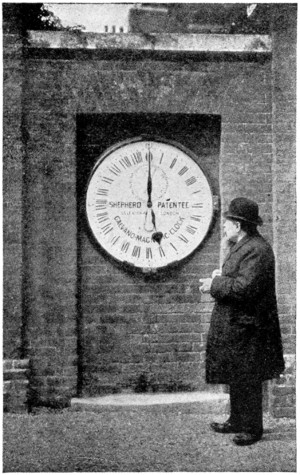
The clock at Greenwich, near London, England, from which the standard time of the world is reckoned.
Thus, each day begins an hour sooner in New York than in Chicago, two hours before Denver, and three hours before San Francisco.
Standard time in Japan is nine hours earlier than Greenwich time.
In the western parts of Canada the twenty-four hour system has been adopted, under which four P. M. becomes sixteen o’clock and so on. Steps are being taken to introduce it generally in India, Belgium, and the United States. It is of special convenience in the construction of railroad time tables; and it has long been used by the Italians and by astronomers.
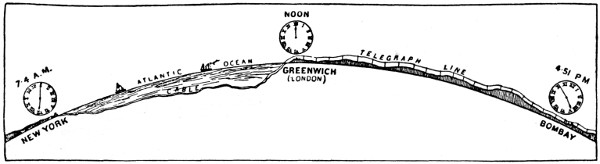
SIMULTANEOUS TIME IN LONDON, NEW YORK, AND BOMBAY
This diagram illustrates the curious fact that a telegram despatched from London may be delivered in New York apparently before the time it was sent off, and why a telegram apparently takes so long to reach Bombay.
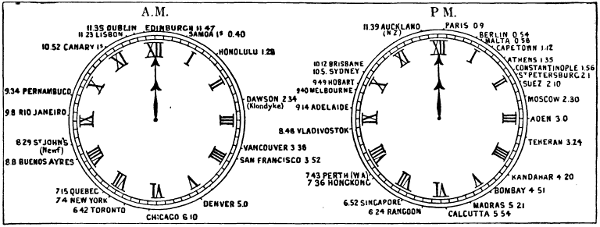
COMPARATIVE TIME ALL OVER THE WORLD WHEN NOON AT GREENWICH
THE CALENDAR
The reckoning of time among the ancients was very inaccurate. This was owning to their ignorance of astronomy, and also to changes that were made from time to time for political reasons. The calendar was reformed by Julius Cæsar, 46 B. C., who made the year consist of 3651⁄4 days, adding one day every fourth year. In 1582, the error in the calendar established by him had increased to 10 days; that is, too much time had been reckoned as a year, until the civil year was 10 days behind the solar year. To correct this error, Pope Gregory XIII. decreed that 10 days should be stricken from the calendar, that the day following the 3d day of October, 1582, should be made the 14th, and that henceforth only those centennial years should be leap years which are divisible by 400.
Most Catholic countries adopted the Gregorian Calendar soon after it was established. Great Britain did not adopt it until 1752, when the error amounted to 11 days. By Act of Parliament, the 3d of September was called the 14th. The civil year by the same act was made to commence on the 1st of January, instead of the 25th of March, as was previously the case.
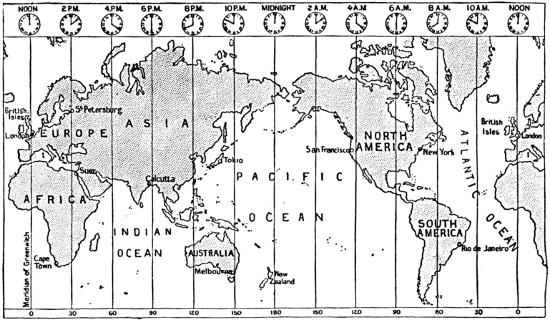
THE COMPARATIVE TIME ZONES OF THE WORLD
Dates reckoned by the Julian calendar are called Old Style (O.S.), and those reckoned by the Gregorian calendar are called New Style (N.S.). The difference now amounts to 12 days.
Perpetual Calendar
To find the day of the week for any given date.
1. Take the last two figures of the year, add one-fourth of them (neglecting remainder). Thus: 1949 = 49 + 12 = 61.
2. Add for the month, if for January or October, 1; May, 2; August, 3; February, March, or November, 4; June, 5; September or December, 6; April or July, 0; if leap year (that is, if it be divisible by 4 without remainder) January 0; February 3.
3. Add day of month.
Divide the sum of these three by 7, and remainder gives the number of the day of the week.
Thus:—What day of the week is 15th July, 1908?
1. 8 + 2 = 10
2. July = 0
3. 15th = 15
25 = 7 × 3 + 4
4th day of the week = Wednesday.
What day of the week was December 25th, 1905?
1. 5 + 1 = 6
2. Dec. = 6
3. 25th = 25
37 = 7 × 5 + 2
2nd day of the week = Monday.
The above only applies to 20th Century. For 19th Century, add 2; for 21st Century, add 6; 18th Century, 4; but before 1752 the “old style” was used.
WHERE THE DAY BEGINS
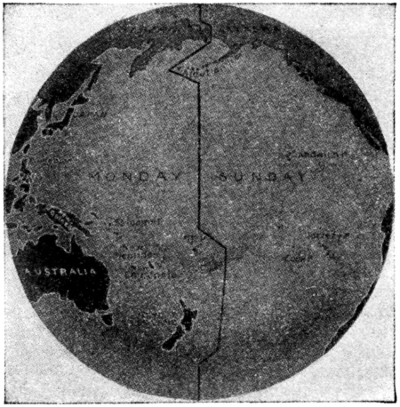
The day begins earlier as you go east until you meet the 180th meridian. This is where the day begins. Starting here, it travels westward, giving the whole world a new day. The 180th meridian is called the International Date Line (I. D. L.) but in reality, the date line is a crooked line which zigzags across the 180th meridian.
From the time the day starts at the International Date Line, until the sun again reaches that line, the same day is in progress the world over.
As marked now, the International Date Line passes southward through Behring Sea, then westerly, then returns to the 180th meridian at about 40 degrees north. It then follows the 180th meridian to 10 degrees south, where it swerves east but returns again to the 180th meridian at about 50 degrees south. It then follows that meridian.
Time on Shipboard.—The twenty-four hours are divided on board ship into seven parts, and the crew is divided into two parts or watches, designated port and starboard watches. Each watch is on duty four hours, except from four to eight p. m., which time is divided into two watches of two hours each, called dog watches, by means of which the watches are changed every day, and each watch gets a term of eight hours’ rest at night. First watch, eight p. m. to midnight; middle watch, midnight to four a. m.; morning watch, four to eight a. m.; forenoon watch, eight a. m. to noon; afternoon watch, noon to four p. m.; first dog watch, four to six p. m.; second dog watch, six to eight p. m. The bell is struck every half-hour to indicate the time, as follows:
1 bell 12: 30 A.M. 1 bell 12: 30 P.M.
2 bells 1: 00 A.M. 2 bells 1: 00 P.M.
3 bells 1: 30 A.M. 3 bells 1: 30 P.M.
4 bells 2: 00 A.M. 4 bells 2: 00 P.M.
5 bells 2: 30 A.M. 5 bells 2: 30 P.M.
6 bells 3: 00 A.M. 6 bells 3: 00 P.M.
7 bells 3: 30 A.M. 7 bells 3: 30 P.M.
8 bells 4: 00 A.M. 8 bells 4: 00 P.M.
1 bell 4: 30 A.M. 1 bell 4: 30 P.M.
2 bells 5: 00 A.M. 2 bells 5: 00 P.M.
3 bells 5: 30 A.M. 3 bells 5: 30 P.M.
4 bells 6: 00 A.M. 4 bells 6: 00 P.M.
5 bells 6: 30 A.M. 1 bell 6: 30 P.M.
6 bells 7: 00 A.M. 2 bells 7: 00 P.M.
7 bells 7: 30 A.M. 3 bells 7: 30 P.M.
8 bells 8: 00 A.M. 4 bells 8: 00 P.M.
1 bell 8: 30 A.M. 1 bell 8: 30 P.M.
2 bells 9: 00 A.M. 2 bells 9: 00 P.M.
3 bells 9: 30 A.M. 3 bells 9: 30 P.M.
4 bells 10: 00 A.M. 4 bells 10: 00 P.M.
5 bells 10: 30 A.M. 5 bells 10: 30 P.M.
6 bells 11: 00 A.M. 6 bells 11: 00 P.M.
7 bells 11: 30 A.M. 7 bells 11: 30 P.M.
8 bells 12: 00 noon 8 bells 12: 00 night
HOW THE MONTHS GOT THEIR NAMES
January, from Janus, was the sacred month of the year to the Romans. To them, Janus was the god of the year. During the 18th century, the Europeans started to recognize it as the first month, but previous to this, March was considered the first.
February comes from februa, the name of a Roman festival celebrated on the 15th of the second month.
March is from Mars, the god of war. March was the first month of the year to the Romans.
April, from the Latin aperire, “to open,” was probably so called because during this month buds begin to open.
May is from Maia, the mother of Mercury. The Romans offered sacrifices to this goddess on the first day of May.
The sixth month in our calendar, June, got its name from Juno, the wife of Jupiter.
July was so named in honor of Julius Cæsar, who was born in this month.
Emperor Augustus Cæsar commanded that the eighth month be named August after him.
September is from the Latin septem, meaning seven. At the time when March was the first month of the year, September was the seventh.
October, November, and December were originally the eighth, ninth and tenth months. Octo, novem, and decem are Latin numerals for eighth, ninth, and tenth.
HOW THE DAYS GOT THEIR NAMES
Sunday (that is, day of the sun, like Monday day of the moon), the first day of the week, the Lord’s day, was sacred to Sol or the Sun.
Monday (that is, moon-day; Anglo-Saxon, Monandæg, German, Montag), the second day of our week, was formerly sacred to the moon.
Tuesday, the third day of the week, is so called from Tiwesdæg, the day of Tiw or Tiu, the old Saxon name for the god of war. The day bears a corresponding name in the other Germanic dialects.
Wednesday, the fourth day of the week, the Dies Mercurii of the Romans, the Mittwoch of the modern Germans. The name Wednesday is derived from the Northern mythology, and signifies Woden’s or Odin’s day. The Anglo-Saxon form was Wôdanesday, the Old German Woutanestac. The Swedish and Danish is Onsdag.
Thursday, (Swedish Thorsdag, German Donnerstag), the fifth day of the week, is so called from Donar, or Thor (see Dictionary of Myths), who, as god of the air, had much in common with the Roman Jupiter, to whom the same day was dedicated. (Latin Jovis dies, French Jeudi).
Friday, the sixth day of the week, from the Anglo-Saxon Frige-dæg, is the day sacred to Frigga or to Freya, the Saxon Venus.
Saturday (Anglo-Saxon Sæterdæg, Sæterndæg—Sæter, Sætern, for Saturn, and dæg, a day—the day presided over by the planet Saturn), is the seventh or last day of the week; the day of the Jewish Sabbath.
MEASURES OF VALUE
The common measure of value is Money.
It is also called Currency, and is of two kinds, viz.: coin and paper money.
Stamped pieces of metal having a value fixed by law are Coin or Specie.
Notes and bills issued by the government and banks, and authorized to be used as money, are Paper Money.
All moneys which, if offered, legally satisfy a debt are a Legal Tender.
UNITED STATES MONEY
The unit of United States or Federal money is the Dollar.
The dollar mark is probably a combination of U. S., the initials of the words “United States.”
The standard of United States money is the gold dollar. Gold is used because in itself it has great worth and little bulk, and because it varies very little in value.
Names of United States Coins
Bronze: Nickel:
One-cent piece Five-cent piece
Silver: Gold:
Dollar = $1.00 Double eagle = $20.00
Half-dollar = 0.50 Eagle = 10.00
Quarter-dollar = 0.25 Half eagle = 5.00
Dime = 0.10 Quarter eagle = 2.50
It may be interesting to know that the word dollar is supposed to have come from Dale, the name of a small town where dollars were first coined.
Dime is from the French word disme, which means tenth.
Cent comes from the Latin word centum, meaning hundred.
Mill is also from the Latin, coming from mille, a thousand.
Eagles were named after our national bird.
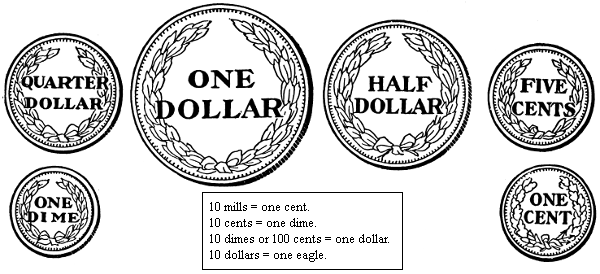
Weights of the United States Coins And the Amounts for Which They are Legal Tender
GOLD
Denominations Weight Grains Amount for Which a Legal Tender
Double eagle, $20 516. Gold coins of denomination are legal tenders for any amount.
Eagle, $10 258.
Half eagle, $5 129.
Three dollars 77. 4
Quarter eagle, $2.50 64. 5
Dollars 25. 8
SILVER
Denominations Weight Grains Amount for Which a Legal Tender
Standard dollar 412. 5 Unlimited.
Trade Dollar 420. Demonetized—Not a legal tender.
Half dollars 192. 9 Ten dollars.
Quarter dollars 96. 45 Ten dollars.
Twenty-cent pieces 77. 16 Five dollars.
Dimes 38. 58 Ten dollars.
Half-dimes 19. 29 Five dollars.
Three-cent pieces 11. 52 Five dollars.
MINOR COINS
Denominations Weight Grains Amount for Which a Legal Tender
Five cents 77. 6 Twenty-five cents.
Three cents 30. Twenty-five cents.
Two cents 96. Twenty-five cents.
Cents 48. Twenty-five cents.
Besides the coins there is paper money, founded on credit. It represents value, but in itself has no value.
This paper money is made up of paper promises to pay the amounts named, in gold or silver, on demand.
It includes bank bills, United States treasury notes, government bonds, etc. They represent the values $1, $2, $5, $10, $20, $50, $100, $500, $1,000 and $10,000.
Notation of United States Money
Dollars and cents are written together. Thus, two dollars and sixteen cents is written, $2.16.
The dollars are separated from the cents by a period. If the number of cents is less than ten, the tens’ place is filled by a 0. Thus, we write twenty dollars and two cents, $20.02.
Mills, or tenths of a cent, are written to the right of the cents. Five dollars, six cents, four mills is written, $5.064.
Note.—The rules and processes of decimals apply to the addition, subtraction, multiplication, and division of United States money.
ENGLISH OR STERLING MONEY
Sterling Money is currency of Great Britain and Ireland.
Table of Sterling Money
4 farthings (far.) = 1 penny (d.)
12 pence (not pennies) = 1 shilling (s.)
20 shillings = 1 pound (£), or sovereign
5 shillings = 1 crown
21 shillings = 1 guinea
The standard unit of Sterling Money is 1 pound or sovereign, whose value in our money is $4.8665.
The coins of Great Britain in general use are:—
Gold: Sovereign, half-sovereign, and guinea, which is equal to 21 shillings.
Silver: The crown (equal to 5 shillings), half-crown, florin (equal to 2 shillings), shilling, six-penny and three-penny pieces.
Copper: Penny and half-penny.
Example: I have £5 sterling. What is the value in United States money?
Solution: The value is 5 × $4.8665, or $24.33
FRENCH MONEY
In France the currency is decimal. The unit is the Franc.
TABLE
10 centimes (ct.) [pronounced son-teems] = 1 decime (de.)
10 decimes [pronounced des-seems] = 1 franc (fr.)
Scale.—Decimal
The value of the franc, as determined by the Secretary of the Treasury, is $.193 in United States money.
The coins of France are of gold, silver, bronze, and copper. The gold coins are the hundred, forty, twenty, ten, and five franc pieces; the silver coins are the five, two, and one franc pieces; also the fifty and twenty-five centime pieces. The bronze coins are the ten, five, two, and one centime pieces. There are also copper coins in ten and five centime pieces.
Example: When in France, I bought goods as follows:—
3 books at 2 francs, 1⁄2 dozen pipes at 1 franc, 2 pictures at 4 francs.
What was the cost in United States money?
Work:
3 books at 2 francs cost 6 francs
1⁄2 dozen pipes at 1 franc cost 6 francs
2 pictures at 4 francs cost 8 francs
Cost of all 20 francs
20 francs = 20 × 19.3 cents, or $3.86
GERMAN MONEY
German money is legal currency of the German Empire.
TABLE
100 pfennigs = 1 mark
Scale.—Decimal
1. The unit is the mark. Its value is $.2385 in United States money.
2. The coins of the German Empire are of gold, silver, nickel, and copper. The gold coins are the 20-mark piece, the 10-mark piece, and the 5-mark piece. The silver coins are the two and one mark pieces; the nickel coins are the ten and five pfennig pieces; and the copper coins are the two and one pfennig pieces.
Philippines Weights and Measures
1 pulgada (12 linea) = .927 inch
1 pie = 11 .125 inches
1 vara = 33 .375 inches
1 gantah = .8796 gallon
1 caban = 21 .991 gallons
1 libra (16 onzo) = 1 .0144 pounds average
1 arroba = 25 .360 pounds average
1 catty (16 tael) = 1 .394 pounds average
1 pecul (100 catty) = 139 .482 pounds average
Paper Measure
24 sheets = 1 quire (qr.)
20 quires = 1 ream (rm.)
2 reams = 1 bundle
5 bundles = 1 bale
Although a ream contains 480 sheets, 500 sheets are usually sold as a ream.
Number Table
12 units = 1 dozen
12 dozen = 1 gross
12 gross = 1 great gross
20 units = 1 score
PERCENTAGE AND ITS BUSINESS APPLICATIONS
The expression “per cent,” which is an abbreviation of the Latin words “per centum,” means “for each hundred.”
The symbol % is often used to denote “per cent.” Thus, 7 per cent, or 7%, means 7 parts out of every 100 parts, i.e., 7⁄100 of the whole.
Since per cent means hundredths, we may write any fraction whose denominator is 100 as so many per cent. In some cases the corresponding common fractions are so simple that it is advisable to remember them. For example:
25% = 25100 = 14, 50% = 50100 = 12,
75% = 75100 = 34, 331⁄3% = 331⁄3100 = 13,
662⁄3% = 662⁄3100 = 23, 5% = 5100 = 120,
21⁄2% = 21⁄2100 = 140, 121⁄2% = 121⁄2100 = 18,
and so on.
The number per cent is called the rate per cent.
Table of Additional Values
Symbol Decimal Common Fraction
1% = .01 = 1⁄100
2% = .02 = 2⁄100 = 1⁄50
3% = .03 = 3⁄100
4% = .04 = 4⁄100 = 1⁄25
5% = .05 = 5⁄100 = 1⁄20
6% = .06 = 6⁄100 = 3⁄50
7% = .07 = 7⁄100
8% = .08 = 8⁄100 = 2⁄25
9% = .09 = 9⁄100
10% = .10 = 10⁄100 = 1⁄10
20% = .20 = 20⁄100 = 1⁄5
25% = .25 = 25⁄100 = 1⁄4
50% = .50 = 50⁄100 = 1⁄2
100% = 1 .00 = 100⁄100 = 1
Here are a few others that should be learned:—
61⁄4% = 1⁄16 of 100% 162⁄3% = 1⁄6 of 100%
81⁄2% = 1⁄12 of 100% 331⁄3% = 1⁄3 of 100%
121⁄2% = 1⁄8 of 100% 662⁄3% = 2⁄3 of 100%
A Decimal as Per Cent
Write the decimal as hundredths, and the number expressing the number of hundredths is the per cent.
Examples:
.4 = .40 = 40100 = 40%
.8 = .80 = 80100 = 80%
.25 = 25100 = 25%
.33 1⁄3 = 331⁄3100 = 331⁄3%
.50 = 50100 = 50%
.87 1⁄2 = 871⁄2100 = 871⁄2%
If the decimal has more than two decimal places, the figures after the second one are written as a fraction of a per cent, as,—
.255 = 251⁄2100 = 251⁄2%.
.163 = 163⁄10100 = 163⁄10%.
To change a common fraction to per cent:
1. Change the fraction to a decimal.
2. Express the decimal as hundredths.
3. The result is the per cent desired.
Examples:
1⁄2 = .5 = .50 = 50%
3⁄4 = .75 = 75%
2⁄3 = .662⁄3 = 662⁄3%
9⁄10 = .90 = 90%
8⁄9 = .888⁄9 = 882⁄9%
7⁄8 = .871⁄2 = 871⁄2%
25⁄26 = .962⁄13 = 962⁄13%
Or, they may be written this way:
3⁄4 = 3⁄4 of 100100 = 75100 = 75%
2⁄3 = 2⁄3 of 100100 = 662⁄3100 = 662⁄3%
1⁄2 = 1⁄2 of 100100 = 50100 = 50%
Terms Used in Percentage
In Percentage, there are five terms or quantities considered; namely, the Base, Rate per cent, Percentage, Amount and Proceeds or Difference; any two being given, a third one may be found.
The base and rate given, to find the percentage.
Rule.—Multiply the base by the rate per cent expressed decimally.
Example: How many dollars is 6% of $50?
$50, the Base, or number on which percentage is computed.
.06, the Rate, or term denoting number of hundredths taken.
$3.00, the Percentage, or the product of the base and rate per cent.
$53.00, the Amount, or the base increased by the percentage.
$47.00, the Proceeds, or Difference, the base less the percentage.
Ans. $3.00.
When the rate per cent is an aliquot part of 100, the percentage is readily found by taking such a part of the base as the rate per cent is part of 100. Thus, at 10%, take 1⁄10 of base; at 121⁄2%, 1⁄8; at 162⁄3%, 1⁄6, etc.
The base and percentage given, to find the rate.
Rule.—Divide the percentage by 1% of the base
Example: Bought a watch for $15 and sold it for $18; what per cent did I make?
.15 ) 3.00
20
Ans. 20%
Here, $15.00 is the base, and ($18 - $15) $3.00, the gain or percentage. Now, as 1% of 15.00 is .15, it is evident that 3.00 is as many per cent of 15.00, as .15 is contained times is 3.00, which is 20.
Proof: 20% or 1⁄5 of $15 = $3.
The percentage and rate given, to find the base.
Rule.—Divide the percentage by the rate per cent expressed decimally.
Example: Received $6.40, percentage or interest, for money loaned at 4%, what was the base or principal?
.04 ) 6.40
Ans. $160
If $1 produces .04 (4 cents) in a certain time, $6.40 must be the percentage of as many dollars as .04 is contained times in $6.40, which is 160.
Proof: 4% of $160 (160 × .04) = $6.40.
The amount and rate given, to find the base.
Rule.—Divide the given amount by 1.00 plus the rate per cent.
Example: Bought a horse at a certain price, and sold him for $84, making 12% on cost; what did he cost?
1.12 ) 84.00
Ans. $75
If I made 12% on cost, every dollar invested gained 12 cents; hence, the horse cost as many dollars as 1.12 is contained times in 84.00, which is 75.
Proof: 12% of $75 (75 × .12) = $9; $75 + $9 = $84.
The proceeds and the rate given, to find the base.
Rule.—Divide the given proceeds by 1.00 minus the rate per cent.
Example: Sold a wagon for $51, which is 40% less than it cost; what did it cost?
.60 ) 51.00
Ans. $85
If I lost 40%, or 40 cents on the dollar, I received only 60 cents for every dollar the wagon cost; hence, it cost as many dollars as .60 is contained times in 51.00, which is 85.
Proof: 40% of $85 (85 × .40) = $34; $85 - $34 = $51.
Note.—The principles of percentage, in one form or another, enter into nearly all commercial calculations, besides many others. It is therefore of the utmost importance to business men, clerks, accountants, bookkeepers, and others, to become expert in percentage, and to adopt the easiest, simplest and shortest methods in computing interest, partial payments, trade discount, profit and loss, commission, insurance, stocks, bonds, taxes, exchange, etc.
PROFIT AND LOSS
When a thing is sold for more than it cost the seller, it is said to be sold at a profit. If it is sold for less than the cost, it is sold at a loss. Hence,
Profit = Selling Price - Cost Price.
Loss = Cost Price - Selling Price.
A profit or loss is generally reckoned as a percentage.
It is always understood that the percentage is reckoned on the cost price.
Example: I buy wheat at 60 cents and sell it for 75 cents. What per cent do I gain?
Solution: I gain the difference between 75 cents and 60 cents, or 15 cents. 15 cents is 25% of the cost. Hence, I gain 25%.
Work:
75 cents - 60 cents = 15 cents.
15 cents ÷ 60 cents = .25, or 25%.
Example: I bought flour at $3.50 per barrel. For what must I sell it to gain 20%?
Solution: I must sell it for 100% of the cost plus 20% of the cost, or 120% of the cost.
120% of $3.50 = $4.20.
∴ I must sell it at $4.20.
Example: I sold my carriage for 80% of its cost and received $90 for it. What was the cost?
Solution:
1% of the cost is 1⁄80 of $90, or $1.125.
100% of the cost = 100 × $1.125, or $112.50.
COMMISSION
is a percentage paid for buying or selling real estate, goods, etc. A consignment is a quantity of goods, sent to an agent, broker or commission merchant, for sale. The consignor is the one who sends the goods, the consignee the one to whom they are sent.
Principles:
1. The commission is some number or per cent of the price of what is bought or sold.
2. The proceeds equal the selling price minus the commission.
3. The amount equals the selling price plus the commission.
Commission presents two classes of problems. One of these classes may be called “buying problems.” The other may be called “selling problems.”
Buying Problem: I sent my agent $1977.60 to buy wild farm lands in northern Wisconsin, at $3 per acre. He was to receive 3% for his work. How many acres did he buy?
Work and Explanation:
3% of $3 = $.09. Cost to me of 1 acre is $3 + .09 = $3.09
For $1977.60 he buys as many acres as $3.09 is contained times in $1977.60, or 640. Hence, he buys 640 acres.
Selling Problem: My agent sells 360 pounds of butter for me at 20 cents. He pays $4.20 freight charges and $9.60 for storage. His commission is 5%. What does he send me?
Work and Explanation:
360 pounds at 20 cents = $72.00
Freight is $4.20
Storage is 9.60
Commission is 5% of $72, or 3.60
Total charges = 17.40
He sends me the difference, or $54.60
TRADE DISCOUNT
is an allowance made by manufacturers and jobbers from their list or marking prices. When the market varies, they change the discount accordingly, or make several discounts instead of changing the list.
Trade discount is a certain per cent off, or from list or marking price; while profit and loss is computed on the cost or purchase price.
The amount of the discount allowed depends sometimes upon the amount of order, and sometimes upon the terms of settlement. Very often two or more discounts are deducted in succession. Thus, 10% and 5% off; or, as it is generally expressed in business, 10 and 5 off, means a discount of 10%, and then 5% from what is left; 20, 10, and 5 off, means three successive discounts. A retailer’s profit is smaller when he is allowed 10 and 5 off, than if he were allowed 15 off. The result is not affected by the order in which the discounts are taken.
Example: I receive a bill of goods amounting to $100, 20% off. What is the net cost?
First Way:
20% of $100 =$20 $100 - $20 = $80
Second Way:
100% - 20% = 80% 80% of $100 = $80
Example: A merchant receives two bills of $200 each. On one there is a discount of 25%; on the other, 15% and 10%. What must he pay on each, net?
First Bill:
100% - 25% = 75%, or 3⁄4 3⁄4 of $200 = $150.
Second Bill:
100% - 15% = 85% 100% - 10% = 90% 90% of 85% = 76.5% .765 × $200 = $153.
PROMISSORY NOTES
A note is a written promise to pay a specified sum at a certain time.
The person who promises is called the maker, and the person to whom he promises is called the payee.
The FACE of a note is the sum of money promised.
A negotiable note is one which is made payable to the bearer, or to the order of the payee. A negotiable note can be sold or transferred.
A note is non-negotiable when it is payable only to the person or persons named in the note.
An indorser of a note is a person who writes his name on the back of it. The person who indorses, by so doing guarantees its payment. An indorsement in blank is simply the signature of the indorser written across the back of the note or draft. When indorsed in this way the note or draft is made payable without further indorsement to any person holding.
A note or draft is indorsed in full when the indorser states, over his signature, the person to whose order the note or draft is to be paid. If an indorser does not wish to guarantee the payment of a note or draft, he writes “Without recourse” over his name when indorsing it.
A protest of a negotiable note or draft is a formal statement by a notary public that said note or draft was presented for payment or acceptance and refused.
A note, when due, must be presented at the place at which it is made payable. The day of maturity is the day on which a note becomes due.
The days of grace are the three days beyond the specified time for payment. Days of grace are now practically abolished throughout the United States.
Kinds of Notes.—There are three principal kinds of notes—Time Notes, Joint Notes, and Joint and Several Notes.
A Time Note must be paid in a specified time.
A Joint Note is one signed by two or more persons who are jointly liable for its payment.
A Joint and Several Note is a note signed by two or more persons who are both jointly and individually liable for its payment. Each man who signs the note is as much responsible for the payment of the whole sum as if he had signed alone.
Legal Rules that Apply to Notes
A note made out on Sunday is void.
If a note does not state that interest is to be paid, it does not bear interest until after it is due.
If anyone obtains a note by fraud or from an intoxicated person, he cannot collect.
To be negotiable an instrument must be in writing and signed by the maker (of a note) or drawer (of a bill or check).
It must contain an unconditional promise or order to pay a certain sum in money.
Must be payable on demand, or at a fixed future time.
Must be payable to order or to bearer.
In a bill of exchange (check), the party directed to pay must be reasonably certain.
Every negotiable instrument is presumed to have been issued for a valuable consideration, and want of consideration in the creation of the instrument is not a defense against a bona-fide holder.
An instrument is negotiated, that is completely transferred, so as to vest title in the purchaser, if payable to bearer, or indorsed simply with the name of the last holder, by mere delivery; if payable to order, by the indorsement of the party to whom it is payable and delivery.
One who transfers an instrument by indorsement warrants to every subsequent holder that the instrument is genuine, that he has title to it, and that if not paid by the party primarily liable at maturity, he will pay it upon receiving due notice of non-payment.
To hold an indorser liable the holder upon its non-payment at maturity must give prompt notice of such non-payment to the indorser and that the holder looks to the indorser for payment. Such notice should be sent within twenty-four hours.
When an indorser is thus compelled to pay he may hold prior parties, through whom he received the instrument, liable to him by sending them prompt notice of non-payment upon receiving such notice from the holder.
One who transfers a negotiable instrument by delivery, without indorsing it, simply warrants that the instrument is genuine, that he has title to it, and knows of no defense to it, but does not agree to pay it if unpaid at maturity.
The maker of a note is liable to pay it, if unpaid at maturity, without any notice from the holder or indorser.
Notice to one of several partners is sufficient notice to all.
When a check is certified by a bank the bank becomes primarily liable to pay it without notice of its non-payment, and when the holder of a check thus obtains its certification by the bank, the drawer of the check and previous indorsers are released from liability, and the holder looks to the bank for payment.
A bona-fide holder of a negotiable instrument, that is, a party who takes an instrument regular on its face, before its maturity, pays value for it and has no knowledge of any defenses to it, is entitled to hold the party primarily liable responsible for its payment, despite any defenses he may have against the party to whom he gave it, except such as rendered the instrument void in its inception. Thus, if the maker of a note received no value for it, or was induced to issue it through fraud or imposition, that does not defeat the right of a bona-fide holder to compel its payment from him.
The dates and amounts of partial payments on a note, before it is finally paid in full, are placed on the back.
The place of payment, if not mentioned, is at the maker’s place of business or residence, during reasonable business hours.
If a note or a check received in payment of a debt is dishonored, the debt revives.
Ignorance of the law does not excuse anyone. No contract is good unless there be a consideration. No consideration is good that is illegal.
The maker of an accommodation note is not bound to the person accommodated; but he is bound to any other person receiving the note for value.
BANK DISCOUNT
The sum charged by a bank for cashing a note or time draft is called bank discount. This discount is the simple interest, paid in advance, for the number of days the note has to run. Wholesale business houses usually sell goods on time and take notes from the retailers in payment. These notes are not often for a longer period than three months. Some are placed in the banks for collection, others are discounted. When a note is discounted at a bank the payee indorses it, making it payable to the bank. Both maker and payee are then responsible to the bank for its payment. If the note is drawing interest the discount is reckoned on and deducted from the amount due at maturity. Most notes discounted at banks do not draw interest. The time in bank discount is always the number of days from the date of discounting to the date of maturity.
Example: A note of $250, dated July 7, payable in 60 days, is discounted July 7 at 6%; find the proceeds.
Explanation: This note is due in 63 days, or September 8. The accurate interest of $250 for 63 days at 6% is $2.59. The proceeds, then, will be $250-$2.59, or $247.41.
The Present Worth of a note or debt is a sum, which, if put at interest, will amount to that debt in the given time.
The True Discount is the difference between the debt at maturity and its present worth.
Remember:
1. To allow three days of grace, if the debt discounted is a note.
2. To add the interest due at maturity to the principal, before discounting, if the note bears interest.
Examples: Case I.—Note not bearing interest.
What is the present worth and true discount on a note of $200, if paid 6 months before due, the discount being 6%.
Solution: Amount of $1 for 6 months at 6% = $1.03. If $1.03 = amount of $1, $200 is the amount of as many dollars as 200⁄1.03, or $194.17+.
$194.17 is the present worth. $200 - $194.17 = $5.83 true discount.
The following rule can be deduced from the foregoing solution:—
Rule: 1. To find the present worth, divide the debt by the amount of $1 for the given time.
2. To find the true discount, subtract the present worth from the debt.
Case II.—Note bearing interest.
What is the present worth of a note of $300, bearing 6% interest, due in 2 years 4 months, if money is worth 10%.
Solution: Interest on $300 for 2 years 4 months at 6% = $42.
$300 + $42 = $342. Amount due at maturity.
Amount of $1 for 2 years 4 months at 10% = $1.231⁄3.
If $1.231⁄3 = amount of $1, then $3.42 is the amount of $3421.231⁄3, or $277.29.
$277.29 = present worth.
INTEREST
If a person borrows money, he usually pays something for the loan.
The sum of money he borrows is called the Principal; the money he pays for the use of the principal is called Interest. Interest is generally reckoned at so much for the use of each $100 for one year. This amount is called the Rate per cent per Annum.
Thus, if we say that $200 is borrowed for three years at 4 per cent per annum, we mean that the borrower, at the end of each year, pays the lender $4 for each $100 borrowed—i.e., $8 interest for each year.
In the above example the interest is supposed to be paid to the lender at the end of each year. Interest thus reckoned is called Simple Interest.
The sum obtained by adding the interest for any given time to the principal is called the Amount in that time.
Common Interest Methods
If we were to find the interest on a sum of money for 3 years 4 months 5 days, we would find the interest for 1 year, then for 1 month (1⁄12 of a year), then for 1 day (1⁄360 of a year). Having the interest for 1 year 1 month 1 day, it is a simple matter of multiplication to get it for 3 years 4 months 5 days.
Example:
What is the interest on $520 for 1 year 3 months at 6%?
Work:
1 year 3 months = 11⁄4 year
$520 principal
.06
4 ) $31.20 interest 1 year
$7.80 interest 1⁄4 year
$39.00 interest 1 1⁄4 year
The 60-Day Interest Method
In what is called the 60-Day Method, 360 days are considered one year, and 30 days one month. Upon this basis the interest for 60 days, or two months, at any rate, will be 1⁄6 of the interest for one year; and when the rate is 6% the interest for 60 days is one per cent or 1⁄100 of the principal. Thus, the interest of $247 for 60 days at 6% is $2.47.
Example: Find the interest of $1728 for 80 days at 6%.
Work:
$17 28 = interest for 60 days.
5 76 = interest for 20 days.
$23 04 = interest for 80 days.
Explanation:
The interest of $1728 for 60 days at 6% is 1% of $1728, or $17.28; and the interest for 20 days (1⁄3 of 60) is 1⁄3 of $17.28, or $5.76. Hence for 80 days it will be $17.28 plus $5.76, or $23.04.
Methods of Reckoning Time
The Common Method.—When the time is long, generally 30 days are considered a month.
The Exact Method.—When the time is short, the exact number of days is generally counted but we sometimes find the exact number of days also when the time is long.
The Bankers’ Method.—Bankers get the exact number of days between two dates, but each day is reckoned as 1⁄360 of a year.
Problem, when the time is long.
Find the time between April 12, 1895, and September 22, 1899.
Best Method
From April 12, 1895, to April 12, 1899, is 4 years. From April 12, 1899, to Sept. 12, 1899, is 5 months. From Sept. 12, 1899, to Sept. 22, 1899, is 10 days. Time between dates = 4 years 5 months 10 days.
Another Method
1899 9 22
1895 4 12
4 5 10
Problem, when the time is short. Find the difference in time between April 12 and July 15, 1902.
Work:
Number of days left in April = 18
in May = 31
in June = 30
in July = 15
Total number of days = 94
Note.—If the rate and principal are given, it is a simple matter to find the interest, now that we have the time.
Example of the use of Table: What is the time from February 10 to October 18, in the same year. February 10 is numbered 41, and October 18 is numbered 291; 291 - 41 = 250, Ans. This includes the last day, but not the first. If both days are taken, subtract 40 from 291 = 251, Ans. When February 29 occurs in a term, count an additional day. The day of the date of a note is not included in its term; thus, required the last day of grace of a note dated March 24, at 90 days. March 24 = 83; 83 + 93 = 176 = June 25, Ans.
TABLE OF TIME, IN DAYS The following table gives the exact time, in days, between two dates.
Jan. Feb. March April May June July Aug. Sept. Oct. Nov. Dec.
1 32 60 91 121 152 182 213 244 274 305 335
2 33 61 92 122 153 183 214 245 275 306 336
3 34 62 93 123 154 184 215 246 276 307 337
4 35 63 94 124 155 185 216 247 277 308 338
5 36 64 95 125 156 186 217 248 278 309 339
6 37 65 96 126 157 187 218 249 279 310 340
7 38 66 97 127 158 188 219 250 280 311 341
8 39 67 98 128 159 189 220 251 281 312 342
9 40 68 99 129 160 190 221 252 282 313 343
10 41 69 100 130 161 191 222 253 283 314 344
11 42 70 101 131 162 192 223 254 284 315 345
12 43 71 102 132 163 193 224 255 285 316 346
13 44 72 103 133 164 194 225 256 286 317 347
14 45 73 104 134 165 195 226 257 287 318 348
15 46 74 105 135 166 196 227 258 288 319 349
16 47 75 106 136 167 197 228 259 289 320 350
17 48 76 107 137 168 198 229 260 290 321 351
18 49 77 108 138 169 199 230 261 291 322 352
19 50 78 109 139 170 200 231 262 292 323 353
20 51 79 110 140 171 201 232 263 293 324 354
21 52 80 111 141 172 202 233 264 294 325 355
22 53 81 112 142 173 203 234 265 295 326 356
23 54 82 113 143 174 204 235 266 296 327 357
24 55 83 114 144 175 205 236 267 297 328 358
25 56 84 115 145 176 206 237 268 298 329 359
26 57 85 116 146 177 207 238 269 299 330 360
27 58 86 117 147 178 208 239 270 300 331 361
28 59 87 118 148 179 209 240 271 301 332 362
29 — 88 119 149 180 210 241 272 302 333 363
30 — 89 120 150 181 211 242 273 303 334 364
31 — 90 — 151 — 212 243 — 304 — 365
Compound Interest
Interest computed, at regular intervals, on the sum of the principal and any unpaid interest, is called compound interest. In other words, as soon as interest becomes due and is unpaid, it begins to draw interest at the same rate as the principal. Compound interest is generally paid on the deposits in savings banks and is used in calculating amortization and sinking funds.
Interest may be compounded quarterly, semi-annually, annually, or at the end of any other period agreed upon. In some States the collection of compound interest is not permitted.
Example: Find the amount and the compound interest of $1200 at 6% for two years, interest compounded semi-annually.
Solution:
$1200. 00 First principal
36. Interest for 6 months
1236. Principal at beginning of second 6 months
37. 08 Interest for second 6 months
1273. 08 Principal at beginning of third period
38. 19 Interest for third period
1311. 27 Principal at beginning of fourth period
39. 34 Interest for fourth period
$1350. 61 Amount at end of two years
$1350. 61 Amount at end of two years
1200. 00 Principal
150. 61 Compound interest.
EXCHANGE
in commerce is a method of making payments in distant places, without the actual transmission of money, but by a Bill of Exchange called Draft, which is a written request upon one person to pay a certain sum to another or to his order. The person who orders the money to be paid, is called the Drawer; the one who is directed to pay it, the Drawee, and the one to whom it is directed to be paid, the Payee.
Domestic or Inland Exchange is exchange between places in the same country: Foreign Exchange, between different countries.
If, for every little business transaction, money had to be sent from one business center to another, much needless inconvenience and expense would be incurred.
A man in Chicago owes a man in New York City a sum of money. He can send it to him in one of five ways:—
1. By Check.
2. By Post-office Order
3. By Express Order
4. By Bill of Exchange
5. By Telegraph
Suppose Mr. White of Chicago owes Mr. Brown of Boston $200 for groceries and Mr. Allen of Boston owes Mr. Warner of Chicago $200 for rent. Wouldn’t it save expense and trouble if Mr. White should go to Mr. Warner and Mr. Allen to Mr. Brown? Thereby two debts are cancelled by two city transactions and no money need be sent from one city to another.
This is all there is to Exchange, only in business life banks instead of individuals transact the business.
Only a small percentage of the money really passes from one city to another.
Exchange in the United States is carried on mostly by banks located in the large cities, which charge a small fee for transacting the business.
TABLE OF COMMERCIAL LAW IN THE STATES
INTEREST LAWS Statutes of Limitation Exemption Laws
Legal Rate Per Cent Per Cent Allowed by Contract and Penalty for Usury Judg- ments Notes Open Ac- counts Personal Property, Exempt Homestead, Exempt
Alabama 8 8; Forfeit interest 20 yrs. 6 yrs. 3 yrs. $1,000 $2,000
Arizona 6 12; No provision 4 yrs. 4 yrs. 3 yrs. 500 2,500
Arkansas 6 10; Forfeit principal and interest 10 yrs. 5 yrs. 3 yrs. 500 2,500
California 7 Any; No provision 5 yrs. 4 yrs. 4 yrs. ... 5,000
Colorado 8 Any; No provision 6 yrs. 6 yrs. 6 yrs. ... 2,000
Connecticut 6 15; Fine or imprisonment, or both 7 yrs. 6 yrs. 6 yrs. ... 1,000
Delaware 6 6; Principal and interest forfeited 10 yrs. 6 yrs. 3 yrs. 200 ...
Dist. of Col. 6 6; Forfeit interest 12 yrs. 3 yrs. 3 yrs. 300 ...
Florida 8 10; Forfeit interest 20 yrs. 5 yrs. 3 yrs. 1,000 160 acres
Georgia 7 8; Forfeit excess of interest 7 yrs. 6 yrs. 4 yrs. 300 1,600
Idaho 7 12; Forfeit interest and 10% of principal 6 yrs. 5 yrs. 4 yrs. ... 5,000
Illinois 5 7; Forfeit interest 20 yrs. 10 yrs. 5 yrs. 400 1,000
Indiana 6 8; Excess interest forfeited 20 yrs. 10 yrs. 6 yrs. 600 or 600
Iowa 6 8; Forfeit interest and 8% of principal 20 yrs. 10 yrs. 5 yrs. 200 or 40 acres
Kansas 6 10; Forfeit of double amount of usurious interest 5 yrs. 5 yrs. 3 yrs. ... 160 acres
Kentucky 6 6; Forfeit of interest 15 yrs. 15 yrs. 5 yrs. 250 1,000
Louisiana 5 8; Forfeit interest 10 yrs. 5 yrs. 3 yrs. ... Total 2,000
Maine 6 Any; No provision 20 yrs. 20 yrs. 6 yrs. ... 500
Maryland 6 6; Forfeit interest 12 yrs. 3 yrs. 3 yrs. 100 ...
Massachusetts 6 Any; No provision 20 yrs. 6 yrs. 6 yrs. ... 800
Michigan 5 7; Forfeit interest 6 and 10 6 yrs. 6 yrs. 500 1,500
Minnesota 6 10; Forfeit interest 10 yrs. 6 yrs. 6 yrs. 500 80 acres
Mississippi 6 10; Forfeit interest 7 yrs. 6 yrs. 3 yrs. ... 2,000
Missouri 6 8; Forfeiture or misdemeanor 10 yrs. 10 yrs. 5 yrs. 300 1,500 (min.)
Montana 8 Any; No provision 10 yrs. 8 yrs. 5 yrs. ... 2,500
Nebraska 7 10; Forfeit interest 5 yrs. 5 yrs. 4 yrs. 500 or 2,000
Nevada 7 Any; No provision 6 yrs. 6 yrs. 4 yrs. ... 5,000
New Hampshire 6 6; Forfeit three times excess 20 yrs. 6 yrs. 6 yrs. ... 500
New Jersey 6 6; Forfeit interest and costs 20 yrs. 6 yrs. 6 yrs. 200 1,000
New Mexico 6 12; Forfeit of twice the amount of interest 7 yrs. 6 yrs. 4 yrs. 500 1,000
New York 6 6; Forfeit of principal and interest; misdemeanor 20 yrs. 6 yrs. 6 yrs. 250 1,000
North Carolina 6 6; Forfeit interest 10 yrs. 3 yrs. 3 yrs. 500 1,000
North Dakota 7 12; Forfeit interest 10 yrs. 6 yrs. 6 yrs. 1,000 5,000
Ohio 6 8; Forfeit interest over 6% 5 yrs. 15 yrs. 6 yrs. 100 1,000
Oklahoma 6 10; Forfeit interest 5 yrs. 5 yrs. 3 yrs. ... 5,000
Oregon 6 10; Forfeit principal and interest 10 yrs. 6 yrs. 6 yrs. ... 1,500
Pennsylvania 6 6; Forfeit excess of interest 20 yrs. 6 yrs. 6 yrs. 300 ...
Rhode Island 6 Any; No provision 20 yrs. 6 yrs. 6 yrs. 800 ...
South Carolina 7 8; Forfeit interest 20 yrs. 6 yrs. 6 yrs. 500 1,000
South Dakota 7 12; Misdemeanor 20 yrs. 6 yrs. 6 yrs. 750 5,000
Tennessee 6 6; Forfeit of excess interest 10 yrs. 6 yrs. 6 yrs. ... 1,000
Texas 6 10; Forfeit interest 10 yrs. 4 yrs. 2 yrs. 500 5,000
Utah 8 12; Forfeit excess interest 8 yrs. 6 yrs. 4 yrs. ... 2,000
Vermont 6 6; Forfeit of excess interest 8 yrs. 6 yrs. 6 yrs. 200 500
Virginia 6 6; Forfeit interest 20 yrs. 5 yrs. 2 yrs. ... 2,000
Washington 6 12; Forfeit of double accrued interest and costs 6 yrs. 6 yrs. 3 yrs. 1,000 2,000
West Virginia 6 6; Forfeit excess interest 10 yrs. 10 yrs. 5 yrs. 200 1,000
Wisconsin 6 10; Forfeit treble amount of usurious interest paid 20 yrs. 6 yrs. 6 yrs. 200 5,000
Wyoming 8 12; Forfeit interest 5 yrs. 5 yrs. 8 yrs. 500 1,500
Note.—In many of the States it is impossible to place a fixed amount on personal property exempt. In the table above these states have no amount given in the personal property column. Days of grace have been abolished in all states except the following: Arkansas, Mississippi, South Carolina and Texas.
If the drawee accepts the draft, he writes across the face of it “Accepted” with the date and his signature. This is called an Acceptance.
Once accepted, the draft becomes a note, with the same laws regulating it. If the draft is not accepted, it is not binding and we say that it has been “dishonored.”
A bill of exchange is entitled to days of grace, if it is payable in a State where grace is allowed, unless a particular day is named in the draft. In most States, no grace is allowed on sight drafts.
Principles of Exchange
To find the cost of a draft, the face and rate per cent of exchange being given.
Rule.—Find the percentage of the given rate per cent of exchange and add it to, or subtract it from the amount of draft.
Example: What is the cost, in Chicago, of a sight draft on Denver for $400, if exchange is 3⁄4% premium; and how much if 1⁄2% discount?
$400 × .003⁄4 = $3; $400 + $3 = $403, at 3⁄4% premium. $400 × .001⁄2 = $2; $400 - $2 = $398, at 1⁄2% discount.
To find the face of a draft, cost and rate per cent of exchange given.
Rule.—Divide by the cost of a draft for $1, at given rate per cent of exchange.
Example: Find face of draft that can be bought for $1000 at 1% premium; at 1% discount.
$1000 ÷ 1.01 = $990.10, at 1% premium. $1000 ÷ .99 = $1010.10, at 1% discount.
Time Drafts, when negotiated before maturity, are subject to discount which is computed on the face of the draft, the same as interest.
Example: What is the proceeds of a 60-day draft for $800, at 5⁄8% premium, and discounted at 7%?
$805.00, face + 5⁄8% premium
9.33, interest (7%, 60 days)
$795.67, proceeds. Ans.
Foreign Drafts are usually made payable in the money of the country on which they are drawn.
To find the equivalent of foreign money in United States money and vice versa.
Rule.—Multiply, or divide (as the case may require) the given sum, by the equivalent of a unit in United States money.
Example: What is the cost of a draft on London for £125, reckoning exchange at $4.8665?
125 × 4.8665 = 608.31. Ans. $608.31.
Wishing to remit $182.50 to Ireland, for what amount must I buy a draft on London?
182.50 ÷ 4.8665 = 37.5. Ans. £371⁄2.
How many francs in $100?
100.000 ÷ .193 = 518.13. Ans. 518.13 francs.
How many dollars in 7500 German marks?
7500 × .238 = $1785, Ans.
How many Swedish crowns in $750?
750 ÷ .268 = 27981⁄2 crowns, Ans.
How many dollars in 4635 rubles?
4635 × .772 = $3578.32, Ans.
A simple method to reduce pounds sterling to United States money, and vice versa; exchange being at $4.8665.
Rule.—Multiply pounds sterling by 73, and divide the product by 15. Or multiply dollars by 15 and divide the product by 73.
Examples: How many dollars in £85?
85 × 73⁄15 = 413.67. Ans. $413.67.
How many £’s in $748.25?
748.25 × 15⁄73 = 1533⁄4. Ans. £1533⁄4.
Another method to change pounds sterling, shillings and pence, to dollars and cents.
Rule.—Reduce pounds sterling to shillings, add the shillings, and multiply the sum by .241⁄3—the product will be cents. Add 2 cents for each pence, if any.
Example: Change £46, 13s. 9d. to United States money.
46 × 20 = 920 933 × .241⁄3 = 227.03
13 9d. = .18
933 Ans. $227.21
Tourists of today patronize express companies for Foreign Money Orders. These are made out similar to regular express money orders and may be cashed in any of the larger cities of all foreign countries. They take the place, to a large extent, of Letters of Credit, which are letters from banking houses in one country to those in another, allowing sums to be drawn not to exceed a total named in the letter.
STOCKS AND BONDS
Stocks is a general name given to the capital of incorporated companies. They are divided into equal parts, usually of $100 each, called Shares, the owners of which are called Stockholders. A Dividend is a part of the net income of the company, divided among the stockholders.
A certificate of stock is a written paper signed by the proper officers of the corporation, naming the number of shares to which the person named therein is entitled, and the original value of the same.
Preferred stock is stock which is given a preference over the common stock. Ordinarily, a dividend is paid on the preferred stock before any is paid on the common shares.
Common stock is the ordinary stock of a corporation, which has no preference, in the payment of dividends, over any other.
The par value of a share of stock is the value named in the certificate of stock.
When a corporation is prosperous, its shares of stock often sell for more than the value named in the certificate of stock. They are then said to be above par, or at a premium. In times of business depression, often these shares of stock sell below their face value. They are then said to be below par, or at a discount.
The market value of a share of stock is the value for which it sells in the open market.
A stock broker is one who makes a business of buying and selling stocks and bonds. He charges a commission for this which is called brokerage.
A surplus is a part of the earnings of a corporation.
The gross earnings of a corporation are its total receipts from all sources.
The net earnings are the profits remaining when all expenses, losses, interest and debts due are paid.
An assessment is a sum levied proportionate to stock held by stockholders, to help out the business when it is not prospering, or when more money is needed to carry it on. It is levied as so many dollars on each share at its par value.
The directors are those shareholders elected by all to manage the affairs of the corporation.
A bond is, in form, a carefully drawn interest-bearing promissory note. Ordinarily, it runs for a period of years with interest often payable semi-annually. It is more formal than the ordinary promissory note. Bonds are usually issued by national, state, county, or local governments, or by corporations, when they wish to raise large sums of money for immediate use.
Difference Between Stocks and Bonds
A bond runs for a specified time. It bears a specified interest, and is an absolute promise to pay the face of it at maturity. It matures at a definite time, and at that time the holder is paid its face value and no more, by the organization that issued it, unless such organization is insolvent, or has repudiated its debts.
Stocks.—A certificate of stock is no promise to pay. It simply shows that the holder owns as much stock in the corporation as is shown by the face of the certificate. It bears no interest and has no date of maturity.
The interest returns of the bondholder are certain and definite. The returns of the stockholder, dividends, are uncertain and depend on the profits of the business.
Consequently, no table can be arranged to show at what rate stocks can be bought to yield a definite return; but with bonds, tables may be made which show at a glance what the return will be from a purchase made at any rate.
Application of Percentage to Stocks
1. To find the value of stocks, when above or below par.
Rule.—Multiply the price per share, by the number of shares.
Example: Find cost of 65 shares of bank stock, at $107 per share, or 7% premium. Also of 48 shares of railroad stock, at $871⁄2 per share, or 121⁄2% discount.
(1) 65 × 107 = 6955. Ans. $6955. (2) 48 × 871⁄2 = 4200. Ans. $4200.
2. To find what rate per cent is realized by investing in stocks or bonds when above or below par.
Rule.—Annex two ciphers to the fixed rate per cent, and divide by the cost per share. Or by proportion: As the cost per share is to the fixed rate, so is 100 to the required rate.
Example: Mr. Warren bought ten shares of Illinois Central Railroad stock at 96. What does he get when a dividend of 6% is declared? What per cent is that on his investment?
Work and Explanation:
(1) 1 share at 6% yields $6 (1) 10 shares yield 10 × $6 = $60. (2) Each share at 96 costs $96. (2) Each share yields $6. Query? $6 is what per cent of $96? Query?$6 is 6⁄96 of 100%, or 61⁄4%. Query?∴ the investment yields 61⁄4%.
3. To find which is the more profitable investment.
Rule.—Find the rate per cent that each investment yields, by rule, under item 2; then compare rates.
Example: Which is the better investment; 6% mortgages at 10% premium, or 5% bonds at 10% discount?
(1) 110)600(55⁄11%.
(2) 90)500(55⁄9%. 5⁄9 - 5⁄11 = 10⁄99, practically 1⁄10.
Ans. The latter, by 1⁄10 of 1%, nearly.
TAXES AND TAXATION
A tax is a contribution levied on persons, property, incomes, or business, for public purposes.
Some Uses for Taxes.—The National Government requires money to support the army and navy, to pay the salaries of government employes, to pay pensions, and to finance other activities carried on by the nation.
The State Governments require money for the expense of their officers, and to support their various institutions, schools, universities, asylums, and penitentiaries.
The counties require money for the building of bridges, the trial of criminal cases, the salaries of officers, the relief of the poor, etc.
Cities must pay for police and fire protection, care of streets, etc.
School districts contribute to the support of the public schools.
The money required for all these expenses is raised by taxes, licenses, fees, assessments, and fines.
State and Local Taxes.—The amount of tax paid by any individual to state and local governments depends upon the value of the property which he owns and the tax rate. In many places the adult male citizen pays a poll tax.
The tax levied on property is called a property tax.
The tax levied on persons is called a poll tax. This is sometimes called a capitation (by the head) tax.
Sometimes a man’s income is taxed. This is an income tax.
After the amount of money to be raised by tax is decided upon, a man, called the assessor, examines each piece of taxable personal property and real estate, and places a value upon it. This is taken as a basis for proportioning the tax among the property owners.
A tax collector is one who collects the taxes. He is sometimes paid a salary. Sometimes he gets only a percentage of the money he collects.
The treasurer receives and takes care of the money collected by the tax collector. He is paid a salary.
The Tax Rate.—Sometimes the rate is fixed by law or by vote of the citizens. More often the lump sum to be raised is named, and the assessor determines the rate.
When the assessor is to determine the rate, he proceeds in this way: First, he assesses each piece of property, usually not at its full market value. Then he determines the total value of all the property in his district. Next, he divides the total tax to be raised by the total value of the property in his district. The result is the rate of tax on the dollar.
Use of the Mill in Taxes.—When a tax is apportioned, it is usually found that if a few mills are paid on each dollar’s worth of property in the district, the aggregate amount is equal to the whole sum of tax needed. Consequently, we often hear of tax levies of so many mills on the dollar, as, 2 mills on the dollar, 5 mills on the dollar, etc.
The denomination of our money system called the mill has practically its only use in the levy of taxes.
Assessors make use of a table like the one given on the following page. This table is based on a tax levy of 9 mills on the dollar.
The following tax rates are equivalent:
16 mills (on the dollar);
1.6%;
$1.60 (on each hundred dollars).
Explanation of Table. The second column shows the tax at nine mills on the dollar, for values of $1 to $30. The fourth column shows the tax for values of $40 and multiples of ten, to $600. The sixth column shows the tax for values of $700 and multiples of one hundred, to $10,000.
Tax Table
Prop- erty Value Tax Prop- erty Value Tax Prop- erty Value Tax
$ 1 $ 0.009 $ 40 $ 0.36 $ 700 $ 6.30
2 0.018 50 0.45 800 7.20
3 0.027 60 0.54 900 8.10
4 0.036 70 0.63 1,000 9.00
5 0.045 80 0.72 2,000 18.00
6 0.054 90 0.81 3,000 27.00
7 0.063 100 0.90 4,000 36.00
8 0.072 200 1.80 5,000 45.00
9 0.081 300 2.70 6,000 54.00
10 0.09 400 3.60 7,000 63.00
20 0.18 500 4.50 8,000 72.00
30 0.27 600 5.40 9,000 81.00
The Amount of Tax.—To find the amount of tax to be paid by any property owner.
Rule.—Multiply the assessed value of the property by the tax rate.
Example: Taylor’s property is assessed at $3800. The rate is 24 mills.
Solution: $3800 assessed valuation
.024 tax rate in mills
$91.20 tax.
Example: The town of Grant is to raise $4725 in tax. The property in the town has an assessed valuation of $395,140. What is the rate?
If on $395,140 a tax of $4725 is to be raised, on $1 as much tax must be raised as $395,140 is contained times in $4725, which is .0119+, or about $.0119. This would be called $0.012, or 12 mills on the dollar.
Example: Finch’s property is assessed at $5470. The tax rate is $1.95.
Solution:
$1.95 the rate per hundred dollars
54.70 the number of hundreds of dollars assessed value
$106.67 the tax.
Indirect Taxes are taxes placed upon goods by the national government, and collected before the goods are sold to the consumer.
The national government needs this money to pay:—
1. Interest on the public debt.
2. To support an army and navy, to build vessels, and keep up arsenals and forts.
3. To pay pensions.
4. To improve the rivers and harbors.
5. To pay the salaries of its officers; as, the president, cabinet officers, judges, ministers to foreign countries, congressmen, etc.
Indirect taxes are of two kinds, customs or duties, and excises or internal revenue.
Excises or internal revenue are taxes levied on certain domestic goods, as, manufactured tobacco, liquors, and the like.
Indirect taxes levied by the government on imported goods or merchandise are called duties or customs.
A custom house is a government office where duties are collected and where vessels are entered and cleared. Nearly every seaport of consequence has a custom house. So also have important towns near the Canadian and Mexican boundaries.
Duties are of two kinds, specific and ad valorem.
A specific duty is one levied at a specified sum per yard, gallon, ton, etc.
An ad valorem duty is one levied at a certain percentage of the value of the goods, at the port of export.
Tare is an allowance made for the weight of bags, barrels, or cases, in which merchandise is shipped.
Leakage is an allowance made for loss of liquids from casks, barrels, etc., in shipping.
Breakage is an allowance made for the loss of liquids from bottles in shipping.
Example: Find the duty on 4 dozen bottles of cologne, allowing 4% for leakage and 3% for tare. The invoice value is 90 cents a bottle and the duty is 25% ad valorem and 20 cents specific. Find the total cost per bottle.
Work and Explanation:
Leakage and tare are 4% + 3% = 7%.
4 dozen bottles = 48 bottles.
The invoice value of 48 bottles is 48 × 90 cents = $ 43 .20
Tare and leakage are 7% of $43.20 = 3 .024
Value on which duty is paid $ 40 .176
Ad valorem duty is 25% of $40.176 = $ 10 .044
Specific duty is 48 × 20 cents = 9 .60
Total duty $ 19 .644
The total cost is
Invoice value $ 43 .20
Ad valorem duty 10 .04
Specific duty 9 .60
$ 62 .84
The total cost per bottle is 1⁄48 of $62.84, or $1.31-.
SQUARE ROOT AND CUBE ROOT
Powers and Roots.—When a product consists of the same factor repeated any number of times it is called a power of that factor.
7 × 7 is the second power, or the square of 7.
7 × 7 × 7 is the third power, or the cube of 7.
A power of a number is generally expressed by writing the number only once, and placing after it, above the line, a small figure to show how many factors are to be taken. The small figure is called an index.
Thus, 72 = 49; 73 = 343; 74 = 2401.
A number is called the square root of its square.
Since 72 = 49, the square root of 49 is 7.
The “square root of 49” is written √49.
Again, a number is called the cube root of its cube. 73 = 343. Therefore, the cube root of 343 is 7.
The “cube root of 343” is written ∛343.
A perfect square is a number whose square root is a whole number. A perfect cube is a number whose cube root is a whole number.
Square Root.—If a number can be put into prime factors, its square root can be written down by inspection.
Example: Find the square root of 27225.
Since 27225 = 32 × 52 × 112.
∴ √27225 = 3 × 5 × 11 = 165 Ans.
Rule for Digits.—We know that √1 = 1, and √100 = 10. Therefore, the square root of any number which lies between 1 and 100 lies between 1 and 10; i.e., if a number contains one or two digits, its square root consists of one digit.
Similarly, since √100 = 10 and √10000 = 100, the square root of a number between 100 and 10000 lies between 10 and 100. That is, if a number contains three or four digits, its square root consists of two digits.
Proceeding in this way, we obtain a general result—viz., the square of a number has either twice as many digits as the number, or one less than twice as many.
Hence, to ascertain the number of digits in the square root of a perfect square, mark off the digits in pairs, beginning from the right. Each pair marked off gives a digit in the square root; and, if there is an odd digit remaining, that digit also gives a digit in the square root.
Examples: There are three digits in the square root of 546121, and four in the square root of 5774409.
For, marking off the digits from the right, we get in the first case 54,61,21, giving three digits in the square root, and in the second case 5,77,44,09, the odd digit giving the fourth in the square root.
The method of finding the square root of a given number depends on the form of the square of the sum of two numbers.
Explanation: The square root of 144 is 12. Let us see how we found it.
12 = 1 ten + 2 units.
122 is the same as (10 + 2)2.
Let us square (10 + 2), that is, multiply 10 + 2 by 10 + 2.
10 + 2
10 + 2
102 + (10 × 2)
+ (10 × 2) + 22
102 + 2(10 × 2) + 22
Then, 122 = 102 + 2(10 × 2) + 22
Rule.—The square of any number made up of tens and units is equal to the square of the tens, plus twice the product of the tens by the units, plus the square of the units.
Another Explanation: Find the square root of 45369.
Solution:
4·53·69 ) 213
4
41 53
41
423 1269
1269
(1) Point off the number into periods of two figures each, as before.
(2) The square root of the first period is 2. 2 × 2 = 4. Write the 2 in the root and subtract the 4 from 4. Bring down the next period, 53.
(3) 2 × 2 = 4. (Remember the 4 is to be used as a trial divisor, being 2 × the tens.)
4 is contained in 5 about 1 time. Place 1 in the root, also on the right of the 4 in the divisor. Multiply 41 by 1. Subtract and bring down the next period.
(4) 2 × 21 = 42. 42 is the trial divisor. 126 ÷ 42 = about 3 times. Place the 3 in the root also at the right of the 42 in the divisor. Multiply out.
Square root = 213.
Cube Root.—The cube root of a number is one of the three equal factors of that number.
Thus, 5 is the cube root of 125, because 5 × 5 × 5 = 125.
The radical sign with a figure 3 over it (∛ ) means that the cube root of the number following it is to be taken.
∛125 reads, “The cube root of 125.”
If we can find the prime factors of any perfect cube, we can write down its cube root by inspection.
Example: Find the cube root of 74088.
8 74088
9 9261
3 1029
7 343
7 49
7
∴ 74088 = 8 × 9 × 3 × 7 × 7 × 7
= 23 × 33 × 73
∴ ∛74088 = 2 × 3 × 7
= 42 Ans.
Rule for Digits.—Since 13 = 1 and 103 = 1000, therefore the cube of a number which lies between 1 and 10 lies between 1 and 1000, i. e., the cube of a number of one digit contains either one, two or three digits.
Again, since 103 = 1000 and 1003 = 1000000, the cube of a number of two digits contains either four, five, or six digits.
Proceeding in this way, we see that the cube of a number contains three times, or one less or two less than three times, as many digits as the number.
Hence, to find the number of digits in the cube root of a given number, we mark off the digits in sets of three, beginning at the decimal point, and marking both to the right and to the left.
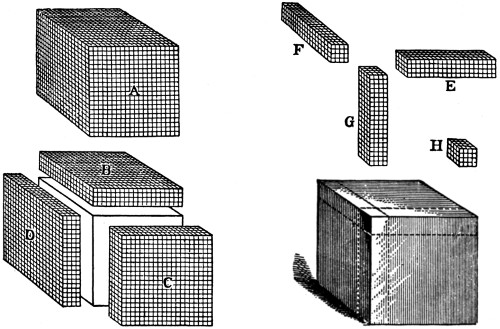
FIGURES REPRESENTING THE PROCESSES OF FINDING CUBE ROOT
Thus, 289383 will be pointed off into two periods—289·383—and we readily see there will be only 2 figures in the root.
The simplest method of finding the cube root of numbers whose prime factors are not known is analogous to the method of finding square root, being based upon the form of the cube of the sum of two numbers.
Explanation: The cube root of 1728 is 12. Let us see how we found it.
12 = 1 ten + 2 units
123= (10 + 2)3
(10 + 2)3 means 10 + 2 × 10 + 2 × 10 + 2
10 + 2
10 + 2
102 + (10 × 2)
+ (10 × 2) + 22
102 + 2(10 × 2) + 22
10 + 2
103 + 2(102 × 2) + (10 × 22)
+ (102 × 2) + 2(10 × 22) + 23
103 + 3(102 × 2) + 3(10 × 22) + 23
That is, the cube of any number made up of tens and units equals—
The cube of the tens + three times the product of the square of the tens by the units + three times the product of the tens by the square of the units + the cube of the units,
or
tens3 + 3(tens2 × units) + 3(tens × units2) + units3.
For graphic illustration the geometrical representation of the cube of units and tens in the drawings is helpful.
After the process is understood, this short method of writing the work may be used by the pupil:
Example: Find the cube root of .0163956, carrying the root to 3 decimal places.
Work:
.016 ·395·600 ) .254+
8
1200 8395
300
25
1525 7625
770600
187500
3000
16
190516 762064
8536
CHEMISTRY
Its Use and Importance—What it is—How it Differs from Physics—Its Divisions—Distinction between Theoretical and Practical Chemistry—Outline of Theoretical Chemistry—Laws of Chemistry—Atomic Theory—Chemical Notation—Molecular Weights—Reactions—Chemical Arithmetic—Bases—Quantivalence—Tests—Table of Chemical Elements—-Chemistry of Familiar Things—Common Names of Chemicals—Radio-Activity and Radio-Active Substances—Radium and its Uses—The Spinthariscope
Importance of Chemistry
A certain amount of knowledge of chemistry is eminently useful in almost every walk of life. An intelligent knowledge of the chemistry involved in the processes of the kitchen, the dairy, the dye-house, the farm, or the manufactory, places the possessor engaged in any of these processes on a different level from the rule-of-thumb worker, who is as ignorant of the reason for adopting a particular method as he is of the properties of the materials he employs.
Technical chemistry deals especially with the application of the principles and processes of chemistry to the arts and manufactures, and it is to those who are engaged in manufactures of almost every kind that a knowledge of chemistry is a particular advantage.
It is not a question of expediency alone, but one of absolute necessity that a technical education, including chemistry as one of its principal subjects, should form not the least important part of the equipment for his work of any artisan who is to excel in his employment in intelligence and skill.
What is chemistry?
Chemistry is that branch of science which treats of the intimate composition of matter, and the changes produced in it when subjected to particular conditions—such as temperature, pressure, mass, light, catalysis, etc.
How does chemistry differ from physics?
The two branches, physics and chemistry, overlap a great deal, it being very difficult to draw the line of demarcation between them, particularly in the higher stages of the physical and chemical changes of matter.
For example, a steel needle rubbed on a magnet in a definite way undergoes physical change by means of which it acquires the power of the magnet. On the other hand, a match rubbed on a match-box undergoes a chemical change by means of which flame is produced. Thus it is possible to make a distinction between the sciences of physics and chemistry. A chemical change involves some alteration in the essential nature of the substance. The match having been ignited has undergone a permanent change, whereby it is no longer combustible. The physical change quoted above involves no alteration in the substance itself, and the acquired property is further only temporary and can be continually lost and reacquired.
The difficulty occurs in this fact, however, that every chemical change is accompanied by physical change, and the physical change may often be the only sign that chemical change has taken place.
What are the chief divisions of chemistry?
Organic and Inorganic Chemistry.—There are two great divisions in the science of chemistry, organic and inorganic. The branch which is best known is that of inorganic chemistry, which covers the chemistry of all the purely mineral substances. Organic chemistry has to do primarily with that of substances obtained from animal or vegetable sources. Now, however, it has resolved itself into the study of the compounds of carbon, always bearing in mind the fact that many carbon compounds have no organic origin, and therefore really fall outside the scope of organic chemistry.
The fundamentals of both branches are the same, and the real reason for the division is the number of the carbon compounds and their highly complex character. It is in this realm that the graphic formula is of most service, and in its organic branch chemistry most nearly approaches biology.
The branch of inorganic chemistry which treats of the composition, etc., of naturally occurring minerals, receives the title of mineralogical chemistry.
Physical Chemistry explains processes, formulates laws for these processes, and is divided within itself again into electro-chemistry and thermo-chemistry, etc. One branch of physical chemistry in which great strides have been made, is the study of the general properties of gases. But it is really as much in the realm of physics as it is in the realm of chemistry.
The study of the chemical nature of substances entering into the constitution of the animal organism, and the chemical changes taking place during the life processes of animals, forms the domain of physiological chemistry.
The investigation of the influence of soils, and manures, etc., of different compositions, upon vegetable life, and the chemical principles underlying the art of agriculture, are included in the province of agricultural chemistry.
Pharmaceutical chemistry deals with the nature and mode of preparation of the various drugs, ointments, etc., employed for medicinal purposes.
The science in its relations to the arts, manufactures, and industrial processes is embraced in the wide titles of technical and applied chemistry.
What is the difference between theoretical and practical chemistry?
There are in every science two great divisions. These are known as the “theory” and the “practice” (or, as they are sometimes called, the science and the art). The theory of any science is that part of it which forms the answer in any case to the question “Why?” The practice in the same way answers to the question “How?”
If we find, for example, that by putting a fire under a vessel of water, the water gradually begins to boil, as we say, “boils away,” we have learned something that relates to practice. We have learned how to change water into vapor. It is not necessary that we should know why the result is brought about, so long as we are satisfied with the result alone.
But as soon as we begin to wish to bring about any result in the best possible way, we must inquire why a certain course of action causes the result; and in the case of the water, we ask why heat should make water boil and then disappear. The answer to the question “How?” is usually a simple one. It can be found out by experiment. Once having found out, we may usually repeat the work as often as we choose.
But the question “Why?” lies deeper, and sometimes cannot be answered at all. The answer to it is in all cases merely a guess—an attempt to explain more or less fully and satisfactorily. If we find that our explanation or theory makes it possible to foretell what will happen in new cases, then we may safely trust it and believe in it.