THE BOOK OF NATIONS Geographical, Historical, Descriptive (continued 10)
Reading edition
Under Teutonic Invaders.—Continual warfare on the open frontier soon began between the Roman legions and the advancing Teutonic nations, of whom the Belgians, a mixed race, were the van. The city of Lutetia Parisiorum, now known by its tribal name, Paris, was the headquarters of Emperor Julian before his accession in A.D. 361, while he was struggling with these invaders. After his death, Gaul became a prey to the Teutons. They did not destroy the old population, but quartered themselves as guests on the proprietors of land; while the Roman cities kept up their self-government, and paid ransoms to escape pillage. Chief of these Teutonic tribes were the Goths, Burgundians and Franks.
Merovingians.—The Franks, whose dominion swallowed up those of both the foregoing tribes, had been long settled in the north; and Pharamond, their chief in 420, is considered the founder of the French monarchy, as he was of the first or Merovingian race of Frankish kings. In 485 Clovis defeated Syagrius, the Roman general, at Soissons, and finally extinguished the Roman power in the west, and in 507, by his victory over the Visigoths, he rendered himself master of the country between the Loire and Garonne, but was checked at Arles by Theodoric, king of the Ostrogoths. He then settled in Paris, where he died. His chief aim was a united Frankish kingdom.
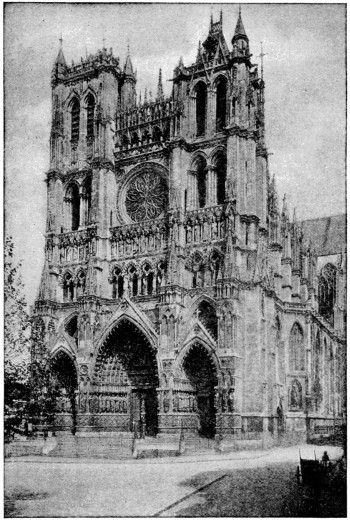
AMIENS CATHEDRAL
The most perfect specimen of Gothic architecture in France, dating from the thirteenth century. This splendid structure is embellished with a wealth of magnificent mediæval sculpture. Viollet-le-Duc happily calls this cathedral “the Parthenon of Gothic architecture.”
Clovis in 493 married Clotilda, a Christian Burgundian princess, and in 496 embraced her faith.
Though nominally Christians, the Franks brought their old hereditary Teuton customs of inheritance and chieftainship, which, as they had last come from the banks of the Yssel, were known as Salic laws—i.e. of the Salian Franks. Their German dominions were called Austreich (the eastern kingdom); their Gaulish Neaustreich (not Eastern) or Neustria; and both were Frankland. Their dynasty soon exhausted itself, and latterly their kings were called Fainéants or “Do-nothing” kings while the mayors of the palace really governed.
Carlovingians.—One of the mayors, a Teuton wholly in blood, Charles Martel, in 721 checked the tide of Saracen invasion, and saved Gaul by the great battle of Soissons. His son, Pepin, in 753 was elected king, and thence descended the line known as Carlovingians. Under Pepin and Charles the Great, called by the French “Charlemagne,” the country was relatively peaceful and prosperous; but after the latter’s death things returned to their original state of confusion.
Charlemagne was one of the really great monarchs of the world. His dominions reached from the Ebro to the Channel, from the Elbe, to the Atlantic, and included North Italy, and in 800 he was crowned by the Pope Emperor of the West. His power was too vast for a single hand of less power, and fell to pieces after his son’s death. The Western Franks fell to Charles the Bald, and it was then (about 870) that France became a recognized term for the country between the Channel and the Pyrenees.
The king had, however, very little power; his lands were cut up into divisions under dukes, marquises, and counts, who simply paid him a nominal homage, and were bound to follow him in war, but who ruled quite independently. Moreover, the Northmen or Normans were horribly ravaging the whole country; Paris was fortified against them under Robert the Strong, but, in 911, Charles the Simple found himself obliged to make to Rolla, the chief of the Northmen invaders, a grant of the Neustrian lands, which took the name of Normandy. The Carlovingians finally were deposed in 987, and their last sovereign, Louis V., retired to Lotharingia or Lorraine as duke.
Capetians.—The grandson of Robert the Strong, Hugh, became king. He was called Capet, apparently from the hood which marked him as guardian of the Abbey of St. Denis; and the name is used for his dynasty, which reigned for eight hundred years.
The German influences had passed away, though the king and nobility were of Frankish blood. The whole realm was parcelled out into feudal holdings, the great chiefs of which hardly owned the royal power, and the only place where the king really ruled directly was the county of Paris. There was much confusion and private warfare, and after the conquest of England in 1066, the Dukes of Normandy overshadowed the French kings.
Louis IV. (“the Fat”), in 1108, was the first king of any ability. He judicially overcame a robber count, and in his time (though not on any fixed principles) cities began to be allowed to purchase their power of self-government, such as the southern one had preserved from Roman times. This was called the right of commune. Except in these cities, the lot of the people of Gallo-Roman blood was wretched. They were called villeins, and, except that they were attached to the soil, were almost slaves, cruelly oppressed and downtrodden by their irresponsible lords, mostly Franks, who covered the land with fortified castles. There was, however, much religious zeal, which found its outlet in the Crusades, first proclaimed at Clermont, in Auvergne, in 1095, and in the religious orders, whose beautiful monasteries and splendid cathedrals still exist.
France was at its weakest under Louis VII., when Henry II. of England, by inheritance Duke of Normandy and Count of Anjou, had married the heiress of the great Duchy of Aquitaine, and obtained the heiress of Brittany for his son. Philip II., called Augustus, spent his life in undermining the power of the English kings, and when King John murdered his nephew Arthur of Brittany, Philip held a court of justice, cited him thither, and, on his non-appearance, adjudged him to have forfeited Normandy and Anjou, which easily were conquered, leaving only Aquitaine as the possession of John’s mother, and these lands, being held direct of the crown, much added to the royal power.
Under Louis IX.—The king, Louis IX., was the best and most blameless of French sovereigns. It was he who, in 1258, established the Parliament of Paris. In every Teuton nation the king was supposed to take counsel and do justice among the other nobles and freemen; but to attend courts of law in a large territory was a great vexation to the nobles, who would not come, and yet resented decisions made in their absence. Louis arranged that though every immediate vassal of the crown had a right to sit in it, yet in its working state it should only consist of men trained in the law, with just nobles enough to give authority. In this parliament the wills and edicts of the king, and the taxes he imposed, were registered. The provinces, likewise, had parliaments to serve as courts of law. Louis’s devotion led him to attempt two unfortunate crusades, and he died in the second, in 1270.
His grandson Philip IV. (“the Fair”), had a desperate quarrel with the Papacy, and by underhand means succeeded in forcing Pope Clement V. to reside in his dominions. The Popes fixed their residence at Avignon, in Provence, a province belonging to the Empire, and held at the time by Philip’s uncle, Charles, Count of Anjou, but near enough for French influence. Here the Papal court continued for seventy years. Philip V. was a violent and unscrupulous man, and the three sons who reigned in succession after him had not his force of character.
Philip was succeeded in turn by Louis X., Philip V., and Charles IV. The rivalry between France and England, consequent upon the accession of Duke William of Normandy to the throne of the latter, came to a decisive crisis during the first half of the fourteenth century.
House of Valois and the “Hundred Years’ War.”—On the death of Charles IV. (1328) Philip of Valois succeeded to the throne, beginning the Valois dynasty; but Edward III. of England, by virtue of hereditary right derived from his mother’s side, claimed not only such provinces as had been taken from his ancestors, but the whole kingdom. In this way began the protracted conflict which French historians call the “hundred years’ war” (1337-1453), a period covering the reigns of John II. (1350-1364), Charles V. (1364-1380), Charles VI. (1380-1422), and the greater part of the reign of Charles VII. (1422-1461). In 1340 an English fleet destroyed the naval force of France at Sluis, on the coast of Flanders; in 1346, at Crécy, the English archers overcame the flower of French chivalry; and at Poitiers (1356) the Black Prince defeated King John and made him prisoner.
The States-General were also the scene of a deadly struggle between the regent and the third estate, and the peasantry of several districts broke out into a fearful insurrection, which was named the Jacquerie, and marked by all the horrors of a servile war. Charles V., with the help of his great constable, Du Guesclin, regained in a few campaigns almost all the English acquisitions in France. On his death, in 1380, his son Charles VI., surnamed the Well-Beloved, ascended the throne.
The reign of this sovereign was signally unfortunate. He fell into a state of insanity, which rendered him incapable of attending to the administration of the government, and in consequence regents were appointed, whose misconduct threw the kingdom into a civil war. During these calamities which afflicted France, Henry V. of England invaded the country, and gained the memorable battle of Agincourt. The consequence of this victory, and other advantages gained by Henry, enabled him to conclude a treaty by which his succession to the throne of France was acknowledged on the death of Charles. Henry and Charles both died shortly after this event, A. D. 1422.
Charles VII. and Joan of Arc.—Charles VII., surnamed the Victorious, asserted his right to the throne of his father, while at the same time the infant Henry VI. of England was proclaimed King of France under the regency of his uncle, the Duke of Bedford. The English laid siege to Orleans, a place of the greatest importance, and so successful were they in their operations against this and other places that the affairs of France began to wear a most gloomy aspect. The tide of misfortune, however, was successfully turned by one of the most extraordinary events recorded in history.
When the hope of saving Orleans was almost abandoned, a young girl named Joan of Arc, about seventeen years of age, who had lived an humble life in a village on the borders of Lorraine, presented herself to the Governor of Vaucouleur, and maintained with much earnestness that she had been sent by Divine commission to raise the siege of that city, and procure the coronation of Charles in the city of Rheims.
After undergoing a most rigid examination before a committee of persons appointed for that purpose, and also before the court and the king himself, she was intrusted with the liberation of Orleans. As she approached the city her presence inspired the inhabitants with confidence, while it spread dismay and consternation among the English, who hastily raised the siege and retired with precipitation, but being pursued by the heroine at the head of the French army, they were entirely defeated at Patay, with a loss of nearly five thousand men, while the French lost only one of their number. From this event Joan was called the Maid of Orleans.
The second part of her mission, which yet remained to be accomplished, was equally arduous and dangerous. The city of Rheims and the intermediate country being in possession of the English or their allies, presented apparently insurmountable difficulties. Charles, however, placing full confidence in her guidance, commenced his march, and as he advanced every obstacle disappeared; the citizens of Rheims, having expelled the garrison, received him with every demonstration of joy. After the coronation was performed, Joan threw herself at the feet of Charles, declaring that her commission was accomplished, and solicited leave to return to her former humble station; but the king, unwilling to part with her services so soon, requested her to remain for some time with the army, with which at length she complied. She afterwards attempted to raise the siege of the city of Campiegne; but her good fortune seemed to have deserted her; she fell into the hands of the English, who, to gratify their revenge for the many losses they sustained through her valour, condemned her, under a charge of various pretended crimes, and caused her to be burned in the public square at Rouen.
By this cruel measure the English hoped to check the success that had attended the operations of Charles. In this they were disappointed; such was the impulse which the heroine had given to the affairs of France, that the English in a few years were expelled from all their possession in the country, with the exception of Calais.
Charles passed the remainder of his reign in improving the internal condition of his kingdom. The close of his life was embittered by the unnatural conduct of his son, who attempted to poison his father. He died in 1464, a prince of acknowledged virtue, justice and discretion.
Louis XI. (1461-1483), the son and successor of Charles VII., annexed Burgundy and Picardy, and acquired Anjou, Maine, Provence, and the counties of Rousillon and Cerdagne; and France thus became one of the great powers on the Mediterranean. On the northwest, by the marriage of Charles VIII. with Anne of Brittany, she gained possession of that large province. Charles VIII. invaded Italy in 1494, and this was the first of a long series of Italian wars in which France was engaged for more than half a century. With Charles VIII., who died in 1498, the direct line of Valois ended, and Louis, duke of Orleans, grandson to a brother of Charles VI., became king under the title of Louis XII. He met at first with some success in Italy, but was at last driven out.
Wars of Francis I. and Charles V. of Germany.—Francis I. (1515-1547), his successor, being opposed by the emperor Charles V., of Germany, suffered a disastrous defeat at Pavia in 1525, and was carried a prisoner to Madrid, where in 1526 he agreed to a treaty by which he forfeited Burgundy, and all claims to Naples, Milan, Tournay, and Arras. No sooner was he set at liberty than he secured from the pope a release from his oaths, and renewed the struggle, but again with unfavorable results, and was compelled to make another disastrous peace at Cambrai (1529).
The Reformation had now begun, and Charles V. was obliged to turn his attention to Germany. Francis encouraged the Protestant princes in their opposition to the emperor, and in 1536 the war again broke out. It was ended in 1544 by the peace of Crespy, when the emperor was threatening Paris.
Francis I. died in 1546, and was succeeded by his son, Henry II., and the struggle soon began again. Henry recovered Calais for France. Under Francis II. (1559-1560) the Roman Catholic House of Guise obtained possession of the effective power in the state. Their adversaries, the House of Bourbon, headed the movement of the reformers. Under the weak kings Charles IX. (1560-1574) and Henry III. (1574-1589), who were under the influence of their mother, Catherine de’ Medici, this division in the French nobility resulted in the war of the League and wars of religion. The massacre of the Protestants on the night of St. Bartholomew (1572) raised to such a pitch the pride of the House of Guise that Henry III. fled to the camp of the Bourbon leader, where he was murdered by a fanatical monk. The name of Charles IX. remains associated with the horrors of the St. Bartholomew’s night, which witnesses the striking of a blow at the very heart of the nation.
The Bourbon Line.—The accession of the Bourbon prince, Henry IV. of Navarre (1589-1610), allayed the fury of religious wars, but his recantation of Protestantism in favor of Catholicism disappointed his own party, to which, however, he granted the free exercise of their religion by the edict of Nantes (1598).
Henry, however, meditated the humiliation of the house of Austria, and was on the eve of his departure for the army when he was assassinated by Ravaillac, May 14, 1610.
Under the regency of his widow, Maria de’ Medici, mother of Louis XIII., the kingdom was distracted by war between the queen mother and the young king. Cardinal Richelieu, who took the reins of government in 1624, consolidated the power of the monarch at home, and, while annihilating the power of the French Protestants, energetically supported the German Protestants against the house of Austria.
His successor, Cardinal Mazarin, pursued the same policy; and the treaty of Westphalia (1648) asserted the triumph of religious and political liberty in Germany, and the victory of France, which added to her territory the province of Alsace.
The troubles of the Fronde, a faint image of the old civil wars, detracted nothing from the influence gained abroad by the French government, and Mazarin concluded with Spain, in 1659, the treaty of the Pyrenees, which secured two other provinces to France—Artois and Roussillon.
Age of Louis XIV.—Under the personal rule of Louis XIV. France rose to the height of glory, while he himself was placed above all control. From the day of Mazarin’s death (1661) he assumed the direction of public affairs. In the first years of his administration the national wealth, promoted by the admirable efforts of Colbert, increased with unusual rapidity. Intellectual progress kept pace with material, and everything conspired to create a literary period of great magnificence.
The king’s military successes, too, achieved through Condé, Turenne, Luxembourg, and others, were brilliant; and he added to his kingdom Flanders, Franche-Comté, the imperial city of Strasburg, and several other important territories.
But the revocation of the edict of Nantes in 1685 drove from the kingdom a large number of its best citizens, and crippled many branches of industry. The war of 1689-1697 against the league of Augsburg greatly exhausted the country, and that of the Spanish succession nearly reduced it to extremities; but after a contest of twelve years Louis succeeded, and by the treaties of Utrecht and Rastadt (1713 and 1714) the house of Bourbon, in the person of Louis’s grandson, Philip V., inherited the best part of the Castilian monarchy.
Louis XIV. died in 1715, after an unparalleled reign of seventy-two years. The burden which he had borne was far too heavy for his weak successors; and toward the end of Louis XV.’s reign France could scarcely be ranked among the great European powers. The four wars in which she then participated, against Spain (1717-1719), during the regency of Philip of Orleans, for the succession of Poland (1733-1735), for the succession of Austria (1740-1748), and finally the seven years’ war (1756-1763), were productive only of disgrace and disaster, including the loss of Canada.
Prelude to the Revolution.—Louis XV. died in 1774, and his grandson Louis XVI. ascended the throne at a period which was perhaps the most inglorious of French history. The kingdom was on the verge of financial as well as political ruin, and it seemed evident that a disastrous crisis was approaching.
An attempt to conciliate the people was made by the restoration of the parliament of Paris; but instead of promoting reform, this body proved a hindrance to it. Turgot and Malesherbes, associated with Maurepas in the ministry, acted with considerable efficiency in the endeavor to improve the state of affairs, but were deposed through the influence of the court party. Necker, who became minister of finance in 1777, at first seemed to improve matters slightly; but the opposition of the nobles and clergy to any scheme of general taxation, with other causes, led to his deposition.
His successor, Calonne, recklessly plunged the finances into a more hopeless condition than ever, and in 1786 the king was induced to call together the States-General, the really popular assembly of representatives, which had not met since 1614, and then in vain. Thenceforward there was a succession of barriers thrown down; madness set in upon the long-oppressed people, who wreaked the vengeance of a thousand years. Frightful mobs rose upon all whom they connected with their past misery. Nobles and clergy fell; the king was dethroned, and in 1793 was executed. A reign of terror set in, during which Robespierre and other fanatics, who thought they must destroy in order to build up, sent to the beheading machine, the guillotine, thousands of victims, and hoped to have swept away even the Christian religion, together with all the old abuses of power.
The Advent of Napoleon and the Directory.—When they fell in 1794, less sanguinary counsels prevailed, and, after sundry attempts at forms of government, Napoleon Bonaparte, of Corsican birth, climbed to supreme power. His course had been through victories. Belgium had been overrun, the Austrians forced back across the Rhine, the allied armies of England and Holland gradually pushed back, and Prussia and Spain forced to conclude peace. The new government began on October 28, the convention having been dissolved on the 26th. England, Russia, and Austria, in a new coalition, now began to carry on a more vigorous warfare; but Carnot’s strategic direction soon baffled it. Bonaparte was put in command of the army which was not to advance against the Austrians from Italy, and in 1796 and 1797 completely changed the condition of affairs. At the truce of Leoben (April 18, 1797) France controlled all Italy; Austria surrendered all rights in Belgium and recognized those republics which France established; and the history of France became almost wholly identified for nearly eighteen years with that of a single man, Napoleon Bonaparte.
The Consulate.—Bonaparte was chosen first consul for ten years, December 13, 1799; consul for life, August 2, 1802; then hereditary emperor, May 18, 1804. He reformed and reorganized legislation at home by the formation of the civil code, the organization of public instruction, and the improvements he introduced in all the branches of public service; while he added to his military and political glory by a new succession of triumphs, resulting in the treaties of peace signed at Presburg (1805), Tilsit (1807), and Vienna (1809).
He had now reached the height of his glory; he had placed his brothers on the thrones of Holland, Westphalia, and Spain, and his brother-in-law on that of Naples; but his power was shaken by the resistance which he met with in the Spanish peninsula (1808-1813); and his prestige was ruined by his expedition to Russia in 1812. The European nations united against him, and inflicted upon him at Leipsic, October 16-19, 1813, a blow from which he never recovered.
The Restoration.—Napoleon was dethroned in April, 1814, exiled to the island of Elba, and the brother of Louis XVI. received from the conquerors the sceptre of France, now restricted to her old limits. The sudden return of Napoleon from Elba, however, overthrew this new power; and for one hundred days, from March 20 to June 28, 1815, he was again the sovereign of France; but the battle of Waterloo (June 18, 1815) destroyed his power forever, and the Bourbons once more ruled the kingdom.
Louis XVIII. granted a charter to his subjects, and died in 1824 in undisturbed possession of his throne. His brother and successor, Charles X., sought popularity by supporting the Greek insurrection against Turkey and conquering Algiers; but having attempted to suspend some of the most important guarantees secured by the charter, a formidable insurrection broke out, July 27, 1830, and he was obliged to abdicate.
House of Orleans.—After a few days’ interval the head of the younger branch of the house of Bourbon, Louis Philippe, duke of Orleans, was appointed “king of the French” (August 9) by the chamber of deputies. The choice, being acceptable to the middle classes or bourgeoisie, was maintained; and notwithstanding some occasional outbursts of republicanism among the people, the July monarchy, as it was called, lasted for nearly eighteen years.
Revolution of 1848.—A political manifestation in favor of parliamentary reform brought on another revolution, February 24, 1848, and France became a republic, with a provisional government in which Lamartine played the most conspicuous part; but within a few months the majority of the constituent assembly, frightened by socialistic movements and a terrible civil struggle in the capital (June 23-26), became hostile to the new form of government. On December 10, 1848, Louis Napoleon Bonaparte, nephew of Napoleon I., was elected president, for a term of four years. On December 2, 1851, the president dissolved the assembly, assumed dictatorial powers, and appealed to the people to sanction his act by their votes. He was reëlected president for a term of ten years; a new constitution was promulgated; and finally, on November 7, 1852, the senate proposed the reëstablishment of the empire.
Second Empire.—The empire was proclaimed, December 2, 1852, and Louis Napoleon ascended the throne with the title of Napoleon III. The chief event of the early portion of this reign was the Crimean war, which largely increased the military prestige of the nation, as well as the popularity and strength of Napoleon’s rule. The war with Austria (1859) left France in a position of even greater authority than before in European politics. In 1860 Savoy and Nice were ceded to France by Italy. The emperor’s schemes for establishing the Hapsburg prince Maximilian on the throne of Mexico proved so ignominious a failure as to do much toward undermining the opinion of his power that had been held in Europe.
The course which Napoleon pursued during the Prusso-Austrian war in 1866 did not tend to restore confidence in him. In 1867 he aided in defending the power of the pope against the Garibaldians. In 1868 the growth of public opinion against the emperor was conspicuous; in 1869 much excitement was caused by the exposure of the confusion in financial affairs; and in 1870 popular disturbances, fomented by Rochefort, broke out on the acquittal of Pierre Bonaparte for the shooting of Victor Noir.
The demand for reforms was answered by a new constitution, which was finally confirmed by a plebiscite on May 8.
Franco-Prussian War.—In the spring of 1870 there were unmistakable manifestations of a hostile spirit on the part of the government against Prussia. The declaration of the candidature of the Hohenzollern prince Leopold for the throne of Spain furnished an immediate cause of war. The voluntary withdrawal of Prince Leopold followed the remonstrances of France, but the latter demanded also of the king of Prussia an explicit promise that no prince of Hohenzollern should ever be a candidate for the Spanish crown. This demand was refused, and war was declared by France, July 19.
On the 28th Napoleon went to Metz, where he personally took command of his forces; and on August 2 the king of Prussia, accompanied by Bismarck and Moltke, joined his army. On the latter day the French bombarded and took Saarbruck. On August 4 the German advance, under the crown prince, defeated the French at Weissenburg, and on the 6th totally defeated MacMahon at Worth.
On the 11th the three German armies under Steinmetz, Prince Frederick Charles, and the crown prince effected a junction on French territory, with headquarters at Saarbruck. By the 14th Steinmetz had advanced to near Metz, where the French army was concentrated under Bazaine, and on the afternoon of the same day won a victory at Courcelles; on the 16th Frederick Charles won a second battle at Mars-la-Tour; and on the 18th the combined forces under King William again defeated the French at Gravelotte.
Bazaine now drew within the fortifications, and the Germans, leaving a portion of their forces to invest the city, marched against MacMahon at Chalons. News reaching them of the advance of MacMahon to relieve Bazaine, they turned northward to intercept him. On the 30th they surprised a corps of General Failly near Beaumont, and fought a battle which resulted in the retreat of the French beyond the Meuse and their final withdrawal to Sedan.
The battle of Sedan was begun by the Germans September 1. After severe fighting they drove the French from all sides to that fortress, where, almost surrounded and without provisions or defenses, they were compelled to capitulate. The emperor surrendered to King William in person, September 2, and was carried a prisoner to Wilhelmshohe. In dead, wounded, and prisoners, the French thus lost in the last few days an army of nearly one hundred and fifty thousand men.
The Third Republic.—The news of Sedan created intense excitement at Paris, and the popular indignation against Napoleon and his party was without bounds. Gambetta proclaimed the republic; and a provisional government of national defense was at once formed, with General Trochu for president and Jules Favre for vice-president. The empress took refuge in England.
The German army entered Rheims on the 5th, and on the 15th they had closely approached Paris. A sortie by General Ducrot on the 19th was repulsed, and a few days later the actual investment of the city was begun. The German headquarters were established at Versailles. A portion of the French government of national defense remained in the capital; another portion, in order to be in communication with the provinces, was established at Tours. Toul surrendered on the 23rd. Strasburg capitulated in the night of September 27-28. Soissons and Schlettstadt capitulated respectively on October 16 and 24, and on the 27th Metz also yielded, Bazaine surrendering one hundred and seventy-three thousand men.
In the meantime the situation of Paris had become hopeless; and on January 28 arrangements for its capitulation had been concluded and provision made for a general armistice. On February 17, 1871, Thiers was chosen chief executive of the republic. On the 26th the preliminary treaty of peace was signed at Versailles, by which France ceded to Germany the greater part of Alsace and Lorraine, and agreed to pay as war indemnity five milliards of francs. The definitive treaty with Germany had been signed at Frankfort on the 10th of May.
In 1873 the Thiers administration was overthrown and replaced by one under Marshal MacMahon. In 1875 a Parliamentary Republic was established, and still remains under the guarantees of the constitution. In 1877 MacMahon was succeeded by Grevy. By this time the republic was fairly firmly established and withstood many attacks. A policy of colonial expansion was adopted, particularly in Egypt, but in spite of the dual control France and England established in 1879, France, in 1882, refused to help England in Egypt, and lost any control she had there.
The Triple Alliance of 1883 isolated France, but in 1890 she confronted the Triple Alliance with the Dual Alliance—between France and Russia—and made great attempts to establish colonial power.
The outstanding events of 1914, 1915 and 1916 were those connected with France’s participation in the European war as the leading military power of the Entente Allies. (See further under Great Wars of History.)
Books of Reference.—The chief histories are those of Henri Martin, Michelet, Dareste, Lavalee, Sismondi, Kitchin Lavisse, and Durny. These works cover the general history of France. See, in addition, Tocqueville’s The Ancient Regime; Taine’s French Revolution; Carlyle’s History of the French Revolution; Fyffe’s History of Europe; Hazlitt’s Life of Napoleon Bonaparte.
COLONIES AND DEPENDENCIES
The colonies and dependencies of France (including Algeria and Tunis) have an area roughly estimated at about 4,000,000 square miles with a population of about 41,600,000. Algeria, however, is not regarded as a colony but as a part of France, and Tunis is attached to the Ministry of Foreign Affairs.
The area and population of the colonial domain of France at the beginning of the European war was as follows:
Colonies and Year of Acquisition Area in Sq. Mi. Population
In Asia:
India (1679) 196 277,000
Annam (1884) - 309,980 16,317,000
Cambodia (1862)
Cochin-China (1861)
Tonking (1884)
Laos (1892)
Total Asia 310,176 16,594,000
In Africa:
Algeria (1830-1902) 343,500 5,231,850
Sahara (——) 1,544,000 800,000
Tunis (1881) 45,779 1,500,000
Senegal (1637-1880) - 1,585,810 - 915,000
Upper Senegal & Niger (1893) 4,415,000
Guinea (1843) 1,498,000
Ivory Coast (1843) 890,000
Dahomey (1893) 749,000
Mauritania (1893) 400,000
Congo (1884) 669,280 5,000,000
Reunion (1649) 970 201,000
Madagascar (1643-1896) 226,015 2,701,000
Mayotte (1843) 840 96,000
Somali Coast (1864) 5,790 180,000
Total Africa 4,421,934 24,576,850
In America:
St. Pierre and Miquelon (1635) 96 6,000
Guadeloupe (1634) 688 182,000
Martinique (1635) 378 182,000
Guiana (1626) 34,000 27,000
Total America 35,222 397,000
In Oceania:
New Caledonia (1854-1887) 7,200 55,800
Tahiti, etc. (1841-1881) 1,544 30,000
Total Oceania 8,744 85,000
Grand Total 4,776,126 41,653,650
SOVEREIGNS AND PRESIDENTS OF FRANCE
Giving, in order, the Royal Houses to which the French sovereigns belonged; Period of Rule in Chronological order; names of kings, emperors, regents and presidents; dates of birth and death of each; their genealogy or lineage; and other important personal facts.
THE MEROVINGIANS
420-428.—Pharamond (?-?); life obscure.
428-448.—Clodion (?-?); son of Pharamond; king of the Salic Franks.
448-457.—Merovaeus (411?-457); founder of the Merovingian Dynasty.
458-481.—Childeric (?-481); son of Merovaeus, king of the Franks.
481-511.—Clovis I. (465-511); son of Childeric; real founder of the Frankish monarchy. At his death his four sons divided the empire.
Childebert; Paris.
Clodomir; Orleans.
Thierry; Metz; and
Clotaire; Soissons.
558-561.—Clotaire I.; sole ruler (497-561); fourth son of Clovis. Upon his death the kingdom was divided between four sons: viz.
Charibert, ruled at Paris.
Gontram, in Orleans and Burgundy.
Sigebert, at Metz and Chilperic, at Soissons; both assassinated by Fredegonde.
575-596.—Childebert II. (570-596); son of Sigebert and Princess Brunehaut; ruled under the regency of his mother; poisoned.
613-628.—Clotaire II. (584-628); son of Chilperic I.
628-638.—Dagobert I., the Great (602-638); son of Clotaire II.; divided the kingdom between his two sons:
Clovis II., Burgundy and Neustria.
Sigebert II., Austrasia.
670-673.—Childeric II. (649-673); son of Clovis II.; assassinated, with his queen and his son Dagobert, in the forest of Livri.
687-714.—Pepin II., of Heristal (?-714); ruled the whole kingdom of the Franks during the reigns of Dagobert II., Clovis III., Childebert III., and Dagobert III.
715-720.—Chilperic II. (?-720); deposed by Charles Martel, mayor of the palace in 717, restored in 720, but soon dies at Noyon.
720-737.—Thierry IV. (712-737); son of Dagobert III.; reigned under the influence of Charles Martel who took the title “duke of the Franks.”
737-741.—Interregnum, till death of Charles Martel, 741.
742-752.—Childeric III. (?-755); son of Childeric II.; last of the Merovingians; made king by Pepin, 742; deposed by him, 752.
THE CARLOVINGIANS
751-768.—Pepin the Little (714-768); son of Charles Martel.
768-814.—Charlemagne, or Charles the Great (742-814); son of Pepin the Short; Charles crowned Emperor of the West, by Leo III., 800. Carloman reigned with him three years.
814-840.—Louis I., le Debonnaire (778-840); son of Charles the Great; emperor; dethroned, but restored.
843-877.—Charles the Bald (823-877); younger son of Louis le Debonnaire, king; emperor in 875; poisoned by Zedechias, a Jewish physician.
877-879.—Louis II. (846-879); son of Charles the Bald.
879-884.—Louis III. (863-882) and Carloman (?-?); sons of Louis II.; the former died 882, and Carloman reigned two years alone.
884-888.—Charles the Fat (839-888); son of Louis the German; usurps right of Charles the Simple.
888-898.—Count Eudes (?-898); Eudes, or Hugh, count of Paris.
898-922.—Charles the Simple (879-929); son of Louis the Stammerer; Charles III. (or IV.) was deposed, and died in prison in 929; he married Edgiva, daughter of Edward the Elder, of England, by whom he had a son, King Louis IV.
922-936.—Raoul (Rudolph of Burgundy) (?-?); Rudolph, or Raoul, duke of Burgundy; elected king, but never acknowledged by the southern provinces.
936-954.—Louis IV. (921-954); son of Charles the Simple; taken by his mother into England, died by fall from his horse.
954-986.—Lothaire (941-986); son of Louis IV.; ruled with his father from 952, succeeds him at fifteen years of age, protected by Hugh the Great; poisoned.
986-987.—Louis V. (966-987); son of Lothaire; poisoned (supposed by his queen, Blanche); last of race of Charlemagne.
HOUSE OF CAPET
987-996.—Hugh Capet, the Great (?-996); eldest son of Hugh the Abbot; usurps the rights of Charles of Lorraine, uncle of Louis IV. From him this race of kings is called Capetians.
996-1031.—Robert II. (971-1031); son of Hugh Capet; surnamed the Sage; died lamented.
1031-1060.—Henry I. (1011?-1060); son of Robert II.
1060-1108.—Philip I., the Fair (1052-1108); son of Henry I.; succeeded at eight years of age; ruled at fourteen.
1108-1137.—Louis VI. (le Gros) (1078-1137); son of Philip I.
1137-1180.—Louis VII. (1120-1180); son of Louis VI.; surnamed the Young; reigned with his father for some years.
1180-1223.—Philip II., Augustus (1165-1223); son of Louis VII.; succeeds at fifteen; crowned at Rheims in his father’s lifetime.
1223-1226.—Louis VIII. (1187-1226); son of Philip Augustus.
1226-1270.—Louis IX., or St. Louis (1215-1270); son of Louis VIII.; succeeded at fifteen, under his mother as guardian and regent; died in camp before Tunis.
1270-1285.—Philip III., the Bold (1245-1285); son of Louis IX.
1285-1314.—Philip IV., the Fair (1268-1314); son of Philip III.; king in his seventeenth year.
1314-1316.—Louis X. (1239-1316); son of Philip IV.; surnamed Hutin, an old word for headstrong, or mutinous.
1316-1321.—Philip the Hardy (1294-1322) second son of Philip IV.
1322-1328.—Charles IV., the Fair (1294-1328); youngest son of Philip the Fair.
HOUSE OF VALOIS
1328-1350.—Philip VI., of Valois (1293-1350); son of Charles of Valois.
1350-1364.—John II., the Good (1319-1364); son of Philip VI.; died suddenly in the Savoy in London.
1364-1380.—Charles V., the Wise (1337-1380); son of John II.
1380-1422.—Charles VI. (1368-1422); son of Charles V.
1422-1461.—Charles the Victorious (1403-1461); son of Charles VI.
1461-1483.—Louis XI. (1423-1483); son of Charles VII.; able but cruel.
1483-1498.—Charles VIII. (1470-1498); son of Louis XI.; the Father of his People; great-grandson of Charles V.
1498-1515.—Louis XII. (1462-1515); a descendant of the younger son of Charles V.
1515-1547.—Francis I. (1494-1547); son of Charles, Count of Angoulême; called the Father of Letters; great-great-grandson of Charles V.
1547-1559.—Henry II. (1519-1559); son of Francis I.; died of accidental wound by comte de Montmorency at the tournament for nuptials of his sister with the duke of Savoy.
1559-1560.—Francis II. (1543-1560); eldest son of Henry II.; married Mary Stuart, Queen of Scots.
1560-1574.—Charles IX. (1550-1574); second son of Henry II.; Catherine de’ Medici, his mother, regent.
1574-1589.—Henry III. (1551-1589); third son of Henry II.; elected king of Poland; last of the house of Valois; stabbed by Jacques Clement, a Dominican friar.
HOUSE OF BOURBON
1589-1610.—Henry IV., the Great (1553-1610); son of Antoine de Bourbon, King of Navarre; son-in-law of Henry II.; assassinated by Francis Ravaillac.
1610-1643.—Louis XIII., the Just (1601-1643); son of Henry IV.
1643-1715.—Louis XIV., the Great (1638-1715); son of Louis XIII. and Anne of Austria.
1715-1774.—Louis XV. (1710-1774); great-grandson of Louis XIV.
1774-1793.—Louis XVI. (1754-1793); grandson of Louis XV.; ascended the throne in his twentieth year; married the archduchess Marie Antoinette, of Austria, May, 1770; dethroned, July, 1789; guillotined, January, 1793, and his queen, October following.
.........—Louis XVII., son of Louis XVI., never reigned; and died in prison, supposed by poison, June, 1795, aged ten years two months.
THE FIRST REPUBLIC
1792-1795.—National convention; first sat September 21, 1792; it consisted of seven hundred and fifty members.
1795-1799.—Directory nominated. November 1, 1795; the Directory (Lareveillère Lepaux, Letourneur, Rewbell, Barras, and Carnot) nominated November; abolished, and Bonaparte, Ducos, and Siéyès appointed an executive commission, November, 1799.
THE CONSULATE
1799-1804.—Napoleon Bonaparte (1769-1821); Cambacérès (1753-1824); and Lebrun (1739-1824), appointed consuls, December, 1799. Napoleon appointed consul for ten years, May, 1802; for life, August, 1802.
THE EMPIRE
(Established by the Senate, May 18, 1804.)
1804-1814.—Napoleon (Bonaparte) I. (1769-1821), decreed Emperor, May 18, 1804. He renounced the thrones of France and Italy, and accepted the Isle of Elba for his retreat, April 5, 1814. Again appeared in France, March 1, 1815. Was defeated at Waterloo, June 18, 1815. Abdicated in favor of his infant son, June 22, 1815. Banished to St. Helena, where he died, May 5, 1821.
.........—Napoleon II. (1811-1832); never reigned; he was Napoleon’s son by his second wife, Maria Louisa of Austria, and later created Duke of Reichstadt, and King of Rome.
RESTORATION OF THE BOURBONS
1814-1824.—Louis XVIII. (1755-1824); brother of Louis XVI.; married Marie-Josephine-Louise of Savoy; entered Paris, and took possession of the throne, May, 1814; obliged to flee, March, 1815; returned July, same year; died without issue.
1824-1830.—Charles X. (1757-1836); younger brother of Louis XVIII.; married Marie-Thérèse of Savoy; deposed July, 1830. He resided in Great Britain till 1832, and died at Gratz, in Hungary.
HOUSE OF ORLEANS
1830-1848.—Louis Philippe (1773-1850); son of Louis-Philippe, duke of Orleans, called Egalité, descended from Philippe, duke of Orleans, son of Louis XIII.; married, 1809, Maria-Amelia, daughter of Ferdinand I., king of the Two Sicilies; raised to the throne as king of the French, 1830; abdicated, 1848; died in exile, in England.
THE SECOND REPUBLIC, 1848
February 22 to December 19, 1848.—The revolution commenced in a popular insurrection at Paris, February, 1848. The royal family escaped by flight to England; a provisional government was established, monarchy abolished, and France declared a republic.
1848-1852.—Charles Louis Napoleon (1808-1873); declared by the National Assembly President of the Republic of France; and proclaimed next day, December 20, 1848; elected for ten years, December, 1851.
THE SECOND EMPIRE
1852-1870.—Napoleon III. (1808-1873); nephew of Napoleon I.; formerly president of the French Republic as Charles Louis Napoleon; elected Emperor, November, 1852; proclaimed, December, 1852; surrendered himself a prisoner to the King of Prussia at Sedan, September, 1870; deposed at Paris, September 4; died at Chislehurst, England, and buried there.
THE THIRD REPUBLIC
1870-1871.—Committee of Public Defense.
1871-1873.—I. Louis Adolphe Thiers (1797-1877); appointed President of the French Republic by the National Assembly, 1871; resigned, 1873.
1873-1879.—II. Marshal M. E. Patrice Maurice MacMahon (1808-1893); elected president, 1873.
1879-1887.—III. François Paul Jules Grévy (1807-1891); elected president, January, 1879; reelected, 1885; resigned, December, 1887.
1887-1894.—IV. Marie-François Sadi-Carnot (1837-1894); elected president, December, 1887; assassinated, June, 1894.
1895-1899.—V. Jean Pierre Paul Casimir-Perier (1847-1907); elected president, June, 1894; resigned, January, 1895.
1899-1906.—VI. François Felix Faure (1841-1899); elected president, January, 1895; died, February, 1899.
1906-1913.—VII. Emile François Loubet (1838- ——); elected president, February, 1899.
1913- ——.— VIII. Raymond Poincaré (1860- ——); elected president, 1906.
GERMAN EMPIRE.
GERMANY (from Lat. Germania) is the English name of the country which the natives call Deutschland, and the French L’Allemagne; while internationally it is known as the German Empire (Das Deutsches Reich), especially since 1871.
The German Empire is composed of a federation of twenty-five states, with one common imperial province, the names of which, with their areas and populations, are given on a subsequent page. Heligoland was ceded by Britain to Germany in 1890.
Divisions of the Empire.—The political divisions or states of the German Empire, together with their areas and population at the last census, are given in the subjoined table:
States Area in Sq. Miles Population at Last Census
Kingdoms
1. Prussia 134,616 40,163,333
2. Bavaria 29,292 6,876,497
3. Saxony 5,789 4,802,485
4. Württemburg 7,534 2,435,611
Grand-Duchies
5. Baden 5,823 2,141,832
6. Hesse 2,966 1,282,219
7. Mecklenburg-Schwerin 5,068 639,879
8. Saxe-Weimar 1,397 417,166
9. Mecklenburg-Strelitz 1,131 106,347
10. Oldenburg 2,482 482,430
Duchies
11. Brunswick 1,418 494,387
12. Saxe-Meiningen 953 278,792
13. Saxe-Altenburg 511 216,313
14. Saxe-Coburg-Gotha 764 257,208
15. Anhalt 888 331,047
Principalities
16. Schwarzburg-Sondershausen 333 89,984
17. Schwarzburg-Rudolstadt 363 100,712
18. Waldeck-Pyrmont 433 61,723
19. Reuss, Junior Branch 122 152,765
20. Reuss, Elder Branch 319 72,616
21. Schaumburg-Lippe 131 46,650
22. Lippe-Detmold 469 150,749
Free-Towns
23. Lübeck 115 116,533
24. Bremen 99 298,736
25. Hamburg 160 1,015,707
Reichsland
26. Alsace-Lorraine 5,604 1,871,702
TOTAL 208,780 64,903,423
Location and Extent.—This combination of Germanic States extends now from the Alps and the Bohemian mountains on the south to the Baltic on the north; and from the borders of France, Belgium, and Holland, on the west, to those of Russia on the east; the greatest distance across it from east to west and from north to south being about five hundred miles. The coast-line measures about nine hundred and fifty miles. The most remarkable features of the coast are the expansions of the river mouths in the Baltic; the lagoons called the Kurische Haff, Frische Haff, and Stettiner Haff; the estuaries of the Elbe and Weser; and the rounded inlets of Jade Bay and the Ems mouth, on the North Sea.
The mountains on the south and the sea on the north give natural frontiers for the most part, but west and east artificial boundaries are marked out, which correspond only in a few parts with the ethnographic limits of Germanic and Romanic peoples on the one side, and Germanic and Slavonic on the other.
Surface Characteristics.—The surface of the empire falls naturally into three divisions: the lowlands in the north, the table-land of the south, and the basin of the Middle Rhine.
The Lowlands are part of the Great European plain, and are largely occupied with sandy tracts, with here and there deposits of peat. They are well watered, and in certain districts fertile, while the monotony of their level is broken by two lines of hills whose heights vary from five hundred to eight hundred feet, and which may be said to extend roughly from the Mecklenberg to the Vistula, and from the moors of Lüneburg in Hanover to Silesia.
Table-lands.—In the southern plateau of Bavaria, the Fichtelgebirge is clearly the pivot round which the other mountain systems revolve. Thus, to its northwest there rises the Thuringian Forest and the Harz Mountains, and to the northeast the Erzgebirge, the Riesengebirge, and the Sudetic Mountains. Southwest radiate the Franconian and Swabian Juras and the Schwarzwald or Black Forest heights. Westward stretch the Taunus Mountains, while beyond these, and divided only by the Rhine, are the ridges of the Vosges. In the extreme southeast of Bavaria the Tyrolese or Noric Alps follow the northern bank of the Inn, and from this range rises the Zugspitze (nine thousand seven hundred feet), which is the highest summit in the whole empire. Between Basle and Mannheim, the Middle Rhine is splendidly sheltered by the Vosges and the Black Forest, which guard its course to left and right. (See further under the Rhine.)
Rivers.—By far the greater part of the country is drained northwards to the Baltic and the North Sea by its navigable highways, the Vistula, Oder, Elbe, Weser, and Rhine. The southeastern corner alone belongs to the upper basin of the Danube, flowing towards the Black Sea. (See Danube.)
The Vistula and the Oder are Baltic waterways, but more important from a commercial point of view are the Elbe, with its chief affluents the Mulde, Havel, and the Saale, and the great Rhine, which both empty into the North Sea, along with the smaller Ems and the Weser, which latter is the only purely German stream. This fact is worth noticing, as the sources of the Oder, Elbe, and Vistula must be traced in Austria, and sections only of the Rhine and Danube traverse the empire.
Climate.—Broadly speaking, the general contours are not favorable to climate; for the level exposed flats, north and east offer no resistance to the passage in winter of the dry, piercing winds from Siberia and the Arctic, while to the south and west the mountainous tracts form effectual barriers against the moist Anti-trades. Extremes of temperature increase eastward in proportion to the distance from the Atlantic. In the warmer latitudes of the south, the elevations counteract the natural tendency to grow hotter, so that Ratisbon has the same temperature as Hamburg. In the Upper Harz the rainfall reaches sixty-six inches, but the mean annual precipitation is only about twenty inches. On the whole the climate may briefly be described as continental. It should be noted that the general slope of the country is from the southeast to northwest, that is, away from the sun, and also that the Rhine valley is so delightfully sheltered that it reaps the full benefit of its warm latitude, and thus enjoys excellent weather conditions.
Internal Communications.—The commercial prosperity of the empire may in some measure be traced to the excellence of the railways, the majority of which are managed by the state. Berlin is splendidly provided with communications by rail, and it may with truth be said that it is within twenty-four hours’ reach of almost every point in the empire. Further, the trunk systems have many of them an international importance; for the great Oriental express from Paris to Constantinople traverses the line from Strassburg to Vienna through Munich, while Paris is linked with the remote Siberia by means of the lines from Cologne to Berlin and from Berlin to Warsaw. Berlin is also directly connected with Breslau, Hamburg, Danzig, and Königsberg. From Frankfort-on-Main, which is the trading center between north and south Germany, lines radiate to Cologne, Ostend, Antwerp, Flushing, Rotterdam, and Berlin northward, and in a southerly direction to Strassburg, Basle, Munich, and Vienna, while east and west it is joined up with Dresden, Breslau and Metz.
Domestic commerce has been further facilitated by an elaborate network of canals. By far the most important of these is the Kaiser-Wilhelm Canal (sixty-one miles long), which unites the North Sea and the Baltic. The Dortmund-Ems (one hundred and fifty miles long) and the Elbe-Trave (forty-three miles long) have only recently been completed. Since the building of the Rhine and Rhone canal through Mulhaüsen, it has been possible for a barge to pass from Rotterdam to Marseilles without unloading.
The union of the Danube and Rhine is effected by the Ludwigs canal, and that of the Seine and Rhine by the Rhine and Marne Canal. A number of canals, including the Teltow (opened in 1906), serve to connect the Spree, and therefore Berlin, with the Oder and the Elbe, the Oder and Vistula being joined by what is known as the Bromberger Canal.
Productions and Industries.—Following this distribution of climate, the forests which still cover a great part of Germany, and form a feature of its landscapes, are chiefly of the hardier pines in the north and east, and of deciduous trees in the south and west. About sixty-one per cent of the surface of the empire is suitable for cultivation, the forests occupy twenty-five per cent, and the uncultivable moors and mountain tracts only eight per cent.
Agriculture.—There are sixty-five million acres of cultivated soil, and over twenty-one million acres of grass and pasture lands. Rye and oats are the chief grains, the former flourishing in the north despite the drawbacks of poor climate and soil. Almost as much land is devoted to potatoes as to rye; for the sandy plains of western Prussia and Pomerania seem to suit this crop equally well. Flax, hemp, and the beet—the last for the sugar industry—are grown in Saxony and in the Baltic provinces, especially in Hanover. The vine covers the dry, sunny slopes of the Vosges, and is also extensively grown along the Rhine. The rich alluvial soils of the sheltered valleys in the southwest are also favorable to the production of tobacco and hops, which are accordingly cultivated with success in Baden, Hesse, and Bavaria.
Minerals.—Germany is rich in minerals, especially in coal and iron. The great industrial activity of the country very largely depends on the fact that these two minerals are found together, and moreover in proximity to navigable water-courses. In the Rhine basin the coal beds follow the courses of the Ruhr, Saar, and Ill, and excellent iron ore is found in both the Ruhr and Saar coal fields. Coal is also found in Silesia, while the Saxon mines in the Elbe basin yield chiefly the lignite variety.
Almost one half of the zinc produced in the world is mined in Germany, the chief centers being at Aachen (Aix-la-Chapelle), in Rhenish Prussia, and Königshütte, on the Oder coal fields, while nearly half the silver of Europe is produced from the silver, lead, and copper ores found in the Harz Mountains, Silesia, and the mines of Freiberg (Saxony). Most of the German copper comes from the Harz and Erzgebirge Mountains. Large quantities of rock and potassium salts are produced in Hanover, Saxony, Thuringia, and Anhalt. The mineral springs of Baden-Baden, Wiesbaden, Ems, etc., are world famous.
Manufactures.—The industrial development of the empire proceeded at an almost unprecedented rate throughout the last century. The following catalogue will give some idea of the local distribution of the various industries: Iron goods and machinery are manufactured in Prussia, Saxony, Alsace-Lorraine, and Bavaria; steel goods in Rhenish Prussia. Woolens and worsteds are produced in Saxony and the Rhine province; cotton goods in Prussia, Saxony, Baden, Bavaria and Alsace-Lorraine; silk at Elberfeld (Rhenish Prussia) and in Baden; and linen goods in Westphalia, Silesia, and Saxony. The Rhine and Moselle districts are important centers for light wines; Bavaria is famous for its toys, like Nuremberg for its watches and pencils, and Meissen, Dresden, and Berlin, etc., for their porcelain. Finally there are manufactories up and down the country of chemicals, beer, sugar, tobacco, leather (in Hesse-Darmstadt), and paper.
People and Language.—The German-speaking inhabitants of the empire are about ninety-three per cent of the total population; but a considerable proportion of these are not of the Germanic stock. Among the peoples retaining their own language (about four and one-fourth millions) are Poles (exclusively in eastern and northeastern Prussia), Wends (in Silesia, Brandenburg, and Saxony), Czechs (in Silesia), Lithuanians (in eastern Prussia), Danes (in Sleswick), French (in Rhenish Prussia, Alsace and Lorraine) and Walloons (about Aix-la-Chapelle in Rhenish Prussia). The Germans are divided into High and Low Germans; the language of the former is the cultivated language of all the German states; that of the latter, known as Platt-Deutsch, is spoken in the north and northwest. (See further, Teutonic peoples, in Book of Races.)
Education and General Culture.—Germany stands conspicuously foremost in the field of state education, and so far is without rival for the admirable systemization and for the variety and thoroughness of the technical trainings provided. It is established by law that every child from the age of six to fourteen must attend one of the elementary schools (“Volkschulen”), or some other recognized scholastic institution.
There are also a number of fully-equipped Technical High Schools, with the power of granting degrees, and some one thousand four hundred secondary schools (gymnasia, realschulen, oberrealschulen, etc.); numerous special schools of technology, agriculture, forestry, mining, commerce, military science, etc. There are twenty-one universities in the empire: at Königsberg, Berlin, Breslau, Greifswald (in Pomerania, southeast of Stralsund), Kiel, Halle, Göttingen, Münster, Bonn, Marburg, Rostock, Giessen, Jena, Leipzig, Heidelberg, Freiburg, Strassburg, Tübingen, Munich, Erlangen, and Würzburg. All of these have the four faculties of theology, law, medicine, and philosophy, and many are some of the oldest foundations of their kind in Europe.
Outside the country the best known are probably Berlin, Munich, Leipzig, and Bonn, which also have the largest numbers of undergraduates, and Göttingen, Strassburg, Heidelberg, and Jena. Four teach theology according to the Roman Catholic doctrine, while in four others the theological faculty is open to both Protestants and Roman Catholics; the remaining universities are Protestant.
Culture is further stimulated in the large towns by public libraries, learned societies, museums, art galleries, and observatories, whilst musical knowledge and appreciation diffuses itself from the highly-reputed conservatories at Leipzig, Dresden, Munich, Frankfort, and Berlin.
Religion.—The Constitution provides for entire liberty of conscience and for complete social equality among all religious confessions. The relation between Church and State varies in different parts of the empire. The Jesuit order is interdicted in all parts of Germany, and all convents and religious orders have been suppressed.
Protestantism predominates in the north and middle, and Roman Catholicism in the southeast and west, although very few states exhibit exclusively either form of faith. The Protestants belong chiefly either to the Lutheran confession, which prevails in Saxony, Thuringia, Hanover, and Bavaria east of the Rhine, or to the Reformed or Calvinistic Church, which prevails in Hesse, Anhalt, and the Palatinate. A union between these two churches has taken place in Prussia. There are five Roman Catholic archbishoprics and fourteen Roman Catholic suffragan bishoprics and six bishoprics immediately subject to Rome.
Defense.—Military service in Germany is compulsory and universal, with the usual exemptions.
Army.—By the regulations in force, every German who is capable of bearing arms must be in the standing army for seven years (generally his twentieth to his twenty-seventh year). Two years must be spent in active service and the remainder in the army of reserve. He then spends five years in the first class of the Landwehr, after which he belongs to the second class till his thirty-ninth year. Besides this, every German, from seventeen to twenty-one and from thirty-nine to forty-five is a member of the Landsturm, a force only to be called out in the last necessity. Those who pass certain examinations require to serve only one year with the colors, and are known as “volunteers.”
The wide stretches of unprotected borderlands have obliged the Germans to consider very carefully the question of frontier defenses. Thus the empire is at present divided into ten “fortress districts,” in which the following are the chief fortified cities: Danzig, Königsberg Posen, Neisse, Spandau, Magdeburg, Küstrin, Mainz, Ulm, Metz, Cologne, Koblenz, Kiel, and Strassburg.
Navy.—Rapid progress has been made in recent years in the formation of a German navy. Prussia took the initiative in gathering together a fleet, but by 1851 it had grown only to fifty-one vessels, thirty-six of which were small gunboats. However, an advance was made in 1867, when every vessel in the navy flew the national colors (black, white, and red), and during the last twenty-five years the measure of progress has been phenomenal. (See further, Armies and Navies of the World.)
Kiel is the chief naval station on the Baltic, and Wilhelmshaven on the North Sea, these two bases being connected by the Kaiser Wilhelm Canal across the Schleswig-Holstein peninsula. Other naval establishments are Danzig, Cuxhaven, and Sonderburg.
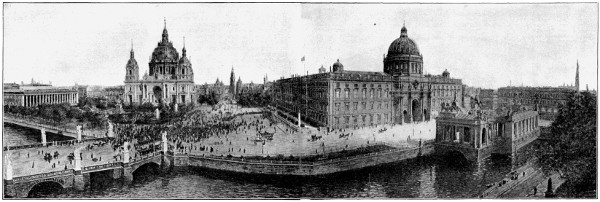
Museum of Fine Arts Cathedral Royal Palace National Monument
PANORAMIC VIEW OF THE HEART OF BERLIN, SHOWING THE MUSEUM OF ART, LUSTGARTEN, NEW CATHEDRAL, ROYAL PALACE, AND NATIONAL MONUMENT.
Large left-hand side of panorama (85 kB) Large right-hand side of panorama (82 kB)
Chief Cities.—German cities and towns are officially distinguished as large cities (with one hundred thousand inhabitants and upwards); medium cities (twenty thousand to one hundred thousand inhabitants); small cities (five thousand to twenty thousand inhabitants); and country towns (two thousand to five thousand inhabitants). According to the latest census, the population of cities over fifty thousand was as follows:
Cities State Latest Population
Berlin Prussia 2,070,695
Hamburg Hamburg 932,166
Munich Bavaria 595,053
Leipzig Saxony 587,635
Dresden Saxony, K. 546,882
Cologne Prussia 516,167
Breslau Prussia 511,891
Frankfort-on-Main Prussia 414,598
Dusseldorf Prussia 357,702
Nürnberg Bavaria 332,651
Charlottenburg Prussia 305,181
Hanover Prussia 302,384
Essen Prussia 294,629
Chemnitz Saxony, K. 287,340
Stuttgart Württemberg 285,589
Magdeburg Prussia 279,685
Bremen Bremen 246,827
Königsberg Prussia 245,853
Rixdorf Prussia 237,378
Stettin Prussia 236,145
Duisburg Prussia 229,478
Dortmund Prussia 214,333
Kiel Prussia 211,044
Mannheim Baden 193,379
Halle-on-Saale Prussia 180,551
Strassburg Alsace-Lorraine 178,913
Schoeneberg Prussia 172,902
Altona Prussia 172,533
Danzig Prussia 170,347
Elberfeld Prussia 170,118
Gelsenkirchen Prussia 169,530
Barmen Prussia 169,201
Posen Prussia 156,696
Aachen Prussia 156,044
Cassel Prussia 153,078
Brunswick Brunswick 143,534
Bochum Prussia 136,916
Karlsruhe Baden 134,161
Crefeld Saxony, K. 129,412
Plauen Prussia 121,104
Mülheim-on-Ruhr Prussia 112,602
Erfurt Prussia 111,461
Mainz Hesse 110,634
Wiesbaden Prussia 109,033
Augsburg Bavaria 102,293
Lübeck Lübeck 98,620
Mülhausen Alsace-Lorraine 95,041
Münster Prussia 90,283
Oberhausen Prussia 89,897
Hagen Prussia 88,625
Bonn Prussia 87,967
Darmstadt Hesse 87,085
Görlitz Prussia 85,790
Spandau Prussia 84,919
Würzburg Bavaria 84,387
Freiburg Baden 83,328
Ludwigshafen-on-Rhine Bavaria 83,297
Bielefeld Prussia 78,334
Offenbach Hesse 75,593
Linden Prussia 73,352
Zwickau Saxony, K. 73,538
Königshütte Prussia 72,642
Remscheid Prussia 72,176
Pforzheim Baden 69,084
Metz Alsace-Lorraine 68,445
Frankfort on O. Prussia 68,230
Beuthen Prussia 67,718
Harburg Prussia 67,024
Gleiwitz Prussia 66,983
Liegnitz Prussia 66,620
Fürth Bavaria 66,535
München Gladbach Prussia 66,410
Osnabrück Prussia 65,956
Rostock Meckl.-Sch. 65,377
Potsdam Prussia 62,224
Flensburg Prussia 60,931
Elbing Prussia 58,631
Bromberg Prussia 57,585
Dessau Anhalt 56,606
Koblenz Prussia 56,478
Ulm Württemberg 55,817
Kaiserslautern Bavaria 53,803
Brandenburg-on-Havel Prussia 53,595
Mülheim-on-Rhein Prussia 53,428
CITIES OF PRUSSIA
Berlin, capital both of the Empire and of the Kingdom of Prussia, is by far the most important center of population in Germany. It lies on both sides of the Spree, and by the Spandau and Tetlow canals to the Havel it is linked with the systems of the Oder and the Elbe. It is eighty-four miles from Stettin and one hundred and eighty miles from Hamburg, and is the center of the great Prussian state railway system. (See Internal Communications.)
The city itself is served by an Outer Circle (Ringbahn) and by the Stadtbahn, running east and west through the city. There are electric surface lines, an overhead, or elevated, electric railway, and a shallow underground railway.
On an island in the center of the city stands the Royal Palace, a foursquare pile built at different times between 1451 and the present day. It stands in the Schloss-platz, and is one of the few old buildings in Berlin, dating from the sixteenth century. It contains over six hundred rooms, including the great White Salon, and halls of the Black and Red Eagle orders.
Unter den Linden.—From this island stretches westward the noblest street in Berlin, Unter den Linden (“under the lime trees”). The triumphal arch at the west end of the street, the Brandenburg Gate (a copy, made in 1789-93, of the Propylæa at Athens), forms the entrance to the large park (six hundred and thirty acres) of the Thiergarten. In the east is the magnificent avenue of the Siegesallee or Avenue of Victory, adorned with thirty-two marble groups of the rulers of Prussia and Brandenburg. In the Unter den Linden are many splendid public edifices, among which are the Armory, the Opera House, the Royal Library, the new Town Hall, the University, the palaces of William I. and of Frederick III., and the monument to Frederick the Great by Rauch.
In the northeast of the Thiergarten stands the most imposing building of the city, the Imperial Diet or Parliament, erected from designs by Wallot, in 1884-94, at a cost of over five million dollars.
Business Quarter.—The Friedrichs-Stadt is the business center of Berlin, and the streets in this section are interesting. The banking street, Behrenstrasse, and the Wilhelmstrasse, the official quarter, where is the imperial chancellor’s palace, lie to the south. Fine shops and restaurants line the Friedrichstrasse, while Viktoriastrasse is one of the many thoroughfares of the fashionable district, southwest. Königstrasse and Kaiser Wilhelmstrasse are the business streets of the city proper.
The Tempelhofn Feld, also to the south, is the parade and review ground of the Berlin garrison.
The most striking bridge is the Schloss-brücke, or Palace bridge, by F. Schinkel, with colossal marble figures. It leads from Unter den Linden, to the Lustgarten, a park in which stands an equestrian statue of Frederick William III.
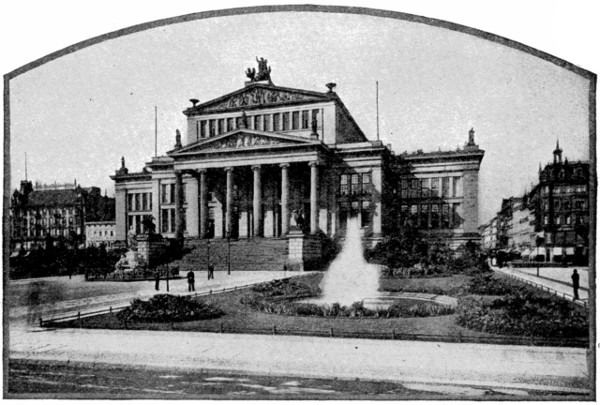
DRAMATIC THEATER, GENSDARMEN MARKT
The Opera Platz contains statues of five generals, by Rauch, and is bounded by the Palace, University, Opera House, and St. Hedwig’s Church, an imitation of the Roman Pantheon. The Schauspielhaus, the leading dramatic theater, is in Gensdarmen Markt. The Schauspielhaus, with the church on each side, is considered one of the finest architectural groups in Berlin.
Statues and Art Museums, etc.—No city has so many statues and monuments to the national heroes, kingly or military, or to those famed in literature, science and art.
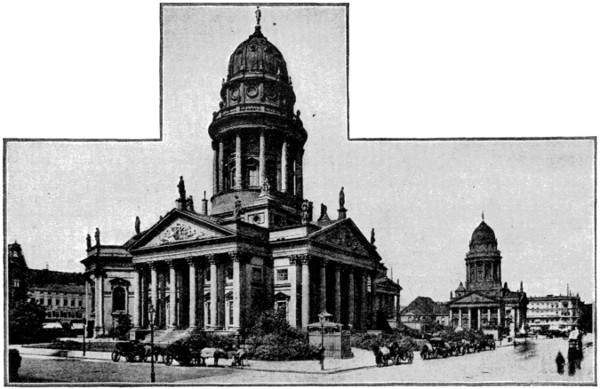
GERMAN CATHEDRAL, GENSDARMEN MARKT
The Royal Library, once in the palace, is now in the new building, built in 1909 on Unter den Linden; it contains nearly five million printed books. The University Library is housed in the same building. There is a large public library and twenty-eight municipal libraries.
The Royal Museum, in the Lustgarten, north of the Schlossplatz, is divided into the Old and the New Museums, containing the treasures of classical and mediæval sculpture, the Egyptian collection, etc. The Old Museum is the finest building in the city, with a grand Ionic portico, adorned with colossal bronze groups, and richly frescoed halls. It has vast collections of antiquities; the halls of Greek, Roman, mediæval, and modern sculptures; and the Hall of the Heroes.
The New Museum is entered from the Old, and contains Kaulbach’s famous mural paintings, the Egyptian museum, an immense collection of casts, twelve cabinets of Northern antiquities four rooms of objects of art, and five hundred thousand engravings. It has a renaissance façade to the east. Opposite is the new Corinthian temple of the National Gallery, which contains a magnificent and world-renowned collection of ancient and modern paintings.
Berlin Suburbs.—In recent years there has been a remarkable expansion of the suburban districts of Berlin, residential sites have sprung up in the pine woods and by the lakes of the Havel to the northwest, and Spandau, Charlottenburg, and Potsdam may almost be regarded as suburbs.
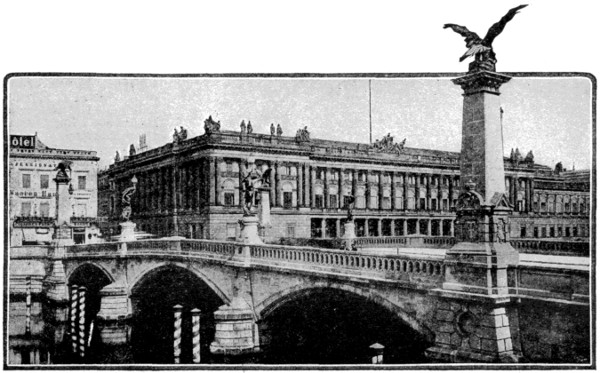
THE BOURSE, OR EXCHANGE, BERLIN
Potsdam, “the Versailles of Prussia,” with its palaces and parks, is sixteen miles from Berlin, among wooded hills and the lakelike expanses of the Havel. Here is the Sans Souci Palace, built by Frederick the Great, and full of reminiscences of him. Near by are the Picture-Gallery, the Orangery (adorned with fine statuary), and the Sicilian Garden. The New Palace has two hundred richly adorned rooms, with fine paintings, and a noteworthy Marble Saloon.
The Marble Palace is north of Potsdam, and has many paintings. Babelsberg is a new Gothic palace, with rich art-treasures. The Royal Palace (1660) is full of relics of the Great Frederick. The Garrison Church contains his tomb and military trophies. The Church of Peace is a noble Ionic basilica, with masterpieces of sculpture. The famous Sans Souci fountains play on summer Sunday afternoons.
Industries of Berlin.—In its industries Berlin is almost as varied as London, but machinery, especially locomotive and electrical, woolens, dyeing, furniture and metal work are the chief. It is beginning to rival Leipzig in book production, and its breweries are large. Besides being the center of the great trade in corn and other cereals of Eastern Europe, its great banks exercise increasing international influence.
A Center of Education and Culture.—The famous Freidrich Wilhelm University, founded in 1810, now the largest in numbers in Germany, the splendid technical institution at Charlottenburg, and its numerous schools of all ranks, make Berlin one of the greatest intellectual and educational centers of the world. As the seat of the Imperial Court, and of the Imperial Parliament and administration, it is also the social center of the empire, and its modern wealth and luxury have made it a growing rival to Paris as a city of pleasure.
Since 1878 the city has been practically rebuilt; the sudden growth of population has resulted in much overcrowding and crushingly high rentals. Once deplorable, the sanitation, water supply, and public hygiene are now of the highest standard, and German scientific thoroughness has made it the most highly organized and best administered city in the world.
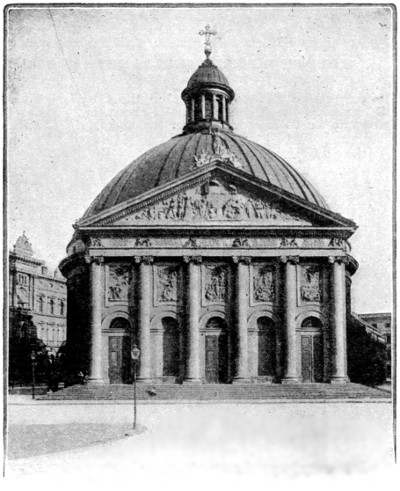
ST. HEDWIG’S CHURCH, BERLIN
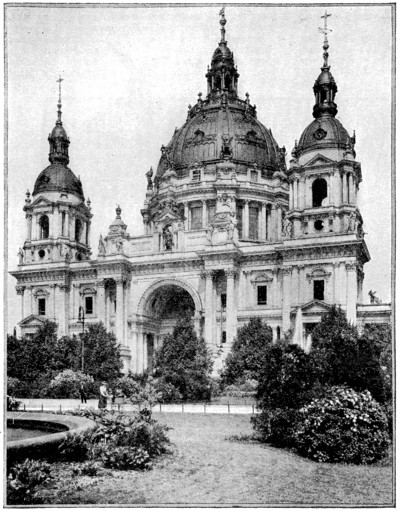
THE NEW HOHENZOLLERN CATHEDRAL, BERLIN
Other Prussian Cities.—Breslau on the Oder, the capital of the mining districts of Silesia, has grown to be the second town of the kingdom, carrying on very extensive manufactures and a great trade by river and railway. It is also the emporium of the flax-growing district of Silesia. About the Rhenish coal fields, which yield half the supply of the kingdom, stand the manufacturing and trading towns of Cologne, Aachen or Aix, Barmen, Düsseldorf, Elberfeld, Crefeld and Dortmund, spinning cotton, wool, linen, and silk; and the famous iron and steel works of Solingen and Essen, where Krupp’s steel guns are made.
Magdeburg, on the Elbe, and Cassel, on the Fulda, are the great manufacturing and trading towns of central Prussia. Much of the internal trade of Germany is still carried on at great annual fairs, and in this respect the two Frankforts (on the Main to the west, and on the Oder to the east) hold the most important place. Hanover, on the Leine, is the point of exchange of the mineral products of the Harz for the goods which come in by Bremen on the Weser, and has important manufactures of its own.
The chief ports belonging to Prussia are the Baltic ones—Königsberg, Danzig, Stettin, Stralsund, Memel, Rostock, Wismar, and Kiel, on the Baltic; Altona, on the Elbe, next Hamburg. Posen, on the Warthe, was the ancient capital of Poland, and is the most important fortress towards the Russian frontier. Wiesbaden is the most important and the oldest of the watering-places which have grown up round the mineral springs of Nassau. Eisleben, where Luther was born, and Erfurt, where he resided, both in Prussian Saxony, are notable points in connection with the history of the Reformation in Germany.
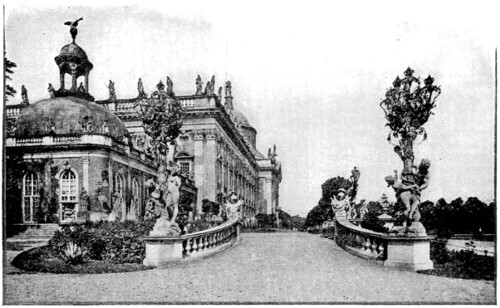
THE NEW PALACE AT POTSDAM
Erected by Frederick the Great, at a cost of $2,250,000. The principal rooms are the Shell Saloon, the rooms of Frederick the Great, the Marble (concert) room, and ball room.
Dresden and Other Cities of Saxony.—Dresden, its capital, finely placed on both banks of the Elbe, famous for its art treasures, has also many varied manufactures. Its architecture and its art collections have given it the name of “the German Florence.”
The old bridge, Augustusbrücke (Augustus Bridge), may be taken as the center of the most interesting part of Dresden. Immediately to the east of the Augustusbrücke, on the Alstadt side, stretches the beautiful Brühl Terrasse, whence are fine views over the river. There are high-class concerts in the Belvedere on the Brühl Terrace. Near the flight of steps to the terrace, facing the Royal Palace and Catholic Church, is the Rathaus (Town Hall) with an equestrian statue of King Albert in front.
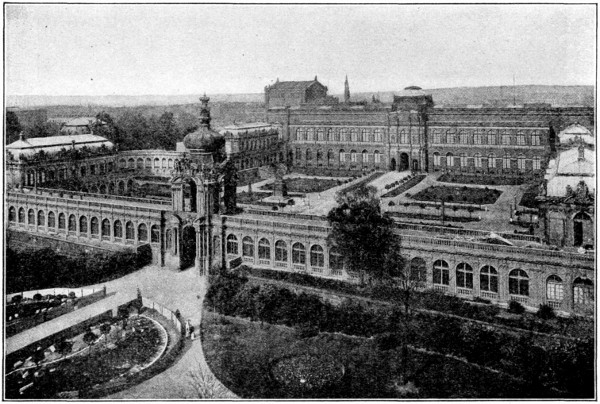
THE ZWINGER, DRESDEN, CONTAINING THE WORLD-RENOWNED GALLERY OF PAINTINGS
The Royal Palace, just south of the Augustusbrücke, will be discovered by its lofty tower, three hundred and thirty-one feet high.
The Zwinger, to the west of the Schloss, is a range of buildings of seven pavilions, with the Museum at one corner. In the Museum are the picture gallery, with collections of engravings and drawings, and mineralogical collections, with scientific instruments.
The Picture Gallery is of world renown, containing more than two thousand four hundred paintings, mostly by Italian and Flemish masters. The gem of the collection is Raphael’s “Sistine Madonna;” other masterpieces being Titian’s “Tribute Money,” and Correggio’s “Magdalene” and “La Notte.”
The Green Vault in the Royal Palace contains an unrivaled collection of precious stones, articles wrought in gold, silver, and ivory, etc. The new Hoftheater is one of the finest theaters in Europe. Of the churches the most noted are the Frauenkirche, with its lofty dome (three hundred and ten feet high).
The so-called “Dresden china” is made for the most part at Meissen, fifteen miles from Dresden.
Leipzig is not only the seat of a famous university and the great book market of Germany, but has one of the largest annual fairs in the world, to which merchants come from all parts of the earth, even from America and China.
Chemnitz and Zwickau, beside the Saxon coal field, are the great woolen and machine-manufacturing towns of the kingdom. Freiberg is famed for its school of mines.
Cities of Bavaria.—Munich (München), the capital, stands in the midst of a bare elevated plain on the left bank of the Isar, one thousand seven hundred feet above sea-level, but has risen to importance as the central point of the great grain-growing plateau of southern Bavaria. It is the great corn depot of the country, and the place of manufacture of its favorite beer. In recent times it has become celebrated as a seat of the fine arts and for its splendid buildings.
Ancient Nürnburg, with its double line of walls, where watches, first called Nürnberg eggs, were invented, is the great seat of industry and commerce in the north of Bavaria, exporting toys which go to all parts of the world. It stands on the Ludwigs Canal, the most important one in the kingdom, uniting the navigable tributaries of the Rhine and Danube.
Augsburg, on the Lech, northwest of Munich, where the Protestants presented the Confession of Faith to Charles V., is a chief center of Bavarian trade and exchange. Würzburg, on the Main, is the old capital of Franconia, the district which was peopled by colonies of Franks in the sixth century.
Speyer or Spire and the fortress of Landau are also important places in the palatinate.
Cities of Württemberg.—Stuttgart, where Hegel was born, and where Schiller spent his youth, is the capital, and stands next to Leipzig and Berlin in the printing arts and book trade. The fortress of Ulm, on the Danube, where it leaves Württemberg, has a large transit trade. Heilbronn is another important trading place. Tübingen is the university town.
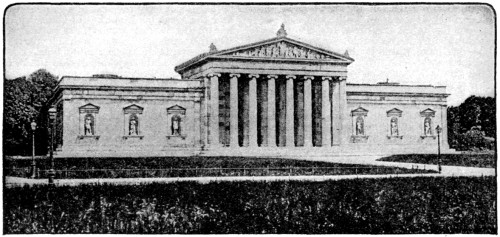
THE PINAKOTHEK, MUNICH, FAMOUS GERMAN MUSEUM OF FINE ARTS
The little territory belonging to the house of Hohenzollern, which runs into Württemberg on the south, fell by inheritance to the king of Prussia in 1849.
Cities of Baden, and Elsass-Lothringen (Alsace-Lorraine).—Carlsruhe, the capital, and Mannheim, at the confluence of the Neckar and Rhine, are its largest towns. Heidelberg (north) and Freiburg (south) are the seats of universities. Baden-Baden in the center, the famous watering-place, gives its name to the Duchy.
The fortress of Strassburg, on the Rhine, in central Elsass, anciently a free imperial city of Germany, is the chief place in the Reichsland and its university town, noted also for its manufacture of leather-work and of beer. The cotton, wool and silk factories and machine works of the province center at Mülhausen in southern Elsass.
The fortresses of Metz and Diedenhofen or Thionville, memorable in the war of 1871, are the chief places in Lothringen.
Cities of the Smaller States.—Hamburg, Bremen and Lübeck, the remaining free Hanse[6] towns, are republics, each governed by a senate and house of burgesses. Each of them has a small territory besides that occupied by the city.
They are the great gates of the external commerce of Germany, and from this have also become important centers for the preparation of foreign products, and of the necessaries of trading (tobacco, sugar-refining, cotton-spinning, shipbuilding). Besides the traffic brought to Hamburg and Bremen by their rivers, all the railways of the northwest converge toward them.
German Colonies.—At the commencement of the war these had a total area of 1,134,239 square miles, with a population of about 14,890,000, of whom 24,170 (including garrison and police) were whites. Of these whites about 18,500 were settled Germans.
The following is a list of the principal colonies and regions under the protection or influence of Germany, with approximate estimates of area and population:
Colonies and Dependencies Date of Acquisition Method of Government Estimated Area Sq. Miles Estimated Population
In Africa
Togoland 1884 Imperial Governor 33,700 1,000,000
Kamerun 1884 Imperial Governor 191,130 3,000,000
German South West Africa 1884-1890 Imperial Governor 322,450 120,000
German East Africa 1885-1890 Imperial Governor 384,180 10,000,000
Total African Possessions 1884-1890 931,460 14,120,000
In Asia
Kiauchau Bay 1897 Imperial Governor 200 33,000
In the Pacific
German New Guinea
Kaiser Wilhelm’s Land 1885-1886 - Imperial Governor - 70,000 - 300,000
Bismarck Archipelago 1885 20,000
Caroline Islands 1899 ...
Palau or Pelew Islands 1899 560 - 56,000
Marianne Islands 1899 250
Solomon Islands 1886 4,200
Marshall Islands, etc. 1886 150
Samoan Islands
Savii 1899 - Imperial Governor - 660 - 37,000
Upolu 1899 340
Total Pacific Possessions 1884-1899 96,160 393,000
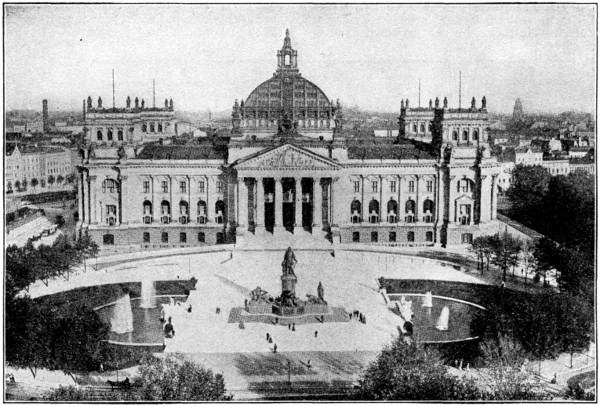
PARLIAMENT BUILDINGS, BERLIN
HISTORY OF GERMANY
The earliest information we have of the Germans, the peoples and the tribes who dwelt among the dense forests that stretched from the Rhine to the Vistula and from the Danube to the Baltic Sea, comes to us from the Romans.
First Contact with Romans.—The first tribes of Germanic race to come into collision with the arms of Rome were the Cimbri and Teutones, who in 113 B. C. had invaded Styria, and there met with defeat from the troops of the consul Papirius. When in 58 B. C. Cæsar began his campaigns in Gaul, he found several hordes of Germans, mostly Marcomanni and Suevi, settled between the Rhine and the Vosges, and even on the western side of these hills.
Appealed to by the Gauls of those regions to free them from their German oppressors, Cæsar inflicted a crushing defeat upon their ambitious chieftain, Ariovistus, and chased him and his followers across the Rhine. In the period 166-74 Aurelius was engaged in beating back a formidable incursion of the Marcomanni and Quadi into Roman territory. From the third century we no longer read of single tribes, but of great confederations of tribes, as the Goths, Alemanni, Franks, Frisians, Saxons, Thuringians, and others. Of the history of Germany itself we learn little more that is authentic until we come down to the times of the Franks, by whom the kingdoms of France and Germany were subsequently formed.
Henceforward, till the time of Charlemagne, Germany was occupied by a number of chieftains, who were perpetually at war with one another, except when invasions from without forced them into transitory alliance.
Charlemagne, or Charles the Great, the Frankish king, was crowned emperor of Rome by the pope in 800, and after his death his empire was partitioned among his four sons, and the result of the family struggles which followed was the separation of Germany from Gaul and of both from Burgundy and Italy by the Treaty of Verdun in 843. (See history of France; also Empire of Charlemagne.)
A separate kingdom of Germany was then formed under Lewis the German. A temporary reunion of the dominions of Charlemagne—with the exception of Burgundy—was effected under Charles the Fat in 884, but he was deposed in 887 and the final separation into the East and West Frankish kingdoms was accomplished.
The inroads of the Norsemen were checked in 891 by Arnulf, but they were followed by the savage attacks of the Hungarians during the reign of Louis the Child, with whom ended the race of Charlemagne in 911.
Under Feudal System.—The royal power had now almost vanished, and the system of granting fiefs had resulted in the formation of a class of powerful local rulers—the dukes of the great groups or confederations of tribes. The maintenance of central authority at all was probably due only to external danger from Slavs, Norsemen, and Magyars, and even this could not prevent constant warfare between the great feudal lords. Conrad of Franconia, elected by the leading nobles, was unable to enforce his authority, and was, at his own suggestion, succeeded by his great enemy, Henry, Duke of Saxony.
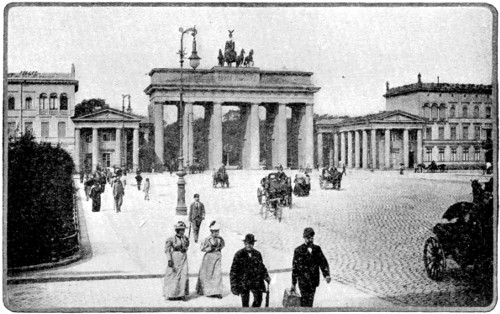
THE BRANDENBURG GATE
at the western terminus of the Unter den Linden, was erected 1789, at a cost of three hundred and seventy thousand dollars, after the Propylæa of Athens, and is regarded as the finest archway in Europe next to the Arc de Triomphe at Paris. The Quadriga or four-horse car of Victory, by Schadow, was taken to Paris by the French in 1806, and returned 1814.
Henry I. Establishes Order.—A born leader of men, statesman and general, Henry I. (919-936) introduced a new civil and military organization. He created the burgher class by the foundation of towns, compelling every tenth freeman to labor on buildings, and these towns he made the centers for judicial administration, ceremonies and festivals, markets, and trade. He broke the power of the Magyars, subdued Danes and Slavs, and before his death private war had ceased.
Otto the Great Revives the Holy Roman Empire.—His son, Otto the Great (936-973), consolidated the royal power, and reduced the great Duchies to submission, keeping them in his own hands or in those of members of his family. In 951 he entered Italy to settle the affairs of the Lombard kingdom, but returned to cope with a revolt terminated only by the vital danger of an invasion by the Magyars, whose power was finally crushed in 955. Crowned Emperor by the Pope in 962, he set an example to subsequent German kings, who claimed the Imperial and Lombard crowns as of right; but the precedent led also to the continued absences of the German rulers in Italy and the severance of their interests from those of their own proper dominions. The sense of German nationality grew in his reign, yet this was accompanied by a weakening of central authority and the development of the power of the great vassals, dukes, and princes, ecclesiastical and secular.
Under the House of Franconia.—After his death constant civil war increased their power until their growing independence was checked by Conrad II. (1024-1039), the first of the Franconian Emperors, who rendered the mediate nobles, vassals of the great lords, less dependent on their feudal superiors, and formed a close alliance with the towns. His son, Henry III. (1039-1056), further strengthened the royal power, put down private war, and in 1043 proclaimed a general peace.
Struggle with the Papacy.—His attempted reformation of the Papacy and appointment of four German popes in succession commenced the long and fierce struggle between the Emperors and the Popes. During the minority of his son, Henry IV., the great nobles recovered much of their power. His opposition to the famous decree of Pope Gregory VII. in 1075 against the marriage of the clergy and their investiture by laymen was followed by his summons to Rome, his deposition of the Pope through a synod of German bishops, his excommunication and complete humiliation at Canossa in 1077. The dispute was only settled under his son, Henry V., by a compromise, the “Concordat of Worms,” in 1122, but the power of the Papacy had been enormously strengthened. It had attempted to dispose of the Imperial Crown, and Innocent II. even claimed to have granted it to Lothar of Saxony (1125-1137) in 1133 as to a vassal.
Famous Hohenstaufen Line.—With Conrad III. of Franconia (1137-1152) commences the line of the famous Hohenstaufen Emperors. The two great parties supporting the Pope and the Emperor now first became known as Guelfs and Ghibelines (Welfs and Waiblings). His successor, the great Frederick Barbarossa (1152-1190), was occupied in Italy during long years with the now permanent struggle against the Popes and the Italian cities supporting them. In Germany Teutonic power was extended over the Slavonic countries along the Baltic by Henry the Lion of Saxony and Albert the Bear, to whom was granted the Mark of Brandenburg. Under Frederick II. (1212-1250) the struggle with the Papacy was continued. Sentence of excommunication was launched against him, and a rival king was elected, and his continued absence in Italy led to the utmost anarchy in Germany. Meanwhile the conquest of the Slavonic lands now forming a great part of Prussia progressed steadily under the Knights of the Teutonic Order and of the Order of the Sword.
The period of the Hohenstaufens was one of great brilliancy. Chivalry was promoted in the Crusades, literature was in full bloom in the works of the Minnesänger, Gothic architecture received its finest developments, the towns increased in prosperity, many serfs were freed, and codes of local customs and usages were compiled, such as the Sachsenspiegel and the Schwabenspiegel. On the other hand, the greater vassals became practically independent, and the principle of inheritance was applied to their lands and offices. The privileges usurped by the ecclesiastical and secular princes were confirmed by Frederick II. in the “Pragmatic Sanctions” of 1220 and 1232, and the right of electing the Emperor was confined to the Seven Electors.
The Interregnum.—The period of anarchy culminating in the “Great Interregnum” (1250-1273) is marked by the formation of the Rhenish Confederation of some seventy leading cities for mutual defense, and of the powerful Hanseatic League.
Beginning of the Hapsburg Line.—Rudolf of Hapsburg, elected in 1273, revived the royal authority and strictly enforced justice, but his rule was unfavorable to the growing privileges of the towns. In this respect his policy was reversed by his successor, Adolf of Nassau (1291-1298), and by his son, Albert I. (1298-1308), who even befriended the serfs and the Jews. The long struggle between the Empire and the Papacy practically ended under Louis IV. (1314-1347), by the formal declaration of the Electors in 1338 that the Papal sanction was not needed to the election of the emperor. Public peace was encouraged under Louis IV., and his friendship to the towns was constant. Industry and trade flourished more and more in the cities, and their government was now becoming more democratic through the victory of the craft-guilds over the old patrician families.
House of Luxemburg.—Charles IV. (1347-1378), the first emperor who retained his hereditary lands on election, by the “Golden Bull” in 1356 regulated the method of election and confirmed the complete sovereignty of the Electors in their own territories. In 1396 the foundations of Swiss independence were laid in the victory of the “Eidgenossen” over Duke Leopold of Austria at Sempach.
Reformation Foreshadowed.—In the reign of Sigismund (1410-1437), who united the dignities of King of Hungary, King of Bohemia, and Margrave of Brandenburg, and who was the last Emperor crowned at Rome, the Hussite war, consequent on the burning of John Huss by the Council of Constance in 1415, foreshadowed the Reformation. The Mark of Brandenburg now passed to the Hohenzollerns, under whom it was to grow into the kingdom of Prussia.
The reigns of Frederick IV. (1440-1493), and Maximilian I. (1493-1519), the husband of Mary, the heiress of Charles the Bold, last Duke of Burgundy, bring the Middle Ages to a close. The age of chivalry was ended by the invention of gunpowder and the use of mercenary troops; the realities of feudalism had passed away, the Imperial authority had dwindled to nominal control, and princes and cities had attained independence. But the Imperial dignity was now permanently connected with the House of Hapsburg and combined with great territorial possessions. The semblance and, to some extent, the reality of unity were established by the growing use of Roman law, by the constitution in 1495 of an Imperial Tribunal or Court of Appeal (the “Aulic Council”), and by the division of Germany in 1501 and 1512 into “Circles,” each with its own “States” charged to carry out the decisions of the Imperial Chamber.
Period of Charles V.—Luther’s denunciation of indulgences was made in 1517, but the full storm of the Reformation burst after the accession of Charles V. (1519-1555), who united to the Empire the entire possessions of the kingdom of Spain. At the Diet of Worms in 1521 he took up the defense of the Church, and condemned Luther as a heretic. At the same Diet an Imperial Administrative Council was established, and a “Matricula” drawn up, settling the contingents of troops to be raised by the States, both of which existed until the fall of the Empire. The Reformation now made irresistible progress; a common name, “Protestants,” was acquired by the Reformers at the Diet of Speyer in 1529, and in common statement of doctrines, the “Augsburg Confession,” was drawn up in 1530.
Thirty Years’ War.—The new and the old religions were put upon an equality by the Religious Peace of Augsburg in 1555, in which, however, the Calvinistic or Reformed Faith was not included. In the fearful struggle which followed the Reformation the Imperial authority was completely ruined. The reaction against the new doctrines, due mainly to the zeal of the Jesuits, gave fresh strength to the Catholic party, the Reformation was stamped out in Bohemia, and complete toleration was not acquired by Protestants (including both Lutherans and Calvinists) until the Peace of Westphalia in 1648.
This was at the close of the disastrous and merciless struggle known as the Thirty Years’ war. The result of the confused period commencing with the abdication of Charles V. in 1555 must be briefly summed up. The Empire in Germany was practically ended and was now attached to the hereditary dominions of the house of Hapsburg in Austria. The population of Germany was reduced by more than one-half; industry and trade had almost ceased to exist; enormous territorial losses had been suffered, and France and Sweden had made great acquisitions. Switzerland and the United Provinces were severed from the Empire, and had acquired complete independence. Germany emerged from the war a mere lax confederation of states, whose rulers—a race of absolute and, in most cases, coarse and selfish despots—were recognized by the Peace of Westphalia as independent. Even in the cities government had passed into the hands of local oligarchies. The only bond of union was the nominal authority remaining to the emperor, and now transferred to the Diet, of passing laws, concluding treaties, and making war and peace. One completely good result of the war was that amid the prevailing anarchy were laid, by Grotius, the foundations of a system of International Law.
Rise of Prussia to Power.—The Thirty Years’ war was followed by the rise of Prussia. Brandenburg had in 1611 become united to the Duchy of Prussia, part of the possessions of the Teutonic Order, which was in 1657 declared independent of Poland, of which it had been a fief, and received further accessions under the Great Elector, Frederick William. It grew steadily in power during the long struggle against the unscrupulous aggressions of Louis XIV., and in 1701 the son of the Great Elector, Frederick I., obtained from the Emperor the recognition of the Prussian Duchy as a kingdom. In 1713 a “Pragmatic Sanction” was drawn up by the Emperor Charles VI. (1711-1740), providing for the inheritance of the Austrian dominions by his daughter, Maria Theresa, and this was ultimately guaranteed by the leading powers.
Frederick the Great and the Seven Years’ War.—But his death in 1740 was the opportunity of Prussia, where Frederick II., better known as Frederick the Great, had just ascended the throne. He immediately occupied Silesia. Maria Theresa met with enthusiastic support in Hungary, and in 1745 her husband was elected emperor as Francis I. (1745-1765). An interval of peace was followed by the Seven Years’ war, at the conclusion of which, in 1763, Prussia was confirmed in the possession of Silesia, took rank as a great Power, and became definitely the rival of Austria in German politics.
In 1765 Joseph II. succeeded to the imperial crown, becoming at the same time co-regent with his mother of the Austrian hereditary dominions. He joined with Russia and Prussia in the first partition of Poland (1772). He was succeeded by his brother Leopold, who, having died in 1792, was succeeded by his son, Francis II., who joined in 1793 in the second partition of Poland. He took the command of his army against the French in 1794, concluded the peace of Campo Formio with Bonaparte (1797); joined the second coalition against France in 1799, and concluded the treaty of Lunéville (1801).
In 1804 Francis took the title of hereditary emperor of Austria, renouncing two years later that of head of the German Empire, which, indeed, had ceased to exist, owing to the conquests of Napoleon. The latter’s secularization of the ecclesiastical states, overthrow of Austria at Austerlitz (1805) and of Prussia at Jena and Auerstädt (1806), and formation of the Confederation of the Rhine, completed the extinction of the Holy Roman Empire.
The German Confederation.—The states of Germany were again united by the treaty of Vienna (1815), in a confederation called the German Confederation (der Deutsche Bund). In 1818 a general commercial league, called the Zollverein was projected by Prussia, and was gradually joined by most of the German states, exclusive of Austria. Revolutionary outbreaks caused great disturbances in various German states in 1830 and 1848, particularly the latter. The German Diet was restored in 1851 by the efforts of Prussia and Austria, who were latterly rivals for the supremacy in the confederation.
Beginning of Bismarck’s Power.—In 1861 William I. succeeded to the throne of Prussia, and the conflicts between the liberals and his ultra-reactionary government led in 1863 to the entrance into the ministry of Otto von Bismarck, who soon after became its president and the minister of foreign affairs. On the death of Frederick VII. of Denmark, Prussia and Austria disputed the claims of Christian IX., his successor, to the duchies of Schleswig and Holstein, and the war which followed (1864) resulted in the cession of Schleswig-Holstein, and Lauenburg to those powers jointly.
By the treaty of Gastein, Austria and Prussia agreed to a joint occupation of the Elbe duchies; but to prevent collision it was judged prudent that Austria should occupy Holstein, and Prussia Sleswick.
Contest Between Prussia and Austria.—Already a difference of policy had begun to show itself. Prussia was believed to have the intention of annexing the duchies; while Austria began to favor the claims of Prince Frederick of Augustemburg. In the meantime, both nations were making ready for the struggle; and Italy, looking upon the quarrel as a precious opportunity to strike a blow for the liberation of Venetia, had secretly entered into an alliance with Prussia.
On July 3, 1866, was fought the decisive battle of Sadowa, in which the Austrians were routed. Not till the victorious Prussians had pushed forward towards Vienna was a truce obtained through the agency of the Emperor of the French, the Peace of Prague (August 20). Italy, though more than half-inclined to stand out for the cession by Austria of the Trentino, as well as Venetia, reluctantly agreed to the armistice (August 12).
A brief campaign sufficed for the defeat of the minor states of Germany that had joined Austria, viz.: Bavaria, Württemberg, Baden and Hesse-Darmstadt; and, after peace had at last been arranged, some of them were forced to submit to a certain loss of territory.
Independence of Austria and Union of Germany.—The war completed the dissolution of the Confederation, and secured the reconstruction of Germany on an entirely new basis. Austria was excluded from Germany, and a new confederation, the North German, was formed of the states north of the Main, under the headship of the king of Prussia. Schleswig-Holstein, Hanover, Hesse-Cassel, Nassau, and Frankfort were incorporated with that kingdom. Efforts to secure a further consolidation were opposed by the South German states, but the final solution of the question was at length brought about by France, whose demands resulted in the War of 1870. (See under France.)
In this war Germany acquired Alsace and a part of Lorraine, and south Germany now waived any further opposition to a consolidation of all the German states under the leadership of Prussia.
Restoration of the German Empire.—On December 3 the king of Bavaria invited the king of Prussia to restore the dignity of German emperor. Most of the other states gave their assent and the North German Reichstag on December 10 adopted a motion for the establishment of the German empire under the king of Prussia. On January 18, 1871, the restoration of the imperial dignity was solemnly proclaimed by William I. at Versailles.
Subsequently the empire was largely organized under the vigorous administration of Prince Bismarck. The parliament of the new empire soon met at Berlin, and adopted the new constitution. The main result of his foreign policy was a cordial alliance with Austro-Hungary; an alliance, in 1872, between the emperors of Germany, Austria and Russia, in which, subsequently, Italy took the place of Russia, forming what is known in European politics as the Triple Alliance.
In domestic affairs many difficulties were encountered. With the birth of the new Empire commenced the long struggle of Prince Bismarck with the Papacy. The Jesuits were expelled in 1872, and in 1873 the famous “Falk Laws” imposed secular restrictions on all ecclesiastical appointments. The strict enforcement of these laws led to intense discontent and ill-feeling among Catholics. The contest ended with the grant of many concessions and the confession by Prince Bismarck in 1887 that his policy was practically changed. The democratic movement known as Socialism, aiming at the regulation and organization by the State of labor and production, grew rapidly in strength and importance, and inaugurated an era of “labor policy” by legislation compelling employers to institute a system of insurance in favor of their work-people, since followed by the adoption of an important state-aided scheme of insurance against death and old age.