THE BOOK OF NATIONS Geographical, Historical, Descriptive (continued 19)
Reading edition
Remuneration.—Members receive seven thousand five hundred dollars and mileage.
Powers of the House of Representatives.—Elects its Speaker (presiding officer) and its other officers. Elects President of the United States if the regular election fails. Prosecutes impeachments before the Senate. Originates all bills for raising revenue.
Committees.—Almost all the acts of the House are under the control of Standing Committees, appointed by the Speaker.
IV. The Judicial Department.
Judges of the United States Courts
Appointed by the President with the advice and consent of the Senate. Tenure of Office.—During life or good behavior; but may retire on full salary after reaching the age of seventy years, and after ten years’ service on the bench.
The Supreme Court of the United States
Members.—A Chief Justice and Eight Associate Justices. Salaries.—Chief Justice, fifteen thousand dollars; Associate Justices, each fourteen thousand five hundred dollars. Terms of Court.—One each year, beginning on the second Monday in October. Original Jurisdiction.—In all cases affecting Ambassadors, Ministers, and Consuls. In all cases in which a State is a party. Appellate Jurisdiction.—In cases of law and equity where the Inferior Courts have original jurisdiction, with such exceptions and regulations as Congress has made. The Chief Justice.—Presides over the Senate when it sits as a Court of Impeachment for the trial of the President.
Inferior Courts
Jurisdiction.—In cases between citizens of different States. In cases in which the United States is a party. In cases of admiralty and maritime jurisdiction. In trials for crimes against the United States; but the trial of crimes must be by jury, and must be held in the State where the crime was committed. Appeals to the Supreme Court may be had in all cases of law and equity, with such exceptions and regulations as Congress has made.
Kinds of Inferior Courts
United States Circuit Courts of Appeals.—Organized in 1891 to relieve the United States Supreme Court in Appellate Cases. Number: One in each Judicial Circuit. Members: Three judges selected from the District Courts. Number.—One in each Judicial Circuit. Members.—Three judges selected from the District Courts. United States Circuit Courts.— Number of Circuits.—Nine. Number of Judges.—Each Circuit has two, three, or four Circuit Judges, and a Justice of the Supreme Court is assigned to each Circuit. The District Judge also may sit in a Circuit Court. Salary of Circuit Judges.—Fixed by law at seven thousand dollars per year. United States District Courts.— Number of Districts.—One or more in each State. At present there are seventy-three Judicial Districts. Salary of District Judge.—Fixed by law at seven thousand dollars per year. United States Court of Claims.— Jurisdiction.—Claims against the United States, including all claims which may be referred to it by Congress. Members.—One Chief Justice and four Associate Justices. Salaries.—Chief Justice, six thousand five hundred dollars; Associate Justices, each six thousand dollars. In addition to the above named courts, Congress has established courts of local jurisdiction in the District of Columbia and in the Territories.
BRITISH EMPIRE
Form of Government.—Monarchy in form, but republic in practice. The monarchy is constitutional and limited. The British Empire consists of the United Kingdom of Great Britain and Ireland, the Empire of India, and the British Dominions beyond the Seas, including the self-governing Dominions, and the Crown Colonies, Protectorates, and other Dependencies, the whole forming one Empire.
I. Constitution.—The British Constitution is mainly unwritten and customary, but its development is marked by certain outstanding and fundamental laws, of which the principal are: Magna Charta, 1215; the Habeas Corpus Act, 1679; the Act of Settlement, 1701; the Act of Union with Scotland, 1707; the Act of Union with Ireland, 1800; and the Parliament Act, 1911. The first secured annual parliaments and the equal administration of justice; the second established the liberty of the person;the third provided for the Protestant succession to the throne; the fourth and fifth created the United Kingdom; and the last enabled the Commons to pass certain Acts without the adherence of the other Chamber.
Amendments.—Amendments to the Constitution can be proposed by either of the legislative bodies, are passed by ordinary legislative process, requiring for their passage a majority simply of the votes of the Reichstag, but they fail if fourteen votes are cast against them in the Bundesrath.
II. The Sovereign. How Designated.—The King’s legal title rests upon the Act of Settlement, in 1701, under William III., by which the succession to the Crown of Great Britain and Ireland was settled on the Princess Sophia of Hanover and the “heirs of her body, being Protestants.” The throne is hereditary in the English house of Saxe-Coburg-Gotha with mixed succession, the sons of the Sovereign and their descendants having precedence of daughters, but daughters and their descendants preference over lateral lines. The Sovereign is designated King (or Queen) of Great Britain and Ireland, and Emperor (or Empress) of India. Term of Office.—Holds office for life, by hereditary title, and cannot be removed.
Salary or Civil List.—The Civil List Act, 1910, gave the King $2,350,000. Provision for other members of the Royal Family, $730,000. The Prince of Wales, as the income of the Duchy of Cornwall, $435,000. The King in addition to his Civil List receives the revenues of the Duchy of Lancaster amounting to $320,000.
Powers and Duties.—Has command of army and navy. Parliament cannot be assembled, prorogued, or dissolved except by the express command of the Sovereign. At the commencement of a new Parliament must deliver, either in person or by a commission authorized for that purpose, a speech declaring the cause of the summons. Bills passed by Parliament must receive the assent of the Sovereign in order to become law. Has legally a veto power; but, because the influence of the Executive over legislation has passed into the hands of the Ministers, the veto of the Crown has been disused since 1707. Has power to appoint all officers in the army and navy, judges, ambassadors, colonial governors, bishops and archbishops of the Established Church, and grants all degrees of nobility. May make treaties of any kind. May grant pardon to any particular offender. The Privy Council.—The King in Council is the supreme executive authority in the realm. The Privy Council meets as a whole at the beginning of a new reign and on other occasions of state and ceremony, possesses certain administrative powers, and is the Supreme Court of the Empire. Its personnel includes the royal princes and the archbishops, Members of the Cabinet and of the royal household, the Speaker of the House of Commons, the ambassadors, the principal colonial governors, colonial statesmen, certain judges, and members of both political parties who have never been in office. The important functions of the Council are the bringing into operation by means of orders in council of the provisions of many statutes which Parliament leaves to the executive to enforce, temporarily or permanently, at such time or times as it may deem necessary and desirable. These orders have all the force and validity of law.
The Executive Departments
The Ministry
The Cabinet, or Inner Council, under the presidency of the Prime Minister, consists of Ministers, drawn from the ranks of the party in power and appointed by the Sovereign on the advice of the Prime Minister.
Members (As reconstituted in June, 1915) and their salaries. Prime Minister and First Lord of the Treasury $25,000 Lord High Chancellor (and $20,000 as speaker of the House of Lords) 50,000 Minister without Portfolio unpaid Lord President of the Council $10,000 Lord Privy Seal unpaid First Lord of the Admiralty 22,500 Secretaries of State: Home Affairs 25,000 Foreign Affairs 25,000 Colonies 25,000 War 25,000 India 25,000 Chancellor of the Exchequer 25,000 Minister of Munitions 25,000 Secretary for Scotland 10,000 Chief Secretary to the Lord Lieutenant of Ireland 21,125 Presidents of Committees of the Council: Board of Trade 25,000 Local Government Board 25,000 Board of Education 10,000 First Commissioner of Works 10,000 Attorney-General 35,000 Board of Agriculture 10,000
Relations to Parliament.—The Chief of the Cabinet and of the Ministry is called the Prime Minister or Premier. He is the leader of the House of Parliament of which he is a member. He dispenses the greater portion of the patronage of the Crown. Other members of the Cabinet are the leaders of Parliament, shaping and directing the business of the Houses.
Tenure of Office.—Dependent upon the favor of the House of Commons; for if not sustained, they must all resign. When a Ministry resigns it is the function of the sovereign to call upon some statesman to form another administration. There is no restriction upon the Royal choice, but the statesman usually selected is the leader of the opposing party in one of the two Houses.
Powers and Duties.—All real authority is with the Cabinet. The executive government is nominally in the Crown, but practically in the Cabinet. The Ministers are at the heads of the administrative departments. The Sovereign does not sit with the Cabinet. Other Ministers.—The Ministry includes a number of minor posts whose occupants have no seat in the Cabinet.
III. Parliament.—Parliament consists of two Houses, the House of Lords and the House of Commons. The Sovereign alone has the power of summoning or proroguing or dissolving Parliament, and gives the Royal Assent to measures which have passed both Houses. Unless it be dissolved by the Crown, Parliament exists five years from the date on which it was first to meet. The demise of the Crown does not dissolve Parliament, but, on the contrary, renders an immediate assembling of the two Houses necessary; and if there be no Parliament in existence, the old Parliament must reassemble, and may sit again for six months, if it be not within that time dissolved by the new Sovereign. All British dominions are subject (except as regards taxation) to the legislation of the British Parliament; but no Act of Parliament affects a colony unless that colony is specially mentioned. If the legislature of a colony enacts a law which is repugnant to an imperial law affecting the colony, it is to the extent to which it is repugnant absolutely void.
THE HOUSE OF LORDS.—The House at present consists of three Princes of the Blood, two Archbishops, twenty-one Dukes, twenty-six Marquesses, one hundred and twenty-one Earls, forty-six Viscounts, twenty-four Bishops, three hundred and fifty-six Barons, sixteen Scottish Representative Peers elected for each Parliament, and twenty-seven Irish Representative Peers elected for life. The members hold their seats by virtue of hereditary title; by creation of the Sovereign; by virtue of office (English bishops); by election for life (Irish peers); by election for duration of Parliament (Scottish peers).
Qualifications.—Must be at least twenty-one years of age.
Remuneration.—Receive no pay.
Committees.—Special committees are appointed to make investigations, and report on matters which could not be undertaken by the whole House.
Powers and Duties.—In concurrence with the House of Commons, makes the laws, having a revising power over all bills proposed by the House of Commons, except those relating to public revenue and expenditure, which it must pass or reject without amendment. It is the highest appellate court of the United Kingdom. It may in certain cases try members of its own body; it tries any person who may be impeached by the House of Commons, and it also decides claims to the peerage.
HOUSE OF COMMONS.—This body consists of six hundred and seventy elected members representing county, borough, and university constituencies. Roughly speaking, about one-sixth of the population are electors.
Qualifications.—Must be at least twenty-one years of age. Clergymen are disqualified from sitting as members, also English and Scottish peers, government contractors, and sheriffs and returning officers for the localities for which they act.
Organization—Quorum.—Forty members, including the Speaker. Elects its own presiding officer, who is called the Speaker, who has a residence in the Palace of Westminster, and receives a salary of $25,000 per annum.
Remuneration.—$2,000 per year (since 1911).
Powers and Duties.—May originate and, in concurrence with the House of Lords, pass resolutions and bills; but bills relating to the imposition of taxes and the granting of supplies for the service of the State must be originated in the House of Commons.
Committees.—The business of the House is almost entirely under the direction of the Ministry; however, commissions and select committees are from time to time appointed to make investigations and report on matters which could not be undertaken by the House.
IV. Judicial Departments, or Courts of Law.
Privy Council.—The Judicial Committee of the Privy Council (which hears appeals from Colonial and Indian Courts, and also from Ecclesiastical Courts) consists of the Lord Chancellor, Lord President, ex-Lords President, the Lords of Appeal in Ordinary, and such other members of the Privy Council as shall from time to time hold or have held “high judicial office.” No dissenting judgments are allowed, but the Judicial Committee can grant special leave to appeal. The English courts of law having jurisdiction in actions between parties are:
House of Lords
Lord High Chancellor and such peers of Parliament as are holding or have held high judicial office. This is the ultimate Court of Appeal from all the courts in the United Kingdom.
There are two Courts of Appeal below these divisions: Lords of Appeal in Ordinary.— Consisting of six Justices. Court of Appeal.—Ex-Officio Judges, the Lord High Chancellor, the Lord Chief Justice of England, the Master of the Rolls, and the President of the Probate, Divorce and Admiralty Division. The High Court comprises the King’s Bench, Chancery, and Probate, Divorce and Admiralty Divisions. High Court of Justice, Chancery Division.—(Administration of trusts, company cases, mortgages, patents, etc.). Consists of the Lord High Chancellor and six other Justices. High Court of Justice, King’s Bench Division.—(Contracts, torts, bankruptcy, etc.). Consists of the Lord Chief Justice of England and fifteen other Justices. High Court of Justice, Probate, Divorce and Admiralty Division.—(Wills, matrimonial cases, and maritime cases). Consists of two Justices. Court of Criminal Appeal.—All the Judges of King’s Bench Division. Court of Arches.—An ecclesiastical court unites the powers of the jus canonicum with new powers conceded by the Church Discipline Act, 1841, and the similar statute of 1874, exercising authority in both provinces. The Judicial Committee of Privy Council is the Court of Final Appeal in ecclesiastical causes. Bankruptcy Court.—Consisting of one Justice.
GERMANY
Form of Government.—The Empire, according to the Constitution of April 16, 1871, is a Confederate League, bearing the name German Empire, under the hereditary presidentship of the King of Prussia, who holds the title of German Emperor, and whose eldest son is styled His Imperial and Royal Highness.
I. Constitution. Adoption.—Present Constitution adopted April 16, 1871. The Constitution of the German Empire is substantially that of the North German Confederation, which came into force in 1867, and which was adopted by the Empire in 1871, after the southern states of Germany had combined with the northern.
Amendments.—Amendments to the Constitution can be proposed by either of the legislative bodies, are passed by ordinary legislative process, requiring for their passage a majority simply of the votes of the Reichstag, but they fail if fourteen votes are cast against them in the Bundesrath.
II. Chief magistrate, styled the Deutscher Kaiser. How Designated.—The election of Wilhelm I., King of Prussia, as German Emperor (1871) was by vote of the Reichstag of the North German Confederation, on the initiative of all the reigning Princes of Germany. The Imperial dignity is hereditary in the House of Hohenzollern, and follows the law of primogeniture in the male line. He must be occupant of the throne of Prussia under the provisions of Prussian law. Term of Office.—Holds office for life,and cannot be removed.
Salary or Income.—Royal Civil List of Emperor, $3,700,000.
Powers and Duties.—Commander-in-Chief of the imperial army. Summons, opens, adjourns, and closes the two Houses. He may dissolve the Reichstag upon advice of the Bundesrath. All measures passed by the Bundesrath are presented to the Reichstag in the name of the Emperor. Bills passed by the two Houses must be promulgated by the Emperor. In cases where he regards them as involving a change in the Constitution, he need not promulgate them if fourteen votes have been cast against them in the Bundesrath. All official acts of the Emperor require the counter-signature of the Chancellor. Appoints and may, at his pleasure, remove the Imperial Chancellor. Appoints and may, with the counter-signature of the Chancellor, remove all minor officers in the imperial service. May declare war if defensive, and make treaties and peace; but for declaring offensive war the consent of the Bundesrath must be obtained. Has power to grant pardons.
The Executive Departments
Imperial Chancellor.—He has no counterpart in any other constitutional government. He is the Emperor’s responsible proxy, controlling the politics of the Empire. Appointment and Tenure of Office.—Appointed by the Emperor. Must be one of Prussia’s seventeen representatives in the Bundesrath. His term is dependent upon the pleasure of the Emperor. Responsibility.—Does not consist in a liability to be forced to resign, but consists simply in amenability to the laws. Powers and Duties.—Must give an account of the administration to the Reichstag, and submits the annual budget. He is the center and source of all the administrative departments, dominating the entire imperial service. He superintends the administration of the laws of the Empire by the States. As chairman of the Bundesrath he is simply a Prussian representing the King of Prussia, as the Emperor has no place in the Bundesrath. The army and navy, however, are not directly controlled by him, but by the General Field-Marshal. The following are the imperial authorities or Secretaries of State; they do not form a Ministry or Cabinet, but act independently of each other, under the general supervision of the Chancellor: Chancellor of the Empire. Secretary for Foreign Affairs. Imperial Home Office and Representative of the Chancellor. Imperial Admiralty. Imperial Secretary of Justice. Imperial Treasury. Imperial Post-Office. Secretary for the Colonies. And, in addition, the following presidents of imperial bureaus: Railways. Imperial Exchequer. Imperial Bank. Imperial Debt Commission. Administration of Imperial Railways. Imperial Court Martial. Acting under the direction of the Chancellor of the Empire, the Bundesrath represents also a supreme administrative and consultative board, and as such has twelve standing committees—namely, for army and fortifications; for naval matters; tariff, excise and taxes; trade and commerce; railways, posts and telegraphs; civil and criminal law; financial accounts; foreign affairs; for Alsace-Lorraine; for the Constitution; for the standing orders; and for railway tariffs.
III. The Government. The legislative functions of the Empire are vested jointly in the Bundesrath or Federal Council which represents the several states, and by the Reichstag or Diet of the Realm, which represents the German nation. The Emperor has no veto on laws passed by these bodies. All laws for the Empire must receive the votes of an absolute majority. The consent of the Federal Council and Reichstag is necessary in regard to certain specified treaties. The Emperor has the right to summon, open, adjourn, and close the Reichstag. The Federal Council and Reichstag must be summoned to meet every year; the Reichstag cannot be summoned without the adherence of the Federal Council.
BUNDESRATH, or Federal Council, is composed of sixty-one votes representing the individual states. They are appointed by the governments (i. e. the Executives) of the States for each session. The apportionments of representation in the Bundesrath among the States of the Empire is as follows: Prussia seventeen votes, Bavaria six, Saxony and Würtemberg four each, Baden, Hesse and Alsace-Lorraine each three, Mecklenburg-Schwerin and Brunswick each two, the other States (seventeen) one apiece.
Remuneration.—Receive no pay.
Organization—Quorum.—The Imperial Chancellor or his substitute (at regular meeting). The Imperial Chancellor presides. Votes with the other Prussian representatives, whose votes must be undivided; and, in case of a tie, Prussia’s vote decides.
Committees.—There are three standing committees and eight commissions, two of which are appointed by the Emperor, five wholly by the Bundesrath, and one in part by the Bundesrath, being made up principally of members ex-officio. Each commission consists of representatives of at least five States of the Empire.
Powers and Duties.—May originate bills to be sent to the Reichstag. Its consent is indispensable to the validity of all legislation. Members may speak on the floor of the Reichstag. Acting under the direction of the Imperial Chancellor, it is the supreme administrative board. It is in some cases the highest court of the Empire. Is the court of appeal between two or more States of the Empire.
REICHSTAG, or Imperial Diet, is composed (in 1917) of three hundred and ninety-seven members, and elected for five years by universal suffrage.
Qualifications.—Must be at least twenty-five years of age, and have lived at least one year in one of the German States.
Organization—Quorum.—A majority of members. Elects its own presiding officer, who is called the President.
Remuneration.—3,000 marks ($750) per session, with deduction of twenty marks ($5.00) for each day’s absence; they have free passes over German railways during session.
Powers and Duties.—Has power to originate and, with the advice and consent of the Bundesrath, to enact the laws. It also exerts a controlling influence through its power to give or withhold its sanction to certain ordinances to whose validity the Constitution makes its concurrence necessary, through its right to inquire into the conduct of affairs; and in many other ways not susceptible of enumeration.
Committees.—There are no standing committees, but select committees are occasionally appointed by election from the seven “Sections” into which the members are divided by lot for committee work.
IV. Judicial Department.
The laws of the Empire take precedence of the Federated States within the scope of the Constitution of the Empire; they are compulsory on all Governments of the Empire. A uniform system of law courts exists throughout the Empire, though, with the exception of the Reichsgericht, all courts are directly subject to the Government of the special State in which they exercise jurisdiction, and not to the Imperial Government. The appointment of the judges is also a State and not an Imperial function. The Empire enjoys uniform codes of commercial and criminal law.
Imperial Supreme Court.
Reichsgericht (Imperial Supreme Court), to which there is a right of appeal from all inferior courts, sits at Leipzig, and consists of one hundred judges, appointed by the Kaiser on the recommendation of the Bundesrath.
The Oberlandesgerichte (Supreme Court), which are the first courts of the second instance, have original jurisdiction in serious offenses, and are presided over by seven judges. The Landgerichte (County Courts) have a fairly extensive jurisdiction in civil and criminal cases and in divorce proceedings. There are five judges in the criminal chamber of a Landgericht, four votes being required to make a conviction valid. Three judges from such a court preside at intervals over jury courts (Schwurgerichte), and juries do not, therefore, form a permanent part of the system. Not the least important work of the Landgerichte is to revise the decisions of the Amtsgerichte, which are the lowest courts of the first instance, being controlled by single judges, who are competent to hear only petty civil and criminal cases. The Amtsgerichte (Police or District Courts) are the lowest courts, each with a single judge competent to try petty civil and criminal cases, divorce cases, etc.
FRANCE
Form of Government.—France, since the overthrow of Napoleon III., in 1870, has been a republic governed by a President and two Chambers under the Constitution.
I. Constitution. Adoption.—Present Constitution adopted February 25, 1875. It has undergone but slight modifications. The present French Constitution remains a mixture of monarchical and republican institutions, and it has fully maintained its strong and old-established centralization. The Constitution of 1875 is based on universal suffrage. It was revised in 1875, 1884, 1885 and 1889.
Amendments.—Whenever the two Houses agree that revision is necessary, and also agree upon particular points that should be revised, the National Assembly, composed of the Senate and the Chamber of Deputies, sitting as one body, convenes at Versailles, and acts upon the amendments proposed, the vote of an absolute majority being decisive. The National Assembly also elects the President of the republic.
II. Chief Magistrate, or President of the Republic. Term of Office.—Elected for seven years by the National Assembly, and is re-eligible. The National Assembly meets for the purposes of this election, as for the revision of the Constitution, at Versailles. The revision of the Constitution and the election of President are its only functions. Qualifications.—Must be a citizen, not a member of any family which has occupied the throne of France.
Salary.—$140,000. Responsibilities.—May be impeached by the Chamber of Deputies, and tried by the Senate, in case of high treason.
Powers and Duties.—Has command of the army and navy. May convene the Chambers on extraordinary occasions. May adjourn the Chambers at any time for a period not exceeding one month. Can close a regular session of the Chambers at his discretion after it has continued five months; an extra session when he pleases. Can with the consent of the Senate dissolve the Chamber of Deputies even before the expiration of five months. This puts an end to the session of the Senate also, but not to its life. The President must order a new election in case of dissolution. At the commencement of a new session of the Chambers the President of the republic sends a message, which is read by one of the Ministers. Bills passed by the Chambers must be signed by the President, and countersigned by one of his Ministers. Has no veto power, but is authorized to demand a reconsideration of any measure by the Chambers. Has power to appoint and remove all officers of the public service, subject to the counter-signature of the Minister whose department is affected in each case. May make treaties of peace, alliance and commerce, but cannot declare war without the advice of the Chambers. Has power to grant pardons. Succession.—In case of his death, resignation, or removal, the Council of Ministers act until the National Assembly can meet and elect a new President.
The Executive Departments
Powers and Duties.—As a Cabinet, the Ministers represent the administration in the Chambers; as a Council, they exercise a general oversight of the administration of the laws, with a view of giving unity of direction to the affairs of the State. The President may be present at all Council meetings. Cabinet and Council of Ministers.—Both the Cabinet and the Council consist of the same persons. The Cabinet is a political body; the Council, an administrative body. Appointment.—Chosen by the President, generally from among the members of the Chambers. Members of the Cabinet.—Membership may vary somewhat: Premier and Foreign Minister. Ministers of State. Minister of Justice and Vice-President of the Council. Minister of War. Minister of Marine. Minister of the Interior. Minister of Finance. Minister of Agriculture. Minister of Public Works. Minister of Commerce. Minister of Colonies. Minister of Instruction and Minister of Inventions affecting National Defense. Council of State.—Gives advice on all projects of law which the Chambers or the Government wish to submit to it, and on administrative regulations and by-laws. Its decision is final in all disputes arising in matters of administration. Is presided over by the Minister of Justice, and is composed of Councillors, Masters of Requests, and Auditors, all appointed by the President of the republic. Relations to the Chambers.—Are the leaders of the Chambers. Whether members of the Chambers or not, they have as Ministers the right to attend all sessions of the Chambers and take a specially privileged part in the debate.
Tenure of Office.—Dependent upon the favor of the Chambers; for, if not sustained, they must all resign.
III. The Chambers.—Consist of the Senate and House of Deputies.
THE SENATE is composed of three hundred members chosen by the Departments and Colonies for nine years, one-third of the members retiring every three years. Until 1884 the Senate contained seventy-five life members, the life list having been originally made up by election by the National Assembly of 1875, and vacancies being filled by the Senate itself. In 1884 this arrangement was abolished, and since that year vacancies in the life roll have been filled by ordinary nine-year Senators.
Qualifications.—Must be a Frenchman, and at least forty years of age.
Remuneration.—15,000 francs ($3,000).
Organization—Quorum.—A majority of members. Elects its own President and Vice-Presidents.
Committees.—Each month the members are divided by lots into “Bureaux.” These select all the special committees to which bills are referred, except when the House chooses itself to elect a committee.
Powers and Duties.—In concurrence with the Chamber of Deputies, makes the laws, and has in law-making the same prerogatives as the Chamber, except that bills relating to revenue originate with the Chamber. It is a court of justice for trying the President of the republic and the Ministers. It may originate, and, in concurrence with the Senate, pass resolutions and bills; but bills relating to finance must be originated by the Chamber of Deputies. Has power to bring accusations against the President of the republic and the Ministers.
THE CHAMBER OF DEPUTIES is composed (in 1917) of five hundred and eighty-four Deputies, distributed among the Departments and certain colonies in the proportion of one Deputy to seventy thousand inhabitants. The Deputies are chosen for a term of four years by universal suffrage, the Arrondissements serving as electoral districts.
Qualifications.—Must be a citizen of France, and at least twenty-five years of age.
Organization—Quorum.—A majority of members. Chooses its own President, Vice-President and other officers.
Remuneration.—15,000 francs ($3,000).
Powers and Duties.—May originate, and, in concurrence with the Senate, pass resolutions and bills; but bills relating to finance must be originated by the Chamber of Deputies. Has power to bring accusations against the President of the republic and Ministers.
Committees.—Each month the members are divided by lot into eleven “Bureaux,” which select all the special committees to which bills are referred, except when the Chamber chooses to appoint a committee directly.
IV. Judicial Department.
The judicial system is under direct control of the government. All Judges are nominated by the President of the republic. They can be removed only by a decision of the Court of Cassation constituted as the Conseil Supérieur of the magistracy.
The Court of Cassation.
The Court of Cassation, which sits at Paris, is the highest court for all criminal cases tried by jury, so far as regards matters of law. Courts of Appeal.—The highest courts are the twenty-six Courts of Appeal, composed each of one president and a variable number of members, for all criminal cases which have been tried without a jury.
Court of Assizes.—In all cases of a délit or a crime the preliminary inquiry is made in secrecy by an examining magistrate (juge d’instruction), who may either dismiss the case or send it for trial before a court where a public prosecutor (procureur) endeavors to prove the charge. The Court of Assizes is assisted by twelve jurors, who decide by simple majority on the fact with respect to offenses amounting to crimes. Justices of the Peace (juges de paix) are the courts of lowest jurisdiction in France. They try small civil cases and act also as judges of Police Courts, where all petty offenses (contraventions) are disposed of. The Correctional Courts pronounce upon all graver offenses (délits), including cases involving imprisonment up to five years. They have no jury, and consist of three judges belonging to the civil tribunals of first instance. For commercial cases there are, in two hundred and twenty-six towns, Tribunals of Commerce and Councils of Experts (prud’hommes). In the towns are police courts.
IMPORTANT BIOGRAPHICAL FACTS RELATING TO THE PRESIDENTS OF THE UNITED STATES
TABLE I. BIRTH AND PARENTAGE TABLE II. EDUCATION, PROFESSION, RELIGION AND POLITICS
NAMES OF PRESIDENTS BORN PARENTS Paternal Ancestry Father’s Business Educational Advantages Early Vocation Profession Religious Connection Politics
Date Birthplace Father Mother
1. George Washington Fri., Feb. 22, 1732 Bridges Creek, near Fredericksburg, Va. Augustine Mary Ball English Planter Common School Surveyor Planter Episcopalian Federalist
2. John Adams Wed., Oct. 30, 1735 Quincy, Mass. John Susanna Boylston English Farmer Harvard College, 1755 Teacher Lawyer Unitarian Federalist
3. Thomas Jefferson Tues., April 13, 1743 Shadwell, Va. Peter Jane Randolph Welsh Planter College of William and Mary, 1762 Lawyer Lawyer Liberal Republican[12]
4. James Madison Fri., Mar. 16, 1751 Port Conway, Va. James Nellie Conway English Planter Princeton College, 1771 Lawyer Lawyer Episcopalian Republican
5. James Monroe Fri., April 28, 1758 Westmoreland Co., Va. Spence Eliza Jones Scotch Planter Entered College, William and Mary Lawyer Politician Episcopalian Republican
6. John Quincy Adams Sat., July 11, 1767 Quincy, Mass. John Abigail Smith English Lawyer Harvard College, 1787 Lawyer Lawyer Unitarian Republican
7. Andrew Jackson Sun., Mar. 15, 1767 Union County, N. C. Andrew Elizabeth Hutchinson Scotch-Irish Farmer Self Taught Lawyer Lawyer Presbyterian Democrat
8. Martin Van Buren Thurs., Dec. 5, 1782 Kinderhook, N. Y. Abraham Maria Hoes Dutch Farmer Academy Lawyer Lawyer Reformed Dutch Democrat
9. William Henry Harrison Tues., Feb. 9, 1773 Berkeley, Va. Benjamin Elizabeth Bassett English Statesman Entered Hampden-Sidney College Medicine Army Episcopalian Whig
10. John Tyler Mon., Mar. 29, 1790 Charles City Co., Va. John Mary Armistead English Jurist College, William and Mary, 1806 Lawyer Lawyer Episcopalian Democrat
11. James Knox Polk Mon., Nov. 2, 1795 Mecklenburg Co., N. C. Samuel Jane Knox ... Farmer University of North Carolina Lawyer Lawyer Presbyterian Democrat
12. Zachary Taylor Tues., Nov. 24, 1784 Orange Co., Va. Richard Sarah Strother Scotch-Irish ... Common School Soldier Army Episcopalian Whig
13. Millard Fillmore Tues., Jan. 7, 1800 Summerhill, N. Y. Nathaniel Phebe Millard English Farmer Public School Tailor Lawyer Unitarian Whig
14. Franklin Pierce Fri., Nov. 23, 1804 Hillsborough, N. H. Benjamin Anna Kendrick English Farmer Bowdoin College, 1824 Lawyer Lawyer Episcopalian Democrat
15. James Buchanan Sat., April 23, 1791 Cove Gap, Pa. James Elizabeth Speer Scotch-Irish Merchant Dickinson College, 1809 Lawyer Lawyer Presbyterian Democrat
16. Abraham Lincoln Sun., Feb. 12, 1809 Nolin Creek, Ky. Thomas Nancy Hanks English Farmer Self Taught Farmer Lawyer Liberal Republican
17. Andrew Johnson Thurs., Dec. 29, 1808 Raleigh, N. C. Jacob Mary McDonough English Sexton Self Taught Tailor Politician Liberal Republican
18. Ulysses Simpson Grant Sat., April 27, 1822 Point Pleasant, Ohio Jesse Root Harriet Simpson Scotch Farmer West Point Military Academy, 1843 Tanner Army Methodist Republican
19. Rutherford Birchard Hayes Fri., Oct. 4, 1822 Delaware, Ohio Rutherford Sophia Birchard Scotch Merchant Kenyon College, Ohio, 1842 Lawyer Lawyer Methodist Republican
20. James Abram Garfield Sat., Nov. 19, 1831 Orange Township, Ohio Abram Eliza Ballou English Farmer Williams College, 1856 Teacher Lawyer Disciples Republican
21. Chester Alan Arthur Tues., Oct. 5, 1830 Fairfield, Vt. William Malvina Stone Scotch-Irish Clergyman Union College, 1848 Teacher Lawyer Episcopalian Republican
22. Grover Cleveland Sat., Mar. 18, 1837 Caldwell, N. J. Richard Falley Anne Neale English Clergyman Common School Teacher Lawyer Presbyterian Democrat
23. Benjamin Harrison Tues., Aug. 20, 1833 North Bend, Ohio John Scott Elizabeth Findlay Irwin English Farmer Miami University, Ohio, 1851 Lawyer Lawyer Presbyterian Republican
24. Grover Cleveland Sat., Mar. 18, 1837 Caldwell, N. J. Richard Falley Anne Neale English Clergyman Common School Teacher Lawyer Presbyterian Democrat
25. William McKinley Sun., Jan. 29, 1843 Niles, Ohio William Nancy C. Allison Scotch-Irish Iron Mnfr. Entered Allegheny College Lawyer Lawyer Methodist Republican
26. Theodore Roosevelt Wed., Oct. 27, 1858 28 East 20th St., New York City Theodore Martha Bullock Dutch Merchant Harvard, 1880 Publicist Publicist Reformed Dutch Republican
27. William Howard Taft Tues., Sept. 15, 1857 Cincinnati, Ohio Alphonso Louise M. Torrey English Lawyer Yale, 1878 Lawyer Lawyer Unitarian Republican
28. Woodrow Wilson Sun., Dec. 28, 1856 Staunton, Va. Jos. Ruggles Jessie Woodrow Scotch-Irish Clergyman Princeton, 1879 Lawyer Educator Presbyterian Democrat
TABLE I. BIRTH AND PARENTAGE
NAMES OF PRESIDENTS BORN PARENTS Paternal Ancestry Father’s Business
Date Birthplace Father Mother
1. George Washington Fri., Feb. 22, 1732 Bridges Creek, near Fredericksburg, Va. Augustine Mary Ball English Planter
2. John Adams Wed., Oct. 30, 1735 Quincy, Mass. John Susanna Boylston English Farmer
3. Thomas Jefferson Tues., April 13, 1743 Shadwell, Va. Peter Jane Randolph Welsh Planter
4. James Madison Fri., Mar. 16, 1751 Port Conway, Va. James Nellie Conway English Planter
5. James Monroe Fri., April 28, 1758 Westmoreland Co., Va. Spence Eliza Jones Scotch Planter
6. John Quincy Adams Sat., July 11, 1767 Quincy, Mass. John Abigail Smith English Lawyer
7. Andrew Jackson Sun., Mar. 15, 1767 Union County, N. C. Andrew Elizabeth Hutchinson Scotch-Irish Farmer
8. Martin Van Buren Thurs., Dec. 5, 1782 Kinderhook, N. Y. Abraham Maria Hoes Dutch Farmer
9. William Henry Harrison Tues., Feb. 9, 1773 Berkeley, Va. Benjamin Elizabeth Bassett English Statesman
10. John Tyler Mon., Mar. 29, 1790 Charles City Co., Va. John Mary Armistead English Jurist
11. James Knox Polk Mon., Nov. 2, 1795 Mecklenburg Co., N. C. Samuel Jane Knox ... Farmer
12. Zachary Taylor Tues., Nov. 24, 1784 Orange Co., Va. Richard Sarah Strother Scotch-Irish ...
13. Millard Fillmore Tues., Jan. 7, 1800 Summerhill, N. Y. Nathaniel Phebe Millard English Farmer
14. Franklin Pierce Fri., Nov. 23, 1804 Hillsborough, N. H. Benjamin Anna Kendrick English Farmer
15. James Buchanan Sat., April 23, 1791 Cove Gap, Pa. James Elizabeth Speer Scotch-Irish Merchant
16. Abraham Lincoln Sun., Feb. 12, 1809 Nolin Creek, Ky. Thomas Nancy Hanks English Farmer
17. Andrew Johnson Thurs., Dec. 29, 1808 Raleigh, N. C. Jacob Mary McDonough English Sexton
18. Ulysses Simpson Grant Sat., April 27, 1822 Point Pleasant, Ohio Jesse Root Harriet Simpson Scotch Farmer
19. Rutherford Birchard Hayes Fri., Oct. 4, 1822 Delaware, Ohio Rutherford Sophia Birchard Scotch Merchant
20. James Abram Garfield Sat., Nov. 19, 1831 Orange Township, Ohio Abram Eliza Ballou English Farmer
21. Chester Alan Arthur Tues., Oct. 5, 1830 Fairfield, Vt. William Malvina Stone Scotch-Irish Clergyman
22. Grover Cleveland Sat., Mar. 18, 1837 Caldwell, N. J. Richard Falley Anne Neale English Clergyman
23. Benjamin Harrison Tues., Aug. 20, 1833 North Bend, Ohio John Scott Elizabeth Findlay Irwin English Farmer
24. Grover Cleveland Sat., Mar. 18, 1837 Caldwell, N. J. Richard Falley Anne Neale English Clergyman
25. William McKinley Sun., Jan. 29, 1843 Niles, Ohio William Nancy C. Allison Scotch-Irish Iron Mnfr.
26. Theodore Roosevelt Wed., Oct. 27, 1858 28 East 20th St., New York City Theodore Martha Bullock Dutch Merchant
27. William Howard Taft Tues., Sept. 15, 1857 Cincinnati, Ohio Alphonso Louise M. Torrey English Lawyer
28. Woodrow Wilson Sun., Dec. 28, 1856 Staunton, Va. Jos. Ruggles Jessie Woodrow Scotch-Irish Clergyman
TABLE II. EDUCATION, PROFESSION, RELIGION AND POLITICS
NAMES OF PRESIDENTS Educational Advantages Early Vocation Profession Religious Connection Politics
1. George Washington Common School Surveyor Planter Episcopalian Federalist
2. John Adams Harvard College, 1755 Teacher Lawyer Unitarian Federalist
3. Thomas Jefferson College of William and Mary, 1762 Lawyer Lawyer Liberal Republican[12]
4. James Madison Princeton College, 1771 Lawyer Lawyer Episcopalian Republican
5. James Monroe Entered College, William and Mary Lawyer Politician Episcopalian Republican
6. John Quincy Adams Harvard College, 1787 Lawyer Lawyer Unitarian Republican
7. Andrew Jackson Self Taught Lawyer Lawyer Presbyterian Democrat
8. Martin Van Buren Academy Lawyer Lawyer Reformed Dutch Democrat
9. William Henry Harrison Entered Hampden-Sidney College Medicine Army Episcopalian Whig
10. John Tyler College, William and Mary, 1806 Lawyer Lawyer Episcopalian Democrat
11. James Knox Polk University of North Carolina Lawyer Lawyer Presbyterian Democrat
12. Zachary Taylor Common School Soldier Army Episcopalian Whig
13. Millard Fillmore Public School Tailor Lawyer Unitarian Whig
14. Franklin Pierce Bowdoin College, 1824 Lawyer Lawyer Episcopalian Democrat
15. James Buchanan Dickinson College, 1809 Lawyer Lawyer Presbyterian Democrat
16. Abraham Lincoln Self Taught Farmer Lawyer Liberal Republican
17. Andrew Johnson Self Taught Tailor Politician Liberal Republican
18. Ulysses Simpson Grant West Point Military Academy, 1843 Tanner Army Methodist Republican
19. Rutherford Birchard Hayes Kenyon College, Ohio, 1842 Lawyer Lawyer Methodist Republican
20. James Abram Garfield Williams College, 1856 Teacher Lawyer Disciples Republican
21. Chester Alan Arthur Union College, 1848 Teacher Lawyer Episcopalian Republican
22. Grover Cleveland Common School Teacher Lawyer Presbyterian Democrat
23. Benjamin Harrison Miami University, Ohio, 1851 Lawyer Lawyer Presbyterian Republican
24. Grover Cleveland Common School Teacher Lawyer Presbyterian Democrat
25. William McKinley Entered Allegheny College Lawyer Lawyer Methodist Republican
26. Theodore Roosevelt Harvard, 1880 Publicist Publicist Reformed Dutch Republican
27. William Howard Taft Yale, 1878 Lawyer Lawyer Unitarian Republican
28. Woodrow Wilson Princeton, 1879 Lawyer Educator Presbyterian Democrat
TABLE III. MARRIAGE, CHILDREN AND ELECTION TO THE PRESIDENCY TABLE IV. TERM OF OFFICE, DEATH AND PLACE OF BURIAL
Terms Name Married Wife’s Name Children Elected Presi- dent Residence When Elected Age When Inaugu- rated Term of Office Died Cause of Death Age at Death Place of Death Place of Burial
Boys Girls
1-2 Washington 1759 Martha (Dandridge) Custis (1732-1802), widow with two children 0 0 1789 Mt. Vernon, Va. 57 April 30, 1789 - Mar. 4, 1797 1799 Pneumonia 67 Mt. Vernon, Va. Mt. Vernon, Va.
3 Adams 1764 Abigail Smith (1744-1818) 3 2 1796 Quincy, Mass. 62 Mar. 4, 1797 - Mar. 4, 1801 1826 Natural decline 90 Quincy, Mass. Unitarian ch., Quincy, Mass.
4-5 Jefferson 1772 Martha (Wayles) Skelton (1748-1782), widow of Bathurst Skelton 0 6 1800 Monticello, Va. 58 Mar. 4, 1801 - Mar. 4, 1809 1826 Chronic diarrhœa 83 Monticello, Va. Monticello, Albemarle Co., Va.
6-7 Madison 1794 Dolly (Payne) Todd (1772-1849), widow 0 0 1808 Montpelier, Va. 58 Mar. 4, 1809 - Mar. 4, 1817 1836 Natural decline 85 Montpelier, Va. Montpelier, Hanover Co., Va.
8-9 Monroe 1786 Elisa Kortwright (1768-1830) 0 2 1816 Oakhill, Va. 59 Mar. 4, 1817 - Mar. 4, 1825 1831 Natural decline 73 New York City Hollywood, Richmond, Va.
10 Adams, J.Q. 1797 Louisa Catherine Johnson (1775-1852) 3 1 1824 Quincy, Mass. 58 Mar. 4, 1825 - Mar. 4, 1829 1848 Paralysis 80 Washington, D. C. Unitarian, Quincy, Mass.
11-12 Jackson 1791 Rachel (Donelson) Robards (1767-1828), divorced wife of Captain Robards 3 0 1828 Hermitage, Tenn. 62 Mar. 4, 1829 - Mar. 4, 1837 1845 Consumption 78 Hermitage, near Nashville, Tenn. Hermitage, near Nashville, Tenn.
13 Van Buren 1807 Hannah Hoes (1783-1819) 4 0 1836 Kinderhook, N. Y. 55 Mar. 4, 1837 - Mar. 4, 1841 1862 Asthma 79 Kinderhook, N. Y. Kinderhook, N. Y.
14 Harrison 1795 Anna Symmes (1775-1864) 6 4 1840 North Bend, Ohio 68 Mar. 4, 1841 - April 4, 1841 1841 Pleurisy fever 68 White House, Washington, D. C. North Bend, Ohio
14 Tyler 1813 (1) To Letitia Christian (1790-1842) 3 4 - ... Williamsburg, Va. 51 April 6, 1841 - Mar. 4, 1845 1862 Bilious attacks with bronchitis 71 Ballard House, Richmond, Va. Hollywood, Richmond, Va.
1844 (2) To Julia Gardiner (1820-1889) 4 2
15 Polk 1824 Sarah Childress (1803-1891) 0 0 1844 Nashville, Tenn. 50 Mar. 4, 1845 - Mar. 4, 1849 ... Chronic diarrhœa 53 Nashville, Tenn. Nashville, Tenn.
16 Taylor 1810 Margaret Smith (1788-1852) 1 3 1848 Baton Rouge, La. 65 Mar. 4, 1849 - July 10, 1850 1850 Cholera morbus and typhoid fever 65 White House, Washington, D. C. Springfield, Ky.
Fillmore 1826 (1) Abigail Powers (1798-1853) 1 1 - ... Buffalo, N. Y. 50 July 10, 1850 - Mar. 4, 1853 1874 Paralysis 74 Buffalo, N. Y. Forest Lawn, Buffalo, N. Y.
1858 (2) Caroline (Carmichael) McIntosh (1813-1881), a widow 0 0
17 Pierce 1834 Jane Means Appleton (1806-1863) 3 0 1852 Concord, N. H. 49 Mar. 4, 1853 - Mar. 4, 1857 1869 Dropsy and inflammation of stomach 64 Concord, N. H. Concord, N. H.
18 Buchanan ... Unmarried ... ... 1856 Wheatland, Pa. 66 Mar. 4, 1857 - Mar. 4, 1861 1868 Rheumatic gout 77 Lancaster, Pa. Woodward Hill, Lancaster, Pa.
19-20 Lincoln 1842 Mary Todd (1818-1882) 4 0 1860 Springfield, Ill. 52 Mar. 4, 1861 - April 15, 1865 1865 Assassinated by Booth 56 Washington, D. C. Oak Ridge, Springfield, Ill.
20 Johnson 1827 Eliza McCardle (1810-1876) 3 2 ... Greeneville, Tenn. 57 April 15, 1865 - Mar. 4, 1869 1875 Paralysis 66 Greeneville, Tenn. Greeneville, Tenn.
21-22 Grant 1848 Julia Dent (1826-1902) 3 1 1868 Washington, D. C. 47 Mar. 4, 1869 - Mar. 4, 1877 1885 Cancer of the tongue 63 Mt. McGregor, N. Y. Riverside, New York City
23 Hayes 1852 Lucy Ware Webb (1831-1889) 7 1 1876 Fremont, Ohio 54 Mar. 4, 1877 - Mar. 4, 1881 1893 Neuralgia of heart 70 Fremont, Ohio Fremont, Ohio
24 Garfield 1858 Lucretia Rudolph (1832- ——) 4 1 1880 Mentor, Ohio 49 Mar. 4, 1881 - Sept. 19, 1881 1881 Assassinated by Guiteau 49 Elberon, Long Branch, N. J. Lake View Cemetery, Cleveland, Ohio
24 Arthur 1859 Ellen Lewis Herndon (1837-1880) 1 1 ... New York City 51 Sept. 20, 1881 - Mar. 4, 1885 1886 Bright’s disease 56 New York, N. Y. Rural Cemetery, Albany, N. Y.
25 Cleveland 1886 Frances Folsom (1864- ——) 2 3 1884 Buffalo, N. Y. 48 Mar. 4, 1885 - Mar. 4, 1889 ... ... ... ... ...
26 Harrison 1853 (1) Caroline Scott (1832-1892) 1 1 - 1888 Indianapolis, Ind. 55 Mar. 4, 1889 - Mar. 4, 1893 1901 Pneumonia 67 Indianapolis, Ind. Crown Hill Cemetery, Indianapolis, Ind.
1896 (2) Mary Scott (Lord) Dimmick (1858- ——) 0 1
27 Cleveland ... Frances Folsom (1864- ——) ... ... 1892 Buffalo, N. Y. 56 Mar. 4, 1893 - Mar. 4, 1897 1908 Heart failure 71 Princeton, N. J. Princeton, N. J.
28-29 McKinley 1871 Ida Saxton (1844-1907) 0 2 1896 Canton, Ohio 54 Mar. 4, 1897 - Sept. 14, 1901 1901 Assassinated by Czolgosz 58 Buffalo, N. Y. Cemetery, Canton, Ohio
29-30 Roosevelt 1883 (1) Alice Lee (1861-1884) 0 1 - 1904 Oyster Bay, N. Y. 43 Sept. 14, 1901 - Mar. 4, 1909 ... ... ... ... ...
1886 (2) Edith Kermit Carow (1861- ——) 4 1
31 Taft 1886 Helen Herron (1861- ——) 2 1 1908 Cincinnati, Ohio 51 Mar. 4, 1909 - Mar. 4, 1913 ... ... ... ... ...
32 Wilson 1885 (1) Helen Louise Axsen (1860-1914) 0 3 1912 Princeton, N. J. 56 Mar. 4, 1913 - ... ... ... ... ... ...
1915 (2) Edith Bolling Galt (1872- ——) ... ...
TABLE III. MARRIAGE, CHILDREN AND ELECTION TO THE PRESIDENCY
Terms Name Married Wife’s Name Children Elected Presi- dent Residence When Elected Age When Inaugu- rated
Boys Girls
1-2 Washington 1759 Martha (Dandridge) Custis (1732-1802), widow with two children 0 0 1789 Mt. Vernon, Va. 57
3 Adams 1764 Abigail Smith (1744-1818) 3 2 1796 Quincy, Mass. 62
4-5 Jefferson 1772 Martha (Wayles) Skelton (1748-1782), widow of Bathurst Skelton 0 6 1800 Monticello, Va. 58
6-7 Madison 1794 Dolly (Payne) Todd (1772-1849), widow 0 0 1808 Montpelier, Va. 58
8-9 Monroe 1786 Elisa Kortwright (1768-1830) 0 2 1816 Oakhill, Va. 59
10 Adams, J.Q. 1797 Louisa Catherine Johnson (1775-1852) 3 1 1824 Quincy, Mass. 58
11-12 Jackson 1791 Rachel (Donelson) Robards (1767-1828), divorced wife of Captain Robards 3 0 1828 Hermitage, Tenn. 62
13 Van Buren 1807 Hannah Hoes (1783-1819) 4 0 1836 Kinderhook, N. Y. 55
14 Harrison 1795 Anna Symmes (1775-1864) 6 4 1840 North Bend, Ohio 68
14 Tyler 1813 (1) To Letitia Christian (1790-1842) 3 4 - ... Williamsburg, Va. 51
1844 (2) To Julia Gardiner (1820-1889) 4 2
15 Polk 1824 Sarah Childress (1803-1891) 0 0 1844 Nashville, Tenn. 50
16 Taylor 1810 Margaret Smith (1788-1852) 1 3 1848 Baton Rouge, La. 65
Fillmore 1826 (1) Abigail Powers (1798-1853) 1 1 - ... Buffalo, N. Y. 50
1858 (2) Caroline (Carmichael) McIntosh (1813-1881), a widow 0 0
17 Pierce 1834 Jane Means Appleton (1806-1863) 3 0 1852 Concord, N. H. 49
18 Buchanan ... Unmarried ... ... 1856 Wheatland, Pa. 66
19-20 Lincoln 1842 Mary Todd (1818-1882) 4 0 1860 Springfield, Ill. 52
20 Johnson 1827 Eliza McCardle (1810-1876) 3 2 ... Greeneville, Tenn. 57
21-22 Grant 1848 Julia Dent (1826-1902) 3 1 1868 Washington, D. C. 47
23 Hayes 1852 Lucy Ware Webb (1831-1889) 7 1 1876 Fremont, Ohio 54
24 Garfield 1858 Lucretia Rudolph (1832- ——) 4 1 1880 Mentor, Ohio 49
24 Arthur 1859 Ellen Lewis Herndon (1837-1880) 1 1 ... New York City 51
25 Cleveland 1886 Frances Folsom (1864- ——) 2 3 1884 Buffalo, N. Y. 48
26 Harrison 1853 (1) Caroline Scott (1832-1892) 1 1 - 1888 Indianapolis, Ind. 55
1896 (2) Mary Scott (Lord) Dimmick (1858- ——) 0 1
27 Cleveland ... Frances Folsom (1864- ——) ... ... 1892 Buffalo, N. Y. 56
28-29 McKinley 1871 Ida Saxton (1844-1907) 0 2 1896 Canton, Ohio 54
29-30 Roosevelt 1883 (1) Alice Lee (1861-1884) 0 1 - 1904 Oyster Bay, N. Y. 43
1886 (2) Edith Kermit Carow (1861- ——) 4 1
31 Taft 1886 Helen Herron (1861- ——) 2 1 1908 Cincinnati, Ohio 51
32 Wilson 1885 (1) Helen Louise Axsen (1860-1914) 0 3 1912 Princeton, N. J. 56
1915 (2) Edith Bolling Galt (1872- ——) ... ...
TABLE IV. TERM OF OFFICE, DEATH AND PLACE OF BURIAL
Terms Name Term of Office Died Cause of Death Age at Death Place of Death Place of Burial
1-2 Washington April 30, 1789 - Mar. 4, 1797 1799 Pneumonia 67 Mt. Vernon, Va. Mt. Vernon, Va.
3 Adams Mar. 4, 1797 - Mar. 4, 1801 1826 Natural decline 90 Quincy, Mass. Unitarian ch., Quincy, Mass.
4-5 Jefferson Mar. 4, 1801 - Mar. 4, 1809 1826 Chronic diarrhœa 83 Monticello, Va. Monticello, Albemarle Co., Va.
6-7 Madison Mar. 4, 1809 - Mar. 4, 1817 1836 Natural decline 85 Montpelier, Va. Montpelier, Hanover Co., Va.
8-9 Monroe Mar. 4, 1817 - Mar. 4, 1825 1831 Natural decline 73 New York City Hollywood, Richmond, Va.
10 Adams, J.Q. Mar. 4, 1825 - Mar. 4, 1829 1848 Paralysis 80 Washington, D. C. Unitarian, Quincy, Mass.
11-12 Jackson Mar. 4, 1829 - Mar. 4, 1837 1845 Consumption 78 Hermitage, near Nashville, Tenn. Hermitage, near Nashville, Tenn.
13 Van Buren Mar. 4, 1837 - Mar. 4, 1841 1862 Asthma 79 Kinderhook, N. Y. Kinderhook, N. Y.
14 Harrison Mar. 4, 1841 - April 4, 1841 1841 Pleurisy fever 68 White House, Washington, D. C. North Bend, Ohio
14 Tyler April 6, 1841 - Mar. 4, 1845 1862 Bilious attacks with bronchitis 71 Ballard House, Richmond, Va. Hollywood, Richmond, Va.
15 Polk Mar. 4, 1845 - Mar. 4, 1849 ... Chronic diarrhœa 53 Nashville, Tenn. Nashville, Tenn.
16 Taylor Mar. 4, 1849 - July 10, 1850 1850 Cholera morbus and typhoid fever 65 White House, Washington, D. C. Springfield, Ky.
Fillmore July 10, 1850 - Mar. 4, 1853 1874 Paralysis 74 Buffalo, N. Y. Forest Lawn, Buffalo, N. Y.
17 Pierce Mar. 4, 1853 - Mar. 4, 1857 1869 Dropsy and inflammation of stomach 64 Concord, N. H. Concord, N. H.
18 Buchanan Mar. 4, 1857 - Mar. 4, 1861 1868 Rheumatic gout 77 Lancaster, Pa. Woodward Hill, Lancaster, Pa.
19-20 Lincoln Mar. 4, 1861 - April 15, 1865 1865 Assassinated by Booth 56 Washington, D. C. Oak Ridge, Springfield, Ill.
20 Johnson April 15, 1865 - Mar. 4, 1869 1875 Paralysis 66 Greeneville, Tenn. Greeneville, Tenn.
21-22 Grant Mar. 4, 1869 - Mar. 4, 1877 1885 Cancer of the tongue 63 Mt. McGregor, N. Y. Riverside, New York City
23 Hayes Mar. 4, 1877 - Mar. 4, 1881 1893 Neuralgia of heart 70 Fremont, Ohio Fremont, Ohio
24 Garfield Mar. 4, 1881 - Sept. 19, 1881 1881 Assassinated by Guiteau 49 Elberon, Long Branch, N. J. Lake View Cemetery, Cleveland, Ohio
24 Arthur Sept. 20, 1881 - Mar. 4, 1885 1886 Bright’s disease 56 New York, N. Y. Rural Cemetery, Albany, N. Y.
25 Cleveland Mar. 4, 1885 - Mar. 4, 1889 ... ... ... ... ...
26 Harrison Mar. 4, 1889 - Mar. 4, 1893 1901 Pneumonia 67 Indianapolis, Ind. Crown Hill Cemetery, Indianapolis, Ind.
27 Cleveland Mar. 4, 1893 - Mar. 4, 1897 1908 Heart failure 71 Princeton, N. J. Princeton, N. J.
28-29 McKinley Mar. 4, 1897 - Sept. 14, 1901 1901 Assassinated by Czolgosz 58 Buffalo, N. Y. Cemetery, Canton, Ohio
29-30 Roosevelt Sept. 14, 1901 - Mar. 4, 1909 ... ... ... ... ...
31 Taft Mar. 4, 1909 - Mar. 4, 1913 ... ... ... ... ...
32 Wilson Mar. 4, 1913 - ... ... ... ... ... ...
TABLE V. LATER CAREER, WRITINGS AND SOBRIQUETS
Name Career After Leaving the Presidency Writings of the Presidents Presidential Sobriquets
Washington Agricultural pursuits; appointed commander-in-chief (1798) because of threatened war with France. Maxims; Transcripts of Revolutionary Correspondence. “Father of his Country;” “American Fabius.”
Adams Member of the Massachusetts Constitutional Convention of 1820. Essay on Canon and Feudal Laws; Defense of the American Constitution. “Colossus of Independence;” “Son of Liberty.”
Jefferson Retired to his plantation at Monticello, Va.; devoted much time to the University of Virginia. A Summary View of the Rights of America; The Declaration of Independence; Act for Freedom of Religion. “Sage of Monticello,” “Long Tom.”
Madison Retired to Montpelier, Va.; contributed large service to University of Virginia; served in the Virginia Constitutional Convention, 1829. Reports of Debates During the Congress, of the Confederation and Federal Congress; Essays. “Father of the Constitution.”
Monroe Retired to private life in Virginia; served as a member of the Virginia Constitutional Convention in 1830. A View of the Conduct of the Executive; The People; The Sovereign. “Last Cocked Hat.”
Adams, J.Q. Was returned to Washington as a member of the House of Representatives; served from 1830 to his death. Poems of Religion and Society; Lectures on Rhetoric and Oratory; Criticisms of Paine’s “Rights of Man;” Defense of Washington’s Policy of Neutrality “Old Man Eloquent.”
Jackson Retired to the “Hermitage,” near Nashville, Tenn.; always took a deep interest in public affairs. ... “Old Hickory;” “Cæsar of the White House.”
Van Buren Was renominated in 1840, 1844, and 1848 for the presidency. Inquiry Into the Origin and Causes of Political Parties in the United States. “Little Magician;” “Wizard of Kinderhook.”
Harrison Died in office. A Discourse on the Aborigines of the Valley of the Ohio. “Tippecanoe.”
Tyler Retired to his estate in Virginia; presided at the peace convention held in Washington in 1861. ... “Young Hickory.”
Polk Died in office. ... Also “Young Hickory.”
Taylor ... ... “Rough and Ready;” “Old Buena Vista.”
Fillmore Was candidate for president in 1852 and in 1856; spent his remaining years at Buffalo, N. Y. ... “The American Louis Philippe.”
Pierce Traveled in Europe; retired to Concord, N. H. ... “Purse.”
Buchanan Retired to Lancaster, Pa.; devoted himself to writing defense of his administration. Résumé of My Administration. “Old Public Functionary;” “Bachelor President.”
Lincoln Died in office. Orations. “Honest Old Abe;” “Rail-splitter;” “Great Emancipator.”
Johnson Retired to home in Greeneville, Tenn.; chosen United States Senator in 1875. Speeches. “Sir Veto.”
Grant Made tour of the world and retired to private life in New York. Shiloh; Vicksburg; Chattanooga; The Wilderness; The Personal Memoirs of U. S. Grant. “Unconditional Surrender;” “Old Three Stars.”
Hayes Was president of the Board of Freedmen, and president of the National Prison association. ... “President de Facto.”
Garfield Died in office. Discovery and Ownership of the Northwestern Territory; Garfield’s Words. “The Martyr President;” “The Dark Horse.”
Arthur Died the year following his retirement. ... “Our Chet;” “America’s First Gentleman.”
Cleveland Retired to New York to practice law; at the end of second term retired to Princeton, N. J. Writings and Speeches. “Man of Destiny;” “The Claimant.”
Harrison Professor of International law at Leland Stanford University, California; afterward practiced law. Speeches; This Country of Ours; Views of an Ex-President. “Son of His Grandfather;” “Hoosier President.”
McKinley Died in office. Speeches. “Prosperity’s Advance Agent;” “Bonaparte of Politics.”
Roosevelt In March, 1909, headed a scientific expedition to Africa, organized in the interest of the Smithsonian Institution; resumed literary work and politics. The Naval War of 1812; Essays on Practical Politics; The Winning of the West; Hero Tales From American History; American Ideals; Life of Oliver Cromwell; African Game Trails. “Teddy;” “The Rough Rider;” “T. R.;” “Our Strenuous President.”
Taft Kent Professor of Law at Yale University. ... “The Globe Trotter;” “The Judicial President.”
Wilson ... Congressional Government; The State; An Old Master, and Other Political Essays; Mere Literature and Other Essays; George Washington; A History of the American People. “The Scholar in Politics.”
CANADA
CANADA.—What is known as the Dominion of Canada is a confederation of the colonies of British North America, constituted in 1867 by the British North America Act of that year. Upper and Lower Canada, Nova Scotia, and New Brunswick were the first to unite under the provisions of that statute, and the Dominion of Canada now includes the whole of the British North American possessions excepting Newfoundland.
Canada is nearly as large as the whole of Europe, and about 750,000 square miles larger than the United States without Alaska. The census figures for 1911 were:
Area sq. mi. Popu- lation
Prince Edward Island 2,184 93,728
Nova Scotia 21,428 492,338
New Brunswick 27,985 351,889
Quebec 351,873 2,002,712
Ontario 260,862 2,523,274
Manitoba 73,732 455,614
British Columbia 355,855 392,480
Alberta 255,285 374,663
Saskatchewan 251,700 492,432
Yukon (Territory) 207,076 8,512
Northwest Territories 1,921,685 17,196
Total 3,729,665 7,204,838
In 1912 parts of the Northwest Territories were transferred to Manitoba, Ontario, and Quebec.
Newfoundland.—The island of Newfoundland, on the northeast side of the Gulf of St. Lawrence, has a total area of 42,750 square miles, with a population (1911) of 238,670. Attached to the government of the island is a coastal strip of the Labrador peninsula 120,000 square miles (population 3,949).
Physical Features.—Both the Atlantic and Pacific shores abound in deep indentations forming magnificent harbors and sheltered bays. On the Atlantic the principal bay is the Bay of Fundy, remarkable for its high and rushing tide, the water rising from twelve to seventy feet. There is also the Hudson Bay, connected with the Atlantic by Hudson Straits, really an inland sea with an area of three hundred and fifty thousand square miles, and the Gulf of St. Lawrence, eighty thousand square miles in extent.
The most striking physical features of Canada are the Rocky Mountains, the Laurentian Range, and the chain of immense fresh water lakes forming part of the boundary with the United States.
The Laurentian Range extends along the north side of the St. Lawrence, the Ottawa River, and then stretches away to Lake Superior and the north, the length of the range being about three thousand five hundred miles. It forms the watershed between Hudson Bay and the St. Lawrence, and varies in height from one to three thousand feet.
The eastern portions of Canada are generally well timbered, and the same is true of British Columbia, and the region north of the Saskatchewan. Westward of the Red River, between the forty-ninth and fifty-fifth parallels, there is an immense fertile plain, suitable for general agriculture and grazing, extending nearly to the Rocky Mountains.
This range consists of triple chains with valleys between; the most easterly has the greatest elevation near the fifty-second parallel, the highest peaks being Mounts Brown, Murchison, Hooker, Columbia, Forbes, Bryce, Alberta, and Freshfield. The average height of the chain is from seven thousand to eight thousand feet. In the north, adjoining Alaska, is Mt. Logan, and, on the dividing line, St. Elias. (See Mountains of the World for elevations.)
Lakes and Rivers.—Canada is well watered, the country presenting a network of lakes and rivers. The system of the St. Lawrence alone, with the great lakes Superior, Huron, Michigan, Erie, and Ontario (between the last are the celebrated falls of Niagara), drains an area in Canada of three hundred and thirty thousand square miles. (See North America and United States.)
Other important lakes are Winnipeg, Winnipegosis, Manitoba, Lake of the Woods, Great Slave, Great Bear, and Athabasca.
Next to the St. Lawrence the chief rivers are the Saskatchewan and the Winnipeg, flowing into Lake Winnipeg, and the Nelson, flowing from it into Hudson Bay; the Assiniboine and the Red River, which join their waters to flow into Lake Winnipeg; the Albany and the Churchill, emptying into Hudson Bay; the Athabasca and the Peace Rivers, flowing into Lake Athabasca, and the Slave River, from it into Great Slave Lake; the Mackenzie, fed from both the Great Slave and the Great Bear lakes, and emptying into the Arctic Ocean; the Fraser and Thompson, in British Columbia, emptying into the Pacific; and in the eastern provinces, the Ottawa, chief tributary of the St. Lawrence, itself fed by the Gatineau and Matawan; the Saguenay, emptying Lake St. John into the St. Lawrence; and the St. John, which flows into the Bay of Fundy, in New Brunswick, which it partly separates from the State of Maine.
The principal islands of the Dominion are: on the east, Cape Breton, Prince Edward and Magdalen Islands, and Anticosti, in the Gulf of St. Lawrence; and on the west coast, Vancouver Island and Queen Charlotte Island. Lying along the north in the great Arctic Archipelago are immense islands, all of which, excepting Greenland, belong to Canada.
Climate.—The cold winter and the heat in summer are frequently extreme, but the climate is a healthy one. The winter may be said to continue from the middle of November to the end of March, or about four and a half months. British Columbia probably possesses the finest climate in North America.
In some inland parts of Canada the maximum temperature may be from ninety to ninety-six degrees, and the minimum from twenty to twenty-six degrees below zero. But although there are these extremes, the air is always dry, bracing, and exhilarating.
Products and Industries.—The chief industries of Canada are those of agriculture, stock-raising, dairy-farming, “lumbering” or timber trade and forestry, shipbuilding, fisheries, and mining. An extensive trade is maintained with the United States and England, the exports being timber, fish, and furs, with dairy produce and live stock; wheat and wheat flour, barley, and other agricultural products, cod and other fish, coal, and minerals.
The minerals are chiefly coal, silver, nickel, gold, copper, iron, asbestos, lead, salt, mineral oils and gypsum. Gold is or has been worked in Nova Scotia, Quebec, and Ontario, and largely in Yukon (Klondike) and British Columbia, where there are yet immense fields to open up. Silver mines are worked in Ontario; those at Cobalt (producing also cobalt, nickel and arsenic) have been the richest yet discovered in Canada. Iron ore is found all over the Dominion. Copper has been mined to a considerable extent both in Quebec and Ontario, and the deposits of the ore are of great extent. There are very large coal deposits in Nova Scotia. The coast of British Columbia is rich in coal of a good quality. Coal is known to exist over a vast region, stretching from one hundred and fifty to two hundred miles east of the Rocky Mountains, and north from the frontier for about one thousand miles.
The forest products of Canada constitute one of her most important sources of wealth. They find their way to all parts of the world—to the United States, to the United Kingdom, and to the Australian commonwealth.
Great progress has recently been made in the development of manufactures. The “national policy” comprises a high protective system, but since 1901 gives a preference to Britain.
Quebec has tanning industries and manufactures boot and shoes, the manufactures of woolen and cotton goods are increasing, and there are sugar refineries in Halifax and Montreal. Such wooden articles as doors, window sashes, etc., are manufactured in large numbers.
People.—The province of Ontario is thickly settled on the south, along the river and the lake shores, by a population which is mainly of British descent, with a considerable infusion of Germans. The province of Quebec is peopled in great part by descendants of the original French settlers; they are called habitans; many of them speak an archaic French dialect and keep up peculiar manners and customs, and they are Roman Catholic in religion.
The principal nationalities represented are English, Irish, Scotch, French, German and Indian, though there are also some few Dutch, Russian, Chinese, Welsh, Italians, Jews, half-breeds, etc.
Though English is the general language of Canada, the French language is by statute an official language in the Dominion parliament and in Quebec, but not now in any other province. Members of the Quebec and Manitoba parliaments may also address the House in either English or French.
Religion and Education.—There is no state religion in Canada, and absolute toleration is there an accomplished fact. Roman Catholics, Methodists, Presbyterians, the Church of England, Baptists, Lutherans, and Congregationalists are all represented.
Canada has long been in the enjoyment of free education, and the control of the system is in the hands of the provinces, except where the Act of Confederation secures the permanence of the denominational schools which existed at the time of confederation. Teachers are trained at provincial normal schools.
In Ontario and Quebec there are separate schools for Protestants and Roman Catholics.
The principal universities of Canada with the dates of their foundation are as follows:
PRINCIPAL UNIVERSITIES AND COLLEGES OF CANADA
Organized Colleges Location Control President or Chairman of Faculty In- struc- tors Stu- dents Volumes in Library
1881 Alma College St. Thomas, Ont. Methodist Robt. I. Warner, D.D. 21 200 2,500
1838 Arcadia University Wolfville, N.S. Baptist Geo. Barton Cutten, D.D. 24 250 2,500
1818 Dalhousie Halifax, N.S. Non-Sect. A. Stanley MacKenzie, B.A. 86 417 28,000
1894 Havergal Ladies’ College Toronto, Ont. ... N. W. Hoyles, Kc. 65 350 1,000
1789 Kings University Windsor, Ont. Prot.Epis. Rev. T.W. Powell. D.D. 13 91 ...
1844 Knox Theo. College Toronto, Ont. Presbyt’n. Rev. Alfred Gandier, D.D. 9 140 22,000
1907 Macdonald College A. de Bellevue, Q. Non-Sect. F.C. Harrison, D.Sc. 50 407 9,000
1906 McGill Univ. Col. Vancouver, B.C. Non-Sect. Geo. E. Robinson (Act.) 24 340 1,600
1821 McGill University Montreal, Can. Indepen. Wm. Peterson, M.A. 280 2,104 140,000
1887 McMaster University Toronto, Ont. Baptist A.L. McCrimman, M.A. 30 300 20,000
1873 Montreal Diocesan Theo. Montreal, Can. Prot.Epis. E.I. Rexford, M.A. 5 30 7,000
1863 Mt. Allison University Sackville, N.B. Methodist Byron C. Borden, D.D. 21 250 12,000
1874 Ontario Ladies’ College Whitby, Ont. Methodist Rev. J.J. Hare, M.A. 22 185 7,000
1867 Presbyterian College Montreal, Can. Presbyt’n. John Scringer, D.D. 21 80 20,000
1855 Provincial Nor. College Truro, N.S. State David Soloam, LL.D. 20 425 4,000
1847 Queen’s University Kingston, Ont. Non-Sect. Very Rev. D.M. Gordon 125 1,610 67,000
1888 Ridley College St. Cath’n’s. Ont. Anglican Rev. J.O. Miller, M.A. 15 160 2,500
1899 St. Andrew’s College Toronto, Ont. ... Rev. D.B. Macdonald, M.A. 18 250 ...
1851 Trinity College Toronto, Ont. Prot.Epis. Rev. T.C.S. Macklem 24 180 15,000
1845 Univ. of Bishop’s Col. Lennoxville, Que. Prot.Epis. Rev. R.A. Parrock 9 60 11,500
1912 Univ. of Calgary Calgary, Alb. Non-Sect. F.H. Dougall (Act.) 11 268 ...
1852 Universite Laval U. Quebec Non-Sect. Mgr. Amedee Gosselin, M.A. 70 474 100,000
1877 Univ. of Manitoba Winnipeg, Man. State James A. MacLean, Ph.D. 43 881 12,790
1800 Univ. of New Brunswick Fredericton, N.B. State Cecil C. Jones (Chan.) 18 165 10,000
1907 Univ. of Saskatchewan Saskatoon, Sask. State Walter C. Murray, M.A. 41 381 ...
1855 U. of St. Fran. Xav. Col. Antigonish, N.S. Catholic H.P. MacPherson, D.D. 19 225 22,000
1841 Victoria Col. and Univ. Toronto, Ont. Methodist Rev. R.P. Bowles, M.A. 28 610 25,080
1873 Wesleyan Theo. Col. Montreal, Can. Methodist Rev. J. Smyth, B.A. 4 100 5,000
1877 Wycliffe College Toronto, Ont. Prot.Epis. Thos. R. O’Meara, LL.D. 8 118 ...
Government.—Canada is a self-governing dominion created by an Act of the British Parliament in March, 1867, known as the British North America Act. The Act provides that the Constitution of the Dominion shall be similar in principal to that of the United Kingdom; that the executive authority shall be vested in the Sovereign of Great Britain and Ireland, and carried on in his name by a Governor-General and Privy Council; and that the legislative power shall be exercised by a Parliament of two Houses, called the “Senate” and the “House of Commons.”
Therefore, the executive government of Canada is vested in the king, who is represented by a Governor-General appointed by him for a term of five years. The emoluments of the Governor-General are, however, paid out of Canadian revenues.
The Governor-General has a right, which is, of course, very seldom exercised, to disallow or reserve bills for imperial consent. The Constitution of Canada cannot be altered save by the Imperial Parliament, but to all intents and purposes Canada has complete autonomy.
The Legislature.—The legislative power is a Parliament, consisting of an Upper House, styled the Senate, and a House of Commons.
The Senate consists at present of eighty-seven members, distributed between the various provinces thus: twenty-four for Ontario, twenty-four for Quebec, ten for Nova Scotia, ten for New Brunswick, four for Prince Edward Island, three for British Columbia, four for Manitoba, four for Alberta, and four for Saskatchewan. The members of the Senate are appointed for life by the Crown on the nomination of the Ministry for the time being; each nominee must be thirty years old, a resident in the province for which he is appointed, a natural born or naturalized subject of the king, and the owner of property amounting to four thousand dollars.
The House of Commons is chosen every five years at longest, and consists of two hundred and thirty-one members, elected as follows: eighty-two being elected for Ontario, sixty-five for Quebec, sixteen for Nova Scotia, eleven for New Brunswick, fifteen for Manitoba, eleven for British Columbia, three for Prince Edward Island, twelve for Alberta, fifteen for Saskatchewan, and one for Yukon. The House of Commons is also composed of natural born or naturalized subjects of the king; no property qualification is necessary, and its members are elected upon a very wide suffrage. The members of the House themselves elect their Speaker, and twenty, including the Speaker, form a quorum.
Each province has also a separate Legislature and administration, with a Lieutenant-Governor, appointed by the Governor-General, at the head of the Executive.
The Judicature.—Justice is administered, as in England, by judges, police magistrates, and justices of the peace, of whom the first named are appointed by the Governor-General, for life, from among the foremost men at the Bar in the several provinces. The highest court is the Supreme Court of Canada, composed of a Chief Justice and five associate judges, and holding three sessions in the year at Ottawa. The only other Dominion Court, viz., the Exchequer Court of Canada, is presided over by a separate judge, and its sittings may be held anywhere in Canada. The Provincial Courts include the Court of Chancery, Court of King’s Bench, Court of Error and Appeal, Superior Courts, County Courts, General Sessions, and Division Courts. The duties of coroners are generally analogous to those in force in England, as are also methods of civil and criminal procedure, while trial by jury prevails.
Cities.—The capital and seat of government of the Canadian Dominion is at Ottawa, population, 1911, 87,062.
Montreal, however, is the largest city of Canada, 470,480. It has extensive trade and manufactures, and from it the magnificent Victoria tubular bridge carries the Grand Trunk Railway of Canada across the St. Lawrence, which is here two miles wide.
Quebec, 79,910, the capital of the lower province, is the great shipping place for the Lower St. Lawrence, and is a picturesque old town, with walls and fortifications. Near it are the memorable Plains of Abraham.
Toronto, 376,538, on the northwest shore of Lake Ontario, is the local capital of the western provinces and the educational center of the Dominion, possessing a university and numerous schools.
Other cities include: Winnipeg, Man., 136,035; Vancouver, B. C, 100,401; Hamilton, Ont., 81,969; Quebec, Que., 78,910; Halifax, N. S., 46,619; London, Ont., 46,300.
Ottawa is situated upon the south bank of the Ottawa River, one hundred and twenty miles from its junction with the St. Lawrence at Montreal. The river here forms the splendid Chaudière Falls (two hundred yards wide and forty feet high), above which a suspension bridge spans the river, and which supply the motive-power for the numerous lumber mills, flour mills and factories.
East of the city the River Rideau forms a second fall. The Rideau Canal passes through the center of the city, and connects with the Rideau Lakes, and so with the great lakes beyond. Opposite the city, to the northeast, the Gatineau River joins the Ottawa.
It is a city of stately public buildings, of turfed drives and wooded pleasure grounds, and there is a constant round of social and official events connected with the meetings of Parliament and other public functions. The Grand Trunk system has added to the attractions of the city by building the Chateau Laurier, which enjoys a continent-wide reputation as being in the first rank of famous hotels.
The parliamentary buildings, constructed in the Italian Gothic style after 1860, are on a bluff on the river bank. They include the handsome library building and the Victoria Tower (one hundred and eighty feet). Adjoining buildings on Parliament Hill are devoted to departments of the Dominion government. The residence of the Governor-General—an old fashioned building, called Rideau Hall—is about a mile from the city. The post-office, city hall, banks and telegraph offices are handsomely built of stone.
Ottawa is the place of residence of the bishop of Ontario (Church of England), and of the Roman Catholic bishop of Ottawa, who has a cathedral here. There are a normal school and a collegiate institute, a very large college conducted by the Oblate Fathers, a ladies’ college, a musical academy, an art school, a well-equipped geological museum, and the parliamentary library, with three hundred thousand volumes.
The industries of Ottawa are mostly connected with lumber. In the winter thousands of men are engaged in cutting timber and drawing it to the streams, and in the spring the freshets carry the rafts down to the mills. Flour, iron wares, bricks, leather, and matches are also manufactured.
The city was begun in the last years of the eighteenth century by a settler named Wright, of Boston, Massachusetts, who built a residence near the Chaudière, and called the village which he founded Hull. The construction of the Rideau Canal stimulated the settlement, which was called Bytown. In 1854 its name was changed to Ottawa, and the town was created a city. In 1858 Ottawa was chosen as the administrative capital of Canada. The first parliament met here in 1865.
History.—In 1534 Jacques Cartier landed on the Gaspé coast of Quebec, of which he took possession in the name of Francis I., king of France. Little was done by way of settlement till 1608, when Champlain founded Quebec. From this time till 1763 Canada, from Acadia (Nova Scotia) to Lake Superior and down the Mississippi to the Gulf of Mexico, was held to be French territory.
The struggle between Great Britain and France for supremacy was long and bitter, but ended in 1763 with the treaty of Paris, by which all the French dominions in Canada were ceded to Britain, save the small islands of St. Pierre and Miquelon, retained by France as fishing stations. Hudson Bay territory, Nova Scotia, and Newfoundland had passed to England by the treaty of Utrecht in 1713.
Through the American War of Independence, what is now Minnesota, Wisconsin, Michigan, Ohio, Indiana, and Illinois was lost in 1783 to the United States, no longer British colonies. Quebec was in 1791 divided into Lower and Upper Canada. A rebellion took place in 1837-1838, and the provinces were reunited in 1840. Prince Edward Island and New Brunswick were separated from Nova Scotia in 1770 and 1784. British Columbia was made a crown colony in 1858, and Vancouver Island joined to it in 1866. The confederation of all the British North American provinces—except Newfoundland—took place in 1867-1871, and the prosperity of the Dominion was only temporarily disturbed by the Red River rebellion of 1869.
The fishery rights have repeatedly been a source of controversy between Canada and Great Britain on the one hand and the United States on the other, and the dispute about sealing in Behring Sea and off the Alaskan coasts was only settled by arbitration in 1893. The Alaska boundary dispute was settled in 1903.
A proposed reciprocity agreement with the United States in the year 1911 saw the decisive defeat at the polls of the Laurier policy and the Liberal party. In October Robert L. Borden took over the reins of government, as Premier, and Earl Grey was succeeded as Governor-General by the Duke of Connaught. In 1916 the Duke of Devonshire succeeded as Governor-General.
The great European war of 1914 and following brought Canada to the vigorous support of Great Britain and the Entente Allies, and has done much toward the political, military and economic solidarity of the Dominion.
MEXICO
MEXICO (or Méjico; Span. pron. Meh´hē-co, from a native word), a federal republic of North America, embraces twenty-seven states, a federal district, and four territories. It extends between the United States and Guatemala, with an extreme length of nearly two thousand miles; its breadth varies between one thousand and (in the Isthmus of Tehuantepec) one hundred and thirty miles. It has a coast-line of almost six thousand miles, but with scarcely a safe harbor beyond the noble haven of Acapulco. On the Atlantic side, with its sand banks and lagoons, there are only open roadsteads, or river-mouths generally closed to ocean vessels by bars and shallows; harbor works, however, have been constructed at Vera Cruz and Tampico.
From the southeast and northwest extremities of the republic there extend the peninsulas of Yucatan and Lower California, enclosing the Gulfs of Campeche and California, respectively. In area (751,300 square miles) Mexico almost equals Great Britain and Ireland, France, Germany and Austria-Hungary together.
Surface.—For the most part Mexico consists of an immense tableland, which commences in the United States, and rises to over eight thousand one hundred feet at Marquez, seventy-six miles north by west of Mexico City; at El Paso, on the northern frontier, the elevation is only three thousand seven hundred and seventeen feet. The most important mountain range is the Sierra Madre (over ten thousand feet, and extending from Tehuantepec into the United States); parallel with this run the Sierras of the east coast and of Lower California.
The surface of the country is also much broken up by short cross-ridges and detached peaks. There are numerous volcanoes, but only a few of them are more or less active. The more prominent are Orizaba (Citlaltepetl, “star mountain”), Popocatepetl (“smoking mountain”); Ixtaccihuatl (“white woman”); Nevada de Toluca, and Malinche.
On the Atlantic side the plateau descends abruptly to the narrow strip (about sixty miles) of gently sloping coast land; toward the Pacific, where the coast lands vary in width from forty to seventy miles, the descent is more gradual.
Rivers and Lakes.—From their rapid fall the rivers of such a mountainous region could never be of value for transport or communication. The Rio Grande del Norte, the boundary river, is only navigable for sixty miles up from the Gulf of Mexico, and the largest interior river—the Rio Grande de Santiago, flowing west to the Pacific—is barred across by many waterfalls, though its upper course expands to form Lake Chapála, the largest sheet of water in Mexico, fully fifty miles in length.
Climate and Landscape.—Though Mexico lies just on the border of the torrid zone, the climate is governed to a far greater extent by elevation than by position in latitude, and distinct climates are recognized at different stages just as in the plateau of Abyssinia.
The low coast land and the maritime region below an elevation of two thousand feet, called the Tierra Caliente, presents all the characteristics of tropical lands.
Above an elevation of two thousand feet, and up the slopes of the mountains to a height of about five thousand feet, a climate is found in which the landscape takes the aspect of that of the temperate zone.
This stage is known as the Tierra Templada.
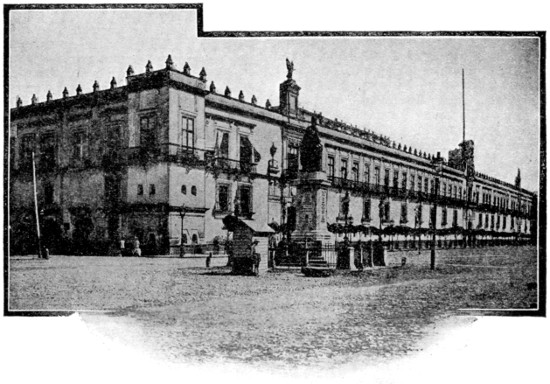
NATIONAL PALACE, CITY OF MEXICO
Still higher, above five thousand feet, a cool region is reached, which is known as the Tierra Fria. This includes the summit of the tableland and the pine covered slopes of the mountains up to the height at which some of the peaks are capped with perennial snows. Much of this high tableland is valuable only for pasture; towards the north and northeast, where the plateau is wider, the landscape becomes bare and dry, and salt lakes like those of the plateau region of the western United States appear. Deeply cut “cañons” or “barrancas,” gorges with steep walls furrowed out by the mountain torrents, are characteristic of the plateau.
Production and Industry.—The vegetation of Mexico has the same wide range as the climate. In the lowlands dye woods and valuable timbers abound in the virgin forests, as well as medicinal plants, india rubber, palms, etc.; and oranges and bananas, many varieties of cactus, agave, sisal, olives, sugar, coffee, cocoa, rice, indigo, cotton and tobacco, besides the omnipresent maize, all thrive. The vine flourishes in some districts, especially near El Paso, Durango, and Parras, in Coahuila, where a good wine is made; and mulberry plants have been imported from Europe to develop the silk industry. In Lower California a good deal of archil is collected, and chicle gum is extracted and prepared in the forests along the coast.
Agriculture in Mexico is steadily developing. Silver mining has been an important industry ever since the conquest. Gold is also produced. Copper is largely mined in some sections, being found in a pure state in Chiapas and Guanajuato, and elsewhere associated with gold. Other important minerals are iron, including enormous masses of meteoric iron ore, and the mountain a mile from Durango, the Cerro de Mercado, a solid mass of magnetic iron ore; lead, found associated with silver; and sulpher, zinc, quicksilver, platinum, cinnabar, asphalt and petroleum, besides salt, marble, alabaster, gypsum, and rock salt in great quantities. There are also said to be large deposits of coal, some of excellent quality.
Mexico is the original home of the “cattle range” business, and there vast herds of horses, cattle, and sheep form the principal wealth of the people.
Woolen and cotton spinning and weaving, and other branches of industry are encouraged by high protective duties.
People.—The population of Mexico consists mainly of the indigenous Indian race, and of the dominant Spaniards or their descendants. Spaniards born in Europe are now very few in number, but the government of the country is in the hands of the “Creoles,” or people of Spanish descent born in Mexico. They number about twenty per cent, mixed Hispano-Americans, or mestizos, forty-three per cent, and full blood Indians thirty-five per cent of the whole population. The mestizos are the farmers and rancheros, the muleteers and servants. Whites and mestizos speak Spanish.
The Roman Catholic is the religion of the country, but all beliefs are tolerated, and education, now free and compulsory, is making steady progress.
Government.—The Mexican constitution is closely modeled upon that of the United States. The president, who is assisted by secretaries of state, is elected for four years, and can be re-elected for a second term. The legislative power is vested in a Congress, consisting of a Senate of fifty-six members, and a Chamber of Deputies of two hundred and thirty-three members. The judicial system occupies the same position as that of the United States; and the several states have elective governors and legislatures.
Owing to revolutionary conditions the civil government was practically suspended in September, 1914. (See under History of Mexico.)
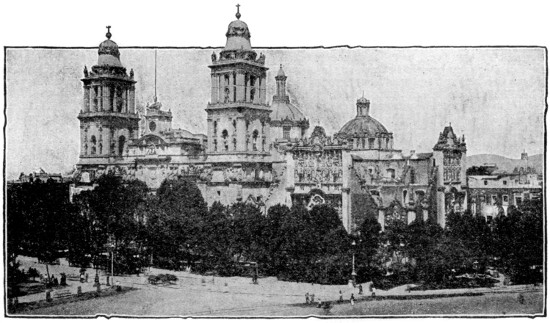
THE CATHEDRAL, CITY OF MEXICO
Cities.—The principal cities are Mexico City, the capital, population 470,000. Puébla, east of the capital, among the mountains, is the second town and the most industrious place in Mexico. Guadalajara, northwest, is also a city of magnificent palaces and churches. Vera Cruz, founded by Cortez, is the only port on the Atlantic. On the Pacific side the chief seaports are Mazatlan and Acapulco, with a fine harbor. Other important towns are Oaxaca, Puebla, and Durango.
The railway system joins that of the United States at El Paso on the Rio Grande.
Mexico City is situated seven thousand four hundred and ten feet above the sea at the lowest level of the great basin (fourteen hundred square miles) of the Anahuac plateau.
All the main streets converge on the Plaza Mayor, where the site of the old teocalli is occupied by the no less famous Cathedral. The walls of this imposing building, forming a cross four hundred and twenty-six by two hundred and three feet, alone cost nearly two million dollars, and the interior with its twenty chapels and elaborate ornamentation, much more. Built into the foot of one of the two open towers (two hundred and eighteen feet) is the famous “Aztec” (Toltec) calendar stone.
Facing the cathedral is the Municipal Palace, and on the sides of the plaza are the National Palace (the old vice-regal residence), the national Monte de Piedad, the postoffice, and the national museum.
Other noteworthy buildings are the national picture gallery and library (two hundred and fifty thousand volumes), the national observatory, the school of mines, the mint, the Iturbide hotel, and the former palace of the Inquisition, now a medical college; and, mostly in secularized ecclesiastical edifices, there are also schools of law and engineering, a conservatory of music, and an academy of fine arts.
Among the monuments of the city are the noble Columbus monument, the statue of Cuauhtemotzin, the last of the Aztec emperors, and that of the engineer Martinez.
The principal streets are broad, clean, and well paved and lighted, with houses of stone gaily painted in bright colors. In addition to the alameda, with its stately beaches, Mexico is remarkable for the extent and beauty of its paseos, or raised paved roads, planted with double rows of trees, which diverge far into the country from every quarter; and there are still on Lakes Chalco and Xochimilco, where a line of steamers runs, a few of the floating gardens for which the ancient city was so celebrated.
Attempts had long been made to drain the valley of Mexico. The federal government finally undertook the work, and operations begun in 1890 were completed in 1898 at a cost of about sixteen million dollars. Extensive drainage and sanitation works have since been carried out at a cost of five million seven hundred and fourteen thousand nine hundred and eighty-two dollars.
In 1905 a sumptuous legislative palace, a national Pantheon for the ashes of the great men of Mexico, and a monument to perpetuate the heroes of the independence were under construction, at a cost of thirty million dollars.
The trade of Mexico is chiefly a transit trade, but it has now extensive cotton and linen factories, paper mills, tobacco and cigars, gold and silver work, pottery, silverware, cork, bricks, and soap—many of them due to foreign enterprise.
History of Mexico.—The history of ancient Mexico exhibits two distinct and widely differing periods—that of the Toltecs and that of the Aztecs. Both were Nahua nations, speaking a language which survives in Mexico to this day.
The eighth century is the traditional date when the Toltecs are related to have come from the north, from some undefined locality, bringing to Anahuac, or Mexico, its oldest and its highest native civilization, about 1325. A hundred years later, under the reign of Montezuma II., they had attained a suzerainty over all the tribes from the Atlantic to the Pacific.
On the coming of the Spaniards under Cortez in 1519, Aztec rule was finally overthrown, chiefly by means of the assistance the Spaniards received from those peoples whom the Aztecs had held in cruel bondage.
In 1540 Mexico was united with other American territories—at one time all the country from Panama to Vancouver’s Island—under the name of New Spain, and governed by viceroys (fifty-seven in all) appointed by the mother country, Spain. For nearly three centuries it may be said to have lain in sullen submission beneath its cruel conqueror’s heel, till in 1810 the discontent, which had been gaining ground against the vice-regal power during the war of Spain with Napoleon, broke into open rebellion under the leadership of a country priest named Hidalgo.
In 1822 General Iturbide had himself proclaimed emperor; but the guerilla leader Guerrero, his former ally, and General Santa Anna raised the republican standard, and in 1823 he was banished to Italy with a pension. Returning the following year he was taken and shot, and the federal republic of Mexico was finally established.
For more than half a century after this (till 1876) the history of Mexico is a record of chronic disorder and civil war. In 1836 Texas secured its independence, for which it had struggled for several years, and which Mexico was compelled to recognize in 1845. In that year Texas was incorporated with the United States, and after the Mexican war of 1848 Mexico ceded half a million square miles to the United States.
The Emperor Napoleon III. declared war against the president, Juarez, in 1862; the Austrian Emperor of Mexico, Maximilian, imposed by the French, was executed in 1867, and the republic re-established. Diaz was re-elected president for the eighth time in 1910, but, being too autocratic, had to resign under pressure of revolution in 1911. In the ensuing welter of revolts and conspiracies President Madero was set aside and killed, and the United States applied pressure to eliminate President Huerta. From this time on the relations of the United States with Mexico became more strained. During 1915-1916, following repeated attacks made by bands of Mexican bandits upon American border towns and assaults by Mexicans upon Americans and other foreigners in Mexico, the relations between the two countries approached a crisis. Early in 1916 nineteen men, nearly all of them Americans, were taken from a train near Chihuahua and killed by a band of bandits.
Conditions became still more tense when, on March 9, several hundred bandits led by Villa raided and burned the town of Columbus, N. M., killing nine American civilians and eight United States soldiers. On March 10 President Wilson ordered five thousand United States troops into Mexico to catch Villa, and two days later the first troops crossed the border. On March 16 the first clash occurred between Villa outposts and the American expeditionary force. On June 18 the war department ordered all the state militia mobilized, and within the next two weeks fifty thousand of the state soldiers had been rushed to the border.
President Wilson later in the year named an American commission at the suggestion of General Carranza, which, jointly with a Mexican commission, began its sessions at New London, Conn. The sessions continued until November 24, when a protocol was signed providing for the withdrawal of the United States troops from Mexico in forty days, conditioned upon the Carranza Government showing within that time that it could protect the border and prevent raids by bandits upon American territory.
Two days before the signing of this protocol Villa, at the head of a strong force, attacked Chihuahua City, and after a battle lasting several days captured the city.
Carranza forces regained control of Chihuahua City December 3, and Villa’s forces fled to the mountains west of the city, where they were later reported to be gathering new recruits in preparation for more extensive operations.
The year 1917 was ushered in with the struggle between the Carranza and Villa factions still in progress.
LEADING COUNTRIES OF SOUTH AMERICA
ARGENTINA, or ARGENTINE REPUBLIC
ARGENTINA, or ARGENTINE REPUBLIC, takes its name from the river La Plata (“River of Silver”). After Brazil, it is the largest state of South America. Its territory reaches from the Pilcomayo River, on the borders of Bolivia, southward for two thousand four hundred miles to Staten Island, off the southeastern extremity of Tierra del Fuego; and from the slope of the Andes on the west to the Uruguay River and the Atlantic in the east.
Physical Features.—Excepting on the northwest, where the spurs of the Andes reach down into the state, the surface of Argentina presents vast monotonous and level plains, broken only by the detached ridges of Córdova and San Luis, in the western interior. In the north the portion of the region called the Gran Chaco, within the frontier, is partly forest covered, but all the central and southern region presents only vast treeless plains or “pampas,” covered at most seasons with coarse grass, which is green in the winter months, but which dries up in summer so as to give an aspect of aridity to the plains. Some portions of the interior, called “Salinas,” are barren and white throughout the year.
Rivers.—The great watercourse of the country is the Paraná, formed by the union of the Upper Paraná and Paraguay rivers near the northeastern corner of the state. This is a noble river, in all parts of its course through Argentine territory scarcely ever less than a mile in width, and in some places spreading out in lateral channels, or “riachos,” to a breadth of ten miles.
The Pilcomayo, which forms part of the northern boundary, has now been explored throughout its length, and is navigable at high water; the Vermejo, the next river southward, has of late years become a regularly navigated highway from the Paraguay up to the northeastern provinces; the Salado, farther south, flowing directly to the Paraná, is also an important river; but the remaining streams which tend eastward to the Paraná have not strength of water sufficient to resist evaporation in crossing the dry plains, and terminate for the most part in marshes and salt lakes.
Climate.—The climate in the extreme north is very hot, for it lies north of the tropic of Capricorn. The more remote southern territories have an extremely disagreeable climate, but are not really so cold as might be expected from their relatively high latitude. But the country in general enjoys an equable, temperate, and healthful climate. Stormy southwest winds, called “pamperos,” sweep over the plains at times, and raise great clouds of dust, which fly across the plains.
Production and Industry.—The principal productions are wheat, maize, oats, linseed, sugar, wool, hides, cattle, sheep, and horses.
The great wealth of the state, however, lies in its countless herds of cattle and horses and flocks of sheep, which are pastured on the “pampas,” and which multiply there very rapidly. The rearing and tending of these herds is the great and characteristic industry of the country; these also yield enormous quantities of hides, horns, and salted beef.
The northwestern provinces of the Argentine Republic, crossed by the lower ramifications of the Andes, are rich in metals, including gold, silver, nickel, copper, tin, lead, and iron, as well as in several kinds of marble, jasper, and precious stones. On the Rio Vermejo petroleum wells have recently been discovered.
The export of frozen beef and mutton is an important industry. The exports are made up entirely of pastoral and agricultural products, with the exception of quebracho, copper, manganese, and wolfram.
People.—The people of the country are mostly Spanish in their language and descent, although there are many Italians, French, Americans, Swiss, and Germans. The Gauchos, or herdsmen of the plains, are a hardy and spirited, but ignorant race, often of partial Indian descent. Some of the Indians of the remote districts have become skilled in the rearing of flocks and herds.
The religion is Roman Catholic. The government is closely modeled upon that of the United States.
Education.—Primary education is secular, free and nominally compulsory from the ages of six to fourteen. Schools are maintained by provincial taxation, and controlled by provincial boards (except in the capital, where there is a National Council), with grants from the Federal Government. Secondary education is controlled by the Federal Government in lyceums and normal schools. There are also Special Government Schools—one naval, one military, one mining, and one agriculture. There are National Universities at Cordoba and Buenos Aires, and Provincial Universities at La Plata, Santa Fé, and Paraná.
Government.—The Constitution vests the executive power in the hands of a President, who is also Commander-in-chief of the troops, elected by representatives of the provinces for six years, not being immediately re-eligible; and the legislative authority in that of a Senate of thirty members, two chosen by the capital and two by the legislature of each province, and a House of Deputies of one hundred and twenty members elected for four years by the people, one-third of the Senate retiring every three years, and one-half of the House retiring every two years.