BOOK OF THE SCIENCES AND INVENTION (continued 4)
Reading edition
It now remains to explain what happens when the steam presses below the piston. It must not remain above, otherwise the piston could not move. But while the steam enters below by the conduit b, the top of the cylinder, by means of the conduit a, is connected with a cavity, O, from which passes the tube L. Through this tube the steam which has already acted upon the piston passes into the atmosphere, or else is condensed in a vessel filled with cold water, which is called the condenser. If, on the other hand, the piston sinks, the vapor below the piston passes, by the conduit b, to the cavity O, and to the tube L.
Transmission of Motion.—The alternating rectilinear motion thus generated within the cylinder is transmitted, by means of a rod attached to the piston, to a strong beam ff, movable upon a central axis, a system of jointed rods ee, called the parallel motion, being interposed for the purpose of neutralizing the disturbing action which the circular path of the beam would otherwise exert upon the piston. The reciprocating motion of the beam is now, through the intervention of the connecting-rod g and crank h, converted into a circular or rotatory motion, which is rendered continuous and uniform by the fly-wheel i, to the axis of which the machinery to be impelled is connected.
The air-pump, p, for withdrawing the vapor and water from the condenser, the feed-pump, s, for supplying the boilers, and cold-water pump, t, for supplying the condenser cistern, are all worked by rods from the beam; and the governor, u, for maintaining uniformity of motion, is driven by a band from the crankshaft. The above description refers more immediately to that class of steam engines called low-pressure engines.
Types of Engines.—The various forms of the steam engine have received a varied form of classification. There are the general divisions into condensing and non-condensing engines, compound and non-compound, and single, double, or direct acting. Again there is the classification connected with the position of the cylinder, as in the horizontal, vertical, and inclined cylinder engines. Another classification divides steam engines into the uses to which they are applied, such as stationary engines, portable engines, marine, locomotive, electric generating, pumping, mill driving, winding, etc.
Steam Turbine.—The steam turbine, though the most modern form of the steam engine in practice, is the most ancient in actual history, the germ of the invention dating from Hero of Alexandria, in the second century B. C.
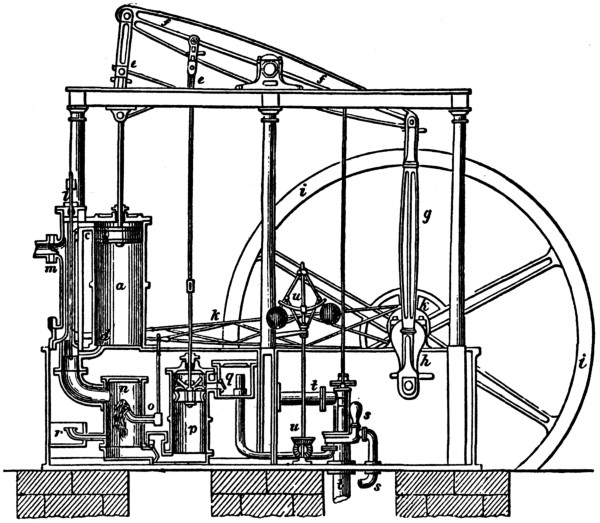
FIG. B—BEAM CONDENSING STEAM ENGINE
a, The steam-cylinder; b, the piston; c, the upper steam-port or passage; d, the lower steam-port; ee, the parallel motion; ff, the beam; g, the connecting-rod; h, the crank; ii, the fly-wheel; kk, the eccentric and its rod for working the steam-valve; l, the steam-valve and valve-casing; m, the throttle-valve; n, the condenser; o, the injection-cock; p, the air-pump; q, the hot-well; r, the shifting-valve for creating a vacuum in the condenser previous to starting the engine; s, the feed-pump for supplying the boilers; t, the cold-water pump for supplying condenser cistern; u, the governor.
One kind of steam turbine is really worked on the same principle as a windmill, only steam is used instead of the wind. Instead, however, of the sails making one revolution in seven or eight seconds, it sometimes makes three thousand revolutions a minute, or fifty revolutions a second. In another kind the blades of the turbine are something like the pockets on a water-wheel, and the steam shoves the wheel round by its great velocity.
Turbine engines are now fitted to vessels of large dimensions, up to ocean liners and battleships, with extremely satisfactory results. Turbine engines have also been applied in various other ways, e.g., to the driving of fans and blowers.
The principle of internal combustion, as used in gas and oil engines, has also been applied to the turbine with marked success, and has done much to solve the all-important problem of efficiency. It is extremely improbable that the long-range activities of the submarine would be nearly so effective were it not for the application of the same principle to their engines.
THE MARVELOUS IRON SKELETON OF THE LOCOMOTIVE AND THE NAMES OF ITS PRINCIPAL PARTS
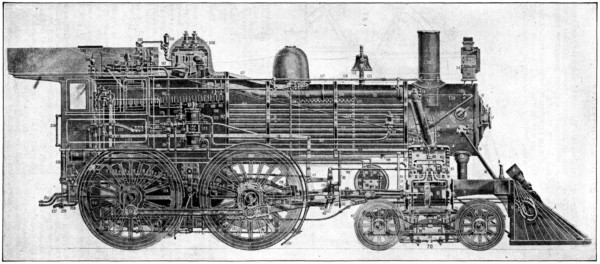
Large image (446 kB)
4 Air Signal Hose 77 Engine Truck Frame 150 Driving Box
5 Air Brake Hose 80 Engine Truck Equalizer 151 Driving Axle
11 Front Frame 82 Engine Truck Spring 155 Main Frame
12 Cinder Chute 86 Truck Brake 158 Go Ahead Eccentric
14 Extension Front 87 Wheel Guard 159 Back Up Eccentric
15 Headlight Step 88 Signal Pipe 165 Rocking Grates
16 Signal Lamp 92 Main Rod 168 Running Board
18 Smoke Arch Door 97 Main Frame 169 Air Cylinder Brake Pump
19 Smoke Arch Front 99 Air Drum 170 Steam Cylinder Brake Pump
22 Headlight Case 100 Pump Connection 173 Drip Cock
23 Headlight Reflector 101 Train Pipe Connection 174 Pump Piston Packing
27 Deflector Plate 102 Valve Stem Rod 177 Governor
28 Deflector Plate Adjuster 103 Train Pipe 186 Fire Box
29 Air Pump Exhaust Pipe 104 Wash Out Plugs 192 Stand Pipe
38 Smoke Stack 108 Link Block 195 Throttle Valve
39 Arch Hand Rail 112 Tumbling Shaft Arm 198 Dome
44 Steam Chest 113 Tumbling Shaft 201 Safety Valves
51 Steam Passages to Chest 114 Tumbling Shaft Lever 202 Chime Whistles
52 Valve Seat 120 Check Valve Case 203 Whistle Rig
56 Steam Ports 121 Check Valve 204 Ventilator
57 Cylinder 122 Flues 205 Cab
58 Back Cylinder Head 123 Oil Pipe 207 Air Gauge
59 Piston Packing 124 Horizontal Boiler Seam 208 Steam Gauge
60 Piston Rod 125 Circumferential Seam 209 Steam Turret
61 Piston Head 126 Boiler Lagging 213 Signal Whistle
62 Piston Packing Rings 127 Boiler Jacket 214 Air Pump Throttle
64 Front Cylinder Head 128 Jacket Bands 215 Throttle Lever
65 Cylinder Head Casing 132 Bell 216 Pneumatic Sander
66 Cylinder Lagging 133 Steam Bell Ringer 216a Sand Lever
67 Cylinder Casing 134 Sand Box 217 Reverse Lever
68 Cylinder Cocks 135 Pneumatic Sander 218 Engineer’s Brake Valve
69 Cylinder Cocks Rigging 136 Sand Pipe 219 Gauge Cocks
70 Engine Truck 137 Driving Wheel Tire 222 Fire Door
71 Engine Truck Wheel 138 Driving Wheel Centers 229 Whistle Signal Valve
73 Engine Truck Axle 140 Driver Brakes 233 Signal Pipe
75 Engine Truck Box 141 Driver Springs 236 Feed Pipe
LOCOMOTIVES
Locomotive engines, or simply locomotives, are steam engines which, mounted on a carriage, propel themselves by transmitting their motion to wheels.
The parallel motion, the beam, and the fly wheel of the ordinary stationary engine form no part of a locomotive. The principal parts are the framework, the fire box, the casing of the boiler, the smoke box, the steam cylinders, with their valves, the driving wheels, and the feed pump.
The framework rests on the axles of the wheels. The illustration on another page shows clearly the arrangement and parts of a typical locomotive. It will be observed that in the lower part of the steam dome is the fire box, from whence the flame and the products of combustion pass into the smoke box, and then into the chimney after having previously traversed the numerous brass fire tubes which pass through the boiler. The boiler, which connects the fire box with the smoke box, is made of iron, and is cylindrical.
The steam passes from the boiler into two cylinders, placed on either side of the smoke box. There, by means of a steam chest similar to that already described, it acts alternately on the two faces of the piston, the motion of which is transmitted to the axle of the large driving wheels. After having acted on the pistons, the steam is forced through the blast pipe into the chimney, thus increasing the draft.
The motion of the pistons is transmitted to the large driving wheels by two connecting rods, which, by means of cranks, connect the piston rods with the axles of the wheels. The alternating motion of the slide valve is effected by means of eccentrics placed on the axles of the large wheels.
Wheels of the Locomotive.—The wheels range ordinarily from forty-five to eighty-five inches in diameter for drivers, thirty to forty-two inches for truck wheels. They are made of castiron or steel body and steel rim shrunk on. Spoked wheels are usual for drivers, solid wheels for trucks. The tread is four to five inches wide, the flange (one to one and one-quarter inch high) increasing this to five and one-half to seven inches. A counterbalance weight is cast between the spokes opposite the crank-pin seat. The axles, forged steel, are six to eight inches in diameter (for drivers); the wheels are forced on their ends by a powerful press. Cranked axles (for inside cylinders) are forged to shape, rarely built up.
Control.—The locomotive is controlled by the throttle-valve and the reverse lever. Both are located in the cab, which is built at the rear around the fire box, and serves also as firing platform.
Auxiliaries.—The necessary auxiliaries of the locomotive are those required for its operation as a power generator, and those necessary to its service as a railroad vehicle or as a tractor. The tender is the most important in the first group. It is a separate vehicle attached behind the locomotive, carrying a water tank of three to eight or nine thousand gallons capacity, and a coal bin of two to ten tons capacity. Eight-wheel (two-truck) tenders are usual. The coal space is at the front of the tender, and the water tank occupies the rear half and extends forward along the sides of the coal bin. The coal thus is reached directly from the rear of the engine cab.
Water is supplied to the engine by pipes leading from the tank to injectors on the engine. Feed pumps are rarely used for pumping the water into the boiler, injectors in duplicate being depended on. The safety valve, mounted on the top of the boiler, is of the spring poppet type. A steam whistle is placed alongside, for use as warning and train-movement signal; a bell operated from the cab by a cord is also mounted on the boiler.
The air-brake equipment of the locomotive comprises the brake mechanism for the engine itself, and an air pump with its governor, a main reservoir, and the engineer’s valve, for supplying and manipulating the brakes of the entire train. The air pump is a direct-coupled compressor whose steam and air cylinders have a common piston-rod, attached in vertical position to the side of the boiler in front of the cab. The cylinder diameter is eight to ten inches. It pumps air into the main reservoir, a cylindrical tank hung under the boiler. An automatic pressure governor starts the compressor when the pressure falls and stops it when the full reservoir pressure is restored.
The locomotive brake equipment consist of brake cylinder and lever system connected to the wheel brake-shoes, but its valve control differs somewhat from that of a car, so as to permit braking the engine alone if desired. The engineer’s valve is a flat-seat rotary valve with positions for supplying brakes, recharging the train-pipe, and closing all connections. A separate valve is usually supplied to operate the engine brake alone, working this as “straight-air” or non-automatic brake. Reservoir and train-pipe gauges are mounted in the engine cab near the brake handles. Steam brakes are no longer fitted on American locomotives. The driving-wheels only of the locomotive are braked, but the tender is fully braked.
The sand-box for increasing the driving-wheel friction on wet or greasy rail is commonly set on top of the boiler with discharge pipes ending in front of the drivers just above the rail. A compressed-air ejector is now often used (pneumatic sander), in which case the sand-box may be placed on the front sill or in other convenient position with equal effectiveness.
The Cab, with windows in front and sides, is built around the fire box, providing a seat on either side which commands a view ahead over the track. The reverse lever is placed on the right-hand, or engineer’s side, from where also the throttle lever and brake-valve handles are reached. Injector, whistle, sander, bell, drain cocks, traction-increaser, and other appliances are controlled from here. The headlight, set on top of the boiler in front of the stack, is usually an oil lamp, with parabolic reflector. Acetylene and electric headlights are extensively used in recent years, the latter supplied by a small steam-turbine and dynamo combination.
Classes and Types of Locomotives.—The wheel-arrangement of a locomotive is, in conjunction with its total weight, the chief characteristic. Freight locomotives, running at slow speeds, utilize a large adhesion, and therefore have a large proportion of their weight carried on drivers; they have less need for good guiding quality and steadiness at great speeds. Passenger locomotives, working at high speeds, develop a much lower tractive force, and therefore require less weight on drivers, but need leading wheels for guiding quality and steadiness.
The number and arrangement of cylinders is another characteristic of classification. Most locomotives have two cylinders, both simple. Compounds are built with two, three or four cylinders.
Recent Developments.—The chief factor in the modern modification of locomotive types and details is increase of size. The only limiting factors are boiler capacity and weight on drivers.
Economy of operation has brought compounding into much favor even for single-frame engines, and more recently has led to the wide adoption of super-heating; these improvements also allow increased power to be obtained from a boiler of given size.
Weight and Power.—Locomotives weighing seventy-five to one hundred and twenty-five tons (without tender) are common. In power, road locomotives range from three hundred to one thousand five hundred horse power and occasionally to two thousand horse power, the more modern ranging from seven hundred to one thousand five hundred. High-speed passenger locomotives are usually more powerful than heavier freights.
Boiler Performance.—The distinguishing feature of the locomotive boiler is its high evaporative capacity, and the very high rates of fuel-burning. At full power one hundred pounds coal are burned per square foot of grate surface per hour, by virtue of the strong draft produced by the exhaust-steam blast. At moderate speeds twenty-five to forty pounds are burned.
Electric Locomotives.—The operation of heavy railroad service (i.e. trains of freight cars and long passenger trains) by electric power requires the use of electric locomotives in place of the car-motor arrangement of street railroads. Such locomotives have been built since the middle of the nineties, and in considerable number since 1905. The earlier ones had the motors geared to the axles, or directly mounted thereon, but recent constructions have the motors mounted on the frame or platform, above the wheels, so that their weight is carried by the frame springs, and the motors drive the wheels through coupling-rods either direct or by way of an intermediate jack-shaft. This form is found to give smoother running and exert less destructive effect on the track than the prior forms. In wheel arrangement these locomotives vary greatly, but recent machines exhibit combinations of coupled drivers with leading and trailing trucks not unlike the arrangement of steam locomotives. Electric locomotives of two thousand to three thousand horse power have been built, and are in regular use hauling trunk-line trains.
AËROPLANES
Flying-machines are distinguished from balloons and dirigibles in being “heavier than air,” and consequently raised and supported by dynamic means alone, by the reaction of the air on surfaces driven through it.
Essentially, the aëroplane may be compared to a kite in which the pull of the string is replaced by the thrust of the propeller.
On December 17, 1903, the Brothers Wright, in America, made their first power-flight; while the very first public flight was made in France by Santos-Dumont on September 14, 1906.
Before it was possible to produce a power-driven aëroplane, experiments over a long course of years were made with aëroplanes not provided with propelling apparatus.
In its earliest form the aëroplane consisted of a flat surface moved through the air in a position slightly inclined from the horizontal; in its forward movement the plane experiences resistance from the air. As this resistance is directed partly on the under side, it will be partly converted into a lifting force. Of these two forces—head resistance or drift, and the lifting or sustaining force or lift—the first, being unproductive, must be reduced as far as possible; the second, lift, must, on the other hand, be raised to the highest possible degree.
This end is achieved by employing, instead of flat surfaces or planes, surfaces curved in the direction of flight.
The Two Types.—A monoplane is a machine with a single spread of surface supporting it. The best known example of a monoplane is the Bleriot. Biplanes have two supporting surfaces, the one above the other; the Wright and Farman machines are machines of this type. There are other machines which have been invented which have more supporting surfaces than this, the most successful of them all being the Roe triplane. But at present, at any rate, the advantage lies between the monoplane and the biplane, the other machines not yet having reached a sufficiently high standard to be able to compete with them.
The monoplane and the biplane have both their own special uses. The monoplane is obviously the lighter machine, and its head resistance is much less, hence it follows logically that its speed will be greater than that of a biplane. But the biplane is a much more stable machine than the monoplane; it will therefore probably be safer and will certainly be able to carry a greater weight.
In the making of aëroplanes wood is usually used for the framework. Specially selected wood is taken, usually from the spruce, hickory, ash, or birch, since wood combines in itself the strength and tenacity of metal without its weight. The fabric with which this frame is covered is more difficult to obtain, since it must contain in itself all the qualities of strength, lightness, smoothness, etc., without any tendencies to shrink, or rot, or burn.
The biplane carries a load of from two and one-half to three and one-half pounds per square foot of surface; the monoplane from three and one-half to six pounds per square foot. The load per horse power in each case is from thirty to forty pounds. In speed the biplane ranges from thirty-five to forty-five miles per hour, as against forty to sixty miles per hour attained by the monoplane.
Practical Uses.—From the very first days the value of the aëroplanes, from a military point of view, has been realized, not as a weapon of offense so much as of intelligence. It would, in fact, be difficult to imagine a better means of scouting and reconnoitering than is afforded by the flying-machine. Its gradually increasing radius of action renders it available for strategical no less than for tactical reconnaissance; its easy mode of progress and absence of vibration allow the most accurate observations to be made and sketch-maps to be drawn. For dispatch-carrying over difficult country its usefulness is also considerable. Its employment for purposes of offense is much more hazardous. On the other hand, it is practically immune from artillery or rifle fire from the land, especially when flying at a fair altitude.
As a commercial vehicle, and for transport, the aëroplane, owing to its relatively low carrying power, is restricted in its usefulness. With increasing reliability, however, it may well assume a portion of the functions of the motor car.
THE MODERN AIRSHIP
The development of the balloon began in 1783, and was the work of two brothers, Joseph and Etienne Montgolfier, who were the sons of a paper manufacturer of Annonay, France.
The latest and most successful experimenter is Count Zeppelin, a German inventor, whose name has been given to the huge dirigible airships known as Zeppelins. Between these there has been a long list of inventors and experimenters who met with varying degrees of success; but the Zeppelins stand paramount.
From the year 1897 the development of the airship was the special work of the Count Zeppelin. In 1900 he made his first flight with a dirigible balloon which carried five men. It was made of aluminum, supported by gas bags and driven by two motors, each about sixteen horse power. His first experiment met with some success, but the first Zeppelin airship was succeeded by another in 1905 with greater motor power; this was wrecked and was succeeded by a third, which met with great success. This airship carried eleven passengers and attained a speed of about thirty-six miles an hour. The fourth Zeppelin airship succeeded in traveling about two hundred and fifty miles in eleven hours, but was wrecked by a storm in 1908, the wreckage catching fire and completely destroying the ship.
Zeppelin VII. had a total length of no less than four hundred and eighty-five feet, a diameter of forty-six feet, and a volume of 690,000 cubic feet. The vessel was fitted with three engines totaling some four hundred and twenty horse power and capable of driving the vessel at thirty-five miles an hour. On one occasion she carried thirty-two people and made a journey of three hundred miles in nine hours.
In the meantime many other experiments had been carried out, notably by Santos Dumont, who circled the Eiffel Tower in the face of a fresh wind.
Dirigibles are divided into three types—(a) rigid, in which there is a framework or skeleton, over which a skin is stretched and within which a number of balloons are placed; (b) semi-rigid, in which the lower part only of the balloon is distended on a flat framework; and (c) non-rigid, when a gas-bag of elongated form has a long girder suspended below it. The propellers are most usually mounted in pairs on each side of the car, but Zeppelin attached them to the balloon itself. To prevent pitching, an “empennage” of flat surfaces is usually arranged near the after-end.
Some Facts About Zeppelins.—In shape an ordinary Zeppelin airship is a long cylinder with semisphere-like ends and a keel running the whole length of the bottom thereof. In appearance from a distance the cylinder and pointed ends appear circular in shape, i.e. in cross-section, but in reality this is not so, both being sixteen sided. About one-third the distance from either end of the keel are small boat-like structures suspended from the hull, so close to it that at these places there is a gap in the hull to make room for them. They are rigidly connected with the metallic hull of the airship and help to support it either when the vessel rests on the ground or is towed or driven along the water.
Within these structures are the crew and engines, while above, but outward on each side of the rigid hull and connected with it by means of outriggers, are two pairs of aërial propellers. These are placed at an equal distance out on either side and in the same horizontal plane, so that their united propulsive action shall act centrally along the line of head resistance. The crew can walk through the keel (originally V-shaped) from end to end, or from one boat to the other, the passage being illuminated by means of suitable windows. An observer can also climb through the hull to take observation from the top. Telephones, electric bells, and speaking-tubes are all employed to transmit orders.
Construction of the Frame.—The frame of the rigid hull is built of sixteen longitudinals or girders of trellised or latticed metal; it runs the whole length of the airship and is riveted at regular intervals to cross-sections of latticed girders. Each of these cross-sections is in the form of a sixteen-sided figure or wheel, with latticed rims strengthened by radial rods running from a center flange or boss to the outer rims. The main hull is thus divided into a number of compartments, each separated from one another by means of these latticed radial discs or wheel-like structures and otherwise enclosed by the sixteen latticed girder longitudinals or beams. Each of these compartments contains a gas-bag or balloonette filled with hydrogen; the balloonette fairly fills the compartment, and each bag exerts its proportionate lift. A netting of ramie cords is stretched from wheel to wheel diagonally, between the beams at their inner corners, while the outward corners of the beams are joined by strong wires arranged diagonally for the purpose of imparting rigidity.
The whole frame is covered externally with a strong fabric, which forms the outer skin or wall of the hull. Air-spaces naturally exist between this covering, the inflated balloonettes, and the wheel-like divisions. The entire airship owes its buoyancy to the balloonettes filled with hydrogen, while the outer framework and covering act as a protection against the sun, foul weather, and external shocks.
War Zeppelins.—Monstrous as the above ships are, they are quite dwarfed by the recent type of military Zeppelins. The latter carry motors aggregating no less than nine hundred horse power. The length varies from five hundred to eight hundred feet, and the diameter is proportional. The gas capacity exceeds a million cubic feet.
Aëroplane versus Airship.—-On the airship’s side the following strong points are claimed: (1) Greater manœuvering power than the aëroplane, more especially with respect to rapidity of ascent; (2) greater offensive power, i.e. ability to carry heavier guns owing to its far greater lifting capacity; (3) ability to stand still or hover in the air over one spot (for bomb-dropping), or remain stationary in the air, end on to the enemy, for the purpose of obtaining a steady gun platform; (4) greater flying durability, i.e. ability to remain longer in the air at a stretch; (5) ability to fly at night.
Manning the Airship.—The crew of a military airship includes the following: the pilot, the engineer, the steersman, the wireless operator, and last but by no means least the observer. The total number of the crew varies with the size of the airship, and the particular mission in view. The pilot is the captain of the airship, and is responsible for (1) the route, (2) the altitude or elevation at which the airship travels, and (3) the maintenance of the correct pressure on the envelope. The steersman maintains the course ordered him, by means of a compass or by special instructions which may be given him, and also controls the altitude or elevation as ordered. The engineer naturally looks after the engines and the mechanical part of the apparatus with which the airship is fitted.
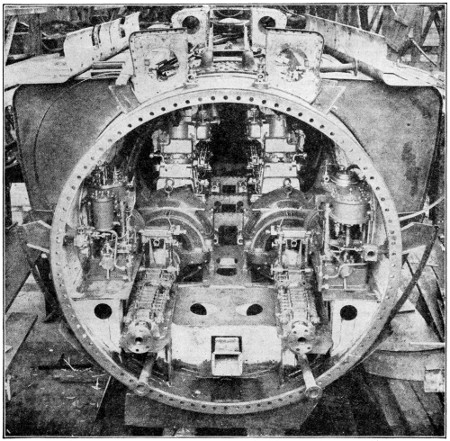
MARVELOUS MECHANISM OF THE MODERN SUBMARINE
Its interior is a steel maze of intricate machinery that fills it from end to end, and makes it easily the most remarkable of modern marine craft.
THE SUBMARINE
Though the submarine boat has only recently been brought to a high degree of practical efficiency, its history extends back to the seventeenth century, and even beyond. The modern submarine, however, whether of the American, English, or German type, has followed the model of J. P. Holland, an American inventor who submitted designs to the United States government in 1895.
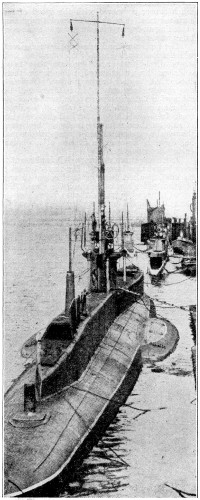
SUBMARINE WITH WIRELESS EQUIPMENT
In 1901 the English Admiralty gave orders to the firm of Vickers, Maxim & Sons, of Barrow, to construct five of the Holland type and subsequently several were constructed for the United States government.
To France belongs the credit of making submarine boats a real factor in naval warfare. In 1881 M. Goubet designed a small submarine boat, and in 1885 an improved Goubet, which was sixteen feet five inches in length, the motive power being electricity. Successful experiments led the French Admiralty to have the Gymnote constructed at Toulon in 1888; she was fifty-six feet five inches long, with a displacement of thirty tons, her motive power being electricity stored in accumulators, which gave her a radius of thirty-two miles at eight knots. Her trials decided the French authorities to have more vessels built, and by 1901 there were some eleven completed.
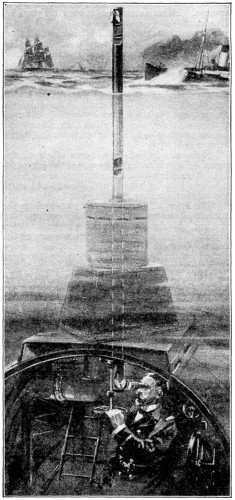
THE PERISCOPE OF THE SUBMARINE
is its ever watchful eye. Ordinarily the top of the periscope extends about eighteen inches above the waves. Continually revolved at a high rate of speed by an electric motor, the mirrors bring into focus the whole panorama of the upper seas so that the commander can follow in the smallest detail what is passing above him, locate vessels to be attacked, and submerge at will in the presence of danger.
In America, the Hollands have been similarly improved, but other types are also in use. The Lake type, named after the inventor, Simon Lake, contains an air-lock through which divers may emerge. These vessels have been adopted by Russia.
Germany started with Hollands, which they have developed along their own lines. The submarine boat is found in all navies now, and has proved an enormously efficient craft; displacements of one thousand tons are not unusual and speeds as well as radius of action have shown great improvement. The Diesel engine has been largely responsible for this. In manœuvers the craft have come up to expectation completely, the experience in actual war has shown them to be among the most formidable of war craft.
There are two distinct types of submarine vessel—the submarine proper, and the submersible. The submarine sinks through the exhaustion of all its buoyancy, and she sinks at once; the submersibles are forced under.
The latter, though equipped to travel on the surface of the water, are specially equipped for sinking quickly out of sight as the occasion arises. The most improved types, such as the recent German U-boats, have lofty armor plated conning towers, torpedo tubes, mounted guns, periscopes, and wireless equipments.
While in the present European war the submarines have shown themselves to be formidable weapons in skillful hands, they are not so formidable as to ring the death-knell of the large battleship, still less perhaps of the swift battle cruiser. Victory has usually rested with the more powerful ship and the heavier guns.
The present-day submarine suffers from two serious drawbacks: (1) inability to see under the water; (2) inefficient speed—the latter being much slower compared with the speed of fast surface boats. The chief chance of a submarine attacking an enemy with success is to come upon him unawares.
The periscopes and other optical tubes with which submarines are fitted, suffer also from many disabilities; and the fact that many collisions have occurred while using them, shows that they are not yet perfect. Obviously one showing not only what is forward of the submarine but what is on the surface of the water on every side is best. One of the drawbacks from which they suffer is the encrustation of salt on their reflecting surfaces; and small though the exposed surface of the periscope may be, there is always the chance of a vigilant enemy detecting it.
The Submarine in Peace.—It is pleasant to record that this invention, like many others of its kind, has not been devoted solely to war, but that peace also can claim its services. The recent remarkable trans-Atlantic voyages of the German submarine Deutschland to American ports is an illustration of their importance to commercial transportation under critical conditions. Since, too, the submarine can sink or dive down to moderate depths, it is obvious it can be used for purposes of underwater salvage, construction, and exploration.
As an aid in the construction of breakwaters, the blowing-up of submerged wrecks in comparatively speaking shallow waters, in searching for sunken treasures, and as an aid to marine explorations in suitable waters, the peace or working submarine is likely to be of untold value.
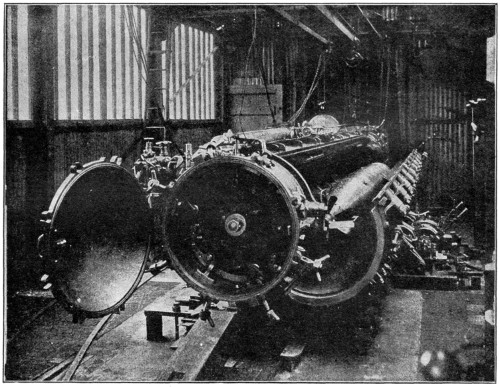
TORPEDO TUBE OF SUBMARINE—DEADLY TORPEDO SHOWN IN TUBE ON RIGHT OF PICTURE
ELECTRICITY AND MAGNETISM
What is Electricity?—Means of Exciting Electricity—Electrified and Non-Electrified Bodies—Conductors and Non-Conductors of Electricity—Electrical Machines—Positive and Negative Electricity—Velocity of Electricity—Principal Agents in Nature Exciting Electricity—Lightning—Three Forms of Lightning—Sheet and Heat Lightning—Duration of a Flash of Lightning—Places Dangerous in a Thunder Storm—How a Tree Influences Lightning—Lightning Conductors—Their Proper Principle of Construction—Franklin’s Experiment with a Kite—Identity of Lightning and Electricity—Utility of Lightning-Rods—What is Thunder?—What Occasions the Rolling of Thunder?—Aurora-Borealis—Extent of the Aurora—Height of the Aurora—Appearance—Aurora-Borealis Occurs in the Day-Time—What is Galvanism?—How Galvanic Electricity Was Discovered—Construction of a Galvanic Battery—Origin of the Term “Galvanism”—Poles of a Battery—Means by Which Galvanic-Electricity in Quantity Can Be Developed—Different Forms of Galvanic Batteries—Light and Heat Produced by Galvanism—Principles and Processes of Electro-Metallurgy—Magnetism—Natural Magnets—Where Found—Bodies Capable of Being Magnetized—Induction—Magnetic Needle—The Magnetic Compass—Discovery and First Use of the Compass—Electro-Magnetism—When and How Discovered—How Iron Bars Become Magnetic—Horse-Shoe Magnets—Excitation of Magnetism—Morse’s Magnetic Telegraph—Telegraph, Magnetic, Principles of—Intelligence, How Conveyed by—Electric Dynamo and Motors—Wireless Telegraphy—Wireless Telephone—X-Rays
Electricity
How may electricity be called into activity?
By mechanical power, by chemical action, by heat, and by magnetic influence.
What is the most ordinary way of exciting electricity?
By friction.
Do we know any reason why the means above enumerated should develop electricity from its latent condition?
We are entirely ignorant upon this subject.
When you rub a piece of paper with India-rubber, why does it adhere to the table?
Because the friction of the India-rubber against the surface of the paper develops electricity, to which this adhesiveness is mainly to be attributed.
Does electricity present any appearance by which it can be known?
No; electricity, like heat, is in itself invisible, though often accompanied by both light and heat.
When a substance, by friction or by any other means, acquires the property of attracting other bodies, in what state is it said to be?
It is said to be electrified, or electrically excited; and its motion towards other bodies, or of other bodies towards it, is ascribed to a force called electric attraction.
Does an electrified body exercise any other influence than an attractive one?
It does; for it will be found that light substances, after touching the electrified body, will recede from it just as actively as they approached it before contact. This is termed electric repulsion.
Thus, if we take a dry glass rod, rub it well with silk, and present it to a light pith ball, or feather, suspended from a support by a silk thread, the ball or feather will be attracted towards the glass. After it has adhered to it a moment, it will fly off, or be repelled. The same will happen if sealing-wax be rubbed with dry flannel, and a like experiment made; but with this remarkable difference, that when the glass repels the ball, the sealing-wax attracts it, and when the wax repels, the glass will attract. These phenomena are examples of electrical attraction and repulsion.
What is a non-electrified body?
One that holds its own natural quantity of electricity undisturbed.
What happens when an electrified body touches one that is non-electrified?
The electricity contained in the former is transferred in part to the latter.
Thus, on touching the end of a suspended silk-thread with a piece of excited wax, the silk will be excited, as will be shown by its moving towards a book, piece of metal, or any other object placed near it.
Do all bodies conduct or allow electricity to pass through them equally well?
Although there is no substance that can entirely prevent the passage of electricity, nor any that does not oppose some resistance to its passage, yet it moves with a much greater facility through a certain class of substances than through others. Those substances which facilitate its passage are called conductors; those that retard or almost prevent it, are called non-conductors.
What substances are good conductors of electricity?
The metals, charcoal, the earth, water, and most fluids, except oils, the human body, etc., are good conductors.
What substances obstruct the passage of electricity, or are “non-conductors”?
Glass, resin, oil, silk, sulphur, dry air, etc., etc., are non-conductors.
What is an electrical machine?
An electrical machine is an arrangement by which quantities of electricity can be collected and discharged.
One type of the electrical machine most usually employed consists of a large circular plate of glass, mounted upon a metallic axis, and supported upon pillars fixed to a secure base, so that the plate can, by means of a handle, be turned with ease. Upon the supports of the glass, and fixed so as to press easily but uniformly on the plate, are four rubbers; and flaps of silk, oiled on one side, are attached to these, and secured to fixed supports by several silk cords. When the machine is put in motion, these flaps of silk are drawn tightly against the glass, and thus the friction is increased, and electricity excited.
Do we know what electricity is?
No; a complete and final answer to this question is no more possible than the answer to the question—what is life? The theory of electricity, however, opens up possibilities of the most fascinating nature; it gives us a wonderfully clear conception of which might be called the inner mechanism of electricity; and it even introduces us to the very atoms of electricity.
Give a short outline of the theory of electricity.
Early Theories.—Early writers on the nature of electricity supposed it to be either a fluid of peculiar properties or else two fluids whose properties were complementary to each other or of opposite kinds; Franklin held the one fluid theory. Later physicists arrived at the conclusion that whatever electricity might be, it was not a material substance. As an alternative it was suggested that electricity was a form of energy, but this proved untenable.
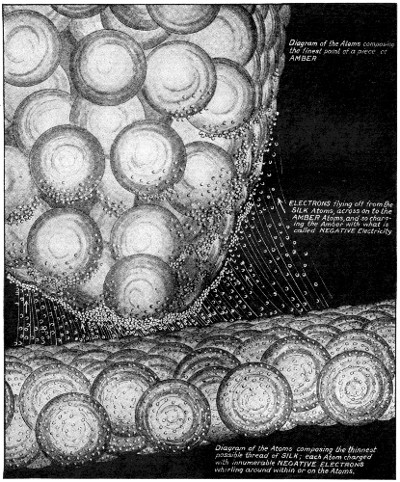
HOW ELECTRICITY IS PRODUCED BY THE ACTIVITY OF ELECTRONS
Diagram of the Atoms composing the finest point of a piece of Amber
ELECTRONS flying off from the SILK Atoms, across on to the AMBER Atoms, and so charging the Amber with what is called NEGATIVE Electricity
Diagram of the Atoms composing the thinnest possible thread of SILK; each Atom charged with innumerable NEGATIVE ELECTRONS whirling around within or on the Atoms.
Electron Theory.—This, with certain reservations, is held by the scientific world of today. All matter is believed to be constituted of minute particles called “atoms,” whose diameter has been estimated at about one millionth of a millimeter. Up to a few years ago the atom was believed to be quite indivisible, but it has been proved beyond doubt that this is not the case. An atom may be said to consist of two parts, one much larger than the other. The smaller part is negatively electrified, and is the same in all atoms; while the larger part is positively electrified, and varies according to the nature of the atom. The small negatively electrified portion of the atom consists of particles called “electrons,” and these electrons are believed to be indivisible units or atoms of negative electricity.
The electrons in an atom are not fixed, but move with great velocity, in definite orbits. They repel one another, and are constantly endeavoring to fly away from the atom, but they are held in by the attraction of the positive core. So long as nothing occurs to upset the constitution of the atom, a state of equilibrium is maintained and the atom is electrically neutral; but immediately the atom is broken up by the action of an external force of some kind, one or more electrons break their bonds and fly away to join some other atom. An atom which has lost some of its electrons is no longer neutral, but is electro-positive; and similarly, an atom which has gained additional electrons is electro-negative.
The Electric Current.—A current of electricity is believed to be nothing more or less than a stream of electrons, set in motion by the application of an electro-motive force. Some substances are good conductors of electricity, while others are bad conductors or non-conductors. In order to produce an electric current, that is a current of electrons, it is evidently necessary that the electrons should be free to move. In good conductors, which are mostly metals, it is believed that the electrons are able to move from atom to atom without much hindrance, while in a non-conductor their movements are hampered to such an extent that interatomic exchange of electrons is almost impossible.
Does electricity seem to exist in two different states or conditions?
It does; and to designate these two conditions, the terms positive and negative have been employed. Thus a body which has an overplus of electricity is called positive, and one that has less than its natural quantity is called negative.
Do light, heat, and electricity appear to have some properties in common?
They do; each may be made, under certain circumstances, to produce or excite the other. All are so light, subtle, and diffusive, that it has been found impossible to recognize in them the ordinary characteristics of matter. Some suppose that light, heat, and electricity are all modifications of some common principle.
Why does the fur of a cat sparkle and crackle when rubbed with the hand in cold weather?
Because the friction between the hand and fur produces an excitation of positive electricity in the hand and negative in the fur, and an interchange of the two causes a spark, with a slight noise.
Why does this experiment work best in very cold weather?
Because the air is then very dry, and does not convey away the electricity as fast as it is excited; if the air, on the contrary, were moist, the electricity would be conducted off nearly as fast as it was excited by friction, and its effects would not therefore be so manifest.
With what velocity is electricity transmitted through good conductors?
With a velocity so great that the most rapid motion produced by art appears to be actual rest when compared to it. Some authorities have estimated that electricity will pass through copper wire at the rate of two hundred and eighty-eight thousand miles in a second of time—a velocity greater than that of light.
What agents are undoubtedly the most active in producing and exciting electricity in the operations of nature?
The light and the sun’s rays.
Do some animals have the power of exciting electricity within themselves?
There are certain animals which are gifted with the extraordinary power of producing electrical phenomena by an effort of muscular or nervous energy. Among these the electrical eel and the torpedo are most remarkable.
How powerful a charge of electricity can the electrical eel send forth when in full vigor?
Sufficient to knock down a man or stun a horse.
Is the electricity generated by these animals the same as that occasioned by the ordinary electrical machine?
It is the same, and produces the same effects.
Do vital action and muscular movements in man and animals give rise to electricity?
They do; and it can be shown by direct experiment that a person cannot even contract the muscles of the arm without exciting an electrical action.
Does change of form or state in bodies generally produce electrical excitation?
Change of form or state is one of the most powerful methods of exciting electricity.
Water, in passing into steam by artificial heat, or in evaporating by the action of the sun or wind, generates large quantities of electricity. The crystallization of solids from liquids, all changes of temperature, the growth and decay of vegetables, are also instrumental in producing electrical phenomena.
What is lightning?
Lightning is accumulated electricity, generally discharged from the clouds to the earth, but sometimes from the earth to the clouds.
What causes the discharge of an electric cloud?
When a cloud overcharged with electric fluid approaches another which is undercharged, the fluid rushes from the former into the latter, till both contain the same quantity.
Is there any other cause of lightning besides the one just mentioned?
Yes; sometimes mountains, trees, and steeples will discharge the lightning from a cloud floating near, and sometimes the electricity passes from the earth into the clouds.
How high are the lightning clouds from the earth?
Sometimes they are elevated four or five miles high, and sometimes actually touch the earth with one of their edges; but they are rarely discharged in a thunder storm when they are more than seven hundred yards above the surface of the earth.
What is a thunder storm?
The disturbance caused in the air when successive discharges of accumulated electricity take place.
Into how many kinds has lightning been divided?
Three.
What are they?
The zig-zag lightning, sheet lightning, and ball lightning.
Why is lightning sometimes forked?
Because the lightning cloud is at a great distance; and the resistance of the air is so great that the electrical current is diverted into a zig-zag course.
How does the resistance of the air make the lightning zig-zag?
As the lightning condenses the air in the immediate advance of its path, it flies from side to side, in order to pass where there is the least resistance.
Why is the flash sometimes quite straight?
Because the lightning cloud is near the earth, and as the flash meets with very little resistance, it is not diverted; in other words, the flash is straight.
What is sheet lightning?
Either the reflection of distant flashes not distinctly visible or beneath the horizon, or else several flashes intermingled.
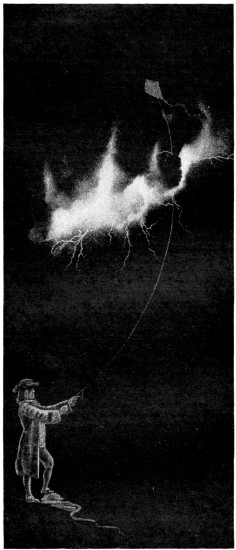
FRANKLIN AND HIS KITE
What other form does lightning occasionally assume?
Sometimes the flash is globular, which is the most dangerous form of lightning.
Does a discharge produce a flash when it passes through good conductors?
It does not, but passes quietly and invisibly.
What is heat lightning?
Sometimes it is the reflection in the atmosphere of the lightnings of storms very remote, the storms themselves being so far distant that their thunders cannot be heard. This phenomenon is also occasioned by the play of silent flashes of electricity between the earth and the clouds, the amount of electricity developed not being sufficient to produce any other effects than the mere flash of light.
Why is lightning more common in summer and in autumn than in spring and winter?
Because the heat of summer and autumn produces great evaporation, and the conversion of water into vapor always develops electricity.
How long is the duration of a flash of lightning?
Arago has demonstrated that it does not exceed the millionth part of a second.
With what velocity is lightning, or the electric fluid which gives rise to its appearance, supposed to move?
Not less than two hundred and fifty thousand miles per second.
By whom was the identity of lightning and electricity first established?
By Dr. Franklin, at Philadelphia, in 1752.
The manner in which this fact was demonstrated, was as follows:
Having made a kite of a large silk handkerchief stretched upon a frame, and placed upon it a pointed iron wire connected with the string, he raised it upon the approach of a thunder storm. A key was attached to the lower end of the hempen string holding the kite, and to this one end of a silk ribbon was tied, the other end being fastened to a post. The kite was now insulated, and the experimenter for a considerable time awaited the result with great solicitude. Finally, indications of electricity began to appear on the string; and on Franklin presenting his knuckles to the key, he raised an electric spark. The rain beginning to descend, wet the string, increased its conducting power, and vivid sparks in great abundance flashed from the key.
Why was the kite insulated when Franklin fastened the key to the post with a silk ribbon?
Because the silk was a non-conductor, and would not allow the electricity received upon the kite to pass off by means of the string to the ground.
Was this experiment one of great danger and risk?
It was; because the whole amount of electricity contained in the thunder cloud was liable to pass from it, by means of the string, to the earth, notwithstanding the use of the silk insulator.
Have we any proof of the utility of lightning rods?
The experience of a hundred years has shown that when all the necessary rules have been observed, the protection is perfect, as far as human effort can avail.
Is a building more or less liable to be struck when furnished with a good lightning conductor?
Lightning conductors do not, as many suppose, attract the lightning toward the building on which they are situated; they simply direct its course, and facilitate the passage of the fluid in the most direct way to the earth, only when a discharge must inevitably occur. There is no attraction, but the lightning takes the road which offers the least resistance.
What is thunder?
It is a certain noise proceeding apparently from the clouds, which usually follows, after a greater or less interval, the appearance of a flash of lightning.
How is it supposed to be occasioned?
The usual explanation offered is a sudden displacement of the air produced by the electrical discharges in which the lightning is evolved.
Others have supposed that the passage of the electric current creates a vacuum, and that the air rushing in to fill it produces the sound. Any explanation that has yet been offered is not altogether satisfactory.
What occasions the rolling of the thunder?
It has been ascribed to the effect of echo; but the true cause probably is, that the sound is developed by the lightning in passing through the air, and consequently separate sounds are produced at every point through which the lightning passes.
Why is thunder sometimes one vast crash?
Because the lightning cloud is near the earth; and as all the vibrations of the air (on which sound depends) reach the ear at the same moment, they seem like one vast sound.
Why is the thunder generally heard several moments after the flash?
Because it has a long distance to travel. Lightning travels nearly a million times faster than thunder; if, therefore, the thunder has a great distance to come, it will not reach the earth till a considerable time after the flash.
Can we not tell the distance of a thunder cloud by observing the interval which elapses between the flash and the peal?
Yes; the flash is instantaneous, but the thunder will take a whole second of time to travel three hundred and eighty yards; hence, if the flash be five seconds before thunder, the cloud is nineteen hundred yards off.
i.e. 380 × 5 = 1900 yards.
What is the aurora borealis or northern lights?
Luminous appearances seen in the sky at night-time. Sometimes streaks of blue, purple, green, red, etc., and sometimes flashes of light, are seen.
What is the cause of the aurora borealis or northern lights?
Electricity in the higher regions of the atmosphere is undoubtedly an active agent in producing this phenomenon.
Is the aurora ever seen in other parts of the heavens than towards the north?
In the northern hemisphere it always appears in the north, but in the southern hemisphere it appears in the south: it seems to originate at or near the poles of the earth, and is consequently seen in its greatest perfection within the arctic and antarctic circles.
What is known concerning the extent of the aurora?
It is not local, but it is seen simultaneously at places widely remote from each other, as in Europe and America.
What calculations have been made respecting the height of the aurora?
The height of the appearances varies from one to two hundred miles; they sometimes appear within the region of the clouds, and very near to the earth.
Do the auroras appear at any particular seasons and times?
They appear more frequently in the winter than in the summer, and are only seen at night.
Do they also occur in the day-time?
The aurora is known to affect the magnetic needle and the telegraph; and as the effects upon these instruments are noticed by day as well as by night, there can be no doubt of the occurrence of the aurora at all hours. The intense light of the sun renders the auroral light invisible during the day.
Of what utility are the auroral appearances in the polar regions?
During the long polar night, when the sun is absent, the aurora appears with a magnificence unknown in other regions, and affords light sufficient for many of the ordinary outdoor employments.
Magnetism
Is there any connection between magnetism and electricity?
There is every reason to believe that magnetism and electricity are but modifications of one force.
What is a loadstone or a natural magnet?
It is an ore of iron, known as the “protoxide of iron,” or “magnetic oxide of iron,” which is capable of attracting other pieces of iron to itself; and if suspended freely by a thread, and left to take its own position, it will arrange itself so that its extremities will point towards the north and south poles of the earth.
Are natural magnets rare?
They are not; they are found in many places in the United States. In Arkansas, especially, an ore of iron possessing remarkably strong attractive powers is very abundant.
The magnetic ore is usually of a dark gray hue, and possesses but little metallic luster. If a piece of this ore be dipped in iron filings, or a number of small needles, they will generally be found collected and clinging together in great quantities at two opposite extremities, whilst the middle portion is nearly destitute. The magnetic property, whatever it may be, seems therefore to be collected and act with the greatest energy at two opposite extremes; these have been termed poles.
What is the origin of the terms “magnet” and “magnetism”?
The loadstone or natural magnet was first found at Magnesia, in Lydia, Asia, whence were derived the names.
Can a natural magnet communicate its attractive properties to other bodies by contact?
It can, and that too without any apparent loss of attractive strength.
What bodies are capable of being magnetized by contact with natural magnets?
Iron and steel are the substances most susceptible of this influence, but brass, nickel, and cobalt can also become magnets.
Does the magnetism imparted to a piece of soft iron, or steel, by contact with a natural magnet, remain permanent in their substances?
In the steel it does, but the soft iron loses its power as soon as it is removed from the magnet.
Is it necessary that absolute contact should take place between a magnet and a piece of soft iron to render the latter a magnet?
No, every piece of soft iron brought near a magnet becomes by induction itself a magnet.
What do you mean by induction?
It is the production of like effects in contiguous bodies. In electricity or magnetism, it is the influence exerted by an electrified or magnetized body through a non-conducting medium without any apparent communication of a current.
What is meant by the directive power of the magnet?
It is that power which will cause a magnet, when suspended freely, to constantly turn the same part towards the north pole and the opposite part towards the south pole of the earth.
What are the poles of a magnet?
They are the ends of the magnet, and are denominated north and south, according as they point to the north or south poles of the earth.
What are the poles of the earth?
The extremities of the earth’s axis, or the points on the surface of the globe through which the axis passes.
What is a magnetic needle?
Simply a bar of steel which is a magnet, suspended in such a way that it can freely turn to the north or south.
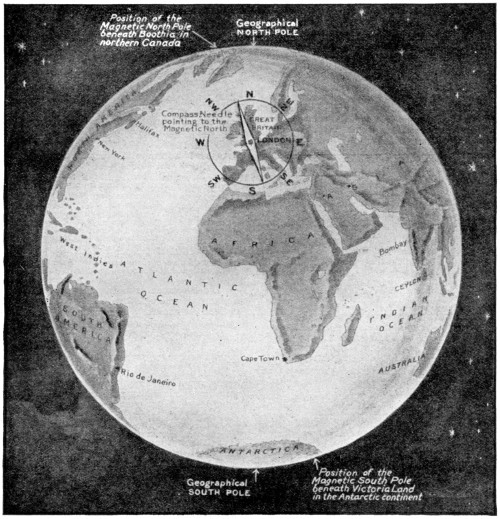
DIAGRAM SHOWING THE VARIATION OF THE MAGNETIC AND GEOGRAPHICAL POLES
What is a mariner’s compass?
It is a delicate steel bar or needle balanced upon a pivot placed beneath its center of gravity in such a way that it can turn horizontally without obstruction. This needle is usually inclosed in a box, upon the bottom of which is a card, with the various points—north, south, east, west, etc., etc., marked upon it.
Such a needle, if the box containing it be placed on a level surface, will generally be observed to vibrate more or less, till it settles in such a direction that one of its extremities or poles will point towards the north, and the other consequently towards the south. If the position of the box be altered or reversed, the needle will always turn and vibrate again, till its poles have attained the same direction as before.
Does the compass needle always point exactly north and south?
It does not; its natural direction is towards the north and south poles, but it seldom points due north or south.
Who first discovered the fact that a magnet would invariably point to the north and the south, and made use of this knowledge in constructing a compass?
It is claimed to have been discovered by the Chinese: it was known in Europe, and used in the Mediterranean, in the thirteenth century.
How were the compasses of that time constructed?
They were merely pieces of loadstone fixed to a cork, which floated on the surface of water.
Is the earth itself supposed to be a magnet?
It is undoubtedly a great magnet.
Is iron under certain circumstances rendered magnetic by the inductive action of the earth’s magnetism?
Most iron bars and rails, as the vertical bars of windows, that have stood for a considerable time in a perpendicular position, will be found to be magnetic.
If we suspend a bar of soft iron sufficiently long in the air, will it assume magnetic properties?
It will gradually become magnetic; and although when it is first suspended it points indifferently in any direction, it will at last point north and south.
How may a bar of iron, such as a kitchen poker, be made immediately magnetic, without resorting to the use of other magnets?
If the bar devoid of magnetism is placed with one end on the ground, slightly inclined towards the north, and then struck one smart blow with a hammer upon the upper end, it will immediately acquire polarity, and exhibit the attractive and repellant properties of a magnet.
What is a horseshoe magnet?
It is a magnetic bar bent into the form of a horseshoe.
When a piece of iron not magnetic is brought in contact with a common magnet, it will be attracted by either pole; but the most powerful attraction takes place when both poles can be applied to the surface of the piece of iron at once. The magnetic bars are for this purpose bent into the shape of the letter U, and are termed horseshoe magnets. Several of these are frequently joined together with their similar poles in contact; they then constitute a magnetic battery, and are very powerful, either for lifting weights, or charging other magnets.
If we break a magnet across the middle, what happens?
Each fragment becomes converted into a perfect magnet; the part which originally had a north pole acquires a south pole at the fractured end, and the part which originally had a south pole, gets a north pole.
If we divide a magnet to the extreme degree of mechanical fineness possible, will the pieces possess magnetic powers?
Each fragment, however small, will be a perfect magnet.
Galvanism
What is galvanism?
It is the production of electrical disturbance by chemical action.
What is the most simple manner of illustrating the production of this electricity?
If we place a piece of silver on the tongue, and a piece of zinc underneath it, no effect will be produced as long as the two metals are kept asunder; but when their ends are brought together, a distinct thrill will pass through the tongue, a metallic taste will diffuse itself, and, if the eyes are closed, a sensation of light will be evident at the same moment.
To what is this result owing?
To a chemical action developed the moment the two metals touched each other.
The saliva of the tongue oxidizes a portion of the zinc, which excites electricity, for no chemical action ever takes place without producing electricity. Upon bringing the ends of the two metals together, a slight current passes from one to the other.
By whom was the production of galvanic electricity first noticed?
By Galvani, professor of anatomy at Bologna, Italy, in 1790.
Having occasion to dissect several frogs, he hung up their hind legs on some copper hooks, until he might find it necessary to use them for illustration. In this manner he happened to suspend a number of the copper hooks on an iron balcony, when, to his great astonishment, the limbs were thrown into violent convulsions.
On investigating the phenomena what did Galvani discover?
He found that whenever the nerves of a frog’s leg were touched by one metal and the muscles by another, convulsions took place on bringing the two different metals in contact.
What is the simplest way of exciting a current of galvanic electricity?
By arranging a series of metal plates in a pile, placing them in pairs, with a wet cloth between them, it being necessary that one of each pair should be more easily oxidized than the other. The simple contact of these plates will produce a feeble and continued galvanic current.
What is such an arrangement of plates for producing electrical currents called?
A galvanic or voltaic battery.
Why are the terms “galvanic” and “voltaic” applied?
They originated in honor of Galvani and Volta, the Italian philosophers who first developed these phenomena of chemical electricity, and the means of producing them.
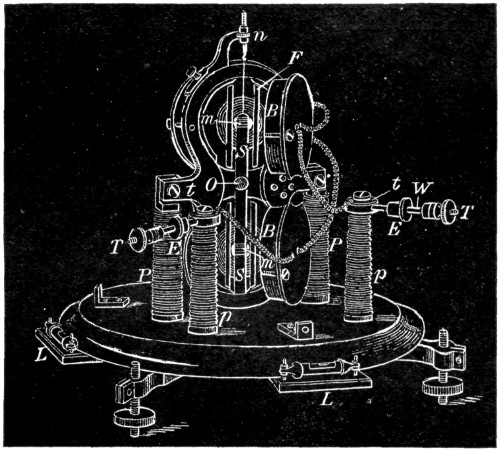
HIGH-RESISTANCE GALVANOMETER FOR VERY SMALL CURRENTS
Are there many metals or other substances which, when brought together, are capable of producing galvanic action?
The number is quite large; among them we may enumerate the following: zinc, lead, tin, antimony, iron, brass, copper, silver, gold, platinum, black lead or graphite, and charcoal.
Will any two of these brought together produce a galvanic current?
They will; but they possess the power in different degrees; and the more remote they stand from each other in the order above given, the more decidedly will the chemical electricity be developed.
Thus zinc and lead will produce a voltaic battery, but it will be much less active than zinc and iron, or the same metal and copper, and this last less active than zinc and platinum, or zinc and charcoal.
Does galvanic or voltaic electricity appear to consist of two kinds, positive and negative, as in ordinary electricity?
It does; positive electricity always flows from the metal which is acted upon most powerfully, and negative electricity from the other.
What do we mean when we speak of a galvanic circuit?
The connection of the two metals in the battery, so that the positive and negative electricities can meet, and flow in opposite directions.
At what point in the circuit will the manifestations of electricity be most apparent?
At the point where the two currents meet.
What is meant by the poles of the battery?
The two metals forming the elements of the battery are generally connected by copper wires; the ends of these wires, or the terminal points of any other connecting medium used, are called the poles of the battery.
Thus, when zinc and copper poles are used, the end of the wire conveying positive electricity from the zinc would be the positive pole, and the end of the wire conveying negative electricity from the copper plate would be the negative pole. Faraday describes the poles of the battery as the doors by which electricity enters into or passes out of the substance suffering decomposition.
A very simple, and at the same time an active, galvanic circuit may be formed by an arrangement as represented in the accompanying illustration. The current of positive electricity, when the circuit is closed, passes from the zinc, through the liquid, to the copper, and from the copper, along the conductors to the zinc. A current of negative electricity traverses the circuit also, from the copper to the zinc, in a direction precisely reversed.
By what chemical action can the greatest abundance of galvanic electricity be developed?
By the oxidation of metallic zinc by weak sulphuric acid.
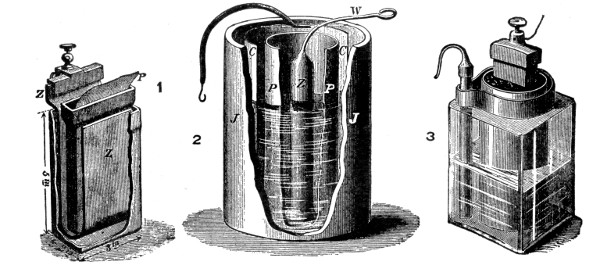
TYPES OF ELECTRIC CELLS OR “BATTERIES”
(1) Grove’s Cell.—Z. Zinc plate in dilute sulphuric acid; P. platinum plate in strong nitric acid. (2) Daniell’s Cell.—Z. Zinc rod in porous pot P containing dilute sulphuric acid; C. copper plate in outer vessel containing copper sulphate solution. (3) Leclanche Cell.—Zinc in sal-ammoniac solution; carbon slab in charcoal and manganese dioxide.
The electricity developed by the action of a single pair of plates immersed in acid water is very feeble: how can it be increased?
By increasing the number of the plates and the quantity of the liquid, we increase the intensity of the electricity developed.
Action Within a Voltaic Cell.—Let us try to see now how an electric current is set up in a simple voltaic cell, consisting of a zinc plate and a copper plate immersed in dilute acid. First we must understand the meaning of the word ion.
If we place a small quantity of salt in a vessel containing water, the salt dissolves, and the water becomes salt, not only at the bottom where the salt was placed, but throughout the whole vessel. This means that the particles of salt must be able to move through the water. Salt is a chemical compound of sodium and chlorine, and its molecules consist of atoms of both these substances. It is supposed that each salt molecule breaks up into two parts, one part being a sodium atom, and the other a chlorine atom, and further, that the sodium atom loses an electron, while the chlorine atom gains one. These atoms have the power of traveling about through the solution, and they are called ions, which means “wanderers.”
An ordinary atom is unable to wander about in this way, but it gains traveling power as soon as it is converted into an ion, by losing electrons if it be an atom of a metal, and by gaining electrons if it be an atom of a non-metal.
Returning to the voltaic cell, we may imagine that the atoms of the zinc which are immersed in the acid are trying to turn themselves into ions, so that they can travel through the solution. In order to do this each atom parts with two electrons, and these electrons try to attach themselves to the next atom. This atom, however, already has two electrons, and so in order to accept the newcomers it must pass on its own two. In this way electrons are passed on from atom to atom of the zinc, then along the connecting wire, and so to the copper plate. The atoms of zinc which have lost their electrons thus become ions, with power of movement. They leave the zinc plate immediately, and so the plate wastes away or dissolves. So we get a constant stream of electrons traveling along the wire connecting the two plates, and this constitutes an electric current.
What are the most ordinary effects produced by the developed electricity of a large galvanic battery?
The production of sparks and brilliant flashes of light, the heating and fusing of metals, the deflagration of gunpowder and other inflammable substances, and the decomposition of water, saline compounds, and metallic oxides.
How may the most splendid artificial light known be produced?
By fixing pieces of pointed charcoal or carbon to the wires connected with opposite poles of a powerful galvanic battery, and bringing them into contact.
What does this produce?
Electric light.
Can intense heat be developed by the action of the galvanic battery as well as intense light?
The greatest artificial heat man has yet succeeded in producing has been through the agency of the galvanic battery.
What refractory substances can be fused by the aid of the galvanic battery?
All the metals, including platinum, can be readily melted; quartz, sulphur, magnesia, slate and lime are liquefied; and the diamond fuses, boils, and becomes converted into coal.
HOW AN ELECTRIC BATTERY GENERATES ELECTRICITY
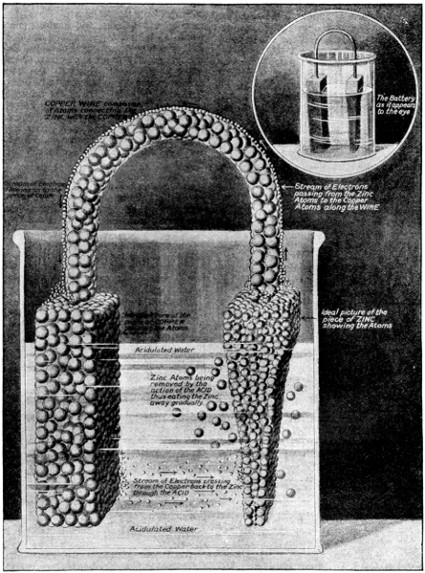
The above simple voltaic battery, or cell, consists of a plate of copper and one of zinc dipping into a vessel containing dilute sulphuric acid to twenty of water by volume. When these plates are joined externally by a wire or other conductor a current flows from the copper plates, called the positive pole of the battery, to the zinc plate, called the negative pole of the battery. This is due to the fact that a difference of potential is set up between the plates on immersion in the acid, in consequence of which an electro-motive force is generated that drives the current round the circuit. The potential between the plates is maintained by the chemical action now going on in the cell. This action results in the gradual consumption of the zinc plate with formation of zinc sulphate and evolution of hydrogen at the copper plate. In a short time the current in the circuit falls off in consequence of local action and polarization.
Large illustration (433 kB)
What is electrotyping, or electro-metallurgy?
It is the art or process of depositing, from a metallic solution, through the agency of galvanic electricity, a coating or film of metal upon some other substance.
Upon what principles is it accomplished?
The process is based on the fact, that when a galvanic current is passed through a solution of some metal, as a solution of sulphate of copper (sulphuric acid and copper), decomposition takes place; the metal is separated in a metallic state, and attaches itself to the negative pole, or to any substance that may be attached to the negative pole; while the acid or other substance before in combination with the metal, goes to, and is deposited on the positive pole.
In this way a medal, a wood-engraving, or a plaster cast, if attached to the negative pole, may be covered with a coating of copper; if the solution had been one containing silver or gold, the substance would have been covered with a coating of silver or gold instead of copper.
How can the thickness of the deposits be regulated?
The thickness of the deposit, providing the supply of the metallic solution be kept constant, will depend on the length of time the object is exposed to the influence of the battery.
Electro-Magnetism
What is electro-magnetism?
It is the magnetism developed through the agency of electrical or galvanic action.
What were the earliest phenomena observed which indicated a relation between magnetism and electricity?
It was noticed that ships’ compasses have their directive power impaired by lightning, and that sewing needles could be rendered magnetic by electric discharges passed through them.
What discovery, made by Prof. Oersted of Copenhagen, established beyond a doubt the connection of electricity and magnetism?
He ascertained that a magnetic needle placed near a metallic wire connecting the poles of a galvanic battery was compelled to change its direction, and that the new direction it assumed was determined by its position in relation to the wire and to the direction of the current transmitted along the wire.
Thus, if a needle be inclosed in a wire not touching it at any point, and a current of electricity pass through the wire, the needle will be made to move in accordance with the direction of the current.
What other important discovery was made about the same time?
It was found that if a piece of soft iron, not possessing magnetic power sufficient to elevate a grain weight, be placed within a coil of copper wire through which a galvanic current is passing, it will become, through the influence of the current, a powerful magnet; and will, so long as the current flows, sustain weights amounting to many hundreds of pounds.
Is the magnetic power of the bar found to be wholly dependent on the existence of the current?
It is; the moment the current stops, the weights fall away from the bar in obedience to the law of gravity.
How great weights have been lifted by magnets formed in this manner?
An electro-magnet constructed by Prof. Henry was capable of elevating and sustaining about a ton weight.
Upon what principle does the construction of the Morse magnetic telegraph depend?
Upon the principle that a current of electricity circulating about a bar of soft iron is capable of rendering it a magnet.
Why is it necessary, in conveying the telegraph wires, to support them upon glass or earthen cylinders?
These are used for the purpose of insuring the perfect insulation of the wires, since but for this the electricity would pass down a damp pole to the earth, and be lost.
Is there any truth in the idea that many persons have, that some principle passes along the telegraphic wires when intelligence is transmitted?
This supposition is wholly erroneous; the word current, as something flowing, conveys a false idea, but we have no other term to express electrical progression.
How can we gain an idea of what really takes place, and of the nature of the influence transmitted?
The earth and all matter are reservoirs of electricity; if we disturb this electricity at Boston by voltaic influence, its pulsations may be felt in Chicago. Suppose the telegraphic wire were a tube, extending from Boston to Chicago, filled with water. Now, if one drop more is forced into it at Boston, a drop must fall out at Chicago, but no drop was caused to pass from Boston to Chicago. Something similar to this occurs in the transmission of electricity.
What was the earliest important industrial application of electricity?
One of the earliest industrial applications of electricity was to the driving of street cars. The first electric railway was installed by Siemens, of Berlin, in 1882; and the system was quickly taken up and brought to a high state of development by American engineers. It is remarkable that the system of traction early adopted is the one generally used in America and Europe until the present date. It consists essentially of (a) a supply of continuous current at five hundred to five hundred and fifty volts, generated in (b) a central powerhouse, and transmitted to the car by means (c) of overhead conductors, whence by contact with a trolley wheel on a pole on the car it is led down to (d) two series-excited motors, which are placed electrically first in series with one another at starting, and then in parallel with one another when a sufficient speed has been attained.
To what well-known electrical machines did this give impetus?
Electric dynamos and motors. All such machines will convert the energy of mechanical motion into that of electricity in motion, or the reverse. The former conversion is done by dynamos, to which power is given by steam-engines or other such prime-movers, and made to generate in conducting circuits alternate or direct currents of electricity. Motors, on the other hand, receive the energy of electrical currents, either alternate or direct, and this produces motion of certain parts of the structure.
The theory of the action of a dynamo was first discovered by Faraday in 1831; it is intimately associated with that of a motor, for the principle of conservation of energy points out that either machine is reversible—that is to say, a dynamo may be used as a motor or a motor as a dynamo, though perhaps not so efficiently as when each fulfills the special function for which it was designed.
The Current in a Dynamo or Motor.—This brings us to the production of an electric current by the dynamo. In the dynamo we have a coil of wire moving across a magnetic field, alternately passing into this field and out of it. A magnetic field is produced, as we have just seen, by the steady movement of electrons, and we may picture it as being a region of the ether disturbed or strained by the effect of the moving electrons. When the coil of wire passes into the magnetic field, the electrons of its atoms are influenced powerfully and set in motion in one direction, so producing a current in the coil. As the coil passes away from the field, its electrons receive a second impetus, which checks their movement and starts them traveling in the opposite direction, and another current is produced. The coil moves continuously and regularly, passing into and out of the magnetic field without interruption; and so we get a current which reverses its direction at regular intervals, that is, an alternating current.
THE TELEGRAPH AND ITS WONDERFUL INSTRUMENTS
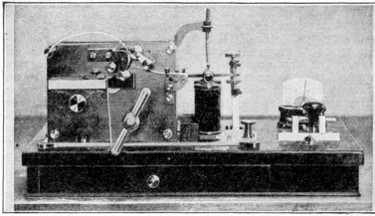
THE MORSE DIRECT INKING PRINTER
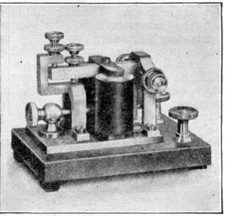
THE MORSE SOUNDER
A . _ J . _ _ _ S . . . 2 . . _ _ _
B _ . . . K _ . _ T _ 3 . . . _ _
C _ . _ . L . _ . . U . . _ 4 . . . . _
D _ . . M _ _ V . . . _ 5 . . . . .
E . N _ . W . _ _ 6 _ . . . .
F . . _ . O _ _ _ X _ . . _ 7 _ _ . . .
G _ _ . P . _ _ . Y _ . _ _ 8 _ _ _ . .
H . . . . Q _ _ . _ Z _ _ . . 9 _ _ _ _ .
I . . R . _ . 1 . _ _ _ _ 0 _ _ _ _ _
THE MORSE TELEGRAPH CODE FOR LETTERS AND FIGURES
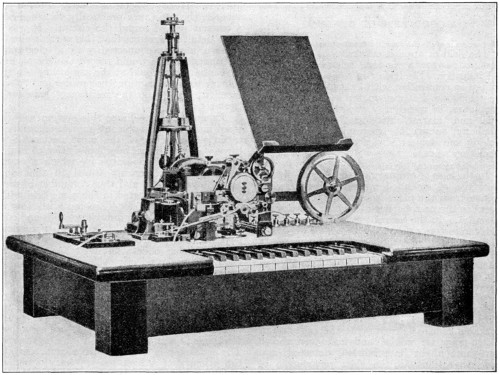
MODERN TELEGRAPHIC TYPEWRITING ATTACHMENT
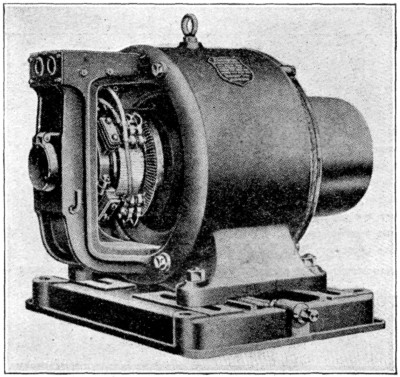
A GOOD TYPE OF DYNAMO
What are some of the chief modern applications of electricity?
The field of applied electricity is one of the most extensive in modern science, invention and industry. Electricity in some form is now utilized in connection with lighting, telegraphy, the telephone, heating, motor boats, railways, aëroplanes, in metallurgy and the arts, clocks, bells and alarms, wireless telegraphy and telephony, submarine telegraphy, automobiles, cooking and domestic science, in medicine and in military science.
Give a brief account of wireless telegraphy.
In the case of ordinary telegraphy we always make use of extended metallic wires or conductors from the place from which the message is sent to the neighborhood to which it is desired to send it. In the case of wireless telegraphy no such conductors exist.
Among the most interesting of the many systems of wireless telegraphy now in vogue the modern Marconi, the De Forrest, the Fessenden, and the Poulsen are noteworthy. It is, however, with the name of Marconi that the introduction of wireless telegraphy will always be directly associated.
In 1888 Hertz had demonstrated in a remarkable series of experiments the existence of electro-magnetic waves, and had even shown how these might be produced, detected, and made to exhibit all the chief phenomena of wave-motion. Marconi’s great achievement lay in so controlling and regulating the dispatch and receipt of such waves as to make them record signals on a specially designed apparatus in accordance with the well-known Morse telegraphic system. His method, as first patented in 1896, was briefly as follows:
The Transmitter, by which the electromagnetic waves were generated and sent off into space in all directions, consisted of a battery connected through a key to the primary of an induction coil whose secondary terminals were joined to two brass balls between which there was a short air-gap. From one of these balls a wire was taken to earth, and from the other an aërial wire was led some distance up in the air. The closing of the primary circuit led to sparks passing across the air-gap, which produced electro-magnetic waves in the ether in exactly the same way as the dropping of a stone into a pool produces a series of concentric ripples.
The Coherer.—To receive and interpret these waves Marconi employed a “coherer” in circuit with a battery and having connection with an aërial wire on the one side and an earth wire on the other. The coherer consisted of a small glass tube not more than, say, two inches long by one-quarter inch in diameter, into the ends of which were fused two platinum wires leading to small metallic electrodes. These electrodes were brought quite near each other, and in the narrow gap between them was placed powdered metallic silver, antimony, etc. The resistance offered by this powder was so high, on account of small air-gaps between the particles, that no current could pass through.
Electro-magnetic waves, however, possess the peculiar property of breaking down the resistance of this powder whenever they impinge upon it. Hence as soon as a wave reached the coherer, the resistance practically vanished and a current passed round the circuit. It was a mere detail to arrange that this current should actuate a relay connected with a telegraphic instrument which would record the signal, and that a hammer would at the same time tap the coherer so as to agitate the powder and “decohere” it, setting up the resistance again for a fresh signal.
Improvements.—Since this system was devised many most important improvements have taken place. One of the most noticeable of these was Sir Oliver Lodge’s invention of tuning and syntonizing apparatus by which a transmitter and receiver are tuned to the same periodic oscillation, and thus a number of messages might be operated in the same field without interference. Lodge accomplished this to some extent by adding inductance coils and condensers to the circuits. Various other methods have been adopted to secure syntonization; but the resonance effects obtained are not great enough to make selective signaling certain.
The Generator.—In the modern Marconi system the energy for the transmitter is obtained from a generator working at one hundred and ten volts. The current is led through a key and an improved form of interruptor to the primary of the induction coil, whose secondary terminals communicate with the spark-gap. The spark-gap is in series with a condenser and the primary of a high tension transformer, of which latter one secondary terminal leads to the aërial and the other to the earth wire.
THE WIRELESS MESSAGE OVER LAND AND SEA
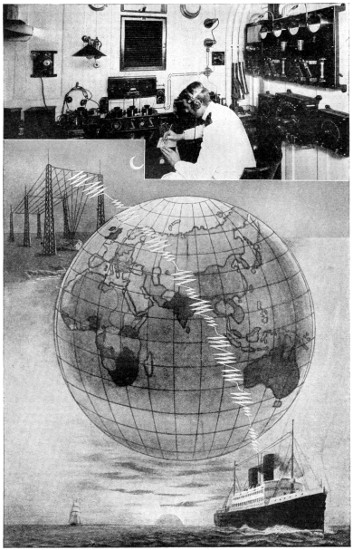
The Detector.—In the receptor the metallic coherer has been discarded for a magnetic detector. This instrument consists of a small glass tube through which travels an endless band of iron wires, moving round two grooved pulleys. Close to the tube are two permanent magnets, and round it is wound a primary coil consisting of one layer of wire. One end of this coil is led straight to earth; the other passes through a condenser to a tuning inductance coil leading in one direction to earth and in the other to the aërial. Above the primary coil on the glass tube a secondary coil is wound and connects with a telephone receiver. The action is simple. The electro-magnetic waves, reaching the aërial, set up oscillatory currents in the primary which act upon the magnetic field. Currents are thus generated in the secondary, which record the message in the telephone receiver by a series of taps corresponding to the Morse dashes and dots.
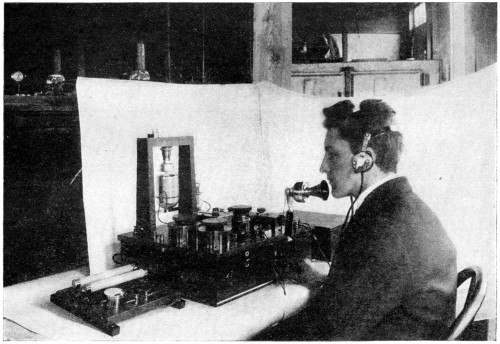
Courtesy of Marconi Wireless Co.
TELEPHONING FROM NEW YORK TO SAN FRANCISCO BY WIRELESS
The De Forrest system is very largely used in the United States, Japan, and elsewhere, and in its more recent modifications secures a high efficiency by means of a number of ingenious improvements.
Describe the wireless telephone.
As in wireless telegraphy, all modern systems of wireless telephony are based upon the action of electro-magnetic waves. It is impossible here to discuss all the various methods that have been devised, but the leading principles employed may be indicated, with special reference to some of the best-known systems. They may be classified according to the methods in which the waves are produced.
Spark Discharge Systems.—These rely for the generation of the Hertzian waves upon a spark discharge across an air-gap. The De Forrest system is perhaps the most popular of this type. In this system the spark discharge is utilized to produce waves of a frequency not less than one hundred thousand per second, the resulting sound being inaudible at the receiving station.
A microphone transmitter is employed with this apparatus. When the operator speaks into the transmitter, the variations of resistance act upon the waves in such a way as to produce a new series of waves of such frequency as to be audible at the receiver.
The receiving apparatus includes the usual antenna, and closed secondary circuit, comprising an inductance and a variable capacity, across the terminals of which an Audion delicate detector is introduced. This instrument depends upon the motions of the ions in a rarefied gas. It is one of the most sensitive detectors yet invented, and offers the great advantage of a practically total absence of time lag in recovery.
Singing-Arc Systems.—Duddell’s discovery of the singing arc in 1909 has been quickly followed by its application to radio-telephony and radio-telegraphy, first by Poulsen and subsequently by Fessenden, Stone, De Forrest, and others. Under certain conditions the electric arc can be made to emit a musical note, while at the same time it transforms a portion of the energy of its own direct current into oscillations. These are led into an oscillation circuit containing a condenser and inductance, and associated with an antenna and earth line. The microphone transmitter may be included in a circuit associated with the inductance, in which case the voice acting on the resistance of the transmitter causes variations in the oscillating currents; or it may be associated with some part of the direct-current circuit, in which case it acts by affecting the current passing across the arc.
Any form of receiver may be used with this arc apparatus. The great advantage of this method is that the arc produces continuous oscillations of constant amplitude, and that the wave-length and frequency of the oscillations are subject to better regulation and control.
Advantages.—The advantages of wireless telephony over wireless telegraphy are many. One is that no skilled operator is required to translate the dot-and-dash signals; for in the latter one hears only long and short buzzes, whereas in the former one hears the actual spoken words. By means of wireless telephony the transmission of intelligence is far more direct and expeditious, and in times of emergency this not unfrequently becomes a very vital question indeed. An important characteristic of wireless telephonic communication is the exceptional clearness of the articulation, owing to the absence of the electrostatic capacity of metallic lines and cables which is always present in wire telephony.
Stronger currents, improved sending and receiving apparatus, and the application of new principles have now greatly extended the speaking range; and only recently distinct communication has been established by wireless telephony between New York and San Francisco. The use of the wireless telephone will be greatly extended, especially in naval, military, and shipping communication.
THE MARVEL OF X-RAYS
Röntgen or X-Rays, the most famous, and up to now by far the most useful, kind of rays associated with high vacuum tubes, were discovered by Professor W. K. Röntgen in 1895. His first observation was that a photographic plate, which was enclosed in an opaque material and which was lying by chance near the apparatus, was affected just as if it had been exposed to ordinary light. This caused him to conclude that the effect must be due to some unknown kind of rays, and the uncertainty as to their character led him to provisionally apply to them the name of X-rays, for x in algebra generally denotes the unknown quantity.
The later sensational part of his discovery was that the property possessed by a highly exhausted bulb of glass, fitted with suitable electrodes, sends out rays or electric discharges capable of passing through many bodies which are quite opaque to ordinary light, and of either affecting a photographic plate or causing a screen coated with certain chemicals to fluoresce or light up under their influence.
How are X-rays produced?
X-rays are thus produced by the discharge of a high-potential current through a special form of vacuum tube, known as a Crookes’ tube. The positive terminal of an induction coil or Wimshurst machine is connected to the anode and the negative to the cathode of the tube. The anticathode is connected to the anode and is also positive. The vacuum of a tube is not perfect, and the current is conveyed through the tube by the infinitesimal quantity of air contained therein.
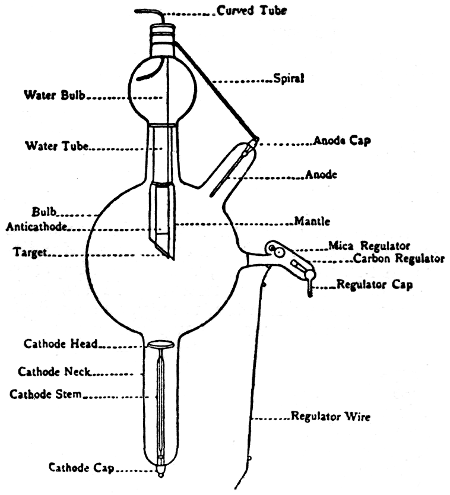
DIAGRAM SHOWING PARTS OF X-RAY TUBE
The “cathodal rays” which pass from the cathode to the anticathode consist of infinitesimal particles traveling at a high rate of speed; when the progress of these minute bodies is arrested, X-rays are produced. The green fluorescence on the sides of the tube opposite the anticathode, though not caused by the X-rays, demonstrate their presence.
What the X-rays Are.—The X-rays are ethereal vibrations traveling with much the same velocity as light. They travel in a straight line in all directions from the point of origin, and are almost incapable of reflection or refraction.
X-rays are invisible to the eye, but have the property of rendering fluorescent certain substances—for example, calcium tungstate and barium platino-cyanide. When a screen coated with these substances is placed near the X-ray tube in a darkened room, the tungstate or barium surface emits a fairly bright fluorescence. If an object such as the hand or a lead pencil is placed between the screen and the tube, the denser parts (the bones or the graphite) appear as black shadows in a gray background.
X-rays penetrate all substances to a greater or less degree, although heavy metals, such as lead and mercury, are, for photographic or visual purposes, practically opaque to the rays.
The greater part of X-ray examination is conducted by photographic methods, as the image given by the rays on a dry plate or film show far more detail than can be seen by visual examination with the fluorescent screen.
Apparatus.—The apparatus required consists of a suitable source of electrical energy, such as a battery or dynamo, etc., and a powerful induction or a large electrostatic influence machine, combined of course in either case with an X-ray tube and special X-ray photographic plates. Ordinary photographic plates can be used, but do not give such brilliant results. If we wish to take a radiograph of the hand, we must first of all use a plate slightly larger than the hand, and enclose it in an opaque envelope. Two such are usually employed, one red and the other black. This is placed on the table or stand, film side uppermost, and the hand is placed upon it, and a short distance above the hand is located the X-ray tube. Since what we really take is a shadowgraph picture, to give a good sharp outline, the hand should be placed as flat as possible on the plate, and the tube some six to eight inches from it.
With some of the most powerful apparatus now in use, even the human trunk can be radiographed in a single flash, which is an improvement on the exposure necessary in the early days of its use, when ten, twenty, or even forty minutes’ exposure was no uncommon practice.
The Fluorescent Screen.—When the X-rays impinge on certain substances they cause them to light up or “fluoresce” under their action. The number of bodies or chemicals which do so is very large, but for practical purposes only one or two are of any use. The best, and the one always employed, is a chemical known as barium platino-cyanide. The screen-holder consists of a box, preferably of pyramidal form, with a flattened apex or top. Inserted in this apex are two tubes, like opera-glass tubes but without lenses; through these we can look into the box in such a manner as to prevent any outside light from entering. The bottom of the box consists of the screen proper, a piece of cardboard or other suitable substance, one side (the inner) of which is coated with the substance mentioned above, because the light rays given off by the barium platino-cyanide under the action of the X-rays cannot of course penetrate an object opaque to light. The box should be absolutely light-tight except for the eye-tubes.
If such a screen be held in the neighborhood of an X-ray tube, opposite the most brilliantly phosphorescing half of the tube, it will be found to be lighted up under the action of the X-rays. If now we place between the tube and the screen an object such as the hand, putting it in as close proximity to the tube as possible, we obtain a shadowgram on the screen, varying in intensity according to the relative transparency of the different parts of the hand to the X-rays. Since the bones are far less transparent than the flesh, they cast a much denser shadow and are very distinct. On such a screen it is possible to see the beats of the heart, the rising and falling of the diaphragm, etc.
X-rays at Work.—In medical X-ray work, the patient is placed upon a couch consisting of a wooden frame covered with canvas. A box containing the tube moves on wheels and rails beneath the couch; it is lined with metal to shield the operator from the X-rays. The time of exposure depends upon the strength of current used, the power of the coil, and the condition of the tube. A “hard” tube—that is, a tube with an extremely high vacuum—requires less exposure than a “soft” or low-vacuum tube.
The condition of the tube is ascertained by finding its “equivalent spark gap.” While the coil and tube are working, the terminal points of the induction coil are slowly brought together. If a spark passes between the points while they are six inches or more apart, the vacuum is too high. If no sparking takes place between the terminals till they are within three inches of each other, the tube is low. A good working spark gap distance is four and one-half inches. A soft, or low-vacuum, tube gives better definition than a hard, or high-vacuum, tube, as the rays pass less easily through dense substances and show greater differentiation of tissue. A very high vacuum tube may show but little difference between the bones and flesh, while a soft tube should give the minute structure of the bones.
Time of Exposure.—With a current of five amperes at one hundred volts passing through the primary winding of a ten-inch coil, the exposure for a hand or foot would be from three to fifteen seconds. The exposure for the thicker portions of the body would be from twenty seconds to two minutes. If an electrolytic break is used, about half the exposure would be required. Dry plates with extra thick sensitive films are specially prepared for radiography, the development and fixation being the same as in ordinary photography. The image is sometimes barely visible on the surface of the plate during development, but when fixed the negative may give good density and definition owing to the penetration into the film of the X-rays.