BOOK OF THE SCIENCES AND INVENTION (continued 3)
Reading edition
Give a clear, succinct outline of the essentials of theoretical chemistry.
The whole matter of molecules and atoms is one of theory. None of our senses can enable us to know directly either molecules or atoms. We can only imagine that they exist, and then give reasons why their existence makes clear to us the action of elements or of compounds one upon the other.
But in a course of descriptive chemistry, a good knowledge of theoretical chemistry is necessary in order to fully understand all that will be taken up.
THEORETICAL CHEMISTRY
(1) Definitions.—An element is a substance that cannot be decomposed.
A compound is a substance that can be decomposed into other different substances; and if the decomposition goes far enough, these substances will be elements.
A mixture is made up of two or more components (elements and compounds or both), physically put together. It differs from a compound whose compounds are chemically united.
(2) Laws.—Law of Definite Proportions: All specimens of a compound contain the same elements in the same proportions.
Law of Multiple Proportions: When two compounds consist of the same elements, the proportion of one is a simple multiple of the proportion of the other.
Law of Combining Proportions: Each element enters into all its compounds by a fixed proportional weight.
The fundamental laws of chemistry are proved by experiment.
(3) The Atomic Theory.—The atomic theory teaches that matter is composed of minute particles which themselves cannot be divided, but which unite to form molecules which can be divided.
A molecule, then, is the smallest amount of a substance that can exist in a free state.
The diameters of molecules have been ascertained by Jeans to be—
Hydrogen 20.3
Nitrogen 29.1
Oxygen 27.3
These figures express number of billionths of a meter.
An atom is an indivisible particle of an element, and goes to make up the molecule.
(4) Chemical Notation.—The symbols used to represent the different elements (e.g. H for hydrogen, O for oxygen, etc.), when used in chemical compounds, refer to the number of atoms which go to make up the molecule of that particular compound. For example, the expression H2SO4 means that in one molecule of that acid there are 2 atoms of hydrogen, 1 of sulphur, and 4 of oxygen.
(5) Molecular Weights.—To determine the molecular weight of a compound it is necessary to know Avogadro’s Law: Equal volumes of all gases under the same conditions contain the same number of molecules; and Molecular Weight = Vapor Density × 2.
(6) Reactions.—A reaction or chemical equation is a method of representing a chemical change.
In chemistry we have three kinds of reactions, namely:
(1) Analytical reaction, which is the breaking up of compound bodies into simple, e.g., H2CO3 can be broken up into its components, H2O and CO2, e.g., H2CO3 = H2O + CO2.
(2) Synthetical reaction is the building up of a compound body by the union of two or more simple bodies, e.g., H2 + O = H2O and H + Cl = HCl.
(3) Metathetical reaction consists in the interchange of two radicals in two substances, e.g.,
2HCl + Zn = ZnCl2 + H2. Here the H of the acid is replaced by the Zn.
KCl + AgNO3 = AgCl + KNO3. Here the Ag and the K change places.
(7) The Chemical Arithmetic by which from the molecular weights of two substances, and the weight of one substance we are enabled to get the weight of the required substance is called Stoichiometry.
Example: Required the amount of zinc necessary to generate 10 grams of hydrogen.
Atomic weights of H, Cl, and Zn are respectively 1, 35.5, and 65.3.
The reaction is as follows:—
Zn + 2HCl = ZnCl2 + H2, and shows that 2 atoms of H are used for every 1 of Zn.
(Mol. Wt. Zn.) (Mol. Wt. H2) (Wt. Zn.) (Wt. H2.)
65.3 : 2 = x : 10
65.3 × 102 = x = 326.5 grams of Zn.
(8) Berthollet’s Law.—Berthollet established the following law, which is of great importance. When two substances can form a substance insoluble or volatile, under the condition of the reaction, that substance will be formed till one of the factors is exhausted.
(9) Radicals.—A radical is an atom or group of atoms which changes places in a reaction. A compound radical is made up of different sorts of radicals, as NH4.
A basic radical is a metal, or a compound radical which behaves like a metal, e.g., Zn and NH4.
(10) Hydrates.—A hydrate is a substance formed from water by replacing half of its hydrogen by a radical, e.g., H2O + 2Na = 2NaOH + H2, where the sodium has taken the place of one atom of hydrogen.
(11) Base.—If a hydrate is formed by a basic radical, the hydrate is called a base, e.g., ZnO2H2.
(12) Alkali.—An alkali is a soluble base, e.g., NaOH, KOH, NH4OH, LiOH.
(13) Acid.—An acid is a substance containing hydrogen which may be replaced by a basic radical, e.g., 2HCl + Zn = ZnCl2 + H2.
(14) Salts.—A salt is a substance formed from an acid replacing its hydrogen by a basic radical, e.g. 2HCl + Zn = ZnCl2 + H2.
An acid salt is a compound derived from an acid which has not all of its hydrogen replaced, e.g., 2NaCl + H2SO4 = NaHSO4 + HCl + NaCl.
(15) Chemical Nomenclature.—Termination “—UM” is now applied to all Metals, though the older-known metals retain the former names, e.g.—Aluminium, Tellurium, etc.
Termination “—IDE” denotes a Binary Compound, that is, a substance composed of only two elements, e.g., Sodium Chloride (NaCl).
Termination “—OUS” is applied to the first of two elements when it exists in a greater proportion than in another combination with the same element, e.g., one atom of phosphorus and three atoms of chlorine form Phosphorous Chloride.
Termination “—IC,” when the first exists in a lesser proportion, e.g., one atom of phosphorus with five atoms of chlorine form Phosphoric Chloride.
Prefixes “MONO—,” “BI—,” “TRI—,” etc., indicate the proportion of the latter of two elements, and are sometimes used instead of the above termination. Thus phosphorous chloride may also be called Phosphorous Tri-Chloride; so one atom of carbon with one atom of oxygen is Carbon Monoxide.
Prefix “HYPO—” (under) and “PER—” (over), specify compounds formed by the same two elements containing less (or more) of an element than is in the usual compound.
Nomenclature of Salts.—From the common acids we get the following salts:—
HCl forms chlorides.
HNO3 forms nitrates.
H2SO4 forms sulphates.
H2S forms sulphides.
H2CO3 forms carbonates.
H2O forms no salts.
H2SiO4 forms silicates.
H3PO4 forms phosphates.
A rough rule for the nomenclature of acids may be made from the above. Acids with the prefix hydro and the suffix ic form salts in ide; with suffix ate, salts in ate; with suffix ous, salts in ite.
(16) Basicity.—The basicity of a substance is measured by the amount of hydrogen which it contains that can be replaced by a basic radical, e.g., H2SO4 is di-basic, i.e., the two atoms of hydrogen can be replaced by a basic radical. H2SO4 + CaCl2 = CaSO4 + 2HCl.
(17) Quantivalence.—The quantivalence of an element is measured by the number of atoms of hydrogen it combines with or replaces. E.g., Na is univalent, for when added to HCl it replaces one atom of hydrogen; Ca is bivalent, for, as seen in the above reaction, it replaces two atoms of hydrogen.
(18) Test for a Chloride.—To test for HCl or any chloride, add to the solution to be tested a little AgNO3, and if a chloride is present, a milky-white precipitate will be formed. The reaction is as follows: HCl + AgNO3 = AgCl (white precipitate) + HNO3. A metal almost invariably changes places with hydrogen.
Caution.—In diluting H2SO4 add the acid to the water; for the evolution of heat from the process will cause the water to boil, and reversing this process will cause the liquid to boil over and possibly result disastrously.
(19) Impurity in H2SO4.—Commercial sulphuric acid contains PbSO4 as an impurity. This gives it the colored appearance, plumbic sulphate being soluble in strong sulphuric acid.
(20) H2S.—Sulphuretted hydrogen is somewhat soluble in water, slightly poisonous, and is a reducing agent.
(21) Carbonic Acid.—H2CO3 does not exist as an acid. We infer its existence from the presence of its salts. Na2CO3 + 2HCl = 2NaCl + H2CO3, but the H2CO3 is so unstable that it breaks up at once into H2O and CO2.
(22) Test for a Carbonate.—To test for a carbonate, treat the substance with an acid; CO2 is formed; pour the gas into a solution of lime-water, and a white insoluble precipitate is formed, CaCO3.
TABLE OF ALL THE KNOWN CHEMICAL ELEMENTS
The Chemical Elements are the simplest known constituents of all compound substances. Chemists regard them as elements or elementary substances only when they have been proved to be not compound. The elements are somewhat arbitrarily divided into metals and non-metals, the former constituting by far the larger class. Several elements occupy positions on the border line. Below is a list of the elements at present known with certainty, and of their atomic weights as fixed by the various kinds of evidence obtained by very numerous, and in many cases varied, experiments. The values are all referred to oxygen as standard with atomic weight 16, and are those adopted, for 1910, by the International Commission on Atomic Weights. The standard O = 16 has been pretty generally adopted by chemists as, upon the whole, more satisfactory than H = 1.
Abbreviations.—At. wt., atomic weight; S. G., specific gravity; M. P., melting point; B. P., boiling point; C. T., critical temperature.
Name and Important Data Occurrence, Preparation and Properties Compounds and Chief Uses
Aluminum. Symbol Al. At. wt. 27.1. Valence III. S. G. 2.7. M. P. 658°. B. P. 1800°. Occ.—cryolite AlF3, 3NaF; bauxite, impure Al(OH)3; in feldspars, micas and clay; emery, ruby, sapphire (Al2O3). Prep.—com’l, by electrolysis of Al2O3, from bauxite, dissolved in cryolite, water-power usually furnishing the electrical energy. Prop.—silver-white, ductile, malleable at 120°, tensile strength (wrought) 16 tons per sq. in. A better conductor of electricity, weight for weight, than copper. Molten metal not mobile enough to make castings. It turns badly in the lathe. Acted upon by dil. hydrochloric acid, slowly by sulphuric, but not by nitric or the acids occurring in foods. Soluble in alkaline hydroxides. The tarnishing action of moist air soon comes to an end as the tarnish acts as an adherent protective coating. Used for cooking utensils, boat-building, military accouterments and small articles requiring lightness and strength; for electric leads. The powdered metal is used as a body for paint; and its mixture with ferric oxide, called thermite, is used for producing very high temperatures (up to 3700°C.) for welding rails, etc. Many metals are reduced from their oxides by means of Al, hence its use in casting steel. Aluminum bronze (10% Al), rolled, has tensile strength of 40 tons per sq. in. Its sulphate forms alums, e.g., KAl(SO4)2, 12H2O, common alum.
Antimony. Symbol Sb. At. wt. 120.2. Valence III. and V. S. G. 6.6. M. P. 630.7°. B. P. 1440°. Occ.—free, and as stibnite (Sb2S3). Prep.—roasting stibnite gives Sb2O4, which is then reduced by heating with carbon. Prop.—white, brittle, crystalline metal. Its alloys expand on solidification, and therefore give very sharp castings, e.g., for type. It does not tarnish, but may be burned in air, and unites directly with the halogens. The metal is a constituent of the alloy type metal, Britannia metal and Babbitt metal (used for bearings). Its oxide (Sb2O3) is both basic and acidic. The trichloride, butter of antimony (SbCl3), is easily hydrolyzed. Tartar emetic (SbOKC4H4O6) is used in medicine and in dyeing.
Argon. Symbol A. At. wt. 39.86. Valence nil. Density 39.9 (oxygen = 32). B. P. -186°. M. P. -190°. Present in the air 0.94% by volume. To isolate, air is freed from CO2 by soda-lime, water by P2O5, oxygen by red-hot copper, nitrogen by magnesium and calcium. From the residual mixture argon is obtained by fractional distillation. Forms no compounds, hence its name—does no work. Is a monatomic gas and is identified by its characteristic spectrum seen by examining the light emitted when the gas is placed in a vacuum tube at low pressure and sparked. More soluble in water than nitrogen, 100 vols. water dissolving 4 vols. argon under ordinary conditions.
Arsenic. Symbol As. At. wt. 74.96 Valence III. and V. S. G. 5.7. B. P. 616° (sublimes). M. P. about 800° (under pressure). Occ.—free, as arsenical pyrites (FeSAs), as orpiment (As2S3) and as realgar (As2S2). Prep.—by heating arsenical pyrites, FeSAs—FeS + As. Prop.—a steel-gray, dully-metallic and crystalline element classed as a metalloid because intermediate between metals and non-metals. Its vapor has a density corresponding to As4 at 644°, and to As2 at 1700°. It burns in air and unites directly with the halogens, sulphur and with many metals. Used for hardening lead for shot. All its compounds are poisonous. White arsenic (As2O3) is partly basic, forming a chloride and partly acidic, forming arsenites. Scheele’s green (CuHAsO3) is a pigment dangerous in wallpapers. Traces of arsenic are detected by Marsh’s test in which the intensely poisonous arsine (AsH3) is formed.
Barium. Symbol Ba. At. wt. 137.37. Valence II. S. G. 3.8. M. P. 850°. Occ.—as barytes or heavy-spar (BaSO4), and as witherite (BaCO3). Prep.—by electrolysis of the fused chloride. Prop.—a silver-white, lustrous, malleable metal harder than lead. Like calcium, it acts slowly on water to give barium hydroxide and hydrogen. The vapors of its compounds impart a green color to the Bunsen flame. The peroxide (BaO2) is used in the manufacture of oxygen and of hydrogen peroxide. The nitrate and chlorate in pyrotechny to give green fires. The sulphate as the body for a permanent white paint and for filling glazed paper. All soluble compounds are poisonous.
Bismuth. Symbol Bi. At. wt. 208.0 Valence III. (and V.). S. G. 9.8. M. P. 270.9°. B. P. 1420°. Occ.—free and as trioxide (Bi2O3) and trisulphide (Bi2S3). Prep.—the ore is roasted and then heated with charcoal and metallic iron (to remove traces of sulphur.) Prop.—an exceedingly brittle, crystalline shining metal, white with a tinge of pink. Bismuth expands on solidification. It does not tarnish, but can be burnt in air. Dissolves in oxygen acids. Used for making fusible alloys, e.g. Wood’s metal, M. P. 60.5°, which are used in plugs of fire sprinklers and boiler safety valves, and for taking casts. The oxynitrate is used in medicine and as a cosmetic.
Boron. Symbol B. At. wt. 11.0. Valence III. S. G. (amorph.) 2.4; (cryst.) 2.5. B. P. 3500° (sublimes). Occ.—as boric acid (H3BO3), borax (Na2B4O7, 10H2O), colemanite (Ca2B6O11, 5H2O). Prep.—amorphous boron by reducing B2O3 with Mg. Impure cryst. boron by reducing B2O2 with excess of Al. Prop.—amorphous boron is a greenish-black powder that burns in air at 700°, forming B2O3 and also BN. It is oxidized, by hot conc. sulphuric or nitric acids, to boric acid. The compounds are analogous to those of silicon. Borax is used as a flux, and, in solution, as a mild alkali on account of its hydrolysis. Boric acid is used as a weak antiseptic and preservative.
Bromine. Symbol Br. At. wt. 79.22 Valence I. S. G. 3.1 B. P. 59°. M. P. -7.3°. Occ.—in seawater as alkali bromide, and in the upper layers of salt deposits as sodium and magnesium bromide. Prep.—by treatment of the brines with sulphuric acid and manganese dioxide, or else with chlorine. Prop.—a dark red liquid, smelling like chlorine, whose vapor irritates eyes, throat and nose. Dissolves in thirty parts of water (bromine water). Combines directly with most other elements, but less vigorously than chlorine. Potassium bromide is used in medicine, silver bromide in photography. Bromine is used in course of the preparation of organic dyes.
Cadmium. Symbol Cd. At. wt. 112.40. Valence II. S. G. 8.6. M. P. 320.9°. B. P. 766°. Occ.—in association with the zinc ores, as carbonate and sulphide. Prep.—in the distillation of impure zinc, the cadmium comes over in the first portions. Prop.—a silver-white metal, more ductile and malleable than zinc. It burns in air, and is attacked by dilute acids. All the compounds are poisonous, and little ionized. The sulphide (CdS) is the basis of “cadmium yellow.” The iodide is used in medicine.
Caesium. Symbol Cs. At. wt. 132.81. Valence I. S. G. 1.9. M. P. 26.3°. B. P. 670°. Occ.—in certain micas, and in the ashes of certain plants. Prep.—by heating the hydroxide (CsOH) with magnesium. Prop.—a white, silvery metal resembling potassium. It is one of the most active of metals, and decomposes water violently. The compounds are characterized by giving, especially, two bright lines in the blue of the spectrum (caesius sky-blue).
Calcium. Symbol Ca. At. wt. 40.07. Valence II. S. G. 1.55. M. P. 803°. Occ.—as carbonate (Iceland spar, calcite, aragonite, marble, chalk, limestone), sulphate (gypsum), phosphate (apatite), fluoride (fluor spar), and as complex silicates in great variety (feldspars, pyroxenes, amphiboles, etc.). Prep.—by electrolysis of the fused chloride. Prop.—a white crystalline metal, harder than lead, that can be cut, drawn, rolled and turned. It attacks water, and burns in the air at a red heat forming the oxide (CaO) and the nitride (Ca3N2). It unites with hydrogen to CaH2, whose action on water is a source of hydrogen for balloons. Calcium oxide (quicklime) is used for mortar and to remove hair from hides. The hydroxide [Ca(OH)2] mixed with sand forms mortar; its solution is limewater. Plaster of paris, a less hydrated sulphate, takes up water on setting to form CaSO4, 2H2O. The phosphates are fertilizers. Bleaching powder is CaClOCl and calcium carbide is CaC2. Common glass contains silicates of calcium and sodium.
Carbon. Symbol C. At. wt. 12.005. Valence IV. S. G. diamond 3.5: graphite 2.3: amorphous 1.9 M. P.—not realized; estimated at 4400°. Occ.—as diamond and graphite, in the free state; in combination with hydrogen as petroleum, with oxygen as carbon dioxide in the air, with these and other elements as coal, and in plant and animal tissues; and as many carbonates. Prep.—by dry distillation of wood or coal, yielding charcoal and coke respectively. Prop.—diamond is crystalline and the hardest of minerals, the dark-colored “bort” being used for cutting and grinding. Graphite has a black metallic luster, is crystalline and may be scratched by the finger-nail. Charcoal is amorphous, and possesses the power of absorbing gases and also coloring matters. All three forms burn in oxygen to produce carbon dioxide. The carbon compounds form the subject of “Organic Chemistry.” Carbon dioxide results from the burning of coal, coke, wood, oil or illuminating gas; from fermentation and decay, which are slow burnings; and is exhaled in the breath. Carbon monoxide, arising from recently-stoked fires, is an exceedingly poisonous gas.
Cerium. Symbol Ce. At. wt. 140.25. Valence III., IV. (and VI.). S. G. 6.8; M. P. 623°. Occ.—as silicate in cerite, along with Nd, Pr and La; also in monazite sand. Prep.—by electrolysis of the fused chloride. Prop.—a metal with the color and luster of iron, like tin in hardness, and very ductile and malleable. Burns in air more easily and brightly than magnesium. Welsbach incandescent gas mantles contain one per cent of cerium dioxide, CeO2.
Chlorine. Symbol Cl. At. wt. 35.46. Valence I. (and VII.). S. G. (liquid) 1.3. M. P. -101°. B. P. -33.6°. C. T. +146°. Occ.—in seawater as chlorides of the alkalis and alkaline earths, and as like compounds in salt deposits. Prep.—by electrolysis of alkali chloride, fused or in solution; or by the action of manganese dioxide on hydrochloric acid. Prop.—a greenish-yellow gas of characteristic odor, with a violent action on the respiratory tract. Unites directly with all elements save oxygen, nitrogen and the argon family. Displaces bromine and iodine from bromides and iodides, and substitutes hydrogen in organic compounds. The gas is used in extracting gold and in preparing bleaching and disinfecting agents. In presence of water it bleaches many coloring matters. Forms chlorides (as NaCl, HCl, CaCl2), hypochlorides [as solution of Ca(OCl)2], chlorates (as KClO3, used for matches and in pyrotechny), and perchlorates (as KClO4).
Chromium. Symbol Cr. At. wt. 52.0. Valence II., III. and VI. S. G. 6.6. M. P. 1515°. B. P. 2200°. Occ.—as chromite [Fe(CrO2)2]. Prep.—by reducing Cr2O3 with aluminum filings. Prop.—a steel-gray, lustrous, brittle and very hard metal. At high temperatures it burns in air to green Cr2O3. It is attacked by dilute sulphuric or hydrochloric acid, but not by nitric acid. The alloy ferrochromium is used in steel-making. Chrome green, the pigment, is Cr2O3. Chrome yellow is PbCrO4. Bichromates (as K2Cr2O7) are used in photo-processes, tanning and dyeing and as oxidizing agents, e.g., in batteries.
Cobalt. Symbol Co. At. wt. 58.97. Valence II. and III. S. G. 8.6. M. P. 1490°. Occ.—as smaltite (CoAs2) and cobaltite (CoAsS). Prep.—by igniting the oxide in hydrogen. Prop.—a white, magnetic, malleable metal, less tenacious than iron. By exposure it turns pinkish. It is less active chemically than iron. Its intensely blue silicates are used in coloring porcelain and constitute the pigment smalt.
Columbium (Niobium) Symbol Cb. At. wt. 93.5. Valence I., II., IV. and V. S. G. 12.7. M. P. 1950°. Occ.—in the mineral columbite. Prep.—by reduction of CbO2 by paraffin. Prop.—a light-gray, malleable and ductile metal, as hard as wrought iron, which is not affected by acids, even by aqua regia. The hydride (CbH) burns in air. The compounds occur with those of tantalum, which they closely resemble.
Copper. Symbol Cu. At. wt. 63.57. Valence I. and II. S. G. 8.9. M. P. 1083°. B. P. 2310°. Occ.—free, as cuprite (Cu2O), copper glance (Cu2S), chalcopyrite (Cu2S, Fe2S3), malachite [CuCO3, Cu(OH)3]. Prep.—after removal of iron and sulphur, the oxide is reduced by heating with carbon. It is refined electrolytically. Prop.—a red, lustrous, very ductile and malleable metal of tensile strength fourteen tons per square inch, second only to silver in electrical conductivity. In ordinary air it gradually becomes coated with basic carbonate. In absence of air, nitric acid alone among the dilute acids attacks it, but in presence of air even the acids found in foodstuffs can dissolve it. The metal is used for coins, electroplating, electric leads, roofing, cooking vessels and for making alloys, such as brass, bell and gun metals, German silver and the bronzes. The soluble compounds are poisonous, and are therefore used as germicides in agriculture. Blue vitriol is CuSO4 5H2O; the basic acetate is verdigris.
Dysprosium. Symbol Dy. At. wt. 162.5. Valence III. Occ.—in monazite, gadolinite, etc. Prep.—not yet isolated. Prop.—the oxide dysprosia, along with three other rare earths, constitutes erbia. The salts are green or yellow in color and show characteristic absorption bands.
Erbium. Symbol Er. At. wt. 167.7. Valence III. S. G. 4.8. Occ.—same as for dysprosium. Prep.—not yet isolated pure. Prop.—crude erbia has been separated into erbia, holmia, thulia, and dysprosia. The salts are rose-colored, and show characteristic absorption spectra.
Europium. Symbol Eu. At. wt. 152.0. Valence III. Occ.—in monazite and other rare minerals. Prep.—not yet isolated. Prop.—this element so closely resembles samarium that the analytical separation of the two is difficult. The salts are pinkish and show a faint absorption spectrum.
Fluorine. Symbol F. At. wt. 19.0. Valence I. S. G. (liquid) 1.11 at -187°. M. P. -223°. B. P. -187°. Occ.—as cryolite (AlF3, 3NaF), fluor spar (CaF2) and very widely elsewhere in small quantities. Prep.—by electrolysis of dry hydrogen fluoride at -23°. Prop.—a pale yellowish-green gas that unites with every element excepting oxygen and the argon family. It rapidly displaces oxygen from water or chlorine from hydrogen chloride. Hydrogen fluoride is used for etching glass and in silicate analysis. Silver fluoride is soluble and calcium fluoride insoluble, in contrast with the other halides of these metals.
Gadolinium. Symbol Gd. At. wt. 157.3. Valence III. Occ.—in gadolinite and samarskite. Prep.—not yet isolated. Prop.—This element closely resembles terbium in its compounds. The salts are colorless and show no absorption bands.
Gallium. Symbol Ga. At. wt. 69.9. Valence III. S. G. 5.9. M. P. 30.1°. Occ.—in zinc blende and in bauxite. Prep.—by electrolysis of a suitable solution of its salts. Prop.—a bluish-white, tough metal that may be cut with a knife. Like aluminum, it is soluble in hydrochloric acid and in caustic alkali, but not in nitric acid. It forms two chlorides (GaCl3 and GaCl2) which yield spark spectra very characteristic of gallium.
Germanium. Symbol Ge. At. wt. 72.5. Valence II. and IV. S. G. 5.5. M. P. 958°. Occ.—in the rare mineral argyrodite. Prep.—by the reduction of the dioxide (GeO2) by carbon. Prop.—a grayish-white, brittle, lustrous metal, insoluble in hydrochloric acid. It combines directly with the halogens. The close relation of this element to carbon and silicon is shown in the compound germanium chloroform (GeHCl3).
Glucinum (or Beryllium). Symbol Gl. At. wt. 9.1. Valence II. S. G. 1.7. M. P. below 960°. Occ.—in beryl [Al2Gl2(SiO3)6]. Prep.—by electrolysis of the fused double fluoride, GlF2, 2KF. Prop.—a hard, white metal that tarnishes when heated in air, and is soluble in dilute acids when powdered. Its hydroxide [Gl(OH)2] is feebly acidic as well as basic, thus resembling the hydroxide of zinc. Emerald is beryl colored green by chromium.
Gold. Symbol Au. At. wt. 197.2. Valence I. and III. S. G. 19.32. M. P. 1062.4°. Occ.—chiefly free, but also as telluride; many specimens of iron are auriferous. Prep.—from gold-bearing sands by washing away the lighter material, and dissolving the gold from the residue by mercury, which is subsequently separated from the gold by distillation. Quartz ores are pulverized in stamping mills, and the powder is then carried by water over amalgamated copper plates on which the gold collects. Prop.—a soft, bright-yellow metal, easily scratched by the knife, an excellent conductor of heat and of electricity. The most ductile and the most malleable of all the metals. Chemically, gold is rather inert, and is not attacked by the oxygen of the air, by hydrogen sulphide, nor, indeed, by any single one of the common acids. It is attacked by fused alkalis, yielding aurates, and by aqua regia, yielding chlorauric acid (HAuCl4). Pure gold is called 24-carat gold. American, French and German gold coins are 21.6 carat, while British sovereigns are 22 carat, the balance in all these cases being copper. Jewelry is made in 18, 14, 9, etc., carat gold, the addition of copper increasing the hardness and rigidity. Sodium chloraurate (NaAuCl4) is used for “toning” in photography, while potassium auricyanide [KAu(CN)4] is used in electro-gilding.
Helium. Symbol He. At. wt. 4.00. Valence 0. S. G. (liquid at B.P.) 0.122. M. P. -272°. B. P. -268.7°. Occ.—in air to the extent of one to two volumes per million; also occluded in certain minerals. Prep.—neon and helium are boiled off crude argon, and the neon solidified by cooling. Prop.—the lightest gas after hydrogen, transparent, odorless and colorless, very inert, forming no compounds with other elements. It is one of the decomposition products of certain other (radio-active) elements.
Holmium. Symbol Ho. At. wt. 163.5. Valence III. ... ...
Hydrogen. Symbol H. At. wt. 1.008. Valence I. S. G. (liquid at B.P.) 0.07. M. P. -259°. B. P. -252.5°. Occ.—in air to the extent of one volume per 20,000 volumes air; combined, in water (11.19% by weight) natural gas, petroleum and all animal and vegetable bodies. Prep.—by treating zinc with hydrochloric or sulphuric acid; by electrolysis of water. Prop.—the lightest gas, transparent, odorless and colorless, soluble in water (2 volumes in 100 volumes water under everyday conditions), in platinum, in palladium (502 volumes in 1 of Pd). Burns in air and in chlorine, and unites with many of the other elements. Its two oxides are water (H2O) and hydrogen peroxide (H2O2), the latter of which is used in solution as a bleaching agent. Every acid contains hydrogen as an essential constituent. Its compounds with carbon and other elements number over 100,000. Hydrogen gas is used for the oxyhydrogen flame and for filling balloons.
Indium. Symbol In. At. wt. 114.8. Valence III. and I. S. G. 7.3. M. P. 155°. Occ.—in zinc blende (ZnS). Prep.—electrolytically from solutions of its salts. Prop.—a white metal, malleable and softer than lead. Its compounds color the nonluminous gas flame blue and show a characteristic blue line in the spectrum.
Iodine. Symbol I. At. wt. 126.92. Valence I., V. and VII. S. G. 4.94. M. P. 114°. B. P. 184°. Occ.—in the ocean, in certain seaweeds, and in Chili saltpeter, always in the combined state. Prep.—from iodides by displacement of their iodine by chlorine. Prop.—a dark gray, brittle solid with a metallic luster. Its vapor is violet, as are its solutions in chloroform and in carbon bisulphide. It requires over 5,000 parts of water for its solution. Combines directly with many elements, but is much less active than chlorine and bromine. Its tincture is used in medicine as a counterirritant. Potassium iodide (KI) and iodoform (CHI3) likewise find application in medicine. The alkyl iodides (e.g., C2H5I) are much used in synthetic organic chemistry.
Iridium. Symbol Ir. At. wt. 193.1. Valence III. and IV. S. G. 22.4. M. P. 2300°. Occ.—along with platinum. Prep.—by a complex series of operations from platinum ores. Prop.—a white metal, brittle when cold, and very hard. It is attacked by fused alkalies, but not by aqua regia. It is used for pointing gold pens. Its alloy with nine parts of platinum is used for standard meter bars on account of its inalterability.
Iron. Symbol Fe. At. wt. 55.85. Valence II. and III. S. G. 7.86; pig 7.03 to 7.73. M. P. 1515°. B. P. 2450°. wrought 1100°- 1500°. steel 1375°. gray pig 1275°. white pig 1075°. Occ.—as magnetic oxide (Fe2O4), hematite (Fe2O3), limonite (2Fe2O3, 3H2O), siderite (Fe2CO3), which are important ores; iron pyrites (FeS2); in rocks as complex silicates, and in plants and animals. Prep.—pig iron is prepared in the blast furnace by reduction of the ore by means of carbon monoxide in presence of a suitable flux. From pig iron, wrought iron is obtained by puddling, and steel by the Bessemer, Siemens-Martin or other process. Prop.—a white, malleable, ductile, magnetic metal, unchanged in dry air or air-free water, but rusting in moist air. Easily attacked by dilute acids, but not by fused alkalies. Cast iron contains 2 to 5% of carbon and other impurities, and is hard and brittle. Wrought iron contains less than 0.2% of carbon, and is softer and tougher, with a tensile strength of 22 to 25 tons per square inch. Steel contains from 0.2 to 1.5% of carbon, is permanently magnetic, may be tempered, and possesses tensile strength up to 100 tons per square inch. The metal is used as a structural material, for rails, machinery, tools, etc. Jeweler’s rouge and Venetian red consist of the oxide (Fe2O3). Rust is chiefly the hydrated oxide (FeO, OH). Hammer scale and loadstone have the composition Fe3O4. Ferric chloride (FeCl3), ferrous iodide (FeI2) and other iron compounds are used in medicine. Green vitriol (FeSO4, 7H2O) is used in making ink, and in dyeing. Potassium ferrocyanide [K4Fe(CN)6] is used for making Prussian blue, potassium cyanide, etc.
Krypton. Symbol Kr. At. wt. 82.92. Valence 0. S. G. (Liquid at B. P.) 2.2. M. P. -169°. B. P. -152°. Occ.—in minute quantity in the air. Prep.—from crude argon by fractional distillation. Prop.—an inert, colorless, odorless gas, resembling, but denser than, argon. It forms no compounds, and is identified by its characteristic spectrum.
Lanthanum. Symbol La. At. wt. 139.0. Valence III. and V. S. G. 6.15. M. P. 810°. Occ.—as lanthanite [La2(CO3)3, 8H2O]. Prep.—by electrolysis of fused LaCl3. Prop.—an iron-gray metal tarnishing in air to steel-blue; malleable and ductile. Attacked slowly even by cold water. When heated in air it forms oxide (La2O3) and nitride (LaN).
Lead. Symbol Pb. At. wt. 207.20. Valence II., IV. S. G. 11.4. M. P. 327.2°. B. P. 1525°. Occ.—as galena (PbS), and in silver ores. Prep.—by calcination of partially roasted galena. Purification is effected by Parkes process. Prop.—a soft, gray metal, malleable, but of low tensile strength. In presence of air, water acts on lead to produce the hydroxide, which being slightly soluble, may cause lead poisoning, if present in water supplies. When heated in air it is oxidized to litharge (PbO), and, under suitable conditions, to minimum (Pb3O4) The metal is used for water pipes, roofs and gutters and storage batteries. For shot it is alloyed with 0.4% of arsenic. Typemetal contains 20% of antimony. Babbitt metal, for bearings, contains over 70% of lead. Solder and pewter are alloys of lead and tin. The basic carbonate [Pb(OH)2, 2PbCO3], “white lead,” is the basis of most oil paints.
Lithium. Symbol Li. At. wt. 6.94. Valence I. S. G. 0.53. M. P. 186°. B. P. above 1400°. Occ.—as a mixed fluoride with aluminium in amblygonite. Prep.—by electrolysis of the fused chloride. Prop.—a silver-white metal, softer than lead, that tarnishes quickly in air, and is easily acted upon by water. When heated, it unites vigorously with nitrogen. The carbonate [Li2(CO3)] is used in medicine as a solvent for uric acid, lithium urate being soluble. The lithium salts give a carmine flame coloration.
Lutecium. Symbol Lu. At. wt. 175.0. Occ.—in euxenite. Prep.—it has not been isolated. Its compounds resemble those of ytterbium.
Magnesium. Symbol Mg. At. wt. 24.32. Valence II. S. G. 1.75. M. P. 650°. B. P. 1120°. Occ.—as magnesite (MgCO2), dolomite (MgCO3, CaCO3), carnallite (MgCl2, KCl, 6H2O) and in very many complex silicates. Prep.—by electrolysis of dried, fused carnallite. Prop.—a silver-white metal, ductile when hot. It tarnishes in air, and acts slowly upon water, rapidly on steam. Burns in air to the oxide MgO, emitting a very bright light used in photography. It unites directly with nitrogen. The sulphate (MgSO4, 7H2O) is known as epsom salts and is used in medicine, as are the oxide (magnesia), the carbonates and citrate. Magnalium is a light, hard alloy with aluminum.
Manganese. Symbol Mn. At. wt. 54.93. Valence II., III., IV., VI. and VII. S. G. 7.3. M. P. 1120°. B. P. 1900°. Occ.—as pyrolusite (MnO2), beaunite (Mn2O3), hausmannite (Mn3O4) and manganese spar (MnCO3). Prep.—by heating Mn3O4 with aluminum filings. Prop.—a steel-gray, hard, brittle metal with a pinkish tinge. It rusts in moist air and is attacked by dilute acids. Ferromanganese and spiegeleisen are alloys with iron, used in steel making. With copper it forms the hard, tough manganese bronzes, with tensile strength up to 30 tons per square inch. Impure sodium permanganate (NaMnO4) is used in disinfecting as Condy’s fluid.
Mercury. Symbol Hg. At. wt. 200.6. Valence I. and II. S. G. 13.6. M. P. -39.5°. B. P. 356.95°. Occ.—free and as cinnabar (HgS). Prep.—by roasting cinnabar HgS + O2—Hg + SO2. Prop.—a silver-white, mobile liquid with a vapor pressure at 0° of 0.0002 mm. It tarnishes but slowly in air and is attacked only by dilute nitric among the dilute acids. The vapor is monatomic. It is used for filling thermometers and barometers. Its alloys are called amalgams, some of which are used in dentistry. Calomel (HgCl) is administered internally in medicine; corrosive sublimate (HgCl2) forms a solution with very powerful germicidal properties.
Molybdenum. Symbol Mo. At. wt. 96.0. Valence III., IV., V. and VI. S. G. 10.0. M. P. 2450°. Occ.—as molybdenite (MoS2) and wulfenite (PbMoO4). Prep.—by reducing the oxides with aluminum powder. Prop.—a white metal, as malleable as iron, that will not scratch glass. Insoluble in hydrochloric or dilute sulphuric acid. The ferromolybdenum alloys are used in the manufacture of special steels.
Neodymium. Symbol Nd. At. wt. 144.3. Valence III. and IV. S. G. 7.0. M. P. 840°. Occ.—with cerium and lanthanum. Prep.—by electrolysis of the fused chloride. Prop.—a yellowish metal, tarnishing in air. The salts are rose-violet in color, and their solutions show characteristic absorption spectra.
Neon. Symbol Ne. At. wt. 20.2. Valence 0. B. P. ca. -243°. Occ.—in minute quantity in the atmosphere. Prep.—neon and helium are boiled out of crude argon, and the neon separated from helium by cooling with liquid hydrogen. Prop.—a colorless, transparent, odorless, inert gas, resembling argon. It forms no compounds, and is recognized by its characteristic spectrum.
Nickel. Symbol Ni. At. wt. 58.68. Valence II. and III. S. G. 8.8. M. P. ca. 1452°. B. P. ca. 2600°. Occ.—as nicollite (NiAs) and nickel glance (NiAsS). Prep.—by igniting the oxalate in hydrogen. Prop.—a white, very hard, lustrous metal, malleable, ductile and tenacious. It rusts but slowly in air, and is attacked easily by only nitric acid. The metal furnishes a protective coating when plated on iron. German silver is an alloy of nickel, copper and zinc. Nickel steel is used for armor plates. Manganin, containing nickel, copper and manganese, is used for electrical resistances.
Nitrogen. Symbol N. At. wt. 14.01. Valence III. and V. S. G. (liquid at B. P.) 0.81. M. P. -214°. B. P. -194°. Occ.—free nitrogen forms about four-fifths of air by volume. As Bengal saltpeter (KNO3), Chili saltpeter (NaNO3); and as an essential constituent of vegetable and animal protoplasm. Prep.—by heating ammonium nitrite, by oxidation of ammonia, etc. Prop.—a colorless, odorless, transparent gas, rather inactive chemically. At ordinary temperature and pressure, 100 volumes of water dissolve 1.5 volumes of nitrogen. It unites directly with strongly heated boron, lithium, calcium and magnesium. Nitrous oxide (N2O), or laughing gas, is used by dentists. Nitric acid (HNO3) has many applications in technical chemistry. Ammonia (NH3) is a very soluble gas. Ammonium sulphate [(NH4)2SO4] and Chili saltpeter are used as nitrogenous manures. Nitrogen is a constituent of the aniline dyes, the proteins and many other important classes of organic substances.
Osmium. Symbol Os. At. wt. 190.9. Valence II., III., IV., VI. and VIII. S. G. 22.477. M. P. 2500°. Occ.—along with platinum. Prep.—by reducing OsO4. Prop.—a gray metal, harder than glass, the heaviest of known bodies. Its alloy with iridium is used in tipping gold pens. Osmium tetroxide (OsO4) is used as a microscopic stain for fat.
Oxygen. Symbol O. At. wt. 16.00. Valence II. S. G. (liquid at B. P.) 1.13. M. P. -218.4°. B. P. -182.5°. Occ.—free oxygen forms about one-fifth of air by volume. Water contains 88.88% of oxygen. The rocks of the earth’s crust contain about 45% in combination, chiefly as silicates. Prep.—in the laboratory by heating potassium chlorate (KClO3). Commercially, from the air. Prop.—a colorless, odorless, tasteless, transparent gas, slightly heavier than air. At ordinary temperature and pressure, 100 volumes of water dissolve 3 volumes of oxygen. It is very active chemically, combining directly with all but a few of the other elements to form oxides. Sulphur, phosphorus, etc., burn much more vigorously in oxygen than in air. Liquid oxygen is magnetic. The gas is sold compressed in mild steel cylinders, and is used for the oxyhydrogen blowpipe and in medicine, besides for chemical purposes. It is necessary to support animal respiration and to sustain ordinary combustion. It enters as a constituent into all oxides, most salts and many organic compounds.
Palladium. Symbol Pd. At. wt 106.7. Valence II. and IV. S. G. 11.9. M. P. 1549°. Occ.—along with platinum, and with gold in Brazil. Prep.—by a complex series of processes from platinum ores. Prop.—a silvery, malleable and ductile metal, related to platinum, unlike which, however, it is attacked by nitric acid. Under suitable conditions it can take up over 900 volumes of hydrogen. Since it does not tarnish, it is used for coating silver goods, and by dentists as a substitute for gold.
Phosphorus. Symbol P. At. wt. 31.04. Valence III. and V. S. G. white, 1.82. red, 2.25. M. P. white, 44°. B. P. 289°. Occ.—as phosphates, such as apatite [CaF(PO4)3]; in bones, teeth, brain and seeds of plants. Prep.—by reduction of calcium phosphate by carbon in the electric furnace in presence of a suitable flux. Prop.—phosphorus exists in two allotropic modifications: white phosphorus is waxy in consistency, soluble in carbon bisulphide, evil smelling and poisonous; red phosphorus is a solid, insoluble in carbon bisulphide, odorless and not poisonous. White phosphorus has a low ignition temperature, hence its former use in matches. Red phosphorus is used in the manufacture of matches, as also is the compound P4S3. In the form of superphosphate of lime [CaH2(PO4)2] phosphorus is an important artificial manure. The chlorides (PCl3 and PCl5) are much used in organic chemistry.
Platinum. Symbol Pt. At. wt. 195.2. Valence II. and IV. S. G. 21.48. M. P. 1753°. Occ.—free, alloyed with the platinum metals, as nuggets in alluvial sands in the Urals, California, etc. Prep.—it is freed from the metals with which it is alloyed by a complex series of processes. Prop.—a silvery, tenacious, ductile and malleable metal, unaltered in moist air and unattacked by any single common acid. Aqua regia, fused alkalies, alkali nitrates and cyanides attack it, however. Platinum “sponge” and “black” are finely divided forms. On account of its resistance to acids, platinum is much used for chemical vessels. Since platinum has a coefficient of expansion very close to that of glass, platinum wires can be fused through glass without danger of breakage on cooling. The salts are used in photography.
Potassium. Symbol K. At. wt. 39.10. Valence I. S. G. 0.86. M. P. 62.5°. B. P. 762°. Occ.—as sylvite (KCl), carnallite (KCl, MgCl2, 6H2O); in plant and animal ashes, and in many complex silicates. Prep.—by reduction or by electrolysis of fused potassium hydroxide (KOH). Prop.—a silver-white, lustrous metal, as soft as wax, tarnishing instantly in moist air. Chemically it is a very active metal, decomposing water in the cold and uniting violently with the halogens, sulphur and oxygen. An alloy with sodium is used in filling high-temperature thermometers. Bengal saltpeter is the nitrate and is used in pyrotechny, for gunpowder and as a preservative. The iodide (KI) is used in medicine. The chlorate, like the nitrate, is used as a source of oxygen in pyrotechny and for match heads. Caustic potash (KOH) has many chemical applications. The cyanide (KCN) is used in gold extraction.
Praseodymium. Symbol Pr. At. wt. 140.9. Valence III. and IV. S. G. 6.47. M. P. 940°. Occ.—with cerium and lanthanum. Prep.—by electrolysis of the fused chloride. Prop.—a yellowish metal, remaining untarnished in air. The salts are leek-green in color, and their solutions have characteristic absorption spectra.
Radium. Symbol Ra. At. wt. 226.0. Valence II. M. P. 700°. Occ.—in minute quantity in pitchblende and other uranium minerals. Prep.—the metal has recently been isolated; the bromide is separated from the barium bromide prepared from pitchblende by fractional crystallization. Prop.—in all of its compounds, the metal has the power of emitting certain radiations. These can pass through matter that is opaque to light, render air a conductor, affect a photographic plate and cause a zinc-sulphide screen to fluoresce visibly. The rays from radium compounds (such as RaBr2, RaCl2, RaCO3) act destructively on living tissues and on bacteria. One gram of radium in any of its compounds gives off about 100 calories of heat per hour.
Rhodium. Symbol Rh. At. wt. 102.9. Valence II., III. and IV. S. G. 12.1. M. P. 1970°. Occ.—in the ores of platinum. Prep.—by a complex series of processes from platinum ores. Prop.—a silvery, malleable and ductile metal, not tarnishing in air and not attacked by aqua regia. The red chloride (RhCl3) is formed by the action of chlorine upon the metal.
Rubidium. Symbol Rb. At. wt. 85.45. Valence I., III. and V. S. G. 1.53. M. P. 38.5°. B. P. 69.8°. Occ.—the salts are associated with salts of potassium. Prep.—similar to that of potassium. Prop.—a silver-white metal resembling potassium, like which it attacks water vigorously. The compounds show characteristic flame-spectra, and were recognized as those of a new element spectroscopically by Bunsen.
Ruthenium. Symbol Ru. At. wt. 101.7. Valence III., IV., VI., VII. and VIII. S. G. 12.1. M. P. above 1950°. Occ.—in the ores of platinum. Prep.—by a complex series of processes from platinum ores. Prop.—a hard, white, brittle metal, oxidized when heated in air, scarcely attacked by aqua regia. The following oxides are known: Ru2O3, RuO2, RuO4, as well as salts corresponding to RuO3 and Ru2O7.
Samarium. Symbol Sa. At. wt. 150.4. Valence II. and III. S. G. ca. 7.7. M. P. 1300 to 1400°. Occ.—in the mineral samarskite. Prep.—by electrolysis of the chloride. Prop.—a whitish-gray metal, tarnishing in air. The salts are topaz-yellow in color, and are similar to those of lanthanum.
Scandium. Symbol Sc. At. wt. 44.1. Valence III. Occ.—in the minerals euxenite and gadolinite. Prep.—the metal has not been isolated. Prop.—the existence of this element, whose oxide was discovered in 1879, was predicted by Mendeléeff in 1869. The chloride (ScCl3) shows a characteristic spark spectrum.
Selenium. Symbol Se. At. wt. 79.2. Valence II., IV. and VI. S. G. amorphous 4.26. monoclinic 4.47 hexagonal 4.8. M. P. amorphous 50°. monoclinic 170 to 180°. hexagonal 217°. B. P. 688°. Occ.—free in some specimens of sulphur, and in combination with lead, iron and other metals, as in pyrites. Prep.—(amorphous) by reducing selenious acid (H2SiO3) by sulphur dioxide. Prop.—three varieties are known: (1) red amorphous, soluble in carbon bisulphide, from which it is deposited as (2) red translucent monoclinic crystals, soluble in carbon bisulphide, (3) blue-gray metallic selenium, insoluble in carbon bisulphide. This last form conducts electricity many times better when exposed to light, and the better the brighter the light. Selenium cells are used as indicators of intensity of illumination. The compounds strongly resemble those of sulphur. Hydrogen selenide is an evil-smelling inflammable gas. Selenic acid (H2SeO4) is a more powerful oxidizer than sulphuric acid and dissolves gold.
Silicon. Symbol Si. At. wt. 28.3. Valence IV. S. G. amorphous 2.3. crystalline 2.34. M. P. 1458°. B. P. ca. 3500°. Occ.—silicon dioxide (SiO2) occurs as flint, quartz, quartz sand, etc. The igneous rocks are composed largely of silicates, and this element constitutes over 25% of the earth’s crust. Prep.—by reducing sand with coke in the electric furnace. Prop.—amorphous silicon is a brown powder that burns when heated in air. Crystalline silicon forms black needles. It is less active than the amorphous variety and is attacked only slowly by a mixture of hydrofluoric and nitric acids. It unites with fluorine, however, at ordinary temperatures. The “pigs” of silicon made at Niagara are used in steel-making. The ornamental varieties of quartz find uses as gemstones, as do several natural silicates. Silicon carbide, “carborundum” (SiC), is used as an abrasive. Sodium silicate solution is “water glass,” used to protect sandstone and to preserve eggs. Common glass is a mixture of sodium and calcium silicates.
Silver. Symbol Ag. At. wt. 107.88. Valence I. S. G. 10.53. M. P. 960°. B. P. 1955°. Occ.—native, as sulphide (Ag2S) often associated with galena; chloride (AgCl), etc. Prep.—from lead by the Pattison or Parkes process; from the ores by the Mexican and other processes. Prop.—a white, highly lustrous, tough, very ductile and malleable metal, the best conductor of heat and electricity known. Liquid silver dissolves oxygen. It is unaffected by the oxygen of moist air, and its tarnishing is due to the action of hydrogen sulphide. It dissolves in dilute nitric and in concentrated hot sulphuric acid. It is employed for articles of use and of ornament and for coinage. U. S. sterling silver contains 90% silver and 10% copper. Lunar caustic is silver nitrate. This salt and the halides of silver are extensively used in photography. For electroplating, a bath of potassium argenticyanide [KAg(CN)2] is used.
Sodium. Symbol Na. At. wt. 23.00. Valence I. S. G. 0.97. M. P. 965°. B. P. 883°. Occ.—in the sea as chloride (NaCl); in salt deposits as chloride, borate, nitrate; in many complex silicates in rocks. Prep.—by electrolysis of fused sodium hydroxide (NaOH). Prop.—a silver-white metal, as soft as wax, that may be welded at ordinary temperature. Like potassium it is very active, uniting directly with many other elements, and attacking water vigorously in the cold. The metal is used in the manufacture of several chemicals. Sodium chloride (NaCl) is a necessity of life to most animals; and is used in the manufacture of hydrochloric acid, chlorine and sodium compounds. Sodium carbonate (NaCO3, 10H2O) or washing soda, and sodium hydroxide (NaOH) are used for cleaning, and in the manufacture of soap and chemicals. Baking soda is sodium bicarbonate (NaHCO3). The sulphate (Na2SO4, 10H2O) is known as Glauber’s salt; the thiosulphate, by photographers, as “hypo.”
Strontium. Symbol Sr. At. wt. 87.63. Valence II. S. G. 2.55. M. P. ca. 800°. Occ.—as strontianite (SrCO3) and celestine (SrSO4). Prep.—by electrolysis of the fused chloride. Prop.—a white metal, softer than calcium and harder than sodium, tarnishing to a yellow tint. Like calcium it is active enough to attack water vigorously in the cold. The nitrate and chlorate are used in pyrotechny for red fire. All volatile compounds color the Bunsen flame red.
Sulphur. Symbol S. At. wt. 32.06. Valence II., IV. and VI. S. G. rhombic 2.06. monoclinic 1.96. M. P. rhombic 112.4°. monoclinic 119°. B. P. 444.9°. Occ.—native, in combination with most metals as sulphides, and with some metals as sulphates. Prep.—by melting the free sulphur away from the rocky matrix, and subsequent purification by distillation. Prop.—natural sulphur is rhombic in crystalline form, yellow, brittle, of vitreous luster, and a poor conductor of heat and electricity. This and the monoclinic variety are soluble in carbon bisulphide, while amorphous sulphur is not. When heated, sulphur unites directly with most of the other elements. Sulphur is used to prepare sulphur dioxide (SO2), which is used in making sulphuric acid and sulphites, and for bleaching; also for vulcanizing rubber and in the manufacture of black gunpowder, fireworks and matches. Sulphuric acid (H2SO4) is to chemical industry what iron is to engineering.
Tantalum. Symbol Ta. At. wt. 181.5. Valence II., IV. and V. S. G. 16.6. M. P. bet. 2250° and 2300°. Occ.—in tantalite and many other rare minerals. Prep.—by the action of sodium on sodium tantalofluoride (Na2TaF7). Prop.—a hard, silver-white metal, ductile and malleable when hot, of very high tensile strength. The hot metal can absorb 740 volumes of hydrogen. It is not attacked by aqua regia. The metal is used for filaments for electric lamps, which possess twice the efficiency of the carbon filament lamp.
Tellurium. Symbol Te. At. wt. 127.5. Valence II., IV. and VI. S. G. cryst. 6.2. M. P. cryst. 455°. B. P. 1400°. Occ.—free and as tellurides. Prep.—by reducing tellurious acid (H2TeO3) by means of sulphur dioxide. Prop.—the crystalline variety is white, has metallic luster, and conducts heat and electricity. The precipitated variety is black and of lower density. The element is related to sulphur but is more metallic in character. The compounds find few applications. Telluric acid (H6TeO6) has basic as well as acid characters, in keeping with the position of the element between metals and nonmetals.
Terbium. Symbol Tb. At. wt. 159.2. Valence III. Occ.—in gadolinite, samarskite, and other rare minerals. Prep.—the metal has not been prepared. The salts show no absorption spectrum.
Thallium. Symbol Tl. At. wt. 204.0. Valence I., and II. S. G. 11.8. M. P. 303. B. P. 1515°. Occ.—in crookesite, and in small quantities in many samples of iron pyrites. Prep.—it is precipitated by zinc from a solution obtained by suitable treatment of the flue dust from sulphuric acid works. Prop.—a bluish-white, lead-like metal, rather soft, malleable, but of low tensile strength. It decomposes water rapidly at red heat, and dissolves in dilute acids. It forms two sets of salts, the thallous (e.g., TlCl) and the thallic (e.g., TlCl3). All the compounds show a characteristic green line in the spectrum.
Thorium. Symbol Th. At. wt. 232.4. Valence IV. S. G. 11.0. M. P. above 1700°. Occ.—in monazite sand. Prep.—by reducing potassium thorium chloride with sodium, or by electrolysis of the chloride in a mixture of fused potassium and sodium chlorides. The nitrate [Th(NO3)4, 6H2O] is used in making Welsbach incandescent mantles, which consist of 99% of ThO2. All the compounds are radio-active.
Thullium. Symbol Tm. At. wt. 168.5. Valence III. M. P. 1700°. Occ.—in gadolinite and other yttrium minerals. Prop.—a metal with the color of nickel, that can be burnt in air. Hydrochloric acid attacks it but slowly. The salts are of a pale bluish color which is destroyed very easily by minute quantities of erbium.
Tin. Symbol Sn. At. wt. 118.7. Valence II. and IV. S. G. white 7.3. gray 5.7. M. P. 231.8°. B. P. 2275°. Occ.—as cassiterite (SnO2). Prep.—after roasting, the ore is reduced by heating with carbon. Prop.—a silver-white, rather soft, very malleable and ductile metal, practically unchanged in air. When heated, it may be burned in air. Dilute nitric acid is the only dilute acid that attacks it rapidly. When kept long at temperatures below zero Centigrade, ordinary tin changes to a brittle, gray, powdery modification. This form is the stable one below 20°. Large quantities of tin are used in the tinning of iron for tinplate. It is a constituent of the alloys Britannia metal, pewter, solder, bronze, etc. Tin forms two sets of salts, stannous (e.g., SnCl2) and stannic (e.g., SnCl4). “Pink salt” [(NH4)2SnCl6] is used in dye. “Mosaic gold” is SnS2.
Titanium. Symbol Ti. At. wt. 48.1. Valence II., III. and IV. S. G. 4.5. M. P. below 1850°. Occ.—as rutile (TiO2) and in titanic iron ore (FeTiO3). Prep.—by reducing the chloride (TiCl4) by means of sodium. Prop.—a hard, brittle metal, resembling polished steel in appearance, that may be forged at a low red heat. It dissolves in dilute sulphuric acid, and decomposes steam at 800°. It unites easily with nitrogen. The element is very widely disseminated, though in small quantity. It is contained in the ashes of all plants.
Tungsten. Symbol W. At. wt. 184.0. Valence II., IV., V. and VI. S. G. 19.3. M. P. 3177°. B. P. ca. 3700°. Occ.—as wolfram (FeWO4) and as scheelite (CaWO4). Prep.—by reducing tungstic acid (H2WO4) by carbon at a high temperature. Prop.—a hard, brittle, gray metal, attacked by chlorine only at 250°, although it can be caused to burn in air. It is slowly acted upon by dilute acids and even by water. The metal is used for the filaments of incandescent electric lamps, giving an efficiency of 1.3 watts per candle power. Tungsten steel has 5% W. Sodium tungstates are used as mordants in dyeing.
Uranium. Symbol U. At. wt. 238.2. Valence III., IV., V. and VIII. S. G. 18.7. M. P. ca. 1500°. Occ.—as pitchblende, which contains U3O8. Prep.—by reducing the oxides with aluminum. Prop.—a white, lustrous metal, tarnishing in air and attacking water slowly in the cold. It combines directly with many of the other elements. All the compounds of uranium are radioactive in proportion to their uranium content. Glass to which uranium compounds have been added shows a greenish-yellow fluorescence.
Vanadium. Symbol V. At. wt. 51.0. Valence II., III., IV. and V. S. G. 5.7. M. P. ca. 1715°. Occ.—in a few rather rare minerals. Prep.—by reduction of the dichloride (VCl2) in hydrogen. Prop.—a silver-white, lustrous metal, harder than quartz. It does not tarnish nor attack water at ordinary temperatures, but can be burnt in oxygen. Vanadium added to steel in even small quantity (0.2%) increases the tenacity and elastic limit without reducing the ductility.
Xenon. Symbol Xe. At. wt. 130.2. Valence 0. B. P. -109°. S. G. (liquid at B. P.) 3.82. Occ.—in minute quantity in the air, less than one volume in 100 million. Prep.—by fractionation of liquid argon. Prop.—a transparent, colorless and odorless gas, very inert like its congener argon. It is the densest of the argon family. It forms no compounds.
Ytterbium (Neoytterbium). Symbol Yb. At. wt. 173.5. Valence III. Occ.—in gadolinite, euxenite and other rare minerals. Prep.—the metal has not been isolated. The compounds show a characteristic spark spectrum.
Yttrium. Symbol Y. At. wt. 88.9. Valence III. S. G. 3.8. Occ.—in gadolinite, euxenite and other rare minerals. Prep.—by electrolysis of sodium yttrium chloride. Prop.—a gray, lustrous metal. The chloride yields a characteristic, though complex, spectrum.
Zinc. Symbol Zn. At. wt. 65.37. Valence II. S. G. 6.9 to 7.2. M. P. 419.3°. B. P. 906°. Occ.—as zinc blende (ZnS), calamine (ZaCO2), zincite (ZnO), etc. Prep.—after roasting, the ore is reduced by coal, the metal distilling off. Prop.—a bluish-white, lustrous, brittle metal, that is malleable and ductile at 120°. It tarnishes in moist air, attacking water slowly in the cold and rapidly when heated in steam. It dissolves in dilute acids and in sodium hydroxide solution. Sheet zinc is used for roofs and gutters. Iron is galvanized by dipping it in molten zinc, and so protected from rusting. Zinc is used for galvanic batteries and, alloyed with copper, to make brass. The salts are used in medicine; the chloride and sulphate antiseptic solutions.
Zirconium. Symbol Zr. At. wt. 90.6. Valence IV. S. G. 6.4. Occ.—as zircon (ZrSiO4). Prep.—by reducing the oxide (ZrO2) with carbon in the electric furnace. Prop.—a hard, gray metal, remaining bright in air and only slowly oxidized at a white heat. It is dissolved by aqua regia and by caustic potash solution. The oxide is contained in some incandescent gas mantles.
CHEMISTRY OF THINGS FAMILIAR
What is Starch?—How Manufactured?—Composition of Wheat Flour—Acids—Alkalies—Sulphuric, Nitric, and Muriatic Acids—Sulphuretted Hydrogen—Tanning of Hides to Form Leather—Vinegar—Alcohol—Yeast—Fruit, How Preserved—Decay in Wood—What is Ether?—Disinfecting Agents—How Smoking Preserves Meat—What is Albumen?—What is a Poison?—Arsenic—Certainty of its Detection—Lead Pipes, How Poison Water—Verdigris—Calomel—Preservation of Wood—Common Names of Chemicals
What is starch?
The name starch is given to a mealy substance which is deposited in most vegetables at the time of ripening, from the juices with which the cells of the plants are filled.
What common vegetable especially abounds in starch?
The potato, which consists entirely of cells filled with starch and water.
A cell is a little membranous bladder filled with a solid or fluid substance.
Why does a laundress find it necessary to boil starch before using it for stiffening linen, etc.?
The starch, consisting of little granules, is insoluble in cold water; but when acted upon by hot water, the granules burst and allow their contents, which are soluble, to become mingled with the water.
Starch is manufactured as follows:—
Potatoes, for example, from which most of the starch of commerce is manufactured, after being pared, are grated to a pulp. This pulp is put upon a sieve and stirred about, while at the same time a little stream of water is made to flow upon it. A milky liquid runs through the sieve, but the fibrous portion of the potato, the vegetable tissue, remains behind. This liquid, after a short interval, deposits a white powder, which is the starch. By the simple process of tearing up the vegetable tissue, and removing the inclosed starch by washing, this substance may be procured from a great variety of plants.
Why do potatoes, beans, rice, and most of the common vegetables, swell up when boiled with water?
Because the starch absorbs water at the boiling temperature, which causes the cells to swell, thereby giving to the vegetable a rounded appearance.
What is the composition of wheat flour?
Starch is one of the principal constituents of wheat flour, as well as of all other kinds of meal. The other principal constituent is a gray, tough, viscous substance, called gluten.
To what does paste, made of wheat or rye flour, owe its adhesiveness?
In some measure to the starch, but principally to the gluten contained in it.
Can starch be converted into gum and sugar?
It can; fruits and plants effect this change naturally: we can also produce the change artificially by chemical processes.
Why are potatoes frozen and thawed sweet?
Because by the freezing action the starch of the potato is in part converted into sugar.
Why are apples, pears, grapes, etc., in their unripe state sour, and in their ripe condition sweet?
In the unripe fruits mentioned starch is present; in the ripe fruits it is absent; in the process of ripening the starch is converted into sugar, and the fruit becomes sweet.
What are acids?
Acids are substances which excite the taste of sourness when applied to the tongue; they change the blue juices of vegetables to red, and combine with alkalies to form neutral compounds.
What is an alkali?
An alkali is a body that possesses properties the converse of those of an acid. It has a highly bitter, acrid taste, changes the blue juices of vegetables to green, or the juices of vegetables which have been changed red by an acid, back again to blue. Potash and soda are the representatives of the alkalies.
When sulphur is burned in the air what is the product formed?
Sulphurous acid.
What causes the suffocating odor of a lighted brimstone match?
The sulphurous acid generated by the combustion of the sulphur.
What is sulphuric acid or oil of vitriol?
It is a compound of sulphur and oxygen, containing one-third more oxygen than sulphurous acid.
What is sulphuretted hydrogen?
A gas formed by the union of sulphur and hydrogen. It possesses an offensive odor, and is very poisonous.
How is sulphuretted hydrogen formed in nature?
Principally from the decomposition of animal substances, as blood, flesh, hair, etc.
Why does the yolk of an egg tarnish a silver spoon?
Because it contains a little sulphur, which, at the temperature of an egg just boiled, will decompose the water or moisture upon the spoon, and produce sulphuretted hydrogen gas, which will tarnish silver.
Both the white and the yolk contain sulphur, but the latter the most abundantly.
What is it that makes an open or foul sewer so destructive of health to any district in which it may be situated?
The evolution of sulphuretted hydrogen. When inhaled, it acts directly upon the blood, thickening it, and turning it black.
Why do surfaces painted with lead paints, in the vicinity of sewers, soon turn black, or become discolored?
Through the action of sulphuretted hydrogen.
What is nitric acid?
Nitric acid, or aqua-fortis, is a compound of five parts of oxygen and one of nitrogen.
It is liquid; when pure, colorless, and highly corrosive; it attacks almost all dead, unorganized substances, and destroys living tissues.
What is muriatic, or, more properly, hydrochloric acid?
A compound of hydrogen and chlorine usually prepared from salt. It is an acid much used in the arts.
What is “lunar caustic”?
A compound of nitric acid and oxide of silver.
Why, when lunar caustic is applied to the flesh, does it burn and destroy it?
Through the agency of the nitric acid contained in it.
Do plants produce acids?
Acids are formed in the vegetable kingdom in great abundance; they especially exist in unripe fruits, imparting to them a sour taste.
Acids formed from mineral substances are called “mineral acids”; acids formed by or from vegetable substances are called “organic acids.”
Why does tanning hides convert them into leather?
Hides are steeped in water, with ground bark of the oak, hemlock, or other trees; these barks contain large quantities of tannic acid, which combine with the skin of animals, and form a combination which is insoluble in water and not subject to putrefaction—viz., leather.
What is ordinary vinegar?
An acid, called acetic acid, and water.
If wine or beer be imperfectly corked, why does it rapidly turn sour?
Because air gets into the liquor, and the oxygen of the air combining with the alcohol of the liquor produces acetic acid, or vinegar.
What is alcohol?
Alcohol is the spirit existing in wine, beer, cider, etc., obtained in the process of fermentation.
What is a ferment?
A ferment is a substance containing nitrogen in a state of decomposition, which is able to excite fermentation in solutions of sugar; old cheese, putrefying flesh, blood, etc., all of them are ferments.
What is yeast?
We apply the term yeast to a particular species of ferment; the foam of beer (or of some similar liquor), produced by fermentation.
Can you explain why it is that a body in a state of fermentation or putrefaction should cause unlimited quantities of similar matter to pass into the same state?
We only know the fact: the reason we are ignorant of. The most minute portion of milk, paste, juice of grapes, flesh, or blood, in a state of fermentation or putrefaction, causes fresh milk, paste, grape juice, flesh, or blood, to pass into the same condition, when in contact with them.
In storing or packing fruit for future use why is it necessary to carefully remove every decayed specimen?
Because the decayed portions of one specimen will quickly communicate decay to the fresh fruit in contact with it, and soon the whole mass of fruit will become putrescent.
If in a vessel, or any other structure, one timber becomes decayed what course ought to be adopted?
It should be removed immediately, or the decomposition once commenced will in time affect the whole structure.
It sometimes happens that physicians, in dissection, are seriously poisoned by the slightest cut of a knife which has been used upon the dead body. The knife introduces to the healthy blood, through the wound, a minute portion of matter in the state of decomposition or putrefaction. This acts as a ferment, and causes the healthy matter in contact with it to pass into the same decomposed state. The action once commenced rapidly extends, until the whole body becomes affected, and death ensues. It is almost impossible to heal wounds of this character.
Why is it especially dangerous to eat fruit or meats partially decayed?
Because the decayed portions of the substance eaten are liable to induce the same condition in the healthy organs of the stomach with which they may come in contact.
Why do fruit preserves frequently turn sour?
Because, owing to the action of some fermenting substance present either in the fruits themselves or in the air, the sugar used in preserving is converted into alcohol, and the alcohol into vinegar.
Why does the housewife scald her preserved fruits to prevent their turning sour?
Because fermenting substances and fermenting action are destroyed by a boiling temperature.
Why do we keep preserves, beer, cider, or other substances liable to turn sour, in a cool place?
Because a depression of temperature arrests fermentation, though it does not prevent its renewal when the temperature in increased.
What is ether?
Ether is a product obtained by distilling strong alcohol and sulphuric acid. The product is called sulphuric ether, but it does not contain sulphuric acid, nor has it any sulphur in its composition.
What are the properties of ether?
It is an exceedingly volatile, inflammable body, producing insensibility when inhaled, and readily dissolving all fatty and oily bodies.
Why will ether remove spots of oil, paint, or grease from garments?
Because it is a solvent for all greasy, oily matters.
What are the best agents for depriving putrid and decaying animal and vegetable substances of their offensive odors?
Chloride of lime is the most effectual agent; and chloride of zinc and sulphate of iron (green vitriol) are also exceedingly efficient. On a large scale, as in the sanatory cleansing of towns, pulverized charcoal, burnt clay, and quicklime are to be recommended.
What effect does the use of perfumes or the burning of pastiles have upon offensive odors?
They merely disguise the odor, but do not remove or destroy it.
By adopting what precautions may a person safely enter sick rooms, or visit, without risk, the most dangerous receptacles of filth?
By moistening a linen cloth with vinegar, and sprinkling over it finely-powdered chloride of lime.
Air breathed through this, applied to the mouth and nostrils, will enter the lungs charged with a minute quantity of chlorine, which will effectually destroy any noxious vapors or miasms that escape from diseased bodies, or from decaying animal and vegetable substances.
What three conditions are requisite to produce putrefaction in animal and vegetable substances?
It is necessary that they should be exposed to the combined influence of air, heat, and moisture.
Why is a substance preserved from decay by drying, or by the exclusion of air from it?
Because by so doing we remove the moisture and air essential to the process of decay.
Why does the smoking of fish or flesh contribute to their preservation?
Because the volatile matters of the smoke, such as creosote, pyroligneous acid, and the like, effect a species of chemical combination with the fiber of the meat, and with the substances contained in the natural juices of the flesh, which combinations are less liable to decay than the substances themselves.
What is albumen?
Albumen is an animal substance as well as vegetable. It exists most abundantly, and in its purest natural state, in the white of an egg, from whence it derives its name (album ovi), which is the Latin for the white of an egg.
The serum or fluid portion of the blood (which, after exposure to the air, is separated from the more solid part), the vitreous and crystalline humors of the eye, the brain, the spinal marrow, and nerves, all contain albumen.
What is the yolk of an egg?
This also consists of albumen, but contains in addition a yellow oil, which imparts to it its color.
Why is meat tough which has been boiled too long?
Because the albumen becomes hard, like the white of a hard-boiled egg.
The best way of boiling meat to make it tender is this: Put your joint in very brisk boiling water; after a few minutes add a little cold water. The boiling water will fix the albumen, which will prevent the water from soaking into the meat, keep all its juices in, and prevent the muscular fiber from contracting. The addition of cold water will secure the cooking of the inside of the meat, as well as of the surface.
Why is meat always tough if it be put into the boiler before the water boils?
Because the water is not hot enough to coagulate the albumen between the muscular fibers of the meat, which therefore runs into the water, and rises to the surface as scum.
Why is the flesh of old animals tough?
Because it contains very little albumen, and much muscular fiber.
What is a poison?
A poison is any agent capable of producing a dangerous effect upon anything endowed with life.
In cases of poisoning by substances taken into the stomach, what course should be pursued, in the absence of medical attendance?
The first step is to evacuate the stomach by means of powerful emetics, and when vomiting has taken place, warm water and the white of eggs may almost always be given with advantage.
Can poisons administered for criminal purposes be almost certainly detected?
They can; chemical science within the last few years has made such advances that the most minute quantities of all the best known poisons can be detected with certainty long after death.
There is no poison so liable and certain to be found as arsenic, and in almost every case of poisoning with mineral poisons, science is enabled to detect the substance, even when life has been extinct for years, and the body nearly decomposed.
What is arsenic?
Metallic arsenic is an exceedingly brittle metal, of a steel-gray color. It vaporizes, when heated, with a strong odor of garlic, a property not possessed by any other metal.
The substance used as poison, and sometimes known as ratsbane, is arsenious acid, a compound of arsenic and oxygen. Arsenious acid has the form and appearance of a fine white powder.
What is the best remedy in cases of poisoning with arsenic?
The hydrated peroxide of iron (iron rust) is considered the best remedy.
The following is the best method for preparing this substance: Take common copperas (sulphate of iron) four ounces; dissolve in warm water in a glass, or porcelain dish, and add a small quantity of sulphuric acid, and afterwards ammonia solution, so long as a dense red precipitate is formed. This precipitate carefully strained off, and thoroughly washed in a filter with water, is hydrated peroxide of iron. So long as kept moist, it may be preserved for a great length of time.
Is lead a poison?
Lead and nearly all its compounds are dangerous and secret poisons; when received into the system, it frequently remains dormant for years, and then suddenly manifests itself in various forms of disease.
What is the disease called “painter’s colic”?
A disease to which painters and others working in lead are liable, in consequence of receiving into their system, imperceptibly, portions of lead.
Is it dangerous to sleep in, or breathe the air of, a room newly painted with paints containing lead?
It is highly dangerous, since the air is filled with a vapor of the lead compound used as paint.
Why are some waters, when conveyed through lead pipe, poisonous?
Waters which are very pure and contain much oxygen dissolved in them; waters which contain nitric acid compounds, such as those flowing from the vicinity of barn-yards, manure heaps, and those which contain common salt or organic matter, as water flowing from swamps and fields; waters containing soluble carbonates—all dissolve lead from the pipes through which they may be made to pass. Constant use of such waters, in the process of time, will introduce sufficient lead into the system to produce disease, which is often attributed to other causes.
What is verdigris?
Verdigris is a compound of copper, oxygen, and acetic acid. This, and all the compounds of copper, are very poisonous. The most efficacious antidotes for poisoning with copper are white of eggs and milk.
What is calomel?
It is a compound of two parts of mercury united to one of chlorine, forming the sub-chloride of mercury. The preparation, commonly known in medicine as “blue pill,” is a preparation of calomel.
What is corrosive sublimate?
A compound of mercury and chlorine united in equal proportions, forming the perchloride of mercury.
Are both these compounds, calomel and corrosive sublimate, poisons?
They are; corrosive sublimate, especially, is a most deadly poison. In case of poisoning by it, the most effectual antidote is white of eggs.
What is the process of preserving wood from decay, commonly termed “kyanizing”?
It consists in saturating the fibers of the wood with a solution of corrosive sublimate.
Poisonous substances, and corrosive sublimate especially, have the property of protecting animal and vegetable substances from decay. The skins of stuffed birds and animals, and the plants of a herbarium, may be protected from insects and decay, by washing them with a solution of corrosive sublimate. It should not, however, be forgotten that these substances by such treatment become themselves poisonous.
Give a list of the chief antidotes for poisons.
(See Book of the Human Body.)
What are the common names of familiar chemical substances?
Common Names of Chemicals
Common Names Chemical Names and Formulæ
Alum Sulphate of Aluminum and Potassium
Aqua Fortis Nitric Acid, HNO3
Aqua Regia Nitro-Hydrochloric Acid
Calomel Mercurous Chloride, Hg2Cl2
Carbolic Acid Phenol, C6H5OH
Caustic Potash Potassium Hydrate, KOH
Caustic Soda Sodium Hydrate, NaOH
Chalk Calcium Carbonate, CaCO3
Copperas Sulphate of Iron
Corrosive Sublimate Mercuric Chloride, HgCl2
Cream of Tartar Potassium Bitartrate
Epsom Salts Magnesium Sulphate
Ether Diethyl Oxide, (C2H5)2O
Fire Damp Light Carburetted Hydrogen
Galena Lead Sulphide, PbS
Glauber’s Salt Sodium Sulphate
Glucose of Grape Sugar Dextrose, C6H12O6
Goulard Water Basic Acetate of Lead
Iron Pyrites Iron Di-Sulphide, FeS2
Jewelers’ Putty Oxide of Tin
Laughing Gas Nitrous Oxide, N2O
Lime Calcium Oxide, CaO
Lunar Caustic Silver Nitrate, AgNO3
Mosaic Gold Bi-Sulphide of Tin
Muriatic Acid Hydrochloric Acid, HCl
Olefiant Gas Ethylene, C2H4
Plaster of Paris Calcium Sulphate
Quartz Silicon Dioxide, SiO2
Realgar Arsenic Di-Sulphide, As2S2
Red Lead Oxide of Lead, Pb3O4
Rochelle Salt Sodium Potassium Tartrate
Salammoniac Ammonium Chloride
Salt, Common Sodium Chloride, NaCl
Salt of Tartar Potassium Carbonate
Saltpeter Potassium Nitrate, KNO3
Salts of Lemon Oxalic Acid
Slaked Lime Calcium Hydrate
Soda Sodium Carbonate
Spelter Zinc
Spirits of Hartshorn Amm. Hydroxide, NH4OH
Spirits of Salt Hydrochloric Acid, HCl
Sugar of Lead Lead Acetate
Tartar Emetic Potass. Antimony Tartrate
Verdigris Basic Copper Acetate
Vermilion Sulphide of Mercury
Vinegar Dilute Acetic Acid
Vitriol, Blue Copper Sulphate
Vitriol, Green Ferrous Sulphate
Vitriol, Oil of Sulphuric Acid, H2SO4
Vitriol, White Zinc Sulphate
Volatile Alkali Ammonia
What is meant by radio-activity and radio-active substances?
Radio-activity is the phenomenon associated with substances which spontaneously emit rays of unique penetrating power through the escape of electrons and their striking against other substances. Chief of the radio-active substances are radium, polonium, actinium, thorium, etc.
What is the history of these substances?
Henri Becquerel in 1896 first observed this in the case of potassium uranyl sulphate, the rays from which he found affected a photographic plate through black paper, thin plates of metal, etc.; the property was further traced in other uranium salts and in uranium itself. These rays are known as Becquerel rays, and have the further power to render air a conductor of electricity, and thus to discharge any electrified substance placed near them.
A charged electroscope forms a test of radioactivity, and the rate at which the leaves fall measures the degree. Different uranium salts have different degrees of radio-activity; some varieties of pitchblende, as also chalcolite, show the property in excess of uranium contained.
Madame Curie, by using the activity test for every precipitate obtained from pitchblende, succeeded in discovering the elements polonium and radium in 1898. The next year Debierne discovered actinium, another radio-active element in the same substance. Meanwhile Schmidt and Madame Curie independently found that the same properties were associated with thorium, its compounds and the minerals containing it. In 1903 Ramsay and Soddy discovered that radium continuously produces helium, the lightest of the inactive gases discovered by Ramsay in 1896.
Twenty-eight elements are now classed in three divisions with the three parents, uranium, thorium, and actinium. Potassium and rubidium have been shown to be radio-active, but otherwise the alkaline metals do not enter the classes.
Describe radium and its special properties.
What It Is Like.—To the eye a tiny sample of radium—or, to speak more correctly, of one of the radium salts, for radium in a pure state (i.e. the metal) has not been obtained as yet—presents no very striking appearance. All one sees is a few tiny crystals, or perhaps a few specks of whitish-looking powder, glowing in the dark with a faint phosphorescent light similar to that sometimes emitted by a piece of decaying fish.
The Radiations are of three kinds, comparable with those of the vacuum tube: Alpha-rays are heavy particles, positively charged, similar to the canal rays; Beta-electrons, negative like cathode rays; Gamma-rays resemble Röntgen rays. They penetrate matter to different degrees, behave differently under the action of a magnetic field, but under ordinary circumstances travel in straight lines.
But rays from different elements vary in penetration, and also with the absorbing substance, varying roughly with the density.
The Alpha-rays have a velocity of from 1.56 × 10⁹ centimeters per second (radium) to 2.25 × 10⁹ centimeters per second (thorium); they are particles of helium carrying a double charge of electricity. Beta-rays have a greater range of velocity and approach that of light. Both Alpha- and Beta-rays are absorbed by a thickness of one centimeter of lead, but Gamma-rays pass through an inch of lead; they carry no charge of electricity, yet ionize the air and discharge the electrometer.
All the rays on impinging on solid particles give rise to secondary rays, sometimes called Delta-rays, electrons moving with comparatively low velocity. The Alpha-rays possess ninety-five per cent of the energy evolved and produce brilliant fluorescence in zinc sulphide, diamond, etc., the other rays producing this best in willemite and the platino-cyanides; all become absorbed and transmuted into heat.
Radium every hour generates sufficient heat to raise its own weight of water from freezing to boiling point.
The Spinthariscope.—This is a simple piece of apparatus invented by Sir William Crookes, by means of which some of the effects of the Alpha-ray particles can be observed in a very striking manner. It consists of a little screen covered with powdered zinc sulphide. A small fragment of radium is placed directly in front of the middle of the screen and in close proximity to it. On observing this screen in the dark through a suitable lens, scintillating little points of light are seen to be continually flashing into view and dying away. Each tiny spark is thought to be produced by the impact of a single Alpha-ray particle. That these particles or emanations must be matter in a state of extreme attenuation is proved by an experiment of Professor Curie’s in which a box constructed of platinum was pierced with two holes so minute as to be capable of retaining a vacuum, and yet these radium emanations passed through quite freely.
What are the medical uses of radium?
Ulcerous growths, birth-marks, and scars are beneficially treated, but so far the selective action of radium on tissue has not been determined, nor its bactericidal effect. Its results in the treatment of cancer have not yet reached a definite stage, though it has been widely heralded as a specific for that dreadful malady.
The application of the rays is by various methods: inhalation of the emanation; external application or injection of the emanation condensed on glycerine, vaseline, oil, water, etc.; or the taking of quinine, arsenic, bismuth, etc., on which the emanation has been condensed. Injections of very dilute solutions of radium salts, or insoluble salts suspended in water, are made. But external applications of the rays are considered most important; copper plates or linen are coated with varnish containing the salts, or glass tubes contain them, and the radiations are directly applied, the surrounding parts being protected with lead foil.
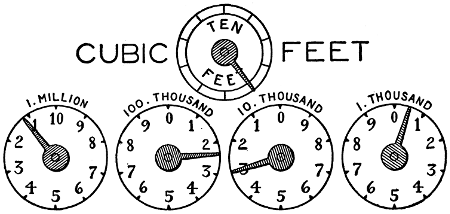
GAS METER INDICATOR DIALS.
HOW TO READ A GAS METER
The dial marked “1 thousand” in the accompanying illustration is divided into hundreds; the dial marked “10 thousand” is divided into thousands; that marked “100 thousand” into ten-thousands, and that marked “1 million” into hundred-thousands. When 1,000 cubic feet of gas have been consumed, the pointer on the dial marked “1 thousand” will have made a complete rotation and the fact will be indicated by the pointer of the next dial at the left, which will point to the figure 1. When 10,000 cubic feet of gas have been consumed, the pointer on the “10 thousand” dial will point to 1, and so on. In reading a gas meter, put down the hundreds first, then the thousands, and so on, always counting the figure just under, or which has just been passed by, the pointer. In the illustration about half a hundred is indicated on the “1 thousand” dial, three thousands is indicated on the next dial, two ten-thousands on the next dial, and one one-hundred-thousand on the “1 million” dial. The reading will be 123,050. The dial marked “ten feet” is called the units dial. It is used for testing the meter to discover whether it is in working order or not. Each mark represents a cubic foot and the complete circle 10 cubic feet. If the pointer moves when no gas is burning, it indicates a leak. If it does not move when the gas is burning, or if its motion is unsteady, it indicates a derangement in the mechanism and shows that the meter requires attention.
OUTLINE COURSE OF ELEMENTARY SCIENCE FOR THE GRADES
Grades LIFE STRUCTURE Grades
ZOOLOGY BOTANY MINERALOGY GEOLOGY PHYSICS AND CHEMISTRY ASTRONOMY, METEOROLOGY
I. II. III. Observe— 1. Birds; migration, nesting, feeding. 2. Insects; butterflies, moths, earth-worms. 3. Uses of birds and insects. Observe— 1. Flowers; color, form, parts. 2. Fruits; color, form, etc. 3. Leaves; shape, color, veining. 4. Stems; form, position, bark, structure. 5. Conditions of growth, habits, etc. Observe 1. Pebbles and rocks; color, shape, hardness. 2. Kinds of rock; quartzose, calcites. 3. Uses; for soil making and building. Rain; its effects— 1. On the surface; slopes, ponds, in valleys, streams. 2. Below the surface; springs, caverns, etc. River Basins— 1. Boundary, uses, etc. 2. Alluvial deposits. Observe qualities; elastic, porous, etc. 1. Forms of water; their uses. 2. Atmosphere; weight, composition.3. Magnetism; electricity. 4. Solutions. 5. Gases; hydrogen, oxygen, nitrogen, carbonic acid gas. Observe— 1. Sun, moon, constellations. 2. Wind, clouds, rain, snow, frost, dew. 3. Their causes. 4. Effects. I. II. III.
IV. By observing the form and structure, determine some 1. Orders of mammals. 2. Orders of birds. 3. Orders of insects. 4. Orders of reptiles. Uses of animals. Observe characteristics of— 1. Exogens and Endogens. 2. Kinds of trees, fruits, vegetables, grasses and grains. 3. Effects of cultivation. 1. Sandstone 2. Argillaceous rocks. 3. Formation of rocks. a. Sedimentary; sandstone, limestone, etc. b. Igneous; granite, etc. 1. Ocean; effects of waves, tides, currents. 2. Glaciers; moraines: formation, effects. 3. Volcanoes; geysers; earthquakes. 4. Gradual elevation and depression of the earth’s crust. 1. Heat; sources: sun, fuel, friction. 2. Transmission; conduction, radiation, convection. 3. Uses: warming, cooking, smelting. 4. Physical and chemical changes observed. 5. Carbon; forms; uses. Climate; causes: 1. Winds, direction of sun’s rays. 2. Surface; mountains, vegetation. 3. Bodies of water; rivers, ocean currents. Twilight; duration. IV.
V. Characteristics, habits and uses of— 1. Fishes. 2. Oysters, crabs, starfishes. 3. Coral animals. Observe characteristics— 1. Plants of the rose, pine, pulse, violet, pink, mustard, composite, lily, grass and fern families. Formation and uses— 1. Coal. 2. Mineral oils. 3. Natural gas. 4. Iron; ores. Continent building— 1. Mountains, plains, coast lines. 2. Agencies; a. Vegetable; peat-bogs, swamps. b. Animal; coral formation, shell deposits. c. Chemical springs, geysers, caverns, deposits in lakes and seas. 1. Light— a. Sources; uses. b. Transmission, reflection, refraction. c. Lenses, glasses. 2. Fermentation of fruit juices; yeast. 1. Prevailing winds. 2. U. S. weather maps. 3. Climate of the United States. V.
VI. Characteristics of Animals of the— 1. Temperate climate. 2. Tropical climate. 3. Polar climate. Uses made of them. Peculiarities, habits, uses— 1. Palm, banana, pineapple and orchid families. 2. Mosses; lichens. 1. Minerals and mines of the United States. 2. Gold and silver. 3. Copper. 1. Appalachian and Rocky mountains. 2. River basins and great lakes of the United States. 1. Magnetism; uses: compass, electro-magnets. 2. Electricity; sources and uses. 3. The levers; scales. 4. Equilibrium of bodies. 5. Chlorine. North and South America— 1. Winds; trades, polar, variable. 2. Wind zones. 3. Weather maps. VI.
VII. Animals of the different zones of the Old World compared with those of the United States. Distribution and migration; cause; limits. 1. Zones of vegetation. 2. Limits of migration. 3. Vegetable products of commerce. Mines and minerals of other countries. Continent structure— 1. South America. 2. Eurasia. 3. Australia. 4. Africa. Pendulum; inertia, motion. Forces: gravitation, cohesion, chemical attraction. Capillary attraction; osmose pressure and flow of liquids. Testing air and water for impurities. Trades and Monsoons. 1. Deserts; Sahara, Arabia, etc. 2. Heavy rains of India. VII.
VIII. Relation of animal life to vegetation and civilization. Checks on animal life. 1. Culture of fruits, vegetables, fibers, grains. 2. Commercial value; benefits to man. Minerals. 1. Constituents. 2. Commercial value and uses in the arts, etc. The earth; form, crust— 1. Rock strata; fossils. 2. Geological ages. Sound; propagation, reflection, vibration, music. Examination of soils. The Solar system. The moon. The sun; fixed stars. The tides; ocean currents. VIII.
Grades LIFE STRUCTURE
ZOOLOGY BOTANY MINERALOGY GEOLOGY PHYSICS AND CHEMISTRY ASTRONOMY, METEOROLOGY
I. II. III. Observe— 1. Birds; migration, nesting, feeding. 2. Insects; butterflies, moths, earth-worms. 3. Uses of birds and insects. Observe— 1. Flowers; color, form, parts. 2. Fruits; color, form, etc. 3. Leaves; shape, color, veining. 4. Stems; form, position, bark, structure. 5. Conditions of growth, habits, etc. Observe 1. Pebbles and rocks; color, shape, hardness. 2. Kinds of rock; quartzose, calcites. 3. Uses; for soil making and building. Rain; its effects— 1. On the surface; slopes, ponds, in valleys, streams. 2. Below the surface; springs, caverns, etc. River Basins— 1. Boundary, uses, etc. 2. Alluvial deposits. Observe qualities; elastic, porous, etc. 1. Forms of water; their uses. 2. Atmosphere; weight, composition.3. Magnetism; electricity. 4. Solutions. 5. Gases; hydrogen, oxygen, nitrogen, carbonic acid gas. Observe— 1. Sun, moon, constellations. 2. Wind, clouds, rain, snow, frost, dew. 3. Their causes. 4. Effects.
IV. By observing the form and structure, determine some 1. Orders of mammals. 2. Orders of birds. 3. Orders of insects. 4. Orders of reptiles. Uses of animals. Observe characteristics of— 1. Exogens and Endogens. 2. Kinds of trees, fruits, vegetables, grasses and grains. 3. Effects of cultivation. 1. Sandstone 2. Argillaceous rocks. 3. Formation of rocks. a. Sedimentary; sandstone, limestone, etc. b. Igneous; granite, etc. 1. Ocean; effects of waves, tides, currents. 2. Glaciers; moraines: formation, effects. 3. Volcanoes; geysers; earthquakes. 4. Gradual elevation and depression of the earth’s crust. 1. Heat; sources: sun, fuel, friction. 2. Transmission; conduction, radiation, convection. 3. Uses: warming, cooking, smelting. 4. Physical and chemical changes observed. 5. Carbon; forms; uses. Climate; causes: 1. Winds, direction of sun’s rays. 2. Surface; mountains, vegetation. 3. Bodies of water; rivers, ocean currents. Twilight; duration.
V. Characteristics, habits and uses of— 1. Fishes 2. Oysters, crabs, starfishes. 3. Coral animals. Observe characteristics— 1. Plants of the rose, pine, pulse, violet, pink, mustard, composite, lily, grass and fern families. Formation and uses— 1. Coal. 2. Mineral oils. 3. Natural gas. 4. Iron; ores. Continent building— 1. Mountains, plains, coast lines. 2. Agencies; a. Vegetable; peat-bogs, swamps. b. Animal; coral formation, shell deposits. c. Chemical springs, geysers, caverns, deposits in lakes and seas. 1. Light— a. Sources; uses. b. Transmission, reflection, refraction. c. Lenses, glasses. 2. Fermentation of fruit juices; yeast. 1. Prevailing winds. 2. U. S. weather maps. 3. Climate of the United States.
VI. Characteristics of Animals of the— 1. Temperate climate. 2. Tropical climate. 3. Polar climate. Uses made of them. Peculiarities, habits, uses— 1. Palm, banana, pineapple and orchid families. 2. Mosses; lichens. 1. Minerals and mines of the United States. 2. Gold and silver. 3. Copper. 1. Appalachian and Rocky mountains. 2. River basins and great lakes of the United States. 1. Magnetism; uses: compass, electro-magnets. 2. Electricity; sources and uses. 3. The levers; scales. 4. Equilibrium of bodies. 5. Chlorine. North and South America— 1. Winds; trades, polar, variable. 2. Wind zones. 3. Weather maps.
VII. Animals of the different zones of the Old World compared with those of the United States. Distribution and migration; cause; limits. 1. Zones of vegetation. 2. Limits of migration. 3. Vegetable products of commerce. Mines and minerals of other countries. Continent structure— 1. South America. 2. Eurasia. 3. Australia. 4. Africa. Pendulum; inertia, motion. Forces: gravitation, cohesion, chemical attraction. Capillary attraction; osmose pressure and flow of liquids. Testing air and water for impurities. Trades and Monsoons. 1. Deserts; Sahara, Arabia, etc. 2. Heavy rains of India.
VIII. Relation of animal life to vegetation and civilization. Checks on animal life. 1. Culture of fruits, vegetables, fibers, grains. 2. Commercial value; benefits to man. Minerals. 1. Constituents. 2. Commercial value and uses in the arts, etc. The earth; form, crust— 1. Rock strata; fossils. 2. Geological ages. Sound; propagation, reflection, vibration, music. Examination of soils. The Solar system. The moon. The sun; fixed stars. The tides; ocean currents.
SOME GREAT MECHANICAL INVENTIONS
STEAM ENGINES
What are steam engines?
Steam engines are machines in which the elastic force of steam is used as a motive power. In the ordinary engines the alternate expansion and condensation of steam imparts to a piston an alternating rectilinear motion, which is changed into a circular motion by means of various mechanical arrangements.
The engine is unquestionably the grandest and most influential for good of all the great inventions in the realm of physics. No other contrivance of man can be compared with this gigantic, yet tractable motor, in relieving both man and beast of ceaseless toil and irksome drudgery; in preventing suffering and starvation, and promoting intercourse, progress and civilization among the nations of the earth.
Give a description of the steam engine.
Every steam engine consists essentially of two distinct parts: the apparatus in which the steam is produced, and the engine proper. We shall first describe the former.
Steam Boiler.—The boiler is the apparatus in which steam is generated. Usually a cylindrical boiler is used for fixed engines; those of locomotives and of steam vessels are very different.
The steam is produced from water at a pressure considerably above that of the atmosphere, and is delivered to the engine with as little loss of pressure and heat as possible. The higher the pressure of the steam, the greater will be the amount of heat available, in a given weight of steam, for conversion into mechanical energy. Only a fraction of the total heat energy given to the steam in the boiler is converted into the mechanical work in the engine. By far the greater portion still remains in the steam after it has passed through the engine. The proportion of heat utilized depends on the thermal efficiency of the engine, amounting from twelve to fifteen per cent in good condensing engines; in the very best engines of large size it may be as high as twenty per cent.
The terms axis, axle, arbor, and shaft, in mechanics, are generally understood to mean the bar, or rod, which passes through the center of a wheel. A gudgeon is the pin, or support, on which a horizontal shaft turns; the pins upon which an upright shaft turns are called pivots.
The engine proper consists of a hollow cylinder closed at both ends; inside it is the piston, a sliding partition which fits the bore of the cylinder sufficiently close to prevent the steam leaking past it, but having sufficient freedom to allow it to move from end to end of the cylinder with as little friction as possible.
In modern engines the pressure of the atmosphere is not employed to drive the piston down. The steam is admitted into the cylinder above the piston at the same time that it is condensed or withdrawn from below, and thus exerts its expansive force in the returning as well as in the ascending stroke. This results in a great increase of power.
The practical construction of the piston and cylinder, and the arrangement of connecting pipes by which steam is admitted alternately above and below the piston, is fully shown in Figure A. This gives a sectional view of the cylinder, of the piston, and of the distribution of steam. The entire engine is of iron. To the piston, T, is fixed a rod, A, which slides with gentle friction in a tubulure, U, placed at the center of the plate which closes the cylinder. As it is very important that no steam shall escape between the piston-rod and this tubulure, the latter is formed of two pieces, one attached to the plate, while the other, which fits in the first, can be pressed as tightly as is desired, so as to compress the material soaked with fat which is between the two tubulures. This arrangement is called a stuffing-box; it prevents the escape of steam without interfering with the motion of the piston.
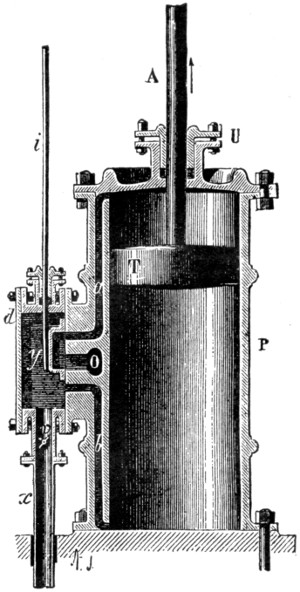
FIGURE A
Valve-Chest.—This is the arrangement by which steam passes alternately above and below the piston.
Figure A presents a vertical section of this valve-chest and shows its relation to the cylinder. The steam enters the valve-chest from the boiler by the brass tube x. From the valve-chest two conduits, a and b, are connected with the cylinder, one above and the other below. If they were both open at once, the steam, acting equally on the two faces of the piston, would keep it at rest. But one of these is always closed by a slide-valve, y, fixed to a rod, i. This moves alternately up and down, by means of an eccentric, e, placed on the horizontal shaft. The slide-valve closes the conduit a, and allowing the steam to enter at b, below the piston, the latter rises. But when it reaches the top of the stroke the rod i sinks, and with it the slide-valve, which then closes the conduit b, and allows the steam to enter at a. The piston then sinks, and so forth at each displacement of the slide-valve.