THE BOOK OF NATIONS Geographical, Historical, Descriptive (continued 3)
Reading edition
712. Constantine opposes the emperor Philippicus Bardanes in the question of the Monothelite heresy. 712-744. Luitbrand, a great and virtuous prince. Luitbrand takes advantage of the civil broils in Italy, captures Ravenna and several cities from the pope.
713-714. Tarik and Musa complete the conquest of Spain. The Christians maintain themselves in the Asturias and Navarre.
715. Death of Pipin, succeeded after a long struggle by his son. 715. Pope Gregory II. engages in controversy with the Emperor Leo the Isaurian over image-worship.
715-741. Charles Martel. Complete master of the French monarchy.
720-729. The Arabs invade France, but are several times defeated and driven back by Eudes, Duke of Aquitaine. 722. Boniface consecrated bishop of Germany.
725 730. Gregory excommunicates the emperor.
732. Charles Martel gains the decisive victory of Tours which saves the liberties and religion of Europe. 731. Pope Gregory III.
739. Alfonso founds the kingdom of Leon which maintains its independence till 1230. Carlovingian Dynasty 749-756. Aistulf.
750 751. With Pipin the Short (741-768), Charles Martel’s son, the Carolingians became kings of the Franks. 752. He defeats the Greek exarchs, and demands a tribute from Rome.
End of the Greek Exarchate
755-1031. Caliphate at Cordova. 754-756. Pipin makes two expeditions into Italy and bestows the exarchate upon the pope, thus laying the foundation of the temporal power of the Papacy.
755-787. Abderrahman having escaped from Bagdad, wrests Spain from the caliphate of the Abbassides—establishes a military government. 756. Commencement of the pope’s temporal power under the auspices of Pipin, who bestows on Stephen the exarchate of Ravenna. Didier, the last king, quarrels with Pope Adrian, 772, at whose request Charlemagne crosses the Great St. Bernard from Geneva, takes Pavia, dethrones Didier, and thus, 774, ends the Kingdom of the Lombards which had lasted 206 years.
768-814. CHARLEMAGNE, and Carloman, the former one of the greatest monarchs, becomes sole ruler upon the death of Carloman, 771. 768. Pope Stephen III.
772. Pope Hadrian I., whom Charlemagne confirms in possession of Pipin’s donation.
775 787. The seventh general council at Nice, in which the doctrine of the Iconoclasts was condemned.
791-842. Alphonso II., the Chaste, defeats and expels the Arabs, who invade his dominions, and from this time may be dated the real independence of the Christians. 795. Pope Leo III. Image-worship condemned by Synod of Frankfort.
800 800. Charlemagne or Charles the Great crowned Emperor by Pope Leo III. The Holy Roman Empire founded. It included all France, Germany, Spain to the Ebro, Italy to Benevento, several isles of the Mediterranean, and the greater portion of Pannonia.
806. Charlemagne divides the empire between his three sons, two of whom die, 810, 811.
808. Descent of the Normans or Northmen upon France. Many bishoprics founded—Great increase of monastic institutions.
813. National assembly at Aix. Louis co-ruler. Charlemagne dies there 814.
814-840. Louis, the Pious, crowned emperor at Rheims, 816, by Pope Stephen IV.
817. Louis divides the empire between his three sons, and, 823, a fourth, Lothaire, is associated in the empire.
820. Second invasion of the Normans.
825 830. Rebellion of Louis’s three sons, and succession of quarrels between them till Louis’s death—Field of lies at Alsace, 833—Louis is deposed, but soon restored.
841. Battle of Frontenai between Lothaire, Charles and Louis; Louis is defeated.
842. Ramiro I., King of Orildo. 843. Partition of the Carlovingian Empire at Verdun, when properly begins the history of France, Germany and Italy as separate states.
The Treaty of Verdun was originally merely a family contract, made without regard to national differences. In Louis’ kingdom, however, the German element was in the majority; in that of Charles the Romance element prevailed. Thus there developed, in the course of the following centuries, from the East Frankish element the German, from the West Frankish the French nationality. The East Franks called their language, in contrast to the Latin used by the educated clergy, the deutsche, i. e. the language of the people, and gradually those who spoke Deutsche came to be called Deutsche, or German.
France Germany Italy
843-987. Carolingian Kings of France. 843-911. Carolingians in Germany. 843-875. Carolingians in Italy.
844. Irruption of the sea kings. 843-877. Charles the Bald obtains France; boundaries: the Meuse, Saone, Rhone Scheldt and Ebro. 843-876. Louis the German obtains Germany to the Rhine, with Mayence, Spires and Worms. 843-855. Lothaire, Emperor, obtains Italy and Lotharingia, or Lorraine.
The power of the monarchs declines, and the nobles become independent. The empire by the almost universal system of division and subdivision, is broken up into an immense number of feudal states.
NOTE: The comparative outline of the History of Nations is continued by Table IX.
EGYPT’S STORY SCULPTURED IN ETERNAL ROCKS
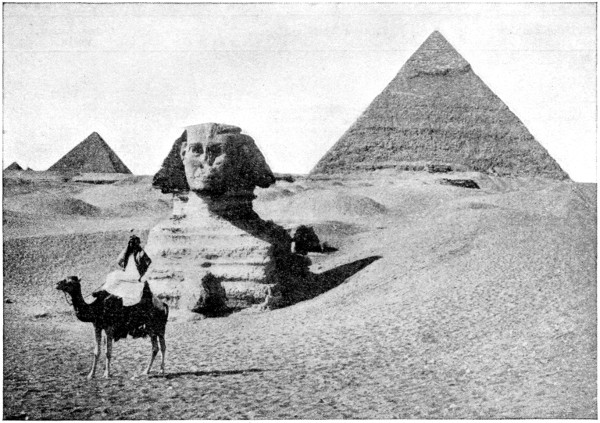
THE SPHINX AND PYRAMIDS AT GIZEH
This most mysterious of all Egyptian sculptures stands near the Second Pyramid. The body of the Sphinx is one hundred and fifty feet long, its paws are fifty feet and its height is seventy feet (See page 351).
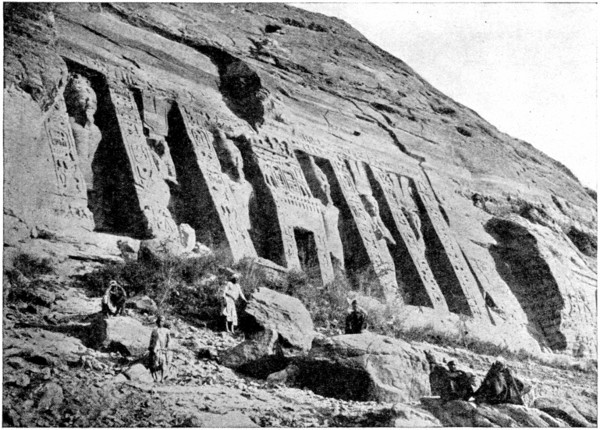
This wonderful temple at Abu-Simbel in Nubia is the most northerly of a group of three, but is separated from the others by a deep ravine. It was dedicated to the goddess Hathor, and built by Rameses the Great in the side of a deep cliff. The portrait statues are thirty-three feet in height and represent Aahmes and his queen Nefertari.
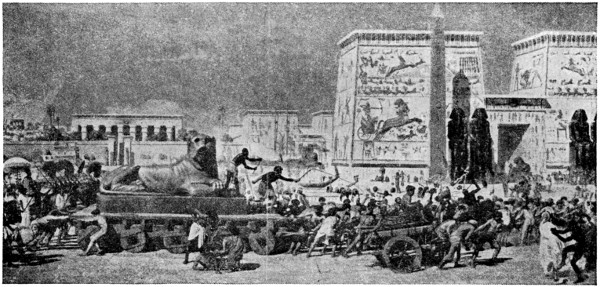
ISRAEL IN EGYPT—From a Painting by Sir Edward J. Poynter
This picture portrays the hardships of the enslaved peoples in Pharaoh’s time. Not only the Israelites but the Egyptians as well were forced into service to build the great Pyramids to immortalize Egypt’s rulers.
EXTINCT NATIONS OF THE PAST
THE SPELL OF EGYPT: ANCIENT AND MODERN
For hoary antiquity, for the massive and sublime, for the quaintly picturesque, Egypt stands unrivalled in the world,—the region where the Pharaohs reigned, where Moses grew from birth to manhood, where Joseph came forth from a dungeon to rule in wisdom at the king’s right hand, and whence the chosen people of God went out into the wilderness towards the promised land.
THE BEGINNINGS OF THE OLDEST CIVILIZATION
When the Egyptians first appear on the page of history they are already possessed of a marvelously advanced civilization, extending back thousands of years before the even remote period of the pyramid builders. Long before the chosen people, the Hebrews, came into possession of the promised land of Canaan, Egypt had kings, priests, cities, armies; laws, temples, learning; arts and sciences and books. Egypt is, beyond all other lands, the land of ruins, surpassing all in gigantic and stately monumental remains, the result of immense human labor.
HOMELAND OF THE EGYPTIANS
Egypt proper occupies little more than twelve thousand square miles. Including the oases in the Libyan Desert, the region between the Nile and the Red Sea, and El-Arish in Syria, but excluding the Sudan, the area is about four hundred thousand square miles.
In ancient as in modern times Egypt was always divided into the Upper and Lower, or the Southern and the Northern country; and at a very early period it was further sub-divided into a number of nomes, or departments, varying in different ages. It is practically confined to the bed of the flooded Nile, a groove formed by its waters in the desert; and the bordering desert and the southern provinces of Nubia, Khartum and others, toward the equator form no part of the Egypt of nature or of history, though from time to time they have been politically joined to it. Without the Nile Egypt would never have existed; and therefore a brief account of this wonderful river is very important.
THE LIFE GIVING RIVER NILE
Though the longest river in Africa, the Nile has little historic interest above Khartum, where the White Nile and Blue Nile unite their waters. Below Khartum navigation is rendered extremely dangerous by the cataracts which obstruct the bed of the river, the sixth occurring not far north of Khartum, the first near Assuan, in Egypt. The Nile enters the Mediterranean by a delta which separates into two main channels, the Rosetta and the Damietta, which are intersected with canals. The valley of Upper Egypt is narrow, and the fringe of mountains on either side are of no great height, so that the landscape varies but little and might appear to be monotonous but for the rich and wondrous coloring of all the scenery, the vivid green of the fields, the rich red-brown of the river, the bright yellow of the rocks, with overhead a deep blue sky and brilliant sunshine. The river flows into Egypt proper north of the second cataract, a little south of Wadi-Halfa. The Blue Nile joins the river at Khartum; this stream brings down an immense quantity of red mud. The cataracts are six in number.
THE NILE’S ANNUAL OVERFLOW
The important feature of the river is its annual inundation. At the end of May the river is at its lowest level, it rises gradually in June and continues rising until the middle of September; it then remains stationary from two to three weeks, rising again until the end of October; it is then at its highest level and begins gradually to fall, until by May it is once more at its lowest. The river rises from twenty-one to twenty-eight feet; when it did not reach this level the crops failed, and when it exceeded it, the land was overflowed and ruin faced the people. Nowhere in the world is there such a large population depending solely on the produce of the soil.
THE RISE OF IRRIGATION BEGINS WITH THE NILE
As the climate is exceedingly dry, irrigation became as early as the second dynasty (about 4514 B. C.) an object of national importance. All through the ages can be marked the tireless persistence and mechanical ingenuity employed in the problems of irrigation. During the nineteenth century, Mehemet Ali Pasha began a gigantic system of canals and locks and weirs. A French engineer of great ability, Mougel Bey, was employed to carry out this difficult task; his great barrage across the Nile, at the apex of the delta, is still a very impressive work; unfortunately the system was a failure. Later British engineers undertook the management of irrigation, and in 1902 the Nile dam, at the head of the first cataract above Assuan, was completed. The dam is such a height that the beautiful temples on the islet of Philæ are partially submerged; and during several months of the year the ruins are no longer visible.
EGYPTIAN LAKES, CLIMATE AND OASES
The chief lakes of Egypt, from west to east are Mareotis, Edku, Burlus, and Menzala; these lie only a few miles from the coast and are shallow and brackish. The seven famous natron lakes lie in a valley in the desert, eighty miles from Cairo. In the province of the Fayum is the Birket-el-Kerum, thirty miles long and five miles wide, forming the remains of the ancient Lake Moeris, which Herodotus believed to have been artificially constructed.
The climate is extremely dry. Egypt lies in an almost rainless area. The days are warm and the nights are cool. January is the coolest month. On the coast rain falls during the winter months, but snow is unknown. In Sinai, snow occasionally falls during the winter, and heavy storms of rain occur, which occasionally flood the rocky ravines. One interesting feature of the climate is the continuous north wind, which blows throughout the year, and the sailing boats are thus able to ascend the Nile against the strong current. During the spring the Kamsin occurs, a hot, dry south wind laden with sand, forming a yellow stifling fog almost obscuring the sun; it lasts from one to three days.
There are five large oases or fertile places in the western desert—Siwa, Baharia, Kharga, Dakla, and Farafra. These have been occupied since 1600 B. C. Kharga possesses a temple of Ammon, built by the Persian conqueror, Darius I., and also other interesting ruins of the time of the Ptolemies. Siwa contains the oracle temple of Jupiter Ammon, consulted by Alexander the Great. The town is built on the rocks and has the appearance of a fortress.
ANCIENT POPULATION OF EGYPT
The population of the country must have been large at the earliest period, as one hundred thousand men were employed in the construction of the Great Pyramid alone during the fourth dynasty, nearly 3600 years B. C. It has been placed at seven million under the Pharaohs, distributed in eighteen hundred towns, which had increased to two thousand under Amasis (525 B. C.), and upwards of three thousand under the Ptolemies. In the reign of Nero it amounted to seven million eight hundred thousand. In 1707 it was eleven million, one hundred and forty thousand in Egypt proper, or, including Nubia and other dependencies nearly twenty millions.
TITANIC IRRIGATION DAMS OF MODERN EGYPT
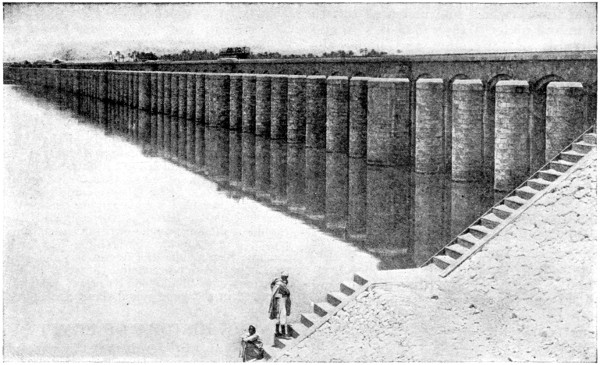
THE BARRAGE AT ASSIOUT ACROSS THE NILE
This dam, though not so large as that of Assuan, is still a gigantic structure. It is over half a mile in length and its massive wall is pierced by one hundred and ten bays or sluices, each over sixteen feet in width.
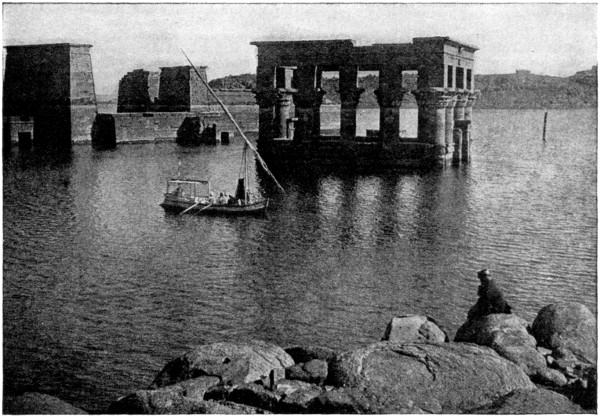
This is a view of the great dam at Assuan, across the Nile in upper Egypt, showing the ruins of the beautiful Temple of Philæ partially submerged. The Assuan dam was the largest in the world until the completion of the Elephant Butte dam, New Mexico, in May, 1916.
HOW WE KNOW THE HISTORY OF EGYPT
Until the last century, what we knew about ancient Egypt was mainly obtained from Greek and Roman historians. At the present time our knowledge of the “land of pyramids and priests” has been greatly increased by the deciphering of the inscriptions on the monuments, and by extended observation of the countless sculptures in which the olden Egyptians have recorded their ways of life, their arts, arms, sciences, religion and customs. In carving or in painting, the obelisks, the temple walls, and temple columns, the inner walls of tombs, the coffins of the dead, artistic objects—all are covered with the strange characters known as hieroglyphics.
THE STORY OF THE HIEROGLYPHICS
This word, of Greek extraction, means “sacred carvings,” given to the sculptures in the supposition that all such characters were of religious import, and known only to the priests of ancient Egypt. The meaning of the characters had been lost for hundreds of years, and the word “hieroglyphics” had long become proverbial for mysteries and undecipherable puzzles, when a keen-eyed Frenchman put into the hands of scholars the clew to their translation.
DISCOVERY OF THE ROSETTA STONE
An artillery officer of Napoleon’s army in Egypt, named Bouchart, discovered near Rosetta, in 1799, an oblong slab of stone engraved with three inscriptions, one under the other. The upper one (half of which was broken off) was in hieroglyphics, the lowest one was in Greek, and the middle one was stated in the Greek to be in the written characters of the country. The Greek inscription told scholars that all three inscriptions expressed a decree of the Egyptian priests, sitting in synod at Memphis, in honor of King Ptolemy V.
Hieroglyphs are representations on stone, wood, or papyrus, of objects or parts of objects, including heavenly bodies, human beings in various attitudes, parts of the human body, quadrupeds and parts of quadrupeds, birds and parts of birds, fishes, reptiles, etc., geometric and fantastic forms, amounting in all to about a thousand different symbols.
More than six hundred are ideographic (idea-writing); i. e., the engraved or painted figure, either directly or figuratively conveys an idea which we express by a word composed of alphabetic signs. Thus, directly, the figure of a man means “man;” figuratively the same figure means “power.”
PHONETIC HIEROGLYPHICS
About one hundred and thirty of the hieroglyphs are phonetic (sound-conveying); i. e., represent words (which are nothing but sound with a meaning attached thereto) of which the first letter is to be taken as an alphabetic sign, and thus phonetic hieroglyphs answer the same end as our letters of the alphabet. For example: in ideographic writing, a bird, a mason, a nest, mean “birds build nests;” in phonetic hieroglyphic the figures of a bull, imp, rope, door and ship would give the word “birds,” and the words “build” and “nests” would be expressed in the same round-about and clumsy fashion.
THE HISTORY OF EGYPT
From the old Greek writers and from records of the monuments we have a fairly complete story of this wonderful country and people.
FIRST MONARCH OF THE OLD KINGDOM
The first king of Egypt, Menes, whose date is set at 3400 years before Christ, is said to have founded the city of Memphis, near the site of the modern Cairo, which became the capital of Egypt; Thebes, in Upper (or Southern) Egypt, afterwards taking this position.
The building of the Great Pyramid at Gizeh, near Cairo, is ascribed to a king named Cheops (kē´ops) by Herodotus, otherwise called Khufu (kōō´fōō), according to the hieroglyphic royal name found inside the structure. He is believed to have reigned about the twenty-eighth century before Christ. Cheops was the second and most celebrated monarch in the fourth of the dynasties which ruled at Memphis. The third king in this list, Khafra (khaf´rä) also founded a pyramid, as did the fourth, Menkaura (men-kȧ-rä´) or Nycerinus, a sovereign beloved and praised in poetry for his goodness. His mummified remains are in the British Museum. In the sixth dynasty was a female sovereign noted for her beauty, named Nitocris, who built a pyramid and reigned at Memphis. The monarchy then was for some time divided, the chief power being held by the kings ruling at Thebes, in Upper Egypt, who developed great power, and constructed many notable works.
THE INVASION AND RULE OF THE SHEPHERD-KINGS
About 1800 B. C. the Hyksos or Shepherd-kings, said to be of Arabian race, conquered Lower Egypt, and then subdued the kingdom of Thebes, ruling the whole land down to 1580 B. C. Probably to this period the story of Joseph in Egypt belongs. The shepherd-kings were expelled with the aid of the Ethiopians from the south, and then came the great period of Egyptian history. During this time, Egypt was a great empire with Thebes for its capital. Under Thutmose III., Amenhotep III. and IV., and Seti I., Egypt rose to great heights of development and art.
GREAT EPOCH OF RAMESES II.
The greatest monarch of this, or perhaps of any, age of Egypt’s history was Rameses the Great (called by the Greeks, Sesostris). To him have been attributed many of the monuments and pictures which represent triumphal processions and captives. Rameses the Great reigned for nearly seventy years in the fourteenth century before Christ. Among his many monuments two are chiefly remarkable, the Memnonium or palace-temple at Thebes, and the great rock-cut temple of Abu-Simbel in Nubia. These architectural works possess an interest more historical than that of the pyramids. He is said to have subdued Ethiopia, carried his arms beyond the Euphrates eastward, and among the Thracians in southeast Europe. The monumental sculptures and paintings tell us of war-galleys of Egypt in the Indian seas, and of Ethiopian tribute paid in ebony and ivory and gold, in apes and birds of prey, and even in giraffes from inner Africa. Other sculptures display the Egyptians fighting with success against Asiatic foes. To this monarch was due a vast system of irrigation by canals for conveying the waters of the Nile to every part of the country.
The next sovereign of note was Sheshanq (Shi´shak), who, in the latter part of the tenth century before Christ, took and plundered Jerusalem. The empire continued to decline, and was entirely reduced by Esarhaddon and Ashurbanipal, and became for a time tributary to the Assyrian monarchs. In the early part of the reign of the king Psametik I. (653-610 B. C.)
IMPORTANT REIGN OF PSAMETIK FOLLOWS AN AGE OF DECAY
We find Egypt in connection, for the first time in its history, with foreign countries, otherwise than as conquering or conquered. Psametik I. (653-610 B. C.) had in his pay a body of Greek mercenaries, and sought to introduce the Greek language among his subjects. In jealousy at this, the great military caste of Egypt emigrated into Ethiopia, and left the king dependent on his foreign troops, with whom he successfully warred in Syria and Phœnicia, and likewise succeeded in making Egypt independent of Assyria.
Neku, son of Psametik (610-595 B. C.), was an enterprising prince, who built fleets on the Red Sea and the Mediterranean, and strove to join the Nile, by a canal, with the Red Sea. Africa was circumnavigated by Phœnicians in his service, who sailed from the Arabian Gulf, and passed round by the Straits of Gibraltar to the mouths of the Nile. He was the king who defeated Josiah, king of Judah, sustaining afterward defeat from Nebuchadnezzar II., king of Babylon, at Carchemish.
In 590 B. C., came Apries (the Pharaoh-Hophra of Scripture), who conquered Sidon, and was an ally of Zedekiah, king of Judah, against Nebuchadnezzar. After being repulsed with severe loss in an attack on the Greek colony of Cyrene, west of Egypt, Apries was dethroned by Aahmes II., who reigned from 570 to 526 B. C. His prosperous rule was marked by a closer intercourse with the Greeks.
EGYPT IS CONQUERED BY PERSIA
Psametik III., son of Aahmes, inherited a quarrel of his father with Cambyses, king of Persia, who invaded and conquered Egypt in 525 B. C. For nearly two centuries afterwards the history of Egypt is marked, disastrously, by constant struggles between the people and their Persian conquerors, and, in a more favorable and interesting way, by the growing intercourse between the land of the Nile and the Greeks. Greek historians and philosophers—Herodotus and Anaxagoras and Plato—visited the country, and took back stores of information on its wonders, its culture, and its faith.
CONQUERED BY ALEXANDER THE GREAT AND PASSES UNDER GREEK RULE
In 332 B. C., Egypt was conquered by Alexander the Great; and its new capital, the great Alexandria, destined to a lasting literary and commercial renown, was founded. Subsequently it passed under Greek rule, and the language of the government, and the administration and philosophy, became essentially Greek. The court of the Ptolemies became the center of learning and philosophy; and Ptolemy Philadelphus, successful in his external wars, built the Museum, founded the library of Alexandria. He purchased the most valuable manuscripts, engaged the most celebrated professors, and had the Septuagint translation made of the Hebrew Scriptures, and the Egyptian history of Manetho drawn up. His successor, Euergetes, pushed the southern limits of his empire to Axum. Philopator (221-204 B. C.) warred with Antiochus, persecuted the Jews, and encouraged learning. Epphanes, (204-180 B. C.) encountered repeated rebellions and was succeeded by Philometor (180-145 B. C.) and Euergetes II. (145-116 B. C.), by Soter II. and Cleopatra till 106 B. C., and by Alexander (87 B. C.), under whom Thebes rebelled; then by Cleopatra, Berenice, Alexander II. (80 B. C.), and Neos Dionysus (51 B. C.) and finally by the famous Cleopatra who maintained her power only through her personal influence with Julius Cæsar and Mark Antony.
EGYPT BECOMES A ROMAN PROVINCE
On the defeat of Mark Antony by Augustus, B. C. 30, Egypt became a province of Rome. It was still a Greek state, and Alexandria was the chief seat of Greek learning and science. On the spread of Christianity the old Egyptian doctrines lost their sway. Now arose in Alexandria the Christian catechetical school, which produced Clemens and Origen. The sects of Gnostics united astrology and magic with religion. The school of Alexandrian Platonics produced Plotinus and Proclus. Monasteries were built all over Egypt; Christian monks took the place of the pagan hermits, and the Bible was translated into Coptic.
PASSES UNDER MOHAMMEDAN RULE
On the division of the great Roman Empire (A. D. 395), in the time of Theodosius, into the Western and Eastern Empires, Egypt became a province of the latter, and sank deeper and deeper in barbarism and weakness. It was conquered in 640 A. D. by the Saracens under Caliph Omar. As a province of the caliphs it was under the government of the celebrated Abbasides—Haroun-al-Rashid and Al-Mamun—and that of the heroic Sultan Saladin. The last dynasty was, however, overthrown by the Mamelukes (1250); and the Mamelukes in their turn were conquered by the Turks (1516-17). The Mamelukes made repeated attempts to cast off the Turkish yoke, and had virtually done so by the end of the eighteenth century, when the French conquered Egypt and held it till 1801, when they were driven out by the British.
BECOMES A PAWN OF TURKEY, FRANCE AND ENGLAND
On the expulsion of the French a Turkish force under Mehemet Ali Bey took possession of the country. Mehemet Ali was made pasha, and being a man of great ability, administered the country vigorously and greatly extended the Egyptian territories. At length he broke with the Porte, and after gaining a decisive victory over the Ottoman troops in Syria in 1839 he was acknowledged by the sultan as viceroy of Egypt, with the right of succession in his family.
By the Anglo-French agreement of 1904 France formally recognized the predominant position of Great Britain, and agreed in no way to obstruct British action in the government of Egypt. The European War of 1914-1916 has again thrown Egypt into the balance, and its political future seems to be entirely a matter of the fortunes of war and diplomacy.
EGYPTIAN GOVERNMENT AND CIVILIZATION
At an early period the form of government in Egypt became an hereditary monarchy, of a peculiar kind. The power of the king was restricted by rigid law and antique custom, and by the extraordinary influence of the priestly class. The soil was held by the priests, the warriors, and the king.
Their Kings.—The Egyptian monarchs appear to have used their authority well and wisely; we rarely hear of insurrection or rebellion, and many received divine honors after death for their beneficence and regal virtues. The common title “Pharaoh” is derived from the Egyptian word “Phra,” the sun.
Social Castes.—The body of the people were divided into castes, not rigidly separated, as in India. The members of the different orders might intermarry, and the children pass from one caste to another by change of the hereditary occupation. The castes were: (1) priests; (2) soldiers; (3) husbandmen; (4) artificers and tradesmen; (5) a miscellaneous class of herdsmen, fishermen and servants. The priests and warriors ranked far above the rest in dignity and privilege.
The Priests.—The hierarchy in Egypt was the highest order in power, influence and wealth. To the priestly caste, however, many persons belonged who were not engaged in religious offices. They were a landowning class, and the solely learned class. In their possession were all the literature and science of the country, and all employments dependent, for their practice, on that knowledge. The priesthood thus included the poets, historians, lawyers, physicians, and the magicians who did wonders before Moses. They paid no taxes, had large landed possessions, exercised immense influence over the minds of the people, and put no slight check even on the king.
Soldiers and Warriors.—Egypt had an army of over four hundred thousand men, mainly composed of a militia supported by a fixed portion of land (six acres per man), free from all taxation. The chariots and horses were famous: the foot-soldiers were variously armed with helmet, spear, coat of mail, shield, battle-axe, club, javelin and dagger, for close fighting in dense array; and with bows, arrows and slings for skirmishing and conflict in open order. The soldier was allowed to cultivate his own land when he was not under arms, but he could follow no other occupation.
The Lower Castes.—The castes below the warriors and priests had no political rights, and could not hold land; to-wit, The husbandmen who tilled the soil paid rent in produce to the king or to the priests who owned it; and the artisan class, which included masons and the usual tradesmen, whose occupations are recorded upon the monuments. The herdsmen were the lowest class, and of these the swineherds were treated as outcasts, not permitted to enter the temples, or to marry, except among themselves.
RELIGION OF THE EGYPTIANS
In Egypt, life was the thing sacred. Hence all that had life, all that produced and all that ended life, was in a way divine. Hence death, too, was sacred. The Egyptian lived in the contemplation of death. His coffin was made in his lifetime; his ancestors were embalmed. The sovereign’s tomb was built to last for, not centuries, but thousands of years.
The highest form of the religious belief of the Egyptians included the idea that the soul was immortal. In the religion of Egypt were united the worship of Nature, and of the spirit which underlies and animates Nature.
The Egyptian Gods.—Having depended on the Nile and the Sun for the vegetation needed for their food, the people conceived human forms for them, and for the prolific Earth, as deities; namely, Osiris as the Nile and the Sun, and Isis as the Earth. These were the only divinities that were worshiped throughout Egypt. In later times they came to be regarded as divinities of the sun and the moon.
Another god, Anubis, worshiped in the form of a human being with the head of a dog, is represented as an Egyptian Hermes.
Whatever higher religious ideas may have been held by learned priests, the worship of the common people was chiefly adoration of animals. The sacred bull, called Apis, was worshiped at Memphis with the highest honors. All Egypt rejoiced on his annual birthday festival, and there was a public mourning when he died. The dog, the hawk, the white ibis, and the cat, were also specially revered. The sparrow-hawk, with human head and outspread wings, denoted the soul flying through space, to animate a new body. Thus we find mingled, in the religion of Egypt, gross superstition in the masses of the people, along with the spiritual conceptions of cultivated minds.
The Future Life.—In a papyrus-book, discovered in the royal tombs of Thebes, called the Book of the Dead, we read in pictured writing of a second life, and of a Hall of Judgment, where the god Osiris sits, provided with a balance, a secretary, and forty-two attendant-judges. In the balance the soul is weighed against a statue of divine justice, placed in the other scale, which is guarded by the god Anubis. The assistant-judges give separate decisions, after the person on trial has pleaded his cause before them. The soul rejected as unworthy of the Egyptian heaven was believed to be driven off to some dark realm, to assume the form of a beast, in accordance with a low character and sensual nature. An acquitted soul joined the throng of the blest.
Embalming.—The religion of the people was connected with the practice of embalming the bodies of the dead. This art seems to have derived its origin from the idea that the preservation of the body was necessary for the return of the soul to the human form after it had completed its cycle of existence of three or ten thousand years. The art appears as old as 4000 B. C., at least, for the bodies of Cheops, Mycerinus, and others of the age of the fourth dynasty, were embalmed.
EGYPTIAN ARCHITECTURE AND SCULPTURE
The chief feature of Egyptian architecture is its colossal, massive grandeur, from the use of enormous blocks of masonry, and from the vast extent of the buildings, which produce in the beholder an unequalled impression of sublimity and awe. The approaches to the palaces and temples were paved roads, lined with obelisks and sphinxes; and the temples and the palaces themselves surpassed in size, and in elaborate ornament of sculpture and of painting, all other works of man.
The Pyramids.—Of about forty pyramids now left standing in Middle Egypt, the most remarkable are the group of nine at Gizeh, near the site of ancient Memphis. The removal of the vast blocks of stone from distant quarries, and their elevation to heights, which have sorely puzzled modern engineers, were effected, not by the ingenuity of mechanical contrivance, but by the lavish use of human labor. Thousands of men were employed for months in moving single stones.
The Temple Columns.—Egyptian columns were formed by their architects on the model of the palm-tree, whose feathery crown of foliage was ever before their eyes, or of the full-blown or budding papyrus. We find constantly in the mural decorations the figure of the famous lotus-plant, or lily of the Nile, beheld by the Egyptians with veneration, and used in sculpture and in painting as no mere ornament, but as a religious symbol. This water-lily of Egypt was consecrated to Isis and Osiris, and typified the creation of the world from water. It also symbolized the rise of the Nile and the return of the sun in his full power.
SCULPTURE AND PAINTING
Egyptian sculpture displays size, simplicity, stiffness, and little of what modern art calls taste or beauty. Neither did the Egyptians become true artists of the pictorial class. They used simple colors of brilliant hue; but of light and shade only little was known; and of perspective, nothing.
Their monuments prove, however, that they practiced the same mechanic arts, and used the same variety of tools, as the moderns. They were adepts at the finest work in every species of handicraft. We have here ample proof that the ancient Egyptians were a highly ingenious, artistic, tasteful, and industrious race.
CITIES AND HISTORIC MONUMENTS
The land of Egypt, teeming with population, abounded in cities and towns. Of these the greatest were Thebes, in Upper Egypt, and Memphis, in Middle Egypt, whose site was near the modern Cairo.
Abu-Simbel (ä´bōō-sim´bel) on the Nile, in Lower Nubia is the site of two very remarkable rockcut temples, among the most perfect and noble specimens of Egyptian architecture. Here there is no exterior and constructed part; the rock out of which they have been excavated rises too near the river. Still the temples have their façade, as richly decorated and as monumental in its character as those of the most sumptuous edifices of Thebes.
The colossal statues here, instead of being isolated monoliths, are a part of the façade itself, hewn out of the rock, though still forming part of it. The façade of the smaller temple, that of Hathor, is eighty-eight feet long and thirty-nine feet high. It has six colossal figures, about thirty-two feet high, of which four represent Rameses, and the other two his wife, Nefert-Ari. The façade of the great temple is larger, being one hundred and twenty-six feet long and ninety-three feet high.
Most striking are the four colossal figures of Rameses, two to the right, two to the left of the door. These are the largest figures of Egyptian sculpture, being sixty-six feet high. Everywhere are pictures like those at Luxor and Karnak, representing the battles and triumphs of Rameses.
Abydos (a-bī´dos), next to Thebes the most important city in the ancient kingdom of Upper Egypt. Here was found, 1817, in a corridor of the temple of Seti I. a very important tablet giving a succession of sixty-five kings beginning with Menes, covering a period of about 2,200 years. A similar tablet containing eighteen names, found in the temple of Rameses in 1818, was removed by the French consul-general, sent to Paris, and finally purchased for the British Museum.
Alexandria, the third capital of Egypt, was founded by Alexander the Great in the autumn of the year 332 B. C. It was situated originally on the low tract of land which separates the lake Marcotis from the Mediterranean, about fourteen miles west of the Canopic mouth of the Nile. Before the city, in the Mediterranean, lay an island, upon which stood the famous lighthouse, the Pharos, built in the time of Ptolemy I. in the third century B. C, and said to have been four hundred feet high. The island was connected with the mainland by a mole, thus forming the two harbors.
The most magnificent quarter of the city, called the Brucheion, contained the palaces of the Ptolemies, the Museum, for centuries the focus of the intellectual life of the world, and the famous library; the mausoleum of Alexander the Great and of the Ptolemies, the temple of Poseidon, and the great theater.
To the south was the beautiful gymnasium. The Serapeum, or temple of Serapis, stood in the Egyptian quarter.
Much of the space under the houses was occupied by vaulted subterranean cisterns, which were capable of containing a sufficient quantity of water to supply the whole population of the city for a year.
From the time of its foundation, Alexandria was the Greek capital of Egypt. Its population in the time of its prosperity, amounted to about three hundred thousand free citizens, and probably a larger number of slaves. This population consisted mostly of Greeks, Jews and Egyptians, together with settlers from all nations of the known world.
After the death of Alexander the Great, Alexandria became the residence of the Ptolemies. They made it, next to Rome and Antioch, the most magnificent city of antiquity, as well as the chief seat of Greek learning and literature.
Alexandria had reached its greatest splendor when, on the death of Cleopatra, the last of the Ptolemies, in 30 B. C, it came into the possession of the Romans. Its glory was long unaffected, and it was the emporium of the world’s commerce.
In the reign of Caracalla, however, it suffered severely. The strife between Christianity and heathenism in the third century—powerfully described in Kingsley’s Hypatia—gave rise to bloody contests in Alexandria. The rise of Constantinople only served to hasten its fall. The choice of Cairo as capital of the Egyptian caliphs hastened the now rapid decay of the city; the discovery of America, and of the passage to India by the Cape of Good Hope, very much diminished its trade; and when, in 1517, the Turks took the place, the remains of its former splendor wholly vanished.
Under Mehemet Ali, however, the tide turned, and the city recovered rapidly. It is now again one of the most important commercial places on the Mediterranean with a population of about three hundred and fifty thousand. The Suez Canal diverted part of its trade; but this was more than compensated by the general impetus given to Egyptian prosperity.
Of the few remaining objects of antiquity the most prominent is Pompey’s Pillar, as it is erroneously called. Of the so-called Cleopatra’s Needles—two obelisks of the sixteenth century B. C. which long stood here—one was taken to England and erected on the Thames Embankment, London, 1878; and the other, presented by the khedive to the United States, was set up at New York in 1881.
Assuan or Assouan (äs-swän), the ancient Syene is the southernmost city of Egypt proper, on the right bank of the Nile, and beside the first or lowest cataract. It is noted for its granite, and was the place of banishment of Juvenal, the Roman poet. Here also is the great Nile irrigation system, begun in 1898, including a dam at Assuan and another at Assiout (two hundred and fifty miles nearer Cairo). The Assuan dam, finished in 1902 was designed to raise the level of the Nile for one hundred and forty miles above the first cataract. Its total length is one and one-quarter miles, the maximum height from the foundation about one hundred and thirty feet and the total weight of masonry over one million tons.
The difference of level of the water above and below is sixty-seven feet, and navigation is provided for by a series of four locks, each two hundred and sixty feet by thirty-two feet. The dam is pierced with one hundred and eighty openings, twenty feet by six feet, capable of discharging fifteen thousand tons of water per second. The reservoir, when opened, held something over one thousand million tons of water.
In 1907 the level was raised by twenty-three feet, steps being taken to preserve (as far as is consistent with partial submersion) the ruins of the temples on the island of Philæ within the area of the dam. Barrages at Zifteh and at Esneh help to regulate the flow.
Cairo (kī´rō).—The present capital of Egypt, is situated one mile east of the Nile. It has important transit trade, and is the starting-point for tours to neighboring pyramids, the sites of Memphis and Heliopolis, and the upper Nile. Its chief suburb is Bulak. It was founded by the Fatimite caliphs about 970, and made the capital. It was taken by the Turks in 1517, was held by the French 1798-1801, and was occupied by the British in 1882. It was the scene of the massacre of the Mamelukes in 1811.
There are about four hundred Mosques, some having six minarets, and adorned with beautiful granite columns, brought from Heliopolis and Memphis. About twenty deserve notice as works of art. The largest mosque is El Azhar, at the center of the city, regarded as a University for all Islam. The next in size is that of Sultan Hasan, in the Roumeyleh square, the finest structure in modern Egypt, and extremely light and elegant. It is built in the form of a parallelogram, and has a deep frieze running round all the wall, adorned with Gothic and Arabesque sculpture.
Other noticeable Mosques are the Tomb-Mosque of Kait Bey, built about 1470, one of the finest pieces of architecture in Cairo; and the Mosque of Amra, the oldest mosque in Egypt (founded 643 A. D.), and a remarkable Mohammedan monument.
The Citadel, or fortified Palace, erected by Saladin in 1176, was the only place of defence in the city; it fell into ruin, but was thoroughly repaired by a late pasha. Formerly it included a magnificent hall, Saladin’s Hall, environed with twelve columns of granite, of prodigious height and thickness, brought from the ruins of Alexandria. These supported an open dome, under which Saladin distributed justice to his subjects.
The view embraces the city, and above thirty miles along the Nile, including the ruins of Old Cairo, site of Memphis, great Pyramids, Obelisk of Heliopolis, and Pyramids of Sakkara. The Khedive resides at the Abdin and Kubbeh Palaces.
The street scenes of Cairo are of inexhaustible interest and amusement; civilization and semi-barbarism constantly jostle, the garb of the east perpetually comparing, in the season, with the toilettes of London, Berlin and Paris; refinement and coarseness, culture and ignorance, Mohammedanism, paganism, Christianity, every tint of skin, all conceivable phases of existence, present themselves in the throng of a Cairo street.
Gizeh or Ghizeh (gē´ze) is situated on the Nile about three miles west-southwest of Cairo. The Gizeh group consists of the Great Pyramid, the second and third pyramids, and eight small pyramids.
The Great Pyramids is the tomb of the Pharaoh Khufu (Cheops), of the fourth dynasty. Its original height was four hundred and eighty-one feet (present height, four hundred and fifty-one), and the original length of the sides at the base, seven hundred and fifty-five. It is built of solid masonry in large blocks, closely fitted, with use of mortar. The exterior forms a series of steps, which were originally filled with blocks of limestone accurately cut to form a smooth slope. The entrance, originally concealed, is on the north side, forty-five feet above the base and twenty-four feet to one side of the center. The passage slants downward for three hundred and six feet; but the corridor, slanting upward to the true sepulchral chambers, soon branches off from it. A horizontal branch leads to the queen’s chamber, about eighteen feet square, in the center of the pyramid, and the slanting corridor continues in the Great Gallery, one hundred and fifty-one feet long, twenty-eight feet high, and seven feet wide, to the vestibule of the king’s chamber, which is thirty-four and one-half feet long, and seventeen feet wide, and nineteen feet high, and one hundred and forty-one feet above the base of the pyramid. It contains a plain, empty sarcophagus.
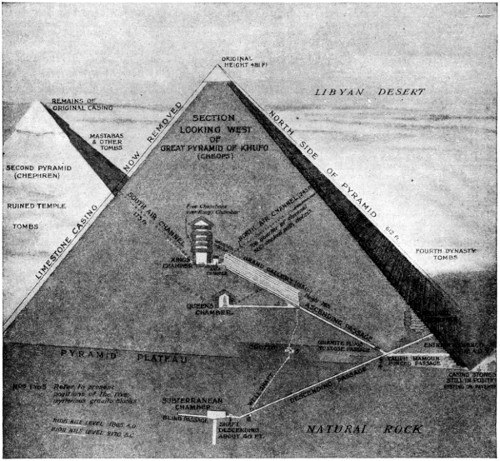
SECTIONAL VIEW OF THE GREAT PYRAMID OF CHEOPS OR KHUFU
This cross-section clearly exhibits the known passages within the seven million ton monument, which for six thousand years has stood to commemorate Cheops (See page 350).
Large image (518 kB)
The Second Pyramid, or pyramid of Chephren (Khafra), was originally four hundred and seventy-two feet high and seven hundred and six feet in base-measurement. It has two entrances, and interior passages and chambers similar to those of the Great Pyramid. It retains at the top, part of its smooth exterior casing.
The Third Pyramid, that of Menkaura, was two hundred and fifteen feet high, and three hundred and forty-six feet to a side at the base. The entrance-passages and sepulchral chambers are similar to those of the other pyramids. All three were built by the fourth dynasty. Temples, now ruined, stand before the eastern faces of the second and third pyramids.
Sphinx (sfingks).—This celebrated figure is a quarter of a mile southeast of the Great Pyramid. According to present opinion, it is older than any of the pyramids. It consists of an enormous figure of a crouching sphinx of the usual Egyptian type, hewn from the natural rock, with the flaws and cavities filled in with masonry. The body is one hundred and forty feet long; the head measures about thirty feet from the top of the forehead to the chin, and is fourteen feet wide. Except the head and shoulders, the figure has for ages generally been buried in the desert sand.
Between the paws were found an altar, a crouching lion with fragments of others, and three large inscribed tablets, one, fourteen feet high, against the Sphinx’s breast, and the two others extending from it on each side, thus forming a sort of shrine. The Sphinx was a local personification of the sun-god.
Heliopolis (hē-li-op´ō-lis) the City of the Sun, or On—the oldest, perhaps, in this land of antiquities—was a sort of sacerdotal and university town, where Herodotus sought the wisest men in Egypt. Here Plato is said to have graduated. Here also lived Potiphar, who bought Joseph the patriarch. It consisted for the most part of temples and colleges; of which nothing now remains but a few isolated mounds, and one extremely ancient Obelisk. At the village of Metariyeh is reputed to be the place where the Virgin, St. Joseph and the infant Jesus stopped, under a sycamore.
Memphis (mĕm´fis) after the fall of Thebes, became the capital of Egypt, and kept its importance till the conquest by Cambyses. It was built by Menes on the western bank of the Nile, south of Cairo. It suffered from the Hyksos, and was captured by the Assyrians and stormed by Cambyses. It continued to exist under the Roman Empire, but was gradually abandoned and ruined after the Mohammedan conquest in the seventh century A. D. The ruins of Sakkara are near it. The desert sands have overwhelmed its famous avenue of sphinxes; and the great Pyramids of Gizeh, and the colossal Sphinx, are the chief memorials of the past in its vicinity.
Although various opinions have prevailed as to their use, the Pyramids were really nothing more than the tombs of monarchs of Egypt who flourished from the first to the twelfth dynasty. With the exception of some very late pyramids in Nubia, none were constructed after the twelfth dynasty; the later kings were buried at Abydos, Thebes, and other places, in tombs of a totally different construction.
Thebes (thēbz) is the No or No Ammon of Scripture, and is situated on the Nile opposite Karnak and Luxor. It was at the height of its splendor, as capital of Egypt from about 1600 to 1100 B. C. Its vastness is shown by the existing remains, known (from the names of modern villages) as the ruins of Karnak, Luxor, etc. They consist of obelisks, sphinxes, colossal statues, temples, and tombs cut in the rock,—mighty monuments, with their countless sculptured details and inscriptions, themselves the historians of the Egyptian Empire of three thousand years ago. It was enriched by the spoils of Asia and the tributes of Ethiopia, and its fame and reputation had reached the early Greeks. At the Persian conquest in the sixth century B. C. Cambyses destroyed many of its noblest monuments.
At the present day the glory of Thebes consists in its ancient temples. Of these the best known are the El Kurna, the Rameseum and Medinet-Abu temples, founded by Seti I., Rameses II., and Rameses III. respectively. To Amenhotep III. are ascribed two temples on the west side of the city, as also the well-known temple at Luxor.
Luxor (luk´sor).—The present front of the latter temple was preceded, at the end of a great dromos of sphinxes leading to Karnak, by two beautiful obelisks of red granite, one of which still remains, and the other stands in the Place de la Concorde, Paris.
Before the large double gateway of the court are two colossal seated statues. The court is surrounded by a double range of columns. Beyond, the avenue to the buildings of Amenhotep makes a sharp angle and meets the gateway of the court, which is surrounded by a double colonnade. The buildings behind the court contain a great number of chambers and an isolated sanctuary, all profusely sculptured and colored.
Karnak (kär´nak).—The temple here originally founded in the twelfth dynasty, owes much of its magnificence to later kings. The Great Temple extends to a length of about twelve hundred feet from west to east, and is comparatively regular in plan. The double gateway of the great court is about three hundred and seventy feet wide; the court is colonnaded at the sides, and has an avenue of columns in the middle.
A second gateway follows, and opens on the famous hall, one hundred and seventy by three hundred and twenty-nine feet, with central avenue of twelve columns sixty-two feet high and eleven and one-half feet in diameter, and one hundred and twenty-two columns forty-two and one-half feet high at the sides. A narrow court follows, ornamented with figures and containing two obelisks.
Behind this building is another large open court, at the back of which stands the edifice of Thothmes III., an extensive building containing a large hall and many comparatively small halls and chambers.
The mural sculptures are vast in quantity, and highly interesting in character, particularly those which portray the racial characteristics of various conquered Asiatic peoples.
Suez (sōō-ez´).—A seaport of Egypt, situated at the head of the Gulf of Suez, is best known as the southern terminus of the Suez Canal. It was the ancient Arsinoë and the terminus of an ancient canal built by the Egyptian king, Rameses II., between the Nile delta and the Red Sea. This, having been allowed to fill up and become disused, was reopened by Darius I. of Persia. It was once more cleared and made serviceable for the passage of boats by Arab conquerors of Egypt.
In 1841 the French diplomat Lesseps set himself to study the isthmus of Suez thoroughly, and in 1854 he managed to enlist the interest of Said Pasha, khedive of Egypt, in his scheme for connecting the Mediterranean with the Red Sea.
Two years later the Porte granted its permission and the Universal Company of the Maritime Suez Canal was formed, receiving important concessions from the ruler of Egypt. The work was begun in 1859, and in 1869, the canal was duly opened for vessels. Between 1885 and 1889 the canal was enlarged and improved, and altogether over one hundred million dollars were spent in its construction. The total length is one hundred miles; the width of the water-surface was at first one hundred and fifty to three hundred feet, the width at the bottom seventy-two feet, and the minimum depth twenty-six feet. At Port Said two strong breakwaters, six thousand nine hundred and forty and six thousand and twenty feet long respectively, were run out into the Mediterranean; at Suez another substantial mole was constructed.
The making of the canal was facilitated by the existence of three or four valleys or depressions (formerly lakes), which, when the water reached them, became converted into lakes. Immediately south of Port Said the canal crosses Lake Menzaleh (twenty-eight miles long); and three more—Lake Ballah, Lake Timsah (five miles long), and the Bitter Lakes (twenty-three miles) are traversed to the south of it. The highest point or elevation that was cut through does not exceed fifty feet above sea-level. At intervals of five or six miles sidings or side-basins are provided to enable vessels to pass one another. By 1890 the canal had been deepened to twenty-eight feet, and widened between Port Said and the Bitter Lakes to one hundred and forty-four feet, and from the Bitter Lakes to Suez to two hundred and thirteen feet.
In 1875 Lord Beaconsfield, Prime Minister of England bought for the British Government the khedive’s shares—nearly half the canal stock—for $20,500,000. They are now valued at about $150,000,000, and bring in over $5,000,000 annual revenue.
From Suez there is a tourist route to Mount Sinai, near the coast, under the range called Jebel-et-Tih past Elim, Pharaoh’s Quarries, and Rephi-dim. The Sinai District comprises Mount Horeb, the Valley of Jethro, Church of the Burning Bush, Chapel of Elijah, and other historical sites. Thence it leads to Akabah, and up the deep pass of Wady Moosa, to Mount Hor (or Petra), Zoar, and Mount Seir, Beersheba and Hebron. (See Holy Land).
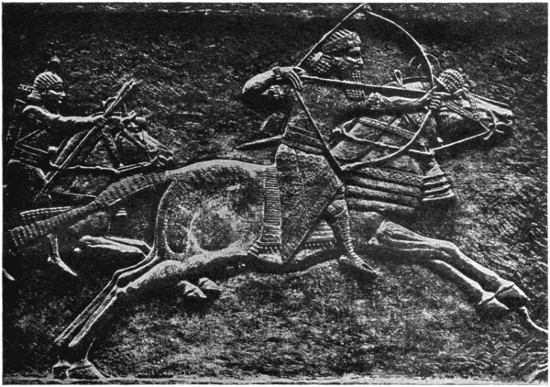
GREAT ASSYRIAN MONARCH, ASHURBANIPAL, AS A LION HUNTER
This famous conqueror was one of the most enlightened of Assyrian rulers. He encouraged literature, and through his wise counsels the annals of Babylonia and Assyria, written on clay tablets, have been preserved for us in the library of his palace. From these we have learned practically all we know of Babylonian-Assyrian history and religion.
BABYLONIA—ASSYRIA
In the very first ages of the world, Babylonia, with Egypt, led the way as the pioneers of mankind in the arts of civilization. Alphabetic writing, astronomy, history, chronology, architecture, plastic art, sculpture, navigation, agriculture, textile industry, all had their origin in one or other of these two countries.
GEOGRAPHY AND PHYSICAL FEATURES OF THE REGION
The ancient kingdom of Babylonia was bounded on the east by Elam or Susiana; on the south by the Persian Gulf; on the west by the deserts of Arabia; and on the north by Assyria. It was watered by two streams, the Tigris and the Euphrates, and it was intersected by a number of canals, branching out from these great rivers, and dug in order to save the country from the effects of the annual inundations.
From the head waters of the Tigris and Euphrates to the Persian Gulf is a distance of about eight hundred miles. The land included between the two rivers divides itself naturally into two parts.
The northern one of these, Assyria, is a great plain of limestone and selenite, in area almost equal to England. The northern and western portions of this plain are broken by mountains and are of a fertile character, as is also that part of Assyria which lies east of the Tigris.
The southern of the two principal parts, Babylonia, is of alluvial character, and in ancient times was about equal in area to the combined territory of Holland and Belgium or to the southern half of Louisiana, the latter a region to which it has been likened in character. On the east of the Tigris, the Babylonian plain stretches away for a distance of some thirty to fifty miles, to the mountains of Elam. On the west it merges into the Arabian desert, twenty or thirty miles from the Euphrates, where the low hills check the overflow of the river.
EARLY DIVISIONS AND FAMOUS CITIES OF BABYLONIA
Babylonia appears to have been divided into the two large provinces of Sumer or Shinar (South Babylonia), and Accad or north Babylonia. The capital of this latter province was, like Babylon, built on both banks of the Euphrates, the larger half being called Sippara of Samas, the sungod (the modern Abu Habba), and the smaller half Accad or Agade. The latter was afterwards named “Sippara of the moon-goddess.” The greater part of Babylonia is now included in the modern Turkish province of Bagdad.
Ancient Babylonia also contained a number of other large cities and there was a succession of famous capitals: Babylon, of the Babylonian Empire, and afterwards of the Persian; Seleucia, founded by Seleucus, king of Syria, after the death of Alexander the Great; Ctesiphon, capital of the Parthian Empire; in modern times, Bagdad.
Babylon, on the Euphrates, is first mentioned in a tablet of 3800 B. C. From 2250 B. C. it became the capital of Babylonia and the holy city of western Asia. The name Babylonia is the Greek form of Babel, meaning “The Gate of the God.” Its Persian name was Babirus. It was according to the accounts of Greek writers, the greatest city of antiquity.
Nebuchadnezzar, who took more pride in the buildings constructed under his auspices than in his victorious campaigns, concentrated all his care upon the adorning and beautifying the city. To this end he completed the fortification of the city begun by his father Nabopolassar, consisting in a double inclosure of mighty walls which were strengthened by two hundred and fifty towers and pierced by one hundred gates of brass. The city itself was adorned with numerous temples, chief among them Esagila (“the high-towering house”), temple of the city and of the national god Merodach (Babylonian Marduk) with his spouse Zirpanit. In the neighborhood of it was the royal palace, the site of which was identified with the ruins of Al-Kasr. Sloping toward the river were the Hanging Gardens, one of the seven wonders, the location of which is in the northern mound of ruins, Babel.
The Tower of Babel, which is supposed to be the temple of Nebo in Borsippa, not far from Babylon, represents the most imposing ruin of Babylonia. It is termed in the inscriptions Ezida (“the eternal house”), an ancient sanctuary of Nebo, and was restored with great splendor by Nebuchadnezzar. It represents in its construction a sort of pyramid built in seven stages, whence it is sometimes called “temple of the seven spheres of heaven and earth,” and it is assumed that the narrative of the “Tower of Babel” which the builders intended to carry up to heaven, was connected with this temple.
In the conquest of Cyrus, 538 B. C., the city of Babylon was spared. Darius Hystaspis razed its walls and towers. Xerxes (486-465 B. C.) despoiled the temples of their golden statues and treasures. Alexander the Great wished to restore the city, but was prevented by his early death. The decay of Babylon was hastened by the foundation in its neighborhood of Selencia, 300 B. C., which was built from the ruins of Babylon. The last who calls himself in an inscription “King of Babylon” was Antiochus the Great (223-187 B. C.)
EARLY HISTORY RIVALS THAT OF EGYPT
It is now evident, from the monuments and inscriptions which have been obtained from the traditionally oldest cities, that the civilization of the ancient people of Babylonia has an antiquity rivaling that of ancient Egypt. The American discoveries at Nippur in 1888-90 carry back Babylonian civilization to about 7000 B. C.
The early struggles for supremacy among the city states seem to have been confined to the lower valley of the Tigris and Euphrates; but about 4000 B. C. a mighty conqueror, Lugalzaggisi of Uruk, made expeditions to the Mediterranean and to the mountains at the north of Mesopotamia. He styled himself “King of Uruk,” “King of the Totality.”
Very early, however, a Semitic invasion must have taken place, for the date of two Semitic kings, namely, Sargon I. and Naram-Sin, of Accad, is placed, according to the testimony of the later Babylonians themselves, at about B. C. 3800 and 3750 respectively. Gudea, the priest-king, and a famous builder, was the chief ruler about 2800 B. C.
GREAT PERIOD OF HAMMURABI
About B. C. 2250 Hammurabi sat upon the throne of Babylon, the name of which now first appears in cuneiform records, although it may have been founded centuries before. This great monarch, Hammurabi, has left records of his enlightened efforts for the agricultural development of the land, and a great law code, cut in the enduring rock, which carries our knowledge of the history of law back a thousand years before the age of Moses. As yet no inscription has been discovered giving the details of his wars; but it is evident that he destroyed the Elamite power in Babylonia, and his assumption of the ancient titles “King of Sumer and Accad,” “King of the Four Quarters of the World,” seems to indicate that his power extended far. In Larsa and Sippar he erected temples to the sun-god, and at Babylon and Borsippa he enlarged those already standing. His great canal running down through the heart of Babylonia made the bordering territory fertile; and the granary built at Babylon stored the increased crops of grain. It may be that Lugalzaggisi and Sargon I. exceeded Hammurabi in the extent of their sway, but Hammurabi made Babylon the center of culture for southwestern Asia during millenniums.
After him we know little of the history until Burnaburiash, a Hassite king who was on the throne about 1400 B. C., exchanged letters with Amenhotep III. of Egypt as recorded in the Tel-el-Amarna Letters.
About 1250 B. C. Babylonia was conquered by Assyria, and, though it soon regained its independence and was again ruled by native kings, it remained a politically subordinate power, and was repeatedly conquered by its more powerful neighbor, until the fall of Nineveh, consequently we must now consider Assyria, as the successor of the first Babylonian Empire, and go back a little into its history up to the time of Tiglath Pileser I., the conqueror of old Babylon.
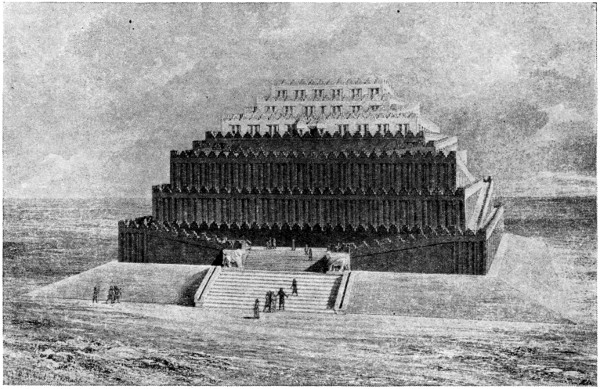
THE TOWER OF BABEL RESTORED
This model of the famous “tower that reached to Heaven” was constructed by Sir Henry Rawlinson after years of study and exploration. The drawing, by O. Schulz, is now in the United States National Museum at Washington, D. C.
II. THE ASSYRIAN EMPIRE
Assyria proper, as heretofore stated, was a table-land, bounded on the north by part of Armenia; on the east by that part of Media which lies towards Mt. Zagros; on the south by Elam or Susiana and part of Babylonia; and on the west by the river Tigris, or later by the Chaboras, a branch of the Euphrates. The greater part of the ancient kingdom of Assyria is now contained in the modern province of Kurdistan. In size it may be compared to Great Britain.
DIVISIONS AND CITIES OF ASSYRIA
It was divided into seven provinces, and contained many great cities, of which the chief after Nineveh, the capital, were Asshur, which alone stood on the west bank of the Tigris, Calah, Dur-Sargon, Arbela, Tarbisi. The ruins of many cities are grouped around Nineveh; while lower down the Tigris is exhibited an almost unbroken line of ruins from Tekrit to Bagdad.
Nineveh was situated on the eastern bank of the upper Tigris opposite the modern Mosul, two hundred and thirty miles northwest of Bagdad. The ruins of the original capital, Asshur, now called Kalah Sherghat, are some sixty miles south. Nineveh, Calah (Nimrud), and Dur-Sargon (Khorsabad), ultimately supplanted it in importance. When Nineveh itself fell, the whole Assyrian empire—essentially a military power—perished with it. It was not until the excavations of Botta in 1842 and Layard in 1845 that the remains, first of Dur-Sargon, then of Nineveh itself, were revealed to the world.
As a result of these excavations, the general outline of the city, the remains of four palaces and numerous sculptures, and thousands of tablets (principally from the so-called library of Ashurbanipal) were discovered. The greater part of these is now in the British museum. The city had a circumference of from seven to eight miles, the ruins of the walls showing a height in some parts of fifty feet. Shalmaneser I. built a palace at Nineveh and made it the city of his residence. Samsi-ramman III. decorated and restored the temple of Ishtar, famous for a special phase of the cult of the goddess. For a time Nineveh was neglected, but Sennacherib (705-681 B. C.), was a special patron of Nineveh. He surrounded it with a wall, replaced the small palace at the northeast wall by a large one, built another palace which he filled with cedar wood and adorned with colossal bulls and lions, and beautified the city with a park. Esarhaddon finished a temple, widened the streets, and beautified the city, forcing the kings whom he conquered to furnish materials for adorning the city and palaces. Nineveh succumbed to the combined attack of the Medes under Cyaxares and the Babylonians under Nabopolassar in 608 B. C.
In its times of prosperity, Assyria extended its borders on every side; and the Greeks and Romans often included the whole of Syria and of the regions watered by the Euphrates and the Tigris under the name.
Assyria and the neighboring provinces were celebrated for their great fertility; they were the original home of wheat and barley, and the date-palm grew there to perfection. The irrigation of the crops was ensured by the annual overflow of the Tigris.
EARLY ASSYRIAN HISTORY SHOWN BY THE INSCRIPTIONS
The Assyrian kingdom first began to be powerful about 1350. Shalmaneser I. had become so powerful that he invaded and captured Babylon about 1250 B. C. His descendant in the direct line of kings was Tiglath-Pileser I., about 1100 B. C., the real founder of the first Assyrian empire, whose reign forms the zenith of the early empire. He spread the dominion of Assyria over all western Asia, from the frontiers of Elam to the shores of the Mediterranean, and from the slopes of the mountains of Armenia to the shores of the Persian Gulf. He captured Babylon, Sippara, and reduced Babylonia to the position of a tributary state. On the west he advanced as far as Khilikhi (Cilicia), defeated the Hittites, captured their stronghold Carchemish, and received the homage of the people of Arvad and the cities of northern Phœnicia.
SECOND IMPORTANT DYNASTY ESTABLISHED
In 960 B. C. a new dynasty was founded by Assur-dân II., whose son Rimmon-nirari II., and great-grandson Asshur-nasirpal, by a long series of cruel wars once again extended the power of Assyria. The extensive trade carried on by Phœnician merchants in Assyria at this time is largely illustrated by the Phœnician bronzes and ivories disinterred in the palace of Asshur-nasirpal at Nimrud.
His son, Shalmaneser II., was successful in war against the monarch of Babylon, Benhadad, king of Damascus, the rulers of Tyre and Sidon, and Jehu, king of Israel. In 745 B. C., Tiglath-Pileser II. became king of Assyria, made himself master of Babylon, and had great successes in war against Syria and Armenia, extending the empire greatly.
REIGN OF SARGON THE ASSYRIAN
Sargon (722-705 B. C.) was engaged in war against Samaria, which he captured, carrying the people into captivity; against King Sabako of Egypt, whom he defeated; and the revolted Armenians, whom he thoroughly subdued. He then turned against Merodach-Baladan, king of Babylonia, and drove him from his throne, and, after extensive internal reforms, was succeeded by his son, the famous Sennacherib.
ASSYRIA BEGINS PERIOD OF GREATEST SPLENDOR
This warlike monarch marched into Syria in 701 B. C., captured Sidon and Askelon, defeated the forces of Hezekiah, king of Judah, with his Egyptian and Ethiopian allies, and made Hezekiah pay tribute. In 700 B. C. Sennacherib marched into Arabia, there defeated Tirhakah, king of Egypt and Ethiopia, and then his army perished before Libnah, in the south of Judah, by the catastrophe recorded in the Hebrew Scriptures. Sennacherib was engaged, on his return to Assyria, in crushing rebellions of the Babylonians, constructing canals and aqueducts, and greatly adding to the size and splendor of Nineveh.
In 681 he was murdered by two of his sons, and another son, Esarhaddon, became king in 680. Esarhaddon made successful expeditions into Syria, Arabia, Egypt, and as far as the Caucasus Mountains, and after the erection of splendid buildings at Nimrud and other cities, was succeeded in 668 by his son Asshur-banipal (the origin of the Greek “Sardanapalus”).
GREAT EXTENT OF THE EMPIRE AT ITS HEIGHT
The Assyrian Empire was at its height of power under the kings Sennacherib, Esarhaddon, and Asshurbanipal. The states nominally subject to the Assyrian king, paying tribute and homage, extended from the river Halys, in Asia Minor, and the seaboard of Syria, on the west, to the Persian Desert on the east; and from the Caspian and the Armenian Mountains, on the north, to Arabia and the Persian Gulf, on the south; and latterly included Egypt.
DECLINE AND FALL OF THE EMPIRE
Ashurbanipal inherited Egypt as part of his dominions, but his power was not firmly established in that country until he led an expedition there, and sacked the city of Thebes. He erected splendid buildings at Nineveh and Babylon, and did much for literature and the arts; so that under him there was a great development of luxury and splendor. He died in 625 B. C.; and soon afterwards Babylonia, for the last time, and with success, revolted. The Babylonians marched from the south against Nineveh, under their governor Nabopolassar; and the now powerful Medes, from the north, came against it under their king, Cyaxares. Nineveh was taken and given to the flames, which have left behind them in the mounds the calcined stone, charred wood, and statues split by the heat, that furnish silent and convincing proof of the catastrophe. Thus, about 625 B. C., warlike, splendid, proud Assyria fell, after which it became a Median province.
III. LATER BABYLONIAN EMPIRE
The founder of the later Babylonian Empire (625 B. C. and ending 538, with its subjection to Persia) was Nabopolassar, who joined the Medes in the destruction of the Assyrian power. Babylon then became an independent kingdom, extending from the valley of the Lower Euphrates to Mount Taurus, and partly over Syria, Phœnicia, and Palestine.
THE FAMOUS REIGN OF NEBUCHADNEZZAR
Nabopolassar was succeeded by his son, the famous Nebuchadnezzar (604 to 561 B. C.), who carried his arms with success against the cities of Jerusalem and Tyre, and even into Egypt. The empire was at its height of power and glory under him, and extended from the Euphrates to Egypt, and from the deserts of Arabia on the south to the Armenian Mountains on the north.
The carrying into captivity of the Jews by Nebuchadnezzar and the pride of his heart,—his image of gold in the plain of Dura, his fiery furnace, his strange madness, recovery, and repentance,—are well known from the account in the Hebrew Scriptures by the prophet Daniel.
Nebuchadnezzar was succeeded by his son Evil-Merodach, the friend of Jehoiachin, captive King of Judah. He was followed by Neriglassar, a successful conspirator against his power and life; and he in turn, after some years, was defeated and slain in battle against the Medes and Persians. The assassination, after a few months, of the tyrant Laborosoarchod brought the last Babylonian monarch, Nabonidus, to the throne, in 555 B. C.
FALL OF BABYLON UNDER BELSHAZZAR
The Medes and Persians to the north had now become a formidable power, and in 540 the Persian king, Cyrus, marched against Babylon, and under its walls defeated Nabonidus, who fled to Borsippa, south of Babylon. The capital was held by a son of Nabonidus, who had been made co-king with his father,—Belshazzar. The revelries of this sovereign during the siege, the handwriting on the wall, and his death the same night, are given in the scriptural narrative of Daniel. The Babylonian Empire fell in 538 B. C., and became a province of the Persian Empire. The site of the great city of Babylon is now a marsh, formed by inundations of the river, due to the destruction of the embankments and the choking up of the canals.
IV. CIVILIZATION IN BABYLONIA AND ASSYRIA
Commerce and Manufactures.—The Babylonians were a commercial and luxurious people; the Assyrians were pre-eminently warlike. The position of the great city of Babylon on the Lower Euphrates, near to the Persian Gulf, made it a great emporium for the trade between India and eastern Asia and western Asia, with the nearest parts of Africa and Europe. From Ceylon came ivory, cinnamon and ebony; spices from the eastern islands; myrrh and frankincense from Arabia; cotton, pearls, and valuable timber, both for ship-building and ornament, from the islands in the Persian Gulf. There was also a great caravan trade with northern India and adjacent lands, whence came gold, dyes, jewels, and fine wool.
Manufactures.—The wealth of Babylon became prodigious and proverbial, and her commerce was, in large measure, due to ingenious and splendid manufactures. Carpets, curtains, and fine muslins, skilfully woven and brilliantly dyed, of elegant pattern and varied hue, were famous wherever luxury was known. The Babylonian gems in the British Museum display art of the highest order in cutting precious stones.
Government and Learning.—The system of government was a pure despotism, with viceroys ruling the provinces under the monarch, who dwelt in luxurious seclusion from his people. The priests and learned men of Babylon were mainly Chaldæans.
There were astronomers or, more properly, astrologers, in several of the cities; and the towers, such as that of Babel, were probably both temples and observatories. The clearness of the sky and the levelness of the horizon on all sides favored the study of the stars, which was more closely connected with religion than any form of science. The Chaldæans worshipped the heavenly bodies. When Babylon was taken by Alexander the Great, in 331 B. C., there was found in the city a series of observations of the stars dating from 2234 B. C.
Architecture and Art.—Assyrian art must be considered great in architecture and sculpture. The emblematic figures of the gods show dignity and grandeur. The scenes from real life, of war, and of the chase, are bold and vivid; and in succeeding ages marked progress is shown in the acquirement of a more free, natural, life-like and varied execution, though the artists never learned perspective and proportion.
The Assyrians constructed arches, tunnels, and aqueducts; were skilled in engraving gems, and in the arts of enamelling and inlaying; made porcelain, transparent and colored glass, and even lenses; ornaments of bronze and ivory, bells, and golden bracelets and earrings of good design and workmanship, were all produced. In mechanics, and for measuring time, they used the pulley, the lever, the water-clock, and the sun-dial.
Implements and Method of Warfare.—The implements and methods used in war, as the monuments show, included swords, spears, maces, and bows and arrows, as weapons of offence; cavalry and chariots for charging; movable towers and battering-rams for sieges; and circular intrenched camps as quarters for a military force.
Religion.—In common with all Semites, the Babylonians were exceedingly religious, and were consequently greatly in the power of their priests, through whom tithes and offerings to their numerous gods were made.
Their earliest chief divinity was apparently the god Ea, lord of the deep, possessor of unsearchable wisdom, and creator of all things. When, however, Babylon became the chief of the city states of Babylonia, Merodach, the god of that city, assumed the first place. He was a reflection of the sun, or the light of day, and was worshiped as he who constantly sought to do good to mankind. His chief title was Bel, (Baal of the Bible) “the Lord”; and his vast temples were maintained by the Babylonian kings with pride. The priests attached to this temple were richly endowed, and the maintenance of the worship involved a great outlay. The impression made by this temple and its worship on the Jews during their captivity is reflected in the account of Bel and the Dragon in the Old Testament.
The other gods of Babylonia would seem to have been the same as those of Assyria, which borrowed its religion, as well as its other culture, from Babylonia. Asshur was the chief god, and is always named first in the invocations of the kings. Sin was the moon-god, Shamash the sun-god, Anum the god of the sky, Bel the god of the earth, and Ea the god of the abyss and of profound wisdom. Rammanu (the Biblical Rimmon) was the ruler of the weather, Ishtar (the Biblical Ashtoreth) the goddess of love, Nebo the god of learning, and Nergal the god of war and hunting. The Assyrian temples always contained statues of the gods or goddesses, and sometimes a particular statue was held in special veneration, as the Ihstar of Nineveh, or the Ihstar of Arbela; only two statues of a god have been discovered in modern times, namely the two limestone figures of Nebo, disinterred in a temple at Nimrud, and dating from the eighth century B. C. With regard to public worship, we know that constant sacrifices and libations were offered to the gods, images were carried in procession, and a highly organized and richly endowed priesthood existed. The building and maintenance of temples were among the chief functions of the king, who himself boasted of the title of high priest.
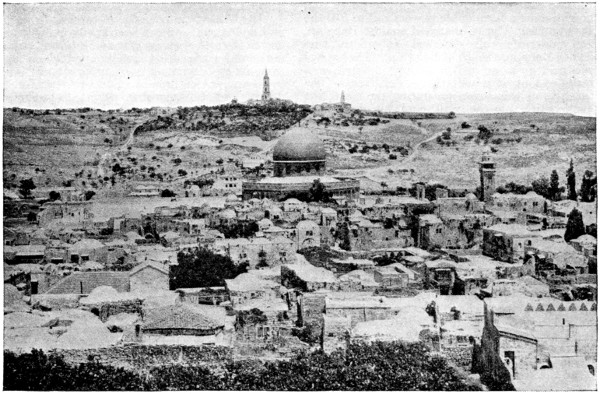
JERUSALEM, THE HOLY CITY OF THE JEWS
THE HEBREWS AND THE HOLY LAND—PALESTINE
The history and characteristics of the Hebrews are fully dealt with in the Old Testament, the important parts of which should be familiar to everyone.
They were a pure Semitic race, akin to the Phœnicians, Chaldeans, and Assyrians. The founder of the nation was Abraham, who, about the twenty-third century before Christ, removed from the plains of Mesopotamia to the land of Canaan, on the southeastern coast of the Mediterranean Sea. This land has since been variously named Palestine, Canaan, the Land of Israel, or the Holy Land, and was the scene of most of the great events of the Bible. Just as the old name Canaan denoted originally the low-lying country along the coast, so Palestine means literally “Land of the Philistines,” and was not used of the inland districts before the time of the Romans.
THE UNIQUE SITUATION AND IMPORTANCE OF THE HOLY LAND
The whole region is practically an isolated oasis, with a productive climate due to proximity to the sea.
All communication between the Babylonians, the Chaldeans and the Assyrians on the one hand, and the Egyptians on the other, was by the way of Palestine. Thus the Holy Land was at the very center of the ancient world. It is this position with its fundamental significance in history which renders it unique among the lands of the earth. It has always been the refuge of the drifting populations of Arabia. Never sought for itself alone, except by the Crusaders, it has been over-run constantly by invaders from the north seeking Egypt, or by the return attack. Thus the Hittites, Ethiopians, Assyrians, Egyptians, Scythians, Parthians, Persians, Seljuk Turks, and Mongols in turn devastated it. Alexander passed through to Egypt in 322 B. C.; the wars of the Seleucids and Ptolemies passed over it; Pompey in 65 B. C. brought it under the Roman Empire; the Crusaders established themselves there from 1098 to 1187; Napoleon in 1799 abandoned his first ambition on its soil. Yet its destiny was typified by the Arab conquest in 634 A. D.; there is everything to attract the desert tribes, but nothing for others except the religious sentiment of Christians.
HISTORY OF THE HEBREWS OR ISRAELITES
The ancestors of the Israelites were certain of the pastoral tribes having their abode in the wild tracts to the south and east of Palestine. Their nearest kinsmen were Edom, Ammon, and Moab. About 2200 B. C. they migrated under their tribal chief, Abraham, from Haran in Mesopotamia into the land of Canaan. Here the tribes continued to lead a pastoral life, and ultimately, in the time of Jacob, a famine in the land of Canaan led to a fresh migration into Egypt. This movement is especially associated with the name of Joseph.
ISRAELITES UNDER THE EGYPTIANS
Here they obtained leave from Pharaoh to dwell in the land of Goshen, where their continued adherence to their own customs and pastoral life led them to be accounted barbarians by the cultured Egyptians. In Egypt a time of great oppression came upon the Hebrews, and they were subjected to the harshest treatment and repressive measures, induced by a fear lest they should ally themselves with Egypt’s foes. Then there arose the figure of Moses, the great founder of both the religion and the law of Israel.
THE EXODUS UNDER MOSES
Moses was the son-in-law of a priest of Midian, and at Horeb (i. e. Sinai), the mountain of God, he heard the call of Yahweh (Jehovah), his father’s God, to deliver Israel from the bondage of Egypt. He had much difficulty in rousing the enthusiasm of those he was sent to save, but ultimately the work was accomplished by means of the miracles wrought by Yahweh on behalf of his people. Moses led the Israelites to Mount Sinai, and here a covenant was solemnly made with Yahweh, and the new religion of Israel was inaugurated, a religion that may rightly be called new, because based upon a conception of the Deity, more spiritual than any which had yet been conceived. From Sinai they passed to the work of conquering Canaan for which they had set out. An attempt made at Kadesh on the southern frontier was unsuccessful, and they returned to the wilderness, for a time which according to the Biblical narrative made the whole period forty years.
THEY ENTER THE LAND OF CANAAN
During this time Moses died, and it was under Joshua that the entry into Palestine was finally made. The Canaanites were put down, but intermarriage between Hebrews and Canaanites was frequent. Hence came the ills of idolatry. The Israelites now settled down to an agricultural and commercial life, entering in many cases into treaties of friendship with their Canaanite neighbors. This weakened the bonds of union between the various tribes and might well have led to the ultimate fusion of the two races; but it was prevented by the rise from time to time of the Judges, who roused the dying ardor of the tribes and led them to the extermination of the enemies of Yahweh.
PERIOD OF THE JUDGES
Fifteen such heroes are named in the Book of Judges, from which book it will be seen how various were the enemies with which they had to contend. Their period shows a regular alternation of sin, punishment, and salvation. After Joshua, comes a long period of falling away, followed by the rise of Othniel who delivers Israel from the oppressions of Cushan of Mesopotamia, into whose hands they had been given. On his death, Israel again sins and is punished by Eglon, king of Moab. This time salvation comes through Ehud, but his death is followed by another relapse into idolatry, and so things continue. Among the rest of the “Judges,” the most famous are Deborah the prophetess, and Barak, Gideon, Jephthah, Samson, and the prophet Samuel.
During this period Israel does not come at all into contact with the great kingdoms of the East. At the time of the Hebrew settlement in Palestine, the country was under the suzerainty of the Pharaohs, but it is probable that by this time the suzerainty was little more than a name. The conflicts were rather with their own kinsmen, the Moabites, Ammonites, and also the Midianites.
THE POWERFUL PHILISTINE TRIBES
The Philistines were among the most powerful opponents of Israel, and the story of Samson relates particularly to them. It was while suffering under defeat from this race that the Israelites cried for a king, not only that by this centralization of authority more head might be made against the invaders, but also that they might be like “all the other nations.” Samuel the prophet, who was at that time their leader, reluctantly consented to accede to their desires and chose as their king Saul, the son of Kish.
HEBREW MONARCHY, UNDER SAUL, DAVID AND SOLOMON
The sole monarchy occupied three reigns, those of Saul, David, and Solomon. Saul reigned for nearly forty years, and, after wars with the neighboring Moabites, Edomites, Amalekites, and others, was defeated and driven to suicide by the powerful Philistines.
Saul’s son-in-law, David, the son of Jesse, reigned also about forty years, and, having conquered Jerusalem from the Jebusites (1048 B. C.) made it the capital of his kingdom, the seat of the national government and religion. David was a warlike monarch, and conquered the Philistines, Moabites, Edomites, and Syrians, extending his power from the Red Sea to the Euphrates.
THE MAGNIFICENT REIGN OF SOLOMON
His son, Solomon, succeeded him, and also reigned forty years (977-937 B. C.). Then the Hebrew nation attained the height of its power, and he confirmed and extended the conquests of David. Solomon married a daughter of a Pharaoh, king of Egypt, formed an alliance with Hiram, king of Tyre, built the magnificent temple at Jerusalem, and made his kingdom the supreme monarchy in western Asia.
An extensive commerce was carried on by land and sea. Solomon’s ships, manned by Phœnician sailors, traded to the farthest parts of the Mediterranean westward, and from ports on the Red Sea to southern Arabia, Ethiopia, and perhaps India. From Egypt came horses, chariots, and linen; ivory, gold, silver, peacocks and apes from Tarshish or Tartessus, a district in the south of Spain; and gold, spices, and jewels from Ophir, variously regarded as in southern Arabia, India, and eastern Africa, south of the Red Sea. The corn, wine and oil of Judæa were exchanged by Solomon for the cedars of Lebanon supplied by Hiram, king of Tyre.
DECLINE AND DIVISION OF THE MONARCHY
On the death of Solomon, in 975 B. C., the temporal glory of the Hebrews was eclipsed. Ten of the twelve tribes revolted against Solomon’s son and successor, Rehoboam, and formed a separate kingdom of Israel, with Samaria as capital; while the tribes of Judah and Benjamin made up the kingdom of Judah, having Jerusalem for the chief city. The Syrian possessions were lost; the Ammonites became independent; commerce declined; idolatry crept in and grew; the prophets of God threatened and warned in vain; gleams of success against neighboring nations were mingled with defeat and disgrace suffered from the Edomites, Philistines, and Syrians, until, in 740 B. C., Tiglath-pileser II., king of Assyria, carried into captivity in Media the tribes east, and partly west, of the Jordan.
FALL AND CAPTIVITY OF ISRAEL
In 721 B. C., Sargon, king of Assyria, took Samaria, and carried away the people of Israel as captives beyond the Euphrates. The kingdom of Israel thus came to an end after a duration of about two hundred and fifty years.
In 713 B. C., Judah, under King Hezekiah, was attacked by Sennacherib, king of Assyria, and relieved by the destruction of the Assyrian army. A time of peace and prosperity followed, but in 677 the Assyrians again invaded the country, and carried off King Manasseh to Babylon.
FALL OF JUDAH AND BABYLONIAN CAPTIVITY
In 624 B. C., the good king Josiah repaired the temple and put down idolatry, but was defeated and slain by the Egyptian king Pharaoh-Necho, in 610. In 606 B. C., Nebuchadnezzar, king of Babylon, took Jerusalem, and made the king, Jehoiakim, tributary; on his revolt, Jerusalem was again taken, and ten thousand captives of the higher class were carried off to Babylon, with the treasures of the palace and temple. In 593 B. C., the Jewish king Zedekiah revolted from Nebuchadnezzar, who now determined to put an end to the rebellious nation. In 588 B. C., Jerusalem was taken and plundered; the walls were destroyed; the city and temple burned, and nearly the whole nation was carried away as prisoners to Babylon. For over fifty years the land lay desolate, and the history of the Hebrew nation is transferred to the land where they mourned in exile. Then were raised the voices of the prophets Jeremiah and Ezekiel and Isaiah, in their definite predictions of the Messiah.
The history of the Jews during the Babylonish captivity.
RETURN OF THE HEBREWS TO JERUSALEM
In 537 B. C., Cyrus the Great became monarch of the Persian Empire. He issued an edict in 536 B. C., by which the Jews were allowed to return to Jerusalem and rebuild their temple. Nearly fifty thousand Jews, chiefly of the tribes of Judah and Benjamin, went to the old home of their race under the command of Zerubbabel and Jeshua, taking with them many of the vessels of silver and gold carried away by Nebuchadnezzar. Zerubbabel was appointed governor of the land, now a dependency of the Persian Empire. In 519 B. C., the Persian king Darius Hystaspis confirmed the edict of Cyrus, and in 515 the Temple was completed and dedicated. The ten tribes disappeared at this time from history, such of them as returned to their land having united themselves with the tribe of Judah, and henceforth the Hebrews are called Jews and their country Judea.
THE JEWS UNDER EZRA AND NEHEMIAH
In the reign of the Persian king Artaxerxes more of the Jews emigrated from Babylonia to Judea under the command of Ezra, 458 B. C., and Ezra was governor of the land until 445.
Nehemiah was governor (with an interval) from 445 to 420, and under him the walls and towers of Jerusalem were rebuilt, and the city acquired something of its ancient importance. With 420 B. C. the history of the Jews ends, as far as the Scriptural narrative goes.
JUDEA BECOMES SUBJECT TO PERSIA
From 420 to 332, Judea continued subject to Persia, paying a yearly tribute, and being governed by the high priest, under the Satrap of Syria. In 332 B. C., Alexander the Great, then engaged in the conquest of the Persian Empire, visited Jerusalem, and showed respect to the high priest and the sacred rites of the Temple. In 330 the Persian Empire fell under the arms of Alexander, who died at Babylon in 323 B. C. Judea was taken possession of by Alexander’s general, Ptolemy Lagus, and from 300 to 202 B. C. was governed by the dynasty of the Ptolemies, ruling Egypt, Petra and southern Syria. The government was administered by the high priests under the Ptolemies, whose capital was at the new city of Alexandria in Egypt. Now the Jews began to spread themselves over the world, the Greek language became common in Judea, and the Septuagint (or Greek version of the Hebrew Scriptures) was written during this and the following century.
In 202 B. C., Antiochus the Great, king of Syria (including in its empire Asia Minor, Mesopotamia, Babylonia, etc.), conquered Judea from Ptolemy V. Antiochus Epiphanes, one of the sons and successors of the great Antiochus, drove the Jews to rebellion by persecution and profanation of their Temple and religion.
STRUGGLE UNDER THE MACCABEES AND HYRCANUS
Under the great patriot and hero Judas Maccabeus, the Jews asserted their religious freedom in 166 B. C. Antiochus Epiphanes died in 164, and Maccabeus fought with success against the Idumeans, Syrians, Phœnicians and others, who had formed a league for the destruction of the Jews. In 163, Judas Maccabeus became governor of Judea under the King of Syria, but fell in battle, in 161, while he was resisting an invasion of his country by the troops of Demetrius Soter, new ruler of the empire. His brother, Jonathan Maccabeus, ruled from 161 to 143 B. C., amidst many troubles from Syria, and was succeeded by his brother, Simon Maccabeus, who strengthened the land by fortifications, was recognized by the Romans as high priest and ruler of Judea, and fell by assassination in 136 B. C.
His son, John Hyrcanus, threw off at last the yoke of Syria, and made himself master of all Judea, Galilee, and Samaria, reigning then in peace till 106 B. C., when the line of the greater Maccabean princes ended. A miserable time of civil wars and religious and political faction followed.
THE CONQUEST BY ROME
These ended in the interference of Rome; and in 63 B. C. Pompey took Jerusalem, after a siege of three months, and entered the “Holy of holies” in the Temple, with a profanation before unheard of in Jewish history. From this time the Jewish state was virtually subject to Rome, and became, in the end, a part of the Roman province of Syria.
The turbulence of the Jews under Roman rule is well known, and a general rebellion ended, after fearful bloodshed and misery, in the capture and destruction of Jerusalem by Titus, A. D. 70. The history, as a separate political body, of the Hebrews thus ends with the dispersion of their remnant over the face of the civilized world.
GEOGRAPHY OF THE HOLY LAND
The area of the Holy Land is about eleven thousand square miles—nearly as large as Belgium; its greatest length, from Beyrout to the southern point of the Dead Sea, being one hundred and eighty miles, and its greatest breadth, east to west, about sixty-five miles. It has a nearly straight western coast-line, with but two indentations—the Bay of Sidon, and the Bay of Acre. Though the Sinaitic Peninsula is not a geographical part of the Holy Land, its history is really one with it, and is so considered in this article.
Notwithstanding its narrow limits, Palestine presents a remarkable variety of surface, scenery, and climate. The central portion consists of an undulating tableland (the “hills” or “hill-country”), separated from Lebanon on the north by the fertile Plain of Esdraelon (Jezreel). It has a gentle slope towards the west, but descends abruptly to the Jordan valley, the surface gradually rising, as it extends southward, till it reaches its greatest elevation (about 3,300 feet) in the neighborhood of Hebron, beyond which, near Beersheba, it sinks into the Idumæan Desert. The northern part of this tract is more fertile than that towards the south, the least productive district being the country round Jerusalem; but even there, the vine is grown with success, and the barren aspect of the plateau is relieved in many places by gardens of olives and figs and luxuriant cornfields.
To the west of the central tableland and the Lebanon ranges, there runs a strip of low seaboard, which expands into the plain of Philistia; to the north is the Valley of Sharon, once the Garden of Palestine, but now for the most part a marshy or sandy wilderness. The maritime plain is intersected by deep gullies, traversed in some cases by perennial streams. Oranges, lemons, citrons, bananas and melons grow luxuriantly, especially in the gardens of Jaffa and Ascalon.
East of the central tableland is a deep fissure, increasing in width from five to thirteen miles, down which flows the Jordan. Beyond Jordan is another upland district, forming a prolongation of the Anti-Libanus ranges, with an elevation of two to three thousand feet, succeeded on the east by a plateau which stretches away to the Arabian Desert. This region contains wide tracts of excellent pasture.
The highest point in Palestine is Jebel Jermuk (three thousand nine hundred and thirty-four feet). The height of Carmel—a northwestern spur of the uplands terminating in a promontory—one thousand seven hundred and forty feet.