THE BOOK OF NATIONS Geographical, Historical, Descriptive (continued 17)
Reading edition
To the west of the White House is the huge building of the State, War, and Navy Departments, enclosing two courts and measuring five hundred and sixty-seven feet in length by three hundred and forty-two feet in breadth. It is a granite building, in Renaissance style, the largest public edifice in Washington, covering four and one-half acres, has five hundred and sixty-six rooms, and cost eleven million dollars. The north and west wings are occupied by the War Department. The Navy Department is in the eastern part of the building.
The Department of State occupies the southern part of the building. Among the finest rooms are the Diplomatic Reception Rooms, containing portraits of the Secretaries of State from 1789 to the present day, and the Library, with Jefferson’s original draft of the Declaration of Independence and other relics.
In Seventeenth Street, to the southwest of the State Building, between New York Avenue and E Street, is the Corcoran Gallery of Art, built and endowed by the late W. W. Corcoran. The present building, erected in 1894-1897, is a handsome white marble structure in a Neo-Grecian style, by Ernest Flagg. The semicircular hall at the north end is used for occasional exhibitions, while the rest of this part of the building is occupied by a School of Art. The steps to the main entrance are flanked by colossal bronze lions, modeled after those by Canova at the tomb of Pope Clement XIII. The Gallery contains more than two hundred paintings, the finest collection of Barye bronzes, Power’s Greek Slave, and Vela’s Dying Napoleon in marble.
Also in Seventeenth Street, south of the Corcoran Gallery, are the new Continental Hall, built by the Daughters of the American Revolution, and the new building of the International Bureau of the American Republics, erected at a cost of one million dollars by Andrew Carnegie.
The Interior Department occupies an entire square in the heart of the city, and is constructed of white marble in pure Doric, costing three million dollars. The General Land Office opposite is a Corinthian marble edifice.
In Judiciary Square on the north side stands the Pension Office, an enormous structure of brick, four hundred feet long and two hundred feet wide. It is surrounded by a terra cotta frieze illustrating military and naval operations. The interior, with its mammoth columns (seventy-five feet high), can accommodate about twenty thousand people at an inauguration ball, or other occasions.
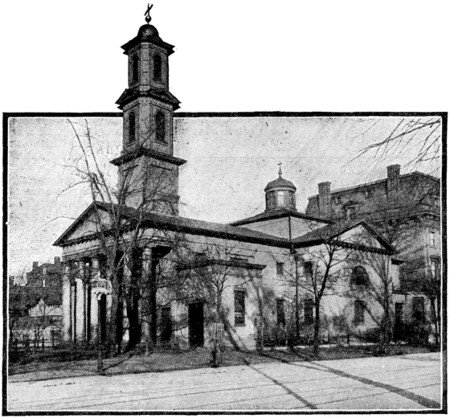
ST. JOHN’S CHURCH, WASHINGTON
Nearby, in B Street, is the large Census Bureau, in which a large staff is constantly at work. The enumerating machines are especially interesting.
To the northeast of this point, at the corner of North Capitol and H Streets, is the Government Printing Office, a twelve-story building erected at a cost of two million dollars.
Ford Theater, in which President Lincoln was assassinated by Booth on April 14, 1865, is in Tenth Street. A house opposite bears a tablet stating that Lincoln died there, and contains a collection of Lincoln relics.
On the south side of Pennsylvania Avenue, between Eleventh and Twelfth Streets, is the Post Office Department, with a tower three hundred feet high. At the corner of Pennsylvania Avenue and Fourteenth Streets is the new District or Municipal Building, a fine marble structure completed in 1908, and occupied by the District Commissioners and other officials of the local government.
At the intersection of Massachusetts Avenue and New York Avenue is Mt. Vernon Square, containing the Public Library, a white marble building, presented by Mr. Andrew Carnegie.
Beyond the Capitol to the southeast are the Washington Barracks, at the junction of the Potomac and its Eastern Branch, an artillery post, and the War College, a fine brick building, erected 1903-1908. In front of the latter is a statue of Frederick the Great by T. Uphues, presented to the United States by Emperor William II.
About one mile to the northeast, on the Anacostia River, is the Washington Navy Yard, with a museum, an important gun foundry, and manufactories of naval stores.
There are more than two hundred and fifty churches in Washington, of which the more important are St. John’s (the “President’s Church”), and St. Thomas’ Episcopal; the New York Avenue, and Church of the Covenant, Presbyterian; the Metropolitan and Foundry, Methodist; St. Matthew’s and St. Aloysius’, Roman Catholic; Calvary, Baptist; Garfield Memorial, Christian; and Mount St. Sepulchre, with its reproduction of the sacred places of the Holy Land.
The National Soldiers’ Home, two miles above the city, founded in 1851, has six hundred acres of park and forest, which serve as a public driving park and rural resort. To the north lies the National Military Cemetery, with the graves of General Logan, General Kearney, and seven thousand soldiers. On the west this is adjoined by Rock Creek Cemetery, containing Saint-Gauden’s beautiful monument to Mrs. Henry Adams. To the east of the Soldiers’ Home Park is the important Catholic University of America, around which has grown up a somewhat remarkable group of ecclesiastical establishments, including a Franciscan Convent, houses of the Dominicans, Paulists and Marists, and Trinity College for young women. The university has a number of fine stone buildings of striking architectural effect. The other colleges of note are: George Washington University, with academic, scientific, graduate, medical, and technological departments, and a famous law school; Georgetown University, a Jesuit institution with academic and professional schools; American University, for graduate instruction only; and the National Deaf-Mute College, founded in 1864, a government institution for the education of deaf and dumb pupils from the army, the navy, and the District of Columbia. Its fine stone buildings lie just north of the city.
Among the more important private buildings may be mentioned those of the Washington Post and Evening Star, and the Munsey buildings, all on Pennsylvania Avenue; the Riggs National Bank, American Security and Trust Company, Washington Loan and Trust, Union Trust and Storage Company, and the National Metropolitan Bank. The larger office buildings are the Bond, the Colorado, the Ouray, the Southern, and Woodward buildings. The Masonic Temple, the Scottish Rite Temple, and the Y. M. C. A. buildings, are important structures.
More and more Washington is becoming the home of a class of wealthy Americans, many of whom have erected beautiful residences, and among those of conspicuous architectural value are the Leiter, Townsend, Walsh, McLean, Belmont, Hale, Anderson, Boardman, Patterson, Thomas Nelson Page, Wayne McVeagh, Henderson, and Gale houses. Of similar interest are the embassy buildings of the British, Chinese, French, Russian, and other nations. The Metropolitan, the Cosmos, the Army and Navy, University, National Press, and the Washington (for women) are the principal clubs, and have homes of their own.
An elaborate park system is in course of development, which will ultimately surround the city with parks and connecting boulevards. The principal park is Rock Creek Park, to the north of the city, containing two thousand acres extending along both sides of Rock Creek. Its natural beauties are very great. On Mt. St. Alban, near Woodley, to the northwest of Georgetown, is the Peace Cross, a large Celtic cross erected at the close of the war with Spain (1898) on the grounds of the new Episcopal Cathedral, of which the cornerstone was laid in 1907. It affords a fine view of Washington. On the Chevy Chase Road, to the northwest of the Zoölogical Park, are the National Bureau of Standards and the Geophysical Laboratory of the Carnegie Institution, the administration building of which latter is in Sixteenth Street.
South of Rock Creek Park, on Rock Creek, lies the National Zoölogical Park of one hundred and seventy acres, reached from Washington in a half hour.
On a commanding site overlooking Rock Creek, north of Georgetown, in handsome grounds, is the United States Naval Observatory, of white marble, with its twenty-six-inch equatorial telescope.
Scattered throughout the city are numerous squares, circles, and small parks, nearly all of which contain statues.
Of bronze statues erected in honor of famous men, Washington has an abundance—mainly to military characters. Equestrian statues of Washington, Jackson, Greene, Scott, Thomas, and McPherson are erected, besides full-length statues of Lafayette, Luther, Franklin, Chief Justice Marshall, Lincoln, Garfield, Professor Henry Farragut, General Rawlins, and Admiral Dupont.
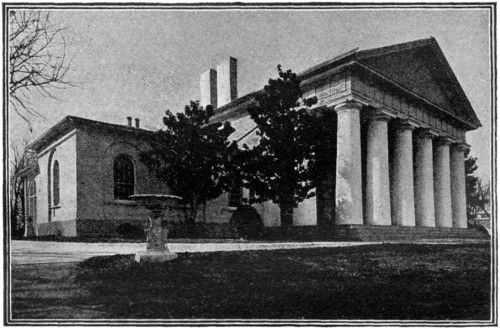
ARLINGTON HOUSE, HOME OF GENERAL ROBERT E. LEE
At Arlington, across the river from Washington, on commanding heights, is the National Cemetery containing the graves of about sixteen thousand soldiers. Arlington House, in the middle of the grounds, two hundred feet above the river, was once the residence of George Washington Parke Custis (step-grandson of Washington) and afterwards of General Robert Lee, who married Miss Custis. Near the house are the graves of General Sheridan, Admiral Porter, General Lawton, General Wheeler, and other distinguished officers.
To the south is a tomb containing the remains of two thousand one hundred and eleven unknown soldiers. The sailors destroyed by the blowing up of the “Maine” in 1898 and other victims of the war with Spain are buried in the southern part of the cemetery.
The cornerstone of a splendid military memorial or Hall of Fame was laid here in 1916, to be erected in classic style, of marble, and to cost several millions of dollars.
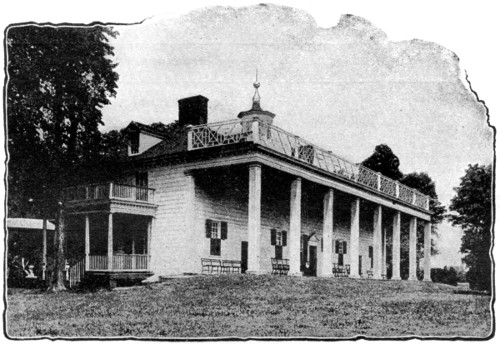
MOUNT VERNON
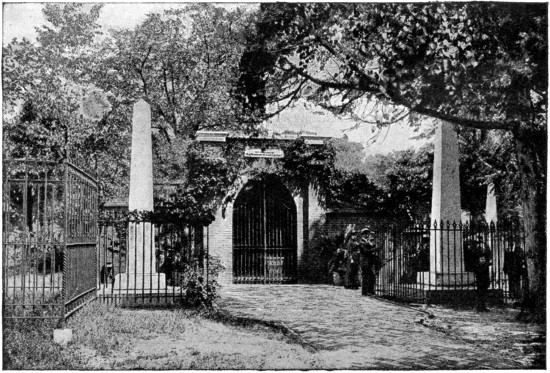
WASHINGTON’S TOMB, MT. VERNON
Mount Vernon, Washington’s home and burial place, is in Fairfax County, Va., about fifteen miles below the city. It is in full view, standing among the trees on the top of a bluff rising about two hundred feet above the river. As the steamboat approaches, its bell is tolled, this being the universal custom on nearing or passing Washington’s tomb. The estate was originally a domain of about eight thousand acres, and Augustine Washington, dying in 1743, bequeathed it to Lawrence Washington, who, having served in the Spanish wars under Admiral Vernon, named it Mount Vernon in his honor. General Washington, in 1752, inherited Mount Vernon from Lawrence. After his death the estate passed to his nephew, Bushrod Washington, subsequently descending to other members of the family.
Congress repeatedly endeavored to have Washington’s remains removed to the crypt under the rotunda of the Capitol, originally constructed for their reception, but the family always refused, knowing it was his desire to rest at Mount Vernon.
In 1856 the mansion and surrounding property were saved from the auctioneer’s hammer, and secured as a national possession by the Ladies’ Mount Vernon Association, assisted principally by Edward Everett, at a cost of two hundred thousand dollars.
Washington, originally called Federal City, was named after Washington in 1791, and became the capital in 1800. In 1814 the Capitol, White House, and other public buildings, were burned by the British.
LEADING EVENTS IN THE COLONIAL HISTORY OF THE UNITED STATES IN THE FORM OF PARALLEL OUTLINES
I. PERIOD OF AUTHENTIC DISCOVERY AND EXPLORATION, FROM 1492 TO 1607
Preceding this Period there are some legendary accounts of discoveries by Norsemen, Irish missionaries and even Asiatics. Little importance attaches to any except those of the Norse discoverers, chief of which was Lief Ericsson and his brother Thorwald who came upon the mainland of North America about 1000 to 1004. The discoveries of Columbus and Vasco da Gama opened a new era, during which the Spaniards explored and settled the West Indies, Mexico, and the southern part of the present United States; while the English and French explored, claimed, and made unsuccessful attempts at settlement in the North.
Dates Spanish Explorers and Rulers Portuguese Explorers and Rulers English Explorers and Rulers European Events Dates
Ferdinand and Isabella, 1474-1516. Emanuel I., the Great, 1469-1521. Henry VII., 1485-1509
1492 1492. CHRISTOPHER COLUMBUS, an Italian, supported by Ferdinand and Isabella, set sail from Palos, Spain (August 3), and discovered America (October 12), landing at one of the Bahamas, which he named San Salvador. During the following three months he visited the islands of Cuba and Hayti. 1492. End of the Moorish dominion in Spain. Death of Lorenzo de Medici, the “Magnificent” at Florence. 1492
1494. Beginning of a series of Italian wars, lasting till 1539.
1497. JOHN CABOT, an Italian in the service of Henry VII. of England discovered the coast of NORTH AMERICA, probably at Labrador. He was accompanied by his son, Sebastian.
1498. Columbus made a THIRD voyage, discovering the island of Trinidad and the mainland of South America, near the mouth of the Orinoco River. 1498. Sebastian Cabot, on a SECOND voyage, probably explored the Atlantic coast from Labrador to Carolina. These voyages were not followed by any attempt at colonization.
1499-1507. Amerigo Vespucci wrote a letter to a friend claiming to have discovered a part of the South American coast in 1499, and an account of this voyage was published. The new continent, therefore, was named after him by the German geographer Waldseemüller, who had read the account. 1499. Vasco Da Gama doubled the Cape of Good Hope and reached India. Another route to India was thus revealed. 1499. The Swiss gain their independence from the Emperor Maximilian.
1500 1500. Cortereal, a Portuguese, explored the coast from Labrador to Nova Scotia. 1500
1502. Columbus made a FOURTH voyage. He explored the coast of Central America and Panama, returned to Spain discouraged and died four years later in the belief that he had discovered India by sailing west. 1502. Outbreak of war between France and Spain in Italy.
1510 Henry VIII., 1509-1547. 1510
1512. Ponce De Leon, seeking a legendary fountain of youth, discovered Florida, so named because he landed on Easter Sunday, the Spanish “Feast of Flowers.” 1511. Pope Julius II. forms the Holy League against France and Spain.
1513. Balboa crossed the Isthmus of Panama and discovered the Pacific, which he took possession of, with its coast and islands, for Spain. Charles I. of Spain and Charles V. of Germany, Emperor. 1516-1556. French Explorers and Rulers 1513. James IV. of Scotland invades England, and is killed at battle of Flodden Field.
Francis I., 1515-1547.
1515. Wolsey appointed Chancellor by Henry VIII. of England.
1519-1521. Cortez conquered Mexico for Spain. This conquest led to the establishment of Spain’s Empire in the new world. The mines brought great wealth to Spain and formed thebasis of Spanish prosperity in the following years. 1519. The German Empire, Spain, Netherlands, Two Sicilies and the Spanish Indies united under Charles V.
1520 1520. Magellan, a Portuguese in Spain’s service, discovered the strait named after him. He reached and named the Pacific Ocean. 1520
1521. Magellan discovered the Philippine Islands. His followers, after his death, continued westward and completed the first circumnavigation of the globe in 1522. 1524. Verrazano, sailing in the service of France, traced the American coast northward from Cape Fear, and discovered New York harbor. 1521. Beginning of the wars between Charles V. of Germany and Francis I. of France.
1527. Captain John Rut explores the coast of North America. 1527. Expulsion of the Medici from Florence.
1530 1539. Coronado and a force of Spaniards marched northward from Mexico to Colorado and Kansas and discovered the Grand Canon of the Colorado River. De Soto, at the same time, led an army of about a thousand into northwest Florida. He reached the Mississippi in 1541. 1535. Cartier, in search of a northwest passage, ascended the St. Lawrence to Lachine Rapids and Mont Réal (Montreal). 1535. Henry VIII. of England assumes the title of supreme head of the Church in England. 1530
1540 1541. Roberval and Cartier made an unsuccessful attempt to establish a French colony on the St. Lawrence. 1543. England enters into an alliance with Charles V. against France. 1540
1550 Philip II., 1556-1598. Elizabeth 1558-1603. 1550
1560 Charles IX., 1560-1574. 1560
1562. Jean Ribault establishes a Huguenot settlement at Port Royal. 1562. Beginning of the Huguenot wars.
1565. The Spaniards, under MENENDEZ, founded ST. AUGUSTINE, Florida. 1565. The Huguenot settlement destroyed by Menendez.
1570 1570
1576-1578. Frobisher, in the interest of England, made three attempts to find a northwest passage to Asia.
1578. Drake explored the Pacific coast as far north as the state of Washington. He had previously doubled Cape Horn. He claimed the land for England.
1580 1582. Spanish monks planted missions in New Mexico and Arizona. 1581. Declaration of independence by the Dutch. 1580
1583. Humphrey Gilbert landed at St. John’s, Newfoundland, and took possession of the country for England. Queen Elizabeth was financially interested in many of the expeditions which followed, and she knighted most of the men who commanded expeditions.
1584. Sir Walter Raleigh sent out an expedition under Captain Arthur Barlow. The expedition landed at Pamlico Sound and the region was named Virginia in honor of Elizabeth.
Henry IV., 1589-1610. 1587. Raleigh despatched another expedition, consisting of two ships with one hundred and fifty men and women, to Roanoke Island. John White was the Governor. Virginia Dare, the first white child born in America, was born here. 1587. Execution of Mary, Queen of Scots. 1588. Battle of the Spanish Armada.
1590 1598. A Spanish settlement was planted by Oñate near Santa Fe, New Mexico. 1595. France declares war against Spain. 1590
1600 1602. Gosnold, an English merchant, made a settlement at Buzzard’s Bay, R. I. James I., 1603-1625. 1600
1603. Champlain entered the St. Lawrence. The French occupation of Canada began with Champlain. His maps, reports, and settlements stimulated French enterprise. 1603. Martin Pring enters the present harbor of Plymouth. 1604. Charles IX. ascends throne of Sweden.
1605. Champlain founded Port Royal (Annapolis, N. S.), and sailed in an exploring expedition as far south as Cape Cod. 1606. In England there was organized the Virginia Company for the purpose of establishing trading colonies in America.
Dates Spanish Explorers and Rulers Portuguese Explorers and Rulers English Explorers and Rulers European Events
Ferdinand and Isabella, 1474-1516. Emanuel I., the Great, 1469-1521. Henry VII., 1485-1509
1492 1492. CHRISTOPHER COLUMBUS, an Italian, supported by Ferdinand and Isabella, set sail from Palos, Spain (August 3), and discovered America (October 12), landing at one of the Bahamas, which he named San Salvador. During the following three months he visited the islands of Cuba and Hayti. 1492. End of the Moorish dominion in Spain. Death of Lorenzo de Medici, the “Magnificent” at Florence.
1494. Beginning of a series of Italian wars, lasting till 1539.
1497. JOHN CABOT, an Italian in the service of Henry VII. of England discovered the coast of NORTH AMERICA, probably at Labrador. He was accompanied by his son, Sebastian.
1498. Columbus made a THIRD voyage, discovering the island of Trinidad and the mainland of South America, near the mouth of the Orinoco River. 1498. Sebastian Cabot, on a SECOND voyage, probably explored the Atlantic coast from Labrador to Carolina. These voyages were not followed by any attempt at colonization.
1499-1507. Amerigo Vespucci wrote a letter to a friend claiming to have discovered a part of the South American coast in 1499, and an account of this voyage was published. The new continent, therefore, was named after him by the German geographer Waldseemüller, who had read the account. 1499. Vasco Da Gama doubled the Cape of Good Hope and reached India. Another route to India was thus revealed. 1499. The Swiss gain their independence from the Emperor Maximilian.
1500 1500. Cortereal, a Portuguese, explored the coast from Labrador to Nova Scotia.
1502. Columbus made a FOURTH voyage. He explored the coast of Central America and Panama, returned to Spain discouraged and died four years later in the belief that he had discovered India by sailing west. 1502. Outbreak of war between France and Spain in Italy.
1510
1512. Ponce De Leon, seeking a legendary fountain of youth, discovered Florida, so named because he landed on Easter Sunday, the Spanish “Feast of Flowers.” 1511. Pope Julius II. forms the Holy League against France and Spain.
1513. Balboa crossed the Isthmus of Panama and discovered the Pacific, which he took possession of, with its coast and islands, for Spain. Charles I. of Spain and Charles V. of Germany, Emperor. 1516-1556. French Explorers and Rulers 1513. James IV. of Scotland invades England, and is killed at battle of Flodden Field.
Francis I., 1515-1547.
1515. Wolsey appointed Chancellor by Henry VIII. of England.
1519-1521. Cortez conquered Mexico for Spain. This conquest led to the establishment of Spain’s Empire in the new world. The mines brought great wealth to Spain and formed thebasis of Spanish prosperity in the following years. 1519. The German Empire, Spain, Netherlands, Two Sicilies and the Spanish Indies united under Charles V.
1520 1520. Magellan, a Portuguese in Spain’s service, discovered the strait named after him. He reached and named the Pacific Ocean.
1521. Magellan discovered the Philippine Islands. His followers, after his death, continued westward and completed the first circumnavigation of the globe in 1522. 1524. Verrazano, sailing in the service of France, traced the American coast northward from Cape Fear, and discovered New York harbor. Henry VIII., 1509-1547. 1521. Beginning of the wars between Charles V. of Germany and Francis I. of France.
1527. Captain John Rut explores the coast of North America. 1527. Expulsion of the Medici from Florence.
1530 1539. Coronado and a force of Spaniards marched northward from Mexico to Colorado and Kansas and discovered the Grand Canon of the Colorado River. De Soto, at the same time, led an army of about a thousand into northwest Florida. He reached the Mississippi in 1541. 1535. Cartier, in search of a northwest passage, ascended the St. Lawrence to Lachine Rapids and Mont Réal (Montreal). 1535. Henry VIII. of England assumes the title of supreme head of the Church in England.
1540 1541. Roberval and Cartier made an unsuccessful attempt to establish a French colony on the St. Lawrence. 1543. England enters into an alliance with Charles V. against France.
1550 Philip II., 1556-1598. Elizabeth 1558-1603.
1560 Charles IX., 1560-1574.
1562. Jean Ribault establishes a Huguenot settlement at Port Royal. 1562. Beginning of the Huguenot wars.
1565. The Spaniards, under MENENDEZ, founded ST. AUGUSTINE, Florida. 1565. The Huguenot settlement destroyed by Menendez.
1570
1576-1578. Frobisher, in the interest of England, made three attempts to find a northwest passage to Asia.
1578. Drake explored the Pacific coast as far north as the state of Washington. He had previously doubled Cape Horn. He claimed the land for England.
1580 1582. Spanish monks planted missions in New Mexico and Arizona. 1581. Declaration of independence by the Dutch.
1583. Humphrey Gilbert landed at St. John’s, Newfoundland, and took possession of the country for England. Queen Elizabeth was financially interested in many of the expeditions which followed, and she knighted most of the men who commanded expeditions.
1584. Sir Walter Raleigh sent out an expedition under Captain Arthur Barlow. The expedition landed at Pamlico Sound and the region was named Virginia in honor of Elizabeth.
Henry IV., 1589-1610. 1587. Raleigh despatched another expedition, consisting of two ships with one hundred and fifty men and women, to Roanoke Island. John White was the Governor. Virginia Dare, the first white child born in America, was born here. 1587. Execution of Mary, Queen of Scots. 1588. Battle of the Spanish Armada.
1590 1598. A Spanish settlement was planted by Oñate near Santa Fe, New Mexico. 1595. France declares war against Spain.
1600 1602. Gosnold, an English merchant, made a settlement at Buzzard’s Bay, R. I. James I., 1603-1625.
1603. Champlain entered the St. Lawrence. The French occupation of Canada began with Champlain. His maps, reports, and settlements stimulated French enterprise. 1603. Martin Pring enters the present harbor of Plymouth. 1604. Charles IX. ascends throne of Sweden.
1605. Champlain founded Port Royal (Annapolis, N. S.), and sailed in an exploring expedition as far south as Cape Cod. 1606. In England there was organized the Virginia Company for the purpose of establishing trading colonies in America.
II. THE COLONIAL PERIOD OF UNITED STATES HISTORY, INCLUDING ITS SETTLEMENT (1607 TO 1689); AND ITS CONSOLIDATION (1689 TO 1763)
The real history of the United States begins with this period. Within it the original Thirteen Colonies were established; New England and Virginia grew in influence and population; the Indian power in the East was subdued; the Colonies increased in strength and self-reliance, and the struggle between England and France for control of the New World was settled in favor of the English.
THE SOUTHERN COLONIES NEW ENGLAND COLONIES THE MIDDLE COLONIES Progress and Population English Rulers and Events
Virginia Massachusetts New York
1603-1625. James I. 1603. Union of England and Scotland.
1607. The London Company made THE FIRST PERMANENT ENGLISH SETTLEMENT IN AMERICA, AT JAMESTOWN, VIRGINIA (May 13). Jamestown was named after the English King, James I. 1607. The Plymouth Company established a colony on the Kennebec River, in Maine under Sir Ferdinando Gorges. The colony failed. 1609. Henry Hudson, employed by the Dutch East India Company, sailed up the Hudson River searching for a passage to the Indies.
1614. The Dutch established trading stations on Manhattan Island and at Fort Orange (Albany) on the Hudson. They called their possessions New Netherland. 1616. Tobacco first cultivated by the English in Virginia.
1619. Virginia settlers establish the FIRST REPRESENTATIVE ASSEMBLY IN AMERICA, called The House of Burgesses. The FIRST SLAVES were sold in Virginia. 1620. The Pilgrim Fathers landed at Cape Cod November 11, and formed the FIRST SETTLEMENT IN NEW ENGLAND AT PLYMOUTH (December 22), under the FIRST REPUBLICAN FORM OF GOVERNMENT IN AMERICA.
1622. An Indian attack was made on Jamestown. New Hampshire New Jersey
1624. Virginia was made into a royal colony. 1623. First settlement on Piscataqua River, by John Mason. 1623. The Dutch founded a settlement on Manhattan Island which they called NEW AMSTERDAM (later New York City). 1623. Ft. Nassau (now Gloucester, N. J.) established by the Dutch. 1625-1649. Charles I.
1626. Peter Minuit, director-general of New Netherland, purchased Manhattan Island from the Indians for $24. Delaware
1628. The permanent settlement of Massachusetts Bay Colony began by the settlement of Salem under John Endicott. 1627. Swaanendael (now Lewis, Del.) founded. 1627. War with France, over the Huguenots.
Maryland 1629-1640. The “Great Migration” of Puritans to Massachusetts. 1629. Establishment of the patroon system to encourage settlement in New Netherland.
1630. BOSTON WAS FOUNDED by the English Puritans. The first general court in New England met there October 19. Connecticut
1632. Lord Baltimore obtained a charter to Maryland. 1633. Settled at Windsor by Pilgrims. 1633-1636. Colonization of Connecticut River valley.
1634. First permanent settlement made at St. Mary’s by Calvert. Rhode Island
1636. Roger Williams settles at Providence. 1637. Pequot Indian War. 1636. Wealthy colonists from Holland settle at Ft. Orange. 1636. First college in America founded by Massachusetts. Two years later it is named Harvard in honor of John Harvard.
1638. Ann Hutchinson settled in Rhode Island. 1638. A Swedish settlement was made near Wilmington, on the Delaware.
1639. Newport founded. 1639. First press in America set up at Cambridge. Stephen Daye was the printer, and the first American Book was The Bay Psalm Book.
1640. Provisional government established at Dover. 1640. English settlements begun on Salem Creek. 1640. Whole number of emigrants to New England previous to this time about 21,200. 1640. Meeting of the Long Parliament.
1642-1652. William Berkeley governor of Virginia, which became a refuge for Cavaliers from England. 1641. Massachusetts Bay Colony adopted laws known as the Body of Liberties. 1642. Civil war begins.
1643. THE FIRST INTER-COLONIAL UNION IN New England. It was formed for protection.
1645. Maryland Catholics and Virginia Puritans engaged in rebellion. 1647-1664. Peter Stuyvesant governor of New Netherland. 1645. Massachusetts established free schools supported by the State.
1649. The Maryland Assembly passed a TOLERATION Act. 1649. Execution of Charles I. 1649-1660. The Commonwealth under Cromwell.
1652. Puritan Commissioners with an army compelled Virginia to accept the rule of the Puritan Commonwealth. Carolinas
1653. Settlement of Albemarle, North Carolina, by Virginia pioneers.
1658. Massachusetts made it a capital offense for Quakers to return to the colony after expulsion. 1657. Proclamation issued against the Quakers. 1655. The Swedish settlements on the Delaware conquered by the Dutch.
1660. The restoration of Charles II. in England brought about the return of Berkeley in Virginia. The restoration was welcomed by the Cavaliers of Virginia, but the Massachusetts Puritans delayed a year before proclaiming Charles king. A second influx of Puritan immigrants followed the restoration. 1663. Carolina granted to a company of proprietors. 1661. Charles Calvert appointed governor. 1663. Charter granted to Rhode Island. 1662. Charter granted to Connecticut. 1661. Eliot’s “Indian Testament” printed at Cambridge. 1660. Restoration of the Stuarts. 1660-1685. Charles II.
1669. John Locke drafts a constitution for Carolina. 1664. Delaware passes under English rule. 1664. New Jersey granted to Berkeley and Carteret. 1664. Eliot’s “Indian Bible” printed at Cambridge. 1668. Triple alliance of England, Sweden and Holland against France.
1670. Charleston, S. C., settled and territory divided into North and South Carolina. 1670. Staten Island purchased from the Indians.
1675. KING PHILIP’S WAR broke out in New England.
Pennsylvania
1676. BACON’S REBELLION broke out in Virginia. 1677. Maine became part of Massachusetts by purchase. 1676. Population of New England estimated at 60,000.
1680. New Hampshire declared a royal province. 1681. Grant of Pennsylvania to William Penn. 1680. John Buckner brings a printing press to Virginia and prints the session laws.
1684. Massachusetts becomes a royal colony. 1683. First Assembly in New York under English rule. 1682. Philadelphia laid out by Penn, and Quaker emigration encouraged. Penn’s treaty with the Indians. 1682. Delaware becomes part of Pennsylvania. 1685-1689. James II.
1686-1689. Andros governor of all New England by royal appointment. 1689-1690. Leisler’s rebellion in New York. 1689. First American newspaper published in Boston; suppressed by Massachusetts government. 1688-1689. The “Glorious Revolution.” 1689-1702. William III. and Mary.
1689-1697. KING WILLIAM’S WAR. The FIRST INTER-COLONIAL WAR. This marked the beginning of a contest which continued with little intermission until the downfall of French power in America.
1691-1693. Salem witchcraft. 1692. The College of William and Mary was established in Virginia.
1700. Population of colonies about 260,000.
1701. Penn granted a Charter of Privileges to Pennsylvania which remained in force until 1776. 1701. Yale College was established in Connecticut. 1701. War of the Spanish succession.
1702-1714. QUEEN ANNE’S WAR. The SECOND INTER-COLONIAL WAR began between France and England. This war was confined mainly to the east; the French attacking New England, and the New Englanders retaliating.
1702. Joseph Dudley appointed governor. 1703. Delaware is made a separate colony. 1702. New Jersey becomes a royal province under the governor of New York. 1704. Appearance of “The Boston News Letter,” the first newspaper in America. 1702-1714. Queen Anne. 1702. Queen Anne war against France and Spain.
1710. First post office in America at New York. 1714-1727. George II.
1719. First Spinning-wheel and cultivation of potatoes introduced by the settlers of Londonderry, N. H. 1718. War with Spain.
1721-1729. The Carolinas are royal colonies. 1720. Tea begins to be used in New England.
1728. Boundary established between Virginia and North Carolina. 1729. North and South Carolina permanently divided into two provinces. 1729. Baltimore founded. 1728-1731. Final boundaries established with New York and Rhode Island. 1729. “Pennsylvania Gazette” started by Franklin. 1727-1760. George II.
Georgia
1733. Last of the thirteen original colonies settled by Oglethorpe at Savannah. 1734. Assembly meets for first time at Greenwich. 1735. Zenger’s trial and acquittal in New York, establishes freedom of the press. 1733. Treaty with the “Six Nations.” 1733. Delaware boundaries defined after twenty years’ litigation. 1736. Appearance of “The Virginia Gazette,” first newspaper in the South.
1740. Boundaries of New Hampshire determined. 1738. Separate charter granted to New Jersey. 1740. University of Pennsylvania founded. 1739. War with Spain.
1742. Spaniards attacked Georgia; defeated by Oglethorpe. 1742. Peter Faneuil builds “Faneuil Hall.” 1743. Sir George Clinton, governor. 1741. Moravians first settle in United States at Bethlehem.
1744-1748. KING GEORGE’S WAR. The THIRD INTER-COLONIAL WAR broke out between England and France. Louisburg was restored to France, much to the dissatisfaction of the New England colonists.
1744. Treaty with the “Six Nations.” 1745. One thousand men sent against Louisburg. 1744. George Whitefield preaches in New Hampshire. 1746. Thomas and Richard Penn sole proprietors of Pennsylvania. 1746. New Jersey College, afterwards Princeton. 1744. War between England, France and Austria.
1749. First English ship reaches Georgia. 1749. Famous Indian treaty renewed at Falmouth. 1750. Trenton public library founded. 1749. White population of the colonies 1,046,000.
1753. GEORGE WASHINGTON was sent by Governor Dinwiddie to order the French out of the Ohio valley. 1753. The Potomac River explored to its source. 1754. Providence library chartered. 1754. Convention at Albany to consider a colonial confederacy. 1752. English Bible first printed in America. Franklin experiments in electricity.
1754-1763. THE FRENCH AND INDIAN WAR. The FOURTH and LAST INTER-COLONIAL WAR broke out between the French and English, which was ended by THE TREATY OF PARIS in 1763. 1754. King’s College (now Columbia), New York City, founded. 1756-1763. Seven Years’ war.
THE SOUTHERN COLONIES
Virginia
1607. The London Company made THE FIRST PERMANENT ENGLISH SETTLEMENT IN AMERICA, AT JAMESTOWN, VIRGINIA (May 13). Jamestown was named after the English King, James I.
1619. Virginia settlers establish the FIRST REPRESENTATIVE ASSEMBLY IN AMERICA, called The House of Burgesses. The FIRST SLAVES were sold in Virginia.
1622. An Indian attack was made on Jamestown.
1624. Virginia was made into a royal colony.
Maryland
1632. Lord Baltimore obtained a charter to Maryland.
1634. First permanent settlement made at St. Mary’s by Calvert.
1642-1652. William Berkeley governor of Virginia, which became a refuge for Cavaliers from England.
1645. Maryland Catholics and Virginia Puritans engaged in rebellion.
1649. The Maryland Assembly passed a TOLERATION Act.
1652. Puritan Commissioners with an army compelled Virginia to accept the rule of the Puritan Commonwealth. Carolinas
1653. Settlement of Albemarle, North Carolina, by Virginia pioneers.
1660. The restoration of Charles II. in England brought about the return of Berkeley in Virginia. The restoration was welcomed by the Cavaliers of Virginia, but the Massachusetts Puritans delayed a year before proclaiming Charles king. A second influx of Puritan immigrants followed the restoration. 1663. Carolina granted to a company of proprietors. 1661. Charles Calvert appointed governor.
1669. John Locke drafts a constitution for Carolina.
1670. Charleston, S. C., settled and territory divided into North and South Carolina.
1676. BACON’S REBELLION broke out in Virginia.
1689-1697. KING WILLIAM’S WAR. The FIRST INTER-COLONIAL WAR. This marked the beginning of a contest which continued with little intermission until the downfall of French power in America.
1702-1714. QUEEN ANNE’S WAR. The SECOND INTER-COLONIAL WAR began between France and England. This war was confined mainly to the east; the French attacking New England, and the New Englanders retaliating.
1721-1729. The Carolinas are royal colonies.
1728. Boundary established between Virginia and North Carolina. 1729. North and South Carolina permanently divided into two provinces. 1729. Baltimore founded.
Georgia
1733. Last of the thirteen original colonies settled by Oglethorpe at Savannah.
1742. Spaniards attacked Georgia; defeated by Oglethorpe.
1744-1748. KING GEORGE’S WAR. The THIRD INTER-COLONIAL WAR broke out between England and France. Louisburg was restored to France, much to the dissatisfaction of the New England colonists.
1744. Treaty with the “Six Nations.”
1749. First English ship reaches Georgia.
1753. GEORGE WASHINGTON was sent by Governor Dinwiddie to order the French out of the Ohio valley. 1753. The Potomac River explored to its source.
1754-1763. THE FRENCH AND INDIAN WAR. The FOURTH and LAST INTER-COLONIAL WAR broke out between the French and English, which was ended by THE TREATY OF PARIS in 1763.
NEW ENGLAND COLONIES
Massachusetts
1607. The Plymouth Company established a colony on the Kennebec River, in Maine under Sir Ferdinando Gorges. The colony failed.
1620. The Pilgrim Fathers landed at Cape Cod November 11, and formed the FIRST SETTLEMENT IN NEW ENGLAND AT PLYMOUTH (December 22), under the FIRST REPUBLICAN FORM OF GOVERNMENT IN AMERICA.
New Hampshire
1623. First settlement on Piscataqua River, by John Mason.
1628. The permanent settlement of Massachusetts Bay Colony began by the settlement of Salem under John Endicott.
1629-1640. The “Great Migration” of Puritans to Massachusetts.
1630. BOSTON WAS FOUNDED by the English Puritans. The first general court in New England met there October 19. Connecticut
1633. Settled at Windsor by Pilgrims. 1633-1636. Colonization of Connecticut River valley.
Rhode Island
1636. Roger Williams settles at Providence. 1637. Pequot Indian War.
1638. Ann Hutchinson settled in Rhode Island.
1639. Newport founded.
1640. Provisional government established at Dover.
1641. Massachusetts Bay Colony adopted laws known as the Body of Liberties.
1643. THE FIRST INTER-COLONIAL UNION IN New England. It was formed for protection
1658. Massachusetts made it a capital offense for Quakers to return to the colony after expulsion.
1663. Charter granted to Rhode Island. 1662. Charter granted to Connecticut.
1675. KING PHILIP’S WAR broke out in New England.
1677. Maine became part of Massachusetts by purchase.
1680. New Hampshire declared a royal province.
1684. Massachusetts becomes a royal colony.
1686-1689. Andros governor of all New England by royal appointment.
1689-1697. KING WILLIAM’S WAR. The FIRST INTER-COLONIAL WAR. This marked the beginning of a contest which continued with little intermission until the downfall of French power in America.
1691-1693. Salem witchcraft.
1702-1714. QUEEN ANNE’S WAR. The SECOND INTER-COLONIAL WAR began between France and England. This war was confined mainly to the east; the French attacking New England, and the New Englanders retaliating.
1702. Joseph Dudley appointed governor.
1728-1731. Final boundaries established with New York and Rhode Island.
1734. Assembly meets for first time at Greenwich.
1740. Boundaries of New Hampshire determined.
1742. Peter Faneuil builds “Faneuil Hall.”
1744-1748. KING GEORGE’S WAR. The THIRD INTER-COLONIAL WAR broke out between England and France. Louisburg was restored to France, much to the dissatisfaction of the New England colonists.
1745. One thousand men sent against Louisburg. 1744. George Whitefield preaches in New Hampshire.
1749. Famous Indian treaty renewed at Falmouth.
1754. Providence library chartered.
1754-1763. THE FRENCH AND INDIAN WAR. The FOURTH and LAST INTER-COLONIAL WAR broke out between the French and English, which was ended by THE TREATY OF PARIS in 1763.
THE MIDDLE COLONIES Progress and Population English Rulers and Events
New York
1603-1625. James I. 1603. Union of England and Scotland.
1609. Henry Hudson, employed by the Dutch East India Company, sailed up the Hudson River searching for a passage to the Indies.
1614. The Dutch established trading stations on Manhattan Island and at Fort Orange (Albany) on the Hudson. They called their possessions New Netherland. 1616. Tobacco first cultivated by the English in Virginia.
New Jersey
1623. The Dutch founded a settlement on Manhattan Island which they called NEW AMSTERDAM (later New York City). 1623. Ft. Nassau (now Gloucester, N. J.) established by the Dutch. 1625-1649. Charles I.
1626. Peter Minuit, director-general of New Netherland, purchased Manhattan Island from the Indians for $24. Delaware
1627. Swaanendael (now Lewis, Del.) founded. 1627. War with France, over the Huguenots.
1629. Establishment of the patroon system to encourage settlement in New Netherland.
1636. Wealthy colonists from Holland settle at Ft. Orange. 1636. First college in America founded by Massachusetts. Two years later it is named Harvard in honor of John Harvard.
1638. A Swedish settlement was made near Wilmington, on the Delaware.
1639. First press in America set up at Cambridge. Stephen Daye was the printer, and the first American Book was The Bay Psalm Book.
1640. English settlements begun on Salem Creek. 1640. Whole number of emigrants to New England previous to this time about 21,200. 1640. Meeting of the Long Parliament.
1642. Civil war begins.
1647-1664. Peter Stuyvesant governor of New Netherland. 1645. Massachusetts established free schools supported by the State.
1649. Execution of Charles I. 1649-1660. The Commonwealth under Cromwell.
1657. Proclamation issued against the Quakers. 1655. The Swedish settlements on the Delaware conquered by the Dutch.
1661. Eliot’s “Indian Testament” printed at Cambridge. 1660. Restoration of the Stuarts. 1660-1685. Charles II.
1664. Delaware passes under English rule. 1664. New Jersey granted to Berkeley and Carteret. 1664. Eliot’s “Indian Bible” printed at Cambridge. 1668. Triple alliance of England, Sweden and Holland against France.
1670. Staten Island purchased from the Indians.
Pennsylvania
1676. Population of New England estimated at 60,000.
1681. Grant of Pennsylvania to William Penn. 1680. John Buckner brings a printing press to Virginia and prints the session laws.
1683. First Assembly in New York under English rule. 1682. Philadelphia laid out by Penn, and Quaker emigration encouraged. Penn’s treaty with the Indians. 1682. Delaware becomes part of Pennsylvania. 1685-1689. James II.
1689-1690. Leisler’s rebellion in New York. 1689. First American newspaper published in Boston; suppressed by Massachusetts government. 1688-1689. The “Glorious Revolution.” 1689-1702. William III. and Mary.
1689-1697. KING WILLIAM’S WAR. The FIRST INTER-COLONIAL WAR. This marked the beginning of a contest which continued with little intermission until the downfall of French power in America.
1692. The College of William and Mary was established in Virginia.
1700. Population of colonies about 260,000.
1701. Penn granted a Charter of Privileges to Pennsylvania which remained in force until 1776. 1701. Yale College was established in Connecticut. 1701. War of the Spanish succession.
1702-1714. QUEEN ANNE’S WAR. The SECOND INTER-COLONIAL WAR began between France and England. This war was confined mainly to the east; the French attacking New England, and the New Englanders retaliating.
1703. Delaware is made a separate colony. 1702. New Jersey becomes a royal province under the governor of New York. 1704. Appearance of “The Boston News Letter,” the first newspaper in America. 1702-1714. Queen Anne. 1702. Queen Anne war against France and Spain.
1710. First post office in America at New York. 1714-1727. George II.
1719. First Spinning-wheel and cultivation of potatoes introduced by the settlers of Londonderry, N. H. 1718. War with Spain.
1720. Tea begins to be used in New England.
1729. “Pennsylvania Gazette” started by Franklin. 1727-1760. George II.
1735. Zenger’s trial and acquittal in New York, establishes freedom of the press. 1733. Treaty with the “Six Nations.” 1733. Delaware boundaries defined after twenty years’ litigation. 1736. Appearance of “The Virginia Gazette,” first newspaper in the South.
1738. Separate charter granted to New Jersey. 1740. University of Pennsylvania founded. 1739. War with Spain.
1743. Sir George Clinton, governor. 1741. Moravians first settle in United States at Bethlehem.
1744-1748. KING GEORGE’S WAR. The THIRD INTER-COLONIAL WAR broke out between England and France. Louisburg was restored to France, much to the dissatisfaction of the New England colonists.
1746. Thomas and Richard Penn sole proprietors of Pennsylvania. 1746. New Jersey College, afterwards Princeton. 1744. War between England, France and Austria.
1750. Trenton public library founded. 1749. White population of the colonies 1,046,000.
1754. Convention at Albany to consider a colonial confederacy. 1752. English Bible first printed in America. Franklin experiments in electricity.
1754-1763. THE FRENCH AND INDIAN WAR. The FOURTH and LAST INTER-COLONIAL WAR broke out between the French and English, which was ended by THE TREATY OF PARIS in 1763. 1754. King’s College (now Columbia), New York City, founded. 1756-1763. Seven Years’ war.
HISTORY OF THE UNITED STATES
When first visited by Europeans, the country now comprised within the United States was exclusively inhabited by the race commonly called American Indians.
Period of Discovery.—According to the Scandinavian sagas, Leif, a Norwegian, sailed about 1001 from Iceland for Greenland, but was driven southward by storms till he reached a country called Vinland, which is supposed to have been Rhode Island or some other part of the coast of New England.
It is possible that some vague rumors of the Norse journeys had come to Christopher Columbus when he set out on Friday, August 3, 1492, to discover the western route to India. He sighted one of the Bahama Islands on October 12, and landed the following day. After cruising about for some time, he returned to Spain. He made in all four voyages to the New World for treasure-getting and discovery. His discoveries, it should be remembered, did not extend to the territory now occupied by the United States, but were confined to certain of the West India Islands, and parts of Central, and possibly, South America. (See further, under Outlines of American History.)
Among the earliest of his followers was Amerigo Vespucci, who in 1497-1498 explored the coasts of the Gulf of Mexico, and who has given his name to the whole continent.
In 1497, about five years after the discovery of America by Columbus, John Cabot sailed westward from Bristol, England, and on June 24 discovered land (Labrador), along which he coasted to the southwest nearly one thousand miles. In 1498 his son, Sebastian Cabot, sailed from the same port in search of a northwest passage to China, but finding the ice impenetrable, he turned to the south and coasted as far as Chesapeake Bay.
In 1513 the Spaniard Ponce de Leon discovered Florida. In 1539 took place the expedition of the Spaniard De Soto, who in the course of two years penetrated overland from Tampa Bay on the west coast of Florida to a point two hundred miles beyond the Mississippi.
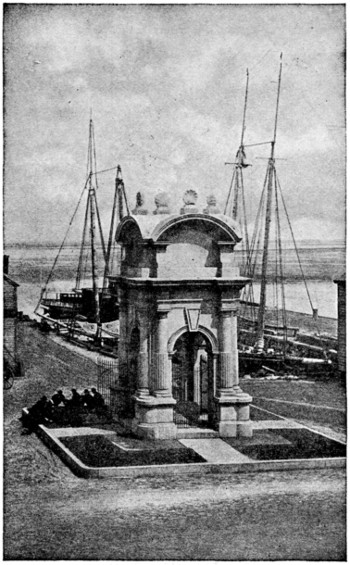
FOREFATHERS’ ROCK, PLYMOUTH, MASS.
Plymouth is of abiding interest as the landing place of the Pilgrim Fathers (December 21st, 1620) and the site of the first settlement in New England. Pilgrim Hall contains numerous interesting relics of the Pilgrims, paintings of their embarkation and landing, old portraits, etc. North Street leads to the so-called Plymouth Rock, a granite boulder enclosed by a railing and covered with a canopy. This, however, is only a fragment (broken off in 1774) of the flat rock where the Pilgrims landed, which lies nearer the sea and is now covered by a wharf. Cole’s Hill, opposite the rock, was the burial-place of the early settlers (1620-1621). Leyden Street was the site of the first house. From the Town Square a path ascends to the right to the ancient Burial Hill, with the graves of many of the early settlers, including Governor Bradford. A fortified church was erected here in 1622. To the south is Watson’s Hill, where the Pilgrims made a treaty with Massasoit in 1621. The National Monument to the Pilgrims, consisting of a granite pedestal forty-five feet high, surmounted by a figure of Faith, thirty-six feet high, and surrounded by seated figures twenty feet high, representing Law, Morality, Freedom and Education is about one-fourth mile from the railway station, on Allerton Street. The three hundredth anniversary of the landing of the Pilgrims will be elaborately celebrated here in 1920.
Period of Settlement.—In 1565 the Spaniards founded St. Augustine, the first permanent settlement in the United States. In 1585 an expedition sent by Sir Walter Raleigh made a settlement on Roanoke Island, N. C., which failed. In 1607 the English founded Jamestown on James River, Virginia, their first permanent settlement.[11] The master spirit of this enterprise was Captain John Smith. Plymouth, Mass., was founded in 1620 by the “Pilgrim Fathers,” a body of Puritans led by John Carver and others, who sailed from England in the Mayflower. Salem was settled by John Endicott in 1628. In 1630 John Winthrop settled Boston. In 1692 Plymouth colony was united to Massachusetts. Portsmouth and Dover, in New Hampshire, were settled in 1623. The first permanent English settlements in Maine were made about the same time. These settlements ultimately fell under the jurisdiction of Massachusetts. Connecticut was colonized in 1635-1636 by emigrants from Massachusetts, who settled at Hartford, Windsor, and Wethersfield. Rhode Island was first settled at Providence in 1636 by Roger Williams. In 1623 permanent settlements were made by the Dutch at Fort Orange (now Albany) and at New Amsterdam on the present site of New York. The Swedes settled on the Delaware in 1638, and were expelled in 1655 by the Dutch army. The English seized New Amsterdam in 1664, and with it the whole of New Netherland, which they named New York from the Duke of York, to whom it had been granted by Charles II. New Jersey at this time acquired its distinctive name. In 1681 the territory west of the Delaware was granted to William Penn, who colonized it chiefly with Friends or Quakers, and founded Philadelphia in 1682. Maryland was settled in 1634 by Roman Catholics sent out by Lord Baltimore. The first permanent settlement in North Carolina appears to have been made about 1663, on Albemarle Sound, by emigrants from Virginia. The first permanent settlement in South Carolina was made in 1670 by colonists from England on the Ashley River, near the site of Charleston, which began to be settled about the same time. Georgia was settled by General James Oglethorpe, who in 1733 founded Savannah.
How Europe First Divided the American Colonies.—It will thus be seen that what is now the territory of the United States has been derived from six European nations. Resting on the discovery by Columbus and the bulls of the popes, Spain claimed the whole continent, but has been in actual possession only of the Gulf coast from Florida to Texas, and of the interior from the Mississippi to the Pacific. The Swedes once had settlements on the Delaware. The Dutch, following up the voyage of Hudson to the river bearing his name, claimed and held the country from the Delaware to the Connecticut. The French discovered the St. Lawrence and explored and held military possession of the valleys of the Mississippi and Ohio and the Great Lakes. The English, by virtue of the voyages of the Cabots, claimed the Atlantic coast, and there founded the colonies which grew into the thirteen United States.
In the course of the struggle, sometimes peaceful, often bloody, by which the rule of these nations has been thrown off, the Dutch conquered the Swedes; the English conquered the Dutch and the French; the United States expelled the English, and in time, by purchase or conquest, drove out the Spaniards and the Mexicans.
Struggle of England and France for America.—The first serious struggle for possession occurred in the middle of the eighteenth century, when the English, moving westward, met the French moving eastward at the source of the river Ohio. In that struggle, which has come down to us as the “French and Indian war,” France was worsted, and, retiring from this continent, divided her possessions between England and Spain. To England she gave Canada and the islands and shores of the Gulf of St. Lawrence, and, entering what is now the United States, drew a line down the middle of the Mississippi River, and gave all to the east of that line (save the island on which is the city of New Orleans) to Great Britain, and all to the west of it to Spain; Spain at the same time gave Florida to England as the price of Cuba.
Oppression of the Colonies under British Rule.—Having thus come into possession of all the country to the east of the Great River, King George determined to send out an army of ten thousand men to defend the colonies, and have the latter bear a part of the expense. This part he attempted to collect by duties on goods imported, and by a Stamp Tax (1765) on legal documents and printed matter. No tax for revenue had before been laid on America by act of Parliament. The colonists, therefore, resisted this first attempt, and raising the cry, “No taxation without representation,” they forced Parliament to repeal the Stamp Tax in 1766. The right to tax was at the same time distinctly asserted, and in 1767 was again used, and duties laid on paints, oils, lead, glass, and tea. Once more the colonists resisted, and, by refusing to import any goods, wares, or merchandise of English make, so distressed the manufacturers of England that Parliament repealed every tax save that on tea. All the tea needed in America was now smuggled in from Holland. The East India Company, deprived of the American market, became embarrassed, and, calling on Parliament for aid, was suffered to export tea, a privilege never before enjoyed.
Selecting commissioners in Boston, New York, Philadelphia, and Charleston, cargoes of tea were duly consigned to them by the East India Company; but the people agreed not to buy any of this tea or allow it to be sold. At Boston men disguised as Indians boarded the tea ships, overcame the guards, and destroyed the tea by throwing the boxes into the harbor. This has gone down in history as the “Boston Tea Party.”
The Continental Congress and the Revolution.—As a punishment for this, Parliament shut the port of Boston and deprived the people of Massachusetts of many functions of local government. The Assembly of Massachusetts thereupon called for a General Congress to meet at Philadelphia on September 5, 1774. The colonies gladly responded and this congress, having issued a Declaration of Rights and Addresses to the king, to Parliament, and to the people of England, adjourned to await the result.
The day for the reassembling of Congress was May 10, 1775; but, before that day came, the attempt of General Gage to seize military stores brought on a fight at Lexington, April 19, 1775. The fight at Lexington was followed by the siege of the British in Boston, by the formation of the “Continental Army,” by the appointment of George Washington to command it, by the battle of Bunker Hill, June 17, 1775, and by an expedition against Quebec, which came to naught, on the last day of the year.
General William Howe meantime had succeeded Gage in command of the British at Boston, and, finding himself hard pressed by Washington, evacuated the city and sailed for Halifax. Believing New York was to be attacked, Washington now hurried to Long Island, where, August 27, 1776, Howe defeated him, took possession of New York, and drove him first up the Hudson and then southward across New Jersey.
American Independence Declared.—Congress, which, July 4, 1776, at Philadelphia, had declared the colonies to be free and independent states, now fled from that city to Baltimore. But Washington, turning in his retreat, surprised and captured the British outpost at Trenton. Cornwallis instantly hurried toward that town, but Washington, passing around the British rear, attacked and captured at Princeton, January 3, 1777, a detachment on its march to Trenton, and then went into winter quarters at Morristown.
With the return of spring Howe, finding that he could not reach Philadelphia by land without passing in front of the Continental army stretched out on a strongly intrenched line across New Jersey, went by sea. Washington met him at Chadd’s Ford on the Brandywine, was defeated, and on September 25, 1777, Howe entered Philadelphia. In the attempt to dislodge him Washington fought and lost the battle of Germantown, October 4, 1777; the loss of Philadelphia was more than made good by the capture of Burgoyne and his army at Saratoga, October 17, 1777, while on his way from Canada to New York City.
The fruits of this victory were the recognition of the independence of the United States by France, the treaty of alliance with France, February 8, 1778, and the evacuation of Philadelphia by General Clinton, who had succeeded Howe. Washington, who had spent the winter at Valley Forge, instantly followed, and overtaking Clinton at Monmouth fought and won the battle at that place, June 29, 1778. Clinton escaped to New York, and Washington, drawing his army in a circle about the city from Morristown on the south to West Point on the north, awaited further movements.
PRINCIPAL CAMPAIGNS AND BATTLES OF THE AMERICAN REVOLUTION The leading battles are indicated in bold-face; successful commanders in italics
Names, Dates and Places of Campaigns and Battles Commanders Engaged
American British Amer. British
1775-1776 Campaign in New England
Lexington, Concord (April 19, 1775) Barret and Butterick Smith and Lord Percy ... 1,700
Ticonderoga (May 10, 1775) Ethan Allen and Eaton Delaplace 83 48
Bunker Hill (June 17, 1775) Warren, Prescott and Putnam Howe and Pigot 3,000 4,500
Quebec (December 6-31, 1775) Schuyler, Montgomery and Arnold M’Lean and Carleton 900 1,200
Norfolk, Va. (Dec. 9, 1775) Woodford Lord Dunsmore ... ...
Boston (March 17, 1776) The British evacuate the city and harbor. ... ...
Charleston (Ft. Moultrie) (June 28, 1776) Moultrie, Lee and Armstrong Clinton 400 4,000
1776-1778 Campaign in Middle States
Brooklyn, L. I. (Aug. 26, 1776) Green and Sullivan Howe, Clinton, and Cornwallis 10,000 20,000
Harlem Plains, N. Y. (Sept. 16, 1776) Washington ... ... ...
White Plains, N. Y. (Oct. 28, 1776) Washington Howe 1,600 2,000
Fort Washington, N. Y. (Nov. 16, 1776) Magaw Howe 3,000 5,000
Trenton, N. J. (Dec. 26, 1776) Washington Lord Cornwallis and Rahl 2,400 1,000
Princeton, N. J. (Jan. 3, 1777) Washington Mawhood 3,000 1,800
Bennington, Vt. (Aug. 15, 16, 1777) Stark and Warner Baum and Beyman ... 1,200
Brandywine, Pa. (Sept. 11, 1777) Washington Howe 11,000 18,000
Bemis Heights, N. Y. (Sept. 19, 1777) Gates Burgoyne 2,500 3,000
Germantown, Pa. (Oct. 4, 1777) Washington Howe 11,000 15,000
Stillwater (Saratoga) (Oct. 7, 1777) Gates Burgoyne 8,000 6,000
Monmouth, N. J. (June 28, 1778) Washington Sir Henry Clinton 12,000 11,000
1778-1781 Campaign in the South
Savannah, Ga. (Dec. 29, 1778) Robert Howe Campbell 900 2,000
Brier Creek, Ga. (Mar. 3, 1779) Ashe Prevost 1,200 1,800
Stony Point, N. Y. (July 16, 1779) Wayne Clinton 1,200 600
Chemung, N. Y. (Aug. 29, 1779) Sullivan Brant 4,000 1,500
Savannah, Ga. (Oct. 9, 1779) Lincoln Prevost 4,500 2,900
Charleston, S. C. (May 12, 1780) Lincoln Clinton 3,700 9,000
Camden, S. C. (Sanders Creek) (Aug. 15, 1780) Gates Cornwallis 3,000 2,200
King’s Mountain, S. C. (Oct. 7, 1780) Campbell Ferguson 900 1,100
Cowpens, S. C. (Jan. 17, 1781) Morgan Cornwallis and Tarleton 900 1,100
Guilford C. H., N. C. (Mar. 15, 1781) Greene Cornwallis 4,400 2,400
Hobkirk’s Hill, S. C. (April 25, 1781) Greene Rawdon 1,200 900
New London, Conn., Fort Griswold (Sept. 6, 1781) Ledyard Benedict Arnold and Eyre 150 800
Eutaw Springs, S. C. (Sept. 8, 1781) Greene Lord Rawdon 2,000 2,800
Yorktown, Va. (Oct. 17-19, 1781) Washington Cornwallis 16,000 7,500
Treason of Arnold and Execution of André.—Turning towards the Southern states, the British commander now dispatched an expedition which took Savannah and overran the State of Georgia. The year which followed (1779) is memorable for the capture of Stony Point by Anthony Wayne; for the treason of Benedict Arnold; for the execution of Major John André; for the capture of the “Serapis” by Paul Jones after one of the most desperate naval battles on record, and by the failure of an attempt by the Americans to retake Savannah. In 1780 Clinton led an expedition from New York to Charleston, took the city, swept over South Carolina, and, leaving Cornwallis in command, hurried back to New York. Gates, who now attempted to dislodge the British, was beaten. Greene now succeeded Gates, and Morgan, the commander of his light troops, won the battle of the Cowpens, January 17, 1781. This victory brought up Cornwallis, who chased Greene across the State of North Carolina to Guilford Court House, where Greene was beaten and Cornwallis forced to retreat to Wilmington. Moving southward, Greene was again beaten in two pitched battles, but forced the British to withdraw within their lines at Charleston and Savannah.
Cornwallis meantime moved from Wilmington into Virginia and took possession of Yorktown. And now Washington, who had long been watching New York, again took the offensive, hurried across New Jersey and Pennsylvania, and, while a French fleet closed the Chesapeake Bay, he besieged Cornwallis by land, till, October 19, 1781, the British general surrendered. This practically ended the war.
The treaty of peace, at Paris, in 1783, actually ended it, secured the independence of the United States, and fixed her boundaries, roughly speaking, as the Atlantic Ocean on the east, the Mississippi on the west, New Brunswick, the St. Lawrence, and the Great Lakes on the north, and the parallel of thirty-one degrees on the south.
Articles of Confederation and their Weakness.—While the war was still raging Congress had framed an instrument of government, which the states ratified and put in force on March 1, 1781. This instrument of government which bound the thirteen states in perpetual union was known as the Articles of Confederation, and established a government as bad as any yet devised by man. There was no executive, no judiciary, and only the semblance of a legislature. The Congress consisted of not more than seven nor less than two delegates from each state; sat in secret session; was presided over by a president elected from its own members; and could not pass any law unless the delegates of nine states assented. It could wage war, make treaties, and borrow money; but it could not lay a tax of any kind whatsoever; nor regulate commerce between the states, or with foreign powers; and was dependent entirely on the liberality of the states for revenues. This defect proved fatal. Inability to regulate foreign commerce by duties stripped the country of its specie. Lack of specie forced the states to issue paper money. Paper money was followed by tender acts and force acts, and in some places by a violent stoppage of justice to the debtor class. A commercial and financial crisis followed and the people of the states, reduced to desperation, gladly acceded to a call for a national trade convention, which met in Philadelphia in May, 1787. The instructions of the delegates bade them suggest amendments to the Articles of Confederation. But the convention, considering the Articles too bad to be mended, framed the Constitution, which the people, acting through conventions in the various states, ratified during 1787 and 1788.
Adoption of the Constitution and Organization of Parties.—On March 4, 1789, the Constitution became the supreme law of the land. In the first Congress no trace of party lines is visible. But the work of establishing government had not gone far when differences of opinion sprang up; when the cry of partial legislation was raised, and the people all over the country began to divide into two great parties—those who favored and those who opposed a liberal construction of the language of the Constitution and the establishment of a strong national government.
The friends of national government took the name of Federalists, and under the lead of Alexander Hamilton, who as Secretary of the Treasury marked out the financial policy of the administration, they funded the foreign and domestic debt occasioned by the war for independence, assumed the debts incurred by the states in that struggle, set up a national bank with branches, and laid a tax on distilled liquors.
Each one of these acts was met with violent opposition, as designed to benefit a class, as unconstitutional, and as highly detrimental to the interests of the South. Against the Federalists were now brought charges of a leaning towards monarchy and aristocracy. Great Britain, it was said, has a funded debt, a bank, and an excise. These things are, therefore, monarchial institutions. But the Federalists have introduced them into the United States. The Federalists, therefore, are aristocrats, monarchists, and monopolists.
Of all who believed these charges, none believed them more sincerely than Thomas Jefferson, Secretary of State. Seeing in these acts a wide departure from the true principles of democracy, he set himself to work to organize a party of opposition, and was soon looked up to as the recognized leader of the Federal Republicans.
Hardly had the two parties thus been called into existence by difference of opinion on questions of home affairs, when they were parted yet more widely, and the dispute between them intensely embittered by questions of foreign affairs.
Effect of the French and English Affairs Upon the New Nation.—In 1793 the French Republic declared war against England, and sent a minister to the United States. As the United States was bound to France by the treaty of alliance and by a treaty of amity and commerce, and was not bound to Great Britain by any commercial treaty whatever, it seemed not unlikely that she would be dragged unwillingly into the war. But Washington, with the advice of his secretaries, proclaimed neutrality, and from that time every Republican was the firm friend of France and every Federalist the ally of England. Then began a seven years’ struggle for neutrality. France threw open her colonial ports to neutral commerce; Great Britain asserting the “Rule of the War of 1756,” a rule prescribing that no neutral should have in time of war a trade it did not have in peace, declared this trade was contraband, and seized the ships of the United States engaged in it. The Republicans denounced neutrality and attempted to force a war. The Federalists in alarm dispatched John Jay, the Chief Justice, to London, with offers of a commercial treaty. England responded and on February 29, 1796, the first treaty of amity and commerce between her and the United States became law. At this France took offense, rejected the new minister (C. C. Pinckney) from the United States, and drove him from her soil, suspended the treaties, insulted a special commission (sent out in the interest of peace), with demands for bribes and tribute, and almost brought on war.
Never since the days of Bunker Hill had the country been so stirred as this act of the French Directory stirred it in the summer of 1798. Then was written our national song, “Hail Columbia.” Then was established the department of the navy. Then, under the cry, “Millions for defense; not a cent for tribute,” went forth that gallant little fleet which humbled the tri-color in the West Indies and brought France to her senses.
Causes and Events of the War of 1812.—With the elevation of Napoleon to the First Consulship came peace in 1800. In that same year the Federalists fell from power, never to return. Once in power, the Republicans began to carry out the principles they had so long preached. They reduced the national debt; they repealed the internal taxes. They sold the navy; boldly assaulted the Supreme Court; and in 1811, when the charter of the National Bank expired, refused to renew it. Their doctrine of strict construction, however, was ruined, when, in 1803, they bought the Province of Louisiana from France and added to the public domain that splendid region which lies between the Mississippi and the Rocky Mountains.
At that moment it seemed as if the people were about to enter on a career of unwonted prosperity. But Napoleon suddenly made war on England, and by 1806 the United States was involved in a desperate struggle of nine years, both with France and England, for commercial independence. Great Britain searched our ships, impressed our sailors, violated the neutrality of our ports, and by the decisions of her admiralty courts and by orders in council sought to ruin our neutral commerce with Europe, unless carried on through her ports and under her license. Napoleon attacked us with his decrees of Berlin and Milan, and sought to ruin our neutral commerce with England. The United States retaliated by means of the embargo and non-intercourse, and, in 1812, declared war.
CAMPAIGNS AND BATTLES OF THE WAR OF 1812-1815
Principal Land Battles
1812.—August 16, the surrender of Detroit by Hull to Brock.
October 13, defeat of Van Rensselaer by Brock at Queenstown.
1813.—January 18-22, the Americans were defeated at Frenchtown by General Proctor, whose Indians massacred the wounded Americans.
April 27, York (Toronto) was captured by the Americans under General Pike.
October 5, General Harrison forced General Proctor to retreat into Canada, and October 5 at the battle of the Thames routed the British and their Indian allies. Tecumseh was killed, the territory lost by Hull regained, and Upper Canada was retained to the end of the war.
November 11, the Americans moved on Montreal, but were defeated at Chryslers Field, and retreated.
1814.—July 25, Winfield Scott again invaded Canada and gained victories at Chippewa (July 5) and at Lundy’s Lane.
August 24, capture of Washington and burning of the Capitol, the White House, and other buildings.
1815.—January 8, a large body of English veterans were landed in Louisiana, and attacked New Orleans; in this battle, which took place before the news of the treaty of peace reached the combatants, Jackson won a decisive victory.
Principal Naval Battles
1812.—August 19, the Constitution destroys the British Guerriere, in the Gulf of St. Lawrence.
October 18, the American Wasp captures the Frolic.
October 25, Captain Decatur in the United States took the Macedonian.
December 29, the Constitution captures the Java.
1813.—February 24, the American Hornet captures the Peacock.
June 1, the Chesapeake is captured by the British Shannon.
September 10, Commodore Perry with a fleet of nine vessels destroys the British squadron of six vessels on Lake Erie.
1814.—September 3, naval attack on Fort McHenry by the British fails.
September 11, Captain Macdonough, on Lake Champlain, completely defeated a British fleet stronger than his own; this checked a serious invasion of the enemy.
Treaty and Results of the War
December 24, 1814, a treaty of peace was made at Ghent, the end of the Napoleonic wars having removed the cause for England’s offensive policy at sea.
The provisions included:
(1) A return of captured territory.
(2) Nothing was said about impressment.
(3) No compensation was secured by the Americans for ships captured previous to 1812.
The results of the war were:
(1) An increase of debt.
(2) An outburst of national patriotism.
(3) The removal of America from participation in European politics.
(4) The development of manufacturing.
(5) The establishment of the protective tariff policy.
With the Cessation of Hostilities Another Epoch in Our History Begins.—From the day when Washington proclaimed neutrality in 1793, to the day when the people celebrated, with bonfires and with fireworks, and with public dinners, the return of peace, in 1815, the political and industrial history of the United States is deeply affected by the political history of Europe. It was questions of foreign policy, not of domestic policy, that divided the two parties, that took up the time of Congress, that raised up and pulled down politicians. But after 1815 foreign affairs sank into insignificance, and for the next thirty years the history of the United States is the history of political and economic development of the country to the east of the Mississippi River.
Fall of the Federalists, or Pro-British Party.—The opposition which the Federalists made to the war completed their ruin. In 1816 for the last time they put forward a presidential candidate, carried three states out of nineteen, and expired in the effort. During the eight years of Monroe’s administration (1817-1825) but one great and harmonious party ruled the political destinies of the country. This remarkable period has come down to us in history as the “era of good feelings.” It was indeed such an era, and so good were the feelings that in 1820 when Monroe was re-elected no competitor was named to run against him. Every state, every electoral vote save one was his. Even that one was his. But the elector who controlled it threw it away on John Quincy Adams lest Monroe should have the unanimous vote of the presidential electors, an honor which has been bestowed on no man save Washington.
Rise of the Protective Tariff Policy.—In the midst of this harmony, however, events were fast ripening for a great schism. Under the protection offered by the commercial restrictions which began with the embargo and ended with the peace, manufactures had sprung up and flourished. If they were to continue to flourish they must continue to be protected, and the question of free trade and protection rose for the first time into really national importance.
The rush of population into the West led to the admission of Indiana (1816), Mississippi (1817), Illinois (1818), Alabama (1819), and Missouri (1820) into the Union, and brought up for serious discussion the uses to be made of public lands lying within them.
The steamboat, which had been adopted far and wide, had produced a demand for some improved means of communication by land to join the greater water highways of the country and opened the era of internal improvements.
The application of Missouri for admission into the Union brought up the question of the admission of slavery to the west of the Mississippi. A series of decisions of the Supreme Court, setting aside acts of the state legislatures, gave new prominence to the question of state rights.
A Decade of Great Political Contests.—The Missouri question was settled by the famous Compromise of 1820 (the first great political compromise), which drew the line thirty-six degrees thirty minutes from the Mississippi to the hundredth meridian, and pledged all to the north of it, save Missouri, to freedom. But the others were not to be settled by compromise, and in the campaign of 1824 the once harmonious Republican party was rent in pieces. Each of the four quarters of the Republic put a candidate in the field and “the scrub-race for the presidency” began.
The new manufacturing interests of the East put forward John Quincy Adams. The West, demanding internal improvements at public expense, had for its candidate Henry Clay. William H. Crawford of Georgia (nominated by a caucus of Congressmen) represented the old Republican party of the South. Andrew Jackson of Tennessee stood for the new Democracy, for the people, with all their hatred of monopolies and class control, their prejudices, their half formed notions, their violent outbursts of feeling.
Behind none of them was there an organized party. But taking the name of “Adams men” and “Clay men,” “Crawford men” and “Jackson men,” the friends of each entered the campaign and lost it. No candidate secured a majority of the electoral college, and the House of Representatives chose John Quincy Adams.
The Triumph of Democracy and Industrial Expansion.—Under the administration of Adams (1825-1829) the men who wished for protection and the men who wished for internal improvements at government expense united, took the name first of National Republicans, and then of Whigs, and, led on by Henry Clay and Daniel Webster, carried through the high protection tariffs of 1828 and 1832. The friends of Jackson and Crawford took the name of Democrats, won the election of 1829, and during twelve years governed the country.
In the course of these years the population of the United States rose to seventeen million, and the number of states to twenty-six. Steam navigation began on the ocean; two thousand miles of railroad were built in the land; new inventions came into use; and the social and industrial life of the people was completely revolutionized. The national debt was paid; a surplus accumulated in the Treasury; the sale of public lands rose from three million dollars in 1831 to twenty-five million dollars in 1836; and the rage for internal improvements burned more fiercely than ever. A great financial panic spread over the country; the charter of the National Bank expired, a hundred “wild-cat banks” sprang up to take its place, and the question of the abolition of slavery became troublesome.
Early Troubles in Our System of Public Finance.—On the great questions which grew out of this condition of affairs the position of the two parties was well defined. The Democrats demanded a strict construction of the Constitution; no internal improvements at public expense; a surrender of the public lands to the state in which they lay; no tariff for protection; no National Bank; no agitation of the question of the abolition of slavery; the establishment of subtreasuries for the safe keeping of the public funds, and the distribution of the surplus revenue. The Whigs demanded a recharter of the National Bank; a tariff for protection; the expenditure of the surplus on internal improvements; the distribution of the money derived from the sale of public lands; a limitation of the veto power of the President; and no removals from office for political reasons.
The Democrats, true to their principles, and having the power, carried them out. They destroyed the Bank; they defeated bill after bill for the construction of roads and canals; they distributed thirty-eight million dollars of the surplus revenue among the states, and by the cartage of immense sums of money from the East to the far distant West, hastened that inevitable financial crisis known as the “panic of 1837.”
Andrew Jackson had just been succeeded in the presidency by Martin Van Buren (1837-1841) and on him the storm burst in all its fury. But he stood it bravely, held to a strict construction of the Constitution, insisted that the panic would right itself without interference by the Government, and stoutly refused to meddle. Since the refusal of Congress to recharter the Bank of the United States, whose charter expired in 1836, the revenue of the Government had been deposited in certain “pet banks” designated by the Secretary of the Treasury. Every one of them failed in the panic of 1837. Van Buren therefore recommended “the divorce of Bank and State,” and after a struggle of three years his friends carried the “subtreasury” scheme in 1840. This law cast off all connection between the state banks and the Government, put the collectors of the revenue under heavy bonds to keep the money safely till called for by the Secretary of the Treasury, and limited payments to or by the United States to specie.
National Conventions and Rise of Slavery Issue.—The year 1840 was presidential year, and is memorable for the introduction of new political methods; for the rise of a new and vigorous party; and for the appearance of a new political issue. The new machinery consisted in the permanent introduction of the national convention for the nomination of a president, now used by the Democrats for the second time, and by the Whigs for the first; in the promulgation of a party platform by the convention, now used by the Democrats for the first time; and in the use of mass meetings, processions, songs, and all the paraphernalia of a modern campaign by the Whigs.
The new party was the Liberty Party, and the new issue the “absolute and unqualified divorce of the general Government from slavery, and the restoration of equality of rights among men.” The principles of that party were: slavery is against natural right, is strictly local, is a state institution, and derives no support from the authority of Congress, which has no power to set up or continue slavery anywhere; every treaty, every act, establishing, favoring, or continuing slavery in the District of Columbia, in the territories, on the high seas, is, therefore, unconstitutional.
The Short-lived Era of the Whigs.—The candidate of this party was James Gillespie Birney. The Democrats nominated Martin Van Buren. The Whigs put forward William Henry Harrison and elected him. Harrison died one month after his inauguration, and John Tyler, the Vice-President and a Democrat of the Calhoun wing, became President.
The Whig policy as sketched by Clay was the repeal of the Subtreasury Act; the charter of a National Bank; tariff for protection; and the distribution of the sales of public lands. To the repeal of the Subtreasury Act Tyler gladly assented. To the establishment of a bank even when called “Fiscal Corporation,” he would not assent, and, having twice vetoed such bills, was read out of the party by a formal manifesto issued by Whig congressmen.
It mattered little, however, for the question of the hour was not the bank, nor the tariff, nor the distribution of the sales of lands, but the annexation of the republic Texas. Joined to the demand for the reoccupation of Oregon, it became the chief plank in the Democratic platform of 1844. The Whig platform said not a word on the subject, and the Liberty Party, turning with loathing from the cowardice of Clay, voted again for Birney, gave the State of New York to the Democrats, and with it the presidency.
The Annexation of Texas, and Wilmot Proviso.—Accepting the result of the election as “instruction from the people,” Congress passed the needed act and Tyler in the last hours of his administration declared Texas annexed.
The boundary of the new state was ill-defined. Texas claimed to the Rio Grande. Mexico would probably have acknowledged the Nueces River. The United States attempted to enforce the claim of Texas, sent troops to the Rio Grande, and so brought on the Mexican war.
At the close of the Mexican war the boundary of the United States was carried south from forty-two degrees to the Gila River, and what is now California, Nevada, Arizona, New Mexico, Utah, and more than half of Wyoming and Colorado were added to the public domain. While the war was still raging, Polk, who had succeeded Tyler, asked for two million dollars to aid him in negotiating peace. Well knowing that the money was to be used to buy land from Mexico, David Wilmot moved in the House of Representatives that from all territory bought with the money slavery should be excluded. This was the famous Wilmot proviso. It failed of adoption and the territory was acquired in 1848, with its character as to slavery or freedom wholly undetermined.
The Preliminary Struggle over the Slave Problem.—And now the old parties began to break up. Democrats who believed in the Wilmot proviso, and Whigs who detested the annexation of Texas, the war with Mexico, and the extension of slavery went over in a body to the Liberty Party, formed with it the Freesoil Party, nominated Martin Van Buren, and gave him three hundred thousand votes. In their platform they declared that Congress had no more power to make a slave than to make a king; that they accepted the issue thrust on them by the South; that to the demand for more slave states and more slave territories they answered, no more slave states, no more slave territories; and that on their banner was inscribed “Free Soil, Free Speech, Free Labor, and Free Men.” As the defection of Whigs to the Liberty Party in 1844 gave New York state to the Democrats and elected Polk, so the defection of Democrats to the Free Soilers in 1848 gave New York to the Whigs and elected Taylor. As Harrison, the first Whig president, died one month after taking office, so Taylor, the second Whig president, died suddenly when a little over one year in office, just as the great Whig compromise of 1850 was closing. The imperative need of civil government in the new territory, the discovery of gold in California, the rush of men from all parts of the earth to the Pacific Coast forced Congress to establish organized territories. The question was: shall they be opened or closed to slavery? But, as the soil had been free when acquired from Mexico, the question really was: shall the United States establish slavery?
THE MEXICAN WAR, 1846-1848
Causes of the War
(1) Long-standing irritation over claims of American citizens upon Mexico, which the latter refused to pay.
(2) The annexation by the United States of Texas, which Mexico claimed as still a part of her territory.
(3) Disputes as to whether the Rio Grande or Nueces River was the boundary of Texas.
Results of the War
The Treaty of Guadalupe Hidalgo, in 1848, closed the war. Its chief provisions were:
(1) The Rio Grande was made the boundary between Texas and Mexico.
(2) California and New Mexico were ceded to the United States.
(3) The United States paid Mexico $15,000,000, and assumed $3,500,000 due American citizens.
The slavery question was intensified in American politics.
PRINCIPAL BATTLES NOTE: The Americans were victorious in every conflict.
Place of Battle Dates Commanders Engaged
American Mexican American Mexican
Bracite Dec. 25, 1846 Doniphan Ponce de Leon 500 1,200
Buena Vista Feb. 23, 1847 Taylor Santa Anna 4,700 17,000
Cerro Gordo April 18, 1847 Scott Santa Anna 8,500 12,000
Chapultepec Sept. 13, 1847 Scott Santa Anna 7,200 25,000
Contreras Aug. 20, 1847 Scott Valencia 4,000 7,000
Churubusco Aug. 20, 1847 Scott Santa Anna 8,000 25,000
Huamantla Oct. 9, 1847 Lane Santa Anna 500 1,000
Mexico Sept. 14, 1847 Scott Santa Anna 6,000 ...
Molino del Rey Sept. 8, 1847 Worth Alverez 3,500 14,000
Monterey Sept. 24, 1846 Taylor Ampudia 6,600 10,000
Palo Alto May 8, 1846 Taylor Arista 2,300 6,000
Resaca de la Palma May 9, 1846 Taylor Arista 2,000 5,000
Sacramento Feb. 28, 1847 Doniphan Trias 900 4,000
Vera Cruz Mar. 27, 1847 Scott Landero 12,000 6,000
The only naval engagements of importance during the war with Mexico were the bombardment of Vera Cruz, by Commodore Conner, which lasted four days, and the bombardment of Monterey, Commodore Sloat, both cities being forced to surrender.
The Democrats, holding that slaves were property, claimed the right to take them into any territory, and asserting the principle of “squatter sovereignty,” claimed the right of the people living in any territory to settle for themselves whether it should be slave or free. The Free Soilers demanded that the soil having been free when a part of Mexico, should be free as a part of the United States. Between these two Clay now stepped in to act as pacificator. Taking up the grievances of each side, he framed and carried through the measure known as the Compromise of 1850, the third great political compromise in our history. The fruit of this was the admission of California as a free state; the passage of a more stringent law for the recovery of fugitive slaves; the abolition of the slave trade in the District of Columbia; and the organization of Utah and New Mexico on the basis of “squatter sovereignty.”
This done, senators and representatives of all parties joined in a manifesto declaring that the issues resting on slavery were dead issues, and that they would neither vote for, nor work for any man who thought otherwise. But thousands did think otherwise. The action of Clay pleased none. Anti-slavery men deserted him in the North; pro-slavery men deserted him in the South; and in 1852 the Whig party carried but four states out of thirty-one and perished. Even its two great leaders, Clay and Webster, were, by that time, in their graves.
Excited by such success, the Democrats, led on by Stephen A. Douglas, now broke through the compromise of 1820 and in 1854 applied “squatter sovereignty” to the organization of the territories of Kansas and Nebraska. Against this violation state legislatures, the people, the pulpit, and the press protested vigorously, for every acre of Kansas and Nebraska lay to the north of 36° 30′ and was solemnly pledged to freedom. But the Democratic leaders would not listen and drove from their ranks another detachment of voters. The effect was soon manifest. The little parties began to unite and when, in 1856, the time came to elect another president, the Republican Party of to-day was fully organized and ready. Once more and for the last time for twenty-eight years the Democrats won.
Buchanan’s Administration the Prelude to the Civil War.—The administration of James Buchanan (1857-1861) marks an epoch. The question before the country was that of the extension of slavery into the new territories. Hardly had he been inaugurated when the Supreme Court handed down a decision on the case of Dred Scott, which denied the right of Congress to legislate on slavery, set aside the compromises of 1820 and 1850 as unconstitutional, and opened all the territories to slavery.
Rise of the Republican Party and Election of Lincoln.—From that moment the Whig and Democratic parties began to break up rapidly till, when 1860 came, four parties and four presidential candidates were in the field. The Democratic party, having finally split at the national convention for nominating a president and vice-president, the southern wing put forward Breckenridge and Lane and demanded that Congress should protect slavery in the territories. The northern wing nominated Stephen A. Douglas and declared for squatter sovereignty and the compromise of 1850. A third party, taking the name of “Constitutional Union,” declared for the Constitution and the Union at any price and no agitation of slavery, nominated Bell and Everett, and drew the support of the old Whigs of the Clay and Webster school. The Republicans, declaring that Congress should prohibit slavery in the territories, nominated Abraham Lincoln and Hannibal Hamlin and won the election.
Secession, and the Formation of the Confederacy.—The State of South Carolina immediately seceded and before the end of February, 1861, was followed by Georgia, Florida, Alabama, Mississippi, Louisiana, and Texas. Taking the name of the Confederate States of America, they formed first a temporary and then a permanent government, elected Jefferson Davis president, raised an army, and besieged Fort Sumter in Charleston Harbor. The attempt to relieve the fort brought on the bombardment and surrender (April 19, 1861). The Confederate States were now joined by Virginia, North Carolina, Arkansas, and Tennessee. Richmond was made the capital, and the Civil war opened.
Civil War between the Union and the Confederacy.—The line of separation between the states then became the Potomac River, the Ohio River, and a line across southern Missouri and Indian Territory to New Mexico. Along this line the troops of the Union were drawn up in many places under many commanders. Yet there were in the main but three great armies. That of the East or Potomac under General McClellan, that of the Center or the Ohio under General Buell, that of the West or Missouri under General Halleck. In command of all as Lieutenant-General was Winfield Scott. Confronting them were the troops of the Confederacy, drawn up in three corresponding armies: that of North Virginia under Johnston and Lee, that of the Cumberland under Albert Sidney Johnston, and that of the trans-Mississippi under McCulloch and Price.
Yielding to the demand of the North for the capture of Richmond before the Confederate Congress could meet there (July 20, 1861), McDowell went forth with thirty-eight thousand three-months volunteers to the ever memorable field of Bull Run.
The Union Successes in the Southwest.—But the serious campaigning did not begin until January, 1862. Then the whole line west of the Alleghanies (made up of the armies of Ohio and Missouri), turning on Pittsburgh as a center, swept southward, captured Forts Henry and Donelson, defeated the Confederates at Shiloh, captured Corinth, took Island Number 10, and drove them from Fort Pillow. Meantime Farragut entered the Mississippi from the Gulf, passed Forts Jackson and St. Philip, captured New Orleans, and sent Commodore Davis up the river to take Memphis. Memphis fell June 6, 1862, and, save for Vicksburg, the Mississippi was open for navigation. When the year closed the Confederates had been driven to the east into the mountains of Tennessee, where, December 31, 1862 to January 2, 1863, was fought the desperate and bloody battle of Murfreesboro. The Union troops won, and the Confederate army fell back to Chattanooga.
The Peninsular Campaign Favors Confederate Arms.—With the Army of the Potomac meantime all had gone ill. The affair at Bull Run in July, 1861, had been followed by the transfer of the army to McClellan. But McClellan wasted time, wore out the patience of the North, and forced Lincoln to issue General Order Number One for the forward movement of all armies on February 22, 1862. Obedient to this McClellan began his Peninsular Campaign against Richmond, was out-generaled by Lee, and in the second battle of Bull Run suffered so crushing a defeat that Lee ventured to cross the Potomac and enter Maryland, and encountered McClellan, on the field of Antietam. In that battle Lee was beaten and fled across the Potomac. But McClellan failed to follow up the victory and was removed, the command of the Army of the Potomac passing to Burnside. Burnside led it across the Potomac and the Rappahannock and on December 13, 1862, lost the battle of Fredericksburg. For this he was replaced by Hooker, who, May 1-4, 1863, fought and lost the battle of Chancellorsville.
The Turning Point of the War.—Lee now again took the offensive, crossed the Potomac, entered Pennsylvania, and at Gettysburg met the Army of the Potomac under Meade. On that field was fought the decisive battle of the war. Then (July 1-4, 1863) the backbone of the Confederacy was broken, and the two armies returned to their old positions in Virginia.
While Meade was beating Lee at Gettysburg, Grant captured Vicksburg, July 1-3, 1863. For this he was sent to command the army of Rosecrans, then besieged by Bragg at Chattanooga. Again success attended him, and in November he stormed Lookout Mountain, defeated Bragg in the famous “Battle above the Clouds,” and drove him in disorder through the mountains. For these signal victories he was raised to the rank of Lieutenant General in 1864, and placed in command of the armies of the United States.
That year is memorable for the great march of Sherman to the east from Chattanooga to the sea, for the victories of Sheridan in the valley of the Shenandoah, for the Wilderness Campaign of Grant, the shutting up of Lee in Richmond, and by the re-election of Lincoln. His competitor was General McClellan, whom the northern Democrats put forward on the platform that the war was a failure, and that peace should be made with the South. In the spring of 1865 came the retreat of Lee from Richmond, and, on April 9, his surrender at Appomattox Court House.
THE AMERICAN CIVIL WAR, 1861-1865
Causes of the War Influencing Events Results of the War
Real, but remote: The invention of the cotton gin, 1793.
(1) The doctrine of popular sovereignty. Different con- structions of the Constitution. Fugitive slave laws, 1793 and 1850. The Union was preserved.
Protective tariff laws.
Missouri compromise, 1820. Slavery was abolished.
Nullification act in South Carolina, 1832.
(2) Slavery. Different systems of labor in the North and the South. Annexation of Texas, 1845. Secession as a working program was shown to be impracticable.
Omnibus bill, 1850.
Kansas-Nebraska bill, 1854
Dred Scott decision, 1857.
(3) Lack of intercourse between the North and the South. Personal liberty bills, 1857. The war cost the lives of nearly one million able- bodied men.
John Brown raid, 1859.
Anti-slavery papers, books, and speeches.
(4) The increase of territory. New England Anti-Slavery Society was organized, 1832. The national debt was in- creased to $2,750,000,000.
Anti-slavery parties:
Immediate: Liberty party, 1840-1848. An incalculable amount of property was destroyed.
The secession of the states. Free-Soil party, 1848-1856.
Republican party, 1854.
CAMPAIGNS AND BATTLES Naval engagements are printed in italics; names of victorious commanders in bold-face type.
LAND AND SEA ENGAGEMENTS
Name, Location and Date of Battle Commanders Casualties
Union Confederate
Killed Wounded Killed Wounded
1861
Bombardment of Fort Sumter (April 13-14) Gen. Beauregard vs. Maj. Anderson. No casualties on either side
Bull Run, Virginia (July 21) Gen. Beauregard and Gen. Johnston vs. Gen. McDowell. 481 1,011 362 1,390
Wilson Creek, Missouri (August 10) Gen. Price vs. Gen. Lyon. 223 721 331 764
1862
Pea Ridge, Arkansas (March 6-8) Gen. Curtis and Gen. Franz Sigel vs. Gen. Van Dorn. 203 972 1,040 3,638
Monitor and Merrimac, Hampton Roads, Virginia (March 9) Lt. J. L. Worden vs. Capt. Franklin Buchanan. 0 1 0 2
Fort Donelson, Tennessee (February 15) Gen. Grant vs. Gen. Floyd, Gen. Pillow and Gen. Buckner. 560 746 466 1,534
Shiloh, or Pittsburg Landing, Tennessee (April 6-7) Gen. Grant vs. Gen. Johnston and Gen. Beauregard. 1,735 7,882 1,128 8,012
Drury’s Bluff, Virginia (May 15) Gen. Beauregard vs. Gen. Butler. 422 2,380 514 1,086
Seven Pines, or Fair Oaks, Virginia (May 31) Gen. Johnston vs. Gen. McClellan. 891 3,627 1,987 2,233
Gaines Mill, Virginia (June 27) Gen. A. Elzey vs. Gen. F. J. Porter. 3,000 4,500 2,000 4,000
Malvern Hill, Virginia (July 1) Gen. McClellan vs. Gen. Lee. 2,860 3,500 3,023 4,077
Cedar Mountain, Virginia (August 8-9) Gen. Jackson vs. Gen. Banks. 450 660 223 1,060
Bull Run No. 2, or Manassas, Virginia (August 29-30) Gen. Lee and Gen. Jackson vs. Gen. Pope. 798 4,023 1,090 6,154
Antietam, Maryland (September 16-17) Gen. McClellan vs. Gen. Lee. 2,010 9,416 1,842 9,399