THE BOOK OF NATIONS Geographical, Historical, Descriptive (continued 12)
Reading edition
Leopold I. and the War of the Spanish Succession.—Ferdinand III.’s son and successor, Leopold I., provoked the Hungarians to rebellion by his severity. The struggle between Leopold and Louis XIV. of France for the heirship to the king of Spain led to the War of the Spanish Succession, during which Leopold died, in 1705.
His eldest son and successor, the enlightened Joseph I., continued the war. He died childless in 1711, and was succeeded by his brother, Charles VI.
Hapsburg-Lorraine Line of Rulers.—With the death of Charles VI., in 1740, the male line of the Hapsburgs became extinct, and his daughter, Maria Theresa, who was married to the duke of Lorraine, assumed the government. For many years it had been the aim of Charles to secure the adhesion of the European powers to the Pragmatic Sanction, by which the possessions of the Austrian crown should pass to Maria Theresa. Those powers during his lifetime had promised to second his wishes, but he was no sooner in his grave than nearly all of them sought to profit by the accession of a female sovereign.
War of the Austrian Succession.—A great war arose, in which England alone sided with Maria. Frederick II. of Prussia conquered Silesia. The Elector of Bavaria was crowned king of Bohemia, and elected emperor as Charles VII. in 1742. The Hungarians, however, stood by their heroic queen, who was soon able to wage a fairly successful war against her numerous foes. At the death of the empress in 1780, the monarchy had an extent of two hundred and thirty-four thousand square miles, with a population of twenty-four millions. The administration of Maria Theresa was distinguished by unwonted unity and vigor, both in home and foreign affairs.
Her successor, Joseph II., was an active reformer in the spirit of the enlightened despotism of the times, though often rash and violent in his mode of proceeding. He was succeeded in the government by his brother, the grandduke of Tuscany—as German emperor, Leopold II.—who succeeded in pacifying the Netherlands and Hungary.
Austria and the French Revolution.—At the outbreak of the revolution in France the fate of Leopold’s sister, Marie Antoinette, and her husband, Louis XVI. of France, led him to an alliance with Prussia against France; but he died in 1792 before the war broke out. War was declared by France on his son, Francis II., the same year, and by the treaty of Campo Formio, 1797, Austria lost Lombardy and the Netherlands, receiving in lieu the Venetian territory.
In 1795, at the second partition of Poland, it had been augmented by western Galicia.
Francis, in alliance with Russia, renewed the war with France in 1799, which was ended by the peace of Lunéville. It is needless to follow all the alterations of boundary that the Austrian dominions underwent during these wars. The most serious was at the peace of Vienna (1809), which cost Austria forty-two thousand square miles of territory. It was in 1804, when Napoleon had been proclaimed emperor of France, that Francis declared himself hereditary emperor of Austria as Francis I. On the establishment of the Confederation of the Rhine, he laid down the dignity of German emperor, which his family had held for nearly four hundred years.
The humiliating peace of Vienna was followed (1809) by the marriage of Napoleon with the Archduchess Maria Louisa, and in 1812 Austria figured as the ally of Napoleon in his great campaign against Russia, but she did not give much active assistance. In August of the following year Austria joined the grand alliance against France and the Austrian general, Schwarzenberg, was entrusted with the chief command of the allied forces, which at the battle of Leipzig and in the campaign of 1814 broke the power of Napoleon.
Congress of Vienna and Subsequent Period of Metternich.—The sacrifices and great services rendered by Austria in the gigantic struggle received full consideration at the treaty of Vienna (1815). As recompense for the loss of the Netherlands she received Venice and Dalmatia, which afforded an outlet for her foreign trade.
After that time Austria, under the diplomatic guidance of Prince Metternich, exerted a powerful influence in European politics generally, and more especially in the German Confederation, of which her emperor was president. The death of Francis I. in 1835 made little alteration in the policy of Austria; Ferdinand I. trod in his father’s footsteps. The political alliance with Russia and Prussia was drawn closer by a personal conference of the emperor with Nicholas I. and Frederick-William III. at Teplitz in 1835.
Revolution of 1848.—In Austria, after the fall of Metternich from power, the revolutionary period of 1848-1849 was one of exceptional severity, the movement for constitutional freedom being complicated by the revival of the national spirit in Hungary, Italy and Bohemia. The time was everywhere ripe for revolt, when the fall of Louis-Philippe of France (February 24, 1848), gave the signal for the outbreak of the revolutionary elements all over Europe. Nowhere was the spirit of change stronger than in Vienna, which for many months became a scene of confusion.
The leaders of the popular movement in Vienna were in sympathy with Hungary, and when the imperial troops were ordered to suppress the national rising there, the citizens again rose in insurrection. In the meantime the military forces had withdrawn from the capital in order to prevent the Hungarians coming to the aid of the Viennese. Vienna was now besieged, and surrendered at the end of October, after a resistance of eight days.
Francis Joseph Emperor.—The reaction was triumphant, and the leaders of revolt severely punished; but as Ferdinand had not shown sufficient vigor in the great crisis, he was persuaded to abdicate, and Francis Joseph was declared emperor at the age of eighteen. Thus restored, the central authority had now to assert itself in Hungary and to complete the reconquest of northern Italy. With the surrender of Venice, which took place in August, the subjugation of Italy was complete.
Conquest of Hungary.—In Hungary, the Magyars, though the Germans and Slavs within the country itself were hostile to them, began the campaign of 1849 with decided success. But the government had already solicited the aid of Russia, whose armies, entering Transylvania and Hungary, added to the imperial cause the irresistible weight of numbers. Surrounded on every side by superior forces, the Hungarians were completely beaten. It was in vain that Kossuth transferred the dictatorship to General Görgei. Görgei, whether from treachery, as the other Magyar leaders maintained, or from necessity, as he himself averred, laid down his arms to the Russians at Vilagos (August 13). The surrender of Komorn, in September, completed the subjugation of Hungary, which was treated as a conquered country.
The ten years which followed on the revolutionary troubles of 1848 were a period of reaction and of absolutism. A constitution which had been granted in 1849 was soon annulled. The policy pursued was one of strong centralization under a bureaucratic government, by which the claims of nationality and of freedom were alike disregarded. Liberty of the press and trial by jury were set aside. A rigorous system of police was maintained. The aim was to Germanize the whole empire and to crush the aspirations of both Slavs and Hungarians. The Church pronounced against national freedom, and supported the central authority and received great privileges by the Concordat of 1855. The result of all these proceedings was only to irritate the national feeling in Hungary, Italy and Bohemia.
Struggle Between Austria and Prussia.—On the confused arena of German politics, the struggle for ascendancy was kept up between Austria and Prussia. In 1850 the two powers were armed and ready to come to blows with reference to the affairs of Hesse-Cassel; but the bold and determined policy of Schwarzenberg prevailed, and by the humiliating arrangement of Olmütz, Prussia gave way. For a few years longer the preponderance of Austria in the German Confederation was secured.
The rule of Austria in Italy had always been unsatisfactory. From her own provinces in Venice and Lombardy she controlled the policy of the courts of central and southern Italy, and her influence tended invariably towards the suppression of national feeling and popular liberty.
Loss of Italian Possessions.—Sardinia was the only state that worthily represented the spirit of the Italian people. In the spring of 1859 it began to arm against Austrian supremacy. Austria demanded immediate disarmament, on pain of war; but Sardinia refused. Austria accordingly commenced hostilities by crossing the Ticino at the end of April, 1859. Sardinia having secured the aid of France, the Austrians were defeated at Magenta, Solferino and elsewhere, and their emperor was fain to seek an armistice from Napoleon. On July 11 the two potentates met at Villafranca, and concluded a peace, ceding Lombardy to Sardinia. Venice was all that still remained of the Italian possessions of Austria.
Austro-Prussian War.—The rivalry of Prussia and Austria for influence in the Germanic body of states dated from the rise of Prussia to be a leading power. The arrangement of Olmütz in 1850 had left a painful feeling of humiliation in the minds of the Prussian statesmen. The long rivalry was now to be brought to a decisive issue. In 1864 the combined Prussian and Austrian forces drove the Danes out of Sleswick-Holstein, but the two victors quarreled about the subsequent arrangements. War was declared, and in 1866 the Austrian armies in Bohemia were completely beaten by the Prussians, in a campaign of seven days, which closed with the great defeat of Königgrätz or Sadowa.
Period of Reforms.—After the great war of 1866 the history of Austria has been concerned chiefly with two important interests. In the first place, the government had to attempt an arrangement of the conflicting claims and rights of the peoples constituting the empire; in the second place, it has had to establish working relations with the great neighboring powers, Germany and Russia, and especially with the latter, on the Eastern Question.
Union of Austria and Hungary.—Hungary’s claims to be recognized as a separate and distinct country were now, with great advantage, pressed forward. In 1867 its political rights were successful in being regarded as justified. This agreement was the famous Ausgleich, which has since been in force, and which has to a sufficient degree justified its adoption.
At the end of 1867 the first parliamentary ministry was formed. The Concordat was set aside. Education was freed from the control of the Church. Marriage was placed under the jurisdiction of the civil power. The press laws were relaxed. Finally, the Prussian system of military organization was introduced.
In the foreign affairs of Austria the chief aim was to arrive at a satisfactory understanding with Germany and Russia. After 1871 Bismarck arranged as between Germany, Austria and Russia a “Three Emperors’ Alliance,” which after the Russo-Turkish war of 1877-1878 was superseded by an alliance between Germany and Austria. This, by the inclusion of Italy, in 1882, became the Triple Alliance, which remained in full force down to the great European war of 1914.
During the Turkish revolution of 1908 Austria-Hungary annexed the Turkish provinces of Bosnia and Herzegovina, which the Treaty of Berlin had placed under Austro-Hungarian administration and military occupation in 1878.
Racial Difficulties Bearing Upon the European War, 1914-1917.—The multiplicity of races and their mutual jealousies rendered the task of the central government in Austria-Hungary both delicate and difficult. (See Peoples and Races.) Russia, as a Slav nation and a great power, had long exercised a predominant influence in the Balkans. Acting under this influence, Servia secretly fostered aspirations in the direction of a Pan-Slavic propaganda with the apparent object of not only lessening Austrian influence in the Balkans but of breaking up, through internal defections, the Austrian Empire; from the accomplishment of this Servia hoped to profit.
The Slavs are closely allied with Russia. The spread of Pan-Slavism constituted a menace to the very existence of the Dual Monarchy. The growth of German and Russian aspirations directed at expansion through the Balkan States had, therefore, a direct connection with the racial element of which Pan-Slavism was but one manifestation. As an evidence of the spread of the doctrine of “Pan-Slavic Unity” and of the bitterness of the racial antipathy which it engendered, the Austrian Archduke Francis Ferdinand and his wife, the Duchess of Hohenberg, were assassinated on June 28, 1914, at Sarajevo, the capital of the Austrian province of Bosnia. This act led directly to a declaration of war against Servia on July 28th, followed by an Austrian invasion on July 30th. (Further causes and details of the war will be found under the European War.)
SOVEREIGNS OF AUSTRIA-HUNGARY.
The following is a list of the Hapsburg rulers of Austria (Dukes and, from 1453, Archdukes of Austria, from 1526, also Kings of Hungary and Bohemia, from 1804 Emperors of Austria).
HOUSE OF HAPSBURG
Albert I. 1282
* Rudolf II. 1282
* Rudolf III. 1293
Frederick (III. as rival Imperial claimant) 1307
* Leopold I. 1314
* Albert II. 1314
* Rudolf IV. 1358
* Albert III. 1365
* Albert IV. 1395
Albert V. (II. as Emperor, King of Hungary and Bohemia) 1404
* Ladislaus (King of Hungary and Bohemia) 1439
Fredrick V. (III. as Emperor) 1457
Maximilian I. 1493
Charles I. (V. as Emperor) 1519
Ferdinand I. 1520
Maximilian II. 1564
Rudolf V. (II. as Emperor) 1576
Matthias 1611
Ferdinand II. 1619
Ferdinand III. 1637
Leopold I. 1658
Joseph I. 1705
Charles II. (VI. as Emperor, III. of Hungary) 1711
* Maria Theresa. 1740
HOUSE OF HAPSBURG-LORRAINE
Joseph II. 1780
Leopold II. 1790
Francis I. (II. as Emperor) 1792
* Ferdinand I. (V. of Hungary) 1835
* Francis Joseph I. 1848
Charles Francis Joseph 1916
* All except those marked with an asterisk likewise filled the throne of the Holy Roman Empire.
THE RUSSIAN EMPIRE
Russia extends over eastern Europe, the whole of northern Asia, and a part of central Asia. This area, which is more than twice as large as Europe, and embraces one-sixth of the land-surface of the globe, has a population estimated at near one hundred and seventy-four millions. The Russian Empire consists of two well-defined parts: European Russia less than one-fourth of the whole but including nearly three-fourths of its population; and Asiatic Russia. The inhabitants of European Russia mostly belong to the Slavic branch of the human race.
The subdivisions are indicated in the following table:
Governments and Provinces Area English Square Miles Population Jan. 1912
European Russia:
Russia proper (50 Provs.) 1,862,524 122,550,700
Poland (10 Provs.) 49,018 12,776,100
Finland (Grand Duchy) 144,178 3,140,100
Asiatic Russia:
Caucasia (11 Provs.) 180,703 12,288,100
Central Asia (10 Provs. and Regions) 1,325,530 10,727,000
Siberia (8 Provs. and Regions) 4,786,730 9,577,900
Dependencies:
Khiva 26,028 800,000
Bokhara 78,524 1,500,000
Inland Lakes 317,468 ...
8,770,703 173,359,900
The various sections of European Russia differ greatly from one another, and have thereby given rise to certain popular divisions that are even better known generally than the strictly governmental provinces. These, with their distinguishing features, may be indicated as follows:
Great Russia (Muscovy).—All the central and northern regions to the Arctic shores. Chief towns: Moscow, Tula.
Except on its outskirts, this region presents everywhere the same aspects, wide, undulating plains covered with cornfields and dotted with small deciduous forests. The soil is of very moderate fertility in the north, but very fertile in the black earth belt of the south.
The Great Russians, numbering about fifty-five millions, are a vigorous and manly stock, usually rather light-haired, with blue or brown eyes, well-formed hands and feet, and a serious, kindly, but somewhat crafty, temperament, an inborn disposition for a wandering life, a very small regard to the value of time, and (especially in the peasantry) an extreme carelessness and slovenliness in all details of daily life.
Little Russia, or the Ukraine.—In the southwest. Chief town: Kieff.
The little Russians, over twenty-two millions in all, are settled in the Ukraine, which contains also in the borderlands some twelve per cent of Jews and six per cent of Poles. Their religion, like their love for music and poetry and their passion for country life, they share with their relations on the north and northeast, but in their developments of folklore and popular song, and in the more feminine character both of their physique and their intellect, they offer marked peculiarities. The Little Russians of the Dnieper basin are closely allied to the Ruthenians of Austria-Hungary.
The Ukraine comprises the governments of Tchernigoff, Kieff, Poltava, and part of Kharkoff, as well as Volhynia and Podolia on the spurs of the Carpathians, the richest and most populous parts of Russia. The soil is mostly a rich black earth, and assumes farther south the aspect of fine grassy steppes, or prairies, yielding rich crops of wheat.
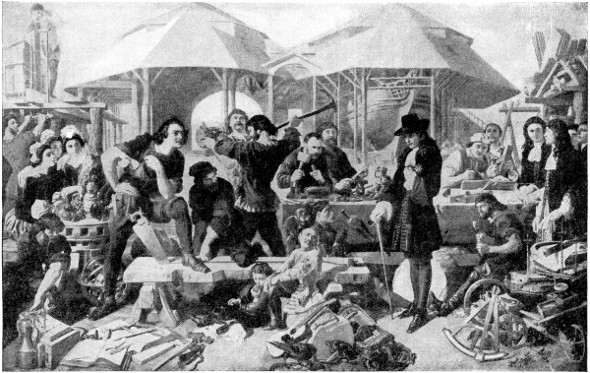
PETER THE GREAT IN HOLLAND
The practical ambition of Peter the Great has probably never been surpassed by any sovereign in history. He began empire building with his travels in 1697. It was an unparalleled step for a young sovereign of twenty-five to take: to withdraw from his kingdom and journey abroad in order to learn the art of government. He was deeply interested in all branches of engineering, especially ship-building, which he first studied in Holland, working as an ordinary laborer in a dockyard. In 1698 Peter went to England to pursue his studies in the theory and practice of ship construction, which he did by visiting the dockyards of Woolwich, Chatham, and Deptford.
Eastern Russia.—Chief towns: Astrakhan, Kazan, Samara, Saratoff.
This part of the country is more elevated, but less effectively drained; and vast forests stretch from the upper Volga to the Urals.
The peoples are of Turkish origin and include the Tartars of Kazan; the Nogai Tartars of the Crimea in the south, and the Kirgiz on the Caspian. The Bashkirs, Chuvash, and others, in the Ural and Volga, are Tartarized Finns. The Kalmucks may be taken as the purest type of the Mongols; they are short, swarthy, broad-shouldered horsemen, black-haired and black-eyed, the eyes slanting down toward the flat nose.
South Russia.—Along the Black Sea. Chief towns: Odessa, Nikolayeff, Kisheneff.
This is chiefly the steppe-region, a belt more than two hundred miles wide along the littoral of the Black Sea and the Sea of Azov, and extends east through the region of the lower Volga and Ural till it meets the steppes of central Asia.
Here are gently undulating plains, clothed with rich grass and coated with a thick layer of fertile black earth.
In order to people Bessarabia after its conquest in the eighteenth century without depriving the Russian landowners of their serfs, several races of foreigners, as Moldavians, Wallachians (Vlachs), Servians, Greeks, Germans, and even Scotch, were freely invited to settle there. The population of the steppe-region exceeds thirteen millions.
Western Russia.—Including the Lithuanian provinces of Kovno, Vilna, and part of Grodno and Vitebsk, drained by the Niemen and the upper Dwina, and other portions of the former kingdom of Poland. Chief town: Vilna.
Here dwell the White Russians, who number about six millions, but they are more mixed with Poles, Jews and Little Russians. In all essentials they are merely “poor relations” of the Great Russian family, living, on the whole, in a more degraded and undeveloped state than any other Russians.
The Baltic Provinces.—The coast-lands of the Gulfs of Finland and Riga. Chief towns: Petrograd (St. Petersburg), Revel, Riga.
These are four Russian governments bordering on the Baltic—viz., Courland, Livonia, Esthonia, and Petrograd; or in a restricted sense, often the first three. The Baltic provinces once belonged to Sweden, except Courland, which was a dependency of Poland. They came into the possession of Russia partly in the beginning of the eighteenth century through the conquests of Peter the Great, partly under Alexander in 1809.
They occupy an undulating plain three hundred to eight hundred feet above the sea. Owing to the influence of the sea, this region enjoys a milder climate than the rest of Russia, and has maintained its excellent forests, chiefly of oak. The soil is of moderate fertility.
The more important non-Slavic peoples of this region are the Lithuanians (one million two hundred and fifty thousand) and Letts (one million five hundred thousand), chiefly in Kovno, Vilna, Grodno, Vitebsk, Courland, and S. Livonia. The Germans (one million five hundred thousand) are mainly descendants of the mediæval conquerors of the east Baltic coasts (Teutonic Knights, Knights of the Sword, and their followers) and of the agricultural colonists brought by Catherine II.
The Grand-Duchy of Finland.—In the northwest, next Scandinavia. Chief towns: Viborg, Helsingfors, Abo.
Finland was ceded by the Swedes in 1809, but still retains an independent administration. The interior, chiefly elevated plateau, consists largely of forest land, and is well supplied with lakes, many of which are united by canals. (See also under Europe.)
Education is highly advanced; Swedish and Finnish are the two languages of the country, Russian being practically unknown. There is an excellent Saga literature, and the beginnings of a modern literature. The Finns came under the dominion of the Swedes in the twelfth and thirteenth centuries, and were by them Christianized.
The Finnish race includes the Finns and the Karelians (two million four hundred thousand in Finland and three hundred and fifty thousand in European Russia); the Esthonians, the people of Livonia, and other Western Finns in the Baltic Provinces (about one million); the Lapps and the Samoyedes in the far north; and the Volga Finns and the Ugrians (one million seven hundred and fifty thousand in European Russia and fifty thousand in Siberia). The Eastern Finns are being rapidly absorbed by the Russians; but the Western Finns warmly cherish their nationality.
[7]Poland.—In the west, next Germany. Chief town: Warsaw.
Surface Features.—In general these embody the plains of European Russia and the lowlands and plains that extend to the north of the two great plateaus of Asia—the high plateau of East Asia and the western plateau of Persia and Armenia.
In European Russia, apart from the Caucasus, the Urals, and the Crimea, the only districts rising above one thousand feet are the Valdai hills at head of the Volga, the Timan range (over three thousand feet) in the Pechora basin, several heights in Russian Lapland (over one thousand five hundred), and some in Ukraine (over one thousand). The main divisions of its landscape are the treeless northern tundras, frozen in winter, grassy in summer; the rock and lake plateau of Finland; the immense central forest region, the cultivated parts of which supply Europe with grain; and the treeless steppes, which lie across the south of the plain from the saline borders of the northern Caspian toward Roumania on the west.
In Western Asia, the Caucasus is a single chain, so narrow that the same summits may be seen from the steppes which reach out from its northern base, and from the deep valleys which separate it from the heights of Armenia on the south. It has thus no great valleys in the direction of its length. The spurs descending from the main chain have deep gorges or troughs between. The culminating points are the Elbruz peak and Koshtan Tau, towards the western end of the chain; and Mount Kazbek, near the middle of it—all rising grandly from deep valleys.
The two most important passes over it were called in ancient times the Caucasian and Albanian gates. The former, now called the Dariel Pass, lies close to the eastern base of the Kazbek, and is a narrow cleft eight thousand two hundred and fifteen feet above the sea, available for carriages in the summer. The latter skirts the eastern termination of the range on the shores of the Caspian.
Over the whole chain vegetation is vigorous, but more luxuriant on the warmer southern slopes. The valleys opening in that direction are highly fertile, producing rice and cotton and silk, indigo, tobacco, and vines, and luxuriant woods. The northern slopes, exposed to the keen winds of the steppes, are characterized by bare pasture-lands and scattered firwoods.
All Western Siberia, nearest the Ural belt and European Russia, is a vast plain rising almost imperceptibly from the shores of the Arctic Ocean to the Kirghiz steppes and the base of the Altai mountains, which spring up from it like a wall, forming the northern buttress of the great tableland of Central Asia. The northern border of this plain is occupied by the marshy frozen tundras; the broad central belt is covered with forest, in the cleared spaces of which the soil is fertile and well suited to agriculture; all the southern portion of it is occupied by treeless steppes which reach away south towards the Caspian and Aral Seas.
The chief elevation in eastern Siberia is a chain of volcanic mountains running down the center of the peninsula of Kamchatka, some of whose peaks reach an elevation of seventeen thousand feet.
Rivers.—The chief rivers of Russia are the Niemen, the Dwina, the Lovat (continued by the Volkhov and the Neva), the Onega, the Dnieper, the Don and the Volga. By means of three lines of canals and canalized rivers, which connect the upper tributaries of the Volga with the streams that flow into Lakes Onega and Ladoga, the real mouth of the Volga has been transferred from the Caspian to the Gulf of Finland—Petrograd being the chief port of the Volga basin. The upper Volga and the upper Kama are also connected by canals with the North Dwina, and the Dnieper with the Düna, the Niemen, and the Vistula.
The rainfall of Russia is small, and as part of it falls in the shape of snow, the rivers are flooded in spring and in early summer. During the winter navigation of course ceases.
The Lake District.—This region lies in the north, and includes the governments of Petrograd, Novgorod, and Finland. The lakes in the district are well-nigh innumerable, the government of Novgorod alone containing more than three thousand lakes. The chief lakes of Finland are the Enare and Saima. Lake Ladoga is the largest lake in Russian Europe. For a third of the year its surface is frozen. The lake abounds with fish, and has a peculiar species of seal. The Neva flows from the lake into the Gulf of Finland.
Lake Onega is joined up to the White Sea by means of a series of lakes and streams.
Lake Ilmen is formed by the meeting of a number of rivers in a shallow depression; the average depth does not exceed thirty feet.
Lake Peipus, a part of which is called the Lake of Pskov, connects with the Gulf of Riga and with the Gulf of Finland. This lake also is very shallow and does not in any part exceed a depth of ninety feet.
Seaboard and Islands.—The ports on the Arctic coast are of little importance, since for nearly three-quarters of the year the outlets are frozen.
The White Sea with its port, Archangel, had lost much of the importance which it formerly possessed until brought into use during the European war in 1916-1917.
The Bering Sea and the coasts which border on the Sea of Japan lose much of their value because they are bleak and inhospitable. The great gulf which has the town of Vladivostok at its head is separated by miles of waste land from the interior, and the value of one of the most magnificent harbors in the world suffers much from this fact.
The sea which is of most importance to Russia is the Baltic, with its gulfs of Bothnia, Riga, and Finland. The chief Russian ports are to be found situated on its banks, and yet it can in no respect be regarded as a purely Russian sea.
The chief islands of the Baltic are: the Aland Archipelago, Dago, Oesel, Mohn, Hochland, and Kotlin, which contains the fortress of Cronstadt.
The Black Sea is becoming of more and more importance every year. The coast lands are being developed, and as the produce of the interior becomes greater so the importance of the Black Sea increases.
The Sea of Azov is the greatest inlet of this sea, but on the whole the importance of the Black Sea is lessened by the fact that it has so few good ports. The best are those of the peninsula of the Crimea, but these are too remote to be of any great importance.
Odessa is the second port of Russia and the greatest port of the Black Sea. Sebastopol is the great naval station, and Batum owes its importance to the fact that it is the port of the oil fields of the Caucasus.
The great inland sea of Russia, the Caspian, lacks importance chiefly because of the fact that it is an inland sea. It forms a good means of communication from the Transcaucasian provinces to Central Asia, and also between Central Asia and Persia; but although attempts have been made to unite it with the Black Sea, the fact that it lies seventy feet below sea-level prevents any real good from being done. It is, however, of vast importance as a fishing center, and supplies almost the whole of Russia with fish.
Climate.—In European Russia, except in the Baltic provinces, the south of the Crimea, and a narrow strip of land on the Black Sea, the climate is continental. A very cold winter, followed by a spring which sets in rapidly; a hot summer; an autumn cooler than spring; early frosts; and a small rainfall, chiefly during the summer and autumn, are the main features. The winter is cold everywhere. All the rivers are frozen over early in December, and they remain under ice for from one hundred days in the south to one hundred and sixty days in the north.
Products and Industries.—Excepting along the tundra belt on the Arctic coasts, in Finland, and in the saline steppes of the southeast, the cultivation of grain extends all over the great Russian plains.
Agriculture and Forests.—Rye and barley, oats and flax, are the chief crops in the north; wheat and vines, hemp and tobacco, the products of the center and the south. The south central governments, extending from the Upper Oka to the Ukraine on the Dnieper, may be regarded as the granary of Russia, for they produce a third of all its corn supply. Russia is thus most important of all as a grain-producing country.
Its forests extend over about forty per cent of the surface—pine and fir and birch in the north; oak and elm and lime in the center and south. The timber is sent down the Niemen and Vistula to the Baltic, and to Archangel in the White Sea, in enormous quantities for the supply of western Europe. In Russia itself the larger portion of the houses are built of wood.
Live Stock and Fisheries.—The steppes of the south are the great pastoral lands of Russia, which possess more than forty-five millions of sheep, about twenty-five per cent yielding fine wool; twenty-five millions of cattle; and twenty millions of horses. Russian leather is famous. Swine are also kept in very large numbers all over the land; the export of bristles and brushes from Russia is very large. Reindeer form the wealth of the Lapps and Samoyeds in the north; camels of the Tartars in the southeastern steppes. Hunting the bear, wolf, fox, and deer, and trapping the sable in the forests for their skins, give employment to many. The Caspian, as well as the Sea of Azof, the Black Sea, and the great rivers, are rich in fish—tunny, sturgeon, salmon, anchovy. Most caviare is made at Astrakhan on the Caspian.
Minerals.—The Obdorsk and Ural Mountains contain very great mineral riches, and, with the Altai range, are the principal seat of mining and metallic industry, producing gold, platinum, copper, iron of very superior quality, rock-salt, marble, and kaolin, or china-clay. Silver, gold, and lead are also obtained in large quantities from the mines in the Altai Mountains. Russia is now the largest producer of petroleum in the world. Great supplies of petroleum and naptha are found in the Baku, Kerch, and Taman. An immense bed of coal, both steam and anthracite, and apparently inexhaustible, has been discovered in the basin of the Donetz (between the rivers Donetz and Dnieper). Other mineral products are: gold, platinum, pig iron, steel and rails, copper, quicksilver, salt and lead.
Education.—From the close of the sixteenth century onward till 1861, the greater portion of the inhabitants of Russia were serfs, belonging either to the crown or to private individuals. Under these circumstances it is not surprising that the masses of the people in Russia are without education. Finland is in advance of all other parts of the empire in respect of education; it possesses a separate system. Probably not more than ten per cent of the population have received instruction of any kind. The control and maintenance of primary schools is divided between the Ministry of Public Instruction and the Holy Synod. Conditions are, however, improving. Secondary institutions comprise gymnasia and good schools, but numbers and attendances are small. Special schools are increasing in number, especially in the European cities. There are universities at Kazan, Kieff, Kharkoff, Moscow, Odessa, Petrograd, Saratoff, Tomsk, Yurieff and Warsaw.
Religion.—The great bulk of the Russians—excepting a few White Russians professing the Union—belong to the Greek-Russian Church, or to one of its numberless sects of dissenters. The Poles and most of the Lithuanians are Roman Catholics; while the Finns, the Esthonians, and other Western Finns, the Swedes, and the Germans, are Protestant (about four millions).
Cities and Towns.—The largest towns in European Russia are Petrograd (2,018,596), Moscow (1,173,427), Warsaw (756,426), Riga (500,000), Odessa (449,673), Lodz (351,570), Kieff (329,000), Kharkoff (197,405), Vilna (162,633), Saratoff (143,431), Kazan (143,707), Ekaterinoslav (135,552), Rostoff (119,889), Astrakhan (121,580), Tula (109,279), and Kishineff (125,787); while Nijni Novgorod, Nikolaieff, Samara, and Minsk have populations between 90,000 and 95,000. In Asiatic Russia the Caucasus contains two towns with over 100,000 inhabitants: Baku (179,133), and Tiflis (160,645); Turkestan contains five large towns, Tashkend (156,000), Namangan, Samarkand, and Andijan; in Siberia Vladivostok has 90,000 (one-third Chinese), Tomsk, Irkutsk, and Ekaterinburg have each about 50,000 inhabitants. Nijni Novgorod, though small, is a station on the Trans-Siberian Railway, and has annually the largest fair in the world.
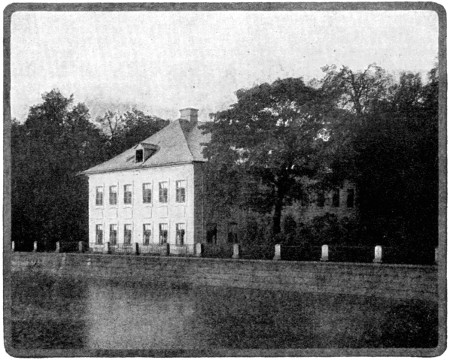
PALACE OF PETER THE GREAT, FOUNDER OF PETROGRAD
Petrograd, the splendid looking metropolis of the Russian Empire, is situated on the River Neva, near its entrance into the Gulf of Finland. The flat and low marshy ground upon which the city is built only recently emerged from the sea. The mighty Neva, which flows thirty-six miles from Lake Ladoga, subdivides into many branches, thus forming some one hundred islands.
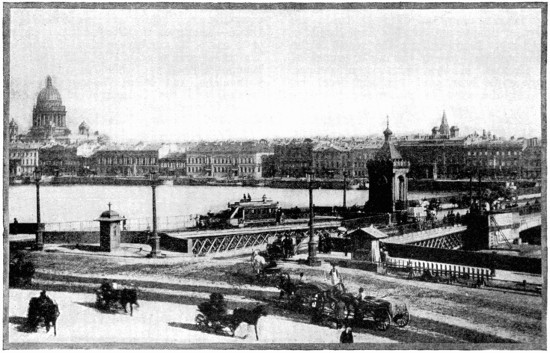
VIEW OF PETROGRAD, RUSSIA, FROM THE ISLAND
Peter the Great began to build, in 1703, a small hut for himself, and some wooden hovels near the old fort. Now the quays form noble uninterrupted walks for several miles on each side of the broad, deep, rapid, and clear river. The climate is cold, damp, and changeable with a mean summer temperature of sixty-four degrees, mean winter temperature of fifteen degrees.
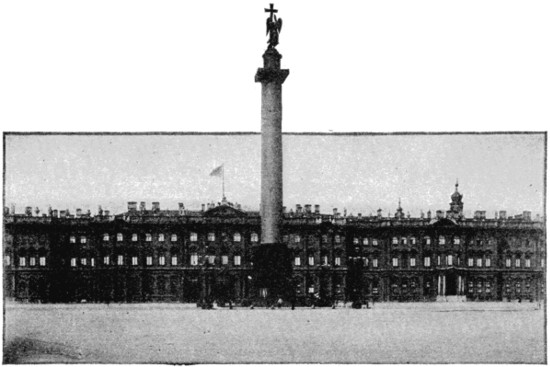
THE IMPERIAL WINTER PALACE, PETROGRAD
General Aspect and Divisions.—The main body of the city stands on the mainland, on the left bank of the Neva; and a beautiful granite quay, with a long series of palaces and mansions, stretches for two and one-half miles. Only three permanent bridges cross the Neva; a bridge of boats is constructed each spring and removed each autumn.
The island Vasilievsky, between the Great and Little Nevas, contains the Stock Exchange, the Academy of Sciences, the University, the Philological Institute, the Academy of Arts, and various schools and colleges.
On the Petrogradsky Island, between the Little Neva and the Great Neva, stands the old fortress and prison of St. Peter and St. Paul, facing the Winter Palace, and containing the mint and the cathedral wherein the members of the imperial family are buried, also the arsenal.
The Chief Center.—The main part of Petrograd has for its center the Old Admiralty. Its lofty gilded spire and the gilded dome of St. Isaac’s Cathedral are among the first sights caught on approaching Petrograd by sea. Three streets radiate from it, the first of them, the famous Nevsky Prospect. The street architecture, with its huge brick houses covered with stucco and mostly painted gray, is rigid and military in aspect.
A spacious square, planted with trees, encloses the Old Admiralty on three sides. To the east of it rise the magnificent mass of the Winter Palace, the Hermitage Gallery of Art, and the semicircular buildings of the general staff.
In the Petrogradsky Square is the well-known statue of Peter I. on an immense block of Finland granite. The richly decorated cathedral of St. Isaac of Dalmatia, erected by Nicholas I., is an almost cubic building (three hundred and thirty feet long, two hundred and ninety feet broad, and three hundred and ten feet high), surmounted by one large and lofty and four small gilded domes.
In Nevsky Prospect are the Kazan Cathedral, the Public Library, the square of Catherine II., and the Anitchkoff Palace.
The aristocratic quarter lies between the line of the Nevsky Prospect and the River Neva.
The principal places of interest are: the Imperial or Winter Palace, the Hermitage, St. Isaac’s Cathedral, the Kazan Cathedral, the Cathedral of Saints Peter and Paul, the Smolnoi Church, the Academy of Science, the House of Peter the Great; and, in the environs, Tsarskoe Selo, and Peterhof. For most travelers the greatest attraction in Petrograd is:
The Hermitage.—It is connected with the Winter Palace, and was originally built by the Empress Catherine II. as a retreat. The present building, erected 1840-1852, by Klenze, is in the Greek style; it is a parallelogram, five hundred and twelve feet by three hundred and seventy-five feet, and for elegance of form as well as for beauty and costliness of materials employed has scarcely a rival in Europe.
Baedeker says: “The gallery of the Hermitage unquestionably stands among the first in Europe, not on account of its numbers (it boasts over one thousand nine hundred pictures) or on account of its completeness—the art of the fourteenth and fifteenth centuries and the entire German school is lacking—but because it possesses such a number of masterpieces from the best periods of the various schools, that for the Spanish masters it ranks next to the Prado and the Louvre, in French masters it is surpassed only by the Louvre, in Flemish artists it stands on a level with the principal galleries, and it is the premier collection of the Dutch school, especially Rembrandt.”
Cathedral of St. Peter and St. Paul is in the fortress. It was erected 1714-1733, and was several times damaged by lightning. It has a beautiful spire, three hundred and two feet, the loftiest in Russia, except that at Reval. All sovereigns of Russia, including and since Peter the Great, except Peter II., who was interred at Moscow, lie buried here. The tomb of Peter the Great is near the south door. On the walls are many military trophies, keys of fortresses, flags, weapons, shields, etc. Nearby the Cathedral, in a brick building, is the boat of Peter the Great, preserved exactly as when it engaged the curious attention of Peter and so led to the creation of the Russian navy, of which it is facetiously called the “Grandfather.”
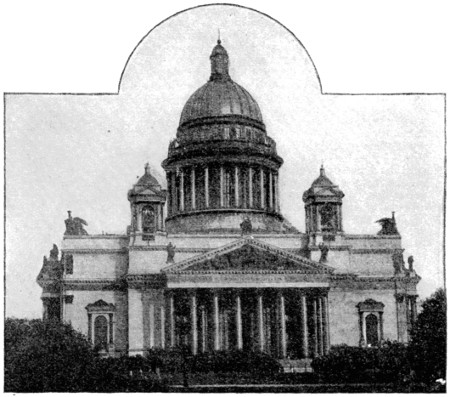
THE CATHEDRAL OF ST. ISAAC
The largest in Petrograd, was begun a century ago by Catherine II.; but was rebuilt in 1819-1858, by Montferrand, in the shape of a Greek cross. It is a simple but massive pile, with one hundred and twelve pillars in the four fronts. Those at the chief entrance are sixty feet high, and seven feet diameter—all round and highly polished granite monoliths from Finland. The dome, two hundred and ninety-six feet high, is surmounted by a golden cross and covered with copper, overlaid with gold. The Altar screen is of immense value and the entire edifice cost about fifty million dollars.
The Kazan Cathedral is situated upon the Nevsky Prospect, and is approached by a circular colonnade, in imitation of St. Peter’s at Rome. In front are fine statues of Smolenskoi and de Tolly. The interior corresponds in its magnificence and display to St. Isaac’s. The special object of interest is the image of “Our Lady of Kazan,” which is covered with gems, the diamonds of the crown being of exceeding value. Around the cathedral are banners of important victories won by Russian arms and valor.
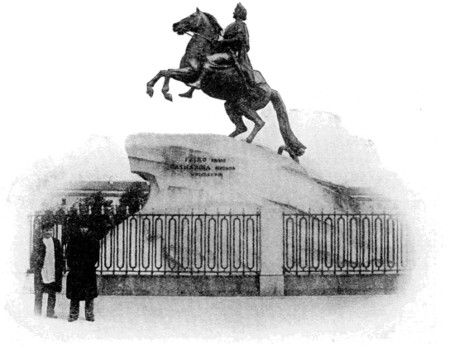
STATUE OF PETER THE GREAT, PETROGRAD
A very striking equestrian statue, erected by Catherine II. in 1782. It is of colossal size, by Falconet, and stands on a huge pedestal of granite, between St. Isaac’s Church and the River Neva.
The Smolnoi Church, at the eastern extremity of the city, is peculiarly rich in its effects, the entire structure and all its decorations being of the purest white. In connection with this church is a celebrated seminary for young ladies of noble birth.
Cathedral and Monastery of St. Alexander Nevsky is at the extreme east end of the Nevsky Prospect. The buildings cover much ground, and include twelve churches, the monastery, and gardens. The Cathedral, which is that of the Metropolitan, dating from 1790, is enriched with marble and agate and paintings—the altarpiece, the Annunciation, is by Raphael Mengs. On pillars opposite the altar are large portraits of Peter the Great and Catherine II. The shrine of St. Alexander Nevsky is of silver, about two thousand pounds of the metal being used in the whole; near the tomb are suspended the keys of Adrianople. The Monastery has a rich collection of jeweled mitres, gold brocaded vestments, and a mass of valuables, also many objects of interest, including the crown of St. Alexander and the bed on which Peter the Great died.
Tsarskoe Selo (tsär’kō-ye sā´lō), about fifteen miles south of St. Petersburg, contains a famous imperial palace, a favorite summer residence of the court. The Old Palace, begun in 1744, is richly decorated, the walls of one room are incrusted with amber, those of another with lapis lazuli. The magnificent marble gallery, two hundred and seventy feet long, connects the palace with a detached building. The park is full of caprices, such as a Chinese tower and village, an Egyptian pyramid, a Turkish kiosk, and the so-called doll-houses of the royal princesses.
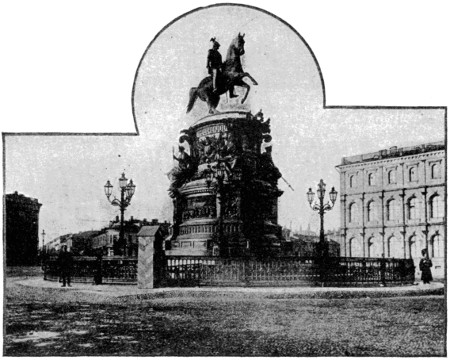
MONUMENT TO NICHOLAS I., PETROGRAD
Peterhof (pā´ter-hōf), near Oranienbaum, was begun in 1720, and built by Leblond for Peter the Great. A marine palace, with a long front, made to retain its original appearance, even its ancient yellow color has been continually renewed. It contains porcelain, malachite, tapestry, paintings of victories in the reign of Catherine II., and a collection of three hundred and sixty-eight portraits of women, painted by Count Rosali for the empress during a journey. All are in the national costume. The gardens are full of Neptunes and Tritons and good fountains. The well-wooded park has many curiosities:—Marli, a favorite resort of Peter the Great; the cottage of the Empress Catherine, brilliant with gold and mirrors; the Palais de Paille; the English Garden, with a ball-room.
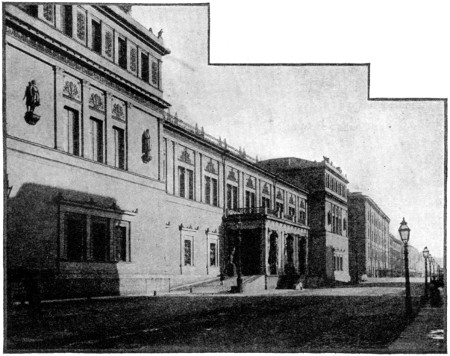
THE HERMITAGE OR MUSEUM OF ART,
connected with the Winter Palace, is one of most famous in Europe and contains one thousand seven hundred paintings of all schools, among them being some by Murillo, Velasquez, Rubens, Van Dyke, Rembrandt, and Ruysdael.
Moscow (mŏs’kō), the ancient capital of the Russian Empire, is one of the most magnificent and interesting cities of the world. The city is gathered in a semi-circle around the citadel, or Kremlin, which stands immediately upon the river bank. The streets are exceedingly irregular, though generally presenting the appearance of broad, well-paved avenues of a modern European city. The innumerable white, semi-oriental structures which greet the vision from every commanding point, with their unnumbered domes, spires, belfries, towers, and minarets, give to the city a magnificence of beauty scarcely to be found elsewhere in the great cities of Europe.
The Kremlin.—The historic, as well as the most interesting part of the city, is within the walls of the Kremlin. It is associated with much that is held in deepest reverence by Russians—here the imperial power receives religious consecration, and the great bell of Ivan Veliky proclaims the new monarch. The Kremlin is an assemblage of many buildings, covering quite a section of the city—churches, palaces, arsenals, barracks, monuments—enclosed within a brick wall about a mile and a half in circuit. Upon the wall, which is sixty feet high, are twenty-one towers. The principal gate, the Gate of the Saviour, is on the east side. Over the passage of the gate is the venerated “Saviour” brought from Smolensk in 1685, and it is the custom for the passer-by to uncover his head.
The Tower of Ivan Veliky, or John the Great, built in 1600, and three hundred and twenty feet high, contains thirty-four bells, the largest of which weighs sixty-four tons. When all these bells are rung together at Easter the effect is wonderful. At the foot of this tower is the vast Tsar Kolokol, or Monarch of Bells. It once hung in a tower (burned in 1737), weighs four hundred and forty-four thousand pounds, and is twenty feet high and sixty feet round. The value of the metal in the bell is nearly two million dollars.
Outside the Kremlin is the Chinese town, so-called, founded by Helena. Here are the Romanoff Palace, the Iberian Gate and Chapel, the University, the great Riding School, the Theaters, and the largest Bazaar in Russia, except that of Nijni-Novgorod.
The Church of the Saviour, is conspicuous near the river, a quarter mile southwest of the Kremlin. This beautiful church, by the architect Thon, was erected 1837-1883, at a cost of more than eight million dollars. It has five cupolas, the principal being about one hundred feet in diameter; many figures in relief of patriarchs and saints upon the facade. The interior is elaborately decorated with marble and gilding; upon the walls are tablets relating to military events, admirable paintings and sculpture.
The Cathedral of St. Basil, erected 1554-1557, is a remarkable edifice, consisting of eleven chapels with as many cupolas, all different, but wonderfully proportioned.
Vladivostok (vlä-dē-vōs-tok´), capital (since 1903) of the vice-royalty of Eastern Asia, Siberia, is situated on the east shore of Amur Gulf. It has one of the finest harbors in the world, is a naval station, has an arsenal, and is a terminus of the Siberian railroad. It escaped attack during the Russo-Japanese war, but suffered from naval mutiny and unrest in the Russian disturbances of 1905-1906. Its climate is severe—the average annual temperature being only forty degrees Fahrenheit.
HISTORY OF RUSSIA
The races who peopled Russia were vaguely known to the ancients as Scythians, and their country as Sarmatia. It received its name from the Ruotsi or Russ, a tribe of Norse “rovers” or freebooters, who entered the country from the west about the eighth century. The name was later applied to the realm of Moscow, and modified to Russia.
Early Traditions.—Three brothers, Rurik, Sineus, and Truvor, Scandinavians, were invited, according to tradition, to come and protect territory in northwest Russia against the Finns and the Lithuanians. They and their successors built new forts, and took part in wars. The times of the “Sunny Vladimir” (980-1015) are the “heroic” epoch of early Russian history, and the feats and feasts of Vladimir and his “war companions” have been handed down through ages in legend and song; while his conversion to Christianity made him the hero of the annals written by monks.
Kieff the First Historic Center.—The first half of the eleventh century, during which Yaroslaff the Wise was grand prince at Kieff, was the most brilliant time for Kieff, then the “mother of the Russian towns.” The great cathedral of St. Sophia was built at that time; schools were opened, and the first written Russian law was compiled. At his death (1054) Yaroslaff was ruling over most of the Russian towns.
The next two centuries of Russian history correspond to the feudal period of Western Europe. The Russians at that time were steadily extending their territory toward the east; they colonized the Oka, the Don, and the Finnish territories in the northeast.
Settlements in and about Moscow.—Owing to the gradual colonization of the basin of the Oka and the upper Volga, a new Russian territory had grown in importance in the meantime. Suzdal and Rostoff were its chief centers. It differed from southwest Russia in many respects. Its inhabitants were Great Russians—a hard-working race, less poetical and less gifted, but more active than their southern brethren. Besides, a good many of its inhabitants were peasants, settled on the lands of the boyars, and the cities themselves, being of recent creation—like Vladimir and, later on, Moscow—had not those traditions of independence which characterized Kieff or Novgorod. It was therefore easier for the authority of the prince to develop in the northeast, under the guidance of the church and the boyars.
The first Suzdal prince, Andrei Bogolubsky (1157-1174), was the first representative of that policy. He invited many Kieff boyars to settle in the land of Suzdal, and finally he took and burnt Kieff (1169).
The supremacy of Kieff was thus destroyed, and the land of Suzdal became the Ile-de-France of Russia—the nucleus of the future Russian state. The Suzdal land continued to grow and to enjoy prosperity during the next fifty years; economical, educational and literary progress were marked, and the Russian territory extended farther eastward.
Tartar Invasion.—But in the thirteenth century a great calamity visited Russia: a Mongol invasion suddenly put a stop to the development of the country and threw it into a totally new direction.
The Tartars first appeared in 1224, but their real conquest, under Batu Khan, was made in 1238 and the years immediately following. They subdued all the little Slav states except the republic of Novgorod. Latterly the rulers or princes of Moscow gained an ascendency over the other states, and formed the nucleus of a central sovereignty.
Ivan III. Expels the Tartars.—The Tartar supremacy lasted till about 1480, when Ivan III. (1462-1505) succeeded in throwing off their yoke. He did much to consolidate and extend his kingdom, and conquered Novgorod in 1478. The reign of Ivan IV. “The Terrible” (1533-1584) is of great importance. In 1547 he assumed the title of Czar or Tsar, a variant of Cæsar. He conquered Kazan and Astrakhan, and the conquest of Siberia was begun in his reign. The epithet “terrible” has reference to his cruel persecution of the boyars, a kind of powerful baronial class.
House of Romanoff Established.—The accession of the still-reigning Romanoff house took place in 1613 when the States-General elected Michael Romanoff as ruler. Under Alexei (1645-1676), son of Michael, territory was won from Poland, the Cossacks of the Ukraine had to submit, and the power of Russia greatly increased. The reign of Alexei’s son, Feodor III. (1676-1682), witnessed a war with Turkey, but was signalized by many important reforms. His imbecile brother Ivan was heir apparent, but Feodor willed the throne to his half-brother Peter, known in history as the Great; but Peter only obtained sole power in 1689 after overthrowing Sophia, Ivan’s sister.
Under Peter the Great.—Peter the Great opened what may be called the European period of Russian history. (See Peter the Great.) He made his country a European state. He gave it a standing army, a navy on the Baltic, the embryo of a modern administration, a diplomatic service, and a financial organization. He made canals, encouraged industry, literature and art. The heart of Russia might remain at Moscow, but henceforth it was to have also a head that looked out westward from the Neva.
On the other hand, Peter increased taxation; his cruelty was oriental, and serfdom under him became more and more extensive.
He completed the conquest of Siberia, waged successful war with Charles XII. of Sweden, and by the treaty of Nystad in 1721 obtained Esthonia, Livonia, Ingermannland, and part of Finland, thus gaining a large maritime territory on the Baltic Sea. He founded Petrograd in 1703, and made it the capital in place of Moscow.
The Eighteenth Century in Russian history is a century of empresses. Peter the Great was succeeded by his wife, Catherine I. (1725-1727). A grandson of Peter the Great, Peter II., followed Catherine, reigning from 1727 to 1730. The next sovereign was Anna (1730-1740), whose reign was a period of German influence. Ivan VI. (1740-1741) was soon displaced by the anti-German party, and Elizabeth (1741-1762), daughter of Peter the Great, ascended the throne. A part of Finland was obtained by the treaty of Abo, and Russia took part against Prussia in the Seven Years’ war. The first Russian university, that of Moscow, was founded in 1755.
The death of Elizabeth and the accession of Peter III., in 1762, greatly relieved the hard-pressed Frederick the Great, because Peter at once reversed the Russian policy.
Catherine II.—In July, 1762, he was deposed by his wife, Catherine II. (1762-1796), whose reign is of great importance in the progress of Russian power.
Under Catherine II. successful wars were carried on against Turkey, Persia, Sweden and Poland, which largely extended the limits of the empire. The acquisition of the Crimea, which gave Russia a firm footing on the Black Sea, and the first partition of Poland, were two most important steps toward the consolidation of the empire.
Napoleonic Period.—Catherine’s son and successor, Paul I. (1796-1801), at first, through apprehension of the revolution in France, joined the Austrians and British against France, but soon after capriciously withdrew, and was about to commence war with Great Britain when his assassination took place. A palace conspiracy put an end to his reign and life.
His eldest son, Alexander I. (1801-1825), was at the outset desirous of peace, but was soon drawn into the vortex of the great struggle with France, in which he played a prominent part. (See Alexander I. and Napoleon.) The Holy Alliance and the example of conservative policy set by Austria exercised a pernicious influence on the later part of his reign; and the higher classes, who had looked for the introduction of at least a portion of the liberal institutions they had seen and admired in Western Europe, became so dissatisfied that, when his youngest brother, Nicholas I. (1825-1855), from whom they had nothing to hope, succeeded, they broke out into open rebellion, which was speedily crushed.
The Turkish Wars.—A full stop was now put to the intellectual development of Russia. Wars were declared with Persia and Turkey; and a long and deadly struggle commenced with the Caucasian mountaineers. The cession of Erivan and Nahitchevan by Persia, of the plain of the Kubañ, of the protectorate of the Danubian principalities, and of the free right of navigation of the Black Sea, the Dardanelles, and the Danube by Turkey only induced him to further prosecute his aim of conquering for Russia a free issue from the Black Sea in the Dardanelles.
In 1830 he converted Poland into a Russian province; in 1849 he aided Austria in quelling the insurrection of the Magyars; and in 1853 he began a war with Turkey which became the Crimean war, and in which, though the allies, Great Britain, France and Sardinia, did not obtain any decided success, Russia suffered immense loss.
Alexander II.—The accession of Nicholas’ son Alexander II. (1855-1881)—one of whose first acts was the conclusion of the peace of Paris (1856), by which Russia lost the right of navigation on the Danube, a strip of territory to the north of that river, and the right of keeping a navy in the Black Sea—was the signal for a general revival of intellectual life in Russia. Obligatory military service for all Russians was introduced in 1874.
The insurrection in Poland was suppressed with extreme severity, and in 1868 the last relics of Polish independence disappeared in the thorough incorporation of the kingdom with the Russian Empire. The subjugation of the Caucasus was completed in 1859. Russian supremacy was established over all the states of Turkestan. In 1876 the administration of the Baltic provinces was merged in that of the central government; but the autonomy of Finland was respected and even extended.
Russo-Turkish War of 1877-1878.—In 1877 the Russo-Turkish war broke out. At first the Russian progress was rapid; but the energy displayed by the Turks during the summer, and the resolute defense of Plevna by Osman Pasha from July till December, checked the progress of the Russian army. During the winter, however, she crossed the Balkans, and her vanguard, reaching the Sea of Marmora, stood in view of Constantinople. The armistice signed in January, 1878, was followed in March by the treaty of San Stefano; and after diplomatic difficulties that seemed for a time not unlikely to issue in war between Russia and Great Britain, a Congress of the Great Powers met at Berlin in June, 1878, and sanctioned the cession to Russia of the part of Bessarabia given to Moldavia in 1856, as also of the port of Batoum, of Kars, and of Ardahan.
Rise of Nihilism.—The growth of revolutionary discontent, leading to severe repressive measures, was marked by several murders of high officials, and on March 13, 1881, Alexander II. was killed by the revolutionists.
Reactionary Reign of Alexander III.—The reign of Alexander III. (1881-1894) was in the main characterized, in contrast to the liberal reforms of the last reign, by reactionary steps. Press freedom disappeared completely, and the universities were again suppressed. The Dumas, or representative assemblies, were deprived of all real independence in 1892. Alexander II.’s judicial reforms were partly undone, and the village communities, known as mirs, were brought under the more direct control of the land-owners. Russification was vigorously pursued in Poland and the Baltic provinces, and in 1890 the first steps toward the Russification of Finland were taken.
Alexander III. was not friendly to Germany, but avoided hostilities more serious than those of a tariff war, although the Bulgarian crisis of 1885 subjected their relations to a severe strain. Russia and France now began to draw close together, but a Franco-Russian alliance was not officially admitted till 1896-1897, and its terms were secret. Merv was annexed in 1884, and the occupation of Penjdeh in 1885 nearly led to war with Great Britain. Alexander III. escaped several attempts at assassination, and died of disease in November, 1894.
Russia in the Far East.—After the reign of Alexander III. comes the fateful reign of his son, Nicholas II. In 1896 China granted permission to carry the Siberian railway (begun in 1889) through Manchuria to the far eastern Russian seaport of Vladivostok. In December, 1897, in consequence of the Germans having acquired Kiauchau from China, Russia occupied Port Arthur, and in the following year obtained from China a lease of it and some neighboring territory, although in 1895 she had taken the chief part in preventing Japan from taking it as a prize of victory. She shared in the international expedition to China in 1900, and herself suppressed risings in Manchuria with the utmost cruelty. Professing to be ready, and even anxious to evacuate Manchuria as soon as possible, she was preparing for virtual annexation; but her aggressive action in Korea aroused Japanese opposition, and led to the war of 1904-1905.
By treaty of Portsmouth (1905), which ended this war, Russia lost—for the time being at least—all influence in Manchuria, Korea, and China, and had to cede to Japan Port Arthur and its territory, and also southern Sakhalien.
The Imperial Duma.—In August, 1905, the czar issued a manifesto ordering the election of an Imperial Duma or Parliament. Count Witte was made president of a reorganized Council of Ministers, with instructions to form a reform cabinet. The general strike in Finland compelled the czar to restore Finland’s constitution and liberties previously taken away in 1903. The bureaucrats attempted to discredit the reform movement by instigating attacks on Jews, and other outrages, especially in Odessa, where the authorities permitted appalling atrocities.
The Imperial Duma, promised in 1905, was duly elected early in 1906, and held its first meeting on May 10 at Petrograd. It was dissolved later in the year because too liberal, and a second one, elected in 1907, met the same fate. By various devices the government managed to get a less advanced Duma elected late in 1907, which did some useful work in 1908. An important Anglo-Russian convention was signed in 1907, the signatories agreeing to respect the territorial integrity of Thibet and the suzerainty of China. Other conventions were signed (1910) between Russia and Japan respecting the status of Manchuria, and between Russia and Germany in 1911.
After declaration of war by Austria against Servia in 1914, Russia announced that her support would be given to Servia. Consequently Russia joined France and Great Britain in the conflict that followed. (See further under European war.)
Books of Reference.—Wallace’s Russia; Leroy-Beaulieu’s The Empire of the Tsars; Norman’s All the Russians; Drage’s Russian Affairs; Suvorin’s All Russia—a Directory of Industries, etc.; Stepniak’s King Log and King Stork; Krapotkin’s Memoirs of a Revolutionist; Morfill’s Russia; Villari’s Russia under the Great Shadow; Wellesley’s With the Russians in Peace and War; Ganz’s The Downfall of Russia; Milyoukov’s Russia and Its Crisis; Meakin’s Russia, Travels and Studies.
SOVEREIGNS OF RUSSIA
A long list of dukes and grand dukes preceded the actual foundation of the Russian monarchy under the rule of a czar.
HOUSE OF RURIK
This royal house includes the descendants of Rurik, Grand Prince of Novgorod, the reputed founder of the Russian royalty. It became extinct in the person of Feodor in 1598.
1462-1505.—Ivan (Basilovitz), or John III., took the title of czar, 1482; Grand Duke of Moscow.
1505-1533.—Vasali IV., or Basil V., obtained the title of Emperor from Maximilian I.; son of Ivan the Great.
1533-1584.—Ivan IV. the Terrible; a tyrant; son of Vasily IV.
1584-1598.—Feodor, or Theodor, I.; and his son Demetrius, murdered by his successor; son of Ivan the Terrible: was elected to the throne.
1598-1604.—Boris-Godonof, who usurped the throne.
1605.—Feodor II., murdered.
1606.—Vasali-Chouiski, or Zouinski.
1606-1610.—Demetrius the Impostor, a young Polish monk; pretended to be the murdered prince Demetrius; put to death.
1610-1613.—Ladislaus of Poland; retired 1613.
HOUSE OF ROMANOFF—MALE LINE
1613-1645.—Michael-Feodorovitz, of the house of Romanoff, descended from the czar Ivan Basilovitz; unanimously elected czar.
1645-1676.—Alexis, styled the father of his country; son of Michael Feodorovitch.
1676-1682.—Feodor, or Theodor, II.; eldest son of Emperor Alexis.
1682-1689.—Ivan V.; Peter I., Ivan was the half-brother of Peter the Great, in whose favor he resigned.
1689-1725.—Peter I., the Great, alone; took the title of emperor October, 1721; founded St. Petersburg; son of Alexis.
1725-1727.—Catherine I., his widow, at first the wife of a Swedish dragoon, said to have been killed on the day of marriage; was married to Peter the Great in 1707.
1727-1730.—Peter II., son of Alexis Petrovitz, and grandson of Peter the Great; deposed.
HOUSE OF ROMANOFF—FEMALE LINE
The reign of the next three sovereigns of Russia, Anne, Ivan VI., and Elizabeth, of the female line of Romanoff, formed a transition period, which came to an end with the accession of Peter III., of the house of Holstein-Gottorp.
1730-1740.—Anne, duchess of Courland, daughter of the czar Ivan.
1740-1741.—Ivan VI., an infant, grand-nephew to Peter the Great; immured in a dungeon for eighteen years; murdered in 1764.
1741-1762.—Elizabeth, daughter of Peter the Great reigned during Ivan’s captivity.
HOUSE OF ROMANOFF-HOLSTEIN
All the subsequent emperors, without exception, connected themselves by marriage with German families. The wife and successor of Peter III., Catherine II., daughter of the Prince of Anhalt Zerbst, general in the Prussian army, left the crown to her only son Paul, who became the father of two emperors, Alexander I. and Nicholas, and the grandfather of a third, Alexander II. All these sovereigns married German princesses, creating intimate family alliances, among others, with the reigning houses of Württemberg, Baden, and Prussia.
1762.—Peter III., son of Anne and of Charles Frederick, duke of Holstein-Gottorp; deposed, and died soon after; supposed to have been murdered. Son of Charles Frederick, Duke of Holstein.
1762-1796.—Catherine II.; a great sovereign; extended the Russian territories on all sides; died 1796; wife of Peter III.
1796-1801.—Paul, her son; murdered, 1801; son of Peter III.
1801-1825.—Alexander I., died 1825; son of Paul.
1825-1855.—Nicholas I.; died 1855; third son of Paul.
1855-1881.—Alexander II., assassinated at St. Petersburg, March, 1881; son of Nicholas I.
1881-1894.—Alexander III.; died 1894; married Mary (formerly Dagmar), princess of Denmark; son of Alexander II.
1894.—Nicholas II., married princess Alix of Hesse-Darmstadt; son of Alexander III.
SECONDARY POWERS OF EUROPE
BELGIUM
BELGIUM (Fr. Belgique), one of the smaller European states, consists of the southern portion of the former kingdom of the Netherlands (as created by the Congress of Vienna), lying between France and Holland, the North Sea and Rhenish Prussia. Its greatest length from northwest to southeast is one hundred and seventy-three miles; and its greatest breadth from north to south one hundred and five miles.
Surface.—Belgium is, on the whole, a level, and even low lying, country; diversified, however, by hilly districts. The north and west of the country is low and level plain, like Holland, but the undulating forest plateaus of the Ardennes cover all the south and east, rising near the frontier in that direction to a height of two thousand feet above the sea. The Campine, composed of marshes, coal-bearing heaths, and irrigated lands, extends along the Dutch frontier. In Flanders dykes have been raised to check the encroachments of the sea.
Rivers.—The land slopes generally northward, and this is the direction of the numerous rivers and streams which water it. The great river of the country is the Meuse, which enters from France and passes out into Holland, being navigable all through Belgium. Its tributary, the Sambre, from France, which joins it on the left near the center of the country, is also a navigable stream; and the Ourthe, from the frontier of Luxemburg, which joins it lower down on the right, is navigable for half its course. The Escaut or Scheldt is the main river of the lowland in the west, and with its chief tributaries, the Lys on the left and the Rupel on the right, forms the waterway of the plain. These rivers and important tributaries, with canals make up one thousand four hundred miles of waterways.
Climate and Landscape.—Belgium has a climate which resembles that of England, opposite to it in the same latitude, but which is more excessive. The lowland of the north is foggy and damp, like Holland; the higher country south and east has clearer skies.
People.—Belgium is one of the most densely peopled countries of the world, only equaled in this respect by some parts of the plain of China, or of the valley of the Ganges in India, a result which is no doubt due to the combination of natural facilities for agriculture, manufactures, and trade, within its limits. The Flemings (of Teutonic stock) and Walloons (Celtic in origin) speak each their own dialects of Dutch and French; there are also numbers of Germans, Dutch, and French. East and West Flanders, Antwerp, and Limburg are almost wholly Flemish, and Brabant mainly so. The line between the Flemish and Walloon districts is sharply defined, the Flemish part being the richest and most cultivated. The French language has gained the ascendancy in educated society and in the offices of government, but the Flemish dialect prevails numerically in the proportion of nine to eight.
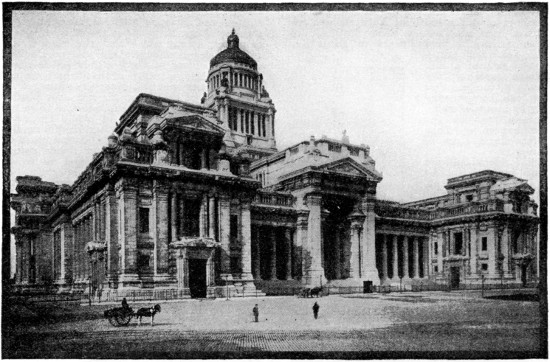
PALACE OF JUSTICE, OR PARLIAMENT BUILDINGS, AT BRUSSELS
Religion and Education.—Almost all the inhabitants of Belgium are Roman Catholics, though complete liberty and social equality is allowed to all religious confessions. Education is not yet generally diffused through the population, and was, until recently, almost entirely in the hands of the Roman Catholic clergy. There are state universities at Ghent and Liège, an independent liberal university at Brussels, and a Catholic university at Louvain.
Products and Industries.—About a fourth of all the inhabitants of Belgium are occupied in agriculture. Besides wheat, rye, and oats, hops are cultivated on a large scale, for export chiefly to France and England. Beetroot for the sugar factories, of which there are over a hundred in the country, is also a large crop, and flax is largely grown in the Flemish lowlands.
Two great coalfields extend across the central part of the country from west to east, along the valleys of the Meuse, but Belgium is essentially a manufacturing country, and it is largely dependent upon foreign supplies for its food. The mineral kingdom yields, beside coal, iron, zinc, lead and copper. The leading industries are collieries, quarries, and metal, glass, textiles, lace, flour and starch mills, sugar, distilleries, breweries, etc.
Government.—On the re-arrangement of European affairs, after the fall of Napoleon, Holland and Belgium were formed into the ill-assorted kingdom of the Netherlands under the family of Orange. The differences between the northern and southern divisions in race and language, in history, religion, and customs, proved too great.
In 1830 Belgium separated from Holland, and her neutrality was guaranteed by a conference of the European Powers, and by a further treaty, in 1839, signed by Austria, France, Great Britain, Prussia, the Netherlands, and Russia.
The Belgium constitution of 1831 jointly vests the legislative power in the king, the Senate, and the Chamber of Representatives. The one hundred and ten senators (with the exception of twenty-seven elected by the provincial councils) and one hundred and sixty-six representatives are elected by the people, the former for eight, the latter for four years. Universal male suffrage, with plural voting up to three votes by property and educational qualifications, was introduced by the electoral law of 1894, proportional representation being secured by an act of 1900. There are in addition representative Provincial and Communal Councils.
Cities.—Brussels, population, 1910, with suburbs, 720,347 inhabitants, is the capital. Other towns with over 100,000 inhabitants are Antwerp, the chief port (320,650 exclusive of suburbs); Ghent (165,149), the center of the iron industry, which has also large cotton and flax spinning mills, and is the second port of importance after Antwerp, while its flower shows are famous; and Liège (174,768).
Its great harbor and commercial city is Antwerp, a strongly fortified city on the Scheldt. The other harbors are Ghent, Bruges, Ostend, Nieuport, Blankenberg, and Zeebrugge.
Antwerp, the principal fortress, and Liège and Namur, also fortified, were designed to afford military protection on the line of the Meuse against a violation of neutrality by either France or Germany.
Brussels (Fr. Bruxelles), the capital of Belgium, is situated in a fertile plain on the ditch-like Senne, twenty-seven miles south of Antwerp, and one hundred and ninety-three miles northeast of Paris. It has a circumference of about five miles, and is built partly on the side of a hill. Though some of the streets are so steep that they can be ascended only by means of stairs, Brussels may on the whole be pronounced one of the finest cities in Europe.
The fashionable Upper Town, in which are the royal palace, public offices, and chief hotels, is much more healthy than the older Lower Town, which is greatly subject to fogs, owing to its intersection by canals and the Senne, although the stream now passes under an arched covering, which supports a boulevard. But the closely built old streets, with their numerous handsome buildings, formerly belonging to the Brabant nobility, and now occupied by successful merchants and traders, have a fine picturesque appearance, while some of the public edifices are unrivaled as specimens of Gothic architecture.
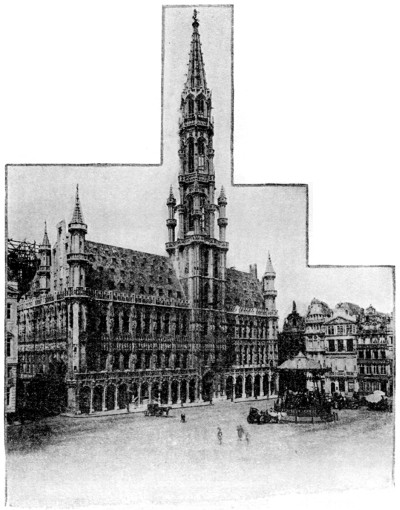
THE TOWN HALL, OR
Hôtel de Ville, in Grande Place, near the center of the city, 1402, is regarded as architecturally one of the finest structures in Europe. Its tower rises to the height of three hundred and seventy feet, and is placed somewhat to one side of the center of the building.
French is spoken in the upper division; but in the lower Flemish is the current language prevalent, and by many the Walloon dialect is spoken.
The walls which formerly surrounded Brussels have been removed, and their place is now occupied by pleasant boulevards extending all around the old town, and shaded by alleys of limes. The Allée Verte—a double avenue along the Scheldt Canal—forms a splendid promenade, and leads toward the country palace of Laeken, three miles north of the city.
Besides the fine park of thirty-two acres, in the Upper Town, ornamented with fountains and statues, and surrounded by the palace and other state buildings, Brussels has several other squares or places, among which are: the Place Royale, with its colossal monument of Godfrey of Bouillon; the Grande Place, in which is the hôtel-de-ville, a splendid Gothic structure of the fifteenth century, with a spire of open stonework three hundred and sixty-four feet high; and the Place des Martyrs, where a memorial has been erected to those who fell here in the revolution of 1830. The statue group of the Counts Egmont and Horn is notable. The cathedral of St. Gudule, dating from the thirteenth century, has many richly painted windows, and a pulpit considered to be the masterpiece of Verbruggen. The Palais des Beaux Arts contains the finest specimens of the Flemish school of painting and a sculpture gallery. The Royal Library adjoining has half a million volumes.
The Palais de Justice, built in 1866-1883 at a cost of more than ten million dollars, is one of the most magnificent buildings in Europe, dominating the lower town from the terraced slope of the upper town. The Royal Palace and the National Palace (for the chambers) are important buildings. Besides the University, there are schools of painting and sculpture, and a conservatory of music.
Brussels lace is particularly famous. Of the so-called Brussels carpets only a few are manufactured here, most of those of Belgian make being produced at Tournai. There are also manufactures of damask, linen, ribbons, embroidery, paper, jewelry, hats, soap, porcelain, carriages, etc.
History.—The history of Belgium as a kingdom can be said to date only from the time of the Congress of Vienna, in 1830, but its history as part of the Netherlands goes back to the time of the Romans.
The province of Belgica under the Romans passed under the sway of the Franks, and fell later to the Burgundian princes. On the death of Charles the Bold in 1477 it passed by marriage to the House of Hapsburg. The Spanish Netherlands remained (unlike the northern provinces which rebelled against Spain and became a Protestant republic) under the Spanish branch of the Hapsburgs, till in 1713 they were transferred to Austria. From 1794 Belgium was under French sway, but on the fall of Napoleon was united with the kingdom of the Netherlands. It rebelled in 1830, and since then, as above stated, has had a separate career as a limited constitutional monarchy. Again, in 1838, Holland and Belgium seemed on the brink of war, the cause being that Belgium had treated Lembourg and Luxembourg, which by the convention had been given to Holland, as if they were in reality a part of its territory. The crisis was terminated by the action of the Great Powers, who reduced Belgium’s share of the national debt of the Netherlands, and partitioned the territories again in dispute. The tranquillity of the country was again disturbed by the revolutionary spirit of 1848, but after 1850 the constitutional party began that series of reforms which gained for Belgium the position of one of the freest countries in Europe.
The question of Luxembourg threatened in 1861 the peace of Europe, and Belgium took part in the congress which prevented war breaking out. In 1870, on the outbreak of hostilities between France and Germany, Belgium, fearing invasion, mobilized her troops, but her neutrality was recognized and left inviolate by both parties. In 1885 the Congo Free State was acknowledged to be under the presidency of the king of Belgium, Leopold II., who had succeeded his father in 1865. The management of the colony gave cause for much bitterness, and led to a number of scandals. Leopold II. died in 1910, and was succeeded by his nephew, King Albert.
On August 2, 1914, the neutrality of Belgium was violated by the invasion of the German army at Visé, on the ground of military necessity. The German forces met with the most stubborn resistance from the valiant though numerically inferior Belgians at Liège and Namur. The country was subsequently completely overrun by German armies and subjected to military control. The Germans are at present (1917) in occupation of practically the whole country, where they are exercising civil government. The Belgian government has withdrawn temporarily to Havre, in France.
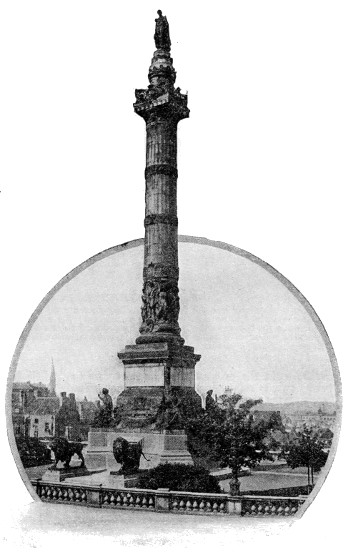
COLUMN OF THE CONGRESS, BRUSSELS
It is in Place du Congrès, two squares north from the Cathedral, was erected, 1850, in honor of the adoption, in 1831, of the present Constitution of Belgium. This is surmounted by a statue of the king. At the corners are allegorical figures of Liberty.
BULGARIA
BULGARIA, a monarchy in the northeast part of the Balkan Peninsula between the Danube and the Balkans, was created a principality by the treaty of Berlin in 1878, greatly extended by the incorporation of East Rumelia in 1885, and declared an independent kingdom in 1908.
The net result of the wars of 1912-1913 was the increase of Bulgarian territory from 33,600 square miles to about 45,000. The population increased by about 500,000, was in 1910 4,337,513—over three-fourths Bulgarians, 465,000 Turks, 121,000 Gypsies, 80,000 Roumanians, 43,000 Greeks, and 40,000 Jews. The Bulgarians now extend into Macedonia, Bessarabia, etc., their total number being about 8,000,000.
Surface.—The north of Bulgaria is fertile plain and hilly country; the south is wooded and mountainous. The country has a fine waterway on the northern boundary, a Black Sea and Ægean seaboard, a mild climate, an agricultural country capable of much, an abundance of iron and some coal, free institutions, a peasantry possessing the solid qualities and persevering industry of northern races, and an assured economic development.
Productions.—The chief occupation of the people is agriculture, which engages about seventy per cent of the population. Cereals (wheat, maize, rye, barley, oats) are the principal crops, and rank first among the exports. Wine is produced everywhere, especially near the Black Sea. Roses are cultivated to a large extent, especially round Kazanlik and Karlavo and on the north side of the Rhodope Mountains for attar of roses, which is largely exported. Silkworms are bred in Philippopolis and Haskaro. Tobacco is carefully cultivated. There is little industry apart from domestic branches such as native cloth, carpets, trimmings and ribbons; but there is some brewing and distilling, leather work at Sumen, copper work, and pottery-making. The chief exports are grain, live stock, butter, eggs, hides, and attar of roses, sent chiefly to Turkey, France, Great Britain, and Austria-Hungary.
People.—Education has been very zealously and steadily promoted. Elementary education is compulsory. There are few technical schools. Sofia has a university.
The old Bulgarian Slavonic tongue is closely allied to the great Russian, but some Servian, Greek, Romanic, Albanian, and Turkish elements have found their way into the language.
The Orthodox Greek Church counts seventy-seven per cent as its adherents, Islam twenty-one and one-half per cent, and the others are Jews.
Government.—Bulgaria possesses one of the freest and most democratic constitutions in Europe, largely modeled on the lines of the Belgian constitution, except that there is no second chamber; and election of the Sobranje or National Assembly is by universal manhood suffrage, in the proportion of one member to every twenty thousand of the population. The executive power is vested in eight ministers nominated by the king. The monarchy, independent since 1908, is hereditary.
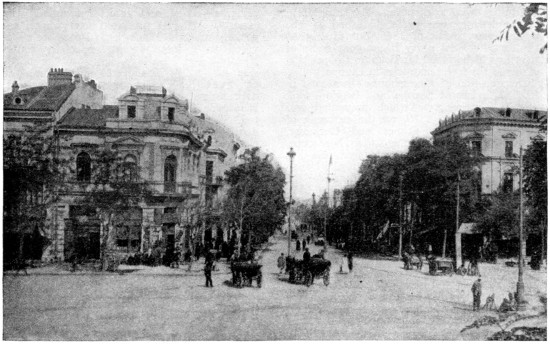
STREET SCENE IN SOFIA CAPITAL OF BULGARIA
This modern city is quite American in its appearance. It typifies to Bulgarians the progress of their nation, and is substantial and practical rather than pleasing. The streets are broad, straight, electrically lighted, and well paved, while the houses in the newer sections are modern structures of dignified architecture. While Sofia may not impress the visitor with its beauty, it does impress him with the fact that there is a good deal of common sense and business efficiency in this part of the Balkans.
Cities.—The chief towns of Bulgaria are Sofia, Philippopolis, Rustchuk and Varna. Varna and Burgas are ports on the Black Sea, Dedeagatch on the Ægean.
Sofia (sofee´a), the capital since 1878 of Bulgaria, stands in a broad valley of the Balkans, on the railway from Constantinople to Belgrade and Vienna. It lies two hundred and six miles northwest of Belgrade, while Constantinople lies three hundred miles southeast. The valley at Sofia is an upland plateau, seventeen hundred feet above sea level, and near the heart of the peninsula, between the Vitosha Mountains and the main Balkan chain. At the end of almost every vista in the city are the distant hill masses, and fringing mountains.
The city early became important as a trade center, and probably would have developed into one of the great cities of Europe had not periodical destruction, almost continual dangers of war, and centuries of misrule held it back.
The rebuilding of Sofia began around 1880. It now has many creditable public buildings, electric lighting, an electric street railway and good sewerage and water systems.
It possesses the largest theater in southeastern Europe. The Bulgarian National Theater, with a competent corps of actors and singers, and offering the best in opera and drama, is a revelation of the strides that have been made in the Balkans since the Turks were driven back a brief generation ago. The theater is a handsome modern structure, planned with greater luxury of detail than most buildings in Sofia, and it cost four hundred thousand dollars.
Sofia has a public bathhouse which is one of the finest buildings of its kind in the world. It was built over a hot mineral spring, famed since the days of the Romans. This building, in Byzantine style, including in its interior appointments all of the most modern luxuries, cost the Bulgarians six hundred thousand dollars.
Their capital city is one of the peculiar prides of the hard-working, long-enduring, persistent Bulgarians. It typifies to them the promise of a great Bulgarian future, and they also look upon it as an earnest of their right to a respected place among the civilized nations of the West.
History.—The country now known as Bulgaria was originally inhabited by Thracians, and under the Romans formed the province of Mœsia. The Bulgars originally came from the banks of the Volga and crossed the Danube in the sixth century, and occupied the East. They overcame the Slavs, adopted their language and customs, and thus became a great Slav power; but by 1186 they had split up into three principalities, and from 1393 fell under the domination of the Turks. For close upon five hundred years the Bulgars were subject to the rule of the Ottoman Empire.
The first national awakening dates from the year 1762, when the monk Paysios, then at Mt. Athos, wrote the national chronicles, and revived memories of ancient glory. A new national literature began; the first Bulgarian school was opened in 1835, and was followed by others. A newspaper appeared in 1844. The Crimean war stirred up Slavonic sympathies which Russia sedulously and naturally cherished. In 1872 the Bulgarian Church and archbishop became again independent of the supremacy of the Greek patriarch.
In 1877 Russia, as guardian of the Slav races of Turkey, declared war. As a result of the war, Bulgaria was created by the treaty of Berlin. July 13, 1878, and in 1885 Eastern Rumelia was added to the newly created principality. In 1908 the country was declared to be an independent kingdom. In 1912-1913 a successful war of the Balkan League against Turkey increased the size of the kingdom, but in August, 1913, a short campaign against the remaining members of the League reduced the acquired area, and led to the surrender of about two thousand square miles to Roumania. In October, 1915, Bulgaria decided to participate in the European conflict, and sided with Germany, Austria-Hungary, and Turkey, and attacked Servia.
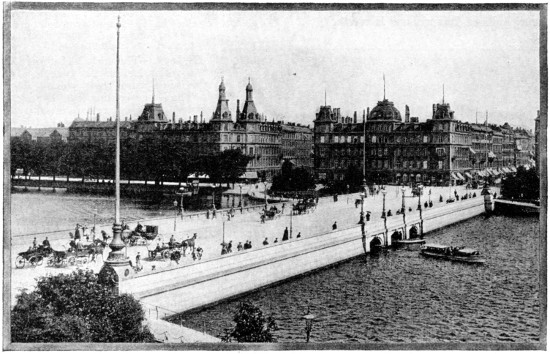
NEW QUARTERS OF COPENHAGEN, CAPITAL OF DENMARK
DENMARK
DENMARK, the smallest of the three Scandinavian kingdoms, consists of the peninsula of Jutland and a group of islands in the Baltic, and is bounded by the Skager-Rak, the Cattegat, the Sound, the Baltic, the Little Belt, Sleswick, and the North Sea.
Surface.—Except in Bornholm, the surface of Denmark is very similar in every part of the kingdom, and is uniformly low, its highest point (in southeast Jutland) being only five hundred and sixty-four feet above sea-level. The coast is generally flat, skirted by sand-dunes and shallow lagoons, especially along the west side. Both the continental portion and the islands are penetrated deeply; by numerous fiords, the largest being Limfiord, which intersects Jutland, and has isolated the northern extremity of the peninsula since 1825, when it broke through the narrow isthmus which had separated it from the North Sea.
Rivers.—Denmark has numerous streams but no large rivers; the principal is the Guden, which flows northeast through Jutland into the Cattegat. It is navigable for part of its course. Less important streams are the Holm, the Lonborg, and the Stor Aa. All the others are insignificant brooks and streamlets.
The lakes are very numerous but not large, none exceeding five and one-half miles in length by about one and one-half miles broad. There are numerous winding inlets of the sea that penetrate far into the land. The largest of these, the Limfiord in Jutland, entering from the Cattegat by a narrow channel, winds its way through to the North Sea, thus making northern Jutland really an island. In this fiord, which widens out greatly in the interior and gives off various minor fiords, there are one large and various small islands.
Climate.—The climate is milder, and the air more humid than in the more southern but continental Germany; it is not unhealthy, except in the low lying islands, such as Laaland, where the short and sudden heat of the summer occasions fevers.
Production and Industry.—The common products are wheat, rye, oats, barley, potatoes, cattle, horses, pigs, sheep, and butter. Its manufactures are, for the most part, for home consumption. Its chief exports are agricultural produce, including wheat and barley, bacon, hams, flour, butter, eggs, hides, skins, corn meal and oil cake, horses and cattle.
People.—The population of Denmark is composed almost exclusively of Danes, with a few thousand Jews and others. The Danes have regular features, fair or brownish hair, and blue eyes. They still maintain their reputation for seafaring skill and hospitable customs. They belong to the Scandinavian branch of the Teutonic peoples, and speak the Danish form of the old Norse, which was fixed in writing about the time of the Reformation.
Since the Reformation the Danes have been adherents of the Lutheran Church. Education is well advanced, and there are very few people in the country who can neither read nor write.
Government.—The present constitution of Denmark dates from 1866. The executive power is vested in the king and his ministers, the legislative in the Rigsdag or Diet, comprising the Landsthing or Upper House, and the Folkething or House of Commons, partly nominated by the Crown, partly elected, indirectly, by the people.
Cities.—Copenhagen is the capital, population, 560,000; other chief towns are Odense, Aarhuus, Aalborg, Randers and Horsens.
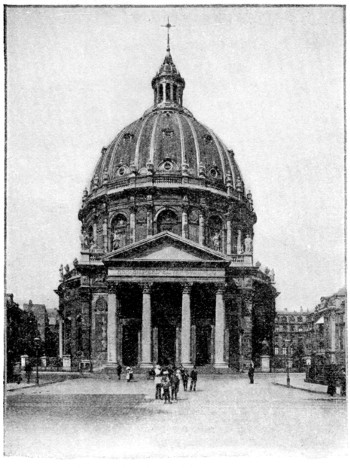
FREDERICK’S CHURCH, COPENHAGEN
Copenhagen (kō-pen-hāgen; Dan. Kjöbenhavn, “Merchants Haven”), the capital of Denmark, is situated on the low-lying eastern shore of the island of Zealand, in the Sound, which is here about twelve miles broad. The channel forms a fine and capacious harbor, which is bridged over so as to connect the isolated suburb of Christianshavn and the main part of the city at two points. Copenhagen is still defended by the old citadel of Frederikshavn and by forts on the seaward side.
Among its buildings of historical interest or intrinsic beauty, the Cathedral, rebuilt after the bombardment of 1807, possesses statues of Christ and the Apostles, and a baptismal font, designed and in part executed by Thorwaldsen. Frederick’s Church, or Trinitatiskirke, is remarkable for its round tower, which is ascended by a spiral incline instead of steps.
The Royal Palace, called Christiansborg, was rebuilt between 1794 and 1828, but suffered greatly from fire in 1884. In the castle of Rosenborg are kept the regalia; the palace of Charlottenborg, is now used as an Academy of Arts. The University, founded by Christian I. in 1479, has a library of three hundred and fifty thousand volumes; the royal library contains six hundred thousand volumes.
Copenhagen is the center, not only of Danish, but of northern literature and art, and is the seat of the unrivaled Museum of Northern Antiquities, and the Thorwaldsen Museum.
The exports include grain, rape-seed, butter, cheese, beef, cattle, wool, etc.; and porcelain, pianos, clocks, watches, mathematical instruments, chemicals, sugar, beer, and tobacco are manufactured.
History.—The early history of Denmark is lost in the twilight of the Vikings and their valiant deeds. The Danes coming from the islands occupied the lands deserted by the Jutes and Angles who had in the fifth century migrated to England. The Danish monarchy was founded in 936 by Gorm the Old, whose son became a Christian. Waldemar I. (1157-1182) ruled Norway also, and conquered Mecklenburg and Pomerania; under his son Waldemar II. further conquests were made in German and Wendish lands, so that the Baltic became a Danish sea.
By the treaty of Calmar in 1397, Norway, Sweden and Denmark, already under one monarch, Margaret, were formally united into one state. In 1448 the Danes elected as king Christian of Oldenburg, a descendant of their royal family, who was also Duke of Sleswick and Holstein; and his line continued on the throne till 1863.
Sweden became independent in 1523. Lutheranism was introduced into Denmark in 1527. In 1815 Denmark had to cede Norway to Sweden; and in 1848 the Germanic peoples of the duchies Sleswick and Holstein rebelled against Denmark. For the time the Danes succeeded in retaining the duchies, but the controversy, renewed in 1863, led to the defeat of the Danes by Austria and Prussia (1864), followed by the incorporation of the duchies in the Germanic Confederation, and, after the Austro-Prussian war of 1866, in Prussia.
Denmark although reduced to the narrow limits of the islands and Jutland, has greatly prospered, in spite of the spread of socialistic opinions, and political dissensions. Christian IX. died January 29, 1906, and was succeeded by his son, Frederick VIII.
GREECE
GREECE is a maritime kingdom in the southeast of Europe. The country is composed of a continental portion, almost separated into two parts by the gulfs of Patras and Lepanto on the west, and the gulf of Ægina on the east, the archipelago of the Ægean Sea and the Ionian Islands, and is divided into twenty-six provinces, called nomarchies.
Surface.—The mountain range which cuts off the peninsula from the continent of Europe is an extension of the Balkans. From it run chains from north-northwest to south-southeast, which form the skeleton of Greece. The western boundary of Thessaly is formed by Pindus, the main offshoot of the Balkans. The eastern boundary is also marked not only by the sea but by important mountains derived from the Balkan system. These are Olympus, Ossa, Mavrovuni, and Pelion. Othrys, a branch of Pindus, forms the south boundary of Thessaly. This branch is continued in the celebrated mountains Parnassus and Helicon, forms the land of Attica, and reappears as the islands of Ceos, Cythnos, Seriphos, and Siphnos. The Peloponnese, “the island of Pelops,” or by its modern name the Morea, is connected with northern Greece merely by the narrow isthmus of Corinth, now pierced by a canal; its highest point is Taygetus.
Rivers.—The rivers of Greece are unimportant. The chief in the Peloponnesus are the Eurotas (Basilipotamo), the Alpheus (Ruphia), draining Arcadia and Elis; and the Peneus draining Elis.
Climate.—The climate is generally mild, in the parts exposed to the sea equable and genial, but in the mountainous regions of the interior sometimes very cold. None of the mountains attain the limit of perpetual snow; but several retain it far into the summer. During summer rain scarcely ever falls, and the channels of the minor streams become dry. Toward the end of harvest rain becomes frequent and copious, and fevers become common.
Production and Industry.—The most important of the fruit trees are the olive, the vine, orange, lemon, fig, almond, citron, pomegranate, and currant grape. Its exports consist of currants, figs, olive oil, wine, cognac, tobacco, hides, lead, iron ore, magnesium, emery, marble, and sponges.
People.—The Greeks called themselves Hellenes, and the inhabitants of Italy called them Graeci. The modern Greeks are by no means pure-bred descendants of the ancient Greeks. Indeed, it has been maintained that from the seventh century A. D. there have been no pure Greeks in the country, but only Slavs. It is, however, pretty certain that the two and one-quarter million of modern inhabitants are descendants of the three races that occupied the soil at the time of the Roman conquest. They speak the modern Greek tongue, which is a greatly modified form of the old.
Education is free and compulsory, maintained by local taxation supplemented by State grants. Secondary education is somewhat backward, particularly in the country districts. There is a university of some repute at Athens, which is largely attended by Turks.
Government.—According to the constitution, which was framed by an assembly in 1864, the executive power is vested in the king and his responsible ministry; the legislature is a single chamber of deputies called the Boulé, elected by the people, and meets at Athens.
Cities.—Athens is the capital, population 167,500; the towns next in size are Patras, Piræus, and Trikhala, all above 20,000; and there are eight others between 20,000 and 10,000.
Athens, in the southeast of Attica, occupies an extensive area round the site and remains of the classical city, four and one-half miles from its harbor of Piræus, on the Gulf of Ægina. The city, which takes its name from Athena, “goddess of science, arts, and arms,” and its own patron divinity, was originally built on the Acropolis, a conspicuous limestone rock rising three hundred and twenty feet above the Attic plain, and afterwards spread out on the plain below. The Acropolis became the citadel and subsequently the site of a group of beautiful temples of the time of Pericles (fifth century, B. C.).
The ruins of the Parthenon, the Erechtheum, the temple of Nike Apteros (“Wingless Victory”), and the Propylæa, still remain to testify to the former glory of the Acropolis. Of the other ancient buildings the most notable are the Theseum (also of the Periclean period, and still almost perfect), and the fragments of the vast temple of Zeus (begun in 530 B. C. and finished by the Roman Emperor Hadrian), with the theater of Dionysus and other structures.
Not far from the Acropolis rose the hill Lycabettus (nine hundred and eleven feet), and the hillocks or ridges of the Pnyx and the Areopagus or Mars Hill. At a greater distance the plain is bounded by Hymettus (three thousand three hundred and sixty-eight feet), Pentelicus (three thousand six hundred and forty-one feet), and other ranges.
Athens was fabled to have been founded by the hero Cecrops. The most brilliant period of its history was when, after the Persian wars (fifth century, B. C.), Athens took the lead among the Greek states, became powerful by land and sea, was adorned by Pericles with most glorious buildings, and brought Greek literature and Greek philosophy to their highest development. Its decline dates from the disastrous conclusion of the Peloponnesian war (403 B. C.). It was plundered and ruined by Sulla in 87 B. C.; and neither under Byzantine nor Turkish rule ever attained any prosperity. In the days of its glory Athens had some one hundred thousand free inhabitants and twice as many slaves; when after the liberation of Greece Athens was made the capital of the new kingdom (1834), it was a wretched village of a few hundred houses. Since then it has had a prosperous growth, looks like a well built German town, with a fine royal palace, a marble stadium (restored), a university with over one hundred and fifty professors and lecturers and two thousand five hundred students, and a good deal of miscellaneous trade by the way of the Piræus. It is connected by rail also with Corinth, and the Athens-Larissa line brings Greece into railway communication with the rest of Europe. (See also under ancient Greece.)