BOOK OF THE ANIMAL KINGDOM (continued 2)
Reading edition
THE VOICE OF BIRDS
With few exceptions, birds have a vocal organ, and are able to produce more or less variable sounds. The organ is, however, wanting in the running birds, such as the ostrich, and in the American vultures. The sounds produced are almost as varied as the different kinds of birds, and an expert has little difficulty in identifying a great number of forms by their distinctive noises. It is among the so-called perchers, songsters, or Insessores, that we find song really developed and that for the most part in the males, and in highest degree at breeding-time.
HOW BIRDS ARE CLOTHED
The integument differs markedly from that of other animals in being clad with feathers. Three distinct kinds of feathers are at once distinguishable—(a) the small hair-like downy rudimentary filoplumes; (b) the numerous smaller contour or covering plumes; and (c) the large strong quill-feathers or pennæ on wings and tail. The ordinary feather consists of a quill at the base of a shaft up the center, and of the vane borne on the sides of the shaft. The vane consists of parallel barbs, which are linked together by small barbules. On the bare legs of many birds the feathers are replaced by horny scales, and the horny structures forming the beak and terminating the toes are very familiar.
THE BIRDS OF PREY
The birds of prey have a hooked, curved beak, at the base of which are the nostrils, surrounded by cere skin. They live chiefly upon warm-blooded animals, which they seize with their claws and tear in pieces with their beak. There are more than five hundred varieties, which are separated into day and night birds of prey.
Eagles, falcons, hawks, harriers, buzzards, and the like are adapted for the pursuit of prey not only by possession of strong, hooked beaks, powerful talons, and keen powers of vision, but also by the swiftness of their flight. Many of them—for example, falcons—are able to poise themselves, apparently motionless, in the air till some such prey as a young rabbit or small bird is discovered, and then swoop down upon the victim with almost incredible rapidity.
Condor (Sarcorhamphus condor).—Largest of vultures, averaging nine feet wing expanse, lives among the peaks of the Andes but descends for food. Its feet are not adapted for grasping, and it cannot truly perch nor carry objects when flying; it sleeps soundly, can be lassoed at night and kills small quadrupeds, besides feeding on carrion. The condor lays two white eggs four inches long, on bare rock, hatched in seven weeks. The young are brown and a year old before they can fly. The male is black with white ruff, has wing bars and tip of bill; wattles are present on the head and breast. The female lacks comb, wattles, and has less white. The young do not acquire full plumage for six years. The condor depends more on sight than smell in finding food.
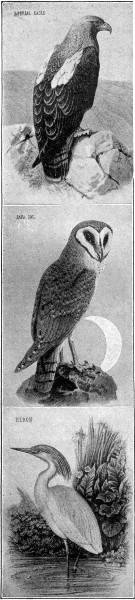
Eagle (Aquila) is a name given to many birds of prey in the Falcon family. The golden eagle, the white-headed eagle, and the sea-eagles are characteristic examples. The falcon family includes over three hundred predacious birds, feeding for the most part on living animals, hunting by day, and living usually on exposed rocky places. The bill is powerful, but rather short, high at the root, and slightly curved; the partition between the nostrils is complete; the upper margin of the eye-socket projects; the head and neck are feathered; the soles of the feet bear large callosities.
Representatives of this noble genus are found in all parts of the world except the neotropical and Australian regions.
The Golden Eagle is a large and magnificent bird. The predominant color is dark, tawny brown, but the back of the head and neck are more tawny and look golden in the sunlight. The young birds have tails of a brighter color. The adult female measures about three feet in length; the male is rather less both in length of body and wing. The golden eagles have their homes in remote rocky regions, but often wander far in search of booty. They prey upon numerous mammals and birds, but are rarely willing to run any great risks in so doing. The nest, usually upon a rocky ledge, is large and roughly made. There are most commonly two eggs. Though a strong and majestic bird, it cannot be credited with much bravery. The occasional cry is loud and shrill, but with some hoarseness. The species is widely distributed in Europe, Asia and North America.
The crested eagles are found in parts of both hemispheres, and are in some species distinguished by tufts of feathers on the back of the head. The harrier-eagle is an Old-World bird represented in Europe, north Africa, and western Asia. The fishing eagle or fish-hawk is an almost cosmopolitan bird, with markedly piscivorous diet. The bald eagle has the tarsus feathered only halfway to toes; with white head and tail after third year. Its length is about 36 inches. The bald eagle is the emblem of the United States, feeds on fish, sometimes secured by robbing the osprey and sometimes found as carrion.
Eagles as Emblems.—In the arms of the present German empire an eagle (with one head) sustains on its breast a shield containing the arms of Prussia. Austria has preserved the double-headed eagle of the earlier German empire. Russia assumed in 1472 the double-headed eagle under Ivan III. to signify that the czar sprang from the Greek emperors, who had borne it as a symbol since the partition of the Roman empire. A white crowned eagle in a red field was the shield of the kingdom of Poland. The arms adopted by the United States consist of a dark-brown eagle with outspread wings, having in one of its talons a bundle of arrows, in the other an olive branch, bearing on its breast a shield whose upper part is blue and under part silver, and crossed by six red vertical bars. In its beak it holds a band with the inscription E. pluribus unum, surmounted by thirteen stars, the original number of states.
Falcons (Falco) are birds of medium or small size, having short, strong beak, with a sharp hook at tip and a strong tooth on each side of upper mandible; legs short and strong, middle toe long, claws much curved and sharp, tail short and stiff, wings long and pointed. There are about fifty species, some known as hawks. True falcons, in hunting prey rise high in air above and swoop down. Hawks chase the prey near the ground. The most common falcon is dark-bluish above and white below with bars; the young are brownish above and streaked below. The largest falcon is found in the Scandinavian Mountains. Among small falcons are the sparrow-hawk of the United States and the kestrel of Europe. They feed on mice and insects. Most falcons prey upon birds, attacking some even larger than themselves. They, at one time, were trained for hunting the heron, sparrow, etc., in the sport known as falconry.
Hawks have the upper mandible not toothed, and the wings short, rounded, and concave below. They do not easily soar or glide.
Henhawks comprise chiefly the rough-legged hawk and the red-shouldered hawk. The first rarely, and the second never, takes chickens; they prey rather on noxious insects, mice, etc. The sharp-shinned hawk, length twelve inches, and Cooper’s hawk, eighteen inches, are rufous on breast and dusky above, with dark bars on the tail. These useful buzzards last mentioned should be protected.
Goshawks (Astur palumbarius) is found in almost all parts of Europe. It generally inhabits thick woods in the neighborhood of fields and meadows, and builds its nest on the topmost boughs of a lofty tree.
The Peacock excels all other birds in the beauty of its plumage, the colors of which are usually both gorgeous and varied. The above bird is pure white, and very rarely seen in the United States.
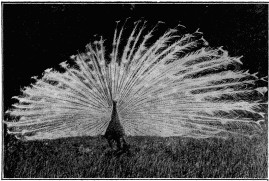
The Peacock excels all other birds in the beauty of its plumage, the colors of which are usually both gorgeous and varied. The above bird is pure white, and very rarely seen in the United States.
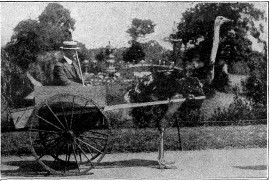
The ostrich is a strong runner and a swift racer. It has been known to equal the speed of a train going at the rate of sixty miles an hour. Though frequently used for driving, it is not easily managed.
The Peacock excels all other birds in the beauty of its plumage, the colors of which are usually both gorgeous and varied. The above bird is pure white, and very rarely seen in the United States.
This unsociable bird is as swift and wild as it is shy and cunning. It can be easily recognized at a distance by its long tail and short wings. When hunting for prey it flies, as a rule, along the edges of woods and thickets, and is active almost the whole of the day. Flying, resting, swimming, or running, it seizes its prey with equal dexterity. Its great swiftness and adroitness render the goshawk a formidable opponent. It appears suddenly among the unsuspecting birds, and, before they can escape, one lies bleeding under the claws of the bold robber. It follows its prey into inhabited houses, and sometimes flies through the windows.
The goshawk carries off poultry, and also steals game. It also destroys a great number of our most useful insect-devouring birds.
Sparrow Hawk (Nisus communis) resembles the goshawk both in form and habits, and is a true copy of its bigger cousin.
Osprey or Fishing Hawk (Haliætus albicilla) is often mistaken for the golden eagle. The latter, however, can be easily recognized by its feathered legs. The osprey is widely distributed in the United States along the Atlantic coast, and is found all over Europe. It has its nest on the summits of inaccessible rocks and cliffs along the coasts, or in the top of a high tree, and rarely among the reeds. The osprey is a lazy but obstinate and dangerous robber, attacking all animals which it is able to overcome. Like the bald eagle, it catches fish; but it also feeds upon carrion.
Owls (Strigidæ) include more than one hundred species, all of which belong to two families. The Java owl, which ranges from the eastern Himalayas to Burma, Ceylon, Java and Borneo in itself constitutes the second of these families. They have large eyes, looking forward, encircled by stiff feathers, and with vertical pupil. Most are nocturnal and see poorly by day, but the Hawk Owl, and Snowy Owl of arctic regions, feed by day. Their food consists of rodents, insects, birds, vermin, and fish. The Great Horned Owl (Bubo virginianus) attains a weight of eight pounds, and attacks poultry. Owls hear well; some have a well developed feathered external ear. The long ears by which the horned owl is known, refers to the horns of feathers, developed above the eyes. Owls fly noiselessly, owing to their soft plumage. The feet are usually feathered; the outer toe is reversible, and in the Fishing Owl the toes are osprey-like. The female is the larger. The size ranges from six inches in the Pygmy Owl of the tropical forests, to thirty inches in the Great Grey Owl of the northern regions. Reddish brown is predominant, but dark and light colors may be exhibited by a single brood. The eggs are spherical and pure white. Some species breed before the snow has gone, and their eggs hatch a few at a time. The Snowy Little Owl of Europe, is the symbol of learning. The Burrowing Owl lives in the burrows of prairie dogs in America, on whose young it feeds, in part while rattle-snakes associate with both as a common enemy.
The White or Barn Owl (Strix flammea) always lives in the neighborhood of man, building its nest in sheds, church-towers, old ruins, and also in pigeon-houses. It sleeps during the day. At night it flies through the gardens and fields, catching all kinds of mice, insects, and young birds. The nest is carelessly built, and in the spring contains from six to nine white, oval eggs.
Vultures (Vulturinæ) are large carrion-eating birds of prey. Those of the Old World differ from those in the New in several particulars; thus, the hind toe of the former is on the level with the other toes; the partition between the nostrils is not perforated as in American vultures; and they carry food to their young in their claws and not in their beaks. The chief of the American vultures are the Condor, Turkey Buzzard, Carrion-crow, or Black Vulture, and the King Vulture, which haunts jungles from Mexico to Paraguay, and is white, with the long tail and wing-feathers black, the head lemon and scarlet. Examples of the Old World vultures are the Bearded Vulture or Lammergeyer (Gypaetus barbatus), the largest bird of prey of Europe. It was formerly often seen in the Alps and Pyrenees; but is now, at least in the Swiss and Bavarian Alps, almost exterminated. It is a bold and dangerous robber, not only waylaying hares and roes, but also sheep and chamois; children even, have been attacked by this bird.
The Egyptian or White Vultures are known as Pharaoh’s Chickens. The crested Black Vulture ranges from China through North Africa. It builds large nests in trees on mountain-tops, where it rears a single young. The Griffon is black, with white tail and wing feathers. Vultures find their food by sight.
THE CLIMBING BIRDS
The toes of the climbing birds are arranged opposite each other in pairs; one of the back toes is, in many of these birds, so flexible that it can be easily turned forward. The claws are long, strong, and hooked, thus these birds can easily hold on firmly, even in a perpendicular position. Most of them frequent the woods, and live upon insects and fruit.
Cuckoo (Caculus canorus) is as large as a pigeon. It has a gently-curved, deeply-cleft beak, long, pointed wings, and wedge-shaped, pointed tail. The outer toe can be directed forward as well as backward. American cuckoos hatch their own eggs. The Old World cuckoos are especially marked by the habit of leaving their eggs to be hatched by other birds. The spotted cuckoo of northern Europe lays four eggs in a nest, usually that of a crow. A small South African cuckoo, size of a sparrow is brilliantly colored. Australia has the large channel billed cuckoo, with its immense beak. The road-runner or chapparal cock of the desert plateaus of western United States feeds mainly on grasshoppers. In the West Indies and adjacent states is found the Ani, with high bill, and peculiar in that several females unite in building one nest, where all co-operate in hatching their eggs.
The cuckoo, with its never-wearied song, is the joyful harbinger of spring, and is heard with delight by old and young. It lives chiefly upon hairy caterpillars; and, as it is always feeding, we can justly include the cuckoo among the useful birds.
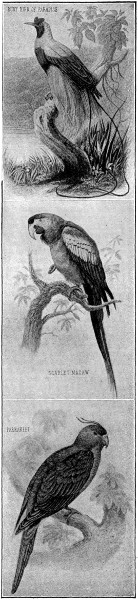
Parrots (Psittaci) are near relatives of the cockatoos, paroquets, macaws, lories, nestors, etc. The true parrots have the upper mandible toothed, and longer than high, and a short, rounded tail. These birds combine with the beauty of their plumage a nature of great docility, and have the faculty of imitating the human voice in a degree not possessed by other birds. They are found chiefly in Africa, from whence we get the gray parrot, the best talker. South America, which is particularly rich in species, furnishes the well-known green parrot; and North America is the home of a single species, the Carolina parrot. The parrots are forest birds, and are adepts at climbing, using for that purpose both the feet and the bill. Their food consists of seeds and fruits. They make their nests in holes, and lay white eggs, as is commonly the case where the eggs are concealed.
The parrots may be called the monkeys among the birds; for, like the monkeys, they seek their food while climbing, but are awkward and clumsy when on the ground. Their imitative qualities and docility, their obstinacy and slyness, and their disagreeable voice and gregarious habits, all serve to remind us of the monkeys.
Toucan (Rhamphastus toco), a bird of the American tropics, is related to the woodpeckers and parrots. It belongs to the most curious of the animal forms, as its immense beak is treble the length of its head. The tongue is horny, slender, and brush-like; the considerable tail is hinged next the pelvis, so that it can be thrown over the back when resting and where the bill lies also during sleep. Toucans are omnivorous, but prefer fruit, live in flocks in forests, and nest in hollow trees. There are over fifty species, in size from that of a robin to a crow, and colored from green to black, variegated with red, yellow and white. The largest is two feet long, with bill eight inches long and three inches high.
Woodpecker (Picidæ) includes any of three hundred birds which have climbing feet, stiff tail feathers and which bore into trees for grubs on which they feed, though some of them are fond of fruit and other vegetable food. Most of the species have barbed and pointed tongues with which they spear the larvæ, but in some the tongue is smeared with a sticky substance, secreted by glands in the throat. There are no woodpeckers in Australia or Madagascar, but they occur in all other parts of the world. The prevailing color of the plumage is green—dark olive on the upper, pale green on the under parts; the crown and back of the head are bright crimson.
Of the numerous American species the flickers, the South American ground-flickers, which live chiefly on termites, and the great ivory-billed woodpecker may be specially noted. The last-named species, which inhabits the dense forests of the southern States, is one of the handsomest of the group, and was once called the prince of woodpeckers.
The woodpeckers lead a solitary life. Their presence is generally known by the noise they make while pecking; holding fast to a tree, they hack at it with their long, sharp beaks, so that splinters and chips fly in all directions. The woodpecker excavates a hole in the rotten tree, in order therein to build its nest.
THE SINGING BIRDS
Not all the birds belonging to this class are veritable songsters; but nearly all of them have in the throat an organ of song, consisting of five or six pairs of muscles, by means of which they can produce a variety of notes. They are mostly small, prettily colored birds, which chiefly inhabit the Temperate Zones, and make themselves very useful by devouring the insects, worms, and seeds of weeds in the fields, gardens, and woods. They delight us with their song; but their song is also the reason why some of them are kept in captivity.
Birds of Paradise (Paradisea apoda), though song birds of some ability, are more particularly notable for their gorgeous plumage. They are natives of New Guinea and Australia, and are very closely allied to the crow family, both in their habits and voice. The Great Bird of Paradise is the largest of the species, measuring about one and one-half feet in length; the others are comparatively small. The adult males are in beauty unsurpassed even by humming-birds. Tufts of bright feathers spring from beneath the wings, from the tail, or from the head, back, or shoulders. Trains, fans, and exquisitely delicate tress-like decorations occur abundantly, and the gracefulness of the plumage is enhanced by the brilliant color and metallic luster. The females are plain, sober-colored birds, and it is only with maturity that the males acquire that brilliancy of plumage which they exhibit to such advantage in their courtships. The true birds of paradise feed on fruits and insects, and are practically omnivorous. Their mode of life is more or less gregarious. Their song consists of a series of loud, shrill notes.
Blackbird (Turdus merula), is a member of the thrush family. The plumage of the male is quite black, and the beak yellow; the female is dark brown above, and greyish brown on the under parts, with a brown beak. It is shy, solitary, nests in March, and has two broods during the season. The nest is plastered inside with mud; four or six blue eggs, speckled with black, are laid. The bird feeds mainly on insects. It is a mocking bird, but not so good a songster as the song-thrush. In confinement it can be taught.
The American Crow-blackbird or Purple Grackle is restricted to the region east of the Rockies, the Blue-headed Grackle is confined west of the Mississippi, while the Rusty Grackle pervades the whole continent.
The Red-winged Blackbird breeds in Mexico and North America south of the Barron Grounds; winters in southern half of United States and south to Costa Rica.
The blackbird is frequently an inhabitant of the woods; but in the winter it comes into the gardens of the villages and towns. It is very fond of fruit, and thus often ravages the orchards and strawberry gardens.
Bobolink (Dolichonyx oryzivorus), resembles a sparrow, but its tail feathers are acute. Length seven inches. It breeds from Ohio northeast to Nova Scotia, north to Manitoba, and northwest to British Columbia; winters in South America.
Few species show such striking contrasts in the color of the sexes, and few have songs more unique and whimsical. In its northern home the bird is loved for its beauty and its rich melody; in the South it earns deserved hatred by its destructiveness. Bobolinks reach the southeastern coast of the United States the last half of April just as rice is sprouting and at once begin to pull up and devour the sprouting kernels. Soon they move on to their northern breeding grounds, where they feed upon insects, weed seeds, and a little grain. When the young are well on the wing, they gather in flocks with the parent birds and gradually move southward, being then generally known as reed birds. They reach the rice fields of the Carolinas about August 20, when the rice is in the milk. Then until the birds depart for South America planters and birds fight for the crop, and in spite of constant watchfulness and innumerable devices for scaring the birds a loss of ten per cent of the rice is the usual result.
Canary (Fringilla) is a beautiful but very common cage-bird, much esteemed for its musical powers. It is native to the region about the Canary Islands. Its color is grayish brown and dusky green, but the numerous artificial breeds show varieties of yellow and black markings, crests, etc. Naturally monogamous, the male sings best to win the love of the female. She incubates the eggs, he feeds the young. Six eggs are produced four times a year. Canaries cross readily with allied species. They have been domesticated for nearly four centuries.
Distinct varieties have been produced by scientific selective breeding, and these reproduce their distinctive characteristics, and “like breeds like” so long as the varieties are not crossed. The hardiest are the Norwich; the largest are Lancashire Coppies; the most costly and delicate are Belgians. Lizards, London Fancies, Yorkshires, Scotch Fancies, and Cinnamons practically complete the list.
Catbird (Mimus Carolinensis) is a species of Thrush common in eastern United States, so called from its peculiar note. It is very dark colored, about nine inches long, and nests in low bushes early in May. It breeds throughout the United States west to New Mexico, Utah, Oregon and Washington, and in southern Canada; winters from the Gulf States to Panama. The bird has a fine song, unfortunately marred by occasional cat calls. With habits similar to those of the mocking bird and a song almost as varied, the catbird has never secured a similar place in popular favor. Half of its food consists of fruit, and the cultivated crops most often injured are cherries, strawberries, raspberries, and blackberries. Beetles, ants, crickets, and grasshoppers are the most important element of its animal food. The bird is known to attack a few pests, as cutworms, leaf beetles, clover-root curculio, and the periodical cicada, but the good it does in this way probably does not pay for the fruit it steals.
Chickadee (Penthestes atricapillus).—The Chickadees are among the most popular birds that we have, owing to their uniform good nature even in the coldest weather, and their confiding disposition. They are common about farms and even on the outskirts of large cities they will come to feasts prepared for them on the window sill with their clear “phe-be,” “chick-a-dee-dee-dee” or “dee-dee-dee,” and several scolding or chuckling notes. They nest in hollow stumps at any elevation from the ground but usually near the ground, and most often in birch stubs. Their eggs are white, sparingly speckled with reddish brown. They range and breed in the northern half of the United States and northward. The Carolina Chickadee (Parus carolinensis) is smaller and with no white edges to the wing feathers, and is found in southeastern United States, breeding north to Virginia and Ohio.
Crossbills (Loxia) are the most highly developed members of the Finch family, characterized by having the tips of the upper and lower bills crossing so as to facilitate extraction of seeds. Males are reddish, females brownish olive in general coloration. The crossbill lives chiefly in the pine plantations, where it feeds for the most part on the seeds of the pine, cleverly opening the cones with its pointed beak. It hatches in all seasons of the year.
Finch (Fringilla) is a name applied to many birds but generally used with some affix, as in the familiar names bullfinch, chaffinch, and goldfinch. A finch is usually small, has a hard, conical beak, and generally lives upon seeds. The distribution is almost world-wide, excepting Australia. The buntings and the weaver-finches of the Ethiopian and Australian regions are usually kept distinct.
Some, as Canary (see Canary) and Bullfinch make fine songsters in confinement. The Chaffinch is the typical Finch of Europe. In America the Purple Finch has a flush of red in male; the female is olive brown, streaked below, the tail feathers soft and rounded; length without tail, three and one-half inches. The Goldfinch has acute bill, yellow on bases and edges of quills, male rich yellow, length three inches without tail; also called Thistle-bird and Yellow-bird. The Lark-finch of the prairies has tail three inches long, and is much streaked with black, white, and chestnut. In the spring the males are usually seen on, or heard from, tree tops in orchards or parks, giving forth their glad carols. They are especially musical in spring when the snow is just leaving the ground and the air is bracing.
The nest consists of strips of bark, twigs, rootlets and grasses, placed at any height in evergreens or orchard trees. The eggs resemble, somewhat, large specimens of those of the Chipping Sparrow. They are three or four in number and are greenish blue with strong blackish specks.
Grosbeaks are finches with beaks extraordinarily stout, forming a continuous curve with the top of the head. The Cardinal Grosbeak is known as the Winter Redbird. In eastern United States are also the Blue, Rose-breasted, and Pine Grosbeaks, all beautifully colored and fine singers. The Rose-breasted Grosbeak breeds from Kansas, Ohio, Georgia (mountains), and New Jersey, north to southern Canada; winters from Mexico to South America. This beautiful grosbeak is noted for its clear, melodious notes, which are poured forth in generous measure. The rosebreast sings even at midday during summer, when the intense heat has silenced almost every other songster. Its beautiful plumage and sweet song are not its sole claim on our favor, for few birds are more beneficial to agriculture. The rosebreast eats some green peas and does some damage to fruit. But this mischief is much more than balanced by the destruction of insect pests. The bird is so fond of the Colorado potato beetle that it has earned the name of “potato-bug bird.” It vigorously attacks cucumber beetles, many of the scale insects, spring and fall cankerworms, orchard and forest tent caterpillars, tussock, gipsy, and brown-tail moths, plum curculio, army worm, and chinch bug. In fact, not one of our birds has a better record.
Jays (Cyanocitta) are brightly colored, noisy birds, near relatives of the crow and are represented by numerous species distributed throughout the northern hemisphere. Probably the best known is the Blue Jay, one of the most beautiful birds that we have, but, unfortunately, one with a very bad reputation. Blue Jays often rob other birds of their eggs and young as well as food and nesting material. They are very active birds and are always engaged in gathering food, usually acorns or other nuts, and hiding them away for future use.
These Green Jays are very beautiful, but, like all the other members of the family, they are merciless in their treatment of smaller birds. During the summer their diet consists of raw eggs with young birds “on the side,” or vice versa; later they live upon nuts, berries, insects; in fact, anything that is edible.
They are fairly common in the Lower Rio Grande Valley in southern Texas.
Lark (Alauda arvensis).—This familiar songster, is well known as the symbol of poets and the victim of epicures. It is included among a type of birds which comprizes over one hundred species, widely distributed in Europe, Asia, Africa, with spreading stragglers in Australia and North America. The plumage is usually sandy brown, the color of the ground; the lower legs bear scales, behind and before; the hind claw is very long and straight; the bill is strong and conical. The skylark measures about seven inches in length; the males and females are alike in plumage; the food consists of insects, worms, and seeds. It nests in April, making a structure of dry grass in a hollow in the ground, usually among growing grass or cereals. The eggs (three to five) are dull gray, mottled with olive brown; two broods are usually reared in the season.
The Meadowlarks (Sturnella magna) our familiar friends of the hillside and meadow; their clear, fife-like whistle is often heard, while they are perched on a fence-post or tree-top, as well as their sputtering alarm note when they fly up before us as we cross the field. In North America they range east of the Plains and north to southern Canada; and winter from Massachusetts and Illinois southward.
The Western Meadowlark has the yellow on the throat extended on the sides; its song is much more brilliant and varied than the eastern bird. It is found from the Plains to the Pacific. The Florida Meadowlark is smaller and darker than the common Horned Lark (Otocoris alpestris). This variety is only found in the United States in winter. During the mating season they have a sweet song that is uttered on the wing, like that of the Bobolink.
Mockingbird (Mimus polyglottos). This is the great vocalist of the South, and by many is considered to be the most versatile singer in America. It is found in gardens, pastures and open woods. All its habits are similar to our Catbird, and like that species, it is given to imitating the notes of other birds. Its song is an indescribable medley, sometimes very sweet and pleasing, at others, harsh and unmusical. Its general colors are gray and white.
Usually the nest is built in impenetrable thickets or hedges, or again in more open situation in the garden; made of twigs and rootlets, lined with black rootlets; the four or five eggs are bluish green with blotches of reddish brown.
It ranges throughout the southern United States, breeding north to New Jersey (and casually farther) and Ohio; and winters in the South Atlantic and Gulf States. The Western Mockingbird is found in southwestern United States, north to Oklahoma and California.
Nightingale (Daulias luscinia).—The common nightingale is well known as the finest of songsters. It is rather larger than the hedge-sparrow, with about the same proportionate length of wings and tail. It is of a rich russet-brown color above, shading into reddish chestnut on the tail-coverts and tail; the lower part grayish-white; bill, legs, and feet brown. The sexes are alike in plumage. It is a native of many parts of Europe and Asia, and of the north of Africa, and is a bird of passage, extending its summer migrations on the continent of Europe as far north as Sweden. It frequents thickets and hedges and damp meadows near streams, and feeds very much on worms, beetles, insects, ants’ eggs, caterpillars, and other insect larvæ. The male bird sings by day as well as by night, but at night its song is most noticeable and characteristic. The variety, loudness and richness of its notes are equally extraordinary; and its long, quivering strains are full of plaintiveness as well as of passionate ecstasy. The ancient Romans paid more for a nightingale than they paid for a slave.
Orioles (Oriolidæ) are confined entirely to the Old World and are characteristic of the Oriental and Ethiopian regions. The birds called “Orioles” in the United States belong to an entirely different family, the Icteridae. The members of the family are generally of a bright yellow or golden color, which is well set off by the black of the wings.
Twenty-four species are enumerated, the best known being the Golden Oriole. The adult male is about nine inches long. Its general color is a rich, golden yellow; the bill is dull orange-red; a black streak reaches from its base to the eye; the iris is blood-red; the wings are black, marked here and there with yellow, and a patch of yellow forms a conspicuous wing-spot; the two middle feathers of the tail are black, inclining to olive at the base, the very tips yellow, the base half of the others black, the other half yellow; legs, feet and claws dark brown. The female is less yellow than the male, and the under parts are streaked with gray. In central and southern Europe it is common in summer in certain localities; it is abundant in Persia, and ranges through central Asia as far as to Irkutsk. It winters in South Africa. Its food consists of insects and their larvæ, especially green caterpillars, and fruits such as currants, cherries and mulberries. The song of the male is short, loud, clear, and flutelike; he has also a mewing call-note, and a harsh alarm-note. The nest is unlike that of any other European bird; it is placed in, and suspended from, a fork in a horizontal branch, sometimes of an oak, usually of a pine, in a shady grove or thick wood, and is made of bark, wool and grass.
The Baltimore Orioles (Icterus galbula) range in color through orange, black, yellow and gray. They are sociable birds and seem to like the company of mankind, for their nests are, from choice, built as near as possible to houses, often being where they can be reached from windows. As they use a great deal of string in the construction of their nests, children often get amusement by placing bright-colored pieces of yarn where the birds will get them, and watch them weave them into their homes. Their song is a clear, querulous, varied whistle or warble; the call, a plaintive whistle. The Baltimore Oriole is found east of the Rockies, breeding north to New Brunswick and Manitoba. They winter in Central America.
Robin (Planesticus migratorius).—These well-known birds are very abundant in the northern half of the United States, being found most commonly about farms and dwellings in the country, and also in cities if they are not persecuted too severely by English Sparrows.
The male has a black head and bright reddish brown breast; the female, a gray head and much paler breast; the young, intermediate between the two and with a reddish brown breast spotted with black.
The song of the Robin is a loud, cheery carol, “cheerily-cheerup, cheerily-cheerup,” often long continued. The nest is a coarse but substantial structure of mud and grass, placed on horizontal boughs or in forks at any height, or in any odd place about dwellings; the four or five eggs are bluish green. Robins range throughout eastern North America, breeding from the middle of the United States northward. They winter throughout the same region. The Southern Robin is a paler form found in the Carolinas and Georgia.
Sparrows (Fringillidæ) are small plain-colored birds, with narrow palates, small conical bills, and streaked plumage. The English Sparrow (Passer domesticus) was introduced into United States in 1853, and has since spread to a remarkable extent, in cities, driving off other birds. The white-throated sparrow, an American form, is really a bunting. Other American sparrows have little in common with the English Sparrow. All American sparrows wear the characteristic brown streaked plumage of the group, and include the small chestnut-capped chipping sparrow of gardens, the song sparrow, the little active seashore sparrow, and the large handsome fox sparrow.
Song Sparrow (Melospiza melodia).—This is probably the best known, most abundant and most widely distributed of all our birds. They are quite hardy and many of them winter in the northern states, but the majority go farther south, returning to their summer homes about the first of March. They may be found anywhere where there are bushes, vines or hedges, and very often about houses, even in large cities.
Their song is very pleasing and musical, strongly resembling brilliant measures from that of the Canary.
The nest of grass is either on the ground or in bushes, and contains three to five bluish-white eggs, profusely spotted with brown. The Song Sparrow breeds from Virginia and Missouri north to southern Canada. It winters from Massachusetts and Ohio southward. Many local races are found west of the Rockies, but only one east of them. Dakota Song Sparrow is found in the vicinity of Turtle Mountains, North Dakota; it is lighter above and brighter below.
Swallows (Hirundinidæ) are birds with long pointed wings, small feet, short, broad bill, and ten tail feathers. About one hundred species are known, almost universal in distribution. They feed while flying, catching insects. Some build nests in crevices, some dig holes in banks, and others make mud nests plastered against walls. The Barn Swallow of the United States, much like that of Europe, is lustrous steel blue, pale chestnut below, tail deeply forked. It arrives early in May and remains until late August. The American Chimney Swallow is a Swift. The Purple Swallow, or Purple Martin is a North American species. The general color, both of the upper and under parts, is shining purplish blue; the wings and tail black. It is a universal favorite and is hailed as the harbinger of spring. The Republican Swallow or Cliff-swallow of North America, makes a nest of mud, in form somewhat like a Florence flask, which it attaches to a rock or to the wall of a house. Hundreds sometimes build their nests in close proximity.
Thrasher (Toxostoma rufum) an American mimic bird or mocking thrush, is common in the eastern United States, mainly rust red above and whitish below, the breast and sides marked with lines of elongated brown spots. It is called also the Brown, Red, or Ferruginous Thrush, the Corn-planter, and French or Sandy Mockingbird. The song of this Thrasher is most musical and pleasing. It has a similarity to that of the Catbird, but is rounder, fuller and has none of the grating qualities of the song of that species. They apparently have a song of their own and do not deign to copy that of others. They are one of the most useful and desirable birds that we have. The Sage Thrasher (Oroscoptes montanus) is often known as the Mountain Mockingbird because of the brilliance of its song, a very varied performance, long continued and mocking that of many other species. They inhabit sage-brush regions and are partial to the lower portions of the country, although frequently met in open mountains. They are not shy and can readily be located by their voices.
They nest in bushes, especially the sage and cactus, and range through the sage-brush regions of western United States from the Plains to the Pacific.
Thrush (Turdus), belongs to a family including many of the most familiar song-birds of Europe and America. The best-known American Thrush is the Robin. (See Robin). The Wood-thrush has a most melodious evening song, and is nearly as large as the Robin; the Hermit Thrush, has an even more exquisite song, which, owing to the habits of the bird is less frequently heard; Wilson’s Tawny Thrush has a strange, bell-like song. Other American thrushes include the Olive-backed and the Gray-cheeked varieties. The largest known British species is the Missel Thrush, sometimes called the “Stormcock,” from its habit of singing before or during wind or rain.
The Song Thrush (Turdus musicus) is smaller in size, and possesses finer powers of song. It is olive grey on the upper parts, while the under parts are a lighter grey, with dark fleckings. It is a true inhabitant of the woods, and comes to us early in March, animating nature, then just waking, with its musical song. The Song Thrush lives upon insects, and also upon snails, which it strikes upon a stone in order to break their shells.
Warblers (Mniotiltidæ).—Numerous species of warblers are found in North America which appear to graduate into the Tanagers. They are birds of brighter plumage than the Old-World Warblers, but resemble them in their habits, and are also migrants. The Blackburnian Warbler (Dendroica fusca) is the most exquisite of the whole family; it is the most eagerly sought bird by bird lovers, in the spring. Some years they are very abundant, while in others few are seen, their routes of migration evidently varying. They arrive about the time that apple trees are in bloom, and are frequently seen among the blossoms, dashing after insects. Their song, a high-pitched lisping “zwe-zwe-zwe-see-ee-ee,” ending in a thin, wiry tone, almost a hiss, is very distinct from the song of any other bird. They nest in coniferous trees at any height from the ground. Shreds of bark, fine cedar twigs, rootlets, etc., are used in constructing nests. The Magnolia Warbler (Dendroica magnolia) is one of the prettiest of the Warblers and one of the least timid. Birch woods are their favorites during migrations, although a few of them will be found almost anywhere. They utter a short, rapid warble.
Wrens (Troglodytes) have a slender, slightly curved and pointed bill; the wings are very short and rounded; the tail short, and carried erect; the legs slender, and rather long. Their plumage is generally dull. Some fifteen species are recognized in North America, of which the most familiar and widely distributed is the House-Wren (Troglodytes ædon). These are bold, sociable and confiding birds, seemingly to prefer men’s society, building their nests in bird boxes that are erected for them, or in the most unexpected situations about buildings. They are one of the most beneficial birds that can be attracted to one’s yard, feeding wholly upon insects. Their songs are loud, clear and bubbling over with enthusiasm.
Wrens breed north to Maine and Manitoba and winter along the Gulf Coast. The Western House Wren is found from the Plains to the Pacific coast ranges.
THE WADING BIRDS (Struthiones)
In this class of birds, the beak is generally slender, the legs long and stilt-like. The struthiones live in marshy spots, and on the banks of rivers. They feed upon the reptiles and insects found in water and marshy districts, and upon plants. Most of the wading birds are migratory.
Adjutant (Leptoptilus argala), is a bird, common during summer in India. Generally stork-like in appearance, it stands about five feet high, and measures fourteen or fifteen feet from tip to tip of extended wings. The four-sided pointed bill is very large; the head and neck are almost bare; and a sausage-like pouch, sometimes sixteen inches long, and apparently connected with respiration, hangs down from the base of the neck. While feeding largely on carcases and offal about the towns, it also fishes for living food, and sometimes devours birds and small mammals. The loose under-tail feathers are sometimes used for decorative purposes.
Bittern (Botaurus).—The American species makes a rude nest of sticks, reeds, etc., in its marshy haunts, and lays four or five greenish-brown eggs. The bird is sluggish, and its flight is neither swift nor long sustained. When assailed, it fights desperately with bill and claws; and it is dangerous to approach it incautiously when wounded, as it strikes with its long sharp bill, if possible, at the eye. It is common in many parts of North America, migrating according to the season. The crown of the head is reddish brown, and the colors and markings of the plumage differ considerably from those of the common bittern.
Crane (Grallatores cinerea).—This family of birds differs from herons, storks, etc., in having the hind-toe placed higher on the leg than the front ones, and in certain characters of bill and skull. The members are also less addicted to marshy places, and feed not only on animal, but, to a considerable extent, on vegetable food. The cranes are all large birds, long-legged, long-necked, long-billed, and of powerful wing. Some of them perform great migrations, and fly at a great height in the air. The young cranes are helpless and require to be fed. Only two eggs are laid. The crane, when standing, is about four feet in height; the prevailing color is ash-gray; the head bears bristly feathers, and has a naked crown, reddish in the male; the bill, which is longer than the head, is reddish at the root, dark green at the apex; the feet are blackish; the tail is short and straight. They are very stately birds, though their habit of bowing and dancing is often grotesque. They feed on roots, seeds, etc., as well as on worms, insects, reptiles and even some of the smallest quadrupeds. The flesh is much esteemed.
The Whooping Crane (G. americana) is considerably larger than the common crane, which it otherwise much resembles except in color; its plumage, in its adult state, is pure white, the tips of the wings black. It spends the winter in the southern parts of North America. In summer it migrates far north.
Heron (Ardea) a large bird covered with long, loose down, with large wings, and a hard horny bill longer than the head, compressed from side to side, and united to the skull by firm, broad bones.
In the Heron genus—which includes the species commonly known as Egrets—the plumage is beautiful, but seldom exhibits very gay colors; white, brown, black, and slate, finely blended, generally predominating. The body is small in proportion to the length of the neck and the limbs. Herons are very voracious, feeding mostly on fish and other aquatic animals; but they also often prey on snakes, frogs, rats, and mice, and the young of other birds.
The Common Heron (Ardea cinerea) measures about three feet from the point of the bill to the tip of the tail. It is of a delicate gray color on the upper parts, the quill-feathers are black, the tail of a deep slate color, and the long plume is glossy dark. It generally builds its nest on a high tree; and as many as eighty nests have been counted on a single oak. America has many species of herons, most numerous in its warmer parts.
A common species of the temperate parts is the green heron (A. virescens), whose flesh is much esteemed. Other important species are the Great Blue Heron (A. herodias), the Great White or Florida Heron (A. occidentalis), the Great White Egret (A. egretta), and the Little White Egret (A. candidissima).
The Peacock Heron (A. helias) of South America, a small heron of exquisitely graceful shape and mien, with plumage variegated with colored spots and bars, is a favorite pet bird of the Brazilians.
Ibis (Ibidoideæ).—These birds are related to the spoonbills, and, more remotely, to the storks and herons. The bill is long, slender, curved, thick at the base, the point rather obtuse, the upper mandible deeply grooved throughout its length. The face and generally the greater part of the head, and sometimes even the neck, are destitute of feathers, at least in adult birds. The plumage is mainly white, with black feathers and plumes on the wings. The neck is long. The legs are rather long, naked above the joint, with three partially united toes in front, and one behind; the wings are moderately long; the tail is very short.
The Sacred or Egyptian Ibis, is an African bird, two feet six inches in length, although the body is little larger than that of a common fowl. The ancient Egyptians worshiped it as the emblem of purity, and used to embalm it.
The Glossy Ibis is a smaller species, also African, but migrating northward into continental Europe, and occasionally seen in Britain. It is also a North American bird. Its habits resemble those of the Sacred Ibis. Its color is black, varied with reddish brown, and exhibiting fine purple and green reflections. It has no loose pendent feathers.
The White Ibis, a species with pure white plumage, once abounded on the coasts of Florida, but has been killed off by feather hunters, so that it is rare except in the remote tropics.
The Scarlet Ibis is a tropical American species, remarkable for its brilliant plumage, which is scarlet, with a few patches of glossy black.
The Straw-necked Ibis is a large Australian bird of fine plumage, remarkable for stiff, naked, yellow feather-shafts on the neck and throat.
Plovers.—Wading shore birds sometimes also known as Sandpipers. Their bills are long for probing in the mud. The wings are long and pointed. The most peculiar species lives in New Zealand: its bill is sharply bent either to the right or left, near the end, enabling it to secure food from beneath stones.
North America has a number of species of plovers, such as the Kildeer Plover, abundant on the great western prairies, and not unfrequent in the Atlantic states. It utters, when approached by man, a querulous or plaintive cry.
Upland Plover (Bartramia longicauda) is the only plainly colored shorebird which occurs east of the plains and inhabits exclusively dry fields and hillsides. It breeds from Oregon, Utah, Oklahoma, Indiana, and Virginia, north to Alaska; winters in South America. It is the most terrestrial of our waders, is shy and wary, but has the one weakness of not fearing men on horseback or in a vehicle. Since the bird is highly prized as a table delicacy, it has been hunted to the verge of extermination. Ninety-seven per cent of the food of this species consists of animal forms, chiefly of injurious and neutral species. It injures no crop, but consumes a host of the worst enemies of agriculture.
Stork (Ciconia alba).—The storks are usually divided into the True Storks and the American “Wood Ibises” (Tantalus). There are about a dozen species. They belong chiefly to the Old World. The most familiar representative of the family is the Common Stork or White Stork (Ciconia alba), a native of the greater part of the Old World, a migratory. bird, its range extending even to the northern parts of Scandinavia. It is about three and one-half feet in length. The head, neck, and whole body are pure white; the wings partly black; the bill and legs red. The neck is long, and generally carried in an arched form; the feathers of the breast are long and pendulous, and the bird often has its bill half hidden among them. The flight is very powerful and high in the air; the gait slow and measured. In flight the head is thrown back and the legs extended. The stork sleeps standing on one leg, with the neck folded, and the head turned backward on the shoulder. It frequents marshy places, feeding on eels and other fishes, frogs, lizards, snakes, slugs, young birds, small mammals, and insects. It makes a rude nest of sticks, reeds, etc., on the tops of tall trees, or of ruins, spires, or houses. There are four or five eggs, white tinged with buff; and the old nest is re-occupied next year.
Woodcock (Scolopax).—Their nest is formed simply by lining a sheltered hollow with dead leaves, and three or four yellowish eggs with brown markings are laid in March or early in April. The young birds are sometimes carried by the mother from place to place, and the manner of carrying has given rise to much discussion. The woodcock feeds in the early morning and at dusk on worms, beetles, small crustaceans, etc., the quantity of food consumed being very large. The adult bird measures about fourteen inches, and weighs less than one pound.
The American Woodcock (S. minor) is a smaller bird than the European species, and it also is in much request for table use. It is eleven inches in length, and is found east of the Mississippi and south of the Canadian forests.
THE SWIMMING BIRDS (Natatores)
The beak is of a medium length; the front toes are, as a rule, joined together by a membrane, to aid the birds in swimming. The natatores live upon all still and flowing bodies of water, and feed upon the water reptiles and insects, rarely upon the water plants; and they are esteemed for their flesh, eggs, and feathers.
Albatross (Diomedea).—The Common or Wandering Albatross (D. exulans) is the largest of web-footed birds, measuring four feet in length, and from ten up to as much as seventeen feet in spread of wings. It weighs fifteen to twenty pounds, or even more. The wings are, however, narrow in proportion to their length. It often approaches very near to vessels, and is one of the objects of interest which present themselves to voyagers far away from land, particularly when it is seen sweeping the surface of the ocean in pursuit of fish and garbage. It seems rather to float and glide in the air, than to fly like other birds, for, except when it is rising from the water, the motion of its long wings is scarcely perceptible. It is affirmed by some to sail by setting its wings like sails, and to make headway against the wind without flapping. The albatross has great powers of sustained flight. It often follows a ship for a considerable time, and it has been calculated that it may fly seven hundred and twenty nautical miles in a day.
The plumage is soft and abundant, mostly white, dusky on the upper parts, with some of the feathers of the back and wings black. The bill is of a delicate pink, inclining to yellow at the tip.
The albatross is extremely voracious; it feeds on fish, cuttle-fish, jelly-fish, etc., but has no objection to the flesh of a dead whale, or to any kind of carrion. When food is abundant it gorges itself like the vultures, and then sits motionless upon the water, so that it may sometimes be taken with the hand. Its hoarse cry has been compared to that of the pelican, but is sometimes more suggestive of the braying of an ass. The single egg is four or five inches long, of a white color, spotted at the larger end. The nestling is white, the young somewhat brownish and of slow growth.
There are seven species. One of these, the Sooty Albatross (D. fuliginosa), chiefly found within the Antarctic circle, is called by sailors the Quaker Bird, on account of the prevailing brown color of its plumage.
Flamingo (Phœnicopterus ruber), a shore bird of Mediterranean, East Indian, and West Indian regions is essentially a greatly modified Goose. Its legs and neck are very long and its bill abruptly bent downward. It feeds with top of head down, sifting the mud, but retaining the small worms, crustaceans, molluscs, fishes, etc., on which the birds subsist.
The flamingoes are birds of powerful flight, and fly like geese in strings or wedge-shaped flocks. They also swim in deep water, but the legs are too long to be well adapted for this purpose. They are habitual waders, and the webbed membrane of the feet helps to support them on soft, muddy bottoms. Hundreds feed and nest together, and, being large and richly colored, form a brilliant assembly, their exquisite pink plumage sometimes making a striking contrast against a background of dark-green mangroves.
The nests are mounds of mud, from eight to fifteen inches in height, gradually raised year after year, and built at distances of three to four feet apart. The nesting occurs about the end of May, the hatching about a month later. There is usually only one egg.
Grebes (Podilymbus).—The grebes are much sought after for their plumage, but their shyness and their great agility in diving and swimming under water render them extremely difficult to shoot. One species known throughout all America is the Dabchick (Podilymbus podiceps). Several of the American species have tufts of feathers called “horns” on the head—a feature of the large European Crested Grebe.
The Western Grebe is the largest American species, being from two to two and one-half feet in length. The Horned Grebe and the Eared Grebe are common in America.
Gulls (Laridæ) are water fowl, mostly marine. In color they are white to pearl gray, with dark upper parts; those with black heads lose this color in winter. The feet and bills are red or yellow, the sexes alike, but the young are more dusky than the adults. The Mackerel Gull has the habit of robbing the Oyster Catcher (Hæmatopus) of the food secured. Ross’s Gull breeds in the unknown regions about the North Pole. This bird has red feet, black bill, and a narrow, black collar.
Pelican (Pelecanus onocrotalus) is a native of southeast Europe, Asia and Africa. It is the largest of all swimming birds, and is found on the lakes and rivers of the continents mentioned. There are a number of species, chiefly tropical. The birds have a tail of twenty-four soft feathers, and a long bill, beneath the mandible of which is a distensible pouch for carrying fish. The Pelican of North America goes north into temperate regions in summer, at its breeding time.
Penguin.—The most remarkable peculiarity of these birds is the flattened wing, which is clad with flat, scale-like feathers; the whole limb, unfit for flight, is admirably suited for swimming. The feathers of the penguin—instead of being disposed in feather-tracts, separated by intervals (apteria) upon which no feathers grow, as is the case with all other birds, not excepting even the ostrich and cassowary—form a continuous covering to the body. The penguins are entirely confined to the Antarctic and to the south temperate regions—Patagonia, Cape of Good Hope, Australia and New Zealand. In some situations they are extremely abundant, and make their nests in a common area. The nest is little more than a hole in the sand in which the female deposits a single egg. The stupidity of these birds is perhaps due to the inaccessibility of the rocks and shores where so great a number live and breed; having been comparatively little interfered with by man, they show no terror at the sight of him. The plumage of the neck is valued by furriers for collars and tippets; and large numbers of “Johnnies,” as the sailors call them, are slaughtered annually.
Swans—See Domesticated Animals.
THE RUNNING BIRDS (Cursores)
This group is characterized by a considerable sized body, long neck, flat beak, powerful legs and strong, two or three-toed running feet. The bones are heavy; the wings are stunted, and useless for flying; and the plumage is scanty on the head, neck, legs and abdomen.
Cassowary (Casuarius).—A bird of ostrich affinities, living in New Guinea, and other Malay Islands, and Northern Australia. They have rudimentary wings, live in dense forests, head protected by horny helmet, have blue, red and yellow wattles, three-toed feet, the inner toe with powerful claw, used as weapon, eat large quantities of miscellaneous articles, including indigestible ones; and can be tamed. Their cry is a loud croak. Their eggs, five in number, are laid in August and September, in nests on ground, covered in brush. The young are brownish, but gradually become blacker. The helmet is not full-grown until the fifth year.
Emu (Dromæus) is closely akin to the cassowary family. There are two species, both Australian—the Common Emu and the Spotted Emu. They differ from the cassowaries in several marked features—e.g., the head and neck are feathered except on cheeks and throat, there is no “helmet,” nor are there wattles on the neck, the bill is broad, and the claws of the three toes are almost of equal length. The emu is a large bird, standing about six feet in height. The plumage is like that of the cassowary; the color is predominantly dull brown, darker on the head, neck and middle line of the back, lighter beneath. The naked parts of head and neck are grayish blue, the bill and feet brownish. The young are striped with black. The wings are of course rudimentary, but the legs serve the bird well both in running and kicking. Timid and peaceful in character, the emu trusts to its speed for safety. It is valued on account of its beef-like flesh, abundant oil, and edible eggs, but is unfortunately being destroyed with too great carelessness.
Ostrich.—See Domesticated Animals.
Rhea, also called Nandu and American Ostrich is a South American bird, which form a somewhat isolated group, though nearer to the ostrich than to any other bird. They are incapable of flight, but the wings are rather better developed than in the ostrich. As in the ostrich and the apteryx, the feathers have no aftershaft, and the color of the eggs is white. The male bird incubates. Three species have been described.
GAME BIRDS (Gallinæ)
The members of this order are ground-birds, with strong, blunt-clawed feet adapted for scratching up the ground in search of food. The beak is nearly always shorter than the head, and has projecting edges; the wings are generally short, and rounded off; the legs are armored with callosities. All these birds build their nests on the ground, and their young are nest fledglings, leaving the nest on the same day. A number of our domesticated fowl belong to this group.
Bobwhite (Colinus virginianus) is known everywhere by the clear whistle that suggests its name. It is loved by every dweller in the country and is better known to more hunters in the United States than any other game bird. It is no less appreciated on the table than in the field, and in many states has unquestionably been hunted too closely. Half the food of this quail consists of weed seeds, almost a fourth of grain, and about a tenth of wild fruits. Although thus eating grain, the bird gets most of it from stubble. It feeds freely upon Colorado potato beetles, chinch bugs, cucumber beetles, wireworms, billbugs, clover-leaf weevils, cotton-boll weevils army worms, bollworms, cutworms, and Rocky Mountain locusts.
Chicken or Fowl.—See Domesticated Animals.
Grouse is a name applied to many game-birds, including quail and partridges. They are well known to be large, plump, somewhat heavy birds, usually short-tailed, and with beautifully variegated plumage, which must often be protective. The largest American grouse, however, is the Cock of the Plains or Sage Cock. The Ruffed Grouse (Bonasa umbellus) is distinguished from other grouse by the broad black band near tip of tail. It is found in the northern two-thirds of the United States and in the forested parts of Canada. The Ruffed Grouse is famed as the finest game bird of the northern woods. It is usually wild and wary and well understands the attacks of hunters. Wild fruits, mast, and browse make up the bulk of the vegetable food of this species; and it is very fond of hazelnuts, beechnuts, chestnuts, and acorns and eats practically all kinds of wild berries and other fruits.
Guinea—See Domesticated Animals.
Partridges (Tetraonidæ).—The most common of the Old World is the Gray Partridge. The Snow Pheasants of the heights of the Himalayas may exceed six pounds in weight. The Gray Partridge of India is not palatable as food, but, being very pugnacious, is kept for fighting; the male has two spurs on each foot. There are upward of fifty species of American partridges, among which are the Mountain Quail of California, the Bobwhite (which see), while the Ruffed Grouse is called Partridge in the North and Pheasant in the South. It is shy, forest-loving; the male makes a drumming sound by vibrating its wings. Its tarsus is feathered half way, the head crested, and plumage variegated.
Peacock.—See Domesticated Animals.
Pheasants (Phasianidæ).—About forty species of pheasants inhabit southeastern Asia. They are brilliantly colored and have long tails and crests. The males generally are pugnacious; the male of the Blood Pheasant, dwelling on the heights of the Himalayas, has four or five spurs on each foot.
The pheasant exhibits a remarkable readiness to hybridize with other like birds. The Ring-necked Pheasant is a native of the forests of India and China. It is distinguished by a white ring almost surrounding the neck, and is of smaller size than the common pheasant, somewhat different in markings, and has a shorter tail. It is the common pheasant of the Celestial Empire. Among other species of pheasant may be mentioned Diard’s pheasant, a native of Japan; Soemmering’s Pheasant, also from Japan, one of the most beautiful pheasants known, but terribly pugnacious; and Reeve’s Pheasant, a native of the north of China, in which white is the prevailing color, and the tail is of extraordinary length.
Of somewhat different type are the Golden Pheasant and the Silver Pheasant, both natives of China. The Golden Pheasant is one of the most splendid of the tribe. It has a fine crest, and a ruff of orange and black, capable of being erected at pleasure. The tail is very long. The Silver Pheasant is one of the largest and most powerful of the tribe. The Impeyan Pheasant is a native of the East Indies, and known as the “bird of gold.”
Ptarmigan (Lagopus), a bird nearly allied to the true grouse, differs chiefly in having the toes as well as the legs thickly clothed with short feathers. They are natives of the northern parts of the world, of elevated or of arctic regions. With the exception of the Red Grouse, the species change color on the approach of winter, assuming a white or nearly white plumage. All are esteemed as food.
The Common Ptarmigan is now resident in the Lofoden Island, in Scandinavia, on the Ural and the Altai ranges, etc., and also on the Alps and the Pyrenees. The winter plumage is pure white, except a black band above the eyes of the male, and some black on the under feathers of the tail. In both sexes the wings are always white, but have dark shafts to their quills. In summer the males are predominantly grayish brown above, with blackish head, shoulders, and breast, with white belly, with black tail-feathers tipped with white. In the female a tawny color predominates. In autumn, again the plumage is different, with numerous streaks of slate gray on the upper parts. The white winter plumage is doubtless protective amid the snow, and may be the result of the cold; the summer plumage is not less harmonious with the surroundings.
Turkey.—See Domesticated Animals.
Quail.—See Partridges and Bobwhite.
THE REPTILES (Reptilia) LIZARDS, CHAMELEONS, SNAKES, CROCODILES, TORTOISES AND TURTLES
The reptiles are vertebrates which are supplied with a horny or bony skin; they have red, cold blood, breathe by means of lungs, and generally lay eggs; many of them have no feet. When limbs are present, however, they do not raise the body far off the ground, for the elbows and knees are turned outward. Some reptiles pass the winter in sleep.
TORTOISES AND TURTLES (Chelonia)
These animals have a wide body, which is enclosed between the arched shell of the back and the flat shell of the stomach. There are land, sea, and river tortoises. In some the head and legs can be retracted inside the shell. Over the outside of the case are horny plates which, in the hawkbill turtle are of value, as they afford the tortoise shell used for combs, etc. Turtles never have teeth, the edges of the jaws being covered with horny material. Most of the species are carnivorous. The largest species are the marine leather-backs of the tropics, which occasionally drift north to New England, and the giant species occurring on the Galapagos Islands, off the west coast of South America, and on some islands in the Indian Ocean.
Land Tortoises have a high arched shell under which the head and feet can be retracted. The feet have separate toes, and are adapted for walking. They are strictly herbivorous. Examples of this family are the large and strong Gopher-tortoises of the Carolinas, which burrow in the earth, the massive Amazon Tortoise, used for food by the natives, the Galapagos Tortoise, and the small Garden Tortoise.
Mud Tortoise (Emys lutaria) is frequently seen in Italy and the south of France. It inhabits lakes and slow-flowing waters, and feeds upon small fish, spawn, frogs, water insects, etc. It lays its eggs in a hole, which it digs in the bank. Its flesh is edible. Small specimens are frequently kept in aquariums, and fed with meat, bread, lettuce leaves, etc.
Sea Turtles have flat shells between which the flipper-like feet and huge head cannot be retracted. There are no nails or separate toes, and the fore feet are much the larger. The Green Turtle (Chelone midas) is much esteemed as food, with its eggs. It lives in or near the Gulf Stream, feeds on the roots of eelgrass, comes ashore at night, during May, and lays nearly one hundred eggs, which hatch in six weeks; the laying is usually repeated several times every two weeks, near the first nest. This Turtle may attain a weight of over eight hundred pounds. The Logger-head Turtle, so-called from its huge head and neck, ranges from Brazil to Massachusetts, attains a weight half that of the Green Turtle, and feeds on fish, crustacea, conchs, etc.
The Hawk’s Bill (Eretmochelys) has pointed plates that supply the “tortoise shell” of commerce. A large specimen may yield as much as eight pounds of the “shell.” The beautiful mottled color and semi-transparent characters of this material are well known. Its manufacture is carried on in the East, a fine tortoise-shell being exported from Celebes to China.
Snapping Turtle is a large voracious turtle, common in North America along stagnant waters and along the southern Mississippi where it sometimes reaches the weight of thirty pounds. It lives on fishes, frogs, and shells, and occasionally water-fowl. It has great strength of jaw and snaps when it bites. When fattened, its flesh is often esteemed as a delicacy. It is sometimes known as the Alligator-terrapin or Alligator Turtle.
Terrapin is the popular name of many species of fresh-water and tidal-water tortoises, native to tropical and the warmer temperate countries. About twenty fresh-water species are found in the United States. But the terrapin par excellence is the Diamond-back Salt-water Terrapin, highly prized as a delicacy for the table. It is caught in salt marshes along the coast from New England to Texas, the finest being those of the Massachusetts and the northern coasts.
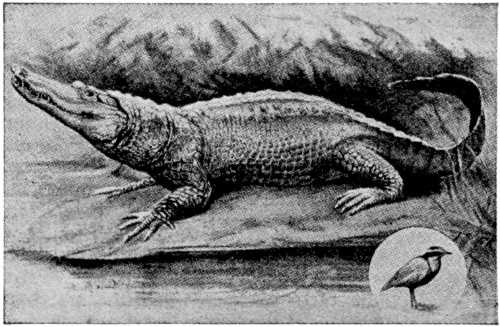
Crocodiles are cruel, but in one way they serve us, by eating the dead bodies of animals which float down the rivers. But for the crocodiles these bodies might poison the water. Here we see the crocodile and the little bird called the ziczac, which picks the food from between the crocodile’s teeth.
CROCODILES AND ALLIGATORS (Crocodilia)
These inhabitants of the rivers and estuaries of tropical regions are somewhat lizard-like in appearance, but in structure they are in many ways much more specialized. They have a scaly, tough skin on the back, four powerful feet, and a long tail. They live chiefly in the water, and only go to the banks to bask in the sun. The jaws are armed with powerful interlocking teeth, which constitute a deadly trap. The valvular nostrils are so situated that the animal can drift along with most of its body submerged, and at the same time breathe quite easily.
Alligator (Alligator mississippiensis) is found in the southern states of North America. It is as voracious as it is bloodthirsty. Should it perceive an unfortunate mammal drinking or browsing on the edge of the bank, it sinks below the surface, and rapidly swims toward the victim by strokes of its powerful, flattened tail. Then comes a sudden snap, aided, perhaps, by a lash of the tail; should the attempt prove successful, the prey is held under water till it is drowned, if too large to be forthwith swallowed. No bullet will pierce the hide on its back. It deposits its eggs in a kind of nest, which it builds with grass and mud on the banks, and defends with great fierceness. It deposits about one hundred eggs in this nest. The alligator is captured in various ways, but there is danger in hunting it.
Crocodile (Procœlia) is found in both hemispheres, but especially in Africa; they swarm on the Upper Nile. The crocodile of the Nile is a well-known species, not now found farther north than Thebes, but occurring abundantly farther south and east. Some two or three score of eggs, with delicate, rough, limy shells, about the size of those of geese, are laid in sandy cavities in the bank. The crocodile is now hunted for the perfume of its musk-glands, and also for its skin and fat.
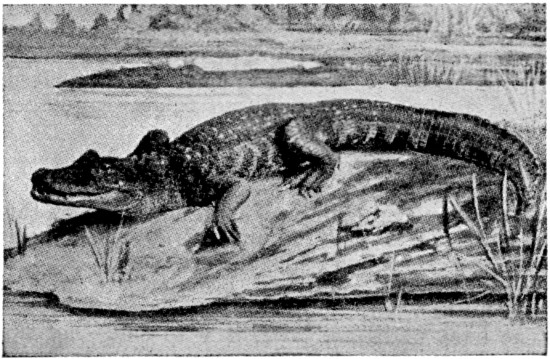
The alligators have a covering of horny plates, and terrible jaws and teeth. These teeth are frequently renewed, new ones forming in place of those worn out. Alligators are, in this respect, more fortunate than human beings. In America alligators are protected part of the year, because they kill things which damage the crops.
LIZARDS (Lacertilia)
These may perhaps be described as the most average of existing reptiles, and have a very wide distribution. Examination of a lizard or its skeleton enables us to grasp very clearly some of the average characters of reptiles, such as the sprawling limbs and long tail. Some of the tropical lizards are of very considerable size, attaining a length of as much as six feet, as in the iguanas of America, some of which are esteemed as food. These are among the climbing members of the order, other examples being the geckoes and chameleons, both of which are animals of small size.
Chameleons are proverbial for the way in which they rapidly change color if placed among fresh surroundings, so as to harmonize with them. This variable general coloration is protective, because it makes the chameleon invisible to its foes, and also aggressive, as the insect prey of the little lizard are thereby lulled into a sense of false security. The digits are bound together into two groups, and a tongs-like grasping organ of great efficiency is thus constituted. The chameleon is also notable for the relatively enormous distance to which it can suddenly shoot out its sticky club-shaped tongue, for the purpose of seizing insects or other small creatures.
Flying Dragon (Draco volans) is found on trees in the island of Java. It generally frequents the trees along the banks of great rivers, in the leaves of which are numerous insects, upon which the flying dragon feeds. As it is as green as the leaves of the trees, it can only be recognized by an experienced eye. It is hunted for its delicate flesh, and also for the eggs, which are found deposited, often fifteen to twenty at a time, in a hollow in the ground.
Gecko (Hemidadylus maculatus) is a native of the East Indies and China. At dawn these reptiles creep out of their holes, and with dilated eyes look around for prey. As soon as they catch sight of it, the clumsy creatures spring upon it from a distance of four to six inches, with all the violence and rapidity of an animal of prey. Sucking pads on the feet of the gecko enable it to cling firmly to the most slippery surface, and to crawl about without slipping; its claws, which are sharp and retractile, are also useful to this reptile.
Iguana (Iguana tuberculata) is found in the East Indies and in South America. It lives in trees along the banks of rivers, feeding upon the insects. Its usual color is dark olive green. Its flesh is considered a delicacy, being tender and very much like that of a chicken. The eggs, of which the female deposits from four to six dozen at a time, are also eaten.
SNAKES OR SERPENTS
have elongated bodies, covered with plates or scales, and no feet. Many kinds have no poisonous fangs in the upper jaw. Serpents reproduce their species from eggs, and feed upon living animals; those found in colder regions sleep through the winter.
HOW THE SNAKE TRAVELS
The vertebrae are very numerous. With the exception of the most anterior (atlas), all bear ribs, which are very freely movable and are the snake’s main organs of locomotion. Snakes are capable of moving with great swiftness. The body undulates from side to side—not up and down—in a wriggling or writhing fashion. The extremely flexible backbone permits of this, but to guard against dislocation the vertebrae are connected by extra locking-joints, which only permit a certain amount of play. It is, however, comparatively easy to break the back of a snake by a sharp blow with a stick or whip.
MOUTH AND SENSE ORGANS OF SNAKES
Snakes are typically carnivorous, and many of them are furnished with powerful poison fangs. The tongue is forked, can be rapidly protruded and retracted, and is an efficient sense organ. Upon it and the well-developed nostrils the snakes largely depend, for neither sight nor hearing is very acute. There are no eyelids, the eyes being covered over by a transparent convex scale. The whole skin is covered with scales, which are folds of the epidermis, continuous with one another. In consequence, when the snake casts its coat—which occurs several times in the year—it casts it in one piece, this being a complete replica of the snake.
THE ORGANS OF CIRCULATION
The heart is four-chambered, as in mammals and birds, and not three-chambered, as in other reptiles and amphibia. The pure and impure blood do not, therefore, mix inside the heart; but as such blending takes place outside, owing to imperfect separation of the great vessels, the net result is much the same as in the lizards.
HOW SNAKES SECRETE POISONS
In venomous serpents some of the glands opening into the mouth secrete a poisonous fluid, which is introduced into the blood of a bitten victim. The largest amount of specialization is found among the vipers, where the teeth are reduced to a pair of hollow “fangs” in the front of the upper jaw, and there are two large poison-glands, one on either side of the head, giving it a characteristic resemblance to the ace of spades. In a state of rest, when the mouth is shut, the poison-fangs are pressed against the roof of the mouth, with their tips directed backwards. But when the snake opens its mouth and “strikes,” the fangs are rotated forward so that their sharp tips can be brought into action. The poison flows into the upper end of the tooth-canal and, in vipers, enters the wound by a small hole on the side of the tip. Were it at the end a blockage might result. We have, in fact, an anticipation of the device used in the construction of the needles employed with hypodermic syringe.
WHY SNAKES ARE COLORED
Snakes, like lizards, are very commonly colored in such a way that they may harmonize with their surroundings. A good many poisonous forms, on the other hand, advertise their dangerous properties by brilliant hues and striking patterns. Such “warning coloration” is seen, for example, in the coral snakes of tropical America, which are marked with broad red rings, alternating with others of whitish tint, shading into black at the front and back of each ring. These coral snakes serve as models which certain harmless forms unconsciously mimic, thus securing a certain amount of immunity from attack by sailing under false colors.
SOME SNAKES THAT WARN
In the American rattlesnakes, at each periodical casting of the skin or slough, a little knob remains at the end of the tail. A series of these loosely united together make up the “rattle,” used for the production of warning sounds. The “hissing” of a snake has the same purpose. Venomous snakes also commonly assume a warning attitude, raising the front part of the body from the ground and, in some cases, as illustrated by the cobra, inflating a kind of hood—in this particular instance bringing a black, spectacle-shaped mark into prominence.
But in these and other animals it must not be supposed that the “warning” is for the benefit of the prey, but may be taken as a hint to aggressive birds and mammals that discretion is the better part of valor. The success of this device is shown by the terror with which all monkeys regard serpents.
THE ART OF SNAKE CHARMING
This art has been practised from very ancient times in Africa and the East, and often remains from generation to generation the profession of a family. It is sometimes practised for alleged useful purposes, since the “charmers” are often employed to clear a house of its unwelcome snake visitors. For the most part, however, it is, like conjuring, a form of popular amusement. In India it is practised by several distinct classes of men, who vary in the methods and success of their art. The charmers usually take good care to play with snakes whose fangs or even poison-glands have been carefully removed, or even to use those which are not venomous at all. The frequent use of a musical pipe, and the way in which the snakes seem to respond to the sounds, are facts interesting to naturalists, who believe that at least many snakes are very deaf. The charmers sometimes manifest a fearlessly confident dexterity in handling intact venomous snakes.
THE WISDOM OF THE SERPENT
In correlation with the presence of a well-developed brain, snakes may be regarded as the most intelligent of reptiles, though the idea of their “wisdom” probably took origin in their stealthy ways, and the curious “fascinating” powers already mentioned. They are among the numerous animals that have been the objects of superstitious worship.
AMERICAN AND OTHER SNAKES
The group of North American snakes include a large number of Colubrine snakes and about a score of pit-vipers or rattlesnakes. Among the Colubrine forms are the water-snakes, the black snakes and coachwhip snakes of the genus Coluber, the pine-snakes, the king-snakes, the ring-necked snakes and so on. Besides the rattlesnakes proper, there are the related copperheads and mocassins. Outside these two families there are the boa-like and venomous coral-snakes, and the harlequin snake.
There are no snakes in Ireland, nor are they represented in most oceanic islands such as New Zealand and Iceland. The pythons and boas are distinctly tropical snakes: the pythons in Africa, India, Malaya, Australia; the boas in tropical America. Among the most important venomous snakes of India are the following: the cobra, the Hamadryas, the Krait, the Sankni, and the sea-snakes.
AMPHIBIANS (Amphibia) FROGS, NEWTS, SALAMANDERS AND TOADS
The amphibians hold a middle position between the reptiles and fishes. The name, Amphibia, means “double-lifed” or living on both land and water. The larvæ, after leaving the eggs, live in the water like fishes; they gradually accustom themselves to live in the air, and when their metamorphosis is complete they breathe by means of lungs.
They have red, cold blood, and are enveloped in a smooth, often slippery, skin. Some have tails, like the newt and salamander, and others are tailless, like the frog and toad.
Frog (Rana temporaria) is familiar all over America, and is found in the early spring in all our ponds, ditches, and lakes, in which also large quantities of frog’s eggs can be seen. When fully developed, frogs have a short, tailless body, a large head, and four legs, the toes being frequently joined together by a membrane.
They deposit their eggs (a) in the water, either in masses or in strings. The larvæ (called tadpoles) have a long, flattened tail (c); they have no legs, and breathe through gills (b), and are therefore very different from the fully developed frog. The gills gradually disappear, and lungs are developed; the fore legs make their appearance, the hind pair developing first (d and e); the tail gradually diminishes, and finally disappears (f). The change, is then complete, and the young frog leaves the water to begin its life upon land. The common frog leaves the water immediately after spawning, and makes itself very useful by destroying numerous injurious insects and snails.
In this country the commoner species of frogs embrace the Bull Frog (R. catesbiana), which is the largest, sometimes being eight inches long. Its sonorous bass notes are familiar to the ear, and to the eye it presents a greenish appearance, brightest on the head; with faint spots on the back and blotches on the legs. It occurs from Kansas eastwards, and its hind-legs fried are considered a delicacy.
The Spring Frog (R. clamatans) is widespread, about three inches in length, green and black spotted above and white below.
The common Green Frog (R. virescens) has irregular black blotches, and is paler beneath. Both average about three inches in length.
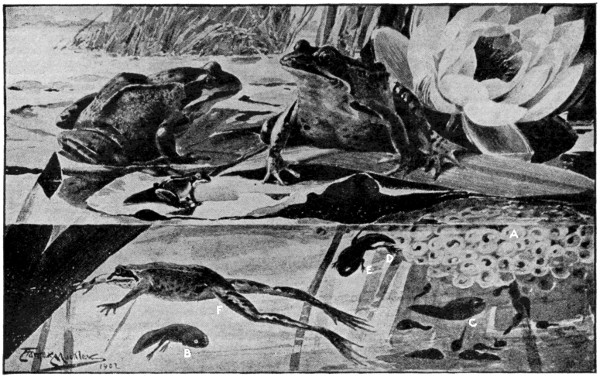
DEVELOPMENT OF THE FROG—FROM THE EGG TO THE FULL-GROWN ANIMAL (See Page 223).
The Pickerel Frog (R. palustris) is light brown in color, with two rows of large oblong blotches of dark brown on the back and spots elsewhere. It is smaller in size and less aquatic than most other kinds.
The Wood-Frog or Tree-Frog (R. sylvatica) is more closely related in structure to the toads than to the frogs proper. The tree-frogs show various interesting adaptations to their arboreal life. The last joint of each toe bears a claw, on which is supported a disc or sucker by means of which the animals can cling to a perfectly perpendicular surface. Most of them also exhibit in a greater or less degree the power of color-change, where the color varies from a dark brown to a lichen-like gray or a brilliant green.
Newts are separated from the lizards on account of their changes while young. Like the frogs, they are first tadpoles, and do not assume their perfect shape until six weeks after their exclusion from the eggs. The common Newt is a beautiful inhabitant of the ponds, ditches, and still waters.
The male newt is distinguished by a beautiful crimson tipped wavy crest of loose skin, that extends along the whole course of the back and tail, and which, together with the rich orange-colored belly, makes it a most beautiful creature. The female has a singular habit of laying her eggs upon long leaves of water-plants, and actually tying them in the leaf by a regular knot.
Salamander (Salamandra maculata) is a nocturnal animal, and found in woods and hedges under decayed leaves and similar matter. Their bodies are longer and similar to the lizard. Most of the species lay eggs, usually in the water. From these the gilled young hatch out. They are carnivorous or insectivorous. In the adult stage, some are aquatic, but more live on the earth burrowing beneath the soil or under stones, seeking their prey at night. None are poisonous, except that they have glands in the skin which secrete an acrid juice. Our largest species is the mud puppy (Necturus) of the Mississippi basin; the largest living species is the giant salamander of Japan, three feet in length.
Toad (Bufo).—Toads are distinguished from frogs by the absence of teeth, by the roughness of the skin, by peculiarities in the breastbone, and by the shorter hind-legs.
The common toad is a shy, nocturnal animal, hiding during the day in dark, damp places, crawling about at night in search of insects, grubs, slugs, worms, and the like. Its appearance is familiar—a dirty brownish-gray color, a warty skin, a flat head, swollen parotid glands above the ears, bright jewel-like eyes with a transverse pupil, slightly webbed toes. They are heavier and clumsier than frogs, and cannot leap nearly so far. During the winter they live in the mud or in holes. In spring they pair, and the females lay in the water-pools their numerous eggs in strings about three or four feet in length. The tadpoles are smaller and darker than those of frogs, and do not accomplish their transformation into toads until autumn.
Toads are widely distributed over most parts of the continents, but are most abundant in tropical regions. The common toad of North America ranges everywhere east of the Rocky Mountains. In the Southern States another very similar species is numerous, and other species are found in the West. The largest toad of tropical America measures eight inches in length.
The Laughing Toad (Bombinator igneus) is the smallest of the toads, with a yellow spotted belly.
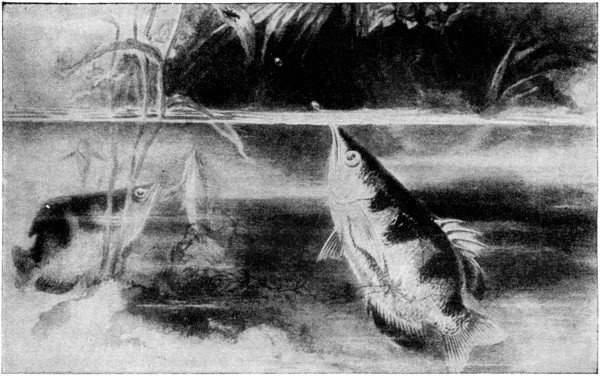
THE ARCHER FISH
is one of the strangest of all fishes in its habits. It shoots down flies and other small creatures from the bank by means of a series of well-aimed “bullets” of water, which it ejects in rapid succession.
THE FISHES (Pisces)
The fishes are the last class of the vertebrated animals, and have cold, red blood. The elongated body generally tapers off to the tail; the head and neck are large; the limbs are called fins, and are such as to make efficient paddles. They are usually one or more fins in the middle line of the back and one or two in a corresponding position beneath the tail (anal fins); while the tip of the tail is terminated by a caudal fin, the chief organ of swimming. All of the fins are supported by a skeleton of rays, either horny or spinous in character.
There are but two chambers to the heart, and the occurrence of a swim bladder, an organ for regulating or recognition of the depth of the water in which the fish is, is very frequent. Externally fish have a defensive armor of scales or bony plates embedded in the skin. They breathe throughout life by means of gills, which are delicate folds or filaments connected with openings (gill slits) in the sides of the throat. The fishes live in water, and reproduce their species by eggs.
There are several great groups of fishes, distinguished by the presence of a cartilage or bony skeleton, by having the gill slits free or under a gill cover, by characteristics of the skull, presence or absence of air bladder, and by peculiarities of the digestive tract and nervous system.
(1) The bony, or true fishes (Teleostei), which include all the most familiar freshwater and marine forms; (2) the Cartilaginous fishes (Elasmobranchii), including sharks, dog-fish, bays and skates; (3) the heavily-armored fishes (Ganoidei), like the sturgeons and bony pike; and (4) the double-breathers (Dipnoi), of rare occurrence.
THE BONY FISHES (Teleostei)
These have a bony skeleton, and a well-defined vertebra, or backbone; their bodies are mostly covered with scales.
Alewife (Alosa tyrannus), a fish of the same genus with the Shad, which, at the beginning of summer, appears in great numbers on the east coast of North America, and enters the rivers to spawn. It appears in Chesapeake Bay in March, on the coasts of New York and New England in April, and on those of the British provinces about May 1. It abounds in the bay of Fundy, but is more rare in the gulf of St. Lawrence; and the bay of Miramichi appears to be its northern limit. Its length is not more than twelve inches. The alewife is called spring herring in some places, and gaspereau by the French Canadians.
Bass (Labrax) is a member of the perch family. The shape is salmon-like. The color is without the zebra-like bars of the perch, and shades off from dusky blue above to silvery white beneath.
The Striped Bass or Rock-fish of the United States (L. lineatus) very nearly resembles the common bass, but attains a larger size. It is one of the most important of American food fishes, and sometimes weighs fifty pounds. It is caught from July to September. The name Stone Bass is given to various forms. A Yellow Bass is found in the Lower Mississippi valley, and the Fresh-water Bass is an imported fish found in the streams of eastern New York and the other middle states.
Bluefish (Temnodon or Pomatomus saltator).—A fish common on the eastern coasts of America, allied to the mackerel. The only known species is abundant on the east coast of North America. The upper parts are of a bluish color, the lower parts whitish, a large black spot at the base of the pectoral fins. The mouth is crowded with teeth, the jaws are furnished with large ones. The bluefish preys on other fishes, such as the menhaden and mackerel, the shoals of which it pursues. It sometimes attains a length of three, or even five feet, and a weight of fourteen pounds. It is often caught by trolling, as it bites readily at an object drawn swiftly through the water. It is much esteemed for the table.
Bullhead.—In the United States the name is given to some species of catfish or horned pout; in England to a smaller fish, allied to our miller’s thumb, but belonging to a different group from the catfish.
Carp. See page 256.
Cod (Gadus), a genus of bony fishes in the soft-rayed order. This is probably the most important food fish and is taken in enormous numbers on the coasts of Europe and of eastern North America. It occurs in the northern Pacific as well. It feeds upon other fishes as well as on shellfish, and large specimens weigh over one hundred pounds. Allied to the cod are the haddock, pollack, hake and cusk.
Eel (Anguilla vulgaris) has elongated form, and has become proverbial on account of its slipperiness and tenacity of life. In the rivers and lakes only female fish are found; the males keep to the open sea. The former go down to the sea in the autumn; but in the following spring the young female fish swim up the rivers in immense numbers, while the young males remain in the sea. During the day the eel conceals itself in the mud, but at night it exhibits its voracious qualities by swallowing numerous fish, water insects, crabs, mussels, and worms. Its firm, delicate flesh is much esteemed.
Flounder (Pleuronectes flesus), a common species of flat-fish, of wide distribution in shallow waters in north temperate countries. It is the Scotch “fluke,” and the Swedish “flundra,” and differs but a little from the plaice and dab, two of the commonest neighbor-species. Like other flat-fishes, the flounder is asymmetrical, and swims or rests on one side, almost always the left, the eye of which is in early youth, brought round to the upturned surface. It measures about one foot in length, and about a third as much between the dorsal and the ventral edge, without including the fringing fins.