BOOK OF THE VEGETABLE KINGDOM (continued 2)
Reading edition
Orange (Citrus Aurantium), small evergreen trees, probably a native of southern China and Burma, but grows wild and spinous in Indian jungles. The scattered glossy leaves are remarkable for their double articulation, having one joint at each end of the winged leaf-stalk. The fragrant white or pinkish flowers have five sepals, five petals, and branched stamens. The fruit has a leathery rind, containing large spindle-shaped cells filled with watery juice. As the fruit takes some months to ripen, it occurs on the tree at the same time as the next year’s blossoms. There are two chief varieties or sub-species, the sweet or China orange, and the bitter, bigarade or Seville orange, but the Mandarin and Tangerine oranges are sometimes ranked as a distinct species. The principal orange-growing sections of the United States are Florida, Louisiana and California.
The Mandarin Orange or Clove Orange has fruit much broader than long, with a rind very loosely attached to the flesh, and small leaves; the Tangerine Orange is apparently derived from the mandarin. It is grown in Florida. The Jaffa Orange has now a great reputation. The Majorca Orange is seedless. The Kum-quat from China and Japan, is little bigger than a gooseberry, and grows well in Australia. The Navel Orange, nearly seedless, is a favorite variety with California growers.
Orange trees are often extremely fruitful, so that a tree twenty feet high and occupying a space of little more than twelve feet in diameter sometimes yields from three thousand to four thousand oranges in a year. One tree in Florida has often borne ten thousand oranges in a single season. The orange tree attains an age of at least one hundred to one hundred and fifty years. Young trees are less productive than old ones, and the fruit is also less juicy, has a thicker rind, and more numerous seeds.
Palms were called by Linnæus “the princess of the vegetable kingdom,” and comprising over one thousand species, chiefly natives of the tropics. They have mostly cylindric, unbranched stems, bearing a tuft of large, often gigantic, leathery leaves at the top, the leaves being torn into segments. The leaves are sometimes spattered, and in most cases have a fibrous sheathing base to the leaf-stalk. The terminal leaf-bud is the “cabbage” which, in some species, is eaten. The fruit varies very much, with a hard seed, as in the date; drupaceous, as in the cocoa-nut; or covered with woody reflexed scales, as in the sago palm. The use of palms are innumerable. Beams, veneers, canes, thatch, fibre for cordage and matting, fans, hats, bowls, spoons, sago, sugar, wine, spirits, food, oil and wax are only some among the number. See also Date, Betel-nut, Cocoa-nut.
Peach (Amygdalus persica), probably a native of China. The nectarine is merely a smooth-fruited variety, differing, however, in flavor. The stone in both is coarsely furrowed. The flowers which appear before the leaves, are of a delicate pink. The fruit in the peach has a separable wooly skin. Though deliciously flavored and refreshing, since it contains eighty-five per cent of water and eight per cent of pectose and gum, it does not contain much nutriment. Peaches grow extensively in Europe and Asia and second only to the apple as an orchard fruit in the United States. California, Michigan, Georgia and Texas lead in production.
Pear (Pyrus communis), is a tree belonging to the same genus as the apple. It grows from thirty to seventy feet high, with a pyramidal outline; branches spinous in the wild state; leaves scattered and somewhat leathery; flowers in clusters; fruit with a fleshily-enlarged stalk, core near the apex and parchment-like, and black seeds. Gritty particles, due to groups of wood-cells, occur in the flesh. They are widely cultivated in temperate regions, but chiefly in France and the United States. Ranks fourth among American orchard fruits, being preceded by the apple, peach and plum. Chiefly grown in California, New York and Michigan.
Pecan (C. illinoensis), is a large, slender tree reaching a maximum height of one hundred and seventy feet and a diameter of six feet. It grows in moist soil, especially along streams, from Indiana to Iowa and Missouri, south to Kentucky and Texas. It is cultivated in the Southern States for its sweet, edible nut, which forms an important article of commerce.
Persimmon, the Virginian date-plum (Dios pyros virginiana), a moderately-sized tree of the United States, belonging to the ebony tribe, the round orange fruit of which, though austere, becomes edible when affected by frost. They are fermented into a beer and distilled for spirit in the Southern States. The bark has medicinal properties.
Plum (Prunus domestica), a small fruit-tree, native to Asia Minor and the Caucasus, and naturalized in most temperate parts of the world. The Damson or Damascus variety was grown by the Romans from very early times. Large quantities of many varieties, both home and foreign are grown, which are eaten raw, in tarts, and in preserves, or, when dried as prunes. Extensive cultivation is carried on throughout temperate regions. Third most important orchard fruit in the United States, exceeding eight million bushels, California growing two-thirds. All prunes produced in the United States grown in the Pacific States; first prune orchard planted at San Jose, California, in 1870.
Pomegranate (Punica Granatum), long valued in hot countries for the refreshing pulp of its fruit. It is a tree, fifteen to twenty-five feet in height, native to West Asia and North Africa. It has opposite, simple, entire leaves, and the flower has five scarlet or white petals. The fruit has a tough, leathery gold-colored, but partly reddened, exterior and numerous seeds each surrounded by a reddish pulp. This varies in flavor in the numerous cultivated varieties. The rind is rich in tannin, and is employed in tanning Morocco leather.
Walnut (Juglans regia), or Common Walnut is a native of Persia and the Himalayas, but has long been cultivated in all parts of the south of Europe. It is a tree of sixty to ninety feet, with large spreading branches. The leaves have two to four pairs of leaflets, and a terminal one. The ripe fruit is one of the best of nuts. It yields a bland fixed oil, which, under the names of walnut oil and nut oil, is much used by painters as a drying oil. The timber of the walnut is of great value, and is much used by cabinet-makers. The wood of the roots is beautifully veined. Both the root and the husks of the walnut yield a dye, which is used for staining light-colored woods brown. Very similar to the common walnut, but more valuable, is the Black Walnut of North America, found in most parts of the United States, except the most northern. See also Butternut.
IV. FRUIT-BEARING SHRUBS AND PLANTS
The trees previously mentioned are woody plants with only one stem, which begin to form branches at some distance from the ground. The shrubs, on the contrary, are woody plants in which the stem forms branches close to the ground, or even underground.
Banana (Musa sapientium), a handsome plant, long cultivated in tropical and sub-tropical countries for its fruit. The sheathing bases of the large, oblong leaves form a false stem twenty to thirty feet high. The spikes of irregular flowers are succeeded by a branch of one hundred to two hundred fruits, weighing together from fifty to eighty pounds. The long, berry-like fruits, as they ripen, convert nearly all their starch into sugar and pectose, and form a valuable article of food, the staple food in many tropical countries, producing forty-four times the weight of food per acre yielded by the potato. It is produced in enormous quantities in the West Indies and Brazil, and shipped in constantly increasing volume to the United States and Europe. Beginning with a few hundred bunches in 1870, consumption in the United States has increased to upwards of five million dollars worth annually. Banana flour is becoming a staple article of food.
Its cultivation antedates historical records in India. Pliny mentions that the Greeks under Alexander the Great saw it in India.
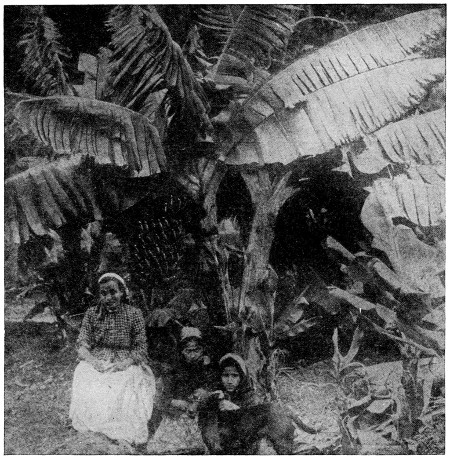
The banana plant is the most wonderfully productive fruit in the world. It is a native of Asia, but most of our bananas come from the New World. Here the plant is full grown and the bananas ripe. From the time the suckers are planted to the gathering of the fruit is less than a year, so rapidly does the plant come to maturity.
Blueberry. See Huckleberry.
Cassava (Manihot utilissima), the bitter cassava, and M. Aipi, the sweet cassava, are both natives of tropical America. Both are shrubby plants, the former with yellow poisonous roots and seven-lobed leaves, the latter with reddish wholesome roots and five-lobed leaves. The coarsely-grated roots are baked into cassava cakes, from which the intoxicating drink piwarrie is prepared. The juice of the poisonous kind is rendered harmless by boiling, and is then the delicious sauce known as cassareep. If allowed to settle, it deposits a large quantity of starch, known as Brazilian arrowroot when simply sun-dried, or as tapioca when partly converted into dextrine by roasting on hot plates. It was long cultivated in Brazil, and, after Spanish discovery, extended to Africa and Asia.
Cranberry (Oxycoccus), a small evergreen shrub, that grows in bogs and marshy grounds, and is a small wiry shrub with creeping, thread-like branches, and small oval leaves rolled back at the edges. The berries are an excellent antiscorbutic, and hence furnish an excellent addition to sea stores. The American cranberry (O. macrocarpa) is larger and more upright with bigger leaves and berries. Large quantities are exported to Europe and other varieties are also imported into Britain and Germany from Russia and other parts of northern Europe.
Currant (Ribes rubrum), is an important shrub, bearing red, black and white fruit. Its branches are not prickly; its leaves have three to five lobes, greenish-yellow blossoms and the berries hang in clusters like grapes. It is often planted in gardens for the sake of its fruit, but is also found in a wild state. Black currants are extensively grown in Continental Europe, Scotland and Canada; sparingly in the United States. In France the liqueur de cassis is made from the fruit. Red currants are very widely grown in Europe and the United States, chiefly for jellies. New York and Michigan lead in production.
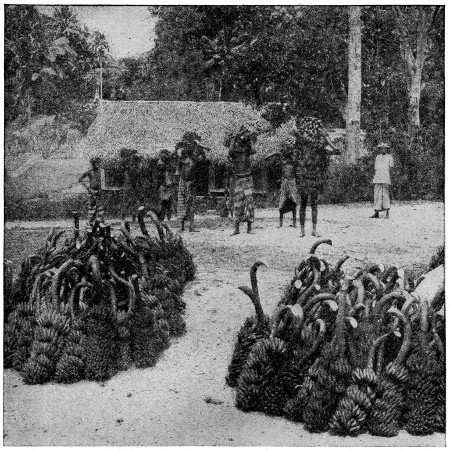
The method of gathering bananas is practically the same wherever they are grown, and here we see the bunches being brought to the railway. Bananas need a great deal of water. They will only grow in a warm, damp atmosphere and if much rain does not fall they must be supplied with water artificially. This is done by having canals between the rows of plants.
Elder (Sambucus) has thorny branches, elliptical, serrated leaves and single, white blossoms which grow in such numbers that they sometimes resemble snow. Its fruit is black and blue. It grows from three to six feet high in copses, hedges and forests. Few of the species are considered of much value though S. Canadensis is used to make a domestic wine and jelly. The most ornamental of the species is S. pubens, which has large, loose panicles of bright scarlet berries. This species is occasionally found in moist high grounds from New York southward. It is very abundant and beautiful on the slopes of the Alleghany Mountains.
Gooseberry (Ribes Grossularia) has branches covered with spines, brown-reddish blossoms and berries of green, yellow or reddish color, which stand singly on the young shoots. It is frequently planted in gardens, and has many varieties. It is highly prized in northwestern Europe; not cultivated in southern Europe, and reaches highest perfection in England. In the United States, while widely grown, is of minor importance, ranking sixth among small fruits, being preceded by the strawberry, raspberry, blackberry, cranberry and currant.
Grape (Vitis Labrusca) has a climbing, knotty trunk, which sometimes attains a length of thirty to fifty feet; its leaves have from three to five lobes, and are coarsely serrated; its small, fragrant, greenish blossoms stand in panicles. The fruit of many varieties of vine, which have been produced by cultivation in the course of thousands of years is very different in color, size and flavor. It is either consumed raw and dried, or manufactured into wine.
In the United States the first vineyard was planted by Lord Delaware in 1610, but not extensively grown until after the introduction of the Concord grape during the last century. While the Concord, Catawba, Isabella, Hartford and most of the cultivated varieties originated from the wild northern fox or plum grape, Vitis Labrusca, the Clinton grape was derived from the wild species, Vitis riparia, and most of the American wine grapes from the native summer grape, Vitis aestivalis.
Since 1860 grape culture has made remarkable progress, the last census showing a crop exceeding eight million dollars in value. New York produces one-third of the American grape crop and is followed by Ohio, Pennsylvania, Michigan, Illinois, Indiana, Missouri and Kansas, in order named. Notwithstanding the extensive culture of the European grape in the Pacific States, the American grape constitutes three-fifths in value of all grape products of the United States. Millions of young vines have been shipped to Europe to be top grafted with the European vine.
The grape shares leading rank with the apple among the world fruits. Chief products: raisins, currants and wine of great commercial importance. Raisin production largest in Spain, but important in southwestern Asia, Australia and California. Currants are small, seedless raisins, mostly grown in Greece (name derived from Corinth). Wine is made throughout the world, total production estimated at four billion gallons, France, Italy and Spain contributing about three-fourths of this enormous amount. The European grape products of California—wine, raisins and table grapes,—amount in value to two-fifths of all grape products of the United States.
Remotely ancient in Egypt. Used by Lake Dwellers of the Bronze Age in Italy. Cultivated by the Phoenicians, Hebrews, Greeks and Romans. Introduced into China 120 B. C.
Huckleberry. The popular name of the genus Gaylussacia, of which there are several species. The Dwarf huckleberry, the Blue huckleberry and the Black huckleberry are common throughout the United States, the latter being the huckleberry of the Northern States. In New England the name is commonly restricted to the black berry species in distinction from the blue berry. The shrubs range in height from about three feet to twelve feet high. In New England canning huckleberries is an extensive if not exceedingly profitable industry. The crop is first picked by hand and afterwards with a “blueberry rake.” The Indians long ago gathered the fruit and dried it for use during wintertime.
Pepper Plant (Piper nigrum) is found all over the Torrid Zone. Its berries stand to the number of twenty to thirty on one spike; at first they are green, then they turn red, and finally black. The black pepper is prepared from the unripe fruit, the white from the ripe fruit, which loses its black shell by being put into salt water (sea water). Pepper is now the most commonly and widely used spice. It is extensively cultivated in East and West Indies, Siam and Malay Peninsula, whence millions of pounds are exported.
Cayenne pepper, or chili is much grown in tropical Africa and America, but less generally used than black pepper.
Pistacia is a small tree, about twenty feet high, and native to Persia and Syria, but now cultivated in all parts of southern Europe and northern Africa. Flowers in racemes, fruit ovate and about the size of an olive. Pistachio nuts are much esteemed; but readily become rancid. Oil is expressed from them for culinary and other uses.
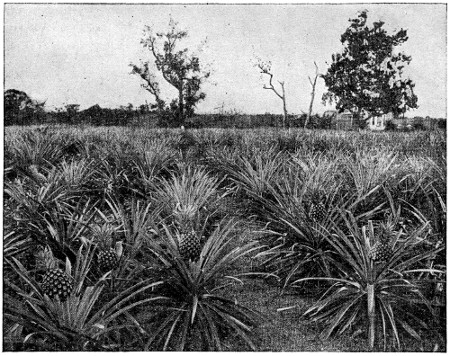
A PINE-APPLE PLANTATION IN FLORIDA
Pine-apple (Ananassa sativa) is highly esteemed and much cultivated for its fruit. It has a number of long, serrated or smooth-edged, sharp-pointed, rigid leaves, springing from the root, in the midst of which a short flower-stem is thrown up, bearing a single spike of flowers, and therefore a single fruit. From the summit of the fruit springs a crown or tuft of small leaves; capable of becoming a new plant; the pine-apple, in cultivation, being propagated entirely by crowns and suckers, as, in a state of high cultivation, perfect seed is almost never produced. The pine-apple is a native of tropical America, and is found wild in sandy maritime districts in certain parts of South America, but has been very much changed by cultivation. It is extensively grown in Florida, and in the West Indies for shipment to northern markets and to Europe. Increasing outdoor plantations have also been developed in the Azores, the Hawaiian Islands, northern Africa, Queensland, and the Bahamas. Florida supports upward of fourteen million plants. Great care is requisite in the cultivation of the pine-apple, which without it is generally fibrous and coarse, with little sweetness or flavor, and with it one of the most delicate and richly flavored of fruits.
WHERE TEA GROWS AND IS CULTIVATED
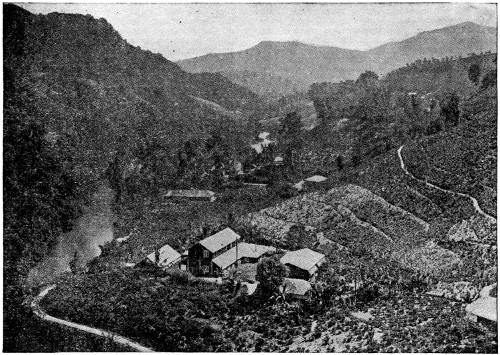
A TEA PLANTATION IN THE BEAUTIFUL HILL COUNTRY OF CEYLON
The most productive tea gardens are at an elevation of about one thousand feet, the land at this altitude being generally of an undulating character, well watered, and the climate sufficiently humid to encourage leaf-production.
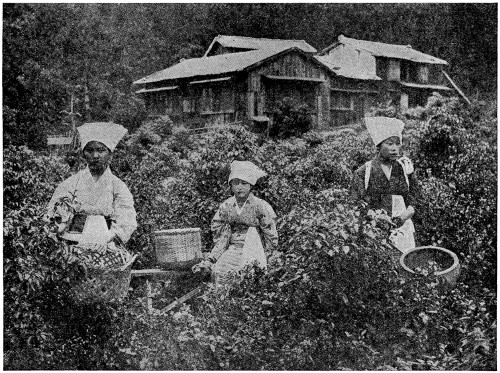
The plants are ready for plucking when three years old, at which time they send out numerous leaf-shoots, known as “flush.” The plucking season begins in September and lasts until June of the following year, during which period each bush is plucked about sixteen times.
For producing superior fruit in winter the Smooth Cayenne and Black Jamaica are two of the best and most reliable, and the Queen is the most highly esteemed for summer fruiting. The Spanish is the variety commonly grown in Florida. A spirituous liquor (Pine-Apple Rum) is made from the pine-apple in some warm countries.
Raspberry (Rubus Idæus), the most valued of all the species of Rubus. The wild raspberry has scarlet fruit and is found in thickets and woods throughout the whole of Europe and northern Asia. It was early introduced into the United States, but those now grown originated in native American varieties. The black raspberry, is largely grown in New York and Ohio as a commercial industry. The red variety is widely grown in the United States, but production is small compared to that of the black raspberry. Among the more promising varieties of the blacks are Gregg, Ohio and Kansas. Cuthbert is one of the best of the red varieties. The raspberry has long been in cultivation for its fruit. The root is creeping, perennial; the stems only biennial, bearing fruit in the second year, woody, but with very large pith. The raspberry is the leading bush fruit of the United States and second only to the strawberry among small fruits. New York, Michigan, Ohio and Pennsylvania, ranking in the order named, grow over one-half of the total crop, which exceeds seventy-five million quarts. The berries are consumed raw or in a preserved state, or are manufactured into raspberry juice, wine and cordial.
Tea (Camellia theifera) is a plant of which there are two well-known varieties: (1) Assam tea; and (2) China tea. The Assam variety, known as “indigenous” tea, is a tree of vigorous growth attaining a height of thirty to forty feet with a leaf from eight to ten inches in length. The China variety is a comparatively stunted shrub, growing to a height of twelve to fifteen feet, with a rounder leaf about three and one-half inches in length, and calyx covered with soft, short hairs. These two varieties have resulted in a hybrid which combines the hardy character of the China with the other features of the indigenous, now largely cultivated on the hills of India and Ceylon, and known as “hybrid-Assam.” The hybrids vary much in productiveness.
The tea-plant will flourish in all parts of the tropical and subtropical zones where the rainfall is over sixty inches and evenly distributed throughout the year. In Ceylon it grows from sea-level to an altitude of seven thousand feet.
The tea-plant is not particular as to soil, but it succeeds best on new forest-land containing plenty of humus. As is the case with cacao, coffee and other economic plants, tea grown on rich, alluvial soil is stronger than tea grown on poorer land, though the latter is often of more delicate flavor.
Chinese teas may be classified thus: Monings, or black leaf teas are grown in the north of China, and shipped from Hankow and Shanghai. Green teas are shipped from Shanghai and consist of Gunpowder, Imperial, Hyson, Young Hyson and Twankay. Kaisows or Red-leafs are grown farther south and are shipped from Foo Chow.
The United States and Canada consume nearly all the tea exported from Japan, all of which is of light character, consisting mostly of Oolongs and greens. Tea has been grown with success in South Carolina and experimentally elsewhere in the United States.
Manufacture.—The first process is to spread the green leaf thinly on hessian trays in the withering house, where it is exposed to a free current of air—a very important operation, which takes from twelve to forty-eight hours. When the leaf is tough and flaccid, like an old kid glove, it is ready for rolling. The old or Chinese system of rolling was by hand. Now this process is performed by machinery, and in India and Ceylon tea is not manipulated after plucking. The rolled leaf is now ready for fermentation, an operation requiring close attention. It is placed in drawers or on tables and covered. The state of the weather hastens or retards the process; in hot, dry weather the leaf will be sufficiently fermented or oxidized in twenty minutes, in cold wet weather it may take hours. Whenever the leaf assumes a bright copper color it must be fired; over-fermentation is a fatal error.
The difference between black and green teas is simply this: if the tea is fired immediately after rolling it is green tea; if it is fermented it becomes black tea. After firing the manufacture is complete, and the tea is what is known as “unassorted,” which contains all the different grades into which tea is usually separated. Sorting by hand sieves is still done in small factories, but in large factories machinery is used.
V. FLOWERS AND OTHER ORNAMENTAL PLANTS
We cultivate in our gardens plants of all kinds, which give us great pleasure on account of their lovely blossoms or their agreeable odors. They are no longer luxuries, but have become necessities of life; and never have they become so extensively grown and widely appreciated as now. There are plants suited for sunny and shaded aspects and for various positions, from the mossy dell to high and dry situations in the country; from the area to the housetop in the town. Only knowledge is wanted for making the best selections for different purposes and sites, with information on culture for the uninitiated to achieve satisfactory results.
Plants and flowers grown in gardens are embraced in three groups: 1. Annuals, 2. Biennials, and 3. Perennials, the last-named being divided into two sections: (a) herbaceous, with soft or succulent stems that die in the winter; and (b) shrubby perennials with woody stems that survive the winter.
Annuals are those flowers which are born, grow, flower, ripen seeds, and die within a year. They never push growths a second season after flowering, because the roots die as well as the tops and branches. The common scarlet Poppy is a typical example.
Biennials are those plants which are raised from seeds in the spring or early summer and require the whole season to make their growth preparatory to flowering the next year, dying after ripening seeds.
Perennials differ from the above in living more than two years. All plants, such as hardy border flowers, that die down and spring up again from the root-stock year after year are perennials—herbaceous. Roses and other flowering shrubs are also perennials, but not herbaceous. Orchids. One of the best examples of herbaceous perennials is that of the Orchids, the most popular of which are the Odontoglossums and the Cattleyas.
Florist’s Flowers. This term has been applied to a number of plants which under cultivation and by selection or hybridization have produced from seed varieties of improved form, habit or color. The plants included under this title are constantly being added to, and great impetus given to the cultivation of hardy flowers and plants in recent years. The following are representative of this class:
Begonia. Named in honor of M. Begon, a French patron of botany. All the species of Begonia are interesting and beautiful winter ornaments of the hot-house or green-house, of the simplest culture in any rich soil if allowed an abundant supply of water. There are several tuberous-rooted species and varieties. They have large, showy flowers, and succeed well in a moist, shady border. The tubers should be kept warm and dry during the winter. They are readily propagated by cuttings, seeds, or division of tubers.
Carnation (Dianthus caryophyllus) is an almost hardy herbaceous perennial plant, a native of southern Europe. The Greeks and Romans used it for making chaplets whence it was called “coronation.” It is a favorite exhibition flower, of many varieties, forms and colors; but the red, white, pink and yellow predominate. Carnations are among the plants which can be grown in the atmosphere of cities, but they are intolerant of shade. Propagation is usually effected by the process of layering, but cutting, seeds, and divisions are also employed.
Cattleya. What the rose and carnation are among garden plants, the Cattleya is among Orchids, preëminently beautiful. Not a species but possesses claims of the strongest nature on the culturist’s attention, either for its delicate loveliness or the rich and vivid coloring of its large and handsome flowers. They are natives of the temperate parts of South America, and in cultivation are found to succeed in a lower temperature than is necessary for the majority of plants of the same order. The plants grow vigorously, and consequently flower in perfection. The colors of the flowers run through all the shades of white, rose, rosy-lilac, crimson and carmine, nor is even yellow absent.
Dahlia. This, through constant improvement, has become one of the indispensable flowers. It derived its name from the Swedish botanist Dahl. Dahlias are known as show, fancy, pompon, single and cactus. They vary from the single type, not unlike a daisy, with broad rays, to the tiny, tightly-quilled, formal “pompon,” and to the “cactus-flowered,” resembling a chrysanthemum; and their lines are equally varied. Yellow, lilac, white and the deepest maroon, are found in innumerable combinations. It is necessary to lift the roots in late autumn, and, having ripened them in a shed, to store them for the winter in a cool, dry place, where the temperature will not fall below thirty-two degrees Fahrenheit. In the spring, the separate tubers may be planted in deep, rich soil; or the roots may be placed in February in a hot-bed, and when the young shoots which form are about three and a half inches long, they may be separated, together with a small piece of the tuber, and potted in small pots, which should be placed in the hot-bed until the young plants are ready to be hardened, preparatory to being planted outdoors.
Geranium. Our native species, called “crane’s bill,” from the beak-like appearance of the fruit, have palmately lobed or cleft leaves. The flowers have unusually bright-colored petals. The plants commonly cultivated in gardens and greenhouses under the name of Geraniums are species of Pelargonium. There are about one hundred and twenty-five species, mostly natives of the Cape of Good Hope, prized on account of the brilliant colors, of the flowers and the shape and markings of the leaves.
The most popular method of propagating is by cuttings, which can be rooted in pots or boxes of light soil placed in a greenhouse, or even a cottage window, at any time from spring to autumn, provided the soil is not kept very moist. Good loam is the best potting material, and beyond a little sand it needs no addition. Firm potting is a point to be well observed. Avoid coddling.
Gloxinia is the florists’ name for plants belonging to the genus Sinningia, tropical American plants. They have beautiful, many-colored, funnel-shaped flowers and velvety leaves. Seeds should be sown in February; and if the young plants are carefully potted, they flower the first year. They require the temperature of a warm greenhouse during the summer months; but as the leaves die away in autumn, the roots may be stored in a dry place, merely protected from cold. They like a sandy soil, containing abundance of leaf-mould and heat.
Lily (Lilium) in its many forms is one of the noblest and must beautiful of all bulbous plants. About forty-five species are natives of the north temperate zone, many of which are prized for the size and beauty of the flowers. The White Lily (L. candidum), a native of the Levant, with large white flowers, has long been in cultivation in gardens. The European Orange Lily (L. bulbiferum), with large, orange-colored flowers, is a well-known and very showy ornament in flower gardens. The Tiger Lily (L. tigrinum) has a stout stem two to five feet high with beautiful orange-colored flowers, spotted with purple. It is a native of China but has escaped from cultivation in many parts of the United States.
PROUD COLOR BEAUTIES OF THE LAND OF FLOWERS
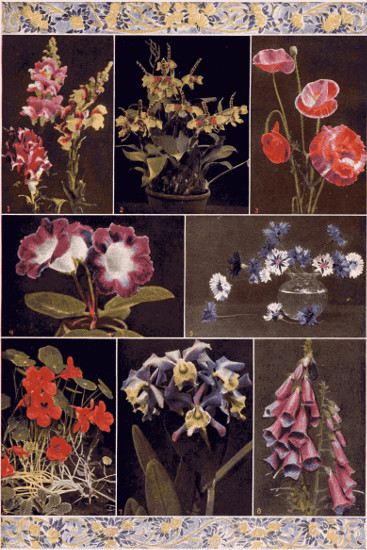
1. ANTIRRHINUM. 2. THE ODONTOGLOSSUM. 3. POPPIES. 4. GLOXINIA. 5. CORNFLOWERS. 6. NASTURTIUMS. 7. THE CATTLEYA FOBIA. 8. FOXGLOVE.
Nasturtium, the generic name of a plant of the cruciferæ or mustard family, and the common name of the widely different genus tropæolum. The best known of these is Tropæolum tricolorum, one of the most generally cultivated annuals. It has tuberous roots, and such very weak and slender stems, that it is found necessary always to train them over a wire frame, as they are quite unable to support themselves. The stem climbs six or eight feet; the flowers vary from yellow to orange, scarlet and crimson. The unexpanded flower buds, and the young fruit while still tender, are pickled in vinegar. The dwarf varieties of this form bushy, rounded tufts about a foot high, and are used for bedding; some of them have flowers of exceedingly rich colors.
Odontoglossum. Unquestionably the most popular genus of Orchids. Very many of the species have been introduced into the green-house, and are greatly prized by cultivators for their magnificent flowers, which are remarkable both for their size and the beauty of their colors. Many of the species have pure white flowers, variously mottled; and some have a powerful odor of violets. With but few exceptions, they require to be grown in a moderately cool house. They are propagated by division, and grown like the other varieties of Orchids.
Tulip (Tulipa). A genus of upward of eighty species of hardy bulbous plants. Between forty and fifty species are known, mostly natives of the warmer parts of Asia. The most famous of all florists’ flowers is the garden tulip (T. gesneriana), which is from eighteen inches to two feet high, with a smooth stem, bearing one erect, large flower. The tulip is still most sedulously cultivated in Holland, especially at Haarlem, whence bulbs are largely exported; but attention is almost exclusively devoted to the cheaper varieties, which are used in hundreds of thousands for the purposes of decoration in gardens and rooms throughout winter and spring. Tulips are propagated by offset bulbs, and new varieties are raised from seed. Another species of tulip cultivated in gardens is the sweet-scented tulip, or Van Thol tulip (T. suaveolens), which has yellow or red flowers, inferior to those of the common garden tulip in beauty, but prized for their fragrance, and for appearing more early in the season.
ROSES AND ROSE CULTURE
Roses are perhaps the most universally admired of all flowers, and few respond so well to the care of the cultivator. The earlier they are planted in the autumn (October 15th to November 15th) the better they will grow. Spring planting is fairly successful, provided the roots are kept moist when out of the ground. Time, April 15th to May 15th.
Roses enjoy deeply worked and fertile soil, and may be grown in specially prepared beds, or as borders. An open position, with a south or southeast exposure is preferable. Pruning should be done toward the end of March. When especially large blooms are desired, only one should be borne on each stem, the remainder of the buds being removed.
DESIRABLE VARIETIES FOR THE ROSE GARDEN
Hybrid Perpetuals.—These produce handsome blooms in varied colors in the summer followed by a more or less bountiful supply in the autumn. Hardiest of the garden roses.
Varieties:
Frau Karl Druschki.—An ideal white rose.
Jacqueminot (Jack Rose).—Brilliant scarlet.
Paul Neyron.—Dark rose; largest of all.
Magna Charta.—Bright pink; a favorite.
George Arends.—Splendid soft pink.
Hybrid Teas.—These possess the freedom of growth of the foregoing with much of the delicacy of flowers for which Tea-scented Roses are admired. The most satisfactory for the general garden.
Varieties:
Robert Huey.—One of the largest bright reds.
The Lyon.—Deep coral pink verging on yellow.
White Killarney.—One of the best pure whites.
La France.—Clear, satiny pink.
Burbank.—Rich pink.
Richmond.—Brilliant crimson.
Tea and Noisettes.—Loveliness with profuseness are combined in this section. Much tenderer than the Hybrid Teas; sweet scented. The Noisette is an excellent climber for walls.
Varieties:
The Bride.—Pure white.
Perle des Jardins.—Beautiful rich yellow.
Papa Goutier.—Dark crimson.
William Allen Richardson.—Deep orange-yellow flowers.
Garland.—Semi-double, blush and white.
Longworth Rambler.—Splendid autumn climber; flowers, semi-double and crimson.
Hardy Climbers.—Popular and showy.
Varieties:
American Pillar.—Large, single, pink flowers.
Excelsa.—Finest of crimson ramblers.
Hiawatha.—Single, brilliant crimson.
Dorothy Perkins.—Soft shell-pink, fragrant.
Lady Gay.—Delicate cerise-pink which change to creamy white.
Wichmoss.—A “Moss” rose, light bluish-pink, fragrant.
Hybrid Briers.—Hardy semi-climbing roses.
Varieties:
Lord Penzance.—Beautiful contrasting shades.
Refulgence.—Dazzling scarlet, in clusters.
Juliet.—Rosy red with reverse petals of old gold.
The “Baby Ramblers.”—Dwarf, “perpetual bloomers.”
Varieties:
Phyllis.—Beautiful pink.
Jessie.—Bright cherry-red, white center.
Orleans.—Brilliant red, white center.
Snowball.—White, free flowering.
Japanese and Chinese.—
Varieties:
Blairii (China).—Vigorous climber for sunny walls; flowers, blush and rose.
Rugosa (Japanese).—No pruning is needed; flowers, white, rose and violet.
GUIDE FOR THE BEST ANNUAL FLOWERS
Common and Botanical Name; Hints on Cultivation Color, Height and Time in Bloom Kind of Soil and Light Required
Blooming in May
Pansies (Viola tricolor), generally wintered in frames, but protected with leaves often survive the winter outdoors. Various; 7 inches; 8 weeks. Rich, light; partial shade.
Trailing Catchfly (Silene pendula).—For succession from May 15th to July 15th sow outdoors September 1st, and again in early spring. Pink, white; 12 inches; 4 weeks. Light, rich loam; sun.
Cornflower (Centaurea Cyanus).—With moisture and frequent picking will bloom longer. Blue; 24 inches; 10 weeks. Light; sun.
Calliopsis (Coreopsis tinctoria).—Calliopsis elegans is one of the best browns among flowers. Yellow and brown; 24 inches; 12 weeks. Light; sun.
Blooming in June
Giant Spider Plant (Cleome spinosa).—Usually planted in the front of shrubbery. Rosy purple; 36 inches; 4 weeks. Light; sun.
Ageratum (Ageratum conyzoides).—Sow seed under glass in March. For edging. Blue; 8 inches; 16 weeks. Rich, light; sun or half shade.
Annual Phlox (Phlox Drummondi).—Remove fading flowers daily. Various; 12 inches; 12 weeks. Rich, moist; sun.
Monkey Flower (Mimulus luteus).—Spotted petals. Flowers somewhat resemble a snapdragon. Various; 36 inches; 6 weeks. Rich, moist; shade.
Three-colored Gilia (Gilia tricolor).—A profuse bloomer. Sow seeds where plants are to grow by May 1st, and it will bloom in late June. Various; 24 inches; 8 weeks. Any good; sun.
Shirley Poppy (Papaver Rhœas).—A form of the common corn poppy. Sow seeds in the poppy bed in early September or April. Various; 24 inches; 2 weeks. Good, moisture; sun.
Sweet Pea (Lathyrus odoratus).—Manure and moisture cause abundance of blossoms. Sow seed March 20th near New York. Cut flowers daily. Various; 72 inches; 8 weeks. Heavy, rich loam; sun.
Candytuft (Iberis umbellata).—Sow early where plants are to stand. Various; 8 inches; 4 weeks. Good; sun.
Petunia (Petunia hybrida).—Grow somewhat apart from low plants because straggling. White, pink; 12 inches; 16 weeks Good; sun.
Western Wallflower (Erysimum asperum).—For May bloom sow in September, for June flowers sow in April. Orange; 18 inches; 4 weeks. Dry; sun.
Antirrhinum or Snapdragon (Antirrhinum majus).—Sow in hotbed in February for June bloom. Various; 24 inches; 12 weeks. Rich, moist sun.
Blooming in July
Lavatera (Lavatera tri).—Sow early May where plants are to grow. Pink, white; 24 inches; 5 weeks. Light, rich; sun.
Clarkia neriifolia (Clarkia elegans).—Clarkia pulchella is also useful for edging beds. White, lilac, pink; 24 inches; 6 weeks. Light, rich; sun or half shade.
Large-flowered Godetia (Œnothera Whitneyi).—The large-flowered species. Some with spotted throats. White, lilac, pink; 12 inches; 6 weeks. Good; sun.
Early Cosmos (Cosmos binnatus).—Very rich soil makes it bloom too late. White, pink, crimson; 48 inches; 8 weeks. Light; sun.
Sweet Alyssum (Alyssum maritimum).—Blooms till frost. Trim back moderately when flowers fade. White; 8 inches; 14 weeks. Light; sun.
Nicotiana affinis (Nicotiana alata).—Very fragrant at night. Plants usually started in cold frame. White; 36 inches; 12 weeks. Light; sun or part shade.
Sander’s Nicotiana (Nicotiana Sanderæ).—More satisfactory as a greenhouse plant, steadily improving. Various; 36 inches; 12 weeks. Light, rich; sun or part shade.
Arctotis grandis (Arctotis grandis).—Petals white above, lilac beneath. Blue-centered daisy. White and lilac; 18 inches; 14 weeks. Light, rich; sun.
Stock, Gilliflower (Matthiola incana, var. annua).—For July bloom sow February in greenhouse or hotbed. Various; 18 inches; 12 weeks. Deep, rich; sun.
Annual Larkspur (Delphinium Ajacis).—Sow seeds in September outdoors to have flowers July 1st. Various; 18 inches; 8 weeks. Good, light; sun.
Bedding Lobelia (Lobelia Erinus).—Blooms till frost in partial shade if watered. Blue; 10 inches; 12 weeks. Light, rich, moist; half shade.
Wishbone Flower (Torenia Fournieri).—Set five inches apart in two or three lines. Blue; 8 inches; 12 weeks. Light, rich, moist; half shade.
Phacelia congesta (Phacelia congesta)—An interesting little plant for border edge. Blue; 12 inches; 6 weeks. Light, rich; sun.
African Marigold (Tagetes erecta).—Colors range from deep orange to sulphur yellow. Yellow; 36 inches; 16 weeks. Rich; sun.
California Poppy (Eschscholzia Californica).—Sow early in border edge. Avoid transplanting. Yellow; 15 inches; 16 weeks. Rich; sun.
Giant Tulip (Hunnemannia fumariæfolia).—Bushy in habit. Sow seeds in May outdoors. Yellow, red; 24 inches; 8 weeks. Rich; sun.
Annual Gaillardia (Gaillardia pulchella).—Best kinds belong to var. picta. Profuse bloomer. Crimson, red, yellow; 24 inches; 14 weeks. Rich, light; sun.
Salvia or Scarlet Sage (Salvia splendens).—Don’t place near pink flowers. Start indoors in March. Red; 36 inches; 14 weeks. Good; sun or half shade.
Youth and Old Age (Zinnia elegans).—Rather stiff, but splendid for mass effects in garden. Various; 36 inches; 14 weeks. Rich; sun.
Rose Moss (Portulaca grandiflora).—Sow outdoors June 1st. It self-sows freely. Various; 6 inches; 14 weeks. Light, sun.
Balsam (Impatiens Balsamina).—Balsamina hortensis strain is best. Pinch plants once. Various; 24 inches; 6 weeks. Light, rich, moist; sun.
Painted Tongue (Salpiglossis nuala).—Beautiful venation. Best started under glass. Various; 18 inches; 8 weeks. Rich, light; sun.
Verbena.—Sow indoors in February to get earliest bloom. Various; 12 inches; 10 weeks. Rich, light, moist; sun.
Blooming in August
Three-Colored Chrysanthemum (Chrysanthemum carinatum).—Sometimes called “painted daisy.” Various; 24 inches; 8 weeks. Rich, light; sun.
Mourning Bride (Scabiosa atropurpurea).—Sown in April for early August bloom. Various; 24 inches; 8 weeks. Rich, light; sun.
China Asters (Callistephus Chinensis).—Dig in wood ashes around roots to prevent diseases. Various; 24 inches; 6 weeks. Rich, light; sun.
Everlasting (Helichrysum bracteatum).—This shade is by far the most desirable. Deep red; 36 inches; 8 weeks. Light, rich; sun.
Didiscus (Trachymene cærulea).—Sow Didiscus cæruleus under glass in April. Light blue; 24 inches; 8 weeks. Rich, light; sun.
Blooming in September
China Aster (Callistephus hortensis).—Dig in wood ashes to prevent aster disease. Various; 24 inches; 4 weeks. Light, rich; sun.
Cosmos (Cosmos bipinnatus).—Dig around it and jolt it in midsummer. Pink, white and red; 6 inches; 2 weeks. Fairly good; sun.
Blooming in October
Autumn Crocus (Colchicum autumnale).—They begin to bloom in September. Purple, white, pink; 4 inches; 4 weeks. Rich, light; sun.
Datsch’s Aster (Aster Datschi).—Latest aster of its color in trade. White; 36 inches; 3 weeks. Good, deep; sun.
Himalayan Aster (Aster trinervis).—Latest aster of its color in trade. Violet-purple; 30 inches; 3 weeks. Good, deep; sun.
Tea Rose (Rosa Chinensis).—Last bloom of the monthly or tea rose. Various; 24 inches; 2 weeks. Rich, deep; sun.
Perennial Larkspur (Delphinium sp.).—Cut back larkspur after annual bloom. Blue; 24 inches; 2 weeks. Deep, rich; sun.
Everbloom Torch Lily (Kniphofia Pfitzerii).—Store roots of Tritoma Pfitzerii in cellar over winter. Orange-scarlet; 36 inches; 6 weeks. Rich, deep; sun.
Blooming in November
Pompon Chrysanthemum (Chrysanthemum Indicum).—Buttons one-half inch across or flowers one inch across. Various; 36 inches; 4 weeks. Rich, loam; sun.
GUIDE FOR THE BEST PERENNIAL FLOWERS
Common and Botanical Name; Hints on Cultivation Color, Height and Time in Bloom Kind of Soil and Light Required
Blooming in March
Anemone or Hepatica (Hepatica triloba).—For wild garden or rock garden. Evergreen. Blue, lilac, pink, white; 5 inches; 3 weeks. Rich, drained loam; shade.
Blooming in April
Bluebell (Mertensia Virginica).—Leave undisturbed for years. Foliage dies in summer. Blue; 16 inches; 3 weeks. Rich loam; sun.
Shooting Star (Dodecatheon Meadia).—Its English name is very descriptive. Pink; 8 inches; 3 weeks. Good; partial shade.
Wild Sweet William (Phlox divaricata).—The tallest of the early phloxes. Blue; 16 inches; 4 weeks. Rich; sun or shade.
Sweet Violet (Viola adorata).—Blooms again in autumn. Blue; 8 inches; 6 weeks. Heavy rich; sun or shade.
Rock Cress (Arabis albida).—For edgings, carpeting bare spots, covering banks, etc. White; 4 inches; 3 weeks. Any; sun.
Large-Leaved Saxifrage (Saxifraga sp.).—The different species known to the trade as Saxifraga Megasea generally appear in early April. White, blue, pink; 12 inches; 2 weeks. Any; partial shade.
Moss Pink (Phlox subulata).—Spreads rapidly. Moss-like foliage. Carpets ground. Pink; 6 inches; 4 weeks. Good; full sun.
English Primrose (Primula vulgaris).—Some moisture is necessary to produce fine blossoms. Yellow; 9 inches; 3 weeks. Light rich; full sun.
Leopard’s Bane (Doronicum plantagineum, var. excelsum).—Showiest early flower of the daisy family. Flowers sometimes four inches across. Give scattering bloom all season. Yellow; 10 inches; 4 weeks. Any; sun or semi-shade.
Poppy Mallow (Callirhoe involucrata).—Hardy. May bloom again in late summer. Red, purple; 9 inches; 8 weeks. Good sun.
Blooming in May
Spiderwort (Tradescantia Virginiana).—For mixed borders, wild garden or front of shrubbery. Violet, blue; 24 inches; 12 weeks. Good; sun or half shade.
Many-Leaved Lupine (Lupinus polyphyllus).—Easily raised from seed. Soil must not dry quickly. Blue, white; 36 inches; 4 weeks. Rich, heavy; sun or shade.
Common Columbine (Aquilegia vulgaris).—Also grow A. chrysantha (yellow), and A. Canadensis (red). Violet, white; 36 inches; 5 weeks. Rich; sun or shade.
German Iris (Iris Germanica).—Plant rhizomes flat, cover half their depth. Best transplanted after bloom. Keep from contact with manure. Various; 24 inches; 3 weeks. Good; sun.
Scotch Pink (Dianthus plumarius).—Evergreen. Don’t cover with litter in winter. White, pink; 10 inches; 2 weeks. Good; sun.
Garden Heliotrope (Valeriana officinalis).—Sweet spicy fragrance; rapid spreader; an old favorite. White; 36 inches; 3 weeks. Good; sun or half shade.
Yellow Larkspur (Delphinium nudicaule).—Grows wild near streams in northern California, a pretty, early variety for the garden. Yellow; 12 inches; 10 weeks. Deep, rich, sandy loam; sun.
Brown and Yellow Corn Flower (Lepachys columnaris, var. pulcherrima).—Grown as an annual for bedding. Start indoors in March; it will bloom June to September. Brown and yellow; 24 inches; 12 weeks. Any good; sun.
Lily-of-the-Valley (Convallaria majalis).—Divide every four or five years if crowded. Plant six or seven pips in a bunch. White; 8 inches; 3 weeks. Good, heavy; partial shade.
Bachelor’s Button (Ranunculus acris, var. flore pleno).—Easiest to raise of the yellow buttons. Yellow; 18 inches; 5 weeks. Good, moist; partial shade.
Cowslip (Primula officinalis).—Small flowers well above leaves. Water during drought. Yellow; 8 inches; 3 weeks. Moist, deep, light; part shade.
Lemon Lily (Hemerocallis flava).—This sweet scented flower is the best Hemerocallis. Yellow; 18 inches; 4 weeks. Good; sun or partial shade.
Early Peony (Pæonia officinalis).—This European species is the parent of the early peonies; blooms fortnight before the Chinese peonies. Red, white; 6 inches; 8 weeks. Rich, heavy; sun.
Carolina Phlox (Phlox ovata).—A rich color for the front of a bed. Rosy red; 8 inches; 4 weeks. Good, light; sun.
Bleeding Heart (Dicentra spectabilis).—Commonly planted in fall. Sold by bulb dealers also. Rosy red; 18 inches; 4 weeks. Rich, light; sun.
Pyrethrum (Chrysanthemum coccineum).—Pyrethrum roseum dies from too much moisture in clay soil. Wilts if too dry. Pink, white; 24 inches; 5 weeks. Rich, deep, light; sun.
English Daisy (Bellis perennis).—Best to winter in cold frames. Water freely while growing. Pink, white; 6 inches; 8 weeks. Rich, rather heavy; sun.
Siberian Primrose (Primula cortusoides).—One of the latest primroses. Flowers one inch across. Pink; 12 inches; 5 weeks. Dry, rich; sun.
Blooming in June
Perennial Larkspur (Delphinium formosum).—D. Zalil is yellow, two feet. D. elatum is blue, six feet. D. Chinensis is a dwarf kind, two feet. Blue; 24 inches; 6 weeks. Rich, well-drained, heavy; sun.
Canterbury Bells (Campanula Medium).—Biennial, needs winter protection. Var. calycanthema best. Blue, white, pink; 24 inches; 5 weeks. Rich, not too light; sun.
Foxglove (Digitalis purpurea).—Short-lived perennial but self-sows. Highest type is var. gloxiniæflora, best sown in August; wintered in cold frames. Purple; 36 inches; 5 weeks. Light, good, moist; sun; shade.
Beard-Tongue (Pentstemon diffusus).—Tall slender spikes of light purplish blue flower. Blue; 24 inches; 3 weeks. Good soil; partial shade.
Japanese Iris (Iris lævigata).—Largest flowered iris. Needs more moisture. Various; 48 inches; 4 weeks. Rich, moist; sun.
Siberian Columbine (Aquilegia Sibirica).—Give columbine seeds light soil; plants rather heavy soil. Light blue; 24 inches; 4 weeks. Rich, dry; sun or half shade.
False Indigo (Baptisia australis).—Resembles the lupine. Blue; 36 inches; 3 weeks. Good; sun.
Douglas’ Clematis (Clematis Douglasi).—Bell-shaped flowers darker within than without. Blue; 24 inches; 3 weeks. Rich, light loam; sun.
Jacob’s Ladder (Polemonium cæruleum).—Likes moisture. An old-time flower. Blue, white; 24 inches; 4 weeks. Rich, deep loam; sun.
Amsonia (Amsonia Tabernæmontana).—Subshrub with willow-like leaves. Grows well in shrubbery. Blue; 24 inches; 4 weeks. Good; sun.
Goat’s Beard (Aruncus astilboides).—Feathery-spiked flowers. Fine cut foliage. White; 24 inches; 3 weeks. Good; sun.
Pearl Achillea (Achillea Ptarmica, var. Pearl).—Fence in roots with a square of boards. White; 24 inches; 12 weeks. Rich; sun.
Phlox Miss Lingard (Phlox maculata, var. Miss Lingard).—Healthiest and best variety of common early perennial garden phlox. White; 18 inches; 6 weeks. Rich; sun.
Gas Plant (Dictamnus Fraxinella).—Will also grow in partial shade. Very long-lived. White, pink; 24 inches. Rich, heavy; sun.
Hardy Yucca (Yucca flaccida).—“Yucca filamentosa” of nurserymen, not of botanists. Transplant only in early spring. Makes new plants every year by suckers. White; 60 inches; 4 weeks. Rich, light loam; sun.
Golden Marguerite (Anthemis tinctoria).—Divide every year. Var. Kelwayi best. Yellow; 12 inches; 10 weeks. Good; sun.
Perennial Coreopsis (Coreopsis lanceolata).—Don’t let it go to seed. Yellow; 18 inches; 10 weeks. Good; sun.
Woolly Yarrow (Achillea tomentosa).—Carpets the ground in early June. Yellow; 8 inches; 4 weeks. Dry, rich; sun.
Perennial Gaillardia (Gaillardia aristata).—The yellow with maroon disk is perhaps the best. Blooms steadily till frost if fading flowers are cut. Yellow; 12 inches; 16 weeks. Good, light; sun.
Thin-Leaved Coneflower (Rudbeckia triloba).—Biennial, but blooms first year and self-sows. Yellow; 36 inches; 5 weeks. Rich, moist; sun.
Wild Indigo (Baptisia tinctoria).—Baptisia australis, blue, is showier. Yellow; 24 inches; 4 weeks. Good; sun.
German Catchfly (Lychnis Viscaria).—Beautiful, old-fashioned, long-lived in congenial situation. Deep red; 9 inches; 3 weeks. Good, light; sun.
Late or Chinese Peony (Pæonia Chinensis).—Flowers best in rather heavy soil, with moisture in spring and summer. Single varieties are exquisite. Crimson, white, pink; 30 inches; 3 weeks. Very rich, deep; sun.
Oriental Poppy (Papaver orientale).—The variety bracteatum—deep red—is the best. Red; 36 inches; 2 weeks. Rich; sun.
Sweet William (Dianthus barbatus).—Biennial but self-sows. Various; 12 inches; 5 weeks. Light, rich; sun.
Japanese Pinks (Dianthus Chinensis, var. Heddewigi).—Best treated as annual. Start indoors. Various; 9 inches; 12 weeks. Light, rich; sun.
Coral Bells (Heuchera sanguinea).—Graceful racemes of delicate flowers. Blooms all summer. Crimson; 18 inches; 12 weeks. Good; sun or half-shade.
Fire Pink (Silene Virginica).—It cannot stand much moisture. Crimson; 18 inches; 8 weeks. Good; sun or half shade.
Blooming in July
Fremont’s Clematis (Clematis Fremonti).—A western bush clematis for the hardy border. Bluish purple; 24 inches; 3 weeks. Deep, rich; sun.
Beard-Tongue (Pentstemon ovatus).—Short-lived but very free blooming while it lasts. Blue; 36 inches; 3 weeks. Moist; sun.
True Monkshood (Aconitum Napellus).—This plant lives longer in partial shade. Blue; 48 inches; 3 weeks. Rich; partial shade.
Japanese Bellflower (Platycodon grandiflorum).—Largest easily grown flower of the bellflower family. Blue, white; 18 inches; 4 weeks. Light loam; sun.
Double Feverfew (Chrysanthemum Parthenium).—Gives many white buttons. White; 18 inches; 12 weeks. Rich; sun.
False Chamomile (Boltonia asteroides).—Like a wild aster. Very profuse of bloom. White, violet; 60 inches; 4 weeks. Any good; sun.
Bugbane (Cimicifuga racemosa).—For shrubbery back of border, or wild garden. White; 60 inches; 4 weeks. Good; partial shade.
Meadow Rue (Thalictrum polygamum).—For wild garden or shrubbery. Fern-like foliage. White; 60 inches; 4 weeks. Moist; sun.
Perennial Phlox (Phlox paniculata).—See also Phlox maculata in June. White, pink, red, blue; 36 inches; 4 weeks. Rich, moist; sun.
Hollyhock (Althæa rosea).—Dig dry Bordeaux about crowns in spring; spray under side of leaves weekly with ammoniacal copper carbonate. White, pink, red; 72 inches; 4 weeks. Deep, rich, heavy; sun.
Double Perennial Sunflower (Helianthus decapetalus, var. multiflorus).—Divide every two years. Flowers deteriorate. Yellow; 60 inches; 6 weeks. Any good; sun.
Shining-Leaved Coneflower (Rudbeckia nitida).—Plenty of moisture suits it best. Yellow; 24 inches; 4 weeks. Any good; sun.
Golden Glow (Rudbeckia laciniata, fl. pf.).—Wonderfully prolific. Divide annually. Getting common. Yellow; 72 inches; 3 weeks. Any good; sun.
Pitcher’s Sunflower (Heliopsis lævis).—Earlier than sunflowers, smaller. Var. Pitcheriana best. Yellow; 6 weeks. Good, dry; sun.
Gay Feather (Liatris pycnostachya).—Very striking. Plant in groups of five or more. Pink; 48 inches; 3 weeks. Good; sun.
Purple Coneflower (Echinacea purpurea).—Rather coarse but effective flowers. Sometimes four feet high. Pinkish; 24 inches; 6 weeks. Good: deep: sun.
Bee Balm (Monarda didyma).—Rapid spreading. Place next to white phlox. Red; 36 inches; 8 weeks. Good; sun.
Blooming in August
Long-Leaved Veronica (Veronica longifolia).—The best is var. subsesilis. Blue; 36 inches; 3 weeks. Deep, rich; sun.
Stoke’s Aster (Stokesia cyanea).—Hardy near Boston. An unusually fine shade of blue. Blue; 18 inches; 4 weeks. Well drained, light, rich; sun.
Mist Flower (Conoclinium cœlestinum).—Easily grown. Light blue color. Blue; 18 inches; 4 weeks. Any good; sun.
Joe-Pye Weed (Eupatorium purpureum).—For back of broad border, or shrubbery. Purple; 96 inches; 4 weeks. Any good; sun.
Arkansas Ironweed (Vernonia Arkansana).—Flowers by August 1st. For shrubbery or wild garden. Purple; 96 inches; 6 weeks. Rich, deep; sun.
New York Ironweed (Vernonia Noveboracensis).—Bushy. May be placed near V. Arkansana. Purple; 60 inches; 6 weeks. Rich, deep; sun.
Lyon’s Turtlehead (Chelone Lyonii).—Resembles pentstemons. Don’t allow to suffer from drought. Purplish; 24 inches; 4 weeks. Rich; partial shade.
Baby’s Breath (Gypsophila paniculata).—Beautiful misty white flower. Effective in bouquets. White; 24 inches; 3 weeks. Rich, light; sun.
Marshmallow (Hibiscus Moscheutos).—They have deep crimson or purple eyes. Rose, white; 60 inches; 3 weeks. Rich; sun.
Showy Coneflower (Rudbeckia speciosa).—Moisture will increase the size of the flower. Yellow; 24 inches; 6 weeks. Good; sun or half shade.
Showy Sunflower (Helianthus lætiflorus).—Spread too rapidly for a crowded border. Yellow; 72 inches; 6 weeks. Good; sun.
Long-headed Coneflower (Lepachys columnaris).—Resembles black-eyed Susan. Yellow; 24 inches; 6 weeks. Good; sun.
Canadian Goldenrods (Solidago Canadensis).—Goldenrods all welcome in the wild garden. Yellow; 48 inches; 5 weeks. Any good; sun.
Yarrow, Milfoil (Achillea Millefolium).—Pink kind is var. roseum. Sink boards around it. Pinkish; 24 inches; 8 weeks. Any good dry; sun.
Butterfly Weed (Asclepias tuberosa).—Has big woody root. Transplant young seedlings. Orange; 24 inches; 5 weeks. Good, dry; sun.
Cardinal Flower (Lobelia cardinalis).—Does well in garden soil. Water freely. Red; 36 inches; 5 weeks. Deep, moist; partial shade.
Showy Stonecrop (Sedum spectabile).—Give good drainage. Best of the tall stonecrops. Pink; 18 inches; 6 weeks. Good, rich; sun.
False Chamomile (Boltonia latisquama).—Satisfactory for back of border. Spreads considerably. Pinkish; 60 inches; 5 weeks. Rich, deep; sun.
Blooming in September
Fischer’s Aconite (Aconitum Fischeri).—Early frost does not harm this beautiful flower. Blue; 60 inches; 4 weeks. Rich, deep, partial shade.
Blazing Star (Liatris graminifolia).—A singular and strikingly beautiful flower. Rosy, purple; 36 inches; 3 weeks. Rich, good; sun.
Tartarian Aster (Aster Tataricus).—Tallest of all asters. Many other good blue kinds. Blue; 72 inches; 3 weeks. Any good; sun.
New England Aster (Aster Novæ Angliæ).—The rose variety is better. Purple; 48 inches; 3 weeks. Any good; sun.
Giant Daisy (Chrysanthemum uliginosum).—Spreads rapidly. For back of borders. Rather heavy soil. White; 60 inches; 3 weeks. Rich, moist; sun.
Graceful Sunflower (Helianthus orgyalis).—One of the best hardy sunflowers. Blooms late. Yellow; 96 inches; 4 weeks. Any good; sun.
Maximilian’s Sunflower (Helianthus Maximiliana).—Another graceful sunflower. Yellow; 72 inches; 5 weeks. Any good; sun.
Sneezeweed (Helenium autumnale).—Begins to bloom in August, sometimes in July. Yellow; 60 inches; 8 weeks. Any good; sun.
DESIRABLE ANNUAL VINES
Common and Botanical Name; Hints on Cultivation Color, Height and Time in Bloom Kind of Soil and Light Required
Hyacinth Bean (Dolichos Lablab).—Sensitive to frost. Makes good screen. Plant one foot apart. Purple; 15 feet; 4 weeks. Rich, light; sun.
Cup and Saucer Vine (Cobæa scandens).—Rapid climber. Set plants six inches apart. Purplish, white; 15 feet; 6 weeks. Rich, light; sun.
Allegheny Vine (Adlumia cirrhosa).—For covering bushes. Set eight inches apart. Pinkish; 10 feet; 3 weeks. Moist, rich; shade.
Ivy-Leaved Gourd (Coccinea cordifolia).—Coccinea Indica is grown for its scarlet fruit. White; 10 feet; 4 weeks. Light, rich; sun.
Canary-Bird Vine (Tropæolum Canariense).—Not showy, but quick growing. Set eight inches apart. Canary yellow; 15 feet; 3 weeks. Light, rich; sun.
Balloon Vine (Cardiospermum Halicabum).—Seed vessels like balloons. Set plants ten inches apart. White; 10 feet; 3 weeks. Light, rich; sun.
Balsam Pear (Momordica Charantia).—Plant seeds outdoors after last frost, else under glass earlier. Yellow; 10 feet; 3 weeks. Light, rich; sun.
Climbing Nasturtium (Tropæolum majus).—For close screen plant ten inches apart. Yellow or red; 10 feet; 8 weeks. Light, rich; sun.
Cypress Vine (Ipomœa Quamoclit).—Star-shaped flowers. Finely cut leaves. Scarlet; 15 feet; 3 weeks. Light, rich; sun.
Scarlet Runner Bean (Phaseolus multiflorus).—Tender perennial with tuberous roots. Red, white; 18 feet; 4 weeks. Light, rich; sun.
Maurandia (Maurandia Barclaina).—Showy leaves and trumpet-shaped flowers. White, blue; 10 feet; 2 weeks. Light, rich; sun.
FLOWERING SHRUBS AND HEDGE PLANTS
Names and Descriptions Height in Feet Flowering Time Cultivation and Use
Spirea (Spiraea Van Houtter).—The most showy of the spireas; flowers in umbels two inches across. Handsome foliage all summer. 6 June Plant in a conspicuous place with ample room. Cut out flowering wood in summer. Thrives anywhere.
Spirea (Spiraea, Anthony Waterer).—The only shrub of its season. Flowers crimson red produced successively for six weeks. Good for edging. 3 July Prune off old flower heads as soon as withered to induce good second crop.
Mock Orange (Philadelphus coronarius).—Most fragrant white large flowered shrub. Valuable for tall screen. Flowers one and one-half inches across. 12 June Old wood should be cut out from time to time, otherwise the tree gets very ragged.
Althea or Rose of Sharon (Hibiscus Syriacus).—The only tall shrub of late summer. Very hardy; leafs late. White or rose flowers. 12 August Good for hedges and screens. Must be planted very early in the autumn.
Hydrangea (Hydrangea paniculata, var. grandiflora).—Most showy of all summer shrubs. White flowers, shading into pink and persisting all winter. 6 to 15 July-August Prune very completely in winter for quantity of flowers next year.
Golden Bell (Forsythia suspensa).—The most showy, early-flowering shrub. Yellow flowers before the leaves. Branches arch over and root at tips. 5 to 8 April-May Plant against a dark background, such as evergreens, or a hillside to set off flowers.
Japan Quince (Cydonia Japonica)_.—Earliest bright scarlet flowered shrub. Useful also as a hedge. Plant as specimen. Slow growing. 4 to 8 May Very subject to San Jose scale. Don’t plant near orchards unless systematically sprayed. Stands close pruning.
Lilac (Syringa vulgaris).—Very fragrant lilac, white or purple flowers. Grows anywhere, even in partial shade. 8 to 15 May-June Spray with potassium sulphide for mildew in August, September. Do not permit suckers to develop. Prune for form only.
Japanese Snowball (Viburnum plicatum).—Largest showy white balls of bloom, better habit than the common snowball and not so subject to plant louse. 6 to 8 May-June Prune as little as possible. Should be planted on lawn as a specimen, or trained on wall of house.
Tartarian Honeysuckle (Lonicera Tatarica).—Most fragrant of all the early summer shrubs, especially at dusk. Flowers pink; several varieties red or white. 8 to 10 May-June Plant in shrubbery where its presence is made known by the odor. Valuable as a low screen on seaside.
Weigela (Diervilla florida).—Showiest shrub of midsummer. Flowers pink, white, red. Best flowering shrub under big trees. 6 to 8 June Can be planted where other shrubs fail. Free from insects and disease. Cut out old wood to the ground.
Wistaria or Wisteria (W. Frutescens).—Handsome hardy, slow-growing, climbing shrub. Flowers in elegant lilac-colored racemes, slightly scented. 8 to 15 All Summer Adapted for screen or trellis.
California Privet (Ligustrum ovalifolium).—Fastest growing. Stands salt spray. Good soil binder. Stands severest pruning and can be trained high or low. 6 to 8 ... Set six inches deeper than in the nursery and cut back to six inches or less.
Regel’s Privet (Ligustrum Ibota, var. Regelianum).—Low growing, denser habit with spreading, drooping branches clothed with white tassels. 2 to 6 June Useful as a border hedge to plantations and along roadways. Should not be planted as a protection.
Osage Orange (Maclura pomifera).—Grows in any soil. Makes a dense defensive hedge as far north as Massachusetts. Flowers white. 3 to 15 May Unless regularly trimmed, the top branches will spread. Will exhaust soil on each side for some feet.
Japanese Barberry (Berberis Thunbergii).—Foliage down to the ground. Dense compact growth of small spiny branches making effective hedge in winter. 4 June Does not need pruning. Red berries all winter, and foliage red until Christmas. Do not plant in wheat districts.
Honey Locust (Gleditschia triacanthos).—The thorniest of all. “Bull strong, horse high and pig tight.” Perfectly hardy. Fast and vigorous grower. Suckers. 3 to 15 May Plant thickly and prune severely. Mice girdle in winter. Spring trimmings must be burned. Needs strict control.
Buckthorn (Rhamnus cathartica).—The best strong hedge, as dense and tight as honey locust but not so high. Thorny. Never ragged. Moderate grower. 6 to 10 ... Spray with kerosene emulsion for hop louse. Old hedges that are out of condition are easily recovered by cutting back.
Trifoliate Orange (Citrus trifoliatus).—Best medium height hedge for the South where it is evergreen. Deciduous in the North. Foliage yellow in fall. ... ... Not reliably hardy north of Philadelphia. White flowers followed by small yellow fruits make it ornamental also.
Tamarix (Tamarix Gallica).—Unexcelled for saline and alkaline soils, growing on the salt water’s edge where nothing else will. 5 to 10 ... Flowers feathery pink on old wood; on new wood in var. Narbonnensis. Foliage small.
Japanese Briar (Rosa rugosa).—The only rose suitable for a hedge. White, pink and red flowers. 5 to 8 All Summer Suited for boundary or screen.
BEST LAWN GRASSES FOR ALL PURPOSES
Common and Botanical Name Region of Use Lbs. per bushel cleaned seed Sow per acre bushels alone Conditions and Uses
Rhode Island Bent (Agrostis canina). On sandy seasides. 15 13 For close, fine turf. Color very green.
Creeping Bent (Agrostis alba, var. stolonifera). Low lying inland and dry valleys of the East. 15 3 Rapid growing, forms a strong turf, that is improved by heavy rolling or tramping.
Red Top, Fancy Red Top (Agrostis alba, var. vulgaris). From Tennessee north. 14 35 4 5-6 Stands hot weather and hard usage. Fills in well with blue grass.
Beach (Ammophila arenaria, A. arundinacea). On railway cuttings and embankments on the sea coast. 15 3 1⁄2 Dry, loose soils. Holds drifting sands and banks.
Biennial Sweet Vernal (Anthoxanthum odoratum). Useful only to lend fragrance to the lawn when cut. Used only in mixture two pounds to the acre. Starts early in spring, and makes new root-leaves all the year after cutting.
Bermuda (Capriola Dactylon). Is killed by frost; valueless north of Virginia. A weed in blue grass lawns where it dies early. 15 1⁄2 Can be used for binding banks. The best lawn grass for the South from Virginia to Florida. Withstands heat and drought. Thrives on poorest soils.
Crested Dog’s Tail (Cynosurus cristatus). Valuable for shady places and under trees. Also for terraces on deep soil. 30 1 Same color as Kentucky blue and so mixes well with that. A good bottom grass. Not recommended alone. Prefers rich, moist soil.
Various Leaved Fescue (Festuca heterophylla). Northern States and on cold, wet soils. 15 1 1⁄2 Does best in cold, moist soils, rich in humus and potash.
Sheep’s Fescue (Festuca ovina). Useful in mixtures for the Northwest and for lands on poorest sands. 16 2 This is a “bunch” or “stool” grass with very fine foliage and dense dwarf growth for any uplands.
Slender Fescue (Festuca ovina var. tenuifolia). Dry slopes on lawns or on dry, high situations. 22 1 1⁄2 Finer leaf than sheep’s fescue and stools like that. Recommended only in special situations.
Italian Rye (Lolium Italicum). Very thickly or in mixture as far south as Jacksonville, Fla. 22 2 1⁄2 Very rapid growing and valuable for short, quick effects. Is practically an annual.
Pacey’s or English Rye (Lolium perenne var. tenue). For quick effects in the Middle and Eastern States. 28 2 Makes good verdure in four weeks. Dies out in two or three years.
Canada Blue (Poa compressa). Throughout the East and North including Canada on dry sand or clay. 14 3 Flatter, more wiry stem than the Kentucky grass, also bluer color. Used in the very cheap mixtures as a substitute.
Wood Meadow (Poa memoralis). Best grass for very shady places in woodland parks. 19 1 1⁄2 Very hardy and early, resisting heat, too.
Kentucky Blue (Poa pratensis). Best lawn grass north of Washington and west to the Allegheny range. 14 3 Starts early, lasts till frost, fine texture, rich green color, smooth, even growth. Three years to establish. Dislikes some soils.
Rough Stalked Meadow (Poa trivialis). More shaded portions of lawns or north side of buildings. 26 4-5 Does not do well on dry land. Forms a fine turf and dense mat.
St. Augustine (Stenotaphrum secundatum, S. Americanum). Florida and the West Indian Islands. 26 4-5 Coarse and upright leaf, but keeps green when even Bermuda grass burns out.
VI. WILD FLOWERS AND FLOWERLESS PLANTS
The beauty and inspiration of wild flowers, which lovers of Nature constantly bring to our attention, should by no means, be passed by. There are few, indeed, whose joy in living is not more than a little deepened by contact with the woods and meadows, perfumed with the scent of wild-growing flowers and blossoms, and made beautiful to the eye by a riot of colors both soothing and delightful. They are to be found under forest trees, in bushes and hedges, amidst grasses in meadows, on highways and declivities, and on rubbish heaps and in water; they crowd together, as though unwilling to be hidden from view.
Among the leading representatives of these plants, grouped according to the localities in which they are found, are sure to be the following.
FLOWERS THAT GROW IN THE WOODS
A prime favorite among the flowers of spring is the Trailing Arbutus (Epigaea repens), a trailing plant of the Heath family, with branches six to fifteen feet long and evergreen leaves, called Mayflower in New England and Ground Laurel in the Southern States. It grows in sandy or rocky soils, especially in the shade of evergreen trees, from Canada to Texas. It is prized for its early blooming, and delicate flowers, now gathered in considerable quantities for city flower markets. In the early spring also the Lungwort (Pulmonaria officinalis) delights us with its violet and blue flowers; as does also the Liverwort (Hepatica triloba), the three-lobed leaves of which live through the winter. That familiar little favorite, the sweet-scented Lily of the Valley (Convallaria majalis), raises its tender string of blooms surrounded by two large leaves in May. This is followed by the sweet-scented Woodruff (Asperula odorata). In some districts the fresh leaves of the woodruff are used for making May wine; when dried they emit an agreeable scent, and are therefore frequently laid in wardrobes. Its leaves are stellate, and its small blossoms are arranged in umbels. It grows from nine to twelve inches high. Other plants found in the woods are the Forget-me-not (Myosotis silvatica), and the Centaury (Erythræa Centaurium). The rose-red blossoms of the latter are arranged in clusters, and its leaves have medicinal properties. Late in the year towards autumn the common Ling or heather (Calluna vulgaris) opens its red blooms. The leaves are small, and arranged in four rows along the stem. The young heather contains a rich honey, and is consequently much sought after by all kinds of insects.
WILD FLOWERS AMONG THE HEDGES AND BUSHES
In March and April, in concealed spots, the sweet-scented Violet blows (Viola odorata), filling the air with its sweet fragrance every morning. The Anemone (Anemone nemerosa) raises its white flower, tinged with red, from the midst of three large green leaves. The Wood-sorrel (Oxalis acetosella), sends out from its root graceful trifoliate leaves and white blooms traversed by violet veins. In the hedges and bushes, also, we meet with the Arum (Arum maculatum), the common wake-robin or lords and ladies. On closely observing this plant, we shall find rather deep in the earth a tuberous root as large as a walnut, from which spring three or four long-stalked, bright leaves. Between the leaves a smooth stem arises six to nine inches high, which bears at its upper end the blossoms, surrounded by a greenish sheath. The arum has acrid properties, but its corm yields Portland sago or arrowroot. In the vicinity of this plant we also find the Valerian (Valeriana officinalis), the root of which possesses healing properties. It contains an oil, which is used as a remedy for cramp.
THE FLOWERS OF THE OPEN MEADOWS
The uniform green which covers the meadows all the year round is agreeably relieved by a large number of plants with colored flowers. Here blooms the sky-blue Gentian (Gentiana verna), which delights both the eye and the heart. There the beautiful blue bells of the Campanula (Campanula Rapunculus) raise their heads, together with the violet flowers of the Scabious (Scabiosa pratensis), and the numerous bloom-whorls of the meadow Sage (Salvia pratensis). Between these can be seen the red and white heads of the meadow and white Clover (Trifolia pratensis and T. repens); and from a distance we can recognize the small Daisy (Bellis perennis), the similar but larger Dog Daisy (Chrysanthemum leucanthemum), the yellow Meadow Sweet (Tragopogon pratensis), and the Dandelion (Taraxacum officinale). In these the fructification is carried out by insects; but, as the single flowers are so small that they would be overlooked by the insects, Nature has arranged many of them in the form of a small chalice or cup, which can be seen from afar, especially in those cases where the radiating petals are different in color from the sepals, like those in the dog daisies. Many meadow plants grow with their stalks and blooms high over their neighbors, as though they were the lords of the meadows.
In these the flowers are very small; but as they are united in large numbers in flat umbals, they show up well. On the dry ridges blooms the Plantain (Plantago), which has good healing properties; and the wild Thyme (Thymus Serpylum), a graceful plant, which is sometimes made into tea, and is frequently placed in children’s baths. The shape of its blooms shows it to be a member of the family of the labiate flowers, to which belongs also the meadow sage.
FLOWERS OF THE WOODED PASTURES
Another large natural family of plants, the milkworts, have a pretty representative in the meadows in the Cuckoo-flower (Cardamine pratensis). Its leaves are pennate, and the lilac-colored flowers contain four large and two short stamens; the fruit is a pod. Upon woody pastures we also often find the Orchis (Orchis Morio). From the two oval tubers a stem arises enclosed in sheath-like leaves. At the top of the stem are the curiously formed flowers, which are fructified by insects in a very peculiar and striking manner. The somewhat unattractive Sour-Sorrel (Rumex Acetosa), Fig. 13, is well known, and its soft stem and juicy leaves are sometimes eaten by children. The leaves are arrow-shaped; the small flowers are reddish in color.
WILD FLOWERS ON HIGHWAYS AND WASTE LAND
Here we meet, besides old acquaintances from the meadows, the Groundsel (Senecio vulgaris) and the Chickweed (Stellaria media), both valued as birds’ food, and common everywhere; the Shepard’s Pouch (Capsella Bursa pastoris), easily recognized by its almost three-cornered little pods, and blooming, like the groundsel, nearly all the year round; the white, spotted, and purple Blind-Nettles (Lamium album, L. maculatum, and L. purpureum), and the Origanum (Origanum vulgare), are labiate flowers, which are diligently visited by insects for their honey. Here, too, are the bristly, blue-flowered Adder-Wort (Echium vulgare); the round-leaved Mallow (Malva rotundifolia); the Burdock (Lappa major), the blossoms of which cling to the clothes so readily; the common Nettles (Urtica); and the Tansy.
FLOWERS IN CULTIVATED FIELDS
Several plants grow amid the corn which are really ornamental with their bright flowers. A very pretty example is the larkspur (Delphinium Consolida), a small graceful little plant, with numerous blue spur-like flowers. Near the latter we also find the blue Cornflower (Centaurea Cyanus), which is so frequently plucked by children and woven into wreaths.
The Camomile (Matricaria Chamomilla), is recognized by its strong odor. It has a small chalice with white petals, and is an important medicinal plant. The Corn-cockle (Agrostemma Githago) and the red Poppy (Papaver Rhœas) are also seen; and at the time when the wind sweeps over the field of stubble the latter is adorned with the wild Pansy (Viola tricolor), the leaves and flowers of which have healing properties, and are collected for medicinal uses.
THE GREAT GROUPS OF CRYPTOGAMS OR FLOWERLESS PLANTS
The Cryptogams are plants without true, or without visible flowers; to these belong the shave grasses, the ferns, the mosses, the algæ, the lichens, and the fungi.
The Horse-tail (Equisetum arvense), frequently grows in damp, sandy fields. The spring stem of the plant is simple and reddish in color, and bears fruit called spores in an upright ear.
The Wall Rue (Asplenium Ruta muraria), belongs to the family of ferns. It grows everywhere on walls, and has a short root, three-cornered leaves, and along both sides of the middle ribs of the leaves the fruit lies in rows.
The Common Fern (Polypodium vulgare), grows on walls and rocks. It has a creeping stem, and beautiful serrated leaves, bearing on their underside the somewhat large fruit glands which contain the spores. Other familiar ferns are the Worm Fern (Aspidium Filix mas), and the Eagle Fern (Pteris Aquilina), from three to five feet high.
The Common Hair Moss (Polytrichum commune), grows in all the woods and in wet fields. The stem is upright; the small leaves are pointed and serrated at their edges. The spores develop in a quadrangular sheath, which is surrounded by a cell. The mosses play an important part in the economy of Nature; they retain in the woods a quantity of the water which falls as rain, and thus preserve the lands from being flooded, store up moisture for the plants, and also influence the climatic conditions of a country. The so-called Peat-moss (Sphagnum) enters largely into the composition of peat.
The Reindeer Moss (Cladonia rangiferina), is a much-branched little plant of a greyish color. The small fruit corpuscles are at the ends of the branches. The reindeer moss is common in the pine woods of northern Europe.
The Toad’s-stool (Agricus muscarius), grows in the woods in autumn. The blood-red cap has numerous white excrescences on its surface. It is very poisonous and ill-smelling, and has a bitter taste. It is often used as a poison for flies, but is also dangerous to men and animals.
The Mushroom (Agricus campestris), is common from May to October in fields, gardens, and meadows. It has lately also been cultivated in cellars and greenhouses. It is a favorite article of food, and one of the most useful of the edible fungi.
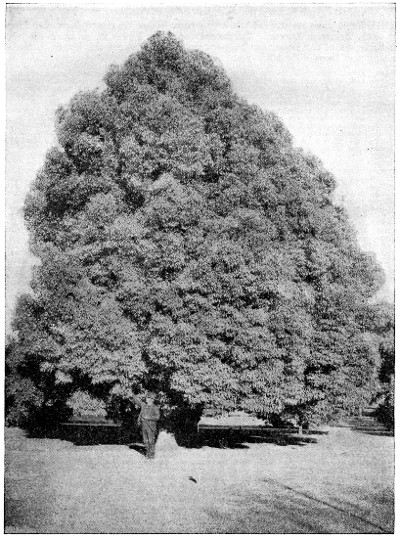
CAMPHOR TREE (Cinnamomum camphora), one of the most beautiful of all trees, grows in China and Japan, more especially in the island of Formosa. It has also been planted in Ceylon and Florida. The wood of the tree is valued by the cabinet maker, but its chief value is in the solid, essential oil, called gum camphor, extracted from it by a process of distillation. When pure, camphor is a white, soft semi-transparent body, with a peculiarly strong aromatic odor, and a bitter, burning taste. It is used extensively in making celluloid and smokeless powder, in medicine and as a protection against insects. Nine-tenths of the world’s supply of raw material is exported from Formosa. Its production is a monopoly of the Japanese government.
VII. TREES OF THE FOREST
The forest trees are divided into two groups: Trees Bearing Foliage, and Trees with Aciculous Leaves. The former lose their leaves in autumn; the stiff linear leaves of the latter, on the contrary, live throughout the winter, with the exception of those of the larch tree.
Alder (Alnus), trees native to the North Temperate and Arctic zones and to the Andes into Chili. The Black Alder grows near the brooks. The male blossoms stand in long, cylindrical catkins; the female blossoms in small, roundish catkins. The fruit is found in small cones. The alder tree blossoms in April and May. It may reach seventy feet in height and nine in girth, but seldom exceeds forty in height. The bark of the shoots is used in tanning and dyeing leather red, brown, yellow, or, with copperas, black. The wood is durable under water, and is said by Virgil to have been the first wood used by man for boats. It was used for piles at Ravenna and for the Rialto at Venice, and is still so employed in Holland. Its chief use is for gunpowder-charcoal. For this purpose shoots five or six years old, or about four inches across, are employed.
Ash (Fraxinus), a valuable timber-tree belonging to the olive tribe. It has smooth, olive-grey bark, black buds, opposite pinnate leaves of from seven to fifteen leaflets, flowers without calyx or corolla, and an oblong-winged fruit. Its wood is more flexible than that of any other European tree, and is used for walking-sticks, spade-handles, the spokes and felloes of wheels, etc. There are about twelve species native to North America. The best known are: Common Ash, a large tree one hundred to one hundred and fifty feet high, growing wild in southern Europe and northern Asia. White Ash, a large tree forty-five to ninety feet high; Nova Scotia to Florida, westward to Minnesota and Texas. Green Ash, forty to fifty feet high, Vermont to Florida, intermittently to Utah and Arizona. Red Ash, a small tree, rarely more than forty feet high, growing in moist soil from New Brunswick to South Dakota, Florida, Alabama and Missouri. Blue Ash, fifty to seventy-five feet high, Ontario, Minnesota, and Michigan to Alabama, west to Iowa and Arkansas. Black or Hoop Ash, a large tree, seventy to eighty feet high, Newfoundland to Manitoba, south to Virginia and Arkansas.
Aspen or Trembling Poplar (Populus tremula), has a greenish-grey bark. Its leaves have long stalks, and tremble at the slightest current of air. The American Aspen called Quaking Aspen or Quaking Asp, is one of the most widely distributed trees of North America, growing from Alaska and Newfoundland to lower California. A slender tree with light green bark, maximum height 100 feet. Wood soft, light, and largely used for manufacture of wood pulp. The European Aspen is a quick growing tree, fifty to eighty feet high. The wood is soft and porous, and is used in turnery and in interior finish for houses.
Beech (Fagus), a genus containing about sixteen species. The trees have smooth, silver-grey trunks, egg-shaped leaves like leather, and blossoms at the base of the leaves. The beechnuts are three-cornered; they grow in couples in a wooden capsule. The beech trees attain a height of from sixty to ninety feet, and blossom in April and May. The American Beech is the only North American species. It is a beautiful tree seventy to eighty and sometimes one hundred feet high, and is one of the most widely distributed trees of eastern North America. The wood is tough, close grained, and is largely used in the manufacture of tool handles, chairs and for fuel. The Common Beech, forming pure forests in many parts of Europe, is a large tree one hundred to one hundred and twenty feet high. The wood is dark colored, solid, and very durable under water and is much used in cabinet making, for weirs, and for fuel. The bark is sometimes used in tanning. The nuts are used for the manufacture of beech oil.
Birch (Betula), is known by all on account of its chalk-white bark, and its fine, pendent leaves. The male and female blossoms of this tree also grow separate on the same plant. Its seeds are small and plumed, whereby they are particularly adapted for being sown by the aid of the wind. There are about thirteen species in North America. Common Birch, abounding in northern Europe, is a beautiful tree sixty to seventy feet high. The bark is used in medicine and dyeing, and it yields the birch tar employed in the preparation of Russia leather. Red or River Birch grows in the United States from Massachusetts to Iowa and Kansas, south to Florida and Texas. It is a slender tree, seventy to ninety feet high, which produces a hard, valuable timber. Cherry Black or Sweet Birch is a large tree, sometimes eighty feet high. Wood fine grained and valuable for making furniture. The bark yields an oil identical with the oil of wintergreen. It grows from Newfoundland to western Ontario, Florida, and Tennessee. Yellow Birch, a large tree, maximum height one hundred feet, is used in shipbuilding. It grows from Newfoundland to Manitoba, south to Carolina and Tennessee. Paper or Canoe Birch, a large tree, maximum height eighty feet, is of a beautiful white color, and the bark is capable of division into thin sheets, used for making canoes, baskets, and ornaments. Found in Newfoundland to Alaska, northern Pennsylvania, Michigan, and Washington.
Buttonwood. See Plane Tree.
Cedar (Cedrus), the popular name of a variety of trees, mostly agreeing in having a reddish-brown aromatic wood. The coniferous genus includes only four forms, all native to the Old World, the most noted of which are the Cedars of Lebanon, frequently mentioned in the Bible. It has its needle-like leaves fascicled, like the larches; but unlike those trees, evergreen, so that they remain on the tree for several years after the dwarf-shoot has elongated. Its cones are erect, with broad, thin-edged scales which ultimately fall away from the axis, as in the firs. The White Cedar of the United States is more nearly a cypress, and the so-called Red Cedar is a juniper. The wood of the latter is used in making lead-pencils. The species native to the West Indies, yields the wood known as Honduras, Jamaica, or Barbadoes cedar, used for cigar boxes.
Chestnut (Castanea vulgaris), is a fine tree that may reach a large size, and has deeply furrowed bark and large, glossy, serrate but simple leaves in tufts, which turn yellow in autumn. Its flowers are in long pendulous catkins. The dark brown nuts are surmounted by the remains of the perianth, being “inferior” fruits. In a wild state two or three kernels or seeds, separated by a membrane, are contained in each nut; but the Lyons marron, the most valued cultivated race, contains only one. The tree is native from Portugal to the Caspian and in Algeria, and is represented by allied forms in Japan and temperate North America, flourishing in the Alps and Pyrenees at 2,500 to 2,800 feet above sea-level. Its timber resembles oak, but is softer and more brittle.
HOW WE MAY KNOW THE TREES OF THE FOREST
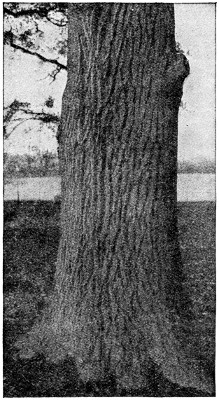
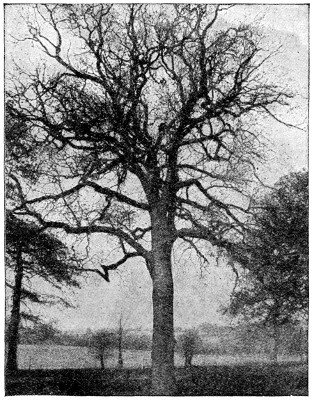
THE OAK
Massive strength is the chief characteristic of the oak, and it was the broad-based trunk of an oak that suggested the design for the first great lighthouse. The branches twist about in zig-zag fashion, and the thick bark is deeply furrowed.
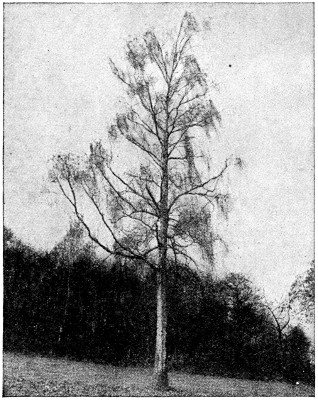
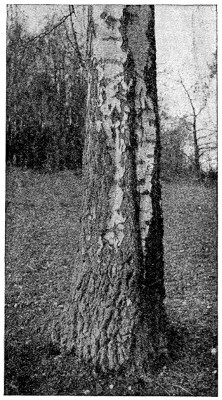
THE BIRCH
We have only to glance at the birch to realize that its name “the lady of the woods” is well deserved. Its chief characteristic is slender gracefulness, and we cannot mistake the silvery white bark, quite unlike any other tree.
Cork Oak or Cork Tree (Quercus suber), is a species of oak, native of southern Europe and northern Africa, the spongy bark of which is the common cork of commerce. It ranges from twenty to forty feet in height, attains a diameter of five feet, and sometimes lives three hundred to five hundred years, producing crops of bark for one hundred and fifty years.
Cypress (Cupressus), is an evergreen tree of the pine family, with small, imbricated leaves and globular cones, comprising about twelve species, in northern regions of the world. The Common Cypress of Europe is famous for its durable wood and is believed to be the cedar or gopher wood of the Bible. The Monterey Cypress, a beautiful tree sometimes one hundred and fifty feet high and eight or ten feet in diameter, grows near the sea in California and three others occur on the Pacific Coast. The so-called Cypress or White Cedar of the Eastern States, and the Bald Cypress of southern swamps, valued for timber, are distant varieties of cypress.
Dogwood (Cornus), is a shrub or small tree, the wood of which is exceedingly hard and is used for many purposes. The astringent bark and sometimes the leaves are used in medicine. There are about eighteen species in the United States. The Flowering Dogwood is a small tree, native of the Eastern States. It has showy white petal-like bracts surrounding its clusters of small flowers.
Ebony (Efenaceæ), is chiefly a species of tropical trees. The hard, dark colored heartwood of these is the source of most of the ebony of commerce. Those of India, Ceylon, and other tropical countries, furnish the best quality.
Elm (Ulmus). There are about six species which are native to the United States. They attain a height of forty-five to ninety feet, and blossom before their leaves appear, in March and April. The American White Elm is a large tree ninety to one hundred feet high, growing from Newfoundland to Florida and Texas. The wood is tough, strong, and largely used for wheel hubs, in cooperage, and for shipbuilding. It is a fine street and park tree. The Cork Elm is a tree seventy to ninety feet high, growing from Quebec and Vermont westward to Nebraska and Tennessee. The wood is considered the best of American elms, and is much used for agricultural implements and bridge timbers. The Slippery, or Red Elm is a tree sixty to seventy feet high, growing from Ontario to Florida, westward to Nebraska and Texas. The wood is durable in contact with the soil and is much used for fence posts and railway ties. The mucilaginous inner bark is used in medicine.
Eucalyptus, a genus of Myrtaceæ, contains about two hundred lofty trees occurring chiefly in Australia and the Malayan Archipelago. Many reach a height of one hundred and fifty feet and a girth of twenty-five feet, and they frequently become hollow. The species are of great economic value, yielding oils, kinos, and useful timber, while the well-known oil of eucalyptus is obtained from the blue-gum tree.
Fir (Abies), a genus of the Pine family containing about twenty-five species, natives of the cooler portions of the north temperate zone. The Silver Fir, is a common tree in central Europe, and is common to the mountainous forests of Germany. It reaches ninety to one hundred and thirty feet in height, and has a smooth, light silver-grey bark, and needle-shaped leaves, which, although they stand singly and in a spiral form round the branches, are yet distinctly turned towards two sides, and are serrated at their points. The large, conical fruits stand like tapers upright on the branches, and decay upon the tree; whilst their spindles remain standing. The wood of the white fir tree is much valued. It is used as timber, and in particular for making masts; it is also useful for making all kinds of carved work, and for the manufacture of musical instruments. It is also the source of the Strassburg turpentine. The Balsam Fir is a tree fifty to eighty feet high, growing from Virginia northward. Canada balsam is made from the sap. The White Fir or Great Silver Fir is a large tree, often three hundred feet high and ten feet in diameter, growing from British Columbia to lower California. The wood is soft and extensively used for cooperage and boxes. The Red Fir is a large tree one hundred and fifty to two hundred feet high, found in the same regions as the white fir. It is often planted in Europe as an ornamental tree. The Mexican Fir is a magnificent silver-leaved tree one hundred and fifty feet high.
Gum. The name given to several trees in America and Australia: (a) The Black-Gum, one of the largest trees of the Southern States, bearing a small blue fruit, the favorite food of the opossum. Most of the large trees become hollow. (b) A tree of the genus Eucalyptus. See Eucalyptus. (3) The Sweet Gum tree of the United States, a large and beautiful tree with pointedly lobed leaves and woody, burlike fruit. It exudes an aromatic juice. The wood is now extensively used in cabinet work and interior finish.
Hemlock Tree (Tsuga), is a genus of the Pine family containing about four species which are native to North America. The Common Hemlock is a large tree sometimes attaining a height of one hundred and ten feet, and growing from Nova Scotia to Alabama and west to Wisconsin and Minnesota. The wood is light and soft and is extensively used in building. The bark is largely used in tanning and hemlock oil is distilled from the branches and leaves. There are many cultivated varieties which are very ornamental. The Carolina Hemlock is a tree attaining a maximum height of eighty feet, and growing in Virginia, North Carolina, and Georgia.
Hickory (Carya), is represented by ten species, exclusively of North America. Their timber is very heavy, strong, and tough, and is much used in the manufacture of agricultural implements, carriages, and hoops for casks. The fruit is a hardshelled nut, which in some species has an excellent flavor. The Shagbark or Shellbark Hickory is a large tree, sometimes one hundred and twenty feet high, growing in rich soils from Ontario and Minnesota south to Florida, Kansas and Texas. The nuts form an important article of commerce, though less used than the pecan. The Whiteheart Hickory or Mockernut is a large tree seventy-five to one hundred feet high, growing from Ontario to Florida, occasionally to Missouri and Texas. It has a thick-shelled, edible nut. The Pignut Hickory, a tree seventy-five to one hundred and sometimes one hundred and twenty feet high, ranges from Ontario to Florida, westward to Nebraska and Texas. See also Pecan.
Horse-Chestnut (Aesculus), is rarely found in forests, but frequently in pleasure-gardens. This beautiful tree, of sixty feet and over, has large leaves, and splendid yellow-and-red colored blossoms forming large pods. The brown chestnuts are enveloped by a prickly cover, which bursts open in the autumn. The Ohio or Fetid Buckeye, reaching a height of about fifty feet, grows from Pennsylvania to Alabama, west to Michigan and Oklahoma. The wood is used for making artificial limbs and wooden ware. The Sweet or Big Buckeye is a large tree eighty to ninety feet high, growing from Pennsylvania to Georgia, west to Iowa and Texas, and often planted as an ornamental tree. The California Buckeye is a small tree thirty to forty feet high, native of California, and sparingly planted for ornament.
Judas Tree (Cercis siliquastrum), is a beautiful leguminous tree, growing wild from Japan to the shores of the Mediterranean, with smooth kidney-shaped leaves, glaucous above, and pink or red flowers, which spring from both old and young wood before the appearance of the leaves. From its appearance at this season the tree shares with the elder the sinister reputation of having formed the gallows of Judas Iscariot.
BARK, CELLS, HEART AND RINGS OF THE TREE
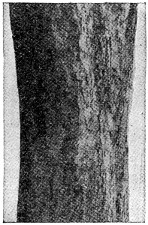
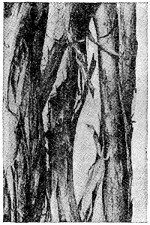
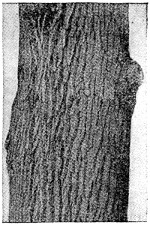
Scaly Bark of Willow Membranous Bark of Birch Fibrous Bark of Honeysuckle Fissured Bark of Oak
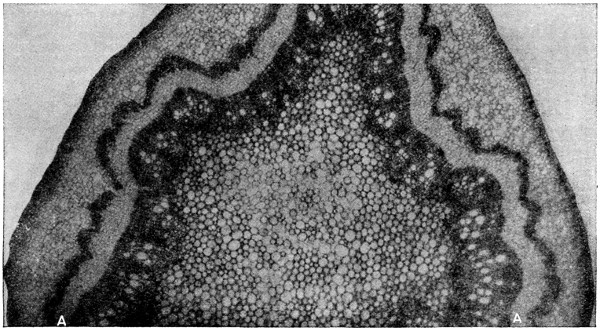
The Structure of a Young Twig of Oak, showing the layer of cells (A) which increases the girth of the twig as it grows into a branch
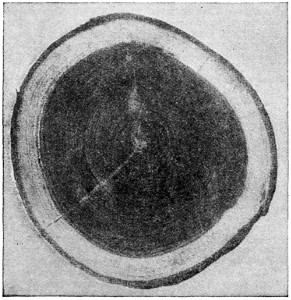
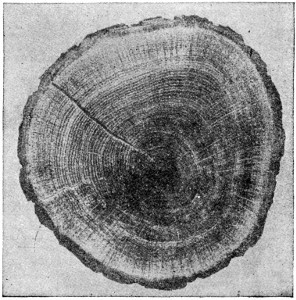
Section of the Trunk of a Laburnum, showing Heart and Sap-wood Section of the Trunk of an Oak, showing the Annual Rings
Juniper Tree (Juniperus communis), is rarely seen as a tree, but appears usually as a low shrub. Its awl-shaped, pointed leaves stand always by threes of the same height on the young shoots. The male blossom catkins are short-stalked, and stand singly in the axils of the bracts; the fruit is a black berry. These berries are employed for medicinal purposes. The so-called White Cedar of the Eastern States and the Bermuda Cedar, much prized for timber, are junipers.
Larch (Larix Europæa), has leaves which grow in clusters, and drop during the Autumn. Its bark is rough and cracked; its red-blossom catkins stand at the side of the yellow catkins. Its egg-shaped little cones have backward bent stalks. The larch tree attains a height of from forty-five to sixty feet, and is found in forests everywhere. The American Larch or Tamarack is a slender tree fifty to sixty feet high, growing from Virginia to Hudson Bay. It is often planted as an ornamental tree and the wood is highly valued for shipbuilding and for telegraph poles.
Linden or Lime (Tilia), is the emblem of intense feeling. It has been from time immemorial the favorite of the Germans. Below the large linden trees the judicial proceedings, the fairs, and national games formerly took place in Germany, and to this day men and women like to sit under the village linden tree, and talk of the good old times. They do not blossom before June and July. The blossom is five-leaved, and contains many stamens and one pistil. The fruit is a little nut. The American Linden or Basswood is a large tree seventy to one hundred and twenty-five feet high, growing from New Brunswick to Georgia, west to Nebraska and Texas. The wood is extensively used for making cheap furniture and paper pulp. The Southern Basswood or Whitewood is a small tree forty to fifty feet high growing from Long Island to Florida, west to Texas. The White Basswood or Bee Tree is a forest tree forty-five to seventy feet high, Pennsylvania to Florida, west to Illinois and Tennessee.
Locust is a name applied to various trees of the Pea family. The American Locust Tree or the False Acacia is seventy to eighty feet high, growing from Pennsylvania to Georgia. It is widely naturalized in most states east to the Rocky Mountains. The wood is compact and hard and is extensively used for shipbuilding and all purposes where great strength and toughness are required.
Mahogany (Swietenia Mahagoni), is a native of Mexico, Central America, and the West Indies, and yields one of the most generally used of cabinet woods. The leaves resemble those of the ash; the flowers are clustered and small, with their parts in whorls of five, and ten united stamens; and the fruit is a pear-shaped, woody capsule with winged seeds. The wood is a rich reddish-brown, often richly mottled, uniform in grain, susceptible of the highest polish, and very durable. In Mexico the timber is sometimes in thirty-foot lengths and forty-eight inches square. Mahogany is commonly divided into Spanish, the darker, heavier and more figured, from San Domingo and Cuba, and Honduras, lighter, softer, and plainer, from the mainland. It is employed in carving, turning, veneering and cabinet-making, and for solid furniture, easily holding first rank among cabinet woods.
Maple (Acer). This genus of trees contains nearly one hundred species, natives of north temperate regions, especially North America and eastern Asia. The Sugar Maple is ninety to one hundred and twenty feet high, and grows from Newfoundland to Georgia, west to eastern Nebraska and Kansas. The wood is extensively used in cabinet work and interior finish. Large quantities of sugar and syrup are made from the sap. The Silver or Soft Maple is found from New Brunswick to Florida, west to Ontario, Nebraska and Oklahoma. It is often planted as a shade tree. The Scarlet or Red Maple grows in swamps and low ground from New Brunswick to Manitoba, south to Florida and Texas. The close-grained wood is largely used for furniture, and in turnery. The Oregon Maple grows from Alaska to California. It is often planted as an ornamental tree.
Mesquite (Prosopis), is a genus of trees containing about sixteen species, natives of America, Asia, and Africa, three of which grow in the United States. It varies from a straggling shrub to a widely-branched tree fifty feet high and occurs from central Texas to eastern California, and southward to Chile and Argentina. The very heavy wood is used for fuel and fence posts, while the pods and leaves are much eaten by stock. The Screwpod Mesquite is twenty-five to thirty feet high and valuable in arid regions.
Oak (Quercus), is most numerous in temperate climates, though some are tropical; fully fifty species occur in the United States, with many intermediate forms or hybrids. The Oak is a true giant among forest trees. Its trunk often attains a circumference of thirty feet. Its bark is smooth in the young trees and rough in the old oaks. The strong, widely extended boughs are pronged and knotty; the crown is large, with a sinuate outline. The blossoms are within long pendent catkins and appear in the month of May. The bark and the acorns, which are contained in pretty little cups, are medicinal. Along the stems and the boughs mosses and lichens grow exuberantly. In the galls of the leaves and branches different gall insects live. The horn beetles suck the sap of the oaks, and the acorns form the food of squirrels and other rodents. The European Oak, the most important Old World timber oak, is sparingly planted in the United States. The White Oak, the most valuable American timber oak, occurs from Texas to Minnesota and eastward. With similar range, but less valuable for timber, are Bur Oak or Mossy Cup Oak, the Scarlet Oak and the Red Oak. The Cow Oak or Basket Oak and the Yellow or Chestnut Oak produce edible acorns. The bark of the Quercitron is used in tanning, as a yellow dye, and in medicine. The Live Oak, once famous for ship-building, is a sturdy species with entire evergreen leaves occurring in the Southern States, Cuba and the Pacific States.