BOOK OF THE ANIMAL KINGDOM (continued 3)
Reading edition
Of the two dozen related species, the plaice, the dab, the smear-dab, and the craig-fluke are the commonest.
Flying-fish.—Various fishes which have the power of sustaining themselves for a time in the air by means of their large pectoral fins. Generally, however, the name is limited to the species of the genus Exocoetus, which belongs to the family of mackerel-pikes. These can pass through the air to a considerable distance, sometimes as much as two hundred yards, to escape from the attacks of other fishes, especially the dolphin. They are most common between the tropics.
Goldfish. See page 256.
Haddock (Gadus æglefinus) is a fish of the same genus as the cod, and much resembling it in general appearance; but distinguished by a notched tail and a white line along the side. In habits the two are much alike, being voracious, eating anything edible, but largely clams and the like.
Halibut (Hippoglossus vulgaris), the largest of all the flat-fish and in form more elongated than the flounder or the turbot. The halibut, though esteemed for the table, is not to be compared in quality with the turbot; its flesh is white and firm, dry and of little flavor. It attains a great size; specimens have been caught weighing at least five hundred pounds, and one caught in Iceland was little short of twenty feet long.
Herring (Clupea harengus) belongs to the order of bony fishes and is spread over the whole North Atlantic. It is of great economic importance, and occurs in large schools, swimming through the sea with open mouths, scooping up the minute life for food. Immense numbers are taken both here and abroad, the annual catch for Europe and America being estimated at a billion and a half pounds. The young are also taken in vast quantities and are preserved as American sardines. With us most of the adults are smoked and dried.
Mackerel (Scomber), a genus of fishes which also includes the tunny, bonito, and sucking fishes. It is an important food fish occurring in the North Atlantic and characterized by its slender shape, the series of little finlets on the tail and the deeply notched caudal or tail fin. It is taken both by hooks and by seines. Some are eaten in the fresh condition and some are salted. It goes in large schools. Allied is the Spanish mackerel of our southern waters and the large horse mackerel which is more common in the Mediterranean, where it is called the tunny.
Perch (Perca).—Spiny-finned fishes, well represented by the Fresh-water Perch (P. fluviatilis), which is widely distributed in lakes, ponds, and rivers in Europe, Northern Asia, North America and Britain. It is of a greenish-brown color above and golden yellow on the under parts, with six or seven indistinct dark bands on the back. In length it measures about eighteen inches, and its height is about a third of this. It sometimes weighs from three to five pounds, and a prize of nine pounds has been recorded.
Porgy.—A food fish on the eastern coast from Cape Cod south, known also as scup. It should not be confounded with the pogy or menhaden, one of the herrings, which is taken extensively for oil.
Pollack (Gadus pollachius), a fish, belonging to the cod genus. It is about the size of the coal-fish, is active in habit, and is frequently caught. The lower jaw projects beyond the upper, and there is no barbel. It has commercial value in the English Channel and off the coasts of Newfoundland. Allied species, which promise a valuable future, abound from Puget Sound to Alaska on the Pacific coast.
Salmon (Salmo), a genus of well-known fish which inhabits both salt and fresh waters, and ranks among the food-fishes. It generally attains a length of from three to four feet, and an average weight of from twelve to thirty pounds, but these limits are frequently exceeded. The adult fish is a steel-blue on the back and head, becoming lighter on the sides and belly.
It usually continues in the shallows of its native stream for two years after hatching, and during this period it attains a length of eight inches. When the season of its migration arrives, the fins have become darker and the fish has assumed a silvery hue. It is now known as a smolt or salmon fry. The smolts now congregate into shoals and proceed seaward. On reaching the estuary they remain in its brakish water for a short time and then make for the open sea. Leaving its native river as a fish weighing, it may be, not more than two ounces, the smolt, after three months’ absence, may return to fresh water as a grilse, weighing four or five pounds. In the grilse stage, the fish is capable of depositing eggs. After spawning in the fresh water the grilse again seeks the sea in the autumn, and when its second stay in the ocean is over it returns after a few months’ absence as the adult salmon, weighing from eight to ten pounds. The salmon returns as a rule to the river in which it passed its earlier existence. The fertility of the fish is enormous.
Salmon are caught by the rod, and by means of nets, the fishings being regulated by law. There are important fisheries in some European and North American rivers. In Europe the fish is found between the latitudes of forty-five and seventy-five degrees, in North America in corresponding latitudes. The flesh when fresh is of a bright orange color, and is of highest flavor when taken from the sea-feeding fish. In the waters of northwestern America are several salmon belonging to a distinct genus, including the quinnat or king-salmon, blue-back salmon or redfish, silver salmon, dog salmon, and humpback salmon. The quinnat has an average weight of twenty-two pounds, but sometimes reaches one hundred pounds. Both it and the blue-back salmon are caught in immense numbers in the Columbia, Sacramento, and Frazer rivers (especially in spring), and are preserved by canning.
Sardine, or Pilchard (Clupea pilchardus) is an important fish closely related to the herring and sprat. In size it grows from ten to fourteen inches; in color it is bluish-green above, whitish underneath and on its sides. It is entirely marine in habit, and its eggs float on the surface of the sea, unlike those of the herring, which are attached to objects at the bottom. The young, before it has attained maturity, is known as the sardine, and as such forms a valuable fishery; the full-grown pilchard is used as an article of diet as well as for bait. The method of capture is usually by drift-net. It is most abundant off the coasts of Portugal, and in the English Channel and the Mediterranean.
Shad is a migratory fish of great food value. It ascends all of the rivers of the eastern coast of the United States every spring to lay its eggs. It is closely related to the herring, but is much larger, and were it not so full of bones it would stand very near the head of food fishes.
Smelt (Osmerus) is a genus of the Salmon family, characterized by strong fang-like teeth, and by rather large scales, which readily fall off. The form is very trout-like, but rather more slender; the tail is larger in proportion, and more forked. The back is whitish, tinged with green; the upper part of the sides shows bluish tints, the lower part of the sides and the belly are of a bright silvery color. The smelt has a peculiar, cucumber-like smell, and a delicious flavor, on account of which it is highly esteemed for the table.
Sole (Solea) is a fish oval in shape, the outline of the snout being semi-circular, and projecting somewhat beyond the mouth. The Common Sole (S. vulgaris) is a fish of high value in European markets. It lives in European seas from the Mediterranean to the north of Denmark, and is rarely caught on the American side of the Atlantic Ocean, although numerous closely allied kinds abound.
Sword-fish (Xiphiidae) are abundantly represented in tropical and subtropical seas. They are among the largest bony fishes, sometimes measuring twelve to fifteen feet in length. The sword, which may be over three feet long, is formed from a compressed prolongation of the upper jaw, and is often strong enough to stab whales fatally, or less advantageously to pierce the bottom of a ship or the planks of a boat. Sword-fish are said to attack whales and other cetacea, and also boats and canoes, and even large vessels.
Trout, a name applied to various members of the Salmon family. The Common or Brown Trout (Salmo fario) varies greatly in appearance, not only with individuals but at different seasons, and this variability has led some authorities to distinguish a number of subspecies.
At midsummer an adult trout is usually brownish or olive in color, with pure white on the belly and gold on the flanks, while the back varies from olive or pale brown to nearly black. The dorsal fin and sides are spotted with black and often also with scarlet. The scales are circular, thin and minute. When the spawning season begins in autumn all the color disappears and the body becomes slimy to the touch. The head of the male is larger than that of the female, and the lower jaw bears a cartilaginous knob. It feeds on a large variety of food, different kinds appealing in turn. It is by cunning imitations of some prevailing fly that the fisherman makes his most cherished captures.
The artificial hatching of trout is now carried on extensively, and lakes and streams can be stocked or replenished with fish if they are not too polluted.
The Bull Trout or Sea Trout (S. eriox) most resembles the salmon in appearance and habits, though thicker in proportion to its length, and with larger and more numerous dark spots on the gill-covers and scales.
The Salmon or White Trout (S. trutta) is a more elegant fish, and its flesh is much more delicate in flavor. The habits of both are similar.
The Rainbow Trout (Salmo irideus) of America has been introduced into many parts of the world; in New Zealand, especially in Lake Taupo, it attains the greatest size, many tons being caught yearly.
Whitefish (Coregonus clupeiformis), the common whitefish, is the largest of all the American lake whitefish. It is very highly esteemed for food, ranking, indeed, as one of the finest table fishes. Its range extends from Lake Champlain to the Arctic Circle.
CARTILAGINOUS FISHES (Elasmobranchii)
These fishes have a cartilaginous, pliant, undeveloped skeleton, and are not covered with true scales. They include rays, sawfish, sharks, skates and others.
Ray, a popular name applied to many of the flat cartilaginous fishes: Thornbacks, Electric Rays, Sting-rays, Eagle-rays are representative. They lead a somewhat sedentary life at the bottom of the sea, moving sluggishly by undulations of the pectoral fins which form a large part of the flat body. Many attain a large size, sometimes measuring six feet across.
Sawfish (Pristis) are distinguished by the prolongation of the snout into a formidable weapon bordered on each side by sharp teeth. Some species are found off the southern coasts of North America and in the Gulf of Mexico, and in the Mediterranean and many other seas. With its saw, which is sometimes six feet in length, the sawfish slashes or rips up its prey, and its assault is often fatal to large whales.
Sharks are a group of very simple fishes, which have only a cartilage skeleton, no bone being developed anywhere in them. They have the gill openings on the side of the neck separate, and in all of the common species the mouth is on the lower side of the head instead of at the tip, as in ordinary fishes. The tail has unequal lobes, the upper lobe being much the larger. There are always four paired fins and one or more on the back. The size of the sharks varies from the smaller dogfish, about two feet long, to the great basking shark, some forty feet in length. Most of these species are very voracious, but the tales of man-eating are often exaggerated, although occasionally they may occur. Some of the largest species feed exclusively on shellfish. The flesh of several species is good to eat, but they are mostly neglected in America. The livers are very rich in oil, which commands a good price for use in dressing leather. In some species the skin has small spines and was formerly used (it was called shagreen) instead of sandpaper. Skin with larger plates is sometimes used in the manufacture of pocketbooks, etc.
Skates (Raia batis).—A group of fishes, closely related to the sharks, but having the body flattened from above downward, and with the anterior fins so united to the side of the head and the body that it has a rhomboid appearance and the tail seems like an inconsiderable appendage. The mouth and the gill openings are on the under surface. The animals are bottom feeders, living on clams and mussels, buried in the mud. In Europe some of the smaller species are used for food. Another has a large electric battery on either side of the head, capable of giving very strong shocks. This is called the torpedo.
ARMORED FISH (Ganoidei)
These include, among others, the Bony Pike and the Sturgeons.
Bony Pike or Garfish.—A remarkable genus of fishes inhabiting North American lakes and rivers, and one of the few living forms that now represent the order of ganoid fishes so largely developed in previous geological epochs. The body is covered with smooth, enameled scales, so hard that it is impossible to pierce them with a spear. The common garfish attains a length of five feet, and is easily distinguished by the great length of its jaws.
Sturgeon (Acipenser).—These large, sluggish fishes, some reach a length of over ten feet, and live on worms, crustacea, and mollusks. The body is long and narrow with five rows of bony shields. There are many species of sturgeon, all confined to the northern hemisphere. They live in the sea and great lakes, and ascend the great rivers. All supply valuable commodities, for which they are regularly captured on a large scale. These commodities are their flesh, which is palatable and wholesome, their roe (caviare), and their air-bladders, from which isinglass is made.
The most important sturgeon-fishery in Europe is that of the Volga and the Caspian Sea. The flesh of the fish is salted, and caviare and isinglass made on a large scale from the roes and air-bladder.
The Sterlet (A. ruthenus) is a much smaller species, which is common in the Black and Caspian Seas, and ascends the Danube as far as Vienna. It is one of the principal objects of the sturgeon fishery on the Volga.
In America sturgeon flesh is eaten fresh, and caviare is made both in Georgia and in San Francisco; but there is no great fishery in any particular district, and the manufacture of isinglass does not receive much attention. The sturgeon of the great lakes (A. rubicundus) and the Shovel-nose of the Mississippi valley are the chief American species.
LUNG-FISHES OR DOUBLE-BREATHERS (Dipnoi)
are at present represented by three fresh-water types, the insignificant remnant of a group that was once dominant in the sea, and would have become entirely extinct if some of its members had not taken to live in the waters of the land. These types are the eel-shaped mud-fishes of West Africa (Protopterus) and South America (Lepidosiren), and a Queensland form (Ceratodus). In all these the swim-bladder has been converted into a regular lung, which returns purified blood to the heart. The African form lives in streams which are liable to dry up, and were it not for the possession of a kind of lung capable of breathing air, it would perish during the dry season, whereas it remains embedded in the mud in a torpid state till the rains return.
The Queensland lung-fish lives under somewhat different conditions, for its native rivers do not entirely dry up, but are reduced to a series of deep holes connected by mere trickles of water. These holes become so foul from decaying vegetation and dead fish that the possession of a lung is a vital matter, and if the ceratodus were not able to come to the surface and breathe air it would probably succumb.
THE MOLLUSCS (Molluska) SNAILS, CUTTLEFISHES, SQUIDS, OCTOPUS, TUSK SHELLS, BIVALVE MOLLUSCS, OYSTERS
The Molluscs have no limbs. The body is surrounded by a membraneous sac, from the secretions of which in many species a chalky shell is formed. The organs of circulation, digestion, and respiration are well developed. The under side of the body is thickened into a fleshy “foot,” by which locomotion is effected, and there is a well-marked head.
The Molluscs are divided into five classes: (1) Snails and Slugs (Gastropoda). (2) Cuttlefishes (Cephalopoda); (3) Tusk Shells (Scaphopoda); (4) Bivalves (Lamellibranchia); (5) Mail Shells (Protomollusca).
Argonaut (Argonauta) belongs to the two-gilled cuttle-fishes, and are distinguished by the females possessing a single-chambered external shell not organically connected with the body of the animal. The males have no shell and are of much smaller size than the females. The shell is fragile, translucent, and boat-like in shape; it serves as the receptacle of the eggs of the female, which sits in it with the respiratory tube or “funnel” turned toward the carina or “keel.” This famed mollusk swims only by ejecting water from its funnel, and it can crawl in a reversed position, carrying its shell over its back like a snail. The argonaut, or paper-nautilus, must be carefully distinguished from the pearly-nautilus or nautilus proper.
Cuttlefish.—One of the mollusks in which there are ten arms around the mouth. The internal shell is calcified and is used as a supply of lime for cage birds. They have also an ink bag, the secretion of which furnishes the pigment sepia. Cuttle-fish are an important article of food in southern Europe.
Octopus.—A mollusk with a rounded body, and a small head bearing a pair of well-developed eyes, the mouth surrounded by eight long arms, each arm bearing numbers of suckers by which the animals hold their prey. Inside the mouth is a pair of jaws, shaped much like those of a parrot. Most of the species are small, possibly averaging a weight of five pounds, but some on the Pacific coast spread nearly twenty-eight feet. The octopus is eaten extensively in the Mediterranean countries.
Oyster.—Possibly the most valuable of all of the mollusks. There are various species in all parts of the world, but the best is the American species, which now occurs from Cape Cod to the Gulf of Mexico. Formerly it extended to the coast of Maine, and even now there are scattered beds in the Gulf of St. Lawrence. The oyster grows in shallow water, fastening its shell to some rock or shell, and in this way large beds are formed. They are also planted; that is, the young are taken and placed in favorable situations for rapid growth.
The oyster contains but comparatively little nourishment, though eaten extensively. The European oyster is smaller than ours and has a coppery taste.
Allied to the true oysters are the Pearl Oysters, especially abundant around Ceylon. These have the interior of the shell lined with mother-of-pearl, and when foreign particles get between body and shell they are covered with the same substance, thus forming the pearls used for adornment. These oysters are obtained by diving; the animal matter is allowed to rot, leaving the pearls behind. The shell is also of value, furnishing material for knife handles, buttons, etc., though most of our pearl buttons are now made from the shells of fresh-water mussels from the Mississippi valley.
Scallop (Pecten), a well-known bivalve, one of those with a single muscle closing the shell. The valves are fan-shaped, the left often more or less flat, the right more markedly arched; both are marked with sinuous radiating ridges, to which the name pecten (Lat. “a comb”) refers. The hinge-line is without teeth, and is extended laterally in two ears. The small finger-shaped foot is usually marked with bright orange or red color. The scallops are widely distributed in all seas, at depths of three to forty fathoms.
Snails.—A common name used for any mollusk with a coiled shell. In the narrower meaning it includes only those forms which occur on land. These land-dwelling forms have a slight shell, into which the whole body can be retracted. They feed exclusively on vegetation, which they rasp by means of a long ribbon, just inside the mouth, the surface of which is covered with thousands of minute teeth, so that the whole is a flexible file. The animal creeps about on a broad sole, and has four tentacles on the head, one pair of them bearing the simple eyes at the tip. Snails do considerable damage where they are numerous. One species is eaten by many in Europe, especially in France and Italy. Over ten thousand species are known.
The shells of sea snails are often of great beauty, and large sums have been given by collectors for specimens of unusual elegance or rarity, fifty pounds having been paid for a single example of a species of cone shell (Conus). The helmet shells (Cassis) are made up of differently colored layers, and on account of their beauty have been largely employed for the carving of cameos.
Squid.—A mollusk nearly related to the cuttlefish. It has a barrel-shaped body, with a head in front bearing ten pairs of tapering tentacles, each with numerous suckers. On the side of the head is a well-developed eye. Squid live largely on small fishes which they catch with the tentacles, biting them with a pair of parrot-like jaws. They are largely used as bait in fishing, and to a limited extent as food. The average length is a foot or two, but in the seas around Newfoundland and Japan giants are occasionally found with bodies a dozen feet in length and tentacles adding thirty feet to this.
Tusk Shells are a small group of burrowing marine forms, in which the body is covered by a long, curved shell resembling a tusk in shape. There is a small hole at its tip, through which the water which has been used in breathing makes its exit. An imperfectly developed head and a rasping organ are present, and burrowing is effected by a long foot with a three-lobed end. The food consists of small organisms, which are apparently secured by the agency of a bunch of filaments with thickened sticky tips that can be protruded from the mouth of the shell. In some respects these animals are intermediate in structure between typical sea snails and bivalve molluscs.
JOINTED-LIMBED ANIMALS (Arthropoda) CRABS AND LOBSTERS, SCORPIONS AND SPIDERS, INSECTS AND GRASSHOPPERS
This great division of the animal kingdom includes far more numerous species than any other, and is abundantly represented in both salt and fresh water, on the land and in the air. It consequently includes both air-breathers and gill-breathers: the former, typical land insects; and the latter, chiefly crustaceous.
CRABS AND THEIR ALLIES (Crustacea)
The Crustaceans breathe by means of gills, and their bodies consist of rings. They have two pairs of feelers and two pairs of jaws, to which are mostly joined one or more pairs of jaw feet. All the remaining rings of the body may have a pair of limbs each. The head bears two pairs of feelers. Crustaceans commonly hatch out as free-swimming larvæ, like the adult in form.
This large class of jointed-limbed animals includes lobsters, prawns, shrimps, crabs, and other familiar forms, the great bulk of which are aquatic, though the wood-lice have become adapted to a life on land.
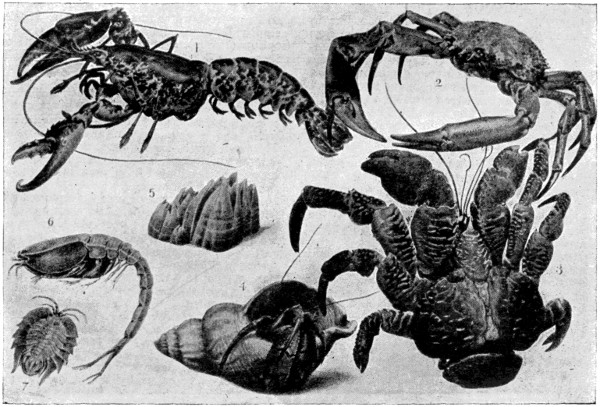
A GROUP OF CRUSTACEANS
1. Common Lobster. 2. Thornback Crab. 3. Land Crab. 4. Hermit Crab. 5. Barnacle. 6. Scorpion. 7. Antarctic Trilobite.
Crab.—In this class of Crustaceans the abdomen is small and folded under the anterior part of the body. Over two thousand species are known, differing greatly in size, shape, and in other respects. The great majority are marine, but there are a few which spend their entire life on land, only going to the water once a year to lay their eggs. The largest is the great spider crab of Japan, whose legs may stretch out a dozen feet. One species on the Atlantic coast is taken at molting time in great numbers and forms the favorite soft-shell crab of the table. The hermit crabs have the abdomen soft, and to protect this vulnerable part, they insert it in the shell of some dead snail, and carry this about with them wherever they go.
Barnacle.—A family of marine crustaceous animals enveloped by a mantle and shell, composed of five principal valves and several smaller pieces, joined together by a membrane attached to their circumference. They are furnished with a long, flexible, fleshy stalk, provided with muscles, by which they attach themselves to ships’ bottoms, submerged timber, etc. They feed on small marine animals, brought within their reach by the water and secured by their tentacula. Some of the larger species are edible.
Crayfish.—Small, fresh-water crustaceans, which resemble the lobsters in appearance. They usually live in burrows in the banks or bottoms of streams and feed on decaying animal matter. In Europe they form a considerable element in the food supply and are bred in ponds. A large number of species occur in the United States, and are always to be found in the larger markets.
Lobster.—The most important of the crustaceans. One species occurs on our east coast, another on the coast of northern Europe. The body is divided into two regions, the anterior bearing, besides the parts used in taking food, a pair of large pincers and four pairs of walking feet. At the front of the head are two pairs of feelers, which are sensory, and a pair of eyes on the ends of short stalks. The lobsters are fond of decaying fish and are among the scavengers of the sea. They are caught in large traps, called lobster pots, made out of lath and baited with decaying fish. The annual catch on the New England coast is estimated at about thirty million pounds, the average weight of a lobster being between two and three pounds. Farther south on our east coast, in California and the Mediterranean a different animal is called lobster.
Prawn.—Crustaceans nearly allied to shrimps and lobsters, but not exclusively marine. They vary in size from a couple of inches to over a foot in some tropical forms. Many of them are semi-transparent, and exhibit very fine colors. On the approach of night they change to a beautiful blue, but the meaning of this “sunset” coloration is not fully understood. Some of the deep-sea prawns are blind; others possess enormous eyes, and many emit a phosphorescent light. They may be caught in putting nets or in osier baskets, like those used for trapping lobsters. They are esteemed for eating even more highly than the shrimp.
Shrimps.—Small crustaceans allied to the lobster, most of them inhabitants of the sea. In many countries they form an important part of the diet, but with us they are little used with the exception of one or two southern species which are used as a basis for shrimp salad. Shrimps are very abundant off our coast and could be made an important fishery.
SCORPIONS AND SPIDERS
In this class of insects the head and thorax are joined together in one mass, on which they have two pairs of jaws, and four pairs of legs.
Scorpions.—These spider-like animals have four pairs of legs and a pair of large pincers, as well as a small pair on the anterior half of the body; while the hinder portion consists of at first a broad region, followed by a narrower one, the whole terminated with a sting, with which a poison gland is connected. The animal strikes by bending the end of this tail over the back. Its sting is very painful, but rarely if ever is it fatal. Scorpions occur as far north as Nebraska, but are more common in the tropics. They bring forth living young and care for their brood for a while.
Spiders have jointed bodies and legs. The bodies are divided into two regions, the anterior of these bearing four pairs of legs and two smaller pairs of appendages. The most anterior of these are the poison claws. They have a poison gland in the base, while the end of the claw tapers to a point. The front of the head has from six to eight simple eyes. The hinder half of the body, the abdomen, is without appendages, save for two or three pairs of very small projections, the spinnerets. Each of these has numbers of openings at the tip, through which a fluid is forced at will. This hardens immediately it comes in contact with the air and furnishes the silk of which the spider’s web is woven. Fine as it is, this silk is really a cable, being made of numbers of finer threads, one for each opening in the spinnerets. They use the silk for making webs, for cocoons for the eggs, nests, and in some cases for parachutes for flying. Each species makes its own type of web.
Spiders breathe by means of sacks—so-called lungs—on the lower side of the abdomen.
Our common house spider is the same as that of Europe; the largest species we see is the one found occasionally in banana bunches.
The Tarantula has the greatest reputation from the unfounded belief that its bite causes madness which can be cured only by music. So far as is known there is only one species which can cause serious effects by biting man, and even these cases are not sufficiently authenticated.
The Bird Catching Spider is a gigantic spider native to Surinam and elsewhere. It preys upon insects and small birds, which it hunts for and pounces upon. It is about two inches long, very hairy, and almost black; its feet when spread out occupy a surface of nearly a foot in diameter.
Hunter-Spiders. A great many of this species construct no webs, but use their silk merely for lining their dwellings—which are commonly underground—or the construction of protective investments for the eggs. Such forms simply stalk their prey, seizing the victims, when near enough, by a sudden spring. One such type is the tarantula spider described above.
Water Spiders are found in ponds and ditches in this country. They hunt down small crustaceans but do not construct a web. For the protection of the eggs a thimble-shaped nest is woven, moored by threads to stems or leaves, and smeared externally with liquid silk to make it watertight. The nest is filled with air brought down from the surface of the pond in successive bubbles adhering to the hairy body of the spider.
THE INSECTS (Insecta)
This ubiquitous class includes more species than all the other groups of land animals put together. The bodies consist of a series of rings, divided into three sections: the head, the thorax, and the abdomen. There is an external covering that serves as a protection. The head possesses a pair of antennæ, two large compound eyes (and sometimes several simple eyes as well), and three pairs of jaws, differing greatly in character according to the habits. The thorax bears three pairs of legs, and in most cases two pairs of wings, while the abdomen is entirely or practically limbless. The air-tubes make up an exceedingly complex system, and open to the exterior by a limited number of air-holes.
All insects undergo a series of changes (metamorphoses). From the egg first comes the larva (caterpillar, maggot); from the larva after several changes of the outer skin, the pupa is developed; from which, after a longer or shorter period of repose, the perfect insect emerges. In some, such as the dragon flies, the whole course of metamorphosis, or change, is not gone through; for in the dragon flies the larva which comes from the egg resembles the full-grown insect, only it is without wings; but later, without entering the pupa stage, it develops into the perfect insect. There are altogether about two hundred thousand various kinds of insects.
The simplest way of classification is into the following nine orders, though specialists recognize a much larger number: (1) Wingless insects (Aptera); (2) Straight-winged Insects (Orthoptera); (3) Bugs (Hemiptera); (4) Fringe-winged Insects (Thysanoptera); (5) Net-winged Insects (Neuroptera); (6) Beetles (Coleoptera); (7) Moths and Butterflies (Lepidoptera); (8) Flies (Diptera); (9) Membrane-winged Insects (Hymenoptera).
Beetles (Coleoptera).—These include an enormous host of insects. Their horny investment is particularly thick, and they possess strong biting jaws, though these differ in some respects from those described for the cockroach and its allies. The third pair, for instance are much more intimately fused together into a lower lip. The fore wings are modified into hard wing-covers, while the hind wings are membraneous, as in straight-winged insects (cockroaches, grasshoppers, and the like). But there is one marked difference between the two orders in regard to these organs. The hind wings of the latter fold up along a set of longitudinal pleats when they are tucked away under their covers, but in a beetle they are relatively long, and require a transverse fold as well.
The life history of beetles exhibits a well-marked metamorphosis. From the egg a grub hatches out, which, after a time, passes into a motionless pupa stage, and ultimately the investment of this splits open so that the perfect insect may emerge.
Beetles vary in size from a mere point to the bulk of a man’s fist, the largest, the elephant beetle of South America, being four inches long. The so-called “black beetles” of kitchens and cellars are not properly beetles at all, but cockroaches.
The most interesting are the following:
Bombardier Beetle (Brachinus crepitans). This insect is preyed upon by larger beetles of its own family; but when chased, the bombardier ejects an acid fluid from glands situated at the tip of its tail. This acid immediately vaporizes on contact with the atmosphere, and looks like a tiny puff of smoke, while at the same time a distinct report is heard, reminding one of a miniature cannon. The discharge can be repeated several times in rapid succession, and prove very serviceable in keeping the enemy at bay until the little artilleryman is able to find shelter beneath a stone, or in a crevice of the soil.
Cantharis, a genus of blister-beetles, represented by the Spanish fly of Southern Europe. The insects are shaken with gloved hands from the branches of trees (ash, privet, lilac, elder, etc.), the gathering in the south of France taking place in May; they are usually killed in a hot vinegar solution and carefully dried. To retain their medicinal properties they must be kept in stoppered bottles. The blistering principle, or cantharidine, is so powerful that those who gather the insects are apt to suffer, and one-hundredth of a grain, placed on the lip, will raise blisters.
Firefly (Elater).—Some fireflies give forth a steady light, and these may be distinguished as fireflies proper from the glow-worms and “lightning-bugs,” which flash light intermittently.
The most brilliant fireflies are a species most at home in tropical America. One form—Pyrophorus noctilucus—common in the West Indies and Brazil, attains a length of about one and one-half inches, and has a dark, rusty-brown color. On the upper surface of the first rings of the thorax are two yellowish oval spots, which are brilliantly luminous during the nocturnal activity of the beetle, while on the first ring of the abdomen a still brighter organ is situated. Even the eggs are luminous, and excised portions placed in a damp chamber remain functional for two or three days. The pounded debris of the insect is also luminous. The luminous organs are special modifications of the epidermic cells, which are disposed in two layers, of which the outer alone is luminous, while the inner contains masses of waste products, and is riddled by air tubes. The luminosity depends on a process of oxidation; the oxygen is supplied by the tracheæ, and the brilliancy varies with the breathing process of the insect. On the sleeping or entirely passive insect a soft light may be observed; the real light is only exhibited during active respiration, and may be exaggerated experimentally by blowing in an extra supply of oxygen. Experiments seem to show that the fireflies utilize their phosphorescence to guide their steps.
SOME PICTURED MARVELS OF INSECT LIFE
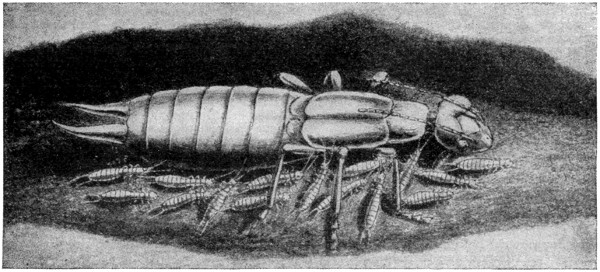
A MOTHER EARWIG PROTECTING HER FAMILY (See page 237)
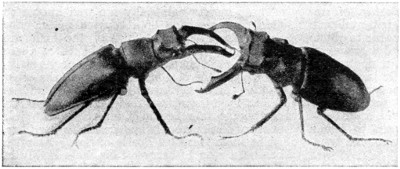
CONTEST BETWEEN TWO MALE STAG-BEETLES FOR A MATE (See Page 234)
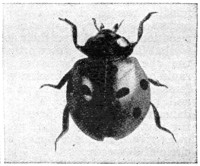
THE SEVEN SPOTTED LADY-BUG (See Page 234)
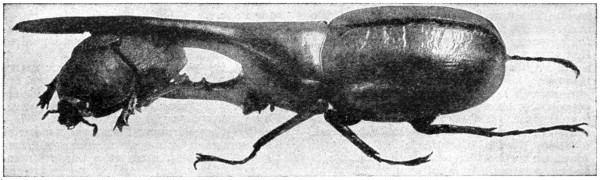
THE VICTORIOUS HERCULES BEETLE HAVING VANQUISHED HIS RIVALS IN COURTSHIP CARRIES OFF HIS MATE IN THIS FASHION. (See Page 234)
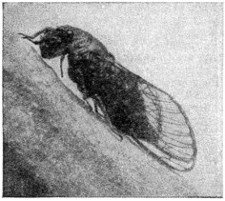
THE ENGLISH CRICKET whose familiar chirp we have all heard in the late autumn (See Page 237)
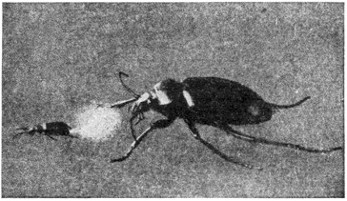
THE BOMBARDIER BEETLE is an expert artilleryman, and when pursued by an enemy is able successfully to resist the chase. (See Page 232)
Glow-worms (Lampyrides) are to be distinguished from the fireflies. They are nocturnal in habit, and represented by about five hundred species, widely distributed, especially in warm countries. America is very rich in “lightning-bugs,” such as Photuris pennsylvanicus, and other species.
The luminous organs consist, like those of the fireflies, of fatty-looking cells round which there is a plentiful supply of tracheæ, affording the necessary oxygen for the rapid production of phosphorescence.
Professor Emery gives a most entertaining account of his observations on the love-lights of Luciola italica, which he studied in the meadows around Bologna, Italy. By catching females and imprisoning them in glass tubes in the meadows he satisfied himself that sight, not smell, was all important. When the females caught sight of the flashes of an approaching male, in spite of their tantalizing situation, they allowed their splendor to shine forth. The most noteworthy difference is that the luminous rhythm of the male is more rapid and the flashes briefer, while that of the female is more prolonged, at longer intervals, and more tremulous. The attracted males dance round about the female, who, after having captivated one suitor, proceeds to signal other rivals, till she is finally surrounded by a circle of devotees.
Ladybird or Ladybug (Coccinella) is a pretty little beetle, generally of a brilliant red or yellow color, with black, red, white or yellow spots. The form is nearly hemispherical, the under-surface flat, the thorax and head small, the antennæ and legs short. When handled they emit a yellowish fluid, with a disagreeable smell. Adults and larvæ feed chiefly on plant lice, and are thus most useful to hop-growers and other agriculturists. Ladybirds occasionally occur in immense numbers, and from ignorance of their usefulness have sometimes been regarded with superstitious dread.
Colorado Beetle (Chrysomela) is a North American beetle which commits fearful ravages among potatoes. It is an oval insect, of an orange color, with black spots and lines. The antennæ are club-shaped. The larvæ and adults live on the potato-plant, and have sometimes quite destroyed the crop in certain parts of the United States. They pass the winter underground, and emerge from their hiding-places in the beginning of May. The female lays many hundreds of eggs in groups of twelve to twenty on the under side of potato leaves. The larvæ, which emerge in about a week, are reddish and afterwards orange. They grow up quickly and produce a second generation, which may again produce a third in the same summer. Their rate of multiplication is therefore very rapid. The surest remedy in case of attack is said to be a preparation of arsenic known as “Paris Green.”
Scarabæus (Ateuchus sacer), one of the dung-beetles well known for the zeal with which they unite in rolling balls of dung to their holes. The dung serves as food, and a beetle having secured a ball seems to gnaw at it continuously—sometimes for a fortnight—until the supply is exhausted. Sometimes an egg is laid in the ball, and the parents unite in rolling this to a place of safety. There are numerous American species.
By the Egyptians the scarabæus was venerated during its life, and often embalmed after death. Entomologists have recognized four distinct species sculptured on the Egyptian monuments, and gems of various kinds of stones were often fashioned in their image.
Stag-beetles (Lucanus) are nearly allied to the scarabees. The males are remarkable for the large size of their mandibles, the branching of which has suggested stags’ antlers. The common stag-beetle is a large formidable-looking insect, the males being fully two inches long, and able to give a sharp bite with their strong mandibles. It flies about in the evening in the middle of summer, chiefly frequenting oak-woods.
These insects habitually are well known to fight for possession of a coveted mate. For this purpose the mandibles of the male are enormously developed, and frequently there occurs a most amusing tussle, one beetle striving to gain the side of his lady-love, the other balking him. Eventually one suitor admits defeat by turning tail and making off, while the victor marches in triumph to the fair cause of all the trouble, and begins to court her.
The huge Hercules Beetle of South America has been seen to carry off his mate bodily in this way. Other tropical beetles have specially developed forelegs for grasping their spouse, should she prove coy and attempt playfully to run away.
Water-beetles (Ditiscus marginalis) are carnivorous types which have become adapted to life in freshwater, although the adults have not lost the power of flight. In our native great water-beetle the large hind legs are fringed with bristles, and serve as oars, while air can be stored under the wing-covers. There is only a partial metamorphosis.
Weevil is a popular name for a large number of beetles, marked by a beak or proboscis, generally used by both sexes as a boring organ. Among ten thousand described species are the American species Trichobaris trinotata, a small black weevil which destroys potatoes, and Conotrachelus nenuphar, which lays its eggs in various fruits and is a great pest, and the Entimus imperialis, the diamond-beetle with very brilliant scales.
Wire-worms are the grubs of skip-jack or click beetles, perhaps the most injurious of farm pests. They are called wire-worms “from their likeness in toughness and shape to a piece of wire;” they are yellowish in color, from one-quarter to one-half an inch in length, with three pairs of legs, and a suctorial appendage below the tail. The eggs are laid near the roots of plants, in the ground or in the axils of leaves; the grub remains for several years (three to five) as such, burrowing in the ground during the frost of winter, but at other times hardly ceasing from voracious attacks on the roots and underground stems of all sorts of crops. Dressing of lime, salt, nitrate of soda, etc., have been recommended as remedies.
THE LIFE HISTORY OF A BEAUTIFUL BUTTERFLY ITS STORY IS VERY SIMILAR TO THAT OF THE SILKWORM
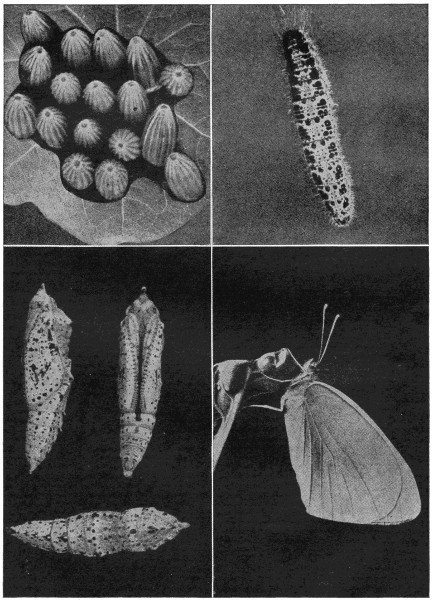
In these photographs the transformations of a butterfly are shown: the butterfly’s eggs (highly magnified) laid upon a leaf; the newly hatched caterpillar; and a caterpillar which has finished its growth and has spun a silken pad, to which as a chrysalis it may cling. The chrysalis is also shown, and the newly emerged butterfly waiting for its wings to expand fully and harden. All the figures are enlarged.
BUTTERFLIES AND MOTHS (Lepidoptera)
These are among the highest orders of insects. For beauty and variety of coloration they are quite unrivaled, and their attractive appearance is primarily due to the fact that the four wings are covered with overlapping scales of different kinds. The mouth parts are specialized to constitute a suctorial organ, which is made up of the second jaws, while the first and third jaws are greatly reduced. Each second jaw has become a half-tube, and the two are hooked together to make up a proboscis, sometimes of great length, which can be separated into its halves.
HOW BUTTERFLIES DEVELOP
The life-history exhibits a very typical and familiar metamorphosis. From the egg, which is often very beautifully sculptured, a larva known as a caterpillar hatches out, possessing not only the three pairs of jointed legs characteristic of the class, but also a varying number of unjointed pro-legs terminating in suckers. After feeding voraciously for some time by means of its powerful biting first jaws, and undergoing a number of moults, the caterpillar passes into the motionless pupa stage, here called a chrysalis, which may or may not be invested in a protective cocoon. The skin of the chrysalis ultimately splits, and the perfect insect makes it way out.
HOW TO DISTINGUISH BUTTERFLIES FROM MOTHS
Butterflies are typically distinguished from moths by the club-shaped thickenings at the ends of their antennæ, and by the fact that when settling, the wings are folded together over the back. In moths the antennæ may be of various form, but very rarely club-shaped, and the rest-position of the wings is horizontal or sloping downward, while in some instances they may be more or less wrapped round the body.
WHY BUTTERFLIES AND MOTHS HAVE BEAUTIFUL COLORS
Some butterflies are dingy, others uniform, but in contrast to moths the majority are beautifully colored. This is especially the case with tropical forms. How the colors are variegated and contrasted in spots and bands, how the hues are embellished by metallic shimmer, every one knows; what exactly the color means is, however, still obscure. A few general facts may be first noticed: (1) The color is in many cases subject to variation—it cannot be said to be absolutely constant for a species; (2) in some instances, at any rate, it is influenced by external conditions, for different forms at different periods of the year, is known in many kinds; (3) sometimes the color and markings, especially of the under surface of the wings, are obviously of use for the protection of the resting butterfly; (4) in some cases this protective adaptation is so pronounced as to deserve to be called mimicry; (5) in many cases the coloring is in direct connection with the physical constitution of the species, and is usually most marked in the males.
CHIEF CLASSES OF BUTTERFLIES
Of the families representing more than five thousand species, the chief are the following:
(1) Nymphalidæ, the largest, containing between four and five thousand species. They have a relatively simple type of coloration, and are interesting because of their disposition to mimic other species. They are distasteful to birds. They include the red admiral, the tortoise-shells, the peacock, and so on, as well as the fritillaries and the purple emperor. In it are also included the remarkable leaf butterflies in which the under surface, in shape, color and markings, closely resemble a dead leaf, while the upper surface is brightly colored. On alighting only the under surface is visible.
(2) The Erycinidæ is represented by the Duke of Burgundy fritillary.
(3) The Lycænidæ include the “blues,” so commonly seen flitting near the ground along muddy roads, so called from the color of the upper surface, but many are also copper, white and yellow.
(4) The Pieridæ include the white cabbage butterflies. They are remarkable for the prevalence of white, yellow, and orange colors, and for the fact that these tints are due to uric acid, or derivatives of this substance, stored in the wings as a pigment.
(5) The Papilionidæ, or swallow-tails, contain perhaps the most beautiful forms. The females are strikingly different from the males, and though larger, do not display the same beauty of coloration. The members of the family are widely distributed.
(6) The family Hesperidæ, or skippers, includes insects very different from other butterflies, both in structure and habits. The adults have in many cases a very rapid but jerky method of flight, and the larvæ in their habits resemble moths rather than butterflies.
Moths (Heterocera).—The antennæ of moths are bristly, gradually lessening from base to tip; when sitting the wings are turned down; and its flight is nocturnal. What the owl is among birds, the moth is among insects: it is a night-insect, carrying on its pursuits, and exercising all its activity amid the gloom of darkness. So numerous is the variety of moths, that there are upward of five hundred species.
The giant Owl-Moth of Brazil (Thysania agrippina) measures nearly a foot across from tip to tip of expanded wings, while the smallest are hardly visible to unaided eyes. The larvæ or caterpillars feed mostly on living plants, and in this connection are very familiar; others of these ravaging forms ruin clothes, furs, and the like. Almost the only directly useful form is the silk-moth.
Silkworm Moth. See under Domesticated Animals.
STRAIGHT-WINGED INSECTS (Orthoptera)
The fore wings are either parchment-like or membraneous; the hind wings always membraneous. The wings cover the body horizontally, and do not meet in a straight line or ridge, as they do in the beetles. This order of insects undergoes only a partial metamorphosis, being produced from eggs in a wingless condition. The Cicadas, however, are an exception, as they live in the ground frequently for years in the larva state. In this order are included the locust, cricket, grasshopper, cockroach, scale insect, plant-lice, and many kinds of bugs.
Crickets (Gryllus) are akin to grasshoppers. They have long feelers, a rasping organ on the wing-covers of the males, wings closely folded lengthwise, but often along with the wing-covers degenerate, great powers of leaping, and a retiring, more or less subterranean habit of life. Many of the species are wingless, and it is the males only which make a chirping sound. They are widely distributed, and all are herbivorous. The field cricket, house cricket and the common mole-cricket, are well-known representatives of the family.
Earwigs (Forficula) have two pairs of wings, very dissimilar, the anterior pair being short and horny, the posterior pair folded longitudinally and transversely; the mouth parts are well developed and suited for biting; the antennae are thread-like; there is no true metamorphosis in the life-history. The common earwig is best known for the pincer-like organ at the end of the abdomen.
Earwigs avoid the light, and do most of their work in the dark. They feed, as gardeners well know, on petals and other parts of flowers, on fruit, seeds and leaves, nor is animal debris refused. They are usually and readily caught in artificial shelters provided for their destruction.
The eggs of the common species are laid in spring, fifteen to twenty, in some convenient cavity. These are carefully watched, and even after the birth of the young earwigs, the mother still tends them as a hen does her chicks.
Grasshopper, a name given to numerous insects forming the locust family. They usually live among vegetation, in woods and thickets or in the open field. Most of them feed on flies and caterpillars, in catching which they use their powerful fore-legs, but many affect plants, and some combine both diets.
In the grasshopper the head is placed vertically; the slender antennae are longer than the body; there are hemispherical eyes, but rarely eye-spots; wings and wing-covers are generally present. The right (and occasionally also the left) wing-cover of the male bears a clear, round membrane stretched on a ring, which produces the well-known “chirp” when set in vibration.
The females have a long egg-positor. The eggs are laid by means of it either in the earth or in some dry stem. From these, in spring, larvæ are developed, which are virtually like the adults, but molt at least six times before they become full-grown.
Katydid, a name applied to numerous American insects, nearly related to grasshoppers. They frequent trees, shrubbery, and grass, and are well concealed in the foliage by their green color. In their general habit, e. g. in the song to which the syllables “kat-y-did” refer, and in the egg-laying accomplished by the long egg-positors of the female, these lively insects resemble grasshoppers.
Locusts (Acrididae) are large, ground-loving insects, of world-wide distribution, famous for their voracious vegetarian appetite. In size they vary from one-quarter inch to five inches in length. They have strong hind-legs with great leaping powers, large heads with formidable mouth-organs, shorter antennæ and robuster bodies than grasshoppers. Both winged and wingless forms occur, the former with strong powers of flight. The females have strong egg-positors by which they bore holes for their eggs. The numerous eggs are laid in holes drilled in the ground; the young when hatched generally resemble the parents except in the absence of wings. From the first they are gregarious, and excessively voracious except during their repeated molts; they devour all green things, and even one another, and are often forced by stress of hunger and excessive multiplication to migrate in great swarms.
Their ravages sometimes cause widespread famine and ruin. One of the most famous and destructive forms is the Rocky Mountain Locust (Caloptenus spretus); the most abundant migratory species of the East, so often mentioned in the Scriptures, is Pachytylus migratorius.
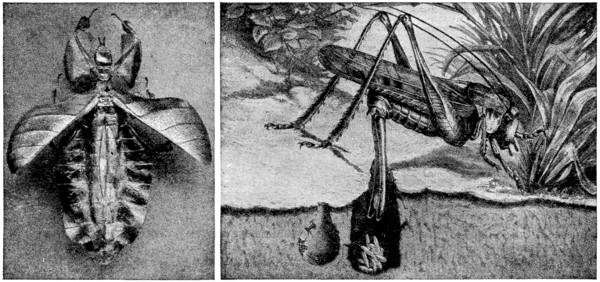
On the left is shown a Leaf Insect which, having given up the habit of flight, has yet retained its likeness to the leaves upon which it feeds to protect itself from its enemies. On the right is shown a grasshopper depositing her eggs in a nest under the ground. (See above).
ANTS, BEES AND WASPS (Hymenoptera)
These membrane-winged insects are the most intelligent of their kind. They are readily recognized by the presence of four transparent wings traversed by a comparatively small number of veins, the hinder ones being much smaller than the others, to which they are in many instances attached during flight by means of a row of minute hooks. The posterior end of the body in the female is commonly provided with a piercing apparatus, which may either serve for boring holes, in which eggs are laid, in which case it is called an “ovipositor,” or may have been modified into a poisoned sting, useful for offense and defense. The black and yellow or black and red bands of wasps and bees are “warning colors,” indicating their stinging powers.
The larvæ either resemble caterpillars or are pale, helpless maggots, devoid of limbs, for the welfare of which more or less elaborate provisions are made by the mother insect. Later on a pupa stage is reached, from which the winged adult ultimately emerges. The highest members of the order live in communities comprising several casts.
Ants (Formicidae).—These familiar and intelligent diminutive creatures are perhaps the most interesting of all insects, owing to the extraordinary way in which they have become adapted to a great variety of modes of life. All are social, and a community typically consists of males, females, workers (of one or more kinds), and, it may be, soldiers. The first two are generally provided with wings, though those of the females are soon shed, but exceptions to this occur, and some species may have both winged and wingless individuals of one sex or the other. The first pair of jaws (mandibles) are well or even excessively developed, and possess unusually free powers of movement in accordance with the varied functions they have to perform. In many cases the females (including the workers) are provided with a sting.
Ants hatch out as helpless, limbless larvæ, which have to be fed and carefully attended, either by the fertile females or the workers, as the case may be. Feeding is rather a curious affair, for the nurse possesses a sort of pouch (crop) connected with her gullet, and this is used as a store from which nutriment can be squeezed up into the mouth. Adults can feed one another in the same way, as also the little beetles and other insects which are often found as guests in their communities.
WANDERING ANTS OF THE TROPICS
These ants are of highly carnivorous habits, and move about in large armies, devouring everything of animal nature that comes in their way. The fact that they are blind, or practically so, does not seem to interfere with their devastations. Some of the forms are common in the hotter parts of South America, while others, the “driver” ants, are well known in Africa, where criminals, it is said, are sometimes tied up in their path, to perish miserably, if speedily.
SLAVE-HOLDING ANTS AND THEIR SLAVES
Some ants press weaker species of their kind into unmerited captivity. In one familiar instance the relatively large oppressor (Polyergus rufescens) is of reddish color and well endowed in the matter of jaws, while the enslaved species (Formica fusca) is small and dark. Regular slave raids are made from time to time, when, after stubborn resistance, the pupæ and older larvæ of the weaker form are carried away to lead a life of bondage, to which, indeed, they take very kindly. This kind of social economy has indeed become an absolute necessity to the slavers, which have quite lost the power of feeding their own young, while some such species cannot feed themselves.
A most extraordinary state of things occurs in the case of a small kind of ant (Anergates) which possesses no workers of its own, but lives within the communities of another species (Tetramorium cæspitosum) entirely made up of workers.
Some ants, such as the little black species (lasius niger) common in gardens, use as part of their food a sweet fluid that exudes from plant lice (aphides), and keep these insects as we keep kine. The captives are fed, sheltered, and jealously guarded. Fenced enclosures are constructed for them on plants in the vicinity of the nest, with which they are connected by covered roads. During winter the fragile eggs of the plant lice are taken underground and sedulously cared for.
THE HARVESTER ANTS OF EUROPE, NORTH AFRICA AND NORTH AMERICA
A number of ants are known that construct extensive underground dwellings, in which they store seeds of various kinds. Some of the American species (Pogonomyrmex) may be even said to winnow their grain, for they carefully strip off the husks and deposit these on rubbish-heaps outside the nest.
Some of the seed-storing ants almost deserve the name of maltsters on account of the way they deal with their harvest. The human method of making malt is to allow the barley grains to germinate to a certain extent until the contained starch is converted into malt-sugar, when the process is arrested by scalding. In similar fashion ants permit germination to go on to a certain point, and then kill the seedlings by biting away the little shoots and roots. In this way a supply of the sweet food they love is secured.
Among the most interesting of ants are leaf-cutting forms (Atta) native to tropical America. They are associated in huge communities occupying complex underground dwellings, the sides of which are marked by mounds that may measure as much as forty yards round. The chief food consists of a kind of fungus (Rozites gongylophora), cultivated on bits of leaf, and treated in such a way that little white elevations are produced. It is these that the ants desire.
The chief duty of one set of workers is to collect the pieces of leaf required. To facilitate their operations, roads, largely underground, are constructed, which lead to suitable trees, and may be as much as twenty yards long, or more. Curved pieces of leaf are bitten out and carried back to the nest, where they are handed over to another set of workers, by them to be reduced to smaller fragments and made into mushroom beds.
WHERE AND HOW THE HOMES OF ANTS ARE BUILT
Ants live in dwellings of the most varied kind, many being underground. In a large number of species ant-hills are constructed of various loose materials, our common native wood-ant (Formica rufa) being a good example of this. An Asiatic ant (Oecophylla) constructs a summer-house of leaves in a curious fashion. The larva possesses silk-glands from which a sticky fluid exudes, hardening quickly on exposure to the air. Advantage of this is taken by the workers, for they hold larvæ in their jaws, and employ them as living gum-bottles, while the leaf-edges to be cemented are held in position by other workers.
Some South American ants construct hanging nests in trees, by which protection against floods is secured. Other ants in the same part of the world make curious homes which well deserve the name of “hanging gardens,” for they are mainly constructed of living plants, some of which have never been found in any other situation. The plants are cultivated and tended by the ants with which they are associated. The soldiers of certain ants (Colobopsis), which tunnel out homes in the wood of trees, play the part of living front doors. Every entrance to the nest is guarded by one of these hall-porters, its huge head not only exactly filling the aperture, but closely resembling the adjacent bark in appearance. If this curious door be touched by a bit of stick or a feather, it remains shut, but is immediately opened when stroked by the antennæ of a worker.
CURIOUS ANT GUESTS AND ASSOCIATES
Not only may ants of two or more kinds be associated together in the same dwelling, but a nest may also be tenanted by peculiar species of beetles (and other insects), spiders, mites, or other creatures. Many of these, especially the beetles, are fed and cared for by the ants, some of them for the sake of a substance which exudes from their bodies; others, perhaps, to serve as pets. The beetle-grubs are looked after as well as the adults; at least in the case of certain blind species.
On the other hand, certain ant-beetles not only steal food from the ants, but also devour their young. There can be no doubt that these curious associations are very ancient ones, for many species of beetles are found nowhere else. A kind of bristle-tail that lives in ants’ nests is a thief pure and simple. It has been seen to steal the drops of honey being passed from the mouth of one worker to another, afterwards retreating at full speed.
The common red ant (Myrmica rubra) shelters and feeds a curious kind of blind mite, which lives on the bodies of its hosts. By stroking its entertainers with its legs it makes known its need of nutriment, and such requests are never refused. Not impossibly some return may be made for these good offices.
One of the Indian ants (Sima rufo-nigra) lives on the bark of trees with a species of wasp (Rhinopsis ruficornis) and a kind of spider (Salticus), both of which closely resemble it in appearance. The three associates appear to be good friends, while wasp and ant sometimes engage in a friendly wrestle.
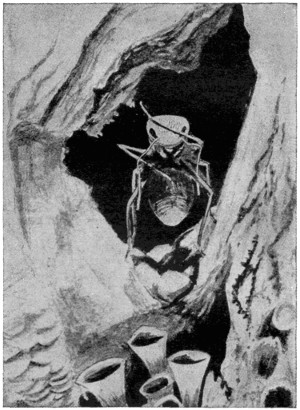
AN ANT AT ITS MORNING TOILET
A remarkable observation made by a student of insect life while examining ants under the microscope.
HOW ANTS COMMUNICATE WITH ONE ANOTHER
The complex life of an ants’ nest is a striking instance of order among apparent disorder. Each of the innumerable individuals discharges its special tasks without hesitation, unless unusual circumstances prove a hindrance. It would seem, therefore, that there must be some means by which any one can convey information to others. When two meet they frequently stroke one another with their feelers, and this perhaps serves the purpose of language.
THEIR REMARKABLE HABITS OF CLEANLINESS
Some wonderful facts are recorded concerning matters of personal cleanliness among ants, and has shown incidentally that these insects perform amazing feats of acrobatic skill without the least effort, and quite as matters of course. For example, an ant will often hang from a grass stem by the claws of one leg, while it combs its antennæ, cleanses its five remaining feet, or bends its head upwards to lick its abdomen and furbish the joints of its armor. Indeed, thanks partly to the wonderful flexibility of its “waist,” and still more to the tenacity of its muscles, an ant is able to assume and maintain almost any position that the need or fancy of the moment may prompt.
Many stingless ants, when fighting, first bite their adversary with their jaws, and then bringing the tip of the abdomen beneath the body, squirt formic acid into the wound.
Bees.—See Domesticated Animals.
Bumble-bees.—These common bees are large, somewhat clumsy-looking insects which live in communities including workers or imperfect females as well as ordinary members of the two sexes. The nests are constructed in holes in the ground or other sheltered places, and the establishment of a community is due in the first instance to the labors of a queen in early summer. She makes a number of waxen cells, stores them with honey and pollen, and afterwards feeds the larvæ when they have devoured these provisions. From the first (and several other), batches of larvæ workers are chiefly produced, which undertake the constructive and nursing work, until at last the queen has nothing to do but lay eggs. Males and other queens are reared from some of the eggs laid in late summer and early autumn.
Wasps, like bees, are either solitary or social, and it is only in the latter that workers exist. Solitary wasps construct small nests of clay and little stones, or else make burrows. They possess the curious habit of storing up immature—for example, caterpillars—or mature insects, or even spiders, for the benefit of their larvæ when these hatch out. The kind of victim depends upon the species of the wasp concerned, but in any case it is killed or paralysed by stinging.
Social wasps somewhat resemble social bees in their habits, but their building material, instead of being wax, is a kind of paper made of chewed wood mixed up with saliva. In some instances the nest is suspended from a bush or tree, and is provided with a kind of overhanging roof by which rain is drained off.
In our commonest species, an underground site is chosen, and a series of combs constructed from above downward, the whole being enclosed in several layers of wasp paper. Adjacent combs are held together by little pillars. The young are at first fed upon fruit-juice, nectar, and other vegetable matter, for which a more stimulating diet of chewed insects is afterwards substituted.
The Hornet (Vespa crabro) is a social wasp which commonly nests in hollow trees or constructs elaborate nests out of wood fibers, suspended from boughs. The females have formidable retractile stings. The hornet is represented in the United States by the white-faced hornet (V. maculata), also a large species.
FLIES (Diptera)
There are some thirty or forty thousand species of flies known, while no other order has so many individuals as this. This enormous assemblage of insects, most of which are small or even minute, includes many species that have earned an undesirable reputation as bloodsuckers and pests. Except in fleas and a few others, such as sheep-ticks, there are two membraneous front wings, the hinder pair serving as sensory structures. The mouthparts of the female are very often piercing and sucking organs of great efficiency, the first and second jaws being in the form of slender lancets protected above and below by the upper and under lip respectively.
But in other types, such as the house-fly (Musca domestica), the jaws are modified into a proboscis used for sucking juices, and devoid of powers of perforation.
THEIR UNCLEANLY AND DEATH- CARRYING HABITS
This fly lays its eggs in manure or other refuse, these hatching out, passing through all their stages and emerging as perfect insects in a few days. Their uncleanly habits make the house flies most efficient agents in the carriage of different diseases, especially typhoid fever and others which attack the digestive tract. Flies are therefore not merely a nuisance to be deplored, but a positive danger to mankind. Among other flies are the carrion flies, black flies, the gnats and the mosquitoes, all troublesome to man, while others attack various plants.
THE LARGE VORACIOUS FLEAS
Of these the breeze-flies or gad-flies possess powerful piercing mouth-parts, with which they torment both stock and human beings. A well-known species is the long brown clegg (Hæmatopota pluvialis), often met with in woods. In some tropical kinds the jaws are of enormous length.
Robber-flies are voracious and insatiable forms which prey upon other insects, even wasps and tiger-beetles being among their victims.
Hover-flies are swift and elegant insects which have already been mentioned in connection with flowers. Some of them closely resemble bees in appearance.
The dreaded tsetse fly (Glossina morsitans), so fatal to horses in parts of South Africa, belongs here. Germs of the fly-sickness (Nagana) are introduced into the blood of the victims, Tsetse flies of other species are responsible for “sleeping sickness,” which makes parts of tropical Africa uninhabitable.
THE PESTIFEROUS MOSQUITOS AND GNATS
These are particularly notable for the blood-sucking propensities of the female. Some tropical mosquitoes disseminate the germs of such diseases as malarial fever. Wholesale destruction of the early stages, by pouring petroleum on the surface of the stagnant water in which they live, has been employed with conspicuous success at Havana and in the Panama Canal zone as a preventive measure against yellow fever and malaria.
Midges are very minute gnats, of which the aquatic larvæ are known as blood-worms.
THE WINGLESS FLEAS AND OTHER PESTS
Fleas are wingless members of the order, and their agility fully compensates for the loss of the power of flight. There are many species, infesting different mammals and birds. The females of the tiny sand-fleas, or chiggers (Sarcopsylla penetrans), of America deposit their eggs in the feet of human beings (or other animals), and unless the painful swellings thus brought about are carefully treated they are apt to fester dangerously.
STRANGE ANIMAL FORMS FOUND IN THE SEA
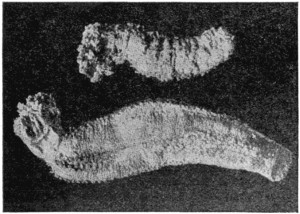
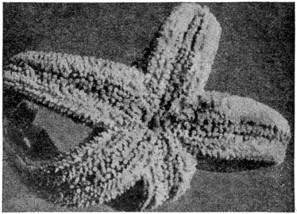
SEA CUCUMBERS (See Page 242) SURFACE OF STARFISH (See Page 242)
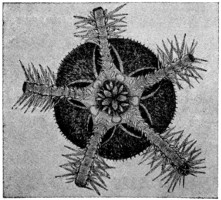
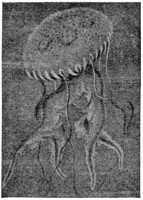
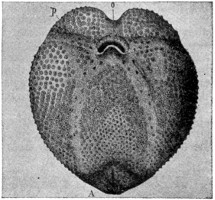
SNAKE-STAR (See Page 242) JELLY-FISH (Page 243) HEART-SHAPED SEA URCHIN (See Page 242)
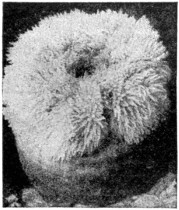
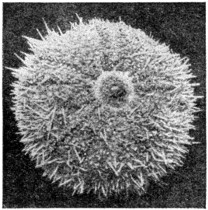
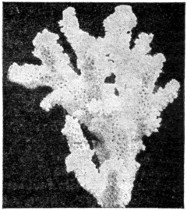
SEA ANEMONE (See Page 243) SEA URCHIN (See Page 242) BRANCHING CORAL (Page 243)
STARFISHES AND SEA-URCHINS (Echinoderms) HEDGEHOG SKINNED ANIMALS OF THE SEA. SEA-LILIES, STAR FISHES, BRITTLE STARS, SEA URCHINS, AND SEA CUCUMBERS
Echinoderms, or hedgehog-skinned animals differ from all the forms so far considered in the nature of their symmetry. Instead of being two-sided, with a well-marked distinction between right and left and front and back (bilateral symmetry), they resemble a star or regular flower in shape. The skin is hardened by the deposition of salts of lime, and the body is often covered with spines, as more particularly in sea urchins.
Five existing subdivisions are recognized: (1) Sea-lilies and feather-stars (Crinoidea); (2) Starfishes (Asteroidea); (3) Brittle Stars (Ophiuroidea); (4) Sea urchins (Echinoidea); and (5) Sea-cucumbers (Holothuroidea). All are marine.
Sea Cucumbers are sort of second cousins to the sea urchins and rather more distantly related to the starfish. As the name indicates, they are shaped like a cucumber, and hundreds of little feet on the side heighten the resemblance, as they recall the spines on the vegetable. Inside they have a coiled intestine, usually filled with mud and the contained vegetable and other debris. With us no use is made of the animals, but they are taken in great numbers in the South Seas, and sent to China, where, as trepang, they form an ingredient in soups.
Sea-lilies are deep-sea animals, once numerous and flourishing, but now comparatively rare, and only to be obtained by dredging in the deeper parts of the ocean. They are fixed by a long, jointed stalk bearing circlets of sensitive threads and terminating in a cup, in the center of which the mouth is situated. Radiating from the edges of the cup are five branching, feather-like arms, all of which are grooved above, the grooves uniting, and finally converging to the mouth. They are beset with cilia, and minute organisms are conducted inward along them to serve as food.
Sea Urchins are radiated animals which are usually shaped like a flattened sphere. They have a mouth, surrounded by five chisel-shaped jaws at one pole, while the whole outer surface is covered with slender, movable spines. Between the spines are numbers of slender, flexible, tubular feet, which pull the body along, while the spines act more like true feet. The animals feed mostly on seaweeds. They have no economic value with us, but in Europe the eggs of some species are eaten, forming part of the frutti di mare of every Italian seaport.
Starfishes.—Starfishes are among the most familiar objects of the seashore, and the commonest kinds, such as the five-finger (Asterias rubens) and the comb-star (Astropecten aurantiacus) possess five radiating arms. The mouth is in the center of the under side, and leads into a capacious stomach, of which the first part can be protruded from the body to surround such prey as mussels and oysters.
A starfish crawls slowly by means of numerous tube-feet, which are lodged in five grooves radiating from the mouth, and make up a part of the water-vascular system, so called because it is full of sea-water. At the end of each arm is an unpaired tube-foot acting as a feeler, while on its under side there is an orange-red eye-spot.
The water-vascular system assists in breathing. It was probably first evolved in the interests of respiration, and this is its chief use in the sea-lily. Some of the spines are formed of little, two-bladed pincers, which clean the surface of the body.
Starfishes are remarkable for their powers of restoring lost parts. A detached arm can grow a fresh disc and another four arms.
ANIMALS THAT APPROACH THE SIMPLEST FORMS OF LIFE WORMS, LEECHES, SEA-ANEMONES, CORAL-POLYPS, JELLY-FISHES, SPONGES
Several groups of the lower animals are collectively known as Worms, though most of these groups are but remotely related. Ringed worms are elongated creatures in which the body is made up of a considerable number of rings or segments, most of which are, on the whole, much alike. There is often a well-marked head, but no distinct thorax and abdomen, as in an insect or crayfish. Two subdivisions are recognized: (a) Bristle-worms (Chætopoda) and (b) Leeches (Discophora).
Bristle-worms include a host of marine worms, together with some that live in fresh water, and also the earthworms. Their average characters are best understood by examining one of the commonest shore-worms, known as the sea-centipede (Nereis). Here the segments are very clearly seen, and almost every one of them bears a pair of unjointed conical foot-stumps, used for crawling.
Imbedded in the foot-stumps of the sea-centipede are bundles of strong bristles, which give a hold on the underlying surface and prevent slipping. The head-region is fairly distinct, and bears a number of feelers of various kinds, as well as four simple eyes. Sea-centipedes and many of their allies are highly carnivorous, and seize their prey by means of a pair of horny jaws which can be protruded at will.
Earthworms are found in all parts of the world, though naturally they do not thrive in arid tracts; and their effect upon the fertility and drainage of the soil can hardly be calculated. Burrowing into the ground, they cast up the earth they have swallowed, and so pursue a constant and thorough system of ploughing. Though eyeless, they evade the light and only come out of their burrows at dusk, often remaining, even then, with their tails in the holes and their bodies working round and round.
Darwin long since demonstrated, the earthworm is one of the farmers’ best friends. Its burrows drain and aerate the soil, while the earth which has passed through its body is finely divided and constantly being brought to the surface from lower levels.
Not far from the front end of an earthworm a thickening will be seen, often erroneously supposed to be the result of injury. From it exudes a fluid which hardens into the egg-cases.
Leeches live in the sea, fresh water, or even in damp, tropical forests. The flattened body of the leech is divided by grooves into a number of narrow parts, several of which go to make up a segment. Foot-stumps and bristles are entirely absent, and progression is effected by means of suckers, one at each end. They effect a looping movement, but the animal can also swim by undulations of its body. The freshwater leech is a bloodsucking parasite. The mouth is situated in the middle of the front sucker, which serves to fix the animal to its victim. Three saw-edged jaws are then brought into play, a three-rayed cut being made, and a fluid poured out which prevents the blood from clotting. Digestion is slow, and the food is stored in a large crop, drawn out into numerous pairs of pouches. The head possesses eye-spots, but no feelers.
ANIMALS LIKE PLANTS
ANIMALS LIKE PLANTS (Cœlenterata) of which sea-anemones, corals, and jelly-fishes are examples, are distinguished by the ray-like symmetry of starfishes and their kind, though here, as a rule, it is more perfect. In structure they are much simpler, than any of the animals so far considered. For such a creature is to all intents and purposes simply a stomach, the wall of which is made up of two layers of cells, one (ectoderm) external, and the other (endoderm) internal. In higher animals a third layer (mesoderm) is interposed.
Sea Anemones are common between tides and lower on all coasts. They are cylindrical animals, with a mouth surrounded by tentacles at one end. Inside there is a single cavity which serves as a stomach and whose branches run to all parts of the body, thus distributing the food like a blood vessel. The colors, especially in the tropics, are variable, and often gorgeous.
Coral-polyps are closely related to sea-anemones, but differ from them by secreting a hard, limy skeleton in the base of the body. They are either simple or compound. The well-known mushroom coral may be taken as an example of the former. Its skeleton is a shallow cup, exhibiting numerous radiating plates. If we look at the upper surface of such a coral in the living state we shall see a mouth surrounded by circlets of tentacles, much as in a sea-anemone.
A compound coral consists of a number of individuals, relatively small in size, connected together by a common flesh, and formed by the budding or splitting of a single original polyp, the results of the process remaining united.
Many corals branch, while others form compact masses, as in the kind above described, and also in the brain coral, where the boundaries between the individuals are not clearly marked.
Corals are widely distributed, some living even in cold latitudes, and others on the floor of the deep sea. Coral reefs, however, made up of the skeletons of such animals, are only found in the warmer parts of the ocean, where the water is clear, particularly favorable conditions being afforded by the Pacific and Indian Oceans. (See also Coral Reefs and Islands).
Jelly-fish (Medusæ).—All agree in having a more or less bell or umbrella shaped body, with a proboscis hanging down in the place of the handle of the umbrella or the tongue of the bell. The mouth is at the end of the handle and leads into a stomach which divides and sends out branches, like the ribs of the umbrella, to the margin. The common name is due to its gelatinous consistency. Most of the species start in life as buds from attached animals, which later separate and henceforth lead a free existence, swimming by opening and closing the bell.
SPONGES
SPONGES (Porifera) are animals of peculiar structure, which resemble zoophytes in many respects, but possess neither tentacles not thread-cells. Some are simple, but most of them are compound. A simple sponge may be compared to a cup or vase with a wall perforated by numerous small holes, through which currents of sea-water stream into the central cavity, to make their exit by the main opening. They are set up by ciliary action.
Venus Flower-basket.—In the majority of cases the skeleton of a sponge is mostly or entirely made up of sharp needles of lime or flint, which may be welded together, as in this form. Often the opening of the vase is provided with a convex perforated covering. Another elegant form is the Glassrope Sponge native to the Japanese seas. It is rooted in the mud by a bundle of long, glassy spicules, which are slightly twisted.
Most sponges are marine, and, despite their fixed habit and apparent helplessness, are pretty free from the attacks of most other creatures, partly because of the innumerable sharp spicules they contain, and partly because their taste and smell are unpleasant. These deterrent qualities are often associated with bright warning colors, generally red, yellow or orange.
Most of us little realize that the sponges we see or use daily are in reality dead animals.
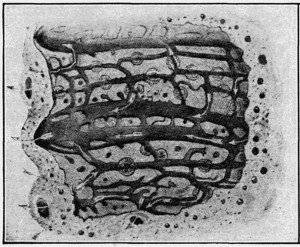
CROSS-SECTION OF LIVING SPONGE
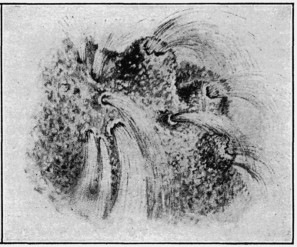
THE SPONGE IN ACTION
The arrows show how the water enters by the small pores, to pass out by the large openings. Food is thus brought to the cells which line the channels. At the right the currents of water are seen passing from the outer openings, as seen under a powerful microscope.
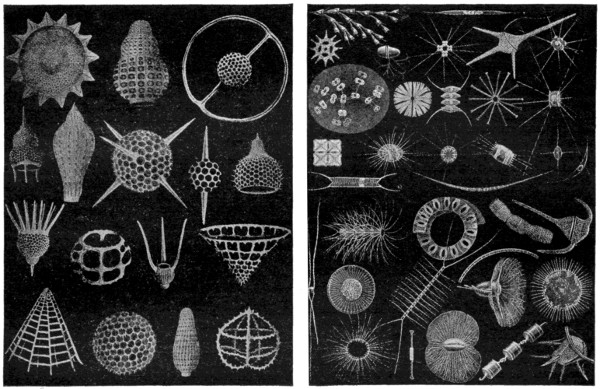
THE BORDER-LINE BETWEEN ANIMAL AND PLANT LIFE
On the left are represented highly magnified animal skeletons of a class of Protozoa called Radiolarians. Most of them are under one-twenty-fifth of an inch in size. Millions upon millions of these little shells are found upon the floors of the ocean, and upon its shores. They are marvels of form and color—so wonderful, indeed, that man with all his skill cannot imitate them. When alive they consist of but a single cell, and live in colonies with the plant forms, called algæ, pictured on the right. The algæ are also single-celled, and of rare beauty of form, and the strange association of the simplest of animal forms with the simplest of plant forms has up to the present time proved the supreme enigma of science.
PROTOZOA OR SIMPLEST FORMS OF ANIMAL LIFE ANIMALCULES, AMOEBA, RADIOLARIA, FLAGELLATES, CILIATES
ANIMALCULES (Protozoa)
In botany we find that the lowest plants are mostly of a microscopic size, and unicellular—that is, consisting of a single cell or structural unit, essentially a fragment of living matter (protoplasm), part of which is specialized into a nucleus. The lowest animals are also unicellular, and the popular term “animalcule”—a little animal—has reference to their diminutive size. One of the simplest known cases is afforded by the
Amœba (Gr. “change”), a name given to a number of the simplest animals or protozoa. The simplest form which the observer will meet is a naked lump of jelly-like protoplasm constantly flowing into new shapes.
Ray Animalcules (Radiolaria) are forms which resemble the members of the last group in some respects, but are more complex in structure, with shells composed of a latticework of flinty matter. These shells cover large tracts of the floor of the deeper parts of the ocean (limy shells dissolve before getting so far), and make up “radiolarian oozes,” such as Barbadoes earth.
Flagellates are immensely numerous animalcules with a body of definite shape covered by a membrane. Swimming is effected by a slender thread of flagellum (Latin for whiplash) of living substance, which executes whip-like movements. They are common in ponds and ditches, where it often makes up a green scum. A mouth is situated at the base of the flagellum, and at this end there is also a red eye-spot. Some flagellates bear more than one flagellum, many are fixed, and the colonial condition is common. The exceedingly minute animalcules which swarm in putrid fluids and are vaguely known as “monads” belong to this group.
Ciliates like flagellates, are invested in a firm membrane, and therefore of definite form. Instead of flagella, they possess cilia, short threads of living substance which are associated in large numbers, and alternately bend and straighten in a rhythmic fashion, bringing about locomotion in free species, or setting up currents in the water in fixed ones.
Despite their apparent insignificance, certain animalcules, by virtue of their almost imperishable skeletons, are among the most important agencies which have built up the crust of the earth. The surface of the sea is largely inhabited by Radiolarians and Foraminifera, the former preponderating in cold, the latter in temperate and tropical waters. As they die, their skeletons sink to the bottom and form mud or ooze, which through time and pressure becomes consolidated into rock.
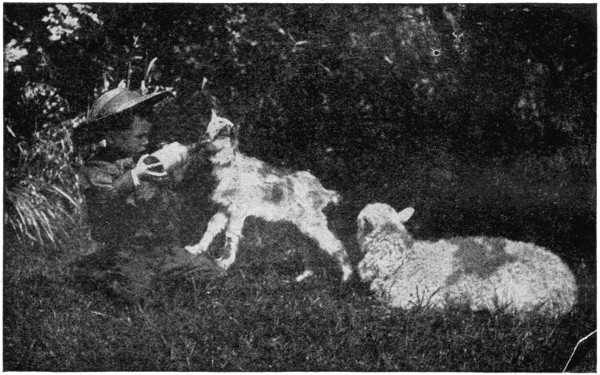
It is generally believed that sheep were the very first of all domesticated animals. Doubtless because they supplied him with food and clothing and by reason of their gentleness, they were selected by man as his first animal associate.
DOMESTICATED ANIMALS
DOMESTICATED MAMMALS: Alpaca, Ass, Camel, Cat, Cattle, Dog, Elephant, Gayal, Goat, Guinea Pig, Horse, Llama, Rabbit, Reindeer, Sheep, Swine, Yak, Zebu. DOMESTICATED FISH: Carp, Goldfish. DOMESTICATED BIRDS: Canary, Chickens or Fowls, Duck, Guinea, Goose, Ostrich, Parrot, Peacock, Pigeon, Swan, Turkey. DOMESTICATED INSECTS: Bee, Cochineal, Silkworm Moth.
Domestic animals are those kept for the use or companionship of man. When studied in their relation to the animal kingdom as a whole it is readily seen that they belong to the highest groups of animals; but the actual process of original domestication is unknown to us. It is also very evident that the origin of some of the domesticated groups themselves is very obscure. In general it may be said that only when a distinct breed has been produced by human interference may we call the result domestication.
CLASSES TO WHICH THE DOMESTIC ANIMALS BELONG
Among the highest class of animals—the Mammals—familiar illustrations are dogs and cats, horses and asses, cattle, elephants, camels, and the like. Birds include the domesticated pigeons, fowls, ducks, ostrich, peacock, canary, and others. Among fishes, goldfish and carp belong to the domestic class; while the honey bee and the silkworm moth belong to the lowest domestic group—the insects.
WHERE ANIMALS WERE FIRST DOMESTICATED
The original home of fully three-fourths of our domestic animals was the continent of Asia, where, also, the first home of man himself is placed. It seems quite probable that nearly all of these animals were first held as captives by the early peoples for food supply, and that their other uses developed later. As the races spread to the continent of Europe and thence over the habitable world, their animal servants spread with them, and others were added, adapted to varying climatic and other conditions. Our own continent—North America—has added only the turkey and the cochineal insect, while South America has contributed the alpaca, llama, and guinea-pig. No new domestic animals have been developed during the last two thousand years; and the natural conclusion is that all must have come into use at various stages from the very earliest period of man down to the time of the Christian Era.
RESULTS OF DOMESTICATION ON ANIMALS
Many animals have been greatly changed in form, size and habits by domestication, especially the dog, sheep, pig, donkey, pigeon and chicken, so that a great variety of breeds and strains have been developed. Many kinds of dogs are incapable of existence apart from human care. The donkey does not run wild, and chickens are never found at a great distance from human habitations. Others, though much varied in form and size, are still capable of independent existence, such as the horse, goat, ox, cat, and goose, but a group like the cheetah, water buffalo, and swan are only partially domesticated, and little changed by association with man.
DOMESTICATED MAMMALS
Alpaca (Auchenia Paco), an animal of the same genus with the llama, belongs to the Camel family, is the half-domesticated form of the wild vicuna. It is remarkable for the length and fineness of the wool, which is of a silken texture, and of an uncommonly lustrous, almost metallic appearance. The alpaca is smaller than the llama, and, in form, somewhat resembles the sheep, but has a longer neck and more elegant head. It carries its long neck erect; its motions are free and active, its ordinary pace a rapid, bounding canter. The eyes are very large and beautiful. The wool, if regularly shorn, is supposed to grow about six or eight inches in a year; but if allowed to remain upon the animal for several years, attains a much greater length, sometimes even thirty inches, and not unfrequently twenty. Its color varies; it is often yellowish brown; sometimes gray, or approaching to white; sometimes almost black.
The alpaca is a native of the Andes, from the equator to Tierra del Fuego, but is most frequent on the highest mountains of Peru and Chile, almost on the borders of perpetual snow, congregating in flocks of one or two hundred. The Peruvians keep vast flocks of them for the sake of the silky luster and fineness of their wool, which furnishes material for the best of fabrics.
The alpaca does not acclimatize in other regions of the world, and all attempts to introduce and establish it as a wool-bearing animal in Europe and the United States have failed.
Ass (Equus asinus), a species of the horse genus, supposed to have sprung from the wild variety (Asinus tæniopus) found in Abyssinia. It differs from the horse in having short hair at the root of the tail and a long tuft at the end, in the absence of warts on the hind-legs, and in the persistence of stripes, except in albinos. The upright mane, the long ears, the cross stripe on the shoulders, and the dark bands on the back are also characteristic. The domestication took place at an early date, probably before that of the horse. It was brought to Mexico and South America by the Spaniards.
In Arabia, Syria, Egypt, Spain, Kentucky, and elsewhere asses are well cared for, and the breed has been considerably varied and improved. The stupidity for which the animal has for long been proverbially reproached seems largely the result of human influence.
The Mule is a hybrid bred between mare and male ass; while the hinny is the rarer result of hybridism between horse and female ass. The mule is much nearer in temper and appearance to the ass than to the horse; the hinny in some points resembles the horse more, as it neighs, while the mule brays like the ass. The ass is admirably adapted for a beast of burden, being remarkable for endurance, hardiness, and docility under kind treatment. It varies greatly in size, from dwarf forms only twenty to thirty inches high in the West Indies to fine Spanish and American breeds sixteen hands high.
The Burro, used almost exclusively as a pack animal by miners and prospectors in the mountain regions of the western states, is a small form.
Banteng (Bos sondaicus), a species of ox, a native of Java and Borneo, which, in color, shape, horns, and absence of dewlap, bears some resemblance in appearance and ferocity to the gaur (Bos gaurus) of India. It is black, with white legs; the hair is short and sleek; the limbs slender; the muzzle sharp; the back rises into a high arch immediately behind the neck.
Camel (camelus), called by the Arabs the “ship of the desert” is a misshapen animal of the even-toed group. In this family, the upper lip is hairy and deeply cleft; the neck is very long; the feet (with two toes) are not enhoofed, but provided with callous soles; and the stomach has three compartments. The family includes the camels proper and the various forms of alpaca.
The camels are well known for their large size, for their dorsal humps, for their callosities on knees, breast, etc., for the common sole uniting the two toes. The ears are small and rounded; the short tail bears a terminal switch; the hair is tangled and felted; a single young one is born; and the diet is wholly vegetarian.
One species is usually spoken of as the Dromedary. It has a single hump and a generally reddish-gray color. There are many breeds, and the dromedary is the most agile of these. Apart from its use in transit and transport, the flesh is eaten, the milk made into butter and cheese, the hair woven into fabrics of various degrees of fineness, and the skin tanned.
The other camel is known as the Bactrian, and is distinguished by its slightly larger size, two dorsal humps, and somewhat finer brown or reddish hair. This camel is bred in central Asia, and in its adaptability to domestication, as well as in its natural adaptation to desert life, is a most useful animal. Its frugal diet, its powers of storing water and of going long without a fresh supply, and its great strength are very familiar facts. A camel will eat almost any herbage or green thing it comes across, even dried, leafless twigs. The hair of the camel forms the woof and cotton the warp of the famous Persian camel’s-hair cloth. Coarser camel’s wool or hair is imported for various purposes.
The Bactrian camel can carry one thousand pounds weight or more, and the dromedary proper can cover one hundred miles in a day. The ordinary jog of a camel is about two and one-half miles an hour, but this can be kept up for many days with little food and less drink. A swift dromedary may go ten miles an hour. A thousand or more may journey in a caravan, and the amount of food carried is surprisingly small. The hump must be in good condition before starting. In the stomach-reservoirs a gallon and a half of water can be stowed away. Like some other frugal animals, the camel enjoys a long life of thirty or forty years.
In disposition the camel is peculiarly stolid, not to say stupid. Whether domestication has been too much for it, there can be no doubt that its “docility” is more the result of habitual nonchalance than any outcome of intelligent subservience. It is usually very submissive, except when habitually thwarted or ill-treated.
The camel is the most useful and important of all African domestic animals; without it commerce would be impossible across some districts which are nearly devoid of water and plants. In Australia, also, it has become valuable for interior expeditions, and camel corps have been formed by European troops in the Sudan, and are a permanent branch of the Egyptian army.
BLUE RUSSIAN
ABYSSINIAN
PERSIAN, OR ANGORA (above) MALTESE KITTENS (below)
Cat
Cat (Felis domestica) is known to everybody. Its nearest relation is the Wild Cat (Felis catus), but it is not a tamed descendant of this wild cat but seems, like other domestic animals, to have come from the East. It is usually, though not with absolute certainty, regarded as the descendant of the Egyptian cat which was domesticated in Egypt thirteen centuries B. C. From Egypt the domestic cat spread through Europe, and was confined to those who could afford a high price for the pet.
THE VARIETIES OF CATS ARE DUE TO COLOR AND FUR
The varieties of domestic cat concern color and quality of fur, not differences of form, as in the case of dogs. Thus we have (1) black cats with clear yellow eyes, usually with a few white hairs, and with hints of markings in the kittens; (2) white cats, sometimes with blue eyes, and then generally deaf; (3) tabby cats, like the wild species, and perhaps the result of crossing with the same; (4) gray cats, which are rare, and differ from the tabby forms in having no black stripes, except the common ones over the forelegs; (5) tortoise-shell, fawn-colored, and mottled with black, usually females; and (6) sandy-colored, usually males. The royal Siamese cat is fawn-colored, with blue eyes and small head; the Carthusian or blue cat has long, dark, grayish-blue fur, with black lips and soles; the Angora, or Persian cat is large, fine furred, generally white, tending to yellow or gray, and possibly derived from an Asiatic species. The Malay cat, in Pegu, Siam, and Burma, has a tail only half the normal length; the Manx cat of the Isle of Man is tailless and has longer hind-legs. A fine all-blue cat comes from Russia and Iceland, and there are characteristic breeds from India, Abyssinia, and other parts of the world.