THE BOOK OF NATIONS Geographical, Historical, Descriptive (continued 18)
Reading edition
Corinth, Mississippi (October 3-4) Gen. Rosecrans vs. Gen. Van Dorn. 315 1,812 1,423 5,692
Perrysville, Kentucky (October 8) Gen. Buell vs. Gen. Bragg. 916 2,943 980 1,520
Fredericksburg, Virginia (December 11-13) Gen. Lee vs. Gen. A. E. Burnside. 1,152 9,101 505 4,061
Murfreesboro, or Stone River, Tennessee (December 30, 1862, to January 2, 1863) Gen. Rosecrans vs. Gen. Bragg 1,533 7,245 1,384 6,892
1863
Chancellorsville, Virginia (April 30 to May 4) Gen. Lee and Gen. Jackson vs. Gen. Hooker. 1,512 9,518 1,718 10,563
Vicksburg, Mississippi (May 19-25) Gen. Pemberton vs. Gen. Grant. 1,848 2,378 1,420 2,151
Gettysburg, Pennsylvania (July 1-3) Gen. George G. Meade vs. Gen. Lee. 2,834 13,709 4,000 14,000
Chickamauga, Georgia (September 18-20) Gen. Bragg vs. Gen. Rosecrans. 1,644 9,262 6,000 10,000
Chattanooga, including Orchard Knob, Lookout Mountain and Missionary Ridge, Tennessee (November 23-25) Gen. Grant, Gen. Sherman and Gen. Hooker vs. Gen. Bragg. 757 4,529 850 2,150
1864
Wilderness, Virginia (May 5-7) Gen. Grant vs. Gen. Lee. 2,309 12,188 1,956 10,444
Spottsylvania, Virginia (May 8-11) Gen. Grant vs. Gen. Lee. 3,288 19,278 3,342 20,187
Spottsylvania, Virginia (May 18) Gen. Grant vs. Gen. Lee. 2,031 7,956 1,752 7,248
Bermuda Hundreds, Virginia (May 26-30) Gen. Butler, vs. Gen. D. H. Hill. 201 998 864 2,136
Cold Harbor, Virginia (June 2-3) Gen. Lee vs. Gen. Grant. 1,905 10,570 364 1,336
Petersburg, Virginia (June 15-19) Gen. Lee vs. Gen. Smith, Gen. Hancock and Gen. Burnside. 1,298 7,474 984 6,721
Petersburg, Virginia (June 20-30) Gen. Grant vs. Gen. Lee. 112 506 801 1,417
Peach Tree Creek, Georgia (July 20) Gen. Thomas vs. Gen. Hood. 301 1,411 880 3,916
Atlanta, Georgia, Hood’s First Sortie (July 22) Gen. Logan vs. Gen. Hood. 499 2,142 1,162 7,337
Petersburg, Virginia (from July 1, exclusive of losses at the Crater and Deep Bottom) (July 31) Gen. Grant vs. Gen. Lee. 419 2,076 799 4,023
Petersburg, Virginia (August 1-31) Gen. Grant vs. Gen. Lee. 87 484 101 605
Opequan, Virginia (September 19) Gen. Sheridan vs. Gen. Early. 653 3,719 1,632 3,868
Cedar Creek, Virginia (October 19) Gen. Sheridan vs. Gen. Early. 588 3,516 961 3,239
Fair Oaks, Virginia (October 27-28) Gen. McClellan vs. Gen. Johnston. 120 783 150 301
Petersburg, Virginia (Sept. 1 to Oct. 30) Gen. Grant vs. Gen. Lee. 170 822 240 761
Franklin, Tennessee (November 30) Gen. Hood vs. Gen. Schofield. 189 1,033 1,141 5,113
Nashville, Tennessee (December 15-16) Gen. Thomas vs. Gen. Hood. 399 1,741 584 3,021
1865
Petersburg, Virginia (April 2) Gen. Grant vs. Gen. Lee. 298 2,565 341 3,092
Appomattox, Virginia (April 9) Gen. Grant vs. Gen. Lee. 203 297 189 386
Lincoln Assassinated, and Beginning of Reconstruction.—On April 14, 1865, Lincoln was assassinated and Andrew Johnson became president. With the succession of Johnson the era of reconstruction, political and social, begins. The outcome of political reconstruction was the thirteenth, fourteenth, and fifteenth amendments to the Constitution of the United States, the impeachment of Andrew Johnson, and a long list of acts to protect and assist the freedmen of the South. The outcome of social reconstruction was the rise of the Ku Klux Klan, the passage and use of the Force Act, and the dreadful condition of affairs which ruined the South for a decade.
In the North the effect of such measures was to split the Republican party and put seven presidential candidates in the field in 1872. One represented the Temperance party; another the Labor party, denouncing Chinese labor and the non-taxation of Government land; a third was the Liberal Republican, demanding union, amnesty, and civil rights, accusing Grant of packing the Supreme Court in the interests of corporations, and calling for a repeal of the Ku Klux laws. The Liberal Republicans having chosen Horace Greeley as their candidate, the Democrats accepted and indorsed him. But he pleased neither party, and the discontented Liberals and the discontented Democrats each chose a candidate of their own. The Republicans nominated Grant and elected him.
Election of Hayes Decided by an Electoral Commission.—His second term (1873-1877) was the nadir of our politics, both state and national, and ended with the disputed election and the rise of the Independent or “Greenback party,” demanding the repeal of the act for the resumption of specie payments and the issue of the United States “greenback” notes, convertible into bonds, as the currency of the country. Double returns and doubtful returns from the Southern states put the votes of thirteen electors in dispute. As the House was Democratic and the Senate Republican, the joint rule under which the electoral votes had been counted since 1865 could not be adopted. A compromise was necessary, and on January 29, 1877, the Electoral Commission of five Senators, five Representatives, and five judges of the Supreme Court was created to decide on the doubtful returns. Of the fifteen, eight were Republicans and seven Democrats, and by a strict party vote the thirteen electoral votes were given to the Republicans and Rutherford B. Hayes declared elected.
Resumption of Specie Payments by the Government.—The memorable events of his term (1877-1881) were the resumption of specie payments on January 1, 1879; the passage of the Bland Silver Bill, restoring the silver dollar to the list of coins, making it legal tender, and providing for the coinage of not less than two million nor more than four million each month; and the rapid growth of the National or Greenback Labor party. Hayes was followed in 1881 by James A. Garfield, whose contest with the Senators from New York over the distribution of patronage led to his assassination by the hand of a crazy applicant for office. Chester A. Arthur then became President, was followed in 1885 by Grover Cleveland, who was succeeded in 1889 by Benjamin Harrison, who was in turn succeeded in 1893 by Grover Cleveland.
The presidential campaign of 1896 was one of the most exciting and important that has ever taken place. It was a contest respecting principles, and party platforms never received more attention. The amount of financial and political literature distributed and read was enormous, and political speeches, almost without number, were delivered. The cooperation of very many gold standard Democrats greatly increased the Republican strength and McKinley and Hobart were elected by a large majority of the electoral votes and by a plurality of over six hundred thousand of the popular vote.
McKinley and the Spanish-American War.—The administration of President McKinley was notable in many respects, and marked a new era in the foreign policy of the United States. Chief of the events was the Spanish-American war, which was precipitated in 1898, largely through the cruel treatment of the Cuban people by the mother country, Spain. Public opinion in the United States had been much divided in regard to the Cuban difficulties, but the division was in no sense sectional and a majority believed that war was not only justifiable but inevitable.
On February 15, 1898, the United States battleship Maine was destroyed in Havana harbor, and many believed this to have been the work of the Spaniards. Thereupon a congress was held, and a resolution passed demanding the withdrawal of Spain from Cuba. But before the message could be delivered, the American minister in Madrid received his passports and the Spanish government declared war. On April 22, Rear-Admiral Sampson began the blockade of Havana and the northern coast of Cuba with his North Atlantic squadron.
Meanwhile Dewey, who had been stationed at Hong-Kong with the American squadron, was ordered to begin operations, and sailed to Manila Bay in the Philippines. He entered Manila Bay early Sunday morning, May 1, 1898. The Spanish fleet lying in the harbor was protected by the guns of the batteries at Cavité, a few miles from Manila.
The Spaniards knew that he had left Hong-Kong, but he came sooner than he was expected and caught them unawares. He had planned to do this so that he might choose his own time for attack. As soon as he reached Manila Bay he opened upon the Spanish fleet a terrible fire of shot and shell. His fire was answered vigorously from the war vessels and the shore batteries, but the guns of the enemy were not well aimed and their shot did little damage. After a sharp fight of about two hours Dewey withdrew his fleet, in order, it is said, to give his men time for breakfast, but more likely to see how his ammunition was holding out.
After three hours he returned to the attack. By this time most of the Spanish vessels were in flames. An hour later the Spanish batteries “were silenced and the ships sunk or burned and deserted.” In the conflict the Spaniards lost every vessel and hundreds of men were killed, wounded, and missing. No American was killed and but seven wounded; while no American vessel was seriously damaged.
The battle of Manila is one of the great naval actions of history; never before had so much been won with so little loss of life and ships. Congress made Dewey a Rear Admiral, gave him a vote of thanks, and voted him a sword. Soon after the war he was made Admiral, the highest rank in the navy.
About the same time the Spanish Admiral, Cervera, had left the Cape Verde Islands en route for Santiago, where he arrived on May 19. Strict watch was kept by Sampson to prevent the escape of the enemy, and the Merrimac was sunk at night to block the Spanish squadron in the harbor, but the ship drifted too far to prevent Cervera’s exit. This difficult feat was intrusted to Ensign Richmond P. Hobson and six men. They performed their dangerous task, notwithstanding a severe fire from the Spanish land batteries. They were captured, but Admiral Cervera was so moved by their bravery that he sent word to the Americans that they were safe and would be well treated.
SUMMARY OF SPANISH-AMERICAN WAR, 1898
Causes
Underlying:
Sympathy for the oppressed Cubans. The “reconcentrados,” people driven into the towns by Weyler, died by thousands, and Americans who aided them are arrested and their property destroyed.
The proximity of Cuba and its geographical position make its situation of great importance to the United States.
Destruction of American property.
Publication of a letter of the Spanish Minister, in which he speaks slightingly of President McKinley.
Immediate:
The blowing up of the battleship Maine.
Treaty and Results
The Treaty of Paris, December 10, 1898, stipulated as follows:
Spain gives up title to Cuba.
Spain cedes Porto Rico, Guam and the Philippines to the United States.
The United States gives Spain $20,000,000.
The direct cost of the war to the United States is about $130,000,000.
Soldiers killed, 430. A large number die of disease.
The United States becomes the guardian of Cuba.
An increase in our navy and standing army.
The war in the Philippines.
The question of territorial expansion in our politics.
LAND AND SEA ENGAGEMENTS
Name, Location and Date of Battle Commanders Casualties
United States Spanish
Killed Wounded Killed Wounded
THE ARMY
Guantanamo (June 11-20, 1898) ... 6 16 ... ...
Bombardment of Santiago (June 22, 1898) ... ... ... ... ...
Las Guasimas, Cuba (June 24, 1898) Gen. Wheeler vs. Gen. Linares. 16 50 28 124
El Caney, Cuba (July 1, 1898) Gen. Lawton and Gen. Chaffee vs. Gen. Vara de Rey. 88 356 120 400
San Juan, Cuba (July 1-3, 1898) ... 151 1,007 204 1,340
Santiago, Cuba (July 10-12, 1898) Gen. Shafter. 2 13 ... ...
Santiago Campaign (June 21 to July 17, 1898) Gen. Shafter vs. Gen. Toral. 260 1,341 ... ...
Porto Rico Campaign (July 25-28, 1898) Gen. Miles. 3 40 ... ...
The Reduction of Manila (August 13, 1898) Gen. Merritt. 17 106 ... ...
THE NAVY
Manila Bay, Philippine Islands (May 1, 1898). American Commander: Geo. Dewey. Spanish Commander: Admiral Montijo. American Casualties: Seven men slightly injured. No damage to ships. Spanish Casualties: All ships destroyed. 450 men killed and wounded.
American Vessels:
Olympia, Baltimore, Raleigh, Boston, Concord, Petrel.
Spanish Vessels:
Reina Cristina, Castella, Don Antonio de Ulloa, Isla de Luzon, Isla de Cuba, General Lezo, Marquis de Duero, Cano Velasco, Isla de Mindanao, Sandoval, José Garcia, Leyte and torpedo boat Barcelona.
Bombardment of Cienfuegos, Cuba (May 11, 1898). By torpedo boat Winslow. 1 11 ... ...
Bombardment of San Juan (May 12, 1898) Admiral Sampson. 1 7 ... ...
Before Santiago (July 3, 1898) American Commander: Winfield Schley. Spanish Commander: Admiral Cervera. American Casualties: One man killed. Brooklyn struck thirteen times, Texas once, but neither badly damaged. Spanish: All ships destroyed, more than 600 men killed and wounded, and rest surrendered.
American Vessels:
Brooklyn, Texas, Oregon, Iowa, Gloucester.
Spanish Vessels:
Almirante, Oquendo, Christobal Colon, Vizcaya, Infanta Maria Teresa, and torpedo boats Pluton and Furor.
The total number of vessels captured from Spain during the war of 1898 was 58.
On June 21, Major-General Shafter arrived off Santiago and successfully landed his troops at Baiquiri, and three days later the Spaniards were driven back from Sevilla. General Shafter then began his attack on Santiago, whither the Spaniards had retreated. Operations began on July 1. The severest fighting took place at San Juan Hill and El Caney, a garrisoned post, where a body of five hundred Spaniards offered a desperate resistance for some hours. By sundown the hills on which the enemy were posted, including San Juan, were occupied by the Americans. The attacking force consisted of regular infantry and dismounted cavalry, with an irregular corps of mounted men known as the Rough Riders. The latter, under the command of Colonels Leonard Wood and Roosevelt, took a prominent part in the fight. On July 4 the city was summoned to surrender, but without success. In the meanwhile Admiral Cervera’s squadron had been ordered to sea by the Madrid government. He accordingly left Santiago harbor the same day at nine a. m. with the object of effecting its escape by keeping close to the western shore. The American fleet, temporarily under Schley’s command, at once engaged the Spaniards, and by two o’clock succeeded in burning, beaching, or capturing all the enemy’s vessels. After this Santiago surrendered, July 17, and Spain sued for peace. It was arranged that Spain should evacuate Cuba, should cede Porto Rico to the United States, as well as her islands in the Antilles, and one of the Ladrones, and should leave the United States in the possession of Manila. In 1899 a treaty was signed, and Spain evacuated Cuba, the Philippines, and other islands for an indemnity of twenty million dollars.
Insurrection in the Philippine Islands.—A day or two after the final vote on the treaty a body of Philippines under Amilio Aguinaldo, a native of great ability, attacked the American defenses at Manila. The next day the Americans returned the attack, and for nearly a year there was a resistance to the American rule on the part of the tribes which Aguinaldo represented. These tribes belonged to the Tagals, a Malay race. They are in a minority as regards the whole population, but are among the most intelligent. By the close of the year 1899 the organized resistance on the part of the Tagals appeared to be nearly ended, and the army of Aguinaldo reduced to marauders and bandits, and the insurrection against the authority and sovereignty of the United States was ended in July, 1902, after the capture and surrender of the insurgent leader.
Assassination of McKinley and Succession of Roosevelt.—Shortly after his re-election to a second term, on September 6, 1901, the country was shocked by the assassination of President McKinley by an anarchist named Czolgosz. This was the third time in the history of the country that the chief executive was stricken down by the hand of an assassin. The Vice-President, Theodore Roosevelt, then succeeded to the presidency and continued, in all essential details, the policy of his lamented predecessor.
Under President Roosevelt, a champion of administrative reform and the regulation of commercial trusts, the status of Cuba was settled; progress was made in the Philippines; the navy was very greatly strengthened; the Isthmian Canal question was solved in favor of the Panama route, and the Republic of Panama recognized; and the President reasserted with emphasis the Monroe Doctrine as the key to foreign policy. The Alaska boundary was fixed by a mixed commission. The United States took part with the European powers in armed intervention at Peking in 1899; and an arbitration treaty with Great Britain and other countries was arranged for.
In a second term (1905-1909) President Roosevelt maintained his popularity by the same policy. In 1906 an insurrection broke out in Cuba, and in October American troops again took possession of the island. When confidence had been restored the United States authorities withdrew.
President Taft and the Rise of the Progressives.—In 1908 the Republican, Taft, defeated Bryan, the Democratic candidate. Mr. Roosevelt had refused to be a candidate again and was instrumental in securing Mr. Taft’s nomination. President Taft was elected on a Rooseveltian programme of anti-trust legislation and promises of a reduced tariff. In 1910-1911 attempts were made at a Reciprocity of Duties Treaty with Canada, so as to establish freer trade between the two countries. The Canadian general election of 1911 gave an emphatic negative to the proposal.
During the latter part of 1912 a renewed insurrection in Mexico brought about strained diplomatic relations with that country.
In Ohio, Minnesota, and Indiana, however, Democratic governors were elected, and these results pointed to a political reaction in the West, largely owing to supposed inequities in the tariff and to the dominance of trusts.
In 1910 an “insurgent” or progressive section, to which Mr. Roosevelt adhered, formed itself within the Republican party; and the state elections in November resulted in a Democratic triumph without a parallel since that of the year 1890.
Democrats Restored to Power under Leadership of Woodrow Wilson.—In 1913 Woodrow Wilson swept the country on a Democratic programme, having a clear majority over the two Republican ex-presidents (Roosevelt and Taft) opposed to him. His election was fought chiefly on the tariff question, his main argument being that some industries were receiving unfair protection at the expense of others.
Shortly after the inauguration of President Wilson (May 31, 1913), the Seventeenth Amendment to the Constitution of the United States, providing for the direct election of Senators by the people of the states, instead of by their respective legislatures, became effective. On October 3, of the same year, the Underwood Tariff Act became a law. Following this, on December 23, the Currency and Banking Bill, providing regional reserve banks throughout the country, was signed.
In 1914 the continued insurrectionary conditions in Mexico led to the seizure of the custom house at Vera Cruz by a United States fleet, resulting in an American loss of eighteen marines killed and seventy wounded. Subsequently diplomatic representatives of the republics of Argentina, Brazil, and Chile (popularly known as the “A B C powers”) offered their services as mediators, were accepted by the United States and the troops withdrawn. The temporary lull, however, thus brought about was soon succeeded by a series of struggles between the provisional Mexican government and the insurrectionists, led by Francisco Villa, which have ever since continued with little abatement. In 1916 the border raids of the Mexican bandits resulted in so many outrages upon American lives and property that the President was compelled to order United States troops to the Rio Grande for the protection of our citizens, and finally a detachment under General Pershing was sent into Mexican territory.
The important La Follette Seaman’s bill, to promote the welfare of American seamen and provide for their safety at sea, was approved March 4, 1915; and, in the same year (February 20), the Panama-Pacific Exposition was opened at San Francisco. On November 12, the United States assumed a protectorate of the Republic of Hayti.
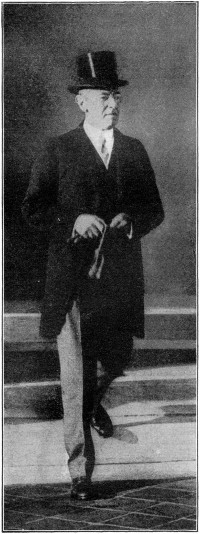
PRESIDENT WILSON LEAVING THE EXECUTIVE OFFICES
During 1916 the Republic of Santo Domingo likewise passed under an American protectorate and the Rural Credits Bill became a law, whereby a system of Farm Loan Banks was created.
From the very beginning of the European war the administration of President Wilson was brought face to face with numerous intricate and several critical diplomatic situations growing out of that titanic conflict. The relationship of the United States, as a neutral nation, to the belligerent countries engaged in this war gave rise to more difficult and significant issues than any other president was compelled to meet since the time of Lincoln, if indeed, it has not been unprecedented in our entire history.
President Wilson Re-elected and His Policies Approved.—At the national election, in November, 1916, President Wilson was re-elected over his opponent, Charles E. Hughes. Following his re-election (December, 1916) the President proffered the services of this government to the belligerent powers of Europe in an effort to re-establish peace between these great contending coalitions. In spite of foreign complications, the year 1916 closed a period of unparalleled industrial and commercial prosperity for the United States, and more than ever confirmed its position as a great world power, with an immense field of new possibilities and corresponding duties.
On January 2, 1917, Congress re-assembled and began the consideration of important questions of national defense, railroads, and foreign policy growing out of the European war. In February, diplomatic relations were severed by the United States with Germany, and was succeeded in March by a declaration of armed neutrality on the part of our government.
Meanwhile great activity characterized all departments of the national government along lines of military preparedness, supported by unprecedented appropriations by Congress.
The supreme national industrial event of the Wilson administration, however, was the opening of the Panama Canal for navigation on August 14, 1914, and its use since that time as an instrumentality of world traffic.
Panama Canal.—This gigantic engineering project was designated by Count de Lesseps, of France, in 1879, and actual work began by the French Panama Canal Company, in 1881. Negotiations extending from 1901 to 1904 resulted in the taking over of the holdings of the French company by the United States, and work was started by United States government engineers in May of the latter year. Since that time the project has been steadily carried forward to completion.
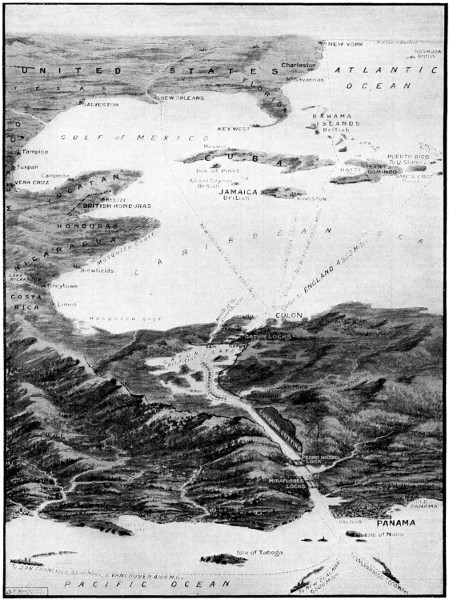
The Canal is about fifty miles in length from deep water in the Caribbean Sea to deep water in the Pacific Ocean. The channel ranges in width from three hundred to one thousand feet. The average bottom width of the channel in this project is six hundred and forty-nine feet, and the minimum width is three hundred feet. The Canal has a minimum depth of forty-one feet. The time required for the passage of a ship of medium size through the entire length of the Canal is estimated at from nine and one-half to ten hours, and for larger vessels from ten and one-half to eleven hours.
The actual construction cost at present estimated for completing the Canal is $325,201,000, which includes $20,053,000 for sanitation and $7,382,000 for civil administration. These figures do not include the $50,000,000 paid to the New French Canal Company and to the Republic of Panama for property and franchises. Hence it is estimated that the total construction cost of the Canal to the United States will approximate $375,000,000.
CONTOUR MAP OF THE PANAMA CANAL AND CONNECTIONS
This map shows the general direction of the canal to be north and south; how it is brought into direct communication with the ports of the United States; and how it facilitates shipping to all parts of the world.
Large map (535 kB)
TABLE OF STATE AND TERRITORIAL GOVERNMENT
In all the States except Arizona, California, Colorado, Idaho, Kansas, Montana, Nevada, Oregon, Utah, Washington and Wyoming and the Territory of Alaska, the right to vote at general elections is restricted to males of twenty-one years of age and upward. Women in Illinois, Iowa and Michigan have a restricted vote and in several States may vote at school elections.
States and Popular Name Requirements as to Citizenship Persons Excluded from Suffrage (in italic) Previous Residence Required Governors Legislatures Members’ Terms Elec- toral Vote, 1916
In State In Co. In Town In Pre- cinct Salaries Length Term Years Ann. or Bien. Limit of Session Salaries of Members Sena- tors Repre- senta- tives
Alabama “Lizard” Citizen of United States or alien who has declared intention. Convicted of treason or other felonies, idiots, vagrants, insane. 2 years 1 year 3 mos. 3 mos. $ 7,500 4 Quad. 50 days $4.00 per diem 4 4 12
Alaska Citizen of the United States, male or female. Aliens and Indians. 1 year ... 30 days 30 days 7,000 4 Bien. 60 days $15.00 per diem 4 2 0
Arizona Citizen of the United States, male or female. Idiot, insane, felon* (b). 1 year 30 days 30 days 30 days 4,000 2 Bien. 60 days $7.00 per diem 2 2 3
Arkansas “Bear” Citizen of the United States or alien who has declared intention. Idiots, insane, convicted of felony, failure to pay poll tax. 1 year 6 mos. 30 days 30 days 5,000 2 Bien. 60 days $6.00 per diem 4 2 9
California “Golden” Citizen, male or female, by nativity, naturalization 90 days prior to election (d). Idiots, insane, embezzlers of public moneys, convicted of infamous crime.* 1 year 90 days ... 30 days 10,000 4 Bien. None $1,000 term 4 2 13
Colorado “Centennial” Citizen, native or naturalized, male or female. Felons, insane. 1 year 90 days 30 days 10 days 5,000 2 Bien. 90 days $1,000 term 4 2 6
Connecticut “Nutmeg” Citizen of the United States. Convicted of heinous crime. 1 year ... 6 mos. ... 5,000 2 Bien. None $300 term 2 2 7
Delaware “Diamond” Citizen of the United States. Insane, paupers, felons.* 1 year 3 mos. ... 30 days 4,000 4 Bien. 60 days $5.00 per diem 4 2 3
Dist. of Col. See foot note on following page. ... ... ... ... ... ... ... ... ... ... ... 0
Florida “Flower” Citizen of the United States. Idiots, duelists, felons. 1 year 6 mos. 6 mos. 6 mos. 6,000 4 Bien. 60 days $6.00 per diem 4 2 6
Georgia “Cracker” Citizen of the United States. Felons, idiots and insane. 6 mos. 6 mos. ... ... 5,000 2 Ann. 50 days $4.00 per diem 2 2 14
Hawaii Citizen of the United States. Idiots, insane, felons (j). 1 year ... ... 3 mos. 7,000 4 Bien. 60 days $600 session 4 2 0
Idaho Citizen of the United States, male or female. Idiots, insane, felons, bigamists. 6 mos. 30 days ... ... 5,000 2 Bien. 60 days $5.00 per diem 2 2 4
Illinois “Prairie” Citizen of the United States (e). Convicted of crime. 1 year 90 days 30 days 30 days 12,000 4 Bien. None $3,500 annum 4 2 29
Indiana “Hoosier” Citizen of the United States or alien who has declared intention (g). Convicted of infamous crime. (b) 6 mos. ... 60 days 30 days 8,000 4 Bien. 61 days $6.00 per diem 4 2 15
Iowa “Hawkeye” Citizen of the United States (k). Idiots, insane, felons. 6 mos. 60 days 10 days 10 days 5,000 2 Bien. None $1,000 session 4 2 13
Kansas “Sunflower” Citizen of the United States, male or female, or alien who has declared intention. Convicted of treason or felony, insane. 6 mos. 30 days 30 days 10 days 5,000 2 Bien. 50 days $3.00 per diem 4 2 10
Kentucky “Blue Grass” Citizen of United States (a). Felons, idiots and insane. 1 year 6 mos. ... 60 days 6,500 4 Bien. 60 days $10.00 per diem 4 2 13
Louisiana “Creole” Citizen of United States (c). Idiots, insane, felons.* 2 years 1 year ... 6 mos. 5,000 4 Bien. 60 days $5.00 per diem 4 4 10
Maine “Pine Tree” Citizen of the United States. Paupers, insane, Indians.*‡ 3 mos. 3 mos. 3 mos. 3 mos. 3,000 2 Bien. None $300 annum 2 2 6
Maryland “Old Line” Citizen of the United States. Felons, lunatics, bribers. 1 year 6 mos. 6 mos. 1 day 4,500 4 Bien. 90 days $5.00 per diem 4 2 8
Massachusetts “Bay” Citizen (a). Paupers.* 1 year 6 mos. 6 mos. 6 mos. 10,000 1 Ann. None $1,000 annum 1 1 18
Michigan “Wolverine” Citizen of the United States or alien who declared intention two years and six months prior to November 8, 1894 (c). Indians with tribal relations. 6 mos. 20 days 20 days 20 days 5,000 2 Bien. None $800 annum 2 2 15
Minnesota “North Star” Citizen of United States (a). Felons, insane, Indians.‡ 6 mos. 30 days 30 days 30 days 7,000 2 Bien. 90 days $1,000 session 4 2 12
Mississippi “Bayou” Citizen of the United States. Insane, idiots, Indians not taxed, felons, bigamists.* 2 years 1 year 1 year 1 year 5,000 4 Bien. None $500 session 4 4 10
Missouri Citizen of the United States or alien who has declared intention. Felons(b). 1 year 60 days 60 days ... 5,000 4 Bien. 70 days $5.00 per diem 4 2 18
Montana “Mountain” Citizen of the United States, male or female. Felons, idiots, insane‡ (b). 1 year 30 days ... ... 5,000 4 Bien. 60 days $10.00 per diem 4 2 4
Nebraska Citizen of the United States or alien who has declared intention (a). Felons, insane. 6 mos. 40 days 10 days 10 days 2,500 2 Bien. 60 days $10.00 session 2 2 8
Nevada “Silver” Citizen of the United States, male or female. Idiots, insane, felons. 6 mos. 30 days 30 days 30 days 7,000 4 Bien. 60 days $600 term 2-4 2 3
New Hampshire “Granite” Citizen of United States (a). Paupers, insane, idiots, felons. 6 mos. 6 mos. 6 mos. 6 mos. 3,000 2 Bien. None $200 term 2 2 4
New Jersey “Jersey Blue” Citizen of the United States. Idiots, paupers, insane, felons (b). 1 year 5 mos. ... ... 10,000 3 Ann. None $500 annum 3 1 14
New Mexico Citizen of United States (a). Idiots, insane, felons.† 1 year 90 days ... 30 days 5,000 5 Bien. 60 days $5.00 per diem 4 2 3
New York “Empire” Citizen who shall have been a citizen for ninety days prior to election. 1 year 4 mos. 30 days 30 days 10,000 2 Ann. None $1,500 annum 2 1 45
North Carolina “Old North” Citizen of the United States. Idiots, lunatics, felons. 2 years 6 mos. 4 mos. 4 mos. 5,000 4 Bien. 60 days $4.00 per diem 2 2 12
North Dakota “Sioux” Citizen of United States (a). Felons, insane, tribal Indians. 1 year 6 mos. 90 days 90 days 5,000 2 Bien. 60 days $5.00 per diem 4 2 5
Ohio “Buckeye” Citizen of United States (a). Idiots, insane, and felons (b). 1 year 30 days 20 days 20 days 10,000 2 Bien. None $1,000 annum 2 2 24
Oklahoma Citizen of United States (a). Felons, idiots, insane*‡ 1 year 6 mos. ... 30 days 4,500 4 Bien. 60 days $6.00 per diem 4 2 10
Oregon “Sunset” Citizen of the United States, male or female, or alien who declared intention more than one year prior to election. Idiots, insane, convicted of felony, U. S. soldiers and sailors. 6 mos. 30 days ... 30 days 5,000 4 Bien. 40 days $3.00 per diem 4 2 5
Pennsylvania “Keystone” Citizen of the United States at least one month. Felons, non-taxpayers. 1 year ... ... 2 mos. 10,000 4 Bien. None $1,500 session 2 2 38
Porto Rico Citizen of United States (f). Felons, insane (b). 1 year ... 1 year ... 8,000 4 Ann. 60 days $5.00 per diem 4 2 0
Rhode Island “Little Rhody” Citizen of the United States. Paupers, lunatics, felons. 2 years ... 6 mos. ... 3,000 2 Ann. 60 days $5.00 per diem 2 2 5
South Carolina “Palmetto” Citizen of United States (h). Felons, insane, paupers. 2 years 1 year 4 mos. 4 mos. 3,000 2 Ann. 40 days $200 term 4 2 9
South Dakota “Coyote” Citizen of the United States or alien who has declared intention. Insane, felons, U. S. soldiers, seamen and marines. 6 mos. 30 days 10 days 10 days 3,000 2 Bien. 60 days $5.00 per diem 2 2 5
Tennessee “Volunteer” Citizen of the United States. Felons, failure to pay poll tax. 1 year 6 mos. ... ... 4,000 2 Bien. 75 days $4.00 per diem 2 2 12
Texas “Lone Star” Citizen of the United States or alien who has declared intention. Idiots, lunatics, felons, U. S. soldiers, marines and seamen. 1 year 6 mos. 6 mos. ... 4,000 2 Bien. 90 days $5.00 per diem 4 2 20
Utah Citizen of the United States, male or female. Idiots, insane, felons (b). 1 year 4 mos. ... 60 days 6,000 4 Bien. 60 days $4.00 per diem 4 2 4
Vermont “Green Mountain” Citizen of the United States. Those lacking approbation of local board of civil authority. 1 year 3 mos. 3 mos. 3 mos. 2,500 2 Bien. None $4.00 per diem 2 2 4
Virginia “Old Dominion” Citizen of the United States. Idiots, lunatics, paupers (b) (i). 2 years 1 year 1 year 30 days 5,000 4 Bien. 60 days $500 session 4 2 12
Washington “Evergreen” Citizen of the United States, male or female. Idiots, lunatics, felons.‡ 1 year 90 days 30 days 30 days 6,000 4 Bien. 60 days $5.00 per diem 4 2 7
West Virginia “Panhandle” Citizen of the United States. Idiots, lunatics, felons. 1 year 60 days 60 days ... 5,000 4 Bien. 45 days $4.00 per diem 4 2 8
Wisconsin “Badger” Citizen of United States (a). Insane, felons, tribal Indians. 1 year ... 10 days 10 days 5,000 2 Bien. None $500 annum 4 2 13
Wyoming Citizen of the United States, male or female. Idiots, insane, felons, unable to read State Constitution. 1 year 60 days 10 days 10 days 4,000 4 Bien. 40 days $8.00 per diem 4 2 3
States and Popular Name Requirements as to Citizenship Persons Excluded from Suffrage (in italic) Previous Residence Required
In State In Co. In Town In Precinct
Alabama “Lizard” Citizen of United States or alien who has declared intention. Convicted of treason or other felonies, idiots, vagrants, insane. 2 years 1 year 3 mos. 3 mos.
Alaska Citizen of the United States, male or female. Aliens and Indians. 1 year ... 30 days 30 days
Arizona Citizen of the United States, male or female. Idiot, insane, felon* (b). 1 year 30 days 30 days 30 days
Arkansas “Bear” Citizen of the United States or alien who has declared intention. Idiots, insane, convicted of felony, failure to pay poll tax. 1 year 6 mos. 30 days 30 days
California “Golden” Citizen, male or female, by nativity, naturalization 90 days prior to election (d). Idiots, insane, embezzlers of public moneys, convicted of infamous crime.* 1 year 90 days ... 30 days
Colorado “Centennial” Citizen, native or naturalized, male or female. Felons, insane. 1 year 90 days 30 days 10 days
Connecticut “Nutmeg” Citizen of the United States. Convicted of heinous crime. 1 year ... 6 mos. ...
Delaware “Diamond” Citizen of the United States. Insane, paupers, felons.* 1 year 3 mos. ... 30 days
Dist. of Col. See foot note on following page. ... ... ... ...
Florida “Flower” Citizen of the United States. Idiots, duelists, felons. 1 year 6 mos. 6 mos. 6 mos.
Georgia “Cracker” Citizen of the United States. Felons, idiots and insane. 6 mos. 6 mos. ... ...
Hawaii Citizen of the United States. Idiots, insane, felons (j). 1 year ... ... 3 mos.
Idaho Citizen of the United States, male or female. Idiots, insane, felons, bigamists. 6 mos. 30 days ... ...
Illinois “Prairie” Citizen of the United States (e). Convicted of crime. 1 year 90 days 30 days 30 days
Indiana “Hoosier” Citizen of the United States or alien who has declared intention (g). Convicted of infamous crime. (b) 6 mos. ... 60 days 30 days
Iowa “Hawkeye” Citizen of the United States (k). Idiots, insane, felons. 6 mos. 60 days 10 days 10 days
Kansas “Sunflower” Citizen of the United States, male or female, or alien who has declared intention. Convicted of treason or felony, insane. 6 mos. 30 days 30 days 10 days
Kentucky “Blue Grass” Citizen of United States (a). Felons, idiots and insane. 1 year 6 mos. ... 60 days
Louisiana “Creole” Citizen of United States (c). Idiots, insane, felons.* 2 years 1 year ... 6 mos.
Maine “Pine Tree” Citizen of the United States. Paupers, insane, Indians.*‡ 3 mos. 3 mos. 3 mos. 3 mos.
Maryland “Old Line” Citizen of the United States. Felons, lunatics, bribers. 1 year 6 mos. 6 mos. 1 day
Massachusetts “Bay” Citizen (a). Paupers.* 1 year 6 mos. 6 mos. 6 mos.
Michigan “Wolverine” Citizen of the United States or alien who declared intention two years and six months prior to November 8, 1894 (c). Indians with tribal relations. 6 mos. 20 days 20 days 20 days
Minnesota “North Star” Citizen of United States (a). Felons, insane, Indians.‡ 6 mos. 30 days 30 days 30 days
Mississippi “Bayou” Citizen of the United States. Insane, idiots, Indians not taxed, felons, bigamists.* 2 years 1 year 1 year 1 year
Missouri Citizen of the United States or alien who has declared intention. Felons(b). 1 year 60 days 60 days ...
Montana “Mountain” Citizen of the United States, male or female. Felons, idiots, insane.‡ (b). 1 year 30 days ... ...
Nebraska Citizen of the United States or alien who has declared intention (a). Felons, insane. 6 mos. 40 days 10 days 10 days
Nevada “Silver” Citizen of the United States, male or female. Idiots, insane, felons. 6 mos. 30 days 30 days 30 days
New Hampshire “Granite” Citizen of United States (a). Paupers, insane, idiots, felons. 6 mos. 6 mos. 6 mos. 6 mos.
New Jersey “Jersey Blue” Citizen of the United States. Idiots, paupers, insane, felons (b). 1 year 5 mos. ... ...
New Mexico Citizen of United States (a). Idiots, insane, felons.† 1 year 90 days ... 30 days
New York “Empire” Citizen who shall have been a citizen for ninety days prior to election. 1 year 4 mos. 30 days 30 days
North Carolina “Old North” Citizen of the United States. Idiots, lunatics, felons. 2 years 6 mos. 4 mos. 4 mos.
North Dakota “Sioux” Citizen of United States (a). Felons, insane, tribal Indians. 1 year 6 mos. 90 days 90 days
Ohio “Buckeye” Citizen of United States (a). Idiots, insane, and felons (b). 1 year 30 days 20 days 20 days
Oklahoma Citizen of United States (a). Felons, idiots, insane*‡ 1 year 6 mos. ... 30 days
Oregon “Sunset” Citizen of the United States, male or female, or alien who declared intention more than one year prior to election. Idiots, insane, convicted of felony, U. S. soldiers and sailors. 6 mos. 30 days ... 30 days
Pennsylvania “Keystone” Citizen of the United States at least one month. Felons, non-taxpayers. 1 year ... ... 2 mos.
Porto Rico Citizen of United States (f). Felons, insane (b). 1 year ... 1 year ...
Rhode Island “Little Rhody” Citizen of the United States. Paupers, lunatics, felons. 2 years ... 6 mos. ...
South Carolina “Palmetto” Citizen of United States (h). Felons, insane, paupers. 2 years 1 year 4 mos. 4 mos.
South Dakota “Coyote” Citizen of the United States or alien who has declared intention. Insane, felons, U. S. soldiers, seamen and marines. 6 mos. 30 days 10 days 10 days
Tennessee “Volunteer” Citizen of the United States. Felons, failure to pay poll tax. 1 year 6 mos. ... ...
Texas “Lone Star” Citizen of the United States or alien who has declared intention. Idiots, lunatics, felons, U. S. soldiers, marines and seamen. 1 year 6 mos. 6 mos. ...
Utah Citizen of the United States, male or female. Idiots, insane, felons (b). 1 year 4 mos. ... 60 days
Vermont “Green Mountain” Citizen of the United States. Those lacking approbation of local board of civil authority. 1 year 3 mos. 3 mos. 3 mos.
Virginia “Old Dominion” Citizen of the United States. Idiots, lunatics, paupers (b) (i). 2 years 1 year 1 year 30 days
Washington “Evergreen” Citizen of the United States, male or female. Idiots, lunatics, felons.‡ 1 year 90 days 30 days 30 days
West Virginia “Panhandle” Citizen of the United States. Idiots, lunatics, felons. 1 year 60 days 60 days ...
Wisconsin “Badger” Citizen of United States (a). Insane, felons, tribal Indians. 1 year ... 10 days 10 days
Wyoming Citizen of the United States, male or female. Idiots, insane, felons, unable to read State Constitution. 1 year 60 days 10 days 10 days
States and Popular Name Governors Legislatures Members’ Terms Elec- toral Vote, 1916
Salaries Length Term Years Ann. or Bien. Limit of Session Salaries of Members Senators Repre- sentatives
Alabama “Lizard” $ 7,500 4 Quad. 50 days $4.00 per diem 4 4 12
Alaska 7,000 4 Bien. 60 days $15.00 per diem 4 2 0
Arizona 4,000 2 Bien. 60 days $7.00 per diem 2 2 3
Arkansas “Bear” 5,000 2 Bien. 60 days $6.00 per diem 4 2 9
California “Golden” 10,000 4 Bien. None $1,000 term 4 2 13
Colorado “Centennial” 5,000 2 Bien. 90 days $1,000 term 4 2 6
Connecticut “Nutmeg” 5,000 2 Bien. None $300 term 2 2 7
Delaware “Diamond” 4,000 4 Bien. 60 days $5.00 per diem 4 2 3
Dist. of Col. ... ... ... ... ... ... ... 0
Florida “Flower” 6,000 4 Bien. 60 days $6.00 per diem 4 2 6
Georgia “Cracker” 5,000 2 Ann. 50 days $4.00 per diem 2 2 14
Hawaii 7,000 4 Bien. 60 days $600 session 4 2 0
Idaho 5,000 2 Bien. 60 days $5.00 per diem 2 2 4
Illinois “Prairie” 12,000 4 Bien. None $3,500 annum 4 2 29
Indiana “Hoosier” 8,000 4 Bien. 61 days $6.00 per diem 4 2 15
Iowa “Hawkeye” 5,000 2 Bien. None $1,000 session 4 2 13
Kansas “Sunflower” 5,000 2 Bien. 50 days $3.00 per diem 4 2 10
Kentucky “Blue Grass” 6,500 4 Bien. 60 days $10.00 per diem 4 2 13
Louisiana “Creole” 5,000 4 Bien. 60 days $5.00 per diem 4 4 10
Maine “Pine Tree” 3,000 2 Bien. None $300 annum 2 2 6
Maryland “Old Line” 4,500 4 Bien. 90 days $5.00 per diem 4 2 8
Massachusetts “Bay” 10,000 1 Ann. None $1,000 annum 1 1 18
Michigan “Wolverine” 5,000 2 Bien. None $800 annum 2 2 15
Minnesota “North Star” 7,000 2 Bien. 90 days $1,000 session 4 2 12
Mississippi “Bayou” 5,000 4 Bien. None $500 session 4 4 10
Missouri 5,000 4 Bien. 70 days $5.00 per diem 4 2 18
Montana “Mountain” 5,000 4 Bien. 60 days $10.00 per diem 4 2 4
Nebraska 2,500 2 Bien. 60 days $10.00 session 2 2 8
Nevada “Silver” 7,000 4 Bien. 60 days $600 term 2-4 2 3
New Hampshire “Granite” 3,000 2 Bien. None $200 term 2 2 4
New Jersey “Jersey Blue” 10,000 3 Ann. None $500 annum 3 1 14
New Mexico 5,000 5 Bien. 60 days $5.00 per diem 4 2 3
New York “Empire” 10,000 2 Ann. None $1,500 annum 2 1 45
North Carolina “Old North” 5,000 4 Bien. 60 days $4.00 per diem 2 2 12
North Dakota “Sioux” 5,000 2 Bien. 60 days $5.00 per diem 4 2 5
Ohio “Buckeye” 10,000 2 Bien. None $1,000 annum 2 2 24
Oklahoma 4,500 4 Bien. 60 days $6.00 per diem 4 2 10
Oregon “Sunset” 5,000 4 Bien. 40 days $3.00 per diem 4 2 5
Pennsylvania “Keystone” 10,000 4 Bien. None $1,500 session 2 2 38
Porto Rico 8,000 4 Ann. 60 days $5.00 per diem 4 2 0
Rhode Island “Little Rhody” 3,000 2 Ann. 60 days $5.00 per diem 2 2 5
South Carolina “Palmetto” 3,000 2 Ann. 40 days $200 term 4 2 9
South Dakota “Coyote” 3,000 2 Bien. 60 days $5.00 per diem 2 2 5
Tennessee “Volunteer” 4,000 2 Bien. 75 days $4.00 per diem 2 2 12
Texas “Lone Star” 4,000 2 Bien. 90 days $5.00 per diem 4 2 20
Utah 6,000 4 Bien. 60 days $4.00 per diem 4 2 4
Vermont “Green Mountain” 2,500 2 Bien. None $4.00 per diem 2 2 4
Virginia “Old Dominion” 5,000 4 Bien. 60 days $500 session 4 2 12
Washington “Evergreen” 6,000 4 Bien. 60 days $5.00 per diem 4 2 7
West Virginia “Panhandle” 5,000 4 Bien. 45 days $4.00 per diem 4 2 8
Wisconsin “Badger” 5,000 2 Bien. None $500 annum 4 2 13
Wyoming 4,000 4 Bien. 40 days $8.00 per diem 4 2 3
Note.—Residents of the District of Columbia never had the right to vote therein for national officers, or on other matters of national concern after the territory embraced in it was ceded to the United States and became the seat of the general Government.
* Or persons unable to read and write in English. † Or citizens of Mexico who desire to become citizens of Arizona under treaties of 1848 and 1854. ‡ Indians who have not severed tribal relations. (a): Women can vote in school elections. (b): Also soldiers, sailors and marines in United States service. (c): Women taxpayers can vote on tax propositions. (d): Or by Queretaro treaty. (e): Women can vote in all elections except those pertaining to Constitutional officers or Constitutional propositions. (f): Males born in Porto Rico who formally renounced allegiance to a foreign power. (g): One year’s residence in the United States prior to election is required. (h): Who has paid six months before election all taxes then due, and can read and write any section of the State Constitution, or can show that he owns and has paid all taxes due the previous year on property in the State assessed at $300 or more. (i): Failure to pay poll tax. (j): Or those unable to speak, read and write the English or Hawaiian language. (k): Women can vote in school and city elections. (l): Offenders against elective franchise rights, guilty of bribery, betting on elections, and persons convicted of a felony and not restored to citizenship by the Executive. Convicts in House of Refuge or Reformatory not disqualified. (m): All of the States and Territories pay mileage also, except New Jersey, but free transportation is accorded in New Jersey by all railroads to members by law.
GOVERNMENTS OF THE UNITED STATES, BRITISH EMPIRE, GERMANY, AND FRANCE ARRANGED IN PARALLEL COLUMNS
UNITED STATES BRITISH EMPIRE GERMANY FRANCE
Form of Government: Republic. The general plan of the government of the United States is determined by the Constitution. The central government is limited to the exercise of the powers specifically enumerated in the Constitution, or implied therein, while the remaining governmental powers, not denied to the states by the Constitution, are reserved to the states. The general government is in three fairly well defined parts, the legislative, executive, and judicial. Form of Government.—Monarchy in form, but republic in practice. The monarchy is constitutional and limited. The British Empire consists of the United Kingdom of Great Britain and Ireland, the Empire of India, and the British Dominions beyond the Seas, including the self-governing Dominions, and the Crown Colonies, Protectorates, and other Dependencies, the whole forming one Empire. Form of Government.—The Empire, according to the Constitution of April 16, 1871, is a Confederate League, bearing the name German Empire, under the hereditary presidentship of the King of Prussia, who holds the title of German Emperor, and whose eldest son is styled His Imperial and Royal Highness. Form of Government.—France, since the overthrow of Napoleon III., in 1870, has been a republic governed by a President and two Chambers under the Constitution.
I. Constitution.—The present Constitution was adopted September 17, 1787. Ratification of the Constitution.—The Constitution was ratified by the thirteen original States in the following order: Delaware, Dec. 7, 1787, unanimously. Pennsylvania, Dec. 12, 1787, vote 46 to 23. New Jersey, Dec. 18, 1787, unanimously. Georgia, Jan 2, 1788, unanimously. Connecticut, Jan 9, 1788, vote 128 to 40. Massachusetts, Feb. 6, 1788, vote 187 to 168. Maryland, April 28, 1788, vote 63 to 12. South Carolina, May 23, 1788, vote 149 to 73. New Hampshire, June 21, 1788, vote 57 to 46. Virginia, June 25, 1788, vote 89 to 79. New York, July 26, 1788, vote 30 to 28. North Carolina, Nov. 21, 1789, vote 193 to 75. Rhode Island, May 29, 1790, vote 34 to 32. I. Constitution.—The British Constitution is mainly unwritten and customary, but its development is marked by certain outstanding and fundamental laws, of which the principal are: Magna Charta, 1215; the Habeas Corpus Act, 1679; the Act of Settlement, 1701; the Act of Union with Scotland, 1707; the Act of Union with Ireland, 1800; and the Parliament Act, 1911. The first secured annual parliaments and the equal administration of justice; the second established the liberty of the person; the third provided for the Protestant succession to the throne; the fourth and fifth created the United Kingdom; and the last enabled the Commons to pass certain Acts without the adherence of the other Chamber. I. Constitution. Adoption.—Present Constitution adopted April 16, 1871. The Constitution of the German Empire is substantially that of the North German Confederation, which came into force in 1867, and which was adopted by the Empire in 1871, after the southern states of Germany had combined with the northern. I. Constitution. Adoption.—Present Constitution adopted February 25, 1875. It has undergone but slight modifications. The present French Constitution remains a mixture of monarchical and republican institutions, and it has fully maintained its strong and old-established centralization. The Constitution of 1875 is based on universal suffrage. It was revised in 1875, 1884, 1885 and 1889.
Amendments.—Congress may, by two-thirds vote of both Houses, propose amendments to the Constitution, or upon application of the Legislatures of two-thirds of the several States, shall call a convention for proposing amendments, which, in either case, must be ratified by the Legislatures of three-fourths of the several States, or by conventions in three-fourths thereof. Amendments.—Amendments to the Constitution can be proposed by either of the legislative bodies, are passed by ordinary legislative process, requiring for their passage a majority simply of the votes of the Reichstag, but they fail if fourteen votes are cast against them in the Bundesrath. Amendments.—Whenever the two Houses agree that revision is necessary, and also agree upon particular points that should be revised, the National Assembly, composed of the Senate and the Chamber of Deputies, sitting as one body, convenes at Versailles, and acts upon the amendments proposed, the vote of an absolute majority being decisive. The National Assembly also elects the President of the republic.
II. The President. How Elected.—The several steps in the election of the President are: State Electors are chosen at a General Election held on the Tuesday following the first Monday of November of every fourth year; the number of Electors of each State being equal to the number of Senators and Representatives to which the State is entitled in Congress. The Electors meet in their respective States on the second Monday in January following their election, and vote by ballot for President and Vice-President; and at the same time make certificates of their vote and transmit the same to the President of the Senate. The Senate and House of Representatives meet together on the second Wednesday of February next ensuing, and count the votes of the State Electors, when, if there is an election, the President of the Senate declares who is elected President and Vice-President. In case there is no choice by the State Electors, the President is elected by the House of Representatives from the three candidates who received the most electoral votes for President; in which election the vote is taken by States, each State having but one vote, and a majority of all the States being necessary to a choice. Term of Office.—Four years. Eligibility.—A natural born citizen; resident of the United States fourteen years; minimum age thirty-five years. II. The Sovereign. How Designated.—The King’s legal title rests upon the Act of Settlement, in 1701, under William III., by which the succession to the Crown of Great Britain and Ireland was settled on the Princess Sophia of Hanover and the “heirs of her body, being Protestants.” The throne is hereditary in the English house of Saxe-Coburg-Gotha with mixed succession, the sons of the Sovereign and their descendants having precedence of daughters, but daughters and their descendants preference over lateral lines. The Sovereign is designated King (or Queen) of Great Britain and Ireland, and Emperor (or Empress) of India. Term of Office.—Holds office for life, by hereditary title, and cannot be removed. II. Chief magistrate, styled the Deutscher Kaiser. How Designated.—The election of Wilhelm I., King of Prussia, as German Emperor (1871) was by vote of the Reichstag of the North German Confederation, on the initiative of all the reigning Princes of Germany. The Imperial dignity is hereditary in the House of Hohenzollern, and follows the law of primogeniture in the male line. He must be occupant of the throne of Prussia under the provisions of Prussian law. Term of Office.—Holds office for life,and cannot be removed. II. Chief Magistrate, or President of the Republic. Term of Office.—Elected for seven years by the National Assembly, and is re-eligible. The National Assembly meets for the purposes of this election, as for the revision of the Constitution, at Versailles. The revision of the Constitution and the election of President are its only functions. Qualifications.—Must be a citizen, not a member of any family which has occupied the throne of France.
Salary.—Fixed by law at $75,000 per year. Salary or Civil List.—The Civil List Act, 1910, gave the King $2,350,000. Provision for other members of the Royal Family, $730,000. The Prince of Wales, as the income of the Duchy of Cornwall, $435,000. The King in addition to his Civil List receives the revenues of the Duchy of Lancaster amounting to $320,000. Salary or Income.—Royal Civil List of Emperor, $3,700,000. Salary.—$140,000. Responsibilities.—May be impeached by the Chamber of Deputies, and tried by the Senate, in case of high treason.
Powers and Duties of the President.—Commander-in-Chief of the Army and Navy. Communicates with Congress by message. Approves or disapproves Acts of Congress. Makes treaties with advice and consent of the Senate. Appoints Public Officers with the advice and consent of the Senate. Commissions Public Officers of the United States. Grants reprieves and pardons for offenses against the United States. The Vice-President.—Elected by State Electors the same as the President; or by the Senate, in case there is no choice by the State Electors. Term of office same as for the President. Eligibility same as required of the President. Salary fixed by law at twelve thousand dollars per year. The Presidential Succession.—In case of the removal, death, resignation, or inability of the President, the Vice-President takes the President’s place. In case of the removal, death, resignation, or inability of both President and Vice-President the heads of the Executive Departments succeed to the Presidency in the order in which the Executive Departments are named below; but such officer must be constitutionally eligible to the Presidency, must have been appointed to the cabinet by the advice and with the consent of the Senate, and be not under impeachment. The Secretary of Agriculture and the Secretary of Commerce and Labor are ineligible to the presidency by reason of the fact that these two cabinet offices were created subsequent to the passage of the act of the forty-ninth Congress in which provision was made for the presidential succession. Powers and Duties.—Has command of army and navy. Parliament cannot be assembled, prorogued, or dissolved except by the express command of the Sovereign. At the commencement of a new Parliament must deliver, either in person or by a commission authorized for that purpose, a speech declaring the cause of the summons. Bills passed by Parliament must receive the assent of the Sovereign in order to become law. Has legally a veto power; but, because the influence of the Executive over legislation has passed into the hands of the Ministers, the veto of the Crown has been disused since 1707. Has power to appoint all officers in the army and navy, judges, ambassadors, colonial governors, bishops and archbishops of the Established Church, and grants all degrees of nobility. May make treaties of any kind. May grant pardon to any particular offender. The Privy Council.—The King in Council is the supreme executive authority in the realm. The Privy Council meets as a whole at the beginning of a new reign and on other occasions of state and ceremony, possesses certain administrative powers, and is the Supreme Court of the Empire. Its personnel includes the royal princes and the archbishops, Members of the Cabinet and of the royal household, the Speaker of the House of Commons, the ambassadors, the principal colonial governors, colonial statesmen, certain judges, and members of both political parties who have never been in office. The important functions of the Council are the bringing into operation by means of orders in council of the provisions of many statutes which Parliament leaves to the executive to enforce, temporarily or permanently, at such time or times as it may deem necessary and desirable. These orders have all the force and validity of law. Powers and Duties.—Commander-in-Chief of the imperial army. Summons, opens, adjourns, and closes the two Houses. He may dissolve the Reichstag upon advice of the Bundesrath. All measures passed by the Bundesrath are presented to the Reichstag in the name of the Emperor. Bills passed by the two Houses must be promulgated by the Emperor. In cases where he regards them as involving a change in the Constitution, he need not promulgate them if fourteen votes have been cast against them in the Bundesrath. All official acts of the Emperor require the counter-signature of the Chancellor. Appoints and may, at his pleasure, remove the Imperial Chancellor. Appoints and may, with the counter-signature of the Chancellor, remove all minor officers in the imperial service. May declare war if defensive, and make treaties and peace; but for declaring offensive war the consent of the Bundesrath must be obtained. Has power to grant pardons. Powers and Duties.—Has command of the army and navy. May convene the Chambers on extraordinary occasions. May adjourn the Chambers at any time for a period not exceeding one month. Can close a regular session of the Chambers at his discretion after it has continued five months; an extra session when he pleases. Can with the consent of the Senate dissolve the Chamber of Deputies even before the expiration of five months. This puts an end to the session of the Senate also, but not to its life. The President must order a new election in case of dissolution. At the commencement of a new session of the Chambers the President of the republic sends a message, which is read by one of the Ministers. Bills passed by the Chambers must be signed by the President, and countersigned by one of his Ministers. Has no veto power, but is authorized to demand a reconsideration of any measure by the Chambers. Has power to appoint and remove all officers of the public service, subject to the counter-signature of the Minister whose department is affected in each case. May make treaties of peace, alliance and commerce, but cannot declare war without the advice of the Chambers. Has power to grant pardons. Succession.—In case of his death, resignation, or removal, the Council of Ministers act until the National Assembly can meet and elect a new President.
The Executive Departments The Executive Departments The Executive Departments The Executive Departments
Acts of Congress become laws:— When signed (approved) by the President; or, by his failure to make objection in writing (veto) within ten days after any act is submitted to him, unless Congress by adjournment within that time prevents its return; but Congress has power to pass a law over the President’s veto by a vote of two-thirds of each House.
The Cabinet The Ministry Imperial Chancellor.—He has no counterpart in any other constitutional government. He is the Emperor’s responsible proxy, controlling the politics of the Empire. Appointment and Tenure of Office.—Appointed by the Emperor. Must be one of Prussia’s seventeen representatives in the Bundesrath. His term is dependent upon the pleasure of the Emperor. Responsibility.—Does not consist in a liability to be forced to resign, but consists simply in amenability to the laws. Powers and Duties.—Must give an account of the administration to the Reichstag, and submits the annual budget. He is the center and source of all the administrative departments, dominating the entire imperial service. He superintends the administration of the laws of the Empire by the States. As chairman of the Bundesrath he is simply a Prussian representing the King of Prussia, as the Emperor has no place in the Bundesrath. The army and navy, however, are not directly controlled by him, but by the General Field-Marshal. The following are the imperial authorities or Secretaries of State; they do not form a Ministry or Cabinet, but act independently of each other, under the general supervision of the Chancellor: Chancellor of the Empire. Secretary for Foreign Affairs. Imperial Home Office and Representative of the Chancellor. Imperial Admiralty. Imperial Secretary of Justice. Imperial Treasury. Imperial Post-Office. Secretary for the Colonies. And, in addition, the following presidents of imperial bureaus: Railways. Imperial Exchequer. Imperial Bank. Imperial Debt Commission. Administration of Imperial Railways. Imperial Court Martial. Acting under the direction of the Chancellor of the Empire, the Bundesrath represents also a supreme administrative and consultative board, and as such has twelve standing committees—namely, for army and fortifications; for naval matters; tariff, excise and taxes; trade and commerce; railways, posts and telegraphs; civil and criminal law; financial accounts; foreign affairs; for Alsace-Lorraine; for the Constitution; for the standing orders; and for railway tariffs. Powers and Duties.—As a Cabinet, the Ministers represent the administration in the Chambers; as a Council, they exercise a general oversight of the administration of the laws, with a view of giving unity of direction to the affairs of the State. The President may be present at all Council meetings. Cabinet and Council of Ministers.—Both the Cabinet and the Council consist of the same persons. The Cabinet is a political body; the Council, an administrative body. Appointment.—Chosen by the President, generally from among the members of the Chambers. Members of the Cabinet.—Membership may vary somewhat: Premier and Foreign Minister. Ministers of State. Minister of Justice and Vice-President of the Council. Minister of War. Minister of Marine. Minister of the Interior. Minister of Finance. Minister of Agriculture. Minister of Public Works. Minister of Commerce. Minister of Colonies. Minister of Instruction and Minister of Inventions affecting National Defense. Council of State.—Gives advice on all projects of law which the Chambers or the Government wish to submit to it, and on administrative regulations and by-laws. Its decision is final in all disputes arising in matters of administration. Is presided over by the Minister of Justice, and is composed of Councillors, Masters of Requests, and Auditors, all appointed by the President of the republic. Relations to the Chambers.—Are the leaders of the Chambers. Whether members of the Chambers or not, they have as Ministers the right to attend all sessions of the Chambers and take a specially privileged part in the debate.
Composed of the heads of the executive departments. Appointed by the President with the advice and consent of the Senate. Salary.—Secretary of State, $12,000; all other cabinet members, twelve thousand dollars annually. The Cabinet, or Inner Council, under the presidency of the Prime Minister, consists of Ministers, drawn from the ranks of the party in power and appointed by the Sovereign on the advice of the Prime Minister.
Heads of Departments Members (As reconstituted in June, 1915) and their salaries. Prime Minister and First Lord of the Treasury $25,000 Lord High Chancellor (and $20,000 as speaker of the House of Lords) 50,000 Minister without Portfolio unpaid Lord President of the Council 10,000 Lord Privy Seal unpaid First Lord of the Admiralty 22,500 Secretaries of State: Home Affairs 25,000 Foreign Affairs 25,000 Colonies 25,000 War 25,000 India 25,000 Chancellor of the Exchequer 25,000 Minister of Munitions 25,000 Secretary for Scotland 10,000 Chief Secretary to the Lord Lieutenant of Ireland 21,125 Presidents of Committees of the Council: Board of Trade 25,000 Local Government Board 25,000 Board of Education 10,000 First Commissioner of Works 10,000 Attorney-General 35,000 Board of Agriculture 10,000
Department of State.—Has charge of foreign affairs. Treasury Department.—Has charge of fiscal affairs. Department of War.—Has charge of the Army and military affairs. Department of Justice.—Has charge of the legal affairs of the Government. Post-office Department.—Has charge of postal affairs. Navy Department.—Has charge of the Navy and naval affairs. Department of the Interior.—Has charge of domestic affairs, including public lands, pensions, patents, Bureau of Education, etc. Department of Agriculture.—Has charge of agricultural affairs, including Weather Bureau, etc. Department of Commerce and Labor.—Has charge of domestic and foreign affairs, relating to commerce, transportation, Department of Labor, etc.
Relations to Parliament.—The Chief of the Cabinet and of the Ministry is called the Prime Minister or Premier. He is the leader of the House of Parliament of which he is a member. He dispenses the greater portion of the patronage of the Crown. Other members of the Cabinet are the leaders of Parliament, shaping and directing the business of the Houses.
Tenure of Office.—Dependent upon the will or favor of the President. Tenure of Office.—Dependent upon the favor of the House of Commons; for if not sustained, they must all resign. When a Ministry resigns it is the function of the sovereign to call upon some statesman to form another administration. There is no restriction upon the Royal choice, but the statesman usually selected is the leader of the opposing party in one of the two Houses. Tenure of Office.—Dependent upon the favor of the Chambers; for, if not sustained, they must all resign.
Powers and Duties.—As stated above, but under the direction of the President. Powers and Duties.—All real authority is with the Cabinet. The executive government is nominally in the Crown, but practically in the Cabinet. The Ministers are at the heads of the administrative departments. The Sovereign does not sit with the Cabinet. Other Ministers.—The Ministry includes a number of minor posts whose occupants have no seat in the Cabinet.
III. Congress.—Consisting of both the Senate and the House of Representatives as co-ordinate bodies. Duration.—The term of each Congress is for two years, commencing March 4th of the odd years. Regular Sessions.—Annual, beginning the first Monday in December. Special Sessions.—At the call of the President. Membership.—Each House is the judge of the elections and qualifications of its own members. Congress has General Powers of Legislation.—To provide for the raising and disbursement of revenue. To borrow money; to coin money and to regulate its value; and to fix the standard of weights and measures. To regulate foreign and interstate commerce. To declare war, and to maintain an army and navy. To establish post-offices and post roads. To enact patent and copyright laws. To enact uniform naturalization and bankruptcy laws. To provide for the punishment of crimes against the United States. To establish courts inferior to the Supreme Court. To provide for organizing and calling out the militia. To admit new States into the Union. To provide for the governments of the Territories. To exercise exclusive jurisdiction over the District of Columbia, public lands, public buildings, forts, and navy yards. To enact all laws necessary and proper for carrying into execution all the powers vested by the Constitution in the government of the United States. III. Parliament.—Parliament consists of two Houses, the House of Lords and the House of Commons. The Sovereign alone has the power of summoning or proroguing or dissolving Parliament, and gives the Royal Assent to measures which have passed both Houses. Unless it be dissolved by the Crown, Parliament exists five years from the date on which it was first to meet. The demise of the Crown does not dissolve Parliament, but, on the contrary, renders an immediate assembling of the two Houses necessary; and if there be no Parliament in existence, the old Parliament must reassemble, and may sit again for six months, if it be not within that time dissolved by the new Sovereign. All British dominions are subject (except as regards taxation) to the legislation of the British Parliament; but no Act of Parliament affects a colony unless that colony is specially mentioned. If the legislature of a colony enacts a law which is repugnant to an imperial law affecting the colony, it is to the extent to which it is repugnant absolutely void. III. The Government. The legislative functions of the Empire are vested jointly in the Bundesrath or Federal Council which represents the several states, and by the Reichstag or Diet of the Realm, which represents the German nation. The Emperor has no veto on laws passed by these bodies. All laws for the Empire must receive the votes of an absolute majority. The consent of the Federal Council and Reichstag is necessary in regard to certain specified treaties. The Emperor has the right to summon, open, adjourn, and close the Reichstag. The Federal Council and Reichstag must be summoned to meet every year; the Reichstag cannot be summoned without the adherence of the Federal Council. III. The Chambers.—Consist of the Senate and House of Deputies.
THE SENATE.—Composed of two Senators from each State (ninety-six in 1917), chosen by popular vote for six years, one-third retiring every two years. THE HOUSE OF LORDS.—The House at present consists of three Princes of the Blood, two Archbishops, twenty-one Dukes, twenty-six Marquesses, one hundred and twenty-one Earls, forty-six Viscounts, twenty-four Bishops, three hundred and fifty-six Barons, sixteen Scottish Representative Peers elected for each Parliament, and twenty-seven Irish Representative Peers elected for life. The members hold their seats by virtue of hereditary title; by creation of the Sovereign; by virtue of office (English bishops); by election for life (Irish peers); by election for duration of Parliament (Scottish peers). BUNDESRATH, or Federal Council, is composed of sixty-one votes representing the individual states. They are appointed by the governments (i. e. the Executives) of the States for each session. The apportionments of representation in the Bundesrath among the States of the Empire is as follows: Prussia seventeen votes, Bavaria six, Saxony and Würtemberg four each, Baden, Hesse and Alsace-Lorraine each three, Mecklenburg-Schwerin and Brunswick each two, the other States (seventeen) one apiece. THE SENATE is composed of three hundred members chosen by the Departments and Colonies for nine years, one-third of the members retiring every three years. Until 1884 the Senate contained seventy-five life members, the life list having been originally made up by election by the National Assembly of 1875, and vacancies being filled by the Senate itself. In 1884 this arrangement was abolished, and since that year vacancies in the life roll have been filled by ordinary nine-year Senators.
Qualifications.—Must be at least thirty years of age, must have been a citizen of the United States for nine years, and must be an inhabitant of the State which he represents. Qualifications.—Must be at least twenty-one years of age. Qualifications.—Must be a Frenchman, and at least forty years of age.
Remuneration.—Members receive seven thousand five hundred dollars, with mileage. Remuneration.—Receive no pay. Remuneration.—Receive no pay. Remuneration.—15,000 francs ($3,000).
Organization.—The Vice-President of the United States is the President of the Senate. Is elected by the Electoral College. Votes only in case of a tie. Quorum.—A majority of members. Organization—Quorum.—Three, including the Lord Chancellor; thirty for final vote on a bill. The Lord Chancellor, who is a member of the Cabinet, presides. He is appointed by mere delivery of the Great Seal to him by the Sovereign and is principal legal adviser of the Crown. His patronage is very extensive. He nominates the puisne judges and county court judges; the holder of the office may not be a Roman Catholic. Organization—Quorum.—The Imperial Chancellor or his substitute (at regular meeting). The Imperial Chancellor presides. Votes with the other Prussian representatives, whose votes must be undivided; and, in case of a tie, Prussia’s vote decides. Organization—Quorum.—A majority of members. Elects its own President and Vice-Presidents.
Committees.—Members are divided into standing committees, chosen by the Senate itself, which act in the preliminary examination, and shaping of measures to be voted on. Committees.—Special committees are appointed to make investigations, and report on matters which could not be undertaken by the whole House. Committees.—There are three standing committees and eight commissions, two of which are appointed by the Emperor, five wholly by the Bundesrath, and one in part by the Bundesrath, being made up principally of members ex-officio. Each commission consists of representatives of at least five States of the Empire. Committees.—Each month the members are divided by lots into “Bureaux.” These select all the special committees to which bills are referred, except when the House chooses itself to elect a committee.
Powers and Duties.—In concurrence with the House of Representatives, it makes the laws. It also has power to confirm or reject all appointments to office by the President of the United States, and all treaties. The members constitute a high court for the trial of impeachments. Elects Vice-President of the United States if regular election fails. Powers and Duties.—In concurrence with the House of Commons, makes the laws, having a revising power over all bills proposed by the House of Commons, except those relating to public revenue and expenditure, which it must pass or reject without amendment. It is the highest appellate court of the United Kingdom. It may in certain cases try members of its own body; it tries any person who may be impeached by the House of Commons, and it also decides claims to the peerage. Powers and Duties.—May originate bills to be sent to the Reichstag. Its consent is indispensable to the validity of all legislation. Members may speak on the floor of the Reichstag. Acting under the direction of the Imperial Chancellor, it is the supreme administrative board. It is in some cases the highest court of the Empire. Is the court of appeal between two or more States of the Empire. Powers and Duties.—In concurrence with the Chamber of Deputies, makes the laws, and has in law-making the same prerogatives as the Chamber, except that bills relating to revenue originate with the Chamber. It is a court of justice for trying the President of the republic and the Ministers. It may originate, and, in concurrence with the Senate, pass resolutions and bills; but bills relating to finance must be originated by the Chamber of Deputies. Has power to bring accusations against the President of the republic and the Ministers.
HOUSE OF REPRESENTATIVES.—Composed (in 1917) of four hundred and thirty-five members elected every second year for two years by the people of the States in the proportion of one Representative for every 211,877 inhabitants. Each State, however, is entitled to at least one member, whatever its population. HOUSE OF COMMONS.—This body consists of six hundred and seventy elected members representing county, borough, and university constituencies. Roughly speaking, about one-sixth of the population are electors. REICHSTAG, or Imperial Diet, is composed (in 1917) of three hundred and ninety-seven members, and elected for five years by universal suffrage. THE CHAMBER OF DEPUTIES is composed (in 1917) of five hundred and eighty-four Deputies, distributed among the Departments and certain colonies in the proportion of one Deputy to seventy thousand inhabitants. The Deputies are chosen for a term of four years by universal suffrage, the Arrondissements serving as electoral districts.
Qualifications.—Must be at least twenty-five years of age, must have been seven years a citizen of the United States, and must be an inhabitant of the State from which he is chosen. Qualifications.—Must be at least twenty-one years of age. Clergymen are disqualified from sitting as members, also English and Scottish peers, government contractors, and sheriffs and returning officers for the localities for which they act. Qualifications.—Must be at least twenty-five years of age, and have lived at least one year in one of the German States. Qualifications.—Must be a citizen of France, and at least twenty-five years of age.
Organization—Quorum.—A majority of members. Elects its own presiding officer, who is called the Speaker, salary twelve thousand dollars per year. Organization—Quorum.—Forty members, including the Speaker. Elects its own presiding officer, who is called the Speaker, who has a residence in the Palace of Westminster, and receives a salary of $25,000 per annum. Organization—Quorum.—A majority of members. Elects its own presiding officer, who is called the President. Organization—Quorum.—A majority of members. Chooses its own President, Vice-President and other officers.
Remuneration.—Members receive seven thousand five hundred dollars and mileage. Remuneration.—$2,000 per year (since 1911). Remuneration.—3,000 marks ($750) per session, with deduction of twenty marks ($5.00) for each day’s absence; they have free passes over German railways during session. Remuneration.—15,000 francs ($3,000).
Powers of the House of Representatives.—Elects its Speaker (presiding officer) and its other officers. Elects President of the United States if the regular election fails. Prosecutes impeachments before the Senate. Originates all bills for raising revenue. Powers and Duties.—May originate and, in concurrence with the House of Lords, pass resolutions and bills; but bills relating to the imposition of taxes and the granting of supplies for the service of the State must be originated in the House of Commons. Powers and Duties.—Has power to originate and, with the advice and consent of the Bundesrath, to enact the laws. It also exerts a controlling influence through its power to give or withhold its sanction to certain ordinances to whose validity the Constitution makes its concurrence necessary, through its right to inquire into the conduct of affairs; and in many other ways not susceptible of enumeration. Powers and Duties.—May originate, and, in concurrence with the Senate, pass resolutions and bills; but bills relating to finance must be originated by the Chamber of Deputies. Has power to bring accusations against the President of the republic and Ministers.
Committees.—Almost all the acts of the House are under the control of Standing Committees, appointed by the Speaker. Committees.—The business of the House is almost entirely under the direction of the Ministry; however, commissions and select committees are from time to time appointed to make investigations and report on matters which could not be undertaken by the House. Committees.—There are no standing committees, but select committees are occasionally appointed by election from the seven “Sections” into which the members are divided by lot for committee work. Committees.—Each month the members are divided by lot into eleven “Bureaux,” which select all the special committees to which bills are referred, except when the Chamber chooses to appoint a committee directly.
IV. The Judicial Department. IV. Judicial Departments, or Courts of Law. IV. Judicial Department. IV. Judicial Department.
Judges of the United States Courts Privy Council.—The Judicial Committee of the Privy Council (which hears appeals from Colonial and Indian Courts, and also from Ecclesiastical Courts) consists of the Lord Chancellor, Lord President, ex-Lords President, the Lords of Appeal in Ordinary, and such other members of the Privy Council as shall from time to time hold or have held “high judicial office.” No dissenting judgments are allowed, but the Judicial Committee can grant special leave to appeal. The English courts of law having jurisdiction in actions between parties are: The laws of the Empire take precedence of the Federated States within the scope of the Constitution of the Empire; they are compulsory on all Governments of the Empire. A uniform system of law courts exists throughout the Empire, though, with the exception of the Reichsgericht, all courts are directly subject to the Government of the special State in which they exercise jurisdiction, and not to the Imperial Government. The appointment of the judges is also a State and not an Imperial function. The Empire enjoys uniform codes of commercial and criminal law. The judicial system is under direct control of the government. All Judges are nominated by the President of the republic. They can be removed only by a decision of the Court of Cassation constituted as the Conseil Supérieur of the magistracy.
Appointed by the President with the advice and consent of the Senate. Tenure of Office.—During life or good behavior; but may retire on full salary after reaching the age of seventy years, and after ten years’ service on the bench.
The Supreme Court of the United States House of Lords Imperial Supreme Court. The Court of Cassation.
Members.—A Chief Justice and Eight Associate Justices. Salaries.—Chief Justice, fifteen thousand dollars; Associate Justices, each fourteen thousand five hundred dollars. Terms of Court.—One each year, beginning on the second Monday in October. Original Jurisdiction.—In all cases affecting Ambassadors, Ministers, and Consuls. In all cases in which a State is a party. Appellate Jurisdiction.—In cases of law and equity where the Inferior Courts have original jurisdiction, with such exceptions and regulations as Congress has made. The Chief Justice.—Presides over the Senate when it sits as a Court of Impeachment for the trial of the President. Lord High Chancellor and such peers of Parliament as are holding or have held high judicial office. This is the ultimate Court of Appeal from all the courts in the United Kingdom. Reichsgericht (Imperial Supreme Court), to which there is a right of appeal from all inferior courts, sits at Leipzig, and consists of one hundred judges, appointed by the Kaiser on the recommendation of the Bundesrath. The Court of Cassation, which sits at Paris, is the highest court for all criminal cases tried by jury, so far as regards matters of law. Courts of Appeal.—The highest courts are the twenty-six Courts of Appeal, composed each of one president and a variable number of members, for all criminal cases which have been tried without a jury.
Inferior Courts There are two Courts of Appeal below these divisions: Lords of Appeal in Ordinary.— Consisting of six Justices. Court of Appeal.—Ex-Officio Judges, the Lord High Chancellor, the Lord Chief Justice of England, the Master of the Rolls, and the President of the Probate, Divorce and Admiralty Division. The High Court comprises the King’s Bench, Chancery, and Probate, Divorce and Admiralty Divisions. High Court of Justice, Chancery Division.—(Administration of trusts, company cases, mortgages, patents, etc.). Consists of the Lord High Chancellor and six other Justices. High Court of Justice, King’s Bench Division.—(Contracts, torts, bankruptcy, etc.). Consists of the Lord Chief Justice of England and fifteen other Justices. High Court of Justice, Probate, Divorce and Admiralty Division.—(Wills, matrimonial cases, and maritime cases). Consists of two Justices. Court of Criminal Appeal.—All the Judges of King’s Bench Division. Court of Arches.—An ecclesiastical court unites the powers of the jus canonicum with new powers conceded by the Church Discipline Act, 1841, and the similar statute of 1874, exercising authority in both provinces. The Judicial Committee of Privy Council is the Court of Final Appeal in ecclesiastical causes. Bankruptcy Court.—Consisting of one Justice. The Oberlandesgerichte (Supreme Court), which are the first courts of the second instance, have original jurisdiction in serious offenses, and are presided over by seven judges. The Landgericht (County Courts) have a fairly extensive jurisdiction in civil and criminal cases and in divorce proceedings. There are five judges in the criminal chamber of a Landgericht, four votes being required to make a conviction valid. Three judges from such a court preside at intervals over jury courts (Schwurgerichte), and juries do not, therefore, form a permanent part of the system. Not the least important work of the Landgerichte is to revise the decisions of the Amtsgerichte, which are the lowest courts of the first instance, being controlled by single judges, who are competent to hear only petty civil and criminal cases. The Amtsgerichte (Police or District Courts) are the lowest courts, each with a single judge competent to try petty civil and criminal cases, divorce cases, etc. Court of Assizes.—In all cases of a délit or a crime the preliminary inquiry is made in secrecy by an examining magistrate (juge d’instruction), who may either dismiss the case or send it for trial before a court where a public prosecutor (procureur) endeavors to prove the charge. The Court of Assizes is assisted by twelve jurors, who decide by simple majority on the fact with respect to offenses amounting to crimes. Justices of the Peace (juges de paix) are the courts of lowest jurisdiction in France. They try small civil cases and act also as judges of Police Courts, where all petty offenses (contraventions) are disposed of. The Correctional Courts pronounce upon all graver offenses (délits), including cases involving imprisonment up to five years. They have no jury, and consist of three judges belonging to the civil tribunals of first instance. For commercial cases there are, in two hundred and twenty-six towns, Tribunals of Commerce and Councils of Experts (prud’hommes). In the towns are police courts.
Jurisdiction.—In cases between citizens of different States. In cases in which the United States is a party. In cases of admiralty and maritime jurisdiction. In trials for crimes against the United States; but the trial of crimes must be by jury, and must be held in the State where the crime was committed. Appeals to the Supreme Court may be had in all cases of law and equity, with such exceptions and regulations as Congress has made.
Kinds of Inferior Courts
United States Circuit Courts of Appeals.—Organized in 1891 to relieve the United States Supreme Court in Appellate Cases. Number: One in each Judicial Circuit. Members: Three judges selected from the District Courts. Number.—One in each Judicial Circuit. Members.—Three judges selected from the District Courts. United States Circuit Courts.— Number of Circuits.—Nine. Number of Judges.—Each Circuit has two, three, or four Circuit Judges, and a Justice of the Supreme Court is assigned to each Circuit. The District Judge also may sit in a Circuit Court. Salary of Circuit Judges.—Fixed by law at seven thousand dollars per year. United States District Courts.— Number of Districts.—One or more in each State. At present there are seventy-three Judicial Districts. Salary of District Judge.—Fixed by law at seven thousand dollars per year. United States Court of Claims.— Jurisdiction.—Claims against the United States, including all claims which may be referred to it by Congress. Members.—One Chief Justice and four Associate Justices. Salaries.—Chief Justice, six thousand five hundred dollars; Associate Justices, each six thousand dollars. In addition to the above named courts, Congress has established courts of local jurisdiction in the District of Columbia and in the Territories.
UNITED STATES
Form of Government: Republic. The general plan of the government of the United States is determined by the Constitution. The central government is limited to the exercise of the powers specifically enumerated in the Constitution, or implied therein, while the remaining governmental powers, not denied to the states by the Constitution, are reserved to the states. The general government is in three fairly well defined parts, the legislative, executive, and judicial.
I. Constitution.—The present Constitution was adopted September 17, 1787. Ratification of the Constitution.—The Constitution was ratified by the thirteen original States in the following order: Delaware, Dec. 7, 1787, unanimously. Pennsylvania, Dec. 12, 1787, vote 46 to 23. New Jersey, Dec. 18, 1787, unanimously. Georgia, Jan 2, 1788, unanimously. Connecticut, Jan 9, 1788, vote 128 to 40. Massachusetts, Feb. 6, 1788, vote 187 to 168. Maryland, April 28, 1788, vote 63 to 12. South Carolina, May 23, 1788, vote 149 to 73. New Hampshire, June 21, 1788, vote 57 to 46. Virginia, June 25, 1788, vote 89 to 79. New York, July 26, 1788, vote 30 to 28. North Carolina, Nov. 21, 1789, vote 193 to 75. Rhode Island, May 29, 1790, vote 34 to 32.
Amendments.—Congress may, by two-thirds vote of both Houses, propose amendments to the Constitution, or upon application of the Legislatures of two-thirds of the several States, shall call a convention for proposing amendments, which, in either case, must be ratified by the Legislatures of three-fourths of the several States, or by conventions in three-fourths thereof.
II. The President. How Elected.—The several steps in the election of the President are: State Electors are chosen at a General Election held on the Tuesday following the first Monday of November of every fourth year; the number of Electors of each State being equal to the number of Senators and Representatives to which the State is entitled in Congress. The Electors meet in their respective States on the second Monday in January following their election, and vote by ballot for President and Vice-President; and at the same time make certificates of their vote and transmit the same to the President of the Senate. The Senate and House of Representatives meet together on the second Wednesday of February next ensuing, and count the votes of the State Electors, when, if there is an election, the President of the Senate declares who is elected President and Vice-President. In case there is no choice by the State Electors, the President is elected by the House of Representatives from the three candidates who received the most electoral votes for President; in which election the vote is taken by States, each State having but one vote, and a majority of all the States being necessary to a choice. Term of Office.—Four years. Eligibility.—A natural born citizen; resident of the United States fourteen years; minimum age thirty-five years.
Salary.—Fixed by law at $75,000 per year.
Powers and Duties of the President.—Commander-in-Chief of the Army and Navy. Communicates with Congress by message. Approves or disapproves Acts of Congress. Makes treaties with advice and consent of the Senate. Appoints Public Officers with the advice and consent of the Senate. Commissions Public Officers of the United States. Grants reprieves and pardons for offenses against the United States. The Vice-President.—Elected by State Electors the same as the President; or by the Senate, in case there is no choice by the State Electors. Term of office same as for the President. Eligibility same as required of the President. Salary fixed by law at twelve thousand dollars per year. The Presidential Succession.—In case of the removal, death, resignation, or inability of the President, the Vice-President takes the President’s place. In case of the removal, death, resignation, or inability of both President and Vice-President the heads of the Executive Departments succeed to the Presidency in the order in which the Executive Departments are named below; but such officer must be constitutionally eligible to the Presidency, must have been appointed to the cabinet by the advice and with the consent of the Senate, and be not under impeachment. The Secretary of Agriculture and the Secretary of Commerce and Labor are ineligible to the presidency by reason of the fact that these two cabinet offices were created subsequent to the passage of the act of the forty-ninth Congress in which provision was made for the presidential succession.
The Executive Departments
Acts of Congress become laws:— When signed (approved) by the President; or, by his failure to make objection in writing (veto) within ten days after any act is submitted to him, unless Congress by adjournment within that time prevents its return; but Congress has power to pass a law over the President’s veto by a vote of two-thirds of each House.
The Cabinet
Composed of the heads of the executive departments. Appointed by the President with the advice and consent of the Senate. Salary.—Secretary of State, $12,000; all other cabinet members, twelve thousand dollars annually.
Heads of Departments
Department of State.—Has charge of foreign affairs. Treasury Department.—Has charge of fiscal affairs. Department of War.—Has charge of the Army and military affairs. Department of Justice.—Has charge of the legal affairs of the Government. Post-office Department.—Has charge of postal affairs. Navy Department.—Has charge of the Navy and naval affairs. Department of the Interior.—Has charge of domestic affairs, including public lands, pensions, patents, Bureau of Education, etc. Department of Agriculture.—Has charge of agricultural affairs, including Weather Bureau, etc. Department of Commerce and Labor.—Has charge of domestic and foreign affairs, relating to commerce, transportation, Department of Labor, etc.
Relations to Parliament.—The Chief of the Cabinet and of the Ministry is called the Prime Minister or Premier. He is the leader of the House of Parliament of which he is a member. He dispenses the greater portion of the patronage of the Crown. Other members of the Cabinet are the leaders of Parliament, shaping and directing the business of the Houses.
Tenure of Office.—Dependent upon the will or favor of the President.
Powers and Duties.—As stated above, but under the direction of the President.
III. Congress.—Consisting of both the Senate and the House of Representatives as co-ordinate bodies. Duration.—The term of each Congress is for two years, commencing March 4th of the odd years. Regular Sessions.—Annual, beginning the first Monday in December. Special Sessions.—At the call of the President. Membership.—Each House is the judge of the elections and qualifications of its own members. Congress has General Powers of Legislation.—To provide for the raising and disbursement of revenue. To borrow money; to coin money and to regulate its value; and to fix the standard of weights and measures. To regulate foreign and interstate commerce. To declare war, and to maintain an army and navy. To establish post-offices and post roads. To enact patent and copyright laws. To enact uniform naturalization and bankruptcy laws. To provide for the punishment of crimes against the United States. To establish courts inferior to the Supreme Court. To provide for organizing and calling out the militia. To admit new States into the Union. To provide for the governments of the Territories. To exercise exclusive jurisdiction over the District of Columbia, public lands, public buildings, forts, and navy yards. To enact all laws necessary and proper for carrying into execution all the powers vested by the Constitution in the government of the United States.
THE SENATE.—Composed of two Senators from each State (ninety-six in 1917), chosen by popular vote for six years, one-third retiring every two years.
Qualifications.—Must be at least thirty years of age, must have been a citizen of the United States for nine years, and must be an inhabitant of the State which he represents.
Remuneration.—Members receive seven thousand five hundred dollars, with mileage.
Organization.—The Vice-President of the United States is the President of the Senate. Is elected by the Electoral College. Votes only in case of a tie. Quorum.—A majority of members.
Committees.—Members are divided into standing committees, chosen by the Senate itself, which act in the preliminary examination, and shaping of measures to be voted on.
Powers and Duties.—In concurrence with the House of Representatives, it makes the laws. It also has power to confirm or reject all appointments to office by the President of the United States, and all treaties. The members constitute a high court for the trial of impeachments. Elects Vice-President of the United States if regular election fails.
HOUSE OF REPRESENTATIVES.—Composed (in 1917) of four hundred and thirty-five members elected every second year for two years by the people of the States in the proportion of one Representative for every 211,877 inhabitants. Each State, however, is entitled to at least one member, whatever its population.
Qualifications.—Must be at least twenty-five years of age, must have been seven years a citizen of the United States, and must be an inhabitant of the State from which he is chosen.
Organization—Quorum.—A majority of members. Elects its own presiding officer, who is called the Speaker, salary twelve thousand dollars per year.