BOOK OF THE VEGETABLE KINGDOM (continued 3)
Reading edition
Osage Orange or Bow Wood (Maclura pomifera), is a native of the southwestern United States. It attains a height of twenty to sixty feet, and is extensively planted for hedges, while the wood, of orange color and of great hardness, is valuable for fence posts, mallet heads, and to some extent in cabinet work.
Pine (Pinus), comprises a genus of about eighty species, nearly two-thirds of which occur in the northern part of the western hemisphere. The White Pine, a tree seventy-five to one hundred feet high, is one of the most important timber trees of North America. Its range is from Newfoundland to Minnesota, south to Georgia. The wood is soft, straight grained, and is much used for building and cabinet work. The Yellow Pine or Long-leaved Pine sometimes attains a height of one hundred feet, and grows in sandy soil from Virginia to Florida and Texas. The wood is heavier and stronger than that of any other pine, and is used in all kinds of building. The tree is the chief source of turpentine, tar, resin, etc. The Western Yellow Pine or Bull Pine is sometimes one hundred and fifty to two hundred and fifty feet high and five to eight feet in diameter. It is found from the Rocky Mountains to the Pacific coast and is one of the most important lumber trees of the West. The Sugar Pine of Oregon and California attains a height of one hundred and fifty to three hundred feet and a diameter of more than ten feet. The timber is strong, straight grained, and is much used for a finishing lumber and cabinet work.
Palm Family (Palmaceae), is a very distinct natural family of trees and shrubs, chiefly tropical and subtropical, embracing about one thousand species which are second in economic importance only to the cereal grasses. The Palm Trees have generally straight, scaly trunks without boughs, and many species attain a considerable height. Their large fan-shaped leaves grow near the top, and form a beautiful crown. The numerous blossoms stand in long panicles. The palm trees represent the only riches of many tribes of mankind in the tropics, providing them with food, drink, dress, and building materials for their dwellings. The most valued are the cocoanut, date and sago palm trees. The large nuts of the first named are the well-known cocoanuts.
Plane Tree (Platanus), a genus of six or seven species, is a native of the north temperate zone. The Sycamore, Plane Tree, or Buttonwood reaches a height of one hundred and thirty feet with a trunk diameter of fourteen feet. It is found from Quebec to Georgia, west to Manitoba and Kansas. The wood is a favorite material for tobacco boxes and butcher blocks and is largely used for furniture. Other species in the United States are the California Sycamore and the Arizona Sycamore, both large trees.
Poplar (Populus), a hardy genus of about twenty trees, native to temperate and cold regions. Half of the species occur in the United States, all of soft wood and rapid growth. The Cotton-Wood, common along streams from the Rocky Mountains eastward, sometimes attaining one hundred and fifty feet in height and a diameter of seven feet, is much planted for ornament. The Balsam Poplar, sometimes one hundred feet high, occurs northward and in Siberia. The European White Poplar and Black Poplar, much-planted ornamentals, have become naturalized in the Eastern States. The Lombardy Poplar, with very upright boughs, frequently grows along the roadside in Asia, Europe and America.
Redwood. See Sequoia.
Sandalwood (Santalum album), is a small tree, native of India and the Indian Archipelago. It produces a compact, fine-grained wood which is used for making small ornamental articles and possesses a remarkable fragrance which persists long after it has become thoroughly seasoned.
Sassafras is a genus containing but two known species, one in North America and the other in China. The Sassafras or Ague Tree, is eighty to ninety feet high, is found from Canada to Florida, west to Kansas and Texas. Oil of sassafras, used for flavoring confectionery, is distilled from the roots, and the bark is frequently employed as a household medicine and beverage.
Sequoia, a genus of trees named after a remarkable Cherokee Indian (otherwise George Guess), who gave his tribe a written alphabet of eighty-six characters, and died in New Mexico in 1845. There are only two living species, both natives of Western North America, the Big or Mammoth Tree and the California Redwood. The Big Tree is a native of the Sierra Nevada, and reaches over one thousand years of age, four hundred and fifty feet in height, and one hundred and twelve feet in circumference. The Redwood has a wider range in latitude as a wild tree, and reaches three hundred feet in height. It has a shaggy, reddish bark and very dark foliage. Its wood is of good texture, but monotonous in grain. It is used in cabinet work and interiors.
Spruce (Picea), a genus of about eighteen species, native of the Northern Hemisphere. The White Spruce is a slender tree fifty to one hundred and fifty feet high, found from New York to British Columbia, north to Newfoundland, Hudson Bay and Alaska. The wood is light and soft and is largely used for construction and for paper pulp. The Black Spruce is twenty to thirty and very rarely one hundred feet high; grows from Newfoundland and Hudson Bay and Alberta south to North Carolina, Michigan and Minnesota. It is largely used for wood pulp and paper. The Red Spruce, seventy to eighty feet high, grows from Nova Scotia to Virginia, and is largely manufactured into lumber. The Tideland or Sitka Spruce is a large tree usually one hundred feet, sometimes two hundred feet high, occurring abundantly from northern California to Alaska. Its valuable timber is used for all kinds of building purposes. The Norway Spruce is largely planted in the Eastern States as an ornamental tree.
Sycamore. Only certain trees of the genus Ficus, mostly natives of Asia and Africa, are properly called sycamores. The Egyptian Sycamore, supposed to be the sycamore of the Bible, is a large spreading tree often planted for shade in Egypt and western Asia. In northern Europe this name is also given to the species of maple, and in the United States to the American Plane Tree. See Plane Tree.
Upas (Antiaris toxicaria). A tree found in the Philippine Islands and tropical Asia. The fiber of the bark is sometimes made into cloth and the juice of the roots is used by the Malays for poisoning their arrows. This tree figures in both religion and mythology.
Walnut (Juglans), a genus of about ten species, mostly natives of North America and Asia. The Black Walnut is sometimes one hundred to one hundred and twenty-five feet high, growing from Ontario to Florida, west to Nebraska and Texas. The dark brown wood is largely used for cabinet making and gunstocks. The White Walnut or Butternut resembles the black walnut, but is seldom over one hundred feet high. The wood is used in the interior finish of houses and for furniture. The California Walnut, a tree sometimes sixty-five feet high, is often cultivated in California for shade and as a stock on which to graft the English Walnut. The English Walnut is sixty to ninety feet high, native of Persia, and has long been cultivated for its edible nuts.
Willow (Salix), a genus of over one hundred and fifty species, mostly of cool, northern regions, fully one-half occurring within the United States. The leaves are egg-shaped and wrinkled; the blossoms yellow and greenish. They possess great quantities of honey, and attract, therefore, all kinds of insects, especially bees. The Weeping Willow is much planted for ornament. The European Osier is cultivated for its twigs. Of the native species, the shrubby Shining Willow, the Black Willow, is sometimes forty feet high, and the Heart-leaved Willow are among the best known.
Yew (Taxus), a genus of some six trees and shrubs, are widely distributed in the northern hemisphere, three species occurring in the United States. The American Yew is a low, straggling shrub seldom over five feet high growing in woods from Newfoundland to Manitoba and south to Virginia and Iowa. The Florida Yew is a bushy tree rarely twenty-five feet high. The California Yew is a tree forty to fifty feet high occurring from British Columbia to California, sometimes cultivated in gardens in Europe. The hard wood is used for fence posts. The European Yew is a native of Europe and Siberia reaching a height of forty feet.
VIII. FIBER AND COMMERCIAL PLANTS
The cultivation of the fiber-yielding plants and the manufacture of their products into textiles, ropes, cordage, and matting are among the most important industries of the world, and afford employment directly and indirectly to many millions of people. The industries, moreover, are of great antiquity, for we have definite evidence from the Lake Dwellings of Switzerland that flax was cultivated and used as a textile during the Stone Age, and the occurrence of linen cloth in the tombs of Egypt and constant references to the same material in the earliest books of the Bible are well known to everyone. How and when mankind first became aware of the possibilities of vegetable fibers as materials for clothing it is not easy to say, but it is not improbable that he first employed the fibers to supply his need for string cordage, especially in his hunting expeditions, and that gradually the idea of weaving the strings to form a fabric occurred to him. The apparatus employed must have been of extreme simplicity and the finished product crude according to modern ideas; but that thousands of years ago textiles of superlative quality, rivaling anything that can be produced to-day, were manufactured by Eastern races is a matter of history and observation.
Annotto, Anatto or Arnotto. The red substance imported under this name consists of the aggregated seed pellicles of Bixa Orellana. The coloring matter is best extracted by alcohol, as it is not very soluble in water. It is the source of coloring for dairy products, being the standard butter and cheese color in the United States, England and Holland. Has also a limited use as a dye in calico printing. It was anciently used by natives of Brazil, Central America, and West Indies to stain their bodies red, and by Mexicans in painting. Cultivation prehistoric in tropical America. Now naturalized in India.
Bamboo (Bambusa) grows in the tropics of Asia, Africa and America. The plants are in reality merely gigantic grasses. The stems are hollow and contain only a light pith, but they are jointed and at the nodes strong partitions stretch across the inside. They grow in clumps, and may reach a height of one hundred and twenty feet and a thickness of ten inches. Some species flower only once, some every year, and others at longer intervals.
The Bamboo is noted for its great economic importance, and serves a variety of useful purposes. The young shoots of some species are cut when tender and eaten like asparagus; the seeds also are sometimes used as food, and for making beer; some species exude a saccharine juice at the nodes which is of domestic value.
The hard stems are converted into bows, arrows, quivers, lance-shafts, masts of vessels, bed-posts, walking-sticks, poles of palanquins, rustic bridges, bee-hives, water-pipes, gutters, furniture, ladders, domestic utensils and agricultural implements. Split up finely they afford a most durable material for weaving into mats, baskets, window-blinds, ropes and even sails of boats. Perhaps the greatest use to which they are put is in building, for in India, China, Japan, Assam, Malay, and other countries of the East, houses are frequently constructed solely of this material.
Betel-nut (Areca Catechu), a palm cultivated in tropical Asia. The seed or nut resembles a nutmeg in size and in color. Pieces of this nut are rolled up with a little lime in leaves of Piper Betel, the Betel-pepper, and chewed by the natives. The pellet is hot, acrid, aromatic and astringent, tinges the saliva red, and stains the teeth. Its charcoal is used as toothpowder.
Cultivated extensively in the East Indies, where the consumption of leaves by chewing with the areca nut is enormous. Narcotic stimulant.
Cinchona, a genus of evergreen trees, includes thirty-six species, about a dozen of which are utilized. They are natives of the Andes, growing mostly between five thousand and eight thousand feet above the sea-level. It is the source of quinine, the most important drug in tropical medicine, and widely used throughout the world. Its cultivation is becoming quite extensive.
The bark introduced into Europe in 1639 by the Countess of Cinchon, whence the name. Now extensively cultivated in India, Japan, Ceylon and Jamaica.
Cotton (Gossypium herbaceum) is one of the most important cultivated shrubs. It is an annual and grows from two to four feet in height, with stalks branching extensively. At the bottom of the stalk the limbs are longest, and at the top they are light and short.
The flowers are white, or pale yellow, or cream-colored the first day. They darken and redden on the second day, and fall to the ground on the third or fourth day, leaving a tiny boll developed in the calyx. This boll develops and enlarges until maturity, when it is somewhat like a hen’s egg, both in size and shape. This boll is the house of the seed and lint—the products of commerce. In it are from three to five apartments or cells (often more than five in improved types), which hold the lint from its earliest formation until it is picked in the fall. The bolls of the cotton plant mature all the way from the last of August until frost attacks them. When matured, the fibrous wool, known as seed cotton, is gathered, ginned, and baled. When separated from the seed the lint becomes the cotton of commerce.
The chief commercial types of cotton are American upland, sea island, Egyptian, India, Brazilian and Peruvian. These differ in the length of the individual fibers (staple). The quality is indicated by the grading under such names as fine, good, good fair, fully fair, middling fair, good middling, middling, etc. Sea island cotton has the longest staple and is used for the finest qualities of yarn and fabrics. Egyptian cotton also has a long staple. Large amounts are imported into the United States.
Cotton is next to corn the most valuable farm crop of the United States. Nearly three-fourths of all the cotton produced annually in the world is grown in the south Atlantic and gulf states. The remainder comes mostly from India, Egypt, China, Brazil, and Asiatic Russia. A comparatively small percentage of the crop is sea island cotton from the coast of Georgia and from islands in the West Indies. The area of cotton production is spreading in the United States as well as in foreign countries.
Cotton fiber is spun into yarn and made into thread, muslin, calico and hundreds of other cotton or part cotton fabrics. Mercerized yarn is prepared by treatment with strong caustic alkali. Cotton linters are used in cheap yarns, cotton batting, mattresses, and the manufacture of celluloid and artificial silk.
Cotton seeds are subjected to heavy pressure in machines in order to extract the oil. The oil-cake is a valuable cattle food and the hulls are used for fuel or for paper making.
Cottonseed oil is used for table purposes, for packing sardines, for cooking, making soap, candles, etc.
The greatest centers of cotton manufacture are in England, New England, the Carolinas and Georgia. Germany, Russia, India and Japan are among the important manufacturing nations.
Modern cotton mills are of immense size. The bales are opened, the cotton cleaned, carded, and twisted into slivers, rovings, and finally into yarn. Raw cotton, cotton yarn and cotton fabrics are all important in trade. About half the crop of the United States is exported in bales to be manufactured in the mills of other countries.
England has an enormous foreign trade in cotton fabrics. The United States exports chiefly unbleached muslin, more of which goes to China than to any other country.
It is certain that cotton was in use in India three thousand years ago, and in Egypt more than two thousand years ago. It was well known to the ancient civilizations of Mexico, Peru, Central America and the West Indies. When the European voyagers, Columbus, Pizarro, and Cortez, visited for the first time these ancient civilizations, the manufacture of cotton was in a flourishing condition, and the quality and beauty of the cotton goods of a high order.
Flax (Linum usitatissimum) has been cultivated for centuries. Along the upright stalk, of eighteen to twenty inches high, small narrow leaves grow; the blossoms appear in July and August, and are light blue.
Flax is grown for fiber in Russia, Belgium, Italy, France, Holland, Ireland and Egypt. Little flax fiber is produced in the United States. Plants for fiber production are straight stemmed, while the varieties grown for seed have many branches. Flax seeds are produced in Russia, India, Argentina and the United States. Plants harvested for fiber are pulled up by the root in order to obtain the greatest possible length. The fiber is separated from the stalk of the plant by retting, a process of partial decay, breaking and scutching to remove the woody parts and hackling or combing. In the best grades of flax most of this work is done by hand.
Flax or linen fiber and linseed oil are the chief products of the plant. Tow is a by-product in making linen and flax yarns and fabrics.
Linseed oil is used in paints, varnishes, printer’s ink, oilcloth and linoleum. Linseed oil-cake is a valuable cattle food. Flax seeds find limited use in medicine.
Flax yarns are used in making rope, twine, bagging and coarse, unbleached fabrics. Linen yarns are made into products of the better grade, including fine linens, cambrics, laces, etc.
Linen is bleached by exposure to the sun and by treatment with a dilute solution of chloride of lime. Linen rags are the stock for the best qualities of paper.
The United States imports flax fiber mainly from Europe, as well as large quantities of linens, laces, etc. Some flax seeds are imported and large amounts of linseed oil-cake are sent to Europe.
Guava (Psidium Guayava), small trees of tropical America belonging to the Myrtle family. The fruits vary very much in size, shape and color, the most valued being the white guava, with pear-shaped, yellow or whitish fruits the size of a hen’s egg. The inferior red guava which is more apple-shaped, is also used in preparing guava-jelly and guava-cheese, which preserves, owing to the perishable character of the fruit, are the only forms in which the fruit is imported. The tree has been naturalized in the East, and is commonly grown from Mexico to Peru at date of Spanish discovery. Since widely diffused in East and West India Islands, India, and China. Recently established in Florida and California.
Hemp (Cannabis sativa) is cultivated in many countries. It is about three feet in height, has finger-like leaves and the fruit has the form of a little nut. The home of the hemp is the East Indies. The stalks are dried in the sun, then steeped in water or upon wet (moist) meadows, and again exposed to the sun, when the woody parts are stripped off. The remaining fibers are manufactured into cables, ropes, sail-cloth, linen and paper.
Other hemps of different botanical origin and having quite different qualities are called by such names as manila hemp, sisal hemp, tampico hemp, Mauritius hemp, sunn hemp, bowstring hemp, etc. Strictly speaking, none of these is true hemp.
It is cultivated in Russia, the warm countries of Asia, the shores of the Mediterranean, Kentucky, Missouri, Illinois and California. Russia produces more hemp fiber than all the rest of the world. Russia and Italy are the largest exporters.
As with other cordage fibers of this character, the long, combed fibers are called line and the short strands, tow. The commercial fiber is longer, coarser and less strong than flax. It can not be bleached perfectly white, although used in so-called coarse linens. Russian, Italian and Kentucky, as applied to hemp, denote the country of origin. Italian hemp is the finest, Kentucky the strongest.
Hemp oil is pressed from the seeds. It is used in paints, varnishes and soap. The oil-cake is a cattle food.
Hop (Humulus lupulus), sometimes grows wild in hedges and bushes, and is also frequently cultivated. Its stalk, which leans to the right, is eighteen to twenty-four feet high; its petiolate leaves are heart-shaped, with three to five lobes. The blossoms of its stamens form panicles; the female cones stand either singly in the axils of the leaves or in clusters. In these cones a yellow, bitter resin, the hop-powder or lupulin, is secreted, which yields the wort for beer, and is also used by chemists. Hops are cultivated in almost all parts of Europe, especially in England, Germany and Austria. In the United States, California, Oregon, Washington, New York and Wisconsin produce the largest crops.
Hops are added to the malt, liquor, or wort before fermentation and give a bitter flavor to malt liquors. Hops are not exported on a large enough scale to be an important item in commerce.
Jute is an East Indian plant whose fibers are strong, coarse, dark in color and sometimes twelve feet long. The fibers are largely employed in the manufacture of coarse bagging and sacking called gunny cloth. Gunny bags, in which pepper, ginger, sugar, cotton, rice, gums, etc., are shipped are made of it. Jute is also largely mixed with silk, as it has a gloss that can scarcely be distinguished from silk when woven with it. Attempts have been made to manufacture paper out of jute, but it is difficult to bleach it white, and only a coarse kind of brown paper is obtained.
Licorice (Glycyrrhiza) is a plant having long, pliant, sweet roots, and generally creeping rootstocks; pinnate leaves of many leaflets, and terminating in an odd one; and whitish, violet-colored flowers in spikes, racemes, or heads. The roots of licorice depend for the valuable properties on a substance called Glycyrrhizine, allied to sugar, yellow, transparent, uncrystallizable, soluble in both water and alcohol, and forming compounds both with acids and with bases. They are a well-known article of materia medica, and were used by the ancients as in modern times, being emollient, demulcent, very useful in catarrh and irritations of the mucous membrane. It is a native of the south of Europe and of many parts of Asia, as far as China. It is cultivated in many countries of Europe. The only American species grows in the plains of the Missouri.
Ramie is the bast fiber from a plant (Boehmeria nivea), commonly called China grass, or rhea, although fibers from other plants sometimes receive these names. It is usually strong and silky in appearance but difficult to clean and bleach.
It is used largely in China for weaving grass cloth, or Canton linen. The fiber is very difficult to “de-gum.” Many experiments have been made to find a satisfactory process. It is now used in making fabrics which resemble linen, laces, underwear, plushes, etc.
Raphia, a strong and useful fiber is obtained from the leaves of Raphia Ruffia, a palm cultivated in Madagascar, Mauritius, and neighboring islands, and of the Jupati palm, of Brazil. Madagascar raphia is the only important grade. A similar soft fiber used locally is produced in West Africa.
It is exported in considerable amounts from Madagascar and used by gardeners for tying plants; and also for making mats and basketry and in kindergartens.
Rattan is the stem of a species of climbing palm, natives of Asia, though some occur in Australia and in Africa. They have slender, reed-like but solid stems, seldom more than one or two inches in diameter, which grow to great lengths, clambering up among the branches of trees by means of the hooked prickles on the stalks of their leaves. The Indian and Malayan species are the source of the largely-imported rattan canes, used for the seats of chairs, and, in their native countries, for cables and a variety of other purposes.
Sisal (henequen or sisal hemp) is a hard, strong fiber from the leaves of a century plant (Agave rigida). It is cultivated in Yucatan and the Bahamas. Plantations of henequen, or maguey, have been established in Cuba, Hawaii, India, German and British East Africa and the Philippines. The home of the agave plants is Mexico and Central America and this part of the world produces most of these fibers.
On modern plantations machines have superseded the primitive hand methods of cleaning the fiber. Sisal is the chief product of Yucatan and its greatest export. The bulk of the production is used in the United States in making rope, twine and sacking. All of the other agave fibers are of less commercial importance than sisal or henequen.
The fiber of this species is especially valuable for ship cables, as it has been found to resist the action of sea-water better than most other materials.
Tobacco Plant (Nicotiana tabacum) is three to four feet in height; its leaves longish and lancet-shaped; its corolla pink; its fruit is a capsule, with many seeds. It is indigenous to America. Its leaves are either used for chewing, for smoking, or for snuff. It belongs to the poisonous plants, and contains no nutritious substance; its flavor and odor are disagreeable; nevertheless it furnishes much enjoyment to a large portion of mankind.
More tobacco is raised in the United States than in any other country and Kentucky raises more than any other state. India is the second largest producer. In Europe it is cultivated in Austria-Hungary, Russia, Germany, Netherlands, France, Belgium and Turkey. Cuba, Porto Rico, Mexico, Central and South America, China, Java, Sumatra, Philippines, Ceylon, Syria and Cape Colony are important producers.
Commercial grades are named from the locality of production as Havana, Sumatra, Mexican, Turkish, Virginia, etc. Certain grades are appropriate for use as cigar wrappers and others for fillers and are so named in the trade.
The United States exports over half of the tobacco raised, chiefly to England in the form of leaf tobacco. Few cigars are exported, but cigarettes and plug tobacco go to the East Indies, China and Australia.
IX. POISONOUS PLANTS
A number of plants contain so powerful a poison that we should take especial care to avoid them. As the danger may be better avoided by a general knowledge of these plants, a detailed description of them is highly desirable. Many of them are also important medicinal plants; and we should therefore by no means regret the existence of these poisonous growths; for, if we apply them to their proper uses, they serve to supply us with valuable medical aids.
Darnell (Lolium temulentum) is from eighteen to thirty-six inches high, and often found in cornfields. Its seeds contain a poison, which is narcotic and stupefying.
Deadly Nightshade (Atropa Belladonna) is common in the woods. The sappy stem is from three to six feet high; the egg-shaped leaves are covered with down; the brownish-red blossoms are arranged solitary in the axils of the leaves. The bright black berry is as large as a cherry. The nightshade is our most dangerous poisonous plant, and there is little hope for children who have eaten of its berries. From the fresh leaves atropine is prepared, which is a very powerful remedy in certain diseases of the eye.
Black Hellebore (Helleborus niger) blooms in December, January and February, and is a native of the mountainous woods of South Germany and Austria. The black root, which is white inside, is poisonous.
Fool’s Parsley or Dog’s Parsley (Aethusa Cynapium) is a common weed, growing in gardens, fields, and also on rubbish. It is easily mistaken for parsley. As it is very poisonous, it is well to remember that it can be easily recognized by three long pendent floral leaves on solitary umbels; the leaves are odorless, and only when crushed emit a faint, garlic-like scent.
Hellebore (H. viridis and H. fœtidus) is also rightly described as a poisonous plant. One species is used for killing lice and vermin on cattle, horses, and other live stock.
Henbane (Hyoscyamus niger) grows on rubbish and waste ground. The entire plant is covered with sticky hairs, and has a repulsive odor. The stem is about thirteen inches high; the longish leaves are widely serrated; the flowers are pale yellow, streaked with dark-violet veins; the fruit is a capsule, which opens with a spring lid. The henbane is also a dangerous, poisonous plant, but its leaves and seeds supply an important medicine.
Herb-Paris (Paris quadrifolia) grows in hedges and shady woods. On its upright stem there are four oval leaves. It has never more than one blossom, consisting of greenish-yellow petals, eight stamens, and one pistil. Its fruit is a dark blue, round berry, which ripens in July and August. The latter when eaten causes diarrhœa, convulsions and other disturbances.
Marsh Crow’s-Foot (Ranunculus sceleratus) grows in ditches and marshes. The upright branching stem is from twelve to eighteen inches high; the leaves are divided in the shape of a hand, and the blossoms are small and yellow. The marsh crow’s-foot contains very poisonous juices, which cause blisters and ulcers to rise on the skin, and when taken inwardly nearly always cause death. The other species of crow’s-foot found in meadows, fields, woods, etc., are also more or less poisonous.
Meadow Saffron (Colchicum autumnale) is a bulbous plant, which blooms in dry meadows in September and October. The flesh-colored blossoms appear in the autumn, and leaves are thrown up in the following spring; between the leaves are large capsules, each containing numerous seeds. The seeds and the bulbous root contain poison, and the former are used in medicine.
Mezereon (Daphne Mezereum) grows solitary in the woods. It is a tough plant, from one to three feet high; the lanceolate leaves are arranged in tufts at the end of the shoots; the rose-colored blossoms appear before the leaves, and are generally situated in clusters of three on the branches; the fruit is a red stone-fruit. The whole plant is poisonous; a medicine is prepared from the bark.
Purple Foxglove (Digitalis purpurea) is a common wild flower, and grows to a height of fifty inches. The longish leaves are felt-like, and the large purple flowers stand in a cluster; the fruit is a capsule. The purple foxglove is poisonous, and its leaves are used in medicine.
Spotted Hemlock (Conium maculatum) grows upon rubbish, hedges, fences, and highways. The stem is three to six feet high, marked with blue and bluish-red spots; the leaves are tripennate; the white blossoms also stand in flat umbels. The leaves when bruised emit a very peculiar mouse-like odor which is very noticeable on hot summer days. The root, especially, is poisonous, and when eaten causes the most fatal consequences. Hemlock is a powerful sedative, and is used medicinally.
Thorn Apple (Datura Stamonium) originally came from the East Indies, but is now widely spread, growing on rubbish and in gardens. Never more than a few plants are found. Its forked stem is from eighteen inches to three feet high; the petiolate leaves are widely serrated; the large blossoms are a pure white; the fruit resembles the horse chestnut, and contains numerous black seeds. The thorn apple has a very repulsive odor, a disagreeable flavor, and is poisonous in all parts. The leaves and seeds are used in medicines.
Water Hemlock (Cicuta virosa), is very common in many localities on the banks of streams, ditches, and in flooded fields; in other localities it is rare. The thick, fleshy root is hollow, and divided in the interior into sections; the upright stem is hollow and smooth; the leaves are tripennate; the small white blossoms are arranged in umbels of ten or more rays. The poison is chiefly contained in the red root, which, when eaten by children, who mistake it for an edible root, nearly always causes death, unless medical aid is immediately at hand. The other parts of the plant also contain a poison, which is so strong that its odor alone will produce headache and giddiness.
Wolf’s-Bane or Monk’s-Hood (Aconitum Lycotonum) is a rare plant from eighteen inches to three feet high; the leaves are shaped like a hand, with three, five or seven lobes. The blossom is yellow. The wolf’s-bane contains a virulent poison, especially in the root and in the seeds. This description also applies to the Aconitum Napellus, which is grown as an ornamental plant in gardens; its tubers are used medicinally.
X. SOME WONDERS OF PLANT LIFE
We usually think of plants as quite harmless things, almost wholly at the mercy of the animal creation. This, however, is only one side of the story, for quite a number of plants have a very cunning plan whereby they entrap flies and other insects. The ingenuity with which these plants lure their victims on to death is simply amazing. Everything is done to tempt the creature to visit the death traps of the plants, and, on the other hand, no means are spared to make an escape impossible.
THE MOST CRUEL PLANT IN THE WORLD
One of the most singular instances of this is to be seen in a little plant which is only found growing in the bogs of the Carolinas. This has been rather cynically called the Venus Fly Trap (Dionæa muscipula), a fanciful name which hides its cruel practices. Few plants have adopted a more certain plan than the Dionæa. Every leaf which the plant produces is the most perfect device for the securing of prey that could be imagined.
The mechanical construction of this remarkable vegetable trap is somewhat on the following lines. The leaf is borne at the end of a curiously broad stalk, and is divided into two lobes; these are joined together by a hinge-like arrangement. The outside borders of the lobes are fringed with from a dozen to twenty long teeth. When fully expanded the leaf lies back on the moss amid which the plant grows.
If we examine the inside surface of the lobes we shall see that these are in the middle colored a rosy red. Just at this point will be discovered three hairs arranged in triangular fashion.
It is interesting to consider the actual manner in which the plant carries out its fly-catching.
As is well known, bright colors have a great attraction for insects. In this case it is apparently the red areas on the lobes of the leaves which possess such an attraction for insects of all kinds. Possibly they secrete a sweet substance, but this is not definitely known. All goes on well as long as the creatures avoid doing one thing; unhappily, this they are almost certain to do sooner or later. Nothing happens unless the insect brushes up against one of the hairs previously mentioned as being on the surface of the lobes. The succeeding happenings are disastrous for the fly.
With really astonishing rapidity the sides of the leaf snap together so that the spines on the borders of the lobes meet. Thus, in a very brief time a most perfect little cage is devised from which any sort of escape is absolutely impossible. During the next half hour the sides draw in still closer, so that the spines overlap. At this stage the leaf pours out a copious discharge of digestive fluid, which enables the plant to make use of the nutritious element in the fly.
CRUEL PLANTS THAT ENTRAP AND KILL ANIMALS
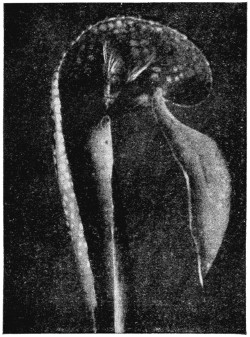
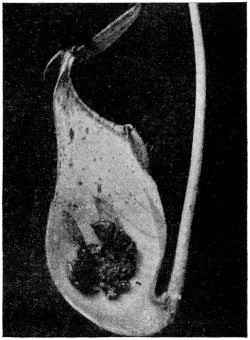
The light streaming through the transparent spaces induces the prisoner to waste its strength in a vain effort to escape through them. Once below the inside edge, escape is almost impossible. Pitchers have been found almost full of flies and other insects.
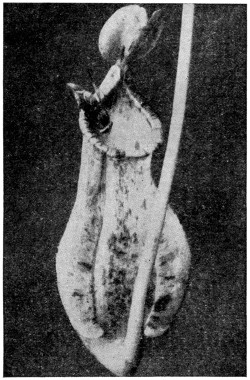
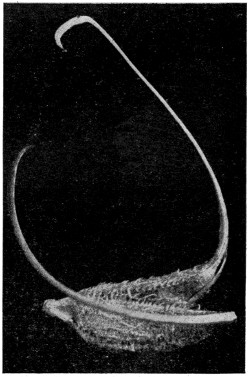
Absorbed in the delights of feasting on the nectar of the Nepenthes, the insect wanders with fatal ease down the fluted rim. The fruits of the Martynia fasten themselves to passing animals that sometimes get the hooks caught in their mouths and die a dreadful death.
After an interval of several days the leaf of the Dionæa opens and allows the hard carcass of the fly to roll away. The plant is then ready for another meal, and unable to realize the fate which is in store for it, another fly falls a victim. Quite often the Venus Fly Trap is able to capture large insects.
THE STRANGE HABITS OF THE NEPENTHES
Scattered over the tropics of the old world there is a remarkable group of plants known as Nepenthes. Many of these are of a climbing habit, rooting in bark crevices where a little moist soil may have collected. To augment their food supply they have produced pitchers, which in some species are of great size. Indeed, in one kind of receptacles will hold as much as two quarts of water. In all cases these pitchers have a thick, corrugated rim, and it is this which plays a big part both in the luring and the capturing of the insects. On this rim, as well as on the lid of the pitcher, there are honey secreting glands, and these, of course, make the strongest appeal to hungry insects.
Absorbed in the delights of the feast, the insect wanders with fatal ease down the fluted rim. Once below the inside edge of this, escape is almost impossible, for the border is adorned with sharp, teeth-like processes, all pointing downward to the pit of destruction. Moreover, the inside walls of the pitcher are specially smoothed with a wax-like secretion, which makes climbing up a very difficult feat. Even insects with wings seem to find a great difficulty in making good their escape.
The pitchers of the Nepenthes are usually about half filled with fluid; this is not entirely collected rain or dew, but is largely formed by a definite secretion of the plant. Into this fluid the exhausted insect tumbles sooner or later, there to end miserably among a mass of drowning victims. It has been definitely proved that this fluid is an acid secretion—not unlike the digestive juices of an animal—which enables the plant to extract the nutriment it needs from the bodies of its victims.
THE NEPENTHES CATCH EVEN MICE AND BIRDS
It is in connection with the fluid contained in the pitchers of the Nepenthes that these plants catch much larger prey than insects. In the tropics it is not always an easy matter for birds and other small animals to secure a drink readily. The half-filled pitchers entice many a small creature to creep over the fluted rim in order to secure a draught of the fluid, which is not unpleasant to the taste. Now and again the venturesome visitor loses his hold and tumbles into the pitcher. Even in the case of mice and small birds the pitcher proves a veritable death-trap. The slippery sides are almost insurmountable, while the sharp hooks round the rim still further check an escape. Sooner or later the victim falls back into the fluid and is drowned. Strange as it may appear, after such a capture the plant grows vigorously, for the decaying body of its victim is rich in just the food material of which it stands in need.
THE DEATH PITCHER OF THE SARRACENIAS
A very singular group of plants, the Sarracenias, are quite common in the bogs of North America. These are of an elegant shape, and may be as much as one foot or two feet in height. Nearly always they are highly colored, and altogether so attractive do they appear that insects of all kinds simply crowd to them. On arrival at the lip of the pitcher, the insects find a feast of honey spread out for their delectation. With almost devilish ingenuity this becomes sweeter and more plentiful the farther down into the pitcher one traverses. At a certain point, however, the nectar ceases, and the insect thinks that he will retrace his steps. But although it has been easy enough to go down, it is almost impossible to get back, for the surface of the inside of the pitcher is thickly covered with sharp bristles, all pointing downward.
Some flying insects may escape, but even these do not find it easy, as witness the fact that the plant often catches a large number of winged creatures. In the lower part of the Sarracenia pitcher a fluid is secreted, and it is into this that the creatures ultimately fall, and, of course, perish. How successful are the Sarracenias in their insect-catching may be gathered from the fact that pitchers have been discovered well nigh full of flies and other small creatures.
A PLANT WITH PRISON WINDOWS
The California Darlingtonia seems to have been specially devised for the securing of winged creatures. The plant is most singular in appearance, and the upper part of the pitchers bear a remarkable resemblance to the head of a snake. Part of the hood and also the two protruding leaves are gaily colored in crimson. It should also be noted that the upper portion of the hood is adorned with transparent patches, like so many little windows. Now, the only opening into the pitcher of the Darlingtonia is quite a small hole on the under side of the hood. As in the case of the other pitcher plants, the orifice of this hole is freely supplied with honey, and this extends well into the interior of the receptacle.
Owing to the attraction of the little windows, which have been already mentioned, the flies do not attempt to get out of the hole to the extent which might be supposed. The light streaming through the transparent spaces seems to convince the insects that in that direction lies the path to freedom. At all times it is possible to see perhaps a dozen flies bobbing against the windows in a vain endeavor to escape. Finally, wearied to death by their hopeless endeavors to escape, the insects fall down into the lower part of the pitcher and become suffocated by the fluid it contains.
AN AUSTRALIAN PLANT WITH TWO KINDS OF LEAVES
A curious little Australian plant which has adopted a very similar plan of fly catching to that to be seen in the Nepenthes is the Cephalotus. One singular feature about this Australian pitcher plant is that it produces quite ordinary leaves in addition to the highly specialized fly-catching ones.
PLANTS THAT KILL EVEN THE POWERFUL LION
The Martynias of South America produce fruits with hooks sometimes five or six inches in length, which get imbedded into the flesh of animals. The African Grapple-plants (Harpagophyton procumbens) are even worse in the amount of suffering which they cause; thousands of antelopes, goats, and other creatures are lamed by them every season. The seed vessel of this plant is provided with a large number of curved hooks by which it attaches itself to the coats or hoofs of animals and is thus transported from place to place. It has been known to choke and cause the death of lions.
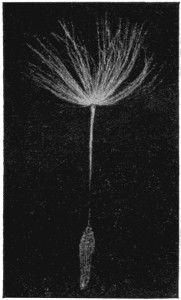
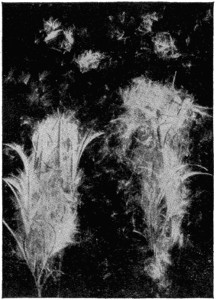
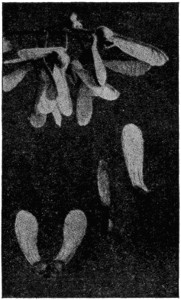
The pretty little parachute-like device of the Dandelion seed which helps to waft it over a wide area. It often rises to a height of thirty feet, and is wafted many miles away. The Willow Herb produces an enormous number of flying fruits. These often sail away in masses and are carried for a great distance over the countryside, to take root in a new location. The seed of the Sycamore is provided with a long wing. These wings revolve quickly when the heavy seed is falling, prevent a rapid decent, and help to scatter them.
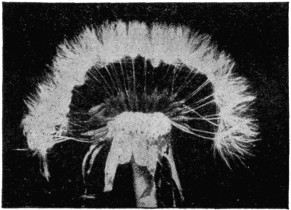
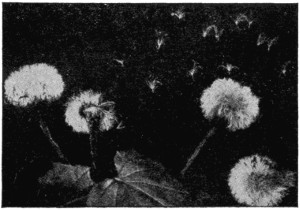
The head of a seeding Dandelion. Observe the enlarged view of one of the parachutes above. When the fruits of the Coltsfoot are ripe the smallest puff of air disperses the seed far and wide.
HOW PLANTS TRAVEL
Many plants provide their seeds with an apparatus which forms a singularly effective flying machine. Some of these are among the most beautiful and ingenious contrivances in the plant world.
NATURE’S AVIATORS AND SEED-SOWERS
By far the commonest method of ensuring a wide distribution of a seed is that in which the object is attached to some light, feathery substance which prevents a speedy falling. Of this there is no better instance than the common dandelion, which at seed time produces the handsome “clock” so prized by the children.
Here each seed is attached to a feathery process which plays the part of a parachute. On a dry day, when the dandelion heads are parting with their fruits, we may see how well the scheme works. Each puff of wind releases a few of the seeds, and these, unlike the ordinary parachute with a load, are so light that they rise upwards on the air currents.
Curiously enough, the fruits seem to travel farther when the breezes are light, and a very rough wind blows them back to earth, where they may catch in the grass or become damaged. Thus, like the airman, the dandelion seed stands the best chance of a safe journey when the weather is not too boisterous.
A very similar arrangement is to be seen in the case of the goat’s-beard fruit and that of the coltsfoot, which, by reason of its flying device, secures a very wide distribution.
THE WILLOW ALSO PRODUCES FLYING SEEDS
After flowering the Willow Herb develops long, pod-like processes. During damp and stormy weather these pods remain tightly closed. On a day when the air is dry and the breezes are light, the sides of the case split open and reveal a prodigious number of perfect flying machines. The seed itself weighs a mere trifle, and to this is attached a beautiful arrangement of feathery hairs. The whole thing is so well adapted for an aërial voyage that it mounts rapidly upward on the faintest puff of air. It should be here explained that by experiment it has been shown that the air currents tend to move upward. So light are some of these flying fruits that they often rise to an immense height. It is not an uncommon thing for them to be found on mountains thousands of feet above sea-level.
Of course, many foreign seeds have remarkable flying appendages. That of the South African Stapelia has a vast mass of fluffy hairs which will support it on quite a long aërial voyage. In the case of the cotton plant man has turned to good account the hairs by which the seed flies.
SEEDS OF THE SYCAMORE A DIFFERENT TYPE OF FLYING MACHINE
In a large number of cases the conveyance of the seeds to a distant point is accomplished by the adoption of the screw-propeller principle. An excellent example of this is to be seen in the fruits of the sycamore. Here the actual seed is large and heavy, but it is attached to a wing-like expansion. When the fruit falls from the tree the wing revolves with great rapidity, very much on the lines of a propeller blade. This has the effect of controlling the rate of fall, so that the whole contrivance is carried to some distance before the seed is actually brought to earth.
PLANT TRAVELERS ON LAND
Some kinds of touring plants send out long trailing stems to search for fresh rooting places. A little Alpine saxifrage is curious in this respect, for the plant will traverse over many feet of barren rock to reach a suitable position. Directly the shoot touches the soil, a new plant is formed, and as this grows up, the connection between it and the parent is severed. A kind of lily has an even more singular way of traveling about. Here, after the plant has flowered, buds arise on the stems which bore the blossoms. Eventually they take root in fresh positions. This plant if left alone would rapidly cover many yards with its offspring, and this without setting a single seed.
A strange group of plants are those which actually break themselves in pieces in order to pursue their journeys abroad. A plant belonging to the Houseleek order (Sempervivum soboliferum) is remarkable in this respect. The species naturally finds its home in the crevices of rocks, and at a certain stage in its development numerous little ball-like offshoots are produced. In the early days these are kept at home by the stems by means of which they are attached to the parent plant. Eventually these attachments shrivel up and the offshoots go rolling away over the rocks often much helped in their journey by the wind. A considerable distance may be traversed before a little ball finds a resting-place in some niche.
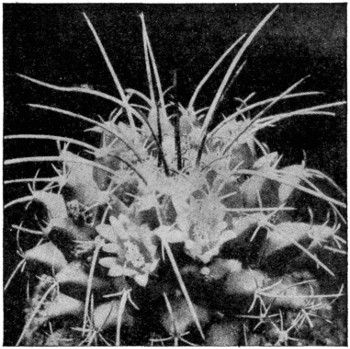
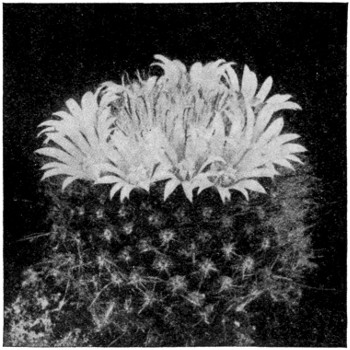
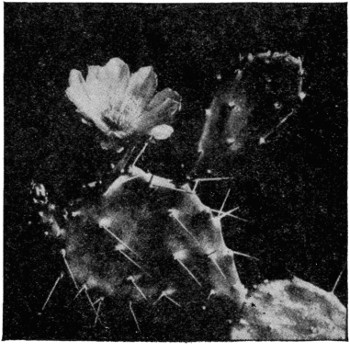
HOW THE CACTUS PROTECTS ITS FLOWERS
HOW THE PLANTS DEFEND THEMSELVES
It is well-known to every intelligent observer that plants are menaced by a host of enemies. Though the plant cannot take up the aggressive to any extent, the weapons which it employs in its own defense are of an exceedingly efficient nature. In their way they are quite as effective as anything that animals employ in their battle for existence.
Among the commonest defenses of the plant are spines, thorns and prickles. In the sloe (Prunus spinosa), for example, the spines are modified branches; in gorse (Ulex Europæus) they are branches and leaves; and in cacti the green parts are thickened stems and the spines reduced leaves; while in holly (Ilex aquifolium) the prickly leaves answer the purpose of spines. The stinging hairs of the nettle which exude an irritating acid when touched are a familiar example of protection against vegetarian animals.
The way in which seeds are protected by spines is well illustrated in the case of the Sweet Chestnut. Here it would be a very knowing animal that could open one of the cases before they split naturally with the ripening of the seed.
HOW THE CACTUS DEFENDS ITS LIFE
There are few plants so well armed as the Cactus, the evident design of which is to conserve its moisture. This is accomplished in several ways. Of course, the very shapes of the plants are all in their favor. Being either round, globular, or cylindrical, they offer a limited surface to the dry air inconceivably less than a plant of the same size bearing a quantity of leaves. The thick skins, too, play a big part in keeping in the moisture, and many kinds of cacti, such as that known as Old Man’s Beard, are covered with dense masses of hair.
Many of these succulent desert plants grow to a great size. Thus the Giant Cactus sends up a tall column, often with only a very few branches, which may be eighty or even one hundred feet in height.
Curiously enough, some cacti produce the most beautiful flowers, blossoms without rival in the whole world. The various kinds bear flowers of every conceivable shade except blue, and the blooms are often of an immense size. It is not unusual for the blossoms to measure eighteen inches, or even two feet, across.
Living as they do in arid regions, cacti are peculiarly liable to be attacked by thirsty animals. Now, a common mode of defense is the covering of the plant with sharp spines. These spines are so arranged that they completely shield the juicy stem from any possibility of attack, it is said that on occasion Mexican ponies will try to knock a cactus to pieces with their heels when they are thirsty. More often than not the animals suffer cruelly for their temerity by being severely pricked.
In much the same way the Aloes and Agaves are protected, so that a hedge of these plants when placed round a field, is better than the most perfect barbed wire fence.
THE AMERICAN AGAVE, OR “CENTURY PLANT”
This plant is remarkable for its beauty, and grows to a height of twenty to thirty-five feet. It was long popularly supposed to bloom only once in a century; hence the name. Though this is a mistaken idea, the vegetative growth of the plant is many years. The plant produces flowering stems, sometimes several feet in height, ultimately terminating in a large panicle of flowers and dying of the effort. A single plant may produce five thousand flowers, so that the ground beneath is wet with the honey distilled by them. The fiber of the leaves was used by the ancient Mexicans for paper parchment, and is now largely exported for that purpose and for cordage.
THE CURIOUS MISTLETOE, A ROBBER PLANT OR PARASITE
The mistletoe is one of the most interesting of the parasite plants. It grows on various trees, and is celebrated on account of the religious purposes to which it was consecrated by the ancient Celtic nations of Europe. It is a small shrub, with oblong, somewhat leathery leaves, and small yellowish-green flowers, the whole forming a pendent bush, covered in winter with small white berries, which contain a glutinous substance. It is common enough on certain species of trees, such as apple and pear trees, hawthorn, maple, lime, and other similar trees, but is very seldom found on the oak. Its roots penetrate into the substance of the tree on which it grows, and though it may live for forty years, it finally kills the branch supporting it.
In days of old the mistletoe was looked upon with awe as a mysterious and wonderful plant. The ancient Druids held it sacred, and cut it down with a golden sickle with all sorts of strange, mystic rites. It was the symbol of peace and friendship; and that is why we hang it up at Christmas time, and when two people meet under its green leaves, they are expected to “kiss and be friends.”
A PLANT THAT GROWS IN SNOW
Strangest of all the plants is the Soldanellas, a small species which exists on the lower slopes of the Alps. When the flower stems are in their most active state of growth they release a considerable amount of heat. In this way they will bore a course up through a thick coating of ice and snow to the light and air above, when by some means the plant is aware that the spring has arrived. There seems to be something more wonderful in this than can be explained by mere mechanical causes. Indeed, the sympathy of the plant with its surroundings is surely one of those mysteries which are as inscrutable as life itself.
THE PRIMARY USE OF LIQUID RUBBER TO PLANTS
The grubs of many beetles live in wood, upon which they feed. This probably gives a clue to the primary use of the important commercial substances india-rubber and guttapercha, which are the dried sticky juices of various shrubs and trees growing in hot climates. Beetles of the wood-boring kind, which seek to pierce and lay eggs in such plants, are liable to be snarled and killed by the viscid fluids which ooze out.
Arums, and various other plants, ward off the attacks of snails and slugs in a rather curious way The outer parts of their stems and leafstalks contain bundles of excessively sharp crystals (raphides), composed of oxalate of lime. These pierce the soft mouths of snails and slugs like so many needles, conveying a lesson which usually needs no repetition.
STRANGE LIFE HABITS OF UNUSUAL PLANTS
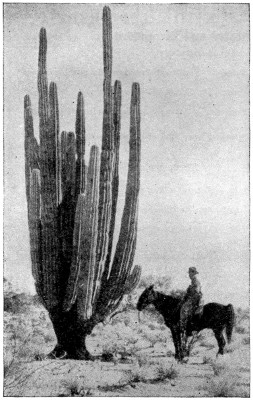
The Giant Cactus of the American Desert
These plants are little more than succulent stems covered with a thick skin which retains the moisture of the juicy shoot.
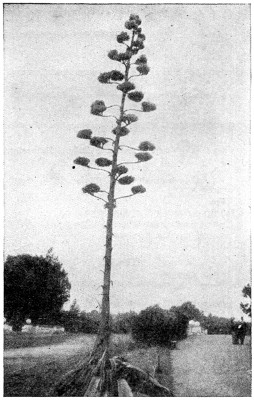
The Century Plant
The Century Plant is a native of Mexico, and is remarkable for the long intervals between the blooming periods—once erroneously thought to be 100 years.
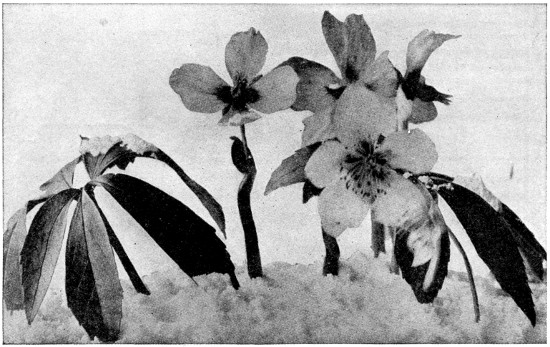
CHRISTMAS ROSE IN WINTER
In defiance of the weather a few plants elect to come into bloom right in the middle of winter. The most striking of these is the Christmas Rose, or Hellebore. The flowers of this plant are protected by the encircling sepals, and are fully able to hold their own until the approach of a more favorable season.
SCIENTIFIC TERMS USED IN BOTANY Completely Classified, Illustrated and Exemplified
ROOTS.
Kinds.—(1.) Primary, growing from root-end of embryo.
(a.) Simple.—Conical, ; napiform, ; fusiform, .


(b.) Multiple.—Moniliform, necklace-like. Fasciculated, tufted, thick and fleshy. Tubercular, having small tubers. Fibrous, threadlike.


(2.) Secondary, growing from stems.
Underground, starting from stem below ground. Aerial, starting from stem above ground.
STEM.
Parts.— n, Node, part to which the leaf is fastened.

i, Internode, portion between nodes.
a, Axil, the angle between leaf and stem, upper side.
Class.—Exogenous, outside-growing (Maple, Elm).
Endogenous, inside-growing (Corn-stalk, Timothy).
Situation.—(1.) Above ground, usually leaf-bearing.
(2.) Under ground, scale-bearing.
Stems above Ground.
Character.—Herbaceous, soft, not woody (Four-o’clock).
Suffrutescent, slightly shrubby (Toad-flax).
Suffruticous, shrubby at base (Trailing Arbutus).
Fruticous, shrubby (Currant-bushes).
Arborescent, tree-like (Flowering Dogwood).
Arboreous, tree (Elm).
Direction of Growth.—Repent, prostrate and rooting from the under surface (Partridge-berry).
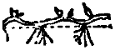
Procumbent, prostrate, but not rooting (Purslane).
Decumbent, prostrate, except at the extremity (Poor Man’s Weather-glass).

Assurgent, ascending obliquely.

Erect, upright (Indian Corn).
Scandent, climbing with tendrils or rootlets (Grape, English Ivy).

Voluble, twining (Morning-glory).

Declinate, declined or bent downwards (Blackberry).

Diffuse, loosely-spreading (Red Currant).

Forms of Branches.—Sucker, a branch of subterranean origin that finally rises out of the ground. The Raspberry multiplies in this way.

Offset, a short, prostrate-rooting branch with a tuft of leaves at the end (Houseleek).

Runner, a long, prostrate-rooting branch with tuft of leaves (Strawberry).

Stolon, a branch that curves downward and takes root. The Currant multiplies in this way.

Tendril, a thread-like coiling branch used for climbing.

Spine or Thorn, a hard, sharp-pointed branch.

Stems under Ground.
Kinds.—Rhizoma or Rootstock, a perennial, horizontal stem, partially or wholly subterranean (Calamus).

Tuber, an enlarged stem with eyes (White-potato).

Bulb, a bud, usually subterranean with fleshy scales (Onion, Lily).

Corm, a solid bulb (Indian Turnip).

LEAVES.
Parts.— b, Blade, the expanded portion.

p, Petiole, the stem.
s, Stipules, leaf-like appendages at base of petiole.
Kinds.—(1.) Simple, having but one blade.

Sessile, without petiole.

Petiolate, with petiole.

Stipulate, with stipules.

Cirrhous, with tendril.

(2.) Compound, having more than one blade.

(a.) Pinnate, with leaflets arranged along a common petiole.

Abruptly pinnate, with even number of leaflets.

Odd-pinnate, having an odd leaflet.

Unipinnate, divided but once.

Bipinnate, divided twice.

Tripinnate, divided three times.
(b.) Palmate, leaflets diverging from one point.

Unipalmate, divided but once.

Bipalmate, divided twice.

Tripalmate, divided three times.

Framework.—Midrib, the central vein.
Ribs, , strong veins branching from near the base of midrib.


Veins, the branching framework.
Veinlets, small veins.

Venation.—Parallel, with simple veins running parallel from base to apex.

Feather, with lateral veins branching at regular intervals from midrib.

Radiate, with strong veins branching from apex of petiole.

Reticulate, with veins and veinlets that unite and separate in the form of network.

Form.—(a.) Broadest at the Middle.—Peliate, ; orbicular, ; oval, ; elliptical, ; oblong, ; linear, , acerōse, (Pine).


(b.) Broadest at Base.—Deltoid, ; ovate ; lanceolate, ; subulate, ; cordate, ; reniform, ; hastate, ; sagittate, .


(c.) Broadest at the Apex.—Obovate, ; oblanceolate, ; spatulate ; cuneate ; obcordate, ; lyrate, ; runcinate, .


Bases.—Auriculate, ; oblique, ; tapering, ; abrupt, ; clasping, ; perfoliate, ; connate, ; decurrent, .


Apexes.—Obcordate, ; emarginate, ; retuse, ; truncate, ; obtuse, ; acute ; acuminate, ; mucronate, ; cuspidate, ; aristate, .


Margins.—Entire, ; repand, ; sinuate, ; crenate, ; dentate, ; serrate, ; incised, ; laciniate, ; palmately-lobed, ; palmately-cleft, ; palmately-parted, ; palmately-divided, ; pinnately-lobed, ; pinnately-cleft, ; pinnately-parted, ; pinnately-divided, .


Surface.—(a.) Without Hairs.—Glabrous, smooth.
(b.) Soft Hairs.—Pílous, few, short; hirsute, few, long; pubéscent, dense, short; villous, dense, long; seríceous, silky; lanūginous, woolly; toméntous, matted like felt; flóccous, fleecy tufts.
(c.) Stiff Hairs.—Scābrous, minute, hard points; hispid, few, short points; sētous, bristly; spinous, having spines.
Color.—Glaucous, covered with whitish powder.
Canéscent, grayish-white with fine pubescence.
Incānous, hoary-white.
Punctate, having transparent dots.
Hyaline, nearly transparent.
Texture.—Succulent, fleshy; coriaceous, leather-like; scarious, dry; rúgous, wrinkled.
Phyllotaxis, arrangement on the stem.—Alternate, ; opposite, ; whorled (verticillate); radical, near the ground; cauline, on the stem; rosulate, clustered; fascículate, in bundles.


Vernation, arrangement in the bud.
Induplicate, folded crosswise (Tulip-tree).

Conduplicate, folded along midrib (Oak).

Plicate, folded like a fan (Red-currant).

Circinate, rolled lengthwise (Fern).

Convolute, rolled edgewise (Cherry).

Involute, both edges rolled inward (Apple).

Revolute, both edges rolled outward (Willow).

Equitant, astraddle (Iris).

Obvolute, half equitant (Jerusalem Sage).

Triquētrous triangular equitant (Sedges).

Duration.—Fugacious, falling very early.
Deciduous, falling at the close of the season.
Persistent, remaining through the winter.
INFLORESCENCE.
Parts.—Flower, the blossom.

Peduncle, the stem of a solitary flower or the main stem of a flower-cluster.

Scape, a peduncle that grows from the ground.

Pedicel, , p, the stem of each flower of a flower-cluster. Bracts, b, small floral leaves.

Involucre, a cluster of bracts.

Kinds.—(1.) Solitary, single, alone.
Terminal, at the summit of the stem.
Axillary, in the axils of the leaves.

(2.) Clustered, several flowers collected in a bunch.
(a.) Indefinite or Indeterminate, flowering from axillary buds. Inflorescence centripetal.
Flowers pedicellate - Racēme, flowers arranged along the axis; pedicels about equal in length (Currant).

Córymb, same as raceme, except that the lower pedicels are elongated, making the top flat (Hawthorn).

Umbel. same as corymb, except that the pedicels branch from about the same point (Milkweed).

Panicle, compound raceme (Blue-grass).

Thyrsus, a compact panicle (Lilac).
Flowers sessile - Spike, same as raceme with flowers sessile (Mullein).

Spādix, a fleshy spike, generally enveloped by a large bract called a Spāthe, (Calla Lily).


Ȧment or Catkin, a slender pendent spike, with scaly bracts (Birch).

Head or Capitulum, a shortened spike, reduced to a globular form (Clover).

(b.) Definite or Determinate, flowers all terminal. Inflorescence centrifugal.
Cyme, flat-topped or rounded inflorescence (Elder).

Fascicle, a compact cyme (Sweet-William).
Glomerule, a cyme condensed into a head (Mint).
Verticillaster, two opposite glomerules joined (Motherwort).
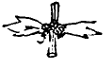
Scorpioid, a one-sided and coiled cyme (Forget-me-not).

FLOWER.

Parts.—Receptacle, the part upon which the several organs of the flower are inserted.
Calyx, the exterior floral envelope.

Corolla, the interior floral envelope. The calyx and corolla constitute the protecting organs, sometimes called perianth.

Stamens, the fertilizing organs.

Pistils, the seed-bearing organs. The stamens and pistils constitute the essential organs.

Kinds.—Symmetrical, same number in each set of organs; unsymmetrical, different number.

Complete, all the sets present; incomplete, some sets wanting.

Regular sepals and petals uniform; irregular, sepals or petals unlike.


Perfect, stamens and pistils both present; imperfect, one set absent.
Staminate, with stamens only; pistillate, with pistils only; neutral, with neither.
Monœcious, staminate and pistillate on same plant; diœcious, on different plants.
Dichlamydeous, having calyx and corolla; monochlamydecous, having calyx only; achlamydecous, having neither.
Di, trí, tetrá, pentá-merous, two, three, four, or five parts in each set.


Sessile, without peduncle; pedunculate, with peduncle.

Deviations from the Normal or Pattern Flower arise from
Augmentation, increase of floral circles (Water Lily).
Cherisis, increase of organs by division. The Bleeding-heart shows the collateral chorisis of stamens, and the Catchfly shows the transverse chorisis of corolla.

Anteposition, parts opposite instead of alternate (Grape).
Cohesion, union of parts of the same set (corolla of Morning-glory).

Adnation, union of different sets. In the Cherry the stamens and corolla are inserted upon the calyx.
Irregularity, parts of the same set unequally developed (Violet, Pea).
Suppression, non-development of some parts. In the mints some of the stamens are suppressed or wanting.
CALYX.
Parts.—Sepals, the divisions of the calyx.

Tube, the united portion of a gamosepalous calyx.
Teeth or lobes, the distinct or divided portions of a gamosepalous calyx.
Throat, the orifice or summit of the tube.
Pappus, in Compositæ, the calyx border consisting of scales, teeth, bristles, or slender hairs.

Cohesion.—Gamosepalous or Monosepalous, sepals partially or wholly grown together.

Truncate, without lobes.

Toothed, lobes small.

Lobed, parted about one fourth.

Cleft, parted about one half.

Parted, separated nearly to the base.

Polysepalous, separated to the base.

Adnation.—Inferior, calyx free from ovary.

Half-inferior, calyx adherent to the ovary half-way.

Superior, calyx adherent to the ovary.

Form.—See under Corolla.
Æstivation.—See under Corolla.
COROLLA.
Parts.—Petals, the divisions of the Corolla.

Lamina, the expanded portion of the petal.
Claw, , the stem portion of the petal.

Spur, ; s, the hollow portion of certain corollas.

Crown, , a small projection from certain petals (Catchfly).

Cohesion.—Gamopetalous or Monopetalous, petals partially or wholly grown together.

Truncate, toothed, lobed, cleft, parted.


Polypetalous, petals separate.

Adnation.—Hypógynous, corolla attached under the pistil (gynia, pistil).

Perígynous, corolla attached to the calyx. It is thus around the pistil.

Epígynous, corolla attached to the ovary. It is thus upon the ovary which is a part of the pistil.

Form.—Gamopetalous and Polypetalous.
Gamopetalous. - Regular.
Urceoiate, urn-shaped (Whortleberry).

Tubular cylindrical (Trumpet Honeysuckle)

Campánulate, bell-shaped (Harebell).

Infundíbular, funnel-shaped (Morning-glory).

Hypocraterimórphous, salver-shaped (Phlox).

Rotate, wheel-shaped (Potato).

Irregular.
Ligulate, strap-shaped (Dandelion).

Lābiate, two-lipped.
Gāleate, upper lip arched (Catmint).

Ringent, both lips arched (Dead-nettle).

Personate, throat closed (Toad-flax).

Polypetalous. - Regular.
Rosāceous, petals without claws (Rose).

Liliāceous, petals with claws gradually spreading (Lily).

Caryophyllāceous, long claws enclosed in a tube (Pink).
Crucíferous, four clawed petals in the form of a cross (Mustard).

Irregular.
Papilionāceous, butterfly-shaped (Bean).

Parts.—Vexillum, banner; alæ, wings; carīna, keel.
Æstivation, the arrangement of the floral organs in the bud.
Valvular, pieces met by their margins (Lilac).

Induplicate, margins turned inward (sepals of Clematis).

Reduplicate, margins turned outward (sepals of Hollyhock).

Convolute, or contorted, each piece overlaps its neighbor in one direction (Geranium).

Imbricated, one or more petals wholly outside.

Quincúncial, five petals, two without and two within and the remaining one with one edge outside and the other inside.

Triquētrous, three petals, one without and one within, and the remaining one with one edge outside and the other inside.

Véxillary, having one large petal enclosing the others (Pea).

Plicate, the folding of gamopétalous flowers.

Supervolute, with folds turned obliquely in the same direction (Morning-glory).

STAMENS (Andrœcium).
Parts.— Anther, the enlarged and essential portion.

Filament, the stem holding the anther.
Pollen, the fertilizing powder found in the anther.
Kinds.—Sessile, anther without filament.

Sterile, filament without anther.
Connivent, converging.

Exserted, protruding out of corolla.

Included, entirely within the corolla.
Didẏnamous, four in number, two long and two short.

Tetradẏnanious, six in number, four long and two short.

Cohesion.—Syngenesious, united by their anthers.

Monodelphous, united by their filaments into one set.
Diadelphous, united into two sets.
Polyadelphous, united into many sets.
Adnation.—Hypógynous, borne on the receptacle.

Perígynous, borne on the calyx.

Epipétalous, borne on the corolla.
Alternate, with the lobes.

Opposite, in front of the lobes.
Epígynous, borne on the ovary at its summit.
Gynándrous, borne on the style (Orchid).
FILAMENT.
Kinds.—Filiform, subulate, dilated, petaloid, bidentate.
ANTHER.
Parts.—Lobes (thecæ) and connective.
Adnation.—Innate, anther firm on summit of filament.

Adnate, anther attached by its whole length to filament.

Extrórse, facing the petals.
Intrórse, facing the pistils.
Versatile, attached near the middle.

Dehiscence.—Longitudinal, opening lengthwise.

Transverse, opening crosswise.

Porous, opening by terminal holes.

Valved, opening by valves or doors.

PISTILS (Gynœcium).
Parts.— Stigma, the rough end to which the pollen adheres.

Style, the stem holding the stigma.
Ovary, the enlarged portion containing the ovules.
Cohesion.—Simple, having but one cell, placenta style and stigma.

Multiple, a collection of simple pistils (Blackberry).

Compound, simple pistils grown together, each called a carpel.

STIGMA.
Kinds.—Sessile, stigma on ovary: no style.
Globose, globular (Four-o’clock).
Capitate, broad and flat.

Lobed, rounded.
Feathered, like a feather (Grasses).
Linear, thread-like (Corn).
STYLE.
Kinds.—Basal, attached to base of ovary (Forget-me-not).
Lateral, attached to side of ovary (Strawberry).
Terminal, attached to top of ovary.

OVARY.
Parts.—Placentæ, the parts to which the ovules are attached.
Dissepiments, partitions.

Cells, cavities in which the ovules are arranged.
Ovules, unfertilized seeds.
Adnation.—Inferior, calyx adherent to ovary, same as superior calyx.

Superior, calyx free from ovary, same as inferior calyx.

Placentation.—Free-central, ovules attached to a central column in a one-celled ovary (Pink).

Axillary, ovules attached to a central column in a compound ovary.

Parietal, ovules attached to the outer walls of the ovary.

OVULE.

Parts.—Nucleus, n, the essential part in which the embryo is formed.
Prīmĭne, p, the exterior coat.
Secundine, s, the interior coat.
Mícropyle, m, the opening of the ovary coats.
Funículus, the stem to which the ovule is attached.
Hilum, h, the point of attachment on the ovule.
Chalāza, c, the place where the coverings and nucleus join
Rhāphe, r, the connection between the hilum and the chalaza.
N. B.—Through the funiculus, the rhaphe, and the chalaza the ovule receives its nourishment from the placenta. Through the micropyle it receives the tubular prolongation of the pollen.
Kinds.—Orthótropous straight; no change in direction of parts (Buckwheat).

Campylótropous, curved; the micropyle brought near the chalaza (Bean).

Anátropous, inverted; the micropyle brought near the hilum, pointing to the placentæ. Rhaphe the whole length of the ovule (Magnolia).

Amphítropous, half inverted; short rhaphe (Mallow).

Direction of Ovary.—Erect, ; ascending, ; horizontal, ; pendulous, ; suspended, .


FRUIT.
Parts.—Seed, the part containing the embryo.
Pericarp, the covering of the seeds, including the ovary and all adnate parts. The parts of the pericarp are epicarp, or outer coat; mesocarp, or middle coat; and endocarp, or inner coat.
Dehiscence.—Septicīdal, opening of the partitions.

Loculicīdal, opening at the dorsal suture.

Septífragal, valves falling away from partitions.

Circumscissile, opening by a circular horizontal line.

Kinds.—Simple, aggregate, accessory, multiple.
(1.) Simple Fruits.—Fleshy, Stone, Dry (formed by a single pistil).
(a.) Fleshy Fruits.—Indehiscent (with two or more seeds).
Seeds immersed in a pulpy mass. - Berry, rind membranous (Grape).
Hesperidium, rind leathery, separable (Orange).
Pēpo, rind hard (Cucumber).
Seeds in cells.—Pome, succulent calyx (Apple).
(b.) Stone Fruits.—Indehiscent; one-celled; endocarp hard.
Drupe, three-coated; stone-cell entire (Peach).
Tryma, two-coated; stone-cell two-parted (Walnut).
Etærio, an aggregation of drupes (Raspberry).
(c.) Dry Fruits.—Indehiscent, usually one seed with one coat.
Achēnium, coat separable from seed (Dandelion).

Utricle, coat inflated (Goosefoot).
Caryópsis, coat inseparable (Wheat).
Glans, invested with a cūpule, (Acorn).

Samāra, having winged appendages (Maple).

(c1.) Dry Fruits.—Dehiscent.
Single pistil. - Follicle, opening by a ventral suture (Columbine).

Legūme, opening by both sutures (Bean).

Loment, jointed legume (Desmodium).

Compound pistil. - Capsule, any compound dehiscent fruit.
Sílique, a two-valved capsule (Mustard).

Sílicle, a short silique (Shepherd’s Purse).

Pyxis, circumscissile dehiscence (Purslane).

(2.) Aggregate Fruits, . A cluster of carpels on one receptacle taken as a whole (Raspberry).

(3.) Accessory or Anthocarpous Fruits.—Those of which the most conspicuous portion, although appearing like a pericarp in some cases, does not belong to the pistil (Rose-hip).
(4.) Multiple or Collective Fruits.—Those which result from the aggregation of several flowers into one mass (Pine-apple, Mulberry).
Stróbile or Cone, a scaly multiple fruit, resulting from the ripening of some kinds of catkins (Hop, Conifers).
Gálbalus, a closed cone (Juniper-berry, Red Cedar).
SEED.

Parts.—Integuments, seed-coats. Nucleus, part containing the embryo.
(1.) Parts of Integuments:
Testa (episperm), the outer or proper seed-coat.
Tegmen (endopleura), the inner coat, sometimes wanting.
Funículus Hílum (h), Chalāza (c), Rhāphe (r), are the same as in ovule.
Aril, covering exterior to the integuments (not in the ovule) (May-apple, Water-lily).
Coma, a tuft of hairs on certain seeds (Silkweed). This is to be distinguished from pappus, which is a tuft on the fruit (Achenium).

(2.) Parts of Nucleus:

Embryo (e), the initial plantlet.
Radicle (r), the rudimentary stem or first internode.

Cotylēdon (c), the seed leaf at the primary node.
Plūmule (p), the growing points above the cotyledons.
Albūmen (a), the food for the plantlet’s first growth, stored outside the embryo.

Kinds.—(1.) General Form: Orthotropous, ; campylótropous, ; anátropous, ; amphítropous, same as in ovule.


(2.) Form of Covering:
Conformed, adhering closely to nucleus.
Cellular, loose (Pyrola).
Winged, having expanded appendages (Catalpa).

Woolly, covered closely with fibers (Cotton).
Cōmose, with coma at the end (Willow Herb).

(3.) Texture of Albumen:
Farinaceous, mealy (Wheat).
Oily, mealy but mixed with oil (Poppy).
Muciláginous, like mucilage (Morning-glory).
Ruminated, wrinkled (Papaw).
(4.) Number of Cotyledons:
Monocotylédonous, (Corn).

Dicotylédonous, (Bean).

Polycotylédonous, (Pine).

(5.) Position and Arrangement of Embryo:
Eccentric, embryo on one side of albumen (Indian Corn).

Perípheric, curved around albumen (Four-o’clock).

Accumbent, applied to the cotyledons when the radicle is bent and lies along their edge (Water-cress).

Incumbent, applied to the cotyledons when the radicle rests against the back of one of them (Shepherd’s Purse).

Conduplicate, applied to cotyledons that are incumbent and so folded as to embrace the radicle (Mustard).

(6.) The Direction of the Embryo as respects the Pericarp.
Ascending, pointing to the apex.
Descending, pointing to the base.
Centripetal, pointing to the axis.
Centrifugal, pointing to the sides.
BOTANICAL CLASSIFICATION OF PLANTS
The living plants may be divided into two grand divisions—Flowering Plants and Flowerless Plants—with five main subdivisions, according to the complexity and structure of their reproductive organs, or seed structure. The scientific names of these groups are the Thallophyta, the Bryophyta, the Pteridophyta, the Gymnosperms, and the Angiosperms.
Each of the five main groups is divided into a number of lesser subdivisions, sometimes called phyla, orders, each of which is composed of several families.
Most systematic botanists begin the study of plants with the lowest forms of plants and proceed to the highest. In the following classification, however, the usual order has been reversed because of its greater interest for a large majority of readers; the highest division is placed first and the lowest last.
In the earlier days of the science of botany nearly every botanist’s energies were devoted to this branch which we now call systematic botany. There are now named and described close on a quarter of a million of living species of plants altogether, including the lower and often nearly invisible forms, and of this vast number about one hundred and thirty thousand belong to the highest group of all—the Angiosperms. With nearly a quarter of a million described forms to deal with the value of such keys will be recognized.
Sub-Kingdom I.—Flowering Plants (Phanerogams), or Spermophytæ.
(1) Angiosperms (anj´ĭ-o-sperms)—Plants producing protected seeds.
The greatest group, the Angiosperms, with over a hundred and thirty thousand species, contains nearly all the plants that yield crops of economic importance to man, or that decorate his gardens, or that feed his sheep or cattle. They have netted-veined leaves. When this group is further examined, there are found to be two well marked divisions—Monocotyledons and Dicotyledons. The first has embryos with only one cotyledon or “seed leaf,” the second has embryos with two. The Angiosperms include over one hundred and thirty thousand species, divided among sixty-two orders, only the most important families of which can be given here.
Order I.—Ranunculaceæ: Herbs or small shrubs; about thirty genera.
Anemone (windflower): Perennial herb. Dry copses. Massachusetts to New Jersey and west to Colorado.
Anemonella (rose anemone): Open woods. Canada to Georgia and west through Mississippi Valley.
Caltha (cowslip, marsh marigold): Perennial herb. United States and Canada.
Clematis (virgin’s bower): Perennial. United States and Canada.
Ranunculus (buttercup, crowfoot): Herb, annual or perennial. Canada, United States and Europe.
Thalictrum (meadow rue): Perennial herb. United States and Canada.
Order II.—Berberidaceæ: Shrubs or perennial herbs; nineteen genera.
Berberis (barberry): Fruit, a sour berry. Found in Europe; naturalized in New England.
Podophyllum (May apple, mandrake): Perennial herb. Fruit, a berry. Found: Eastern North America; a species in Himalaya Mountains.
Order III.—Papaveraceæ: Annual or perennial herbs with milky or colored juice; about twenty-four genera.
Papaver (poppy): Geographical home on southern edge of North Temperate Zone, spreading north and south. Great opium districts are the valley of Ganges, Asiatic Turkey, Persia, Egypt, Asia Minor, China. From India, fourteen million pounds annually. Persia and Turkey, seventy-one million pounds.
Order IV.—Cruciferæ: Herbs; about one hundred and seventy-two genera.
Brassica (turnip, mustard, cabbage, cauliflower, rape): United States, Europe, India, Syria and Russia.
Capsella (shepherd’s purse): Naturalized in United States; from Europe.
Cochlearia (horseradish): Perennial. Root. Middle and southern edges of North Temperate Zone, from Great Britain to Asia and northeastern America.
Isatis (woad): Biennial. Throughout Europe. Cultivated in Azores and Canary Isles.
Nasturtium (watercress): Europe and northern Asia. Cultivated in Palestine, Hindustan, Japan.
Order V.—Capparidaceæ: Herbs, shrubs, trees; twenty-three genera.
Capparis (caper): Small shrub. Southern France and Mediterranean countries, Sicily, Malta.
Order VI.—Violaceæ: Herbs; twenty-one genera.
Viola (violet): Perennial. Canada; United States, west to Colorado; throughout Europe, some parts of China, Japan, India.
Order VII.—Biximæ: Shrubs; 29 genera.
Bixa (arnotto): Tropical America. Cultivated in southern Europe, Burma, Philippine Islands, Hindustan.
Order VIII.—Terustrœmiaceæ: Shrubs and small trees; thirty-two genera.
Thea (tea): Shrub. China. Cultivated between parallels of 25° and 35° throughout Asia. In Kangra, Gurhwal, Assam, Cachar, Sylhet, Chittagong, Darjeeling, Chota, Nagpur, Hindustan, Japan, Australia, Jamaica, Brazil, North America.
Order IX.—Malvaceæ: Herbs, shrubs.
Gossypium (cotton): Tropical and sub-tropical. East Indies, China, Asiatic Islands, Greece, islands in eastern Mediterranean, Asia Minor, northern and western Africa, Australia, West Indies, southern United States, Venezuela, British Guiana, Brazil.
Order X.—Sterculeaceæ: Trees and shrubs.
Theobroma (cocoa): Tropical and sub-tropical. Brazil and north of Brazil, West Indies, Mexico. Cultivated in Philippine Islands, southern Europe, India.
Order XI.—Tiliaceæ: Trees and shrubs; 40 genera.
Corchorus (yellow jute): Southern belt of North Temperate Zone and Tropics. Cultivated in southern and western Asia, Grecian Archipelago, central and northern Africa.
Order XII.—Linaceæ: Shrubs and herbs; 94 genera.
Linum (flax): Herb. Widely distributed. Hindustan, southern Egypt, throughout Europe, southern and middle Russia, northeastern America.
Erythroxylon (coca): Shrub. Tropical and sub-tropical. Bolivia, Peru, Ecuador, Colombia, northern Brazil.
Order XIII.—Zygophyllaceæ: Trees, shrubs, herbs; seventeen genera.
Guaiacum (lignum-vitæ): Tree. Tropical and sub-tropical. Exclusively American; native to West Indies.
Order XIV.—Rutaceæ: Small trees and shrubs; eighty-three genera.
Citrus (orange, lemon, shaddock): In all regions of no frost. India. Cultivated in Persia, Syria, southern Europe, northern Africa, Spain, China, Japan, Sicily, Australia, Brazil, West Indies, Florida, southern California, Azores.
Order XV.—Meliaceæ: Trees; thirty-seven genera.
Swietenia (mahogany): Large tree. Tropical and sub-tropical. West Indies, Bahamas, Central America, southern Florida. Cultivated in southern British India.
Order XVI.—Iliciniæ: Trees and shrubs; three genera.
Ilex (Paraguay tea): Small tree. Paraguay. In Parana, ten million pounds produced annually.
Order XVII.—Rhamnaceæ: Trees and shrubs; thirty-seven genera.
Ceanothus (New Jersey tea): Shrub. Eastern North America.
Rhamnus (buckthorn): Shrubs, small trees. Southern Persia and southern Levant countries. Grows as far north as England.
Order XVIII.—Ampelideæ: Woody vine; few genera.
Vitis (grape): Zone from 21° N. latitude to 48°. British Isles and Portugal, east to Persia. Middle Atlantic States to California. Cultivated in Australia.
Order XIX.—Sapindaceæ: Trees and shrubs; seventy-three genera.
Acer (maple): Tree. Not south of 38° N. latitude, except in high mountains in northern United States and southern British America.
Order XX.—Anacardeaceæ: Trees and shrubs; forty-six genera.
Anacardium (cashew nut): Tropics of Asia and America, Jamaica.
Rhus (sumach): North America, Canada to Gulf States; Arkansas, Levant, and western Europe, Syria. Cultivated in Sicily, Italy, Turkey, Spain, Portugal.
Order XXI.—Leguminosæ: Herbs, shrubs, trees; four hundred genera.
Acacia (gum arabic): Shrubs and small trees. Tropical and sub-tropical, but widely distributed. Australia, Africa, Asia, America.
Arachis (peanut): Sub-tropical. Southern United States, southern and central Virginia, the Carolinas and Tennessee.
Astragalus (gum tragacanth): Small shrub or herb. Sub-tropical. Persia, Greece, east Mediterranean Islands, Syria.
Cassia (senna): Tropical and sub-tropical. Widely distributed.
Cæsalpinia (Brazil wood): Trees. Brazil.
Dalbergia (rosewood): Trees and vines. Brazil and southern Asia.
Glycyrrhiza (licorice): Small shrub and herb. Italy and southern Europe, southern England. Cultivated in Spain and Portugal.
Hæmatoxylon (logwood): Small tree. Yucatan, Guatemala, Honduras, Isthmus of Panama, West Indies. Cultivated in Burma.
Indigofera (indigo): Shrub. India, Java, East Indies, north Africa, West Indies, Central Asia.
Lens (lentil): Annual. Syria, Egypt, southern and central Europe, Hindustan.
Phaseolus (bean): Annual herb. Tropics and Temperate Zones to forty-fifth parallels.
Pisum (pea): Annual herb. Central and southern Europe, Egypt, Syria, Japan, India, China.
Tamarindus (tamarind): Tree. Tropical and sub-tropical. Africa. Cultivated in Arabia, southern India, Ceylon, Java, Philippines, northern Australia, Pacific Isles, South America.
Order XXII.—Rosaceæ: Trees, shrubs, herbs; seventy-one genera.
Fragaria (strawberry): Herb. Widely distributed, even to Kamchatka and Alaska.
Prunus (plum): Tree. Temperate Zone, south of 60°. Europe, western Asia. Cultivated in northeast America.
Prunus (cherry): Tree. North Africa, Holland, Portugal. Cultivated in southeastern Africa, America, Belgium, England.
Prunus (apricot): Tree. Armenia, Persia, China, Japan, California.
Prunus (peach): Tree. Southern half of North Temperate Zone in Asia, Europe, America, New Jersey, Pennsylvania, Delaware, Maryland.
Pyrus (apple): Tree. England, France, Germany, Netherlands, Prussia, Poland, United States, south Australia.
Pyrus (pear): Tree. China, Syria, Persia, central and northern Europe, Belgium, France, Great Britain. Cultivated in North America.
Pyrus (quince): Tree. Northern Persia, east and west. Cultivated in northeastern America, Portugal.
Rubus (black raspberry and raspberry): Shrub. Temperate Zone, between 30° and 50° latitude. In North America, Europe north to sixtieth parallel, south to northern parts of Africa, Asia Minor, and eastward into India; also in British Isles.
Order XXIII.—Saxifragaceæ: Shrubs, herbs; seventy-three genera.
Ribes (currant): Shrub. Lapland and southern Europe; also in the New World, northern United States to south and middle Canada.
Ribes (gooseberry): Shrub. France, England, Germany and northeastern Russia, Siberia.
Order XXIV.—Combretaceæ: Shrubs, trees; seven genera.
Terminalia (myrobalano): Large trees. Tropical India, along southern fringes of Ghaut Mountains, and in Burma.
Order XXV.—Myrtaceæ: Trees; seventy-six genera.
Bertholletia (Brazil nut): Large tree. Tropical South America, Panama.
Eugenia (cloves): Molucca Islands. Cultivated in Brazil, West Indies.
Eugenia (allspice): Jamaica.
Myrtus (myrtle): Tropical and sub-tropical. Southeastern Italy. Cultivated in all Mediterranean countries.
Order XXVI.—Lythraceæ: Tropical trees; thirty genera.
Punica (pomegranate): Persia. Cultivated in Syria, Asia Minor, Levant, southern Europe, China, Japan, South and North America.
Order XXVII.—Cucurbitaceæ: Herbs; sixty-eight genera.
Citrullus (watermelon): Herbaceous vine. Africa. Cultivated in southern Europe and southern and middle North America.
Cucumis (cucumber): Northeastern India. Cultivated in Levant, southern Asia, southern Europe, Africa, southern Russia, United States.
Cucumis (muskmelon): British India, Baluchistan, West Africa, Guinea, banks of Niger. Cultivated in Mediterranean States, India, China, Japan, middle and southern United States.
Cucurbita (squash): Annual. Europe and western Asia. Cultivated in Pacific Islands, southern Asia, Africa.
Cucurbita (pumpkin): Warm climates.
Order XXVIII.—Umbelliferæ: Herbs; one hundred and fifty-two genera.
Apium (celery): Biennial. Great Britain, western Europe, Mediterranean shores, Peloponnesus, Caucasus, Palestine, South America, and western coast of North America to southern California.
Coriandrum (coriander): Annual. Tartary. Cultivated in Hindustan, Burma, middle, southern and western Europe, North America.
Carum (parsley): Biennial. Mediterranean countries and Asia Minor. Cultivated in Japan, England, and northeastern America.
Carum (caraway seed): Lapland to Siberia. Cultivated in Great Britain and Continent south of 60°, North Africa, Hindustan, Burma, northeastern America.
Cuminum (cumin): Northern Africa, middle and southern Europe, Syria, Hindustan, Bombay, Burma.
Daucus (carrot): Biennial. Herb. All over Europe south of 60°, especially in France, Germany, northern Africa, southwestern Asia, China, Japan. Cultivated in North America.
Fœniculum (fennel): Biennial. Levant. Cultivated in Hindustan, Atlantic States, France, Germany, Great Britain, southern Europe.
Pinipinella (anise): Perennial. Egypt, Syria, Malta, Spain, southern Germany, Hindustan, Japan.
Pencedanum (parsnip): Biennial. Europe, southern Greece. Cultivated in Asia and North America.
Ferula (asafetida): Middle and western Asia.
Order XXIX.—Rubiaceæ: Trees, shrubs, herbs; three hundred and thirty-seven genera, including madder, coffee, tea, etc., according to most authorities.
Cephaelis (ipecacuanha): Shrub. Tropical and sub-tropical. Bolivia, Colombia. Cultivated in West Indies, Hindustan, India, America.
Cinchona (Peruvian bark): Trees. Tropical Andes. Cultivated in Ceylon, Jamaica.
Coffea (coffee): Shrub. Persia. Cultivated in Arabia, East Indies, Mexico, Brazil, Guatemala, Cuba, British West Indies, Santo Domingo, Java, Padang, Sumatra, Macassar, Ceylon, British India, Manila.
Rubia (madder): Perennial. West Asia, Mediterranean countries.
Order XXXVII.—Borraginaceæ: Herbs; sixty-eight genera.
Symphytum (comfrey): Perennial herb. Peloponnesus and Greek islands. Cultivated in middle Europe and older parts of the United States.
Order XXXVIII.—Convolvulaceæ: Herb; thirty-two genera.
Ipomoea (sweet potato): Perennial. Asia and America. Cultivated in southern United States, Carolinas, Virginia, Maryland, Delaware, southern New Jersey, southern Spain, Italy.
Order XXXIX.—Solanaceæ: Herb; sixty-six genera.
Atropa (deadly nightshade): Europe, western Asia. Cultivated in North America.
Capsicum (red pepper, cayenne pepper): Annual. South America, southern Asia. Cultivated in southern Europe and in United States, West Indies, middle Africa, southern Asia.
Lycopersicum (tomato): Annual. South and Central America. Cultivated in Italy, southern France, Spain, Greece, northern Africa, Islands of southern Asia, England (under glass), Virginia, Carolinas.
Nicotiana (tobacco): Santo Domingo, South Atlantic States of United States of America. Cultivated in Virginia, Kentucky, Carolinas, Venezuela, Cuba, Brazil, Connecticut, Pennsylvania, Holland, Flanders, France, Alsace, Hungary, European Turkey, China, Japan, southern Africa, Australia.
Solanum (potato): Chile. Cultivated wherever cereals flourish.
Order XL.—Pedalineæ: Herb; ten genera.
Sesamum (sesame): Sunda Islands. Cultivated in India, western Asia, southern Europe, northern Africa, America.
Order XLI.—Verbenaceæ: Tree; fifty genera.
Tectona (teak): Tropical. East Indies, Burma, Philippines.
Order XLII.—Labiatæ: Herb; one hundred and thirty-six genera.
Lavandula (lavender): Greece and Grecian Isles. Cultivated in Hindustan, Atlantic States of North America, Levant.
Marrubium (hoarhound): Perennial. Levant, Peloponnesus, etc. Cultivated all over Europe, and in Temperate Zone in Asia, and Atlantic States in North America.
Mentha (pennyroyal): England, Hindustan, Japan, Persia, India, Egypt. In a belt from eastern side of Mississippi Valley to Japan.
Mentha (spearmint): England, etc., as above.
Nepita (catnip): Perennial or annual. Europe, western Asia, Levant, North America.
Origanum (marjoram): Levant, Mediterranean countries, Europe, as far north as fiftieth parallel. Sweet marjoram, native in Greece.
Rosmarius (rosemary): Evergreen. Southern Europe, Greek islands in the Peloponnesus. Cultivated in western Europe, Japan, Egypt, Hindustan, Asia.
Salvia (sage): Mediterranean countries. Cultivated in middle-southern Europe, British Isles, North America, British India.
Thymus (sweet thyme): Perennial. Spain, southern Europe, Mediterranean States, mountains of Greece, and islands of Archipelago, British Isles, southern Siberia.
Order XLIII.—Chenopodiaceæ: Herb; eighty genera.
Beta (beet): Europe and western Asia. Cultivated in Europe, west Africa, temperate British India, North America.
Spinacia (spinach): Annual. Persia. Cultivated in middle of North Temperate Zone, from Hindustan to western shores and islands of Europe, eastern United States of North America, South Pacific Islands.
Order XLIV.—Polygonaceæ: Herb; thirty genera.
Fagopyrum (buckwheat): Central Asia and Tartary, Russia. Cultivated in Canada, northern United States, northern and central Europe.
Rheum (rhubarb): Perennial. Tartary. Cultivated as far north as fiftieth parallel, China, especially in provinces of Shensi, Kansu, and Szechuen.
Order XLV.—Piperaceæ: Shrub; eight genera.
Piper (pepper): Southern Asia. Cultivated in southern India, Java, Sumatra, and Malabar.
Order XLVI.—Myristicaceæ: Trees, shrubs; one genus.
Myristica (nutmeg): Molucca Islands. Cultivated in Sumatra, Island of Bourbon, Mauritius, Madagascar, West Indies.
Order XLVII.—Lauraceæ: Tree; thirty-four genera.
Cinnamomum (cinnamon): East India Archipelago. Cultivated in Ceylon, West Indies, South America, Pacific Isles.
Cinnamomum (camphor): Trees. Japan, Formosa, China, Borneo. The camphor gum of commerce was introduced into Europe by the Arabs.
Order XLVIII.—Santalaceæ: Herbs, shrubs, trees; twenty-eight genera.
Santalum (sandalwood): Trees. East Indies, Asia, Malaysia, Pacific Islands, India, China.
Order XLIX.—Euphorbiaceæ: Herbs, shrubs, trees; one hundred and ninety-five genera.
Buxus (box): Evergreen, shrub, and small trees. Southern Europe, western Asia, Syria, Persia, and south of Black Sea. Cultivated in middle States of North America and Virginia.
Croton (croton-oil plant): Cultivated in southeastern Hindustan and East India Islands.
Hevea (caoutchouc): Large tree. South America. Cultivated in southern Asia, middle Africa, northern Australia.
Manihot (tapioca): Tropical and sub-tropical South America. Cultivated in southern Asia and western Africa.
Ricinus (castor-oil plant): Annual. Southern Asia, eastern Africa. Cultivated in Japan, Bengal, eastern and northern Africa, southern Europe and United States, especially Kansas.
Order L.—Urticaceæ: Trees, shrubs, herbs; one hundred and eight genera.
Cannabis (hemp): Annual. Chinese Tartary, northern India, southwestern Siberia. Cultivated in China, Japan, Persia, Hindustan, Egypt, southern Africa, Russia, European states, Canada, United States.
Ficus (fig): Tree. Subtropical. Western Asia. Cultivated through Mediterranean countries west to Canary Isles.
Humulus (hop): Perennial herb. Middle Europe, Siberia, Levant, Asia Minor, Japan, North America, foot-hills of Rocky Mountains, and along upper Arkansas River, Missouri and Mississippi Rivers, Lake Winnipeg, North Atlantic States. Cultivated in Egypt.
Morus (mulberry): Tree. Cultivated in western New England, southern upper Canada, Dakotas, Kansas and the South. White mulberry is a native of China and Japan. Cultivated in Italy, Greece, Asia Minor, Armenia.
Ulmus (elm): Tree. From Mediterranean countries to the middle of European Russia, from southern banks of St. Lawrence River to Gulf of Mexico, and westerly to foot-hills of Rocky Mountains.
Order LI.—Juglandaceæ: Trees; five genera.
Juglans (butternut): Northeastern North Africa. Cultivated in middle Europe and England.
Juglans (walnut): Southwestern New York and southward to Gulf of Mexico and westward beyond Mississippi River. Cultivated in eastern middle States and southern New England, England and southern Europe.
Hicoria (hickory nut): North and middle States of North America from Atlantic to Mississippi River, and cultivated in corresponding latitude in Europe.
Hicoria (pecan nut): Southern North America. Cultivated in Prussia and England.
Order LII.—Cupuliferæ: Trees; ten genera.
Castanea (chestnut): Eastern coast of North America, west to eastern Kentucky and Tennessee. Cultivated in middle and southern England, middle and southern Europe, northern Africa, Levant, and southern and eastern Asia.
Corylus (hazelnut): Levant. Cultivated between 35° and 55° latitude in Northern Hemisphere, eastern parts of Western Hemisphere, and western Old World.
Fagus (beech): Temperate Zones up to 60° north latitude, south to 50°.
Quercus (oak): Temperate Zones above 35°, and in a zone between 30° and 60° around the globe.
Order LIII.—Salicaceæ: Shrubs, trees; numerous genera.
Salix (weeping willow): Western and southern Asia. Cultivated in southern England.
Salix (curled willow): England. Cultivated in eastern United States.
ANGIOSPERMS (LEAVES PARALLEL-VEINED)
Order LIV.—Orchidaceæ: Woody vine; three hundred and thirty-four genera.
Vanilla (climbs over lofty trees): Tropical and sub-tropical southern Mexico, coast of Vera Cruz. Cultivated in Guatemala, Mauritius, Bourbon, Madagascar, Java.
Order LV.—Zingiberaceæ: Herbs; thirty-six genera.
Curcuma (turmeric): Farther India and Asiatic isles, southern Asia and Malay Peninsula. Cultivated in Hindustan, Cochin-China, southern India, Bengal, Java, Pacific Isles.
Elettaria (cardamom): Perennial. Tropical Asia. Cultivated in southern India, Madras, Allepy, Ceylon.
Maranta (arrowroot): Tropical America, Florida.
Musa (banana): Asia. Cultivated in Indian Archipelago, China, Cochin-China, Hindustan, Australia, Pacific Islands, Madagascar, western Africa, Sicily, southern Spain, Mexico, Central America, Colombia, Peru, northern Brazil, Guiana, West Indies, southern Florida, and Louisiana.
Musa (manila): Philippines. Cultivated in India and southern Asia.
Zingiber (ginger): Sub-tropical. Southern Asia. Cultivated on western coast of Africa, in the West Indies, and southern slopes of Himalayas.
Order LVI.—Bromeliaceæ: Herbs; twenty-seven genera.
Ananassa (pineapple): Perennial root. Tropical. Bahama Islands. Cultivated in South America, Florida, southern shores of Europe, East Africa, Pacific Isles, India.
Order LVII.—Iridaceæ: Herbs; fifty-seven genera.
Crocus (saffron): Throughout southern parts of North Temperate Zone.
Order LVIII.—Dioscoreaceæ: Shrubs; eight genera.
Dioscorea (yam): Tropical and sub-tropical Africa.
Dioscorea (Chinese yam): America, Asia, Malaysia. Cultivated in Japan, East Indies, Siam.
Order LIX.—Liliaceæ: Herbs; one hundred and eighty-seven genera.
Asparagus: Perennial herb. Japan, Levant. Cultivated in England, Holland, central Europe, Mediterranean countries, sandy places of Poland, southern Russia, Hindustan, North America.
Aloe: Southern Asia, Arabia, southern Africa. Cultivated in southern Europe, northern Africa, British West Indies.
Order LX.—Palmæ: Shrubs and small and large trees; one hundred and thirty-seven genera.
Areca (betelnut): Sunda Isles, Philippines, Cochin-China, Sumatra, southern India.
Cocos (cocoanut): East India Archipelago, Arabia, Persia, Malay. Cultivated in eastern Africa, western America, Brazil, West Indies, islands of Central America.
Metroxylon (sago palm): Malacca, southern China. Cultivated in Eastern Archipelago.
Phœnix (date palm): Between 15° and 30° north latitude, from Atlantic Coast to the River Indus; Sahara oases. Cultivated in Acre, Palmyra, Jaffa.
Order LXI.—Gramineæ: Herbs; one thousand two hundred and ninety-eight genera.
Avena (oats): West central Asia, east central Europe. Cultivated in Scotland, Ireland, Norway, Canada, United States.
Hordeum (barley): Annual. Temperate western Asia. Cultivated in northern Russia, Siberia, etc.
Oryza (rice): Southern Asia. Cultivated in India, China, Japan, East Indies, Africa, southern Europe, Hungary, South America, southern United States.
Setaria (millet): China, Japan, India. Cultivated wherever oats and rye are, except in United States.
Saccharum (sugar-cane): Perennial. Cochin-China. Cultivated in West Indies, Brazil, Mexico, Louisiana, Mississippi, Missouri, Mauritius, southern India, Pacific Islands, northern Australia.
Sorghum (broom corn): Annual. Middle Africa. Cultivated in southern India, northern Africa, southern and middle Europe, throughout United States.
Secale (rye): Southern Russia and north of Black and Caspian Seas. Cultivated in northern Germany, Poland, Sweden, Norway, Russia, western Europe, United States.
Triticum (wheat): Cultivated in western Asia, western America, southern Russia, central and western Europe, southern Italy, Turkey, Syria, northern and southern Africa, Brazil, Chile, Australia. Great wheat-growing regions are southwestern plains of Russia and central plain of North America, and in southern California, northern India, England.
Zea (Indian corn or maize): America. Cultivated in United States, upper Canada, South America, Mexico, southern Europe, Africa, western Asia.
Order LXII.—Coniferæ: Shrubs, trees; thirty-two genera.
Abies (fir): Northeastern North America, Quebec, New Brunswick, Nova Scotia, middle States, western Wisconsin. Cultivated in England.
Chamæcyparis (cypress): Evergreen, cypress. Cultivated between 30° and 42° N. latitude in both hemispheres, Carolinas, Georgia, Florida.
Lumpirus (cedar): Trees and shrubs. Middle and western Europe, northern Asia, North America.
Larix (larch): Mountains of middle Europe, north of New York to Pacific Ocean.
(2) Gymnosperms (jĭm´ṉō̇-sperms).—Plants producing naked seeds (i. e., seeds not inclosed in an ovary), as the common pine and hemlock.
This second division of flowering plants (phanerogams) includes four living groups: (a) Coniferæ, including all evergreen trees, such as pine, fir, redwood (Sequoia), etc.; (b) Cycadaceæ, trees such as cypress, palmetto, etc.; (c) Gnetaceæ; (d) Ginkgo. There are about five hundred living species.
Order LX.—
Order LXX.—
Sub-Kingdom II.—Flowerless Plants, or Cryptogamia (krĭp´ṯō̇-gā´mĭ-ȧ).
(3) Pteridophyta (tĕr-ĭ-dŏf´ĭ-ta).
This group does not include over five thousand species altogether. All its members have a well-marked differentiation into leaves and stems, some with large leaves like the Bracken fern and some with small leaves like the Club-moss. All are provided with well-differentiated wood and phlœm, which are arranged in bundles in the stem. All the members, also, have a well-marked alternation of generations, but it differs from that of the bryophytes, for the leafy plant which is conspicuous is the spore-producing generation, while the sexual generation is a very small and inconspicuous little structure, as simple as an alga except for its sexual organs. To this cohort belong all the ferns, all the Equisetums, or Horsetails, and the Club-mosses and Selaginellas.
(4) Bryophyta (brĭ-ŏfĭ´-tȧ).
The Bryophyta form a much smaller group, reported to have about sixteen thousand species. Some of these appear, as do the mosses, to have true leaves, but their apparent leaves are not really like those of the higher plants. They have no true wood or vessels. They have a definite alternation of generations, but the spore-producing generation grows on to the “leafy” sexual generation, and is generally, but wrongly, called its “fruit capsule.” To this group belong the Mosses and Liverworts.
(5) Thallophytes (thāl´ō-fitz).
The Thallophytes have the largest number of species after the Angiosperms, and number about eighty thousand species all told. They are all comparatively simple in structure and have no differentiation into stems and roots. The Thallophytes include the algæ, the large fungi, the toadstools, and all the parasitic and disease producing forms of plants.
Algæ are divided into Florideæ, the Red Seaweeds, and the orders Dictyoteæ, Oösporeæ, Zoösporeæ, Conjugatæ, Diatomaceæ, and Cryptophyceæ.
Fungi include the molds, mildews, mushrooms, puffballs, etc., which are variously grouped into several sub-classes and many orders. The Lichenes or Lichens are now considered to be of a mixed nature, each plant partly a Fungus and partly an Alga.
THREE CELEBRATED PICTURES OF ANIMAL FAVORITES

ORPHEUS AND HIS LUTE.
From the painting by J. C. Dollman.
THE POLAR BEAR BEGS
LION-MARMOSETS OF BRAZIL