THE BOOK OF NATIONS Geographical, Historical, Descriptive (continued 6)
Reading edition
The following table gives a list of the Roman Emperors, with the dates of their reigns and other facts. Many of them were quite insignificant in personality and in their influence upon history. The greater rulers call for more extended notice in their proper historical place in the Outline of Universal History, as well as in the Dictionary of Biography.
THE EMPERORS OF ROME
Name, Lineage or Basis of Accession and Cause of Death Period of Rule Birth Death
THE CÆSARS
Octavianus Cæsar, “Augustus” (majesty).—A title conferred by the Senate; died August 19 B.C.27-A.D.14 B.C.63 A.D.19
Tiberius (Claudius Nero).—Stepson of Augustus; murdered by a tribune A.D.14-37 42 37
Caius Caligula.—Youngest son of Germanicus, nephew of Tiberius; poisoned by his wife, Agrippina, to make way for 37 - 41 12 41
Claudius I. (Tiberius Drusus).—Grandson of Tiberius 41 - 54 10 54
Claudius Nero.—Son of Domitius Ahenobarbus; deposed; kills himself 54 - 68 A.D.37 68
Servius Sulpicius Galba.—Proclaimed Emperor; slain by the prætorians 68 - 69 B.C. 3 69
M. Salvius Otho.—Proclaimed Emperor; stabbed himself 69 - A.D.32 69
Aulus Vitellius.—Proclaimed Emperor; deposed by Vespasian, and put to death 69 - 69 15 69
Titus Flavius Vespasian.—Proclaimed Emperor 70 - 79 9 79
Titus (Vespasian).—Son of Vespasian 79 - 81 41 81
Titus Flavius Domitian.—Brother of Titus, second son of Vespasian; last of the twelve Cæsars 81 - 96 51 96
THE FIVE GOOD EMPERORS
Cocceius Nerva.—Proclaimed Emperor 96 - 98 32 98
Trajan (M. Ulpius Crinitus).—Adopted son of Nerva 98 - 117 53 117
Hadrian (Publius Ælius).—Nephew of Trajan 117 - 138 76 138
Antoninus Titus, surnamed Pius.—Adopted son of Hadrian 138 - 161 86 161
Marcus Aurelius Antoninus.—Nephew of Antoninus Pius 161 - 180 121 180
THE PERIOD OF MILITARY DESPOTISM
Commodus (L. Aurelius Antoninus).—Son of Marcus Aurelius; poisoned by his favorite mistress, Martia, December 31 180 - 193 161 192
Publius Helvius Pertinax.—Proclaimed Emperor; killed by prætorian band 193 - 126 193
Didius Julianus.—Proclaimed Emperor 193 - ... 193
Lucius Septimus Severus.—Proclaimed Emperor; died at York, in Britain 193 - 212 ? 146 211
M. Aurelius Caracalla and Septimius Geta.—Son of Septimius Severus; Caracalla murders Geta, 212; is slain by his successors 212 - 217 188 217
M. Opilius Macrinus, prefect of the guards; beheaded in a mutiny 217 - 218 164 218
Heliogabalus (M. Aurelius Antoninus), a youth (Elagabalus).—First cousin of Caracalla; put to death for enormities 218 - 222 205 ? 222
Alexander Severus.—Cousin of Heliogabalus, by whom he was adopted; assassinated by soldiers corrupted by Maximinus 222 - 235 205 235
Caius Julius Verus Maximinus.—Elevated by soldiers; assassinated in his tent 235 - 238 173 238
M. Antonius Gordianus and his son; the latter falling in battle with partisans of Maximinus, the father strangled himself in despair, at Carthage, in his eightieth year.—Appointed by the Senate 238 - 238 ... (238 (238
Gordian II.—Grandson of Gordian I.; assassinated by guards, instigated by Philip the Arabian 238 - 244 224 244
Philip the Arabian.—Murdered Gordian and usurped the throne; assassinated by his soldiers 244 - 249 ... 249
Metius Decius.—Proclaimed Emperor by the army; he perished in battle with Goths 249 - 251 ... 251
Gallus Hostilius, and his son Volusianus.—Elected Emperor by Senate and soldiers; both slain by soldiers 251 - 254 ... 254
Æmilianus.—Elected Emperor by Senate and soldiers; put to death after reign of four months 254 - 208 ? 254?
Valerian.—Elected Emperor by Senate and soldiers; taken prisoner by Sapor, king of Persia, and flayed alive 254 - 260 ... 260
Gallienus 260 - 268 ... 268
Flavius Claudius 268 - 270 214 270
Aurelian.—Designated by Claudius; assassinated by soldiers on march against Persia 270 - 275 212 275
Tacitus.—Elected by Senate and soldiers; died at Tarsus, in Cilicia 275 - 276 200 276
Florian.—Proclaimed Emperor; not recognized by Senate 276 - 276 ... ?
M. Aurelius Probus.—Choice of the army; assassinated by troops at Sirmium 277 - 282 ... 282
M. Aurelius Carus.—Elevated to throne by soldiers; killed at Ctesiphon by lightning 282 - 283 222 283
Carinus—Elder son of Carus - both assassinated 284 - 284 ... 285
and
Numerian.—Son of Carus
Diocletian.—Proclaimed Emperor by the army - 284 - 305 - 245 313
and
Maximian.—Made Cæsar by Diocletian ... 310
Constantius - Created Cæsar 305 - 306 - 250 306
and
Galerius ... 311
Constantine the Great.—Eldest son of Augustus Constantius Chlorus 306 - 336 272 337
Constantius II.—Third son of Constantine the Great 336 - 361 317 361
Julian the Apostate.—Son of Julius Constantius; mortally wounded in battle with Persians 361 - 363 331 363
Jovian.—Elevated to the throne by the army 363 - 364 332 364
ROMAN EMPERORS OF THE WEST
Tacitus.—Elected by Senate and soldiers; died at Tarsus, in Cilicia 275 - 276 200 276
Valentinian I.—Proclaimed Emperor by the army 364 - 375 321 375
Gratian.—Son of Valentinian I 375 - 383 359 383
Maximus—Made Emperor by the legions in Britain 383? ? 398
Valentinian II.—Son of Valentinian I 383? - 388 371 392
Eugenius.—Proclaimed Emperor 388 - 394 ... ...
Theodosius the Great.—Son of Theodosius, a Roman general 394 - 395 346 395
Honorius.—Second son of Theodosius 395 - 423 384 423
Valentinian III.—Son of Constantius 423 - 455 419 455
Maximus Petronius.—Proclaimed Emperor 455 - 395 ? 455
Avitus.—Assumed the purple 455 - 457 ... 457
Majorian or Majorien.—Elected by Ricimer 457 - 461 ... ?
Severus.—Raised to imperial dignity by Ricimer 461 - 467 ... 465-7 ?
Anthemius.—Son-in-law of Emperor Marcian 467 - 472 ... ?
Olybrius.—Made Emperor through influence of Ricimer 472 - 473 ... ?
Glycerus.—Proclaimed Emperor (or Genseric) 473 - ... ?
Nepos.—Proclaimed Emperor by order of Leo X. 473 - 475 ... 480
Romulus Augustulus.—Son of Orestes 475 - 476 ... 476
Augustus is deposed and banished by Odoácer, who thus puts an end to the Western Empire of Rome.
(See Chronology of the more important events under Rome in Comparative Outlines of Universal History.)
VI. FROM CONSTANTINE TO THE FALL OF ROME, 306-476 A.D.
VI. FROM CONSTANTINE TO THE FALL OF ROME, 306-476 A.D.—The sixth period includes the remainder of Roman history, extending from the reign of Constantine to the Fall of Rome, when captured by the Heruli, A.D. 476. The reign of Constantine the Great imparts splendor to the commencement of this period. He embraced the Christian faith himself, and patronized it in the Empire, as did also most of his successors; on which account this may be called the period of the Christian Emperors.
One of the most important events of his reign, and one which had a great influence on the subsequent affairs of Rome, was the removal of the Government to a new seat. He selected Byzantium for his capital, and removed there with his court, giving it the name of Constantinople, which it still bears. He left his empire to five princes, three sons and two nephews; the youngest son, Constantius, soon grasps the whole, A.D. 360. By the death of Constantius, his cousin Julian received the purple, which he was already on his march from Gaul to seize by force. The reign of Julian, styled the Apostate, is memorable for his artful and persevering attempts to destroy the Christian religion, and his unsuccessful efforts to rebuild the Temple of Jerusalem, with the express purpose of casting discredit on the predictions of the Bible.
From the death of Julian, A.D. 363, to the reign of Theodosius the Great, A.D. 379, the history presents little that is important to be noticed, except the jealousies between the eastern and western portions of the Empire, which grew out of the removal of the court to Constantinople. Theodosius was the last emperor who ruled over both. In 395 he died, leaving to his sons Arcadius and Honorius separately the east and west. From this time the Eastern portion remained distinct, and its history no longer belongs to that of Rome.
The western portion languishes under ten successive emperors, who are scarcely able to defend themselves against the repeated attacks of barbarian invaders. At length, under Augustulus, the eleventh from Theodosius, Rome is taken by Odoácer, leader of the Heruli, and the history of ancient Rome is terminated, A. D. 476.
The whole of the period from Constantine to Augustulus is marked by the continued inroads of barbarous hordes from the north and the east. But the greatest annoyance was suffered in the latter part of the time, from three tribes, under three celebrated leaders; the Goths, under Alaric; the Vandals, under Genseric; and the Huns, under Attila. The two former actually carried their victorious arms to Rome itself (A.D. 410 and 455), and laid prostrate at their feet the haughty mistress of the world; and the latter was persuaded to turn back his forces (A. D. 453) only by ignoble concessions and immense gifts.
By A.D. 300 great changes had passed over the empire. Its population had become largely barbarized; the armies contained great numbers of Goths, Vandals, and Sarmathians (from territory now the west and south of Russia). Germans were spread through the empire more than any other nationality. The former distinction as to Roman citizenship having been lost, the distinction between the “Roman legions” and the “allies” was now effaced, and the last visible record of Rome’s conquest was obliterated.
PERIOD OF CONSTANTINE THE GREAT
Diocletian’s resignation in A.D. 305 was followed by a period of confusion and civil war, which ended in the establishment of Constantine as sole emperor in A.D. 323. He was son of one of the co-emperors and the Empress Helena. Constantine made an important change in the government by separating the military power from the civil authority. The influence of the Legati (provincial viceroys) was thus reduced, and the fact that the emperor alone held both the civil and military power gave him a great predominance.
CONSTANTINE MAKES BYZANTIUM THE CAPITAL
In A.D. 324 Christianity was established by Constantine as the religion of the State, and in 330 he made Byzantium the capital of the empire. This city on the Thracian Bosporus, founded by Greek colonists in 658 B.C., had early become a great commercial center. After being held successively by the Athenians, Lacedæmonians, and Macedonians, it came into Roman possession, and the new or reconstructed city Byzantium was afterwards called Constantinópolis (“City of Constantine”) and remained the capital of the Eastern Empire of Rome till A. D. 1453.
CONSTANTINE GIVES A NEW IMPETUS TO CHRISTIANITY
In religion, Constantine showed marks of his former Paganism even after his conversion to Christianity. He was an able general and statesman, whose real character has been obscured by historical excesses, both of panegyric and of detraction, and around whose name, in connection with Christianity, interesting and picturesque legends are associated, like that of the apparition of the Cross and the words (in Greek), “By this sign, conquer.” He died in 337, leaving the empire to confusion and civil war under his sons.
Apart from its effects upon the morals, the new religion greatly and beneficially stirred the mind of the age. Political speculation and discussion were impossible under a despotism, and active minds turned to theology, and soon showed that the intellectual power of the time was to be found within the ranks of Christianity.
Among these early writers and rules of the church, known as the “Christian Fathers,” the following are the chief, Tertullian, Ambrose, Cyprian, Lactantius, Jerome, and Augustine being Latin Fathers; Origen, Gregory, Basil, Chrysostom, and Athanasius being Greek Fathers.
THE IGNOBLE END OF THE WESTERN EMPIRE
The last Roman Emperor of the West was a child, called, as if in derision, Romulus Augustulus, the one name being that of the city’s mythical founder, the other (“Augustus the little”) a parody of the style of him who organized the empire. Augustulus became nominal ruler in A.D. 475, and in 476 was overthrown by the invasion of some German tribes, of which the chief were the Heruli. Their leader, Odoácer, took the title of “King of Italy,” and the Western Empire came thus ignobly to an end.
CONTRIBUTIONS OF ROMAN SWAY TO THE WORLD
The chief benefits derived by the world from Rome’s imperial sway were the spread of the Greek culture, the transmission of the greatest productions of the Greek mind, and the clear course made for the progress of Christianity.
THE DARK AND MIDDLE AGES
Modern history, in a comprehensive sense, begins with the downfall of the Western Roman Empire; for with that event the volume of ancient history was closed: new actors then appeared on the stage, and a new civilization arose.
THE ROMAN WORLD SUCCEEDED BY THE GERMANIC
The development of the German world begins, kindled by foreign culture, religion, polity, and legislation. These new elements were taken up by the Teutonic tribes, and amalgamated with their own national life.
THE HISTORIC DARK AGES
In many respects this period seemed a relapse into barbarism, and the interval from the fifth to the eleventh century is sometimes called specifically the Dark Ages. But in a juster view it was the germinating season: the seeds of modern civilization, cast into the soil, were quickening in new institutions and new nations; so that when we see modern society in the fifteenth and sixteenth nations; so that when we see modern society in the fifteenths and sixteenth centuries assuming the fixed shape which it still wears, we must remember that it grew into that shape in the antecedent thousand years.
REAL NATURE OF THIS PERIOD
The most important historic features of the Middle Ages were certain peculiar forms of society, rather than the development of great nations. Indeed, the modern nations as such were only in their beginnings, and these characteristic social peculiarities were common to all of them. Thus, all the nations of Europe were under that peculiar form of society called feudalism; all bore certain relations to the papal power; all participated in the Crusades and in the spirit of Chivalry; and all passed through the period named the Dark Ages, and shared in the intellectual revival which marked the latter part of the Middle Ages.
THE EASTERN OR BYZANTINE EMPIRE
THE EASTERN OR BYZANTINE EMPIRE.—This Empire, called also the Greek Empire, was sustained under various fortunes, for a period of almost one thousand years after the overthrow of the Western or Roman Empire. After the fall of Rome nearly sixty different emperors had occupied the throne at Constantinople, when, A.D. 1202, that city was taken by the crusaders from France and Venice. By this event the Greek emperors were forced to establish their court at Nicæa in Asia Minor. After the lapse of sixty years, their former capital was recovered; and, subsequent to this, eight different emperors held the scepter there, until the empire was gradually reduced in strength and extent, and it consisted of but a little corner of Europe. Its existence was prolonged to A.D. 1453, when Constantinople fell into the hands of the Turks, who have retained it to the present day.
While the new nationalities and the new civilization of Western Europe were being developed under the influence of German vigor, the emperors at Constantinople, though they ruled dominions where the language and civilization were mainly Greek, still claimed to be Roman emperors, and under their sway the laws and official forms of imperial Rome were maintained.
The Patriarch of Constantinople was the head of the Christian Church in the East, as the Bishop of Rome was in the West, while the latter, as the successor of St. Peter, was the head of the universal Church.
NOTABLE REIGN AND SERVICE OF JUSTINIAN
The Eastern Empire attained its acme in the sixth century, during the reign of Justinian, A.D. 527-565. It was he who built the great Church of Saint Sophia at Constantinople, now a Mohammedan mosque. His chief service to mankind, however, was the codification of the laws in the great system of Roman jurisprudence called the Civil Law, forming the basis of the law in European states at the present day.
CONQUESTS OF THE FAMOUS GENERAL BELISARIUS
In the East, the famous Belisarius, an Illyrian of plebeian birth, fought for Justinian against the Persian king Chosroes I. (or Nushirvan), who reigned A.D. 531-579. Justinian purchased peace by payment of tribute to this Oriental despot, whose empire extended from the Red Sea to the Indus.
In the West, Justinian’s arms had great success. In 534 the Vandal kingdom in Africa was brought to an end by the victories of Belisarius. In 535 Belisarius conquered Sicily, and from 535-540, and again from 541-544, fought the Goths in Italy, until the jealousy of his master recalled him.
His successor in command, Narses, completed the overthrow of the Ostrogothic kingdom in Italy by his campaigns in 552-553. Under Justinian, the Visigoths were driven out of the south of Spain, so that there was for a time a revived Roman Empire of the West, embracing nearly the whole of the Mediterranean coasts. Justinian died in 565, and a speedy change came in Italy.
LOMBARDS CONQUER AND CONTROL ITALY UNTIL TIME OF CHARLEMAGNE
The warlike Germans called Lombards had settled in Pannonia (south of the present Austrian Empire), by Justinian’s invitation, about 540. They fought to extermination the Gepidæ (Goths), and in 568 passed over the Alps into the fertile plain of northern Italy.
Under their king Albion, the Lombards subdued the north and much of the south of Italy (the central part, including Rome and Ravenna, on the Adriatic, with Sicily, Corsica, and Sardinia, remaining still Roman), and the Lombard kingdom of Italy thus formed continued for two centuries, until conquered by Charlemagne.
The growth of Venice dates from this Lombard conquest, when the victims took refuge in the islands and lagoons at the head of the Adriatic Sea, where a town had been founded by fugitives from the Huns.
THE EMPIRE OVERRUN BY PERSIANS AND GREEKS
The flourishing period of the Eastern Empire closes for a long time with Heraclius, who died in A.D. 641. The Persians and the Turks (Mongolians from Asia), with their kinsmen the Avars attacked the empire with formidable strength. Between 611 and 615 the Persians overran Egypt, Syria and Asia Minor, remaining encamped for ten years within sight of Constantinople. Heraclius, between 620 and 628, recovered the Persian conquests.
DECLINE OF THE EASTERN EMPIRE AND CONQUEST BY THE TURKS
For the next four hundred years the Empire enjoyed a period of comparative prosperity, marked by successful defense against Saracens and Bulgarians. From 1204 to 1261 it fell under the sway of the French and Venetians, who jointly established the so-called Latin dynasty. From this period on for almost a hundred years its decline was steady, and, in 1453, the empire was brought to a close with the capture of Constantinople by Mohammed II.
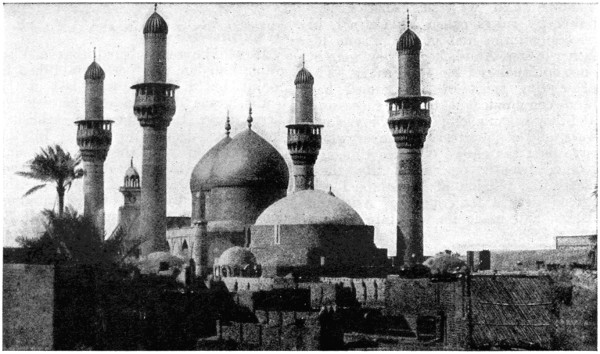
MOSQUE NEAR BAGDAD, THE EASTERN CAPITAL OF THE SARACEN EMPIRE
THE SARACEN EMPIRE: ITS FANATICISM, ART AND LEARNING
Saracen (Arab. Sharkiin, the eastern people, from Sharq, the East), is a term applied to the first followers of Mohammed or Mahomet who within forty years after his death, 632 A.D., had subdued a part of Asia and Africa. The Saracens conquered Spain in 711 and following, but were defeated at Tours, France, by Charles Martel in 732. Under Abd-el-rahman they established the caliphate of Cordova in 755, which gave way to the Moors in 1237. The empire of the Saracens closed with the capture of Bagdad by the Tartars, 1258.
We now come to a remarkable chapter in European history,—the invasion of Europe, the land of the Aryans, by a Semitic race, the followers of the famous Mohammed. Connected with this is the rise of the new religion and of a vast dominion that played a great part in the history of the Middle Ages. The latter only can be touched on here.
THE “KORAN” BECAME THE BASIS OF BOTH RELIGION AND EMPIRE
The doctrines of Mohammed, written down from time to time, received the name of the Koran,—that is, the “Reading”; and the religion itself was called Islam, or Mohammedanism—that is, “Salvation.”
THE HEGIRA OR FLIGHT OF MOHAMMED
His wife and a few other immediate relatives were the prophet’s first disciples, and these did not increase very rapidly. The people of Mecca denounced him as a madman or an impostor, and in a little time he was forced to flee from Mecca to save his life. He betook himself, with his disciples, to what is now Medina. The date of this flight, or Hegira, as the Arabians call it,—July 15, 622 A.D.,—has been adopted ever since as the chronological era in Mohammedan countries. At Medina he was received with open arms,—his doctrines having already made a number of converts in that place; and here he built his first mosque.
HIS RELIGION SPREAD BY THE SWORD
A complete change now came over Mohammed,—the dreamer became a red-handed soldier. “The sword,” cried he, “is the key of heaven and hell,” and by the sword Islam was to be forced upon all men. Tribe after tribe was subdued; and before the lapse of ten years the whole Arabian peninsula acknowledged the sovereignty of Mohammed, and could boast of an unmixed population of Moslems, or True Believers. The prophet was preparing to carry the new religion beyond the bounds of Arabia, when he was cut off by a fever at Medina in A.D. 632.
EMPIRE EXTENDED BY CONQUESTS OF THE CALIPHS
Mohammed was succeeded in his power by rulers called his Caliphs, or Successors, the first of whom was his father-in-law, Abu-beker. They were at once spiritual and temporal rulers. The proselyting spirit of Mohammed had been communicated to his successors, and they began a long series of invasions, wars, and conquests. They everywhere gave men the choice of three things,—Koran, tribute, or sword. By these means the religion of Mohammed was spread over a large part of Asia and Africa, and made its way into Europe also.
SARACEN CONQUESTS IN THE EAST
The first countries assailed were the Oriental possessions of the Byzantine Empire. In the reign of Abu-beker, Syria and Mesopotamia were subdued by Arabian armies. Under the next caliph, Omar, Egypt was conquered and Northern Africa overrun. The Arabs, or Saracens, as they were also called, met with comparatively little resistance in the Oriental countries, the countries beyond Mount Taurus; and this may be accounted for by the fact that these were the parts of the Roman Empire in which both Roman law and Christianity had taken least hold.
Thus the Eastern Empire was shorn of all its Oriental possessions; and even the farther East—Persia and the lands beyond, to India—was added to the Moslem dominion.
THE FURY OF CONQUEST IN THE WEST
In the West, however, a stout resistance was encountered. The Saracens besieged Constantinople, against which they carried on a siege of eight years (A.D. 668-675); but every assault was repelled by torrents of terrible Greek fire. A second siege, forty years afterward, met a like result. In North Africa, too, they encountered long and obstinate resistance; but finally the whole northern coast—Cyrene, Tripoli, Carthage—was subdued; and in A. D. 710 a host of turbaned Arabs, with unsheathed scimitars, under Tarik-ben-Zaid, crossed the narrow strait into Spain and landed on the rock which commemorates the name of their leader (“Gibraltar,” i. e., Jebel Tarik, the Mountain of Tarik).
SUBJUGATION OF SPAIN AND SOUTHERN GAUL
It will be remembered that a Visigothic kingdom had been established in Spain; but Roderick, the “last of the Goths,” was defeated on the field of Xeres, and the Saracens established themselves firmly in Spain. In the course of a few years they had possession of the whole peninsula, with the exception of the mountainous districts in the north, where the little Christian kingdom of the Asturias maintained itself.
The ambition of the Saracens now overleaped the Pyrenees. They obtained a foothold in Southern Gaul; and after a time an able Saracen commander, Abd-el-rahman, led a powerful Mohammedan army northward to subdue the land of the Franks. As far as the Loire everything fell before him, and it seemed that all Europe would come under Moslem sway.
THEIR DEFEAT BY CHARLES MARTEL
It was in the hour of need that Charles Martel appeared as a champion for Christendom. Gathering a powerful army, he met the Saracens between Tours and Poitiers (pwät-yea´). A desperate battle, which lasted for seven days, ensued; but on the seventh day the Saracens were defeated with great slaughter, A.D. 732.
This victory arrested forever the progress of the Mohammedan arms in Europe, and procured for Charles the expressive surname of “the Hammer” (Martel), by which he is known in history.
While the Saracens were stopped from pushing their conquests farther into Europe, they firmly established themselves in Spain, where they founded a kingdom that lasted for seven hundred years,—that is, till the very close of the Middle Ages.
DIVISION OF SARACENIC EMPIRE
For a short time the vast dominion which the Saracens had conquered held together, and a single caliph was obeyed in Spain and in India. But soon disputes arose as to the right of succession to the caliphate: wars and secessions took place, and in A.D. 755 the Saracenic empire was divided,—one caliph reigning in Spain and another in Bagdad.
In the East, the most distinguished of the Saracenic rulers was Haroun-al-Raschid (Aaron the Just), who became caliph in A.D. 786, and was a contemporary of Charlemagne. In the Arabian Nights we find a vivid picture of the city he ruled and the life he led. After the death of Haroun, the Eastern dominion of the Saracens was rent by civil strife; one province after another broke off from the caliphate, till in the eleventh and twelfth centuries it fell a prey to the Turks.
SARACENS SUCCEEDED BY THE MOORS IN SPAIN
In Spain, on the division of the Saracenic power, the rule was in the hands of the Ommiyad line, and the capital was at Cordova. From this city the scepter of the Ommiyades ruled during 283 years (from A.D. 755-1038); but in the eleventh century the supremacy of the Saracens gave place to the Moorish empire in Spain.
SARACEN CONTRIBUTIONS TO LEARNING AND ART
In the intellectual history of the Middle Ages the Saracens played a remarkable part. When Europe was sunk in the grossest ignorance, this clever people were actively engaged in the cultivation of science, learning, and the arts. The schools of Cordova vied with those of Bagdad in the collection of books and the encouragement of science, and from them proceeded nearly all that was original in the medicine, physics, and metaphysics of Europe during the Middle Ages.
GERMANIC EMPIRE OF CHARLEMAGNE
Charlemagne may be regarded as the chief regenerator of Western Europe after the dissolution of the Roman Empire. At the date of his coronation, 800 A.D., his empire was not inferior in extent to that of the old Roman Empire. He was master of all Germany and Gaul, the greater part of Italy, and part of Spain. Under him the Frankish dominion reached its highest point, and marks the formal termination of an antiquated state of society. It was also the introduction to another totally different form itself and from its predecessor. It was not barbarism, it was not feudalism; but it was the bridge which united the two.
The most important chapter in the history of the Middle Ages is that informing us how the ruins of the dilapidated Western Empire were for a time rebuilt into an imposing structure by the genius of a great man, the grandest figure of the Middle Ages,—Charlemagne. The real name of this great man was Karl, that is, Charles. Though best known by his French name of Charlemagne (Charles the Great), we must remember that he was not a Frenchman in our sense of the term, but a thorough Teuton, or German, in birth, instinct, speech, and residence.
WHAT THE DOMINIONS OF CHARLEMAGNE COMPRISED
The kingdom of the Franks, to which Charlemagne fell heir on the death of his father, formed an extensive dominion comprising portions of the two countries we now call France and Germany,—for it must be remembered that the specific countries, France and Germany, did not yet exist at all.
At this time—the latter half of the eighth century—Italy was divided between the Lombards and the Eastern emperors, England had come into existence, but only as a number of feeble and warring states, Spain was under the rule of the Moslems. In the meantime the land of the Franks was lifting itself from out the surrounding barbarism of the new races, and was the center of that Germanic civilization which was struggling into existence.
It is important to bear in mind the actual condition of the European world at the time Charlemagne came on the stage, for it will help us to understand the work he did, how far he succeeded and how far he failed.
THE CENTRAL PLAN OF CHARLEMAGNE’S EMPIRE
The ruling idea of Charlemagne was the re-establishment of the Roman Empire,—the building up on German soil of that colossal power which had toppled over because it rested on the too narrow basis of Latin nationality. In executing this design he aimed to use all the elements of civilization that the times presented, and especially these two great elements,—the political ideas and instincts of the Teutons, and the adhesive power of the Christian Church. Hence we find him, throughout his whole career, carefully cherishing all those old German institutions upon which the mass of his people looked with deep reverence, while at the same time we behold him the protector of the Pope and the loyal and ardent champion of the Church.
OBJECT OF HIS WARS AND HIS CHIEF FOES
It was in the effort to realize his grand idea that Charlemagne undertook the numerous wars and expeditions that filled the forty-six years of his reign. We shall not enter into the details of these wars; but it is needful to understand their object and their result.
The most important of Charlemagne’s military enterprises were directed against the fierce pagan nations of Germany and the wild Scythians in the outlying lands beyond. To appreciate the importance of these we must try to realize that the eastern frontier of the Frankish land, that is, the eastern boundary of Charlemagne’s kingdom, on the German side of the Rhine, ran into and abutted on the extensive stretch of country in Middle Europe that was still in the hands of the various uncivilized tribes. As long as these peoples remained in their warlike, savage, and pagan condition, they would press heavily on the struggling civilization of the Frankish kingdom, and would endanger, if not utterly destroy, its progress. Hence to subdue and especially to Christianize these tribes—to extend the domain of organized and law-governed society into the desert waste of Teutonic barbarism—was a main object with Charlemagne.
HE SUBDUES THE SAXONS AND BAVARIANS
With the Saxon confederation, formed by various pagan tribes on the Weser and the Elbe (the same tribes from among which the Saxons and Angles, who conquered Britain three centuries before this, had gone forth), Charlemagne had the greatest trouble. He repeatedly marched into their country and subdued them; but they constantly rose up again, and it was only after some terrible acts of vengeance,—for example, he one day had forty-two hundred prisoners hanged,—that they at length submitted to be baptized and to become peaceable subjects.
Soon after this the Bavarians attempted to render themselves independent of the Frankish power by the assistance of the Avars, a Tartar race living in what we now call Hungary (then Pannonia). Charlemagne overpowered the Bavarians, incorporating Bavaria with his German territory; and then revenged himself on the Avars by conquering them, taking their treasures, and annexing Hungary to his dominion.
THE FIRST UNION OF THE GERMANS UNDER ONE HEAD
The result of Charlemagne’s conquests on the east side of the Rhine was that Germany was for the first time all united under one head, and on that side the Frankish kingdom was extended to the confluence of the Danube with the Theiss and the Save.
Against the Saracens in Spain Charlemagne made an important expedition. The capture of Saragossa laid Aragon and Navarre at his feet, and he united the whole country as far as the Ebro to his own kingdom as a Spanish province. During his return the rear-guard under Roland, suffered a defeat in the valley of Roncesvalles, in which the bravest champions of the Franks were destroyed. This somewhat tarnished the laurels Charlemagne had won in Spain, but did not undo the substantial results of the campaign.
NORTHERN ITALY UNITED TO HIS EMPIRE
We must now see what Charlemagne did in Italy. At this period the Lombards were very troublesome to the Pope, and frequently assailed the Roman territory. Accordingly, when Pope Adrian I. called on Charlemagne for aid, the Frankish monarch crossed the Alps, defeated the Lombards, shut up their king in a monastery, and himself assuming the famous “iron crown” of Lombardy, united the whole of Upper Italy to the kingdom of the Franks (A.D. 773). At the same time he confirmed the gifts made by Pepin to the Pope.
The general result of all the wars and conquests which we have described was that by the year 800 Charlemagne, who had inherited from Pepin a kingdom scarcely equal to all Gaul, found himself lord of a dominion as large as the ancient Roman Empire of the West, and extending from the Ebro (in Spain) on the west to the Elbe in the northeast, the Theiss (Hungary) in the southeast, and including half of Italy, with Corsica, Sardinia, and the Balearic Isles. He fell heir to a kingdom; he was now master of an empire.
CROWNED BY THE POPE AS EMPEROR OF THE WEST
The year A.D. 800 forms the climax of Charlemagne’s reign. The sovereign had gone in splendid state to visit Italy. On Christmas day Charlemagne and his court were attending divine service in the church of St. Peter’s, at Rome. Suddenly, while the monarch was kneeling on the steps of the altar in prayer, the Pope, Leo III., placed a crown upon his head and solemnly saluted him as “Emperor of the West,” with the title of Charles I., Cæsar Augustus.
CHARLEMAGNE’S CONTRIBUTIONS TO THE CIVILIZATION OF HIS TIME
The latter years of Charlemagne’s life were spent in labors for the consolidation of his empire and the elevation of his people. He was a great patron of learning and learned men. He was himself a good Latin scholar, and he knew something of Greek. Wherever he was he was usually surrounded by learned churchmen, whom he drew to his court from all quarters, and with whom he delighted to hold conversations on literary and other subjects. The emperor, his family, and all attached to his household formed what was called the “School of the Palace.” Fond of literary pursuits, Charlemagne studied grammar, rhetoric, music, logic, astronomy, and natural history under his learned friends; and even after he was considerably advanced in years he took the pains to acquire the art of writing,—an accomplishment then very unusual except among churchmen.
HIS EFFORTS FOR EDUCATION OF HIS PEOPLE
Nor was the emperor’s interest in education confined to his own household. Each of the numerous monasteries that he endowed was bound to maintain a school. He had copies of the writings of the ancient Romans made and distributed among the convents, he formed a collection of old German heroic ballads, and under his patronage church music was greatly improved.
CAPITAL AND FAVORITE RESIDENCE OF CHARLEMAGNE
Charlemagne’s favorite place of residence was at Aix-la-Chapelle (in German, Aachen). He made this the northern capital of his empire, as Rome was the southern, and built a magnificent palace there. When his power was confirmed by his coronation as Emperor of the West, all the world hastened to pay him homage. The Saracen caliph, the famous Haroun-al-Raschid, who ruled the Eastern dominion of the Saracens, at Bagdad, exchanged courtesies with his great brother of the West, sending him, among other presents, an ape, an elephant, and a curious clock which struck the hours.
THE END OF CHARLEMAGNE’S GREAT EMPIRE
Charlemagne died at the age of seventy-two, at Aix-la-Chapelle, in A.D. 814. The year before, he had caused his only living son, Louis, to assume the imperial crown. But the vast structure that Charlemagne had raised during his lifetime tottered and fell almost immediately after his death. Louis, known as the Gentle (le Debonnaire), was better fitted for the repose of a cloister than for the government of a warlike kingdom. His sons, among whom he divided the empire, turned their arms first against himself and then against one another. Finally, in A.D. 843, a treaty was made at Verdun, by which France, Germany and Italy became separate and independent states; so that, in less than thirty years after the death of Charlemagne, the history of the Franks came to an end, and the history of France and of Germany began.
COMPARATIVE HISTORY OF NATIONS--Continued
IX. FROM THE TREATY OF VERDUN TO THE SIGNING OF MAGNA CHARTA BY KING JOHN, 843-1215 A. D.
Great Events of Period. 900-1000: Norse ravages and conquests continue; also private wars. 1000-1100: Increasing and beneficent power of the church exerted in the direction of order. Normans in Italy and Sicily. The Norman conquest of England; which as regards good government far surpasses all other countries. Quarrels between popes and emperors begin. 1100-1200: Quarrels between popes and emperors continue; zenith of papal power; Criticism revived. Private wars lessen; advance in power of kings and of towns at expense of the feudal baronage. The Crusades. 1200-1300: Rise of universities and of mendicant Friars. Quarrels between popes and emperors still continue. Last Crusades. English liberties recognized by the crown. Magna Charta.
A. D. Spain Britain France Germany Italy Church Scandinavia and Slavs Eastern Empire Saracens China, Japan, India A. D.
850 850
855. Kingdom divided. Louis II., Emperor, obtains Italy and Rhætia till 875. Charles, Provence, till 863. 860. Separation of the Greek and Latin Churches. 862. Russia: Rurik, first grand prince. 859. Japan: Powerful Seiwa family arises.
864-1131. Kingdom of Barcelona. 866. Invasion of the Danes. 867. Pope Hadrian II., Photius, Patriarch of Constantinople, deposed. 863-1030. Norway: Harold Harfargar to St. Olaf. 867-1057. Eastern emperors of the Macedonian line. 870-892. Muattemed re-establishes the capital at Bagdad.
871-900. ALFRED THE GREAT. 872. Pope John VIII.
875 876. Kingdom divided: Charles the Fat obtains Suabia and Alsace till 887. Louis the Younger, Saxony and Thuringia till 882. Carloman, Bavaria, etc. till 879; becomes King of Italy, 877. 875
885-1512. Kingdom of Navarre. 884. Charles the Fat reunites the monarchy of the Franks. 895. Hungary: Magyars under Arpad enter the Kingdom. 886-911. Leo VI., the Philosopher.
900 901-924. Edward the Elder, the first prince who takes the title of King of England. Rollo, the Dane, forces Charles to confer on him the province of Normandy and becomes: 907-960. China: Period of five dynasties. 900
912-961. Abderrahman III. The greatest Arab prince of Spain; splendid edifices built; learning encouraged; commerce flourishes. 912. Robert, Duke of Normandy; capital Rouen. 919-1024. Kings and Emperors of the Saxon house. 911. The Northmen in France embrace Christianity. 917. The Bulgarians besiege Constantinople.
919-936. Henry I., the Fowler, a great prince, consolidates the empire.
925 France is now divided among the powerful barons, who exercise sovereign power in their respective domains. 936-973. OTHO the GREAT. 927. Odo, abbot of Cluny, establishes celebrated code of discipline. 941. Russian expedition against Constantinople, under Igor. 925
950 955. Decisive victory over the Huns, which leads to the consolidation of the margravate of Austria. 950-961. Berenger II., submitted to Otto as his suzerain. 956. Armenia and the provinces between the Black and the Caspian Sea, recovered from the Saracens. 950
961-965. Otho’s second expedition into Italy; he dethrones Berenger; is crowned king, and emperor. 959. St. Dunstan becomes Archbishop of Canterbury and attempts to reform the church; enforcing clerical celibacy. 959-963. Romanus II. 960. China: Tai Tsoo founder of later Sung dynasty.
962. Makes Rome his capital. 966. Poland receives Christianity under Miecislas. 964-975. Cyprus, Cilicia and Antioch are captured by Nicephorus; Syria is overrun, and, under Zimisces, the Greeks penetrate to the Tigris.
967. Otho II. crowned emperor. 969. The Fatimites become masters of Egypt, with Cairo as the capital.
975 978-1016. Ethelred the Unready. New invasion of the Danes. 976-1025. Basil II. 980. Seljuk, a Turk officer of the khan of Tartary, becomes a Mohammedan, and settles in Samarcand. 975
House of Capet
987-996. Hugh Capet. France, for a long period before and after the accession of the Capets, has no national history; the royal authority is now restricted to the city in which the court resides. 989. Byzantine Christianity propagated in Russia by Vladimir the Great. 999. Pope Sylvester II.
1000 1000-1035. Sancho III., the Great, King of Navarre and Castile. There existed henceforward three Christian kingdoms in Spain: 1, Castile-Leon; 2, Navarre; 3, Aragon. Golden age of Arabian literature in Spain. 1016-1035. Canute the Great, King of Denmark. 1002-1024. Henry, Duke of Bavaria, a just and pious king. Continual wars with the Poles and Italy. Venice, Genoa, and Pisa rise in power, opulence and civilization. 1000-1186. India: Supremacy of Ghazni. 1000
1017-1041. Danish kings. House of Franconia
1024-1039. Conrad II., the Salic. 1019. Russia: Yaroslaff the Great. 1018. Bulgaria again reduced to a Grecian province.
1025 1026. Hixem III. 1029. Settlement of the Normans in South Italy. 1025-1028. Constantine IX. Culmination point of Byzantine greatness. Greeks greatest merchants and capitalists of the world during this century. Golden Age of Rajput civilization in India. 1025
1030. With him ends the Califate of the West. 1039-1056. HENRY III. He defeats the Bohemians and Hungarians and makes both tributary. The imperial power at its highest point.
1042. The Saxon line restored. 1042-1066. Edward the Confessor. French Normans become a new source of trouble. 1041. They conquer Apulia from the Greeks; 1060, Calabria; 1060-1090, Sicily. 1042. Turks invade and conquer Persia. The kingdom of Ghizni declines after 1032, and is confined to India; falls 1183.
1050 1056-1106. Henry IV. 1057-1185. Eastern emperors of the houses of the Ducas and the Comnenes. Southern Italy lost to the Normans. 1050
1059. Quarrels between the Popes and German Emperors respecting investitures and nomination to the Holy See.
1060-1108. Philip I. 1060. Robert Guiscard, first duke. 1060-1090. Sicily conquered by Count Roger, brother of Robert.Robert invades the Greek Empire and gains the battle of Durazzo.
1072. Alfonso VI. of Castile, enlarges his dominions by conquests from the Mohammedans. 1066. Harold elected king, but is defeated and slain in the battle of Hastings, which gives England to William. 1066-1154. Norman Kings. 1066-1087. WILLIAM THE CONQUEROR. 1066. William, Duke of Normandy, invades England. 1073. POPE GREGORY VII. Papacy attains great power.
1075 1077. Hungary: Ladislas I., the Saint. 1076. Jerusalem captured by Turks. 1075
1085. The Cid. Toledo is taken by Alfonso VI. after a three years’ siege. 1084. Bohemia erected into a kingdom by the Emperor Henry IV. 1084. Seljuks in Asia Minor.
1086. The battle of Zalaca. 1087-1100. William II., Rufus. Revolt of the Norman nobles. The feudal system established in England. 1088. Pope Urban II. 1092. The Seljuk Empire falls apart into a number of smaller states. Iconium or Roum, Damascus, Aleppo, Kerman and Iran.
1096. The First Crusade. Peter the Hermit and Walter the Penniless. 1095-1270. The First Crusade.
1099. Pope Pascal II. 1099. Foundation of the Kingdom of Jerusalem. Godfrey of Bouillon, elected king by the army.
1100 1100-1135. Henry I., Beauclerc. 1100-1523. Denmark: Introduction of Feudal system to Independence of Sweden. 1100-1468. Norway. 1100-1448. Sweden. 1100
1101. Robert, Duke of Normandy, invades England.
1103-1106. Henry invades and conquers Normandy. 1106-1125. Henry V., Emperor of Germany and King of Italy. 1119. Pope Calixtus II.
1125 1139. Kingdom of Portugal. Wars between the French and English, and rise of rivalry between these two nations, which lasts for three centuries and a half. House of Hohenstaufen 1138-1152. Conrad I., elected emperor. 1139. The two Sicilies erected into a kingdom under Roger. 1127. China: Kaou Tsung, Emperor. 1125
1147. The Second Crusade preached by St. Bernard and joined by the Emperor Conrad and Louis VII. of France. Rise of the factions of Guelfs and Ghibelines. 1146. The Second Crusade. The power of the crusaders declines.
1150 1154-1399. Plantagenets. 1154-1189. Henry II., Plantagenet. 1152-1190. Frederic I., Barbarossa, Emperor and King, one of the most heroic figures of the Middle Age. 1154. Pope Hadrian IV. 1150
1159. War between France and England. 1158. Venice a great maritime power. 1159. Pope Alexander III. 1157. Denmark: Waldemar I., the Great. 1156. Japan: War between the families of Gen and Hei.
1171-1172. Conquest of Ireland. The French language cultivated. 1166. Frederic in Italy. League of the Italian cities, 1167, to preserve their liberties. 1170. The Waldenses. 1171-1193. Saladin becomes Sultan of Egypt. Extends his dominions in Egypt, conquers Syria, Assyria, Mesopotamia and Arabia.
1175 1189-1199. Richard I., the Lion-hearted. Dreadful massacre of the Jews at his coronation. 1180-1223. Philip II., the greatest prince since Charlemagne. 1183. Peace of Constance re-establishes the independence of the Italian Republics. 1177. Poland: Casimir the Just. 1185-1204. Dynasty of Angelus. 1186-1206. India: The Afghans of Ghor rule. 1175
1189. Third Crusade led by Philip Augustus, of France; Richard, of England; and Frederic Barbarossa. 1189. The Third Crusade.
1190-1198. Henry VI., Emperor and King of Italy and the Sicilies. 1191. Pope Celestine III. 1193. Saladin dies; his dominions divided.
1195. Battle of Alarcon in which the Christians are defeated. 1199-1216. John usurps over Arthur, the son of his elder brother, Geoffrey. 1198. Philip of Suabia and Otho of Saxony, dispute the crown; the former supported by the Ghibelines, the latter by the Guelfs. 1198. Pope Innocent III.
1200 1201-1206. War with France; Philip espouses the cause of Prince Arthur. 1204. Venice aggrandized by the conquest of Constantinople. Papal power attains its climax. It is supreme over secular power. 1202-1241. Denmark: Waldemar II., the Conqueror. 1204. New revolution. The Crusaders return, again take Constantinople. 1204-1261. Latin Empire. 1202. The Fourth Crusade. 1206. Genghis Khan becomes emperor of the Mongols. 1200
1212. Battle of Navas de Tolosa; a victory for the Christians. 1202. The Fourth Crusade under Boniface of Montferrat. 1212-1250. Frederic II. becomes emperor and king of the two Sicilies. 1210-1212. First war of Venice and Genoa. ST. FRANCIS OF ASSISI (1182-1226)
1213-1276. James I., the Conqueror in Aragon. 1213-1215. War with France; the English lose Vermandois and Valois.
1214-1217. Henry I., King in Castile. 1215. Insurrection of the barons. Magna Charta signed at Runnymede. 1215. Fourth Lateran, and twelfth general council against the Albigenses and all heretics. The doctrines of transubstantiation and auricular confession established. 1217-1262. Norway: Haco IV.
A. D. Spain Britain France Germany Italy
850
855. Kingdom divided. Louis II., Emperor, obtains Italy and Rhætia till 875. Charles, Provence, till 863.
864-1131. Kingdom of Barcelona. 866. Invasion of the Danes.
871-900. ALFRED THE GREAT.
875 876. Kingdom divided: Charles the Fat obtains Suabia and Alsace till 887. Louis the Younger, Saxony and Thuringia till 882. Carloman, Bavaria, etc. till 879; becomes King of Italy, 877.
885-1512. Kingdom of Navarre. 884. Charles the Fat reunites the monarchy of the Franks.
900 901-924. Edward the Elder, the first prince who takes the title of King of England. Rollo, the Dane, forces Charles to confer on him the province of Normandy and becomes:
912-961. Abderrahman III. The greatest Arab prince of Spain; splendid edifices built; learning encouraged; commerce flourishes. 912. Robert, Duke of Normandy; capital Rouen. 919-1024. Kings and Emperors of the Saxon house.
919-936. Henry I., the Fowler, a great prince, consolidates the empire.
925 France is now divided among the powerful barons, who exercise sovereign power in their respective domains. 936-973. OTHO the GREAT.
950 955. Decisive victory over the Huns, which leads to the consolidation of the margravate of Austria. 950-961. Berenger II., submitted to Otto as his suzerain.
961-965. Otho’s second expedition into Italy; he dethrones Berenger; is crowned king, and emperor.
962. Makes Rome his capital.
967. Otho II. crowned emperor.
975 978-1016. Ethelred the Unready. New invasion of the Danes.
House of Capet
987-996. Hugh Capet. France, for a long period before and after the accession of the Capets, has no national history; the royal authority is now restricted to the city in which the court resides.
1000 1000-1035. Sancho III., the Great, King of Navarre and Castile. There existed henceforward three Christian kingdoms in Spain: 1, Castile-Leon; 2, Navarre; 3, Aragon. Golden age of Arabian literature in Spain. 1016-1035. Canute the Great, King of Denmark. 1002-1024. Henry, Duke of Bavaria, a just and pious king. Continual wars with the Poles and Italy. Venice, Genoa, and Pisa rise in power, opulence and civilization.
1017-1041. Danish kings. House of Franconia
1024-1039. Conrad II., the Salic.
1025 1026. Hixem III. 1029. Settlement of the Normans in South Italy.
1030. With him ends the Califate of the West. 1039-1056. HENRY III. He defeats the Bohemians and Hungarians and makes both tributary. The imperial power at its highest point.
1042. The Saxon line restored. 1042-1066. Edward the Confessor. French Normans become a new source of trouble. 1041. They conquer Apulia from the Greeks; 1060, Calabria; 1060-1090, Sicily.
1050 1056-1106. Henry IV.
1059. Quarrels between the Popes and German Emperors respecting investitures and nomination to the Holy See.
1060-1108. Philip I. 1060. Robert Guiscard, first duke. 1060-1090. Sicily conquered by Count Roger, brother of Robert. Robert invades the Greek Empire and gains the battle of Durazzo.
1072. Alfonso VI. of Castile, enlarges his dominions by conquests from the Mohammedans. 1066. Harold elected king, but is defeated and slain in the battle of Hastings, which gives England to William. 1066-1154. Norman Kings. 1066-1087. WILLIAM THE CONQUEROR. 1066. William, Duke of Normandy, invades England.
1075
1085. The Cid. Toledo is taken by Alfonso VI. after a three years’ siege.
1086. The battle of Zalaca. 1087-1100. William II., Rufus. Revolt of the Norman nobles. The feudal system established in England.
1096. The First Crusade. Peter the Hermit and Walter the Penniless.
1100 1100-1135. Henry I., Beauclerc.
1101. Robert, Duke of Normandy, invades England.
1103-1106. Henry invades and conquers Normandy. 1106-1125. Henry V., Emperor of Germany and King of Italy.
1125 1139. Kingdom of Portugal. Wars between the French and English, and rise of rivalry between these two nations, which lasts for three centuries and a half. House of Hohenstaufen 1138-1152. Conrad I., elected emperor. 1139. The two Sicilies erected into a kingdom under Roger.
1147. The Second Crusade preached by St. Bernard and joined by the Emperor Conrad and Louis VII. of France. Rise of the factions of Guelfs and Ghibelines.
1150 1154-1399. Plantagenets. 1154-1189. Henry II., Plantagenet. 1152-1190. Frederic I., Barbarossa, Emperor and King, one of the most heroic figures of the Middle Age.
1159. War between France and England. 1158. Venice a great maritime power.
1171-1172. Conquest of Ireland. The French language cultivated. 1166. Frederic in Italy. League of the Italian cities, 1167, to preserve their liberties.
1175 1189-1199. Richard I., the Lion-hearted. Dreadful massacre of the Jews at his coronation. 1180-1223. Philip II., the greatest prince since Charlemagne. 1183. Peace of Constance re-establishes the independence of the Italian Republics.
1189. Third Crusade led by Philip Augustus, of France; Richard, of England; and Frederic Barbarossa.
1190-1198. Henry VI., Emperor and King of Italy and the Sicilies.
1195. Battle of Alarcon in which the Christians are defeated. 1199-1216. John usurps over Arthur, the son of his elder brother, Geoffrey. 1198. Philip of Suabia and Otho of Saxony, dispute the crown; the former supported by the Ghibelines, the latter by the Guelfs.
1200 1201-1206. War with France; Philip espouses the cause of Prince Arthur. 1204. Venice aggrandized by the conquest of Constantinople.
1212. Battle of Navas de Tolosa; a victory for the Christians. 1202. The Fourth Crusade under Boniface of Montferrat. 1212-1250. Frederic II. becomes emperor and king of the two Sicilies. 1210-1212. First war of Venice and Genoa.
1213-1276. James I., the Conqueror in Aragon. 1213-1215. War with France; the English lose Vermandois and Valois.
1214-1217. Henry I., King in Castile. 1215. Insurrection of the barons. Magna Charta signed at Runnymede.
A. D. Church Scandinavia and Slavs Eastern Empire Saracens China, Japan, India
850
860. Separation of the Greek and Latin Churches. 862. Russia: Rurik, first grand prince. 859. Japan: Powerful Seiwa family arises.
867. Pope Hadrian II., Photius, Patriarch of Constantinople, deposed. 863-1030. Norway: Harold Harfargar to St. Olaf. 867-1057. Eastern emperors of the Macedonian line. 870-892. Muattemed re-establishes the capital at Bagdad.
872. Pope John VIII.
875
895. Hungary: Magyars under Arpad enter the Kingdom. 886-911. Leo VI., the Philosopher.
900 907-960. China: Period of five dynasties.
911. The Northmen in France embrace Christianity. 917. The Bulgarians besiege Constantinople.
925 927. Odo, abbot of Cluny, establishes celebrated code of discipline. 941. Russian expedition against Constantinople, under Igor.
950 956. Armenia and the provinces between the Black and the Caspian Sea, recovered from the Saracens.
959. St. Dunstan becomes Archbishop of Canterbury and attempts to reform the church; enforcing clerical celibacy. 959-963. Romanus II. 960. China: Tai Tsoo founder of later Sung dynasty.
966. Poland receives Christianity under Miecislas. 964-975. Cyprus, Cilicia and Antioch are captured by Nicephorus; Syria is overrun, and, under Zimisces, the Greeks penetrate to the Tigris.
969. The Fatimites become masters of Egypt, with Cairo as the capital.
975 976-1025. Basil II. 980. Seljuk, a Turk officer of the khan of Tartary, becomes a Mohammedan, and settles in Samarcand.
989. Byzantine Christianity propagated in Russia by Vladimir the Great. 999. Pope Sylvester II.
1000 1000-1186. India: Supremacy of Ghazni.
1019. Russia: Yaroslaff the Great. 1018. Bulgaria again reduced to a Grecian province.
1025 1025-1028. Constantine IX. Culmination point of Byzantine greatness. Greeks greatest merchants and capitalists of the world during this century. Golden Age of Rajput civilization in India.
1042. Turks invade and conquer Persia. The kingdom of Ghizni declines after 1032, and is confined to India; falls 1183.
1050 1057-1185. Eastern emperors of the houses of the Ducas and the Comnenes. Southern Italy lost to the Normans.
1059. Quarrels between the Popes and German Emperors respecting investitures and nomination to the Holy See.
1073. POPE GREGORY VII. Papacy attains great power.
1075 1077. Hungary: Ladislas I., the Saint. 1076. Jerusalem captured by Turks.
1084. Bohemia erected into a kingdom by the Emperor Henry IV. 1084. Seljuks in Asia Minor.
1088. Pope Urban II. 1092. The Seljuk Empire falls apart into a number of smaller states. Iconium or Roum, Damascus, Aleppo, Kerman and Iran.
1095-1270. The First Crusade.
1099. Pope Pascal II. 1099. Foundation of the Kingdom of Jerusalem. Godfrey of Bouillon, elected king by the army.
1100 1100-1523. Denmark: Introduction of Feudal system to Independence of Sweden. 1100-1468. Norway. 1100-1448. Sweden.
1119. Pope Calixtus II.
1125 1127. China: Kaou Tsung, Emperor.
1146. The Second Crusade. The power of the crusaders declines.
1150 1154. Pope Hadrian IV.
1159. Pope Alexander III. 1157. Denmark: Waldemar I., the Great. 1156. Japan: War between the families of Gen and Hei.
1170. The Waldenses. 1171-1193. Saladin becomes Sultan of Egypt. Extends his dominions in Egypt, conquers Syria, Assyria, Mesopotamia and Arabia.
1175 1177. Poland: Casimir the Just. 1185-1204. Dynasty of Angelus. 1186-1206. India: The Afghans of Ghor rule.
1189. The Third Crusade.
1191. Pope Celestine III. 1193. Saladin dies; his dominions divided.
1198. Pope Innocent III.
1200 Papal power attains its climax. It is supreme over secular power. 1202-1241. Denmark: Waldemar II., the Conqueror. 1204. New revolution. The Crusaders return, again take Constantinople. 1204-1261. Latin Empire. 1202. The Fourth Crusade. 1206. Genghis Khan becomes emperor of the Mongols.
ST. FRANCIS OF ASSISI (1182-1226)
1215. Fourth Lateran, and twelfth general council against the Albigenses and all heretics. The doctrines of transubstantiation and auricular confession established. 1217-1262. Norway: Haco IV.
X. FROM THE SIGNING OF MAGNA CHARTA TO THE DISCOVERY OF AMERICA BY COLUMBUS, 1215-1492 A. D.
Great Events of Period. 1200-1300: Hanse League established. Great conquests Tartars in Asia; they overrun Russia and establish a dynasty at Moscow. 1300-1400: Growth of cities and trade—especially in Italy, where also literature and art, inspired by Dante and Giotto, make progress. Popes at Avignon. Era of Wyclif: his teaching spreads in Bohemia. Invention of gunpowder. Mariner’s compass comes into use in the West. 1400-1500: Turks take Constantinople. Revival of learning and advance of art in the West—especially in Italy. Consolidation of France and Spain. End of Tartar rule in Russia. Invention of printing. Formation of modern “middle classes.” Maritime discoveries: The cape route to India; the “New World.” End of the Middle Ages.
A. D. Spain, Portugal Britain France Holy Roman Empire Switzerland, Poland, Hungary, Bohemia Scandinavia and Russia Eastern Empire Saracens China, Japan, India A. D.
Italy and Church Germany
1214-1292. ROGER BACON. Struggle of the Guelfs and Ghibelines. The power of the Roman pontiffs is carried to the highest pitch during this century.
1217. Ferdinand, King of Castile. 1216-1272. Henry III. 1219. Japan: The shogunate seized by the Fujiwara.
1224-1240. Mongolian invasion of Russia. 1221. Robert Guiscard, Emperor. 1221. The Khorasmian Empire overthrown by Genghis Khan.
1225 1230. Castile and Leon united by Ferdinand III., who takes large territory from the Moors. 1228. The Fifth Crusade. Many English and French nobles join. 1226-1270. LOUIS IX., Saint. Blanche of Castile, his mother, regent. 1227-1274. THOMAS AQUINAS. 1225
1248. The king sets out on The Sixth Crusade. 1243. Struggle of Pope Innocent IV. with the Emperor Frederick. 1243. The Hanseatic League. 1242. Alexander Nevski, Prince of Novgorod. 1244. The Khorasmians take Jerusalem.
1250 1253. The Alhambra founded. 1250. Conrad IV., Emperor. 1250. Egypt: The Mamelukes rule; take Damascus and Aleppo. 1250
1263-1265. CIVIL WAR. 1262. Norway: Iceland subjected. Greenland tributary to Norway. 1261. Michael Palæologus recovers Constantinople and overthrows the Latin Empire. 1258. Hulaku Khan enters Persia, takes Bagdad, and an end to the caliphate. 1259-1294. China: Kublai Khan, Emperor of all China, founder of the Mongol dynasty.
1265. Parliament of Simon of Montfort. Beginning of the House of Commons. Defeat and death of Simon of Montfort at Evesham. 1264. China: Kublai Khan builds Pekin, and makes it his capital.
1270. The Seventh and Last Crusade. House of Hapsburg
1274. Crown of Navarre passes to France. 1272-1307. Edward I., Longshanks. 1274. Fourteenth General Council at Lyons. 1273. Rudolf, Emperor, founds House of Hapsburg.
1275 1283. England and Wales united. Robert Bruce and John Balliol contend for the crown of Scotland. 1276. France at war with Castile. 1279. Russia: Hanseatic settlement at Novgorod. 1281. Japan: Invasion of Mongol Tatars. 1275
1284. Annexation of Wales to England.
1291. James II., King of Aragon. 1297. War between England and Scotland. 1297. Invasion of Flanders. 1293. Naval war between Genoa and Venice. 1298. Adolphus, Emperor, deposed and Albert I. enthroned. 1295. Poland: Vladislav the Dwarf, founder of Polish greatness. 1291. Capture of Acre by the Mamelukes; end of the European states in Asia Minor. 1288. Othman begins to lay the foundations of the Turkish power in Asia Minor.
1300 1302. First convocation of the states-general in France. 1303. Papal power declines. 1300
1304. War with Flanders. 1304. Rise of the Swiss towns.
1306. Robert Bruce proclaimed king of Scotland. 1306. Rudolf of Austria, Emperor.
1309. Seat of the popes transferred to Avignon. 1308. Henry of Luxemburg, Emperor. General insurrection in Switzerland.
1312. Alphonso XI., King of Castile and Leon. 1311. General Council at Vienna. 1314. Louis of Bavaria and Frederick of Austria contend for the crown. 1315-1388. AUSTRO-SWISS WAR.
1265-1321. DANTE. 1322. Frederick of Austria defeated.
1325 1326. Death of Othman; Orkhan, son of Othman, makes Prusa his capital. 1325
1327. Arrival of 200,000 Moors to assist Granada. 1327-1377. Edward III. 1327. Nicomedia taken by Orkhan.
1328-1400. CHAUCER. 1328-1498. The House of Valois. 1328-1350. Philip VI. 1328. Moscow under the Grand-duke Ivan Kalita becomes paramount in Russia. 1329. Andronicus III. defeated by the Turks in the battle of Pelekanon. 1330. Nicæa taken.
1265-1337. GIOTTO. 1333. Poland: Casimir the Great becomes King. 1333. China: Shun-te last of the Mongol Emperors succeeds. Japan: Fall of the Hojo family.
1340. Moors defeated at Tarifa. 1337. Edward lays claim to France which gives rise to: 1337-1453. HUNDRED YEARS WAR. 1339. Struggle in Rome between the Colonna and the Ursini. House of Luxemburg 1342. Hungary: Louis the Great. 1340. Denmark: Waldemar III. 1341. John V. (Paleologus), Emperor. 1336-1392. Japan: Feudalism reached its height.
1347. Democracy in Rome under Rienzi, last of the Tribunes. 1346-1378. Charles IV., King of Bohemia.
1350 Heroic Age of Portugal. 1354. Rienzi killed; papal dominion restored. 1355-1356. Promulgation of the golden bull; it fixes the prerogatives of the electoral college. Fundamental law of the empire. 1354. Turks seize Gallipoli in Europe. 1350
1359. Murad I., conquered Adrianople.
1364-1380. Charles V. the Wise. 1365. Adrianople residence of sovereigns. 1363. Timur, or Tamerlane, begins his career of conquest.
1368-1398. China: Hung Woo establishes the native Ming dynasty.
1370. Poland: Extinction of the royal race of Piasts with Casimir III. 1369. Timur becomes king of Transoxiana and makes Samarcand the capital of his new empire.
1375 1378. Wenceslas, King of Bohemia, Emperor. 1382. Russia: The Tartars sack Moscow. 1381. The empire pays tribute to the Turks. 1375
1394-1460. Henry the Navigator, King of Portugal. 1387. Denmark and Norway: Margaret, the Semiramis of the North, becomes queen. 1392. Timur subjugates Persia.
1399-1461. House of Lancaster. 1399. Henry IV., King of England. 1397. Union of Calmar, forming Denmark, Sweden and Norway into a single monarchy. 1398. Invasion of India by Timur; he takes Delhi.
1400 1400. Robert, Count of Palatine, Emperor. 1402. Bajazet defeated and made prisoner by Timur at the battle of Angora. 1400-1573. Japan: The Shoguns dominate for almost two centuries. 1400
1403. Empire of the Turks divided after death of Bajazet, among Solyman I., Musa and Mohammed I.
1407. John II., King of Castile. 1406. James I., King of Scotland. 1410. Civil war between Orleans and Burgundy. 1411. Sigismund, King of Hungary, Emperor.
1416. Alphonso V., King of Aragon and Sicily. 1414. Henry V. claims the French crown. 1414. Council of Constance. 1419. Bohemia: HUSSITE WAR. 1413. Mohammed I. sole ruler of the Turks.
1422. Henry VI. proclaimed at Paris, King of France. War with France. 1420. Sigismund becomes king of Bohemia.
1424. Bohemia: Death of John Ziska, the Hussite leader.
1425 1430. War between Castile and Granada. 1427-1429. Siege of Orleans. The English defeated by the French under Joan of Arc. France saved from the fate of Ireland. Charles VII. crowned at Rheims. 1429-1463. Cosmo de’ Medici in Florence, great patron of the arts and sciences. 1425
1431. Joan of Arc burned.
1438. House of Austria. Albert II. (King of Bohemia and Hungary), Emperor. 1438-1439. The emperor visits Italy to obtain help against the Turks.
1444. Truce with France. Marriage of Henry to Margaret of Anjou. 1446. War with Hungary. 1448. Denmark: Christian I., of Oldenburg, King. Sweden: Charles VIII. 1448. Constantine XII., last of the Greek emperors.
1450 1450-1560. Period of great maritime power of the Portuguese. 1450. Richard, Duke of York, claims the throne. 1450-1466. House of Sforza in Milan. 1451. Mohammed II., sultan of the Turks. 1450
1452. Civil war in Navarre, in which Castile and Aragon join. 1453. End of the French and English wars, without any formal peace. 1453. Austria made an hereditary duchy by Emperor Frederick III. 1453. Siege and capture of Constantinople by the Turks, ending the Eastern Empire.
1454. Henry IV. of Castile, King of Spain. 1455-1485. WARS OF THE ROSES. 1454. Struggle between Cosmo de’ Medici and the aristocracy. Ottoman Empire
1458. Hungary: Matthias Corvinus makes his country formidable to her neighbors. 1458. Greece subjected to the Turks.
1461-1485. House of York. 1461. Edward IV., King. House of York. 1461. Louis XI., King. 1462. The emperor besieged in court at Vienna. 1464. War with Hungary.
1468. Uzun Hasan, master of all Persia.
1469. Marriage of Ferdinand of Aragon with Isabella of Castile. 1470. Henry VI. restored by Warwick. 1469. Lorenzo de’ Medici at Florence. 1469-1480. Invasion of the Turks. 1470. Forms an alliance with the Venetians and the Duke of Burgundy against the Turks; conquers Bagdad. 1469. India: The Sikhs become powerful.
1471. Return of Edward IV. Deaths of Warwick and Henry VI. 1471. Increase of the power of the Medici. Rise of learning. Sixtus IV., Pope. 1472. Russia: Ivan III. marries Sophia, niece of the Greek Emperor.
1475 1475. Edward IV. invades France. 1477. Artois and Burgundy united to France. 1477. Marriage of Maximilian and Maria of Burgundy. 1477. Hungary: War with Frederick III. 1475
1479. Union of Castile and Aragon. 1480. War between England and Scotland. 1480. Otranto taken. 1481. Bajazet II., Sultan.
House of Tudor 1483-1498. Charles VIII.
1485-1509. Henry VII. 1485. Hungary: Matthias Corvinus takes Vienna.
1492. Conquest of Granada and union of the kingdom with Castile.
1492. America discovered by Columbus.
A. D. Spain, Portugal Britain France Holy Roman Empire
Italy and Church Germany
1214-1292. ROGER BACON. Struggle of the Guelfs and Ghibelines. The power of the Roman pontiffs is carried to the highest pitch during this century.
1217. Ferdinand, King of Castile. 1216-1272. Henry III.
1225 1230. Castile and Leon united by Ferdinand III., who takes large territory from the Moors. 1228. The Fifth Crusade. Many English and French nobles join. 1226-1270. LOUIS IX., Saint. Blanche of Castile, his mother, regent. 1227-1274. THOMAS AQUINAS.
1248. The king sets out on The Sixth Crusade. 1243. Struggle of Pope Innocent IV. with the Emperor Frederick. 1243. The Hanseatic League.
1250 1253. The Alhambra founded. 1250. Conrad IV., Emperor.
1263-1265. CIVIL WAR.
1265. Parliament of Simon of Montfort. Beginning of the House of Commons. Defeat and death of Simon of Montfort at Evesham.
1270. The Seventh and Last Crusade. House of Hapsburg
1274. Crown of Navarre passes to France. 1272-1307. Edward I., Longshanks. 1274. Fourteenth General Council at Lyons. 1273. Rudolf, Emperor, founds House of Hapsburg.
1275 1283. England and Wales united. Robert Bruce and John Balliol contend for the crown of Scotland. 1276. France at war with Castile.
1284. Annexation of Wales to England.
1291. James II., King of Aragon. 1297. War between England and Scotland. 1297. Invasion of Flanders. 1293. Naval war between Genoa and Venice. 1298. Adolphus, Emperor, deposed and Albert I. enthroned.
1300 1302. First convocation of the states-general in France. 1303. Papal power declines.
1304. War with Flanders. 1304. Rise of the Swiss towns.
1306. Robert Bruce proclaimed king of Scotland. 1306. Rudolf of Austria, Emperor.
1309. Seat of the popes transferred to Avignon. 1308. Henry of Luxemburg, Emperor. General insurrection in Switzerland.
1312. Alphonso XI., King of Castile and Leon. 1311. General Council at Vienna. 1314. Louis of Bavaria and Frederick of Austria contend for the crown.
1265-1321. DANTE. 1322. Frederick of Austria defeated.
1325
1327. Arrival of 200,000 Moors to assist Granada. 1327-1377. Edward III.
1328-1400. CHAUCER. 1328-1498. The House of Valois. 1328-1350. Philip VI.
1265-1337. GIOTTO.
1340. Moors defeated at Tarifa. 1337. Edward lays claim to France which gives rise to: 1337-1453. HUNDRED YEARS WAR. 1339. Struggle in Rome between the Colonna and the Ursini. House of Luxemburg
1347. Democracy in Rome under Rienzi, last of the Tribunes. 1346-1378. Charles IV., King of Bohemia.
1350 Heroic Age of Portugal. 1354. Rienzi killed; papal dominion restored. 1355-1356. Promulgation of the golden bull; it fixes the prerogatives of the electoral college. Fundamental law of the empire.
1364-1380. Charles V. the Wise.
1375 1378. Wenceslas, King of Bohemia, Emperor.
1394-1460. Henry the Navigator, King of Portugal.
1399-1461. House of Lancaster. 1399. Henry IV., King of England.
1400 1400. Robert, Count of Palatine, Emperor.
1407. John II., King of Castile. 1406. James I., King of Scotland. 1410. Civil war between Orleans and Burgundy. 1411. Sigismund, King of Hungary, Emperor.
1416. Alphonso V., King of Aragon and Sicily. 1414. Henry V. claims the French crown. 1414. Council of Constance.
1422. Henry VI. proclaimed at Paris, King of France. War with France. 1420. Sigismund becomes king of Bohemia.
1425 1430. War between Castile and Granada. 1427-1429. Siege of Orleans. The English defeated by the French under Joan of Arc. France saved from the fate of Ireland. Charles VII. crowned at Rheims. 1429-1463. Cosmo de’ Medici in Florence, great patron of the arts and sciences.
1431. Joan of Arc burned.
1438. House of Austria. Albert II. (King of Bohemia and Hungary), Emperor.
1444. Truce with France. Marriage of Henry to Margaret of Anjou. 1446. War with Hungary.
1450 1450-1560. Period of great maritime power of the Portuguese. 1450. Richard, Duke of York, claims the throne. 1450-1466. House of Sforza in Milan.
1452. Civil war in Navarre, in which Castile and Aragon join. 1453. End of the French and English wars, without any formal peace. 1453. Austria made an hereditary duchy by Emperor Frederick III.
1454. Henry IV. of Castile, King of Spain. 1455-1485. WARS OF THE ROSES. 1454. Struggle between Cosmo de’ Medici and the aristocracy.
1461-1485. House of York. 1461. Edward IV., King. House of York. 1461. Louis XI., King. 1462. The emperor besieged in court at Vienna.
1469. Marriage of Ferdinand of Aragon with Isabella of Castile. 1470. Henry VI. restored by Warwick. 1469. Lorenzo de’ Medici at Florence. 1469-1480. Invasion of the Turks.
1471. Return of Edward IV. Deaths of Warwick and Henry VI. 1471. Increase of the power of the Medici. Rise of learning. Sixtus IV., Pope.
1475 1475. Edward IV. invades France. 1477. Artois and Burgundy united to France. 1477. Marriage of Maximilian and Maria of Burgundy.
1479. Union of Castile and Aragon. 1480. War between England and Scotland.
House of Tudor 1483-1498. Charles VIII.
1485-1509. Henry VII.
1492. Conquest of Granada and union of the kingdom with Castile.
1492. America discovered by Columbus.
A. D. Switzerland, Poland, Hungary, Bohemia Scandinavia and Russia Eastern Empire Saracens China, Japan, India
1219. Japan: The shogunate seized by the Fujiwara.
1224-1240. Mongolian invasion of Russia. 1221. Robert Guiscard, Emperor. 1221. The Khorasmian Empire overthrown by Genghis Khan.
1225
1242. Alexander Nevski, Prince of Novgorod. 1244. The Khorasmians take Jerusalem.
1250 1250. Egypt: The Mamelukes rule; take Damascus and Aleppo.
1262. Norway: Iceland subjected. Greenland tributary to Norway. 1261. Michael Palæologus recovers Constantinople and overthrows the Latin Empire. 1258. Hulaku Khan enters Persia, takes Bagdad, and an end to the caliphate. 1259-1294. China: Kublai Khan, Emperor of all China, founder of the Mongol dynasty.
1264. China: Kublai Khan builds Pekin, and makes it his capital.
1275 1279. Russia: Hanseatic settlement at Novgorod. 1281. Japan: Invasion of Mongol Tatars.
1295. Poland: Vladislav the Dwarf, founder of Polish greatness. 1291. Capture of Acre by the Mamelukes; end of the European states in Asia Minor. 1288. Othman begins to lay the foundations of the Turkish power in Asia Minor.
1300
1315-1388. AUSTRO-SWISS WAR.
1325 1326. Death of Othman; Orkhan, son of Othman, makes Prusa his capital.
1327. Nicomedia taken by Orkhan.
1328. Moscow under the Grand-duke Ivan Kalita becomes paramount in Russia. 1329. Andronicus III. defeated by the Turks in the battle of Pelekanon. 1330. Nicæa taken.
1333. Poland: Casimir the Great becomes King. 1333. China: Shun-te last of the Mongol Emperors succeeds. Japan: Fall of the Hojo family.
1342. Hungary: Louis the Great. 1340. Denmark: Waldemar III. 1341. John V. (Paleologus), Emperor. 1336-1392. Japan: Feudalism reached its height.
1350 1354. Turks seize Gallipoli in Europe.
1359. Murad I., conquered Adrianople.
1365. Adrianople residence of sovereigns. 1363. Timur, or Tamerlane, begins his career of conquest.
1368-1398. China: Hung Woo establishes the native Ming dynasty.
1370. Poland: Extinction of the royal race of Piasts with Casimir III. 1369. Timur becomes king of Transoxiana and makes Samarcand the capital of his new empire.
1375 1382. Russia: The Tartars sack Moscow. 1381. The empire pays tribute to the Turks.
1387. Denmark and Norway: Margaret, the Semiramis of the North, becomes queen. 1392. Timur subjugates Persia.
1397. Union of Calmar, forming Denmark, Sweden and Norway into a single monarchy. 1398. Invasion of India by Timur; he takes Delhi.
1400 1402. Bajazet defeated and made prisoner by Timur at the battle of Angora. 1400-1573. Japan: The Shoguns dominate for almost two centuries.
1403. Empire of the Turks divided after death of Bajazet, among Solyman I., Musa and Mohammed I.
1419. Bohemia: HUSSITE WAR. 1413. Mohammed I. sole ruler of the Turks.
1420. Sigismund becomes king of Bohemia.
1424. Bohemia: Death of John Ziska, the Hussite leader.
1425 1429-1463. Cosmo de’ Medici in Florence, great patron of the arts and sciences.
1438-1439. The emperor visits Italy to obtain help against the Turks.
1448. Denmark: Christian I., of Oldenburg, King. Sweden: Charles VIII. 1448. Constantine XII., last of the Greek emperors.
1450 1451. Mohammed II., sultan of the Turks.
1453. Siege and capture of Constantinople by the Turks, ending the Eastern Empire.
Ottoman Empire
1458. Hungary: Matthias Corvinus makes his country formidable to her neighbors. 1458. Greece subjected to the Turks.
1464. War with Hungary.
1468. Uzun Hasan, master of all Persia.
1470. Forms an alliance with the Venetians and the Duke of Burgundy against the Turks; conquers Bagdad. 1469. India: The Sikhs become powerful.
1472. Russia: Ivan III. marries Sophia, niece of the Greek Emperor.
1475 1477. Hungary: War with Frederick III.
1480. Otranto taken. 1481. Bajazet II., Sultan.
1483-1498. Charles VIII.
1485. Hungary: Matthias Corvinus takes Vienna.
XI. FROM THE DISCOVERY OF AMERICA BY COLUMBUS TO THE PEACE OF WESTPHALIA, 1492-1648 A. D.
Great Events of Period. 1500-1600: The Reformation: Immense development of new life in Europe. Age of Charles V. Power of Spain, and her conquests in America. The monarchy strong in England. 1600-1700: The Thirty Years’ War, at first a life struggle of Roman Catholics and Protestants, results in downfall of Spain, and the ascendency of France, which reached its zenith under Louis XIV.
A. D. Britain Spain and Portugal Holland France Holy Roman Empire Poland, Prussia, Hungary, Bohemia Scandinavia and Russia Ottoman Empire and Persia China, Japan, India A. D.
Italy and Church Germany and Austria
The power of Spain grew rapidly. Greatest power in Europe during most of Sixteenth Century. 1491. Bretagne united to the crown.
1492. America discovered by COLUMBUS. 1493-1519. Maximilian I.
1494-1529. WARS WITH FRENCH for control of Italy. 1494-1529. WARS FOR THE CONTROL OF ITALY between the French and Spanish. 1494. Expedition of Charles VIII. into Italy. 1494-1559. Sixty-five years of Italian Wars. 1495. Diet at Worms.
1497-1503. Voyages of Amerigo Vespucius. South American coast explored. COPERNICUS (1473-1543).
1498. Vasco de Gama reaches India via Cape of Good Hope.
1500 1502. Marriage of Henry’s eldest daughter, Margaret, with James IV., King of Scotland. 1500. Partition of Naples between France and Spain. 1502. Destruction of the Golden Horde and end of Mongol power in Russia. 1502. Persia: Ismail Shah Sufi makes himself sole sovereign of Persia. 1500
1503. Naples annexed to the Spanish crown. JULIUS II., pope.
1509. Henry VIII., King. 1506. Columbus dies at Valladolid. 1506-1530. Margaret of Austria regent for her nephew Charles. 1506. Poland: Sigismund I., the Great. 1505. War with Persia. 1506. China: Portuguese, first Europeans in China.
1512. War with France. Alliance with Spain and the Pope against France. 1510. Council of Tours. 1512. Maximilian divides the empire into ten circles. 1512. Selim I. dethrones and puts to death his father.
1513. Battle of Flodden; James IV. killed. 1513. Pope LEO X. patron of literature and the arts. LUTHER (1483-1546). 1514. Persians defeated; Kurdistan added to the empire.
1515. Wolsey, chancellor and cardinal. 1515. Francis I. invades Italy.
1516-1556. CHARLES I. of Spain and V. of Germany. ARIOSTO (1474-1533). 1517. Beginning of the Reformation. 1516. Cairo taken.
1519. Conquest of Mexico by Cortez. RAPHAEL (1483-1520). 1519-1556. CHARLES V., King of Spain, Emperor. 1520. Christian II. of Denmark invades Sweden and overthrows Sten Sture. 1520. Soliman the Magnificent, Sultan.
1521. First war with Charles V. 1521. Accession of Bohemia and Hungary to the House of Hapsburg. 1523. Sweden: Revolt under Gustavus Vasa. The Danes expelled. Union of Calmar dissolved. Denmark and Norway: Frederick I. 1521. Belgrade taken.
1525 1525. Francis defeated and taken prisoner at Pavia. 1525. Spanish ascendency by the victory of Pavia. MICHAELANGELO (1475-1564). TITIAN (1477-1576). HOLBEIN (1498-1559). 1525. Albert, Grand-master of Teutonic Order makes East Prussia a secular possession. 1526. Invasion of Hungary. 1526. India: Baber founds the Mogul dynasty at Delhi. 1525
1527. Second war with Charles V.
1529. Reformation begins in England. Rivalry of Spain and France begins. CALVIN (1509-1564). 1530. Russia: Ivan IV., the Terrible. 1529. Invasion of Austria. Siege of Vienna.
1532. The king marries Anne Boleyn. 1531-1532. Conquest of Peru by Pizarro. 1532-1544. Struggle for possession of Italy. 1533. Norway and Denmark: Christian III.
1535. Henry excommunicated by the Pope. IGNATIUS LOYOLA (1491-1556). 1535. Barbarossa seizes Tunis.
1540. Lisbon the market of the world. 1540. Order of Jesuits founded by LOYOLA.
1543. Invasion of France. 1541. De Soto discovers the Mississippi River. 1543. Alliance with England against France.
1547. Edward VI., King. Formal establishment of Protestantism. 1547. Henry II., King; Catherine de’ Medici, Queen. 1545. Council of Trent. 1546-1547. Schmalkaldic War. 1547. Turks invade Persia.
1550 1552. Fifth war with Charles V. 1550. Julius III., Pope. 1551. Treaty of Passau secures religious liberty to the Protestants. 1551. Tripoli taken. 1550
1553. Mary Tudor, Queen of England. 1552. Invasion of Hungary.
1554. Lady Jane Grey executed. PALISSY (1510-1589).
1555. Persecution of the Protestants. 1556. Philip II., King. 1556. Charles V. abdicates. 1556. India: AKBAR becomes Mogul emperor, a patron of science and literature. Mogul Empire at its greatest splendor.
1558. ELIZABETH, Queen. Rise of the Puritans. CAMOENS (1525-1579). RELIGIOUS WARS IN FRANCE 1562-1598. 1559. Termination of French wars in Italy. 1559. Denmark and Norway: Frederick II. 1559. Military power of the Turks at its greatest height under Soliman.
1564. Acquisition of the Philippines. 1562. Religious liberty granted to the Huguenots. Tintoretto (1512-1594). 1564. Maximilian II., Emperor. Tycho Brahe (1546-1601).
1568. Mary, Queen of Scots, takes refuge in England. 1567. Duke of Alva, Governor of the Netherlands. WAR OF LIBERATION. 1568-1648. Sanguinary tribunals. Egmont and Horn beheaded, 1568. MONTAIGNE (1533-1592). 1569. Florence a grand duchy. 1569. Poland and Lithuania united by the Diet of Lublin. 1570. War with Venice.
SPENSER (1553-1599). SIR WALTER RALEIGH (1552-1618). 1571. Battle of Lepanto. Reign of Terror under Alva. 1572. Massacre of St. Bartholomew. Torquato Tasso (1544-1595). 1571. Russia devastated by the Tartars, and Moscow burned. 1571. Battle of Lepanto. 1573. Japan: Fall of the Ashikaga shoguns; Nobunaga supreme.
1575 1576. The Catholic league. 1576. Rudolph II., (King of Bohemia and Hungary), Emperor. 1575. Poland: Stephen Bathori chosen king; he strengthens the Jesuits. 1575
1577. Sixth religious war. 1578. Alliance of Sweden and Poland against Russia.
1580. Portugal passes under Spanish dominion. 1579. Commencement of the Dutch Republic by the Union of Utrecht; William, Prince of Orange, stadholder.
1584. Raleigh’s colony in Virginia. 1584. William of Orange assassinated.
1585. War with Spain. 1585. Pope Sixtus V. restores the Vatican library.
1588. Spanish Armada destroyed. 1588. Defeat of the Spanish Armada. England saved from Spanish invasion. 1588. Revolt of Paris. 1587. Poland: Sigismund III., King. 1588. Denmark: Christian IV.
Maritime supremacy of England begins. 1589-1792. House of Bourbon. 1589-1610. HENRY IV. 1589. Revolt of the Janisaries.
CERVANTES (1547-1616). 1590. Siege of Paris raised by the Spaniards. 1592. The Rialto and Piazza di San Marco built at Venice. 1592. Sweden: Sigismund III., of Poland, succeeds to the Swedish crown.
1596-1597. Naval expeditions of Drake and Raleigh in South America. Cadiz taken, and the Spanish fleet burned. 1598-1621. Philip III. 1598. Edict of Nantes toleration granted to the Protestants. GALILEO (1564-1642). 1594. Union of Protestants at Heilbronn. RUBENS (1577-1640). 1595. Power in Hungary declines; revolt of Wallachia.
SHAKESPEARE (1564-1616). KEPLER (1571-1630).
1600 1603. Union of England and Scotland. 1603. Japan: Tokugawa Iyeyasu makes himself shogun: his descendants retain power till 1868. 1600
BACON (1561-1626). 1583-1645. GROTIUS.
1607. English settlement at Jamestown. 1609. Expulsion of the Moors. 1610. Assassination of Henry IV. 1609. Leghorn becomes the emporium of the Levant trade. 1608. Protestant union under Frederick the Elector. 1611. Sweden: GUSTAVUS ADOLPHUS, King. War with Denmark. Oxenstiern, Minister. 1605. India: Jehangir, Mogul, Emperor.
1614. Last assembly of the states-general. 1613. Russia: Michael Romanoff, Czar, founder of the present ruling line.
1616. Sweden dominates the North.
1618-1648. THIRTY YEARS WAR—THIRTY YEARS WAR—THIRTY YEARS WAR—THIRTY YEARS WAR. 1618-1648.
1620. Emigration of Pilgrims to New England and founding of Plymouth. 1621. Dutch War. 1621. Dutch West India Company incorporated. 1620. Massacre of Prague.
HARVEY (1578-1657). 1624. Ministry of Cardinal Richelieu.
1625 1625. Charles I., King. 1625. Naval war with England. 1625. Breda taken by Spinola. DESCARTES (1596-1650). 1626. St. Peter’s dedicated. 1628. Victories of Wallenstein. 1625
1629. Gustavus Adolphus lands in Germany. War with Austria 1682-1699.
1632. Maryland settled by a colony sent out by Lord Baltimore. 1631. Influence of France increases. 1632. Battle of Lutzen. 1632. War with Russia. Poles advance to Moscow. 1632. Sweden: Christina, Queen; Oxenstiern, Regent. 1634. Murad invades Persia.
1639. Great naval victory by Van Tromp, over the Spanish fleet in the Downs. Vandyck (1599-1641). 1638. Invasion of Spain. 1637. Troubles on the Tartar frontier. Bagdad taken by the Turks.
1642-1649. CIVIL WAR AND REVOLUTION. 1640. Portugal regains independence. VELASQUEZ (1599-1660). 1640. Turin taken by the French. 1643. LOUIS XIV., King. 1646. Revolt of Naples under Masaniello. 1640. Frederick William of Prussia. 1645. War with Venice. 1644. China: Establishment of the Manchu dynasty.
1648. Cromwell routs the Scotch. The presbyterians expelled from parliament, which receives the name of “the Rump.” 1648. Wars of the Fronde. 1648. Peace of Westphalia, the Basis of all Subsequent Treaties; Signed at Munster. At this time begins the policy of the “Balance of Power” in Europe.
A. D. Britain Poland, Prussia, Hungary, Bohemia Scandinavia and Russia Ottoman Empire and Persia China, Japan, India
1500 1502. Marriage of Henry’s eldest daughter, Margaret, with James IV., King of Scotland. 1502. Destruction of the Golden Horde and end of Mongol power in Russia. 1502. Persia: Ismail Shah Sufi makes himself sole sovereign of Persia.
1509. Henry VIII., King. 1506. Poland: Sigismund I., the Great. 1505. War with Persia. 1506. China: Portuguese, first Europeans in China.
1512. War with France. Alliance with Spain and the Pope against France. 1512. Selim I. dethrones and puts to death his father.
1513. Battle of Flodden; James IV. killed. 1514. Persians defeated; Kurdistan added to the empire.
1515. Wolsey, chancellor and cardinal.
1516. Cairo taken.
1520. Christian II. of Denmark invades Sweden and overthrows Sten Sture. 1520. Soliman the Magnificent, Sultan.
1523. Sweden: Revolt under Gustavus Vasa. The Danes expelled. Union of Calmar dissolved. Denmark and Norway: Frederick I. 1521. Belgrade taken.
1525 1525. Albert, Grand-master of Teutonic Order makes East Prussia a secular possession. 1526. Invasion of Hungary. 1526. India: Baber founds the Mogul dynasty at Delhi.
1529. Reformation begins in England. 1530. Russia: Ivan IV., the Terrible. 1529. Invasion of Austria. Siege of Vienna.
1532. The king marries Anne Boleyn. 1533. Norway and Denmark: Christian III.
1535. Henry excommunicated by the Pope. 1535. Barbarossa seizes Tunis.
1543. Invasion of France.
1547. Edward VI., King. Formal establishment of Protestantism. 1547. Turks invade Persia.
1550 1551. Tripoli taken.
1553. Mary Tudor, Queen of England. 1552. Invasion of Hungary.
1554. Lady Jane Grey executed.
1555. Persecution of the Protestants. 1556. India: AKBAR becomes Mogul emperor, a patron of science and literature. Mogul Empire at its greatest splendor.
1558. ELIZABETH, Queen. Rise of the Puritans. 1559. Denmark and Norway: Frederick II. 1559. Military power of the Turks at its greatest height under Soliman.
Tycho Brahe (1546-1601).
1568. Mary, Queen of Scots, takes refuge in England. 1569. Poland and Lithuania united by the Diet of Lublin. 1570. War with Venice.
SPENSER (1553-1599). SIR WALTER RALEIGH (1552-1618). 1571. Russia devastated by the Tartars, and Moscow burned. 1571. Battle of Lepanto. 1573. Japan: Fall of the Ashikaga shoguns; Nobunaga supreme.
1575 1575. Poland: Stephen Bathori chosen king; he strengthens the Jesuits.
1578. Alliance of Sweden and Poland against Russia.
1584. Raleigh’s colony in Virginia.
1585. War with Spain.
1588. Spanish Armada destroyed. 1587. Poland: Sigismund III., King. 1588. Denmark: Christian IV.
Maritime supremacy of England begins. 1589. Revolt of the Janisaries.
1592. Sweden: Sigismund III., of Poland, succeeds to the Swedish crown.
1596-1597. Naval expeditions of Drake and Raleigh in South America. Cadiz taken, and the Spanish fleet burned. RUBENS (1577-1640). 1595. Power in Hungary declines; revolt of Wallachia.
SHAKESPEARE (1564-1616).
1600 1603. Union of England and Scotland. 1603. Japan: Tokugawa Iyeyasu makes himself shogun: his descendants retain power till 1868.
BACON (1561-1626).
1607. English settlement at Jamestown. 1611. Sweden: GUSTAVUS ADOLPHUS, King. War with Denmark. Oxenstiern, Minister. 1605. India: Jehangir, Mogul, Emperor.
1613. Russia: Michael Romanoff, Czar, founder of the present ruling line.
1616. Sweden dominates the North.
1618-1648. THIRTY YEARS WAR. 1618-1648.
1620. Emigration of Pilgrims to New England and founding of Plymouth.
HARVEY (1578-1657).
1625 1625. Charles I., King.
War with Austria 1682-1699.
1632. Maryland settled by a colony sent out by Lord Baltimore. 1632. War with Russia. Poles advance to Moscow. 1632. Sweden: Christina, Queen; Oxenstiern, Regent. 1634. Murad invades Persia.
1637. Troubles on the Tartar frontier. Bagdad taken by the Turks.
1642-1649. CIVIL WAR AND REVOLUTION. 1640. Frederick William of Prussia. 1645. War with Venice. 1644. China: Establishment of the Manchu dynasty.
1648. Cromwell routs the Scotch. The presbyterians expelled from parliament, which receives the name of “the Rump.” 1648. Peace of Westphalia, the Basis of all Subsequent Treaties; Signed at Munster. At this time begins the policy of the “Balance of Power” in Europe.
A. D. Spain and Portugal Holland France Holy Roman Empire
Italy and Church Germany and Austria
The power of Spain grew rapidly. Greatest power in Europe during most of Sixteenth Century. 1491. Bretagne united to the crown.
1492. America discovered by COLUMBUS. 1493-1519. Maximilian I.
1494-1529. WARS WITH FRENCH for control of Italy. 1494-1529. WARS FOR THE CONTROL OF ITALY between the French and Spanish. 1494. Expedition of Charles VIII. into Italy. 1494-1559. Sixty-five years of Italian Wars. 1495. Diet at Worms.
1497-1503. Voyages of Amerigo Vespucius. South American coast explored. COPERNICUS (1473-1543).
1498. Vasco de Gama reaches India via Cape of Good Hope.
1500 1500. Partition of Naples between France and Spain.
1503. Naples annexed to the Spanish crown. JULIUS II., pope.
1506. Columbus dies at Valladolid. 1506-1530. Margaret of Austria regent for her nephew Charles.
1510. Council of Tours. 1512. Maximilian divides the empire into ten circles.
1513. Pope LEO X. patron of literature and the arts. LUTHER (1483-1546).
1515. Francis I. invades Italy.
1516-1556. CHARLES I. of Spain and V. of Germany. ARIOSTO (1474-1533). 1517. Beginning of the Reformation.
1519. Conquest of Mexico by Cortez. RAPHAEL (1483-1520). 1519-1556. CHARLES V., King of Spain, Emperor.
1521. First war with Charles V. 1521. Accession of Bohemia and Hungary to the House of Hapsburg.
1525 1525. Francis defeated and taken prisoner at Pavia. 1525. Spanish ascendency by the victory of Pavia. MICHAELANGELO (1475-1564). TITIAN (1477-1576). HOLBEIN (1498-1559).
1527. Second war with Charles V.
Rivalry of Spain and France begins. CALVIN (1509-1564).
1531-1532. Conquest of Peru by Pizarro. 1532-1544. Struggle for possession of Italy.
IGNATIUS LOYOLA (1491-1556).
1540. Lisbon the market of the world. 1540. Order of Jesuits founded by LOYOLA.
1541. De Soto discovers the Mississippi River. 1543. Alliance with England against France.
1547. Henry II., King; Catherine de’ Medici, Queen. 1545. Council of Trent. 1546-1547. Schmalkaldic War.
1550 1552. Fifth war with Charles V. 1550. Julius III., Pope. 1551. Treaty of Passau secures religious liberty to the Protestants.
PALISSY (1510-1589).
1556. Philip II., King. 1556. Charles V. abdicates.
CAMOENS (1525-1579). RELIGIOUS WARS IN FRANCE 1562-1598. 1559. Termination of French wars in Italy.
1564. Acquisition of the Philippines. 1562. Religious liberty granted to the Huguenots. Tintoretto (1512-1594). 1564. Maximilian II., Emperor.
1567. Duke of Alva, Governor of the Netherlands. WAR OF LIBERATION. 1568-1648. Sanguinary tribunals. Egmont and Horn beheaded, 1568. MONTAIGNE (1533-1592). 1569. Florence a grand duchy.
1571. Battle of Lepanto. Reign of Terror under Alva. 1572. Massacre of St. Bartholomew. Torquato Tasso (1544-1595).
1575 1576. The Catholic league. 1576. Rudolph II., (King of Bohemia and Hungary), Emperor.
1577. Sixth religious war.
1580. Portugal passes under Spanish dominion. 1579. Commencement of the Dutch Republic by the Union of Utrecht; William, Prince of Orange, stadholder.
1584. William of Orange assassinated.
1585. Pope Sixtus V. restores the Vatican library.
1588. Defeat of the Spanish Armada. England saved from Spanish invasion. 1588. Revolt of Paris.
1589-1792. House of Bourbon. 1589-1610. HENRY IV.
CERVANTES (1547-1616). 1590. Siege of Paris raised by the Spaniards. 1592. The Rialto and Piazza di San Marco built at Venice.
1598-1621. Philip III. 1598. Edict of Nantes toleration granted to the Protestants. GALILEO (1564-1642). 1594. Union of Protestants at Heilbronn.
KEPLER (1571-1630).
1600
1583-1645. GROTIUS.
1609. Expulsion of the Moors. 1610. Assassination of Henry IV. 1609. Leghorn becomes the emporium of the Levant trade. 1608. Protestant union under Frederick the Elector.
1614. Last assembly of the states-general.
1618-1648. THIRTY YEARS WAR—THIRTY YEARS WAR. 1618-1648.
1621. Dutch War. 1621. Dutch West India Company incorporated. 1620. Massacre of Prague.
1624. Ministry of Cardinal Richelieu.
1625 1625. Naval war with England. 1625. Breda taken by Spinola. DESCARTES (1596-1650). 1626. St. Peter’s dedicated. 1628. Victories of Wallenstein.
1629. Gustavus Adolphus lands in Germany.
1631. Influence of France increases. 1632. Battle of Lutzen.
1639. Great naval victory by Van Tromp, over the Spanish fleet in the Downs. Vandyck (1599-1641). 1638. Invasion of Spain.
1640. Portugal regains independence. VELASQUEZ (1599-1660). 1640. Turin taken by the French. 1643. LOUIS XIV., King. 1646. Revolt of Naples under Masaniello.
1648. Wars of the Fronde. 1648. Peace of Westphalia, the Basis of all Subsequent Treaties; Signed at Munster. At this time begins the policy of the “Balance of Power” in Europe.
XII. FROM THE PEACE OF WESTPHALIA TO THE CLOSE OF AMERICAN WAR OF INDEPENDENCE, 1648-1783 A. D.
Great Events of Period. 1600-1700: Civil and religious liberty fought out in England under the Stuarts. Rise of modern science and philosophy. 1700-1800: Astounding growth of the British Empire. Government in England now and henceforth carried on by a Cabinet Ministry. Development of manufactures in England. Inventions and discoveries. Immense advance in arts and sciences. INDEPENDENCE OF THE UNITED STATES. THE FRENCH REVOLUTION which powerfully influences social, political and intellectual progress for the next hundred years.
A. D. United States Britain Spain and Portugal France Italy and Church Holland Scandinavia Germany Prussia and Poland Russia Ottomans, India, Japan, China A. D.
1649. Trial and execution of Charles I. The Commonwealth. 1649. Siege of Paris. 1648. Poland: The Cossacks revolt and defeat the Poles. John Casimir, King.
1650 1652. War with Holland. 1650
1653. CROMWELL, Lord Protector. 1654. Brazil recovered from the Dutch. 1653. Mazarin enters Paris in triumph. 1653. John de Witt, Grand Pensionary of Holland. 1653. Sweden: Christina resigns. Charles X. first of the House of Zweibrucken. 1653. Poland: War with Russia. 1654. Russian victories in Poland.
MILTON (1608-1674). 1655. War with England. MOLIERE (1622-1673). REMBRANDT (1607-1669). 1655. Charles X. of Sweden invades Poland. 1656. The Elector of Brandenburg allies himself with Sweden against Poland.
Stuarts restored. 1659. Peace of the Pyrenees. 1658. Denmark: War against the Swedes, who overrun Denmark, and menace Copenhagen. 1657. Leopold I., Emperor. 1657. Poland cedes Prussia to the Elector. 1657. Alliance with Sweden against Poland.
1660. Charles II., King. 1661. Invasion of Portugal. 1660. Denmark: Peace of Copenhagen. Revolution in Denmark; absolute monarchy established. Prussia acknowledged independent. 1661. War with Austria.
1663. Settlement of North Carolina under royal patent. 1662. Invasion of Hungary.
1664. New Amsterdam occupied by the English. 1665-1700. Charles II. 1665. Tyrol united to Austria. 1664. India: Rise of the Mahratta power. Sivaji takes and sacks Surat.
1668. Triple alliance of England, Sweden and Holland against France. MURILLO (1618-1682). 1667-1697. First three wars of Louis XIV. 1667. War with Spain. 1669. Candia taken from Venice. 1667. Holland: Peace of Breda; loss of New Netherlands.
1670. War between Genoa and Savoy. SPINOZA (1632-1677). 1671. The Cossacks subjugated.
1672. War with Holland. 1672. Sea fight between the Dutch fleet, under De Witt and De Ruyter, and the English and French fleets; Dutch defeated. Holland: William III., Stadtholder. 1672. The Emperor and Elector of Brandenburg ally themselves with Holland against France. 1672. Invasion of Poland.
1673. War with France to protect Holland. 1673. War of Austria and France. 1674. Sobieski, King of Poland.
1675 1675-1676. King Philip’s War in New England. Bacon’s Rebellion in Virginia. 1676. Messina blockaded by the Dutch and Spanish fleets. 1675. The Swedes invade Brandenburg and are defeated at Fehrbellin. 1676. General revolt of the Hungarians. 1675
1679. Habeas Corpus Act passed. 1678. Peace with Holland and Spain restores tranquility to Europe. 1677. Battle of the Lund, between the Swedes and Danes; the latter defeated. LEIBNITZ (1646-1716). 1678. First war with Russia.
NEWTON (1642-1727). 1680. France the most formidable power in Europe. 1680. Greater part of Alsace seized by France. 1682. Ivan and Peter, Czars. 1682. War with Austria.
1685. James II., King. Rise of the Whigs and Tories. 1685. Revocation of the edict of Nantes. 1683. Siege of Vienna by the Turks.
JOHN LOCKE (1632-1704). 1686. Buda taken after being held by the Turks one hundred and forty-five years. 1686. Russia declares war. 1686. India: The Dekkan conquered by Aurungzeb.
1688. Revolution. 1688. War of the allies against France. 1687. Joseph I., King of Hungary. 1688. Prussia: Frederick III. 1687. Revolution in Constantinople. Solyman II., Sultan.
1689-1697. War of William and Mary with the French. 1689. Revolt in Catalonia in favor of France. 1689. Alexander VIII., Pope. 1689. Russia: PETER THE GREAT begins personal rule after overthrowing his sister Sophia and repressing the Streltsi. 1689. First trade with China. India: Height of the Mogul power under Aurungzeb. China: Great influence of Jesuits.
1689. William III., King, and Mary II., Queen. War with France.
1690. Battle of the Boyne. James defeated, returns to France. 1691. Incursion of the French into Aragon. 1693. Battle of Marsaglia. 1693. The King of Sweden declared absolute. 1690. Joseph I. elected King of the Romans. 1692. First trade with China.
1695. Brussels bombarded by the French. 1696. Poland: Death of Sobieski; succeeded by:
1697. General peace. 1697. General peace of Ryswick between France and the allies. 1699. CHARLES XII. begins to reign. Denmark, Poland and Russia form an alliance against Sweden. 1697. Victories of Prince Eugene over the Sultan Mustapha at Zenta. 1697. Frederick Augustus I. 1699. Peace of Carlowitz. The Ottoman power broken.
1700 1701-1714. WAR OF THE SPANISH SUCCESSION 1701-1714. 1700-1721. GREAT NORTHERN WARS. 1700
1702-1713. Queen Anne’s War with the French. 1701. Philip V., King. 1702. Invasion of Holland. Revolt of the Huguenots. 1702. French victory at Luzzara over the Imperialists. 1702-1706. Charles XII. sweeps Poland and Russia. 1701. Hague alliance. 1701. Prussia is erected into a kingdom under Frederick I. 1700. Peter the Great wars with the Northern Powers.
1702. Queen Anne. War against France and Spain.
1704. Gibraltar taken by English. 1705. Barcelona taken by the Allies. 1704. Defeat at Blenheim. 1706. French driven from Italy by Prince Eugene. 1704. Battle of Blenheim. Bavarians and French defeated by English and Allies. Germany delivered from Louis XIV. 1704. Stanislaus I., King of Poland. 1703. St. Petersburg founded. 1703. Mustapha II. deposed by the Janizaries.
1707. Unsuccessful expedition against Port Royal. 1707. Act of union of England and Scotland. First united parliament of Great Britain meets. 1707. All Spanish possessions in Italy abandoned. 1707. Revolt of the Cossack Mazeppa. 1708. Charles XII. of Sweden invades Russia.
1711. Charles VI., Emperor. 1712-1786. Frederick II. 1709. Is defeated at Pultowa by Peter the Great. Russia becomes a great power.
1713. Treaty of Utrecht which gives Arcadia to the English. 1713. Peace of Utrecht. England acquires large American possessions. 1713. Peace of Utrecht; perpetual separation of the crown of France and Spain. 1714. Finland conquered.