BOOK OF LANGUAGE AND LITERATURE (continued 10)
Reading edition
Moloch.—A god of the Phœnicians to whom human victims, principally children, were sacrificed. Moloch is figurative of the influence which impels us to sacrifice that which we ought to cherish most dearly.
Momus (mō´mus).—The god of mockery and censure.
Mona (mon´a).—The isle of Anglesey; sometimes supposed to be the isle of Man. It was one of the chief seats of the Druids.
Moneta (mon-ē´ta).—A Roman surname of Juno as the protectress of money.
Mopsus (mop´sus).—The name of two soothsayers, one being the prophet of the Argonauts, and the other the son of Apollo and Manto. He contended in prophecy with Calchas (q.v.), whose superior he proved himself to be.
Morpheus (mor´fe-us).—The son of sleep and the god of dreams. The name signifies (Gr.) the fashioner, moulder, so called from the shapes he calls up before the sleeper.
Mowis.—The bridegroom of Snow, who (according to American Indian tradition) wooed and won a beautiful bride; but when morning dawned, Mowis left the wigwam, and melted into the sunshine. The bride hunted for him night and day in the forests, but never saw him more.
Musæ (mū´zē).—The Muses, daughters of Jupiter and Mnemosyne, were nine in number, and presided over the different kinds of poetry, the arts and sciences. Their names and special attributes were as follows: (i) Calliope (kal-lī´o-pē), the muse of epic poetry; (ii) Clio (klī´ō), of history; (iii) Erato (er´a-tō), of erotic poetry and mimic imitation; (iv) Euterpe (ū-ter´pē), of lyric poetry; (v) Melpomene (mel-pom´en-ē), of tragedy; (vi) Polyhymnia (pol-i-him´ni-a), of the sublime hymn; (vii) Terpsichore (terp-sik´o-rē), of choral song and dancing; (viii) Thalia (tha-li´a), of comedy; and (ix) Urania (ū-rā´ni-a), of astronomy. The favorite haunt of the Muses was Mount Helicon in Bœotia, where were the sacred fountains of Aganippe and Hippocrene. Mount Parnassus was also sacred to them.
Myrmidones (mer-mid´on-ēz), or Myrmidons (mer´mid-ons).—A people of Thessaly, under the rule of Achilles, whom they accompanied to Troy.
Myrtilus (mer´til-us).—Son of Mercury, and charioteer of Œnomaus. See “Pelops.”
Mysterious Three, The.—In Scandinavian mythology were Har “the Mighty,” the “Like-Mighty,” and the “Third Person,” who sat on three thrones above the rainbow. Then came the Æsir, of which Odin was chief, who lived in Asgard (between the rainbow and earth); next came the Vanir, or gods of the ocean, air, and clouds, of which deities Niörd was chief.
N
Naiades (nā´i-a-dēz), or Naiads (nā´yadz).—The nymphs of freshwater. See “Nymphæ.”
Naraka.—The hell of the Hindus. It has twenty-eight divisions, in some of which the victims are mangled by ravens and owls; in others they are doomed to swallow cakes boiling hot, or walk over burning sands.
Narcissus (nar-sis´us).—A beautiful youth, inaccessible to the feeling of love. The nymph Echo fell in love with him, but, her love not being returned, she pined away in grief (see “Echo”). In order to punish him, Nemesis made him see his own reflected image in a fountain, whereupon he became so enamored of it that he gradually pined away until changed into the flower that bears his name.
Nausicaa (naw-sik´a-a).—Daughter of Alcinous, who conducted Ulysses, when shipwrecked on the coast of Scheria (an island), to her father’s court.
Neleus (nē´lūs).—Son of Neptune and the nymph Tyro; king of Pylos, in Peloponnesus, and father of Nestor (q.v.).
Nemea (ne-mē´a).—A city in Argolis, near which Hercules slew the Nemean lion.
Nemesis (nem´e-sis)—i. e. vengeance (Gr.).—The goddess of retribution, who brings down all immoderate good fortune. She was also regarded as the goddess who punished crimes. She was the daughter of Night, and was represented as a crowned virgin, of great beauty and grace, with a whip in one hand and a pair of scales in the other.
Neoptolemus (ne-op-tol´em-us).—Son of Achilles and Deidamia. He was also called Pyrrhus (pir´us), on account of his reddish hair (Gr.); his other name, Neoptolemus, which signifies New-to-war (Gr.), having been given to him because he came late to Troy. He displayed great valor at Troy, and was one of the heroes concealed in the wooden horse (see “Troy”). He slew Priam and his daughter Polyxena. At the distribution of captives Andromache, the widow of Hector, fell to his lot, and he took her to Epirus. He married Hermione, the beautiful daughter of Menelaus and Helen, but was slain by Orestes, to whom she had been previously promised.
Neptunus (nep-tū´nus), or Neptune; called Poseidon (po-sī´don) by the Greeks.—The god of the sea and other waters, the brother of Jupiter, and husband of Amphitrite. His palace was in the depth of the sea, near Ægæ, in Eubœa, where he kept his horses with brazen hoofs and golden manes, which drew his chariot over the waves of the sea. His celebrated contest with Minerva for the possession of Athens is narrated under “Athenæ.” In the Trojan war he sided with the Greeks. He not only created the horse, but also taught men the art of managing horses by the bit and bridle. The symbol of his power was a trident, or spear with three prongs, with which he called forth or hushed storms, shook the earth, etc. Besides the trident, his attributes are the dolphin and the horse.
Nereides (nē´re-i-dēz or nē-rē´id-ēz); the Nereids (nē´-re-ids).—The fifty daughters of Nereus and Doris. They were the marine nymphs of the Mediterranean (see “Nymphæ”). Thetis, the mother of Achilles, was a Nereid.
Nereus (nē´rūs).—Son of Pontus and Gæa, and husband of Doris, father of the fifty Nereids. He dwelt at the bottom of the sea, and was regarded as the wise old man of the sea. Like other marine divinities, he was supposed to have the power of prophesying the future, and of appearing to mortals in various shapes. The Ægean Sea was his empire—possibly the whole of the Mediterranean.
Nessus (ness´us).—A Centaur who was slain with a poisoned arrow by Hercules (q.v.).
Nestor (nes´tor).—Son of Neleus and king of Pylos. He was famous among the heroes before Troy for his wisdom, justice and eloquence. In early life he was a distinguished warrior, and took part in the fight between the Centaurs and the Lapithæ, and was one of the Calydonian hunters and one of the Argonauts. He is said to have lived through three generations of men. He safely reached Pylos again after the fall of Troy.
Nicneven.—A gigantic and malignant female spirit of the old popular Scottish mythology. The hag is represented as riding at the head of witches and fairies at Hallowe’en.
Nidhogg.—The dragon that gnaws at the root of Yggdrasil, the tree of the universe in Scandinavian mythology.
Niflheim.—Mist-home of old Norse mythology. The region of endless cold and everlasting night, ruled over by Hela. It consists of nine worlds, to which are consigned those who die of disease or old age. This region existed “from the beginning” in the north, and in the middle thereof was the well Hvergelmir, from which flowed twelve rivers.
Niobe (nī´o-bē).—Daughter of Tantalus and wife of Amphion, king of Thebes. Having seven sons and seven daughters, she imprudently boasted of her superiority to Latona, who had but two children—Apollo and Diana. The latter, indignant at her presumption, slew all her children with their arrows. Niobe herself was changed into a stone.
Niord.—The Scandinavian sea-god. He was not one of the Æsir. Niord’s son was Frey (the fairy of the clouds), and his daughter was Freyja. His home was Noatun. Niord was not a sea-god like Neptune, but the spirit of water and air. The Scandinavian Neptune was Ægir, whose wife was Skadi. His temples were near the seashore and all aquatic plants belonged to him.
Nisus (nī´sus).—A friend of Euryalus (ū-rī´a-lus).—The two accompanied Æneas to Italy, and perished in a night attack on the Rutulian camp.
Nix.—Little creatures not unlike the Scotch brownie and German kobold. They wear a red cap, and are ever ready to lend a helping hand to the industrious and thrifty.
Nokomis.—Daughter of the moon, American Indian myths. Sporting one day with her maidens on a swing made of vine canes, a rival cut the swing, and Nokomis fell to earth, where she gave birth to a daughter named Wenonah.
Nornir, or Norns.—The three fates of Scandinavian mythology, past, present, and future. They spin the events of human life, sitting under the ash-tree Yggdrasil which they carefully tend. Their names are Urda (the past), Verdandi (the present), and Skuld (the future). Besides these three Norns, every human creature has a personal Norn or fate. The home of the Norns is called in Scandinavian mythology Doomstead.
Notus (nō´tus) (Gr.); called Auster by the Romans.—The south or southwest wind.
Nox (noks); called Nux (nūks) by the Greeks.—Night, daughter of Chaos.
Numitor (nū´mi-tor).—A king of Alba, grandfather of Romulus and Remus.
Nymphæ (nim´fē), or Nymphs.—Lesser female divinities supposed by the Greeks to dwell in the sea, springs, rivers, grottoes, trees and mountains. They had distinctive names, according to their habitat, as follows:
(i) The sea-nymphs, which were divided into two classes—the Oceanides (ō-se-an´id-ēz), or Nymphs of the Ocean, who were daughters of Oceanus (ō-sē´an-us); and the Nereides (nē´re-id-ēz or nē-rē´id-ēz), or Nereids (nē´re-ids), the nymphs of the Mediterranean, who were the daughters of Nereus.
(ii) The nymphs of fresh-water (rivers, lakes, brooks or springs); called Naiades (nā´i-a-dēz), or Naiads (nā´yads).
(iii) Oreades (o-rē´ad-ēz), the nymphs of mountains and grottoes.
(iv) Napææ (na-pē´ē), the nymphs of glens.
(v) Dryades (drī´ad-ēz), or Dryads, and Hamadryades (ham-a-dri´ad-ēz), the nymphs of trees; these nymphs died with the trees that had been their abode, and with which they had come into existence.
Nysa (nī´sa).—A city in India, where Bacchus was brought up.
O
Oceanus (ō-sē´an-us).—Son of Heaven and Earth, the god of the water that was supposed to surround the whole earth, the husband of Tethys, and the father of all the river-gods and water-nymphs of the whole earth. The ancient Greeks imagined the earth to be flat and circular, and to be surrounded by a river, which flowed perpetually around it, and which they called Oceanus. It was the great Outward Sea, opposed to the Inward or Mediterranean.
Odhærir.—In Scandinavian mythology the mead or nectar made of Kvasir´s blood, kept in three jars. The second of these jars is called “Sohn,” and the third “Bohn.” Probably the nectar is the “spirit of poetry.”
Odin.—The king of gods and men, and the reputed progenitor of the Scandinavian kings. He corresponds both to the Jupiter and the Mars of classical mythology. As god of war, he holds his court in Valhalla, surrounded by all warriors who have fallen in battle, and attended by two wolves, to whom he gives his share of food; for he himself lives on wine alone. On his shoulders he carries two ravens, Hugin (mind) and Munin (memory), whom he dispatches every day to bring him news of all that is doing throughout the world. He has three great treasures, namely, Sleipnir, an eight-footed horse of marvelous swiftness; Gungnir, a spear, which never fails to strike what it is aimed at; and Draupnir, a magic ring, which every ninth night drops eight other rings of equal value. The German tribes worshiped Odin under the name of “Woden.” The fourth day of the week, Wednesday, was sacred to him.
Odur.—In Scandinavian mythology, husband of Freyja, whom he deserted. He abandoned his wife on her loss of youth and beauty, and was punished.
Odysseus (od-is´sūs).—The Greek form of Ulysses, king of Ithaca, whose return from Troy to Ithaca forms the subject of the Odyssey. See “Ulysses.”
Œneus (ē´nūs).—King of Pleuron and Calydon, in Ætolia, husband of Althæa, and father of Meleager, Deianira, and other children. During his reign the boar that laid waste the lands of Calydon gave rise to the celebrated Calydonian boar hunt.
Œnone (ē-nō´nē).—Wife of Paris of Troy, before he carried off Helen.
Oileus (o-ī´lūs).—King of the Locrians, father of the lesser Ajax, and one of the Argonauts.
Olympia (o-lim´pi-a).—A plain in Elis, where the Olympian games were held. In the plain was the sacred grove of Jupiter, which contained the masterpiece of Greek art—the colossal statue of Jupiter by Phidias. The Olympic games were held every four years, this interval being called an Olympiad.
Olympus (o-lim´pus).—A mountain range on the boundary of Macedonia and Thessaly, of great height, and consequently regarded as the abode of the gods. Once the giants tried to reach heaven, and to do so piled Mount Pelion on Mount Ossa (both being high mountains in the neighborhood of Olympus); but Jupiter used his thunderbolts against them, and, with the assistance of Hercules, destroyed them all, and buried them under Mount Ætna.
Omphale (om´fa-lē).—A queen of Lydia, whom Hercules served as a slave a short time. She put on his lion´s skin, and carried his club, whilst he donned woman´s attire and spun wool.
Ops.—Wife of Saturn, the goddess of plenty and fertility, and especially the patroness of husbandry.
Oreades.—See “Nymphæ.”
Orestes (o-res´tēz).—Son of Agamemnon and Clytæmnestra, who, on the murder of Agamemnon, after his return from Troy, by Clytæmnestra and her paramour Ægisthus, was saved from the same fate by his sister Electra. He went to Strophius, king of Phocis, who was the husband of his aunt Anaxibia. Here he formed a memorable friendship with Pylades (pī´la-dēz), the king’s son. Later he avenged his father’s death by slaying his mother and Ægisthus; but was, in consequence, seized with madness and wandered from place to place. Apollo told him he could recover from his madness only by bringing the statue of Diana from the Tauric Chersonesus. Accordingly he set out, in company with his friend Pylades; but on their arrival they would have been sacrificed by the Tauri (q.v.) to Diana had not Orestes’ sister Iphigenia, who was the priestess of Diana, recognized him and intervened in time to save their lives. All three then escaped with the statue of the goddess. After this Orestes became king of Mycenæ, his father’s kingdom, and married the beautiful Hermione, daughter of Menelaus and Helen (of Troy), after slaying Neoptolemus (q.v.).
Orion (o-rī´on).—A handsome giant and hunter. He was beloved by Diana, which so displeased Apollo that he asserted that she was unable to hit, with one of her arrows, a distant point he showed her in the sea. This point was the head of Orion, who was swimming in the sea. Thus Orion perished, and he was placed among the stars, where he appears as a giant with a girdle, sword, a lion’s skin, and a club.
Orlog.—A god of Norse fable personifying the eternal law of the universe, from whose decree there was no appeal.
Ormuzd.—The name of the supreme deity of the ancient Persians, and of their descendants, the Parsees and Ghebers. He is an embodiment of the principle of good, and was created by the will of the great eternal spirit, Zervan-Akharana, simultaneously with Ahriman, the principle of evil, with whom he is in perpetual conflict. Ormuzd is the creator of the earth, sun, moon, and stars, to each of which he originally assigned its proper place, and whose various movements he continues to regulate.
Orpheus (or´fe-us).—A pre-Homeric poet, son of Œagrus and Calliope, lived in Thrace, and accompanied the Argonauts in their celebrated expedition. He played so skillfully on the lyre, which had been presented to him by Apollo, and which he had been taught to play by the Muses, that not only were wild beasts made tame, but even the rocks and trees moved from their places to follow him. He married the nymph Eurydice (ū-rid´is-ē), who died from the bite of a snake. He followed her into the lower world, where his beautiful strains of music even suspended the punishment of the wicked. Pluto promised to yield back his wife to him on the condition that he did not look back until he arrived in the upper world again. At the very moment, however, of passing the fatal bounds, Orpheus glanced back to see if she were following him, and just beheld her snatched back into the infernal regions. His grief for the loss of Eurydice was such that he treated all the Thracian women with contempt, and they in revenge, during the Bacchanalian orgies, tore him to pieces.
Ortygia (or-tij´i-a).—The ancient name of Delos, where Apollo and Diana were born.
Osiris (o-sī´ris).—A great deity of the Egyptians, husband of Isis. The ancients differ in opinion concerning this celebrated god, but they all agree that as ruler of Egypt he took care to civilize his subjects, to improve their morals, to give them good and salutary laws, and to teach them agriculture. He was worshiped under the form of an ox.
Ossa (os’sa).—A celebrated mountain in the northeast of Thessaly, near Mount Olympus. When the giants tried to scale heaven, they heaped Pelion, another mountain, on Ossa in order to reach the lofty mount Olympus, on the top of which Jupiter and the other gods dwelt.
P
Pæan (pē´an)—lit. “physician” (Gr.).—The name of the physician of the gods. Later the name was transferred to Apollo, and afterwards it was applied to a choral song, hymn or chant addressed to Apollo, and also to a war song before battle or after a victory.
Pagasæ (pag´a-sē), or Pagasa.—A maritime town of Thessaly, where the Argo (see “Argonautæ”) was built.
Paimosaid.—In American Indian myths a walking thief, especially one who walks through cornfields about harvest time to pluck the ears of maize or corn.
Palæmon (pal-ē´mon).—A sea-god; originally called Melicerta (q.v.).
Palamedes (pal-a-mē´dēz).—Son of Mauplius, and one of the Greek heroes who sailed against Troy. Having exposed Ulysses (q.v.) when he feigned madness in order to avoid going to Troy, the latter, who was famous for his craft, revenged himself by contriving to get a letter, purporting to be written by Priam, king of Troy, concealed under Palamedes’ bed. Ulysses then accused Palamedes of treachery, the fatal letter apparently established the charge, and Palamedes was stoned to death by the Greeks. Palamedes is credited with having added four letters—θ, ξ, χ, φ—to the original Greek alphabet of Cadmus, and also with the invention of quoits, dice, lighthouses, measures, scales, etc.
Pales (pal´ēz).—The Roman protecting deity of flocks and shepherds.
Palici (pal-ī´sī).—Twin sons of Jupiter and the nymph Thalia. They were worshiped in Sicily, in the neighborhood of Mount Ætna.
Palinurus (pal-i-nū´rus).—The pilot of Æneas, who fell into the sea off the west coast of Lucania.
Palladium (pal-lad´i-um).—Properly any statue of Pallas—i. e. Minerva; but the Palladium was an ancient image of the goddess at Troy, on the preservation of which the safety of the city was supposed to depend. Ulysses and Diomedes succeeded in carrying it off and afterwards took it to Greece. See “Troy.”
Pallas (pal´las).—The Greek name of Minerva (q.v.).
Pan.—The chief god of shepherds and flocks; son of Mercury, and the inventor of the syrinx or shepherd’s flute. He was also god of woods, in which he dwelt, and occasionally appeared suddenly before travelers, whose consequent fright was hence called “Panic fear.” Pan is usually represented as a being with horns, puck-nose and goat’s legs and feet.
Pandarus (pan´da-rus).—A celebrated archer in the Trojan army.
Pandora (pan-dō´ra)—lit. “giver of all” (Gr.).—A beautiful woman, made by Vulcan at Jupiter’s command, who received presents from the gods—hence her name. She was the first woman on earth, and was designed to work the ruin of man in revenge for Prometheus having stolen fire from heaven and thus benefited mankind against the will of Jupiter. Venus adorned her with beauty, Mercury endowed her with boldness and cunning, and the gods, each and all, provided her with a combination of destructive powers wherewith to work out the ruin of man. Thus provided, Mercury took her to Epimetheus (i. e. afterthought), who made her his wife, forgetting, till too late, that his brother Prometheus (i. e. forethought) had strictly enjoined him not to receive any gifts from the gods. Pandora brought with her from heaven a box containing every human ill, which, with feminine curiosity, she opened, and out of it they all flew, to afflict mankind, Hope alone remaining.
Paphos (paf´os).—A town in Cyprus; the chief seat of the worship of Venus.
Parcæ (par´sē).—The Fates; called by the Greeks Moiræ (moy´rē).—They were three in number; and their names were:
(i) Clotho (klō´tho), the spinner of the thread of life.
(ii) Lachesis (lak´e-sis), the disposer of lots in life.
(iii) Atropos (at´ro-pos)—lit. “the inflexible”—the fate that cannot be avoided. To these mighty goddesses both gods and men must submit. Sometimes Atropos is represented as cutting the thread of life spun by Clotho.
Paris, usually called Alexander (lit. “defending men”) in the Iliad. The second son of Priam, king of Troy, and Hecuba. He was brought up on Mount Ida by a shepherd, who gave him the name Paris. He was afterwards called Alexander on account of the bravery he displayed in defending the flocks and shepherds. He married Œnone (ē-nō´nē), the daughter of the river-god Cebren. He soon deserted her, however, in the following manner: At the marriage of Peleus and the Nereid Thetis all the gods, with the single exception of the goddess of Discord, were invited. Annoyed at being thus passed over, she threw among the guests a golden apple—usually called the Apple of Discord—with the inscription, “To the fairest.” Three were claimants for it—Juno, Venus and Minerva. Jupiter ordered Mercury to take the three goddesses to Mount Ida, and submit the matter to the judgment of the shepherd Paris, hence giving rise to the celebrated “Judgment of Paris,” which has formed the subject of so many masterpieces of art. In order to influence him in their favor severally, Juno promised him the sovereignty of Asia, Minerva renown in war, and Venus the most beautiful woman in the world for his wife. Paris decided in favor of Venus, and awarded her the golden apple. He then, under the guidance of Venus, sailed for Greece, to the court of Menelaus, king of Sparta, whose wife, Helen, was the most beautiful of women. He succeeded in carrying Helen off, and so gave rise to the famous Trojan war, as all the chiefs in Greece joined with Menelaus in an expedition to fetch her back from Troy (see “Helena”). Paris fought with Menelaus before the walls of Troy, and would have been slain by him, had not Venus interposed and carried him off in a cloud. He was killed by the celebrated archer Philoctetes, who shot him with one of the poisoned arrows of Hercules. When wounded he returned to his long-neglected wife Œnone, and requested her to heal the wound; but she refused, and he died in consequence. Œnone soon repented, however, and put an end to her own life. During the Trojan war Paris killed Achilles (q.v.).
Parnassus (par-nas´sus).—A high mountain in Phocis (Greece), with two peaks, sacred to Apollo and the Muses. Near it was the town of Delphi; and on the mountain was the famous Castalian spring, also sacred to Apollo and the Muses, in which the Pythia, the priestess, at Delphi, used to bathe.
Parthenopæus (par´then-o-pē´us).—Son of Meleager and Atalanta, and one of the “Seven against Thebes.”
Parthenope (par-then´o-pē).—One of the Sirens (q.v.), and the name of an ancient city forming the site of the present city of Naples (Neapolis).
Pasiphae (pā-sif´a-ē).—Daughter of the Sun and Perseis, wife of Minos and mother of Androgeos, Ariadne and Phædra; also of the Minotaur (see “Minos”).
Patroclus (pa-trok´lus).—The beloved friend of Achilles. Whilst Achilles remained inactive during part of the Trojan war, Patroclus was allowed by Achilles to lead the latter’s Myrmidons against the Trojans at a critical time. Achilles, in order to enhance the effect, equipped him with his own armor and arms. Patroclus, whom the Trojans supposed to be Achilles himself, drove them back to the walls of Troy, where, however, he was slain by Hector. To avenge his death, Achilles quickly reappeared in the field, and slew Hector in single combat.
Pauguk.—Name given to the great power, death, in American Indian mythology.
Pau-Puk-Keewis.—In American Indian folk-lore a mischievous magician, who is pursued by Hiawatha, goes through a series of wonderful transformations in his endeavors to escape, and finally becomes an eagle.
Peboan.—In American Indian folk-lore the personification of winter in form of a great giant who shook the snow from his hair and turned water into stone by his breath.
Pegasus (peg´a-sus).—The winged horse which sprang from the blood of the Gorgon Medusa, when her head was struck off by Perseus (q.v.). It was named Pegasus from the springs of Ocean, near which Medusa was killed. With a blow of his hoof he caused the fountain of the Muses (Hippocrene) to spring from Mount Helicon. Bellerophon rode him when he slew the Chimæra (ki-mē´ra).
Peleus (pē´lūs).—Son of Æacus, king of the Myrmidons in Thessaly, husband of Thetis and father of Achilles. The Nereid Thetis, who was his second wife, had the power, possessed also by Proteus, of assuming any form she pleased, a power she exercised in order to escape from Peleus. But the latter, having been taught by Chiron, held the goddess fast till she promised to marry him. At their marriage all the gods, save one, were present, and the uninvited one, the goddess of strife, threw the celebrated golden apple among the guests (see “Paris”). Peleus survived the death of his famous son Achilles.
Pelias (pe´li-as).—King of Ioclus, in Thessaly. In order to get rid of his nephew Jason, who claimed the throne, he sent him to fetch the golden fleece, thus giving rise to the celebrated expedition of the Argonauts (see “Argonautæ”). When Jason returned with Medea, the latter persuaded the daughters of Pelias to cut him in pieces and boil him, with the idea of thus restoring him to youth and vigor. In this way he perished. See “Jason.”
Pelion (pē´li-on).—A lofty range of well-wooded mountains in Thessaly. The giants heaped it on Mount Ossa, in their attempt to scale heaven (see “Ossa” and “Olympus”). The Centaur Chiron dwelt in a cave near its summit. The Argo (see “Argonautæ”) was built from timber felled here.
Pelops (pē´lops).—Son of Tantalus, king of Phrygia, father of Atreus and Thyestes, grandfather of Agamemnon and Menelaus. When a boy he was cut in pieces and boiled to make a savory dish to set before the gods, whom Tantalus, the favorite of the gods, had invited to a repast; but the gods would not touch it, and ordered Mercury to again put him into a caldron, whereby he was restored to life. Being driven out of Phrygia, he went to Elis, a province of Peloponnesus, and there obtained the hand of Hippodamia, daughter of King Œnomaus, whom he succeeded on the throne. He afterwards became so powerful that the whole peninsula was called after him “the island of Pelops.” In order to gain Hippodamia (hip-po-da-mī´a) he had first to engage in a chariot race with Œnomaus (ē-nom´a-us), a condition which the latter imposed on every suitor for his daughter’s hand, as an oracle had declared that he would be killed by his son-in-law. His horses being swifter than those of any mortal, many a suitor had suffered death, the stipulated penalty of defeat. Pelops, however, bribed Myrtilus, the charioteer of Œnomaus, to remove the linchpins of his master’s chariot, the bribe being the promise of half the kingdom. In the race the wheels of Œnomaus’ chariot soon came off, and Œnomaus was thrown out, and killed. Pelops thus gained Hippodamia, but was unwilling to keep faith with Myrtilus, whom he threw from a cliff into the sea.
Penates (pē-nā´tēz).—Old Latin guardian deities both of a household and of the state. The images of these gods were kept in the penetralia (pen-e-trā´li-a)—that is, the innermost or central part of the house. The Lares (q.v.) formed part of the Penates. On the hearth a perpetual fire was kept up in their honor, and the table, which was also sacred to them, always contained the salt-cellar and offerings of first fruits for them.
Penelope (pe-nel´o-pē).—The wife of Ulysses; celebrated for her constancy to her husband during his twenty years’ absence from Ithaca. She was the daughter of Icarius and Peribœa, of Sparta, and was won by Ulysses in the following way: Her father promised her to the suitor who should win a foot-race; but when Ulysses was the successful competitor her father tried to persuade her not to leave him. Ulysses left her free to act as she pleased in the matter, whereupon she covered her face with her veil to hide her blushes, and thus intimated that she preferred to accompany him as her husband. By Ulysses she became the mother of an only child, Telemachus. During Ulysses’ long absence she was the object of much undesired attention on the part of a host of importunate suitors, who declared that Ulysses must surely be dead. Penelope at last promised to make a selection of one of their number to be her husband as soon as she had finished a robe she was making for Ulysses’ aged father, Laërtes (lā-er´tēz). This was only a ruse (generally referred to as “Penelope’s web”), however, to put them off, as she undid every night the work done during the day. At last the secret was betrayed by one of her servants, and she was importuned more than ever. Ulysses now arrived home after twenty years’ absence at Troy and his subsequent celebrated wanderings, and came at first disguised as a beggar to see how the land lay. Having soon ascertained his wife’s noble fidelity, he still further tested her by getting her to promise her hand to the suitor who could draw his bow. This none of them could do, so Ulysses took it up and slew them all. He then made himself known to Penelope, and went to see his aged father.
Peneus (pē-nē´us).—The principal river of Thessaly, which flows in the valley of Tempe, between Mount Pelion and Mount Ossa, into the sea; also the river-god, who was the father of Daphne and Cyrene.
Penthesilea (pen-thes-i-lē´a).—The young and beautiful queen of the Amazons, who fought against the Greeks before Troy, and was slain by Achilles.
Pentheus (pen´thūs).—Grandson of Cadmus, whom he succeeded as king of Thebes. He was opposed to the introduction of the worship of Bacchus into his kingdom, and in consequence was torn to pieces by his mother and her sisters, who in their Bacchic frenzy imagined him to be a wild beast.
Perdix (per´diks).—The nephew of Dædalus (q.v.), the inventor of the chisel, saw, compasses, etc.
Peri.—Peris are delicate, gentle, fairy-like beings of eastern mythology, begotten by fallen spirits. They direct with a wand the pure in mind the way to heaven. These lovely creatures, according to the Koran, are under the sovereignty of Eblis; and Mohammed was sent for their conversion, as well as for that of man.
Persephone (per-sef´on-ē).—The Greek name for Proserpina (q.v.).
Perseus (per´sūs).—Son of Jupiter and Danaë (q.v.). His most heroic deed was the slaying of the Gorgon Medusa, which he accomplished in the following manner: With the aid of Mercury and Minerva he possessed himself of the winged sandals, the magic wallet, and the helmet of Pluto, which rendered the wearer invisible, and further received from Mercury a sickle, and from Minerva a mirror. Thus provided, he rose into the air and made his way to the abode of the Gorgons. He found them asleep, and cut off with the sickle the head of Medusa, looking at her terrible form in the mirror, as a single glance would have immediately changed him into stone. Perseus placed her head in the magic wallet, which he carried on his back, and escaped in safety from the pursuit of the two other Gorgons, the helmet rendering him invisible. He then proceeded to Æthiopia, where he slew the sea-monster, and saved and married the beautiful Andromeda (q.v.). The latter having been previously promised, however, to her uncle Phineus, he and several armed companions made their appearance at the nuptials, and endeavored to carry off the bride; but Perseus brought out Medusa’s head, and they were all turned into stone. Perseus afterwards gave the head of Medusa to Minerva, who placed it in the middle of her breastplate or shield. In fulfillment of the oracle he accidentally killed his grandfather Acrisius (q.v.) with a quoit. He is said to have founded Mycenæ.
Phæaces (fē-ā´sēz).—A fabulous people represented in the Odyssey as inhabiting the island of Scheria (afterwards Corcyra; now Corfu), and famous as sailors. Alcinous (q.v.) was their king.
Phaethon (fā´e-thon)—lit. “the shining” (Gr.).—Son of the sungod (Apollo) and Clymene (klī´men-ē). Having obtained permission from his father to drive the chariot of the sun across the heavens for one day, he drove so near the earth that he almost set it on fire, his strength being insufficient to keep the horses in the right track. Consequently Jupiter hurled him down with a thunderbolt into the river Padus (Po).
Phaon (fā´ōn).—A boatman at Mytilene, who, originally an ugly old man, was made young and handsome by Venus, whom he had carried across the sea without payment. Sappho (q.v.) thus fell in love with him, and, on her love not being returned, threw herself into the sea.
Philoctetes (fil-ok-tē´tēz).—A very famous archer, a friend of Hercules, who gave him at his death the poisoned arrows without which Troy could not be taken. In the tenth year of the Trojan war he was specially fetched from Lemnos, where he had been detained by a wound, by Ulysses and Diomedes. On arriving at Troy, Æsculapius or his sons cured his wound. He slew Paris and other Trojans.
Phlegethon (fleg´e-thon)—lit. “the blazing” (Gr.).—A river in the lower world, which ran with fire instead of water.
Phœbe (fē´bē).—A feminine form of Phœbus (lit. “the bright one”); applied to Diana, the sister of Apollo, as the goddess of the moon.
Phœbus (fē´bus)—lit. “the bright one” (Gr.).—An epithet applied to Apollo as the god of the sun. See “Apollo.”
Phœnix (fē´nix).—(i) A fabulous bird described as being as large as an eagle; its head finely crested with a beautiful plumage, its neck covered with gold-colored feathers, its tail white, and its body purple or crimson. (ii) Son of Amyntor, the teacher of Achilles, and his companion during the Trojan war.
Phorcys (for´sis), or Phorcus (for´kus).—A sea-god, father of the Gorgons and of the Grææ.
Phrixus (frix´us).—Son of Athamas and Nephele. Athamas having neglected Nephele (nef´el-ë), and married Ino, the latter persuaded him to sacrifice Nephele’s son Phrixus to Jupiter. Nephele, however, enabled her two children, Phrixus and Helle, to escape by means of a ram with golden fleece, the gift of Mercury, which carried them through the air. Helle fell into the sea (see “Helle”), but Phrixus arrived safely in Colchis, the kingdom of Æëtes (q.v.). Here he sacrificed the ram to Jupiter, and gave its golden fleece to Æëtes, who suspended it to an oak tree in the grove of Mars. To fetch this golden fleece the famous expedition of the Argonauts (see “Argonautæ”) was undertaken.
Picus (pī´kus).—Son of Saturn and father of Faunus. He was changed by Circe into a woodpecker, because he did not requite her love. The Romans regarded the woodpecker as a prophetic bird, sacred to Mars.
Pieria (pī-er´i-a).—A district of Macedonia, in the north of Greece; celebrated as one of the earliest seats of the worship of the Muses, who are hence called Pierides (pī-er´id-ēz). Hence the following lines:—
“A little learning is a dangerous thing; Drink deep, or taste not the Pierian spring.” Pope’s Essay on Criticism.
Pirene (pī-rē´nē).—A noted fountain at Corinth, at which Bellerophon caught Pegasus.
Pirithous (pī-rith´o-us).—Son of Ixion, whom he succeeded as king of the Lapithæ; famous for his friendship with Theseus. When Pirithous was invading Attica he was opposed by Theseus, king of Athens, for whom he soon conceived feelings of admiration, which afterwards deepened into a lasting friendship. At the marriage of Pirithous with Hippodamia (hip-po-da-mī´a) the bride was seized by a drunken Centaur, and thus arose the celebrated fight between the Centaurs and Lapithæ (q.v.), in which, with the assistance of Theseus, Pirithous and the Lapithæ came off victorious. On the death of Hippodamia, Pirithous conceived the bold project of carrying off Proserpine, wife of Pluto. Accordingly the two friends descended into the lower world, but were seized by Pluto and chained to a rock, where they both remained till Hercules visited that region. Hercules then delivered Theseus, who was suffering punishment merely on account of his friendship for Pirithous; but the latter he left to his fate.
Pleiades (plē´ya-dēz).—The seven daughters of Atlas and Pleione (plē´yo-nē).—They were the virgin companions of Diana, and when pursued by Orion were changed into doves and placed among the stars.
Pluto (plū´tō).—The god of the nether world; originally called Hades (hā´dēz), the name Pluto (lit. “wealth”) being applied to him because corn, the wealth of early times, was sent from beneath the earth as his gift. He was the son of Saturn and Rhea, brother of Jupiter and Neptune, and the husband of Proserpine. He possessed a celebrated helmet, which rendered the wearer invisible, and which Perseus (q.v.) borrowed when he went to slay the Gorgon Medusa. Black sheep were sacrificed to him. Pluto was also called Dis (dīs) and Orcus (or´-kus).
Plutus (plū´tus).—The god of wealth; represented as blind.
Pluvius (plū´vi-us)—lit. “rain-bringing” (Lat.).—A surname of Jupiter, to whom sacrifices were offered in times of drought. See “Jupiter.”
Pollux.—See “Castor.”
Polyhymnia.—See “Musæ.”
Polyphemus (pol-i-fē´mus).—Son of Neptune; was one of the celebrated Cyclops living in Sicily. He was a huge monster, having but one eye in the center of his forehead, and ate human flesh. Being rejected by the nymph Galatea in favor of Acis, he crushed the latter under an enormous rock. Ulysses, during his wanderings on his journey homeward after the fall of Troy, was driven upon Sicily, and at once seized by Polyphemus, who shut him and his companions in the great cave in which he dwelt. In the evening he drove his flock into the cave, closed the mouth of the cave with a heavy rock, and ate two of Ulysses’ companions for his supper. The next morning he led his sheep out to pasture, closing the mouth of the cave after him. The wily Ulysses then contrived and successfully carried out the following plan of escape: When the monster returned in the evening, Ulysses offered him some wine he had brought with him, and gave him enough to make him intoxicated. Polyphemus asked Ulysses his name, and the latter gave that of Noman. The giant then fell asleep, whereupon Ulysses and his companions, having made everything ready, bored out his eye with a red-hot piece of timber. Polyphemus roared out, and the other Cyclops dwelling on the island came to the mouth of the cave and inquired what was the matter; Polyphemus replied that no man had injured him, whereupon they all went away. Even now, however, Ulysses could not escape, the cave being closed by such a heavy rock, and had to wait till the following morning. Polyphemus then removed the rock, but sat by the opening and felt the back of each sheep as it passed out. Ulysses, whose name is synonymous with craft itself, had foreseen this, however, and he and his six companions safely passed out by clinging to the wool on the bellies of the sheep. They then made their way to their ships, and quickly put out from the shore. When a little way out Ulysses derided Polyphemus, whereupon the latter threw several immense rocks after him, one of which nearly struck his ship. See Odyssey, Book IX.
Polyxena (pol-ix´en-a).—Daughter of Priam and Hecuba. She was beloved by Achilles, and sacrificed at the grave of the latter by his son Pyrrhus.
Pomona (pō-mō´na).—The goddess of fruit and fruit trees. Her name is derived from Lat. pomum, fruit (of any kind).
Ponemah.—In American Indian mythology the name of the land of the future life, or the spirit land.
Portunus (por-tū´nus), or Portumnus (por-tum´nus).—The protecting god of harbors.
Poseidon (po-sī´don).—See “Neptune.”
Priam (prī´am).—Son of Laomedon, the famous king of Troy at the time of the Trojan war. The name Priam (Gr.) means the Chief, or Leader. He was the husband of Hecuba, and the father of Paris, Hector, Deiphobus, Cassandra, Polyxena, etc. On the capture of Troy he was slain by Pyrrhus, the son of Achilles.
Priapus (pri-ā´pus).—Son of Bacchus and Venus. The god of fruitfulness in general, and the protector of flocks of sheep and goats, of bees, of the vine, and of all garden produce.
Procas (prō´kas).—King of Alba Longa, and father of Numitor and Amulius.
Procne (prok´nē).—Sister of Philomela (q.v.).
Procris (prō´kris).—Wife of Cephalus (q.v.).
Procrustes (prō-krus´tēz)—lit. “the Stretcher” (Gr.).—The name of a famous robber of Greece, who used to make all his captives fit into his iron bed, either by cutting pieces off their legs if they were too long, or by stretching them out if they were too short. He was slain by Theseus.
Prometheus (pro-mē´thūs)—lit. “Forethought” (Gr.).—Son of the Titan Iapetos, brother of Epimetheus (ep-i-mē´thūs), or “After-thought.” The great benefactor of mankind, in spite of Jupiter. He stole fire from Olympus (heaven), and was the inventor of many arts, especially of working in metal and clay, whence he is said to have made man from clay. As a set-off against these advantages, Jupiter gave Pandora (q.v.) to Epimetheus. He also chained Prometheus to a rock, where in the daytime an eagle consumed his liver, which grew again during each succeeding night. From this perpetual torture he was delivered by Hercules, who killed the eagle.
Proserpina (pro-ser´pin-a); usually called Proserpine (pros´er-pīn); called by the Greeks Persephone (per-sef´on-ē).—Daughter of Jupiter and Ceres, and queen of the lower world. Her father, unknown to her mother, promised her to Pluto, who carried her off by causing the earth to open beneath her as she was gathering flowers. In consequence of this, Ceres did not allow the earth to bring forth any fruits, and Jupiter was obliged to send Mercury into the lower world to fetch Proserpine back. Pluto allowed her to go, but first gave her a pomegranate to eat. Having thus eaten in the lower world, she was obliged to spend one-third of the year with Pluto, remaining during the other two-thirds with her mother (see “Ceres”). Pluto and Proserpine ruled over the souls of the dead in the lower world.
Proteus (prō´tūs).—A sea-god who had the power of assuming any form he pleased. He tended the flocks (seals) of Neptune, and at midday rose from the sea and slept in the shade of the rocks. At such times he was much sought after, his prophetic powers being highly valued. When seized by the person wishing to consult him, he, in order to escape, assumed several different shapes in succession; but, if firmly held, he speedily returned to his original form, and prophesied.
Psyche (si´kē)—lit. “the soul” (Gr.).—The following beautiful story shows in an allegorical manner how the human soul is purified by misfortunes and prepared for the enjoyment of true and lasting happiness hereafter: Psyche was the youngest and most beautiful of the three daughters of a king, and by her beauty excited the jealousy of Venus. The goddess consequently ordered Cupid to inspire her with love for some utterly unworthy object; but instead of doing this Cupid himself fell in love with her. He accordingly visited her every night, leaving her always at daybreak. Her jealous sisters, however, made her believe that her midnight lover was a monster, and accordingly she one night brought a lamp while Cupid was asleep, and was astonished to behold the lovely god. In her excitement she let fall a drop of hot oil on the shoulder of Cupid, and so awoke him. He blamed her for her mistrust, and fled. In misery Psyche now wandered from temple to temple, inquiring after her lover, and at length came to the palace of Venus. Here she was treated with great severity and compelled to perform hard and menial tasks, which would have overcome her had not Cupid secretly and invisibly sustained her. At length she overcame the jealousy of Venus, and, becoming immortal, was united to Cupid forever. In works of art Psyche is represented as a maiden with the wings of a butterfly.
Pukwana.—The smoke from the calumet or peace pipe among American Indians. The pipe was made from stone found near the headwaters of the Mississippi. A quarry, located near the mountains, was famous among the Indians, who had made the adjacent territory neutral ground. Here they came and provided themselves with pipes. To apply the stone to any other use than that of pipe-making would have been sacrilege in their mind. From the color, they even fancied it to have been made, at the great deluge, out of the flesh of the perishing Indian.
Puk-Wudjies.—The pygmies of American Indian folklore; little wild men of the woods.
Pygmalion (pig-mā´li-on).—King of Cyprus, who became enamored of an ivory statue which he had made. Venus having answered his prayer to her to breathe life into it, he married the maiden.
Pylades (pi´la-dēz).—Nephew of Agamemnon, and celebrated as the friend of Orestes (q.v.). He married Electra, the sister of Orestes.
Pyramus (pī´ra-mus).—The lover of Thisbe (q.v.).
Pyrrhus (pir´us).—See “Neoptolemus.”
Python (pi´thon).—The famous serpent produced from the mud left after the subsidence of the deluge of Deucalion. It was slain near Delphi by Apollo, who founded the Pythian games to commemorate the victory.
Q
Quirinus (kwi-rī´nus).—The name of Romulus after his deification.
R
Rachaders.—In Indian mythology the second tribe of giants or evil genii, who had frequently made the earth subject to their kings, but were ultimately punished by Siva and Vishnu.
Radegaste.—In Slavonic mythology a tutelary god of the Slavi. The head was that of a cow, the breast was covered with an ægis, the left hand held a spear, and a cock surmounted its helmet.
Ragnarök (twilight of the gods).—The day of doom, when the present world and all its inhabitants will be annihilated. Vidar and Vali will survive the conflagration, and reconstruct the universe. In Scandinavian mythology the belief is taught that after this time the earth or realm will become imperishable and happiness sure.
Rahu.—In Hindu mythology the demon that causes eclipses. One day Rahu stole into Valhalla to quaff some of the nectar of immortality. He was discovered by the Sun and Moon, who informed against him, and Vishnu cut off his head. As he had already taken some of the nectar into his mouth, the head was immortal; and he ever afterward hunted the Sun and Moon, which he caught occasionally, causing eclipses.
Rakshas.—Evil spirits in Hindu myths, who guard the treasure of Kuvera, the god of riches. They haunt cemeteries and devour human beings; assume any shape at will, and their strength increases as the day declines. Some are hideously ugly, but others, especially the female spirits, allure by their beauty.
Ravana.—According to Indian mythology, was fastened down between heaven and earth for ten thousand years by Siva’s leg, for attempting to move the hill of heaven to Ceylon. He is described as a demon giant with ten faces.
Ravens.—According to an oracle from the gods, delivered at ancient Athens, ravens prognosticate famine and death because they bear the characteristics of Saturn, the author of these calamities, and have a very early perception of the malign influence of that planet.
Remus (rē´mus).—The brother of Romulus (q.v.).
Rhadamanthus (rad-a-man´thus).—Son of Jupiter and Europa, and brother of Minos. He was one of the three judges in the lower world, the other two being Æacus and Minos.
Rhea (rē´a).—See “Cybele.”
Rhea Silvia (rē´a sil´vi-a).—Daughter of Numitor, and mother of Romulus and Remus.
Rhesus (rē´sus).—A Thracian prince, who went to the assistance of Troy. As an oracle had declared that Troy would never be taken if the snow-white horses of Rhesus once drank of the Xanthus and fed on the grass of the Trojan plain. Diomedes and Ulysses slew Rhesus on the night of his arrival on Trojan territory, and carried off his horses.
Rhodope (rod´o-pē).—A lofty mountain range in Thrace, which, like the rest of Thrace, was sacred to Bacchus.
Romulus (rom´u-lus).—The founder and first king of Rome; twin-brother of Remus, son of Silvia by Mars. Silvia was the daughter of Numitor and a vestal virgin, hence the twins were condemned to be thrown into the Tiber. This was done; but the cradle stranded, and they were suckled by a she-wolf. They were afterwards found by Faustulus, the shepherd of king Amulius, who handed them over to the care of his wife Acca Larentia. When grown up, they decided to found a city on the Tiber; but in a dispute as to the site, Romulus killed Remus. When the city was built, it was found that women were very scarce. Romulus accordingly proclaimed that games were to be celebrated, and invited his neighbors, the Latins and Sabines, to the festival, during which the Roman youths carried off the maidens—this being generally referred to as “The Rape of the Sabine Women.” Hence arose a war between the two peoples, which was brought to a termination by the Sabine women rushing in between the armies and praying them to be reconciled. After a reign of thirty-seven years, Romulus was taken up to heaven by his father Mars in a fiery chariot. He was then worshiped by the Romans as Quirinus (kwi-rī´nus).
S
Saga.—Goddess of history in Scandinavian mythology.
Salamander.—A fabulous animal supposed by the ancients to live in and have the quality of eating fire.
Salmoneus (sal-mō´nūs).—Son of Æolus and brother of Sisyphus. He presumed to imitate the thunder and lightning of Jupiter, and was consequently hurled down to Tartarus with a thunderbolt by the father of the gods.
Sarpedon (sar-pē´don).—(i) Son of Jupiter and Europa, king of the Lycians. Jupiter granted him the privilege of living three generations. (ii) Grandson of the preceding; assisted the Trojans in the Trojan war, but was slain by Patroclus.
Saturnus (sā-tur´nus); usually called Saturn (sat´urn); called by the Greeks Cronos.—A mythical king of Italy, whose reign was the “golden age.” He was the son of Uranus (Heaven) and Gæa (Earth), the husband of Rhea, and the father of Jupiter, Juno, Pluto, Neptune, etc. He was the god of agriculture and of civilization in general. He was dethroned from the government of the world by his son Jupiter. His temple in Rome was used as the state treasury.
Satyri (sat´er-ī), or Satyrs (sat´erz).—A kind of wood-deities, resembling apes, with two goats-feet, and very lascivious. The older Satyrs were generally called Sileni (sī-lē´nī), and the younger ones Satyrisci. They were described as fond of wine, sleep, and music.
Scamander (ska-man´der).—A celebrated river near Troy.
Scamandrius (ska-man´dri-us), or Scamander.—Son of Hector and Andromache (an-drom´a-kē), whom the Trojans called Astyanax (q.v.).
Sciron (sĩ´ron).—A famous robber of Attica, slain by Theseus. He compelled those he robbed to wash his feet on the Scironian rock (which was named after him), and at the completion of the process kicked them over the rock into the sea. At the base of the rock was a tortoise, which devoured them.
Scylla (sill´a), and Charybdis (ka-rib´dis).—The names of two rocks, opposite to one another, between Italy and Sicily. In the one nearest to Italy was a cave in which dwelt Scylla, who was a terrible creature (female) with six long necks and heads, each of which contained three rows of sharp teeth, twelve feet, and barking like a dog. On the opposite rock, Charybdis, dwelt a being of the same name under an immense fig tree. Thrice a day she swallowed the waters of the sea and thrice threw them up again. Between these rocks, Scylla and Charybdis, the sea was very narrow and very dangerous. Hence mariners had to exercise great vigilance lest while avoiding Scylla they did not fall on Charybdis. This last expression is often used in speaking of cases where a middle course has to be carefully steered between two threatening difficulties.
Scyros (sī´ros).—An island in the Ægean Sea, near Eubœa. Here Achilles—at the court of King Lycomedes—was concealed, dressed as a woman, by his mother Thetis, in order to prevent his going to the Trojan war.
Sedrat.—The lotus tree which stands on the right hand side of the invisible throne of Allah. Its branches extend wider than the distance between heaven and earth. Its leaves resemble the ears of an elephant. Each seed of its fruit incloses an houri; and two rivers issue from its roots. Numberless birds sing among its branches, and numberless angels rest beneath its shade.
SCENES FROM THE STORY OF PSYCHE AND VENUS
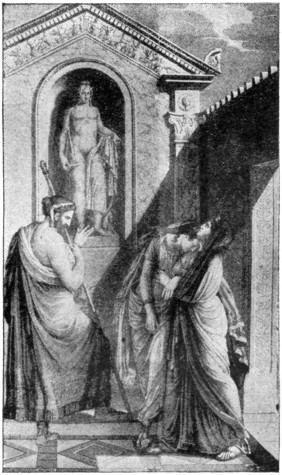
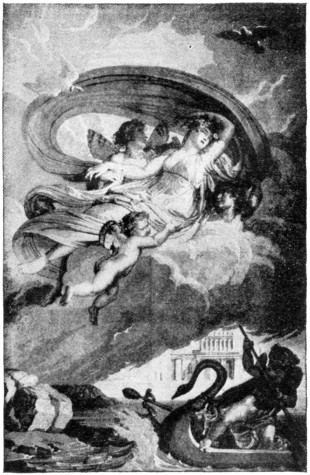
PSYCHE’S PARENTS CONSULT THE ORACLE A ZEPHYR BORE PSYCHE FROM THE EARTH
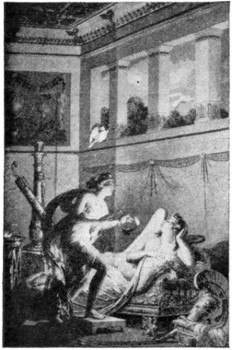
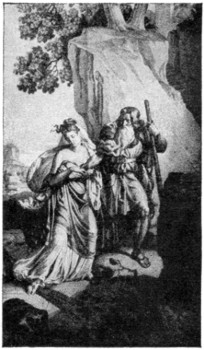
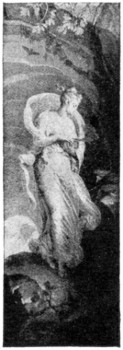
BURNING OIL FELL ON CUPID’S SHOULDER A FISHERMAN SHELTERS PSYCHE SHE OPENED THE BOX
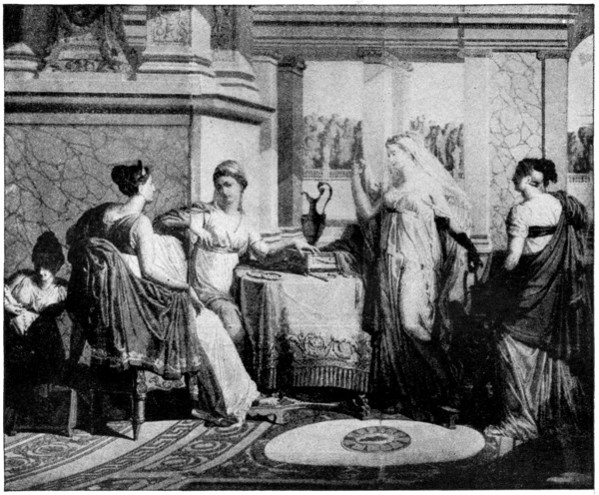
PSYCHE’S SISTERS ASKED WHAT SORT OF A PERSON HER HUSBAND WAS
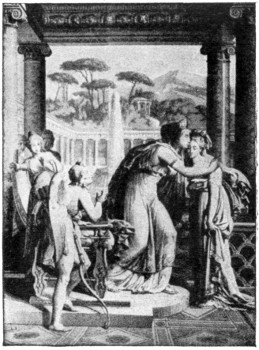
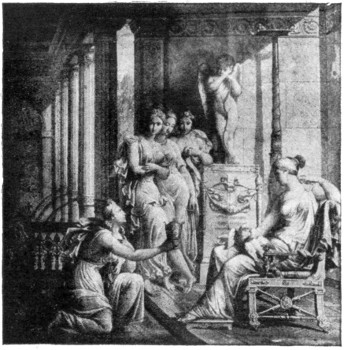
VENUS AND PSYCHE BECOME RECONCILED “DRINK THIS, PSYCHE, AND BE IMMORTAL”
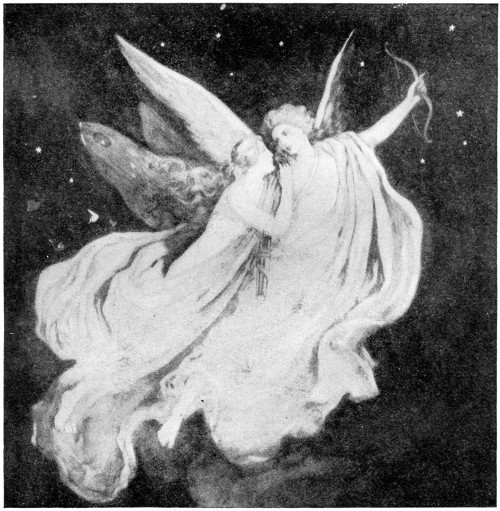
THE MARRIAGE OF CUPID AND PSYCHE
This symbolical picture represents the conscious union of the Soul of Man, figured as a young girl (Psyche), with the divine Spirit of Love (Cupid). Their starry or celestial environment signifies the emergence of the soul from matter into a permanent, uninterrupted or eternal life. The beautiful Greek story as a whole is simply an allegory describing the fall of the soul of man into earthly conditions; the labors and pains there undergone in order that, refined and redeemed, it may once more be raised into the heavenly world.
Semele (sem´el-ē).—Daughter of Cadmus and Harmonia, and mother, by Jupiter, of Bacchus. Juno, actuated by jealousy, persuaded her to ask Jupiter to appear before her in his terrible majesty as king of heaven. Having promised to grant whatever she desired, Jupiter did so; but warned her of the danger she would incur. The result was that she was consumed by the lightning; but Jupiter saved her child Bacchus.
Serapis (se-rā´pis).—An Egyptian divinity (male), whose worship was introduced into Rome, together with that of Isis, toward the end of the republic.
Seven Sages.—Same as Seven Wise Men of Greece (q.v.).
Seven Wise Men of Greece.—The title applied to seven Greeks of the sixth century B. C., who were distinguished for their practical wisdom and their terse maxims or principles of life. Their names are as follows: Bias, Chilo, Cleobulus, Periander (in place of whom some give Epimenides), Pittacus, Solon and Thales. They were the authors of the following famous mottoes, inscribed in later times in the temple of Apollo at Delphi: “Most men are bad,” Bias; “Consider the end,” Chilo; “Avoid excess,” Cleobulus; “Nothing is impossible to industry,” Periander; “Know thy opportunity,” Pittacus; “Know thyself,” Solon; “Suretyship is the precursor of ruin,” Thales.
Seven Wonders of the World.—A name applied to seven very remarkable objects of the ancient world. They are usually given as follows:
(i) The Pyramids of Egypt.
(ii) The Pharos (fā´ros) of Alexandria, which was a lofty lighthouse built by Ptolemy II. on the island of the same name, just opposite to Alexandria and united to it by a mole.
(iii) The walls and hanging gardens of Babylon. The walls are described under “Ninus.” The hanging gardens of Nebuchadnezzar were laid out upon terraces, which were raised one above another on arches.
(iv) The Temple of Diana at Ephesus.
(v) The colossal statue of the Olympian Jupiter by Phidias. It was made of ivory and gold, and the god was represented as seated on a throne of cedar wood, adorned with gold, ivory, ebony and precious stones.
(vi) The mausoleum of Artemisia.
(vii) The Colossus of Rhodes.
Sibyllæ (si-bil´lē), or Sibyls.—Prophetesses, supposed to be ten in number. The most famous of them is the Cumæan, who was consulted by Æneas before he descended into the lower world and gave him the sop to throw to Cerberus, which, when he had devoured it, threw him into a deep sleep and so enabled Æneas to slip by.
Sichæus (si-kē´us).—Dido’s uncle and husband; often called Acerbas. He was murdered by Pygmalion, Dido’s brother.
Silenus (si-lē´nus).—A name specially applied to a satyr (q.v.) who brought up and instructed Bacchus and was his constant companion. He is described as a bald-headed, jovial old man, generally intoxicated, and hence unable to trust his own legs to carry him safely. He generally rode on an ass. He possessed prophetic powers, which he could be made to exercise by surrounding him with chains of flowers while he was drunk and asleep.
Silvanus (sil-vā´nus).—A Latin deity presiding over woods and forests.
Sinon (sin´on).—Son of Æsimus, who allowed the Trojans to take him prisoner, and then persuaded them to take the famous wooden horse into their city. See “Troy.”
Sirenes (sī-rē´nēz), or Sirens (si´renz).—Sea nymphs, three in number, who had the power of enticing mariners to their destruction on dangerous rocks by their sweet music. In order to get his ship away in safety from them, Ulysses stuffed the ears of his companions with wax and then tied himself to the mast of the vessel, and did not release himself till he could no longer hear their charming voices. They dwelt on an island near the southwest coast of Italy.
Sisyphus (sis´i-fus).—Son of Æolus and king of Corinth; notorious for his avarice and deceit. His punishment in the lower world was to roll to the top of a hill a huge marble block, which no sooner reached the top than it rolled down again: hence a never-ending punishment.
Siva.—The third of the Hindu triad of divinities, who, among a thousand names, bears also that of Mahadeva. The greatest confusion exists as to his attributes; now he is said to be the destroyer, and now the creative principle.
Somnus (som´nus).—The god of sleep; was a son of Night and a brother of Death.
Soracte (sō-rak´tē).—A high mountain, near the Tiber, in Etruria, on the summit of which was a temple of Apollo.
Specter of the Brocken.—Among German myths, a singular colossal apparition seen in the clouds, at certain times of the day, by those who ascend the Brocken, or Blocksberg, the highest peak of the Hartz mountains.
Sphinx (sfingks).—A she-monster, who proposed a riddle to the Thebans, and murdered all who failed to guess it (see “Œdipus”). In works of art she is represented with a woman’s bust on the body of a lioness. The word Sphinx (Gr.) means the Throttler, from her manner of killing her victims.
Stentor (sten´tor).—A Grecian herald in the Trojan war. His voice was as loud as that of fifty ordinary men together: hence our word stentorian.
Stheno.—See “Gorgons.”
Stymphalus (stim-fā´lus).—A town in Arcadia; the haunt of the terrible birds slain by Hercules. See “Hercules (vi).”
Styx (stiks)—i. e., “the hateful, horrible” (Gr.).—The principal river of the lower world, around which it flows seven times. Charon (q.v.) ferried the souls of the departed across it. By the Styx the gods swore their most sacred oaths.
Surya.—The sun-god, according to the Hindu Veda, whose car is drawn by seven green horses, the charioteer being Dawn.
Sybaris (sib´ar-is).—A Greek town in Lucania, notorious for the luxury of its inhabitants: hence our word Sybarite.
Syphax (sif´ax).—King of one of the tribes of the Numidians. See “Sophonisba.”
Syrinx (sī´rinks).—A nymph, who, being pursued by Pan, was metamorphosed into a reed, of which Pan then made his shepherd’s pipe, usually called Pan’s pipe.
T
Tantalus (tan´ta-lus).—Son of Jupiter and the nymph Pluto; father of Pelops and Niobe. Having divulged some of his father’s secrets, he received a terrible punishment in the lower world. He was made to stand up to his chin in water, being at the same time afflicted with a raging thirst, and over his head hung branches of tempting fruit, yet when he attempted to drink the waters receded from him, and when he would pluck the fruit the branches immediately sprang out of his reach. Moreover, a huge rock was suspended above his head, threatening every moment to crush him. (Hence our word tantalize, meaning to torment by holding out hopes or prospects which cannot be realized.)
Tarpeia (tar-pē´ya).—Daughter of the governor of the Roman citadel: was tempted by the gold bracelets of the Sabines, who, in the time of Romulus, were besieging the fortress, to treacherously open one of the gates. As they rushed in they threw their shields upon her and crushed her to death. The Tarpeian Rock (tar-pē´yan), from which criminals were hurled headlong, was named after her.
Tartarus (tar´ta-rus).—The place of punishment of the wicked in the lower world, as opposed to the Elysian Fields, the abode of the blessed. Sometimes it means the lower world generally.
Taygete (tā-ij´et-ē).—Daughter of Atlas and Pleione, one of the Pleiones.
Tecmessa (tek-mes´sa).—Daughter of Teleutas, king of Phrygia, and mistress of Ajax the Great.
Telamon (tel´a-mōn).—Son of Æacus and brother of Peleus. He was king of Salamis and father of Ajax the Great (or Telamonius) and of Teucer, the celebrated archer. He was one of the Argonauts, and took part in the Calydonian boar hunt.
Telegonus (te-leg´on-us).—Son of Ulysses and Circe. He killed his father without knowing it. See “Ulysses.”
Telemachus (tē-lem´ak-us).—Son of Ulysses (q.v.) and Penelope.
Telephus (tē´le-fus).—Son of Hercules and king of Mysia. He married Laodice, daughter of Priam, king of Troy. He was wounded by the spear of Achilles, but was afterward cured by its rust.
Tenedos (ten´e-dos).—A small island in the Ægean Sea, off the coast of Troas. Hither the Greeks brought their fleet when they pretended to sail away from Troy (q.v.).
Tereus (tē´rūs).—Son of Mars, king of Thrace and husband of Procne, by whom he became the father of Itys. He hid Procne and married Philomela (q.v.). Procne killed her son Itys and served him up in a dish to Tereus. She then fled with her sister Philomela. Procne was afterwards changed into a swallow, Philomela into a nightingale, and Tereus into a hawk.
Terpsichore.—See “Musæ.”
Tethys (tē´this).—Wife of Oceanus and mother of the sea-nymphs and sea-gods.
Teucer (tū´ser).—(i) Brother of Ajax the Great, and the most skillful archer among the Greeks before Troy. (ii) The first king of Troy: whence the Trojans are sometimes called Teucri.
Thalia.—See “Musæ.”
Themis (them´is).—The goddess of justice and of prophecy. She is generally represented holding a cornucopia and a pair of scales.
Thersites (ther-sī´tēz).—A Greek before Troy, notorious for his ugliness and scurrility. He was killed by Achilles.
Theseus (thē´sūs).—The great legendary hero of Attica; was the son of Ægeus, king of Athens, and of Æthra. He went of his own accord as part of the yearly tribute of Athens to the Minotaur (q.v.). Ariadne, the daughter of Minos, however, fell in love with the hero, and gave him a sword wherewith he slew the monster, and a clue of threads by means of which he found his way out of the labyrinth. Theseus then sailed away in company with Ariadne, but he abandoned her (see “Ariadne”) in the island of Naxos. When approaching Attica, he forgot to hoist the white sail, as a token of success, and so caused the death of his father (see “Ægeus”). Theseus thus became king of Athens. His life was full of adventure. He was an Argonaut, and took part in the Calydonian boar hunt. His friendship with Pirithous is proverbial. He even accompanied Pirithous into the lower world with the object of carrying off Proserpine (see “Pirithous”). On his return from the lower world he found himself unable to re-establish himself as king of Athens, and retired to the island of Scyros, where he was killed by Lycomedes, the king, who treacherously thrust him down a rock.
Thetis (thet´is).—A sea-nymph; daughter of Nereus and Doris, wife of Peleus and mother of Achilles. At her wedding with Peleus occurred the celebrated incident of the Golden Apple (see “Paris”).
Thisbe (this´be).—A beautiful maiden of Babylon, beloved by Pyramus (pi´ra-mus).—Their parents being averse to their union, they used to converse secretly through a hole in the wall, as they lived in adjoining houses. Once they agreed to meet at the tomb of Ninus. Thisbe arrived first, but perceiving a lioness devouring an ox, she took flight. While running she lost her garment, which the lioness seized and soiled with blood. Meanwhile Pyramus came on the scene, and finding her garment soiled with blood, he imagined that she had been slain, and killed himself. Thisbe returned later, and finding the dead body of her lover killed herself also.
Thor.—In Scandinavian mythology the eldest son of Odin and Frigga; strongest and bravest of the gods. He launched the thunder, presided over the air and the seasons, and protected man from lightning and evil spirits. His wife was Sif (“love”); his chariot was drawn by two he-goats; his mace or hammer was called Mjolner; his belt was Megin-giord, and whenever he put it on his strength was doubled; his palace, Thrudvangr, contained five hundred and forty halls; Thursday is Thor’s day. This word means “refuge from terror.”
Thyone (thi-ō´nē).—The name given to Semele when she was brought from the lower world by her son Bacchus and placed among the immortals.
Tiresias (tī-res´i-as).—A celebrated blind soothsayer of Thebes. He was blind from his seventh year; but lived to a great age. He was one of the most famous soothsayers in all antiquity.
Tiryns (tī´rins).—A town in Argolis; one of the most ancient in all Greece, where Hercules was brought up. Remains of the city are still to be seen.
Tisiphone.—See “Furiæ.”
Titanes (tī-tā´nēz).—The Titans; the six sons and six daughters of Uranus (Heaven) and Ge (Earth), who contended with Jupiter for the sovereignty of heaven, but were overcome by him and precipitated into Tartarus.
Tithonus (tī-thō´nus).—Son of Laomedon and brother of Priam. He was beloved by the goddess Aurora, who endowed him with immortality, but not with eternal youth. Consequently, with the gradual decay of nature, he became at length a decrepit old man, whose immortality with ever-weakening physical vigor became a terrible burden to him. Aurora eventually changed him into a grasshopper.
Trimurti.—The name of the Hindu triad of deities; or Brahma, Vishnu, and Siva united in one god-head, and spoken of as an inseparable unity.
Triptolemus (trip-tol´em-us).—Son of Celeus, king of Eleusis. He was the favorite of Ceres, and the inventor of the plow and agriculture: hence introduced civilization, which follows the latter. He introduced the worship of Ceres.
Triton (trī´ton).—A sea-god; son of Neptune, who blows through a shell to calm the sea. He is represented with a man’s head and body, the lower part being that of a fish.
Troas (trō´as).—The region about Troy (or Ilium), forming one of the five parts into which Mysia, a district occupying the northwest corner of Asia Minor, was divided. Troas is frequently called The Troad.
Troilus (trō´il-us).—Son of Priam and Hecuba; slain by Achilles.
Troja (trō´ja), or Troy, called by the Greeks Ilium (ī´li-um).—A city of Asia Minor, situated in the Troad, famous for its ten years’ siege by the Greeks. The name Troy was derived from king Tros (trōs), who gave his name originally to the district (Troas) and the people; Ilium from Ilus, son of Tros, who founded the city—which, however, was also called, after his father, Troy. The Trojan war forms the subject of Homer’s immortal poem, the Iliad. The history of this celebrated war may be briefly told as follows: The war arose from the abduction of Helen, wife of Menelaus, king of Sparta, and the most beautiful woman of her time, by Paris, son of Priam, king of Troy. The cause of her abduction is given under “Paris” and “Helen.” All the chiefs of Greece, who had been former suitors of Helen, joined Menelaus in an expedition to Troy to bring her back. They accordingly massed all their forces and sailed for the coast of Troas. Even the gods took an active part in the contest: Juno and Minerva, owing to the judgment of Paris, were hostile to the Trojans, and accordingly sided with the Greeks; while Venus, to whom Paris had awarded the golden apple, took the side of the Trojans. The innumerable incidents of the siege itself must be passed over; only the remarkable way in which, after a ten years’ siege, the city was finally taken, must be told. The city contained an ancient statue of Pallas (i. e. Minerva), called the Palladium, (q.v.) on the preservation of which the safety of the city was supposed to depend. Accordingly the Greeks make a night attack on Troy, and Ulysses and Diomedes succeeded in carrying off this Palladium. A little later the Greeks returned to their ships and sailed away, pretending that they had relinquished the siege. On the plain before the city, however, they left behind them the celebrated wooden horse, the invention of Ulysses, which was hollowed out in the interior sufficiently to admit of the presence of its wily inventor and a few other heroes within it. Meanwhile Sinon, a relation of Ulysses, had allowed himself to be taken prisoner by the Trojans, and then persuaded them to draw this wooden horse, which he pretended was an atonement for the Palladium, into the city. They foolishly believed him and dragged the horse into the city, and in the dead of night Sinon let the Greeks out of the horse, and they at once set fire to the city. Meanwhile the main body of the Greeks, who had gone no farther than the island of Tenedos, returned and rushed through the gates of the city, opened by their friends within, and in this way the city was taken. The date most generally accepted for the capture of Troy is B. C. 1184.
Trolls.—Dwarfs of Northern mythology, living in hills or mounds; they are represented as stumpy, misshapen, and humpbacked, inclined to thieving, and fond of carrying off children or substituting one of their own offspring for that of a human mother. They are called hill-people, and are especially averse to noise, from a recollection of the time when Thor used to fling his hammer after them.
Tydeus (tī´dēs).—Son of Œneus, king of Calydon, and father of Diomedes, who was one of the principal Greek heroes at the Trojan war. Hence Diomedes is often called by his patronymic Tydides (ti-dī´dēz).
Tyndareus (tin´dar-ūs).—King of Sparta and husband of Leda. He invited Menelaus to come to Sparta, and handed over the kingdom to him.
Typhoeus (ti-fō´ūs), or Typhon (ti´fon).—A giant who wished to acquire the sovereign power over gods and men, but was overcome with a thunderbolt from Jupiter and buried under Mount Ætna.
Tyr.—In Norse mythology, a warrior deity, and the protector of champions and brave men; he was also noted for his sagacity. When the gods wished to bind the wolf Fenrir, Tyr put his hand into the demon’s mouth as a pledge that the bonds should be removed again. But Fenrir found that the gods had no intention of keeping their word, and revenged himself in some degree by biting the hand off. Tyr was the son of Odin and brother of Thor.
U
Ulin.—An enchantress, who had no power over those who remained faithful to Allah and their duty; but if any fell into error or sin, she had full power to do as she liked. Thus, when Misnar (sultan of India) mistrusted the protection of Allah, she transformed him into a toad. When the Vizier Horam believed a false report, obviously untrue, she transformed him also into a toad. And when the Princess Hemjunah, to avoid a marriage projected by her father, ran away with a stranger, her indiscretion placed her in the power of the enchantress, who transformed her likewise into a toad. Ulin was ultimately killed by Misnar, sultan of Delhi, who felled her to the ground with a blow.
Ulysses (ū-lis´ēz), or Ulixes (u-lix´ēz); called Odysseus (od-is´sūs) by the Greeks.—A king of Ithaca, famed among the Grecian heroes of the Trojan war for his craft and eloquence; the son of Laertes, husband of Penelope, and father of Telemachus and Telegonus (by Circe). In order to escape from going with the other Greek heroes against Troy, he feigned madness, ploughing the sea-shore with a horse and bull yoked together and sowing salt. The imposture, however, was laid bare by Palamedes (q.v.), who placed Telemachus, the infant son of Ulysses, in the furrow, when the latter at once turned aside the plough; but the wily Ulysses had his revenge on Palamedes. Ulysses, in his turn, sought out and obtained the indispensable assistance of Achilles (q.v.). At the siege of Troy his cunning and valor were of the greatest service to the Greeks. In company with Diomedes he slew the horses of Rhesus, and also carried off the Palladium (q.v.). Perhaps the crowning effort of his ingenuity was the invention of the famous wooden horse, by means of which the city of Troy (q.v.) was ultimately taken by the Greeks. After the taking of Troy Ulysses set out for Ithaca, which, however, he did not reach for twenty years. During this time he passed through the adventures which form the subject of Homer’s glorious poem, the Odyssey, which takes its name from Odysseus, the Greek name for Ulysses. He thus visited Circe (q.v.), Polyphemus (q.v.), the Lotophagi, and other persons and places. In order to get safely past the island of the Sirens, he, with his usual sagacity, devised special means, which proved entirely successful (see “Sirens”). He lost six of his companions while sailing between Scylla (q.v.) and Charybdis. He then suffered shipwreck, he alone escaping by means of the mast and planks. In ten days he was drifted on to the island of Ogygia, inhabited by Calypso (q.v.), with whom he stayed for eight years. He then constructed a raft, and made his way to the island of Scheria (q.v.), whence he obtained a ship that carried him to Ithaca. He did not, however, make himself known at once to his wife and son. In order to see how the land lay, he disguised himself as a beggar, but was kindly received by the old swineherd. Meanwhile his son Telemachus, now grown up to manhood, returned from a journey to Pylos and Sparta, undertaken with a view to gleaning what information he could as to the probable whereabouts of his father. Ulysses then made himself known to Telemachus, and the two resolved on a plan of revenge on the numerous unfortunate suitors for the hand of the virtuous and constant Penelope (q.v.). With great difficulty she was induced (being, as yet, unaware of the safe arrival of her husband) to promise her hand to that suitor who could shoot with the bow of Ulysses. Not one of them, however, was able to draw this bow, whereupon Ulysses himself took it up and slew them all. He then made himself known to Penelope, and went to see his father Laertes, bowed down with grief and years. Now Circe, who had had a son, Telegonus, by Ulysses, sent him in search of his father. Telegonus encountered a storm which cast his ship on the coast of Ithaca, and being pressed by hunger, he began to plunder the fields. Ulysses and Telemachus hearing of this, went out against the spoliator; but Telegonus, not knowing Ulysses, ran him through the body with a spear given to him by his mother. Thus the famous hero died at the hands of his own son. Telegonus afterwards married Penelope, and became by her the father of Italus.
Urania (ū-rā´ni-a).—The muse of astronomy. See “Musæ.”
Uranus (ū´ra-nus), or Heaven.—Husband of Gæa (Earth), and father of Oceanus, Hyperion, Rhea, Themis, Cronos, and other children. At the instigation of Gæa he was dethroned by Cronos.
Utgard-Loki.—The chief of the giants, in Norse mythology.
V
Varuna, or Vrauna.—In Hindu mythology, the deity who presides over the waters of the ocean, corresponding with Neptune of classic mythology.
Valhalla.—In Scandinavian mythology the palace of immortality wherein are received the souls of heroes slain in battle.
Valkyrs.—The battle-maidens of Scandinavian mythology. They were mounted on swift horses and held drawn swords. They rushed into battle and selected those destined to death and conducted them to Valhalla. The number of Valkyrs differs greatly according to the various mythologists and ranges from three to sixteen, the greater part of them, however, naming only nine.
Venus (vē´nus); called by the Greeks Aphrodite (af-ro-dī´tē)—i. e. “sea-foam.”—The goddess of love and beauty. She was supposed to have sprung from the foam of the sea: hence her Greek name. She was the wife of Vulcan, but was very unfaithful to him. She loved the gods Mars, Bacchus, Neptune and Mercury, and the mortals Adonis and Anchises. She was considered by Paris (q.v.) the most beautiful of the goddesses and had awarded to her the celebrated Golden Apple. Anyone who wore her magic girdle immediately became beautiful and the object of love and desire. She is generally accompanied by her son Cupid. The month of April, as the commencement of spring, was considered peculiarly sacred to the goddess of love. The myrtle, rose, apple and poppy, and the sparrow, dove, swan and swallow, were all sacred to her. She was probably originally identical with Astarte, a Syrian goddess, called by the Hebrews Ashtoreth. As might have been anticipated, the representation of the Queen of Beauty on canvas and in marble has resulted in some of the finest works of the most celebrated painters and sculptors of antiquity. Among the former, Apelles’ masterpiece of Venus rising from the sea deserves special mention; and among the latter the “Cnidian Venus” (so called because it stood in her temple at Cnidus), by Praxiteles, is unquestionably the most famous. Phryne (q.v.) sat as model for both of these noble works of art. The fame of the “Cnidian Venus” was so great that travelers from all parts of the civilized world resorted to Cnidus in order to see it. In fact, Pliny and others declared it to be the finest statue in the world. The “Venus of Milo” is, however, the noblest extant representation of Venus. It was found, in 1820, in the island of Melos, the modern Milo (hence the epithet), which is one of the group of islands named the Cyclades, in the Ægean Sea. It now forms one of the treasures of the Louvre, Paris.
Vertumnus (ver-tum´nus).—The god of the changing year—that is, of the seasons and their productions. His festival was celebrated by the whole Roman people on the 23rd of August.
Vesta (ves´ta); called by the Greeks Hestia (hes´ti-a)—i. e. “the hearth.”—One of the twelve great Roman deities, the goddess and guardian of the hearth and home. She was the daughter of Saturn and Rhea. In her temple in the Forum at Rome stood no statue, the goddess being represented by the eternal fire burning on her altar as her abiding symbol. This fire was kept up and attended to by a number of virgin priestesses, called Vestals, who were chaste and pure like the goddess herself. On March 1 in every year the sacred fire was renewed, and on June 15 her temple was cleaned and purified.
Vidar.—The Scandinavian god of wisdom, noted for his thick shoes, and not infrequently called “The god with the thick shoes.”
Vishnu.—In Hindu mythology one of the great deities of the Hindu triad, ranking as the Preserver, after Brahma, the Creator, and before Siva, the Destroyer. It is believed that he has appeared on earth nine times, his tenth avatar, or incarnation, having yet to come.
Volumnia (vol-um´ni-a).—Wife of Coriolanus (q.v.).
Vulcanus (vul-kā´nus), or Vulcan; called Hephæstus (hē-fēs´tus) by the Greeks. The god of fire. He was the son of Jupiter and Juno, and was lame from his birth. Besides being the god of fire, he was master of the arts which need the aid of fire, especially of working in metal. He made all the palaces of the gods on Olympus, the armor of Achilles, the fatal necklace of Harmonia, the fire-breathing and brazen-hoofed bulls of Æëtes (see “Argonautæ”), etc. The Cyclops were his workmen, and his workshops were situated under Mount Ætna in Sicily. Vulcan’s wife was Venus. His favorite abode on the earth was the island of Lemnos. His great festival was celebrated on the 23rd of August.
W
White Lady.—In German folk-lore, the ancient Teutonic goddess Holda or Berchta, who was the receiver of the souls of maidens and children, and who still exists as the White Lady, not infrequently, in German legends, transforming herself, or those whom she decoys into her home, into a white mouse.
Wild Huntsman, The.—A spectral hunter in folk-lore, especially in German folk-lore; the subject of a ballad by Bürger.
Woden (wō´den), or Wotan.—The Anglo-Saxon form of the Scandinavian god Odin; Wednesday is called after him.
Y
Yama.—In the Rigveda, the name of the god who rules in heaven over the blessed—the Manes, Fathers, or Pitris—and is therefore called king.
Yggdrasil.—In Scandinavian mythology the great ash tree which binds together heaven, earth, and hell. Its branches extend over the whole earth, its top reaches heaven, and its roots hell. The three nornas, or fates, sit under the tree, spinning the events of man’s life.
Z
Zem.—The sacred well of Mecca. According to Arab tradition, this is the very well that was shown to Hagar when with Ishmael in the desert. It is supposed to be in the heart of the city of Mecca.
Zephyrus (zef´i-rus).—The west wind, or properly, the northwest.
Zeus (zūs).—See “Jupiter.”
Zohak.—The giant of Persian mythology who keeps the “mouth of hell.” He was the fifth of the Pischdadian dynasty, and was a lineal descendant of Shedâd, king of Ad. He murdered his predecessor, and invented both flaying men alive and killing them by crucifixion. The devil kissed him on the shoulders, and immediately two serpents grew out of his back and fed constantly upon him. He was dethroned by the famous blacksmith of Ispahan, and appointed by the devil to keep hell-gate.
Zohara.—An oriental queen of love, and mother of mischief. When Harût and Marût were selected by the host of heaven to be judges on earth, they judged righteous judgment till Zohara, in the shape of a lovely woman, appeared before them with her complaint. They then both fell in love with her and tried to corrupt her, but she flew from them to heaven; and the two angel-judges were forever shut out.
Zulzul.—According to Chinese mythology the sage whose life was saved in the form of a rat by Gedy, the youngest of the four sons of Corcud. Zulzul gave him, in gratitude, two poniards, by the help of which he could climb the highest tree or most inaccessible castle.
EXPLANATORY CHART OF GREEK AND ROMAN MYTHOLOGY: SHOWING THE ORIGIN, RELATIONSHIP AND DESCENT OF CHIEF MYTHS
The relationship of these mythical personages are quite unlike those of mortals and are full of inconsistencies. To reconcile all the contradictions of the poets and mythologists is impossible. Perhaps this chart is as consistent with their fabulous tales as can well be made.
CHAOS Produced EREBUS, god of darkness, NOX, goddess of night, and TERRA, Earth. - TITAN Oldest of the twelve Titans. - - JUNO, wife and sister of Jupiter, queen of the gods, and of Heaven and Earth. - By Them´is.
Astræa, the goddess of justice; Nemesis, of vengeance.
By Juno.
Mars, the god of war; by Venus, Anteros, Harmonia; the goddess of youth; once cupbearer to Jupiter.
THE CYCLOPS Giants, at first three in number: Arges, Brontes, Steropes. JUPITER or Zeus, the most powerful of all the gods; king of gods and men, had Hebe, by her husband Hercules, Alexiares and Anicetus.
Typhon, by the monster Echidna, Chimæra and Sphinx.
Vulcan, the god of fire and of blacksmiths, and husband of Venus; by his wife Venus, Cupid; by Medusa, Cacus, by Juno, Cæculus.
By Lato´na.
Apollo, the god of poetry, music, eloquence, medicine, the fine arts, augury, and archery.
Diana, the goddess of hunting, the patroness of chastity, presided also over childbirth.
By Ma´ia.
TERRA or TITÆA produced CŒLUS or URANUS, Heaven. BRIAREUS A famous giant called by men Ægæon, and by the gods Braireus. Mercury, the messenger of the gods, the god of eloquence and commerce, the patron of travellers, thieves, and knaves, and the conductor of the souls of the dead to the infernal regions. By Penelope, Pan. By the Greeks he was called Hermes.
By Mnemos´y-ne.
The Nine Muses.
TETHYS Wife of Oceanus; for offspring, see Oceanus Cli´o presided over History. - See Dictionary of Mythology. Calli´o-pe presided over eloquence and epic poetry. Er´ato presided over lyric and amorous poetry. Thali´a presided over pastoral and comic poetry and festivals. Melpom´e-ne presided over tragedy. Terpsich´o-re presided over dancing. Euter´pe presided over music. Polyhym´nia presided over singing and rhetoric. Ura´nia presided over astronomy.
THEA Wife of Hyperion; the mother of rivers, and of about three thousand daughters, called Ocean´i-des. By Euryn´o-me.
Graces.
Agla´ia - Three beautiful virgins, attendants on Venus; presided over kindness and good offices, and were supposed to give to beauty its charms; represented dancing in a circle with their hands joined. Thali´a Euphros´y-ne
CŒLUS or URANUS, i.e. Heaven, and TERRA or TITÆA, i.e. Earth. - had SATURN or Cronos, god of Time, had by Rhea same as Ops, same as Cybele. By Sem´e-le.
Bacchus, god of wine; by his wife Ariadne, Thoas, Œnopion, Ceranus, Tauropolis, and others.
By Metis.
Minerva, the goddess of wisdom, war, and the liberal and useful arts.
By Dione.
Venus, said to have been borne in the foam of the sea; the goddess of love and beauty, and mistress of the graces; wife of Vulcan; for offspring, see Vulcan.
MNEMOSYNE Mother of the nine Muses. By Ceres.
Pros´erpine, wife of Pluto, queen of hell, presided over death. She was stolen away by Pluto while gathering flowers in Sicily, and became the mother of the Fates and Furies, which see under Dictionary.
By Euro´pa.
Minos, Rhadamanthus, and Æ´acus, three inflexible judges of Hades.
THEMIS Mother of Astræa, goddess of Justice. By Leda. - See Dictionary of Mythology. Castor and Pollux. By Dan´a-e. Per´seus. By Anti´o-pe. Amphi´on and Zethus.
CYBELE OPS or RHEA, wife of Saturn; the goddess of all things; styled Magna Mater or Great Mother, Bona Mater or Good Mother; for off-spring, see Saturn. By Segesta.
Æolus, whose offspring were the various Winds.
By Alcmena.
Hercules, whose descendants were the Heraclidæ.
VESTA, the goddess of fire, and patroness of Vestal Virgins, who had the care of the sacred fire in the temple of Vesta at Rome, which was kept continually burning.
CERES, the goddess of corn and harvest. The famous Eleusinian mysteries were celebrated in honor of Ceres, during the representation of which it was death to speak; as it was also to reveal afterwards what took place.
LATONIA, celebrated for her beauty, and for being greatly beloved by Jupiter and persecuted by Juno.
NEPTUNE, the god of the sea, the father of rivers and fountains, and, next to Jupiter, the most powerful deity; had by Amphitrite, TRITON, his father’s companion and herald.
OCEANUS The god of water, to whom the ancients recommended themselves when going on a voyage, had by Tethys. PLUTO, the god of the infernal regions, of death and funerals; the dog Cer´berus, a frightful mastiff with three heads, and a tail like a serpent, watches at his feet, and three Har´pies, winged monsters, hover about him.
- AMPHITRITE had by Neptune TRITON, who had no offspring.
CYLMENE had by Japetus ATLAS, also Menœtius, Prometheus, Epimetheus, and others.
PHORCYS had by Ceto - The Gorgons, viz., Medusa, Stheno, and Euryale; three sisters whose heads were covered with vipers. The Graiæ, viz., Pephredo, Enyo, and Dinon.
ACHELOUS had by Calliope. The Sirens were three sea nymphs, named Parthen´ope, Lige´ia, and Leuco´sia, having the form of a woman above the waist, and the rest of the body like a flying fish.
The Harpies, viz., Aello, Ocypete, and Celæus.
HYPERION, god of the Sun, had by Thea, AURORA, the goddess of the morning; represented riding in a rose-colored chariot drawn by white horses, usually covered with a veil, the morning star appearing overhead. She was called rosy-fingered, because she scattered roses; by Tithon´us, a mortal, she had Memnon and Æmathion.
JAPETUS, father of mankind, had by Clymene, ATLAS, also Prometheus, Epimetheus, Menœtius, and others, called Japitonides.
EREBUS and NOX - had - Light, or Day, Somnus, Mors, and Charon, the Ferryman - Nox or Night, Mors or Death, Somnus or Sleep, and Morpheus (the minister of Somnus, who brought dreams to men) were infernal divinities. Momus, god of laughter and satire, son of Somnus and Nox.
Ancient Roman Sun-god—Janus, the god of the year, presided over the gates of heaven, and over peace and war; represented with two faces. His temple in Rome was open in time of war and shut in time of peace.
CHAOS Produced EREBUS, god of darkness, NOX, goddess of night, and TERRA, Earth.
TERRA or TITÆA produced CŒLUS or URANUS, Heaven.
CŒLUS or URANUS, i.e. Heaven, and TERRA or TITÆA, i.e. Earth. had
TITAN Oldest of the twelve Titans.
THE CYCLOPS Giants, at first three in number: Arges, Brontes, Steropes.
BRIAREUS A famous giant called by men Ægæon, and by the gods Braireus.
TETHYS Wife of Oceanus; for offspring, see Oceanus.
THEA Wife of Hyperion; the mother of rivers, and of about three thousand daughters, called Ocean´i-des.
SATURN or Cronos, god of Time, had by Rhea same as Ops, same as Cybele.
JUNO, wife and sister of Jupiter, queen of the gods, and of Heaven and Earth.
JUPITER or Zeus, the most powerful of all the gods; king of gods and men, had
By Them´is.
Astræa, the goddess of justice; Nemesis, of vengeance.
By Juno.
Mars, the god of war; by Venus, Anteros, Harmonia; the goddess of youth; once cupbearer to Jupiter.
Hebe, by her husband Hercules, Alexiares and Anicetus.
Typhon, by the monster Echidna, Chimæra and Sphinx.
Vulcan, the god of fire and of blacksmiths, and husband of Venus; by his wife Venus, Cupid; by Medusa, Cacus, by Juno, Cæculus.
By Lato´na.
Apollo, the god of poetry, music, eloquence, medicine, the fine arts, augury, and archery.
Diana, the goddess of hunting, the patroness of chastity, presided also over childbirth.
By Ma´ia.
Mercury, the messenger of the gods, the god of eloquence and commerce, the patron of travellers, thieves, and knaves, and the conductor of the souls of the dead to the infernal regions. By Penelope, Pan. By the Greeks he was called Hermes.
By Mnemos´y-ne.
The Nine Muses.
Cli´o presided over History.
Calli´o-pe presided over eloquence and epic poetry. (See Dictionary of Mythology.)
Er´ato presided over lyric and amorous poetry. (See Dictionary of Mythology.)
Thali´a presided over pastoral and comic poetry and festivals. (See Dictionary of Mythology.)
Melpom´e-ne presided over tragedy. (See Dictionary of Mythology.)
Terpsich´o-re presided over dancing. (See Dictionary of Mythology.)
Euter´pe presided over music. (See Dictionary of Mythology.)
Polyhym´nia presided over singing and rhetoric. (See Dictionary of Mythology.)
Ura´nia presided over astronomy. (See Dictionary of Mythology.)
By Euryn´o-me.
Graces. (Three beautiful virgins, attendants on Venus; presided over kindness and good offices, and were supposed to give to beauty its charms; represented dancing in a circle with their hands joined.)
Agla´ia
Thali´a
Euphros´y-ne
By Sem´e-le.
Bacchus, god of wine; by his wife Ariadne, Thoas, Œnopion, Ceranus, Tauropolis, and others.
By Metis.
Minerva, the goddess of wisdom, war, and the liberal and useful arts.
By Dione.
Venus, said to have been borne in the foam of the sea; the goddess of love and beauty, and mistress of the graces; wife of Vulcan; for offspring, see Vulcan.
By Ceres.
Pros´erpine, wife of Pluto, queen of hell, presided over death. She was stolen away by Pluto while gathering flowers in Sicily, and became the mother of the Fates and Furies, which see under Dictionary.
By Euro´pa.
Minos, Rhadamanthus, and Æ´acus, three inflexible judges of Hades.
By Leda.
Castor and Pollux. (See Dictionary of Mythology.)
By Dan´a-e.
Per´seus. (See Dictionary of Mythology.)
By Anti´o-pe.
Amphi´on and Zethus. (See Dictionary of Mythology.)
By Segesta.
Æolus, whose offspring were the various Winds.
By Alcmena.
Hercules, whose descendants were the Heraclidæ.
VESTA, the goddess of fire, and patroness of Vestal Virgins, who had the care of the sacred fire in the temple of Vesta at Rome, which was kept continually burning.
CERES, the goddess of corn and harvest. The famous Eleusinian mysteries were celebrated in honor of Ceres, during the representation of which it was death to speak; as it was also to reveal afterwards what took place.
LATONIA, celebrated for her beauty, and for being greatly beloved by Jupiter and persecuted by Juno.
NEPTUNE, the god of the sea, the father of rivers and fountains, and, next to Jupiter, the most powerful deity; had by Amphitrite, TRITON, his father’s companion and herald.
PLUTO, the god of the infernal regions, of death and funerals; the dog Cer´berus, a frightful mastiff with three heads, and a tail like a serpent, watches at his feet, and three Har´pies, winged monsters, hover about him.
MNEMOSYNE Mother of the nine Muses.
THEMIS Mother of Astræa, goddess of Justice.
CYBELE OPS or RHEA, wife of Saturn; the goddess of all things; styled Magna Mater or Great Mother, Bona Mater or Good Mother; for off-spring, see Saturn.
OCEANUS The god of water, to whom the ancients recommended themselves when going on a voyage, had by Tethys.
AMPHITRITE had by Neptune TRITON, who had no offspring.
CYLMENE had by Japetus ATLAS, also Menœtius, Prometheus, Epimetheus, and others.
PHORCYS had by Ceto {The Gorgons, viz., Medusa, Stheno, and Euryale; three sisters whose heads were covered with vipers. {The Graiæ, viz., Pephredo, Enyo, and Dinon.
ACHELOUS had by Calliope. The Sirens were three sea nymphs, named Parthen´ope, Lige´ia, and Leuco´sia, having the form of a woman above the waist, and the rest of the body like a flying fish.
The Harpies, viz., Aello, Ocypete, and Celæus.
HYPERION, god of the Sun, had by Thea, AURORA, the goddess of the morning; represented riding in a rose-colored chariot drawn by white horses, usually covered with a veil, the morning star appearing overhead. She was called rosy-fingered, because she scattered roses; by Tithon´us, a mortal, she had Memnon and Æmathion.
JAPETUS, father of mankind, had by Clymene, ATLAS, also Prometheus, Epimetheus, Menœtius, and others, called Japitonides.
EREBUS and NOX had Light, or Day, Somnus, Mors, and Charon, the Ferryman
Nox or Night, Mors or Death, Somnus or Sleep, and Morpheus (the minister of Somnus, who brought dreams to men) were infernal divinities.
Momus, god of laughter and satire, son of Somnus and Nox.
Ancient Roman Sun-god—Janus, the god of the year, presided over the gates of heaven, and over peace and war; represented with two faces. His temple in Rome was open in time of war and shut in time of peace.
SCREENS OF LIGHT CAST BY INVISIBLE ATOMS
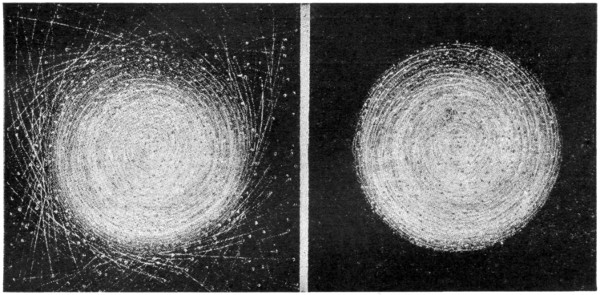
IMMENSELY ENLARGED REPRESENTATIONS OF ATOMS
(1) of Ordinary Matter; (2) of Radium
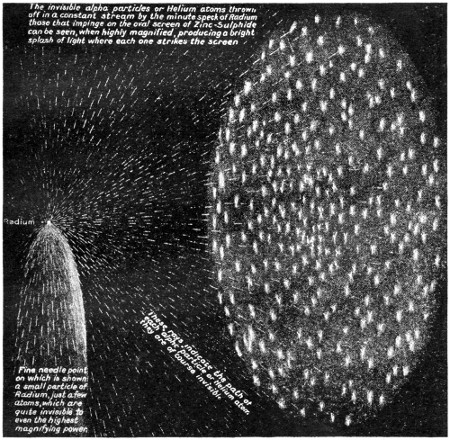
Here is seen an invisible speck of radium throwing out invisible atoms that sparkle into sight on a film. This stream of atoms will pour forth for 2500 years before the radium ceases to exist, thus showing the marvelous energy stored up in the smallest particle. These flying particles fall on the screen or film like hailstones splashing on the surface of water, and the splash is visible, while the radium itself and flying atoms are not. This is the nearest men have yet come to seeing an actual atom.
Large photograph (268 kB)