THE BOOK OF NATIONS Geographical, Historical, Descriptive (continued 4)
Reading edition
Mount Nebo, a summit of Abarim, Moab (two thousand six hundred and forty-three feet), seven miles northeast of the Dead Sea, was the place of the death of Moses.
Mount Tabor (tā´bor), a wooded mountain in Palestine, six miles east of Nazareth, on the border of the plain of Esdraelon, according to a tradition, was the scene of the Transfiguration; and in the monastic ages it was peopled with hermits. Height, about one thousand eight hundred feet.
Mount Sinai (sī´nī or sī-nā-ī) and the Sinaitic (sī-nȧ-it´ik) Peninsula. This peninsula, which, since 1907, has been included within the boundaries of Egypt, is situated between the Gulf of Suez and the Gulf of Akaba. In the north of the peninsula is the desert Paran, a desolate limestone plateau, bounded on the south by a tract of low sandstone mountains, ravines, and valleys rich in minerals which had been worked as early as 3000 B. C. Then rises the barren, rugged, and majestic triangle of the Sinai Mountain (also called Horeb) on which, tradition asserts, the Law was given to Moses.
From very early times it seems to have been regarded as a sacred mountain, perhaps as dedicated to the Babylonian moon-god Sin. These peaks are over six thousand feet high. At the base is a broad plain where the Israelites may easily have encamped. In a valley on the northeast of the same mountain, stands the famous convent of St. Catharine, with its beautiful gardens, which was originally founded by the Emperor Justinian (527-565). It became celebrated in recent years by the discovery of the Codex Sinaiticus (the Greek version of the Old Testament and the Greek New Testament), made in it by Tischendorf in 1844. There are two other valleys in the same vicinity, both of which are comparatively fertile and well-watered. The rocks of this region are steep and jagged and richly colored. They are composed of granite, porphyry, diorite, and gneiss. A path of stone steps leads up from the convent to the summit. Holy places marked by crosses cover the mountain. Near the top of Jebel Musa stands a chapel dedicated to Elijah.
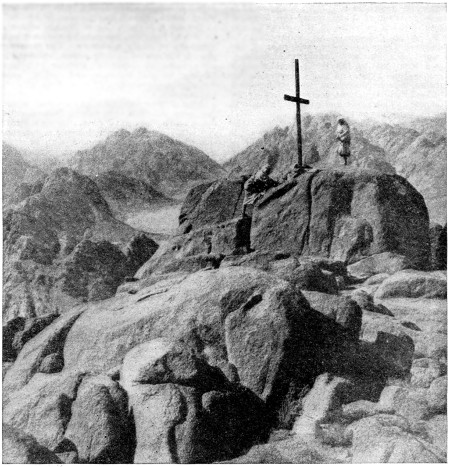
MOUNT SINAI
where the Laws of Moses were received. The site is disputed, but these heights on the northwest cliffs of Jebel Mûsa seem to answer the required conditions better than any other mountain on the Sinaitic Peninsula. The law given from Sinai—“the book of the Covenant”—is contained in Exodus xx. to xxiii. 19. Besides the Ten Commandments there are rules for justice, equity and purity far transcending any known ancient legislation.
RIVERS, LAKES AND OTHER HISTORIC WATERS
The principal river of Palestine is the Jordan, which rises in Anti-Libanus in several streams, that unite to flow through Lake Merom, and then through the Sea of Tiberias, or Galilee, running due south into the Dead Sea. Several other streams flow into the Dead Sea, of which the best known is the Kedron, that rises near Jerusalem. A similar series of small rivers flows through the coast plains into the Mediterranean, the principal being the Kishon and Leontes.
The Jordan (meaning “the descender”).—The highest source of the Jordan is seventeen hundred feet above sea-level on the west of Mt. Hermon, near the village of Hasbeya. The most important feature in its course between the Sea of Galilee and the Dead Sea is the rocky cleft known as the Ghor, some sixty-five miles long and from three to twelve miles in breadth, through which it passes. It then falls into the Dead Sea at a point twelve hundred and ninety-two feet below the level of the Mediterranean. The course of the Jordan is extremely tortuous, its total length being about two hundred miles.
The upper reaches are much obstructed by growths of reeds and shrubs, and though narrow it is deep, and can only be passed by the fords, of which there are many, the most famous being that of Bethabaca, near Jericho.
During its annual swelling it was miraculously crossed by the Israelites, probably at the ford above mentioned. In its waters Naaman was healed and an iron axehead made to swim. In it our Saviour was baptized.
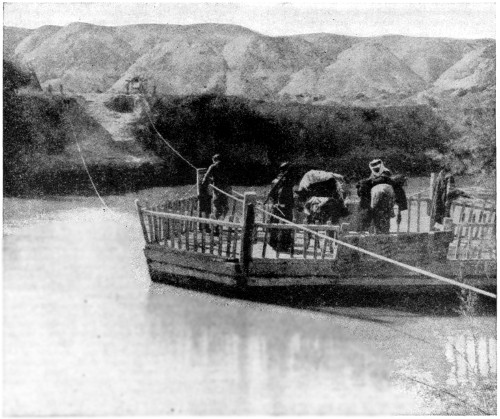
SUPPOSED FORD OF BETHABACA, NEAR JERICHO, WHERE THE CHILDREN OF ISRAEL CROSSED THE RIVER JORDAN ON THEIR WAY TO THE “LAND OF PROMISE.”
Galilee, Sea of, called also in the New Testament the Lake of Gennesaret and the Sea of Tiberias, is a large lake in the north of Palestine. Lying six hundred and eighty-two feet below sea-level, it is thirteen miles long by six broad, and more than eight hundred feet deep. It occupies a great basin, and is of volcanic origin. Although the Jordan runs into it red and turbid from the north, and many warm and brackish springs also find their way thither, its waters are cool, clear and sweet. In the time of Jesus the region round about the lake was the most densely populated in Galilee.
Dead Sea, scripturally called “Salt Sea,” “Sea of the Plains,” “Sea of the Arabah,” is near the southern extremity of Palestine. Its length is forty-six miles and its greatest breadth is nine and one-half (average eight and one-half) miles. The long oval of the lake is unequally divided by the El Lizan peninsula, of loose calcareous formation. North of the peninsula the greatest depth is twelve hundred and seventy-eight feet, south of that it is only three to twelve feet. It receives the Jordan and six other rivers, but has no outlet, the surplus water being carried off by evaporation. The water is intensely salt, with a specific gravity one-sixth greater than water. Fish cannot live in the lake but it has a healing reputation for lepers, and the inhabitants on the banks are quite healthy. It is surrounded by high cliffs of bare limestone, and masses of sulphur exposed by periodically occurring earthquakes lie on its borders.
CHIEF TOWNS AND INDUSTRIES
Modern Palestine forms part of the “pashalic” of Syria, under the Turkish Government, the chief towns of importance in modern times include: Jerusalem, with a population of about sixty thousand consisting of Moslems, Jews, and Christians; Damascus, with a population of two hundred thousand, has a trade in silk and cotton stuffs, jewelry, saddlery, and sword blades; Acre, a seaport, twelve thousand; Beyrout, one hundred and twenty thousand, considered to be the port of Damascus; Joppa, or Jaffa, a seaport, fifty-five thousand. The country is mainly agricultural, the crops consisting of wheat, barley, maize, vines and olives. The land is naturally fertile, but it suffered centuries of neglect.
Jerusalem (signifying probably “abode of peace”), the “Holy City,” central point of Hebrew worship and Christian tradition, was founded by the ancient Canaanite inhabitants upon a spur of the limestone ridge that forms the watershed of this part of Palestine. Standing at an elevation of twenty-six hundred feet upon a plateau about half a mile square and cutoff by the deep valleys of Gihon on the west, Hinnon on the south, and Jehoshaphat east, the city held an almost impregnable position, and was only wrested from the Jebusites by David, who made it the base of his military and political enterprises. The modern city proper is surrounded by a wall of hewn stones, two and one-half miles in circumference, and probably built by the Sultan Solyman the Magnificent. This wall is surmounted by thirty-eight towers and pierced by eight gates. The inner city is divided into four quarters—the Armenian in the southwest, the Jewish in the southeast, the Moslem in the northeast, and the Christian in the northwest. Since 1858 extensions have been made towards the north and west. In the older part the streets are narrow, dull, and dirty. The Mosque of Omar, the Church of the Holy Sepulchre, and the Jews’ Wailing Place, are among the more interesting places.
It has always been a sacred city. Its drama of events included the reigns of David and Solomon; the sieges of Egyptian, Assyrian, and Babylonian hosts; the Greek conquest; the heroism of the Maccabees; the events of the Roman dominion; our Saviour’s appearance and crucifixion; the siege of Titus and its destruction, A. D. 70; its rebuilding by Hadrian, A. D. 120; the Crusades, and its capture by Godfrey of Bouillon (first Christian King of Jerusalem), Richard Cœur de Lion, and its final capture by the Ottoman Turks in 1516.
The later-built additions extend much beyond the walls of Our Lord’s time, and beyond the reputed site of Calvary (He “suffered without the Gate”), which is now in the middle of the city. Of the eight gates, one is called St. Stephen’s, or Bâb Sitti Maryam (Lady Mary Gate), at the end of the via Dolorosa, leading to Gethsemane, Mount of Olives (where He beheld the city and wept over it), and Bethany. The Golden Gate, which He entered on Palm Sunday, is walled up. The relics of the old city are buried twenty to forty feet below the present site.
The Church of the Holy Sepulchre in the northwest quarter of the city is so called because alleged to contain under its roof the very grave in which the Saviour lay. This church, which was built by Helena, the mother of Constantine the Great, is remarkable for the richness of its decorations and the number of pilgrims by whom it is visited.
On Mount Moriah, Solomon is supposed to have built his famous temple, where a rectangular walled space called the Harâm at present encloses the Mosque of Omar and the El Aksa Mosque, once, perhaps, a Christian church. Recent explorers believe that they found traces of Solomon’s masonry here, and the foundations of the existing walls are more safely identified with those of the sacred building as reconstructed by Hadrian.
According to the Jews, Abraham sacrificed here, the intended offering of Isaac was here, and Jacob anointed the rock. The Order of Knights Templar was founded in this Mosque. Just outside the extreme northeast corner of the Harâm, to be seen from the windows in north wall, down in a ravine, is the Pool of Bethesda, rarely containing water, half filled with rubbish.
North of the Harâm is a huge rocky platform, where the residence of the Turkish governor marks the site of the Court of Pontius Pilate.
The Golgotha Chapels on Mount Calvary are off the south side of the east end of the Church of the Crusaders. Steps lead up to them, their elevation being fourteen and one-half feet above the main building. Just beyond the top of the steps is a silver lined opening where the Cross was inserted in the rock; at a distance of about five feet the spots of the thieves’ crosses are indicated—some searches are satisfied that the cross of the penitent thief would be the one to the north.
Gethsemane is at the base of Mount Olivet, and near it is the traditional Grotto of the Agony, with the spot where Judas betrayed his Master. This grotto is held in great veneration, and near it is the Church of St. Salvatore, said to have been erected by the mother of Constantine, containing the tombs of St. James, St. Ann, and St. Joseph.
The Via Dolorosa, or Way of the Cross, possesses a number of places of much interest, even if partly legendary. Among them the place where Christ is said to have pronounced the words “Daughters of Jerusalem, weep not for me.” Where the Virgin is said to have fainted on meeting her Son. At a truncated column where Jesus fainted under the Cross, and they called on Simon of Cyrene to help him. The house of Dives, and the stone on which Lazarus sat. The Gate of Judgment, formerly marking the limits of the town, and the Calvary itself, now inclosed within the Church of the Holy Sepulchre.
Mount Zion (though used in the Scriptures as identical with Jerusalem) is just outside the southwest corner of the city wall. There were Christian churches erected here at very early dates over the spot where the Holy Ghost descended upon the Apostles, but there followed so many destructions, mutilations, and confusions, that little certainty attaches to the cluster of buildings now standing. Here is reputed to be the tomb of David, and the Room of the Last Supper, once part of a Christian Church.
The Mount of Olives is a range of eminences and slight depressions on the east side of Jerusalem, parallel with the hill of the Temple, but on higher ground. Here is the Tomb of the Virgin within a subterranean church, where she lay until her “assumption.” A few yards from the Tomb, off the south side of the road, is the Garden of Gethsemane. The Chapel of the Ascension marks the tradition of the Ascension of Christ from this spot.
Bethlehem (beth´lē-em), (Heb., “house of bread”), is six miles south of Jerusalem. It was the birthplace of David, the scene of Ruth’s story, and, most important of all (according to Matthew, Luke and John), the birthplace of Christ. The Church of St. Mary, at Bethlehem, is built over the birthplace of Christ. The Chapel of the Nativity is in the crypt of the church, under the great choir; here in the pavement is a star and the words “Hic de Virgine Maria Jesus Christus natus est” (Here Jesus Christ was born to the Virgin Mary); opposite the Chapel of the Nativity is the Chapel of the Manger.
Hebron (hē´bron) is situated on a hill among the mountains of Judah, about seven hours south of Jerusalem. It is one of the oldest existing biblical towns and was the home and burial-place of the patriarchs. Afterward it became an important city in the territory of Judah. David resided here the first seven years of his reign. Later it was taken possession of by the Idumeans, from whom Judas Maccabeus recaptured it. Upon the traditional site of the burial-place of the patriarchs, Machpelah, a magnificent mosque is erected.
Cana of Galilee, a decayed town near Nazareth, is celebrated in Scripture as the scene of our Saviour’s first miracle, where He turned water into wine. Near it is the Mount of Beatitudes, the supposed scene of the Sermon on the Mount.
Damascus (da-mas´kus) formerly the capital and most important city of Syria, is situated in a fertile valley east of the Anti-Lebanon, on the edge of the desert. On account of its beautiful fertile surroundings, its lofty position, and its richness in fresh water, Damascus had been praised in antiquity and in modern times as the “paradise of the earth,” “the eye of the desert,” and “the pearl of the Orient.” Originally a Hittite city, it became the capital of Syria, and a great part of the country was called by its name.
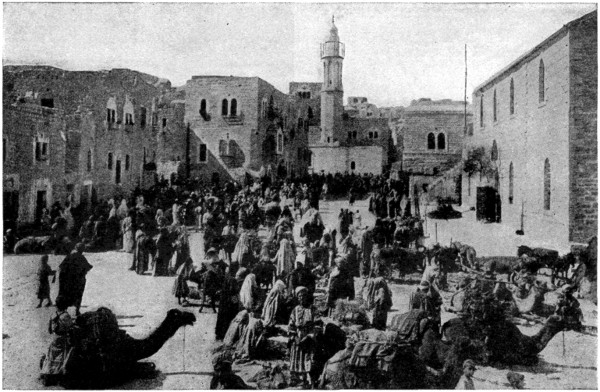
MARKET PLACE IN THE VILLAGE OF BETHLEHEM. THE CHURCH OF ST. MARY, NEARBY, IS BUILT OVER THE BIRTHPLACE OF OUR SAVIOUR, AND CONTAINS THE CHAPEL OF THE NATIVITY
In the Old Testament the name of Damascus occurs as early as the history of Abraham. After the time of David, Damascus often came into sharp collision with Israel. In the New Testament Damascus is known especially from the history of Paul.
Its chief modern glory is the Omayyad Mosque, and the ever changing color and variety of the street traffic, the costumes and the animation of the bazaars. The mosque was the subject of extravagant description by Arabian writers. In 1069 fire destroyed part of the building, and again in 1893 immense injury was done by fire; it has been restored, though it has not its ancient magnificence.
Jericho (jer´i-kō), situated west of the Jordan and fourteen miles east-northeast of Jerusalem, was destroyed by Joshua and rebuilt by Ahab. It was the residence of Herod the Great; was destroyed by Vespasian, rebuilt by Hadrian, and again destroyed by the Crusaders.
Nazareth (naz´a-reth) is celebrated as the dwelling-place of Jesus during his childhood and early manhood. The Church of the Annunciation here was founded by the empress Helena, but ruined in the middle ages, and rebuilt later. It is well proportioned, and, while much of the architecture is new, it preserves interesting memorials of the past. In the crypt is the traditional place of the Annunciation.
Petra (pē´trä).—On the northwest edge of the Arabian desert, about midway between the Gulf of Okabah and the Dead Sea, among desolate mountains, stand the remains of the rock-hewn city of Petra, best reached from Jerusalem. These ruins probably date from the time of Roman rule in 105 A. D., though some of the magnificent monuments were built by the Edomites who dwelt here before the Greeks and Romans.
This wonderful city is approached through a narrow gorge called the Sik, a kind of gateway in the rocks, like the entrance to a Roman amphitheatre.
Here one is confronted by a temple cut in the rock, with the most exquisite Corinthian columns, and entering the doorway he finds himself in the heart of the hill, surrounded by subterranean architecture of the most elaborate beauty of form and workmanship. This is called the Khaznet or Treasury of Pharaoh, which is rightly regarded as one of the wonders of the East. It is attributed to the Emperor Hadrian, who visited the place in A. D. 131, and erected here a temple to Isis. The rock wall from which it is hewn is an exquisite rose-pink. It is in a state of remarkable preservation. The imposing facade shows two rows each of six majestic columns, one row above the other, with niches in which are rock-hewn equestrian and other statues, the whole terminating above in a miniature temple crowned by a huge urn, the entire height being one hundred and two feet. Within is a bare lofty room and some chambers. The urn is said to contain treasures of Pharaoh. Neither the Coliseum at Rome, grand and interesting as it is, nor the ruins of the Acropolis at Athens, nor the Pyramids, nor the mighty temples of the Nile, present a more marvelous spectacle.
But this is only an introduction to the marvels behind. The gorge opens out into a narrow valley, some three miles in circumference, everywhere sunk deep beneath the enclosing mountains, and the walls of this valley are filled with the remains of other rock-cut temples, tombs and dwelling places. In one place are the remains of an open air theatre, the workmanship of which is Greek. Some of the structures, cut in the face of the rock, are several stories in height, while their architectural details excite the wondering admiration of the beholder. A stairway of many hundreds of steps leads to the largest of the ruins, El Deir, or Convent. In design it somewhat resembles the Treasury of Pharaoh.
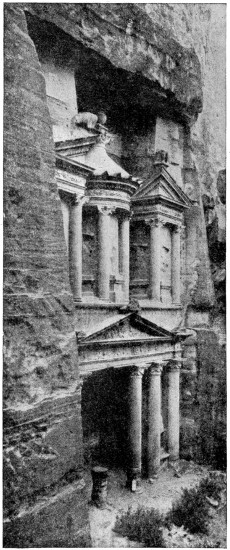
THE TREASURY OF PHARAOH
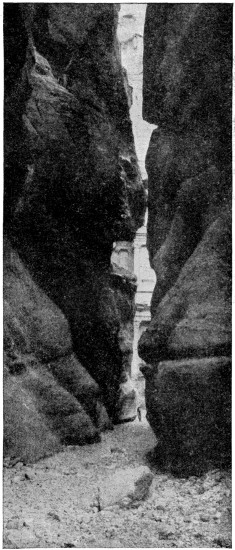
REMARKABLE NATURAL ENTRANCE
MARVELOUS ROCK-HEWN TEMPLES AT PETRA—(See under Petra)
The cliffs that enclose the valley are simply dotted all over with the handiwork of artists of a bygone age. Here is a portion of a heathen temple, there the remains of a palace, yonder a column, and beyond, again, a stately portico or pediment. They stand at varying elevations. Most of them are conspicuous, while others are hidden in the mountain recesses. There are tombs by the hundred, and on the mountain tops many places of sacrifice, where strange religious ceremonies were enacted. They challenge admiration by the variety of styles they embody, and by the exquisite hues of the sandstone from which they are hewn, varying from the prevailing purplish-red of the mountains and cliffs to a delicate pink and rose.
Until quite recently, this ancient city built out of rocks was seldom visited and almost unknown. Now, however, by means of the new Damascus to Mecca Railway, they are within easy reach. The journey from Jerusalem to Maan may be made in less than a day. From the latter place the ruins can be reached in six to eight hours by horseback.
Palmyra (pal-mī´ra), or Tadmor (tad´môr), a famous ancient city situated on an oasis in the desert east of Syria, is said to have been built by Solomon. After the decline of Petra in 105 A. D., Palmyra took its place as the chief commercial center in northern Arabia. Its merchant aristocracy reaped great advantage from the long-protracted wars between Rome and Parthia by acknowledging the supremacy of Rome. One of its chiefs, Odænathus, husband of the more famous Zenobia, extended his power over most of the adjoining countries, from Egypt to Asia Minor. Aurelian at length crushed in 272 the attempt of the Palmyrenes to found an independent empire. After the Roman empire became Christian, Palmyra was made a bishopric. When the Moslems conquered Syria, Palmyra also submitted to them. From the fifteenth century it began to sink into decay, along with the rest of the Orient. Magnificent remains of the ancient city still exist, chief among them being the great temple of the Sun (or Baal); the great colonnade, nearly one mile long, and consisting originally of some fifteen hundred Corinthian columns; and sepulchral towers, overlooking the city.
Jaffa, is a maritime city in Palestine, Syria, fifty-four miles by rail northwest of Jerusalem, of which it was the port in King David’s time. Extensive fruit and orange orchards surround the city. Its fortifications were destroyed by Saladin in 1188, and, during the Crusades, Richard the Lion-Hearted was confined here by sickness. In 1722 it was attacked by the Arabs, and in 1799 by Napoleon. The principal exports are oranges, wheat, soap, hides, olive oil, wool, and barley.
THE PHŒNICIANS
Phœnicia was a narrow strip of country on the southeastern coast of the great inland sea of antiquity, lying chiefly between Mount Libanus (Lebanon) and the Mediterranean shore, and extending for about one hundred and twenty miles north of Mount Carmel. Here lay the cities Tyre and Sidon, Byblus and Berytus, Tripolis and Ptolemais. The land was fertile, and rich in timber trees and fruits, such as the pine, fir, cypress, sycamore, and cedar; figs, olives, dates, pomegranates, citrons, almonds. Here was material for trade abroad, and comfort and prosperity at home, and the coast was so thickly studded with towns as almost to make one continuous populated line.
HISTORY AND GOVERNMENT OF PHOENICIA
The history of Phœnicia is peculiarly a history of separate cities and colonies, never united into one great independent state, though now and then alliances existed between several cities in order to repel a common danger. Each city of Phœnicia was governed by a king or petty chief, under or with whom an aristocracy, and at times elective magistrates, appear to have held sway. But the genius of the race cared little for political development; they devoted themselves almost exclusively to commercial pursuits.
THE GREAT CITIES OF SIDON AND TYRE
Sidon was probably the more ancient of the Phœnician cities. Its richly embroidered robes are mentioned in the Homeric poems. It was the greatest maritime city of the ancient world until its colony, Tyre, surpassed it, and it seems to have been subject to Tyre in the time of David and Solomon. About 700 B. C., it became independent again, but was taken by Nebuchadnezzar, king of Babylon, about 600 B. C., and became subject to Persia about 500 B. C. Under the Persian rule, it was a great and populous city, and, coming into the hands of Alexander the Great in 333 B. C., helped him with a fleet in his siege of Tyre. Its history ends with submission to Roman power, 63 B. C.
Tyre was a powerful city as early as 1200 B. C. The friendship of its king, Hiram, with Solomon is well known from the Hebrew Scriptures; and at this time the commerce of Tyre was foremost in the Mediterranean, and its ships sailed into the Indian Ocean from the port of Elath on the Red Sea. Tyre is celebrated for its obstinate resistance to enemies. Sargon, king of Assyria, besieged the city in vain for five years (721-717 B. C). Nebuchadnezzar took thirteen years (598-585 B. C.) to capture it only partially, and it was taken by Alexander the Great after a seven months’ siege, in 332 B. C. The old glory of Tyre departed with the transfer of its chief trade to the newly created city of Alexandria, though the indomitable energy of the Phœnicians again, in Roman times, made it a great seat of trade.
PHOENICIAN MARINERS FOUND CARTHAGE
Phœnicia was at the height of prosperity from the eleventh to the sixth centuries B. C. As a colonizing country it preceded the Greeks on the shores and islands of the Mediterranean, and sent ships to regions that the Greeks knew nothing of, save by report of the bold mariners of Tyre. Until the rise of Alexandria about 300 B. C., the sea trade of Phœnicia was rivaled only by that of Carthage, its own colony; and Phœnician merchants still kept up their great land trade by caravans with Arabia, central Asia and northern India, Scythia and the Caucasian countries.
By far the most renowned of all Phœnician colonies—famous in history for Hannibal’s heroic hate of Rome and warlike skill—was Carthage, in the center of the northern coast of Africa. The date of its foundation is put about 850 B. C. At Utica and Tunis, to the north and south, Phœnician settlements were already existing.
VAST EXTENT OF PHOENICIAN COMMERCE
The trade of Tyre and her sister cities reached almost throughout the world as then known. They imported the spices—notably the myrrh and frankincense—of Arabia; the ivory, ebony, and cotton goods of India; linen yarn and corn from Egypt; wool and wine from Damascus; embroideries from Babylon and Nineveh; pottery, in the days of Grecian art, from Attica; horses and chariots from Armenia; copper from the shores of the Euxine Sea; lead from Spain; tin from Cornwall. Phœnicia exported not only these articles of food and use and luxury, but the rich purple dyes made from the murex (a kind of shell-fish) of its own coast, the famous hue of Tyre, with which were tinged the silken costly robes of the despots. From Sidon went the famous glass produced in part from fine white sand, found plenteously near Mount Carmel. There was gold from Ophir, and interchange of cedar, sent by Hiram, king of Tyre, for building Solomon’s Temple, in barter for the wheat and balm and oil of Israel’s fertile land.
So important was the trade by caravans through Babylon with the interior of Asia that the great town Palmyra (or “Tadmor in the desert”) was founded or enlarged by Solomon to serve the traffic on its route through Syria to the valley of the Tigris and Euphrates.
THEIR ARTS OF CIVILIZATION INCLUDED OUR ALPHABET
As a money-making race the Phœnicians were skilled in arts by which the grand aim of its life could be attained. Great as they were at the dyeing vat and loom, adepts in working brass and other metals, and in fabricating glass, they were also the best ship builders and the most famous miners of their time. Their greatest service to civilization seems rather to have been in appropriating, developing, and spreading the ideas of others, especially in forming an alphabet for the Western world.
While the mythical story about Cadmus, taking his sixteen letters from Phœnicia into Greece, must be rejected, the European world owes to this race of traders the alphabetic symbols now in use. The gradual change of shape is easily traced in most of the signs as here given. The simple and ingenious device by which each sign stands for one elementary sound of human speech is largely due to the Phœnician people, as an improvement on the cumbrous hieroglyphics of Egypt. Of literature they have left nothing whatever recognized as really theirs.
THEIR CHARACTER AND RELIGION
They had a name for craftiness in trade, and wealth led to worse than luxury,—to flagrant vice. Their religion was a kind of nature worship closely related to that of the Babylonians. They adored the sun and moon and five planets, the chief deities being the male Baal, and the female Ashtoreth or Astarte. At Tyre a deity was worshiped with the attributes of the Greek god Hercules. There was also the worship of Adonis, under the name of Thammuz, in the coast towns; and this included a commemoration of his death, a funeral festival, at which the women gave way to extravagant lamentations. It was Phœnician women that allured Solomon to their form of religion; it was a princess of Phœnicia, Jezebel, that brought Ahab, her husband, king of Israel, to ruin; that slew the prophets of God, and left a name proverbial of infamy in life, and for ignominious horror in her death. The work done by Phœnicia in the cause of human progress was chiefly important and interesting in material or practical things.
THE MEDO-PERSIAN EMPIRE
With the Persian Empire we first enter on continuous history. A multiplicity of histories first met and commingled in that of Persia. The Persian Empire extended itself over the whole of western Asia, and into Europe and Africa; it drew together Bactria, Parthia, Media, Assyria, Syria, Palestine, Phœnicia, Asia Minor, Armenia, Thrace, Egypt, and the Cyrenaica. The voice of the Great King was law from the Indus on the east to the Ægean Sea and Syrian Gulf on the west, from the Danube and the Caucasus on the north to the Indian Ocean and the deserts of Arabia and Nubia on the south.
The empire of the Medes and Persians, commonly known as “the Persian Empire,” absorbed all the territories of Western and Southwestern Asia (except Arabia), as well as Egypt and a small portion of Europe. The Medes and the Persians are treated of together, because of their intimate connection in race and the fact that Media was conquered by and included in Persia, as the latter empire rose into power and importance in the western Asiatic world.
GEOGRAPHICAL SITUATION OF MEDIA AND PERSIA
The map shows the position of Media on the tableland south of the Caspian Sea, east of Armenia and the Zagros Mountains, and north and west of the mountains of Persia proper and the great rainless Persian desert, or desert of Iran. The mountain ranges enclosed fertile valleys, rich in corn and fruits; and the Zagros Mountains had on their pastures splendid horses, which supplied the chargers of the king and nobles of Persia.
Persis, or Persia proper, was a mountainous district between the desert of Iran and the northeastern shore of the Persian Gulf. The country contained, among its hills, fertile plains and valleys abounding in corn, pasture and fruits.
ORIGIN AND CHARACTER OF THE MEDES
The close connection of the Medes, in origin and institutions, with the Persians, is shown in the famous expression, “The law of the Medes and Persians, which altereth not.” The people migrated into Media at an early period, from the original abode of the Aryan race. By degrees they overcame the Scythian races whom they found in possession of the land. The Medes were a warlike race, strong in cavalry and archers. Their language was a dialect of the Zend, the ancient tongue of Persia, and their religion was the Magian.
Probably about 800 B. C. the Medes had established themselves in their new home. About 710 B. C., Sargon, king of Assyria, conquered some part of Media, and made settlements of Israelites taken captive by him from the cities of Samaria; but the Assyrians could never conquer the Medes, who at last grew into a powerful kingdom under native princes.
MEDIAN POWER FIRST ESTABLISHED BY CAYAXARES
The monarchy was founded by Cyaxares about 633 B. C. He extended the Median Empire westward, by conquest, through Armenia to the river Halys in Asia Minor. His great achievement was the capture of Nineveh, about 620 B. C., in alliance with the revolted Babylonians, and the consequent overthrow of the Assyrian Empire. Cyaxares reigned forty years, and died about 593 B. C.
He was succeeded by his son Astyages (as-ty´a-jēz), who reigned for over thirty years,—a despot of quiet life and peaceful disposition. The end of the Median monarchy came in 558 B. C., with his dethronement by Cyrus of Persia.
ORIGIN AND CHARACTER OF THE PERSIANS
The Persians, in race, language, and religion, were closely connected with the Medes. They appear first in human records as hardy and warlike mountaineers, noble specimens of the great Aryan race,—simple in their ways of life, noted for truthfulness, keen-witted, generous, and quick-tempered. The language which they brought with them when they migrated is known as the Zend, closely allied to the Sanscrit, and now only existing in the sacred books of the Zendavesta, containing the doctrine of Zoroaster (Persian name, Zarathustra), the founder of the Magian religion.
The Persians were, in their early history, subject to the Medes, but governed by their native princes. The Median supremacy passed to the Persians with the dethronement of Astyages, king of Media, by Cyrus.
FOUNDING OF THE PERSIAN EMPIRE BY CYRUS
Master of Media, Cyrus came next into collision with the great kingdom of Lydia,[2] in Asia Minor. Crœsus was king of Lydia when Cyrus met his attack and conquered him, in 546 B. C. The rising empire of Persia was thus extended to the western seaboard of Asia Minor. The Greek colonies on the coast next fell a prey to the arms of Cyrus, and in 538 B. C. he captured Babylon, as we have seen, and added the provinces of the later Babylonian Empire to the Persian. Before this he had conquered the territory eastwards between Media and the Indus, and restored the Jews from captivity. His power and life ended in his expedition against the Scythian people, by whom he was defeated and killed, in 529 B. C. Cyrus, the greatest as a king and the best as a man among all the Persian monarchs, had spread the Persian sway from the Hellespont on the west to the Indus on the east.
He was succeeded by his son Cambyses who is distinguished by his conquest of Egypt in 525. He died in 522, on his march from Egypt against a Magian pretender to the throne. The usurper reigned for a few months, and was then dethroned and slain in an insurrection headed by Darius, son of Hystaspes, a noble, who succeeded to the throne.
THE GREAT REIGN OF DARIUS
Darius Hystaspis, or Darius I, reigned from 521 to 485 B. C., and was a great and able monarch. He finished the work which Cyrus had begun, by setting in order the affairs of the vast empire which Cyrus and Cambyses had conquered.
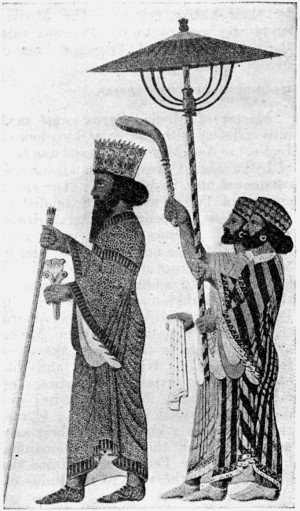
A PORTRAIT OF DARIUS THE GREAT
Here “The Great King,” with state umbrella and attendants, as carved on one of the door-jambs of the palace of Darius I. at Persepolis. The original bears considerable traces of color.
Darius is credited with the establishment of highroads and swift postal communication between the provinces and the court. The kings of Persia resided in the winter at Susa, a warm place in the plain east of the Lower Tigris; in the summer at Ecbatana, in Media, by the mountains; and Babylon was a third capital of occasional residence in winter. From these different centers of power the Persian monarchs, according to their measure of energy and resolution, controlled the conduct of the satraps in every quarter of their widespread dominions.
ATTEMPT TO INVADE EUROPE, AND WAR WITH THE GREEKS
About 508 B. C. Darius invaded Scythia, and, crossing the Danube, marched far into the territory which is now European Russia; but the expedition ended in a retreat without encountering the enemy, and with great loss of men from famine. On his return his generals subdued Thrace and Macedonia, north of Greece, and added them to the Persian Empire.
His famous war with the Greeks arose out of the revolt of the Ionian Greek cities in Asia Minor in 501, and the burning of the city of Sardis by their Athenian allies. An expedition sent against Greece under the general Mardonius, in 492 B. C., was defeated by the Thracians on land, and frustrated by a storm in the Ægean Sea. In 490 a great armament was sent by Darius under Datis and Artaphernes, and then was fought the decisive battle of Marathon. Darius’s proposed and long-prepared revenge upon the Greeks was baffled by a rebellion in Egypt; and he died in 485, leaving the task to his son and successor, Xerxes.
REIGN OF XERXES THE GREAT
Xerxes reigned from 485-465 B. C., and he began with the suppression of the Egyptian revolt in 484, devoting the next four years to preparations against Greece. The grand effort made in 480 has been ever famous in history for the magnitude of the host of men and ships employed, for the heroism of the resistance on the one side, and the completeness of the final disaster on the other, as will be seen in the history of Greece. Xerxes returned to Sardis, after the destruction of his fleet at Salamis, toward the end of the year 480. The defeat of his general Mardonius at Platæa ended the war in Greece, and the Persians lost their last foothold in Europe by the capture of Sestos on the Hellespont.
ARTAXERXES II. AND THE “RETREAT OF THE TEN THOUSAND GREEKS”
Artaxerxes II., reigned 405-359. At the beginning occurred the revolt of his younger brother Cyrus, satrap in Western Asia, who marched against Babylon, and fell in the battle of Cunaxa, 401 B. C. He was supported by a body of Greek mercenaries, whose retiring march to the Black Sea over the mountains of Kurdistan has been immortalized by Xenophon’s description in his Anabasis, and is known as the “Retreat of the Ten Thousand Greeks.” After many conflicts between the Persians and Greeks, the peace of Antalcidas, concluded in 387 B. C., gave to the Persians all the Greek cities in Asia Minor. The Persian Empire, however, was now going to decay. Artaxerxes failed to recover revolted Egypt, and was constantly at war with tributary princes and satraps. The want of cohesion in the unwieldy, ill-assorted aggregate of “peoples, nations, and languages,” was being severely felt.
DARIUS III. LAST OF THE PERSIAN EMPERORS
In 336 B. C., the last king of the Persian Empire, Darius III., surnamed Codomannus, succeeded to power. With the great battle in the plains of Gaugamela, in Assyria, known as the battle of Arbela, from a town fifty miles distant, where Darius had his headquarters before the struggle, the Persian Empire came to an end in October, 331 B. C. The defeat of Darius was decisive; and in 330 he was murdered in Parthia by Bessus, one of his satraps. Asiatic Aryans had succumbed at last to their kinsmen of Europe, who, after repelling Oriental assaults upon the home of a new civilization, had carried the arms of avenging ambition into Asia, and struck a blow to the heart of the older system.
SCIENCE AND THE ARTS IN PERSIA
In science, art, and learning, the Persians developed nothing that was new, except in architecture. In the conquest of the Assyrians, Babylonians, Phœnicians, and Egyptians, the Persian kings and nobles came into possession alike of the scientific acquirements and learning of those peoples, and of the products of their mechanical arts. The Persians were soldiers, and not craftsmen, and had no need to be producers, when they could be purchasers, of the carpets and muslins of Babylon and Sardis, the fine linen of Egypt, and the rich variety of wares that Phœnician commerce spread throughout the empire.
Architecture.—In architecture, they were at first pupils of the Assyrians and Babylonians. The splendid palaces and temples of Nineveh and Babylon had existed for centuries before the Persians were anything more than a hardy tribe of warriors, and it was only after the acquirement of imperial sway that they began to erect great and elegant buildings for themselves. When that time came, the Persians showed that they could produce, by adaptation of older models, an architectural style of their own. This style was one that comes between the sombre, massive grandeur of Assyrian and Egyptian edifices and the perfect symmetry and beauty of the achievements of Greek art.
Palaces and Tombs, not temples, were the masterpieces of Persian building. The ruins of the city of Persepolis, in the province of Persis, are the most famous remains of Persian architecture. Here, on a terraced platform, stood vast and splendid palaces, the doorways adorned with beautiful bas-reliefs. The great double staircase leading up to the “Palace of Forty Pillars” is especially rich in sculptured human figures. The columns are beautiful in form, sixty feet in total height, with the shaft finely fluted, and the pedestal in the form of the cup and leaves of a pendent lotus. Throughout the ruins a love of ornament and display is visible. In the bas-reliefs are profuse decorations of fretwork fringes, borders of sculptured bulls and lions, and stone-work of carved roses.
PERSIAN CITIES
Babylon has been already described.
Ecbatana, formerly the capital of the Median Empire, was a very ancient city, surrounded by seven walls, each overtopping the one outside it, and surmounted by battlements painted in five different colors, the innermost two being overlaid with silver and with gold. The strong citadel inside all was the royal treasury.
Susa was a square-built city unprotected by walls, but having strongly fortified citadel, containing a royal palace and treasury. The only remains of the place are extensive mounds, on which are found fragments of bricks and broken pottery with cuneiform inscriptions.
Persepolis was one of the two burial-places of the Persian kings, and also a royal treasury. Darius I. and Xerxes greatly enlarged and adorned the city, which retained its splendor till it was partially burned by Alexander the Great. The tomb of Cyrus and a colossal bas-relief sculpture of the great founder of the monarchy, was at Murghab, northeast of Persepolis.
Sardis, in western Asia Minor, once the capital of the Lydian monarchy, was an almost impregnable citadel, and the residence of the satrap of Lydia, and is often mentioned in connection with the Persian kings.
PERSIAN LIFE
The splendor of Persian life at court and abroad is known to us from many sources. The sculptures of Persepolis show something of the state and ceremony attendant on a Persian king. In the Book of Esther we read of King Ahasuerus (Xerxes) entertaining all “the nobles and princes of the provinces” for “a hundred and fourscore days,” of his making a feast for seven days “in the court of the garden of the king’s palace” for all the people of Susa; of pillars of marble, silver curtain rings, beds of gold and silver, pavements of marble that was red, and blue, and white, and black; of drinking vessels of gold diverse in shape and size, and “royal wine in abundance, according to the state of the king”; of garments of purple and fine linen; and of the absolute power of a Persian despot in his caprices and his wrath, with his “seven chamberlains that served in his presence,” and with the lives of men and women of all ranks held in the hollow of his hand.
The Magi.—The priests or Magi had great power, from the reverence of the people for them. The great objects of worship were the heavenly bodies. This national priesthood, like the Chaldeans in the Babylonian Empire, formed a caste to whom belonged all mental culture and legislation. The modern term “magic,” in its superstitious sense, is connected with their professions and practices.
THE GREEKS: GLORY OF THE ANCIENT WORLD
The interest of the great story of ancient Greece is inexhaustible. Of all histories of which we know so much, this is the most abounding in consequences to us who now live. The Greeks are the most remarkable people who have yet existed. This high claim is justly made on the grounds of the power and efforts that were required for them to achieve what they did for themselves and for mankind. With the exception of Christianity, they were the originators of most of the great things of which the modern world can boast. The period from the permanent settlements in Greece until its final reduction to a Roman province covers about two thousand years.
The name Greece was almost unknown by the people whom we call Greeks, and was never used by them for their own country. It has come to us from the Romans, being really the name of a tribe in Epirus, northwest of Greece, the part of the country first known to them.
THE LAND OF HELLAS AND THE HELLENES
The Greek writers and people called their land Hellas, the term meaning all territory in which their own people, the Hellenes, were settled. Hellas included not only the Greek peninsula, but many of the islands of the Ægean Sea, and the coast settlements and colonies above referred to. The peninsula, much indented by bays, was broken up into many small divisions, connected by the sea. There were numerous mountains in ridges, offshoots, and groups; there were plains, valleys and small rivers. All was diversified. The position and conformation of the country undoubtedly helped to render the Greeks the earliest civilized people in Europe, both by developing, in a life of struggle with nature on land and sea, their special and innate character, and by bringing them into contact with the older civilizations, in Egypt and Phœnicia, on the eastern shores of the Mediterranean. The mountains that divided the country into small isolated districts had a great political importance in giving rise to many separate and independent states, the rivalries and conflicts of which favored the working-out of political problems and the growth of political freedom.
GREAT DIVISIONS OF GREECE
Greece naturally divides itself into Northern, Central and Southern. Northern Greece contained two principal countries, Thessalia and Epirus, though the Greeks themselves did not regard the inhabitants of Epirus (the Epirots) as being of real Hellenic race. It was only in later times that Macedonia, north of Thessalia, was considered a part of Hellas.
Central Greece had nine separate states, the most important of which was Attica, the peninsula jutting out southeastward, and renowned forever through its possession of the city of Athens.
Southern Greece, or the Peloponnesus (meaning “island of Pelops,” a mythical king), contained seven principal states, Laconia being the most important, and sharing the fame of Attica because it contained the city of Sparta.
THE FAMOUS GRECIAN ISLANDS
The largest of the islands on the coast was Eubœa, about ninety miles in length, noted for good pasturage and corn. On the west coast was the group known to modern geography as the “Ionian Isles.” To the south lay Crete, one hundred and sixty miles in length, noted for the skill of its archers. In the Ægean Sea were the two groups called the Cyclades and Sporades. The Cyclades (or “circling isles,” the chief being Delos) are clearly shown upon the map. The Sporades (or “scattered isles”) lay to the east off the southwest coast of Asia Minor. Northward in the Ægean, in mid-sea, or on the Asiatic coast, were Lemnos, Scyros, Lesbos, Chios and Samos.
THE EFFECT OF GREEK COLONIZATION
The establishment of so many colonies in countries pre-eminently favored by nature in productions and climate, and so situated as to prompt the inhabitants to navigation and commerce, gave a great impulse to the civilization of the Hellenic race, and may be regarded as the main cause of its rapid progress.
HISTORY OF THE GREEKS
I. THE PRE-HISTORIC PERIOD
I. THE PRE-HISTORIC PERIOD.—This period includes the mythical accounts of the origin of the Greeks, the Trojan war, the more certain story of the excavations, and the establishment of the peculiar Greek institutions under the so-called rule of the half-mythical kings. Down to the time of the Trojan war very considerable progress had already been made, and civilization among the Greeks had received its first important impulse. The oracles at Delphi and Dodona had been established; the mysteries at Eleusis; the four sacred games; the court of Areopagus at Athens; and the celebrated Amphictyonic Council. The arts and sciences likewise received considerable attention. Letters had been introduced by Cadmus. The accounts of the siege of Thebes and that of Troy show that progress had been made in the various arts pertaining to war, but the history of the period as a whole exhibits that singular mixture of barbarism with cultivation, of savage customs with chivalrous adventures, which marks what is called an heroic age.
According to the Greek historians, the earliest inhabitants of Hellas were the so-called Pelasgians, but the information afforded by the ancients on the subject is scant and vague.[3] For our knowledge of the inhabitants and civilization of prehistoric Greece, we are therefore dependent on the more certain witness of the excavations, which, in recent years, have yielded very important results.
THE MINOAN AGE
Excavations at Knossus in Crete have revealed to us the civilization of the Minoan age of Greek history. This civilization is the oldest of which we have knowledge. It flourished about 2000 B. C. Prehistoric Knossus was a city of massive structure in which the fine arts flourished and had reached a remarkably high stage of development (specimens of Minoan pottery are of exceptional beauty and grace) and in which the art of writing was known. This last fact is of great importance, as until recently the art of writing in Greece was supposed to be post-Homeric.
THE MYCENEAN AGE
The next age of Greek civilization on which archæology has concentrated its searchlight is the Mycenean (fl. c. 1600-1100 B. C.). The Mycenean civilization is revealed to us by excavations in the sites of Mycenæ, Tiryns, etc. The characteristic features of these splendid cities is their massiveness and solidity. Pausanias relates that tradition attributed the building of Tiryns and Mycenæ to the Cyclopes (hence the expression “Cyclopean walls” used to denote structures of this massive type), thus testifying to the gigantic edifices of prehistoric times as contrasted with the masonry of a later date. The jewelry, pottery and weapons excavated from these ancient cities are of rare beauty. Iron was practically unknown in the Mycenean age. Its use is more extensive in the Homeric age, and therefore Homeric civilization is probably post-Mycenean.
THE SO-CALLED DORIAN INVASION
But vast invasions swept over Greece, and a ruder civilization displaced this early culture. In the latter half of the eleventh century B. C., the Dorians ravaged Greece. They were a coarser, hardier stock than the peoples they conquered, but they brought to Greece a new vigor and a new robustness, which when toned and harmonized by the finer influences of the land, produced that civilization which is the world’s marvel for all time.
II. PERIOD OF MIGRATIONS AND FORMATION OF STATES
II. PERIOD OF MIGRATIONS AND FORMATION OF STATES.—The first governments of Greece were small monarchies, and they continued such until after the Trojan war. Soon after this we find the country involved in fatal civil wars, in which the people, under a number of petty chieftains hostile to each other, suffered extremely from calamity and oppression. These evils led to change in the form of government, and the substitution of the popular instead of the regal system. The same evils also probably contributed to the spirit of emigration, which so strikingly marks the period. During this period of colonization we notice the origin of the four principal dialects in the Greek language. In this period two of the Grecian states are chiefly conspicuous—Athens and Sparta, whose special effort was to provide themselves with a suitable political constitution, civil code and government.
These great migrations which swept over Greece created a congestion of the population which was eventually relieved by widespread colonization on the west coast of Asia Minor and in the neighboring islands of the Ægean Sea. These colonies were settled by the three races, the Æolians, Ionians and Dorians. The Æolians colonized the northwestern part, the coast of Mysia, and the island of Lesbos. The Ionians settled in the central part, on the coast of Lydia, and in the islands of Chios and Samos. The Dorians occupied the southwest corner of Asia Minor (the coast of Caria) and the adjacent islands. Of all these by far the most important, wealthy and powerful were the Ionians.
OTHER GREEK COLONIES
The Greeks gradually spread themselves in settlements along the northern coast of the Ægean Sea and the Propontis, in Macedonia and Thrace, so that the whole Ægean became encircled with Greek colonies, and its islands were covered with them. The tide of emigration flowed westward also in great strength.
The coasts of Southern Italy were occupied by Dorians, Achæans, and Ionians in settlements which grew to such importance that the region took the name of Magna Græcia, or Greater Greece. The cities of Tarentum, Croton and Sybaris became famous for their wealth, the latter giving rise to the proverbial name for a luxurious liver.
On the southwestern coast of Italy was Rhegium, and farther north came Pæstum, Cumæ, and Neapolis (Naples). In Sicily flourishing Greek settlements abounded, the chief being Messana, Syracuse, Leontini, Catana, Gela, Selinus, and Agrigentum. Farther west still a colony from Phocæa, in Asia Minor, founded the city of Massilia, now Marseilles. On the southern coast of the Mediterranean, westwards from Egypt, the Greek colony of Cyrene became the chief town of a flourishing district called Cyrenaica.
The establishment of the later of these colonies brings us down well within authentic historical times, and the whole period of Greek colonization extends from about 1100 to 600 B. C., the colonies being, in many cases, offshoots of colonies previously established and risen to wealth and over-population. In all these movements and settlements, the enterprise and ability of the Greeks made them great commercial rivals to, and successors of, the Phœnicians.
CONTRAST BETWEEN IONIANS AND DORIANS
The two leading races of Greece were the Ionians and the Dorians, and they stand to each other in a strong contrast of character which largely affected Greek political history. These prominent points of difference run through the whole historical career of the two chief states, Ionian Athens and Dorian Sparta, and were the cause of the strong antagonism that we find so often in action between them. The Dorian was distinguished by severity, bluntness, simplicity of life, conservative ways, and oligarchic tendency in politics; the Ionian was equally marked by vivacity, excitability, refinement, love of change, taste in the arts, commercial enterprise, and attachment to democracy. The Dorian, in the best times of his history, reverenced age, ancient usage, and religion; the Ionian, at all periods of his career, loved enjoyment, novelty and enterprise.
THE EARLY CAREER OF SPARTA
The Spartans, or the people of Lacedæmon, properly the southern half of Laconia, first became the dominant nation in that part of Greece. Of Spartan doings and fortunes we know almost nothing until the time of the great Legislator Lycurgus, who is said to have organized, about 850 B. C. the famous Spartan constitution. The probable account is that he altered and reformed existing usages, and that the reverence of after ages ascribed to him the promulgation and establishment of a full grown, brand new set of institutions, which must have been, in many points, of gradual growth.
THE FAMOUS LAWS OF LYCURGUS
The government was that of an aristocratic republic under the form of a monarchy. There were two kings, whose powers were nominally those of high priests, judges, and leaders in war, but in the two latter capacities their functions were in time greatly restricted and almost superseded. The chief legislative and judicial and much of the executive, power lay with the Senate, or council of twenty-eight elders. No citizen could be a member of this body until he had become sixty years of age, and the office was held for life. The popular assembly, open to every Spartan citizen over thirty years old, really handed over its powers to a board of five commissioners, officers called Ephors (“overseers”), whom it annually elected. These high officials had a secret and irresponsible control over the executive power, both at home and abroad; and in military enterprises, where the kings were the nominal leaders, the two Ephors who accompanied the army exercised much influence. The whole body of Spartan citizens was an aristocracy, and among themselves entire political equality existed.
TRAINING OF THE SPARTAN CITIZEN
The object of the peculiar training of Spartan citizens, ascribed to Lycurgus, was the maintenance of Spartan supremacy over the subject population. It was necessary for safety that the small body of men, surrounded by enemies in their own land, should be ready at all points, against every attempt at opposition or rebellion, and against the outside world as well.
As every man had to be a soldier, and the citizen existed only for the state, the state took the Spartan citizen in hand at his birth, and regulated him almost from the cradle to the grave. From the age of seven the body was cultivated, and every means was used to give the instrument the finest temper, in a physical sense, and to bring it to the sharpest edge. Such training lasted till the sixtieth year of life, when the Spartan became qualified by age, if not by wisdom, for election to the Senate, or “assembly of old men,” above described.
The girls were trained in athletic exercises like those of the youths, and everything was done to produce vigorous and stern women, prepared to gladly see their sons die on the battle-field for Sparta.
The result of all was that the Spartans became a race of well-drilled and intrepid warriors, but a state distinguished in the history of Greece for the display of a domineering arrogance, a rapacity, and a corruption, which contributed not a little to its downfall. However, the Spartan institutions were very successful in giving the state security at home and success in war abroad. Sparta was free from domestic revolutions, and the spectacle it presented of constancy to fixed maxims of policy gave it a great ascendancy over the Hellenic mind.
EARLY HISTORY OF ATHENS. THESEUS
The Athenians became by far the most famous, in political ascendancy and in artistic and intellectual eminence, of all the Ionian race, to which they belonged.
At first they were under kings like the other Hellenes; but about 1050 B. C. the title of king became changed to that of archon (“ruler”), though the office was still held for life, and continued in the same family. The archon was responsible for his acts to a general assembly of the people, in which, however, the nobles had the chief influence; and down to long after the time of the first Olympiad, Athens may be regarded as an oligarchic republic, in which the supreme office, the archonship, was confined to one family; and members of the chief court of justice, called Areopagus (lit. “hill of Ares,” the place of its assembly at Athens), were elected only from the noble houses.
IMPORTANCE OF THE OLYMPIADS IN GREEK CHRONOLOGY
We come, in the year 776 B. C., to the era when the chronology of Grecian history becomes consecutive, and dates are reckoned by Olympiads. These were the periods of four years each which elapsed between the successive celebrations of the Olympic games in honor of the Olympian Zeus (the chief Greek deity) in the plain of Olympia in Elis (in Peloponnesus). The First Olympiad began at midsummer, 776 B. C., the Second Olympiad at midsummer, 772 B. C., and so on—any event being dated by a particular year of a specified Olympiad.
THE UNPOPULAR LAWS OF DRACO
Down to the year 621 B. C. the people were still without a substantial share in the government, and popular discontent demanded a written code. Consequently Draco, one of the archons, drew up laws, the severity of which has become proverbial, and which were intended, by their rigor, to check the growth of the democracy that was clamoring for a change. The penalty of death was assigned to all offenses, great or small, to enable the nobles to get rid of dangerous leaders of the people; but such a system did not long continue.
Anarchy prevailed in Attica, owing to the various factions of the oligarchs, the democrats, and a middle party (the moderates).
SOLON REFORMS THE LAWS
A wise reformer was found in Solon, chosen as an archon in 594 B. C., and invested by his fellow citizens, for the special purpose of restoring tranquility, with unlimited power to change the laws. He was already distinguished as a poet and as a general in the war of Athens against her neighbor, Megara. His great object was to remove the oppressive and excessive power of the aristocracy without introducing pure democracy.
Solon began with the abolition of Draco’s code, but retained the penalty of death for murder. His celebrated disburdening ordinance for the relief of debtors won the complete confidence of the people. This had the immediate effect of mitigating the oppressions caused by the old laws of debt: in future neither the person, family, nor estate of the debtor might be pledged in security for the loan. A further democratic character was given at the outset to the constitution of Solon by the division of the people into four classes, according to property, which was now substituted for birth as a qualification for the higher offices of state.
A council of state, or senate, called the Boule (council) was chosen annually by lot, to prepare measures for submission to the popular assembly, or Ecclesia, in which the citizens of the fourth or lowest class (who could hold no state office) had the right of voting. The Ecclesia included all classes of the citizens, who there legislated, elected the magistrates, decided on peace or war, and other matters sent down to it from the Boule.
For the courts of justice below the Areopagus, a body of six thousand jurors was to be annually selected by lot from the popular assembly, and the causes were tried by divisions of the whole body.
Solon was also the author of many laws which regulated private life and rights, public amusements, slavery, marriage, and other matters. Among his miscellaneous enactments may be noted that which legalized the export of olive oil only, that which obliged the father to teach his son a trade, that which penalized a citizen for remaining neutral on the outbreak of civil strife, and that which empowered a man who died childless to dispose of his property by will.
SOLON’S CONSTITUTION OVERTHROWN BY PISISTRATUS
During Solon’s absence on a tour of travel a renewal of factions followed and their struggles ended in the seizure of power by Pisistratus, in the year 560 B. C. He was one of the class of rulers called “Tyrants” by the Greeks, who held power in Greek states during this and the preceding century.
The Greek Tyrants were aristocratic adventurers who took advantage of their position and of special circumstances to make themselves masters of the government in their respective states.
It is to Pisistratus, however, that the world owes the preservation in their present form of the poems of Homer, which he caused to be collected and edited in a complete written text. He was succeeded by his sons Hippias and Hipparchus, as joint rulers; but the severity of Hippias (after the murder of Hipparchus) caused his expulsion by the people, and the end of the despotism at Athens, 510 B. C.
ATHENS A PURE DEMOCRACY UNDER CLEISTHENES
The government at Athens now (507 B. C.) became a pure democracy, under the auspices of Cleisthenes. At the head of the popular party he effected important changes in the constitution. The public offices of power were thrown open to all the citizens, the whole people was divided into ten tribes or wards, and the senate (Boule) now consisted of five hundred members, fifty from each ward or tribe.
Political Ostracism.—Cleisthenes introduced the ostracism (from ostrakon, the oyster-shell, on which the vote was written), by which the citizens could banish for ten years, by a majority of votes, any citizen whose removal from the state might seem desirable. This device was intended to secure a fair trial for the new constitution by checking the power of individuals who might be dangerous to popular liberties, and by putting a stop to quarrels between rival politicians.
Athens had at last secured a government of the thoroughly democratic type, and from this time began to assume a new and ever-growing importance in Greece, and was soon regarded as the chief of the Ionian States. The people, through the Ecclesia, became thoroughly versed in public affairs, and practically, as well as legally, supreme in the state.
GROWTH AND IMPORTANCE OF SPARTA
As Athens had Draco and Solon as its great lawgivers, so Sparta found in Lycurgus her lawgiver. His institutions gave a permanent cast to the Spartan character, and were not abolished until the last ages of Greece. The system of Lycurgus, meanwhile, had made Sparta a thoroughly military state, and in two great wars (743-723 and 685-668 B. C.) it conquered its neighbors on the west, the Messenians, reducing them to the condition of the Helots, and appropriating their land. By this and by successful war against its northern neighbors, the people of Argos, Sparta acquired the supremacy and became the leading Dorian state of Peloponnesus and of the Grecian world. These two great states of Greece, Athens and Sparta, now were (about 500 B. C.) with the rest of Greece to encounter Persia; and Europe, with united Greece for her champion and representative, was to triumph over the older civilization and prowess of Asia.
III. PERIOD OF PERSIAN WARS AND MILITARY GLORY
III. PERIOD OF PERSIAN WARS AND MILITARY GLORY.—To this age the Greeks ever after looked back with pride, and from its history orators of every nation have drawn their favorite examples of valor and patriotism. The Persian invasion called forth the highest energies of the people, and gave an astonishing impulse to Grecian mind. The design of subjugating Greece originated in the ambition of Darius the Persian king, the second in succession from Cyrus the Great. He found a pretext and occasion for the attempt in a revolt of his Greek subjects in Asia Minor, in which Sardis, the capital of Lydia, was pillaged and burned. The war was carried on by three successive kings, Darius, Xerxes and Artaxerxes, but on neither of them did it confer any glory; while the battles of Marathon, Thermopylæ, Salamis, Mycale, and Platæa, secured immortal honor to the Greeks. A succession of splendid names adorns the history of Athens during this period. Miltiades, Themistocles, Aristides, Cimon, and Pericles, acted distinguished parts in the brilliant scene. Sparta also justly gloried in the self-sacrifice of Leonidas and his three hundred brave companions. The period of the Persian war was the age of the highest elevation of the national character of the Greeks. Before it, there existed little union comparatively between the different states, and it was not till Athens had alone and successfully resisted the strength of Persia at the battle of Marathon, that other states were aroused to effort against the common enemy. In the confederation which followed, Sparta was the nominal head, but the talents, which actually controlled the public affairs, were found in the statesmen of Athens. To Athens, therefore, the supremacy was necessarily transferred, and before the close of the war this state stood, as it were, the mistress of Greece.
Persia at this time was the chief power of the world, and, by the conquest of the Lydian kingdom, had become master of the Greek cities on the coast of Asia Minor. In 500 B. C. a general revolt of these Ionian cities took place, and the Athenians sent a force of ships and soldiers to help their kinsmen. The united Ionians and Athenians took and burned Sardis, the capital of Lydia, in 499, but, after a six years’ struggle, the power of Darius conquered the whole seaboard of Ionia, and left Persia free to punish the Athenians for interfering between the great Eastern empire and her revolted subjects. In 490 B. C. a great Persian force, under Datis and Artaphernes, was sent across the Ægean, and the fleet landed the Persian army near Marathon, on the east coast of Attica, with a view to an advance upon Athens.
THE FAMOUS BATTLE OF MARATHON
The first and most important battle of the Persian War, and one of the most momentous in history, was that of Marathon. At the plain of Marathon, near Athens, a small Athenian force of about ten thousand men (with the help of six hundred men from Platæa), under the famous general Miltiades, routed a Persian army of perhaps one hundred and ten thousand, in 490 B. C. This memorable battle, resulting as it did in the defeat of the power which had conquered the greater part of the known world, first taught the Greeks their own strength and gave Athens a position in Greece which it had never yet held. The leading men in Athens at this time were Themistocles and Aristides.
The death of Darius, in 485 B. C., prevented him from renewing the Persian attack on Greek liberties, and the task was bequeathed to his son Xerxes. The invasion of Greece by Xerxes took place ten years after the battle of Marathon with an immense force by sea and land (two million five hundred thousand men according to Herodotus).
STAND OF THE THREE HUNDRED AT THERMOPYLAE
Then was fought the memorable battle of Thermopylæ (gates of the hot springs, from hot springs situated there), in which the Spartan Leonidas with a mere handful of men held the whole Persian army at bay in the narrow pass of Thermopylæ; but, a way around the pass being shown the Persians by a treacherous Greek, they were able to attack Leonidas in the rear. Part of the Greek forces retreated on learning of this movement of the Persians, but Leonidas with three hundred Spartans and seven hundred Thespians refused to retreat, and, advancing against the overwhelming numbers of the enemy, sold their lives as dearly as possible.
This little remnant of the Greeks, armed only with a few swords, stood a butt for the arrows, the javelins, and the stones of the enemy, which at length overwhelmed them. Where they fell they were afterwards buried.
GREEK VICTORY AT SALAMIS
Xerxes, having taken the pass of Thermopylæ, moved towards Athens, when the inhabitants had fled, taking refuge in their ships, according to their interpretation of a decree of the oracle that they must seek safety in their “wooden walls.” The Persians burned Athens, and the fate of Greece was then decided by the naval battle of Salamis (480 B. C.), which resulted in a complete victory for the Greeks.
The battle of Salamis, with the battles of Platæa and Mycale, in the next year, decided the war, and the Persians were driven out of Greece forever, and finally, after several years, were driven wholly out of Europe. The arbitrary rule of an irresponsible despot was overcome by the spirit of voluntary obedience to law, the freedom of Greece was maintained, and the future civilization of Europe was secured.
IV. AGE OF PERICLES AND GREEK LUXURY
IV. AGE OF PERICLES AND GREEK LUXURY.—This period includes the portion from the close of the Persian war to the Supremacy of Philip, B. C. 337. At the beginning of this period the general affairs of Greece were in a highly prosperous condition, and Athens was unrivaled in wealth and magnificence under the influence of Pericles. But a spirit of luxurious refinement soon took the place of the disinterested patriotism of the preceding age, and the manners of all classes became signally marked by corruption and licentiousness. The events of most prominent interest were: (1) the Peloponnesian war between Athens and Sparta; (2) the accusation of Socrates, disgraceful to the city and all concerned; (3) the expedition of Cyrus the Younger which involved the Greeks in another war with Persia; (4) the successive downfall of Athens, Sparta and Thebes, and the rise of Macedon.
The half-century following the battle of Salamis (480-430 B. C.) forms the most brilliant period of Athenian history, and one of the greatest eras in the history of the world.
ATHENS UNDER CIMON
After the fall of the great Athenian Themistocles,—who was banished by ostracism in 469 B. C., at the instance of the aristocratic party,—the rich, able, and popular Cimon, son of Miltiades, the victor at Marathon, was at the head of affairs. In 466 B. C. he gained a great victory, by land and sea, over the Persians, at the mouth of the river Eurymedon, in Pamphylia, on the south coast of Asia Minor. A part of the value of the plunder taken was devoted to the adornment of the city of Athens, which Themistocles had rebuilt and fortified. Cimon spent large sums of his own on the city, and under his direction the defenses of the famous Acropolis (the citadel of Athens) were completed. In 461 B. C. the democratic party at Athens banished Cimon by the ostracism, and the illustrious Pericles, for some years his rival, came to the front.
PERICLES AND HIS GREAT ACHIEVEMENTS
Pericles began to be distinguished in Athenian politics about 470 B. C. as leader of the democratic party.
In the constitution of Athens a wide scope was given for the development of great political characters, because the system not only allowed the display of a man’s powers, but summoned every man to use those powers for the general welfare. At the same time, no member of the community could obtain influence unless he had the means of satisfying the intellect, taste, and judgment, as well as the excitable and volatile feelings, of a highly cultivated people.
Such a man was Pericles. From the force of his personality, and his majestic oratory, he was called “the Zeus of the human Pantheon of Athens.” For over thirty years (461 to 429 B. C.) this great man swayed the policy of Athens. Pericles was at once a statesman, a general, a man of learning, and a patron of the fine arts. He recovered for Athens (445 B. C.) the revolted island of Eubœa; he was the friend of the famous sculptor Phidias, and in his age the great dramatic compositions of Sophocles were presented on the Athenian stage. To him Athens owed the Parthenon, the Erechtheum, left unfinished at his death, the Propylæa, the Odeum, and numberless other public and sacred edifices; he also liberally encouraged music and the drama; and during his rule industry and commerce were in so flourishing a condition that prosperity was universal in Attica.
THE PELOPONNESIAN WAR
The supremacy over the other states of Greece which Athens attained after the Persian War, and maintained during the Age of Pericles, with her constant prosperity and unparalleled growth, raised up jealousy and hatred against her, and during that brilliant period were sown the seeds of a civil warfare which was destined to destroy the power and splendor of Greece. After the death of Pericles, Athens had trusted to unworthy demagogues, of whom the most notorious was Cleon.
The other leading state of Greece was Sparta, and there was a general gravitation in the different cities to these two centers of Grecian life, those in which democratic sentiments prevailed looking to Athens for leadership, the rest (those in which the aristocratic or oligarchical element prevailed) regarding themselves as the natural allies of Sparta. The conflict between these two opposing principles, democracy and oligarchy, broke out in 431 B. C., and is known as the Peloponnesian War. Athens was the stronger by sea, Sparta by land.
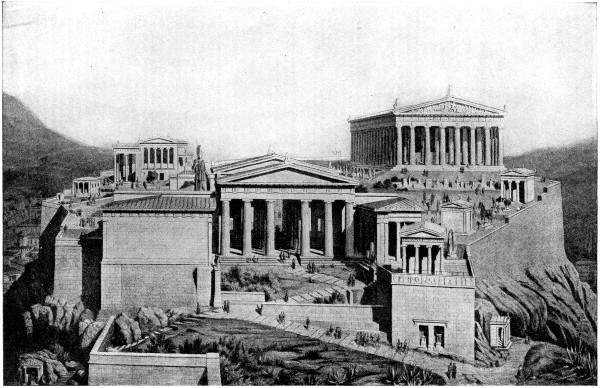
Pinakotheka, or Museum of Pictures. Propylæa, or Porch. Nike Apteros. Parthenon, or Temple of Athena Parthenos.
THE ACROPOLIS OF ATHENS AS IT APPEARED DURING THE AGE OF PERICLES
Pericles, with the sculptor Phidias, covered the Acropolis with a mass of beautiful buildings, making it the glory of Athens, if not of the whole ancient world. No finer structure has ever been known than the Parthenon. It is to be seen on the highest point of the Acropolis, on the right hand of the picture.
CHIEF LEADERS IN THE WAR
The chief generals on the Athenian side were Demosthenes (not the great orator of a later time) and Nicias; the Spartan chief was the famous Brasidas, who had much success against the Athenian colonies on the coast of Thrace. The brilliant Alcibiades began to display his powers as a statesman at Athens. In 422 B. C. a battle near Amphipolis, on the coast of Thrace, ended in the defeat of the Athenians, and the deaths of Cleon and of Brasidas, the latter an irreparable loss to Sparta. In the place of Cleon, the mild Nicias became one of the leading statesmen at Athens, and his efforts resulted in a truce between Athens and Sparta, in 421 B. C.
SECOND PERIOD OF WAR
Questions as to keeping the truce, and the mutual distrust and jealousy between these states increased their antagonism. Athens, now mistress of the sea, had the ambition, under the incitement of the great Alcibiades, to acquire complete sway in the Mediterranean.
Perhaps the most important and decisive event of the war was an attack made (415 B. C.) by Athens upon Syracuse in Sicily, when the Spartans helped the Syracusans, and which resulted in the total failure of the expedition (413 B. C.), and great damage to the power of Athens. The Athenians had sent a more powerful armament against Sicily than had ever before been turned out in the history of Greece. The consequences of the defeat of this force were felt all over Greece, the enemies of Athens were stimulated to much greater activity, and thought that the fate of that city was sealed.
THIRD AND LAST PERIOD
Henceforward Athens could only fight for her life as an independent state. In 412 B. C. many of her subject states revolted, including the wealthy Miletus, on the coast of Asia Minor, and the islands of Chios and Rhodes. Sparta formed an alliance with Persia, and used Eastern gold to furnish ships and mercenaries against Athens. Alcibiades, having quarreled with the Spartans, rejoined his country, and conducted her war, in some of its closing years, with brilliant success. In 411 B. C. a revolution took place in Athens which really swept away the democratic constitution of Solon, and substituted an oligarchical faction in power.
DOWNFALL OF ATHENS
The war was chiefly carried on in Asia Minor, where Alcibiades and others defeated the Spartans and their allies by land and sea; but in 405 B. C. the tide of success for Athens turned again, and the Athenian fleet was captured by the Spartan admiral Lysander, at Ægospotami, in the Hellespont, the Athenian galleys being seized, by surprise, on the beach. In 404 B. C. Athens, blockaded by the Spartans both by land and sea, surrendered to Lysander after a four months’ siege, and the war ended in the downfall of Athens, and the formal abolition of the great Athenian democracy.
RESULT OF PELOPONNESIAN WAR
Henceforward Athens was a subordinate power. Sparta was, for a time, supreme; a Spartan garrison held the Acropolis; Alcibiades, who might have restored Athens, was assassinated in Persia through the influence of Lysander; and though, after a brief period of rule by the Thirty Tyrants, set up by Lysander, a counter-revolution restored, in part, the constitution of Solon, the political greatness of Athens had departed.
Even the disastrous Peloponnesian War, which lasted twenty-seven years, did not destroy the impulse given to the Greek intellect during the preceding age, and literature, oratory, and philosophy flourished.
SOCRATES AND THE SHAME OF ATHENS
Socrates, the great and good Athenian philosopher, lived (469-399 B. C.) during a period covering much of the age of Pericles, and the whole time of the Peloponnesian war. Though opposed to the oligarchical tyranny of the Four Hundred and the Thirty, Socrates was even more adverse to the unmixed democracy, with its election by lot and its payment for political services. Accordingly, on the triumph of the demagogues, he was in 399 B. C. accused of denying the gods and corrupting the young, and being convicted by an overwhelming majority of the jury, was sentenced to death. He passed thirty days before execution in the noble discourses on the immortality of the soul, which are recorded in Plato’s Phædo, drank the cup of hemlock, and died.
SUPREMACY OF SPARTA AND THEBES
Sparta was now at the head of Greece, and for thirty-four years (405-371 B. C.) wielded power over the Greek states. Her sway was harsh and despotic.
RETREAT OF THE TEN THOUSAND
After the Peloponnesian War, some of the Greeks were hired by Cyrus, the Persian prince, to help him in an attempt to wrest the Persian throne from his brother Artaxerxes. The attempt failed, and the memorable retreat (400 B. C.) homeward of the Greeks is famous as the “Retreat of the Ten Thousand.”
THE RISE OF MACEDONIA
Macedonia, north of Thessaly, was not considered by the Hellenes as a part of Hellas, and had no political importance till now. Yet the peoples had elements in common, being Thracians and Illyrians, with a large mixture of Dorian settlers among them.
KING PHILIP OF MACEDON
The line of Macedonian kings being of Hellenic descent, Greek civilization had been cultivated by some of them.
Philip of Macedon was a prince of great ability, educated at Thebes during the Theban supremacy, and trained in war by Epaminondas, on whose tactics he founded his famous invention, the “Macedonian phalanx.” His fame has been overshadowed by that of his illustrious son, but he made Macedonia the leading power in Greece, and gave Alexander the basis for his great achievements. He was a man of unscrupulous character, determined will, prompt action, and patient purpose; and when he became King of Macedon, in 359 B. C., he designed making his country supreme in the Hellenic world, as Athens, Sparta and Thebes had successively been.
THE FIRST SACRED WAR
From 356 B. C. to 346 B. C. the Phocian or First Sacred War was waged between the Thebans and the Phocians, with allies on each side, the origin of the war being a dispute about a bit of ground devoted for religious reasons to lying perpetually fallow. Philip of Macedon was called in to settle matters, and thereby his ambition secured a firm foothold in Greece. He possessed himself by force of the Athenian cities Amphipolis, Pydna, Potidæa, and Olynthus, being vigorously opposed throughout by the great Athenian orator and patriot Demosthenes, who strove to rouse his countrymen against Philip’s dangerous encroachments, in the famous speeches known as the Olynthiac and Philippic orations.
THE GREATEST PERIOD OF GREEK ORATORY
This was the most brilliant time of Greek oratory, which reached its perfection in the contest between Æschines, who advocated the cause of Macedonia, and Demosthenes, who opposed the designs of Philip. It was also a period of great mental activity in the region of scientific inquiry and speculative thought. Plato, whose birth fell in the preceding century, founded the Academic school, which took its name from the groves of Academus in the vicinity of Athens, where the philosopher was accustomed to lecture. Aristotle (called the Stagyrite, from his birthplace, Stagyra, in Macedonia) was the instructor of Alexander the Great, and founded, at the Lyceum in Athens, what is known as the Peripatetic school, from his habit of walking about while conversing with his disciples.
After the battle of Chæronea, Philip, having made Greece subject to his power, planned to unite all the forces of that country in an aggressive war against the great power of Persia, but was murdered in 336 B. C.
V. MACEDONIAN PERIOD AND EMPIRE OF ALEXANDER THE GREAT
V. MACEDONIAN PERIOD AND EMPIRE OF ALEXANDER THE GREAT.—This period extends from the supremacy of Philip, gained by the battle of Chæronea, to the capture of Corinth, 146 B. C. By the disastrous defeat at Chæronea the genuine fire of the Grecian spirit was extinguished, and the subsequent history exhibits little else than the steps by which the country was reduced to a dependent province. Alexander, who succeeded his father Philip, as king of Macedon, and autocrat of Greece, cast an imperishable glory on the first years of this period by his extensive conquests reaching from the Hellespont to the Granicus, to Issus, to Tyre, to the Nile, to the desert of Libya, to the Euphrates, and the Indus. For twenty years after Alexander’s death the vast empire he had formed was agitated by the quarrels among his generals. By the battle of Ipsus in Phrygia, B. C. 301, these contests were terminated, and the empire was then divided into practically four kingdoms. To the first of these the Grecian states belonged. Patriotic individuals sought to arouse their countrymen to cast off the Macedonian yoke; but jealousy between the states and the universal corruption of morals rendered their exertions fruitless. All that is really memorable in the affairs of Greeks at this later time, is found in the history of the Achæan league.
After the assassination of Philip, the task of subjugating the Persian Empire was left for his son Alexander, who subsequently proved himself one of the greatest commanders of any age. Alexander’s exploits were all performed in the short rule of thirteen years (336-323 B. C.). Coming to the throne of Macedon at the age of twenty, he put down rebellion in his own kingdom, marched into Greece and overawed Thebes, which had been intriguing against him, and in a congress of Greek states at Corinth he was appointed to command the great expedition against Persia.
THE DESTRUCTION OF THEBES
In 335 B. C. he made a successful expedition against the Thracians, Getæ, and Illyrians, and on his return found Thebes in revolt. He took Thebes by storm; the inhabitants were all slain or sold as slaves; and all the buildings, except the temples and the house which had been that of Pindar the poet, were razed. This capital had defied Alexander, and ceased to exist.
ALEXANDER’S INVASION OF PERSIA
In 334 B. C. Alexander crossed the Hellespont with an army of thirty thousand foot-soldiers and five thousand cavalry, and first met the foe at the river Granicus, in Mysia. The result was a Persian defeat, which cleared the way through Asia Minor, and brought the Macedonians to the borders of Syria. The second, a great battle (333 B. C.), was fought at Issus, in the southeast of Cilicia. There Alexander met the King of Persia himself, Darius III., and gained a complete victory over a vastly superior force. Darius fled, leaving his wife and mother prisoners in the conqueror’s hands, by whom they were treated with the greatest courtesy and kindness.
SYRIAN AND EGYPTIAN CAMPAIGNS
The Persian resistance thus disposed of for a time, Alexander turned southward, left behind him nothing unsubdued before his advance into the interior of Asia, and made an easy conquest of the cities of Phœnicia, except Tyre, which resisted obstinately for seven months, and was taken in the summer of 332 B. C. After taking Gaza, Alexander marched into Egypt, which received him gladly, from hatred of her Persian rulers. Early in 331 B. C. the Macedonian king handed down his name to future ages by founding, at the mouth of the western branch of the Nile, the city of Alexandria, which was destined to become so famous for commerce, wealth, literature, and learning.
ALEXANDER’S SECOND INVASION OF PERSIA
In the spring of 331 B. C. Alexander set out again for Persia, where Darius had been gathering an immense force with which to make a last struggle for the empire of the world. After traversing Phœnicia and Northern Syria, Alexander crossed the Euphrates and Tigris, and came out on the plain near the little village of Gaugamela, to the southeast of the ruins of Nineveh. Then took place the great and decisive battle of Arbela, with the Persians, October, 331 B. C.
After receiving the surrender of the other two capitals, Susa and Persepolis, Alexander spent the year 330 B. C. in conquering the northern provinces of the Persian Empire, between the Caspian Sea and the Indus. In 329 B. C. he marched into Bactria, over the mountains now called the Hindu Kush, caught and slew the traitor Bessus, who murdered Darius, and advanced even beyond the river Jaxartes. In 328 he was engaged in the conquest of Sogdiana, between the Oxus and Jaxartes, the country of which the capital was Maracanda, the modern Samarcand.
HIS INVASION OF NORTHERN INDIA
In the spring of 327 B. C., Alexander marched through what is now Afghanistan, crossed the Indus, and defeated an Indian king, Porus, on the banks of the Hydaspes (the Jhelum). On his way to the Indus he stormed the capital of an Indian tribe, now Mooltan, and was himself severely wounded. In 326 he sailed in a fleet, built on the spot, down the Indus, into the ocean; despatched a part of the army on board the ships, under his admiral Nearchus, by sea coastwise into the Persian Gulf, and marched himself with the rest through what is now Beluchistan, reaching Susa early in 325 B. C.
ALEXANDER SETTLES IN BABYLON
During the rest which the troops took here, Alexander, many of his generals, and many thousands of his soldiers, married Asiatic women, and, with the same view of bringing Europe and Asia into one form of civilization, great numbers of Asiatics were enrolled in the victorious army, and trained in the European fashion. For the improvement of commerce, the Tigris and Euphrates were cleared of obstructions. From Susa, in the autumn of 325 B. C., Alexander visited Ecbatana (in Media) and thence proceeded to Babylon, which he entered again in the spring of 324 B. C.
It was the intention of Alexander to make Babylon the capital of the empire, as the best medium of communication between east and west; and he is said to have meditated the conquests of Arabia, Carthage, Italy, and of Western Europe. For commercial and agricultural purposes he intended to explore the Caspian Sea, and to improve the irrigation of the Babylonian plain. All his plans were made vain by his sudden death by fever at Babylon, in the summer of 323 B. C.
ESTABLISHMENT OF VARIOUS GREEK KINGDOMS
Alexander the Great left no heir to his immense empire. In Bactria (the modern Bokhara), Asia Minor, Armenia, Syria, Babylonia, and above all in Egypt, Greek kingdoms were established as centers of science, art, and learning, from which Greek light radiated into the world around them. In Europe, besides that of Macedon, a kingdom of Thrace, stretching beyond the Danube, another in Illyria, and another in Epirus, were under the rule of Greek princes. To Alexander the world owed, among other great cities built by him or his successors, Alexandria in Egypt, and Antioch in Syria.
LASTING INFLUENCE OF GREEK THOUGHT IN ASIA
The Greek language became the tongue of all government and literature throughout many countries where the people were not Greek by birth. Throughout Asia Minor, Syria, and Egypt the Hellenic character that was thus imparted remained in full vigor down to the time of the Mohammedan conquests; and the early growth and progress of Christianity were aided by that diffusion of the Greek language and civilization.
Beyond the Euphrates, Grecian influences largely modified Hindu science and philosophy and the later Persian literature. The intellectual influence of ancient Greece, poured on the Eastern world by Alexander’s victories, was brought back to bear on Mediæval Europe through the Saracenic conquests. The learning and science of the Arabians, communicated at that epoch to the western parts of Europe, were merely the reproduction, in an altered form, of the Greek philosophy and the Greek learning acquired by the Saracenic conquerors along with the territory of the provinces which Alexander had subjugated, nearly a thousand years before the armed disciples of Mohammed began their career in the East.
ALEXANDER’S SUCCESSORS
On the death of Alexander, in 323 B. C., a struggle of more than twenty years’ duration ensued among his principal generals and their heirs—Perdiccas, Ptolemy, Antigonus, his son Demetrius Poliorcetes, Cassander, Seleucus, and others. At last, in 301 B. C., a decisive battle was fought at Ipsus, in Phrygia, between Antigonus (with his son Demetrius) and a confederacy of his rivals. The result was to distribute the provinces of Alexander’s empire in the following way: To Lysimachus, nearly the whole of Asia Minor; Cassander, Greece and Macedon; Seleucus, Syria and the East; Ptolemy had Egypt and Palestine. The two most important kingdoms were that of the Ptolemies in Egypt, and that of the Seleucids[4] in the East. (See further under Comparative Outlines, and Egypt.)
LATER HISTORY OF MACEDONIA AND GREECE
The last period in the history of Greece presents us with long wars among different successors of Alexander for the sovereignty of the Greek states, and factions and intrigue rife in and between the different communities. From time to time great and patriotic men arise, making a struggle glorious but vain for the restoration of political freedom and the spirit of the olden time. We find “leagues” and confederations formed in order to resist the coming doom of political extinction.
THE FATAL LAMIAN WAR
A great effort to free Greece from the Macedonian supremacy was headed by Athens in 323 B. C. The renowned Athenian orators Demosthenes and Hyperides were its political heroes, opposed by Phocion, a man of pure character, but who despaired of a successful rising against Antipater, ruler of Macedonia before and after Alexander the Great’s death. Athens was joined by most of the states in Central and Northern Greece; and the war derives its name from Lamia in Thessaly, where Antipater, after being defeated by the confederates, was besieged for some months. The war ended in 322 B. C., by Antipater’s complete victory at the battle of Crannon in Thessaly. Demosthenes ended his life by poison in the same year; Hyperides was killed by Antipater’s orders; Phocion died by the hemlock at Athens, in 317 B. C., on a charge of treason.
HEROIC EFFORTS OF DEMETRIUS
The distinguished Demetrius Poliorcetes (besieger of cities) was king of Macedonia from 294 to 287 B. C. His life was passed in fighting with varied success and he was driven from the throne at last by a combination of enemies, including the famous Pyrrhus, king of Epirus. Demetrius was a man of wonderful abilities and resources, deriving his surname from the enormous machines which he constructed for the siege of Rhodes, one of his warlike enterprises. He freed Athens for a time from Macedonian domination before he became ruler of Macedon.
A famous personage was Pyrrhus, the warlike king of Epirus, the territory in the northwest of Greece, inhabited by descendants of the old Pelasgians and Illyrians. The first king of the whole country was Alexander, the brother of Olympias, mother of Alexander the Great. He ruled from 336 to 326 B. C.
THE WARRIOR PYRRHUS, KING OF EPIRUS
Pyrrhus (295 to 272 B. C.) is renowned as the greatest warrior of his age. He had been driven by his subjects from Epirus, but, assisted with a fleet and army by Ptolemy I. of Egypt, returned thither and began his actual reign in 295 B. C. His first efforts were turned against Macedonia; but, after much fighting, he lost his hold there, in 286 B. C. It was in 280 B. C. that he began his great enterprise by crossing over into Italy, to aid the Tarentines against the Romans. In his first campaign he defeated the Romans in the battle of Heraclea in Lucania. His skill was aided by a force of armored elephants, and by the Macedonian formation of the phalanx, both novelties to the Romans. In the second campaign (279 B. C.) Pyrrhus gained a second dearly bought victory over the Romans at Asculum, in Apulia, yet with no decisive result; in 278 B. C. he crossed into Sicily, to help the Greeks there against the Carthaginians.