THE BOOK OF NATIONS Geographical, Historical, Descriptive (continued 9)
Reading edition
In the reign of Stephen occurred the civil war between the Empress Maud, daughter of Henry I., and Stephen; she finally retired to France, and concluded a peace with her adversary. The great struggles of the successors of William were with the ecclesiastics and with the barons. Sometimes in these the popular sympathies were with, and sometimes against, the crown. The Conqueror himself and his immediate successors had no difficulty in maintaining the superiority of the courts of justice over the ecclesiastics; but even a sovereign so bold and skillful as Henry II. was forced, after the outcry occasioned by the murder of Thomas à Becket (1170 A. D.) to yield the point. The right to nominate the higher ecclesiastics was also secured by the popes.
The Plantagenets.—Under the Plantagenets an era of progress, generally, opened for England. The reign of Henry II. gave to the country the constitution of Clarendon; Ireland was conquered, 1172; England was divided into six circuits for the better administration of justice, and a digest of the laws was made by Glanville about 1181. Richard I. did little for the internal good of the land, his chief exploits occurring on the field of battle in foreign lands.
Magna Charta.—Under John two important events occurred: Magna Charta was obtained, and the French possessions were nearly all lost—both unmitigated blessings; but otherwise John’s influence was cast against progress and reform. The degradation of the English monarchy was at its lowest when he consented (1213 A. D.) to hold the crown as a gift from Rome. From Henry II. something similar to the Great Charter had already been gained; but it was the Magna Charta of John which firmly established two great English principles—that no man should suffer arbitrary imprisonment, and that no tax should be imposed without the consent of the council of the nation.
During the reign of Henry III., England obtained her first regular parliament, and gold money was first coined in 1257. Edward I. was crowned 1272, and almost the first event of his reign was the conquest of Wales; Scotland also was subdued, but revolted again in 1297.
The reign of Edward II. was disastrous to himself and to England. The barons rose against his favorites, and Edward was murdered by the connivance of his wife. A new and vigorous era began with the reign of Edward III. The Scots were defeated at Halidon Hill; important victories were gained in France; the Order of the Garter was instituted, and, most important of all, law pleadings were ordered to be in English, instead of in the Norman-French tongue which had hitherto prevailed. Richard II. was crowned in 1377, and with his death in 1385, ended the line of the Plantagenets.
House of Lancaster.—Henry IV. was the first sovereign under this ill-fated house. His reign was disturbed by an insurrection of the Welsh under the Percies, but was otherwise peaceful. Henry V. invaded France and won the famous battle of Agincourt, and gained the French crown, 1420; but during the reign of his successor, Henry VI., all the French possessions were lost save Calais. He was deposed by Warwick the kingmaker, and the first representative of the House of York, Edward IV., was placed on the throne. The Wars of the Roses ensued, which continued through the two succeeding reigns of Edward V. and Richard III, ending with the death of Richard on Bosworth field, the coronation of Henry VII., 1485, and his marriage with Elizabeth, daughter of Edward IV.
The Tudors.—The union of the houses of York and Lancaster under Henry VII. begins a new period in English history. Under him England entered on her career of maritime discovery. He died, 1599, and was succeeded by his second son, Henry VIII. Henry VIII. succeeded under the most favorable auspices. He found the alliance of his now important country courted by both of his contemporaries, Francis I., of France, and Charles V., of Germany. But the interest of the foreign complications of the reign merges in the courts of England and of Rome. Henry was frequently engaged in hostilities with foreign countries, and the great victory of Flodden was won by one of his generals over James IV. of Scotland, husband of his sister Margaret. He threw off his allegiance to the pope, and became head of the church in England. He was six times married, and two of his wives were beheaded and two were repudiated. In his reign the scaffold was occupied by victims from every class of society. He died January 28, 1547, and was succeeded by his only son, Edward VI., whose mother was Jane Seymour, Henry’s third wife.
Edward was in his tenth year, and the government was vested in a regency. In this reign the church of England was established, and the nation placed on the Protestant side in the struggle then going on in Europe. When Edward VI. died, July 6, 1553, Lady Jane Grey, to whom Edward had bequeathed the crown, was queen for ten days, when her party was dispersed, and Mary, eldest daughter of Henry VIII., ascended the throne.
The marriage of Mary with Philip II. of Spain led to war between England and France, and an English army joined the Spanish force that invaded France. Mary was a devout Catholic, and caused Cranmer, Latimer, Ridley, and about three hundred other Protestants to be burned. Her death, November 17, 1558, left the throne to Elizabeth, who sided with the Protestants.
Elizabethan Period.—The reign of Elizabeth, which lasted nearly forty-five years, is one of the most brilliant in English history. She triumphed over her enemies, and raised her kingdom to the first place in Europe. She ruled over Scotland in fact, and put the queen of that country, the unfortunate Mary Queen of Scots, to death, after having held her in captivity nearly nineteen years. The Huguenots of France and Henry IV. received aid from her, and but for the assistance which she gave the Dutch they would have sunk under the power of Spain. She invited the Turks to join her in attacking the pope and Phillip II.; and over both those potentates she achieved a great triumph in 1588, when the Spanish armada was destroyed. The enterprise of Englishmen led them to circumnavigate the globe, to attempt colonization, to extend commerce, and to inaugurate trade relations with India. Elizabeth died March 24, 1603, and with her terminated the Tudor dynasty, after an existence of nearly one hundred and eighteen years.
House of Stuart.—Elizabeth was succeeded by James VI. of Scotland, the son of her victim, Mary Stuart, and first king of England of the Stuart line, who inherited the English crown in virtue of his descent from Margaret Tudor, eldest daughter of Henry VII., who had married his great-grandfather, James IV. The new king, under the title James I., was hailed with much satisfaction by the English; but he was a pedant and a tyrant, and soon lost his popularity. His first parliament, 1604, in reply to his assertion that all their privileges were derived from him, asserted all those principles for which the English constitutionalists contended as facts not to be questioned.
Then began that civil contest which lasted down to 1689 in full force, and which was not utterly at an end till 1746. The foreign policy of James was as vicious as his home policy, and England sank in the estimation of Europe. He died in 1625, and was succeeded by his son Charles I.
For eleven years (1629-1640) this ruler called no parliament, and England was ruled as despotically as France. His chief instruments were Wentworth, afterward earl of Strafford, and Laud, archbishop of Canterbury. Laud sought to fasten the English church policy on Scotland. War between the Scotch people and the English government followed, and Charles was compelled to call a parliament April, 1640, which was dissolved in a few days, and became known as the “short parliament.” Six months later assembled the famous “long parliament,” which proceeded to divest the king of much of his power.
Period of the Commonwealth.—The contest between the king and parliament under the lead of Vane, Cromwell and others, led to the great English Civil war, which began in the latter part of 1642. Cromwell was everywhere victorious in the field. The army became the source of all power. The king was tried, condemned and executed. Ireland was conquered by Cromwell, who was almost equally successful in Scotland. The battle of Worcester, September 3, 1651, crushed the royalists for nearly nine years. In 1653 Cromwell dissolved the parliament by force, and was master of England for five years, as Lord Protector. After his death, in 1658, the military and civil republicans quarreled.
Restoration of the House of Stuart.—Richard, the son and successor of the great Protector, resigned, and the restoration of the Stuarts was effected in the person of Charles II., 1660, whose reign in law dates from the time of his father’s execution, January 30, 1649. The king’s popularity soon declined, mainly on account of his foreign policy. An unnecessary war with the Dutch produced much disgrace. The triple alliance with Sweden and Holland for a brief interval stayed the course of Louis XIV., but the king’s forces assisted in the war on Holland made by Louis, and afterward assistance was sent to the Dutch.
The peace of 1678 was followed by the excitement caused by the alleged popish plot. Parliament after parliament was elected, met, set itself in decided opposition to the government, and was dissolved. The leading object of the opposition was the exclusion of the duke of York, Charles’ brother, from the line of succession. Charles II. died in February, 1685, and his brother James II., an avowed Roman Catholic, came to the throne.
James II. was bent on the establishment of a despotism, by the destruction of the constitution in church and state. He punished Monmouth’s rebellion with excessive vindictiveness. The king prorogued parliament in November, 1685, and that body never met again. For three years he governed despotically, and a perpetual contest was waged between him and his people.
In June, 1688, it was announced that the king’s second wife had given birth to a prince, who was afterwards known as the pretender. It was generally believed that a supposititious child had been placed in the position of heir apparent.
In November, William, prince of Orange, who was the king’s nephew and had married his eldest daughter Mary, heir apparent to the British crown, landed in England at the head of an army. James fled, and William and Mary were proclaimed sovereigns.
War was declared against France in 1689, and was ended in 1697. Ireland was subdued. Mary died in 1694, and left William III. sole monarch till his death in March, 1702, when the succession passed to Anne, second daughter of James II.
In May war was declared against France, and after splendid victories achieved by Marlborough, it was ended by the treaty of Utrecht in 1713. The union of England and Scotland was effected in 1707. Anne died August 1, 1714, and the crown passed to the house of Hanover in the person of George I.
House of Hanover under the Four Georges.—The rebellion of 1715 in behalf of the Stuarts proved a failure. The bursting of the “South sea bubble” in 1720 placed Robert Walpole in control of the government, which he retained under George II. (who ascended the throne in 1727) till 1742. His fall was occasioned by a war with Spain, to which one with France was soon added, growing out of the question of the Austrian succession. In 1746 the contest between the reigning dynasty and the remains of the Stuart party was brought to an end at Culloden where the duke of Cumberland defeated Charles Edward. The treaty of Aix-la-Chapelle in 1748 restored peace to Europe for a few years.
The Whigs continued to rule, headed by Henry Pelham, and after his death in 1754 by his brother, the duke of Newcastle. The renewal of the war with France in 1755 was followed by the formation in 1757 of the celebrated Pitt-Newcastle ministry, which carried on the contest with great vigor; so that when George II. died, October 25, 1760, his fleets and armies were everywhere triumphant. The foundation of the East Indian empire of England was laid at Plassey June 23, 1757. French America was conquered at Quebec, September 13, 1759.
The new king, George III. (the first English-born king of his house), grandson of George II., was by nature and education as despotic as the worst of the Stuarts. The attempt to tax the American colonies led to the American revolution. The English in the last years of the war had to fight the Americans, the French, the Spaniards, and the Dutch. The peace of 1783 left England in a low condition.
When France became convulsed by the revolution, England engaged in the war against her that soon followed, which lasted, with two brief intervals, till 1815, ending in the complete triumph of England and her allies. The legislative union between Ireland and Great Britain went into effect January 1, 1801. The exertions made by England, beginning with the administration of Pitt, were vast. Her fleets, chiefly under Nelson, achieved splendid victories over the French and Spaniards, and in the last years of the war her armies were greatly distinguished under the lead of Wellington, who, at Waterloo, inflicted the final defeat on Napoleon in 1815.
In 1810 George III. lost his reason finally, and his eldest son was prince regent till 1820 when he became king as George IV.
In 1812 England became involved in a war with the United States, growing out of the impressment and right of search questions. The contest was virtually terminated by the treaty of Ghent, December 24, 1814. In 1829 the Catholic emancipation act was passed, under a ministry headed by Wellington and Peel. George IV. died in 1830, and was succeeded by his brother, the duke of Clarence, as William IV.
In March, 1831, a bill for parliamentary reform was introduced into the house of commons by Lord John Russell, and after long debates in parliament and intense excitement in the country, caused by the opposition of the house of lords, a bill making extensive changes in the constitution of the house of commons finally passed in June, 1832, under the ministry of Earl Grey.
The first reformed parliament, which met January 29, 1833, contained an overwhelming majority of reformers. Lord Grey retired from office in 1834, and was succeeded by Lord Melbourne. Toward the close of the same year the government was committed to Sir Robert Peel, who formed a conservative ministry. Peel continued in office until April 8, 1835, when he retired, having been repeatedly beaten on Irish church questions. Lord Melbourne returned to office, with many of his old colleagues. The king died on June 20, 1837, and was succeeded by his niece Victoria, the only child of Edward, duke of Kent, fourth son of George III.
The Victorian Period.—The accession of Victoria led to the separation of the crowns of England and Hanover, which had been worn by the same persons since 1714. In 1841 Melbourne resigned, and the conservatives under Peel came into power. In 1846 the Peel ministry brought forward an act to protect life in Ireland, but it was defeated in the commons on the same day that the Corn Laws were repealed, and the ministry came to an end, being succeeded by one at the head of which was Lord John Russell. The Russell ministry went out of office in 1852, and for several months the tories, led by Lord Derby and Mr. Disraeli, were at the head of affairs. This ministry was followed by one composed of the coalesced Whigs and Peelites, headed by Lord Aberdeen.
Crimean War.—In 1853 the troubles on the Turkish question began, and war was declared against Russia by France and England in March, 1854. Large fleets and armies were sent to the East, and fleets to the Baltic. The Crimea was invaded, the victory of the Alma won by the allies, and Sebastopol partially invested. On September 8 Sebastopol was reduced, the French storming the Malakhoff, and peace was restored by a congress of the powers at Paris in March, 1856.
Indian Mutiny and Final Absorption of the Indian Empire.—Early in 1857 a formidable revolt broke out in England’s great Bengal army of sepoys. Delhi fell into the hands of the rebels, and the nominal Mogul emperor found himself once more a sovereign in reality. The mutiny spread rapidly, and in a short time the whole Bengal army had become hostile to the English. The military reputation of England was greatly raised by the successes of her armies in India, achieved under the lead of Sir Henry Havelock, Sir Colin Campbell, and others. In eight months after the breaking out of the mutiny there were nearly seventy thousand effective English troops there, and new native corps had replaced the sepoys. By the end of 1858 the revolt was totally suppressed. The rebellion resulted in the transfer of the immediate government of India from the East India company to the crown, the old directory sitting for the last time September 1, 1858.
In February, 1858, the Palmerston ministry was driven from office, and a new conservative ministry was formed, with the earl of Derby as premier, and Mr. Disraeli as Chancellor of the Exchequer. This ministry soon resigned and Lord Palmerston resumed office in June, 1859. On May 13, 1861, Great Britain recognized the belligerency of the Confederacy during the American Civil war and the blockade of their ports, and proclaimed neutrality.
In 1868 Disraeli became Prime Minister in succession to Lord Derby, but was defeated in the general election of that year and resigned before the end of the year.
Disraeli was succeeded by Gladstone, who, during the five years of his ministry passed more measures than almost any previous one. Education became compulsory. Trade unions were legalized, the Ballot Act was passed. The Irish Church Act and a Land Act for Ireland were passed, and the state of Ireland at the time also necessitated Coercion Acts.
In 1874 Gladstone resigned, and the Conservatives were returned to power, having for the first time since 1841 a real majority in the House of Commons. The ministry formed by Disraeli was a brilliant one, and the Opposition was for a time weakened by the withdrawal into private life of Gladstone. The great question of Home Rule was gradually forcing itself to the front, and the Irish tactics in the House became obstructive. It was at this time that Disraeli put forward his imperial policy, and the ministry is chiefly noticeable for its attitude on foreign and imperial affairs.
From 1879 to the present time Irish agitation has been for Great Britain a source of serious disquiet. In 1882 Mr. Gladstone adopted a policy of conciliation, but the murder of Lord Frederick Cavendish and of Mr. Burke caused its abandonment and the immediate passing of a coercion law which virtually placed Ireland under martial law. In 1882 the Egyptian army, under the leadership of Arabi Bey, having revolted from the khedive’s authority, Great Britain sent a large naval expedition to Egypt, bombarded Alexandria, and defeated the rebellious forces. Since that date the Egyptian government has been under British suzerainty, and in 1896, a British expedition was sent up the Nile with the purpose of regaining the provinces of Egypt held by the mahdist forces.
Within the past quarter of a century Great Britain has largely extended its territory in Africa, bringing great areas in the south and east of the continent under its protection. During the same interval several subjects of dispute have arisen with the United States, which have all been peacefully settled. An imposing festival took place in London in June, 1897, on the occasion of the sixtieth anniversary of Queen Victoria’s accession, in which all sections of the empire took part.
Boer War.—October 11, 1899, war was declared by the Boers of the Transvaal and Orange Free State, the aim being the destruction of the British paramountcy in South Africa. This led to the annexation of those states by the British, after a fierce contest, in 1900. In 1900, a new parliament was elected, which again supported the Conservative ministry, with a slightly increased majority.
House of Saxe-Coburg.—Victoria died January 22, 1901, and was succeeded by her eldest son, Edward VII., who proved himself to be an active promoter of peaceful relations with other countries.
The Boer war was concluded in the middle of 1902 by the treaty of Vereeniging, and almost immediately afterward Lord Salisbury retired from office, being succeeded in the premiership by his nephew, Mr. A. J. Balfour. The education act of 1902 did away with school boards where they existed, bringing the voluntary and former board schools alike under education committees in England and Wales, and the same change was made in London in 1903. The Irish land act of 1903 was a measure of the first importance, its object, being to transfer practically all the agricultural land of Ireland to farmers or peasant proprietors. In the autumn of 1903 Mr. Chamberlain resigned office in order to be free to advocate a change in the country’s fiscal policy, intended to unite the colonies more closely with the mother country—a change which many have regarded as meaning a return to protection.
In 1905 the Liberal party returned to power under the leadership of Sir Henry Campbell Bannerman, who was succeeded after his death in 1908 by H. H. Asquith.
On May 5, 1910, the illness of King Edward was announced, followed by that of his death the next day. His son, George V., succeeded to the throne May 6, 1910.
A lengthy battle had begun to be waged against the hereditary prerogatives of the House of Lords, to which the death of the king caused a temporary cessation, but, in August, 1911, the Upper House was finally shorn of its permanent veto. In September, 1910, the fisheries dispute with the United States, which had remained unsettled for more than a hundred years, was decided at the Hague.
Early in 1913 the Irish home rule question became the dominant issue and a bill favoring it was passed by the House of Commons by a large majority, only to be overwhelmingly rejected in the House of Lords. In February, 1914, King George urged mutual concessions in the controversy, and in the same year the Home Rule bill became a law without the approval of the Lords, but practically non-operative. Today (1917) home rule for Ireland is still the great unsolved problem of British domestic policy.
The year 1914 also marked the entrance of Great Britain into the great European war that has since engulfed practically the whole of Europe and one-third of the civilized world. England’s history since has been almost wholly bound up with the diplomatic, economic, and military aspects of that titanic struggle, the real facts of which it will require more than a generation of dispassionate minds to verify, sift and assess at their true values. An attempt is made to give the leading features of this war, and the parts played in it by the various nations involved, under a separate heading.
IMPORTANT FACTS CONCERNING THE BRITISH EMPIRE
This title is usually given to the total territory governed or administered in the name of the British government centralized in London. It includes the United Kingdom of Great Britain and Ireland, the self-governing Dominions, Dependencies, Crown colonies and Protectorates whose inhabitants look to the king as their ultimate head. Of the whole area of the lands of the globe, the British Empire occupies nearly one-quarter, extending to every continent.
THE UNITED KINGDOM
Countries Area in Square Miles Population, 1911 How and When Acquired by England Character of Government
EUROPE:
England 50,839 34,043,076 ... - Constitutional Monarchy. Constitute the United Kingdom of Great Britain and Ireland.
Wales 7,470 2,032,183 Conquest, 1282
Scotland 29,785 4,759,445 Union, 1603
Ireland 32,583 4,381,951 Conquest, 1172
Islands 302 148,934 ...
DEPENDENCIES AND COLONIES
EUROPE:
Gibraltar 2 23,553 Conquest, 1704 Military Governor.
Malta, etc. 122 215,879 Treaty cession, 1814 Governor; Councils.
ASIA:
India (including Burma) 1,800,258 314,955,000 - Conquest, begun 1757 Transfer from East India Co., 1858 - Viceroy; Council; Departments. Native rulers under Political Supervision.
Ceylon 25,365 4,038,456 Treaty cession, 1801 - Governor; Executive and Legislative Councils.
Cyprus 3,584 261,587 Convention with Turkey, 1878
Aden and Socotra 3,070 53,222 (Aden) Conquest, 1839
Straits Settlements 1,500 620,127 Treaty cession, 1785-1824
Hongkong 30.5 428,888 Treaty cession, 1841
Labuan 31 8,411 Treaty cession, 1846
British North Borneo 31,000 204,000 Cession to company, 1877 - Governor (British North Borneo Company).
AFRICA:
Union of South Africa (including Cape of Good Hope, Natal, The Transvaal, and Orange River Colony) - 473,184 5,938,499 - Treaty, conquest, and cession, 1588-1900 - The Union of South Africa—Governor-General; Executive Council; Senate; House of Assembly.
St. Helena 47 3,553 Conquest, 1673 - Governor and Executive Council.
Ascension 38 266 Annexation, 1815 Under the Admiralty.
Mauritius, etc. 1,063 373,336 - Conquest and cession, 1810, 1814 - Governor; Executive and Legislative Councils.
British East Africa (including the Protectorate of Nyasaland, East Africa, Uganda, Zanzibar and Somaliland) - 420,466 8,728,276 - Conquest and cession, 1870-1890 - Governor, Executive and Legislative Councils.
British West Africa (including Gambia, Gold Coast Colony, Northern Nigeria, Southern Nigeria, and Sierra Leone) - 495,490 17,442,772 - Conquest, annexation, cession, 1673-1872 - Governor; Executive and Legislative Councils.
AMERICA:
Dominion of Canada 3,745,574 ... - Conquest and settlement, 1670-1858 - Governor General; Parliament.
Ontario 260,862 2,519,902 Conquest, 1759-1760
Quebec 347,350 2,000,697 Conquest, 1759-1760
New Brunswick 27,985 351,815 Treaty cession, 1763
Nova Scotia 21,428 461,847 Conquest, 1627
Manitoba 73,732 454,691 Settlement, 1813
British Columbia 312,363 362,768 Transfer to crown, 1858
Alberta 253,540 372,919 Settlement
Saskatchewan (including Mackenzie, Ungava, and Franklin) - 250,650 453,508 Settlement
Northwest Territories 1,418,000 19,330 Charter, 1670
Yukon Territory 196,976 7,000 Charter, 1670
Prince Edward Island 2,184 93,722 Conquest, 1745
Newfoundland (and Labrador) - 42,734 - 230,000 Treaty cession, 1713 Governor; Parliament.
120,000
British Guiana 104,000 305,090 - Conquest and cession, 1803-1814 - Governor; Executive and Legislative Councils.
British Honduras 8,598 44,000 Conquest, 1798
Jamaica 4,207 831,123 Conquest, 1655
Trinidad and Tobago 1,868 358,641 ...
Barbadoes 166 196,287 Settlement, 1605
Bahamas 5,794 55,872 Settlement, 1629
Bermuda 19 19,289 Settlement, 1612
Other Islands 8,742 255,000 ...
AUSTRALASIA:
Commonwealth of Australia (including Australia, Tasmania, and Papua) - 3,091,496 5,140,393 Settlement - Separate State Legislatures and Governments (Governors); Federal Parliament and Government; Governor-General and Executive Council.
Dominion of New Zealand 104,471 982,926 Purchase, 1845 - Governor and Houses of Parliament.
Fiji 7,435 128,404 Cession from the natives, 1874 - Governor and Legislative Council.
TABLE OF THE SOVEREIGNS OF ENGLAND
Names and Lineage of Sovereigns Began to Reign Years of Age L’gth of Reign Death Character Principal Statesmen Chief Warriors Events of Reign
ANGLO-SAXON KINGS
EGBERT (775?-837)—Son of Alcmund, descended from Inigisil, brother to Ina, king of West Saxons. 801 ... 37 Natural causes. Possessed all the qualities required in a warrior. ... The king.—Ethelwolf.—Kenneth. The kingdoms of the Heptarchy united, and take the name of England.
ETHELWOLF (—— -358)—Son of Egbert. 838 ... 20 Natural causes. Pious, wise, valiant and clement. A lover of peace, and zealous for religion. Athelstan. Wolfhere.—Ethelhelm.—Ceorle. Tithes instituted; London plundered by the Danes; England becomes tributary to the Holy See.
ETHELBALD—Son of Ethelwolf. 858 ... 2 Natural causes. Neither pious nor valiant. Swithun, Bishop of Winchester. Osric. Scots defeated by the Britons.
ETHELBERT—Son of Ethelwolf. 860 ... 6 Natural causes. Sweet-tempered, wise, pious and valiant. ... The king. Winchester burnt by the Danes.
ETHELRED I. (871).—Brother to Ethelbert. 866 ... 6 Killed in the battle of Wittingham. Pious, valiant, prudent, and just. ... Young Alfred. Battles of Aston and Basing—York taken.
ALFRED The Great (849-901).—Brother to Ethelred, and son of Ethelwolf. 872 22 28 By a contraction of the nerves. A great sovereign, warrior, legislator, politician and scholar. ... The king.—Oddune, earl of Devonshire. University of Oxford founded. Juries instituted. England divided into shires, tithings and hundreds.
EDWARD the Elder (870?-924).—Second son of Alfred the Great. 900 17 25 Natural causes. Equal to his father—his love for learning and lenity excepted. ... The king. Northumberland and East Anglia united to the crown. University of Cambridge founded. Battles of Temsford and Malden.
ATHELSTAN (895?-941).—Natural son of Edward the Elder. 925 20 16 Natural causes. Possessed uncommon virtues; wise, valiant, and just. Turketul, Chancellor. Guy of Warwick. Constantine III. of Scotland and six Irish and Welsh kings killed at battle of Brunanburh.
EDMUND the Pious (923-946).—Eldest legitimate son of Edward the Elder. 941 25 7 Assassinated by Leolf, while feasting at Puckle-kirk. Pious, valiant and just, and much respected by his people. ... The king. Cumberland and Westmoreland given up to Malcolm, king of Scotland.
EDRED (—— -955?).—Second legitimate son of Edward the Elder. 948 29 7 Natural causes. Pious and valiant, but too obsequious to his council. Aldheim, Archbishop of Canterbury. The king. Northumbrian Danes reduced.
EDWY (939?-959).—Eldest son of Edmund the Pious. 955 17 4 Died of grief on brother being set up in his stead. Hated the monks, and persecuted them, which caused a rebellion. Odo, Archbishop of Canterbury. Prince Edgar. Rebellion of the Mercians.
EDGAR (943?-975).—Brother to Edwy. 959 13 16 Natural causes. Pacific, active, wise, and industrious. Ethelwold. ... King of Wales, Ireland and the Isle of Man, recognize Edgar for their sovereign.
EDWARD the Martyr (961?-978).—Eldest son of Edgar. 975 15 3 Assassinated by order of his step-mother Elfrida. Amiable and sweet-tempered. Dustan. ... ...
ETHELRED II. (Sweyn) (—— -1016).—Brother to Edward the Martyr, and son of the beautiful Elfrida. 979 12 37 Natural causes. Cowardly, indolent, and avaricious. Siricius, Archbishop of Canterbury. Prince Edmund. Alfric. Arabic figures introduced. Sweyn, king of Denmark, conquers England.
EDMUND, Ironside (989-1017).—Eldest son of Ethelred II. 1016 26 1 Assassinated by order of Edric. Valiant and prudent. Edric, Earl of Wilts. ... Massacre of the Danes. England divided between Edward and Canute I.
DANISH KINGS
CANUTE I. (995-1035).—Son of Sweyn, King of Denmark. 1017 ... 19 Natural causes. A great king; humble, just, and truly religious. Thurkell, Duke of East Anglia.—Urick, Duke of Northumberland. Godwin, Earl of Kent. Parents prohibited selling their children. End of the Danish war of two hundred years.
HAROLD I. (1040- ——)—Second son of Canute I., by Queen Alfwen. 1036 30 3 Occasioned by intemperance. Impious, unjust, dissolute and mean. Earl Godwin. Godwin, Earl of Kent. Paper first used in England.
CANUTE II. (1019-1042).—Third son of Canute I., by Emma of Normandy. 1039 29 2 By excessive eating. To the vices of Harold I., he added that of cruelty. Earl Godwin. Leofric, Duke of Mercia. ...
SAXON KINGS
EDWARD the Confessor (1004-1066).—Son of Edmund Ironside. 1041 40 24 Natural causes. Honored as a great saint; of a mild and peaceful temper; was charitable, but had no great genius. Robert, Archbishop of Canterbury—Harold. Siward, Duke of Northumberland. Common law of England established. Westminster Abbey founded.
HAROLD II. (1022-1066).—Son of Earl Godwin, by the eldest daughter of Canute I. 1065 ... 1 Killed in the battle of Hastings. A valiant warrior. Morcar, Earl of Northumberland. Gurth and Leofwin, the king’s brothers. Battle of Hastings, Norman conquest.
NORMAN KINGS
WILLIAM the Conqueror (1027-1087).—Son of Robert, Duke of Normandy, by his mistress Harlotte. 1066 40 21 Death occasioned by heat at the burning of Mantes. Possessed great bodily strength, a great soul and an elevated mind, and a prodigious genius; and governed the English with a heavy hand. Odo, Bishop of Bayeaux. Fitzosborne, Earl of Hereford. Malcolm, King of Scotland. Tower of London built. Doomsday book. Bishoprics created.
WILLIAM Rufus (1056-1100).—Second son of William the Conqueror. 1087 31 13 Accidentally shot by Sir Walter Tyrrell, in New Forest. Courageous and vicious to a high degree. Herbert—Lozinga. Earl of Northumberland—Duke of Normandy. First Holy War. Westminster Hall built. Reduction of the Welsh.
HENRY I. (1068-1135).—Brother of William Rufus. 1100 32 35 Death occasioned by eating too many lampreys. Handsome, brave, sober, cruel, avaricious, and unclean. Archbishop Anselm. Bishop of Salisbury. Earl of Flanders. Normandy conquered. First Parliament.
STEPHEN (1105-1154).—Son of Stephen, Earl of Blois, and Adela, daughter of William the Conqueror. 1135 31 19 Natural causes. In person majestic; his air placid and insinuating. Possessed great courage, an elevated genius, and sound judgment. William of Ypres. Earl of Gloucester. Canon law introduced.
PLANTAGENETS
HENRY II. (1133-1189).—Eldest son of Geoffrey, Earl of Anjou, and of the Empress Maud. Heir to Henry I. 1154 21 35 Natural, before the High Altar at Chinon. Brave, generous, magnificent, clement, just, prudent, ambitious, lustful, and violent in anger. Thomas à Becket, Lord Chancellor. Strongbow, Earl of Pembroke. King takes possession of Ireland. Judicial circuits established.
RICHARD I. (1157-1199).—Second son of Henry II. 1189 33 10 Killed by a cross-bowman, at the siege of Chalus. Brave to a high degree; but possessed no other virtue. Bishop of Durham—Longchamp, Bishop of Ely. The king, surnamed Cœur de Lion. London divided into companies. King joins the Crusade.
King JOHN (1166-1216).—Brother to Richard I. 1199 33 17 Died of grief for having lost his rich baggage. Witty, hot-headed and hasty. After his first transports, soft, indolent, fearful and wavering. Archbishop of Hubert, Chancellor. Prince Arthur. Phillip II. of France takes possession of Normandy. War with the barons. Magna Charta signed.
HENRY III. (1207-1272).—King John’s eldest son. 1216 9 56 Natural causes. Inconstant, capricious and prodigal of his money; continent and averse to cruelty. William, Earl of Pembroke, Hugh de Burgh, Bishop of Winchester. Simon, Earl of Leicester. Prince Edward. Intestine wars. Westminster Abbey rebuilt.
EDWARD I. (1239-1307).—Eldest son of Henry III. 1272 33 35 Natural causes. A good king and father, a formidable enemy, and a great captain; chaste, just, prudent and moderate. Giffard Archbishop of York. Llewellyn, Prince of Wales. Wales united to England. Mariner’s compass invented.
EDWARD II. (1284-1327).—Eldest son of Edward I. 1307 23 20 Murdered by Gourney and Maltravers at Berkley Castle. Handsome shaped, but had neither the capacity of warrior, statesman, or man of genius. Pierce Gaveston—Hugh de Spencer. Guy, Earl of Warwick. King abdicates the throne. Courts of Nisi Prius established.
EDWARD III. (1312-1377).—Son of Edward II. 1327 14 50 Died of the St. Anthony’s fire at Sheen. An excellent prince; gentle, beneficent, and valiant. Mortimer, Earl of March. Edward, the Black Prince—Sir Richard Knowles. Battles of Cressy and Poictiers. Order of the Garter instituted.
RICHARD II. (1366-1400).—Son of Edward the Black Prince, and grandson of Edward III. 1377 11 22 Murdered by Exton, at Pontefract Castle, by order of Henry IV. Handsomest monarch in the world. Kind, magnificent, soft, timid, of little genius, and a slave to his favorites. Richard de Vere, Duke of Ireland. A. Neville, Archbishop of York. H. Percy, surnamed Hotspur—John of Gaunt. Wat Tyler’s insurrection. King deposed.
HOUSE OF LANCASTER
HENRY IV. (1366?-1413).—Son of John of Gaunt, and grandson of Edward III. 1399 32 14 Died of a dropsy. Courageous, prudent, vigilant, and extremely jealous of his throne, which he obtained by unwarrantable means. R. Neville, Earl of Westmoreland. Sir John Oldcastle. Battle of Shrewsbury.
HENRY V. (1388-1422).—Eldest son of Henry IV. 1413 24 9 Natural causes. A good soldier and politician; had an elevated genius; was extremely ambitious, and inclined to cruelty. Beaufort, Duke of Exeter. Duke of Gloucester, Wodehouse Gam. Battle of Agincourt. Siege of Rouen.
HENRY VI. (1421-1471).—Son of Henry V. 1422 9 m. 39 Dethroned. Afterwards killed, by order of Edward IV. Just, chaste, temperate, pious and patient; but had a weak mind. Humphrey, Duke of Gloucester, Duke of Suffolk, Duke of Somerset. Joan of Arc, Duke of Bedford, Lord Talbot, R. Neville, Earl of Warwick. Battles of Crevant, Verneuil, St. Albans, and Towton. Siege of Orleans.
HOUSE OF YORK
EDWARD IV. (1441-1483).—Son of Richard, Duke of York; descendant of Edward III. 1461 19 22 Death occasioned by excessive eating. One of the handsomest men in England, but after crowned was a voluptuary. Earl Rivers. Admiral Coulon. Printing first in use.
EDWARD V. (1470-1483).—Eldest son of Edward IV. 1483 12 2 m. Smothered by order of Richard, Duke of Gloucester. ... Richard, Duke of Gloucester. Lord Hastings. Richard’s usurpation.
RICHARD III. (1452-1485).—Brother to Edward IV. 1483 30 2 Killed in the battle of Bosworth Field. Small, ugly and crooked backed; dissembling and cruel, yet sagacious and brave. Lord Stanley. Henry, Earl of Richmond. Duke of Buckingham. Battle of Bosworth Field.
HOUSE OF TUDOR
HENRY VII. (1457-1509).—Son of Margaret, Countess of Richmond; descendant of John of Gaunt. 1485 28 24 By consumption. A wise and able prince; pious, chaste, temperate and just; but insatiably covetous. Cardinal Morton, Sir Edward Poynings. Lord Lovell. Discovery of America.
HENRY VIII. (1491-1547).—Second son of Henry VII. 1509 18 38 Natural causes. Comely, but very corpulent; brave, candid and liberal; versed in music, philosophy, and divinity; yet was cruel and presumptuous. Cardinal Wolsey, Sir Thomas More, Fox, Cromwell. Duke of Norfolk—Earl of Surrey. Lord Maxwell. The Reformation. Monasteries dissolved.
EDWARD VI. (1537-1553).—Son of Henry VIII., by Jane Seymour. 1547 9 6 Of a consumption. Sweet tempered, and had a great genius. Seymour, Duke of Somerset—Dudley, Earl of Warwick. Lord Russell. Religious insurrection.
Queen MARY (1516-1558).—Daughter of Henry VIII., by Catharine of Aragon. 1553 38 5 Of a dropsy. Small capacity, bigoted, revengeful and cruel. Gardiner, Chancellor. Duke of Savoy. Catholic religion restored.
Queen ELIZABETH (1533-1603).—Daughter of Henry VIII., by Anne Boleyn. 1558 25 45 Natural causes. Tolerably handsome; had a noble air, and great affability; celebrated for her wit, judgment, economy, policy, sincerity, justice, liberality, and magnificence. Robert Dudley, Sir Nicholas Bacon, Lord Burleigh. Admiral Howard—Sir Francis Drake. Sir F. Vere. Sir P. Sidney. Mary Queen of Scots executed. Spanish Armada destroyed. Protestant religion restored.
HOUSE OF STUART
JAMES I. (1566-1625).—Son of Mary, Queen of Scots, and Henry Stuart, Lord Darnley; and great-grandson of Margaret, daughter of Henry VII. 1603 37 22 Of an ague. Learned and pacific, but wavering and undetermined. Robert Car, Earl of Somerset. George Villiers, Duke of Buckingham. Earl of Salisbury. Sir Horace Vere. Union of the crowns of England and Scotland. Gunpowder plot.
CHARLES I. (1600-1649).—Third son of James I. 1625 25 24 Beheaded near the windows of the banqueting house, Whitehall. Religious, sober, chaste, affable and courageous; had great penetration and judgment, but too fond of prerogative. Earls of Portland and Strafford—Laud, Archbishop of Canterbury. Earl of Essex. Sir T. Fairfax, Earl of Manchester. Battles of Edge Hill, Tadcaster and Gisborough.
COMMONWEALTH declared May 19. 1649 ... 11 ... ... Oliver Cromwell. Admiral Blake, General Monk. Charles I. beheaded. Royal power usurped. Battle of Dunbar.
HOUSE OF STUART
CHARLES II. (1630-1685).—Eldest son of Charles I. 1660 29 25 Supposed to have been poisoned. Extremely liberal and affable; had a sprightly and witty genius, and a wonderful conception. Earl of Clarendon. Duke of York. Earl of Sandwich. Restoration of monarchy. Plague and fire in London. Royal Society founded.
JAMES II. (1633-1701).—Brother to Charles II. 1685 52 3 Natural, having abdicated the throne. A kind father, husband and master; more pious than resolute, and too submissive to his ministers. Chancellor Jeffries. Duke of Monmouth. King abdicates the throne. Revolution.
WILLIAM (1650-1702) and MARY (1662-1694).—William, Prince of Orange, (Holland). Mary, eldest daughter of James II., by Anne Hyde. 1688 W. 37 M. 26 W. 14 M. 6 Mary died of the smallpox; William, by a fall from his horse. Mary, pious and amiable; had an air of grandeur, without pride or affectation. William, not comely in person, had a great genius, was a good statesman and warrior. Earl of Sunderland. Earl of Tankerville. Russell, Shovel, Ginkle. Bank of England established. Siege of Namur. Battles of Boyne and La Hogue. Treaty of Ryswick.
Queen ANNE (1685-1714).—Second daughter of King James II., and consort of George, Prince of Denmark. 1702 37 12 Natural causes. In private life, virtuous, charitable and pious; as a sovereign, easy, kind and generous. Lords Godolphin and Cowper—Earl of Oxford. Harcourt. Bollingbroke. Duke of Marlboro’—Sir G. Rook, Ormund—Benbow. Battles of Blenheim and Ramilles. Scotch union.
HOUSE OF HANOVER
GEORGE I. (1660-1727).—Eldest son of Ernest Augustus, Duke of Brunswick, and Princess Sophia, daughter of Frederick V., of Bohemia. 1714 54 13 Died of a lethargic disorder, at Osnaburg. Unostentatious and familiar; a circumspect general; a wise and virtuous prince. Dukes of Newcastle and Devonshire. Lords Townsend and Carteret. Earl of Mar. Duke of Argyle. Lord Cobham. Insurrection in favor of the Pretender. Septennial parliament.
GEORGE II. (1683-1760).—Only son of George I., by Dorothy, daughter and heiress of the Duke of Zell. 1727 44 34 Died instantly, by a sudden rupture of the heart, while in good health. Well-shaped, fair complexion; hasty, of moderate abilities, humane, liberal, temperate, and a scientific warrior. Sir R. Walpole. Mr. Sandys. Earl of Huntington. Duke of Bedford. Duke of Cumberland. Lord Anson. Earl of Stair. Gen. Wolfe. New style introduced. Battles of Dettingen, Culloden, and Minden. Peace of Aix La Chapelle.
GEORGE III. (1738-1820).—Eldest son of Frederick and Augusta, Prince and Princess of Wales, and grandson of George II. 1760 22 59 By the gradual exhaustion of nature, having been in state of continual mental derangement for nine years. His figure uniting strength and comeliness; his manners unassuming and liberal; hair light flaxen, eyes grey, eyebrows white, of moderate genius, and very pious. Chatham. North, Pitt, Fox. Rodney, Howe, Abercrombie—Nelson, Wellington. French and American Revolutions. Union with Ireland. Battles of Leipsic and Waterloo.
GEORGE IV. (1762-1830).—Eldest son of George III., by his consort, Charlotte of Mecklenburg. 1820 58 9 ... ... ... ... ...
WILLIAM IV. (1765-1837).—Third son of George III. 1830 65 7 Natural causes. A man of homely talents, immoral, tactless, but good hearted. Lord John Russell, Robert Peel, Lord Melbourne. ... Reform Bill passed by Parliament. Municipal Corporations Act. Establishment of the University of London.
Queen VICTORIA (1819-1901).—Daughter of Edward, fourth son of George III., and Victoria Maria Louisa, daughter of Francis, duke of Saxe-Coburg. 1837 18 64 Natural causes. A sagacious ruler, jealous of her royal prerogative, persistent, self-devoted, but greatly beloved. Lord Palmerston, Lord Derby, Disraeli, Gladstone, Rosebury, Salisbury. Generals Gordon, Roberts, Kitchener. Crimean war, Indian Mutiny, Zulu war, Boer war, Home Rule agitation. Australian Commonwealth bill. Imperialism strengthened. Marked literary achievements.
HOUSE OF SAXE-COBURG
EDWARD VII. (1841-1910).—Son of Victoria and Prince Albert of Saxe-Coburg and Gotha. 1901 60 9 Natural causes. Lacked political training, but cultivated the arts of peace. Popular, but lacking in moral force. ... Lord Roberts, General Kitchener. King Edward and his Ministers were influential in establishing the Triple Entente, including England, France and Russia.
GEORGE V. (1865- ——).—Son of Edward VII. and Queen Alexandra, daughter of Christian IX. of Denmark. 1910 45 ... ... Without political training; like his father, his foreign policy almost wholly in the hands of a powerful ministry. Personally a notable sportsman and popular. Asquith, Lloyd-George, Cecil. Kitchener, French, Haig. England the leading and directing power of the Entente in the Great European war against the Germanic Allies.
Names and Lineage of Sovereigns Began to Reign Years of Age L’gth of Reign Death Character
ANGLO-SAXON KINGS
EGBERT (775?-837)—Son of Alcmund, descended from Inigisil, brother to Ina, king of West Saxons. 801 ... 37 Natural causes. Possessed all the qualities required in a warrior.
ETHELWOLF (—— -358)—Son of Egbert. 838 ... 20 Natural causes. Pious, wise, valiant and clement. A lover of peace, and zealous for religion.
ETHELBALD—Son of Ethelwolf. 858 ... 2 Natural causes. Neither pious nor valiant.
ETHELBERT—Son of Ethelwolf. 860 ... 6 Natural causes. Sweet-tempered, wise, pious and valiant.
ETHELRED I. (871).—Brother to Ethelbert. 866 ... 6 Killed in the battle of Wittingham. Pious, valiant, prudent, and just.
ALFRED The Great (849-901).—Brother to Ethelred, and son of Ethelwolf. 872 22 28 By a contraction of the nerves. A great sovereign, warrior, legislator, politician and scholar.
EDWARD the Elder (870?-924).—Second son of Alfred the Great. 900 17 25 Natural causes. Equal to his father—his love for learning and lenity excepted.
ATHELSTAN (895?-941).—Natural son of Edward the Elder. 925 20 16 Natural causes. Possessed uncommon virtues; wise, valiant, and just.
EDMUND the Pious (923-946).—Eldest legitimate son of Edward the Elder. 941 25 7 Assassinated by Leolf, while feasting at Puckle-kirk. Pious, valiant and just, and much respected by his people.
EDRED (—— -955?).—Second legitimate son of Edward the Elder. 948 29 7 Natural causes. Pious and valiant, but too obsequious to his council.
EDWY (939?-959).—Eldest son of Edmund the Pious. 955 17 4 Died of grief on brother being set up in his stead. Hated the monks, and persecuted them, which caused a rebellion.
EDGAR (943?-975).—Brother to Edwy. 959 13 16 Natural causes. Pacific, active, wise, and industrious.
EDWARD the Martyr (961?-978).—Eldest son of Edgar. 975 15 3 Assassinated by order of his step-mother Elfrida. Amiable and sweet-tempered.
ETHELRED II. (Sweyn) (—— -1016).—Brother to Edward the Martyr, and son of the beautiful Elfrida. 979 12 37 Natural causes. Cowardly, indolent, and avaricious.
EDMUND, Ironside (989-1017).—Eldest son of Ethelred II. 1016 26 1 Assassinated by order of Edric. Valiant and prudent.
DANISH KINGS
CANUTE I. (995-1035).—Son of Sweyn, King of Denmark. 1017 ... 19 Natural causes. A great king; humble, just, and truly religious.
HAROLD I. (1040- ——)—Second son of Canute I., by Queen Alfwen. 1036 30 3 Occasioned by intemperance. Impious, unjust, dissolute and mean.
CANUTE II. (1019-1042).—Third son of Canute I., by Emma of Normandy. 1039 29 2 By excessive eating. To the vices of Harold I., he added that of cruelty.
SAXON KINGS
EDWARD the Confessor (1004-1066).—Son of Edmund Ironside. 1041 40 24 Natural causes. Honored as a great saint; of a mild and peaceful temper; was charitable, but had no great genius.
HAROLD II. (1022-1066).—Son of Earl Godwin, by the eldest daughter of Canute I. 1065 ... 1 Killed in the battle of Hastings. A valiant warrior.
NORMAN KINGS
WILLIAM the Conqueror (1027-1087).—Son of Robert, Duke of Normandy, by his mistress Harlotte. 1066 40 21 Death occasioned by heat at the burning of Mantes. Possessed great bodily strength, a great soul and an elevated mind, and a prodigious genius; and governed the English with a heavy hand.
WILLIAM Rufus (1056-1100).—Second son of William the Conqueror. 1087 31 13 Accidentally shot by Sir Walter Tyrrell, in New Forest. Courageous and vicious to a high degree.
HENRY I. (1068-1135).—Brother of William Rufus. 1100 32 35 Death occasioned by eating too many lampreys. Handsome, brave, sober, cruel, avaricious, and unclean.
STEPHEN (1105-1154).—Son of Stephen, Earl of Blois, and Adela, daughter of William the Conqueror. 1135 31 19 Natural causes. In person majestic; his air placid and insinuating. Possessed great courage, an elevated genius, and sound judgment.
PLANTAGENETS
HENRY II. (1133-1189).—Eldest son of Geoffrey, Earl of Anjou, and of the Empress Maud. Heir to Henry I. 1154 21 35 Natural, before the High Altar at Chinon. Brave, generous, magnificent, clement, just, prudent, ambitious, lustful, and violent in anger.
RICHARD I. (1157-1199).—Second son of Henry II. 1189 33 10 Killed by a cross-bowman, at the siege of Chalus. Brave to a high degree; but possessed no other virtue.
King JOHN (1166-1216).—Brother to Richard I. 1199 33 17 Died of grief for having lost his rich baggage. Witty, hot-headed and hasty. After his first transports, soft, indolent, fearful and wavering.
HENRY III. (1207-1272).—King John’s eldest son. 1216 9 56 Natural causes. Inconstant, capricious and prodigal of his money; continent and averse to cruelty.
EDWARD I. (1239-1307).—Eldest son of Henry III. 1272 33 35 Natural causes. A good king and father, a formidable enemy, and a great captain; chaste, just, prudent and moderate.
EDWARD II. (1284-1327).—Eldest son of Edward I. 1307 23 20 Murdered by Gourney and Maltravers at Berkley Castle. Handsome shaped, but had neither the capacity of warrior, statesman, or man of genius.
EDWARD III. (1312-1377).—Son of Edward II. 1327 14 50 Died of the St. Anthony’s fire at Sheen. An excellent prince; gentle, beneficent, and valiant.
RICHARD II. (1366-1400).—Son of Edward the Black Prince, and grandson of Edward III. 1377 11 22 Murdered by Exton, at Pontefract Castle, by order of Henry IV. Handsomest monarch in the world. Kind, magnificent, soft, timid, of little genius, and a slave to his favorites.
HOUSE OF LANCASTER
HENRY IV. (1366?-1413).—Son of John of Gaunt, and grandson of Edward III. 1399 32 14 Died of a dropsy. Courageous, prudent, vigilant, and extremely jealous of his throne, which he obtained by unwarrantable means.
HENRY V. (1388-1422).—Eldest son of Henry IV. 1413 24 9 Natural causes. A good soldier and politician; had an elevated genius; was extremely ambitious, and inclined to cruelty.
HENRY VI. (1421-1471).—Son of Henry V. 1422 9 m 39 Dethroned. Afterwards killed, by order of Edward IV. Just, chaste, temperate, pious and patient; but had a weak mind.
HOUSE OF YORK
EDWARD IV. (1441-1483).—Son of Richard, Duke of York; descendant of Edward III. 1461 19 22 Death occasioned by excessive eating. One of the handsomest men in England, but after crowned was a voluptuary.
EDWARD V. (1470-1483).—Eldest son of Edward IV. 1483 12 2 m. Smothered by order of Richard, Duke of Gloucester. ...
RICHARD III. (1452-1485).—Brother to Edward IV. 1483 30 2 Killed in the battle of Bosworth Field. Small, ugly and crooked backed; dissembling and cruel, yet sagacious and brave.
HOUSE OF TUDOR
HENRY VII. (1457-1509).—Son of Margaret, Countess of Richmond; descendant of John of Gaunt. 1485 28 24 By consumption. A wise and able prince; pious, chaste, temperate and just; but insatiably covetous.
HENRY VIII. (1491-1547).—Second son of Henry VII. 1509 18 38 Natural causes. Comely, but very corpulent; brave, candid and liberal; versed in music, philosophy, and divinity; yet was cruel and presumptuous.
EDWARD VI. (1537-1553).—Son of Henry VIII., by Jane Seymour. 1547 9 6 Of a consumption. Sweet tempered, and had a great genius.
Queen MARY (1516-1558).—Daughter of Henry VIII., by Catharine of Aragon. 1553 38 5 Of a dropsy. Small capacity, bigoted, revengeful and cruel.
Queen ELIZABETH (1533-1603).—Daughter of Henry VIII., by Anne Boleyn. 1558 25 45 Natural causes. Tolerably handsome; had a noble air, and great affability; celebrated for her wit, judgment, economy, policy, sincerity, justice, liberality, and magnificence.
HOUSE OF STUART
JAMES I. (1566-1625).—Son of Mary, Queen of Scots, and Henry Stuart, Lord Darnley; and great-grandson of Margaret, daughter of Henry VII. 1603 37 22 Of an ague. Learned and pacific, but wavering and undetermined.
CHARLES I. (1600-1649).—Third son of James I. 1625 25 24 Beheaded near the windows of the banqueting house, Whitehall. Religious, sober, chaste, affable and courageous; had great penetration and judgment, but too fond of prerogative.
COMMONWEALTH declared May 19. 1649 ... 11 ... ...
HOUSE OF STUART
CHARLES II. (1630-1685).—Eldest son of Charles I. 1660 29 25 Supposed to have been poisoned. Extremely liberal and affable; had a sprightly and witty genius, and a wonderful conception.
JAMES II. (1633-1701).—Brother to Charles II. 1685 52 3 Natural, having abdicated the throne. A kind father, husband and master; more pious than resolute, and too submissive to his ministers.
WILLIAM (1650-1702) and MARY (1662-1694).—William, Prince of Orange, (Holland). Mary, eldest daughter of James II., by Anne Hyde. 1688 W. 37 M. 26 W. 14 M. 6 Mary died of the smallpox; William, by a fall from his horse. Mary, pious and amiable; had an air of grandeur, without pride or affectation. William, not comely in person, had a great genius, was a good statesman and warrior.
Queen ANNE (1685-1714).—Second daughter of King James II., and consort of George, Prince of Denmark. 1702 37 12 Natural causes. In private life, virtuous, charitable and pious; as a sovereign, easy, kind and generous.
HOUSE OF HANOVER
GEORGE I. (1660-1727).—Eldest son of Ernest Augustus, Duke of Brunswick, and Princess Sophia, daughter of Frederick V., of Bohemia. 1714 54 13 Died of a lethargic disorder, at Osnaburg. Unostentatious and familiar; a circumspect general; a wise and virtuous prince.
GEORGE II. (1683-1760).—Only son of George I., by Dorothy, daughter and heiress of the Duke of Zell. 1727 44 34 Died instantly, by a sudden rupture of the heart, while in good health. Well-shaped, fair complexion; hasty, of moderate abilities, humane, liberal, temperate, and a scientific warrior.
GEORGE III. (1738-1820).—Eldest son of Frederick and Augusta, Prince and Princess of Wales, and grandson of George II. 1760 22 59 By the gradual exhaustion of nature, having been in state of continual mental derangement for nine years. His figure uniting strength and comeliness; his manners unassuming and liberal; hair light flaxen, eyes grey, eyebrows white, of moderate genius, and very pious.
GEORGE IV. (1762-1830).—Eldest son of George III., by his consort, Charlotte of Mecklenburg. 1820 58 9 ... ...
WILLIAM IV. (1765-1837).—Third son of George III. 1830 65 7 Natural causes. A man of homely talents, immoral, tactless, but good hearted.
Queen VICTORIA (1819-1901).—Daughter of Edward, fourth son of George III., and Victoria Maria Louisa, daughter of Francis, duke of Saxe-Coburg. 1837 18 64 Natural causes. A sagacious ruler, jealous of her royal prerogative, persistent, self-devoted, but greatly beloved.
HOUSE OF SAXE-COBURG
EDWARD VII. (1841-1910).—Son of Victoria and Prince Albert of Saxe-Coburg and Gotha. 1901 60 9 Natural causes. Lacked political training, but cultivated the arts of peace. Popular, but lacking in moral force.
GEORGE V. (1865- ——).—Son of Edward VII. and Queen Alexandra, daughter of Christian IX. of Denmark. 1910 45 ... ... Without political training; like his father, his foreign policy almost wholly in the hands of a powerful ministry. Personally a notable sportsman and popular.
Names and Lineage of Sovereigns Principal Statesmen Chief Warriors Events of Reign
ANGLO-SAXON KINGS
EGBERT (775?-837)—Son of Alcmund, descended from Inigisil, brother to Ina, king of West Saxons. ... The king.—Ethelwolf.—Kenneth. The kingdoms of the Heptarchy united, and take the name of England.
ETHELWOLF (—— -358)—Son of Egbert. Athelstan. Wolfhere.—Ethelhelm.—Ceorle. Tithes instituted; London plundered by the Danes; England becomes tributary to the Holy See.
ETHELBALD—Son of Ethelwolf. Swithun, Bishop of Winchester. Osric. Scots defeated by the Britons.
ETHELBERT—Son of Ethelwolf. ... The king. Winchester burnt by the Danes.
ETHELRED I. (871).—Brother to Ethelbert. ... Young Alfred. Battles of Aston and Basing—York taken.
ALFRED The Great (849-901).—Brother to Ethelred, and son of Ethelwolf. ... The king.—Oddune, earl of Devonshire. University of Oxford founded. Juries instituted. England divided into shires, tithings and hundreds.
EDWARD the Elder (870?-924).—Second son of Alfred the Great. ... The king. Northumberland and East Anglia united to the crown. University of Cambridge founded. Battles of Temsford and Malden.
ATHELSTAN (895?-941).—Natural son of Edward the Elder. Turketul, Chancellor. Guy of Warwick. Constantine III. of Scotland and six Irish and Welsh kings killed at battle of Brunanburh.
EDMUND the Pious (923-946).—Eldest legitimate son of Edward the Elder. ... The king. Cumberland and Westmoreland given up to Malcolm, king of Scotland.
EDRED (—— -955?).—Second legitimate son of Edward the Elder. Aldheim, Archbishop of Canterbury. The king. Northumbrian Danes reduced.
EDWY (939?-959).—Eldest son of Edmund the Pious. Odo, Archbishop of Canterbury. Prince Edgar. Rebellion of the Mercians.
EDGAR (943?-975).—Brother to Edwy. Ethelwold. ... King of Wales, Ireland and the Isle of Man, recognize Edgar for their sovereign.
EDWARD the Martyr (961?-978).—Eldest son of Edgar. Dustan. ... ...
ETHELRED II. (Sweyn) (—— -1016).—Brother to Edward the Martyr, and son of the beautiful Elfrida. Siricius, Archbishop of Canterbury. Prince Edmund. Alfric. Arabic figures introduced. Sweyn, king of Denmark, conquers England.
EDMUND, Ironside (989-1017).—Eldest son of Ethelred II. Edric, Earl of Wilts. ... Massacre of the Danes. England divided between Edward and Canute I.
DANISH KINGS
CANUTE I. (995-1035).—Son of Sweyn, King of Denmark. Thurkell, Duke of East Anglia.—Urick, Duke of Northumberland. Godwin, Earl of Kent. Parents prohibited selling their children. End of the Danish war of two hundred years.
HAROLD I. (1040- ——)—Second son of Canute I., by Queen Alfwen. Earl Godwin. Godwin, Earl of Kent. Paper first used in England.
CANUTE II. (1019-1042).—Third son of Canute I., by Emma of Normandy. Earl Godwin. Leofric, Duke of Mercia. ...
SAXON KINGS
EDWARD the Confessor (1004-1066).—Son of Edmund Ironside. Robert, Archbishop of Canterbury—Harold. Siward, Duke of Northumberland. Common law of England established. Westminster Abbey founded.
HAROLD II. (1022-1066).—Son of Earl Godwin, by the eldest daughter of Canute I. Morcar, Earl of Northumberland. Gurth and Leofwin, the king’s brothers. Battle of Hastings, Norman conquest.
NORMAN KINGS
WILLIAM the Conqueror (1027-1087).—Son of Robert, Duke of Normandy, by his mistress Harlotte. Odo, Bishop of Bayeaux. Fitzosborne, Earl of Hereford. Malcolm, King of Scotland. Tower of London built. Doomsday book. Bishoprics created.
WILLIAM Rufus (1056-1100).—Second son of William the Conqueror. Herbert—Lozinga. Earl of Northumberland—Duke of Normandy. First Holy War. Westminster Hall built. Reduction of the Welsh.
HENRY I. (1068-1135).—Brother of William Rufus. Archbishop Anselm. Bishop of Salisbury. Earl of Flanders. Normandy conquered. First Parliament.
STEPHEN (1105-1154).—Son of Stephen, Earl of Blois, and Adela, daughter of William the Conqueror. William of Ypres. Earl of Gloucester. Canon law introduced.
PLANTAGENETS
HENRY II. (1133-1189).—Eldest son of Geoffrey, Earl of Anjou, and of the Empress Maud. Heir to Henry I. Thomas à Becket, Lord Chancellor. Strongbow, Earl of Pembroke. King takes possession of Ireland. Judicial circuits established.
RICHARD I. (1157-1199).—Second son of Henry II. Bishop of Durham—Longchamp, Bishop of Ely. The king, surnamed Cœur de Lion. London divided into companies. King joins the Crusade.
King JOHN (1166-1216).—Brother to Richard I. Archbishop of Hubert, Chancellor. Prince Arthur. Phillip II. of France takes possession of Normandy. War with the barons. Magna Charta signed.
HENRY III. (1207-1272).—King John’s eldest son. William, Earl of Pembroke, Hugh de Burgh, Bishop of Winchester. Simon, Earl of Leicester. Prince Edward. Intestine wars. Westminster Abbey rebuilt.
EDWARD I. (1239-1307).—Eldest son of Henry III. Giffard, Archbishop of York. Llewellyn, Prince of Wales. Wales united to England. Mariner’s compass invented.
EDWARD II. (1284-1327).—Eldest son of Edward I. Pierce Gaveston—Hugh de Spencer. Guy, Earl of Warwick. King abdicates the throne. Courts of Nisi Prius established.
EDWARD III. (1312-1377).—Son of Edward II. Mortimer, Earl of March. Edward, the Black Prince—Sir Richard Knowles. Battles of Cressy and Poictiers. Order of the Garter instituted.
RICHARD II. (1366-1400).—Son of Edward the Black Prince, and grandson of Edward III. Richard de Vere, Duke of Ireland. A. Neville, Archbishop of York. H. Percy, surnamed Hotspur—John of Gaunt. Wat Tyler’s insurrection. King deposed.
HOUSE OF LANCASTER
HENRY IV. (1366?-1413).—Son of John of Gaunt, and grandson of Edward III. R. Neville, Earl of Westmoreland. Sir John Oldcastle. Battle of Shrewsbury.
HENRY V. (1388-1422).—Eldest son of Henry IV. Beaufort, Duke of Exeter. Duke of Gloucester, Wodehouse Gam. Battle of Agincourt. Siege of Rouen.
HENRY VI. (1421-1471).—Son of Henry V. Humphrey, Duke of Gloucester, Duke of Suffolk, Duke of Somerset. Joan of Arc, Duke of Bedford, Lord Talbot, R. Neville, Earl of Warwick. Battles of Crevant, Verneuil, St. Albans, and Towton. Siege of Orleans.
HOUSE OF YORK
EDWARD IV. (1441-1483).—Son of Richard, Duke of York; descendant of Edward III. Earl Rivers. Admiral Coulon. Printing first in use.
EDWARD V. (1470-1483).—Eldest son of Edward IV. Richard, Duke of Gloucester. Lord Hastings. Richard’s usurpation.
RICHARD III. (1452-1485).—Brother to Edward IV. Lord Stanley. Henry, Earl of Richmond. Duke of Buckingham. Battle of Bosworth Field.
HOUSE OF TUDOR
HENRY VII. (1457-1509).—Son of Margaret, Countess of Richmond; descendant of John of Gaunt. Cardinal Morton, Sir Edward Poynings. Lord Lovell. Discovery of America.
HENRY VIII. (1491-1547).—Second son of Henry VII. Cardinal Wolsey, Sir Thomas More, Fox, Cromwell. Duke of Norfolk—Earl of Surrey. Lord Maxwell. The Reformation. Monasteries dissolved.
EDWARD VI. (1537-1553).—Son of Henry VIII., by Jane Seymour. Seymour, Duke of Somerset—Dudley, Earl of Warwick. Lord Russell. Religious insurrection.
Queen MARY (1516-1558).—Daughter of Henry VIII., by Catharine of Aragon. Gardiner, Chancellor. Duke of Savoy. Catholic religion restored.
Queen ELIZABETH (1533-1603).—Daughter of Henry VIII., by Anne Boleyn. Robert Dudley, Sir Nicholas Bacon, Lord Burleigh. Admiral Howard—Sir Francis Drake. Sir F. Vere. Sir P. Sidney. Mary Queen of Scots executed. Spanish Armada destroyed. Protestant religion restored.
HOUSE OF STUART
JAMES I. (1566-1625).—Son of Mary, Queen of Scots, and Henry Stuart, Lord Darnley; and great-grandson of Margaret, daughter of Henry VII. Robert Car, Earl of Somerset. George Villiers, Duke of Buckingham. Earl of Salisbury. Sir Horace Vere. Union of the crowns of England and Scotland. Gunpowder plot.
CHARLES I. (1600-1649).—Third son of James I. Earls of Portland and Strafford—Laud, Archbishop of Canterbury. Earl of Essex. Sir T. Fairfax, Earl of Manchester. Battles of Edge Hill, Tadcaster and Gisborough.
COMMONWEALTH declared May 19. Oliver Cromwell. Admiral Blake, General Monk. Charles I. beheaded. Royal power usurped. Battle of Dunbar.
HOUSE OF STUART
CHARLES II. (1630-1685).—Eldest son of Charles I. Earl of Clarendon. Duke of York. Earl of Sandwich. Restoration of monarchy. Plague and fire in London. Royal Society founded.
JAMES II. (1633-1701).—Brother to Charles II. Chancellor Jeffries. Duke of Monmouth. King abdicates the throne. Revolution.
WILLIAM (1650-1702) and MARY (1662-1694).—William, Prince of Orange, (Holland). Mary, eldest daughter of James II., by Anne Hyde. Earl of Sunderland. Earl of Tankerville. Russell, Shovel, Ginkle. Bank of England established. Siege of Namur. Battles of Boyne and La Hogue. Treaty of Ryswick.
Queen ANNE (1685-1714).—Second daughter of King James II., and consort of George, Prince of Denmark. Lords Godolphin and Cowper—Earl of Oxford. Harcourt. Bollingbroke. Duke of Marlboro’—Sir G. Rook, Ormund—Benbow. Battles of Blenheim and Ramilles. Scotch union.
HOUSE OF HANOVER
GEORGE I. (1660-1727).—Eldest son of Ernest Augustus, Duke of Brunswick, and Princess Sophia, daughter of Frederick V., of Bohemia. Dukes of Newcastle and Devonshire. Lords Townsend and Carteret. Earl of Mar. Duke of Argyle. Lord Cobham. Insurrection in favor of the Pretender. Septennial parliament.
GEORGE II. (1683-1760).—Only son of George I., by Dorothy, daughter and heiress of the Duke of Zell. Sir R. Walpole. Mr. Sandys. Earl of Huntington. Duke of Bedford. Duke of Cumberland. Lord Anson. Earl of Stair. Gen. Wolfe. New style introduced. Battles of Dettingen, Culloden, and Minden. Peace of Aix La Chapelle.
GEORGE III. (1738-1820).—Eldest son of Frederick and Augusta, Prince and Princess of Wales, and grandson of George II. Chatham. North, Pitt, Fox. Rodney, Howe, Abercrombie—Nelson, Wellington. French and American Revolutions. Union with Ireland. Battles of Leipsic and Waterloo.
GEORGE IV. (1762-1830).—Eldest son of George III., by his consort, Charlotte of Mecklenburg. ... ... ...
WILLIAM IV. (1765-1837).—Third son of George III. Lord John Russell, Robert Peel, Lord Melbourne. ... Reform Bill passed by Parliament. Municipal Corporations Act. Establishment of the University of London.
Queen VICTORIA (1819-1901).—Daughter of Edward, fourth son of George III., and Victoria Maria Louisa, daughter of Francis, duke of Saxe-Coburg. Lord Palmerston, Lord Derby, Disraeli, Gladstone, Rosebury, Salisbury. Generals Gordon, Roberts, Kitchener. Crimean war, Indian Mutiny, Zulu war, Boer war, Home Rule agitation. Australian Commonwealth bill. Imperialism strengthened. Marked literary achievements.
HOUSE OF SAXE-COBURG
EDWARD VII. (1841-1910).—Son of Victoria and Prince Albert of Saxe-Coburg and Gotha. ... Lord Roberts, General Kitchener. King Edward and his Ministers were influential in establishing the Triple Entente, including England, France and Russia.
GEORGE V. (1865- ——).—Son of Edward VII. and Queen Alexandra, daughter of Christian IX. of Denmark. Asquith, Lloyd-George, Cecil. Kitchener, French, Haig. England the leading and directing power of the Entente in the Great European war against the Germanic Allies.
FRANCE
Location and Extent.—France occupies the narrowest part of the great western peninsula of the European continent between the Mediterranean on the one side, and the Bay of Biscay and the English Channel on the other. As both coasts have many harbors, the situation between two seas is a very advantageous one. In extent it is fully three and a half times larger than England, measuring about six hundred miles each way across it.
Most of its frontiers are natural. On the south the high barrier of the Pyrenees rises between it and Spain; on the east the Alps and Jura separate it from Italy and Switzerland and part of the Vosges mountains forms the boundary towards Germany. On the northeast alone the political limit towards Germany and Belgium is artificially drawn, and has to be guarded by a line of fortresses.
Since 1768, France had held the Mediterranean island of Corsica, a rugged pyramid of forest-covered mountains.
Divisions of the Country.—Previous to the French Revolution, France was divided into provinces, which bore the names of the separate territories out of which the state had been gradually built up. These are accordingly of much greater historical interest than the present division into eighty-seven departments, which are almost universally named after the river basins in which they lie. The provincial names are also those which are still most in use in ordinary life in France.
The following are the provinces, with the dates of their incorporation as parts of France, and the departments they include:
Ile de France, the original kernel of the state round Paris (Departments—Seine, Seine et Oise, Seine et Marne, Oise, Aisne).
Champagne (part of France since 1285) to the east of the former (Ardennes, Marne, Haute-Marne, Aube).
Lorraine (since 1766), east of Champagne (Meuse, Meurthe et Moselle, Vosges, and territory of Belfort).
Flanders (since 1677), on the border of Belgium (Nord).
Artois (since 1640), on the Channel (Pas de Calais).
Picardy (original), adjoining Ile de France on N. (Somme).
Normandy (since 1203), along the Channel (Seine-inferieure, Eure, Calvados, La Manche, Orne).
Brittany (since 1532), the western peninsula (Finistere, Morbihan, Cotes-du-Nord, Ille et Vilaine, Loire-inferieure).
Poitou (since 1375), southeast of Brittany (Vendee, Deux-Sevres, Vienne).
Anjou (since 1202) north of Poitou, across the Loire (Maine et Loire).
Maine (since 1202), between Anjou and Normandy (Mayenne, Sarthe).
Angoumois, Aunis and Saintonge (since 1242), south of Poitou, along the Bay of Biscay (Charente and Charente-inferieure).
Touraine (since 1256), across the Loire, east of Anjou (Indre et Loire).
Orleans (original), south of Ile de France (Loire et Cher, Eure et Loire, Loiret).
Nivernais (since 1707), southeast of Orleans (Nievre).
Bourbonnais (since 1559), south of Nivernais (Allier).
Marche (since 1531), southwest of Bourbonnais (Creuse).
Berri (since 1100), between Marche and Orleans (Cher, Indre).
Limousin (since 1369), southwest of Marche (Haute-Vienne and Correze).
Auvergne (since 1531), west of Limousin (Cantal, Puy-de-Dome).
Lyonnais (since 1307), northeast of Auvergne (Loire, Rhone).
Burgundy (since 1476), south of Champagne (Ain, Saone et Loire, Cote d’or, Yonne).
Franche Comte (since 1674), nearest Switzerland (Haute-Saone, Jura, Doubs).
Dauphine (since 1349), between the Alps and the Rhone Channel (Isere, Drome, Hautes, Alpes).
Savoie (since 1860), south of Lake of Geneva (Savoie, Haute-Savoie).
Languedoc (since 1271), along the Mediterranean, west of the Rhone (Ardeche, Haute-Loire, Lozere, Gard, Herault, Tarn, Haute-Garonne, Aude).
Guyenne (since 1453), in the basin of the Garonne, southwest (Aveyron, Lot, Dordogne, Tarn et Garonne, Lot et Garonne, Gironde).
Gascogne (since 1453), in the southwest, old Aquitaine (Landes, Gers, Hautes-Pyrenees).
Bearn and Navarre (since 1607) (Basses Pyrenees).
Foix (since 1607) next Spain, in the south (Ariege).
Roussillon (since 1642), in the southeast (Pyrenees-Orientales).
Avignon, Vennaissin, and Orange (since 1791), near the Rhone delta (Vaucluse).
Provence, Roman Provincia (since 1245), in the southeast along the Mediterranean (Bouches-Du-Rhone, Basses-Alpes, Var, Alpes-Maritimes).
Corsica (since 1768), in the Mediterranean (Corse).
Surface and Mountains.—Within France the long curve of the Cevennes Mountains in the southeast, prolonged northward by the Cote d’or, the Plateau of Langres, and the Vosges, determines the slope of the country. Between them and the Alps lies the deep valley of the Rhone, with a southward fall to the Mediterranean. But these high lands, ramifying outward with gentler descent to north and west, give direction to the drainage of the longer slope to the Atlantic coast, the Bay of Biscay, the Channel, and the North Sea.
Mont Blanc, the highest point in Europe, rises within France, near the point of union of its boundary with that of Italy and Switzerland; the Pic de Nethou, the highest point of the Pyrenean barrier, stands just outside the boundary on the Spanish side; centrally in the country, the highest point is Mont Dore, in the volcanic group of the mountains of Auvergne, embraced by the curve of the Cevennes. The lowlands of France are not level plains like those of Belgium and Holland, but for the most part undulating districts; they lie along the Atlantic border (excepting where the heights of Normandy and Brittany run out into the ocean) and in the Mediterranean valley of the Rhone.
Chief Rivers.—The main direction of the drainage of France is from southeast to northwest over the long slope of land. The Garonne, receiving the numerous gaves, as the streams from the Pyrenees are called, and its tributary the Dordogne, from the mountains of Auvergne, forming the estuary of the Gironde in the south; the Loire, curving through the center of the country from the Cevennes to the Atlantic,—the longest river of France; the Seine, from the Cote d’or, flowing northwest to the English Channel; and the Meuse, from the Vosges, passing out to join the Rhine in the Netherlands. All are navigable, forming with their tributaries the natural waterways of France, which possesses a river navigation of about five thousand five hundred miles. The great southern river, the Rhone, from the mountains of Switzerland, receiving its chief tributary, the Saone, from the southern Vosges, is comparatively valueless to navigation from the rapidity of its current.
Climate and Soil.—Occupying a middle position between northern and southern Europe, France enjoys one of the finest climates of the continent. Toward the northeast it becomes more continental, toward the northwest more maritime and like that of southern England; in the warm south the hot winds from the African deserts may occasionally be felt, and in contrast to these, in the Rhone valley, the chilly northeast wind known as the Mistral at times descends from the Alpine Heights with great violence; but the greater part of the country is within the area of the westerly winds.
Products of Soil.—Very few parts of the country are unadapted for cultivation; only some parts of the Pyrenees, the Landes, and of the Vosges, can be thus characterized.
The destruction of natural timber in France within the past two centuries has been enormous. About a sixth part of the surface is wooded, the most extensive remaining forests being those of Orleans and Fontainebleau, between the northern curve of the Loire and Paris; of the hills of Var in the extreme southeast; and of the Jura and the Vosges. Much of the department of Vaucluse, in the lower valley of the Rhone, is covered with Truffle oaks, from about the roots of which enormous quantities of this fungus are obtained. The western promontory of Brittany is now barest of all, but here, as in the mountains of Auvergne, the Cevennes, the Pyrenees, and the Alps, replanting has begun.
The vine is grown in all parts of France excepting the northwestern departments; more than one thousand four hundred varieties of grapes are recognized; the finest growths being those of Champagne and Burgundy in the east, and of the basin of the Gironde (Bordeaux) in the southwest. Wheat, flax and beet-root for sugar, are the staple products of the north; olives of the extreme southeast. Apples and pears are widely grown in Normandy for cider and perry; oranges, citrons, and pomegranates come from the Mediterranean departments.
In pastoral wealth, in cattle and sheep rearing, France is far behind England and Germany in proportion to its extent.
Industries and Trade.—Agricultural and pastoral pursuits occupy the larger share of the people of France. The trade of the Champagne wine district centers at Reims and Chalons-sur-Marne, east of Paris; that of the Burgundy wines at Dijon, in the Saone valley, on the east; that of the Gironde wines, or claret, at Bordeaux, on the southwest. The subsidiary products of vinegar and brandy are made most largely, the one at Orleans, on the Loire, the other at Cognac, a small town on the Charente, north of Bordeaux.
The French People.—To the aboriginal Iberian and Celtic peoples of France came the Romans chiefly in the south and east; the descendants of this intermixture being the small dark and lively Frenchman of the south; in the north, in some degree, the Germanic element became interwoven; hence the Frenchman of the northern parts of the land partakes more of the character of his neighbors, is taller, blonde, blue-eyed, and less volatile than the southerner. Hence also the old division of the Romanized French language into the Langue d’oc (or Provençal) of the south; and the Langue d’oil (or Roman Walloon) of the north, from which the many dialects now spoken have descended.
The Celtic element remains almost pure in Brittany, and the Iberian in the Basques of the western Pyrenees. Italians appear in the southeast and in Corsica, Flemings on the Belgian frontier, and Germans toward Lorraine and Alsace, though, in this direction, the boundary drawn long the Vosges and round Lorraine since the war of 1871 follows as nearly as possible the meeting points of the German and French inhabitants of the northeast.
Religion and Education.—France is a Roman Catholic country. Protestants form but a small proportion, and the most numerous in the southwest between the Loire and the Pyrenees. Public education is entirely under the supervision of the Government, and no longer in the hands of the clergy. The percentage of illiterates is least in the districts which lie nearest to Germany, and greatest in the Atlantic coast-lands of the west and southwest.
There are state universities at Aix, Algiers, Angers, Bordeaux, Caen, Clermont, Dijon, Grenoble, Lille, Lyon, Marseilles, Montauban, Montpelier, Nancy, Nantes, Paris, Poitiers, Rennes, and Toulouse.
Cities and Towns.—More than 8,000,000 people live in the seventy-one chief cities. Fifteen cities have populations of more than 100,000:
Paris 2,888,110
Marseilles 550,619
Lyon 523,796
Bordeaux 261,678
Lille 217,807
Nantes 170,535
Toulouse 149,576
St. Etienne 148,656
Nice 142,940
Le Havre 136,159
Rouen 124,987
Roubaix 122,723
Nancy 119,949
Rheims 115,178
Toulon 104,582
There are besides twenty others of over 50,000 inhabitants.
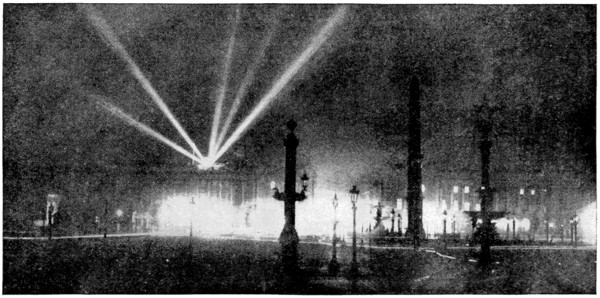
PLACE DE LA CONCORDE, PARIS, UNDER GIANT SEARCHLIGHTS
Paris (Fr. pron. Par-ee´), capital of France, and the largest city in Europe after London, is situated on the river Seine, about one hundred and ten miles from its mouth. It lies in the midst of the fertile plain of the Île-de-France, at a point to which converge the chief tributaries of the river, the Yonne, the Marne, and the Oise; and is the center of a great network of rivers, canals, roads, and railways.
France has long been the most highly centralized country in Europe, and Paris as its heart contains a great population of government functionaries. It is a metropolis of pleasure, and attracts the wealthy from all parts of the world; hence it is a city of capitalists and a great financial center.
The Seine and its Bridges.—The Seine divides the city into two parts, and forms the islands of La Cite and St. Louis, both covered with buildings. This river is navigable by small steamers. The quays or embankments, which extend along its banks on both sides, are built of solid masonry, protect the city from inundation and form excellent promenades. The Seine, within the city, is fully five hundred and thirty feet in width, and is crossed by numerous bridges, the more important being Pont Neuf, Pont de la Concorde, Pont Alexandre III., Pont d’Iena, and the Pont de l’Alma.
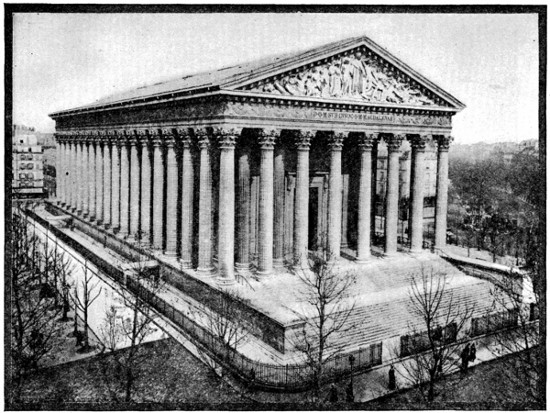
THE MADELEINE, PARIS
This splendid edifice, begun in 1764, is modeled after the Parthenon at Athens. In 1806, Napoleon decreed its completion for a Temple of Glory. Louis XVIII. proposed converting it into an expiatory chapel to Louis XVI. and XVII. and Marie Antoinette. It was completed, 1842, at a cost of nearly $3,000,000.
Environs and Fortifications.—Paris is surrounded by a line of fortifications twenty-five miles long; outside of this is a chain of fortresses, while beyond that again are the detached forts. These form the two main lines of defense. The inner line consists of sixteen forts, the outer line of eighteen forts besides redoubts; the area thus inclosed measuring four hundred and thirty square miles, with an encircling line of seventy-seven miles.
Montmartre, within the fortifications is four hundred feet high; the city is encircled at a distance of from two to five miles by an outer range of heights, including Villejuif, Meudon, St. Cloud, and Mont-Valerien (six hundred and fifty feet), some of which are crowned by the detached forts which now form the main defenses of the city. At the fifty-six gates in the walls of Paris are paid the octroi dues.
Streets and Boulevards.—The houses of Paris are almost all built of white calcareous stone, and their general height is from five to six stories, arranged in separate tenements. Many of the modern street buildings have mansard roofs, and are highly enriched in the renaissance manner. In the older parts of the city the streets are narrow and irregular, but in the newer districts the avenues are straight, wide, and well-paved.
The central point of the city is Place Royal, along which passes the great thoroughfare of the city from southeast to northwest. Beginning at the Place de la Nation, at the southeast margin of the city, this grand avenue, from Place de la Nation to Place de la Bastille, is called Rue du Faubourg St. Antoine; from Place Bastille to near Hotel de Ville it is called Rue St. Antoine; from Hotel de Ville, past the Louvre, to Place de la Concorde, Rue de Rivoli; from Place de la Concorde to the Arc de Triomphe, Avenue des Champs Elysees; and beyond the Arch, Ave. de la Grande Armée.
The Center of Parisian Life.—That which is specifically called The Boulevard extends in an irregular arc on the north side of the Seine, from the Place de la Bastille in the east to the Place de la Madeleine in the west and it includes the Boulevards du Temple, St. Martin, St. Denis, des Italiens, Capuchins, and Madeleine, and its length is nearly three miles. Here may be noted also the triumphal arches of the Porte St. Denis and the Porte St. Martin, the former of which is seventy-two feet in height.
On the south side of the Seine the boulevards are neither so numerous nor so extensive, the best-known being the Boulevard St. Germain, which extends from the Pont Sully to the Pont de la Concorde.
After the boulevards among the best streets are the great new streets formed in the time of Napoleon III. are the Rue de Rivoli, two miles in length, the Rue de la Paix, the Rue du Faubourg St. Honore, the Rue Royale and twelve fine avenues radiating from the Place de l’Etoile.
Squares and Parks.—The most notable public squares or places are the Place de la Concorde, one of the largest and most elegant squares in Europe, adorned by an Egyptian obelisk, fountains, and statues; Place de l’Etoile, in which is situated the Arc de Triomphe, a splendid structure one hundred and fifty-two feet in height; the Place Vendôme with column to Napoleon I.; Place des Victoires, with equestrian statue of Louis XIV.; Place de la Bastille, with the Column of July; Place de la République, with colossal statue of the Republic.
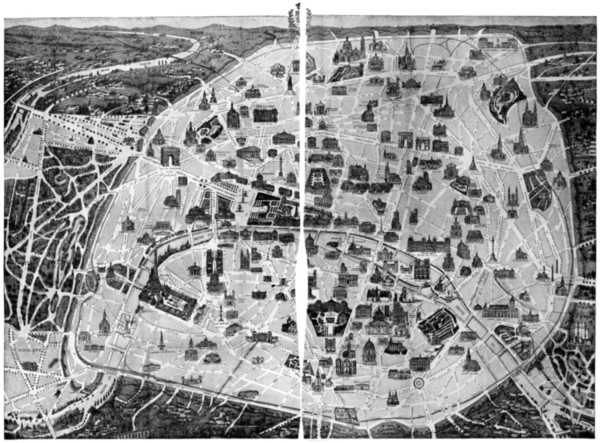
A REMARKABLY INFORMING PANORAMA OF PARIS AND IMMEDIATE SUBURBS, SHOWING THE PLAN OF THE CITY, THE COURSE OF THE RIVER SEINE, CHIEF BOULEVARDS AND STREETS, AS WELL AS THE LOCATION AND ARCHITECTURAL OUTLINES OF THE PRINCIPAL BUILDINGS AND MONUMENTS.
Large map: Left-hand side (779 kB) Right-hand side (775 kB)
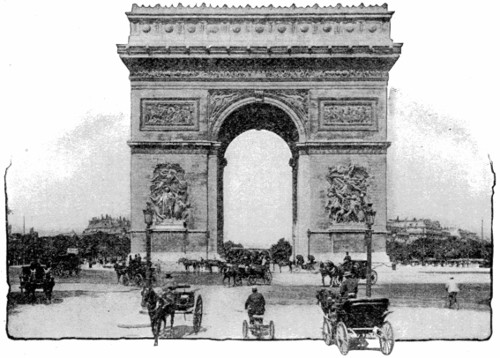
ARC DE TRIOMPHE (ARCH OF TRIUMPH), PARIS
Within the city also are situated the gardens of the Tuileries, which are adorned with numerous statues and fountains; the gardens of the Luxembourg, in which are fine conservatories of rare plants; the Jardin des Plantes, in which are the botanical and zoological gardens, hothouses and museums, which have made this scientific institution famous; the Buttes-Chaumont Gardens, in which an extensive old quarry has been turned to good account in enhancing the beauty of the situation; the Parc Monceaux; and the Champs Elysees, the latter being a favorite promenade of all classes.
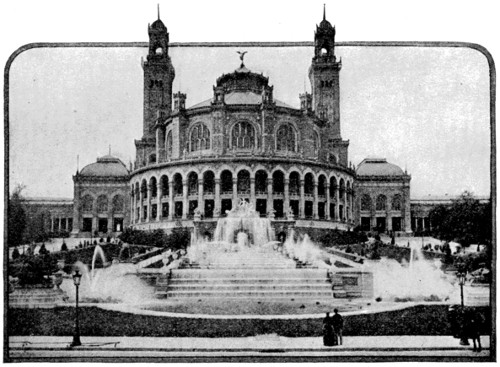
TROCADERO PALACE, PARIS
Built for the Exhibition of 1878, the Trocadero contains a fine collection of architectural and monumental casts. The building affords some of the finest views of Paris.
But the most extensive parks are outside the city. Of these the Bois de Boulogne, on the west, covers an area of two thousand one hundred and fifty acres, gives an extensive view toward St. Cloud and Mont Valérien, comprises the racecourses of Longchamps and Auteuil, and in it are lakes, cascades, ornamental cafes, and the Jardin d’Acclimatation.
The Bois de Vincennes, on the east, even larger, is similarly adorned with artificial lakes and streams, and its high plateau offers a fine view over the surrounding country.
The most celebrated and extensive cemetery in Paris is Père la Chaise (one hundred and six and one-half acres), finely situated and containing the tombs of many celebrities. The Catacombs are ancient quarries which extend under a portion of the southern part of the city, and in them are deposited the bones removed from old cemeteries now built over.
Cathedrals and Churches.—Of the churches of Paris the most celebrated is the Cathedral of Notre Dame, situated on one of the islands of the Seine, called the Île de la Cité. It is a vast cruciform structure, with a lofty west front flanked by two square towers, the walls sustained by many flying-buttresses, and the eastern end octagonal.
The church of La Madeleine, a modern structure in the style of a great Roman temple, with a peristyle of lofty Corinthian columns, stands on an elevated basement fronting the north end of the Rue Royale. It is considered by many to be the most beautiful edifice in Paris.
The Pantheon, or church of St. Geneviève, patron saint of Paris (1764) was begun as a church, but converted by the Constituent Assembly into a temple dedicated to the great men of the nation. Napoleon III. restored it to the church and rededicated it to St. Geneviève, but once more, on the occasion of the funeral of Victor Hugo (1885), it was reconverted into a valhalla. There are the tombs also of Voltaire, Rousseau, Marat and Victor Hugo.
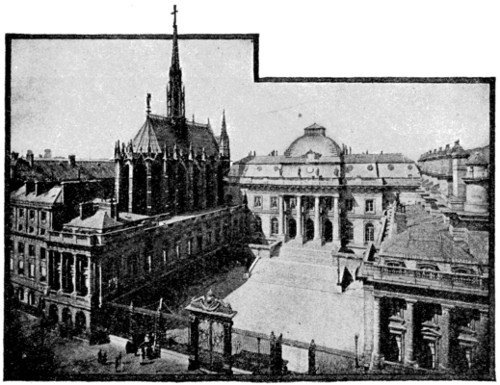
PALACE OF JUSTICE, PARIS
The Sainte Chapelle, in the south court of the Palais of Justice is the most beautiful example of Gothic in Paris.
St. Eustache (1532-1637) is an interesting example of French Renaissance architecture; and others worthy of note are: St. Germain l’Auxerrois; St. Gervais; St. Roch; St. Sulpice; Notre Dame de Lorette; and St. Vincent de Paul. On the very summit of Montmartre is the Church of the Sacred Heart, a vast new structure in the Byzantine style which cost over five million dollars. The chief French Protestant churches are the Oratoire and Rédemption. There are several English, Scotch, and American churches, a Russian Greek church, and several synagogues.
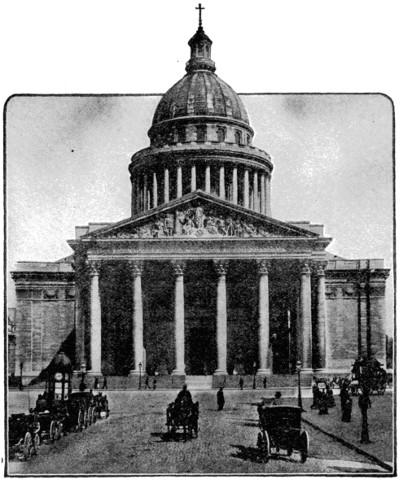
THE PANTHEON, PARIS
It occupies a most commanding position near the Luxembourg Palace, and is one of the finest architectural structures of the city.
Palaces and Public Buildings.—Notable among the public buildings of Paris are its palaces.
The Louvre, a great series of buildings within which are two large courts, is now devoted to a museum which comprises splendid collections of sculpture, paintings, engravings, bronzes, pottery, Egyptian and Assyrian antiquities. The Venus de Milo, the Fettered Slaves of Michael Angelo, the Mona Lisa of Leonardo da Vinci, and a noble group of the works of Raphael, Titian, and Veronese are the chief treasures. In one gallery there are twenty-one large pictures by Rubens. The Salon Carré contains the most striking works of art.
The palace of the Tuileries was set on fire in 1871 by the Communists. The ruins have been removed, but a few of the architectural details have been preserved.
The Palace of the Luxembourg, south of the Seine, since 1879 the meeting-place of the French senate, was built by Marie de Médicis in the Florentine style. Close to it a gallery has been constructed for the reception of the works of living artists acquired by the state.
The Palais de l’Élysée, situated in the Rue St. Honoré, with a large garden, is now the residence of the president of the republic. The Chambre des Députés—known under the Empire as the Palais du Corps Législatif—is the building in which the deputies meet.
The Hôtel de Ville, or municipal building, is situated in the Place de l’Hôtel de Ville, formerly Place de Grève, on the right bank of the river. It was destroyed by the communists in 1871, but has now been re-erected on the same site with even greater magnificence. It is a very rich example of Renaissance architecture.
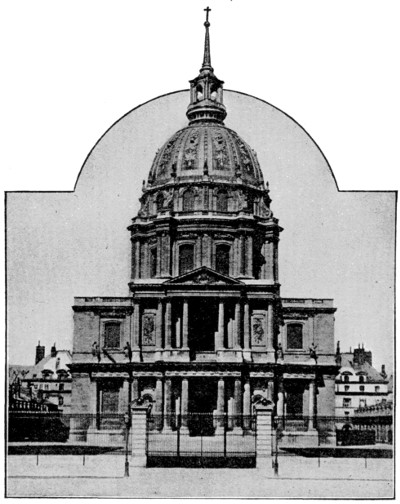
HOTEL DES INVALIDES, PARIS
Prepared as a tomb for Napoleon by Louis Philippe.
The Hôtel des Invalides, built in 1670, is now used as a retreat for disabled soldiers, and is capable of accommodating five thousand. The church attached has a lofty and finely-proportioned dome. It contains the burial-place of the first Napoleon.
The Palais de Justice is an irregular mass of buildings occupying the greater part of the western extremity of the Île de la Cité. Opposite the Palais de Justice is the Tribunal de Commerce, a quadrangular building inclosing a large court roofed with glass. The mint (Hôtel des Monnaies) fronts the Quai Conti, on the south side of the Seine, and contains an immense collection of coins and medals.
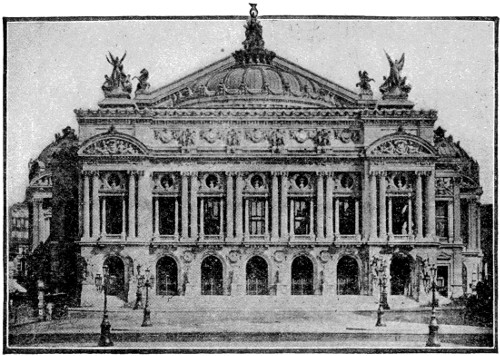
GRAND OPERA HOUSE, PARIS
This is the finest building of its class in the world.
Theaters and Places of Amusement.—Paris has numerous theaters. The leading houses are the Opéra, the Théâtre Français—chiefly devoted to classical French drama—the Opéra Comique and the Odéon, which receive a subvention from government. The new opera house, completed in 1875, cost, exclusive of the site, five million, six hundred thousand dollars.
Montmartre is the center of the bohemian life of Paris, and contains many cafés and places of amusement. It has upwards of forty theaters.
Latin Quarter and Its Institutions.—The chief institutions connected with the University of France, and with education generally, are still situated in the Quatier Latin.
The Sorbonne, the seat of the Paris faculties of letters, science, and Protestant theology, has been rebuilt and increased in size. The Sorbonne contains lecture-halls and class-rooms, and an extensive library open to the public. There gratuitous lectures are given and degrees are granted by the University of France.
Near the Sorbonne is the Collège de France, where gratuitous lectures are also delivered by eminent scholars and men of letters, as well as a large number of colleges and lycées, the great public schools of France for secondary instruction.
The Ecole Polytechnique, the School of Medicine and the School of Law, the Observatory, and the Jardin des Plantes, with its great museums of natural history, are situated in the same quarter of Paris.
The principal public library is Bibliothèque Nationale, which originated in a small collection of the books placed by Louis XI. in the Louvre.
Industries of Paris.—Paris cannot be described as a manufacturing town. Its chief and peculiar industries produce articles which derive their value not from the cost of the material, but from the skill and taste bestowed on them by individual workmen. They include jewelry, bronzes, artistic furniture, and decorative articles known as articles de Paris. In consequence of the intelligence and taste required in their trades the Paris workmen are in many respects superior to the machine hands of manufacturing cities.
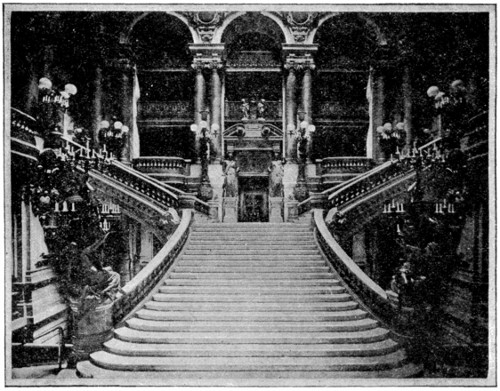
STAIRWAY OF HONOR, GRAND OPERA HOUSE
Versailles (vér-sālz´ Fr. pron. ver-säy´), is situated eleven miles west-southwest of Paris. It contains a famous royal palace, a great part of which is now occupied by the Museum of French History, consisting of paintings; but some of the apartments are still preserved with the fittings of a royal residence. The chapel is well proportioned and sumptuous. The great gallery, called the Galerie des Glaces, is one of the finest rooms existing; it is two hundred and forty by thirty-five feet, and forty-two feet high, adorned with mirrors and gilding, and with ceiling-paintings by Lebrun representing the triumphs of Louis XIV.
Here King William of Prussia was proclaimed German emperor in 1871. The council-chamber, the bedroom of Louis XIV., the antechamber of the Mil de Boeuf, the Petits Apartements of the queen, and the theater are all historic and highly interesting.
The gardens are the finest of their kind. They abound with monumental fountains profusely adorned with groups of sculpture, and supplied the model for those of half the palaces of Europe.
St. Denis (saṅ-dė-nē´), two and one-half miles north of the fortifications of Paris, is chiefly notable for its abbey church, the historic burial-place of the kings of France. Dagobert built the church, which was the nucleus of one begun by Pepin, finished by Charlemagne in 775, and demolished and a larger one built on its ruins four hundred years later. During the Revolution the church was pillaged. It was restored by Viollet-le-Duc. Here Charlemagne was anointed; the Oriflamme was kept; Abélard dwelt; Joan of Arc hung up her arms; Henri IV. abjured Protestantism; and Napoleon I. was married to Marie Louise. The bones of the kings of France from Dagobert (630) to Louis XV. (1774) were buried here; and the mad Revolutionists tore them from their tombs, and buried them in a common ditch. They are now in the crypt, and superb royal monuments adorn the church, whose interior is lighted by splendid stained windows, and enriched with mosaics and statuary.
Among the monuments of greatest interest are those of Frédégonde, Dagobert, Pepin, Charlemagne, Clovis II., Charles Martel, Henry II., Catherine de Médicis, Francis I., Louis XVI., Marie Antoinette, Henry IV., Louis XII., and Louis XIV.
Of the 167 sepulchral monuments, 53 are new or were brought from other churches. In 1817, Louis XVIII. caused the remains of Louis XVI. to be removed from the Madeline cemetery to St. Denis.
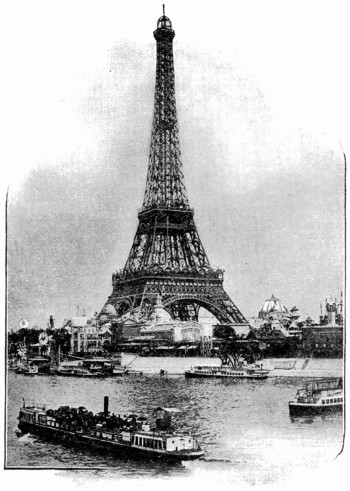
THE EIFFEL TOWER
Contains three stories, reached by a series of elevators. The platform at the summit is nine hundred and eighty-five feet above the ground. It cost about one million dollars.
Fontainebleau (Fong´tehn-blȯ´), near the Seine’s left bank, thirty-seven miles southwest of Paris, is chiefly famous for its royal château, and the beautiful forest that surrounds it. The château, said to have been founded by Robert the Good toward the end of the tenth century, was rebuilt in 1169 by Louis VII., and enlarged by Louis XI. and his successors. After being allowed to fall into decay, it was repaired and embellished by Francis I., Henry IV., Napoleon I., and Louis-Philippe.
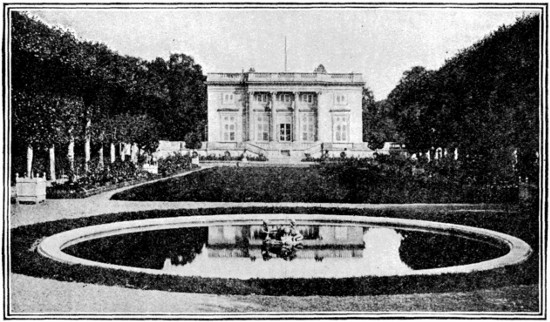
PETIT TRIANON, VERSAILLES
This beautiful little palace was the favorite residence of the unfortunate Marie Antoinette, after Louis XVI. came to the throne of France. It is now a museum of the personal relics of this beautiful and ill-fated Queen.
Barbizon (Bar-bee-song´), is close to the Forest of Fontainebleau. It is a great artists’ resort, and was the home and death-place of Millet. Corot, Diaz, Daubigny, and Rousseau were other members of the “Barbizon School” of painters.
Chief Industrial Centers.—Textile manufactures are the most important of the mechanical industries of France.
Lyons, the third city of France, at the junction of the Saône with the Rhone, is the center of the silk-growing region and the metropolis of the silk manufactures, in which the country stands unrivalled. St. Etienne (146,000), southwest of Lyons, comes second to it in this manufacture, after which come Nimes, near the delta of the Rhone, Tours, on the Loire, and Paris. Inland trade and manufactures in the south are most active at ancient Toulouse, on the Garonne, and at Montpellier, near the Rhone delta.
Woolen, linen, and cotton manufactures are almost entirely confined to the northern region. Foremost among these manufacturing towns of the north stands Lille, with its neighbor towns of Roubaix and Tourcoing, still nearer the Belgian manufacturing region; and Cambrai, Douai, Valenciennes, and St. Quentin, southeast of it. Rouen, on the Seine in Normandy, and Amiens, on the Sommer, between Rouen and Lille, Reims, in the Champagne district, Sedan, on the Ardennes and Nancy, in French Lorraine, still farther east, are the other chief manufacturing towns of the northern region.
At Sèvres, southwest of Paris, are the chief porcelain factories, which give the models and take the lead in this industry. Limoges is also a noted center of porcelain manufacture.
Glass is very extensively made in the northern departments. Paris itself excels in every kind of luxurious and fanciful manufacture. Besançon, the largest town near the frontier of Switzerland, is a great depot for the produce of the French half of that country, and manufactures watches largely.
The mining industries of France are comparatively limited. Coal is drawn chiefly from the basin of Valenciennes, which continues the Belgian coalfield on the north, from the basin of the Loire and Rhone, and from that of Creuzot, on the south of the heights of the Côte d’or. Iron occurs in eleven districts and is of excellent quality, but generally lies distant from the fuel necessary to smelt it, so that this metal must also be imported in large quantity. St. Etienne, southwest of Lyons, is the most noted center of the French hardware manufactures, especially of guns and machinery; Le Creuzot, in the midst of its coal basin, has also noted ironworks.
The trade of France is only inferior to that of Britain, Germany, and the United States; the position of the country, with coasts on three of the most frequented seas, is exceedingly favorable to its commerce. The great seats of maritime traffic with all the world are Marseilles, on the Mediterranean coast; Bordeaux and Nantes, with St. Nazaire, on the coast of the Bay of Biscay; Le Havre (at the mouth of the Seine), Boulogne, Calais, and Dunkerque, on the English Channel. All of these may in a sense be called the harbors of the central point of the life of the state, luxurious Paris.
Naval and Military Centers.—The naval arsenals of France, dockyards, and stations of the fleet, are at Cherbourg and Brest, on the northwest coast; L’Orient and Rochefort (south of La Rochelle) on the Bay of Biscay; and Toulon, on the Mediterranean. Nice and Cannes, on the Riviera, are favorite winter resorts.
France has more than one hundred fortified places; indeed almost every town along the northern and northeastern border is a fortress. Briançon, the highest town in the country, in the Alps, south of the pass of Mont Cenis into Italy, is the chief arsenal and depot of this mountain barrier, and is considered impregnable.
HISTORY
The name France first appears in history about the ninth century. Prior to that time the country which constitutes the greater part of modern France was occupied successively by Celts, Gauls and Franks.
Under the Romans.—When first known this country was called Gallia, and was the center whence swarms of plunderers poured over the mountains into Italy; but the Phœnicians and Greeks had a few trading cities on the Mediterranean coast—especially Marseilles—where in the seaport towns traces of descent from the Greeks are said still to be found.
In 125 B. C. the Romans formed in the east of the Rhone a settlement ever since called Provincia or “the Province,” whose capital was Aquae Sextiae (now Aix), and where corrupted Latin has never ceased to be the dialect, and their power and influence gradually spread. Between 58 and 51 B. C. Julius Caesar subdued the whole of Gaul, except the granite peninsula of the northwest. Later, refugees from Britain caused it to be called Brittany; and there to the present day the Celtic tongue has prevailed, and the habits have been peculiar. The Iberian or Basque tribes of the Pyrenees have likewise preserved their entirely different tongue, which is not even Aryan.
The Impress of Roman Rule.—Roman habits, civilization and speech were adopted all over the country, and Christianity became nearly universal. Many cities were founded as centers of government from the conquered population, and most of the great cities such as Arles and Lyons and many others date from this time. Nimes and Vienne show splendid monuments of Roman architecture. The Romans also made magnificent roads, and are said to have introduced the olive and the vine, to both of which the climate is eminently suitable.