BOOK OF THE SCIENCES AND INVENTION
Reading edition
HISTORICAL DEVELOPMENT OF THE SCIENCES
OUTLINES OF SCIENCE FOR SCHOOLS
PRACTICAL MATHEMATICS FOR DAILY USE: Business and Industrial Arithmetic, Everyday Applications of Percentage, Weights and Measures, Mensuration and its Applications
COMMERCIAL AND INDUSTRIAL LAW
PHYSICS: ITS PRINCIPLES AND APPLICATIONS
CHEMISTRY: ITS THEORY AND USES
THE CHEMISTRY OF COMMON THINGS
REVISED TABLE OF CHEMICAL ELEMENTS
GREAT INVENTIONS AND SCIENTIFIC DISCOVERIES
RELATION OF THE GOVERNMENT TO SCIENCE
BOOK OF SCIENCE AND INVENTION
Science in its widest significance is sometimes defined as the correlation of all knowledge. In this sense it would include philosophy. In a more restricted and generally accepted sense, the term is applied to the systematized divisions of knowledge.
Science and philosophy resemble each other in so far as they both have to do with knowledge; but while the latter deals with the whole sum of knowledge and goes back to generalized first principles, the former takes up special branches of it. That is, a science is such in fact when a sufficient number of interrelated facts are so arranged and classified by referring them to the general truths and principles on which they are founded that they constitute a well-certified and more or less complete branch of knowledge.
From the present development of knowledge the separate entities of the universe are five—namely, ether, matter, energy, life, and mind. The first three are inseparable agents in the simplest phenomena that occur in nature. They may ultimately be reduced to two, or, conceivably, to one. It is with these that the various branches of science have to deal—to observe, to experiment, to classify, to define.
Classification of the Sciences.—The sciences may be grouped in two ways. First, from what has been said above, they may be divided into:
(a) the physical sciences, which have to do with inorganic nature—that is with the laws and properties of matter, energy, and ether;
(b) the biological sciences, which consider the laws of life; and
(c) the psychical sciences, which deal with the phenomena of mind.
Second.—Another, and probably more practical, division is that of (a) pure or theoretic sciences, and (b) applied or practical sciences. The latter consist of those branches which deal with facts, events, or phenomena as explained, accounted for, or produced by means of powers, causes, or laws; the former as the knowledge of these powers, causes, or laws, considered apart or as pure from all applications. To the class of pure or fundamental sciences belong mathematics, physics, chemistry, psychology, and sociology; to the applied or concrete belong geology, mineralogy, botany, zoology, meteorology, geography, ethics, politics, law, jurisprudence, logic, grammar, rhetoric, philology, and political economy; navigation, engineering, and practical mechanics; surgery, medicine, materia medica, etc.
Methods of Science.—The great method of scientific inquiry is experiment—the laboratory. Contrasted with experiment is observation. But even in astronomy, emphatically an observational science, experiment plays an important part. The dynamical knowledge which Newton developed into the cosmic law of gravitation was founded on experiment. Meteorology, again, has made great strides in these days by appealing to laboratory experiments for elucidation of its phenomena. Likewise in biology, botany, and zoology experiment has led to striking discoveries; while such branches as embryology and bacteriology are as truly experimental as chemistry itself.
In the psychical group of sciences the method of experimenting still awaits development. The complexity of the problems presented, and the manner in which they affect the welfare and happiness of humanity, render social and political experimenting excessively hazardous. Such sciences as those studied by the economist, the ethnologist, the moralist, or the theologian are of necessity essentially observational.
APPLIED ARITHMETIC, WEIGHTS AND MEASUREMENTS
It would be difficult to overestimate the extent to which mathematics enters into the conditions of everyday life. In its elementary stages, as the science of number, it teaches us the relations of magnitude, and enables us to build up a system of calculation and measurement which, applied to the relations observed to exist in nature, gives results of far-reaching importance.
The properties of number are investigated in arithmetic, and methods examined by which those engaged in practical science are able to work out their results to any degree of approximation.
With the help of algebra, we arrive at a system of logarithms by which many of these results may be reached with the minimum of labor.
The measurement of lines and angles, by methods investigated in geometry and trigonometry, enables us to calculate areas, and work out various problems met with in surveying, and is of the first importance in astronomy.
Arithmetic, which deals with the properties of numbers, forms the basis of all mathematical calculation. (For the primary treatment of numbers, see under The Child World.)
COMMON FRACTIONS
A Fraction is one or more of the equal parts into which a unit has been divided. A Common Fraction is expressed by two numbers; the one written above the line is called the Numerator, the one below, the Denominator: both, called the Terms, denote the value of the fraction.
Thus, in the fraction 3⁄4, the denominator 4, denotes that a unit or whole thing has been divided into four equal parts; and the numerator 3, shows that three of those parts are taken or expressed in the fraction.
A Proper Fraction is one whose numerator is less than its denominator; as 1⁄2, 3⁄4, 7⁄8, etc. Its value is always less than 1.
An Improper Fraction is one whose numerator is equal to, or greater than its denominator, as 5⁄5, 9⁄7, 30⁄12, etc. Its value is never less than 1.
A Mixed Number is a whole number and a fraction; as 32⁄5, 101⁄2, 62⁄3.
The mixed number means that there are whole things taken together with a fraction of another.
A Complex Fraction is one in which the numerator or denominator, or both, are fractions.
Thus 31⁄723⁄8, 15⁄6 × 3⁄4, 15⁄178, are complex fractions.
SIMPLE FRACTIONS
A very good method of learning the combinations in small fractions is by the use of paper or cardboard disks.
Cut out a large number of them, and, in order to avoid trouble later on, it might be better to have the disks all of one size—about 4 inches in diameter.
Learning the Fraction 1⁄2 With Disks
Explanation:—Take a circular disk and cut it into two equal parts. Then proceed in this manner: What is this part called? What is other part called? How many halves in the whole circle? One-half and one-half are what? One-half taken away from one leaves what? If I take a half two times, what do I get? How many halves in a whole?
Now I will write these—
12 + 12 =
1 ÷ 2 =
1 less 12 =
1 - 12 =
2 × 12 =
1 divided by 12 =
Give me the answers and I will write them.
Drawings showing the “placing” of disks for number combinations can then be made; as,
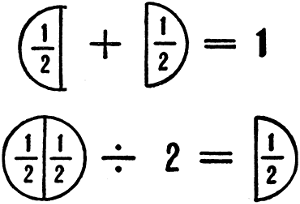
Make similar drawings to tell about halves.
Proceed like this—How many halves in a pie? If a pie cost 10 cents, what will half a pie cost? Who can tell other stories about halves? etc.
Learn fourths along with halves.
Learning the Fraction 1⁄3 and Others with Disks
Cut several disks into thirds and have children practice on cutting, so that they will be able to make the three parts of each disk equal. Frequently children will find pleasure in “teaching” one another.
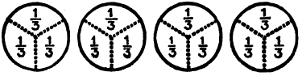
Then proceed like this: What do you call each of these parts? Why are they called thirds? How many thirds in a circle? I am going to take a circle and cut it any way, so as to make three parts; do I call these unequal parts thirds? Why not? Let me write one-third on a piece of paper for you. (Write, 1⁄3.) Draw a circle for me. Instead of cutting it, draw lines where you would cut it to make thirds. Write one-third (1⁄3) on each third of a circle. I write this (1⁄3 + 1⁄3). Who can tell me what the answer is? Are two-thirds and two-thirds more than one? How much more? I have two-thirds of an apple and give Mary one-third, how much have I left? Who can give other story problems about thirds? Everybody try, etc.
Learn sixths along with thirds. Use disks, dots, marks, sticks, and inches to illustrate.
Remember that no advance should be made until each little part is understood. Then have fifths compared with fourths, thirds, and halves.
Teach tenths along with fifths.
When twelfths are taught, show the relations between twelfths and sixths, fourths, thirds, and halves.
Equal Fractions in Different Forms
Have the children see how fractions may differ in form but still remain the same in value.
Begin with his knowledge of smaller fractions as
12, 24, 36, 48, and 510 of an apple.
Let them show by the use of drawings that fractions may have large or small terms but be equal in value.
Write a number of proper fractions, improper fractions, and mixed numbers, and have the children pick out those of each kind; as,
38, 271⁄2, 511, 1920, 2020, 1816, 115, 31⁄2, 162⁄3
Principles of Fractions
1. A fraction’s value is the quotient obtained by dividing the numerator by the denominator.
62 = 3 3 is the value of 62
23 = 23 23 is the value of 23
2. Multiplying the denominator of a fraction divides the fraction by that number.
12 × 4 = 18 37 × 3 = 321 23 × 9 = 227
3. Dividing the denominator of a fraction multiplies the fraction by that number.
38 ÷ 4 = 32 109 ÷ 3 = 103 310 ÷ 5 = 32
4. Multiplying the numerator of a fraction multiplies the fraction by that number.
23 × 2 = 43 19 × 8 = 89 58 × 3 = 158
5. Dividing the numerator of a fraction divides the fraction by that number.
47 ÷ 2 = 27 1216 ÷ 12 = 116 37 ÷ 3 = 17
6. Multiplying both numerator and denominator of a fraction by the same number does not change the value of the fraction.
13 × 3 × 3 = 39 = 13 67 × 2 × 2 = 1214 = 67
7. Dividing both numerator and denominator of a fraction by the same number does not change the value of the fraction.
1215 ÷ 3 ÷ 3 = 45 = 1215 1827 ÷ 9 ÷ 9 = 23 = 1827
Reduction of Fractions
is the process of changing their forms without altering their values.
To reduce a fraction to its lowest terms:
Rule.—Divide both terms by their greatest common divisor.
Reduce 8⁄12 to its lowest terms.
Work:4 ) 8⁄12 ( 2⁄3Ans. 2⁄3
Four is the G. C. D. of 8 and 12; hence 8⁄12 ÷ 4 = 2⁄3.
Reduce 35⁄56 to its lowest terms.
Work:7 ) 35⁄56 ( 5⁄8Ans. 5⁄8
Seven is the G. C. D. of 35 and 56; hence 35⁄56 ÷ 7 = 5⁄8.
A fraction whose terms have no common divisor is in its lowest terms, as 9⁄16.
To reduce an improper fraction to a whole or mixed number:
Rule.—Divide the numerator by the denominator; the quotient will be the whole or mixed number.
How many units in 30⁄6?
Work:30 ÷ 6 = 5Ans. 5.
There are as many units in 30 sixths as 6 is contained times in 30.
Reduce 75⁄4 to a mixed number.
Work:75÷ 4 = 18 + 3Ans. 183⁄4.
In 75 fourths there are 18 units, and 3 fourths over, which equals 183⁄4.
To reduce a mixed number to an improper fraction:
Rule.—Multiply the whole number by the denominator of the fraction; add the numerator to the product, and write the sum over the denominator.
Reduce 183⁄4 to an improper fraction.
Work: 18 × 4 = 7272⁄4 + 3⁄4 = 75⁄4Ans. 75⁄4.
In 18 are 72 fourths, plus the 3 fourths, equals 75 fourths.
To reduce two or more fractions to their least common denominator:
Rule.—Find the least common multiple of the given denominators for a common denominator. Then for each new numerator take such a part of this common denominator as the fraction is part of 1.
Reduce 1⁄2, 2⁄3 and 3⁄4 to their L. C. D.
Work: 12 = 612 23 = 812 34 = 912
Ans. 6⁄12, 8⁄12 and 9⁄12.
The L. C. M. of the denominators 2, 3 and 4 is 12. Hence, 12 is the L. C. D. to which the given fractions can be reduced. Then to change 1⁄2 to 12ths, say, 1⁄2 of 12 is 6, and write it over 12; to change 2⁄3 to 12ths, say 2⁄3 of 12 is 8, and write it over 12; to change 3⁄4 to 12ths, say, 3⁄4 of 12 is 9, and write it over 12.
Fractions must be reduced to a common denominator to be added or subtracted.
Addition of Fractions
If two or more fractions have the same denominator, their sum is obtained by adding the numerators.
Work: 17 + 47 + 57 = 1 + 4 + 57 = 107 = 137
If the fractions have different denominators, we must first express them as equivalent fractions with the same denominator.
Example 1: Find the value of 19 + 37 + 521 + 23
The lowest common multiple is 63. The several denominators, when divided into 63, give 7, 9, 3, 21 respectively, for quotients. Therefore, we multiply the numerators and denominators of the fractions by 7, 9, 3, 21, and add the numerators to obtain the required sum. The result must be reduced to a mixed number or to lower terms, if necessary.
Work: 19 + 37 + 521 + 23 = 7 + 27 + 15 + 4263 = 91⁄63 = 128⁄63 = 14⁄9 Ans.
In adding mixed numbers, first add the whole numbers, then the fractions, finally adding the two results.
Example 2: Add together 31⁄8 + 7⁄24 + 711⁄15 + 43⁄20. Given expression:
= 3 + 7 + 4 + 18 + 724 + 1115 + 320
= 14 + 15 + 35 + 88 + 18120
= 14 + 156120 = 14 + 136120 = 15310 Ans.
Subtraction of Fractions
The principle is the same as in addition. Reduce the fractions, if they have different denominators, to a common denominator, and then take the difference of the numerators. In the case of mixed numbers, subtract the whole numbers and the fractions separately.
Example 1: Take 45⁄21 from 63⁄7.
637 - 4521 = 6 - 4 + 37 - 521
637 - 4521 = 2 + 9 - 521
637 - 4521 = 2 + 421 = 2421 Ans.
If the fractional part of the number to be subtracted be greater than the fractional part of the other number, we proceed as follows:
Example 2: From 74⁄15 take 411⁄25.
7415 - 41125 = 7 - 4 + 415 - 1125
7415 - 41125 = 3 + 20 - 3375
7415 - 41125 = 2 + 75 + 20 - 3375
7415 - 41125 = 2 + 6275 = 26275 Ans.
Example 3: Simplify 32⁄9 + 45⁄7 - 513⁄21 + 2⁄35 - 114⁄15. Given expression:
= 3 + 4 - 5 - 1 + 29 + 57 - 1321 + 235 - 1415
= 1 + 70 + 225 - 195 +18 - 294315
= 1 + 313 - 489[15]315
= 628 - 489315 = 139315 Ans.
Multiplication of Fractions
(i) When the multiplier is a whole number. This, as in the case of whole numbers, means that we have to find the sum of a given number of repetitions of the fraction.
Example 1:
79 × 4 means 79 + 79 + 79 + 79, i.e., 289 or 7 × 49
Hence, to multiply a fraction by a whole number, simply multiply the numerator by that number.
Since the multiplier thus becomes a factor of the numerator, we cancel any common factors contained in the multiplier and the denominator; and this may be done before we perform the actual multiplication:
Example 2: Multiply 19⁄46 by 69.
1946 × 69 = 19 × 6946 = 19 × 32 (cancelling 23), = 572 = 2812 Ans.
It follows that if the multiplier be itself a factor of the denominator, we may, to multiply a fraction by a whole number, divide the denominator by that number.
(ii) When the multiplier is a fraction.
Example: In performing the operation 7 × 9, it is plain that we do to 7 what we do to a unit to obtain 9. Similarly, 3⁄5 × 4⁄11 may be looked upon as doing to 3⁄5 what we do to the unit to obtain 4⁄11.
Now, to obtain 4⁄11 from the unit, we must divide the unit into 11 equal parts and take 4 of them.
Therefore, to find the value of 3⁄5 × 4⁄11 we must divide 3⁄5 into 11 equal parts and take 4 of them.
But 3⁄5 = 33⁄55 = 3⁄55 × 11, so that, the eleventh part of 3⁄5 is 3⁄55; and, if we take 4 of these parts, we get 3⁄55 × 4 or 12⁄55.
Thus, 35 × 411 = 1255. Now 12 = 3 × 4, and 55 = 5 × 11.
Hence we have the following rule: To multiply two fractions together, multiply the numerators for a new numerator and the denominators for a new denominator.
As in Example 2 the work is shortened if we cancel common factors from the numerators and denominators.
Example: Multiply 22⁄91 by 13⁄77.
The product = 2 22 × 13 91 7 × 77 7 = 249 Ans.
Here, the 22 of the numerator and the 77 of the denominator contain a common factor, 11. Therefore, we cross out the 22 and write 2 above it, and cross out the 77 and write 7 under it. Similarly, we cancel the factor 13 from 13 and 91. There is now 2 left for numerator and 7 × 7 for denominator.
To multiply more than two fractions together, we proceed in the same way.
In multiplication of fractions, mixed numbers must first be expressed as improper fractions.
Example: Simplify 51⁄7 × 11⁄27 × 111⁄24.
Given expression = 3 36 7 × 11 27 9 × 5 35 24 2 = 55 18 = 3 1 18
Division of Fractions
(i) When the divisor is a whole number. Suppose we have to divide 7⁄9 by 4.
We know 7⁄9 = 28⁄36. This fraction means that the unit is divided into 36 equal parts, and 28 of the parts taken. If we divide the 28 parts by 4, we get 7 of them—i.e. 7⁄36. Hence 7⁄9 ÷ 4 = 7⁄36.
Therefore, to divide a fraction by a whole number, we multiply the denominator by that number.
In the same way as already explained for multiplication, we cancel any common factors contained in the divisor and the numerator. Hence, if the numerator be exactly divisible by the divisor, we may divide a fraction by a whole number by dividing the numerator by that number.
Example 1:
2731 ÷ 18 = 3 27 31 × 18 2 = 3 62 Ans.
Example 2:
3641 ÷ 9 = 441 Ans.
(ii) When the divisor is a fraction.
In the operation 24 ÷ 3, we have to find the number which, when multiplied by 3, will give 24. Similarly, to find the value of 3⁄7 ÷ 5⁄9 we have to find the fraction which, when multiplied by 5⁄9, will give 3⁄7.
But 3 × 97 × 5 is the fraction which gives 3⁄7 when multiplied by 5⁄9. Therefore, 37 ÷ 59 = 3 × 97 × 5.
Hence, to divide by a fraction, invert the divisor and multiply.
As in multiplication, mixed numbers must first be reduced to improper fractions.
Example 3: Divide 31⁄14 by 55⁄42.
3114 ÷ 5542 = 4314 ÷ 21542 = 4314 × 3 42 215 5 = 35 Ans.
DECIMAL FRACTIONS
Differ in form from common fractions, in not having a written denominator; and from whole numbers, by having the decimal point (.) prefixed; which also separates the integral part from the decimal. The word decimal is derived from the Latin word decem, which signifies ten. The denominator of a decimal is always 10, or some power of 10, as 100, 1000, etc.
A Complex Decimal is a decimal with a common fraction at the right, as, .121⁄2.
A Mixed Decimal is a whole number with a decimal fraction to its right, as, 34.5.
The denominations of United States money are based on the decimal system—the dollar occupying the unit’s place, the dime the tenth’s place, the cent the hundredth’s place, and the mill the thousandth’s place.
The rules given for addition, subtraction, and so on, also apply to decimals.
Addition in Decimals
Example: 27.295 + .0287 + 591.68 + 9.1846.
27 .295
.0287
591 .68
9 .1846
628 .1883 Ans.
Write the numbers so that the same powers of 10 come under one another, or, what is the same thing, write the numbers so that the decimal points come under one another. Then, adding the ten-thousandths first, 6, 13, carry 1, etc.
Subtraction in Decimals
Example: Subtract .07295 from 21.651.
21 .651
.07295
21 .57805 Ans.
Write the first number under the second, so that the point comes under the point. Remember that we may consider there are 0’s above the 9 and 5, since in 21.651 there are no ten-thousandths and no hundred-thousandths.
Say, mentally 5 and 5 make 10, carry 1.
Say, mentally 10 and 0 make 10, carry 1.
Say, mentally 3 and 8 make 11, carry 1, etc.
Multiplication in Decimals
Rule.—Multiply as in whole numbers, and point off from the right of the product as many places as there are decimal places in both multiplier and multiplicand—prefixing ciphers if necessary.
Example 1: Multiply 87.432 by 564.
87 .432
564
43716 .0
5245 .92
349 .728
49311 .648 Ans.
Place the multiplier so that its unit’s digit comes under the right-hand digit of the multiplicand. Then place the first figure of each product underneath the multiplying digit. The decimal point of the answer will then be directly under the decimal point of the multiplicand.
Example 2: Multiply 31.56 by 5.49.
31.56
5 .49
157.80
12.62 4
2.84 04
173.26 44 Ans.
As before, place the unit’s figure of the multiplier—that is, the 5—under the right-hand digit of 31.56, and proceed as above.
Note.—The number of decimal places in the product will always be equal to the sum of the number of decimal places in the multiplier and the multiplicand. Thus, in Example 2, there are two places of decimals (i.e. two figures to the right of the point) in 31.56, and two places of decimals in 5.49; and we found 2 + 2 = 4 places in the product 173.2644.
To multiply a decimal by 10, 100, etc.
Rule.—Remove the (.) as many places to the right as there are ciphers in the multiplier.
Work: 8.75 × 10 = 87. 5
8.75 × 100 = 875.
8.75 × 1000 = 8750.
Division of Decimals
Rule.—Divide as in whole numbers, annexing ciphers to the dividend, if necessary; then point off from the right of the quotient as many places as the decimal places in the dividend exceed those in the divisor—prefixing ciphers if necessary.
(a) Division of a decimal by a whole number.
Example 1: Divide 18.2754 by 4.
4 ) 18.2758
4.5688 5
We divide 4 into 18 (units) and have 4 (units) quotient and 3 units remainder. Since the 4 is the unit’s figure of the quotient, we write the decimal point immediately after it. Then, the 2 units remainder and the 2 tenths of the dividend make 22 tenths to be divided by 4, and so on. Having reached the 4 (ten-thousandths) of the dividend, we find 8 (ten-thousandths) quotient and 2 remainder. This remainder is 20 hundred-thousandths, which when divided by 4 gives 5 (hundred-thousandths) and no further remainder.
Example 2: Divide 18.2758 by 11.
11 ) 18.2758
1.6614 3636
Here we find the digits 3, 6 repeated indefinitely in the quotient. Decimals of this sort will be fully considered later.
Example 3: Divide 354.43 by 184.
184 ) 3 5 4. 4 3 ( 1.92625 Ans.
1 7 0 4
4 8 3
1 1 5 0 [16]
4 6 0
9 2 0
Here we find the first figure of the quotient is obtained by dividing 184 into 354 units. Having now reached the decimal point in the dividend we also put the decimal point in the answer, and go on as before.
(b) Division of a decimal.
Example 4: Divide 10.6603 by 7.85.
Thus:
785 ) 1 0 6 6. 0 3 ( 1.358 Ans.
2 8 1 0
4 5 5 3
6 2 8 0
Here 7.85 is 785 hundredths, and 10.6603 is 1066.03 hundredths; so that the required quotient is obtained by dividing 1066.03 by 785.
Therefore, to divide by a decimal, move the point as many places to the right as will make the divisor a whole number; move the point in the dividend the same number of places to the right. Then proceed as in Example 3.
Example 5: Divide 176.4 by .00012.
12 ) 17640000
Ans. 1470000
Here, to make the divisor a whole number, we have to move the point 5 places. Therefore we also move the point 5 places to the right in the dividend, first writing enough 0’s after the 176.4 to enable us to do so.
To divide a decimal by 10, 100, etc.
Rule.—Remove the (.) as many places to the left as there are ciphers in the divisor.
Work:
62.5 ÷ 10 = 6 .25
62.5 ÷ 100 = .625
62.5 ÷ 1000 = .0625
Expression of decimal fractions as common fractions.
Example: Express 5.375 as a common fraction.
Example: .375 = 375 thousandths.
Therefore 5.375 = 53751000 = 538 Ans.
Rule.—Take the digits of the decimal for numerator; for the denominator put down 1 followed by as many ciphers as there are digits in the decimal. Reduce this fraction to its lowest terms.
Expression of common fractions as decimals.
We have seen that a common fraction represents the quotient of the numerator divided by the denominator. Therefore, to convert a common fraction to a decimal fraction, we divide the numerator by the denominator.
Example: Express 332 as a decimal.
4 ) 3 .0
8 ) .75
.09375 Ans.
It will be found in many cases that there is always a remainder, so that the quotient can be continued indefinitely.
Circulating Decimals
The learner has already discovered that some common fractions cannot be changed to exact decimal fractions, as—
1⁄3 =.33333 on to infinity. 2⁄3 =.66666 on to infinity. 7⁄33 =.212121, etc.
These decimals are known as Circulates, Recurring or Circulating decimals.
The part which recurs is called the Repetend.
This is marked by putting a dot over the first and last figures of it. For instance, if we write the 21 in the last case above, this way: 2̊1̊, it indicates that, if written out, the result would be 21212121, etc., on to infinity.
Where a circulating decimal occurs in work, it is best to reduce it to a common fraction. If need be, it may be expressed in the result as a circulate to any number of decimal places.
To change a pure circulate to a common fraction.
Rule.—Omit the (.) and write the figures of the repetend for the numerator, and as many 9’s for the denominator as there are places in the repetend.
Examples: Change the pure circulates .3̊, .2̊7̊, .1̊42857̊, to common fractions.
.3̊, (39 = 13) Ans. 1⁄3.
.2̊7̊, (2799 = 311) Ans. 3⁄11.
.1̊42857̊, (142857999999 = 17) Ans. 1⁄7.
To change a mixed circulate to a common fraction.
Rule.—From the whole decimal subtract the finite part, and make the remainder the numerator. For the denominator, write as many 9’s as there are figures in the repetend, and annex as many 0’s as there are finite places.
Example: Change the mixed circulates .16̊ and .416̊ to common fractions.
16 - 1 = 15, 1590 = 16. Ans. 1⁄6.
416 - 41 = 375, 375900 = 512. Ans. 5⁄12.
To add, subtract, multiply and divide circulates, reduce them to common fractions, then apply the respective rules.
Short Methods in Merchandising
When one of the numbers is an aliquot part of 100, the process of multiplication and division can often be very much shortened, as shown below.
Find cost of 27 yards of goods at 162⁄3c ($1⁄6) per yard. At $1 per yard, 27 yards cost $27; at $1⁄6, (27 ÷ 6), $41⁄2. Ans. $41⁄2.
Find cost of a bale of cotton, 528 pounds at 81⁄3c ($1⁄12) per pound. At $1 per pound, 528 pounds cost $528; at $1⁄12 (528 ÷ 12) $44. Ans. $44.
Find cost of 1845 pounds of iron, at 31⁄3c ($1⁄30) per pound. Take 1⁄30 of 1845, since 31⁄3c is 1⁄30 of $1. (1845 ÷ 30 = 611⁄2). Ans. $611⁄2.
Find cost of 16 pounds of butter at 371⁄2c ($3⁄8) per pound. Here we take 3⁄8 of 16. Say 1⁄8 of 16 is 2, and 3⁄8 is (2 × 3) 6. Or say 3 times 16 is 48, and 1⁄8 of 48 is 6. Ans. $6.
Find cost of 171⁄2 bushels of apples at 75c ($3⁄4) per bushel. The shortest way to find 3⁄4 of $17.50 is to diminish it by 1⁄4 of itself.
4 ) 17 .50 at $1
3 .371⁄2 at $1⁄4
13 .121⁄2 at $3⁄4
Ans. $13.121⁄2.
At 61⁄4c per pound how much sugar will $5 buy? As 61⁄4c is 1⁄16 of $1, evidently each dollar will buy 16 pounds. Ans. 80 pounds.
In multiplying by a fraction, write the quantity in a line with the numerator and cancel common factors.
Find cost of 72 yards of carpet, at 871⁄2c ($7⁄8) a yard. Cancel 8, also 72 and write 9 instead. Ans. $63.
78 × 72 9 = 63
Of 28 pounds of coffee, at 183⁄4c ($3⁄16) per pound. Cancel 28 and 16, write 7 and 4. Ans. $51⁄4.
316 ×4 28 7 = 214 or 51⁄4
At 662⁄3c ($2⁄3) per bushel, how many bushel of wheat will $34 buy? Ans. 51 bushel.
32 × 34 17 = 51
In division, invert terms of fraction.
How much syrup, at 412⁄3c ($5⁄12) per gallon can be bought for $15? Ans. 36 gallons.
125 × 15 3 = 36
Table of Aliquot Parts of 100
3 1⁄3 is 1⁄30
6 1⁄4 is 1⁄16
8 1⁄3 is 1⁄12
12 1⁄2 is 1⁄8
16 2⁄3 is 1⁄6
18 3⁄4 is 3⁄16
20 is 1⁄5
25 is 1⁄4
31 1⁄4 is 5⁄16
33 1⁄3 is 1⁄3
37 1⁄2 is 3⁄8
40 is 2⁄5
41 2⁄3 is 5⁄12
43 3⁄4 is 7⁄16
50 is 1⁄2
56 1⁄4 is 9⁄16
58 1⁄3 is 7⁄12
60 is 3⁄5
62 1⁄2 is 5⁄8
66 2⁄3 is 2⁄3
68 3⁄4 is 11⁄16
75 is 3⁄4
80 is 4⁄5
81 1⁄4 is 13⁄16
83 1⁄3 is 5⁄6
87 1⁄2 is 7⁄8
91 2⁄3 is 11⁄12
93 3⁄4 is 15⁄16
This table embodies all the aliquot parts of 100 and their equivalent fractions which are generally used in practical calculations.
Problems in Grain, Stock, Cotton, Coal, Hay, Lumber, etc.
To find the value of articles sold by the unit, hundred or thousand.
Rule.—Multiply the quantity by the price, or vice versa, and point off the proper number of decimal places in the result.
Find the cost of a bale (518 pounds) of cotton at 73⁄8c per pound.
518 × .07 = 36 .26
„ × .003⁄8 = 1 .941⁄4
Ans. $38 .201⁄4
At 7c (.07) per pound, 518 pounds cost $36.26; at 3⁄8c, $1.941⁄4. For 3⁄8 of 518, multiply by 3, and divide product by 8.
Find cost of a lot of hogs, weighing 8740 pounds, at $4.35 per hundredweight.
87.40
4.35
380.1900
The price being $4.35 per 100 pounds and as in 8740 pounds there are 87.40 hundredweight, four decimal places are pointed off. Ans. $380.19.
Find the cost of 2864 feet of lumber, at $171⁄4 per 1000 feet.
Price being dollars per 1000, point off three places. (2.864 × 171⁄4 = 49.404.) Ans. $49.40.
To find the value of articles sold by the ton (2000 pounds).
Rule.—Multiply the weight by the price and take half of the product.
Find the cost of 2680 pounds of hay, at $111⁄2 per ton.
Point off three places, when price is dollars; five if dollars and cents. (2680 × 111⁄2 = 30820; 30820 ÷ 2 = 15.410.) Ans. $15.41.
When the long ton of 2240 pounds is used.
Rule.—Multiply the weight by the price and divide the product by 2.240.
Find the cost of 4800 pounds coal, at $63⁄4 per long ton. (4800 × 63⁄4) ÷ 2.24 = $14.46, Ans.
To find the cost of grain, when the price per bushel and weight is given.
Rule.—Reduce the weight to bushels, and multiply by the price.
Find the cost of 3570 pounds of shelled corn, at 36c per bushel.
56 ) 3570 ( 63 .75 bu.
.36
Ans. $22.9500
To reduce pounds of shelled corn to bushels, divide by 56. At 36c per bushel, 63.75 bushels come to $22.95.
Find cost of 2900 pounds of wheat, at 57c per bushel.
To reduce pounds of wheat to bushels divide by 60. 2900 ÷ 60 = 481⁄3 bushels; 481⁄3 × .57 = $27.55, Ans.
In computing the value of grain, the operation can often be abbreviated by cancellation.
Rule.—Write the weight and price per bushel, on the right of a vertical line, and the number of pounds to the bushel on the left. Then cancel common factors, as explained above.
Find the cost of 3230 bushels of wheat, at 72c per bushel.
60 3230
72 12
323 × 12 = 38.76
Here we cancel the 0’s on both sides; then, 6 and 72, which leaves 323 and 12. Their product being the answer.
At 28c per bushel, what will 4080 pounds of oats cost?
32 4080 510
4 28 7
Ans. $35.70
Oats, 32 pounds to the bushel. See table, page 861. Cancel 32 and 4080, then, 4 and 28, leaving the factors 510 and 7.
Other short cuts for computing cost of merchandise, produce, etc.
Find cost of 261⁄2 dozen eggs, at 181⁄2c a dozen.
26 × 18 = 4.68
1⁄2 of 44 = .22
1⁄2 × 1⁄2 = 1⁄4 4.90 1⁄4
Ans. $4.90.
When both fractions are 1⁄2. To product of the whole numbers, add 1⁄2 of their sum, and annex 1⁄4 to answer.
Of 533⁄4 pounds of butter, at 283⁄4c per pound.
53 × .28 = 14.84
3⁄4 of 81 = .60 3⁄4
3⁄4 × 3⁄4 = 9⁄16 15.45
Ans. $15.459⁄16.
To the product of the whole numbers, add 3⁄4 of their sum, plus the square of 3⁄4.
Of 131⁄4 yards of flannel, at 311⁄4c per yard.
13 × .31 = 4.03 + .11 = 4.14, Ans.
To 4.03 add .11, 1⁄4 of 44 (13 + 31). The 1⁄16 (1⁄4 × 1⁄4) is disregarded.
DENOMINATE NUMBERS
Simple denominate numbers.—When we speak of measures, whether they are of money, extension, time, or weight, we use terms like 5 dollars, 4 yards, 3 hours, or 10 pounds to express the quantity we are talking about.
Sometimes we use two or more terms or names to express the measure, as 3 hours, 15 minutes, 10 seconds; 4 gallons, 3 quarts, 1 pint. These are compound denominate numbers.
The chief differences between compound numbers and simple numbers is, that with the exceptions of United States money, and the metric system of weights and measures, the denominations of compound numbers do not increase or decrease by the scale of ten.
Reduction.—Reduction of Compound Numbers is the process of changing them from one denomination to another without altering their value.
Reduction Descending is changing the denomination of a number to another that is lower, as: 2 hours = 120 minutes; 2 feet = 24 inches.
Reduction Ascending is changing the denomination of a number to another that is higher, as: 120 minutes = 2 hours; 24 inches = 2 feet.
Rules for Addition of Denominate Numbers
First.—Write the names of the different units to be used in addition, placing them in a horizontal row, the largest to the left.
Next.—Write the numbers of each unit to be added, below the names of the units, each in its proper place.
Then.—Add and place each sum below the column added.
Example: Add 7 hours 15 minutes 30 seconds, 9 hours 30 minutes 40 seconds, and 11 hours 40 minutes 32 seconds.
Work:
hours minutes seconds
7 15 30
9 30 40
11 40 32
28 26 42
Explanation: 32 seconds + 40 seconds + 30 seconds = 102 seconds. But, 102 seconds = 1 minute 42 seconds. Write the 42 below and carry the 1 minute. 1 minute (carried) + 15 minutes + 30 minutes + 40 minutes = 86 minutes. But, 86 minutes = 1 hour 26 minutes. Write the 26 and carry the 1 hour. 1 hour + 11 hours + 9 hours + 7 hours = 28 hours. Result = 28 hours 26 minutes 42 seconds.
Subtraction of Denominate Quantities
Example: Subtract 6 tons 12 cwt. 9 pounds 10 ounces from 15 tons 7 cwt. 13 pounds 9 ounces.
Work:
Tons Cwt. Pounds Ounces
15 7 13 9
6 12 9 10
8 15 3 15
Explanation: (1) Place as in addition of denominate quantities. 10 ounces cannot be taken from 9 ounces, so we must take 1 pound from the 13 pounds and add it to the nine ounces. 16 ounces + 9 ounces = 25 ounces. 25 - 10 = 15. Write the 15 below.
(2) Now there are only 12 pounds left to take the 9 from. 12 - 9 = 3. Write the 3 below.
(3) 12 is larger than 7. 1 ton + 7 cwt. = 27 cwt. 27 - 12 = 15. Write the 15 below.
(4) 14 - 6 = 8. Write the 8 below.
(5) Result = 8 tons 15 cwt. 3 pounds 15 ounces.
Multiplication of Denominate Quantities
Example: Multiply 21 yards 2 feet 11 inches by 6.
Work:
Yards Feet Inches
21 2 11
6
131 2 6
Explanation: (1) 6 × 11 inches = 66 inches = 5 feet 6 inches. Write the 6 below and carry the 5.
(2) 6 × 2 feet = 12 feet. 12 feet + 5 feet (carried) = 17 feet, or 5 yards 2 feet. Write the 2 below and carry the 5.
(3) 6 × 21 yards = 126 yards. 126 yards + 5 yards = 131 yards.
(4) Result = 131 yards 2 feet 6 inches.
Division of Denominate Quantities
Problem: Divide 3 years 9 months 4 days by 12.
Work
Years Months Days Hours
12 ) 3 9 4 0
0 3 22 20
Explanation: (1) We cannot divide 3 by 12, so we reduce 3 years to months. 3 years = 36 months. 36 months + 9 months = 45 months. 45 ÷ 12 = 3, and a remainder 9. Write the 3 and carry the remainder 9.
(2) 9 months (carried) = 270 days. 270 days + 4 days = 274 days. 274 ÷ 12 = 22, and a remainder 10. Write the 22 and carry the 10.
(3) 10 days = 240 hours. 240 ÷ 12 = 20. Write the 20.
(4) Result = 3 months 22 days 20 hours.
Reduction Ascending
Rules: 1. Divide the given denomination by the number which will reduce it to the next higher denomination. Divide the quotient in the same manner, and continue the operation until the entire quantity is reduced.
2. To the last quotient annex the several remainders in their proper order. The result will be the answer.
Example: Reduce 201458 inches to higher denominations.
Work: Solution:
12 201458 inches 201458 inches = 16788 feet 2 inches.
3 16788 feet 2 inches 16788 feet 2 inches = 5596 yards 2 inches.
5 1⁄2 5596 yards 5596 yards 2 inches = 1017 rods 2 yards 1 foot 8 inches.
2 2
11 11192 half yards
320 1017 rods 5 half yards 1017 rods 2 yards 1 foot 8 inches = 3 miles 57 rods 2 yards 1 foot 8 inches.

3 miles 57 rods |

2 yds. 1 ft. 6 in.
201458 inches = 3 miles 57 rods 2 yards 1 foot 8 inches.
Reduction Descending
Rules: 1. Write the given quantity in the order of its denominations, beginning with the highest, and supply vacant denominations with ciphers.
2. Multiply the highest denomination by the number which will reduce it to the next lower denomination, and add to the product the units of the lower denomination, if there be any.
3. Proceed in the same manner until the entire quantity is reduced to the required denomination.
Example: Reduce 10 yards 8 feet 10 inches to inches.
Work:
Yards Feet Inches
10 8 10
3
38
12
456
10
466
Solution:
10 yards = 10 × 3 feet = 30 feet. 30 feet and 8 feet are 38 feet.
38 feet = 38 × 12 inches, or 456 inches. 456 inches + 10 inches = 466 inches.
Note.—To prove the above work, use reduction ascending, beginning with the result.
Long or Linear Measure
Long or linear measure is used in measuring lines and distances.
There are two systems in use in the United States, the English System and the French System. The English system is the one commonly used, while the French system is used in making scientific measurements. (See under Metric System.)
Table of Long Measure
12 inches (in.) = 1 foot (ft.)
3 feet = 1 yard (yd.)
51⁄2 yards, or 161⁄2 feet = 1 rod (rd.)
320 rods, or 5280 feet = 1 mile (mi.)
1760 yards = 1 mile
mi. rd. yd. ft. in.
1 = 320 = 1760 = 5280 = 63360
Architects, carpenters, and mechanics frequently write ′ for foot, and ′′ for inch. Thus 8′ 7′′ means 8 feet 7 inches.
Other measures of length are:
1 hand = 4 in. Used in measuring the height of horses.
1 fathom = 6 ft. Used in measuring depths at sea.
1 knot, nautical or geographical mile = 1.15262⁄3 miles or 6086 feet.
The knot is used in measuring distances at sea. It is equivalent to 1 minute of longitude at the equator.
Surveyors’ Linear Measure
7.92 inches = 1 link (l.)
25 links = 1 rod (rd.)
4 rods or 100 links = 1 chain (ch.)
80 chains = 1 mile (mi.)
mi. ch. rd. l. in.
1 = 80 = 320 = 8000 = 63360
The linear unit commonly employed by surveyors is Gunter’s chain, which is 4 rods or 66 feet.
An engineers’ Chain, used by civil engineers, is 100 feet long, and consists of 100 links.
Measures of Length
The following measures of length are also used:
3 barleycorns = 1 inch. Used by shoemakers.
4 inches = 1 hand. Used to measure the height of horses.
6 feet = 1 fathom. Used to measure depths at sea.
3 feet = 1 pace. - Used in pacing distances.
5 paces = 1 rod.
8 furlongs = 1 mile.
1.15 statute miles = 1 geographical, or nautical mile.
3 geographical miles = 1 league.
60 geographical miles - = 1 degree - of Latitude on a Meridian, or of Longitude on the Equator.
69.16 statute miles
The length of a degree of latitude varies. 69.16 miles is the average length, and is that adopted by the United States Coast Survey.
The standard unit of length is identical with the imperial yard of Great Britain.
The standard yard, under William IV., was declared to be fixed by dividing a pendulum which vibrates seconds in a vacuum, at the level of the sea, at 62 degrees Fahrenheit, in the latitude of London, into 391,393 equal parts, and taking 360,000 of these parts for the yard.
The following denominations also occur: The span = 9 inches; 1 common cubit (the distance from the elbow to the end of the middle finger) = 18 inches; 1 sacred cubit = 21.888 inches.
Surface Measures
Square Measure, used in measuring surfaces, such as cloth, ceilings, floors, etc.; paving, glazing, and stone-cutting, by the square foot; roofing, flooring, and slating by the square of 100 feet.
A surface has two dimensions, length and breadth.
A square is a figure that has four equal sides and four right angles.
The unit of measure for surfaces is a square, each of whose sides is a linear unit. Thus, a square inch is a square, each of whose sides is one inch long; a square foot is a square, each of whose sides is one foot long, etc.
The area of a square is the product of two of its sides. Thus, the area of a surface 3 feet square is 3 × 3 = 9 square feet.
Hence, to find the area of a rectangle:
Rule.—Multiply the length by the breadth expressed in units of the same denomination.
As the area of a rectangle is found by taking the product of the numbers representing its length and breadth, it is evident that if the area be divided by either of those numbers, the quotient will be the other number. Hence, to find either side of a rectangle when its area and the other side are given:
Rule.—Divide the area by the given side. The quotient will be the required side.
Table of Square Measure
144 square inches (sq. in.) = 1 square foot (sq. ft.)
9 square feet = 1 square yard (sq. yd.)
301⁄4 square yards = 1 square rod (sq. rd.)
160 square rods = 1 acre (A.)
640 acres = 1 square mile (sq. mi.)
Sq. ′ and sq. ′′ are frequently used for square foot and square inch. Thus, 15 sq.′ 6 sq.′′ means 15 square feet 6 square inches.
A square is 100 square feet. It is used in measuring roofing.
Practical Application of Square Measure
PAPERING
Facts about Wall Paper:
(1) Wall paper in this country is 1⁄2 yard wide, and comes in rolls 8 yards long, or in double rolls, 16 yards long.
(2) It is sold by the roll only.
(3) Bordering is sold by the linear yard.
(4) Make liberal allowances for waste in matching figures.
(5) If the border is wide, the strips need not extend to the ceiling.
Rules for Measuring:
(1) Measure the distance around the room in feet.
(2) Deduct the width of doors and windows.
(3) Divide the difference by 11⁄2, and the quotient will be the number of strips needed.
(4) Multiply the number of strips by the number of yards in a strip, and the product is the number of yards needed, approximately.
(5) Divide the number of yards by 8, and the result is the number of single rolls needed.
Example: A room of ordinary height, 16 feet by 24 feet, has three windows and 2 doors, each 4 feet wide. How many rolls of paper are needed to paper the sides?
Solution:
Distance around the room = 80 feet
Width of doors and windows = 20 feet
After deducting for doors and windows 60 feet
60 ÷ 7 = 84⁄7, or 9 double rolls.
CARPETING
Facts about Carpets:
(1) Carpets are usually 3⁄4 yard wide and are sold by the linear yard.
(2) Always draw a diagram of the floor or stairs to be covered.
(3) The number of yards required depends on which way the strips run—whether lengthwise or across the room. Sometimes by running the strips lengthwise, there is less waste in matching the pattern.
(4) The part cut off in matching patterns is charged to the purchaser.
Rules for Estimating:
The number of yards required will be the number of yards in a strip (including the waste for matching), multiplied by the number of strips.
Example: What is the cost of carpeting a room 16 feet by 24 feet at 85c per yard? The carpet is 21⁄4 feet wide and the strips run lengthwise.
Solution:
16 ÷ 21⁄4 = 71⁄9. Hence, I must buy 8 strips.
24 ÷ 3 = 8, which is the number of yards in a strip.
8 × 8 yards = 64 yards.
64 yards will cost 64 × 85c, or $54.40.
To this must be added the cost of sewing, the laying of the carpet, and the waste in matching the pattern.
Land Measure
Rule.—To find the number of acres in a tract of land, divide the number of square rods by 160, or number of square chains by 10.
Example: (1) How many square rods, also acres, in a field 80 rods long and 621⁄2 rods wide?
80 × 621⁄2 = 5000 square rods; 5000 ÷ 160 = 311⁄4 acres.
Ans. 311⁄4 acres.
(2) In tract, 79 chains 84 links (79.84 chains) by 41 chains 25 links (41.25 chains)?
79.84 × 41.25 = 3293.4 square chains; 3293.4 ÷10 = 329.34 acres. Ans. 329.34 acres.
Table showing one side of a Square Tract or Lot containing
1 acre = 208 .7 feet = 43,560 square feet
1 1⁄2 acres = 255 .6 feet = 65,340 square feet
2 acres = 295 .2 feet = 87,120 square feet
2 1⁄2 acres = 330 feet = 108,900 square feet
3 acres = 361 .5 feet = 130,680 square feet
5 acres = 466 .7 feet = 217,800 square feet
10 acres = 660 feet = 435,600 square feet
1⁄10 acre = 66 feet = 4,356 square feet
1⁄8 acre = 73 .8 feet = 5,445 square feet
1⁄6 acre = 85 .2 feet = 7,260 square feet
1⁄4 acre = 104 .4 feet = 10,890 square feet
1⁄3 acre = 120 .5 feet = 14,520 square feet
1⁄2 acre = 147 .6 feet = 21,780 square feet
3⁄4 acre = 180 .8 feet = 32,670 square feet
Table of Surveyors’ Square Measure
2721⁄2 square feet = 1 square rod
16 square rods = 1 square chain
160 square rods, or 10 square chains = 1 acre
640 acres = 1 square mile, or section
36 square miles, or 36 sections = 1 township
Texas Land Measure (Also used in Mexico, New Mexico, Arizona, and California)
26,000,000 square varas (square of 5,099 varas) = 1 league and 1 labor = 4,605 .5 acres
1,000,000 square varas (square of 1,000 varas) = 1 labor = 177 .136 acres
25,000,000 square varas (square of 5,000 varas) = 1 league = 4,428 .4 acres
12,500,000 square varas (square of 3,535 .5 varas) = 1⁄2 league = 2,214 .2 acres
8,333,333 square varas (square of 2,886 .7 varas) = 1⁄3 league = 1,476 .13 acres
6,250,000 square varas (square of 2,500 varas) = 1⁄4 league = 1,107 .1 acres
7,225,600 square varas (square of 2,688 varas) = 1,280 acres
3,612,800 square varas (square of 1,900 .8 varas) = 1 section = 640 acres
1,806,400 square varas (square of 1,344 varas) = 1⁄2 section = 320 acres
903,200 square varas (square of 950 .44 varas) = 1⁄4 section = 160 acres
451,600 square varas (square of 672 varas) = 1⁄8 section = 80 acres
225,800 square varas (square of 475 varas) = 1⁄16 section = 40 acres
5,645 .376 square varas (square of 75 .137 varas) = 4,840 square yards = 1 acre
To find the number of acres in any number of square varas, multiply the latter by 177 (or to be more exact, by 1771⁄8), and cut off six decimals.
1 vara = 331⁄3 inches 1,900.8 varas = 1 mile.
THE MEASURE OF SOLIDS, OR CUBIC MEASURE
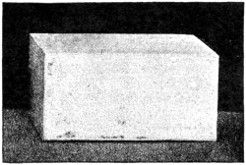
Just as the rectangle is the chief surface considered in arithmetic, so the rectangular solid is the chief solid body.
A rectangular solid is bounded by six rectangular surfaces, each opposite pair of rectangles being equal and parallel to each other.
A rectangular solid thus has three dimensions—length, breadth, and thickness.
If the length, breadth, and thickness are all equal to one another, the solid is called a cube. Hence, a cubic foot, the unit of volume, is a solid body whose length, breadth, and thickness are each a linear foot. Similarly, a cubic inch measures one linear inch in length, breadth, and thickness; and a cubic yard measures one linear yard in length, breadth, and thickness.
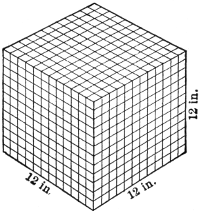
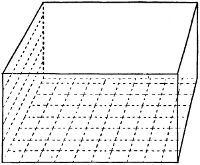
One cubic foot
The number of cubic feet (or inches, or yards) in the volume of a rectangular solid is equal to the number of linear feet (or inches, or yards) in the length, multiplied by the number of linear feet (or inches, or yards) in the breadth, multiplied by the number of linear feet (or inches, or yards) in the thickness.
This is usually abbreviated into
Length × breadth × thickness = volume, or cubic content.
For example, suppose the solid in the diagram is 10 feet in length, 8 feet in breadth, and 5 feet in thickness. It is clear that the solid can be cut into five slices, each 1 foot thick, by planes parallel to the bottom. But, the bottom contains 10×8 square feet and above each square foot there is a cubic foot. Thus, each slice contains 10×8 cubic feet. Therefore, since there are five slices, the whole solid contains 10×8×5, or 400 cubic feet.
Since length × breadth × thickness = cubic content, it follows that, if we know any three of these four quantities, we can find the fourth.
The student should remember that
(a) A cubic foot of water weighs 1000 ounces (avoirdupois) approximately.
(b) A gallon of pure water weighs 10 pounds (avoirdupois).
We have thus a relation between weight, capacity, and cubic content.
Table of Cubic Measure
1728 cubic inches (cu. in.) = 1 cubic foot (cu. ft.)
27 cubic feet = 1 cubic yard (cu. yd.)
128 cubic feet = 1 cord (C.)
Cubic Yard Cubic Feet Cubic Inches
1 = 27 = 46656
A cord of wood or stone is a pile 8 feet long, 4 feet wide, and 4 feet high.
A pile of wood 4 feet high, 4 feet wide and 1 foot long makes a cord foot. 8 cord feet = 1 cord.
A perch of stone or masonry is 161⁄2 feet long, 11⁄2 feet thick, and 1 foot high, and contains 243⁄4 cubic feet.
A cubic yard of earth is considered a load.
Brick work is commonly estimated by the thousand bricks.
Bricklayers, masons, and joiners commonly make a deduction of one half the space occupied by windows and doors in the walls of buildings.
In computing the contents of walls, masons and bricklayers multiply the entire distance around on the outside of the wall by the height and thickness. The corners are thus measured twice.
A cubic foot of distilled water at the maximum density, at the level of the sea, and the barometer at 30 inches, weighs 621⁄2 pounds or 1000 ounces avoirdupois.
By actual measurements, it has been found that a bushel, dry measure, contains about 11⁄4 cubic feet. This makes it easy to estimate about how many bushels any bin will hold.
Practical Applications of Cubic Measure
Example: An open tank made of iron 1⁄4 inch thick, is 4 feet long, 2 feet 6 inches broad, and 2 feet deep, outside measurement. Assuming that iron weighs 7.8 times as much as water, find the weight of the tank.
The external volume of the tank = 2 × 21⁄2 × 4 cubic feet = 20 cubic feet.
Since the iron is 1⁄4 inch thick, the inside length is 1⁄2 inch less than the outside, the inside breadth is 1⁄2 inch less than the outside, and the inside depth is 1⁄4 inch less than the outside.
Therefore the interior volume
= 291⁄2 × 471⁄2 × 233⁄4 cubic inches
= 59 × 95 × 9516 cubic inches
= 3327911⁄16 cubic inches
Therefore, volume of iron in the tank
= 20 cubic feet - 3327911⁄16 cubic inches
= 12805⁄16 cubic inches.
But 1 cubic foot of iron weighs as much as 7.8 cubic feet of water, i. e., 7.8 × 1000 ounces, or 7800 ounces.
∴ Weight of tank = 12805⁄16 × 78001728 × 16 pounds.
∴ Weight of tank = 361.199 pounds, Ans.
Example: A wood pile is 8 feet high and 40 feet long. The sticks are 4 feet long. How many cords in it?
Solution: Being 8 feet high, it is 2 cords high. 40 feet in length equal 5 cords in length. Hence, the pile contains 2 × 5 cords, or 10 cords.
To estimate a bin:
(1) Find the number of cubic feet in the bin.
(2) Divide the number of cubic feet by 11⁄4.
(3) The result is the number of bushels.
Example: How many bushels will a bin hold, if its inside measurements are, length 20 feet, width 12 feet, depth 8 feet?
Solution: The number of cubic feet in a bin is 8 × 12 × 20, or 1920.
If 1 bushel contains 11⁄4 cubic feet, in 1920 cubic feet there are as many bushels as 11⁄4 is contained times in 1920, or 1536.
Work:
8 × 12 × 20 = 1920
1920 ÷ 11⁄4 = 1536.
The work may be indicated in this way as well:—
8 × 12 × 20 × 4⁄5 = 1536.
To get the number of heaped bushels of corn in the ear in a crib:
(1) Multiply the length of the crib in inches by the width in inches.
(2) Multiply the product obtained, by the height of the corn in the crib in inches.
(3) Divide the result by 2748.
Example: How much corn in the ear can I put into a crib 12 feet wide, 20 feet long, and 10 feet deep?
Solution: The number of cubic inches in the crib is 144 × 240 × 120, or 4,147,200.
Since 2748 cubic inches hold 1 bushel, 4,147,200 cubic inches hold as many bushels as 2748 is contained times in 4,147,200, or 1509+ bushels.
Work:
144 × 240 × 1202748 = 1509+.
MEASURES OF CAPACITY
Measures used in telling the extent of room in vessels are called measures of capacity.
There are two kinds of capacity measures, dry measures and liquid measures.
Dry measures are used to measure grain, seeds, and the like.
Liquid measures are used to measure water, milk, oils, etc.
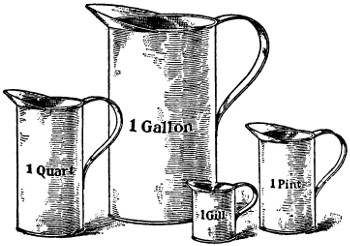
Liquid measures
Common Liquid Measure Table
4 gills (gi.) = 1 pint (pt.)
2 pints = 1 quart (qt.)
4 quarts = 1 gallon (gal.)
311⁄2 gallons = 1 barrel (bbl.)
2 barrels = 1 hogshead (hhd.)
Gallon Quarts Pints Gills
1 = 4 = 8 = 32
A pint, quart, or gallon, dry measure, is more than the same quantity, liquid measure; for a quart, dry measure, is 1⁄32 of a bushel, or 1⁄32 of 2150.4 cubic inches, which is about 671⁄5 cubic inches, while a quart liquid measure is 1⁄4 of 231 cubic inches, or 573⁄4 cubic inches.
Cu. In. in 1 Gal. Cu. In. in 1 Qt. Cu. In. in 1 Pt. Cu. In. in 1 Gi.
Liquid measure 231 57 3⁄4 28 7⁄8 7 7⁄32
Dry measure 268 4⁄5 67 1⁄5 33 3⁄5 8 2⁄5
In determining the capacity of cisterns, reservoirs, etc., 311⁄2 gallons are considered a barrel (bbl.), and 2 barrels, or 63 gallons, a hogshead (hhd.). In commerce, however, the barrel and hogshead are not fixed measures.
Casks of large size, called tierces, pipes, butts, tuns, etc., do not hold any fixed quantity. Their capacity is usually marked upon them.
The standard gallon of the United States contains 231 cubic inches, and will hold a little over 81⁄3 pounds of distilled water. The imperial gallon, now adopted by Great Britain, contains 277.274 cubic inches, or 10 pounds of distilled water, temperature 62 degrees Fahrenheit, the barometer standing at 30 inches.
Table of Apothecaries’ Liquid Measure
These measures are used in mixing medicines.
60 minims (m) = 1 fluid dram (fʒ)
8 fluid drams = 1 fluid ounce (f℥)
16 fluid ounces = 1 pint (O.)
8 pints = 1 gallon (Cong.)
A minim is about 1 drop.
Table of Dry Measure
2 pints (pt.) = 1 quart (qt.)
8 quarts = 1 peck (pk.)
4 pecks = 1 bushel (bu.)
Bushel Pecks Quarts Pints
1 = 4 = 32 = 64
A common Winchester bushel (the standard of the United States) contains 2150.42 cubic inches.
A dry quart contains 67.2 cubic inches.
A liquid quart contains 57.75 cubic inches.
Example 1: Reduce 5 bushels 2 pecks 4 quarts 1 pint to pints.
Operation:
4 8 2
bu. pk. qt. pts.
5 2 4 1
4
22 pk.
8
180 qt.
2
361 pt.
Explanation: As there are 4 pecks in 1 bushel, any number of bushels is equal to 4 times that number of pecks. Then, 5 bushels = 20 pecks, and 2 pecks added make 22 pecks. As there are 8 quarts in 1 peck, any number of pecks is equal to 8 times that number of quarts. Then 22 pecks = 176 quarts, and 4 quarts added make 180 quarts. As there are 2 pints in 1 quart, any number of quarts is equal to 2 times that number of pints. Then, 180 quarts = 360 pints, and 1 pint added make 361 pints. Hence, 5 bushels 2 pecks 4 quarts 1 pint = 361 pints.
Example 2: Reduce 361 pints to bushels.
Operation:
2 361 pt.
8 180 qt. + 1 pt.
4 22 pk. + 4 qt.
5 bu. + 2 pk.
Explanation: As there are 2 pints in 1 quart, 361 pints are equal to one-half that number of quarts = 180 quarts, with a remainder of 1 pint. Also, 180 quarts are equal to one-eighth of that number of pecks = 22 pecks, with a remainder of 4 quarts. Finally, 22 pecks are equal to one-fourth of that number of bushels = 5 bushels, with a remainder of 2 pecks. Hence, 361 pints are equal to 5 bushels 2 pecks 4 quarts 1 pint.
MEASURES OF WEIGHT
Avoirdupois Weight
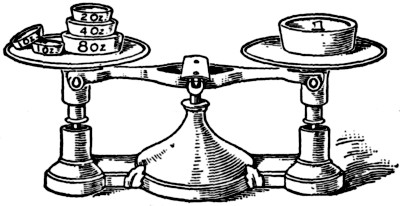
Avoirdupois Weight is used for weighing heavy articles as grain, groceries, coarse metals, etc.
16 ounces (oz.) = 1 pound (lb.)
100 pounds = 1 hundredweight (cwt.)
20 hundredweight = 1 ton (T.)
Ton Hundred- weight Pounds Ounces
1 = 20 = 2000 = 32000
Scale.—20, 100, 16.
In weighing coal at the mines and in levying duties at the United States Custom House, the long ton of 2240 pounds is sometimes used.
The ounce is considered as 16 drams.
The unit is the pound. It contains 7000 grains.
The following denominations are also used:
14 pounds = 1 stone
100 pounds butter = 1 firkin
100 pound grain or flour = 1 cental
100 pounds dried fish = 1 quintal
100 pounds nails = 1 keg
196 pounds flour = 1 barrel
200 pounds pork or beef = 1 barrel
280 pounds salt at N. Y. works = 1 barrel
Troy Weight
Troy Weight is used in weighing gold, silver, and jewels.
TABLE
24 grains (gr.) = 1 pennyweight (pwt.)
20 pennyweights = 1 ounce (oz.)
12 ounces = 1 pound (lb.)
Pounds Ounces Penny- weights Grains
1 = 12 = 240 = 5760
In weighing diamonds, pearls, and other jewels, the unit commonly employed is the carat, which is equal to 4 carat grains, or 3.168 Troy grains.
The term carat is also used to express the fineness of gold, and means 1⁄24 part. Thus, gold that is 18 carats fine is 18⁄24 gold, and 6⁄24 alloy.
The standard unit of weight is the Troy pound. It is equal to the weight of 22.7944 cubic inches of distilled water at its maximum density, the barometer being at 30 inches. It is identical with the Troy pound of Great Britain.
The following are approximate avoirdupois weights of certain articles of produce according to the laws of the United States, and in the majority of States:
Table I. UNITED STATES LEGAL WEIGHTS (in pounds) PER BUSHEL Prepared by the United States Bureau of Standards
State or Territory Apples Bar- ley Beans Beets Blue- Grass Seed Bran* Broom- Corn Seed Buck- wheat Car- rots Clover Seed Coal Coke Corn Corn Meal*
Ap- ple* Dried Ap- ples Beans* Castor Beans, Shelled Corn in Ear Shelled Corn
United States ... ... 48 60 50 ... ... ... ... 48 ... ... 80 ... ... ... ...
Alabama ... 24 47 60 ... ... ... ... ... ... ... ... ... ... 70 56 ...
Arizona ... ... 45 a55 ... ... ... ... ... ... ... ... ... ... ... ... ...
Arkansas b50 24 48 a60 ... ... 14 20 48 52 ... 60 ... ... 70 56 48
California ... ... 50 ... ... ... ... ... ... 40 ... ... ... ... ... ... ...
Colorado ... ... 48 60 ... ... 14 ... ... 52 ... 60 80 ... 70 ... 50
Connecticut 48 25 48 60 ... c60 ... 20 ... 48 50 60 80 ... ... ... 50
Delaware ... ... ... ... ... ... ... ... ... ... ... ... ... ... ... ... ...
Florida b48 24 48 d60 48 ... ... 20 ... ... ... ... ... ... 70 56 48
Georgia ... 24 47 e60 ... ... 14 f20 ... 52 ... 60 80 ... 70 56 48
Hawaii ... ... 48 ... ... ... ... ... ... ... ... ... ... ... ... ... ...
Idaho ... 28 48 ... ... ... ... ... ... 42 ... 60 ... ... ... 56 ...
Illinois ... 24 48 e60 46 ... 14 20 ... 52 ... 60 80 ... 70 56 48
Indiana ... 25 48 60 46 ... 14 ... ... 50 ... 60 80 ... g68 56 50
Iowa 48 24 48 60 46 56 14 20 50 52 50 60 80 38 70 56 50
Kansas b48 24 48 60 46 56 h14 20 ... 50 50 60 80 ... 70 i56 ...
Kentucky ... 24 47 e60 *45 ... 14 20 ... 56 ... 60 76 ... j70 56 50
Louisiana ... ... 32 ... ... ... ... ... ... ... ... ... ... ... ... ... ...
Maine 44 ... 48 60 ... 60 ... ... ... 48 50 ... ... ... ... ... 50
Maryland ... 28 ... ... 50 ... 14 20 ... ... 50 60 80 ... ... 56 48
Massachusetts 48 25 48 k60 ... 60 ... 20 ... 48 50 60 ... ... ... l56 50
Michigan 48 22 48 60 46 ... 14 ... ... 48 ... 60 80 ... 70 56 50
Minnesota b50 28 48 60 ... 50 14 ... 57 50 45 60 80 ... 70 56 ...
Mississippi ... 26 48 e60 m46 ... 14 20 ... 48 ... 60 80 ... 72 56 48
Missouri 48 24 48 m60 46 ... 14 20 ... 52 50 60 80 ... 70 56 50
Montana 45 ... 48 60 ... 50 14 20 ... 52 50 60 76 ... 70 56 50
Nebraska 48 24 48 e60 46 ... 14 20 ... 52 ... 60 80 ... 70 56 50
Nevada b48 24 48 60 46 56 h 20 ... 50 50 60 ... ... 70 56 48
New Hampshire 48 25 48 62 ... 60 ... 20 ... 48 50 60 ... ... e50 ... 50
New Jersey 50 25 48 60 ... 60 ... ... ... 50 50 64 ... ... ... ... ...
New York 48 25 48 60 ... ... ... 20 ... 48 50 60 ... ... ... ... 50
North Carolina 48 ... 48 ... *46 ... 14 ... 46 50 ... 60 ... ... ... ... 48
North Dakota 50 ... 48 60 ... 60 ... 20 30 42 ... 60 80 ... 70 56 ...
Ohio 50 24 48 60 ... 56 ... ... ... 50 50 60 n80 40 68 56 ...
Oklahoma 48 24 48 60 ... 60 14 20 30 52 50 60 80 ... 70 56 50
Oregon 45 28 46 ... ... ... ... ... ... 42 ... 60 ... ... ... ... ...
Pennsylvania ... ... 47 ... ... ... ... ... ... 48 ... 60 o76 40 ... ... ...
Rhode Island 48 25 48 60 46 50 ... 20 ... 48 50 60 80 40 70 56 50
South Carolina ... ... ... ... ... ... ... ... ... ... ... ... ... ... ... ... 48
South Dakota ... ... 48 60 ... 60 ... 20 30 42 ... 60 80 ... 70 56 ...
Tennessee b50 24 48 p60 46 50 14 20 42 50 50 q60 80 40 70 56 ...
Texas 45 28 48 e60 ... ... ... 20 ... 42 ... 60 80 ... 70 56 ...
Vermont 46 ... 48 62 ... 60 ... ... ... 48 50 60 ... ... ... ... ...
Virginia 45 28 48 e60 ... ... 14 ... ... 52 ... 60 80 ... 70 56 50
Washington b45 28 48 ... ... ... ... ... ... 42 ... 60 ... ... ... ... ...
West Virginia ... 25 48 60 ... ... ... ... ... 52 ... 60 80 ... ... ... ...
Wisconsin 50 25 48 60 ... 50 ... 20 ... 50 50 60 ... ... ... ... 50
State or Territory Apples Barley Beans Beets Blue-Grass Seed Bran* Broom-Corn Seed
Apple* Dried Apples Beans* Castor Beans, Shelled
United States ... ... 48 60 50 ... ... ... ...
Alabama ... 24 47 60 ... ... ... ... ...
Arizona ... ... 45 a55 ... ... ... ... ...
Arkansas b50 24 48 a60 ... ... 14 20 48
California ... ... 50 ... ... ... ... ... ...
Colorado ... ... 48 60 ... ... 14 ... ...
Connecticut 48 25 48 60 ... c60 ... 20 ...
Delaware ... ... ... ... ... ... ... ... ...
Florida b48 24 48 d60 48 ... ... 20 ...
Georgia ... 24 47 e60 ... ... 14 f20 ...
Hawaii ... ... 48 ... ... ... ... ... ...
Idaho ... 28 48 ... ... ... ... ... ...
Illinois ... 24 48 e60 46 ... 14 20 ...
Indiana ... 25 48 60 46 ... 14 ... ...
Iowa 48 24 48 60 46 56 14 20 50
Kansas b48 24 48 60 46 56 h14 20 ...
Kentucky ... 24 47 e60 *45 ... 14 20 ...
Louisiana ... ... 32 ... ... ... ... ... ...
Maine 44 ... 48 60 ... 60 ... ... ...
Maryland ... 28 ... ... 50 ... 14 20 ...
Massachusetts 48 25 48 k60 ... 60 ... 20 ...
Michigan 48 22 48 60 46 ... 14 ... ...
Minnesota b50 28 48 60 ... 50 14 ... 57
Mississippi ... 26 48 e60 m46 ... 14 20 ...
Missouri 48 24 48 m60 46 ... 14 20 ...
Montana 45 ... 48 60 ... 50 14 20 ...
Nebraska 48 24 48 e60 46 ... 14 20 ...
Nevada b48 24 48 60 46 56 h 20 ...
New Hampshire 48 25 48 62 ... 60 ... 20 ...
New Jersey 50 25 48 60 ... 60 ... ... ...
New York 48 25 48 60 ... ... ... 20 ...
North Carolina 48 ... 48 ... *46 ... 14 ... 46
North Dakota 50 ... 48 60 ... 60 ... 20 30
Ohio 50 24 48 60 ... 56 ... ... ...
Oklahoma 48 24 48 60 ... 60 14 20 30
Oregon 45 28 46 ... ... ... ... ... ...
Pennsylvania ... ... 47 ... ... ... ... ... ...
Rhode Island 48 25 48 60 46 50 ... 20 ...
South Carolina ... ... ... ... ... ... ... ... ...
South Dakota ... ... 48 60 ... 60 ... 20 30
Tennessee b50 24 48 p60 46 50 14 20 42
Texas 45 28 48 e60 ... ... ... 20 ...
Vermont 46 ... 48 62 ... 60 ... ... ...
Virginia 45 28 48 e60 ... ... 14 ... ...
Washington b45 28 48 ... ... ... ... ... ...
West Virginia ... 25 48 60 ... ... ... ... ...
Wisconsin 50 25 48 60 ... 50 ... 20 ...
State or Territory Buckwheat Carrots Clover Seed Coal Coke Corn Corn Meal*
Corn in Ear Shelled Corn
United States 48 ... ... 80 ... ... ... ...
Alabama ... ... ... ... ... 70 56 ...
Arizona ... ... ... ... ... ... ... ...
Arkansas 52 ... 60 ... ... 70 56 48
California 40 ... ... ... ... ... ... ...
Colorado 52 ... 60 80 ... 70 ... 50
Connecticut 48 50 60 80 ... ... ... 50
Delaware ... ... ... ... ... ... ... ...
Florida ... ... ... ... ... 70 56 48
Georgia 52 ... 60 80 ... 70 56 48
Hawaii ... ... ... ... ... ... ... ...
Idaho 42 ... 60 ... ... ... 56 ...
Illinois 52 ... 60 80 ... 70 56 48
Indiana 50 ... 60 80 ... g68 56 50
Iowa 52 50 60 80 38 70 56 50
Kansas 50 50 60 80 ... 70 i56 ...
Kentucky 56 ... 60 76 ... j70 56 50
Louisiana ... ... ... ... ... ... ... ...
Maine 48 50 ... ... ... ... ... 50
Maryland ... 50 60 80 ... ... 56 48
Massachusetts 48 50 60 ... ... ... l56 50
Michigan 48 ... 60 80 ... 70 56 50
Minnesota 50 45 60 80 ... 70 56 ...
Mississippi 48 ... 60 80 ... 72 56 48
Missouri 52 50 60 80 ... 70 56 50
Montana 52 50 60 76 ... 70 56 50
Nebraska 52 ... 60 80 ... 70 56 50
Nevada 50 50 60 ... ... 70 56 48
New Hampshire 48 50 60 ... ... e50 ... 50
New Jersey 50 50 64 ... ... ... ... ...
New York 48 50 60 ... ... ... ... 50
North Carolina 50 ... 60 ... ... ... ... 48
North Dakota 42 ... 60 80 ... 70 56 ...
Ohio 50 50 60 n80 40 68 56 ...
Oklahoma 52 50 60 80 ... 70 56 50
Oregon 42 ... 60 ... ... ... ... ...
Pennsylvania 48 ... 60 o76 40 ... ... ...
Rhode Island 48 50 60 80 40 70 56 50
South Carolina ... ... ... ... ... ... ... 48
South Dakota 42 ... 60 80 ... 70 56 ...
Tennessee 50 50 q60 80 40 70 56 ...
Texas 42 ... 60 80 ... 70 56 ...
Vermont 48 50 60 ... ... ... ... ...
Virginia 52 ... 60 80 ... 70 56 50
Washington 42 ... 60 ... ... ... ... ...
West Virginia 52 ... 60 80 ... ... ... ...
Wisconsin 50 50 60 ... ... ... ... 50
Table I. UNITED STATES LEGAL WEIGHTS (in pounds) PER BUSHEL—Continued
State or Territory Corn Meal, Bolted Corn Meal, Un- bolted Cotton Seed Cran- berries Flaxseed (Linseed) Goose- berries Plas- tering Hair Hemp Seed Herdes Grass Hun- garian Grass Seed Millet Oats Onions Orchard Grass Seed Osage Orange Seed Pars- nips Peaches
Cotton Seed* Sea- Island Onions* Onion Sets
United States ... ... ... ... ... 56 ... ... ... ... ... ... 32 57 ... ... ... ... ...
Alabama ... ... 32 ... ... ... ... ... ... ... ... ... 32 ... ... ... ... ... ...
Arizona ... ... ... ... ... ... ... ... ... ... ... ... 32 ... ... ... ... ... ...
Arkansas ... ... 331⁄3 ... ... 56 ... ... ... ... ... 50 32 57 ... 14 ... ... ...
California ... ... ... ... ... ... ... ... ... ... ... ... 32 ... ... ... ... ... ...
Colorado ... ... ... ... ... ... ... ... 44 ... ... ... 32 57 ... ... ... ... ...
Connecticut ... ... 30 44 ... 55 ... ... ... 45 ... ... 32 52 ... ... ... 45 ...
Delaware 44 48 ... ... ... ... ... ... ... ... ... ... ... ... ... ... ... ... ...
Florida ... ... 32 46 ... ... ... ... ... ... ... 50 32 56 ... ... ... ... 54
Georgia ... ... 30 ... ... 56 ... 8 44 ... ... ... 32 57 ... ... ... ... ...
Hawaii ... ... ... ... ... ... ... ... ... ... ... ... 32 ... ... ... ... ... ...
Idaho ... ... ... ... ... 56 ... ... ... ... ... ... 36 ... ... ... ... ... ...
Illinois ... ... ... ... ... 56 ... 8 44 ... ... ... 32 57 ... ... ... ... ...
Indiana ... ... ... ... 33 ... ... ... 44 ... ... 50 32 48 ... 14 33 55 ...
Iowa ... ... ... ... ... 56 40 ... 44 ... 50 50 32 57 ... 14 32 42 48
Kansas ... ... ... ... ... 56 ... r8 44 ... 50 50 32 57 ... ... ... 52 48
Kentucky ... ... ... ... ... 56 ... 8 44 ... 50 50 32 57 36 14 ... ... ...
Louisiana ... ... ... ... ... ... ... ... ... ... ... ... ... ... ... ... ... ... ...
Maine ... ... ... ... ... ... ... 11 ... 45 ... ... 32 52 ... ... ... 45 ...
Maryland ... ... ... ... ... 56 ... ... 44 45 50 50 32 57 ... 14 ... ... 40
Massachusetts ... ... 30 44 32 55 ... ... ... 45 ... ... 32 52 ... ... ... 45 48
Michigan ... ... ... ... 40 56 ... ... 44 ... 50 50 32 54 ... 14 33 ... ...
Minnesota ... ... ... ... 36 ... 40 r8 50 ... 48 48 32 52 ... 14 ... 42 ...
Mississippi 44 48 32 ... ... 56 ... ... 44 ... 50 50 32 57 ... ... ... ... ...
Missouri ... ... 33 ... ... 56 ... ... 44 ... 48 50 32 57 28 14 36 44 48
Montana ... ... ... ... ... 56 ... ... 44 ... 50 ... 32 57 ... ... ... 50 ...
Nebraska ... ... ... ... ... 56 ... 8 44 ... 50 50 32 57 25 ... 32 ... ...
Nevada ... ... ... ... ... 56 ... ... 48 ... 50 50 32 57 ... ... ... 50 48
New Hampshire ... ... ... ... 32 56 ... ... ... 45 ... ... 32 52 ... ... ... 45 48
New Jersey ... ... ... ... ... 55 ... ... ... ... ... ... 30 57 ... ... ... ... 50
New York ... ... 30 44 ... 55 ... ... ... 45 ... ... 32 57 ... ... ... ... ...
North Carolina 48 48 30 44 ... 55 ... ... 44 ... ... 50 32 57 ... 14 ... ... ...
North Dakota ... ... ... ... ... 56 ... ... ... ... ... 50 32 52 ... ... ... ... ...
Ohio ... ... ... ... ... 56 ... ... 44 ... 50 50 32 55 ... ... ... ... 48
Oklahoma ... ... 32 ... ... 56 ... ... 44 ... ... 50 32 57 28 14 36 44 48
Oregon ... ... ... ... ... ... ... ... ... ... ... ... 32 ... ... ... ... ... ...
Pennsylvania ... ... ... ... ... ... ... ... ... ... ... ... 32 50 ... ... ... ... ...
Rhode Island ... ... 30 44 ... 56 ... ... 44 ... 50 50 32 50 ... ... ... 50 48
South Carolina 48 48 30 ... ... ... ... ... ... ... ... ... ... 52 ... ... ... ... ...
South Dakota ... ... ... ... ... 56 ... ... ... ... ... ... 32 52 ... ... ... ... ...
Tennessee 50 48 28 ... ... 56 48 8 44 ... 48 50 32 56 28 14 33 50 50
Texas ... ... 32 ... ... 56 ... ... 44 ... 48 50 32 57 ... ... ... ... 50
Vermont ... ... ... ... ... ... ... ... ... 45 ... ... 32 52 ... ... ... ... ...
Virginia ... ... 32 ... ... 56 ... 8 44 12 48 50 30 57 28 14 34 ... ...
Washington ... ... ... ... ... 56 ... ... ... ... ... ... 32 ... ... ... ... ... ...
West Virginia ... ... ... ... ... 56 ... ... ... ... ... ... 32 ... ... ... ... ... ...
Wisconsin ... ... 30 44 ... 56 ... 8 44 ... 48 50 32 57 ... ... ... 44 ...
State or Territory Corn Meal, Bolted Corn Meal, Unbolted Cotton Seed Cranberries Flaxseed (Linseed) Gooseberries Plastering Hair Hemp Seed
Cotton Seed* Sea-Island
United States ... ... ... ... ... 56 ... ... ...
Alabama ... ... 32 ... ... ... ... ... ...
Arizona ... ... ... ... ... ... ... ... ...
Arkansas ... ... 331⁄3 ... ... 56 ... ... ...
California ... ... ... ... ... ... ... ... ...
Colorado ... ... ... ... ... ... ... ... 44
Connecticut ... ... 30 44 ... 55 ... ... ...
Delaware 44 48 ... ... ... ... ... ... ...
Florida ... ... 32 46 ... ... ... ... ...
Georgia ... ... 30 ... ... 56 ... 8 44
Hawaii ... ... ... ... ... ... ... ... ...
Idaho ... ... ... ... ... 56 ... ... ...
Illinois ... ... ... ... ... 56 ... 8 44
Indiana ... ... ... ... 33 ... ... ... 44
Iowa ... ... ... ... ... 56 40 ... 44
Kansas ... ... ... ... ... 56 ... r8 44
Kentucky ... ... ... ... ... 56 ... 8 44
Louisiana ... ... ... ... ... ... ... ... ...
Maine ... ... ... ... ... ... ... 11 ...
Maryland ... ... ... ... ... 56 ... ... 44
Massachusetts ... ... 30 44 32 55 ... ... ...
Michigan ... ... ... ... 40 56 ... ... 44
Minnesota ... ... ... ... 36 ... 40 r8 50
Mississippi 44 48 32 ... ... 56 ... ... 44
Missouri ... ... 33 ... ... 56 ... ... 44
Montana ... ... ... ... ... 56 ... ... 44
Nebraska ... ... ... ... ... 56 ... 8 44
Nevada ... ... ... ... ... 56 ... ... 48
New Hampshire ... ... ... ... 32 56 ... ... ...
New Jersey ... ... ... ... ... 55 ... ... ...
New York ... ... 30 44 ... 55 ... ... ...
North Carolina 48 48 30 44 ... 55 ... ... 44
North Dakota ... ... ... ... ... 56 ... ... ...
Ohio ... ... ... ... ... 56 ... ... 44
Oklahoma ... ... 32 ... ... 56 ... ... 44
Oregon ... ... ... ... ... ... ... ... ...
Pennsylvania ... ... ... ... ... ... ... ... ...
Rhode Island ... ... 30 44 ... 56 ... ... 44
South Carolina 48 48 30 ... ... ... ... ... ...
South Dakota ... ... ... ... ... 56 ... ... ...
Tennessee 50 48 28 ... ... 56 48 8 44
Texas ... ... 32 ... ... 56 ... ... 44
Vermont ... ... ... ... ... ... ... ... ...
Virginia ... ... 32 ... ... 56 ... 8 44
Washington ... ... ... ... ... 56 ... ... ...
West Virginia ... ... ... ... ... 56 ... ... ...
Wisconsin ... ... 30 44 ... 56 ... 8 44
State or Territory Herdes Grass Hungarian Grass Seed Millet Oats Onions Orchard Grass Seed Osage Orange Seed Parsnips Peaches
Onions* Onion Sets
United States ... ... ... 32 57 ... ... ... ... ...
Alabama ... ... ... 32 ... ... ... ... ... ...
Arizona ... ... ... 32 ... ... ... ... ... ...
Arkansas ... ... 50 32 57 ... 14 ... ... ...
California ... ... ... 32 ... ... ... ... ... ...
Colorado ... ... ... 32 57 ... ... ... ... ...
Connecticut 45 ... ... 32 52 ... ... ... 45 ...
Delaware ... ... ... ... ... ... ... ... ... ...
Florida ... ... 50 32 56 ... ... ... ... 54
Georgia ... ... ... 32 57 ... ... ... ... ...
Hawaii ... ... ... 32 ... ... ... ... ... ...
Idaho ... ... ... 36 ... ... ... ... ... ...
Illinois ... ... ... 32 57 ... ... ... ... ...
Indiana ... ... 50 32 48 ... 14 33 55 ...
Iowa ... 50 50 32 57 ... 14 32 42 48
Kansas ... 50 50 32 57 ... ... ... 52 48
Kentucky ... 50 50 32 57 36 14 ... ... ...
Louisiana ... ... ... ... ... ... ... ... ... ...
Maine 45 ... ... 32 52 ... ... ... 45 ...
Maryland 45 50 50 32 57 ... 14 ... ... 40
Massachusetts 45 ... ... 32 52 ... ... ... 45 48
Michigan ... 50 50 32 54 ... 14 33 ... ...
Minnesota ... 48 48 32 52 ... 14 ... 42 ...
Mississippi ... 50 50 32 57 ... ... ... ... ...
Missouri ... 48 50 32 57 28 14 36 44 48
Montana ... 50 ... 32 57 ... ... ... 50 ...
Nebraska ... 50 50 32 57 25 ... 32 ... ...
Nevada ... 50 50 32 57 ... ... ... 50 48
New Hampshire 45 ... ... 32 52 ... ... ... 45 48
New Jersey ... ... ... 30 57 ... ... ... ... 50
New York 45 ... ... 32 57 ... ... ... ... ...
North Carolina ... ... 50 32 57 ... 14 ... ... ...
North Dakota ... ... 50 32 52 ... ... ... ... ...
Ohio ... 50 50 32 55 ... ... ... ... 48
Oklahoma ... ... 50 32 57 28 14 36 44 48
Oregon ... ... ... 32 ... ... ... ... ... ...
Pennsylvania ... ... ... 32 50 ... ... ... ... ...
Rhode Island ... 50 50 32 50 ... ... ... 50 48
South Carolina ... ... ... ... 52 ... ... ... ... ...
South Dakota ... ... ... 32 52 ... ... ... ... ...
Tennessee ... 48 50 32 56 28 14 33 50 50
Texas ... 48 50 32 57 ... ... ... ... 50
Vermont 45 ... ... 32 52 ... ... ... ... ...
Virginia 12 48 50 30 57 28 14 34 ... ...
Washington ... ... ... 32 ... ... ... ... ... ...
West Virginia ... ... ... 32 ... ... ... ... ... ...
Wisconsin ... 48 50 32 57 ... ... ... 44 ...
Table I. UNITED STATES LEGAL WEIGHTS (in pounds) PER BUSHEL—Continued
State or Territory Dried Peaches Peeled Peanuts Pears* Peas Potatoes Sweet Potatoes Redtop Seed Rough Rice Ruta- bagas Rye Meal Rye Shorts* Sorghum Seed Tomatoes Timothy Seed Turnips Wheat
Green Peas Un- shelled Peas*
United States ... ... ... ... 60 60 ... ... ... ... ... 56 ... ... ... ... ... 60
Alabama 38 ... ... ... 60 60 55 ... ... ... ... 56 ... ... ... ... 55 60
Arizona ... ... ... ... ... ... ... ... ... ... ... 56 ... ... ... ... ... 60
Arkansas 33 ... ... ... 60 60 50 14 ... ... ... 56 ... 50 ... 60 57 60
California ... ... ... ... ... ... ... ... ... ... ... 54 ... ... ... ... ... 60
Colorado ... ... ... ... ... 60 ... ... ... ... ... 56 ... ... ... 45 ... 60
Connecticut 33 ... ... ... 60 60 54 ... 45 60 50 56 20 ... ... ... 50 60
Delaware ... ... ... ... ... ... ... ... ... ... ... ... ... ... ... ... ... 60
Florida 33 22 60 ... ... 60 60 ... ... ... ... 56 ... 56 ... ... 54 60
Georgia 38 ... ... ... 60 60 55 ... 43 ... ... 56 ... ... ... 45 55 60
Hawaii ... 25 ... ... ... ... ... ... ... ... ... 56 ... ... ... ... ... 60
Idaho ... ... 45 ... ... 60 ... ... ... ... ... 56 ... ... ... ... ... 60
Illinois ... ... ... ... ... 60 50 ... ... ... ... 56 ... ... ... 45 55 60
Indiana ... ... ... ... ... 60 55 ... ... ... ... 56 ... ... ... 45 55 60
Iowa ... 20 ... 50 60 60 46 14 ... 50 ... 56 ... 50 50 45 55 60
Kansas ... ... ... ... ... 60 50 ... ... ... ... 56 ... 50 56 45 55 60
Kentucky 39 24 ... ... 60 60 55 ... ... ... ... 56 ... ... ... 45 60 60
Louisiana ... ... ... ... ... ... ... ... ... ... ... 32 ... ... ... ... ... 60
Maine ... ... ... ... 60 60 ... ... ... 60 50 50 ... ... ... ... 50 60
Maryland ... 22 ... ... 60 60 60 14 ... ... ... 56 ... 50 60 45 50 60
Massachusetts 33 20 58 ... 60 60 54 ... 45 ... 50 56 20 ... 56 45 55 60
Michigan 28 ... ... ... 60 60 56 14 ... ... ... 56 ... ... ... 45 58 60
Minnesota 28 ... ... ... 60 60 55 14 ... 52 ... 56 ... 57 ... 45 ... 60
Mississippi 33 24 ... ... 60 60 60 ... ... ... ... 56 ... 42 ... 45 55 60
Missouri 33 ... 48 56 60 60 56 14 ... 50 ... 56 ... 42 45 45 42 60
Montana ... ... 45 ... 60 60 ... ... ... ... ... 56 ... ... ... 45 50 60
Nebraska 33 ... ... ... 60 60 50 ... ... ... ... 56 ... 50 ... 45 55 60
Nevada ... ... 58 ... 60 60 50 ... ... ... ... 56 ... 50 56 45 56 60
New Hampshire ... 20 ... ... 60 60 54 ... ... ... 50 56 20 ... 56 45 55 60
New Jersey 33 ... ... ... 60 60 54 ... ... ... ... 56 ... ... ... 45 ... 60
New York 33 ... ... ... 60 60 54 ... 45 ... 50 56 20 ... ... 45 ... 60
North Carolina ... 22 ... ... 60 60 56 14 44 ... ... 56 ... 50 ... 45 50 60
North Dakota ... ... ... ... 60 60 46 ... ... ... ... 56 ... ... ... 45 60 60
Ohio 33 ... ... ... 60 60 50 ... ... ... ... 56 ... ... 56 45 60 60
Oklahoma ... 22 48 56 60 60 55 14 ... 50 ... 56 ... 50 45 45 60 60
Oregon 28 ... 45 ... ... 60 ... ... ... ... ... 56 ... ... ... ... ... 60
Pennsylvania ... ... ... ... ... 56 ... ... ... ... ... 56 ... ... ... ... ... 60
Rhode Island 33 ... ... ... 60 60 54 ... ... ... 50 56 20 ... 56 45 50 60
South Carolina ... ... ... ... ... ... ... ... ... ... ... ... ... ... ... ... ... ...
South Dakota ... ... ... ... 60 60 46 ... ... ... ... 56 ... ... ... 42 60 60
Tennessee 26 23 56 30 60 60 50 14 ... ... ... 56 ... 50 56 45 50 60
Texas 28 ... ... ... ... 60 55 ... ... ... ... 56 ... ... 55 45 55 60
Vermont ... ... ... ... 60 60 ... ... ... ... ... 56 ... ... ... 45 60 60
Virginia 40 22 ... ... 60 56 56 12 ... ... ... 56 ... ... ... 45 55 60
Washington 28 ... 45 ... ... 60 ... ... ... ... ... 56 ... ... ... ... ... 60
West Virginia 33 ... ... ... ... 60 ... ... ... ... ... 56 ... ... ... 45 ... 60
Wisconsin 33 ... ... ... 60 60 54 ... 45 56 50 56 20 ... ... 45 42 60
State or Territory Dried Peaches Peeled Peanuts Pears* Peas Potatoes Sweet Potatoes Redtop Seed Rough Rice
Green Peas Un- shelled Peas*
United States ... ... ... ... 60 60 ... ... ...
Alabama 38 ... ... ... 60 60 55 ... ...
Arizona ... ... ... ... ... ... ... ... ...
Arkansas 33 ... ... ... 60 60 50 14 ...
California ... ... ... ... ... ... ... ... ...
Colorado ... ... ... ... ... 60 ... ... ...
Connecticut 33 ... ... ... 60 60 54 ... 45
Delaware ... ... ... ... ... ... ... ... ...
Florida 33 22 60 ... ... 60 60 ... ...
Georgia 38 ... ... ... 60 60 55 ... 43
Hawaii ... 25 ... ... ... ... ... ... ...
Idaho ... ... 45 ... ... 60 ... ... ...
Illinois ... ... ... ... ... 60 50 ... ...
Indiana ... ... ... ... ... 60 55 ... ...
Iowa ... 20 ... 50 60 60 46 14 ...
Kansas ... ... ... ... ... 60 50 ... ...
Kentucky 39 24 ... ... 60 60 55 ... ...
Louisiana ... ... ... ... ... ... ... ... ...
Maine ... ... ... ... 60 60 ... ... ...
Maryland ... 22 ... ... 60 60 60 14 ...
Massachusetts 33 20 58 ... 60 60 54 ... 45
Michigan 28 ... ... ... 60 60 56 14 ...
Minnesota 28 ... ... ... 60 60 55 14 ...
Mississippi 33 24 ... ... 60 60 60 ... ...
Missouri 33 ... 48 56 60 60 56 14 ...
Montana ... ... 45 ... 60 60 ... ... ...
Nebraska 33 ... ... ... 60 60 50 ... ...
Nevada ... ... 58 ... 60 60 50 ... ...
New Hampshire ... 20 ... ... 60 60 54 ... ...
New Jersey 33 ... ... ... 60 60 54 ... ...
New York 33 ... ... ... 60 60 54 ... 45
North Carolina ... 22 ... ... 60 60 56 14 44
North Dakota ... ... ... ... 60 60 46 ... ...
Ohio 33 ... ... ... 60 60 50 ... ...
Oklahoma ... 22 48 56 60 60 55 14 ...
Oregon 28 ... 45 ... ... 60 ... ... ...
Pennsylvania ... ... ... ... ... 56 ... ... ...
Rhode Island 33 ... ... ... 60 60 54 ... ...
South Carolina ... ... ... ... ... ... ... ... ...
South Dakota ... ... ... ... 60 60 46 ... ...
Tennessee 26 23 56 30 60 60 50 14 ...