BOOK OF LANGUAGE AND LITERATURE (continued 8)
Reading edition
Primrose, Moses.—Brother of the above, noted for giving in barter a good horse for a gross of worthless green spectacles with copper rims.
Primrose, Olivia.—The eldest daughter of the doctor. Pretty, enthusiastic, a sort of Hebê in beauty. “She wished for many lovers,” and eloped with Squire Thorndill.
Primrose, Sophia.—The second daughter of Dr. Primrose. She was “soft, modest, and alluring.”
Princess: a Medley.—A poem by Alfred Tennyson. “It is,” says Stedman, “as he entitles it, a medley, constructed of ancient and modern materials—a show of mediæval pomp and movement, observed through an atmosphere of latterday thought and emotion. The poet, in his prelude, anticipates every stricture, and to me the anachronisms and impossibilities of the story seem not only lawful, but attractive. Tennyson’s special gift of reducing incongruous details to a common structure and tone is fully illustrated in a poem made—
“‘To suit with time and place, A Gothic ruin and a Grecian house, A talk at college and of ladies’ rights, A feudal knight in silken masquerade.’
Other works of our poet are greater, but none is so fascinating. Some of the author’s most delicately musical lines are herein contained. The tournament scene is the most vehement and rapid passage in the whole range of Tennyson’s poetry. The songs reach the high water mark of lyrical compositions. The five melodies—As Thro’ the Land, Sweet and Low, The Splendor Falls, Home They Brought and Ask Me No More—constitute the finest group of songs produced in our century, and the third seems to many the most perfect English lyric since the time of Shakespeare.” The name of the Princess is Ida.
Priscilla (pri-sil´ä).—Courtship of Miles Standish, Longfellow. A Puritan maiden who is wooed by Captain Standish through the mediation of his friend, John Alden, who is in love with Priscilla. She prefers John Alden and marries him after the captain’s supposed death. The captain, however, appears at the close of the wedding service, and the friends are reconciled.
Prometheus (prō-mē´thūs) Bound.—A tragedy of Æschylus, of uncertain date. Prometheus is fabled to have made men of clay, and to have imparted life to them by means of fire brought from heaven. It was said that for this he was bound to the rock by order of Zeus, that he resisted all efforts to subdue his will and purpose, bade defiance to the father of the gods, and disappeared in an appalling tempest. Mrs. Browning published a poetical translation in 1833.
Prospero (pros´pe-rō).—Tempest, Shakespeare. Rightful duke of Milan, deposed by his brother. Drifted on a desert island, he practised magic, and raised a tempest in which his brother was shipwrecked. Ultimately Prospero “broke his wand,” and his daughter married the son of the King of Naples.
Puff, Mr.—In Sheridan’s farce The Critic, a hack writer, who, having failed at other occupations, tries criticism for a living, and is a “professor of the art of puffing.”
Puss in Boots.—The subject and title of a well-known nursery tale derived from a fairy story in the Nights of the Italian author Straparola, and Charles Perrault’s Contes des Fées. The wonderful cat secures a princess and a fortune for his master, a poor young miller, whom he passes off as the rich marquis of Carabas.
Pygmalion (pig-mā´li-on) and Galatea (gal-a-tē´ä).—A mythological comedy, by W. S. Gilbert, embodying the fable of the Athenian sculptor who prayed the gods to put life into the statue of Galatea which he had fashioned. In the comedy, Galatea evokes the jealousy of the sculptor’s wife Cynisca; and, after causing great misery by her very innocence, voluntarily returns to the original stone.
Pyncheon (pin´chon).—The name of an ancient but decayed family in Hawthorne’s romance The House of the Seven Gables. There are: (1) Judge Pyncheon, a selfish, cunning, worldly man. (2) His cousin Clifford, a delicate, sensitive nature, reduced to childishness by long imprisonment and suffering. (3) Hepzibah, the latter’s sister, an old maid who devotes herself to the care of Clifford. (4) A second cousin, Phœbe, a fresh, cheerful young girl, who restores the fallen fortunes of the family and removes the curse which rested on it.
Q
Quasimodo (kwā-si-mō´dō).—Notre Dame de Paris, Hugo. A misshapen dwarf, one of the prominent characters in the story. He is brought up in the cathedral of Notre Dame de Paris. One day, he sees Esmeralda, who had been dancing in the cathedral close, set upon by a mob, and he conceals her for a time in the church. When, at length, the beautiful gypsy girl is gibbeted, Quasimodo disappears mysteriously, but a skeleton corresponding to the deformed figure is found after a time in a hole under the gibbet.
Quaver.—The Virgin Unmasked, Fielding. A singing-master, who says, “if it were not for singing-masters, men and women might as well have been born dumb.” He courts Lucy by promising to give her singing-lessons.
Queen Lab.—Arabian Nights. The queen of magic, ruler over the enchanted city, in the story of Beder, prince of Persia. She transforms men into horses, mules, and other animals. Beder marries her, defeats her plots against him, but is himself turned into an owl for a time.
Quentin Durward (kwen´tin der´wärd).—A novel by Sir Walter Scott. A story of French history. The delineations of Louis XI. and Charles the Bold of Burgundy will stand comparison with any in the whole range of fiction or history.
Quickly, Mistress.—Merry Wives of Windsor, Shakespeare. A serving woman to Dr. Caius, a French physician. She is the go-between of three suitors for “sweet Anne Page,” and with perfect disinterestedness wishes all three to succeed.
Quickly, Mistress Nell.—Hostess of a tavern in Eastcheap, frequented by Harry, Prince of Wales, Sir John Falstaff, and all their disreputable crew.
Quidnunkis.—Title and name of hero in a fable found or written by Gay in 1726. This hero was a monkey which climbed higher than its neighbors, and fell into a river.
Quilp (kwilp).—Old Curiosity Shop, Dickens. A hideous dwarf, cunning, malicious, and a perfect master in tormenting. Of hard, forbidding features, with head and face large enough for a giant, he lived on Tower hill, collected rents, advanced money to seamen, and kept a sort of wharf, calling himself a ship-breaker.
Quintus Fixlein.—Title of a romance by Jean Paul Richter and the name of the principal character.
Quirk, Gammon, and Snap.—A firm of rascally, scheming, hypocritical solicitors in Warren’s Ten Thousand a Year.
R
Raby, Aurora.—In Byron’s Don Juan. She was a rich, noble English orphan, “a rose with all its sweetest leaves yet folded.”
Radigund.—Faërie Queene, Spenser. Queen of the fabled Amazons. Having been rejected by Bellodant “the Bold,” she revenged herself by degrading all the men who fell into her power by dressing them like women, and giving them women’s work.
Ramayana [(rä´-mä´yȧ-nȧ); Rāma-ayana, the goings or doings of Rama].—One of the two great epics of India, the other being the Mahabharata. It is ascribed to a poet, Valmiki, and consists at present of about twenty-four thousand stanzas, divided into seven books. It is the production of one man, though many parts are later additions, such as those in which Rama is represented as an incarnation of Vishnu, all the episodes in the first book, and the whole of the seventh. It was at first handed down orally, and variously modified in transmission, and afterward reduced to writing.
Ramona (ra-mō´nä).—Title of a romance by Helen Hunt Jackson. Ramona saw the American Indian followed by “civilization” while retreating slowly but surely toward his own extinction, and had herself a share in the tragedy. Ramona is considered the great romance of Indian life.
Random (ran´dom).—Roderick Random, Smollett. A young Scotch scapegrace in quest of fortune. At one time he revels in prosperity, again he is in utter destitution. He roams at random, in keeping with his name.
Rappaccini (rap-ä-chē´nē).—Mosses from an Old Manse, Hawthorne. A doctor in whose garden grew strange plants whose juices and fragrance were poison. His daughter, nourished on these odors, became poisonous herself. Her lover found an antidote which she took, but the poison meant life and the antidote meant death to her.
Rasselas (ras´e-las).—An imaginary romance by Dr. Johnson. According to the custom of his country, Abyssinia, Rasselas was confined in paradise, with the rest of the royal family. This paradise was in the valley of Amhara, surrounded by high mountains. It had only one entrance, a cavern concealed by woods, and closed by iron gates. He escaped with his sister Nekayah and Imlac the poet, and wandered about to find what condition or rank of life was the most happy. After investigation, he found no lot without its drawbacks, and resolved to return to the “Happy Valley.”
Raud the Strong.—Tales of a Wayside Inn, Henry W. Longfellow. The viking who worshiped the old gods and lived by fire and sword. King Olaf went against him, sailing from Drontheim to Salten Fjord.
Raven, The.—A poem by Edgar Allan Poe, published in 1845, which has attained a world-wide popularity. For the author’s account of the mode of its construction, see The Philosophy of Composition, an essay, in the collected edition of his works. The last verse runs:
And the Raven, never flitting, still is sitting, still is sitting, On the pallid bust of Pallas, just above my chamber door; And his eyes have all the seeming of a demon’s that is dreaming, And the lamplight o’er him streaming throws his shadow on the floor; And my soul from out that shadow that lies floating on the floor Shall be lifted—Nevermore!
Ravenswood.—Bride of Lammermoor, Scott. The lord of Ravenswood, an old Scotch nobleman and a decayed royalist. His son Edgar falls in love with Lucy Ashton, daughter of Sir William Ashton, Lord-Keeper of Scotland. The lovers plight their troth, but Lucy is compelled to marry Frank Hayston, laird of Bucklaw. The bride, in a fit of insanity, attempts to murder the bridegroom and dies. Bucklaw goes abroad. Colonel Ashton, seeing Edgar at the funeral of Lucy, appoints a hostile meeting; and Edgar, on his way to the place appointed, is lost in the quicksands. A prophecy, noted as a curse, hung over the family and was thus fulfilled.
Raymond.—In Jerusalem Delivered, by Tasso. Raymond was known as the Nestor of the crusaders, slew Aladine, the king of Jerusalem, and planted the Christian standard upon the tower of David.
Rebecca.—Ivanhoe, Scott. Daughter of Isaac the Jew, in love with Ivanhoe.
Red-cross Knight.—The Red-cross Knight is St. George, the patron saint of England, and, in the obvious and general interpretation, typifies holiness, or the perfection of the spiritual man in religion. In Spenser’s Faërie Queene the task of slaying a dragon was assigned to him as the champion of Una.
Redgauntlet (red-gänt´let).—One of the principal characters in Sir Walter Scott’s novel of the same name, a political enthusiast and Jacobite, who scruples at no means of upholding the cause of the Pretender and finally accompanies him into exile. His race bore a fatal mark resembling a horseshoe which appeared on the face of Red-gauntlet as he frowned when angry.
Red-Riding-Hood.—This nursery tale is, with slight variations, common to Sweden, Germany, and France. In Charles Perrault’s Contes des Fées it is called Le Petit Chaperon Rouge.
Religio Medici (rē-lij´i-ō med´i-sī).—A prose work by Sir Thomas Browne. “The Religio Medici,” says the elder Lytton, “is one of the most beautiful prose poems in the language; its power of diction, its subtlety and largeness of thought, its exquisite conceits and images, have no parallel out of the writers of that brilliant age when Poetry and Prose had not yet divided their domain, and the Lyceum of Philosophy was watered by the mixing of the wine!”
Representative Men.—A work by Emerson which more nearly than any of his other works, gives expression to his system as a whole. The topics are: (1) Plato, the Philosopher; (2) Swedenborg, the Mystic; (3) Montaigne, the Skeptic; (4) Shakespeare, the Poet; (5) Napoleon, the Man of the World; (6) Goethe, the Writer. The mental portraits sketched under these six heads give us Emerson himself, so far as he is capable of being formulated at all.
Republic, The.—A work composed by Plato four hundred years before Christ. The Republic is not, as the title would suggest, a political work, like the Politics of Aristotle. The principles and government of an ideal moral organism, of which the rulers shall be types of fully developed and perfectly educated men, are the real subject. In the Republic we find the necessity of virtue to the very idea of social life proved in the first book; then the whole process of a complete moral and scientific education is set forth. It has been said that the most complete record of the beliefs or opinions of Plato are found in this work.
Reveries of a Bachelor.—By D. G. Mitchell. The Reveries is a collection of sketches of life and character, painted in such a dreamlike, delicate manner as to make the reader lose for the time being the full consciousness of his surroundings. It has called forth a number of imitators more or less successful, no one of whom, however, is comparable to the original.
Reynard (rā´närd, or ren´ärd) the Fox.—A beast-epic, so called. This prose poem is a satire on the state of Germany in the middle ages. Reynard represents the Church; Isengrin the wolf (his uncle) typifies the baronial element; and Nodel the lion stands for the regal power. The plot turns on the struggle for supremacy between Reynard and Isengrin. Reynard uses all his endeavors to victimize everyone, especially his uncle Isengrin, and generally succeeds.
Richelieu (rēsh-y-lōō´), or The Conspiracy.—A drama in five acts, by Edward, Lord Lytton; produced in 1839, the part of the hero being played by Macready. For some of the incidents the author confesses himself indebted to the authors of Cinq Mars and Picciola. Among the characters are Baradas, the favorite; De Mauprat, in love with Julie; Julie de Mortemar herself; Marion de Lorme, mistress of Orleans; Orleans himself; Louis XIII., and others.
Rights of Man, The.—“Being an answer to Mr. Burke’s Attack on the French Revolution,” by Thomas Paine. This work, which was published in 1791-1792, procured for the writer the distinction of a trial for sedition, which he escaped by flying to France.
Rinaldo (ri-nal´dō).—A Christian hero in Tasso’s Jerusalem Delivered. He was the son of Bertoldo and Sophia, and nephew of Guelpho, but was brought up by Matilda. He was one of Charlemagne’s paladins, and cousin to Orlando. Having killed Charlemagne’s nephew Berthelot, he was banished and outlawed. After various adventures and disasters, he went to the Holy Land, and, on his return, succeeded in making peace with the emperor.
Ring and the Book, The.—A poem by Robert Browning, published in 1869. It is the story of a tragedy which took place at Rome in 1698. The versified narrative of the child Pompilia’s sale to Count Guido, of his cruelty and violence, of her rescue by a young priest, the pursuit, the lawful separation, the murder by Guido of the girl and her putative parents, the trial and condemnation of the murderer, and the affirmation of his sentence by the pope—all this is made to fill out a poem of twenty-one thousand lines; but these include ten different versions of the tale, besides the poet’s prelude, in which latter he gives a general outline of it. The chapters which contain the statements of the priest lover and Pompilia are full of tragic beauty and emotion. The pope’s soliloquy, though too prolonged, is a wonderful piece of literary metempsychosis.
Rip Van Winkle.—A tale by Washington Irving, adapted from the old German legend of Peter Klaus, a goatherd, who drank a miraculous draught of wine in a dell of the Harz mountains, which brought on sleep from which he did not wake until twenty years after, when he returned to his native village to find everything changed, and no one who knew him. In Irving’s tale the hero is a Dutchman living in America, and the scene is the Catskill mountains. The story is most picturesquely told, and has been effectively dramatized, the leading personage being illustrated by the genius of Jefferson.
Rivals, The.—A comedy by Richard Brinsley Sheridan, produced at Covent Garden, London, in 1775, and described by Hazlitt as “a play of even more action and incident, but of less wit and satire, than The School for Scandal. It is as good as a novel in the reading, and has the broadest and most palpable effect upon the stage.”
Roaring Camp, The Luck of.—A prose sketch by Francis Bret Harte, an American poet, in which the softening effects of the presence of a little child in a camp of ruffians are very touchingly described. It has been dramatized.
Rob Roy.—A romance by Sir Walter Scott which is founded on some passages in the career of the famous Highlander, Robert MacGregor, who was popularly called Rob Roy. The nominal hero of Rob Roy is Francis Osbaldistone; the heroine, Diana Vernon. Among the other characters are Baillie Nicol Jarvie, “The Dougal Cratur” Andrew Fairservice, Helen MacGregor, Sir Frederick Vernon, and Rashleigh Osbaldistone. The novel has been dramatized in a version which still holds the stage in Scotland. Scott speaks of Rob as “the Robin Hood of Scotland—the dread of the wealthy, but the friend of the poor, and possessed of many qualities, both of head and heart, which would have graced a less equivocal profession than that to which his fate condemned him.”
Roderick, or Roderic (rod´er-ik) Dhu.—Lady of the Lake, Scott. An outlaw and chief of a band of Scots who resolved to win back what had been lost to the Saxons. In connection with Red Murdock he sought the life of the Saxon Fitz-James.
Roderigo (rod-e-rē´gō).—In Shakespeare’s Othello, a Venetian in love with Desdemona, who, when the lady eloped with Othello, hated the “noble Moor.”
Roland (rō´land).—The hero of one of the most ancient and popular epics of early French or Frankish literature, and, according to tradition, the favorite nephew and captain of the Emperor Charlemagne. Roland is the hero of Théroulde’s Chanson de Roland; of Turpin’s Chronique; of Bojardo’s Orlando Innamorato; of Ariosto’s Orlando Furioso.
Romance of the Rose.—A poetical allegory, begun by Guillaume de Lorris in the latter part of the thirteenth century, and continued by Jean Meung in the first half of the fourteenth century. The poet dreams that Dame Idleness conducts him to the Palace of Pleasure, where he meets many adventures among the attendant maidens, Youth, Joy, Courtesy, and others, by whom he is conducted to a bed of roses. He singles out one, when an arrow from Love’s bow stretches him fainting on the ground. Fear, Slander, and Jealousy are afterward introduced.
Romeo.—In Shakespeare’s tragedy of Romeo and Juliet, a son of Montague, in love with Juliet, the daughter of Capulet, who was the head of a noble house of Verona, in feudal enmity with the house of Montague.
Romeo and Juliet.—A tragedy by William Shakespeare. Romeo, a son of Montague, in love with Juliet, the daughter of Capulet; but between the houses of Montague and Capulet there existed a deadly feud. As the families were irreconcilable, Juliet took a sleeping draught, that she might get away from her parents and elope with Romeo. Romeo, thinking her to be dead, killed himself; and when Juliet awoke and found her lover dead, she also killed herself.
Romola (rom´ō-lä).—A novel of Italian life and character by George Eliot. Romola is a marvelously able story of the revival of the taste and beauty and freedom of Hellenic manners and letters, under Lorenzo de’ Medici and the scholars of his court, side by side with the revival of Roman virtue, and more than the ancient austerity and piety, under the great Dominican Savonarola. This period of history is one which of all others may well have engrossing interest for George Eliot. Treasures of learning and discipline, amassed for mankind ages before, for ages stored and hidden away, see again the sun, are recognized and put to use. What use they will be put to, with what new and fruitful effects on the state and the citizen, with what momentary and with what lasting consequences, this she strives to discover; this she follows through the public history of Italy during the modern invasion of Charles VIII., and the events which succeed his invasion, and through the private fortunes of her admirably chosen group of characters, some of them drawn from life, all of them true to nature.
Rosetta (rō-zet´tä) Stone.—Found at Rosetta in the delta of the Nile, contains equivalent inscriptions in hieroglyphics in demotic and in Greek letters. The meaning of the Greek text being known, the hieroglyphics could be translated.
Rowena (rō-ē´nä).—A Saxon princess, ward of Cedric of Rotherwood, in Sir Walter Scott’s romance of Ivanhoe.
Rumpelstilzchen.—Old German Tales. According to Grimm, this name is a compound, but the spirit represented is one familiar to all German children. The original story tells of him as a dwarf who spun straw into gold for a certain miller’s daughter.
S
Sacripant (sak´ri-pant), King.—(1) King of Circassia, and a lover of Angelica, in Bojordo and Ariosto. (2) A personage in Tassoni’s mock heroic poem, Rape of the Bucket, represented as false, brave, noisy and hectoring.
Sagas (sä´gas).—Title of the ancient traditions which form the substance of the history and mythology of the Scandinavian races. The language in which they are written is supposed to be the old Icelandic. In the Edda there are numerous sagas. As our Bible contains the history of the Jews, religious songs, moral proverbs, and religious stories, so the Edda contains the history of Norway, religious songs, a book of proverbs, and numerous stories. The original Edda was compiled and edited by Sæmund Sigfusson, an Icelandic priest and scald, in the eleventh century. It contains twenty-eight parts or books, all of which are in verse. Two hundred years later Snorri Sturleson, of Iceland, abridged, rearranged, and reduced to prose the Edda, and his work was called The Younger Edda. In this we find the famous story called by the Germans the Nibelungenlied. Besides the sagas contained in the Eddas, there are numerous others, and the whole saga literature makes over two hundred volumes. Among them are the Völsunga Saga, which is a collection of lays about the early Teutonic heroes. The Saga of St. Olaf is the history of this Norwegian king. Frithjof’s Saga contains the life and adventures of Frithjof of Iceland. Snorri Sturleson, at the close of the twelfth century, made the second great collection of chronicles in verse, called the Heimskringla Saga. This is a most valuable record of the laws, customs and manners of the ancient Scandinavians.
Sakuntala.—A famous drama by Kâlidasa. The daughter of Viswamita and a water nymph, abandoned by her parents, and brought up by a hermit. One day, King Dushyanta came to the hermitage, and persuaded Sakuntala to marry him. In due time a son was born, but Dushyanta left his bride at the hermitage. When the boy was six years old, his mother took him to the king, and Dushyanta recognized his wife by a ring which he had given her. Sakuntala was now publicly proclaimed queen, and the boy (whose name was Bhârata) became the founder of the glorious race of the Bhâratas.
Samson Agonistes (sam´son ag-o-nis´tēz).—A sacred drama by Milton. Samson, blind and bound, triumphs over his enemies. As in the Bible story, he grasps two of the supporting pillars, and perishes in the general ruin.
Sancho Panza (sang´kō pan´zä).—The esquire and counterpart of Don Quixote in Cervantes’ famous novel. He has much shrewdness in practical matters, and a store of proverbial wisdom. He rode upon an ass and was noted for his proverbs.
Sartor Resartus (sär´tor rē-sär´tus), (i. e., The Tailor Patched).—The title of an old Scottish ballad, being The Life and Opinions of Herr Teufelsdröckh, in Three Books, by Thomas Carlyle. It may be described as a kind of philosophical romance, in which the author gives us, in the form of a review of a supposed German work on dress, and a notice of the writer, his opinions on things in general. The hero, it has been said, seems to be intended for a portraiture of human nature as affected by the moral influence to which a cultivated mind would be exposed by acquaintance with the transcendental philosophy of Fichte.
Satyrane (sat´i-rān), Sir.—Faërie Queene, Spenser. A noble knight who delivered Una from the fauns and satyrs. The meaning seems to be that Truth, driven from the towns and cities, took refuge in caves and dens where for a time it lay concealed. At length Sir Satyrane (Luther) rescues Una from bondage; but no sooner is this the case than she falls in with Archimago, to show how very difficult it was at the time of the Reformation to separate Truth from Error.
Sawyer, Bob.—Pickwick Papers, Dickens. A drinking young doctor who tries to establish a practice at Bristol, but without success. Sam Weller calls him “Mr. Sawbones.”
Scalds, or Skalds.—Court poets and chroniclers of the ancient Scandinavians. They resided at court, were attached to the royal suite, and attended the king in all his wars. These bards celebrated in song the gods, the kings of Norway, and national heroes. Few complete Skaldic poems have survived, but a multitude of fragments exist.
Scarlet Letter, The.—A romance by Nathaniel Hawthorne, published in 1850. The heroine, Hester Prynne, was condemned to wear conspicuously the letter “A” in scarlet, token of her sin as mother of her child, Pearl, whose father was not known. She was first exposed in disgrace on a raised scaffold, then served a term in prison, and afterward gained a moderate support for herself and child by embroidering. She refused to reveal the name of the father, although she might then be allowed to lay aside the letter. He was always near, held an important position, and lived a life of wearing remorse. After his death Hester Prynne took her child to another country, but returned to spend her old age in seclusion and comfort in the same place that had witnessed her punishment. She always bore herself proudly, but not defiantly, and brought to herself such love and respect that the scarlet letter became a badge of honor. Roger Chillingworth, Hester’s husband, appeared as a learned foreign physician, visited her in prison, but promised not to reveal his relation to her, and devoted his life to learning her secret. The characters in the story are intense, and the analysis of motives subtle.
Scheherazade, or Sheherazade (she-hē´rä-zād).—Arabian Nights. The fabled relater of the stories in these “Entertainments.”
Scaramouche (skar´a-mouch).—An Italian character whose traits are cowardice and boastfulness. He is of Spanish creation, copied into Italian comedy.
Schlemihl (shlem´el), Peter.—The name of the hero of a little work by Chamisso, a man who sells his shadow to the devil. The name has become a byword for any poor, silly, and unfortunate fellow.
Schneider (shnī´der).—Rip Van Winkle’s dog, in Boucicault’s dramatization of Irving’s Rip Van Winkle. The name of the dog in the story is “Wolf.”
School for Scandal, The.—A comedy by Richard Brinsley Sheridan, produced at Covent Garden, London, in 1777, and characterized by Hazlitt as, “if not the most original, perhaps the most finished and faultless comedy which we have. The scene in which Charles Surface sells all the old family pictures but his uncle’s, who is the purchaser in disguise, and that of the discovery of Lady Teazle when the screen falls, are among the happiest and most highly wrought that comedy, in its wide and brilliant range, can boast. Besides the art and ingenuity of this play, there is a genial spirit of frankness and generosity that relieves the heart as well as clears the lungs. While it strips off the mask of hypocrisy, it inspires a confidence between man and man.”
School for Wives [L’Ecole des Femmes (lä-kol´ dā fam´)].—A comedy by Molière. Arnolph has a crotchet about the proper training of girls to make good wives, and tries his scheme upon Agnes, whom he adopts from a peasant’s cottage, and designs in due time to make his wife. He sends her from early childhood to a convent, where difference of sex and the conventions of society are wholly ignored. When removed from the convent, she treats men as if they were schoolgirls, kisses them, plays with them, and treats them with girlish familiarity. The consequence is, a young man name Horace falls in love with her, and makes her his wife, and Arnolph loses his painstaking.
School of Husbands [L’Ecole des Maris (lä-kol´ da mä-re´)] A comedy by Molière. Ariste and Sganarelle, two brothers, bring up Léonor and Isabelle, two orphan sisters, according to their systems for making them in time their model wives. Sganarelle’s system was to make the woman dress plainly, live retired, attend to domestic duties, and have few indulgences. Ariste’s system was to give the woman great liberty, and trust to her honor. Isabelle, brought up by Sganarelle, deceived him and married another; but Léonor, brought up by Ariste, made him a fond and faithful wife.
Scottish Chiefs, The.—A romantic story by Jane Porter, published in 1810, and counting among its heroes Robert Bruce and Sir William Wallace.
Scourge of God.—Attila, king of the Huns. A. P. Stanley says the term was first applied to Attila in the Hungarian Chronicles. It is found in a legend belonging to the eighth or ninth century.
Scrooge (skröj), Ebenezer.—Christmas Carol, Dickens. The prominent character, made partner, executor, and heir of old Jacob Marley, stockbroker.
Seasons, The.—A series of poems by James Thomson, which appeared in the following order: Winter; Summer; Spring; and Autumn; the whole being republished, with the famous Hymn. Horace Walpole said that he would rather have written the most absurd lines by Lee than The Seasons; but Wordsworth, on the other hand, speaks of it as “a work of inspiration. Much of it,” he says, “is written from himself, and nobly from himself.”
Sebastian (se-bas´tian).—(1) Brother of Viola, in Twelfth Night. They were twins, and so much alike that they could not be distinguished except by their dress. Sebastian and his sister being shipwrecked, escaped to Illyria. Here Sebastian was mistaken for his sister (who had assumed man’s apparel), and was invited by the Countess Olivia to take shelter in her house from a street broil. Olivia was in love with Viola, and thinking Sebastian to be the object of her love, married him. (2) Brother of Alfonso, king of Naples, in The Tempest. (3) Father of Valentine and Alice, in Beaumont and Fletcher’s Mons. Thomas.
Sedley, Mr.—Vanity Fair, Thackeray. A wealthy London stockbroker, brought to ruin in the money market just prior to the battle of Waterloo.
Selith.—One of the two guardian angels of the Virgin Mary and St. John the divine, in Klopstock’s Messiah.
Sempronius (sem-prō´ni-us).—In Shakespeare’s Timon of Athens, a flatterer of Timon, who excuses himself from lending Timon money on the ground that others had been asked first.
Senena.—Madoc, Southey. A Welsh maiden in love with Caradoc. Under the assumed name of Mervyn she became the page of the Princess Goervyl, that she might follow her lover to America, where Madoc colonized Caer-Madoc. Senena was promised in marriage to another; but when the wedding day arrived the bride was nowhere to be found.
Sentimental Journey Through France and Italy.—By Laurence Sterne, published in 1768. Sterne describes this work as follows: “It is a subject which works well, and suits the frame of mind in which I have been for some time past. I told you my design in it was to teach us to love the world and our fellow creatures better than we do—so it runs most upon these gentler passions and affections which add so much to it.”
Serena (sā-rā´nä).—Faërie Queene, Spenser. Allured into the fields by the mildness of the weather, to gather wild flowers for a garland, she was attacked by the Blatant Beast, which carried her off in its mouth. Her cries attracted to the spot Sir Calidore, who compelled the beast to drop its prey.
Sesame.—In Arabian tales given as the talismanic word which would open or shut the door leading into the cave of the forty thieves. In order to open it, the words to be uttered were, “Open, Sesame!” and in order to close it, “Shut, Sesame!” Sesame is a plant yielding grain which is sometimes used for food, and from which an oil is expressed. When Cassim forgot the word, he substituted “Barley,” but without effect. Sesame has come into general use in connection with any word or act which will open the way for accomplishment of the thing desired.
Seven Lamps of Architecture, The.—A treatise on architecture by Ruskin, published in 1849. The “seven lamps” are those of Sacrifice, Truth, Power, Beauty, Life, Memory, and Obedience. They are symbolic rules for the guidance of the student.
Sganarelle (sgä-nä-rel´).—The hero of Molière’s comedy La Mariage Force. He is represented as a humorist of about fifty-three, who, having a mind to marry a fashionable young woman, but feeling a doubt, consults his friends upon this momentous question. Receiving no satisfactory counsel, and not much pleased with the proceedings of his bride elect, he at last determines to give up his engagement, but is cudgeled into compliance by the brother of his intended.
Shallow.—A braggart and absurd country justice in Shakespeare’s Merry Wives of Windsor, and in the second part of King Henry IV.
Shandy, Mrs.—The mother of Tristram Shandy in Sterne’s novel of this name. She is the ideal of nonentity, a character individual from its very absence of individuality.
Shandy, Tristram.—The nominal hero of Sterne’s The Life and Opinions of Tristram Shandy, Gent.
Shandy, Walter.—The name of Tristram Shandy’s father in Sterne’s novel of this name, a man of an active and metaphysical, but at the same time a whimsical, cast of mind, whom too much and too miscellaneous learning had brought within a step or two of madness.
Sharp, Becky.—A leading character in Thackeray’s Vanity Fair, the daughter of a poor painter, dashing, selfish, unprincipled, and very clever.
Shepherd of Salisbury Plain, The.—The hero and title of a religious tract by Hannah More. The shepherd is noted for his homely wisdom and simple piety.
Shepherd’s Calendar, The.—Twelve eclogues in various meters, by Spenser, one for each month. January: Colin Clout (Spenser) bewails that Rosalind does not return his love. February: Cuddy, a lad, complains of the cold, and Thenot laments the degeneracy of pastoral life. March: Willie and Thomalin discourse of love. April: Hobbinol sings a song on Eliza. May: Palinode exhorts Piers to join the festivities of May, but Piers replies that good shepherds who seek their own indulgence expose their flocks to the wolves. June: Hobbinol exhorts Colin to greater cheerfulness. July: Morrel, a goatherd, invites Thomalin to come with him to the uplands. August: Perigot and Willie contend in song, and Cuddy is appointed arbiter. September: Diggon Davie complains to Hobbinol of clerical abuses. October: On poetry. November: Colin being asked by Thenot to sing, excuses himself because of his grief for Dido, but finally sings her elegy. December: Colin again complains that his heart is desolate. Thenot is an old shepherd bent with age, who tells Cuddy, the herdsman’s boy, the fable of the oak and the brier, one of the best-known fables included in the calendar.
Shepherd’s Pipe.—Pan, in Greek mythology, was the god of forests, pastures, and flocks, and the reputed inventor of the shepherd’s flute or pipe.
Sheridan’s Ride.—A lyric by T. B. Read, one of the few things written during the heat of the Civil war that is likely to survive.
She Stoops to Conquer.—A comedy by Oliver Goldsmith, said to have been founded on an incident which actually occurred to its author. When Goldsmith was sixteen years of age, a wag residing at Ardagh directed him, when passing through that village, to Squire Fetherstone’s house as the village inn. The mistake was not discovered for some time, but all concerned enjoyed the joke. She Stoops to Conquer is one of the gayest, pleasantest, and most amusing pieces of English comedy.
Shingebis.—In Longfellow’s Hiawatha, the diver who challenged the North Wind and put him to flight in combat.
Shocky.—The Hoosier Schoolmaster, Edw. Eggleston. The little lad from the poorhouse who adores the schoolmaster and early warns him of plans for upsetting his authority. He is also a small poet, not in rhyming, but in comprehension of things about him and in his way of looking at life, and he grows to be a helper in the Church of the Best Licks, founded by the schoolmaster.
Shylock.—A sordid, avaricious, revengeful Jew, in Shakespeare’s Merchant of Venice.
Siege Perilous, The.—The Round Table contained sieges, or seats, in the names of different knights. One was reserved for him who was destined to attainment in the quest of the Holy Grail. This seat was called “perilous” because if anyone sat therein except he for whom it was reserved, he would “lose himself.” It finally bore the name of Sir Galahad.
Siegfried (sēg´frēd).—The hero of various Scandinavian and Teutonic legends, particularly of the old German epic poem, the Nibelungenlied. He is represented as a young warrior of physical strength and beauty, and in valor superior to all men of his time. He cannot easily be identified with any historical personage.
Sikes, Bill.—A brutal thief and housebreaker in Dickens’ novel Oliver Twist. He murders his mistress, Nancy, and, in trying to lower himself by a rope from the roof of a building where he had taken refuge from the crowd, he falls, and is choked in a noose of his own making. Sikes had an ill-conditioned, savage dog, the beast-image of his master, which he kicked and loved, ill-treated and fondled.
Silas Marner (mär´ner).—A novel by George Eliot, published in 1861. This novel is one of the authoress’ most beautiful stories, the most poetical of them all—the tale of Silas Marner, who deems himself deserted and rejected utterly of God and man, and to whom, in his deepest misery, in place of lost gold, a little foundling girl is sent. This tale is the most hopeful of all her books. The contemplation of the renewal of enterprise and energy, which comes with little children, and of the promise with which each new generation gilds the crown of honor for its sires, is pleasant and grateful to her. She writes upon her title page the lines of Wordsworth:
A child, more than all other gifts That earth can offer to declining man, Brings hope with it and forward-looking thoughts.
The weaver of Raveloe and Eppie are creations after Wordsworth’s own heart.
Silken Thread.—Gulliver’s Travels. In the kingdom of Lilliput, the three great prizes of honor are “fine silk threads six inches long, one blue, another red, and a third green.” The thread is girt about the loins, and no ribbon of the Legion of Honor, or of the Knight of the Garter, is worn more worthily or more proudly.
Sindbad (sind´bad) the Sailor.—A character in the Arabian Nights, in which is related the story of his strange voyages and wonderful adventures.
Sinon.—In Vergil’s Æneid the cunning Greek who, by a false tale, induced the Trojans to drag the wooden horse into Troy.
Sir Roger de Coverley (kuv´er-li).—In Addison’s The Spectator. The prototype of this famous character was Sir John Pakington, a hypothetical baronet of Coverley or Cowley, near Oxford.
Skeleton in Armor, The.—A lyric by Henry Wadsworth Longfellow, suggested to him while riding on the seashore at Newport. A year or two previous a skeleton had been dug up at Fall River, clad in broken and corroded armor; and the idea occurred to him of connecting it with the Round Tower at Newport, generally known hitherto as the Old Windmill, though now claimed by the Danes as a work of their early ancestors.
Sketch-Book, The.—A series of short tales, sketches, and essays, published by Washington Irving in 1820. They are chiefly descriptive of English manners and scenery, and have often been reprinted.
Skylark, Ode to the.—By Percy Bysshe Shelley, written in 1820. “In sweetness,” says Leigh Hunt, “and not even there in passages, the Ode to the Skylark is inferior only to Coleridge—in rapturous passion to no man. It is like the bird it sings—enchanting, profuse, continuous, and alone; small, but filling the heavens.”
Hail to thee, blithe spirit! Bird thou never wert, That, from heaven, or near it, Pourest thy full heart In profuse strains of unpremeditated art.
Slick, Sam.—The hero of various humorous narratives, by Haliburton, illustrating and exaggerating the peculiarities of the Yankee character and dialect.
Slop, Dr.—The name of a choleric and uncharitable physician in Sterne’s Tristram Shandy, Gent.
Slough of Despond.—Pilgrim’s Progress, Bunyan. A deep bog, which Christian had to pass on his way to the Wicket Gate.
Sly, Christopher.—Taming of the Shrew, Shakespeare. A keeper of bears and a tinker and a sad drinker, son of a peddler.
Sofronia (sof-rō´ni-ä).—A young Christian of Jerusalem, the heroine of an episode in Tasso’s Jerusalem Delivered. She and her lover, Olinda, are condemned to death by Aladine, king of Jerusalem. The king finally, at the solicitation of Clorinda, spares them and they are married.
Sohrab (sö-hrâb´) and Rustum.—An episode, or narrative in verse, by Matthew Arnold. The story is told in prose in Sir John Malcolm’s History of Persia. “The powerful conception of the relation between the two chieftains, and the slaying of the son by the father, are,” says Stedman, “tragical and heroic. The descriptive passage at the close beginning—
But the majestic river floated on,
for diction and breadth of tone would do honor to any living poet.”
Song of Roland.—An ancient song recounting the deeds of Roland, the renowned nephew of Charlemagne, slain in the pass of Roncesvalles. At the battle of Hastings, Taillefer advanced on horseback before the invading army, and gave the signal for onset by singing this famous song.
Spanker, Lady Gay.—In London Assurance, by Boucicault, is a woman of great spirit, devoted to the chase.
Speed.—An inveterate punster and the clownish servant of Valentine, one of the two “gentlemen” in Shakespeare’s The Two Gentlemen of Verona.
Spenlow (spen´lō).—Lavinia and Clarissa, in Dickens’ David Copperfield, two spinster aunts of Dora Spenlow, with whom she lived at the death of her father.
Squeers.—Name of a family prominent in Dickens’ Nicholas Nickleby. Wackford Squeers, master of Dotheboys Hall, in Yorkshire, is a vulgar, conceited, ignorant schoolmaster, overbearing and mean. He steals the boys’ pocket money, clothes his son in their best suits, half starves them, and teaches them next to nothing. Ultimately he is transported for theft. Mrs. Squeers, a raw-boned, harsh, heartless virago, with no womanly feeling for the boys put under her charge. Miss Fanny Squeers, daughter of the schoolmaster. Miss Fanny falls in love with Nicholas Nickleby, but later hates him because he is insensible to the soft impeachment. Master Wackford Squeers, over-bearing, self-willed and passionate.
Squire of Dames.—A personage introduced by Spenser in the Faërie Queene, and whose curious adventures are there recorded. The expression is sometimes applied to a person devoted to the fair sex.
Steerforth (stēr´fōrth), James.—David Copperfield, Dickens. The young man who led little Em’ly astray. When tired of his toy, he proposed to her to marry his valet. Steerforth, being shipwrecked off the coast of Yarmouth, Ham Peggotty tried to rescue him, but both were drowned.
Stentor (sten´tor).—A Grecian herald in the Trojan war whom Homer describes as great-hearted, brazen-voiced Stentor, accustomed to shout as loud as fifty other men.
Stephano (stef´a-nō).—(1) In Tasso’s Jerusalem Delivered, earl of Carnuti, the leader of four hundred men in the allied Christian army. He was noted for his military prowess and wise counsel; (2) a drunken butler in Shakespeare’s The Tempest; (3) servant to Portia in Shakespeare’s Merchant of Venice.
Stiggins, Rev. Mr.—A red-nosed, hypocritical “shepherd,” or Methodist parson, in Dickens’ Pickwick Papers, with a great appetite for pineapple rum. He is the spiritual adviser of Mrs. Weller, and lectures on temperance.
Strephon (stref´on).—The shepherd in Sir Philip Sidney’s Arcadia, who makes love to the beautiful Urania. It is a stock name for a lover, Chloe being usually the corresponding lady.
Strongback.—One of the seven attendants of Fortunio, in D’Aulnoy’s Fairy Tales. He could never be overweighted, and could fell a forest in a few hours without fatigue.
Summer, St. Martin’s.—The fine weather which generally occurs in October and November; referred to in Henry VI.
T
Tabard (tab´ārd), The.—Is the inn, in High Street, Southwark, London, from which Chaucer makes his pilgrims start on their journey to Canterbury. It took its name from its sign—a tabard.
Tale of Two Cities, A.—A novel, by Charles Dickens, originally produced in All the Year Round for 1859, and afterward republished in complete form. The author says he first conceived the main idea of the story when acting, with his children and friends, in Wilkie Collins’ drama of The Frozen Deep. His narrative is drawn from the scenes of the French revolution of 1789; and it was one of Dickens’ hopes, he says, to add something to the popular and picturesque means of understanding that terrible time; “though no one,” he continues, “can hope to add anything to the philosophy of Carlyle’s wonderful book.”
Tales of a Wayside Inn.—Name given by Longfellow to a collection of short poems arranged by himself and collected together much in the same form as Chaucer’s Canterbury Tales. These “tales” were mostly gathered from old literature and translated into Longfellow’s own verses—only one, The Birds of Killingworth, being said to be entirely original. Seven narratives are represented: the Landlord, the Student, the Spanish Cavalier, the Jew, the Sicilian, the Musician, and the Theologian. Four colonial tales are included in the work: Paul Revere’s Ride, Elizabeth, Lady Wentworth, and The Rhyme of Sir Christopher.
Taming of the Shrew, The.—A comedy by Shakespeare. The incident of Vincentio’s personation by the pedant was borrowed by Shakespeare from George Gascoigne’s Supposes. The chief characters are Petruchio and his wife Katharine, the shrew.
Tam O’Shanter.—The title of a poem by Burns, and the name of its hero, a farmer, who, riding home very late and very drunk from Ayr, in a stormy night, had to pass by the kirk of Alloway, a place reputed to be a favorite haunt of the devil and his friends and emissaries. On approaching the kirk, he perceived a light gleaming through the windows; but, having got courageously drunk, he ventured on till he could look into the edifice, when he saw a dance of witches. His presence became known, and in an instant all was dark; and Tam, recollecting himself, turned and spurred his horse to the top of her speed, chased by the whole fiendish crew. It is a current belief that witches, or any evil spirits, have no power to follow a poor wight any farther than the middle of the next running stream. Fortunately for Tam, the River Doon was near, and he escaped, while the witches held only the tail of his mare Maggie. It has been said of Tam O’Shanter that in no other poem of the same length can there be found so much brilliant description, pathos, and quaint humor, nor such a combination of the terrific and the ludicrous.
Tancred (tang´kred).—In Tasso’s Jerusalem Delivered, was the greatest of all the Christian warriors, except Rinaldo.
Tartufe, or Tartuffe (tār-tūf´).—One of Molière’s best known comedies. Tartuffe is a religious hypocrite and impostor, who uses “religion” as the means of gaining money, covering deceit, and promoting self-indulgence. He is taken up by one Orgon, a man of property, who promises him his daughter in marriage; but, his true character being exposed, he is not only turned out of the house, but is lodged in jail for felony.
Isaac Bickerstaff adapted Molière’s comedy to the English stage, under the title of The Hypocrite. Tartuffe he calls “Dr. Cantwell,” and Orgon “Sir John Lambert.” It is thought that “Tartuffe” is a caricature of Père la Chaise, the confessor of Louis XIV., who was very fond of truffles (French, truffes), and that this suggested the name to the dramatist.
Task, The.—A poem by William Cowper. “The Task,” says Southey, “was at once descriptive, moral, and satirical. The descriptive parts everywhere bore evidence of a thoughtful mind and a gentle spirit, as well as of an observant eye; and the moral sentiment which pervaded them gave a charm in which descriptive poetry is often found wanting. The best didactic poems, when compared with The Task, are like formal gardens in comparison with woodland scenery.” “The Task,” says Hazlitt, “has fewer blemishes than The Seasons; but it has not the same capital excellence, the ‘unsought grace’ of poetry, the power of moving and infusing the warmth of the author’s mind into that of the reader.”
Teazle (tē´zl), Lady.—The heroine of Sheridan’s comedy The School for Scandal, and the wife of Sir Peter Teazle, an old gentleman who marries late in life. She is represented as being “a lively and innocent, though imprudent, country girl, transplanted into the midst of all that can bewilder and endanger her, but with enough of purity about her to keep the blight of the world from settling upon her.”
Teazle, Sir Peter.—A character in Sheridan’s play The School for Scandal, husband of Lady Teazle.
Télémaque (tā-lā-mȧk´), Les Aventures de: “Adventures of Telemachus”.—A romance by Fenelon, published in 1699. It is founded on the legendary history of Telemachus, and is one of the classics of French literature. Though the beautiful fiction of Telemachus, which has much in common with, and was doubtless suggested to Fenelon by the Argenis, be rather an epic poem in prose than a romance, it seems to have led the way to several political romances, or, at least, to have nourished a state for this species of composition.
Tell, William.—Title of a drama by Schiller. The hero is chief of the confederates of the forest cantons of Switzerland, and son-in-law of Walter Fürst. Having refused to salute the Austrian cap which Gessler, the Austrian governor, had set up in the market-place of Altdorf, he was condemned to shoot an apple from the head of his own son. He succeeded in this perilous task, but, letting fall a concealed arrow, was asked by Gessler with what object he had secreted it. “To kill thee, tyrant,” he replied, “if I had failed.” The governor now ordered him to be carried in chains across the Lake Lucerne to Küssnacht Castle, “there to be devoured alive by reptiles”; but, a violent storm having arisen on the lake, he was unchained, that he might take the helm. Gessler was on board; and, when the vessel neared the castle, Tell leaped ashore, gave the boat a push into the lake, and shot the governor. After this he liberated his country from the Austrian yoke.
Tempest, The.—One of Shakespeare’s fairy plays. The story runs: Prospero, duke of Milan, was dethroned by his brother Antonio, and left on the open sea with his three-year-old daughter Miranda, in “a rotten carcass of a boat.” In this they were carried to an enchanted island, uninhabited except by a hideous creature, Caliban, the son of a witch. Prospero was a powerful enchanter, and soon had not only Caliban, but all the spirits of the region under his control, including Ariel, chief of the spirits of the air. Years afterward Antonio, Alfonso, Sebastian and other friends of the usurper came near the island. Prospero, by his magic, raises a storm which casts their ship on the shore and the whole party are spellbound and brought to Prospero. Plots and counterplots follow, bringing in Caliban and clowns; but all are made ridiculous and are defeated by Prospero and Ariel.
Tessa (tes´ä).—In George Eliot’s novel of Romola is the peasant girl who is deceived into marriage with Tito Melema.
Thangbrand.—Tales of a Wayside Inn, Henry W. Longfellow. King Olaf’s drunken priest, “short of stature, large of limb,” who was sent to Iceland, found the people poring over their books, and sailed backed to Norway to say to Olaf “little hope is there of these Iceland men.”
Theagenes (thē-aj´e-nēz) and Chariclea (kar-i-klē´ä).—The chief characters in a Greek love story, by Heliodorus, bishop of Trikka, fourth century. A charming fiction, largely borrowed from by subsequent novelists, and especially by Mdlle. de Scudéri, Tasso, Guarini, and D’Urfé.
Thekla.—The daughter of Wallenstein in Schiller’s drama of this name. She is an invention of the poet.
Theodorus.—The name of a physician, in Rabelais’ romance of Gargantua. At the request of Ponocrates, Gargantua’s tutor, he undertook to cure the latter of his vicious manner of living, and accordingly “purged him canonically with Anticyrian hellebore,” by which medicine he cleared out all the perverse habits of his brain, so that he became a man of honor, sense, courage, and piety.
Theresa, or Teresa (te-rē´sä, or tā-rā´sä).—Daughter of the count palatine of Padolia, beloved by Mazeppa, in Byron’s Mazeppa.
Thersites (ther-sī´tēz).—A scurrilous Grecian chief, loquacious, loud and coarse, in the Iliad. His chief delight was to inveigh against the kings of Greece. He squinted, halted, and on his tapering head grew a few white patches of starveling down.
Thopas, Sir.—In the Canterbury Tales, a capital sportsman, archer, wrestler, and runner, who resolved to marry no one but an “elf queen,” and accordingly started for Faëryland. Story left unfinished.
Thorberg Skafting.—Tales of a Wayside Inn, Henry W. Longfellow. The master-builder ordered by King Olaf to build a ship twice as long and twice as large as the Dragon, built by Raud the Strong, which was stranded.
Three Musketeers [Trois Mousquetaires (trwä mös-ke-tar´), Les].—A novel by Alexander Dumas père, published in 1844. The scene is laid in the time of Richelieu. The three musketeers are Athos, Porthos, and Aramis, but D’Artagnan is the principal character. He is a young Gascon of an adventurous yet practical nature, with a genius for intrigue, who goes up to Paris to seek his fortune with an old horse, a box of miraculous salve given to him by his mother, and his father’s counsels. His career is one of hairbreadth escapes (with death, in the end, on the field of battle) in the society of the three musketeers.
Thyestean Banquet.—Referred to in Milton’s Paradise Lost. A cannibal feast. Thyestes was given his own two sons to eat at a banquet served up to him by his brother Atreus.
Thyrsis (ther´sis).—A herdsman introduced in the Idylls of Theocritos, and in Vergil’s Eclogues.
Hard by, a cottage chimney smokes From betwixt two aged oaks, Where Corydon and Thyrsis, met, Are at their savory dinner set. Milton, L’Allegro.
Timias.—King Arthur’s squire in Spenser’s Faërie Queene. He went after the “wicked foster,” from whom Florimel fled, and the “foster” with his two brothers, falling on him, were all slain.
Tobey, Uncle.—A character in Sterne’s Tristram Shandy. A captain who was wounded at the siege of Namur, and was obliged to retire from the service. He is the impersonation of kindness, benevolence, and simple-heartedness; his courage is undoubted, and his gallantry delightful for its innocence and modesty.
Tommy Atkins.—Barrack-Room Ballads, Kipling. The name is here used in its general meaning, a British soldier. The name came from the little pocket ledgers served out, at one time, to all British soldiers. In these manuals were to be entered the name, the age, the date of enlistment, etc. The war office sent with each little book a form for filling it in, and the hypothetical name selected was Tommy Atkins. The books were instantly so called, and it did not require many days to transfer the name from the book to the soldier.
Tom Sawyer, Adventures of.—By Mark Twain. An “elastic” youth whose performances delight both old and young readers. Queer enterprises, influenced by the old superstitions among slaves and children in the Western states give reliable pictures of boy-life in the middle of the nineteenth century.
Topsy.—Uncle Tom’s Cabin, Mrs. Stowe. A young slave-girl, who never knew whether she had either father or mother, and being asked by Miss Ophelia St. Clare how she supposed she came into the world, replied, “I ’spects I growed.”
Touchstone (tuch´stōn).—A clown in Shakespeare’s As You Like It. His seven degrees of the lie are: (1) The retort courteous, (2) the quip modest, (3) the reply churlish, (4) the reproof valiant, (5) the countercheck quarrelsome, (6) the lie circumstantial, (7) the lie direct.
Townley Mysteries.—Certain religious dramas; so called because the MS. containing them belonged to P. Townley. These dramas are supposed to have been acted at Widkirk abbey, in Yorkshire.
Tranio (trā´ni-ō).—In Shakespeare’s Taming of the Shrew, one of the servants of Lucentio, the gentleman who marries Bianca, sister of Katharina “the Paduan shrew.”
Triads.—Three subjects, more or less connected, formed into one continuous poem or subject; thus the “Creation, Redemption, and Resurrection” would form a triad.
Trim, Corporal.—Uncle Toby’s attendant, in Sterne’s novel, The Life and Opinions of Tristram Shandy, Gent., distinguished for his fidelity and affection, his respectfulness, and his volubility.
Tristram (tris´tram), Sir.—One of the most celebrated heroes of mediæval romance. His adventures form an episode in the history of Arthur’s court, and are related by Thomas the Rhymer, as well as by many romancists.
Tubal (tū´bal).—A wealthy Jew, the friend of Shylock, in Shakespeare’s The Merchant of Venice.
Tuck, Friar.—Ivanhoe, Scott. The father-confessor of Robin Hood and connected with Fountain’s Abbey. He is represented as a clerical Falstaff, very fat and self-indulgent, very humorous, and somewhat coarse. His dress was a russet habit of the Franciscan order. He was sometimes girt with a rope of rushes. Friar Tuck also appears in the “morris dance” on Mayday.
Turveydrop.—Bleak House, Dickens. A conceited dancing-master, who imposes on the world by his majestic appearance and elaborate toilette. He is represented as living upon the earnings of his son, who has a most slavish reverence for him as a perfect “master of deportment.”
Tutivillus (tū-ti-vil´us).—In Langland’s Visions of Piers Plowman, the demon who collects all the fragments of words omitted, mutilated, or mispronounced by priests in the performance of religious services, and stores them up in that “bottomless” pit which is “paved with good intentions.”
Tweedledum and Tweedledee.—The prince of Wales was the leader of the Handel party, supported by Pope and Dr. Arbuthnot; and the duke of Marlborough led the Bononcinists, and was supported by most of the nobility.
Twelfth Night.—A drama by Shakespeare. The story is said to have come from a novelette written early in the sixteenth century. A brother and sister, twins, are shipwrecked. Viola, dressed like her brother, becomes page to the duke Orsino. The duke was in love with Olivia, and, as the lady looked coldly on his suit, he sent Viola to advance it; but the willful Olivia, instead of melting toward the duke, fell in love with his beautiful page. Sebastian, the twin-brother of Viola, was attacked in a street brawl before Olivia, and, thinking him to be the page, she invited him in. The result was the marriage of Sebastian to Olivia, and of the duke to Viola.
Twice-Told Tales.—A collection of tales by Nathaniel Hawthorne, some of which had been already published in the Token, and other periodicals. They are mystical and, though in prose form, are the work of a poet. The tales are nearly all American in subject, but are treated from the spiritual rather than the practical side.
Two Gentlemen of Verona (vā-rō´nä).—A drama by Shakespeare, the story of which is taken from the Diana of Montemayor (sixteenth century). The plot resembles that of Twelfth Night, as Julia, disguised as a page, is a prominent figure.
U
Uarda (ö-är´dä).—A novel by Ebers, published in 1877. The scene is laid chiefly in Egypt at the time of the reign of Rameses II.
Ubaldo.—Jerusalem Delivered, Tasso. One of the older crusaders, who had visited many regions. He and Charles the Dane went to bring back Rinaldo from the enchanted castle.
Ubeda.—Don Quixote, Cervantes. A noted artist who one day painted a picture, but was obliged to write under it, “This is a cock,” in order that the spectator might know what was intended to be represented.
Thule (thū´lē).—“Ultima Thule.” The extremity of the world; the most northern point known to the ancient Romans. Pliny and others say it is Iceland.
Una (ū´nä).—Faërie Queene, Spenser. The personification of truth. She goes, leading a lamb and riding on a white ass, to the court of Gloriana, to crave that one of her knights might undertake to slay the dragon which kept her father and mother prisoners. The adventure is accorded to the Red Cross Knight. Being driven by a storm into Wandering Wood, a vision is sent to the knight which causes him to leave Una, and she goes in search of him. In her wanderings a lion becomes her attendant. After many adventures, she finds St. George, “the Red Cross Knight,” but he is severely wounded. Una takes him to the House of Holiness, where he is carefully nursed, and then leads him to Eden.
Uncle Tom’s Cabin.—A work of fiction by Mrs. Harriet Beecher Stowe. It had an enormous sale, and at once made the author famous. As a picture of slave life as it once obtained in the Southern states of America it is certainly unsurpassed. The scenes described in it are so terrible that Mrs. Stowe deemed it advisable to publish in 1853 a Key to the work, showing the large extent to which it is founded upon fact. The hero is, of course, Uncle Tom.
Uncle Tom was an old negro slave of unaffected piety, and most faithful in the discharge of all his duties. His master, a humane man, becomes embarrassed in his affairs, and sells him to a slave-dealer. After passing through various hands, and suffering intolerable cruelties, he dies. The figure next in interest is Legree, the brutal slave-owner. Everyone, also, will remember Eva and Topsy.
Urganda (ör-gän´dä).—In the romance of Amadis de Gaul, a powerful fairy sometimes appearing in all the terrors of an evil enchantress.
Uriel (ū´ri-el), or Israfil.—In the Koran, the angel who is to sound the resurrection trumpet. Longfellow, in The Golden Legend, calls him “the minister of Mars,” and says that he inspires man with “fortitude to bear the brunt and suffering of life.”
Uther (ū´ther).—Son of Constans, one of the fabulous or legendary kings of Britain, and the father of Arthur.
Utopia (ū-tö´pi-ä).—The name of an imaginary island described in the celebrated work of Sir Thomas More, in which was found the utmost perfection in laws, politics, and social arrangements. More’s romance obtained a wide popularity, and the epithet Utopian has since been applied to schemes for the improvement of society which are deemed not practicable.
Uzziel.—In Paradise Lost, the next in command to Gabriel. The word means “God’s strength.”
V
Valentine (val´en-tīn).—(1) One of the heroes in the old romance of Valentine and Orson. (2) One of the Two Gentlemen of Verona, by Shakespeare. (3) A gentleman attending on the duke in Shakespeare’s Twelfth Night. (4) One of the characters in Goethe’s Faust. He is a brother of Margaret.
Valerian (va-lē´ri-an).—Canterbury Tales, Chaucer. The husband of St. Cecilia. Cecilia told him she was beloved by an angel, who constantly visited her; and Valerian requested to see this visitant. Cecilia replied that he could do so if he went to Pope Urban to be baptized. This he did, and on returning home the angel gave him a crown of lilies, and to Cecilia a crown of roses, both from the garden of paradise.
Valley of Humiliation.—Pilgrim’s Progress, Bunyan. The place where Christian encountered Apollyon, just before he came to the “Valley of the Shadow of Death.”
Vanity Fair.—A novel without a hero, by Thackeray. “There are scenes of all sorts,” says the author in his preface to the work, “some dreadful combats, some grand and lofty horse-riding, some scenes of high life and some of very middling indeed, some love making for the sentimental, and some light comic business; the whole accompanied by appropriate scenery, and brilliantly illuminated by the author’s own candle.”
Vathek (vath´ek).—By Beckford. Originally written in French. “It was composed,” says the author, “at twenty-two years of age. It took me three days and two nights of hard labor. I never took off my clothes the whole time.” The description of the Hall of Eblis, which is often quoted, was taken, it appears, from the old hall at Fonthill, Beckford’s residence, probably the largest in any private house in England. “It was from that hall I worked, magnifying and coloring it with Eastern character. All the female characters were portraits drawn from the domestic establishment of old Fonthill, their good or evil qualities ideally exaggerated to suit my purpose.” Vathek was translated into English, it is not known by whom, immediately on its appearance. “It was one of the tales,” says Byron, “I had a very early admiration of. For correctness of costume, beauty of description, and power of imagination, it far surpasses all European imitations, and bears such marks of originality that those who have visited the East will find some difficulty in believing it to be more than a translation.”
Veck, Toby.—The Chimes, Dickens. A ticket-porter who went on errands and bore the nickname Trotty. One New Year’s eve he had a nightmare and fancied he had mounted to the steeple of a neighboring church, and that goblins issued out of the bells. He was roused from his sleep by the sound of the bells ringing in the new year.
Veiled Prophet.—Lalla Rookh, Moore. He assumed to be a god, and maintained that he had been Adam, Noah, and other representative men. Having lost an eye, and being otherwise disfigured in battle, he wore a veil to conceal his face, but his followers said it was done to screen his dazzling brightness.
Vernon, Di, or Diana.—Rob Roy, Scott. The heroine of the story, a high-born girl of great beauty and talents. She is an enthusiastic adherent to a persecuted religion and an exiled king.
Vicar of Wakefield.—A novel by Goldsmith. The hero is Dr. Primrose, a simple-minded, pious clergyman, with six children. He begins life with a good fortune, a handsome house, and wealthy friends, but is reduced to poverty without any fault of his own, and, being reduced like Job, like Job he is restored.
Vincentio (vin-sen´shiō).—The duke of Vienna in Shakespeare’s Measure for Measure. He commits his scepter to Angelo, under the pretext of being called to take an urgent and distant journey, and by exchanging the royal purple for a monk’s hood, observes incognito the condition of his people.
Vincy (vin´si), Rosamond.—One of the principal female characters in George Eliot’s novel Middlemarch.
Viola. (vi´ō-lä)—Twelfth Night, Shakespeare. A sister of Sebastian. They were twins, and so much alike that they could be distinguished only by their dress. When they were shipwrecked Viola was brought to shore by the captain, but her brother was left to shift for himself. Being in a strange land, Viola dressed as a page, and, under the name of Cesario, entered the service of Orsino, duke of Illyria. The duke greatly liked his beautiful page, and, when he discovered her true sex, married her.
Violenta.—All’s Well That Ends Well, Shakespeare. A character in the play who enters upon the scene only once, and then she neither speaks nor is spoken to. The name has been used to designate any young lady nonentity; one who contributes nothing to the amusement or conversation of a party.
Virgilia (ver-jil´i-ä).—In Shakespeare’s Coriolanus, was the wife of Coriolanus, and Volumnia his mother; but historically Volumnia was his wife and Veturia his mother.
Virginia (ver-jin´i-ä).—A young Roman plebeian of great beauty, decoyed by Appius Claudius, one of the decemvirs, and claimed as his slave. Her father, Virginius, being told of it, hastened to the forum, and arrived at the moment when Virginia was about to be delivered up to Appius. He seized a butcher’s knife, stabbed his daughter to the heart, rushed from the forum, and raised a revolt. This has been the subject of a host of tragedies. It is one of Lord Macauley’s lays (1842), supposed to be sung in the forum on the day when Sextus and Licinius were elected tribunes for the fifth time.
Vivian (viv´i-an), or Viviane, or Vivien.—In the Arthurian cycle of romance, an enchantress, the mistress of Merlin. She brought up Lancelot in her palace, which was situated in the midst of a magical lake; hence her name “the Lady of the Lake.”
Volpone (vol-pō´ne), or the Fox.—A comedy by Ben Jonson, written in 1605. Hazlitt calls it his best play; prolix and improbable, but intense and powerful. It seems formed on the model of Plautus in unity of plot and interest. The principal character is represented as a wealthy sensualist, who tests the character of his friends and kinsmen by a variety of strategems, obtains from them a large addition to his riches by the success of his impostures, and finally falls under the vengeance of the law. “Volpone,” says Campbell, “is not, like the common misers of comedy, a mere money-loving dotard, a hard, shriveled old mummy, with no other spice than his avarice to preserve him—he is a happy villain, a jolly misanthrope, a little god in his own selfishness; and Mosca is his priest and prophet. Vigorous and healthy, though past the prime of life, he hugs himself in his harsh humor, his successful knavery and imposture, his sensuality and his wealth, with an unhallowed relish of selfish existence.”
W
Wallenstein (väl´len-stīn).—A trilogy by Schiller, comprising Wallenstein’s Lager, Die Piccolomini, and Wallenstein’s Tod. Schiller conceives his hero in these dramas as the type of the practical realist, serious, solitary, and reserved.
Wandering Jew, The—(F. Le Juif Errant).—A novel by Eugene Sue. The chief character is an imaginary person in a legend connected with the history of Christ’s passion. As the Savior was on the way to the place of execution, overcome with the weight of the cross, he wished to rest on a stone before the house of a Jew, who drove him away with curses. Driven by fear and remorse, he has since wandered, according to the command of the Lord, from place to place, and has never yet been able to find a grave.
War and Peace.—An historical novel by Tolstoi, published 1865-1868. The scene is laid in the time of the Czar Alexander I., and the novel is a picture of Russian society during the Russo-French wars.
Waverley (wā´ver-li) Novels.—General name given to Scott’s historical novels.
Wayside Inn, Tales of a.—Poems in various meters by Henry Wadsworth Longfellow. The first series includes a Prelude (The Wayside Inn), the Landlord’s Tale (Paul Revere’s Ride), the Student’s Tale (The Falcon of Ser Federigo), the Spanish Jew’s Tale (The Legend of Rabbi Ben Levi), the Sicilian’s Tale (King Robert of Sicily), the Musician’s Tale (The Saga of King Olaf), the Theologian’s Tale (Torquemada), the Poet’s Tale (The Birds of Killingworth), several Interludes, and Finale.
Weller (wel´er), Sam.—In Dickens’ celebrated Pickwick Papers. A servant to Mr. Pickwick, to whom he becomes devotedly attached. Rather than leave his master when he is sent to the Fleet, Sam Weller gets his father to arrest him for debt. He is an inimitable compound of wit, simplicity, quaint humor, and fidelity. Tony Weller, father of Sam; a coachman of the old school, who drives between London and Dorking. On the coachbox he is a king, elsewhere a mere London “cabby.” He marries a widow, and his constant advice to his son is, “Sam, beware of the vidders.”
Westward Ho!—A novel by Charles Kingsley, the scene of which is laid in “the spacious times of great Elizabeth,” when the safety of England was threatened by the Spanish armada. Several historical personages figure in the story, such as Sir Walter Raleigh, Sir Richard Grenville, Admiral Hawkins, and Sir Francis Drake; and the narrative carries the reader from Bideford to London, and from thence to Ireland, to the Spanish main, and the South American continent, back again to Bideford and Plymouth, whence the hero, Amyas Leigh, sails to take part in the famous sea-fight.
Wild (wīld), Jonathan.—A cool, calculating, heartless villain, with the voice of a Stentor, hero of Defoe’s romance of the same name.
Wilford.—(1) In Knowles’ The Hunchback, supposed to be earl of Rochdale. (2) In Knowles’ The Beggar of Bethnal Green, the truant son of Lord Woodville, who fell in love with Bess, the daughter of the “blind beggar of Bethnal Green.”
Wilhelm Meister (vil´helm mīs´ter).—Title of a philosophic novel by Goethe. The object is to show that man, despite his errors and shortcomings, is led by a guiding hand, and reaches some higher aim at last. This is considered to be the first true German novel.
Wimble (wim´bl), Will.—A member of the fictitious Spectator Club, said to be intended as a portrait of a Mr. Thomas Morecroft, a gentleman of simple habits and good nature.
Winter’s Tale, The.—A play by Shakespeare. Leontês, King of Sicily, invites his friend Polixenês to visit him, becomes jealous, and commands Camillo to poison him. Camillo warns Polixenês, and flees with him to Bohemia. Leontês casts his queen, Hermionê, into prison, where she gives birth to a daughter. Hermoinê is reported dead and the child is brought up by a shepherd, who calls it Perdita. Florizel sees Perdita and falls in love with her; but Polixenês, his father, tells her that she and the shepherd shall be put to death if she encourages the suit. Florizel and Perdita flee to Sicily, and being introduced to Leontês, it is soon discovered that Perdita is his lost daughter. Polixenês tracks his son to Sicily, and consents to the union. The party are invited to inspect a statue of Hermoinê, and the statue turns out to be the living queen.
Worldly-Wiseman, Mr.—One of the characters in Bunyan’s Pilgrim’s Progress, who converses with Christian by the way, and endeavors to deter him from proceeding on his journey.
Wrayburn (rā´bern) Eugene.—Our Mutual Friend, Dickens. Barrister-at-law; an indolent, moody, whimsical young man, who loves Lizzie Hexam. After he is nearly killed by Bradley Headstone, he reforms and marries Lizzie, who saved his life.
Y
Yahoo (yȧ-hö´).—A name given by Swift, in his satirical romance of Gulliver’s Travels, to one of a race of brutes having the form and all the vices of man. The Yahoos are represented as being subject to the Houyhnhnms, or horses endowed with reason.
Yorick (yor´ik).—(1) The King of Denmark’s jester, mentioned in Shakespeare’s Hamlet. Hamlet picks up his skull in the churchyard and apostrophizes it. (2) A humorous and careless parson in Sterne’s Tristram Shandy.
Z
Zadig.—The title of a novel by Voltaire. Zadig is a wealthy young Babylonian, and the object of the novel is to show that the events of life are beyond human control.
Zanoni (za-nō´ni).—Hero of a novel, so-called, by Lord Lytton. Zanoni is supposed to possess the power of communicating with spirits, prolonging life, and producing gold, silver, and precious stones.
Zara (zä´rä; French, zaire), a tragedy by Voltaire. Zara is the daughter of Lusignan d’Outremer, king of Jerusalem and brother of Nerestan. For twenty years Lusignan and his two children were captives at the court of the sultan Osman. The latter loves Zara, and was jealous of Nerestan, of whose relationship he was ignorant, and stabbed her to the heart. Nerestan being brought before the sultan, told him he had slain his sister. Osman then stabbed himself out of remorse.
Zenobia (ze-nō´bi-ä).—Blithedale Romance, Hawthorne. A strong-minded woman, beautiful and intelligent, who was interested in playing out the pastoral of the life at Brook Farm. She is represented as disappointed in love, and at last she drowned herself.
Zephon.—A “strong and subtle spirit” in Milton’s Paradise Lost, whom Gabriel dispatched with Ithuriel to find Satan.
Zillah.—One of Southey’s characters, beloved by Hamuel, a brutish sot. Zillah rejected his suit, and Hamuel vowed vengeance. Accordingly, he gave out that Zillah had intercourse with the devil, and she was condemned to be burnt alive. God averted the flames, which consumed Hamuel; but Zillah stood unharmed, and the stake to which she was bound threw forth white roses, “the first ever seen on earth since paradise was lost.”
Zimri (zim´ri).—In Dryden’s Absalom and Achitophel, is intended for George Villiers, duke of Buckingham, who had satirized Dryden in The Rehearsal as Bayes.
Zophiel (zō´fi-el).—In Milton’s Paradise Lost, an angelic scout.
Zuleika (zū-lē´kä).—The heroine in Byron’s poem of The Bride of Abydos, in love with Selim:
“Fair, as the first that fell of womankind... Soft, as the memory of buried love; Pure, as the prayer which childhood wafts above: Such was Zuleika—such around her shone The nameless charms unmark’d by her alone: The light of love, the purity of grace, The mind, the music breathing from her face, The heart whose softness harmonized the whole— And, oh! that eye was in itself a soul!”
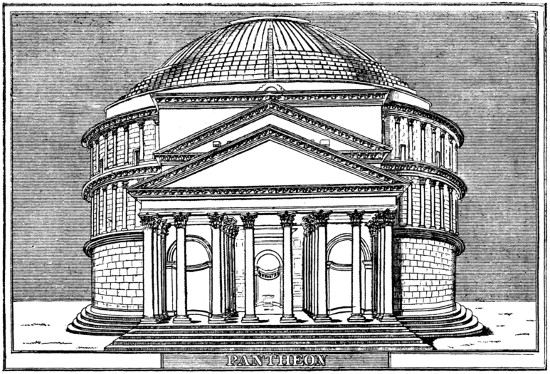
This beautiful Roman temple, said to have been erected by Agrippa in 27 B. C, was dedicated to all the gods of Greece and Rome. It is lighted by a single aperture in the center of its magnificent dome. (See illustration on next page.)
GODS, HEROES AND MYTHICAL WONDER TALES
A myth is a story told about gods or heroes. Mythology is a term applied to the collected myths of a nation or people, sometimes to the scientific study of myths. The first to busy itself in a large sense with mythology was the Greeks, whose myths had the most luxuriant and fanciful development. When the Romans received the arts and sciences from the Greeks, they adopted also their gods and their entire religious system. Thus it was that the Greek and Roman mythologies were to a great extent the same.
THE IMPORTANCE OF MYTHOLOGY IN EDUCATION
On account of their great beauty and universal interest, myths were made the themes of poets, priests, artists and commentators alike. Not only were the myths the inspiration of classical literature, art and religion, but they kept their place in later civilizations, and mythological allusions are so frequent in our own literature that an acquaintance with classic fable is a necessary part of modern education.
HOW THE MYTHS ORIGINATED
A large proportion of these myths are due to men’s observations of Nature, and her various active and creative forces, which appeared to their lively Southern fancy as manifestations of single supernatural beings. These were regarded now as friendly, now as hostile, to man; and men therefore strove as eagerly to gain their favor as to appease their wrath. Of the appearance of the deities who thus manifested themselves in the workings of nature, men necessarily formed at first very crude and fantastic ideas. But later, when men emerged from the simple conditions of the early patriarchal epoch, and began to dwell in regular political communities, they gradually ceased to regard the gods as mere personifications of natural forces. They began to regard them as beings acting in accordance with unchangeable moral laws, and endowed with forms similar to those of men. They brought the gods into connection with each other by means of genealogies in a great measure artificial, and built up a vast political system, which has its center in Zeus, or Jupiter, the “father of gods and men.” (See Chart on following pages.)
HOW THE GODS RESEMBLE MORTALS
The ancient Greeks believed their gods to be of the same shape and form as themselves, but of far greater beauty, strength, and dignity. They also regarded them as being of much larger size than men; for in those times great size was esteemed a perfection, supposed to be an attribute of divinities, to whom they ascribed all perfections. A fluid named ichor supplied the place of blood in the veins of the gods. They were immortal, but they might be wounded or otherwise injured. They could make themselves visible or invisible to men, and assume the forms of men or of animals. Like men they stood in daily need of food and sleep. The meat of the gods was called ambrosia, their drink nectar. The gods, when they came among men, often partook of their food and hospitality.
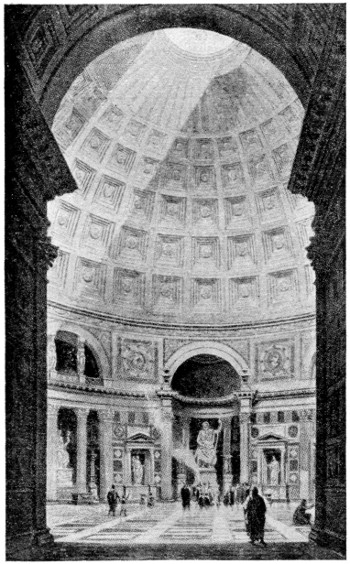
Glimpse into the interior of the Pantheon at Rome showing statues of the gods and the marvelous effects of lighting.
Like mankind, the gods were divided into two sexes; namely, gods and goddesses. They married and had children. Often a god became enamored of a mortal woman, or a goddess was smitten with the charms of a handsome youth, and these love tales form a large portion of Grecian mythology.
To make the resemblance between gods and men more complete, the Greeks ascribed to their deities all human passions, both good and evil. They were capable of love, friendship, gratitude, and all affections; on the other hand, they were frequently envious, jealous, and revengeful. They were particularly careful to exact all due respect and attention from mankind, whom they required to honor them with temples, prayers, costly sacrifices, splendid processions, and rich gifts; and they severely punished insult or neglect.
HOW AND WHERE THE GODS LIVED
If we look to the employment of the gods, we find that it consists chiefly in pleasant idleness; though they endeavor, like the rich among mankind, to make time fly by indulging in their favorite pastimes. They take their meals in common, and assemble for this purpose in the palace of Zeus, on the windy heights of Olympus. There they refresh themselves, while Hebe ministers to their wants, listening to the strains of Apollo’s lute, and to the songs of the sweet-voiced Muses, and entertaining themselves with pleasant conversation. Not always, indeed, is the company so peaceful and pleasant. At times these great gods quarrel finely; nay, even small conspiracies arise to interrupt the uniformity of their existence, such as that of Hera, Poseidon, and Athene against Zeus during the Trojan war, which is related in the fifteenth book of the “Iliad.”
RELATIONSHIP AND DOMINION OF THE GODS
Lastly, that no point in their resemblance to mankind may be omitted, all the different deities are united in one great family, of which Zeus, or Jupiter, the father of men and the ruler of the gods, is the head and center. Zeus has, however, a special dominion over the celestial deities only, those of the sea and waters being subjected to Neptune or Poseidon, and those of the lower world to Hades, or Pluto.
A PRONOUNCING DICTIONARY OF MYTHOLOGY
KEY TO PRONUNCIATION
The long (marked) vowels are pronounced as in the following words; fāte, fāre, far; mē; mīne; mōte; mūte. The short vowels, which include all not marked as above, are pronounced as in the following words: pat; pet; pit; pot; put. The accented syllable in each word is indicated by a mark placed immediately after it. (q.v.), quod vide (L)—which see.
A
Abaris (ab´a-ris).—A mythical personage who is said to have taken no earthly food, and to have ridden on an arrow—the gift of Apollo, whose priest he was—through the air.
Absyrtus (ab-sir´tus).—A son of Æetes, king of Colchis, sister of Medea. (See “Medea.”)
Acamas (ak´a-mās).—(i) Son of Theseus and Phædra; went with Diomedes to Troy to recover Helen.
Acantha (ak-an´tha).—A nymph beloved by Apollo and changed into the acanthus.
Acca Laurentia (ak´ka law-ren´shi-a).—The nurse of Romulus and Remus, after they had been taken from the she-wolf. (See “Romulus.”)
Achates (a-kā´tēz).—A friend of Æneas—“fidus Achates” famous for his fidelity.
Acheloiades (a-ke-lō´i-a-dẽz).—The Sirens, so called because they were the daughters of Achelous.
Achelous (ak-el´ō-us).—The river-god was the son of Oceanus and Tethys, and the eldest of three thousand brothers. He and Hercules both loved Deianira, and fought for the possession of her. Hercules conquered him, when he took the form of a bull, but was defeated again and deprived by Hercules of one of his horns. Achelous, who was looked upon as the representative of all fresh water, was considered a great divinity throughout Greece.
Acheron (ak´er-ōn).—Generally signifies the whole of the lower world. Properly, it is the river of the lower world, around which the shades of the departed hover, and into which the Cocytus and Pyriphlegethon flow. There are other rivers also named Acheron.
Achilles (a-kill´ẽz).—The great hero of the Iliad. He was the son of Peleus, king of the Myrmidones, and the Nereid Thetis. His mother, wishing to make him immortal, plunged him, when an infant, into the river Styx, and succeeded with the exception of the ankles, by which she held him. He was educated by Phoenix and Chiron, the centaur—the former teaching him eloquence and the arts of war, the latter the healing art. When he was but nine years old, Calchas declared that Troy could not be taken without his aid. His mother, knowing that this war would be fatal to him, disguised him as a girl and sent him to dwell with the daughters of Lycomedes, at whose court he was called Pyrrha (pir´ra), i.e., red or tawny, on account of his auburn hair. Seeing, however, that Troy could not be taken without his aid, the crafty Ulysses, disguised as a merchant, sought him out, offering for sale jewels and articles of feminine attire, among which he had placed some arms. The ruse succeeded, as Achilles, by eagerly seizing the arms, at once betrayed his sex, and accompanied Ulysses to the Greek army before Troy. While at Lycomedes’ court he became by Deidamia the father of Pyrrhus, or Neoptolemus. Before Troy he performed great feats of valor. After killing numbers of Trojans, he at length met Hector, whom he chased thrice round the walls of the city, and, having slain him, tied his body to his chariot and dragged it to the ships of the Greeks. He had an invulnerable suit of armor made, at his mother’s request, by Vulcan. Finally, he was slain by Paris, son of Priam, who shot him in the heel, his only vulnerable part. He is the principal hero of the Iliad, and is represented as the handsomest and bravest of all the Greeks. After his death Achilles became one of the judges in the lower world, and dwelt in the islands of the blessed, where he was united to Medea, or Iphigenia.
Acis (ā´sis).—A Sicilian shepherd, beloved by the nymph Galatea. He was crushed, through jealousy, under a huge rock by Polyphemus, the Cyclop, and his blood gushing forth from under was changed by the nymph into the river Acis, at the foot of Mount Etna.
Actæon (ak-tē´ōn).—A mighty huntsman, son of Aristæus and Autonoë. One day while hunting he saw Diana and her nymphs bathing, and was immediately changed by the goddess into a stag, in which form he was torn to pieces by his fifty dogs.
Admetus (ad-mē´tus).—King of Pheræ, in Thessaly. On the death of his first wife he sued for the hand of Alcestis, whom he obtained, by Apollo’s aid, only on coming in a chariot drawn by a lion and a wild boar. The god (Apollo) tended the flocks of Admetus for nine years, when he was compelled to serve a mortal for having slain the Cyclops. Apollo prevailed on the Fates to grant that Admetus should never die if another would lay down his life for him. This Alcestis did, but was brought back from the lower world by Hercules.
Adonis (a-dō´nis).—A beautiful youth beloved by Venus. While hunting he was killed by a wild boar, and was changed by Venus into the anemone. The grief of Venus was so great that the gods of the nether regions allowed him to spend six months of every year with Venus upon the earth. (This myth seems to refer to the apparent death of nature in winter and its revival in spring; hence Adonis spends six months in the lower and a like period in the upper world.)
Æacus (ē´ak-us).—Son of Jupiter and Ægina. It is related that at his birth in the island of Ægina, which was named after his mother, there were no inhabitants on the island, and that Jupiter changed the ants there into men; hence the latter were called Myrmidones (Gr. ants), and Æacus ruled over them. Æacus was renowned throughout Greece for his justice and piety, and after his death became one of the three judges in Hades (the other two being Rhadamanthus and Minos).
Aedon (a-ē´dōn).—Daughter of Pandareus and wife of Zethus, king of Thebes. Jealous of Niobe, her brother Amphion’s wife, having six sons and six daughters, while she had but one son, she determined to kill the eldest of Niobe’s sons, but by mistake slew her own son Itylus. Jupiter changed her into a nightingale, whose melancholy notes are represented as Ædon’s lamentations for her son.
Æetes (ē-ē´tēz) or Æeta, (ē-ē´ta).—Son of Helios (the sun) and Persëis, and king of Colchis at the time Phrixus had fled to his court on a ram with golden fleece, the gift of Mercury. (See “Phrixus.”) After having sacrificed to Jupiter the ram that had carried him, Phrixus gave its golden fleece to Æetes, who suspended it to an oak tree in the grove of Mars, where it was guarded day and night by an ever-watchful dragon. It was, however, greatly coveted, and an expedition was fitted out, consisting of all the great heroes of the age, with the special object, which proved successful, of obtaining it. (See “Argonautæ.”)
Ægæon (ē-jē´ōn).—Son of Uranus (heaven) and Gæa (earth). Ægæon and his brothers, Gyas and Cottus, were huge monsters with a hundred arms and fifty heads. Ægæon and his brothers, who are often called the Uranids, conquered the Titans when they made war upon the gods, and secured the victory to Jupiter, who thrust the Titans into Tartarus, and placed Ægæon and his brothers to guard them. Ægæon is often referred to under the name Briareus.
Æneas (ē-nē´as), the hero of Virgil’s great epic poem the Æneid (ē-ne´id), was the son of Anchises and Venus, and was born on Mount Ida. Having been attacked on Mount Ida by Achilles, who also drove away his flocks, he led the Dardanians against the Greeks, and at once took part in the Trojan war. Æneas and Hector were the great Trojan heroes, and the former, being beloved by gods and men, was on more than one occasion saved in battle by the gods. Venus saved him from Diomedes, and Neptune from Achilles, when the latter was on the point of killing him. From the flames of Troy he carried on his back his father, Anchises, and the household gods, and led Ascanius, his son, leaving his wife, Creusa, daughter of Priam, to follow. Æneas then set out on those wanderings that form the subject of the Æneid. After visiting Epirus and Sicily he was driven by a storm on the coast of Africa, where he met with Dido, queen of Carthage, who hospitably entertained him and became enamored of him. Æneas, however, left suddenly, and Dido (q.v.) killed herself. He then sailed to Latium, where he married Lavinia, the daughter of King Latinus, and founded the town of Lavinium, so named in honor of his wife. Turnus, to whom Lavinia had been betrothed, made war against Latinus and Æneas, but was slain by the latter, who now became ruler of the Aborigines and Trojans. Soon afterwards, however, he was slain in battle by the Rutulians.
Æolus (ē´o-lus).—The happy ruler of the Æolian Islands. He had been given, by Jupiter, dominion over the winds, which he kept enclosed in a mountain. When Ulysses was on his journey from Troy to Ithaca, Æolus gave him all the adverse winds in bags, but his companions, from curiosity, opened them.
Æsculapius (ēs-kū-lā´pi-us).—The god of healing. He was the son of Apollo and Coronis, and was brought up by Chiron, the centaur, who instructed him in the art of healing and in hunting. When he was grown up, he not only healed the sick, but recalled the dead to life. He was killed by a thunderbolt by Jupiter, who feared lest men should, by his aid, escape death altogether. Serpents were sacred to him, and the cock was sacrificed to him.
Agamemnon (ag-a-mem´nōn).—King of Mycenæ, and brother of Menelaus. He married Clytemnestra, who bore him Iphigenia, Chrysothemis, Laodice (Electra) and Orestes. He was the most powerful prince in Greece. When Helen (q.v.) was carried off by Paris, and the Greek chiefs sought to regain her, Agamemnon was chosen commander-in-chief of the expedition. He is not, however, the hero of the Iliad, as he is the inferior of Achilles in true nobility of character. At the capture of Troy he received Cassandra, the daughter of Priam, as his prize. On his return home he was murdered by Ægisthus, who, during his absence at Troy, had been living with Agamemnon’s wife Clytemnestra. His son Orestes avenged his father’s death by slaying both Ægisthus and Clytemnestra.
Aganippe (ag-a-nip´pē).—A fountain at the foot of Mount Helicon, in Bœotia, sacred to the Muses, who were hence called Aganippides (ag-a-nip´pi-dēz).
Ajax (ā´jaks).—There are two heroes having this name, Ajax the Great, or Ajax Telamonius, and The Lesser Ajax, or Ajax Oïleus. (i) Ajax the Great was son of Telamon, king of Salamis, and grandson of Æacus. He took a very prominent part in the Trojan war, and was placed second to Achilles alone in bravery. He was conquered by Ulysses in struggle for the armor of Achilles, and this, according to Homer, was the cause of his death. (ii) The Lesser Ajax, or Ajax, son of Oïleus, also took part in the Trojan war. He was, next to Achilles, the most swift-footed among the Greeks.
Alcathous (al-kath´o-us).—Son of Pelops and Hippodamia. Obtained his wife by slaying the Cithæronian lion, which had killed the king’s son, and succeeded his father-in-law as king of Megara, the walls of which he restored.
Alcestis or Alceste (al-ses´tē).—Wife of Admetus (q.v.).
Alcmene (alk-mē´nē).—Wife of Amphitryon. Jupiter, who appeared disguised as her husband, became by her the father of Hercules.
Alcyone (al´si-on-ē) or Halcyone.—Daughter of Æolus and wife of Ceyx. Her husband having perished in a shipwreck, Alcyone’s grief became so intense that she threw herself into the sea. Out of compassion the gods changed the two into birds, and while these birds (halcyons) were breeding the sea always remained calm.
Alecto (a-lek´tô).—One of the Furies (q.v.).
Aloeus (al-lō´-ūs).—Son of Neptune and Canace. His wife had, by Neptune, two sons, Otus and Ephialtes, the Aloidæ (a-lō´i-dē), who were of extraordinary size and strength. At the age of nine years they attempted to scale heaven by piling Mount Ossa upon Olympus and Pelion upon Ossa. To prevent them accomplishing this when they grew older Apollo destroyed them before their beards began to appear.
Althæa (al-the´a).—Wife of Æneus and mother of Meleager (q.v.).
Amalthea (am-al-thē´a).—Nurse of the infant Jupiter in Crete, whom she fed with goat’s milk. Jupiter broke off one of the horns of the goat and gave it the power of becoming filled with whatever the possessor might wish; hence it was called the cornucopia—i.e., horn of plenty.
Amazones (a-māz´on-ēz).—The Amazones, a mythical race of warlike women living near the river Thermodon. The female children had their right breasts cut off that they might use the bow with greater ease; hence their name Amazon, which means, “without breast.” One of the twelve labors of Hercules was to obtain the girdle of Hippolyte, the queen of the Amazons. They came, under their queen, Penthesilea, to the assistance of Priam in the Trojan war; but she was killed by Achilles.
Amphion (am-fi´ōn).—Son of Jupiter and Antiope, and twin-brother of Zethus. They were born on Mount Cithæron, and were brought up by a shepherd. Amphion received a lyre from Mercury, on which he learned to play with marvelous skill. Amphion married Niobe (q.v.).